LETTERS AND JOURNALISM
Reading edition
In letters, as in life, the passing of "the old order" was already apparent at the opening of the period under review in this volume. For in 1892 the author of the lines immortally associated with the phrase himself passed away, full of years and honours. Punch had always been a Tennysonian, even in the days when the Laureate was still looked upon as an innovator. He had given Tennyson the hospitality of his columns in 1846 to retort on Bulwer Lytton, who had attacked "School-miss Alfred" in The New Timon. Finally, when Tennyson was laid to rest in the Abbey, Punch saluted him without reserve as the chief glory of Victorian minstrelsy. The memorial verses are too long to quote, for Punch in his elegiac moods was still inclined to prolixity, but they deal adequately with the spirit and influence, the consummate art, and the fervent patriotism of one who, after various fluctuations of prestige, is even now being re-discovered by Georgian critics.
The vacant laureateship was not filled till the close of 1895, when the appointment of Mr. Alfred Austin by Lord Salisbury unloosed a flood of ridicule. In the cartoon "Alfred the Little" Punch depicted a diminutive figure, standing on tip-toe, as he hangs his lyre on the walls of the Temple of the Muses. The laurelled bust of Tennyson is shown in the interior, while outside the figures of Sir Edwin Arnold and Sir Lewis Morris are seen dissembling their disappointment. A few weeks later the inclusion of the new Laureate amongst the celebrities of Madame Tussaud's Exhibition prompted the malicious soliloquy of "Alfred amongst the Immortals."
Swinburne and the British Academy
Mr. Austin's unfortunate efforts at the time of the Boer war did not escape Punch's derision, and when his name failed to appear in the New Year's Honour List of 1901, Punch, in a sardonic parody, modelled on the famous lyric in Atalanta in Calydon, represented Swinburne ironically asking:—
Austin—what of the Knight, Heavy with hope deferred? When will he solace our sight, Panoplied, plumed and spurred?
Swinburne and Meredith, two other "eminent Victorians," both died in 1909. Towards them Punch's attitude had undergone considerable vicissitudes. Swinburne's erotic ballads had, as I have noticed in an earlier volume, excited Punch's vehement disapproval. Yet he paid him the tribute of constant imitation and parody. When the proposal for establishing a British Academy was brought forward in 1897, Punch, who "crabbed" the scheme from the outset, was not content with printing imaginary letters from various aspirants—Hall Caine, Miss Marie Corelli, Grant Allen, William Watson, "Sarah Grand," and Clement Scott—but made good play with Swinburne's publicly avowed disgust at having his name associated with a "colluvies litterarum" and a "ridiculous monster." The exclusion of pure or creative literature from the British Academy, it may be added, prompted Sambourne's cartoon in 1902 in which a sour-visaged lady in academical costume is seen mounting the steps to the Academy, while three graceful figures—Drama, Romance, and Poetry—are locked out on the other side of the railings.
To return to Swinburne, it should be noted that probably more poems were written in the "Dolores" stanza throughout this period than in any other metre. And when he died in 1909, Punch, granting him full amnesty for his violence in controversy, his extravagance and lawlessness of spirit, forgot the rebel and only remembered the singer:—
What of the night? For now his day is done, And he, the herald of the red sunrise, Leaves us in shadow even as when the sun Sinks from the sombre skies. High peer of Shelley, with the chosen few He shared the secrets of Apollo's lyre, Nor less from Dionysian altars drew The god's authentic fire. Last of our land's great singers, dowered at birth With music's passion, swift and sweet and strong, Who taught in heavenly numbers, new to earth, The wizardry of song— His spirit, fashioned after Freedom's mould, Impatient of the bonds that mortals bear, Achieves a franchise large and uncontrolled, Rapt through the void of air. "What of the night?" For him no night can be; The night is ours, left songless and forlorn; Yet o'er the darkness, where he wanders free, Behold, a star is born!
George Meredith was an old friend of Punch's from the days when he contributed to Once a Week, but he was not exempt from criticism on that account, as I have already shown. In 1894 he was again burlesqued in a parody of Lord Ormont and his Aminta, which ran through three numbers and was decorated with a portrait of the author as a bull in the china shop of syntax, grammar and form. Punch in middle age only dimly appreciated Meredith's genius, and was disconcerted by his obscurity. Punch erred in good company, for Tennyson is reported to have said that "reading Meredith is like wading through glue"; but sixteen years later the mists cleared away, and the verses of May, 1909, reveal insight as well as admiration:—
Masked in the beauty of the May-dawn's birth, Death came and kissed the brow still nobly fair, And hushed that heart of youth for which the earth Still kept its morning air. Long time initiate in her lovely lore, Now is he one with Nature's woods and streams, Whereof, a Paradisal robe, he wore The visionary gleams.
When from his lips immortal music broke, It was the myriad voice of vale and hill; "The lark ascending" poured a song that woke An echo sweeter still. Yet most we mourn his loss as one who gave The gift of laughter and the boon of tears, Interpreter of life, its gay and grave, Its human hopes and fears. Seer of the soul of things, inspired to know Man's heart and woman's, over all he threw The spell of fancy's iridescent glow, The sheen of sunlit dew. And of the fellowship of that great Age For whose return our eyes have waited long, None left so rich a twofold heritage Of high romance and song.
"Eminent Victorians"
Nor did Punch allow the minor Victorian poets and authors to pass without homage, witness his tributes to Coventry Patmore, the "poet of Home and High Faith," and Jean Ingelow, whose High Tide on the Coast of Lincolnshire is one of the finest of modern ballads, besides touching the high-water mark of her achievement. Professor Henry Morley, who died in 1894, elicited the well-earned tribute, "He made good letters cheap"; while the heroic industry and distinguished talent of Mrs. Oliphant—for The Beleaguered City comes very near to greatness—are fittingly acknowledged in Punch's "Vale!" in 1897. Sir Theodore Martin, as the joint author of the immortal Bon Gaultier Ballads, had a special claim to grateful remembrance from one who, like him, had known Astley's Circus in the palmy days of Widdecomb and Gomersal:—
Comrade of our "roaring 'forties," in your pages still From the midmost fount of laughter may we drink our fill; Watch you, Rabelais' disciple, sunshine in your eyes, Shooting with an aim unerring folly as it flies.
Punch's loyalty to Thomas Hood was testified in a long and perfectly serious study, in three instalments, of Hood as a poet and satirist, which appeared in 1896. In 1899 he was moved to sing the praises of Marryat in the manner of Gilbert's Captain Reece; in 1900 he reiterated his fealty to Walter Scott in verse as unimpeachable in sentiment as it was undistinguished in execution. I think one may safely say that nothing so inadequate to the occasion has since appeared in the pages of Punch. But even when the literary quality of Punch was at its lowest he was capable of welcome surprises, as for example in the really charming verses, in 1893, on Izaak Walton's Tercentenary—verses based on intimate and affectionate study of The Compleat Angler.
Another Tercentenary, that of Milton in 1908, prompted the cartoon in which Shakespeare congratulates his brother poet because every three hundred years they gave him a banquet at the Mansion House, while they only talked about a National Theatre for himself. A Chicago professor had seized the occasion to observe that Milton, if alive then, would be in favour of every advanced movement except Woman's Suffrage, and Punch turned the saying to good account in a mock-heroic sonnet after Wordsworth. One might well have thought that Charles Lamb's reputation was securely established by 1913, yet in that year a member of the London Education Committee suggested that the Essays of Elia was hardly the kind of book to be put in the hands of young women students. Punch dealt judicially with the offender in two letters—one from a prudish parent; the other from a humanist and lover of Lamb who sends a copy of the incriminated volume to his daughter, together with a report of the protest, and some comments on the survival of Podsnap:—
He lives, he lives though sorely spent; We shrug our shoulders, and lament The tyranny not overpast Of Philistine and agelast.
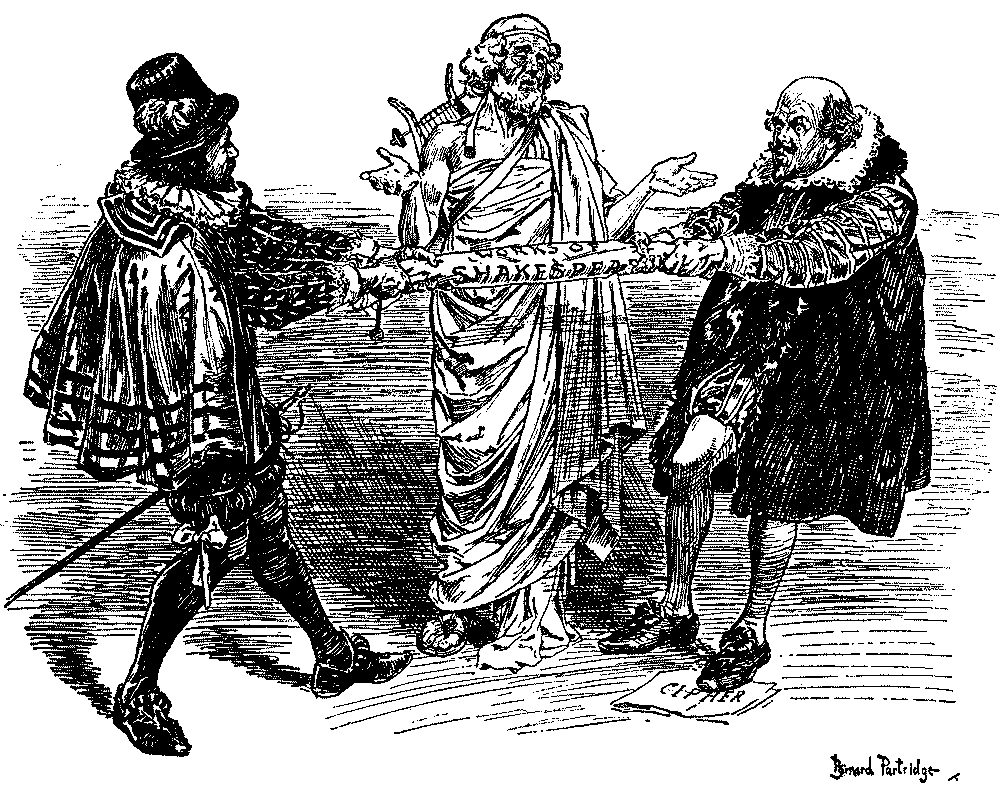
SHACON AND BAKESPEARE
Homer: "Look here, what does it matter which of you chaps wrote the other fellow's books? Goodness only knows how many wrote mine!"
(Nods, as usual, and exit.)
Shakespeare and Shaw
The last word has an academic ring, but Punch was probably thinking of George Meredith's use of it in a letter to The Times in 1877 when he spoke of those "whom Rabelais would have called agelasts or non-laughers."
A brilliant American essayist, Miss Agnes Repplier, has recently remarked that the Twentieth Century does not "lean to extravagant partialities" but rather to "disparagement, to searchlights, to that lavish candour which no man's reputation can sustain." In the pastime of hauling eminence down from its pinnacle she awards a pre-eminence to British critics. It cannot be said that Punch has taken an active hand in this game. Even Shakespeare had not been exempt from this "lavish candour." Mr. Bernard Shaw, writing in the Saturday Review in 1896, had said that "with the single exception of Homer, there is no eminent writer, not even Sir Walter Scott, whom I can despise so entirely as I despise Shakespeare, when I measure my mind against his." Whether he really meant what he said is a question passing the wit of the plain person; but the utterance stung Punch into a rejoinder in the form of an imaginary interview with "G. B. S.," in which the criticism is further developed and obliquely ridiculed. Punch was equally sensitive where patronage of the bard suggested self-advertisement, and in 1901, in the "New Genius of Stratford-on-Avon," he expressed an ironical apprehension lest Miss Corelli might oust Shakespeare as the tutelary deity of that town. The Bacon-Shakespeare controversy was again becoming acute and claimed Punch's attention in 1902, when he published a cartoon bearing on the issue, and followed it up with a happy burlesque. As he argued, "If Bacon wrote Shakespeare's Plays, why, in the name of all that is biliteral, should not Shakespeare have written Bacon's Essays?" Hence the dissertation "Of Plays and their Authors," from which I may quote the concluding passages:—
It may be said of such an one that he is a man unlettered, having little Latin and of Greek no whit. How should he write plays? Whence hath he lore of law and medicine, of history and science? But there be handbooks. And a man may learn by enquiry of another, giving to him the price of half-a-pint. So shall the dramatist acquire such matters as be necessary, as the names of battles and of Kings and an imperfect understanding of legal phrases. Moreover, where no copyright is, he may steal freely from others, appropriating their plots and embellishing them.... Lastly to conclude this part, he that writeth dramas must endure with philosophy the investigations of talented ladies. Being of humble estate he must not murmur should his works be taken from him and given to a Lord Chancellor. Being himself sane he must bear with the lunatick fancies of others. And though his words be twisted into crazy anagrams, and his dramas be made a source of a scandal about Queen Elizabeth, he must not complain. Generally let the wise man ignore the bee that buzzeth in another's bonnet.
Punch's "Essay" is not without relevance in its bearing on the recent "invention" of that highly "talented lady" Miss Clemence Dane.
Punch on "R. L. S."
To repeat what I said in another volume, the highest qualities of the literary critic are revealed, not in his loyalty to established reputations so much as in his attitude to contemporary writers, in his ability to gauge the durability of their merits, and to distinguish a passing vogue from a sure title to remembrance. And there was certainly no lack of material on which to exercise these faculties in the 'nineties—romantic, realistic, and decadent. Punch had already welcomed Mr. Kipling and Sir James Barrie, and though his appreciation of the former varied considerably in the next fifteen years, admiration of his freshness and invention prevailed on the whole over distaste for his excursions into politics, his addiction to technicalities, slang and obscurity. The literary criticism of Punch was probably at its lowest ebb in 1893, when a review of Stevenson's Catriona is bracketed with a notice of Miss Corelli's Barabbas. Punch deals faithfully with the method of handling Holy Writ adopted in Barabbas, but contents himself with recommending Catriona to those who love Scots dialect, which he frankly confesses he does not.
When Stevenson died in his early prime in 1894, a very different temper inspired Punch's tribute to the Great Romancer:—
The lighthouse-builder raised no light That shall outshine the flame Of genius in its mellowest might, That beacons him to fame. And Pala's peak shall do yet more Than the great light at Skerryvore To magnify his name, Who mourned, when stricken flesh would tire, That he was weaker than his sire. Teller of Tales! Of tales so told That all the world must list: Story sheer witchery, style pure gold, Yet with that tricksy twist Of Puck-like mockery which betrays The wanderer in this world's mad maze, Not blindly optimist, Who wooes Romance, yet sadly knows That Life's sole growth is not the Rose.
So when in 1901 the late Mr. W. E. Henley published his famous disparagement of the official life of Stevenson, Punch, in an address to the "Beloved Shade" of R. L. S., uttered an indignant protest against the attack on his memory.
Punch enthusiastically greeted the Ruritanian romances of "Anthony Hope" as an antidote to the ultra-realistic novel, and Mr. Kipling's Jungle Book was welcomed in 1894 with a salvo of puns on the Kip-lingo of the Laureate of the Jingle-Jungle, the Bard of the Bandar-log. In 1895 The Men that Fought at Minden is described as "perhaps the most coarse and unattractive specimen of verse that this great young man has yet put forth—a jumble of words without a trace of swing or music. All this Tommy Atkins business is about played out." In 1898, in the series of "Letters to the Celebrated," "The Vagrant," while deprecating the "orgy of Imperialism" which Mr. Kipling had helped to foster, frankly admitted that he was largely responsible for "a quickened sense of the greatness of our mother-land, and a new sympathy for those who fight our battles"; and predicted that his greatest and most enduring title to fame would rest on his verse. In 1899 Mr. Kipling is rebuked for his glorification of machinery—he is called "the Polytechnic Poet"—slang and militarism, while the parody of Stalky and Co. is distinctly hostile to what Punch evidently considered an ignoble travesty of Public School traditions. Punch had himself repeatedly assailed the fetish-worship of Athletics, but Mr. Kipling's Island Race—with its bitter reference to those who
contented their souls With the flannelled fools at the wicket or the muddied oafs at the goals—
was more than he could endure. Accordingly his representative conducted an imaginary interview with "The Director-General of the Empire," who had added some fresh lines in violent and obscure abuse of rowing-men, and who explained that he never played games himself, but "spent all his spare time loafing and scoring off masters"—a further hit at Stalky. This mood of resentment had entirely passed by 1907, when Punch depicted Mr. Kipling as "A Verry Parfit Nobel Knight"—on the occasion of his being awarded the Nobel Prize—and in 1910 the perusal of Rewards and Fairies is compared to reading English history by the light of a Will-o'-the-Wisp.
The reviewer notes defects in style and lucidity, but ends on a note of whole-hearted admiration:—
When one considers the quality of Mr. Kipling's invention, the piety of his patriotism, the freshness and vigour of his style, and his astounding understanding of men and movements, why, one forgets all about these little trifling defects and again murmurs, "Wizard."
The Yellow Book
To return to the early 'nineties, Punch saw no virtue, artistic or otherwise, in the movement towards unrestrained self-expression in belles lettres which had its outcome in the Yellow Book and the Savoy, its headquarters at "The Bodley Head," and whose chief hierophants were the avowed disciples of Baudelaire and Verlaine. To Punch the movement was wholly decadent. In the verses "Tell it not in Gath," in 1894, after denouncing "flowers of evil," and the practice of delving in the drains and dustbins of humanity, the writer declares he would far rather remain a Philistine than achieve enlightenment by such unsavoury means. In the same vein he addresses "Any Boy-poet of the Decadence":—
For your dull little vices we don't care a fig, It is this that we deeply deplore: You were cast for a common or usual pig, But you play the invincible bore.
As in his earlier tirades against the Æsthetes, Punch confounded all the contributors to the Yellow Book and the Savoy in one common anathema. The former, with an illustration by "Daubaway Weirdsley," and "Max" as "Max Mereboom," himself one of the finest literary parodists of our time, is held up in 1895 to especial ridicule. The Savoy in 1896 becomes "The Saveloy," with imaginary extracts and further attacks on Max Mereboom, Simple Symons, and Weirdsley; while in the same year in "The Chaunt of the Bodley Head" (after Praed's Chaunt of the Brazen Head) the Savoy School is condemned for its mephitic atmosphere. There was in the movement much deliberate eccentricity, much of the cant of anti-cant, which clamoured for robust satire, but Punch was more happily inspired in his ridicule of the popular and society novels of the time—in his parody of Sherlock Holmes, which was quite good enough for the original, and of Dodo, in which the rowdiness and pseudo-intellectuality of Mr. Benson's heroine are excellently hit off. It opens well with "'Sling me over a two-eyed steak, Bill,' said Bobo." In the sequel the Marquis of Cokaleek, the noble unappreciated husband, gets killed in the hunting field, but Bobo does not marry Bill, her fancy man. She jilts him and "got herself married to an Austrian Prince at half an hour's notice by the A. of C." Punch, let it be recorded, was responsible for the often quoted saying which appeared in 1894 that "the modern novel is a blend of the Erotic, the Neurotic and the Tommyrotic."
Esther Waters, compared and contrasted with Hardy's Tess, is pronounced in 1894 to be not "virginibus puerisque," and a once famous "emancipation novel," The Yellow Aster, by "Iota," long since hopelessly out-distanced in the reaction against reticence, becomes The Yellow Plaster, by "Iõpna," whose "She-notes" wild are amusingly travestied in the same year. The Yellow Aster and Key-Notes were pioneer efforts in the domain of the psychological novel, and the new jargon is ridiculed in such burlesque phrases as "the woman's voice came through the envelope of Margerine's subconsciousness, steely clear as a cheese-cutter." The vogue of The Green Carnation, a roman à clef which created some stir at the same time, is attested in Du Maurier's picture "How Opinion is Formed":—
He: "Have you read that beastly book The Mauve Peony by Lady Middlesex?"
She: "Yes, I rather liked it."
He: "So did I."
Unchristian Criticism of Hall Caine
Du Maurier's Trilby was naturally treated with benevolence, though Punch regretted the theological interludes, but The Sorrows of Satan is rudely dismissed as "a farrago of balderdash and vanity"; the egotism of the author and of Mr. Robert Buchanan in belabouring their detractors is severely rebuked; and Mr. Hall Caine's The Christian is recommended only as an absolute pis aller if you hadn't even a Bradshaw to read. This great work is also parodied as "The Heathen," with Alleluia Grouse and Luke Blizzard in the rôles of Glory Quayle and John Storm. There was still a spice of Bludyer in Punch, and on occasion he could act on the advice of a famous editor, "Be kind, be merciful, be gentle, but when you come across a silly fool, string him up." In later years, as the literary quality of his reviews improved, his clemency to the new-comers approached an uncritical tolerance.
The passing of the three-volume novel in 1894 is noted in a Ballade not untinged with regret, to judge from the "Envoi":—
Prince, writers' rights—forgive the pun— And readers' too forbid the blow; Of triple pleasure there'll be none, Three-volume novels are to go!
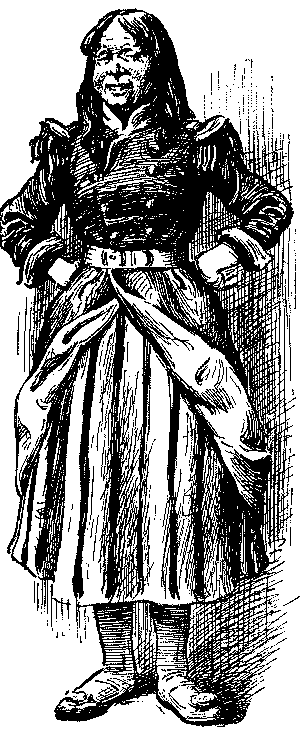
"The Trilby mania grows apace. It has reached Peckham. Aunt Maria went to the Fancy Dress Ball of the Peckham season as Trilby in her first costume."—Extract from letter of Miss M. Br-wn to Miss N. Sm-th.
The later manner of Henry James is rather infelicitously described in 1896 as "indifferent Trollopian and second-class Meredithian"; but Punch made no mistake in the following year over Mr. W. W. Jacobs, in whose Many Cargoes—studies of those "who go down to the sea in ships of moderate tonnage"—he found a new fount of joy.
Punch's "literary recipes" place Romance first, then follow the Society Novel (with thinly veiled portraits from life); the Detective Story (Gaboriau and water); and the Religious Novel. The plague of Reminiscences had moved Punch to protest as early as 1893, when he wrote:—
That Memory's the Mother of the Muses, We're told. Alas! it must have been the Furies! Mnemosyne her privilege abuses— Nothing from her distorting glass secure is. Life is a Sphinx; folk cannot solve her riddles, So they've recourse to spiteful taradiddles, Which they dub "Reminiscences." Kind fate, From the Fool's Memory preserve the Great!
Another and a newer aversion was the parasitic patronage of FitzGerald by inferior novelists and writers, which moved Punch to include among "the things that we are still waiting, and it seems, likely to wait for—A Temporary Surcease from Omar Khayyám." This last-named nuisance has ceased to be so vocal of late years, but the plague of "Diaritis" is worse than ever. Mr. H. G. Wells appears on Punch's horizon in 1898, but only as the weaver of circumstantial scientific romances, not as the regulator of the Universe, and discoverer of new Heavens and Hells. The War of the Worlds is parodied in The Martian, but the wonderland of science appealed less to Punch than the dream-world of "Lewis Carroll," whose death inspired a graceful tribute to author and illustrator:—
Lover of children! Fellow-heir with those Of whom the imperishable kingdom is! Beyond all dreaming now your spirit knows The unimagined mysteries. Darkly as in a glass our faces look To read ourselves, if so we may, aright; You, like the maiden in your faërie book— You step beyond and see the light! The heart you wore beneath your pedant's cloak Only to children's hearts you gave away; Yet unaware in half the world you woke The slumbering charm of childhood's day. We older children, too, our loss lament, We of the "Table Round," remembering well How he, our comrade, with his pencil lent Your fancy's speech a firmer spell. Master of rare woodcraft, by sympathy's Sure touch he caught your visionary gleams, And made your fame, the dreamer's, one with his, The wise interpreter of dreams. Farewell! But near our hearts we have you yet, Holding our heritage with loving hand, Who may not follow where your feet are set Upon the ways of Wonderland.
Magic, Megalomania, and Sham Culture
From this wonder world Punch turned to "le monde où l'on s'affiche" to castigate the methods of Mr. Hall Caine and Mr. Le Gallienne—the Manx megalomaniac and the Author-Lecturer—and to the realm of blameless banality ruled over by Sir John Lubbock. Sir John's genius for truisms had been guyed in 1894; in 1900 he appears in a special section of "The Book of Beauty" as the author of some enchanting platitudes, e.g. "A man's work will often survive him. Thus, Shakespeare and Watt are dead; but Hamlet and the steam engine survive."
This was the year of the appearance of Lady Randolph Churchill's Anglo-Saxon Review, a sumptuous publication which for a brief period revived the glories of the Books of Beauty and Keepsakes, edited in the 'thirties and 'forties of the last century by that "most gorgeous" lady, the Countess of Blessington.
Pseudo-intellectuality was one of the social shams which Punch loved to pillory, and there is a good example in 1901 in the "Cultured Conversation" of a lady who observes, "I'm devoted to Rossetti—I delight in Shelley—and I simply love Ella Wheeler Wilcox." Punch himself in the same year "delighted" quite sincerely in Some Experiences of an Irish R.M., and "wept tears of laughter" over the episode of "Lisheen Races." This was apparently his first introduction to the work of those two wonderfully gifted Irish cousins, Violet Martin and Edith Somerville, but only towards the end of their long and fruitful collaboration did he recognize in them far higher qualities than those of the mere mirth-provoker.
In 1903 he was destined to make acquaintance with one of the most conspicuous representatives of the opposite tendency, Gorki, the Russian novelist and playwright. In "The Lowest Depths" Punch parodied the dreary, violent and brutal squalors of The Lower Depths, and incidentally had a dig at the Stage Society for producing it. It was in the same year that Punch described the "new curse of Caine"—"to be everlastingly coupled with the name of Miss Marie Corelli"—and paid them both grateful homage as purveyors of "copy":—
From cutting continual capers Ev'n Kaisers must sometimes refrain; But you're never out of the papers— Corelli and Caine.
At the time of the Boer war poets had been vociferously active. By 1904 a "slump" had set in; and in an interview Mr. John Lane, of the Bodley Head, had declared that verse had ceased to be remunerative. Embroidering this text Punch traced the cause to the material self-indulgence of the public. People dined too well to want to read rhymes, and poets wanted better pay:—
And this is why no bards occur. None ever knows that aching void, That hunger, prompting like a spur, Which former genii enjoyed; For all the poets dead and gone, Whose Muse contrived to melt the nation, Habitually did it on A regimen of strict starvation.
Notable Newcomers
But if verse was at a discount, new forms of prose were emerging, and the spasmodic discourses of Mr. Bart Kennedy in the Daily Mail moved Punch to parody what he considered to be a variant on Walt Whitman, in which sentences were reduced to a minimum and verbs were dispensed with altogether. Another new writer to whom Punch now paid the homage of parody was Mr. Chesterton, whose glittering paradoxes are travestied in a mock eulogy of Bradshaw, in the manner of "G. K. C.'s" book on Dickens. Bradshaw is praised for his splendid consistency, his adherence to fact, his uniform excellence of style and freedom from extraneous matter. Moreover, he is a great teacher:—
The last and deepest lesson of Bradshaw is that we must be in time. No man can miss a train and miss a train only. He misses more than that. A man who misses a train misses an opportunity. It is probably the reason of the terrific worldly success of Cæsar and Charlemagne that neither of them ever missed a train.
Reviews of books, chiefly novels, became a regular feature of each week's issue in the latter half of this period, and it would be impossible to deal fully with Punch's critical activities. As an example of the frank handling of a bad book it would be hard to improve on the notice of a novel which appeared in 1906: "Anyone who wants to read a vulgar book in praise of vicious vulgarians should read——, by————. All others are counselled to avoid it."
Punch's later and more tolerant mood may be illustrated by his notices of three typical novels by three representative novelists of post-Victorian days. Mr. Wells's Ann Veronica in 1908 is received with guarded praise as that author's first real novel and "a remarkably clever book about rather unpleasant people." In 1910 Punch shies at the excessive length and accumulated detail of Mr. Arnold Bennett's Clayhanger, but admits that the author makes wonderful use of unpromising material in his remarkable work. Thirdly, in 1913, Punch's reviewer proclaims himself a whole-hearted admirer of Mr. Compton Mackenzie's Sinister Street, finding the hero "a figure to love," and the whole book marked by passionate honesty, marvellously minute observation, humour, and a haunting beauty of ideas and words. In conclusion, he is "prepared to wager that Mr. Mackenzie's future is bound up with what is most considerable in English fiction," adding, "We shall see."
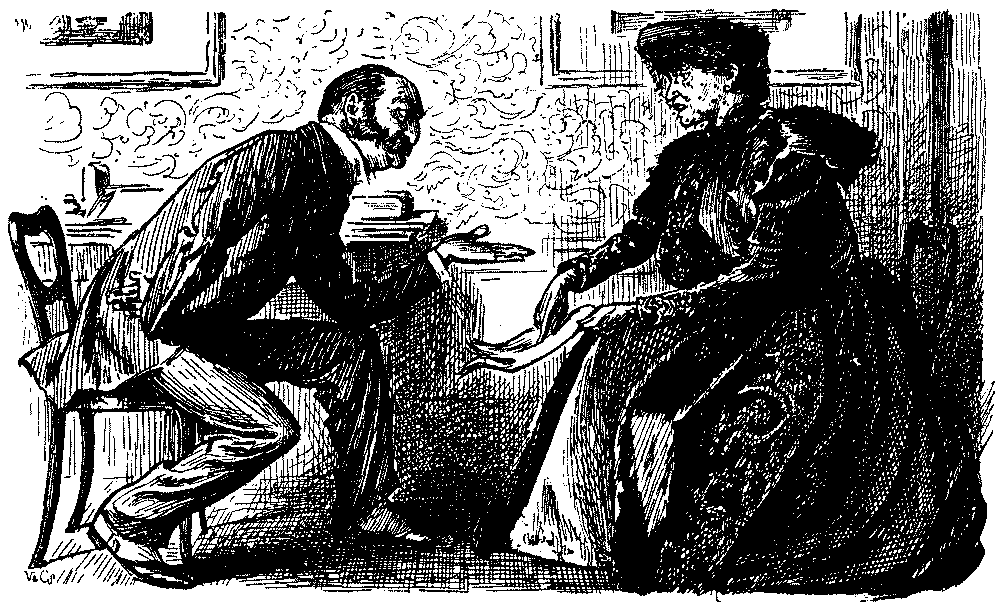
THE "SEXO-MANIA"
"We think Lips that have Gone Astray the foulest novel that ever yet defiled the English tongue; and that in absolute filth its Author can give any modern French writer six and beat him hollow!"—The Parthenon.
Fair Author (to her Publisher, pointing to above opinion of the Press quoted in his advertisement of her novel): "And pray, Mr. Shardson, what do you mean by inserting this hideous notice?"
Publisher: "My dear Miss Fitzmorse, you must remember that we've paid you a large price for your book, and brought it out at great expense—and we naturally wish to sell it!"
These views are somewhat difficult to reconcile with those expressed in other parts of the paper about the same time. An eminent conductor and composer has recently stated that no noise which is deliberately made can be said to be ugly—e.g. a railway whistle or a boy whistling in the street. So in letters a similar creed had already come into fashion—any subject was fit for treatment if it was "arresting" or "elemental," a doctrine that Punch outside his "Booking Office" found it hard to swallow. In "The Qualities that Count" one of his writers applied this principle to the poetry and letters of the hour:—
If you're anxious to acquire a reputation For enlightened and emancipated views, You must hold it as a duty to discard the cult of Beauty, And discourage all endeavours to amuse. You must back the man who, obloquy enduring, Subconsciousness determines to express, Who in short is "elemental," "unalluring," But "arresting" in his Art—or in his dress. Or is your cup habitually brimming With water from the Heliconian fount? Then remember the hubristic, the profane, the pugilistic, Are the only things in poetry that count. So select a tragic argument, ensuring The maximum expenditure of gore, And the epithets "arresting," "unalluring," "Elemental" will re-echo as before. But if your bent propels you into fiction, You should clearly and completely understand That your duty in a novel is not to soar, but grovel, If you want it to be profitably banned. So be lavish and effusive in suggesting A malignant and mephitic atmosphere, And you're sure to be applauded as "arresting," "Elemental," "unalluring," and "sincere."
Mr. Gosse and the Georgian Poets
In the same year Mr. Edmund Gosse had indulged in some caustic criticism of the Poetry of the Future. Mr. Gosse had said that "the natural uses of English and the obvious forms of our speech will be driven from our poetry." Also that "verses of excellent quality in this primitive manner can now be written by any smart little boy in a grammar school." Hence a squib in which Punch makes disrespectful fun of "the Sainte-Beuve of the House of Lords," who, it may be added, has since made his peace with the young lions whom he had treated so disrespectfully. In 1913 the cult of Rabindranath Tagore had become fashionable. Here was an Oriental poet who sedulously eschewed the flamboyant exuberance of the westernized Indian, but Punch, while finding him a less fruitful theme for burlesque than the Babu immortalized by Mr. Anstey, regarded his mystical simplicity as fair game for parody, and declined to worship at his shrine. Another foreign importation, Mr. Conrad—whom in virtue of long residence in England, marvellous command of our language and unequalled insight into the magic of the sea and the simple heroism of the British sailorman, we are proud to call one of ourselves and one of the glories of English fiction—fascinated Punch in 1900, the year in which Lord Jim appeared. Punch was a little disconcerted at first by Mr. Conrad's oblique method of narration, but the fascination grew with advancing years.
Farewell to Mark Twain
I find few references to Continental authors, but may single out the "little English wreath" which Punch added to the memorial tributes to Alphonse Daudet on his death in 1897. Daudet's affinities with Dickens, always one of Punch's heroes, naturally appealed to him apart from the humour of Tartarin and the masterly studies of the Second Empire which Daudet had seen from the inside as one of the Duc de Morny's private secretaries. Towards American writers Punch was almost uniformly sympathetic. It is true that he appreciated the earlier and American manner of Henry James more than the later cosmopolitan phase which began with The Portrait of a Lady. But during the short period in which Punch, in his "additional pages," published a number of short stories by various authors, Henry James was a contributor, and Mrs. Medwin appeared in serial form in four successive numbers in August and September, 1901. Oliver Wendell Holmes, who died in 1894, is compared to Elia in the graceful memorial stanzas modelled on "The Last Leaf." Mr. W. D. Howells's papers on London and England in Harper's Magazine in 1904 prompt a generous acknowledgment of their reasonableness, sanity and humour, together with an expression of amazement at the productivity of American short-story writers, mostly in the manner of Mr. Henry James. Punch, both then and afterwards, refused to take Mrs. Ella Wheeler Wilcox seriously, and described her essays, The Woman of the World, as "high-toned but serenely platitudinous; 'bland, passionate, but deeply religious.'" Mark Twain, on his visit to London in 1907, was welcomed with pen and pencil—in the cartoon "To a Master of his Art," where Punch salutes him over the punch-bowl and in some verses, à propos of the dinner at the Pilgrims' Club:—
Pilot of many Pilgrims since the shout "Mark twain!"—that serves you for a deathless sign— On Mississippi's waterway rang out Over the plummet's line— Still where the countless ripples laugh above The blue of halcyon seas long may you keep Your course unbroken, buoyed upon a love Ten thousand fathoms deep!
Some three years later came Punch's "Ave, atque Vale," when Mark Twain died in April, 1910:—
Farewell the gentle spirit, strong to hold Two sister lands beneath its laughter's spell! Farewell the courage and the heart of gold! Hail and Farewell!
To complete these American references I may add that Punch in 1907 made great play out of the letter addressed by an American "Clippings Agency" to Petrarch, offering to send him press-cuttings of his works. But America has no monopoly of these solecisms. Fourteen years later, when the Phoenix Society revived The Maid's Tragedy, a similar offer was made by a London press-cutting agency to "John Fletcher, Esq." and "—Beaumont, Esq."
JOURNALISM
Already in the early 'nineties the altered status of journalism and the journalist had leapt to the eyes of Punch, who himself was in a sense born and bred in the "Street of Ink." I pass over his ironical disapproval of the St. James's Gazette when that journal, in October, 1892, "sincerely hoped that there was no truth in the rumour that a paper for children will shortly make its appearance, entirely written and illustrated by children under fifteen years of age." The project never materialized, but its spirit has been translated into action by the literary enterprise of our modern enfants terribles. The adult journalist in the 'nineties was not to suffer from this unfair competition for a good many years to come. Meanwhile he could at least congratulate himself that he was better housed and paid: it was not until 1904 that the "wisdom of the East" began to interfere with his freedom as a war correspondent.
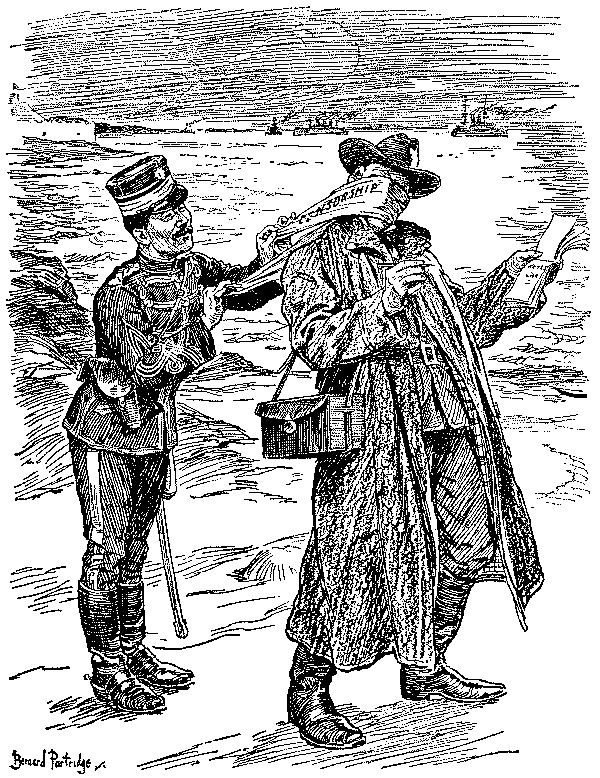
THE WISDOM OF THE EAST
Japanese Officer (to Press Correspondent): "Abjectly we desire to distinguish honourable newspaper man by honourable badge."
The Daily Mail Arrives
In 1897 Punch illustrated the change by parallel pictures of the journalist in 1837, writing in a squalid room in the Fleet Prison, and in the year of the Diamond Jubilee, seated in a sumptuously equipped office, fat and prosperous, and smoking a large cigar. In the previous year Punch had saluted the Daily News on the attainment of its jubilee. The connexion was an old and intimate one, for the publishers of Punch had been the first publishers of the Daily News, and it had been renewed in the 'nineties when Sir Henry Lucy ("Toby," of Punch) for a while occupied the chair in which Dickens had sat. A far more momentous event, however, was associated with the year 1896—the founding of the Daily Mail by Mr. Alfred Harmsworth, subsequently described by one of Punch's writers as "the arch-tarantulator of our times." He was certainly, if unintentionally, invaluable to Punch, and even more stimulating than Mr. Caine and Miss Corelli. By 1900 his genius for discovering a constant succession of scapegoats, and converting the idol of yesterday into the Aunt Sally of to-day, is handsomely acknowledged in the lines "Ad Aluredum Damnodignum." Then it was Sir Michael Hicks-Beach and Mr. Balfour, but Punch foresaw that the habit was inveterate:—
For still, oh hawk-eyed Harmsworth, you pursue With more than all the ardour of a lover, From find to check and so from check to view Your scapegoat-hunt from covert into covert.
As for the test of circulation, Punch betrays a certain scepticism in his remarks on "The People's Pulse" in 1903:—
The account given by the Daily Mail, in Saturday's issue, of its daily circulation for the last eight months, together with the leading event of each day, ought to be kept up from time to time as a Permanent People's Pulse Report. Nothing could be more instructive than to note, for instance, that while the Delhi Durbar only attracted 844,799 readers, the "Oyster Scare" allured as many as 846,501; while "Lord Dalmeny's Coming of Age" brought the figures up to 847,080, and the "Sardine Famine" accounted for a further increase of 14,586. Or, again, there is a world of significance in the fact that the relative attractions of the "Poet Laureate's Play" and "Mr. Seddon's Meat Shops" are represented by a balance of 5,291 in favour of the Napoleon of New Zealand.
Life was certainly made livelier by the new methods introduced, with variations, from America, and Punch feelingly contrasts the drab existence of those who lived before with that of those who lived under the Harmsworth régime:—
Drear was the lot, minus the Mail, Of soldier, sailor, ploughboy, tinker; And worse, whenever they grew pale, They had no pills to make them pinker.
It is a nice question whether we owe more to the pink pill or to the Yellow Press. But there can be no doubt as to the influence of the new journalism on sport and pastime. Until then, in Punch's phrase, "cricket was still a childish game and not a penman's serious study." Henceforth the cricketer fulfilled a double function. He not only played cricket but he wrote about it—and himself. Under the heading "The Cricketer on the Hearth," in 1899, Punch publishes an imaginary interview à la mode with Mr. Slogger. We omit the complacent autobiographical passages and content ourselves with the sequel:—
"Well, that's pretty well all, I think, except you'll probably want to print at length my opinions on the Transvaal Question, Wagner's Music, and the Future of Agriculture. These will have an overpowering interest for your readers."
"Here are a few photographs of myself—but it's rather too heavy a parcel to carry. I'll send it round in a van. Of course you'll print them all. And now I must ask you to excuse me, as it's time to get into flannels."
I thanked him for his courtesy, and hoped that he'd make a fine score in the county match. He stared at me in surprise. "County Match? You don't imagine I've time to play cricket nowadays, do you? No; I'm going to change because half-a-dozen photographers will be here directly, and they like to take me in costume. And after that I shall have to see seven or eight more interviewers. Good morning!"
The Cricket Journalist
The intrusion of the emotional literary "note" in articles on pastime came later, and is parodied in the article (in 1904) "Do we take our amusements seriously enough?" by Mr. C. B. F:—
The frivolity of the Press is only paralleled by the frivolity of the public. Take the light and airy way in which the spectators at our great cricket grounds treat the imposing functions provided for them. Suppose little (but heroic) Johnny Tyldesley runs out to that wily, curling ball which sunny-faced Wilfred Rhodes pitches thirty-three and three-quarter inches from the block. Up glides his trusty willow, and a fortieth of a second after the ball has pitched descends on the leather. With a wonderful flick of the elbow he chops the ball exactly between square leg and point. Is the raucous "Well hit, Johnny," of the crowd a fitting, a reverent salutation? Our Elizabethan dramatists knew better. Have you not noticed in their stage directions, "A solemn music"? Two or three phrases of Chopin played, let us say, on the French horn by the doyen of the Press-box would be a better tribute to such a miracle of skill. There are, however, elements of better things in our crowds. Before now I have seen the potent Jessop smite a rising ball to the boundary with all the concentrated energy of his Atlantean shoulders, and as the ball reached the ring the spectators with involuntary reverence prostrated themselves before it.
Nor do our greatest men gain the public honours which are their due. In ancient Greece a great athlete was a national hero. The name of Ladas has come down to us through the ages with those of Socrates and Xenophon. Think of the sad contrast in modern England. Why is not Plum Warner (I knew him in long clothes) a Knight of the Garter? Why is not Ranji (exquisitely delicate Ranji—the Walter Pater of the cricket field) Viceroy of India? There are living cricketers, with an average of over eighty, and a dozen centuries in one season to their credit, who have never even been sworn of the Privy Council.
On every side I trace the growth of the same spirit. England is devoting itself to art, politics, literature and theology, and in the rush and hurry of our modern life there is a sad danger that sport will be underrated or overlooked. My countrymen must learn to concentrate their minds on the things which really matter. In your nobler moments would you not rather stand at the wicket than at the table of the House of Commons, or on the political platform of the City Temple, or on the stage of the Alhambra? Save her sport and you save England.
Modern journalistic methods are reduced to absurdity in the account of the staff of a daily paper, who are all football players, cricketers, clairvoyants, crystal-gazers, music-hall artists, or burglars. In the verses on "Journalistic Evolution," in 1907, the tendency to condense everything is specially noted. Leaders have become "leaderettes," and will in turn yield to "leaderettelets"; the writer prophesies a day when The Times will only consist of headlines.
Dasent's Life of Delane appeared in 1908, and Punch's reviewer reminds us of the commanding position occupied by that great editor, who was consulted by all Premiers, except Gladstone, and to whom Palmerston actually offered office. The gist and sting of the review, however, is to be found in a sentence not merely true but almost tragic in its bearings on the history of English journalism:—
Delane accepted the favour of contributions by Cabinet Ministers to his news-chest, but he recognized that the power and influence of The Times were based upon the foundations of public spirit, concern for national interest, and absolute impartiality in dealing with statesmen.
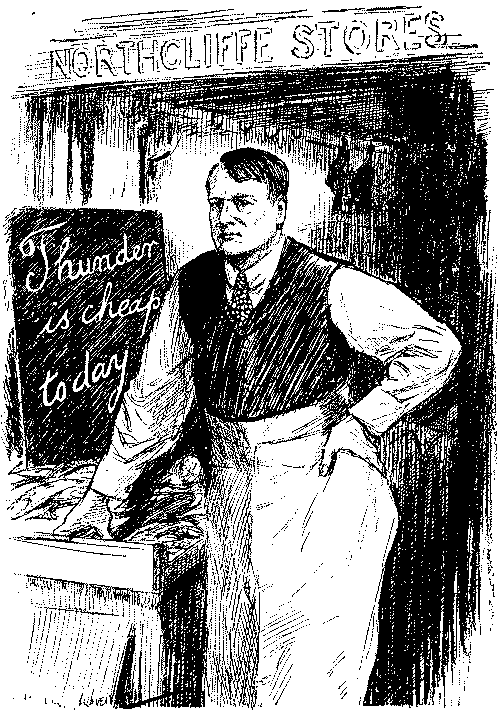
PENNY WISDOM
("In view of the grave importance of the present political situation, The Times will be reduced in price to a penny."—Press Association.)
The Times passed under the financial control of Lord Northcliffe at the beginning of 1908, and in the spring of 1914, "in view of the grave importance of the political situation," its price was reduced to one penny. Punch's comment took the form of a cartoon in which the new Dictator of Printing House Square is shown as a salesman at the door of the "Northcliffe Stores" with the legend on a slate, "Thunder is cheap to-day."
Homage to Andrew Lang
By way of contrast with hustling methods Punch had noted with regret the passing in 1905 of Longman's Magazine, in whose pages Mr. Andrew Lang had for many years presided so gracefully "At the Sign of the Ship":—
Formerly, when, sated by sensation, Gentle readers sought an air serene, Refuge from the snapshot's domination Might be found in Longman's Magazine. There at least the roaring cult of dollars Never took its devastating way; There the pens of gentlemen and scholars Held their uncontaminating sway. There no parasitic bookman prated, No malarious poetasters sang, There all themes were touched and decorated By your nimble fancy, Andrew Lang. True, some hobbies you were always riding, —Spooks and spies and totemistic lore; But so deft, so dext'rous was your guiding, No one ever labelled you a bore. But alas! the landmarks that we cherish, Standing for the earlier, better way, Vanquished by vulgarity must perish, Overthrown by "enterprise" decay. Still with fairy books will you regale us, Still pay homage to the sacred Nine, But no more hereafter will you hail us Monthly at the Ship's familiar Sign. There no longer faithfully and gaily Will you deal alike with foes and friends, Wherefore, crying "Ave, atque vale!" Punch his parting salutation sends.
Punch had his own losses to deplore, for in August, 1897, the death of Mr. E. J. Milliken removed a most valuable and fertile member of his staff. Mr. Milliken was not only the creator of "'Arry," and a fluent and dexterous versifier, but he combined with a retentive and accurate memory "the rare talent of most happily applying past literature, whether in history or fiction, to the illustration of contemporary instances," and for a long time had been the chief cartoon-suggester. A longer and more distinguished connexion with Punch was severed in 1906 by the retirement of Sir Frank Burnand after forty-three years' service. He joined in 1863, as the youngest of the staff, and held the editorship for over twenty-five years. In "Just a Few Words at Parting" he defines the aim of the editor in words worthy of remembrance. If Punch was to hold securely the position he had achieved, it should and must be "to provide relaxation for all, fun for all, without a spice of malice or a suspicion of vulgarity, humour without a flavour of bitterness, satire without reckless severity, and nonsense so laughter-compelling as to be absolutely irresistible from its very absurdity." The precept hardly covers the higher function assumed by Punch in "The Song of the Shirt," but, as it stands, had assuredly been faithfully carried into practice by the master of exhilarating burlesque, the intrepid parodist, the author of the immortal Happy Thoughts. As for the personal affection that he inspired in his staff, it is truly expressed in the farewell lines addressed to him by "R. C. L.":—
Dear Frank, our fellow-fighter, how noble was your praise, How kindly rang your welcome on those delightful days When, gathered in your presence, we cheered each piercing hit, And crowned with joy and laughter the rapier of your wit. And if our words grew bitter, and wigs, that should have been Our heads' serene adornment, were all but on the green, How oft your sunny humour has shone upon the fray, And fused our fiery tempers, and laughed our strife away!