HIGH POLITICS
Reading edition
Transition and growth, change and decay and reconstruction marked the half-century covered in the previous three volumes. In the twenty-two years that divide the return of the Liberals in 1892 from the "Grand Smash" (as Mr. Page has called it) of 1914, these features are intensified to an extent that renders the task of attempting even a superficial survey perilous and intractable to one who is neither a philosopher nor a trained historian. The wisest and sanest of those who have lived through these wonderful times are too near their heights and depths to view them in true perspective. Whatever merit attaches to this chronicle is due to its reliance on contemporary opinion as expressed in the pages of an organ of independent middle-class views. It is within these limits a history of Victorians and post-Victorians written by themselves.
"Full closes," unfashionable in modern music, are generally artificial in histories. But the period on which we now enter did more than merely coincide with the end of one century and the beginning of another. It marked the passing of the Old Order, the passing of the Victorian age: of the Queen, who, alike in her virtues and limitations, in the strength and narrowness of her personality, epitomized most of its qualities; and of the type of Elder Statesmen, of whom, with the sole exception of Mr. Balfour, none remains at the moment as an active force in the political arena. Of the Ministry of 1892-5 the only survivor who mixes in practical politics is Mr. Asquith, but his record as a legislator hardly entitles him to the name of an Elder Statesman in the Victorian sense. Sir George Trevelyan, Lord Morley, Lord Eversley and Lord Rosebery have all retired into seclusion. So, too, with the Unionist Ministers who held office from 1895 to 1905. Veterans such as Lord Chaplin, Lord George Hamilton and Lord Lansdowne enjoy respect, but they do not sway public opinion, and are debarred by age from active leadership and office. Lord Midleton stood aside to make way for younger men when the Coalition Government was formed, and Lord Selborne is perhaps the only Conservative statesman who held office before 1906 who has any chance of sitting in a future Cabinet.
It was not only an age of endings; it was also an age of beginnings, fresh and sometimes false starts, both as regards men and measures. It witnessed the coming of the Death Duties in 1894, when Sir William Harcourt's "Radical Budget," by equalizing the charges on real and personal property, paved the way for the more drastic legislation introduced by the Liberals in 1906 and the following years. This was Harcourt's greatest achievement, and perhaps the most notable effort in constructive policy of the short-lived Liberal administration; for the second Home Rule Bill was dropped on its rejection by the Peers. Under the Unionist administrations of 1895-1905 Mr. Joseph Chamberlain, as Colonial Secretary, and Mr. Wyndham, by his Irish Land Purchase Act, rendered conspicuous service in the domain of Imperial and Home policy. Yet at the culminating point of his popularity Mr. Chamberlain left the Government to prosecute that Fiscal Campaign which broke up the Government, broke down his strength, and ended a brilliant career in enforced retirement. Mr. Wyndham's withdrawal from the Government, owing to friction over Irish policy, closed in early middle age the career of the most gifted and attractive politician of his generation.
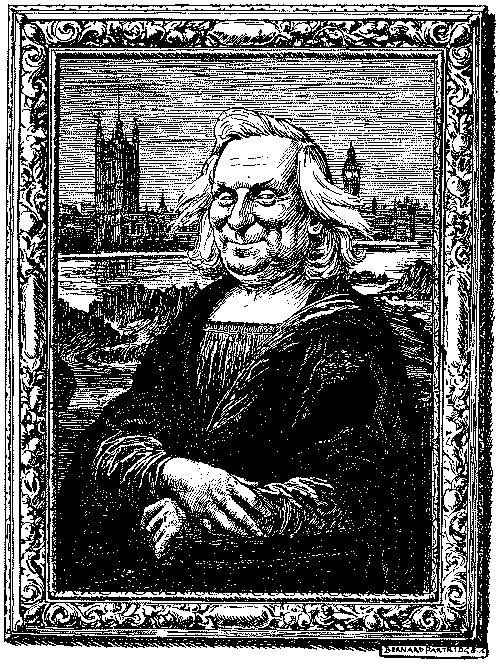
"IL GIOCONDO"
The enigmatic smile of this Old Master distinguishes it from that other National treasure, the "Bonar Lisa."
From 1906 onwards we are confronted by the meteoric and Protean personalities of Mr. Lloyd George and Mr. Winston Churchill, who between them have held almost all the great offices of State, and ranged over the whole spectrum of Party colours, and lastly of Lord Birkenhead. Mr. Churchill's father had once called Mr. Gladstone "an old man in a hurry." One wonders what Lord Randolph would have called his son Winston, of whom it was said "he likes things to happen, and when they don't happen he likes to make them happen." In comparison with the discreet progress of Reform in the last century the pace became fast and furious. The demands of organized Labour were conceded in the Trade Disputes Bill of 1906—the greatest landmark in industrial legislation of the last half-century—and in 1910 the People's Budget led to the revolt and surrender of the House of Lords.
Yet concurrently with the democratic drift of Liberal finance and social reform, the principle of a continuity of foreign policy, initiated by Lord Rosebery, and continued by Lord Salisbury and Lord Lansdowne, was faithfully maintained by Sir Edward Grey, whose sober and frugal expositions contrasted strangely with the vivacity and flamboyant rhetoric of his colleagues. The Anglo-French Entente and the Anglo-Japanese Alliance both came into being when Lord Lansdowne was at the Foreign Office, and the influence of the Liberal Imperialist group in Sir Henry Campbell-Bannerman's Cabinet secured a free hand for the Foreign Minister. It is the fashion in some quarters to regard the late King Edward as "the only begetter" of the Entente; it is at any rate within the mark to credit him with having missed no opportunity of fostering it by his tact and bonhomie. It was no easy task. When he visited Paris in 1902 the official greetings were perfectly correct, but the animosity aroused over the Boer war found vent in outrageous and unseemly caricatures. England was then the most unpopular country in the world; and in allaying this general distrust and dislike, the personal relations of King Edward with foreign statesmen and rulers wrought powerfully for goodwill and a better understanding.
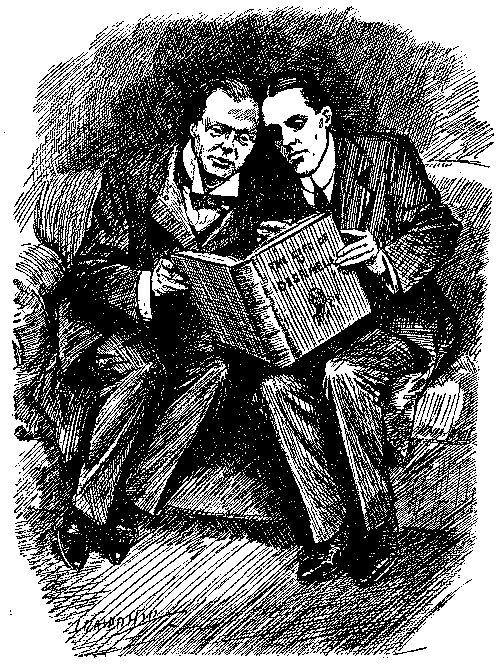
STUDENTS ON THE MAKE
Mr. F. E. Smith: "Master of epigram—like me!"
Mr. Winston Churchill: "Wrote a novel in his youth—like me!"
Together: "Travelled in the East—like us. How does it end?"
(Mr. W. F. Monypenny's official "Life of Disraeli" has just been published.)
Foes and Friends
Looking back, in the light of fuller knowledge, on the South African war of 1899-1902, we cannot fail to recognize how narrowly we escaped the active hostility of more than one European Power; how much we owe to the wise magnanimity of the British Government in granting full autonomy to the Transvaal in 1906—an act not only justified by the sequel but approved by those who voted against it. It converted the most formidable of those who fought against us into loyal servants of the Empire in her hour of greatest need; it allayed the misgivings of those at home who had opposed the Boer war, and it silenced the criticisms of foreigners who had denounced our aim as the extermination of a people rightly struggling to be free. Whatever views may be held as to the origin of the Boer war—that it was forced on by mining magnates, or that it was the inevitable result of a reactionary system which threatened our hold on South Africa—it remains one of the very few examples of a war which, in the long run, left things better than they had been, and satisfied the aspirations of the majority of the conquered. And if we did not learn all the lessons that we might have learned from the military point of view, the experience was not thrown away. The services of Kitchener, Plumer and Byng, to mention only three out of scores of names, proved that what was comparatively a little war was a true school of leadership for the greatest of all.
Great Britain's warlike operations throughout this period were intra-Imperial, and the scale of the South African campaign, in which from first to last we put 250,000 men into the field, dwarfed the troubles in Ashanti and on the Indian frontier into insignificance. That we kept out of all the other wars which convulsed the world between 1892 and 1914 must be put down to good management as well as good luck. It is remarkable to notice the steady if gradual convergence of the war clouds on Europe, the drawing in of the war zone from the circumference to the centre, beginning with the conflict between China and Japan. The brief and inglorious Greco-Turkish war hardly counts, and Europe was not physically engaged in the Spanish-American war, where all the fighting was done in the New World. Politically its significance was far-reaching, as revising the Monroe Doctrine and enlarging the Imperial horizons of the United States. Politically, again, the "Boxer" rising in China affected the European Powers, whose competing interests in the "integrity of China" were not reconciled by their joint expedition for the relief of the Legations in 1900. Here again the fighting was in the Far East, as it was in the Russo-Japanese war, if we except the "regrettable incident" of the Dogger Bank; and Russia has always been as much an Oriental as a Western Power. But the Russo-Japanese war shook Tsardom to its foundations, promoted Japan to the status of a Great Power, and compensated her largely for the intervention of Russia, Germany and France in robbing her of the spoils of her victory over China. The European conflagration broke out in 1912 with the war of the Balkan League on Turkey. Victory crowned the efforts of a righteous cause—the relief of oppressed nationalities from the oppressions and exactions of a corrupt and tyrannous rule—but was wasted by the internecine quarrels and irreconcilable demands of the victors. Serbia, who had lived down much of the odium excited by the barbarous murders of Alexander and Draga, and had borne more than her share of the war against Turkey, was isolated, partly by her own intransigence, mainly by the greed, the diplomatic manoeuvres and the treachery of her allies, and in her isolation fell a victim to the dynastic ambitions of Austria. The assassination of the Crown Prince Ferdinand at Sarajevo was the excuse for Austria's ultimatum to Serbia, the proximate cause of the Great War of 1914. Whether engineered in Vienna or not, the murder secured the removal of an heir whose succession to the throne of Austria-Hungary was looked upon with grave suspicion by a powerful group in Austria who had no desire to upset the House of Hapsburg but profoundly distrusted the Crown Prince. In the homely phrase Sarajevo killed two birds with one stone. It eliminated an uncertain and unpopular prince, and furnished Austria with an opportunity for gratifying her long-standing hostility to Serbia. But there was a third and bigger bird; for the complicity of Germany in dispatching the Ultimatum is no matter for surmise. Without her support and pressure it would never have been sent.
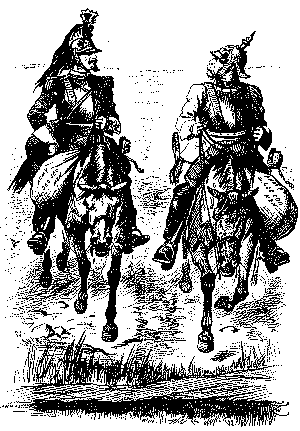
THE ROAD TO RUIN
Punch on World Politics
Confronted on all sides by problems of such magnitude and far-reaching importance, it is not to be wondered at if Punch—primarily a comic journal—failed to gauge their full significance, or to preserve an attitude of inflexible consistency in his comments. There was always a certain divergence between his editorial policy as expressed in the cartoons and the comments of individual members of his staff. This elasticity made for impartiality in the main; but it became somewhat perplexing at the time of the Boer war, when a general support of the Government was combined with very sharp criticism of Lord Milner. Yet if Punch here and elsewhere spoke with more than one voice, his views on high policy, international relations and home affairs exhibit a certain general uniformity and continuity. He supported both the Entente and the alliance with Japan. The spasm of irritation over the Fashoda incident soon passed; he resented the intervention of Russia and Germany which robbed Japan of the fruits of her victory over China, and his sympathies were unmistakably with Japan in the war with Russia. Punch was consistently and increasingly critical of the Kaiser, while perhaps over-ready to dissociate his temper from that not only of the German people but of the educated classes; he was also consistently alive to the menace of German competition in naval armaments and trade, though by no means disposed to acquit British merchants and workmen from a provocative lethargy. Towards America, Punch's attitude shows a progressive benevolence. The Venezuela incident and President Cleveland's message at the beginning of this period brought us within measurable distance of a rupture, happily averted by negotiation, as the later and less serious difficulty over the Alaska boundary was averted by arbitration. One may fairly say that Punch's relief at the pacific adjustment of these outstanding questions was far greater than his sensitiveness on the point of national honour. He did not refrain from the use of the word "filibustering" in connexion with the Spanish-American war, in which the gallantry of Cervera went far to enlist sympathy on the beaten side; but with the accession to the Presidency of Mr. Roosevelt, a man in many ways after Punch's own heart, though not exempt from criticism for his controversial methods, a friendlier tone became apparent, and the historic "indiscretion" of Admiral Sims's speech at the Guildhall in 1910 helped to create the atmosphere of goodwill which rendered possible the fulfilment of his prophecy.
On National Defence and the maintenance of our naval supremacy Punch continued to speak with no uncertain voice. He applauded Lord Roberts's patriotic but neglected warnings and his advocacy of universal military service, and lent a friendly but not uncritical approval to the Territorial Army scheme.
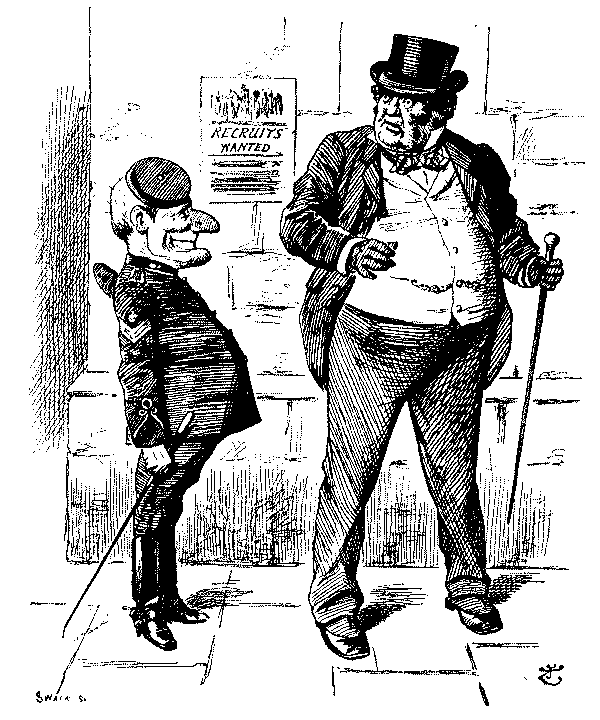
THE ONLY ALTERNATIVE
John Bull: "Recruits coming in nicely, Sergeant?"
Recruiting Sergeant Punch: "No, Sir. The fact is, Mr. Bull, if you can't make it better worth their while to enlist, you'll have to shoulder a rifle yourself!"
Gladstonian Home Rule
In regard to Ireland and Home Rule, after the rejection of the Home Rule Bill of 1893 Punch's independent support of the Liberals gave place to a general support of the Unionist policy, tempered by a more or less critical attitude towards Ulster. He cannot be blamed for neglecting to note the obscure and academic beginnings of the Sinn Fein movement, or for failing to forecast that triple alliance of Sinn Fein with the old physical force party and the Labour extremists under Larkin which led to the rebellion of Easter, 1916. The Government expert, who devoted seven years to the neglect of his duties, was sunk in unholy ignorance of all that was going on until the explosion took place. For the rest, Punch became increasingly critical of the demands of Labour and the parochial outlook of its leaders; increasingly antagonistic to the measures passed in satisfaction of those demands. At the same time he devoted more space than ever to satirizing, ridiculing, and castigating the excesses, extravagances and eccentricities of "smart" society, the week-end pleasure hunt of the idle rich, and all the other features which may be summed up in the phrase, "England de Luxe." Pictorially his record reveals perhaps more amusement than disgust at the carnival of frivolity which reached its climax in the years before the war. The note of misgiving is not lacking, but it is sounded less vehemently than in the 'eighties of the last century. In the main Punch's temper may be expressed, to borrow from Bagehot, as an "animated moderation."
To turn from outlines to details, one is confronted in 1893 with Mr. Gladstone's second attempt to solve a problem which Giraldus Cambrensis pronounced insoluble seven centuries ago. Punch's earlier cartoons on the Home Rule Bill are negligible, but the difficulties of the Premier's position are aptly shown in the picture of Gladstone as a knight in armour on a perilous pathway between the Irish Nationalist bog and the "last ditch" of Ulster. The accompanying text, modelled on Bunyan, represents Mr. Gladstone as a Pilgrim relying as much on tactics as the sword. The most genial reference to Ulster is that in which she figures as the Widow Wadman asking Uncle Toby, "Now, Mr. Bull, do you see any 'green' in my eye?" and Uncle Toby protests he "can see nothing whatever of the sort." Otherwise Punch's attitude is unsympathetic, witness the use of the term "Ulsteria" and the epigram on the second reading of the Bill, put, it is true, into the mouth of "A rebellious Rad":—
Butchered—to make an Easter Holiday, For Orangemen who yearn to have their say! They've got political delirium tremens. Orange? Nay, they're sour as unripe lemons!
In the "Essence of Parliament" little is said of the arguments, but we get a glimpse of Lord Randolph Churchill's return to the political arena and echoes of the unbridled loquacity of Mr. Sexton. The cartoons are more instructive, notably that on the introduction of the "Guillotine" by Gladstone, with the G.O.M. as chief operator, Harcourt and Morley as republican soldiers, and Amendments, as heads, falling into a waste-paper basket. The fate of the measure is neatly hit off in the "Little Billee" cartoon; Home Rule as "Little Billee" is about to be massacred by the House of Lords, represented by Salisbury and Hartington as chief villains. "Little Billee" in the legend not only survived but attained high distinction in after life; but it is hard to say whether Punch implied a similar resurrection for the Bill of 1893. But whatever were his views on the merits of Home Rule, Punch was decidedly critical of the Government's naval policy, and when Mr. Gladstone and Mr. Morley had simultaneously made seemingly irreconcilable speeches on the subject, he adroitly invoked the shade of Cobden, who had, in certain conditions, proclaimed himself a Big Navyite. Punch fortified the argument by a set of verses headed "Rule Britannia" and ending with this stanza:—
Devotion to the needs of home And claims parochial is not all. Beware lest shades more darkling come With gloomier writings on the wall. Rule, Britannia! Britannia, rule the waves! Britons to careless trust should ne'er be slaves.
Mr. Gladstone and his Successor
Yet when Mr. Gladstone resigned the premiership, early in 1894, Punch's tribute is an unqualified eulogy of the "Lancelot of our lists":—
"Unarm, Eros; the long day's task is done." This is no Antony; here's a nobler one; Yet like the Roman his great course is run. From source to sea a fair full-flooded flow Of stainless waters, swelling as they go, Now widening broad in the sun's westering glow, Broad widening to the ocean, whither all The round world's fertilizing floods must fall, The sweeping river with the streamlet small. Hang up the sword! It struck its latest stroke, A swashing one, there where the closed ranks broke Into wild cheers that all the echoes woke. That stroke, the last, was swift, and strong, and keen, Now hang thou there, though sheathed, yet silver-clean, For never felon stroke has dimmed thy sheen! For thee, good knight and grey, whose gleaming crest Leads us no longer, every generous breast Breathes benediction on thy well-won rest. The field looks bare without thee, and o'ercast With dark and ominous shadows, and thy last Reveille was a rousing battle-blast! But though with us the strife may hardly cease, We wish thee, in well-earned late-coming ease, Long happy years of honourable peace!
The "last stroke" referred to was doubtless the speech in which Mr. Gladstone uttered his warning to the Lords, a warning translated into action by the Parliament Act of 1910. Lord Rosebery, his successor, came from the gilded chamber, and, in spite of his democratic record and brilliant gifts, was not enthusiastically welcomed by the Liberal Party. But Punch had no misgivings at the moment and acclaimed him in a cartoon in which he enters the lists, "from spur to plume a star of tournament," with Harcourt as his squire, a reading of their relations hardly borne out by the sequel. The Cabinet were not a "band of brothers," and, as we have said above, the most notable legislative feature of the Liberal administration was the "Radical Budget" of Sir William Harcourt. Punch's comment, in the cartoon "The Depressed Dukes" and the verses on "The Stately Homes of England," combined prescience with a touch of malice. The Duke of Devonshire is shown saying to the Duke of Westminster, "If this Budget passes, I don't know how I am going to keep up Chatsworth," and the Duke of Westminster replies, "If you come to that, we may consider ourselves lucky if we can keep a tomb over our heads." Mr. Chamberlain's famous phrase about "ransom" is recalled, in view of his rapprochement to the Tories, to illustrate his falling away from Radicalism, and Punch's references to him are, for a while, critical to the verge of hostility. Sambourne's picture of the interesting development of the "Josephus Cubicularius (orchidensis)" exhibits his evolution from the manufacturer of screws, the republican and the radical, to the patriot, society pet, and full-blown Conservative with a peerage looming in the future; while in the "Essence of Parliament" he is ironically complimented on investing the High Court of Westminster with "the tone and atmosphere of the auction-room."
On the other hand, Punch recognized that a disposition to add to our Imperial responsibilities was no longer a Tory monopoly. Uganda was annexed in 1894, and John Bull is seen finding a black baby on his doorstep: "What, another! Well, I suppose I must take it in," the explanatory verses being headed "Prestige oblige." The assassination of President Carnot prompts a tribute to France:—
Sister in sorrow now as once in arms, Of old fair enemy in many a field—
an obvious adaptation of Sir Philip Sidney's "that sweet enemy France." But in the realm of foreign affairs the most striking event was the Chino-Japanese war. Here Punch's sympathies are clearly revealed in his cartoon, "Jap the Giant-killer," with an up-to-date fairy-tale text; in the picture of Japan as the Infant Phenomenon lecturing on the Art of War to John Bull, Jonathan, the Kaiser and other crowned heads; and in the condemnation of the jealous intervention of Russia and Germany to rob Japan, who had "played a square game," of the fruits of victory. The death of the Tsar Alexander III in November, 1894, is commemorated in a cartoon in which Peace is chief mourner. Punch, as we have seen, had not been enthusiastic over the gravitation of Russia towards a French alliance; but no official declaration of its existence was made until 1897, though it was mentioned publicly by M. Ribot in 1895.
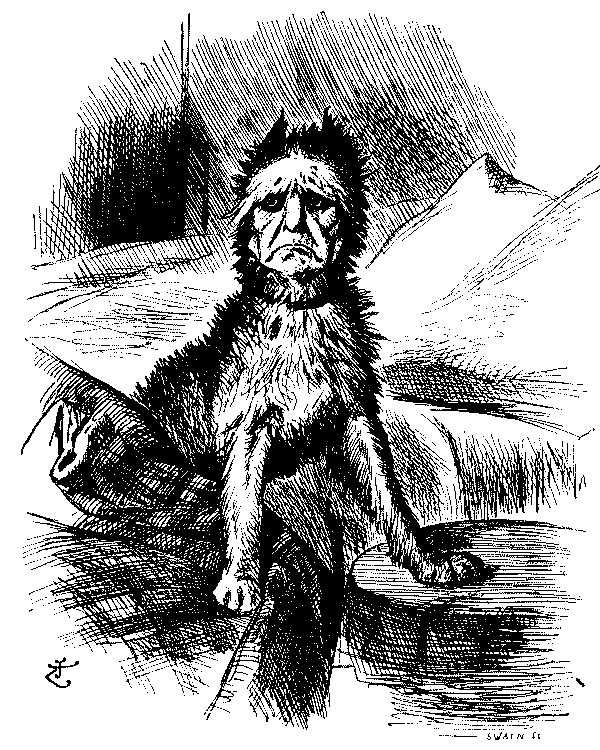
"WHO SAID—'ATROCITIES'?"
(After the popular engraving)
"Old as I am my feelings have not been deadened in regard to matters of such a dreadful description." (Mr. Gladstone's Birthday speech at Hawarden on the Armenian atrocities.)
The Seven Lord Roseberys
The Rosebery Cabinet resigned in June, 1895. Punch's admiration for Lord Rosebery had steadily waned during his brief tenure of the Premiership, and distrust of his versatility is revealed in the versified comment on Mr. St. Loe Strachey's article in the Nineteenth Century. There the "Seven Ages of Rosebery" are traced, in the manner of Jaques, from the Home Ruler onward through the phase of London County Council chairman to Premier, and Sphinx à la Dizzy, ending:—
Last scene of all That ends this strange eventful history, Newmarket Rosebery, Ladas-owner, Lord— Sans grit, sans nous, sans go, sans everything.
Lord Salisbury's third Cabinet was reinforced by the inclusion of the Liberal-Unionists—the Duke of Devonshire, Mr. Goschen and Mr. Chamberlain. It was a powerful combination, but suffered in the long run from the inherent drawbacks of all coalitions, though the course of events postponed the inevitable disruption. Before the Liberals left office, Mr. Gladstone had emerged from his retirement to denounce the "Armenian Atrocities" and urge British intervention. Here, as in earlier years, Punch sided with the advanced Liberals, rejoiced in his well-known cartoon, "Who said 'Atrocities'?" that there was life in the old dog (Mr. Gladstone) yet; welcomed the adhesion of the Duke of Argyll to Mr. Gladstone's campaign in another cartoon of the "Old Crusaders: Bulgaria, 1876, Armenia, 1895"; and denounced the unchangeable ferocity of the Turk. When the Bishop of Hereford invited his clergy to send up petitions respecting the Armenian atrocities, one vicar refused to protest against Turkish crimes, on the ground that the English Government was exercising all its ingenuity to persecute and plunder Christians here. This referred to the Liberal Government's Welsh Disestablishment Bill. Punch ironically declared that the vicar's logic was as convincing as his Christian sympathy was admirable. On the return of the Unionists to power, Punch continued to urge strong measures, and lamented the powerlessness of the "Great Powers" to bring about reforms in Turkish administration.
The Kiel Canal
The retirement of Mr. Peel from the Speakership afforded Punch a fitting opportunity for recognizing his great qualities in maintaining the dignity of his position, his "awesome mien and terrible voice" in administering rebukes, and for joining in the chorus of congratulation to the new Conductor of the Parliamentary Orchestra, Mr. Gully. As for the protest of Lord Curzon, Lord Wolmer and Mr. St. John Brodrick against the exclusion of peers from the House of Commons, Punch dealt faithfully with the movement in his comments on the "Pirate Peers." Better still is the cartoon in which a bathing woman addresses a little boy wearing a coronet, and battering with his toy spade at the door of a bathing-machine labelled House of Commons. "Come along, Master Selborne," she says, "and take your dip like a little nobleman." This incident of May, 1895, is hardly worth mentioning save as an example of self-protective insurance against future legislation aimed at the power of the Upper House. For years to come Punch's political preoccupations were almost exclusively with questions of Imperial policy and international relations. The opening of the Kiel Canal practically coincided with the return to power of Lord Salisbury, and is celebrated by Punch in the same number in which he ironically adapts Shakespeare's Coriolanus to illustrate the alliance of Lord Salisbury and Mr. Chamberlain. Punch's representative went out on the Tantallon Castle with Mr. Gladstone, and gives a lively account of the junketings on board and on shore, and the entertainment of sovereigns and local magnates. In more serious vein Punch editorially hails the canal as a "Path of Peace," banishing misgivings and remembrances of Denmark and France:—
Not war alone, but trade, will take the track That shuns the wild and stormy Skager-Rak; And may Brunsbüttel's now familiar name Be little linked with Empire's big war-game; May battle-echoes in the Baltic cease; And the Canal be a new Path of Peace.
A couple of months later our friendly relations with Italy inspired a cartoon in which Britannia congratulates Italy, but advises her to be less visionary and more practical. Italy's finances were causing her trouble; otherwise the advice showed an inability to sound the springs of Italian policy. Punch's pacific dreams were dispelled in the autumn by the renewed troubles in Ashanti. Britannia, as he put it, expected more than an umbrella this time; King Coffee's umbrella had cost us £900,000 in 1874. Happily the expedition was well organized and its immediate purpose executed, though a further expedition became necessary in 1900. Far graver anxieties threatened us from Africa at the close of the year, and since Punch's criticisms of and comments on the successive phases of controversy and conflict betray a certain amount of variation and even inconsistency, it is as well to point out that the unfriendly tone he had shown towards "Joe" in previous years had largely abated upon Mr. Chamberlain's accession to office as Colonial Secretary. In the account of a dinner held in the late autumn of 1895 to celebrate the opening of railway communication between Natal and the Cape, Mr. Chamberlain's speech is extolled as "splendidly pitched, admirably phrased, and full of the Palmerstonian ring." Simultaneously in "The Imperial Federalists' Vade Mecum" Punch discourses on the difficulties, no longer insuperable, which attended on the translation into reality of that dream of Imperial Federation which had once been regarded as a nightmare.
Dr. Jameson's Popularity
The abortive Jameson Raid at the close of December, 1895, came as a bombshell; and Punch, in his "Tug of War" cartoon, shows the Uitlander trying to pull the British Lion into the Transvaal, while Mr. Chamberlain is pulling him back. Canning's well-known lines on "The Pilot that weathered the Storm" are rewritten in honour of Mr. Chamberlain's handling of the crisis. A few months earlier Punch had ridiculed the Kaiser for his arbitrary absolutism in sending to prison a private University teacher "for writing in praise of a certain kind of soap." The famous telegram to President Krüger was dealt with more audaciously in an apocryphal letter purporting to have been sent by the Queen to her grandson:—
Mein lieber Willy,—Dies ist aber über alle Berge. Solch eine confounded Impertinenz have ich nie gesehen. The fact of the matter is that Du ein furchtbarer Schwaggerer bist. Warum kannst Du nie ruhig bleiben, why can't you hold your blessed row? Musst Du deinen Finger in jeder Torte haben? Was it for this that I made you an Admiral meiner Flotte and allowed you to rig yourself out in einer wunderschönen Uniform mit einem gekokten Hut? If you meant mir any of your blooming cheek zu geben why did you make your grandmamma Colonel eines Deutschen Cavallerie Regiments? Du auch bist Colonel of a British Cavallerie Regiment, desto mehr die Schade, the more's the pity. Als Du ein ganz kleiner Bube warst have ich Dich oft tüchtig gespankt, and now that you've grown up you ought to be spanked too.... Du weist nicht wo Du bist, you dunno where you are, and somebody must teach you. Is Bismarck quite well? Das ist ein kolossaler Kerl, nicht wahr? So lange. Don't be foolish any more.
Deine Dich liebende,
Grandmamma.
This was followed up by the picture of the Kaiser as "Fidgety Phil." But Punch was already alive to the widespread hostility to England which prevailed on the Continent, and did not shrink from suggesting that we were ready at need to take up the challenge. He admitted the popularity of "Dr. Jim," but irony underlies his dialogue between the dubious Londoner, who asks:—
"How will they treat this Doctor Jim, Who doesn't return a winner?"—
and the Hearty Citizen who replies:—
"There's only one way of treating him."— "And that is?"—"Give him a dinner."
Punch is ironically sympathetic, again, in his comment on the statement that "About 130 letters awaited Dr. Jameson ... many of them containing offers of marriage." A few months later, however, Punch supported the demand for his release on account of ill-health. The cartoon based on Mr. Rhodes's resignation in May is headed, "The Pity of it." South Africa (as Othello) says to him: "Cassio, I love thee; but never more be officer of mine." Punch adds as his authority a statement in The Times: "Mr. Rhodes has no longer any power of assailing or menacing the Transvaal. The military authority in the Company's territory is in the hands of Sir Richard Martin. The administration is in the hands of Lord Grey." It was about the same time that Punch published a design for a statue of Krüger, in which the British Lion is shown in chains while Chamberlain kneels obsequiously to the President.
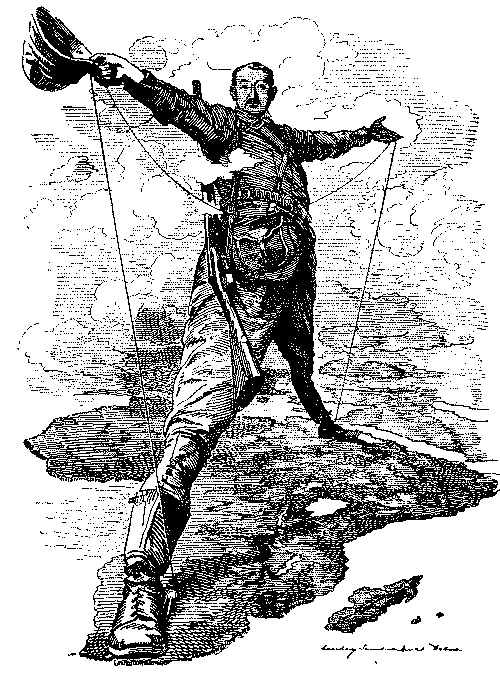
THE RHODES COLOSSUS
Striding from Cape Town to Cairo
South Africa was not our only source of anxiety in 1896. Indeed, it may be said to have temporarily receded into the background as a storm centre. For our strained relations with the United States over the Venezuelan arbitration had been brought to a critical stage by President Cleveland's message. The conciliatory speeches of Mr. Chamberlain and Mr. Balfour in January led Punch to represent them in the act of placating the American Eagle with caresses and sugar. He was better inspired in his open letter to Mr. W. D. Howells, the distinguished American writer, recognizing his generous and courageous efforts to create a better mutual understanding between the two countries. In particular he saluted the "Golden words" in which Mr. Howells criticized his own countrymen:—
Letter to Mr. Howells
"What I chiefly object to in our patriotic emotion, however, was not that it was so selfish but that it was so insensate, so stupid. It took no account of things infinitely more precious than national honour, such as humanity, civilization, and
'the long result of time'
which must suffer in a conflict between peoples like the English and the Americans. For the sake of having our ships beat their ships, our poor fellows slaughter their poor fellows, we were all willing, for one detestable instant at least, to have the rising hopes of mankind dashed, and the sense of human brotherhood blunted in the hearts of the foremost people of the world."
But is there, as you say, "in the American heart a hatred of England, which glutted itself in her imagined disaster and disgrace when we all read the President's swaggering proclamation, in which he would not yield to the enemy so far as even to write good English"? Is there to be no forgiveness, are we never to cancel old scores and begin our international book-keeping, if I may so term it, on a clean page? I do not think our people hate yours. Your dash, your pluck, your humour, your keen common sense, your breezy and inexhaustible energy, your strength and broad capacity for government, all these qualities command and obtain from us a sincere tribute of admiration. If you hate us, we must submit to that melancholy condition, but never submit in such a fashion as to cease from honest effort to abate and in the end to remove all hatred. Blood, as one of your naval captains[1] said on a memorable occasion, is thicker than water. So saying, he dashed in to the help of our sorely pressed ships. Let us then call a truce to petty and malignant carping, and join hands in an alliance dependent not upon written treaties, but upon the noble sympathy of two great nations engaged in the same work of civilization and progress. You, Sir, speaking for others, I trust, as well as for yourself, have set us an example.
Believe me, yours in all cordial friendship,
Punch.
It was in the same spirit that Punch welcomed a remark in the New York Morning Press: "After all the English people are our people, and we are theirs," and deprecated as suicidal any efforts to forsake a common heritage and rend asunder a family tree. The tension passed, thanks to diplomacy and arbitration, and towards the close of the year we find Punch welcoming Mr. McKinley on his election as President, the Shade of Washington (with a somewhat bulbous nose) congratulating Columbia: "'Sound Money' is the best policy." Meanwhile the expedition to Khartum had been decided on; the House of Commons, reassured by a confident speech from Mr. Chamberlain, having approved of the forward policy by a two to one vote, in spite of the misgivings of Mr. Morley, Sir William Harcourt and Sir Charles Dilke. Punch, mindful of 1884, registered his approval in the cartoon in which the Shade of Gordon in the desert utters the one word, "Remember!" Wars and rumours of wars did not distract Punch's attention from the peaceful rivalry of commerce. He was still much concerned by Germany's competition, which he typified in his cartoon of British Trade as the old woman whose petticoats were "cut all round about," while she was asleep, by a German pedlar. And the commercial significance of Li Hung Chang's visit is not overlooked in the generally farcical handling of that extremely astute Oriental. In the cartoon "China in the Bull Shop," rival Continental shopkeepers, who had got no orders out of him, are consumed with envy and curiosity. If Punch is to be believed, their envy was ill-founded. Li Hung Chang displayed a boundless inquisitiveness, but there was "nothing doing" in the way of business between him and his hosts. Punch drew mainly on his imagination for the events of the visit, and ascribed to Li Hung Chang a number of topical Chinese proverbs. The best of them—"Half an official welcome is better than an ill-bred mobbing"—refers to his arrival in the "dead" season.
Two Modern Hamlets
Lord Rosebery resigned the leadership of the Liberal Party in June. While still in office he had estranged the Radical stalwarts by his Imperialist foreign policy and his heretical view of the necessity of converting the "predominant partner," England, before attempting to revive Home Rule. His Government, as one of his colleagues put it, were condemned to the task of "ploughing the sands." In the intervening year the gulf that severed him from the stalwarts and the Nonconformist conscience had been widened by his refusal to join in Mr. Gladstone's Armenian crusade, and henceforth he decided to "plough a lonely furrow." In later years he made occasional dramatic interventions, but his official career, like that of his contemporary at Eton, Lord Randolph Churchill, closed before he was fifty.
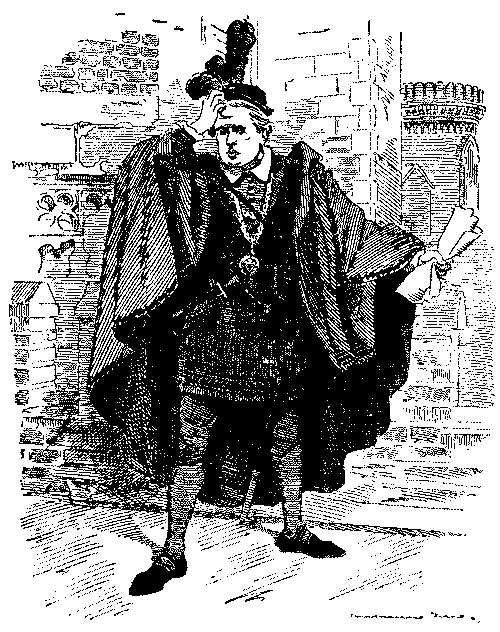
THE CHESTERFIELD HAMLET
Lord R-s-b-ry (in leading rôle): "The 'Party's' out of joint;—O, cursèd spite, That ever I was 'asked' to set it right!" Act i, scene 5, Mr. Punch's edition.
Our relations with the United States were bettered at the opening of 1897 by the signing of the Arbitration Treaty adjusting the Venezuelan question. In Europe events did not conduce to diminish our unpopularity. It was the year of the brief Greco-Turkish war, which revived old divisions of opinion at home. Punch was no lover of the Turk; he realized the difficulties of King George, whom he depicted as Hamlet at Athens, recognizing (like Lord Rosebery) that the "time was out of joint" and deploring "the cursed spite that he was ever born to set it right"; but he supported Lord Salisbury in severely rebuking the hundred M.P.'s who had sent the King a message of encouragement. The verses, modelled on Tennyson's "Charge of the Light Brigade," disparaged the message as mere gaseous talk, which did not mean business, and was bound to end in smoke. Criticism of the Kaiser becomes more animated than moderate; the frequent prosecutions for lèse-majesté, and the famous pamphlet, in which Professor Quidde of Munich ingeniously satirized the Kaiser's megalomania in an historical essay on the aberrations of Caligula, inspire a caustic open letter to Wilhelm II, the gist of which is that, though old enough to know better, he was still the victim of the capricious extravagance of youth:—
Formerly I imagined that throughout Germany, and from time to time in Russia, Austria, or in Italy, an imperial but soaringly human boy was lifting his glass and crying, "Hoch! Hoch! Hoch!" amid the clatter of swords and the admiring shouts of a profusely-decorated soldiery. Now I know that a stout gentleman is doing these things, and reducing his hearers to an abyss of melancholy at his dismal failure in dignity. A boy who played fantastic tricks with the telegraph-wires incurred but a mild censure. What shall be said of a middle-aged and pompous party whose pleasure it is to play practical jokes that set two nations by the ears?
The "Raid" and its Aftermath
Yours is a great inheritance, greatly won by heroic deeds. Your people are by nature the mildest and most loyal, and by tradition and education the most thoughtful, in Europe. But mild and loyal as they are their minds must rise in revolt against a sovereign who reproduces in the crudest form the stale theories of divine right and arbitrary government, whose one notion of administration is to increase his stupendous military forces by taxation while diminishing the number of his reasonable critics by imprisonment. You have travelled, cocked hat in hand, to capital after capital, you have dismissed Bismarck, you have made yourself into the tin god of a great monarchy, you have shouted, reviewed, toasted, speechified, you have donned a thousand different uniforms, you have dabbled in the drama, you have been assisted in the design of allegorical cartoons, you have composed hymns to Ægir, and Heaven knows how many others—and to-day the result of all your restless and misdirected energies is that you have added not only to your army but also to the foreign ill-wishers of your country and to her internal distractions. And at this moment, in spite of the millions of men and money that go to form her army, Germany is weaker than she has been at any moment since the Empire was proclaimed at Versailles. This feat, Sir, you have accomplished, and such credit as attaches to it is yours alone. Where and how do you propose to end?
In lighter vein but with equal disrespect Punch satirizes the instructions to Prince Henry on starting with the naval expedition to Kiao-Chow. In particular Punch dwells, not unfairly, on the Kaiser's insistence on the sanctity of his mission. It was to be a Holy war:—
To preach abroad in each distinct locality The gospel of my hallowed personality.
Another was added to the long list of Indian Frontier wars in the Tirah campaign. Punch did well to recognize the loyalty of native officers, N.C.O.s and men, while saluting the achievements of the Gordon Highlanders in his verses to their Commander, Colonel Mathias. The men were "doing splendidly," but as Colonel Punch says in one cartoon, "Yes, they always do; but is this 'forward policy' worth all this?" And a similar misgiving is revealed in an article implying that so-called "peaceful missions" to barbarian kings were too often closely followed up by punitive expeditions. The "repercussions" of the Jameson Raid were not overlooked. Punch made merry over President Krüger's famous claim for "moral and intellectual damages"; but his criticisms are not confined to the Boers. The proceedings of the South African Committee of Inquiry prompted a parallel between Warren Hastings and Cecil Rhodes, in which the Indian proconsul remarks to the new Empire-builder: "I succeeded and was impeached; you fail—and are called as a witness."
Of the second or Diamond Jubilee of Queen Victoria, the last great State pageant of her reign, one may say that it was more than a great act of veneration and loyalty; it was a celebration of Imperial expansion and solidarity which formed a reassuring interlude on the eve of events that were destined to test that solidarity to the utmost. For 1898 was the year of Fashoda, of the conflict over the "open door" in China, and of the Spanish-American war. I put Fashoda first, because the incident came perilously near embroiling us in war with France. It was not an isolated expression of French resentment, since the general attitude of British public opinion over the Dreyfus affair had greatly inflamed Anglophobia in France. Punch, like the majority of Englishmen, was strongly Dreyfusard. Early in the year he published his cartoon, based on Holman Hunt's picture, in which Zola figures as the "Dreyfus Scapegoat"—a reference to the famous "J'accuse" article—and a similar spirit is shown in the "Dreyfus Dictionary," in which strong hostility is shown to all the leading actors on the anti-Dreyfus side. On a large and sincerely patriotic section of the French public, exasperated by what they considered to be a gratuitous interference in a domestic affair, Punch's comments on the occupation of Fashoda in the Sudan by Colonel Marchand operated like vitriol on a raw wound. They certainly were not flattering to one, who if not a very discreet was a very gallant soldier. Beginning with a farcical burlesque of the stealthy invasion of the French, they go on from ridicule to contempt. "Marchez, Marchand," says John Bull to the Colonel, ironically congratulating him on having had a "nice little scientific trip." The last straw was the cartoon in which John Bull says: "Go away, go away," to a French organ-grinder with a little monkey in uniform perched on his instrument, which is labelled Fashoda. The organ-grinder says, "Eh? What you give me if I go?" and John Bull retorts: "I'll give you something if you don't." A "furious Gaul" broke Mr. Punch's windows, and now we can understand and forgive the retaliation. It may have been an added sting to say, as Punch did on the best authority, that Colonel Marchand had been really saved from the Dervishes by Kitchener's success at Omdurman. Anyhow, it was fortunate that Lord Kitchener, who had served with the French in 1870 in Chanzy's army, was in charge of the negotiations with Colonel Marchand on the spot. The French Government did not give way until six weeks had passed, during which Irish members had avowed their sympathy with France, and Punch addressed her with serious warnings and even bellicose threats. For the peaceful adjustment of what looked like a casus belli, we certainly owe more to Lord Kitchener than to Punch. The battle of Omdurman, fought on September 2, 1898, was the culminating point of a carefully planned campaign which had lasted more than two years, and was duly celebrated in Punch's cartoon of the re-occupation of Khartum, with the statue of Gordon, avenged after thirteen years, in the background. Lord Kitchener lost no time in issuing his appeal for funds to erect the Gordon Memorial College in Khartum, to which Punch dedicated his cartoon of "Dreaming True." The agreement delimiting the respective spheres of England and France in North Africa was not signed till January 19, 1899, but Punch had foreshadowed the issue in his cartoon of John Bull as a "Fixture" in Egypt, his features replacing the battered countenance of the Sphinx.
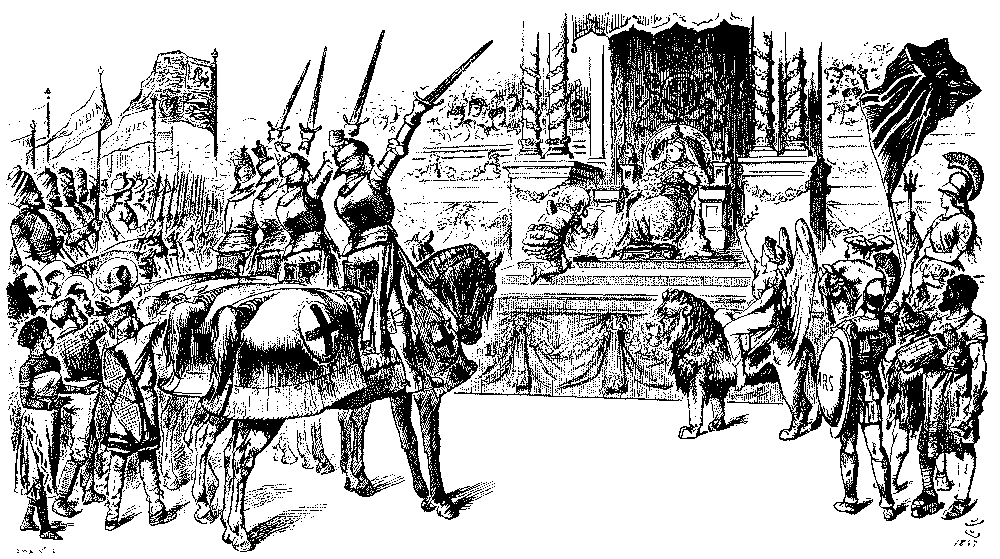
"FOR QUEEN AND EMPIRE!!"
It cannot be said that Punch was any more conciliatory to the United States over the Spanish-American war than he had been to France over Fashoda. He is sympathetic to the young King of Spain, shown as a small boy on the throne threatened by Bellona and Revolution. Both in prose and verse he is distinctly hostile to the U.S.A., ironically crediting them with no desire to annex Cuba, but talking almost in the same breath of "filibustering" and "spread-eagling." And when Cuba was acquired Punch professes to regard it as anything but an unmixed blessing. Spain is shown saying to Uncle Sam: "Well, you wanted him! You've got him! And I wish you joy of him!"—Cuba being represented as an ill-conditioned little coloured boy. Punch's reading of the Treaty of Peace was that Uncle Sam would agree to anything if Spain would take Cuba back; while in another cartoon European resentment of American intrusion into European politics is typified by a very "sniffy" Europa asking Uncle Sam if he is "any relation of the late Colonel Monroe." All this did not make for good blood, or the promotion of that friendly understanding applauded in Punch's letter to Mr. Howells, but it may be pleaded in extenuation that some of the sanest and wisest and noblest Americans were not at all happy about the Spanish war, and that Charles Eliot Norton openly denounced the mixture of hypocrisy and thoughtlessness with which his countrymen had plunged into it.
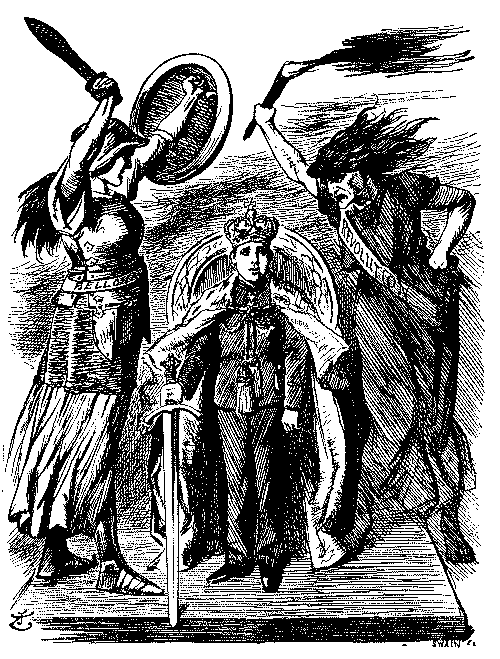
"GOD SAVE THE KING!"
The "Open Door" in China
The conflicting commercial interests of various Powers in China are also the subject of a good deal of frank comment at the expense of Russia and Germany. In one cartoon the British Lion is shown with a barrow-load of goods denied entrance by the Bear at the "free port" of Talienwan. In another, the "Open Door" is reduced to a farce, being occupied by the Bear armed to the teeth and a German entrenched in tariffs. A third, entitled "The Sentinels," is based on the view that the occupation of Port Arthur left us no alternative but to occupy Wei-hai-wei in order to restore the equilibrium upset by Russia. The powerlessness of the young Emperor, who had proposed a scheme of reforms, is clearly indicated in the dialogue in which the "Son of Heaven" discusses his Aunt—the formidable Dowager-Empress. Punch had a friendly greeting for the young Queen of Holland on the attainment of her majority, referring to the House of Orange as a link with our Royal family; but for the most part wherever he saw a crowned head he hit it. The lèse-majesté campaign in Germany had led to the prosecution of Herr Trojan, the editor of the Kladderadatsch, to whom Punch offered his "Prosit," regretting that there was not also the companion offence of Humanitätsbeleidigung for which punishment could be awarded to "the Imperial buffoon." This was the year in which the young Tsar Nicholas put forward his proposal for general disarmament, but Punch's comments are very much on the lines of his satirical report of an imaginary meeting of the Nations summoned by the Arbitration League in 1894. Everybody was anxious to disarm so long as somebody else set the example. This scepticism now finds vent in the cartoon in which Peace suggests disarmament to Vulcan, understanding that the Tsar's proposal had already seriously interfered with his trade. Vulcan promptly undeceives her. He never was busier—and on orders for Russia.
The assassination of the Empress of Austria in September passed without mention in Punch, an omission probably accidental rather than deliberate, since she was popular in England as a great sportswoman. She was also a generous and enlightened patron of the arts, unconventional in her ways, blameless in her life, yet doomed by malign fate to the supreme infelicity of grandeur.
Gladstone and "C.-B."
Punch certainly missed a great opportunity for a chivalrous tribute to a lady whose unhappiness was greater than her rank, to say nothing of a text for a sermon on the notorious ineptitude of assassins in the choice of victims. Still, it was a harder theme than that which inspired Punch's most notable memorial verses in 1898—the death of Mr. Gladstone. The writer contrasts his end with that of those who have died in their early prime or the ripeness of their manhood, and continues:—
But you, O veteran of a thousand fights, Whose toil had long attained its perfect end— Death calls you not as one that claims his rights, But gently as a friend. For though that matchless energy of mind Was firm to front the menace of decay, Your bodily strength on such a loss declined As only Death could stay. So then with you 'tis well, who after pain, After long pain, have reached your rest at last; But we—ah, when shall England mould again This type of splendour past? Noble in triumph, noble in defeat, Leader of hopes that others held forlorn, Strong in the faith that looks afar to meet The flush of Freedom's morn.
And now, with all your armour laid aside, Swift eloquence your sword, and, for your shield, The indomitable courage that defied The fortune of the field— As in the noontide of your high command, So in the final hour when darkness fell, Submissive still to that untiring Hand That orders all things well— We bear you to your resting-place apart Between the ranks where ancient foe and friend, Kin by a common sorrow at the heart Silent together bend.
A new leader of the Liberal Party emerged in 1899 in Sir Henry Campbell-Bannerman. Sir William Harcourt is shown wishing his successor joy—rather ironically—and Mr. Balfour, in the cartoon of "The Wrestlers," acknowledges the strength of his opponent after their first round. "C.-B.'s" promotion to leadership coincided with the discussion of the Tsar's disarmament proposals, which the Liberal leader was destined to revive later on, and in May, representatives of Great Britain attended the Hague Conference convened on the Tsar's initiative. The enthusiasm which Punch had displayed a generation earlier over the Paris Conference had now evaporated, and his contributions to the subject are marked by farcical scepticism. The Tsar and the Kaiser are shown in one picture holding, at some uncertain date in the future, an imaginary review of what remains of the Russian Army, the soldiers resembling Stigginses armed with umbrellas. Punch's twelve suggestions are a reductio ad absurdum of the Tsar's idea, the first being a proposal to postpone the coming into operation of the new rules for 1,000 years. The list of "Some Probable Agenda" for the Hague Conference, published when it was already sitting, is pure burlesque. For example: "Declarations of war shall in future be abolished as being calculated to wound the feelings of opponents." In the same number there is a large picture of Imperial Bruin drinking to Peace, coupling the toast with the name of Victoria, Empress of India (the Queen had just celebrated her eightieth birthday), with a batch of papers, labelled "Further demands in China," behind his back. The political atmosphere was not conducive to the calm discussion of international peace. Punch's espousal of the cause of Dreyfus became increasingly vehement and provocative. In May, under the heading "A bas la Vérité," Truth is shown saying "I must get out" (of her well), while the French generals reply: "Not if we know it." A month later, in "At Last," Tenniel depicts indignant Justice triumphing with the Sword of Revision, and trampling Lies and Forgery under foot. The universal preoccupation with the topic is illustrated in Phil May's picture of the little street boy crying because his father "has got Drifus fever." In September, Napoleon's shade is shown scornfully surveying a group of degenerate generals eagerly discussing a "secret dossier", and saying, "Vive l'armée! Yes! But it was not with generals like you that I won my campaigns!" In the face of death Punch has always shown restraint, and, whether from ignorance or of set purpose, wrote of President Faure:—
He sought to serve his country's needs And dying died with harness on.
But the address to France "in memory of the verdict of Rennes" amounts to an indictment of the whole nation:—
Who speaks of pardon? Nay, for France there's none, Nor can be never till the damnèd blot Be wiped away and expiation done. Then, not till then, May be renewed the bonds that once have been, Since we, whatever else, are honest men. Meanwhile, we know you not! Go, hide your face until your heart is clean.
The Verdict of Rennes
Punch, it is true, spoke with a different voice on the same page, but it is doubtful whether his levity was calculated to heal the effect of his self-righteous indignation:—
SOME FURTHER SELF-DENYING ORDINANCES
To be observed by those who wish to testify their righteous indignation at the Rennes verdict by boycotting next year's Paris Exposition, and in the most material and convincing manner to bring about the complete rehabilitation of the unfortunate prisoner.
It is proposed—
That no more French leave shall be taken by individuals desirous of absenting themselves from their duties or annexing other persons' property. Undergraduates will faithfully attend every lecture, city clerks will bury no more aunts, cooks will cease to entertain policemen, and there will be a close time for burglary, kleptomania and kissing under the mistletoe.
That the use of French chalk shall be abandoned in ballrooms, and dancing given up altogether, except on village greens.
That "Frenchmen," alias red-legged partridges, shall be shot on sight, and given to the retriever to eat.
That elbow-grease shall be substituted for French polish.
That French beans shall be cut and given the cold shoulder at table.
That the French language (which at the present moment chiefly consists of the verb conspuer) shall be tabooed, except in the case of solecisms like nom de plume, double entendre, à l'outrance, and so forth. Café, coupé and similar words shall be pronounced "caif," "coop," etc., as in Canada. Dépôt shall be "depott"; sang froid, au revoir, tableaux vivants and the like shall be similarly anglicized. Boulogne to be called "Boolong," if mentioned at all, which is inadvisable. No more bull-fights to be attended.
That French grey shall in future mean, as circumstances demand, either black or white.
Towards America Punch shows a tempered benevolence in his open letter to President McKinley, whom he warns against the new-fangled policy of Imperial expansion. His welcome to Mr. Choate, on his appointment as American Ambassador, is entirely cordial: "There are only two things necessary to make your visit a success. Don't believe all you hear, and read your Punch regularly." I do not know whether Mr. Choate took the second piece of advice or not; the first was quite unnecessary. He was a huge success as an Ambassador, though his chief claim on the abiding affection of England rests on his noble and self-sacrificing exertions, in extreme old age and up to the day of his death, in furthering the cause of the Allies and strengthening the brotherhood in arms of America and Great Britain.
Lord Milner Censured
Meanwhile events in South Africa were rapidly approaching a critical stage. At Mr. Chamberlain's request, a conference between Sir Alfred Milner and President Krüger was held at Bloemfontein early in June to adjust the conflicting claims of the Transvaal Boers and the Uitlanders, whose position Sir Alfred Milner had compared to that of "helots." Punch summed up the conference in two cartoons. In the first, headed "Moral Suasion," Milner is seen endeavouring to pacify Krüger as a cow: "I will sit on the stile and continue to smile." In the second, "The Smile that Failed," the High Commissioner remarks:—
I have sat on this Stile And continued to Smile, But it's had no effect on the Cow.
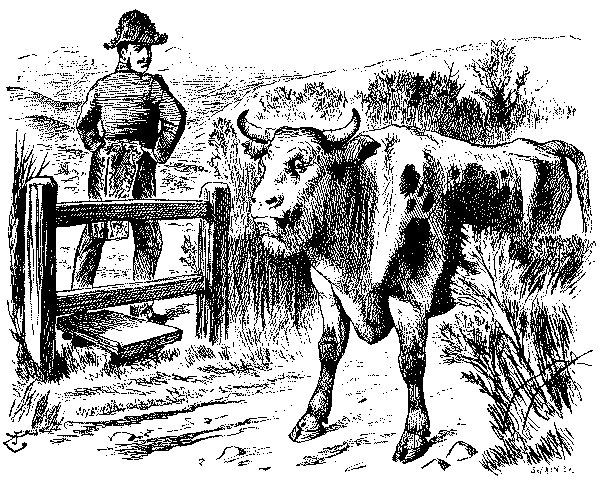
THE SMILE THAT FAILED
Sir Alfr-d M-ln-r again sings:—
"There was a 'High Com.' who said, 'Now I've conferred with this wily old cow! I have sat on this stile, And continued to smile, But it's had no effect on the Cow!'" (Exit.)
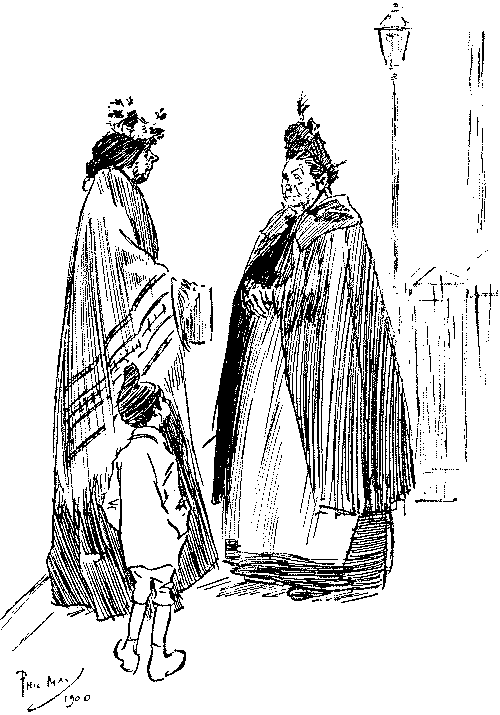
"Yer know, them Boers 'as been storin' guns and hambition for years!"
The Boer War
A very different reading of the situation is given in the letter to Sir Alfred Milner published a week later. Here the High Commissioner is heavily censured not for the failure of the conference, but for the "ridiculous" and "frothy" tone of his dispatch about "helots," and for his rash, impetuous and overbearing temper. In July Punch was still inclined to make light of the whole business, apparently expecting an amicable settlement, and in a burlesque "Story of a Crisis" in "Nabothsland" reflected adversely if obliquely on the pretensions of the Uitlanders. Yet early in September sympathy with the Uitlanders underlies the verses condemning the inconsistency of Little Englanders, who in theory espouse the cause of all oppressed nationalities but their own. The damning blot on the Uitlanders' cause was that they were English. If they had been Finns, for instance, the Little Englander would have shed his last drop of ink in their defence. This was at the lowest a good debating point, and at all points preferable to the unfortunate picture ridiculing the unmilitary appearance of the Boers, President Krüger being shown in the act of reviewing his veterans, a number of fat, unwieldy farmers. The declaration of war came early in October, and Punch unhesitatingly declared his support of the decision in the cartoon "Plain English," where John Bull says to the Boers: "As you will fight, you shall have it. This time it is a fight to a finish." So it was; but few, except Lord Wolseley, expected that the finish would only be reached after a long, obstinate and costly struggle. Lord Wolseley's warning in September, 1899, foreshadows the more famous anticipation of the duration of the Great War made by Lord Kitchener fifteen years later. Many other parallels and contrasts are suggested in Punch's pages as he reflects the varying moods of England during the chequered progress of the campaign. The divisions of opinion at home were more acute than in 1914. Moreover, we entered on the Boer war in a spirit of confidence and complacency which rendered the initial reverses more surprising and depressing. Otherwise the alternations of despondency and elation; the criticisms of mismanagement, laxity and indifference, want of intelligence and imagination; and the charges against the enemy of disregarding the rules of the game have a curiously familiar ring. Punch reflected popular opinion in resenting the "detachment" of Mr. Balfour in describing our reverses as "inevitable," and in rebuking the optimism of other Ministers; in his demand for the "facts"; in attributing to President Krüger gratitude to the Opposition for their assistance; in his cheering message to Baden-Powell for "keeping his end up" in Mafeking. Yet he commented severely on the diamond speculators for their "operations" during the war; he had a good word for Lord Morley when he was attacked as a Little Englander; and a strong rebuke for the agencies which announced tours to the South African battlefields as early as April, 1900. Punch had shown John Bull as Mark Tapley—when Kimberley had been relieved and Lord Roberts was advancing—but his comments on the publication of the Spion Kop dispatches reveal grave dissatisfaction with the conduct of the Natal campaign:—
SOME ONE HAD BLUNDERED
Sir Redvers devised an impossible plan Which he trusted to Warren, an obstinate man; Lord Roberts sent home some dispatches, and there He freely expressed what he thought of the pair. The War Office published these documents plain, To the joy of their foes, and the grief of the sane; And while they were reading them, all the world wondered, And promptly concluded that everyone blundered.
Humorous relief was provided by the report that Krüger had encouraged his burghers by circulating the news that London had been captured by the Russians, a method foreshadowing the imaginative exploits of the Germans in the late war. It was based, however, on an incontestable fact—our unpopularity in both hemispheres. The Boer delegates had been welcomed in America, though Punch sought to discount the effect of their propaganda by a cartoon in which Columbia reassures John Bull: "Don't mind those noisy boys of mine. You know, my dear, it's Election Time."
The Anglophobe feeling was much more vocal in France, and Punch gives a curious account of the Transvaal section of the Paris Exhibition in October, where signatures were invited and freely appended to addresses to the two Presidents, the bust of Krüger was crowned with palm branches, poetic eulogies were circulated, and the walls covered with "Mort aux Anglais," "Chamberlain est un vache," etc. Meanwhile, Mafeking had been relieved, and Punch had defended the "loud extremes of passionate joy" which added the now well-nigh forgotten verb "to Maffick" to our current vocabulary. Lord Roberts's uninterrupted advance to Pretoria had moved Punch, with many others, to declare very prematurely on June 6th that the war was practically over, though it lasted nearly two years longer, and the slow progress of "rounding up" the Boers actually prompted the suggestion from a leading paper that Lord Kitchener should be recalled and Lord Roberts sent out again. President Krüger's flitting is illustrated in a cartoon in which "Oom Paul" is seen in a small boat, with two millions of treasure, quitting the sinking ship Transvaal; while in a set of verses, written after reading of his triumphal progress through France, Punch prophesies for him a green old age in Grosvenor Square. The C.I.V.'s returned in the autumn and were welcomed by the City of London; and shortly afterwards "a Mr. Williams offered respectful apologies to Satan for mentioning him in the same breath with Lord Kitchener." Punch, even in his most Chauvinistic mood, never indulged in such abuse of the Boer generals, and at the end of 1900 paid a well-deserved compliment to the elusive De Wet in his cartoon of "De Wet o' de Wisp."
China and Australia
Before dealing with the subsequent progress of the "guerrilla war," we may turn aside for a moment to other developments overseas. In an epigram on "The Millennium" in August, 1900, Punch writes:—
In some problematic day Strife and wrath shall fade away, Crews no longer blessing pouring On the coxes who have cox'd, When the Boers shall cease from boring And the Boxers shall be boxed.
The revolt of the Boxers in China and the joint expedition of the European Powers assisted by Japan to relieve the Legations in Peking are treated in two cartoons. In the first, in which the Chinese Dragon is seen in the background, Japan expresses her readiness to help the European Powers. She is glad to join them, "but permit me to remark that if some of you hadn't interfered when I had him down, it would have saved all this trouble"—a legitimate comment on the intervention of Germany and Russia after the Chino-Japanese war. In the second, "The Closed Door," Europa is seen armed with an axe, preparing to break her way in to the relief of the Legations. Apocryphal reports of what was happening in China reached a high-water mark of mendacity this summer, and the English Press did not escape the charge of credulity, to put it mildly. Reports of the death of the Dowager Empress were so common as to inspire Punch with a poetic homage to the "lady of the charmed life," and when she shifted her capital, he showed Krüger looking over a wall at her exodus with the remark: "My idea!"
It was in 1900 also that the Australian Commonwealth Bill was introduced by Mr. Chamberlain. Punch in his first reference to the measure, animated by a recognition of Australia's loyalty in the Boer war, assumed that Clause 74, abolishing the appeal to the Privy Council, would be passed. Australia is seen showing the new latchkey she has had made, as she wanted a little more freedom, and Britannia declares her readiness to trust her. This proved premature, and a little later on Punch, in a letter to the Australian delegates, waxes sarcastic over the "niggling, pedantic and pettifogging inquisition which it was proposed to institute into the demand for Federation"—à propos of the Privy Council Appeals. As a matter of fact, the clause was amended, because the States were not at one on the point, and all seven Chief Justices favoured the maintenance of the right of Appeal.
Lord Roberts returned to England at the close of the year, and Punch saluted his arrival in "The Home-coming of the Chief." His great services are acknowledged, not least his self-sacrifice in the hour of bitter personal loss:—
Ah! but while a nation's cries Storm against our sullen skies 'Midst the madness and the mirth Flung about your victor's way, If behind the brave array All the hidden heart were known, Save for love of England's name Gladly would you yield the prize, Glory, triumph, wealth and fame, Could you win one grace alone, Could you have your boy again Home from where he takes his rest Lying under alien earth By Colenso's dreadful plain, With the Cross above his breast.
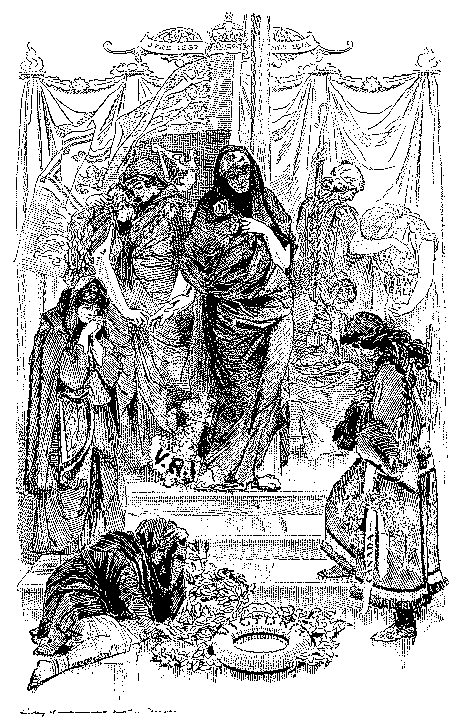
"REQUIESCAT!"
That is truly and finely said, and yet how strangely the epithet "dreadful" sounds to those who have found all the vocabulary of horror beggared by the experiences of the Great War! The opening of the New Year was clouded by the passing of Queen Victoria. In all the sixty years of Punch's existence, even in the moods when his comments on Court and Crown had been frank to the verge of audacity, loyalty to the person of the Sovereign had never failed. His adverse criticism was seldom malicious, and was almost always animated by a desire that the Sovereign should never fall below the standard of noblesse oblige. The days of resentment against the Queen's prolonged seclusion had long passed. She had ceased to be "the Royal Recluse," and was unsparing of herself in the discharge of her duties up to within a few weeks of her death. When she spoke in one of her messages of "her beloved people," there could be no question of her sincerity, or of the devotion with which her love was returned.
As Mr. Balfour said significantly of her: "Even those who loved not England loved her," and in later years those who came to scoff at her memory remained to praise:—
THE QUEEN
Born May 24, 1819. Died January 22, 1901.
The tears we disallow to lesser ill Here is no shame for English eyes to shed, Because the noblest heart of all is still— Because the Queen lies dead. Grief asks for words, yet silent grief were well; Vain is desire, as passionate prayer was vain; Not all our love can bring, by any spell, Breath to those lips again. Ah! had but Death forgone his royal claim, Demanding ransom, life for life the price, How loyalty had leaped to kiss the flame Of such a sacrifice! God knows, in many a need this thing has been— Light hearts for her have dared the desolate grave; From other hurt their blood has saved the Queen, From Death it could not save. And of the dregs to drink from sorrow's cup This is most bitter, that with life's release She might not leave her children folded up Between the wings of Peace. Yet, for a solace in that darkest hour, When even Kings have found themselves alone, Over a people's love she kept her power Firm as her fathers' throne.
Candid Friends and Hostile Critics
The "Khaki" election of the previous autumn, at which the Government had appealed to the country to decide the issue of fighting the war to a finish, had resulted in the return of the Unionists by a majority of 134, but did not abate the activities of the "Stop the War" party. They were stimulated to further and more vehement protests by the policy of the Concentration Camps, and the loss of life through epidemics caused by the compulsory herding together of those who were interned. Between the denunciations of British "brutalities" by the German Press and the talk of "hecatombs of slaughtered babes" by British Liberals—between "candid friends" and hostile critics—there was not much to choose. Punch invoked the shade of Bismarck to rebuke the excesses of the German journalists; he ridiculed Miss Emily Hobhouse's descriptions of Concentration Camp horrors by giving a list of the luxuries which were not provided there—hairpins, curling-tongs, etc.—and in a cartoon at the close of the year represented the "Stop the War" group as making such a noise that Peace's voice could not be heard. Cleavage was shown in the ranks of the Opposition, and Punch did not fail to emphasize the divergences between Mr. Asquith and the Imperialist Liberals on the one side, and "C.-B." and Sir William Harcourt on the other. General Baden-Powell arrived in England in July, and Punch's greeting aptly describes his mood and that of the man in the street:—
Time has flown; but not forgotten is the tale of Mafeking! Who that lived that Day in London could forget its echoing ring? How the Town broke into bunting, Piccadilly to Mile End! How each man for joy saluted every other man as friend! How we crowded to the city in an orgy of delight, Tumbled out of bed for gladness, waving Union Jacks all night! Even if we overdid it after deadening suspense, Better this than anti-British Queen's Hall windbags' insolence! Though we later coined a playful word, our soberer sense to show, I would rather "maffick" daily than abet a treacherous foe!
In the controversies that arose over the treatment of various British generals, I may note that Punch supported the motion for an inquiry into the circumstances under which General Colvile was deprived of his command, which was negatived in the House by 262 votes to 248. Over the still more thorny question of General Buller's conduct of the Natal campaign he preserved an impartial attitude, while implying that the general would not exploit his grievance for political purposes. Early in the war Punch paid a rather left-handed compliment to the war correspondents; they are represented as welcoming war because it brought them remunerative employment. In the autumn of 1901 we find him pressing their claims for war medals, and observing that the Press had been shut out but not shut up.
The war, he also notes on the authority of a daily paper, had produced more poets than any similar crisis in English history. A more striking parallel with recent war-products is to be found in Punch's review of the depression, discontent and decline of trade which it had begun to cause before hostilities ceased. This is clearly shown in July, 1901, in the Preface to Vol. cxxi, where Punch rebukes John Bull, no longer in his Mark Tapley vein, for listening to pessimists, and encouraging a seditious and pernicious Press. In the opening stages of the war Punch had been none too friendly to Lord Methuen, but he was righteously indignant at the "Ghoul-like ecstasy" of the Irish Members who cheered the news of the defeat and capture of that gallant soldier in the spring of 1902. The end of the war came in June, and is chronicled in Punch's "Cease Fire" cartoon. The happiest incident of the surrender was the speech made by Lord Kitchener to the Boer delegates at Vereeniging when he said that "if he had been one of them, he would have been proud to have done so well in the field as they had done." Punch did well to record it, for it reflected the national respect felt for a stubborn foe. For confirmation we need only turn to the laconic entry in the National Register for August 16, 1902: "The Boer generals, Botha, De Wet and Delarey ... proceeded to London, and had an enthusiastic popular reception." Subsequent events have justified the somewhat complacent remark attributed to John Bull in the cartoon two months later, à propos of the grant of £3,000,000 to the Transvaal, and the Boers' "Appeal to the Civilized World": "Look here, my friend, stick that up, if you like; but I think you'll find that I talk less than the others and give more."
Lord Kitchener's Return
Lord Kitchener had returned in July, and Punch's welcome ends on a prophetic note:—
You're a worker from of old, K. of K. Pomps and pæans leave you cold, K. of K. You would like to land in mufti, You would hurry down the dock Not in trappings, plumed and tufty, But in checks and billycock! And you haven't, now It's over, Come to stay; Nor to lie at length in clover, But to change your train for Dover, K. of K. For, although the work's appalling Which should have you here at hand, Yet you've heard the East a-calling Out of India's coral strand; And, as soon as time and place Let our feelings find release, And we've called you, to your face, First in War and first in Peace;— Thither where the Empire needs you, K. of K., And your own "Ubique" leads you, Lies your way!
Mr. Roosevelt had succeeded to the Presidency of the United States on the assassination of Mr. McKinley, and Punch, after condoling with Columbia, saluted the "Rough-Rider."
Our closer relations with Japan and their effect on Russia are symbolized in the cartoon in which she remarks as a tertia anything but gaudens: "H'm—I don't like these confidences." In Europe the subject that provoked Punch's closest attention was the treatment of the Poles by Germany. There is an amusing story in "Charivaria," probably apocryphal, but not beyond the possibilities of Prussian pedantry:—
Fifty Prussian schoolgirls have been arrested at Gnesen on a charge of high treason, and the police are said to have their eyes on several Kindergartens, where it is reported that the children have been playing "I'm the king of the Castle" and other games suggestive of Majestätsbeleidigung.
But the whole essence of "Prussification" is summed up in the last quatrain of a brilliant adaptation of the "Pied Piper of Hamelin" to the situation in Posen:—
You can take a Pole, as I understand, And play on his nerves with a German Band; But you can't convert his natural temper, or Get him to jig for a German Emperor.
Lord Salisbury had resigned in the summer of 1902, and Mr. Balfour had succeeded to the Premiership. It was not exactly a case of "Amurath to Amurath," but with nephew succeeding to uncle, and the presence of another nephew and a son-in-law in the Cabinet, there was some ground for the once familiar gibes against the "Hotel Cecil." Punch was not unfriendly to the new Premier, and applauded his handling of the negotiations initiated by Germany to secure a British subsidy to the German-controlled Baghdad railway. In "The Trap that Failed," the British Lion "doesn't like the look of it and resolves to go round the other way"; and the verses (after Omar Khayyám) indicate the surprise of "the Potter of Potsdam" at the unexpected firmness of Mr. Balfour. The gradual improvement of our relations with other foreign Powers is symbolized in "The Chain of Friendship," showing King Edward joining in a dance with France, Italy and Portugal; while the strengthening of the Anglo-French Entente is illustrated in the cartoon in which King Edward, presenting the British Lion, says to the French President: "See, M. Loubet, he offers you his paw." An element of reserve, however, is shown in a dialogue in French, mildly satirizing the new Anglomania; and in the burlesque sketch foreshadowing the ludicrous and disastrous influence on both countries of the Entente—e.g. the re-introduction of the duel on the initiative of the Daily Mail; the presentation of Waterloo Station to the French and, as a set-off, the presentation of the Keys of Calais to the Lord Mayor of London by the Paris Municipal Council. To turn from gay to grave, this was the year of the assassination of the King and Queen of Serbia, recorded in the cartoon of "Murder as the King Maker."
Ireland, Army Reform, and India
Home politics fill a larger space in 1903 in Punch's pages than for some years previously. Remedial legislation in Ireland inspires the cartoon of Mr. Balfour as St. Patrick—a saint invaluable to the harassed cartoonist—driving out the snakes of sedition. The basis of Mr. Wyndham's Land Purchase Act is well shown in the cartoon illustrating the financial relations of the two countries. Tenant and landlord both present money-boxes labelled "Land Purchase" to John Bull, asking him to "put a thrifle in them"; John Bull scratches his head, but he pays all the same. The difficulties of Mr. Brodrick in securing national support for Army Reform are set forth in the verses on "The Unhappy Warrior" (after Wordsworth), and the cartoon "Ready, aye unready," with John Bull asleep on sentry duty—à propos of the Report of the Royal Commission on the South African war. A little later, John Bull's short memory is satirized in his protest against the size of his new watch-dog. Forgetting that he had clamoured for increase, he now declares that he cannot afford him.
At the opening of the year Punch had lavishly chronicled the glories of the Delhi Durbar. "The Pilgrims to the East" included three members of his staff, who did justice to the occasion both with pen and pencil, and Sambourne's fine cartoon, "Vivat Imperator," forms an instructive pendant and palinode to Punch's anti-imperialist misgivings of 1876, when he regarded the assumption of the new title as a piece of shoddy Disraelian Orientalism.
Lord Salisbury's death in 1903 removed a great figure, whose prestige has grown with the knowledge available in later years. We have learned to revise the old view of his political stature as compared with that of Lord Beaconsfield, and to reject the often-quoted but quite erroneous saying attributed to Bismarck that he was "a lath painted to resemble iron." Punch's memorial tribute admits that he "nothing common did or mean":—
When Lord Salisbury, resigning the Premiership, practically retired from public life, a gap was made in the House of Lords no living man might fill. Only once has he returned to the scene of memorable labour. He came with the rest of the cloaked Peers to pay homage to King Edward the Seventh when first he seated himself on the throne which he had long regarded from the point of view of the Cross Benches. There was hope that the ex-Premier would, from time to time, still give the House and the country the advantage of his sagacious counsel, the pleasure of listening to his brilliant speech. But, like the other tall man in another chair, "his heart was worn with work." He was sick of the sometimes mean rivalry of political life, and felt he had earned his leisure.
In a manner unique Lord Salisbury had the faculty of standing apart from his fellow men, regarding them and appraising them as if he himself did not belong to the genus. It was as if a man from Mars had visited our planet, studying its pygmy population with amused, on the whole scornful interest. With one exception he was the only statesman who never bent the knee to the Baal known in political chatter as The Man in the Street. The exception is, of course, the Duke of Devonshire, who had further kinship with the Marquis in respect of absolute freedom from desire to get anything for himself out of the game of politics. Intellectually and morally—this latter more precious because more rare—Lord Salisbury uplifted and maintained at high level the standard of English public life. He was a man whom foreigners, equally with his own countrymen, unreservedly trusted, because of a personal quality worth the whole armoury of diplomacy.
With his withdrawal from the stage, the House of Lords as a debating assembly lost its chief attraction. It was worth sitting through a dreary couple of hours for the chance reward of hearing him speak. Whilst others discoursed he sat impassive, taking no note, making no sign of hearing, or caring about, what the noble lord on his legs said or left unspoken. Only a curious rapid movement of the crossed leg betokened cogitation, betrayed closest attention, and the framing of some sentences that would presently play about the adversary's head like forked lightning.
The Fiscal Fray
An event of greater immediate interest which coincided with the passing of Lord Salisbury was the resignation of Mr. Chamberlain. On his return from a strenuous and exhausting tour in South Africa, he had thrown himself with immense energy into the Tariff Reform campaign, and withdrew from the Cabinet in order to devote his entire energies to the prosecution of the cause. Punch's pages throughout the second half of 1903 furnish a lively chronicle of the progress of Mr. Chamberlain's crusade and the wonderful egg-dance of Mr. Balfour. Early in September the situation is portrayed in "The Parting of the Ways." Mr. Balfour, "long troubled by philosophic doubt," is shown on the road with a knapsack labelled "Treasury Returns" and "Board of Trade Returns," looking at a sign-post, one arm pointing to Chatsworth, the other to Highbury, and saying: "Well, now, I suppose I must really make up my mind."
A week later we have the Fiscal Hamlet in "The Unready Reckoner." Prince Arthur remarks: "O dear Ophelia, I am ill at these numbers; I have not the art to reckon," while on the wall hangs a portrait of Mr. Chamberlain as Ophelia. In November, under the heading "An Eye for Effect," Punch exhibits "Foreign Competition" as a Guy on a barrow, with Mr. Chamberlain in charge and conversing with Mr. Balfour:—
Arthur: "Ain't you made 'im too 'orrible?" Joe: "No fear! You can't make 'em too 'orrible!"
Simultaneously, Punch published a burlesque on the Daily Mail's canvass, with expressions of opinion from Henry James, Rudyard Kipling and Mr. A. B. Walkley. The Daily Express, not to be outdone, offered a prize of £25 to the owner of the first parrot taught to speak distinctly the phrase: "Your food will cost you more." The "folly of the fray" was not overlooked, but Punch did not misread its essential significance in his cartoon of Mr. Chamberlain in the guise of the political Ancient Mariner who had slain the albatross of Conservative unity.
Foreign politics once more dominated the scene in 1904, when the legacy of friction, bequeathed by Russia's intervention at the close of the Chino-Japanese war and her Manchurian policy after the "Boxer" outbreak, bore its inevitable fruit in the Russo-Japanese war. The sympathy of England with Japan is reflected in the pages of Punch. He rebuked the hissing of Russian performers at a performance in the provinces; but satirized the indignation generally expressed in Russia that Japan should have begun hostilities without a formal declaration, or, as Punch put it, without consulting Russia as to whether the date was convenient to her. The fervent patriotism of the Japanese army is cordially applauded: John Bull is shown in a mood of envy, thinking he must try to introduce it at home. The unfortunate Dogger Bank incident, when Admiral Rozhdestvensky's fleet, on their way out to the Far East, fired on a fleet of British trawlers, aroused great indignation, mixed with bitter satire of Russian nerves and thrasonical satisfaction. Punch published a scarifying parody of Campbell's "Battle of the Baltic" on this "famous victory" over a "hostile trawling fleet" engaged in "gutting plaice." Later on in "Admirals All" there is an equally sarcastic comment on the Report of the North Sea Court of Inquiry, at which the Russians were exculpated by an Austrian Admiral. Nor was Punch's indignation expressed against Russia alone. The acceptance of Russian orders by British coal exporters is chastised in a cartoon with the legend as under:—
Old King Coal Was a sordid old soul, And a sordid old soul was he: He sold to the Russ, And he didn't care a cuss, And the Baltic fleet crossed the sea.
On the fall of Port Arthur, however, Punch did not forget to acknowledge the heroism of the defence: here, at least, "the honour of the Russian eagle was untarnished." The war ended in May, 1905, but before its close Russian internal unrest had become menacing and hampered the prosecution of hostilities. Punch read the signs of the times truly in his cartoon of Death as the Czar of all the Russias, with a figure holding a "Petition" lying slain at his feet; and again in his rather cruel verses to "The Little Father":—
THE LITTLE FATHER
Nichol, Nichol, little Czar, How I wonder where you are! You who thought it best to fly, Being so afraid to die. Now the sullen crowds are gone, Now there's nought to fire upon; Sweet your sleigh bells ring afar, Tinkle, tinkle, little Czar. Little Czar, with soul so small, How are you a Czar at all? Yours had been a happier lot In some peasant's humble cot. Yet to you was given a day With a noble part to play, As an Emperor and a Man; When it came—"then Nicky ran." Little Czar, beware the hour When the people strikes at Power; Soul and body held in thrall, They are human after all. Thrones that reek of blood and tears Fall before the avenging years. While you watch your sinking star, Tremble, tremble, little Czar!
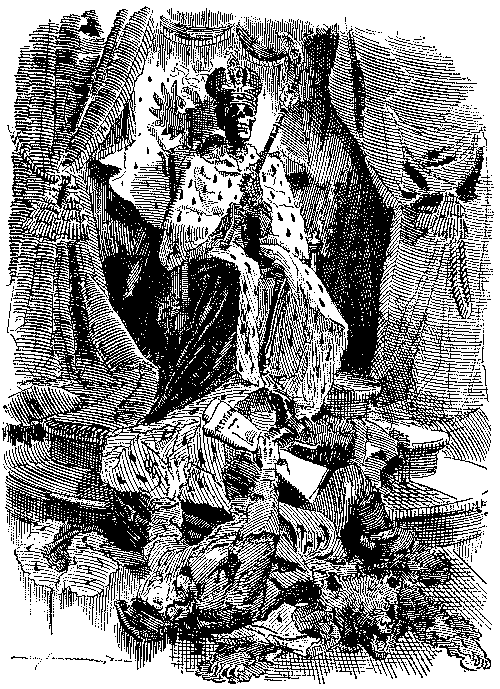
THE CZAR OF ALL THE RUSSIAS
The contrasted outlook in Russia and Japan is shown in "Peace and After"—gloom and storm in the one country, general rejoicing in the other. The signing of the Peace in October brought mutiny and insurrection in Russia, repressed for the moment by grape-shot and concessions. Punch distrusted the former method, and warned the Tsar through the mouth of Louis XVI: "Side with the people, Sire, while there is yet time. I was too late." The instalment of constitutional government granted was shorn of its grace by the antecedent display of ruthlessness. Punch typified this situation in his cartoon of the Tsar armed with a sword and leaning on a cannon, with corpses strewn around, and saying: "Now I think the way is clear for universal suffrage." But Punch was premature in saluting the first Duma—opened by the Tsar in person in May, 1906—as the Infant Hercules strangling the twin snakes of Bureaucracy and Despotism. It was the Duma which was strangled by these forces, of which the first was the more potent and malign.
Belgium and Germany
Another foreign monarch who came in for severe criticism in these years was King Leopold II of the Belgians. Quite recently he had been treated by Punch with a benevolence that bordered on fulsomeness. But 1904 was the year of the "Congo Atrocities," and Punch, in a cartoon modelled on the ancient Egyptian lines, compared him with the Pharaoh Rameses II whose scribes counted over the hands cut from his vanquished enemies. This was suggested by the stories of the similar treatment of the natives in the rubber plantations vouched for by the British Consul at Boma. The value of this evidence has since been impaired by the fact that the Consul in question was none other than Roger Casement. From Belgium to Germany the transition is easy. In the last two years of the Unionist administration, German aggressiveness is a constant theme of comment, mainly inspired by misgiving, occasionally enlivened by burlesque belittlement of scaremongers. To the latter category belongs the forecast, at the close of 1904, of the invasion of London, seized during a week-end exodus of its inhabitants. Nor should we fail to note the series of appreciative articles on life in Berlin in 1905, in which "Tom the Tourist" finds the German capital "one of the liveliest, pleasantest and handsomest of cities," and descants on its good beer, pleasant company, genial hospitality, and the absence of any sign of hatred of the British. The writer even goes so far as to compare the Sieges-Allée favourably with some of the statuary of London. But a different note is struck in the lines on the vicarious patriotism of those who objected to conscription; in the references to the inadequacy of our coast defences; in the satisfaction expressed in the appointment of Sir John Fisher as First Sea Lord, and the improvement in naval gunnery; and in the satire directed against the new German Chancellor, Count von Bülow, for his cynical "blague." As "Der Taubadler," he reproves President Roosevelt for Jingoism, and declares:—
Our passion for ruling the brine Is based on a single and pure design— To serve as a sort of Marine Police, Patrons of Universal Peace.
Lord Roberts's warning speech at the London Chamber of Commerce in the late summer of 1902 had prompted the cartoon "The Call to Arms." John Bull, aroused from slumber and only half-awake, asks "What's wrong?" Lord Roberts, the warning warder, replies: "You are absolutely unfitted and unprepared for war!" whereon John Bull rejoins drowsily: "Am I? You do surprise me," and goes to bed again. Growing distrust of the Kaiser is shown in the cartoon in which he figures as "The Sower of Tares" after Millais's picture, while Punch simultaneously manifests his satisfaction at the strengthening of the Anglo-French Entente. The British working man, if Punch is to be believed, disliked all foreigners, but his pet aversion was "them blooming Germans." There was, at any rate, a legitimate grievance in the fact that fifty-nine foreign pilots were employed on our coasts, whereas abroad our ships were compelled to take native pilots; and the Nelson Centenary on October 21, 1905, impelled Punch, in an address to the hero of Trafalgar, to deplore the decay of national patriotism in a vein of pessimism happily falsified ten years later:—
Much you would have to marvel at Could you return this autumn-tide; You'd find the Fleet—thank God for that— Staunch and alert as when you died; But, elsewhere, few to play your part, Ready at need and ripe for action; The rest—in idle ease of heart Smiling an unctuous satisfaction. I doubt if you could well endure These new ideals (so changed we are), Undreamed, Horatio, in your Philosophy of Trafalgar; And, should you still "expect" to see The standard reached which you erected, Nothing just now would seem to be So certain as the unexpected.
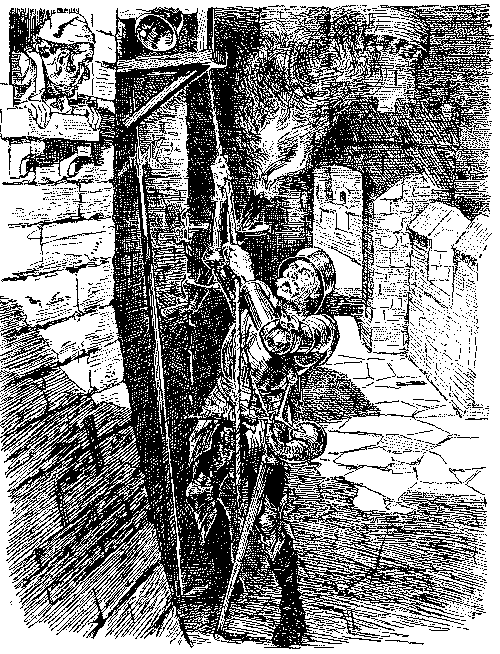
THE CALL TO ARMS!
John Bull (aroused from slumber and only half awake): "What's wrong?"
Lord Roberts (the warning Warder): "You are absolutely unfitted and unprepared for war!"
John Bull (drowsily): "Am I? You do surprise me!" (Goes to bed again.)
(Vide speech by Lord Roberts at meeting of London Chamber of Commerce, Mansion House.)
The "decline and fall" of the Unionist administration are symbolized and explained in two cartoons in the late summer of 1905. In one Mr. Balfour is seen, a lonely swimmer, wallowing in the sea of Public Opinion. A voice from the Tug (Tory Organization) hails him, urging him to keep afloat and he'll "drift in to the shore" (Session 1906). He replies that he "can't do much against a tide like this." The sources of weakness are even better diagnosed in the cartoon of August 30, "Shelved," showing the group of statesmen who had resigned—the Duke of Devonshire, Mr. Ritchie, Lord Balfour of Burleigh, Lord George Hamilton and Mr. George Wyndham.
The rout of the Government at the General Election of 1906 was a veritable débâcle. Liberal candidates were returned who never got in before or after: there is a story of one so overwhelmed by his wholly unexpected success that he fainted on the declaration of the poll. Ministers went down like ninepins, and on the meeting of the new Parliament Punch descants on the disappearance of the "old familiar faces"—Mr. Arthur Balfour and his brother Gerald, Alfred Lyttelton and St. John Brodrick, Bonar Law, Sir John Gorst, Sir Albert Rollit, Sir W. Hart Dyke, Gibson Bowles, and, "saddest fate of all and most lamented," Mr. Henry Chaplin. The emergence of a new, formidable, but uncertain factor was at once recognized in the cartoon in which John Bull looks over the wall at a bull labelled Labour Vote. The Trade Disputes Bill, the first and most notable concession to the demands of Trade Unionism, is discussed in the next section.
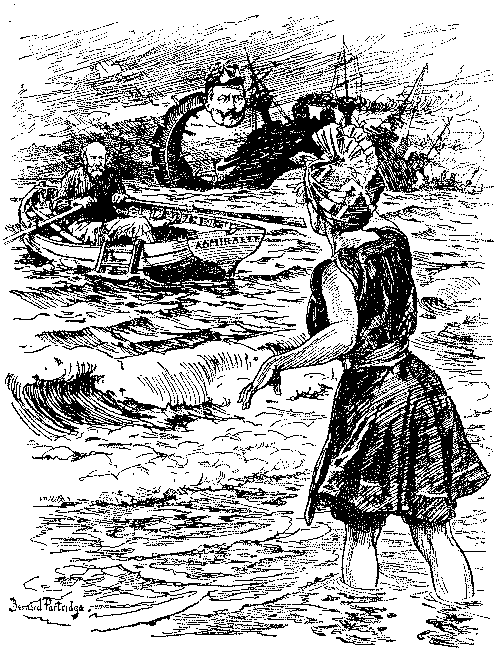
AN UNDER-RATED MONSTER
Britannia: "That's a nasty-looking object, Mr. Boatman!"
Lord Tw-dm-th: "Bless your 'eart, mum, 'e won't 'urt you. I've been here, man an' boy, for the last six months, an' we don't take no account o' them things!"
Punch was more preoccupied with Lord Haldane's new army scheme, and when the War Minister, in introducing it, declared that the country would not be "dragooned into conscription," interpreted his statement "in other and less conventional terms" as indicating a conviction that "it is the inalienable right of the free-born British citizen to decline to lift a finger in his country's defence." Lord Haldane's proposals for retrenchment are symbolized in his efforts to make big toy soldiers fit his box, instead of making the box fit the soldiers. Wasters and loafers who had cheered "Bobs" on his return from South Africa are shown expressing indignation at his wanting to enforce universal military service. Punch's reluctant admission of our national lethargy finds vent in a dialogue emphasizing the predominance of the Panem et Circenses spirit—devotion to the Big Loaf and spectacular games—coupled with a loss of our supremacy in games. The pageant mania became acute in 1907, when Punch satirically asks, "Can you cite any other country where it is impossible to walk out of doors without colliding with an historical pageant?"