CAPITAL AND LABOUR
Reading edition
The fervid Radicalism of Punch's earlier years had always been tempered by a distrust of "agitators" and socialistic experiments. It is impossible to deny that, in the period under review in this volume, this distrust gained in force if not in vehemence. There is nothing so bitter as the sketch of the delegate which appeared in the days of Douglas Jerrold (see Vol. I, p. 50), but the general attitude of the paper to the working man is decidedly less sympathetic. This change can be illustrated negatively as well as positively; less space is devoted to "the people," and more to "Society"—though in many cases it is suburban society—and to the middle classes. The references to Labour exhibit an increasing tendency to criticize and denounce trade union tyranny, socialistic legislation, the improvidence and extravagance of highly paid workmen, and "ergophobia" (as Punch academically calls work-shyness)—a habit which he describes as early as 1892 as "the new employment of being 'unemployed.'" Yet if Punch was increasingly critical of Labour—organized Labour—he was very far from being a thick-and-thin champion of Capital. Greedy employers and directors are never spared. The agricultural depression in 1892 furnishes him with the occasion for a vigorous onslaught on railway rates. Agriculture is shown as a female figure, bound hand and foot by Foreign Competition, lying prostrate on the track and about to be run down by an engine labelled Railway Rates. In 1895 the verses and cartoon inspired by lock-outs on the Clyde are equally severe on the employers. Punch condemns the action of "crass and unpatriotic capital," and shows Britannia rebuking the shipbuilders who are playing into Germany's hands by assisting the growth of her navy. In 1896, under the heading of "The Millions to the Millionaires," Punch takes for his text an actual appeal made by the working men of Walworth on the death of Baron Hirsch, à propos of his munificent bequests to his countrymen, and holds up the example for imitation. The continuance of the habit of "slumming," out of curiosity rather than good will, prompts in 1897 a satirical inversion of the organized visits to the East End. Punch's "West End Exploration Agency, Ltd.," provided "Night Tours through Belgravia and Lightest London" with the purpose of proving "the depressing monotony and triviality of the existence to which Fashion's merciless decree condemns her countless thousands of white slaves."
The debate in the Commons in the same year over Lord Penrhyn's dispute with his quarrymen found Punch decidedly hostile to the young Tory lions who supported that inflexible peer. When in 1900 the Coal Mining Companies in Fife declared a dividend of 50 per cent., and the price of coal was still rising, Punch castigated the greed of the owners. In 1907 the miners are exempted from any share of the responsibility for the high cost of coal. The triple Cerberus who dominates the situation is made up of the colliery owner, the coal merchant and the railway company. But as the price this joint monster exacted was only 30s. a ton—exorbitant for the time, no doubt—it is hard for this generation to share Punch's sympathy for the consumer. As late as 1912, when the coal crisis again became acute, Punch, though resenting the increased resort to the strike weapon, represents the merchant profiteer as in clover while Britannia is the victim of his avarice.
Underpaid Women Workers
On behalf of unorganized labour, when it was unfairly exploited by the employer, Punch continued to lift up his voice in the old strain. In 1893 the hard case of the shopgirls, slave-driven by exacting masters, always standing, too tired at the end of the week to profit by Sunday, prompts him to a plea for a true Day of Rest. The verses, like the "Cry of the City Clerk," are vitiated by their sentimentality. There is more vigour in the lines "'Arriet on Labour" in the same year, which show that the new type of woman was not confined to the upper classes. 'Arriet is a workgirl who works hard, loves her freedom and nights off, has no respect for spouting Labour candidates, and no envy of married drudges:—
Labour? Well, yus, the best of hus must work; yer carn't git quit of it; And you and me, Poll, like the rest, must do our little bit of it. But oh, I loves my freedom, Poll, my hevenings hoff is 'eaven; But wives and slavies ain't allowed even one day in seven. Jigger the men! Sam spouts and shouts about the 'Onest Worker. That always means a Man, of course—he's a smart Man, the shirker. But when a Man lives upon his wife, and skulks around his diggings, Who is the "'Onest Worker" then? Yours truly, 'Arriet 'Iggings.
Another "hard case" exposed by Punch in the following year was that of the rural schoolmistress, contrasted unfavourably with Crabbe's version. Punch took his cue from a paper read by Dr. Macnamara at a meeting of the N.U.T. and drew a lamentable picture of the weary, overworked and miserably underpaid teacher, "passing poor on £40 a year." The picture was obviously drawn at second-hand, but the line in which the schoolmistress is described as "a lonely, tired, certificated slave" was an excellent summary of a real hardship. Women workers were not only slave-driven by employers and underpaid by the State; they were also handicapped by the competition of their sisters who only worked for pocket-money. This, at least, was the burden of a complaint made by an old-fashioned woman in the Daily Chronicle in the autumn of 1895:—
"In every branch of work we see well-to-do women crowding into the ranks of competition, in consequence of which wages are lowered, and women who really want work are left to starve."
This letter inspired Punch to deliver a fierce homily in verse on the wickedness of well-to-do women "playing at work," to the detriment of their poor sisters. As a set-off, however, we may note that in 1897 Punch condemns mistresses for exploiting "Lady servants," getting them to do double the work for half the ordinary wages because of their inability to stand up for themselves. Sweated women workers were still to be found in the tailoring trade, and Punch did well in 1896 to retell in his columns the story of the tailoress, Mary Ould of Peckham, as unfolded before the Lambeth County Court. She had to buy her own materials and pay her fare for fetching and carrying work; she toiled till 10 p.m. from Saturday till Thursday and, at ¾d. per coat, earned 3s. The pillorying of these abuses did credit to Punch's humanity, but as they were nearly always chosen from unorganized trades, they became increasingly difficult to reconcile with his increasing hostility to trade union organization, and his distrust of legislation expressly designed to satisfy the demands of Labour. Philanthropic efforts to relieve the squalor of the home life of the poor were another matter. To the appeals of the Children's Country Holiday Fund Punch always lent a ready ear, and when Canon Barnett arranged an exhibition of Watts's pictures in Whitechapel, Punch vigorously applauded the scheme. Pictures were as good as sermons, and better than many:—
Where Whitechapel's darkness the weary eyes of the dreary worker dims, It may be found that Watts's pictures do better than Watts's hymns.
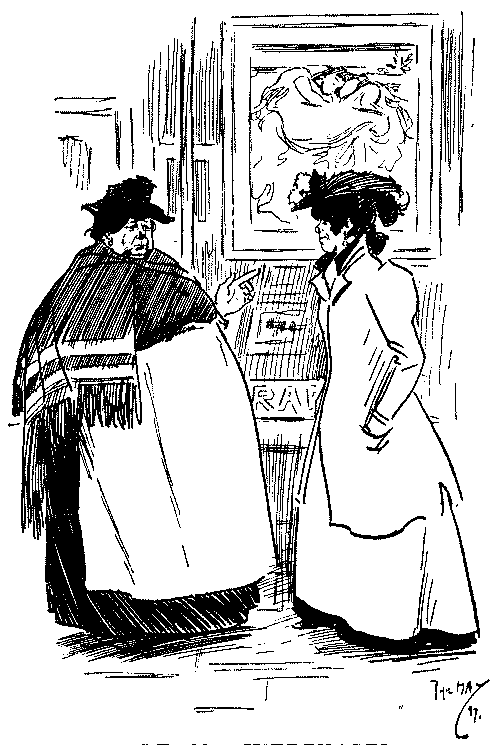
ART IN WHITECHAPEL
"Well, that's what I calls a himpossible persition to get yerself into!"
The Children's Champion
At the same time the Philistine attitude of the East End matron is not overlooked in Phil May's picture. Much depended on the spirit in which this campaign of enlightenment was conducted, and Punch continued to rebuke and satirize the lack of sympathy and comprehension shown by the fashionable "slummer." He had "no use" for people like "Mrs. Slumley Smirk," the District Visitor, who asked to be warned if any illness was about, as then she wouldn't wish to come near; and he was even more satirical at the expense of Socialism as conceived by certain members of the aristocracy—vide the imaginary interview with "Lady Yorick" in 1905—who sought to have it both ways, and, as I notice elsewhere, represented a new and inverted type of snobbery.
For the scandal of the insurance of poor children's lives he held not the parents, but the "Bogus Insurance sneak," mainly responsible. He is at least half in sympathy with the soliloquy in St. James's Park of the Socialist loafer who deprecates the amount of food wasted on the ducks and swans. He applauds the revival of Folk Dancing in 1903; in 1905 there is a long and charming sketch of an old Cambridge bedmaker who had recently died at an advanced age; and in the following year Punch published a delightful imaginary description of a socialistic experiment, by which poor children were sent on visits to "upper-class" families, and treated as guests and equals, to the mutual profit of both classes. The scheme is suggested as an improvement on bazaars and similar activities. On the other hand, Punch indulges in ironic comment on the result of well-meant efforts to teach poor children to "think imperially"—a subject on which he spoke with more than one voice. In an Empire Day Essay a London school-child wrote in 1908:—
"There are a lot of Empires like Chinese Empire, Hackney Empire, Stratford Empire, and Russian Empire. Hackney Empire is different to ours because they sing there, and ours is places."
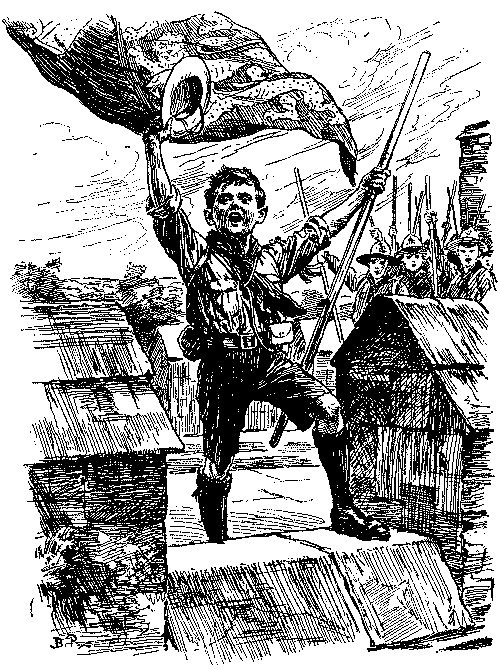
THE CAPTURE OF WINDSOR CASTLE by the Boy Scouts.
The Boy Scout Movement
The best-inspired and most fruitful of all movements for the uplifting of the children of the people which belongs to this period was that of the Boy Scouts. It was entirely independent of State or official encouragement, and sprang from the ingenious brain of one man, General Sir Robert Baden-Powell, and Punch, as an Individualist, was not inclined to think worse of it on that account. As a matter of fact, he greeted the Boy Scouts with the utmost cordiality from the very outset. In 1909 his cartoon on "Our Youngest Line of Defence" shows the Boy Scout reassuring Mrs. Britannia: "Fear not, Grandma; no danger can befall you now. Remember I am with you." Later on in 1911 came the delightful cartoon of the Boy Scouts capturing Windsor Castle, and, on the very eve of the war, in Punch's Holiday Pages we encounter the late Mr. F. H. Townsend's admirable picture of our "dear old friend the foreign spy (cunningly disguised as a golfer) visiting our youngest suburb on a Saturday afternoon in quest of further evidence of our lethargy, general decadence and falling birth-rate." As a result of observing the activity and numbers of the Boy Scouts, he gets a serious shock, and at once telegraphs to his Commander-in-Chief "urging that the conquest of the British Isles be undertaken before the present generation is many years older." This oblique and imaginative tribute was happily conceived and well deserved. The spirit of the Boy Scout movement was at least a contributory factor in helping us to win the War. What was even more important was the conversion of a great many Pacificists from their mistrust of the alleged "militarism" of the movement, and their recognition of its essential value as an instrument in fostering self-respect, truthfulness, altruistic kindliness and cleanliness of mind and body.
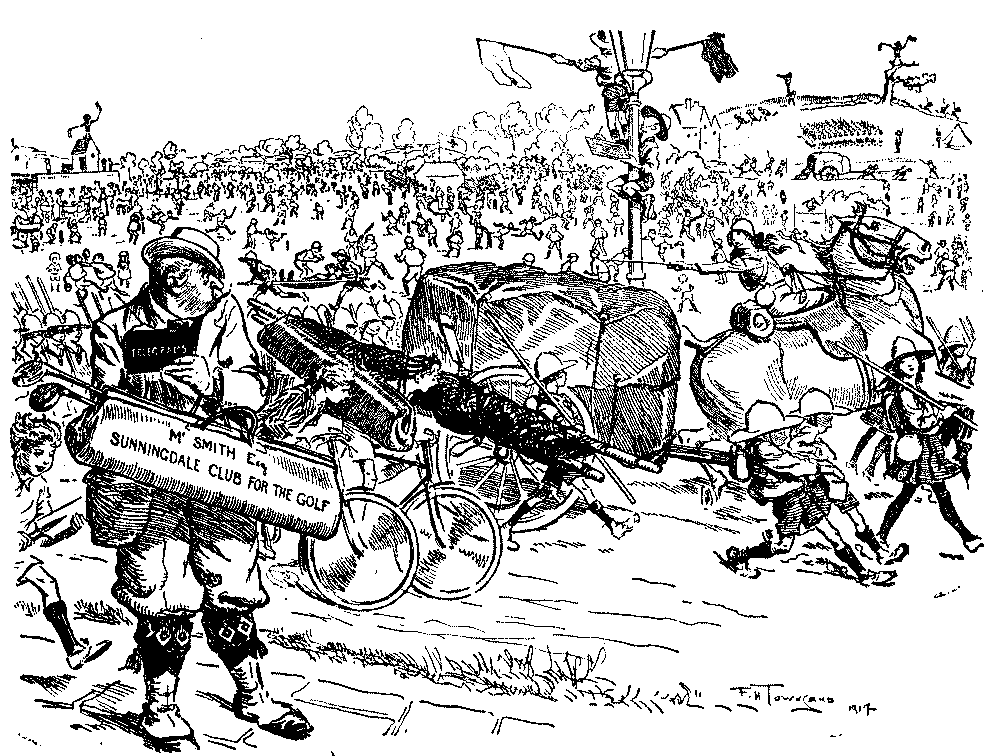
OUR DEAR OLD FRIEND THE FOREIGN SPY
Strikes and Unemployment
This record—and it is by no means exhaustive—of Punch's humanitarian activities must not blind us to the fact that throughout these years the principal object of his sympathy and compassion was not the working man but the middle-class tax-and rate-payer. In 1893 Punch depicts him bound to a post and in danger of being drowned by the rising tide of rates—L.C.C., Asylums, Libraries, Baths, Vestries. Punch, as we have seen, did not acquit the coal owners and coal merchants of rapacity, but he was not any more sympathetic to the miners—witness the following dialogue printed in the same year:—
THE STRIKER'S VADE MECUM
Question. You think it is a good thing to strike?
Answer. Yes, when there is no other remedy.
Q. Is there ever any other remedy?
A. Never. At least, so say the secretaries.
Q. Then you stand by the opinions of the officials?
A. Why, of course; because they are paid to give them.
Q. But have not the employers any interests?
A. Lots, but they are not worthy the working man's consideration.
Q. But are not their interests yours?
A. Yes, and that is the way we guard over them.
Q. But surely it is the case of cutting off the nose to spite the mouth?
A. And why not, if the mouth is too well fed.
Q. But are not arguments better than bludgeons?
A. No. And bludgeons are less effective than revolvers.
Q. But may not the use of revolvers produce the military?
A. Yes, but they can do nothing without a magistrate reading the Riot Act.
Q. But, the Riot Act read, does not the work become serious?
A. Probably. But at any rate the work is lawful, because unremunerative.
Q. But how are the wives and children of strikers to live if their husbands and fathers earn no wages?
A. On strike money.
Q. But does all the strike money go to the maintenance of the hearth and home?
A. Of course not, for a good share of it is wanted for the baccy-shop and the public-house.
Q. But if strikes continue will not trade suffer?
A. Very likely, but trade represents the masters.
Q. And if trade is driven away from the country, will it come back?
A. Most likely not, but that is a matter for the future.
Q. But is not the future of equal importance to the present?
A. Not at all, for a day's thought is quite enough for a day's work.
Q. Then a strike represents either nothing or idleness?
A. Yes, bludgeons or beer.
Q. And what is the value of reason?
A. Why, something less than smoke.
Simultaneously Punch published a cartoon (rather prematurely) in which Mars, expressing his readiness to arbitrate, appeals to Vulcan to do the same. Lord Rosebery's successful intervention as a mediator in the coal strike in December, 1893, is handsomely acknowledged in the cartoon in which he figures as the "G.O.M.'s handy boy." Lord Rosebery was still at the height of his personal popularity; it was not until 1905 that Punch described him as "unemployable." Unemployment had reached formidable dimensions, and then, as now, proved serviceable material to the political agitator. Mr. Asquith, as Home Secretary, had allowed political meetings in Trafalgar Square "so long as the proceedings were orderly," and Punch represented the disappointment of the extremists at having the ground cut from under their feet by this condition. A year later Punch depicted the Trafalgar Square of the future, with anarchy rampant in every corner, and early in 1894 the verses "The Devil's Latest Walk (after Coleridge and Southey)," fiercely attacking Socialist agitators as animated by sheer malice, are accompanied by a picture of a fiendish figure with horns and tail.
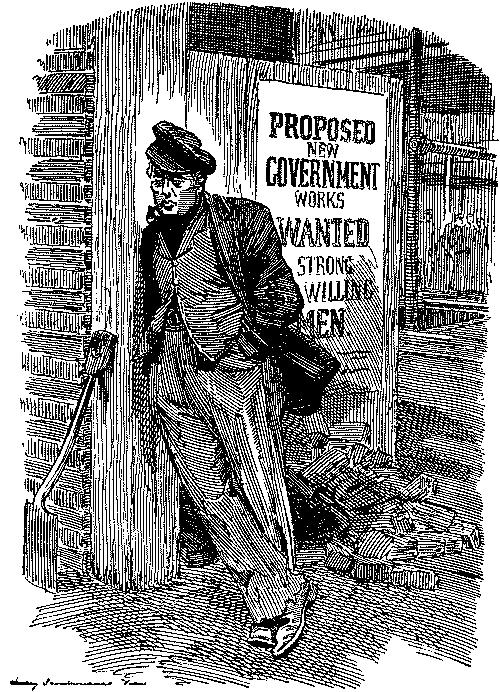
THE UNEMPLOYABLE (Dedicated to Lord R-s-b-ry)
Gambling and Improvidence
It was about this time that, as we read in the Annual Register, "a large body of the unemployed attended service at St. Paul's Cathedral in response to an invitation from Canon Scott Holland, whose sermon was frequently interrupted by the applause of those present." Punch, in his then mood, would have probably explained this episode on the principle of "the Devil was sick, the Devil a monk would be." Punch was no admirer of the art of Mr. George Moore, but he had paid him reluctant homage as a moralist in 1894, under the head of "All the Winners":—
Boycotted or not boycotted, if Esther Waters calls general and effectual attention to the growth of gambling, which is the real "curse of the country" in these days, it will do more good than all the Dodos and Marcellas and Barabbases and Heavenly Twins in all the Libraries in the land.
It was in the same spirit that a few years later Punch applauded the idea of establishing a Bureau of Common-sense to combat the extravagance and improvidence of the working classes. The suggestion was made by Judge Emden, the well-known County Court Judge, in dealing with the case of a man who, on wages of from 25s. to 30s. a week, committed himself to a twenty-five-guinea piano on the hire-purchase system.
"Agricultural Depression" bulks largely in Punch's pages in the 'nineties, but it is the farmer, not the farm labourer, who is singled out for commiseration. In 1893 he is shown as Buridan's Ass between two piles of sapless chaff—Tory and Liberal—overburdened by the triple load of Rents, Rates and Foreign Competition:—
What choice between the chaff of arid Rad And that of equally dry-and-dusty Tory? Chaplin would feed you on preposterous fad, And Gardner[4] on—postponement! The old story! While the grass grows the horse may starve. Poor ass! Party would bring you to a similar pass!
In the summer of 1894 the verses "A Good Time Coming" foreshadow the end of the agricultural depression, but a few weeks later the farmer was bitterly disappointed. His crops had been plentiful, but the plenty had brought down the price of wheat in some cases to 16s. and 19s. a quarter. In short, there had been a golden harvest, but he couldn't get gold for it. Let it be noted, in parenthesis, that if Punch espoused the cause of the farmer, he was not wholly wedded to the old rural régime of the Squire and the Parson. In 1894 there is a humorously ironic lament by a lover of the "Good Old Times" in the form of a new version of "The Village Blacksmith," suggested by the actual return of a blacksmith to one of the new parish councils at the head of the poll. When the Conservatives came back to power in 1895, Lord Salisbury, in a new fable of Hercules and the Farmer, is represented as adroitly ascribing agricultural depression to Providence, and exculpating the Government which had done its best; but the farmer is unconvinced by this pious explanation. The remedy which the Government sought to apply in the Agricultural Land Rating Bill of 1896 failed to satisfy Punch. Mr. Chaplin is seen, in an adaptation of Æsop, shifting the burden of rural rates from the horse (country) to the ass (town). But the latter was Punch's special protégé, and the verses in May express accurately enough the cry of the poor townsman, the rate-crushed cockney, protesting against Mr. Chaplin's remedy when the income-tax was already 8d. in the pound! The income-tax payer this time is the patient ass, hoping that some at least of the surplus of six millions may be devoted to the relief of his gigantic burden. To return to Agriculture, a sidelight is thrown on the shortage of farm hands in 1901, in the picture of an elderly farmer rebuking a very small boy for slacking, only to be met by the retort "Chaps is scarce." The parallel to the Great War is obvious, but one would hardly have thought that the Boer war was on a large enough scale to affect the labour market in this way. In 1903 voluntary labour bureaus were started, but the results were disappointing, and Punch quotes an account of an experiment in Wiltshire. Fifteen men had been sent down from London; two returned in three days "because it rained"; and twelve more were back in a fortnight. Our increasing reliance on imported food had already prompted Punch to indulge in a forecast of the Stores of the Future, at which Tierra-del-Fuego Devonshire cream and similar products are offered for sale because it had become impossible to get any home-grown produce. The exodus from the land to the cities was already in full swing, and we find Punch as early as 1896 commending a clergyman who had started dancing classes in his village near Stroud as a counter-attraction to the lure of the towns. In this context it is worthy of note that in 1900 Punch suggested that, as a result of socialistic legislation in Australia and elsewhere, and the growing struggle for the good things of life, no one was willing "to do the washing up." Yet prices and taxes were low enough to excite the envy of the harassed post-war householder. Eggs were advertised at 16 for 1s., but even this did not satisfy Phil May's broken-down tragedian in 1900, who exclaims as he reads the announcement in a shop-window: "Cheap! Ha! Ha! Why, in my time they threw them at us."
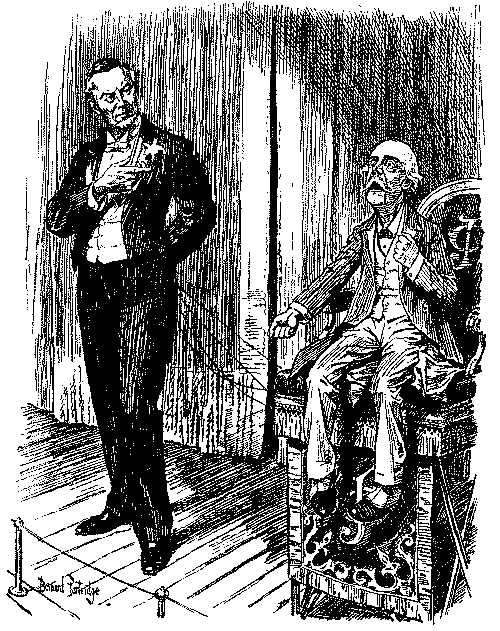
JOE THE VENTRILOQUIST
Professor Ch-mb-rl-n: "You see, ladies and gentlemen, he talks just as well even when I go right away!"
Town v. Country
If all was not well with those who lived on or by the land, the town exodus of week-enders and the demand for small country residences had already created a cult of "rural felicity," the artificiality of which did not escape Punch when he satirized in 1904 the platitudinous appreciation of Nature and country life distilled in the halfpenny Press. At the same time the drastic legislation dealing with the land problem introduced by the Liberals on their return to power in 1906 found little or no sympathy from Punch. The cross-currents revealed in the Unionist Party by the great Tariff Reform controversy, the resignation of Mr. Chamberlain, the secession of the Free Trade Ministers, and the inability of the plain person to cope with the transcendental fiscal dialectics of Mr. Balfour, had made it difficult for Punch, born and bred in the principles of Free Trade, to accord a whole-hearted support to the Unionist administration in its later years. There was, however, no perplexity in his attitude towards the land policy of their successors. At all their stages Punch was hostile to the new "Lloyd Georgics." We may specially single out the cartoon in August, 1910, presenting a "study of a free-born Briton who, within the period usually allotted to his holidays, is required under threat of a penalty of £50 to answer a mass of obscure conundrums relating to land values, to facilitate his future taxation." The miseries of this inquisitorial process are further developed in an imaginary extract from a specimen return showing how some of the questions in the historic "Form IV" were to be answered. The sequel to this laborious and costly preliminary investigation falls outside the scope of this volume. Nor is it necessary to dwell at length on the movement, doubtless animated by a noble sympathy with the rural population, initiated by the Daily Mail in 1911 on behalf of the revival of windmills and standard bread. The new-found interest in the yokel is satirized in the song of the "Merry Hind" (after Masefield's Daffodil Fields), and the cartoon "The Return of the Golden Age" in February, 1913, where Mr. Lloyd George is seen emptying a cornucopia of "rare and refreshing fruit" into the lap of the ecstatic farm labourer. Hodge was at last fairly in the limelight, for both parties had their land policy, and the opening of Mr. Lloyd George's Land Campaign in October is symbolized by a picture of him as an irresponsible music-hall comedian with "Songs Without Wurzels. No. 1, Land of Hope (as arranged by the Cabinet)" in his hand. Mr. Asquith is seen as his accompanist, waiting for the "patter" to finish, and observing, "This is the part that makes me nervous." But the Pall Mall Gazette, then edited by the great Mr. Garvin, declared in December that "whatever can be done to improve the lot of the agriculturist will have the Opposition's cordial support," and, on the strength of this assurance, the Premier's anxiety, in Punch's view, was allayed. When Scout George reports to his chief "the enemy is on our side, sir," Scoutmaster Asquith replies, "Then let the battle begin."
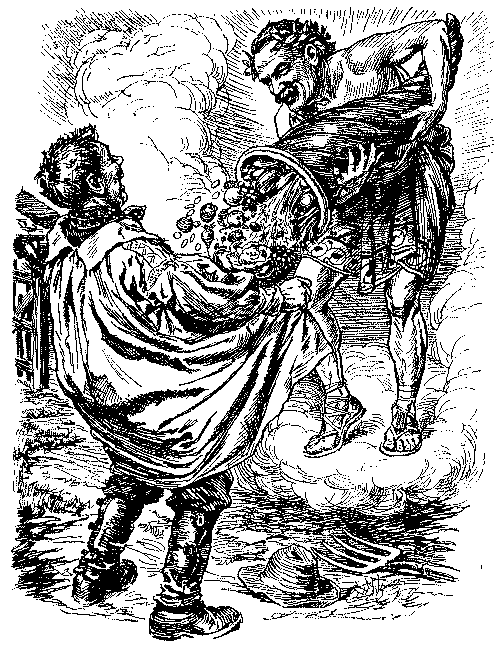
THE RETURN OF THE GOLDEN AGE (Vide The Lloyd-Georgics—passim)
Work, Wages, Pensions, and Doles
Farmers and farm labourers were regarded in Punch's survey as not much more than pawns in the game of party politics. The claims of organized labour in the other great industries and the general tendency of legislation in their interests found him a more vigilant and a more hostile critic. Even so mild a measure as the Early Closing Bill of 1896—with the principle of which he had been in agreement in earlier years—excited his misgivings and prompted a forecast of increasingly intimate interference with the private life of householders: the outline of his "Household Regulations Act" contains provisions for hours of rising, cleaning, meals, bills and rent. It is a burlesque, but none the less indicates resentment of patriarchal State interference. Yet Punch's general individualism admitted of exceptions. He noted the failure of the Voluntary Labour Bureau system, and was frivolously critical of the amateur attempt of a vicar to start Trust Houses to supersede Public Houses—a movement which later on came to stay and to achieve solid results. Here, however, allowance must be made for Punch's inveterate distrust of temperance agitators. State interference on behalf of minorities did not always meet with Punch's approval, and in 1898 we find him vehemently protesting against the recognition of "Conscientious Objectors" to vaccination. In a striking picture headed "The Triumph of De-Jenner-ation" he shows a grisly skeleton waving as his banner the Vaccination Bill, which Punch calls "the Bill for the encouragement of Small Pox." But the burden of his criticisms of Labour is concerned with the artificial restriction of output, the conversion of the trade unions from an industrial to a political organization, and the increasing tendency of State intervention to encourage a reluctance either to work or save. The picture of Hyde Park on "Labour Day" in 1898 with the grass strewn with recumbent sleeping figures is, if I read it aright, designed less in compassion for the unemployed than as a satire on the unemployable. Wages were high in the bricklaying trade, but a shortage of labour was complained of; as for the skill required, a surveyor had written to the Daily Telegraph stating that "any ordinary man could learn bricklaying in a fortnight," and Punch ironically foreshadows the invasion of the trade by underpaid clerks, barristers, etc. Ruskin College—opened at Oxford in 1899—is described as "a College for Labour Leaders" by Punch, who rather unnecessarily prophesied that it might become the scene of "strikes"; but the friction which arose between those who conceived that the function of the college was purely educational, and those who wished to make it a school of political thought, went far to justify Punch's misgivings. The plan of Old Age Pensions had long been in the air. The committee which reported in 1892 showed considerable divergence of opinion. Mr. Chamberlain, the chairman, condemned Mr. Charles Booth's proposal of the general endowment of old age as a gigantic system of outdoor relief for every one, good and bad, thrifty and unthrifty. The majority of the Royal Commission of 1893 were adverse to State pensions. The Rothschild Committee in 1896 found themselves unable to devise any satisfactory proposal. The Select Committee over which Mr. Chaplin presided put forward a scheme substantially on Mr. Charles Booth's lines, but in view of the cost and the hostility of the Government the matter rested till the passing of the Act by the Liberals in 1908. Punch, it may be noted, was no enthusiast for the scheme formulated by the Chaplin Committee; his cartoon of "Old Gaffer" and "Little Chappelin" (modelled on Southey's ballad) is undoubtedly hostile, and the accompanying verses end up on a cynical note when the "Old Gaffer" asks "Little Chappelin" what is the bag he is carrying, and is told:
"Only another dole," said he; "It is a famous Ministry."
The Trade Union Congress at Plymouth in the same year censured Lord Mount Edgcumbe because, in throwing open his grounds to them, he had reserved the privacy of his lawn for a garden party. Punch accordingly indulged in some sarcastic verses, supposed to be written by a Trade Unionist, and ironically applauding the action of Mr. Ben Tillett, who had distinguished himself by his attack on Lord Mount Edgcumbe. This was fair game enough, though to-day it would probably have been passed over in silence. Punch no doubt was thinking of the saying that an Englishman's house is his castle; and hardly anticipated the time when an Englishman's or an English nobleman's castle would cease to be his home. To-day we read with an amused surprise Punch's comment in 1900 on the introduction of an eight-hours' day for domestics in Australia, and his forecast of a similar state of affairs in England under a new Patriarchal Statute. Nor is there anything wildly extravagant in his ironical anticipation of the cook of the future demanding £100 wages, though unable to guarantee more in return than "chop one day and steak the next." The higher education of servants, according to Punch, was tending to produce a type which knew everything except the things which really mattered. He tells us in 1902 of a lady who was delighted to get a cook who could develop her photographs, and gives us, in the same year, an excellent study (after Gilbert) of the "Up-to-date Cook-General":—
I am the very pattern of an up-to-date cook-general, I've information vegetable, animal and mineral; I've passed the seventh standard, and I vary the monotony Of flirting with the butcher's boy by writing books on botany. I know the chemistry of zinc, tin, potash and ammonium; I practise on the fiddle, flute, piano and harmonium; I understand minutely the formation of an icicle, And in the season round the Park I like to ride my bicycle. I've studied Herbert Spencer and I've views on sociology, And as a mere parergon I have taken up conchology— In short, in matters vegetable, animal and mineral, I am the very model of an up-to-date cook-general. In fact, when I have learnt to tell a turnip from an artichoke, Or grill a steak that will not make my mistress's dinner-party choke; When I can cook a mutton chop or any plain comestible In such a way that it becomes not wholly indigestible; When I can wash a cup without inevitably breaking it, Or make a bed where folk can sleep at ease without remaking it; In short, when I've an inkling of economy domestical, You'll say, "Of all cook-generals this girl the very best I call." For my culinary ignorance and all-round imbecility Is only to be equalled by my housewifely futility— But still, in learning vegetable, animal and mineral, I am the very pattern of an up-to-date cook-general.
The Aristocrats of Labour
The plethora of processions in 1901 moved Punch to make various suggestions for the better conduct of such spectacles, mostly in the shape of fantastic and satirical concessions to the greatest happiness of the greatest number of sightseers. Warnings against the panem et circenses habit were legitimate enough, but Punch took a more aggressive line in his attack on the miners in 1901:—
A BLACK LOOK-OUT
(A paper picked up near the office of the Chancellor of the Exchequer.)
Pity the sorrows of a poor collier, who, if a shilling export duty is imposed upon coal, will have (possibly) to see—
1. His wife giving up her music and riding lessons.
2. His children not able to go to the seaside for a month or two.
3. His favourite licensed victualler unable to supply him with that extra quart he enjoys so much after he has drunk the others.
4. His dogs unable to compete for prizes because their upkeep will be too expensive.
5. His tailor sending in his account and respectfully requesting immediate payment.
6. His wine merchant writing to ask him why he has given up ordering champagne.
7. Worst (and, fortunately, most improbable) of all, himself having to work four days a week instead of three.
In earlier years Punch would have given chapter and verse for such charges; the later method, though it makes easier reading, carries less weight. Punch did not, however, wholly abandon the practice of "documenting" his criticism, and he turned it to excellent account in a discussion of the much-abused German clerk in 1898, when he quoted the following passage from the official Consular Report from Stettin, issued by the Foreign Office:—
Much of the commercial knowledge of Germany has been supplied by young Germans who have been employed as clerks in Great Britain, mostly as foreign correspondents. British clerks cannot be used as foreign correspondents, because not one in a thousand can correspond correctly in any foreign language.
For the effective German competition which threatened to oust British trade from the markets of the world, Punch did not hold any one class responsible. The fault was our national complacency, symbolized in 1901 by a lethargic John Bull priding himself on the superior excellence of his goods, but declining to take the trouble to make foreign customers understand it. The contrast between the German and the Briton in regard to practical business capacity is brought out in the papers headed, "Pashley's Opinions." "Efficiency" was the motto of the hour, yet Punch found it hard to reconcile the cry with the "Catchwords for the Million," especially the "Equal Rights of Man" as interpreted by trade union rules, especially those affecting bricklaying, which in his view sterilized competition and ambition. Another side of the subject is dealt with in the series of papers entitled, "How to get on," one of which satirizes the almost hysterical worship of "efficiency" by those who in the same breath declared that we were the greatest race on earth and also the greatest slackers, but confined their own energies to mere talk. The underlying principles, however, which govern Punch's contributions to the "Efficiency" controversy could not be better summed up than in the dictum of Mr. J. M. Beck,[5] the Solicitor-General of the United States: "The great evil of the world to-day is the aversion to work."
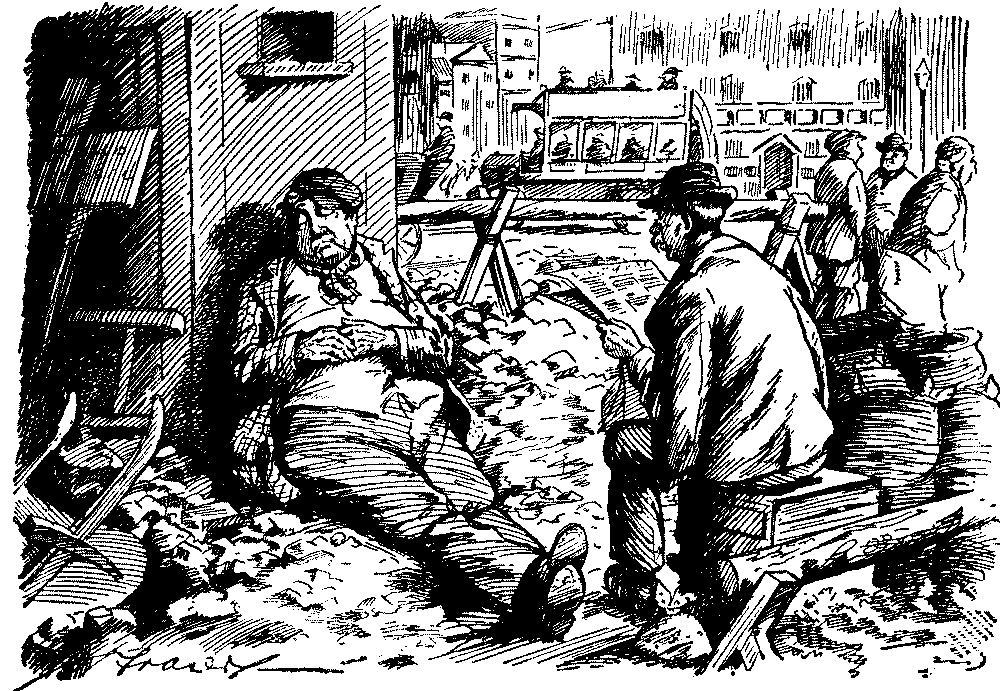
MR. GEORGE BERNARD SHAW AND THE PEOPLE
"Wot d'y' fink o' this 'ere G.B.S.?"
"Never tried it! I smokes V.B.D."
Sport and Crime
What troubled Punch, to borrow an epigram from another American anonymous writer, was "not so much the unemployment of the idle as the idleness of the employed." He is increasingly concerned with the popular pre-occupation with sport and criminal celebrities, combined with a corresponding apathy on important questions. Foreign politics were only brought home to the masses when they lent themselves to sensational or spectacular treatment, and, in 1903, Punch gibbets an announcement in the Scotsman: "Scenes resulting from the Macedonian Atrocities displayed by the Modern Marvel Cinematograph, at 3 and 8 (see Amusement Column)." The sentimental interest in criminals is bluntly rebuked as a perversion of the philanthropic maxim that "to know all is to forgive all"; the blame for this was attributed to the journals which catered for the million, but the avidity with which this pabulum was devoured, and the absence of any protest from those affected, was a disquieting symptom; and Punch was within his rights in making game of the Clarion when it scented class distinction in the abortive movement to introduce knee-breeches for evening wear.
Liberals and Labour
In the Unionist defeat at the election of 1906, Punch recognized not merely the return to power of the Liberals, but the coming of the "New Demos," the growing importance of the Labour Party, and the increasing impetus lent to its demands. His "farewell to the beaten side" is animated by no enthusiasm for the victors:—
You leave a record which shall bear the light When History delves for Truth in after days, Not as the sudden mob condemns at sight, Or stints its grudging praise. Meanwhile the heart of gratitude is cold; A young new Demos, born of yester-eve, Big-mouthed and blustering, overbears the old, Waiting for no man's leave. Every inhuman name that he can spell He prints in red for all to know you by, Citing his gods to prove he would not tell, Nor yet believe, a lie. He paints your lurid portraits on the polls:— "Drivers of slaves that oust the white man's brood." "Bigots that bind in chains our children's souls!" "Filchers of poor folk's food!" Had you been Czars to drain the people's blood, Or sought to earn a country's dying curse, Dragging her remnant honour through the mud, He could have done no worse. His hooligans are out with stones and dirt; And in the darkness you must hide your head, Nor look for Chivalry to salve the hurt, For Demos reigns instead. Not much it helps to know that those, ere long, Who lent him aid and did a mutual deal, Will find their henchman, grown a shade too strong, Stamping them under heel. Little it serves that they, your old-time foes, Who found him useful for their present ends, Must seek you soon and plaintively propose— "Please save us from our friends!" But let this solace keep your hearts resigned— That, till a second lustre's course is through, The noblest heritage you leave behind Demos can scarce undo.
The prophecy that the Liberals would invoke the assistance of the Unionists to "save them from their friends" was not fulfilled; the course of legislation up to the war indicated in the main a desire to consult the demands of Labour rather than to break away from the alliance. The summary of reasons "Why I lost" from defeated candidates furnishes a useful commentary on the verses quoted above. They include Chinese Labour, the Big Loaf cry, the Education Bill of 1902, the Trade Disputes Bill, Overbridge Trams, the Japanese Alliance and the Entente Cordiale. The messages were not actually received by Punch, but they are not an unfair interpretation of the issues which weighed with the bulk of the electorate. A "spirited foreign policy" was out of favour, and a cold fit had succeeded to the fervour of the "Khaki" election.
The Government lost no time in setting to work to redeem their pledge about Trade Disputes. Early in April, C.-B. figures in the cartoon "Hard to please" as a farmer soliloquizing over his dog (Labour), "He's had two platefuls of biscuits and isn't satisfied. Looks as if he wanted raw meat." The plates, labelled Workmen's Compensation and Merchant Shipping Bill, are both empty. The third, the Trade Disputes Bill, is full of biscuits as yet untouched. When the Attorney-General, Sir J. Lawson Walton, introduced that measure, Punch, in his "Essence of Parliament," speaks of it as a "ticklish Bill" conceding important demands in regard to picketing and conspiracy, but "as to the immunity of Trade Union funds from amercement consequent on civil actions, the Bill does not go the full lengths of the demands of Labour." The attitude of the Labour Party, who threatened to bring in their own Bill and to insist on its substitution for the Government measure, is symbolized in the cartoon showing Labour offering his scales to Justice in preference to her own, in which Capital and Labour are equally balanced, with the comment, "I think you'll find this pair works better—for me." The climbing down of the Government in the autumn session is illustrated in a further cartoon representing Labour as the predominant partner. The Liberal Party is seen on foot being pushed on by a donkey (Labour) drawing a cart in which the Trade Disputes Bill is sitting. "Yes," says the old lady, "I was wrong to threaten him with a whip. The dear creature must be led, not driven. Still—this isn't quite the way I meant to come." Comment in Punch's "Essence of Parliament" on the progress of the Bill is curiously meagre, but there is one illuminating paragraph on the Report Stage: "The Attorney-General explained that when at the earlier stage he argued against the immunity of Trade Unions from action at law, he did not mean to debar himself from subsequently insisting upon the justice of such immunity." The momentous and far-reaching consequences of a measure which created a privileged class and set them above the law were only dimly apprehended in Punch, who confined himself in his further comments to the lack of spirit shown by the Opposition in the Lords. Thus in "The Better Part of Valour" we see the Trade Disputes Bill standing over the prostrate figure of the Education Bill, about to batter its way into the Lords, while Lord Lansdowne remarks: "I bar your way? My dear fellow! Why, you've got a mandate." "Well, so had my friend here," rejoins the T.D.B., on which Lord Lansdowne replies: "Ah! but not such a big one!" The same idea is developed in the Epilogue, where the Lords are charged by the representative of "The People's Will" with having attacked and brutally ill-treated the Education Bill, while they were too cowardly to tackle the Trade Disputes Bill.
The Revolt of the Middle Classes
The Daily Mail, which had anticipated a Unionist victory at the polls, now espoused the cause of the "Middle-Class Serf," taxed and rated and bled beyond endurance "in the interests of the most pampered section of the community the labouring man," and rumours of the formation of a new political body, with a view to obtaining justice and recognition, impelled Punch to indulge in a forecast, half sympathetic, half sceptical, of "The Turning of the Middle-Class Worm":—
England, be warned! The time for patience passes; You are more near the eve Of a revolt among the Middle Classes Than you perhaps believe; Worn to a thread by Labour's licensed plunder Of what poor desultory pay they earn, Can anybody reasonably wonder These worms should turn?
In 1897 Punch had resented Government interference with the management of workhouses, and fell foul of the Local Government Board when a Board of Guardians in Lincolnshire were asked to make a return of the number of currants put into the children's puddings. Ten years later the ground of this complaint had shifted; and the administrative scandals which Punch assails in 1907 are ascribed to the extravagance of Labour Guardians. Poplar is described as "the Pauper's Paradise"; and the new Bumbledom is shown, in a perversion of the scene from "Oliver Twist," "asking for more," while the miserable ratepayer ladles out champagne-cup for its refreshment. The "latest excursion" is "A day in Profuse Poplar," the lair of the "Gorgeous Guardians."
The Workmen's Compensation Act is treated as a set-off to the Prevention of Corruption Act, aimed at the abuse of secret commissions, and a butler is shown reassuring a cook and advising her how to get her own back by a carefully contrived accident. The same spirit is revealed in the picture of the workman whose innocence has been outraged by someone who said he had seen him hurry: "I never 'urry."
To this year belongs the farcical suggestion of a Society to Protect Employers, for the special benefit of persons who were afraid of their servants and had not the courage to dismiss them.
Punch was nearer the mark in his illustrations of the popular prejudice against the Army. A football enthusiast at a match commiserates "silly people who mess about with a rifle on Saturday afternoons"; and a "Spartan mother" standing at a barrack gate, uplifts her voice in thankfulness that her Bill "isn't wasting his time drilling," while Bill is shown in an inset engrossed in the contemplation of a pot of beer.
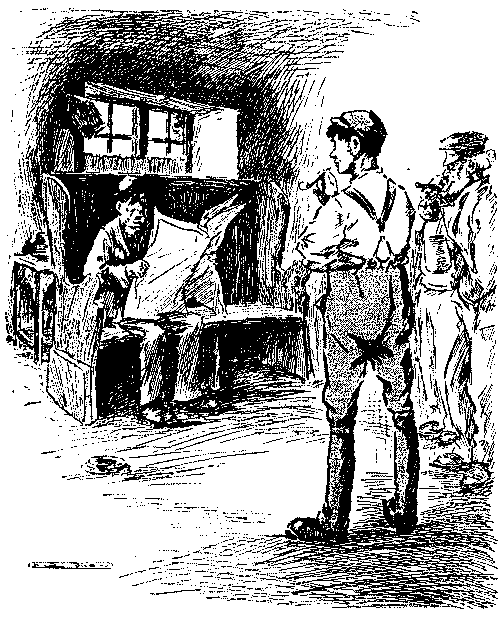
Heckling Thomas: "D'yer mean ter say if yer 'ad two 'osses yer'd give me one?"
Socialist: "Cert'nly."
H. T.: "And if yer 'ad two cows, yer'd give me one?"
S.: "'Course I would!"
H. T.: "An' if yer 'ad two pigs?"
S.: "Wot yer talkin' about? I've got two pigs!"
"The Open-minded Beggar"
Punch distrusted Socialism because, in his view, it led in practice to vicarious generosity. The Socialist would give half of everything, so long as he didn't possess it himself. Yet in apportioning the blame for the railway trouble in 1907, Punch did not spare Capital. Railway directors and trade unions were in his cartoon shown as equally animated by a disregard for the interests of the public. Incidentally we may note that the volunteer service rendered by the general public in 1919 is anticipated in a humorous sketch of the experiences of an amateur porter. Punch, even where he felt strongly, was alive to the extravagances of the extremists on his own side, witness the verses in 1908 which purport to express the perplexity of "an open-minded beggar":—
Reader, tell me, if you know, What, on earth, is Socialism. Is it—men have told me so— Some preposterous abysm, Into which we all may drop— With the criminals on top? Is the vehement Express Justified in all it mentions; And are Wells and G. B. S. Worse than Sikes in their intentions? Do those Fabian beasts of prey Wish to take my wife away? Or—observe that I am quite Open-minded, gentle reader— Are they sometimes nearly right In the shocking Labour Leader? Will the coming Commune be Paradise for you and me? Do you think it can be true That the death of competition Guarantees for me and you Sinless Edens—new edition? Or was Stuart Mill correct— Will there be some grave defect? Shall we all be servile wrecks With the brand of Marx imprinted On our miserable necks, As The Referee has hinted? Or—see Justice—shall we share Perfect freedom with the air? Will that entity, the State Of Collectivist Utopia, Actually operate Something like a cornucopia? Or will Hardie's fatted friends Leave me only odds and ends? In this monster maze of doubt I am groping like a blind man. Shall I boldly blossom out As a follower of Hyndman? Or continue to exist As an Individualist? So, dear reader, will you, please, Tell a poor, distracted Briton Whom, in troubled times like these, He should put his little bit on? And, philosopher and guide, Do pick out the winning side!
Punch's comment on the Eight Hours Bill is influenced by the objections of those who opposed it on the ground that it would affect the cost of all the necessaries of life. King Coal observes, "This means that I shall have to reduce my output," and Commerce rejoins, "Then I shall have to reduce mine, too," and both agree in doubting whether the Government had ever thought of this inevitable result.
Old Age Pensions are shown in 1908 as having already become a millstone round the neck of the Government; and in that form Mr. Asquith is seen tying them to the person of Mr. Lloyd George as a presentation to be worn by all Chancellors of the Exchequer in perpetuity. "Several of our contemporaries," Punch observes, "are devoting their columns to an explanation of the best way to obtain an Old Age Pension. Mr. Punch's advice is: Don't save."
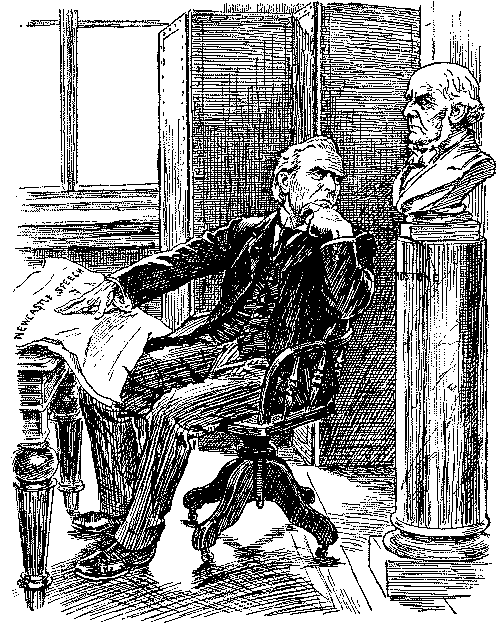
THE SLUMP IN MANNERS
Mr. Asquith: "He wouldn't have stood this kind of thing. I wonder whether I ought."
On the much-vexed question of Chinese Labour, Punch sided against its critics, and his cartoons in 1906 represent Sir Henry Campbell-Bannerman forcing unwelcome freedom on the Chinese coolie. Ignorance of Imperial questions on the part of the Labour Party is a frequent theme of comment. In the same year we find an article describing an imaginary tour in the Colonies by Mr. Keir Hardie and Mr. Philip Snowden. Mr. Keir Hardie spent two months in India in 1907, and the reports of his speeches, which he declared to be gross exaggerations and fabrications, led to vehement protests in the British Press. His biographer states that "for a full fortnight Keir Hardie was the most violently detested man throughout the English-speaking world. Even Punch joined in the vituperation with a cartoon by Linley Sambourne, which showed Britannia gripping the agitator by the scruff of the neck and apostrophizing him: 'Here, you'd better come home. We know all about you there, and you'll do less harm.'" Punch's adverse comments were not merely pictorial, and though Mr. Keir Hardie laid himself open to criticism by his angularity, his vanity and such remarks as "India to-day is governed by a huge military oligarchy," his courage and sincerity passed unrecognized.
Strikes and trade depression furnish themes for comment in 1908. In one cartoon Trade is shown as a lean and ill-favoured goose that has lost confidence in herself; in another, an engineer going back to work after seven months' stoppage, meets a cotton-spinning girl just coming out, and is credited with the admission that his action has done no good to himself or anyone else.
In 1909-1910 the conflict between Lords and Commons over the Budget proposals overshadowed all other home issues. It even became a subject of debate at preparatory schools, and Punch quotes a bonâ fide letter from a boy of nine: "We had two debates yesterday about the Budget being rejected. I was against the Budget, but the ones who were for it won, because just about half the ones who were against it had to go away for their prayers." Mr. Lloyd George was now the champion and hero of the democracy, for this was the year of the famous Limehouse speech and its sequel at Newcastle, where he referred to the House of Lords as "500 ordinary men, chosen accidentally from the unemployed." Dukes were handled almost as roughly as by Punch in the 'forties, and "robber-barons" were held up to obloquy. Punch resented this wholesale vituperation, and indulged in some effective reprisals in his criticism of trade union indiscipline, notably the growing tendency towards unofficial and lightning strikes. Thus, in 1910, he published a cartoon showing a trade union official lying prostrate in the road, overthrown and left behind by a crowd marching under a banner inscribed "Down with Authority." The comments on the payment of Members in the same year imply that trade unions were hostile to a change which impaired their control. The State might pay M.P.s, but the trade unions must call the tune. Nor was Punch favourably impressed by the Government's scheme of Insurance against Unemployment, which, in his forecast, would only encourage the existing reluctance to work.
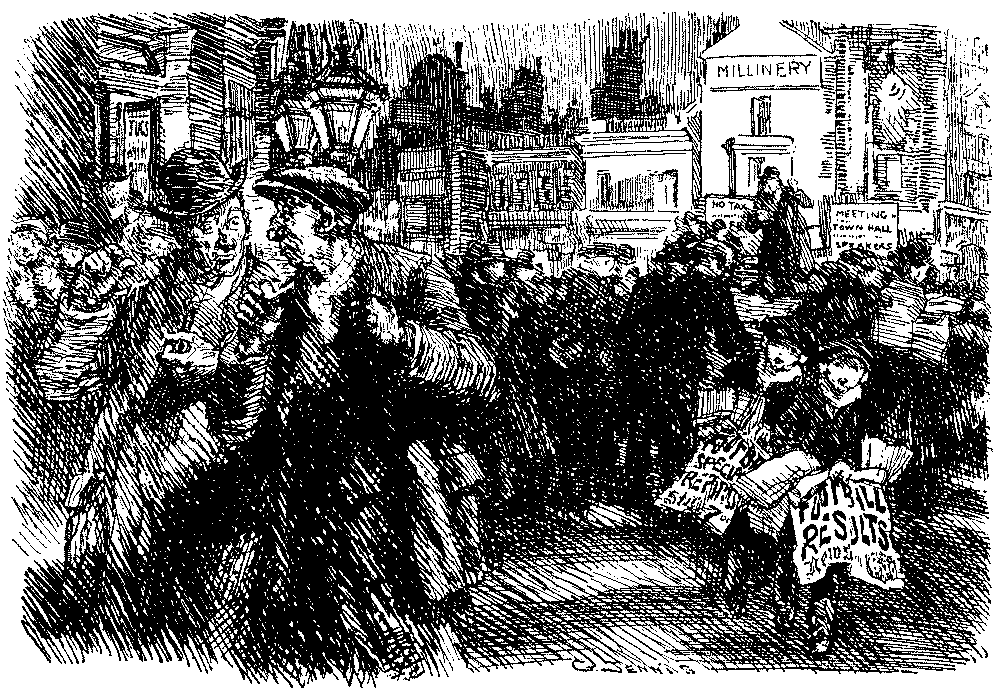
Constituent (referring to M.P. speaking in market-place): "It's the likes of hus that 'as to pay him £400 a year. It makes me that wild to think as we could 'ave two first-class 'arf-backs for the same money."
Claims for "Recognition"
Throughout 1911 and 1912 the claims of the new Trade Unionism met with little sympathy. "Look here, my friend," says John Bull of the "New Volunteer Police" to a Trade Union leader: "I've been hearing a good deal of talk of 'recognition.' Well, I represent the public, and it's about time my interests were 'recognized.'" A month later, in October, 1911, an "imported agitator" is shown talking to his comrade as they watch the President of the Board of Trade (Mr. Sydney Buxton) nailing up a notice of the new Government Conciliation Scheme, with Sir George Askwith as chairman of the Industrial Council. "Don't be down-hearted," he observes. "Let's hope we shall be able to make as much trouble as before." This was apportioning the responsibility for failure in advance; but unfortunately failure there was. Punch's frontispiece to 1912 is the "tug of war" of Labour and Capital. The coal crisis was again acute in February, but in its opening stages Punch's hostility was chiefly displayed against the coal merchant, who was against strikes, but the more they were threatened the better it suited his book. Punch derived a certain malicious satisfaction from the spectacle of Mr. Ramsay MacDonald's exclusion from the coal conference; but recognized that the final arbiter was not this or that leader or statesman but Famine. The thorny question of "blackleg" labour having again emerged, Punch asserted the right of the community in no uncertain terms. John Bull declares that he can't make the striker work, if he won't; but if others want to, he can and will make the striker let them. This strike introduced a new figure into Punch's portrait gallery; "Prince Petroleo" being introduced for the first time as a possible "second string" and rival of the hitherto indispensable King Coal. But such light-hearted treatment is henceforth rarely found in the treatment of industrial troubles. By the summer John Bull is seen on the edge of the crater of Labour unrest, listening vainly for any reassuring voices from its depths. The methods of the Trade Unionist are contrasted with those of Justice: he is all for striking first and arguing afterwards. The threat of a general strike was heard in June, but Punch remained sceptical as to the response. Agitators might call spirits from the vasty deep; but there would be no answer. In 1913 Dublin, for the first time in its long and chequered career, became the chief focus of industrial unrest in the British Isles, for this was the year of the strike of the Dublin transport workers, and the emergence, in the person of the notorious Jim Larkin, of a super-agitator of the most strenuous type. Strange things were done in the name of Liberty Hall—his headquarters—Mr. Birrell's absenteeism having become chronic, not to say conspicuous. Larkin was arrested and imprisoned, but released with a rapidity which reduced the penalty to a farce; and the assaults on the Dublin police during the strike riots in the winter were sufficiently severe to excuse Mr. Punch for calling their assailants the "be-labouring classes."
Labour Members in Transition
Mr. John Burns's political evolution, since the days when Punch savagely attacked him at the time of the Trafalgar Square riots in 1884, had long removed him from the range of attack on the score of his revolutionary views. His former associates regarded him as a renegade; independent observers found in him an energetic and arbitrary bureaucrat. Punch appreciated his manliness, but could not resist having an occasional dig at his complacent egotism, and when the Cabinet was reconstructed early in 1914, there is a picture of him praising the four new appointments as "excellent choices—with perhaps the exception of Samuel, Hobhouse and Masterman"—in other words, all but his own.
Towards Labour members of the House of Commons, Punch, as we have seen, had of recent years been none too friendly: least of all to Mr. Keir Hardie. But on the occasion of the debate in the House over the resignations at the Curragh in March, 1914, Punch's Parliamentary representative credits them with intervening effectually as representatives of the vast social and political weight behind them. In particular he praises Mr. John Ward and Mr. J. H. Thomas for their warning against militarism. "General Gough may feel keenly the Ulster situation. Tommy Atkins will feel not less keenly the industrial situation." For Mr. Thomas went on to point out that in the following November four hundred thousand railwaymen would come to grips with their employers, and if they did not attain satisfactory terms they might simultaneously strike. And if the Opposition doctrine in regard to Ulster were sound, added Mr. Thomas, "it will be my duty to tell the railwaymen to prepare for the worst by organizing their forces, the half-million capital possessed by the Union to be used to provide arms and ammunition for them." Mr. Thomas still occasionally utters blood-curdling warnings, but is now the special bête noire, to put it mildly, of the Labour extremists. General Gough's views on Ulster and Ireland have undergone considerable modifications, and Mr. John Ward, who denounced military juntas, is Colonel John Ward, D.S.O., the gallant soldier, fearlessly candid friend of Labour and uncompromising foe of Bolshevism.
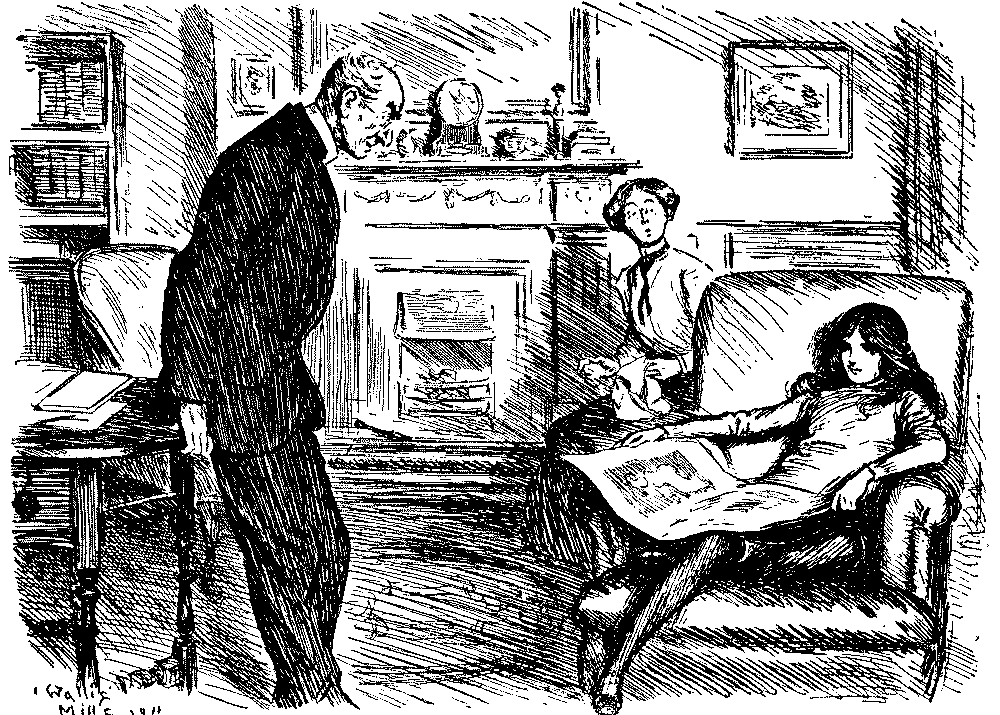
The Rector: "Now, Molly, would you rather be beautiful or good?"
Molly: "I'd rather be beautiful and repent."
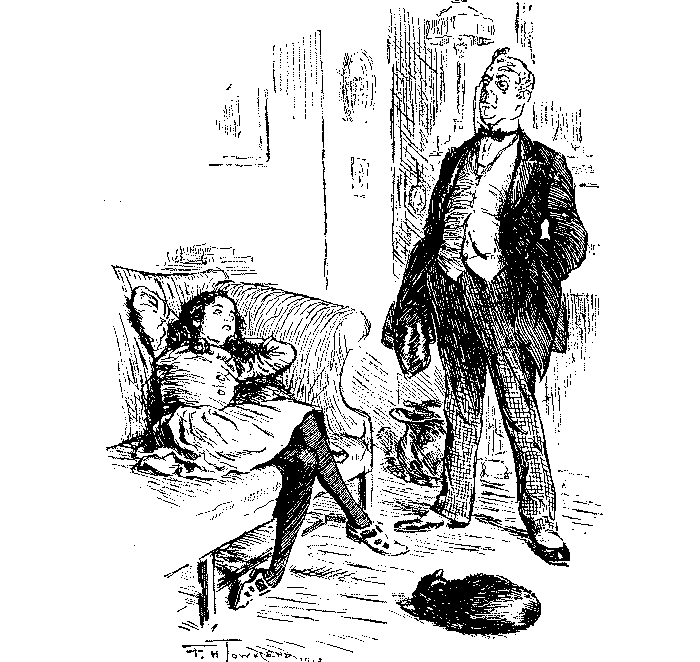
Uncle George: "What! Hate all your lessons? Come, now, you don't mean to say you hate history?"
Niece: "Yes, I do. To tell you the truth, Uncle, I don't care a bit what anybody ever did."
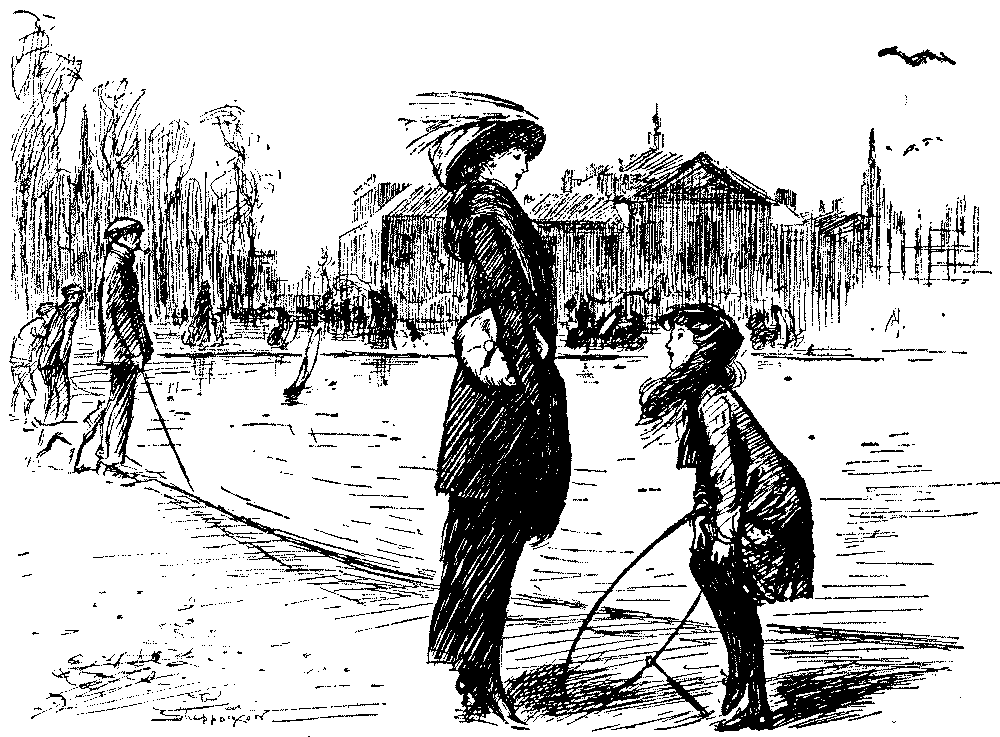
Miss Smith: "Now, Madge, tell me, which would you rather be—pretty or good?"
Madge (promptly): "I would rather be pretty, Miss Smith; I can easily be good whenever I like to try."