FINE ARTS, DRAMA AND MUSIC
Reading edition
I have noticed in earlier volumes with what asperity Punch assailed the conventionalities of academic and Royal Academic Art; how he became, for a while at any rate, a convert to Pre-Raphaelitism; how, later on, the exhibitors at the Grosvenor Gallery superseded the exponents of fashionable orthodoxy at Burlington House as the targets of his satire; and with what unremitting and undiscriminating zeal he "belaboured" all representatives of the Æsthetic movement. The further progress of this reaction can be traced throughout the first half of the period now under review. In the 'nineties Aubrey Beardsley was his special bête noire; in the early years of the new century the Impressionist school, and by 1910 the Post-Impressionists, furnish him with unfailing matter for caricature. It was not that those who stood on the old ways were exempt from criticism. Year after year the annual summer show at Burlington House never failed to receive a punctual tribute from pen and pencil. But for the most part these notices are inspired by irresponsible frivolity—a desire to extract fun by burlesquing the titles and subjects and treatment quite foreign to the spirit in which Punch had addressed himself to the task in the 'fifties, and even later. The private view of the Academy became for Punch an annual excuse for an explosion of punning, and the illustrations were a faithful counterpart of the text. Yet criticism occasionally emerges from this carnival of jocularity, as when Mr. Sargent's cavalier treatment of details is noted in 1895; or when Punch in 1902 suggests that the formidable congestion of pictures at the R.A. might be relieved by hanging some of them in the refreshment room; or when he writes in 1904:—
An interesting exhibit at the Royal Academy is a drawing executed by the artist when he was only sixteen years of age. Quite a feature of the show, too, is the number of pictures by artists over that age which have the appearance of having been painted by artists under that age.
In 1908 Punch satirized a then prevalent fashion in his drawing of the "Problem Room" at Burlington House, crowded with perplexed spectators dropping their solutions into a box marked "Puzzle Picture Syndicate." When the "Rokeby Venus" was damaged by a militant suffragist in 1914, Punch suggested that the offender ought to be made to serve her term of imprisonment in the Royal Academy—a remark quite in the spirit of his old art-critic, Charles Eastlake.
The oblique and ironical method is admirably employed in the dramatized conversations of visitors to the Academy and other exhibitions. In the sketch "Round the R.A." in 1893 the schoolmistress and her bored pupils, the complacent Briton giving himself away at every turn to his French friend, and the prosaic and practical person, are all drawn from the quick. The orthodox verdict is "quite up to the average—such delightful puppies and kittens," while the rebellious pupil of the edifying Miss Pemmican remarks, "Bother the beastly old Academy. I wish it was burnt, I do!"
From the same hand, seventeen years later, comes an equally illuminating sketch of the visitors to the Grafton Galleries—art-student, precious young painter, young City man, high-brow critic, matter-of-fact lady, and the frank and immortal Philistine only moved to unseemly mirth when his friend remarks, "Drawing to the Synthesist is entirely unimportant in solving the problem how the artist may best express his own temperament." Punch often found himself driven into the ranks of the Philistines in self-defence; anyhow, he always preferred the way of Gath to that of gush. In "An Old Master's Growl" in 1895 the speaker declares that the mass of the people only enjoyed the annual summer show; the few who came to see the Old Masters mostly came to be seen. But the ancients were not annoyed, it was only what they expected:—
We expect it—I said just as much to Vandyck— There's but one in a hundred that comes who'll descry The Beauty of Art. It's the sham I dislike: Well—good-bye!
Leighton and Millais
From the other end of the scale comes another "growl" in the same year—that of the professional model, in Phil May's picture, against Burne-Jones who had recently made a drawing of Labour for the Daily Chronicle: "I reckon 'e'll be on the pavement next." Personalities, rather than principles or theories, interested Punch at this period, and in 1896 and 1897 the circle of his eminent Victorian friends was reduced by the passing of three ornaments of British Art, all of them Academicians and two successively presidents of the Academy. Of the two sets of verses on Leighton, the second is much the better. Punch takes for his text Watts's saying that Leighton had painted many pictures, but that his life was nobler than them all:—
Noblesse oblige: his manners matched his art; Fine painter-skill, the bearing of a prince.
The writer alludes to the malignant disparagement indulged in by his detractors and sums up:—
Great if not quite among the greatest, here A noble artist of a noble life Rests with a fame that lives, and need not fear Detraction or the hour's ephemeral strife.
Leighton's generosity and munificence to brother artists deserved all and more than all that Punch said: his fame as an artist has hardly borne out the prediction of the last couplet. Sir John Millais, his successor, was linked by more intimate ties from the days of Once a Week. Du Maurier was one of his dearest friends, and Punch claimed to have been alone, save for the Spectator, in acclaiming the genius of his early work. As he happily says, "from P.R.B, to P.R.A.—that tale is worth the telling." Millais only lived a few months to enjoy his honour, and on his death in the summer of 1896 Punch dwelt on his triple endowment of health, heartiness and power, his entirely English spirit, his mastery as a painter, and his genius for friendship.
Sir John Gilbert, who died a year later, was an old comrade and contributor. He had designed the fourth wrapper in January, 1843—Doyle's final design was not adopted till six years later—and contributed intermittently to Punch down to 1882. His robust and spirited talent as an illustrator is acknowledged in Punch's tribute:—
The faded history of courts and kings Touched by your spell took on its former hue; You made the daily art of common things Fresh as the morning dew.
A deeper note is sounded in Punch's salutation of Watts on his death in 1904, when he recognizes the fidelity of that illustrious artist to his conception of the high mission of Art and his well-known repudiation of the maxim "Art for Art's Sake":—
His means were servants to the end in view And not the end's self; so his heart was wise To hold—as they have held, the chosen few— High failure dearer than the easy prize. Now lifted face to face with unseen things, Dimly imagined in the lower life, He sees his Hope renew her broken strings, And Love and Death no more at bitter strife.
Punch on Aubrey Beardsley
To retrace our steps to the 'nineties, it must be admitted that Punch enjoyed himself more in belabouring Beardsley than in saluting established reputations. Seeing nothing in his work but a wilful, exotic and decadent bizarrerie, Punch assailed him under various aliases, all of them grotesque and uncomplimentary. In 1893 the famous Beardsley "poster" for the Avenue Theatre inspired the lines headed "Ars Postera," which begin:—
Mr. Aubrey Beer de Beers, You're getting quite a high renown; Your Comedy of Leers, you know, Is posted all about the town; This sort of stuff I cannot puff, As Boston says, it makes me "tired": Your Japanee-Rossetti girl Is not a thing to be desired. Mr. Aubrey Beer de Beers, New English Art (excuse the chaff) Is like the Newest Humour style, It's not a thing at which to laugh: But all the same, you need not maim A beauty reared on Nature's rules; A simple maid au naturel Is worth a dozen spotted ghouls.
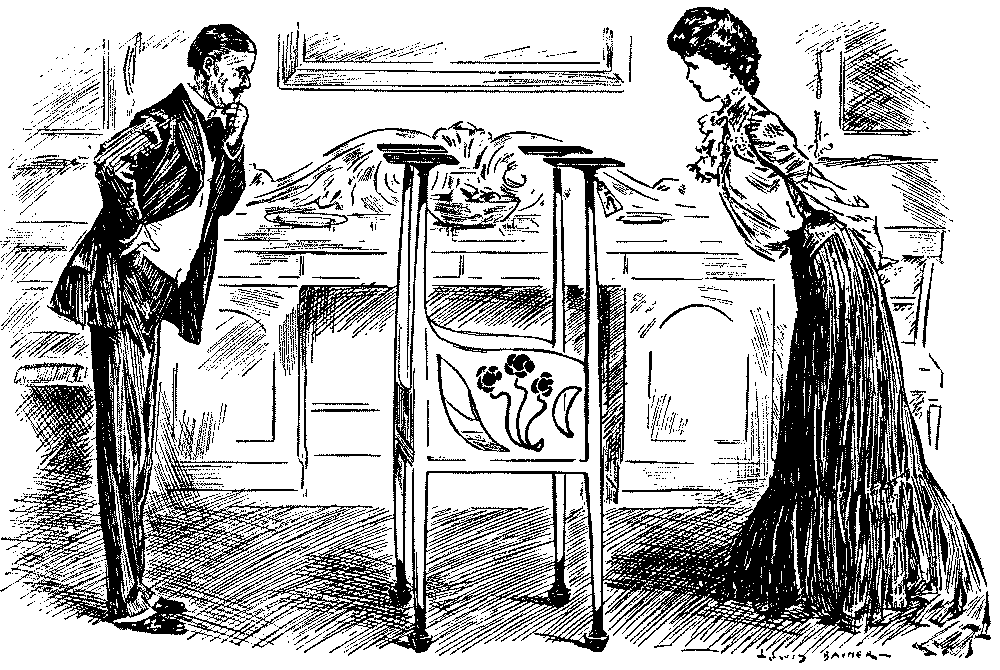
THE DISCOMFITURE OF THE PHILISTINES
On being presented with artful and crafty puzzle by artistic friend. (Query—Is it the right way up? And, if so, what is it?)
Punch pursued his pet aversion from pillar to post—or poster—with caricatures of his types, compared to "Stygian Sphinxes, Chimæras in soot, problems in Euclid gone mad." Mr. Beardsley, however, was not the only emancipated artist who came under Punch's lash. In a notice of an Exhibition at the Dudley Gallery, Mr. Sickert's picture of "The Sisters Lloyd" prompts the comment, "To be more original than the originals is to paint the piccalilli and gild the refined ginger-bread." By 1901 Punch had become much impressed and exasperated by the modern cult of ugliness, and in 1902 began the first of a succession of travesties of modern impressionist art—"The Garden Party," "The Picnic," "A Dutch Landscape," in which all the negligible features are accentuated and the important ones left out. Another ingenious series belonging to the same year is that of illustrations of "Mary had a Little Lamb" in the style of Marcus Stone, Goodall, Clausen, Alma-Tadema, Dana Gibson, Albert Moore, John Collier, Briton Rivière, etc. These are executed in a spirit of friendly burlesque, very different from the notice of Mr. Gordon Craig's drawings, which is a masterpiece of adroit belittlement. "His drawing-power as an actor," we read, "is only equalled by his drawing-power as an artist"; and Punch kindly recommends him "to confine, or extend, his art almost entirely to designing nursery wall-papers."
The exuberances of "nouveau art" had already elicited the cry of the visitor (in Du Maurier's picture in 1894) on being shown round her friend's new house: "Oh, Liberty, how many crimes are committed in thy name!"—a joke repeated from an earlier volume.[8] Nine years later the angularities of the new "Artful and Crafty" furniture are held up to well-merited ridicule. But it is only right to add that in 1897, in "The Pendulum of Taste"—an imaginative forecast of the sale of old furniture in the year 1996—Punch indulges in a comprehensive and entirely damaging review of the monstrosities of Victorian furniture and decoration: groups of fruit in wax; hideous gaseliers; terrible chromolithographs; a tea-cosy embroidered with holly-berries in crewel work; a kneeling statuette of the infant Samuel; chairs and sofa in mahogany, upholstered in horsehair; a Kidderminster carpet "with a striking design of large nosegays on a ground of green moss"; and a complete set of antimacassars in wool and crochet. Mr. Galsworthy's minute description of the "Mausoleum," in which old Timothy Forsyte, the last and most long-lived of his generation, lived or rather vegetated down to and through the War, is much on the same lines. But Punch, being nearly twice as old as Mr. Galsworthy, had spent a good part of his life amid these surroundings.
Art Definitions
The principles and theory of art-criticism, as I have noted above, did not trouble Punch greatly in the first twelve or fifteen years of this period. He was mainly concerned with the robust expression of his likes and dislikes. But by 1908 he had become slightly infected by the new psychology of art, and by way of clarifying the atmosphere launched the following list of definitions:—
ART
(A glossary for the opening of the R.A.)
An Artist is a person who paints what he thinks he sees.
An Amateur is a person who thinks he paints what he sees.
An Impressionist is a person who paints what other people think he sees.
A Popular Artist is a person who paints what other people think they see.
A Successful Artist is a person who paints what he thinks other people see.
A Great Artist is a person who paints what other people see they think.
A Failure is a person who sees what other people think they paint.
A Portraitist is a person who paints what other people don't think he sees.
A Landscape Painter is a person who doesn't paint what other people see.
A Realist is a person who sees what other people don't paint.
An Idealist is a person who paints what other people don't see.
The Hanging Committee are people who don't see what other people think they paint.
A Royal Academician is a person who doesn't think and paints what other people see.
A Genius is a person who doesn't see and paints what other people don't think.
A Critic is a person who doesn't paint and thinks what other people don't see.
The Public are people who don't see or think what other people don't paint.
A Dealer is a person that sees that people who paint don't think, and who thinks that people who don't paint don't see. He sees people who don't see people who paint; he thinks that people who paint don't see people who see; and he sees what people who don't paint think.
FINALLY
A Reader is a person whose head swims.
The art critics accredited to the daily Press, like their musical colleagues, could no longer be accused of lagging behind the modernist tendencies of the times: they aspired to be in the van of progress. In 1913 Punch burlesques the wonderful phraseology of The Times art critic in one of his "Studies of reviewers," which deals with the exhibitors at the Neo-British Art League. It may suffice to quote the appreciations of Mme. Strulda Brugh and Mr. Marcellus Thom. The method of the former, as illustrated by her "Pekinese Puppies," is contrasted with that of the Congestionist school in that she "deanthropomorphizes her scheme of pigmentation into nodules of aplanatic voluminosity":—
When therefore we have to assume a fluorescent reticulation of the interstitial sonorities, a situation is developed which might well baffle any but an advanced expert in transcendental mathematics. As a result the modelling of the puppies' tails is lacking in curvilinear conviction; their heads fail in canine suggestiveness, their fore-paws in prehensile subjectivity.
Mr. Marcellus Thom's "Sardine Fishers in the Adriatic," executed in "creosoted truffle stick," is a masterpiece of "suppressed but dignified antinomianism":—
Wonderful though the drawing and the interfiltration of coordinating paraboloids are, it is the psychological content of the picture rather than its direct presentative significance which affects the solar plexus of the enlightened onlooker. The whole atmosphere is summarized and condensed in a circumambient and oleaginous aura.... To do full justice to such a picture is unhappily beyond the resources of the most sublime preciosity. It demands the εσωτερικη πφλαρια of Theopompus of Megalocrania or even the intima desipientia distilled in the Atopiad of Vesanus Sanguinolentus.
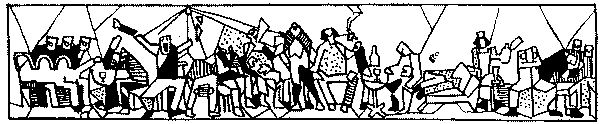
The Hanging Committee Sir Hubert Herkomer, R.A.
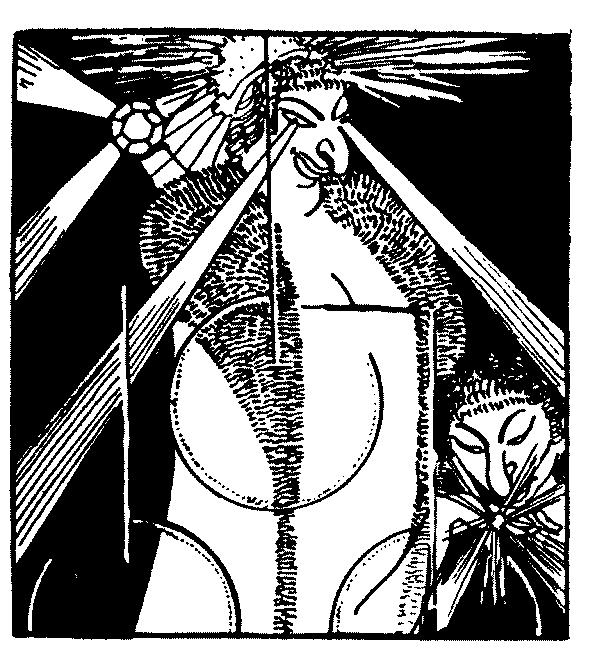
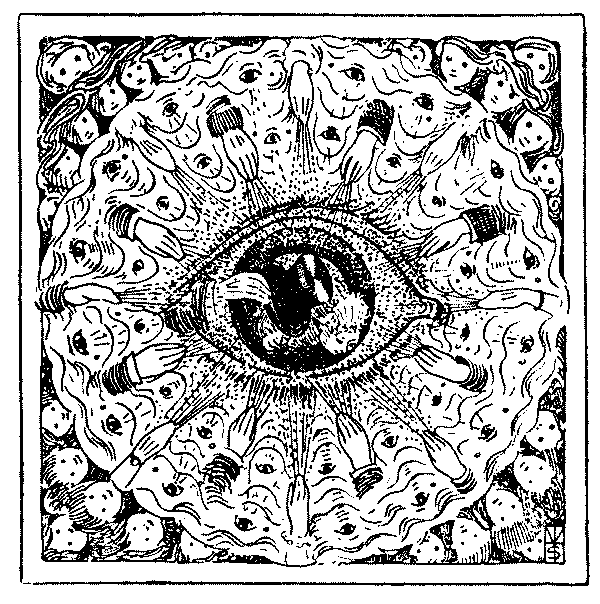
Portrait of Miss Guldheimer J. Sargent, R.A. The Young Squire's Wedding H. H. La Thangue, A.R.A.
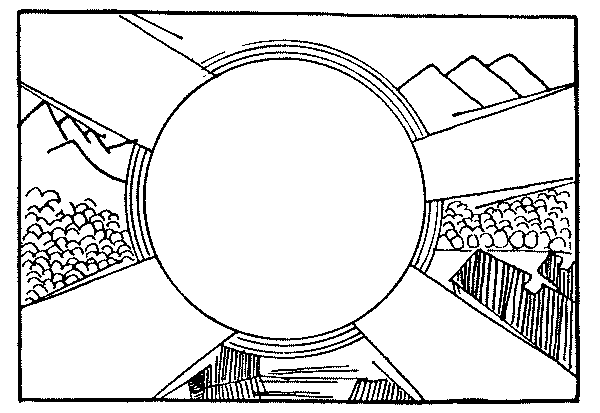
"The red orb sinks, the toiler's day is done" B. W. Leader, R.A.
The new spirit in Art had already been burlesqued by one of Punch's artists in a series of "intelligent anticipations" of the work of Herkomer, Sargent, Leader and La Thangue as executed in the Futuristic Style; and again in Mr. Haselden's Paulo-Post-Impressionist portraits of various celebrities in the Almanack for 1913. In the same year Mr. Sargent's decision to withdraw from portraiture is commemorated in a fancy picture of "an old Chelsea Gateway," where, beneath the name "John S. Sargent" hangs a notice, "No Bottles, No Circulars, No Hawkers, No Portraits." Here, I may add, that Punch had, three years earlier, with the aid of Mr. George Morrow's ingenious pencil, duly chronicled the decay of flattery in contemporary portrait painting.
Three notable additions to the Art Galleries of London were made during this period. The opening of the National Portrait Gallery, in 1896, is recorded in Sambourne's picture of Britannia welcoming British worthies to their new home: "at last we can give you a roof over your heads." The Tate Gallery, opened in the following year, is welcomed with a profusion of puns on the name of the donor; and the installation of the Wallace Collection at Hertford House, in 1900, prompts the observation that "millions after all have their utility." The sensational abduction and recovery of the famous portrait of the Duchess of Devonshire impelled Punch to cry, "Vive la Grande Duchesse!" over the "loss and Gain-sborough picture." Another famous portrait of a Duchess—Holbein's superb Christina of Milan—was in danger of being permanently lost to England in 1909, when Punch, in "Hans across the sea," portrayed an American dealer with a bag of dollars dragging the Duchess away with the comment: "Once aboard the liner, and the gyurl is mine!" The peril, however, was averted, and Christina still remains with us in London.
Tenniel, Phil May and Sambourne
I do not suppose that any of the honours which have fallen to his staff ever gave Punch more unfeigned satisfaction than the knighthood bestowed on Tenniel in 1893. The "Black-and-White Knight," as Punch then called him, did not quit the "Table" until 1901, when he had been a member for fifty years, and the public dinner given in his honour, with Mr. Balfour in the chair, was a national tribute to a great gentleman and great artist. On his death in 1914 the special "Tenniel" number, with personal tributes from his colleagues, was a wonderful memorial of the work of one who "nothing common drew or mean." Tenniel was the Nestor of Punch's staff. When the copyright of Alice in Wonderland expired, a number of artists laid hands on the text, to the disgust of Punch, who regarded this attempt to supplant Tenniel's illustrations as little less than an act of sacrilege. The situation is happily dealt with in Mr. Reed's picture of Alice, surrounded with Tenniel's figures, contemplating the antics of the interlopers, and asking, "Who are these funny little people?" The Hatter replies: "Your Majesty, they are our imitators"; and Alice rejoins: "Curiouser and curiouser." Phil May was only thirty-nine when he died in 1903, and left a gap never quite filled as a brilliant, humorous and masterly delineator of street life and of modern Alsatia. Phil May, who was the soul of modesty and gentleness, and had no enemy in the world but himself, once said, "Everything I know I learnt from 'Sammy.'" "Sammy," as all his colleagues called Linley Sambourne, who succeeded Tenniel as chief cartoonist, was the greatest pride and pleasure of the Table until his death in 1910, and affection and regret still keep his memory green. When one compares his early with his later work, one is inclined to assert that none of Punch's artists ever made more astonishing progress in their art. And for the rest I can only echo what one of his colleagues wrote on his passing: "While Art has lost a noble, sincere and devoted servant, we have lost our merriest friend."
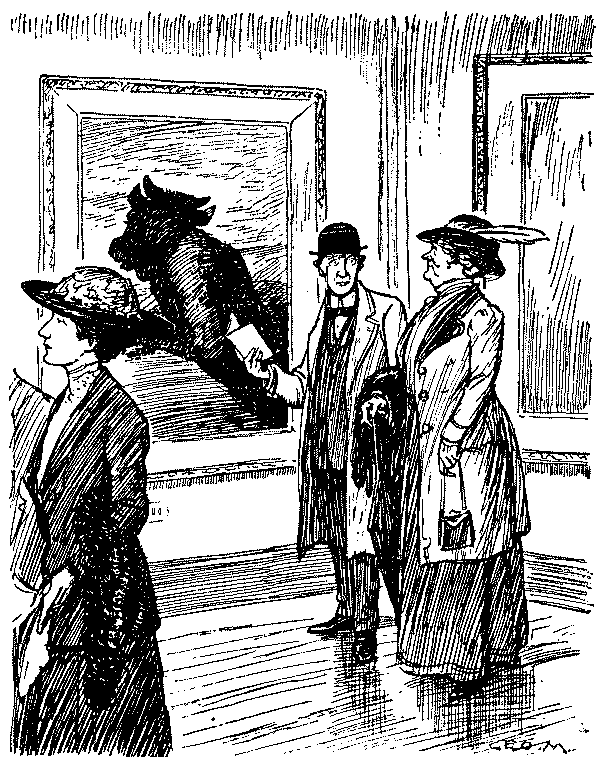
AT THE TATE GALLERY
Dutiful Nephew (doing the sights of London for the benefit of his aunt from the country): "This is the famous 'Minotaur,' by Watts. What do you think of it?"
Aunt: "Well, it's a short-horn, whatever else it may be!"
DRAMA, OPERA, MUSIC
The period which began with the triumphs of the late Mr. Penley, and ended with those of Mr. Ainley, was more remarkable for dramatic alarums, excursions, innovations, inventions and discoveries than any of those dealt with in my previous volumes. If one were asked to single out the most remarkable event in British Theatrical history in those twenty-two years, pre-eminence might fairly be awarded to the establishment and fruitful work of the repertory theatres in the provinces—Manchester, Birmingham, Glasgow and Dublin. I mentioned in an earlier volume Punch's generous tribute to Calvert's services in Manchester, but if we except his references to the Irish players, little or nothing is said of this decentralizing movement. Where the theatre was concerned Punch, as in many other ways, was first and foremost a Londoner. But, with this reserve, most of the outstanding features of the drama and its presentation are recorded and commented on in his pages. New dramatic luminaries shot into his sphere, some of them too wildly to suit his Victorian tastes. Ibsen remained for a while as his chief bogy and butt, but was supplanted, as a target for caricature, by Maeterlinck, and to a certain extent by Rostand. But as time went on Punch was even more preoccupied with the experiments and achievements of native playwrights. The revival of the poetic or literary drama associated chiefly with the works of the late Mr. Stephen Phillips, met with a not unsympathetic reception at his hands. Mr. Shaw worried him from the very outset, but there is no notice of Arms and the Man in 1894, in which, by the way, Mr. Bernard Partridge, as Mr. Bernard Gould, greatly distinguished himself before he abandoned the boards for black-and-white. Punch contemptuously dismisses the piece with two lines and two villainous puns: "''Ave a New Piece?' They've got it at the Avenue. A shawt criticism on it is 'Pshaw! Absurd!'" It was only by slow degrees that Punch came to recognize the vivacity, the wit and the originality which redeemed Mr. Shaw's perversity, his lapses from taste and his consistent defiance of tradition and convention. It was, if my memory serves me aright, one of Punch's young men who was responsible for a poem, recited at a dinner of the Stage Society, which contained the couplet:—
And if The Lady from the Sea seems foreign, For British matrons there is Mrs. Warren.
A Short Way with Shaw
Towards Barrie as a playwright Punch was at first much less benevolent than he had been to Barrie the novelist, and Mr. Granville Barker's plays depressed more than they impressed him. But for rather more than half the period under review Punch's critiques of plays were primarily a medium for jocular comment, for fun at all costs, for explosions of puns. As a devotee of cheerfulness he resented gloom; as a professional humorist he found himself out of touch with a good deal of the new humour, the new whimsicality, the new wit. These editorial limitations were made good by the oblique methods of parody adopted with brilliant results by some of his collaborators, but it is not too much to say that theatrical criticism was never so impartially and tactfully conducted as under the fifth editor of Punch, the only one who had never written for the stage.
Turning from the creative aspect of the drama to the organization and regulation of the theatre, we have to notice two important factors, one of which was increasingly active throughout these years. Societies for the production of new, and the revival of old plays on a non-commercial basis were already in existence, but an impetus was given to the movement by the establishment of the Independent Theatre by Mr. Grein in the 'nineties, and the Stage Society and other similar bodies have carried it on with undiminished vigour down to the present time. These activities did not always commend themselves to Punch, but at least he did not ignore them.
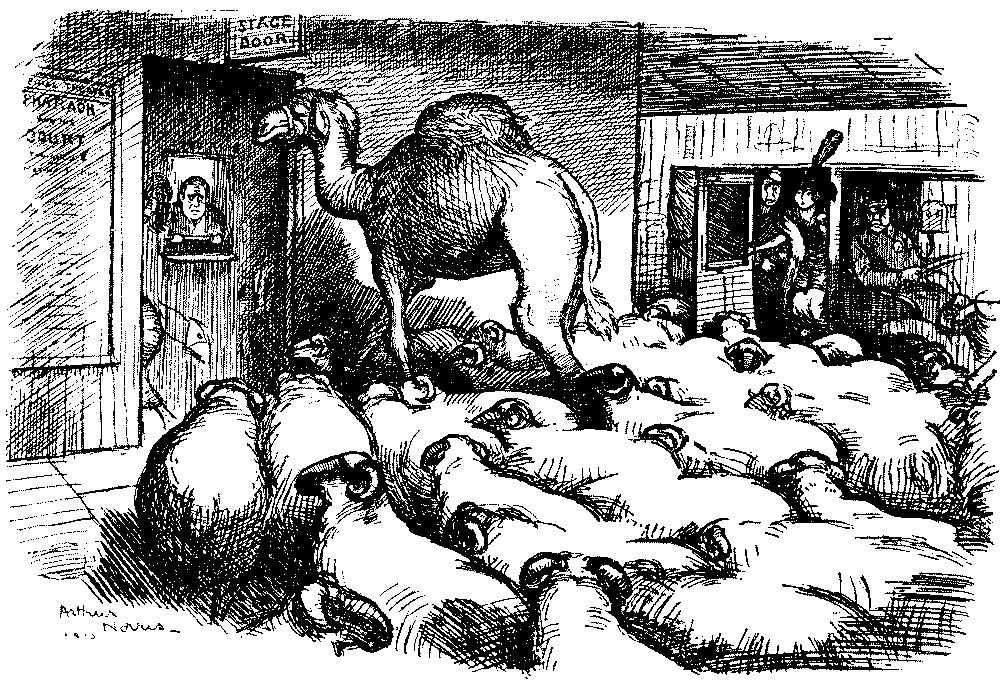
PEEPS INTO BIBLICAL THEATRICAL LIFE
Arrival of Actor-Manager, Leading Lady, and other members of the cast.
Then there was the Censorship. The Lord Chamberlain intervened pretty frequently in the 'nineties where plays dealing with Scriptural motives came under his scrutiny. Maeterlinck's Mona Vanna was barred on moral grounds, and in 1907 the apparently blameless Mikado was temporarily withdrawn for political reasons. It must be admitted that in these years Punch was less inclined to criticize these interventions when they were aimed at the frank discussion of disagreeable themes than when they sought to restrict the unseemly vivacities of the Variety Stage—witness his continued hostility to the L.C.C. in regard to their licensing policy and his comments on the Puritan protests against the programme at the Empire in 1894. An altered mood, however, is distinctly revealed in a cartoon in 1907 where the Censor is shown preferring the claims of musical comedy to those of the serious drama, and Punch's sympathies are clearly with the latter. Since then, though Scriptural and political plays have not always escaped the ban, restrictions on the didactic drama, where it deals with the "social evil," have been largely withdrawn in deference to modern conceptions of the needs of education and the responsibilities of the State.
English Plays and Foreign Players
To go back to 1893, the three plays which Punch specially singled out for approval were Charley's Aunt, Becket and The Second Mrs. Tanqueray. The nearest approach to criticism is to be found in the notice of the first-named piece, in which, while admitting that Penley was "inimitably and irresistibly funny" throughout two hours of "all but continuous merriment," the writer lays his finger on a real blot—the intrusion of cheap sentimentality. Tennyson's Becket is pronounced a great and genuine success, both for Irving and the author, who had treated the story "with a free hand, a poetic touch and a liberal mind." The opening sentences of the notice, however, illustrate Punch's insuperable inclination to succumb to frivolity. "Becket has beaten the record": and he goes on to speculate how Thomas à Becket would have beaten The Record if that paper had existed in his time and had ventured to criticize him.
The Second Mrs. Tanqueray might be too strong meat for the young person, but it "marked an epoch in our dramatic annals," it was "every inch a play," and revealed in Mrs. Patrick Campbell an actress of exceptional gifts. There is a delightful burlesque of Ibsen in "Pill Doctor Herdal," but Punch did not leave well alone, and in another number furiously denounced The Master Builder (which he had read but not seen). "Of all the weak-kneed, wandering, effeminate, unwholesome, immoral, dashed rot (to quote Lord Arthur Pomeroy in The Pantomime Rehearsal) this is the weak-kneed-est," and so on in the superlative degree with all the other epithets of abuse. This was the year in which Madame Duse made her London début, but Punch did not get beyond a few puns on her name. The visit of Got, Mlle. Reichemberg and other representatives of the Comédie Française is treated less cavalierly, and the rumoured reconciliation of Gilbert and Sullivan suggests the possibilities of a new "Savoy Peace"—"the Reunion of Arts." Sarah Bernhardt, Yvette Guilbert and Réjane were the three bright particular foreign stars in 1894. Sarah Bernhardt was, as we know, an old flame of the susceptible Punch, and though he found Ize l the reverse of exhilarating, homage was paid to the golden voice of the heroine in a graceful cartoon of "Sarah Chrysostoma." Réjane in Madame Sans-Gêne comes in for high but not unqualified praise. She was perfect in the last act, but overdid the canaillerie of her farce in earlier passages, or at least Punch thought so. His tribute to Yvette Guilbert, "the Queen of the 'Café Concert,'" killed two birds with one stone, for it took the form of a very neat and witty adaptation of her famous song, "Les Vierges," at the expense of the "unco' guid" of Glasgow, whose Puritanism had recently aroused the protest of Sir Frederic Leighton and other Academicians:—
Ils défendent tous les desseins Où l'on peut voir les bras, le sein, à Glasgow. Jamais nus; même dans un bain Sont-ils tout habillés enfin? (Parlé) Matin! A Glasgow. Portez des lunett's; l'oeil nu Est absolûment défendu à Glasgow. Des corps nus ils n'ont jamais vus Là, où leurs raisonn'ments sont plus (Parlé) Cornus! A Glasgow.
Irving's Knighthood
The closing of the Empire Theatre on the score of the improper character of the performances inspired a cartoon in which "Miss Prowlina Pry" (the L.C.C.) "hopes she doesn't intrude." The accompanying verses, protesting against the action of the new Bumbledom, compare unfavourably in their heavy-heeled satire with the verses quoted above. Ada Rehan in Twelfth Night is a pleasant memory to middle-aged playgoers. Punch did not acquit her Viola of a certain restlessness, but acknowledged that at times she acted like one inspired. To the same year belongs his tribute to the "imitative charms" of Cissie Loftus in a set of verses alluding to her imitations of May Yohé, Florence St. John, Jane May, Yvette Guilbert and Letty Lind, names that bear witness to the "fugacity" of the years and the transitoriness of stage popularity.
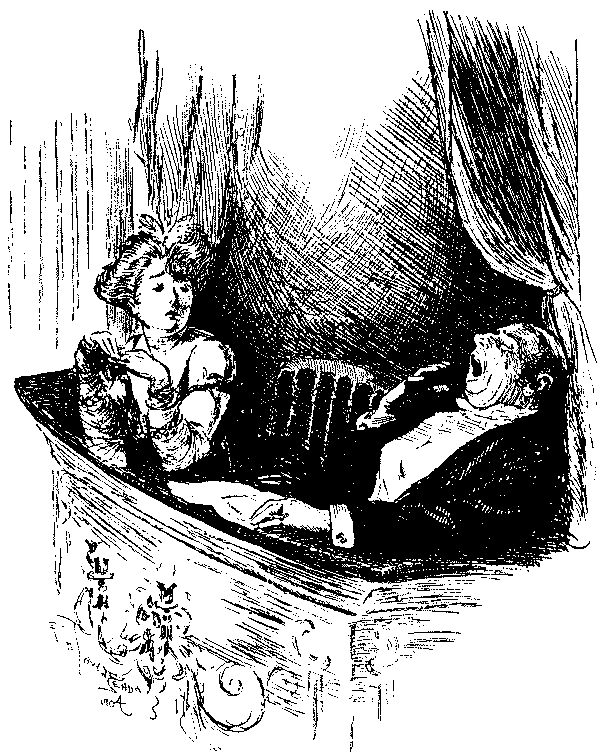
TRUE APPRECIATION
(Overheard at the Theatre.)
Mrs. Parvenu: "I don't know that I'm exactly gorne on Shakespeare plays."
(Mr. P. agrees.)
In 1895 Punch waxed lyrical over Tree as Svengali and Miss Dorothea Baird in the title rôle of the dramatized version of Trilby. He bestowed the "highest order of histrionic merit" on Irving for his Corporal Brewster in Conan Doyle's Story of Waterloo, and, in the cartoon recording his knighthood, congratulated him in the name of the profession through the mouth of David Garrick. Pinero's play, The Notorious Mrs. Ebbsmith, is described as "a drama of inaction" owing to the length of the speeches, but praise is liberally bestowed on Hare, Forbes-Robertson and Mrs. Patrick Campbell. The popularity of a now forgotten work of advanced fiction—Keynotes, by "George Egerton"—is attested by Punch's perversion of the title of the piece into "The Key-note-orious Mrs. Ebbsmith." The revival of Romeo and Juliet served as the occasion for jest seasoned with shrewdness:—
Mrs. Patrick Campbell's "Juliet" takes the poison but not the cake. Her "Juliet" has over her the shadow of Paula Tanqueray.... Watching Forbes Robertson as "Romeo" I could not help thinking what an excellent "Hamlet" he would make; perhaps when I see him in that character I shall remember how good he was in "Romeo."
Cymbeline was the next of the Shakespearean revivals, and its production at the Lyceum, with Irving as Iachimo and Ellen Terry as Imogen, prompted eulogies of the performance and a burlesque of the plot. Mrs. Stirling (Lady Gregory), famous in her prime as Peg Woffington, incomparable in her old age as the Nurse in Romeo and Juliet, awakened gracious memories in Punch when she died at the close of 1895. Sir Augustus Harris was little more than half her age when his crowded and in the main prosperous life ended some six months later. The memorial verses to "Druriolanus," the ingenious agnomen of Punch's coining, render full justice to one who began as an indifferent melodramatic actor and ended as a successful impresario, and throughout served "amusement's motley world" with unfailing energy and resourcefulness. But to call him the Showman and Solon of the stage was at once to exaggerate his defects and his merits.
Mr. Henry Arthur Jones cannot be said to have been exactly a favourite with Punch in these years. Indeed, the title under which Punch habitually alluded to him—'Enery Author Jones—was the reverse of honorific. Yet in 1897 The Liars, with Charles Wyndham in the principal rôle, was cordially welcomed as "an exceptional play with the prospect of an exceptionally long run." Praise from such a source was praise indeed. The tragic death of William Terriss at the hand of a lunatic robbed melodrama of its brightest ornament, and Punch's memorial verses, though melodramatic in their emotion, are a faithful reflection of popular sentiment. Aladdin at Drury Lane impels Punch to pay a well-deserved compliment to Mr. Oscar Barrett for maintaining the best traditions of pantomime. From first to last it was "very funny without being in the least vulgar," and Punch's notice is embellished by an admirable portrait of Dan Leno as "The Second Mrs. Twankyray." In 1898 Rostand swam into our ken with Cyrano de Bergerac, but Punch took decidedly a minority view in crediting Coquelin with a "nasal victory over difficulties of his own choice." The author "had much to be thankful for," and the play is pronounced overweighted with verbiage which was neither brilliant nor helpful. Punch was much happier in his burlesques of Maeterlinck, "the Belgian Shakespeare," and the travesty of Hamlet, with "Ophelaine" and "Hamelette," and the dialogue, re-written in Ollendorffian sentences abounding in endless iteration, makes excellent reading, though perhaps eclipsed by the brilliant condensed American version of the same tragedy, in which prominence is assigned to the members of the Elsinore University Football Team. In 1899 the claims of the Celtic Drama begin to assert themselves, but Punch's "recipe" for the construction of this new type, founded on Mr. Martyn's play, The Heather Field, shows little sympathy for the aims or methods of the new school:—
Rostand and Maeterlinck
Choose for your scene an Irish bog. Among brutal Saxons the theory still lingers that Ireland is all bog, and this will give vraisemblance to your picture. If you require an Interior, an Irish cabin will be most appropriate, for there is another curious superstition on this side of the St. George's Channel that all Irishmen live in cabins.
For the subject of your drama select something gloomy and Scandinavian. It is true that The Times says that "Lunacy and surface drainage are not cheerful subjects for drama," but your Celt knows better. Everything depends on the treatment. Did not Ibsen contrive a drama of enthralling interest on the subject of the drainage of a watering-place? And they say Ibsen is a Scotsman by descent, which is next door to being a Celt.
Let your characters be crazy or neurotic. You will find Ibsen's works a perfect storehouse of these, and if you "lift" one or two of them nobody is likely to detect the theft. Rita Allmers, or Mrs. Borkman, or that sweet thing Hedda Gabler, would all come in useful, and, as your scene is an Irish bog, there is an obvious opening for a Wild Duck.
If the plot of your play is gloomy, the dialogue should be even gloomier. Irish humour would be quite out of place on this occasion. No one must flourish a shillelah or sing "Killaloe" to lighten up the proceedings, and the stirring strains of "The Wearing of the Green" must be rigidly banished. This paramount necessity for gloom will probably place you in a somewhat difficult position, and may make it necessary for you to banish the Irish brogue altogether from your cast. Long experience has shown that a Saxon audience invariably associates a brogue with latent humour, and if anybody laughed it would be all up with the Celtic Renascence.
Punch's charity—or tolerance—did not, however, begin at home. London dramatic critics fared no better at his hands than Irish playwrights; witness the essay which begins "Dramatic critics are of three kinds. They may either write about themselves, or about the play, or about Macready." The first were egotistic, the second wholly unjudicial, the third laboriously and tediously reminiscent. But the sting of the satire is in the last paragraph:—
In criticizing the acting of a play, you should be guided wholly by the status of the actors. Thus the performance of the highly salaried players should receive unstinted praise, and that of the actor-manager (it is not the least blessing of his happy position) adulation. Less known performers may be mentioned with less enthusiasm, and minor personages may even be alluded to with marked disfavour. This will lend to your judgments that air of fine discrimination which will add to their weight.
Punch and "the Duse"
Loyalty to old favourites was another matter, as when Punch, under the heading "Little Nell," pleaded in support of the "Nellie Farren" Benefit on behalf of that famous Gaiety heroine in 1898; or when in 1899 he offered his parting salute to Mrs. Keeley, who throughout her long career in burlesque, melodrama, and legitimate drama had never been vulgar or tawdry, but always brave and gay, and who lived to the patriarchal age of ninety-four. Sardou's Robespierre, written for Sir Henry Irving and his company, gave Punch the opening for a graceful compliment to father and son, for Mr. Lawrence Irving translated the play and appeared in the part of Tallien. Sarah Bernhardt's Hamlet is regarded rather as a tour de force than a legitimate interpretation, and Punch, who could not accept her reading of the Prince as a mischievous, spoilt and conceited boy of eighteen, suggested, in a whimsical picture, that she ought to get Irving to play the part of Ophelia. The same year, 1899, was notable for the coming of the Revue. The pioneer effort, which was launched at the Avenue Theatre, was more or less on French lines, but even at the outset the Variety element was prominent in a series of imitations of popular actors and actresses. Tree's production of King John, with Lewis Waller as Falconbridge and Miss Julia Neilson as Constance, is pronounced "a superb revival," but the English version of Cyrano de Bergerac failed to convert Punch to the majority view, though he now admitted that the piece contained brilliant poetry. He preferred Wyndham to Coquelin, but liked neither of them in the title rôle, and he sums up by declaring the piece to be a fine dramatic poem not to be acted, but read. Still, Punch was never wholly insular or inaccessible to new and foreign influences. He describes in 1900 how an enthusiastic friend accosted him in broken Anglo-Italian and swept him off to see Mme. Duse in the Italian version of The Second Mrs. Tanqueray. Punch began by scoffing at the grotesque costumes of the cast, but succumbed to the magic of this wonderful actress, who owed nothing to physique, discarded all make-up, even in a part where artificiality was in keeping with the character, and triumphed by sheer force of genius.
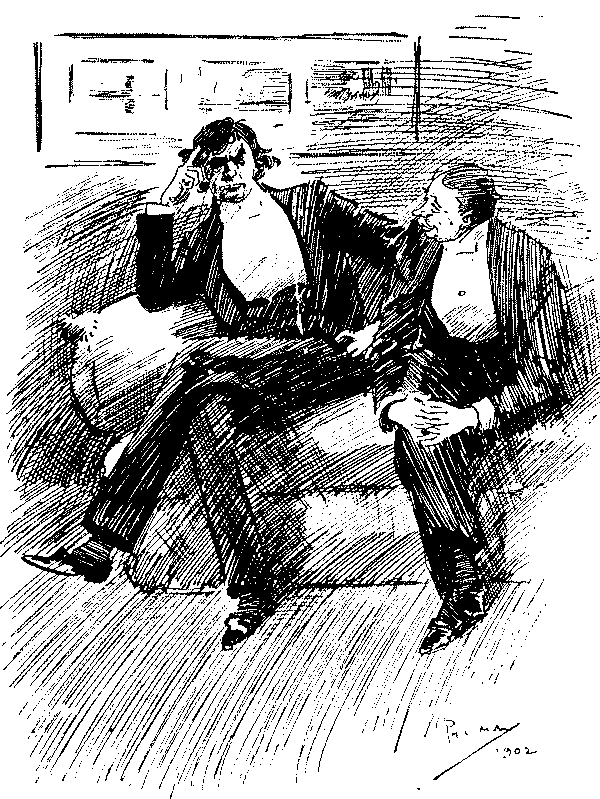
Conversationalist: "Do you play Ping-Pong?"
Actor: "No, I play Hamlet!"
The vogue of musical comedy was now at its height. Punch has some amusing suggestions in 1900 for adapting The School for Scandal and Mr. Henry Arthur Jones's Mrs. Dane's Defence to suit the fashion of the hour, with appropriate casts, including Dan Leno and Miss Marie Lloyd. His rhymed extravaganza on "The Evolution of Musical Comedy" accurately describes the prevalent method in this quatrain:—
In musical comedy books (Chiefly frivol and froth) You do not spoil the broth By employing a number of cooks.
With the opening of the new century, the "poetic drama" was revived with a certain measure of success by the production of Mr. Stephen Phillips's plays. Mr. Phillips had graduated as an actor, but Punch found him lacking in the theatrical sense, while acknowledging the pomp and pageantry of his verse. Herod, with Sir Herbert Tree in the title rôle, is condemned for its repulsive realism, and the lack of any character that engaged sympathy. The notice of Paolo and Francesca in 1902 is long, critical and by no means unfriendly, but the resultant impression is of "a negative achievement" in which the purple patches failed to redeem the lack of consistent characterization or of stage-craft. Mr. Henry Ainley is mentioned, but without any recognition of the qualities which have since earned for him distinction and popularity. Nero, by the same author, produced in 1906, is described as "out-heroding Herod." There were many fine lines but little dramatic action. Punch praises Miss Constance Collier as Poppaea, but cannot take the part seriously. "She looked the Roman lady, played the unfaithful wife, and died effectively as an invalid after a long and inexplicable illness. Perhaps she was poisoned. Nero knows; nobody else does except, perhaps, Mr. Stephen Phillips." Tree's make-up as Nero was most artistic, but he had not one really fine scene given him; Mrs. Tree was an admirable Agrippina; but Punch was not thrilled by the final conflagration, which he describes as a "weird, maniacal but dramatically unsatisfactory finish."
Barrie and Shaw
Meanwhile Sir James Barrie and Mr. Bernard Shaw were coming along with leaps and bounds, but neither of them owed much to Punch in the early years of the century. He had nothing but praise for H. B. Irving's acting in The Admirable Crichton, but it was a triumph for the actor rather than the playwright. The hero was "a perplexing creation," and the play "a queer mixture of comedy, extravaganza, farce and tragedy." Even less sympathetic was the first notice of Peter Pan, in 1905. As Punch had detected resemblances to The Overland Route and Foul Play in The Admirable Crichton, so he now found reminiscences of Peter Schlemihl and Snowdrop in the new play. For the rest, he could find little either to amuse or that could even be acknowledged as new or original in the extravaganza. He could not even tell whether the children present enjoyed it. Punch acknowledges that Barrie was the pet of the critics, and congratulates him on having his pieces perfectly acted by first-rate comedians. He frankly admits that he (Punch) was in the minority. A year later Peter Pan is recognized as a popular favourite in a much more sympathetic notice. Mr. Shaw was a much tougher morsel to digest, but here, too, one notes a progressive appreciation from the days when Punch pronounced Man and Superman to be "unpresentable," not on moral grounds, but because it was not a mirror of humanity in point either of character or action. Similar reserves are expressed in the notice of The Doctor's Dilemma in 1906. The general verdict is summed up in the epigram that "unfortunately, by steady abuse of it, Mr. Shaw has long ago forfeited his claim to be taken seriously." Yet the play contains "some very excellent phagocytes which enjoy a strong numerical advantage over its malevolent germs." So, again, Cæsar and Cleopatra, while affording in many ways a rare intellectual entertainment, was spoiled by the author's passion for being instructive; the piece fell between two stools, for it was neither frankly sacrilegious nor purely serious.
The ingenious burlesque account of an imaginary meeting of "The Decayed Drama and Submerged Stage Rescue Society" in 1903 is in the main hostile to the societies which confined their activities to the revival of old plays that failed to attract the general public. But Punch was by no means enamoured of all the manifestations of modernity, and the rumour in 1906 that Mr. Seymour Hicks was going to produce a musical comedy based on As You Like It prompted a diverting retort in Punch's: "As We Certainly Don't Like It, a Musical Comedy in Two Acts, by Hicks von Rubenstammer and William Shakespeare."
Punch adds the note:—
"Great care has been taken to follow the usual musical-comedy plan of making the Second Act even worse than the first."
His success may be judged by the extract that follows:—
ACT II
A wild place in Shepherd's Bush
Enter the melancholy James (footman to the banished Duke) with one or two Lords, like Bushmen.
James [looking at his watch]:
'Tis but an hour ago since it was nine And after one hour more 'twill be eleven; And thereby hangs a song.
[Sings it.]
[Mr. Punch: Excuse me a moment, but is this Act very bad?
Mr. Hicks von Rubenstammer: Very bad indeed.
Mr. Punch: Personally I fear that I shall not be able to survive it.
Mr. H. v. R.: Oh, two or three of us will re-write it after the first night, you know.
Mr. Punch: Then by all means let us wait for that occasion.]
Irving had met with various vicissitudes of criticism at Punch's hands during his career. But latterly admiration prevailed, and, when the end came, real affection shines through the brief memorial quatrain printed in October, 1905:—
Ring down the curtain, for the play is done. Let the brief lights die out, and darkness fall. Yonder to that real life he has his call; And the loved face beholds the Eternal Sun.
Ellen Terry's Jubilee
Irving, as Punch noted in his review of Mr. Bram Stoker's Life, was if possible more loved by his company than by the idolizing public. The financial misfortunes which dogged the last years of his life were due more to bad luck than bad management, and did not impair his serenity. He died in harness, and there was more tragedy in the latter years of his contemporary and friend, the famous and prosperous comedian J. L. Toole, for they were clouded by bereavement as well as infirmity; and Punch's farewell to his friend in July, 1906, emphasizes the contrast:—
While Summer's laughter thrills the golden air, Come, gently lay within the lap of earth This heart that loved to let us share its mirth But bore alone the sorrow none might share.
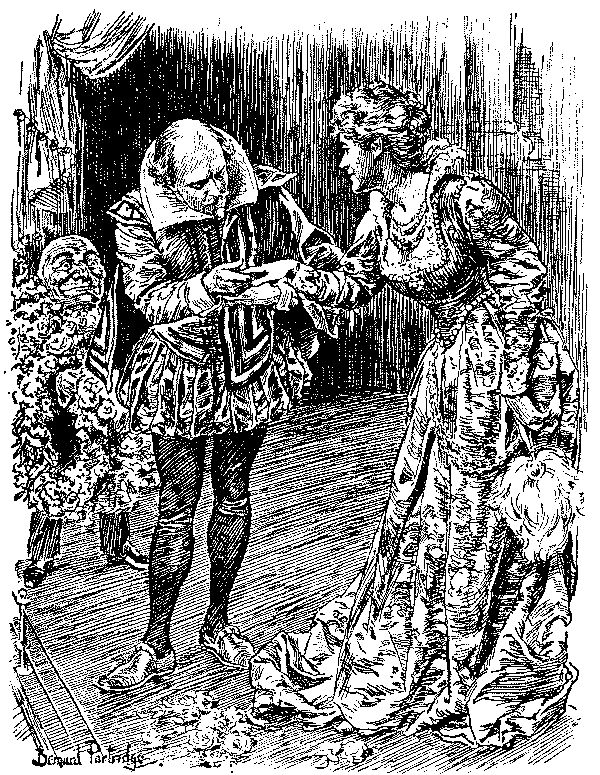
FIFTY YEARS A QUEEN
(An Author's Tribute.)
(A scheme is on foot for presenting a National Tribute to Miss Ellen Terry on April 28, the fiftieth anniversary of her first appearance on the stage.)
Ellen Terry's Jubilee in the same year was honoured in a cartoon; but a new and formidable rival to the Muses of legitimate Comedy and Tragedy reared its menacing head in the following year. The visit of the Grand Guignol to London in 1907 inspired a prophetic fantasy on the new cult of "Shrieks and Shudders" which has been easily eclipsed by the realities of the Little Theatre. As I write these lines the leading serious weekly, among "Plays worth seeing," includes the "unabated horrors" of the London Grand Guignol. I have spoken elsewhere of the dancing mania. In 1909 the furore excited by Miss Maud Allan led to the following squib in which burlesque is mingled with caustic ridicule:—
HER RETURN
Being a wholly imaginative anticipation of the Proceedings at the Palace on the historic night.
... Before the dancing began an ode to the artiste from the emotional pen of Sir Ernest Cassel was read by Sir John Fisher, containing these memorable lines:—
Barefooted Bacchanal, would that I were Kipling To celebrate thy marvellous arm-rippling!
... The new dances were four in number, and in them She personated in turn Pharaoh's Daughter in her famous fandango known tastefully as the Bull Rush; Jephthah's Daughter in her final macabre Hebrew fling, on hearing of her father's vow and her own fate; Uriah's wife in her pas de liberté after the battle; and Jezebel in her defiant tarantella before a waxen Elijah—all new and all marvellously restrained (not only in dress) and full of scriptural tact.... At the end of the turn the applause lasted fourteen minutes, and She was led on eleven times. Free restoratives were then distributed in the theatre, ambulances removed those admirers who were too far gone to remain any longer, and the programme proceeded. Late at night She was drawn to her residence at Frognal in a carriage from which the horses had been removed, the Prime Minister, Mr. Walkley, Mr. Alfred Butt and a number of other talented gentlemen taking their places. Never was there such a triumph.
The "Follies"
Happily there were antidotes to the plague of Biblical Bacchanals; none better than that supplied for several seasons by the late Mr. Pélissier and his "Follies," to whom Punch expressed his gratitude in 1910. It was a "priceless" entertainment, with its "Potted Plays," admirable burlesques of the music-hall stage, opera, the Russian ballet, and on occasion, as in "Everybody's Benefit," really acute satire of the histrionic temperament. "The Follies" have had reincarnations and successors and imitators, but Punch's doggerel is not a bad picture of the troupe at its best, before the late Miss Gwennie Mars left them, and when Mr. Lewis Sydney, Mr. Dan Everard, Mr. Morris Harvey, and Miss Muriel George contributed nightly to the gaiety of the London public:—
When life seems drear and hollow, When Fortune wears a frown, I haste to the Apollo And plank my dollar down. Outside the tempest vollies Against uplifted brollies; I care not, for "the Follies" Are back in London town. Pélissier, prince of "Potters," You earn our grateful thanks, You and your fellow plotters— Co-partners in your pranks— For slating smart inanity, Or Fashion's last insanity, Or histrionic vanity, Or madness à la Manx. From introspective thinking In every minor key, Good Sydney, grimly blinking, You set my spirit free. If laughing makes one fatter, Then listening to your patter, O very harebrained hatter, Has added pounds to me. Nor must my brief laudations Omit the genial Dan, Or Harvey's imitations Framed on a novel plan, Or Ben, that priceless super Moustachioed like a trooper, Who plays like Margaret Cooper Were she a Superman. 'Twould need the fire of Uriel To hymn your female stars For Muriel's most Mercurial And Gwennie's surnamed Mars. O Gwennie, you're a miracle Of mimicry satirical, Yet when your mood is lyrical There's not a note that jars.
The "Follies" were benefactors; their satire was in the main most genial; and they did not cause their audiences "furiously to think." These aims accorded largely with Punch's own conception of the function of public entertainers; none the less in his later years he was by no means antagonistic to the serious drama. In 1907 Mr. Galsworthy's Strife is welcomed as a great play, greatly acted. Punch's dramatic critic has nothing but praise for it, though he did not think that the author bothered about a moral. It was his business to make other people uncomfortable, to make them think and "do something." "If Strife has a moral it is simply that the problem of Capital and Labour will have to be settled."
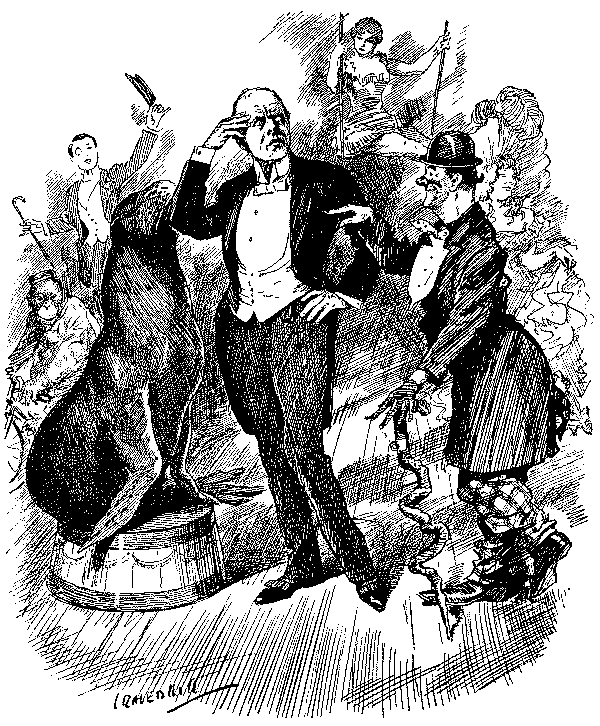
THE ENEMY THAT WAS
Chorus of Music-Hall Artists: "Glad you're one of us now, Sir Beerbohm."
Punch still intermittently bewailed the decline of the Harlequinade. His Lament for King Pantomime in 1910 was based on an article in the Daily Telegraph welcoming the beneficent revolution which had substituted Peter Pan for the old Christmas carnival of Clown and Pantaloon. At the same time Punch had himself become more than reconciled to the new children's idol and had compared Maeterlinck's Blue Bird unfavourably with the perennial Peter. The competition of the film play had not yet become acute, and the Music-Hall, which Punch had so frequently and even fiercely assailed in its earlier phases, was now a formidable and fashionable rival of the theatre. In 1908 Harry Lauder's salary, alleged to average £250 a week, is compared with that of the Lord Chancellor. There was no longer any talk of "indignity" in appearing on the boards of the variety stage, and Punch notices Sarah Bernhardt's appearance at the Coliseum, in 1910, as putting the crown on the new movement, and providing the Halls with their apotheosis, for she was "still the greatest star in the Thespian firmament." Her "turn" was in the second Act of L'Aiglon; the only other feature in the programme that called for notice was the performance of the "Balalaika Orchestra"; the rest of the "artists" were "very small minnows alongside of this great Tritoness." The "divine Sarah" could do no wrong, but, when Sir Herbert Tree appeared in the Halls, in 1911, Punch's cartoon was certainly not honorific. Nor is the note of "indignity" altogether lacking in the dialogue between the two knockabout comedians in Mr. Townsend's picture in 1912:—
First Music-Hall Artist (watching Mr. J. M. Barrie's "The Twelve Pound Look" from the wings): "I like this yer sketch; the patter's so good. 'Oo wrote it?"
Second M.-H. A.: "Bloke called Barrie, I think."
First M.-H. A.: "Arst for 'is address. 'E writes our next."
The "Balalaika Orchestra," by the way, was a minor sign of the Russian invasion already at its height. Miss Maud Allan had been unfavourably received in 1909 in Manchester, and about the same time the Chicago "Wheat King," Mr. Patten, had been mobbed on the Manchester Exchange, and Punch ingeniously "synthesised" the two events in the following stanza:
The types that make the market mad No doubt inspire the self-same loathing In spots that spin, as those whose fad Is chucking up all kinds of clothing.
The March of Music
The Russian Ballet was a very different thing from the poses and wrigglings of barefooted Bacchantes, and Punch became lyrical in his eulogies of these "spring-heeled Jacks and Jills." The exquisite romance and fantasy of "The Spectre of the Rose," the "Carnival" and the "Sylphides" were a revelation to those who, like Carlyle, only saw in the old opera-ballet the conversion of the human frame into a pair of animated compasses.
The Russian Ballet furnished Punch in his almanack for 1913 with an excellent formula for caricatures of the idols and butts of the hour, but his admiration for the originals was sincere.
In the years immediately preceding the war the cinema demands an evergrowing if not altogether appreciative attention. Punch pays a left-handed compliment to the versatility of the film actor, but very properly satirizes the extraordinary representations of English life and dress in the foreign films produced for the English market. The invasion of Debrett by chorus girls, recorded in October 1913, is an old story, but if Punch is to be trusted had then reached dimensions unparalleled in the annals of aristocratic condescension.
MUSIC
Music has been called "the youngest of the arts" in view of the fact that, as we now understand it in the Western world, it dates roughly from the year 1600. But the "heavenly maid" had already ceased to be the Cinderella of the Muses, though still condemned in restaurants and places where they feed to the menial function of acting as an obbligato accompaniment to conversation, deglutition, and digestion. A pessimistic observer remarked about fifteen years ago that modern life bade fair to be dominated by music and machinery, and the correlation of the two factors has since been abundantly illustrated by the momentous development of the gramophone and the pianola, the cult of "sonority" and the dynamics of the orchestra. When to these influences are added the successive experiments in harmony and tonality and rhythm associated with the names of Strauss and Debussy, Scriabine and Stravinsky, Ravel and Schönberg, one cannot deny that the ferment in letters has been more than matched by the exuberant activities of musical modernists. In the period under review the "whole tone scale" was partially acclimatized and "rag-time" was domesticated, Wagner ceased to be regarded as an anarch of discord, and the "Music of the Future" became the music of the past. It was no longer a guarantee of enlightenment to worship Brahms or admire Beethoven. Of the three "B's" Bach alone has maintained his prestige, and to-day counts upon the allegiance of all schools. Otherwise, and in spite of the renown of Strauss, Germany ceased to exercise her old musical supremacy, and, even before the war, Russia, France and Italy had entered into a formidable competition with the "predominant partner" in the domain of opera. And though opera is an artificial blend of incompatibles and must always remain on a lower plane than abstract or absolute music—the most transcendental thing in the whole range of art—it claims priority of notice in this record for two sufficient reasons: its social prestige and the amount of space devoted to it by Punch.
Wagner's operas were now established in the Covent Garden repertory, and as I have already noticed, their new-found and fashionable popularity was largely due to the appeal of the great singers, notably Jean and Edouard de Reszke and Mlle. Ternina, who proved that Wagnerian melody was all the more effective when sung beautifully and not declaimed or barked as by so many German singers. Moreover when, as in the artists mentioned, this vocal lustre was combined with a splendid presence, dignity of bearing, and dramatic intelligence, the appeal was well-nigh irresistible. I insert the qualification advisedly on behalf of Punch who, in these years at any rate, was never reconciled to Wagner, and when he heard Jean de Reszke and his brother in the Meistersinger in 1897 could not refrain from jocular disparagement of the score.
Foreign Stars and Native Composers
Verdi's Falstaff had been produced in 1894, but Punch abstains from any criticism of that exhilarating work, merely pronouncing the performance a success, and a few years later further advertised his inability to recognize the supreme achievements of the later Verdi by declaring that Otello as an opera was "heavy." In opera he was in the main an inveterate laudator temporis acti and chiefly enjoyed himself when opportunities arose for indulging in alliterative quips such as "merry Mancinelli," "beaming Bevignani," or puns on the name of the performers, e.g. "Mlle. Bauermeister-singer." Puccini's operas—Manon, La Bohême and Madama Butterfly— found favour in his sight; they had sparkle, elegance and brio. But he was not impressed with La Tosca, holding that the "operaticizing" of successful plays was a mistake; in general his notices are void of musical criticism and only deal with the singing of Melba and Caruso and the admirable Destinn. Still Punch had lucid intervals of vision when he saw a good or great thing and praised it handsomely. The Santuzza of Calvé, in 1894, was "grand and magnificent" and her Carmen "marvellous" and unique. The epithets were fully deserved, but Punch acutely detected that this great artist and actress suffered from the excess of her qualities, and wittily described her Marguerite in Faust as "a Mädchen with a past." Madame Patti's reappearance in opera in 1895 after many years' absence was genially welcomed, none the less so for her choice of La Traviata for her rentrée, for Punch was faithful to his old operatic loves. In the next few years English opera and operatic composers claimed Punch's attention. The scheme of a National Opera House was revived in 1899 when Punch represented Music petitioning the L.C.C. for a site, but the sinews of war were not forthcoming. Sir Charles Stanford's Much Ado about Nothing, the libretto adapted from Shakespeare by Mr. Julian Sturgis, with Miss Marie Brema, Miss Suzanne Adams, Mr. David Bispham and M. Plançon in the cast, was pronounced "an undisputed success" in 1901. In 1902 there were two native novelties. In Mr. Herbert Bunning's Princesse Osra, founded on "Anthony Hope's" novel, Punch found little scope for positive praise: it was "musically disappointing save for accidental reminiscences." Nor was he much more enthusiastic over Miss Ethel Smyth's Der Wald, with its lurid plot "of the penny plain, twopence coloured type" and "interminable duets." Over one stage direction, "Peasants turn pale," Punch waxed ribald, and he concludes his notice with the ambiguous sentence: "Miss Smyth was acclaimed vociferously, the Duke of Connaught and the occupants of the Royal box testifying their great pleasure at what may come to be, after judicious elimination, a satisfactory success." The first of the Salomes who de-decorated the lyric and variety stages was not Strauss's but Massenet's version, produced in the summer of 1903. Mme. Calvé was in the cast, but the opera provided no scope for her genius, and Punch damned it with faint praise as not likely to be retained in the repertory, a very safe prediction. In the summary of the season Punch puts Richter at the head of the successes, a well-merited recognition of his direction of the Wagner performances; the list of "stars" includes the "two Vans"—Van Rooy, the Dutch baritone, and Van Dyck, the Dutch tenor—Destinn, Calvé and Melba, Caruso and Plançon. In the winter the San Carlo troupe from Naples visited London, with Sammarco and Caruso—or Robinson Caruso, as Punch liked to call him—as the chief male singers, but no new operas were produced. André Chénier in 1907 is described as of the Tosca or lurid type. A new hand is observable in the notice which acknowledges an unexpected dignity and refinement in Caruso's always brilliant singing and pronounces Destinn "adorable." Wagner's star was still in the ascendant in 1908, and Richter's splendid conducting of the Tetralogy is commemorated in the cartoon of Hans the Ring-master; while the "record operatic duel" between Melba and Tetrazzini is similarly honoured a little later. Never before, unless I am much mistaken, had two cartoons with a musical motive appeared in the same year. In 1910 Strauss was the grand and conspicuous portent of the operatic world, for Elektra, was produced in the spring and Salome in the winter. The former was hailed by Punch as a supreme manifestation of the Maladie de Siècle. His verses are quoted not for their literary merit so much as because they are a fairly compendious record of the fashions and foibles of "England de luxe" at the time:—
"Elektra" and "Salome"
O sons of the new generation Athirst for inordinate thrills; O daughters, whose love of sensation Is shown in your frocks and your frills— Come, faithfully answer my queries If you would completely assuage The passionate craving that wearies Both sinner and sage. Has Ibsen no power to excite you? Can't Maeterlinck make you applaud? Do dancers no longer delight you, Who wriggle about à la Maud? Are you tired of the profile of Ainley? The tender falsetto of Tree? Do you envy each bonnet insanely That harbours a bee? Is the Metchnikoff treatment a failure? Do you weep when you miss your short putts? Have you ceased with enjoyment to hail your Diurnal allowance of nuts? Are you bored by the leaders of Spender? Or cloyed by the pathos of Caine? Do you find that "The Follies" engender A feeling of gêne? Are you sick of Sicilian grimaces? Unattracted by Chantecler hats? Are you weary of Marathon races And careless in choosing your spats? Are you jaded with aeroplaning And sated with social reform? Apathetic alike when it's raining And when it is warm? Do you shy at the strains that are sober? Does Wagner no longer inflame? Do you find that the music of Auber And Elgar is equally tame? Do you read without blushing or winking The novels of Elinor Glyn? Do you constantly hanker, when rinking, For draughts of sloe gin? If I am correct in divining The tortures you daily endure, Don't waste any time in repining, But try this infallible cure: With the sharpest of musical plectra Go pluck at your soul till it's raw; In a word, go and witness Elektra— Give up the jig-saw.
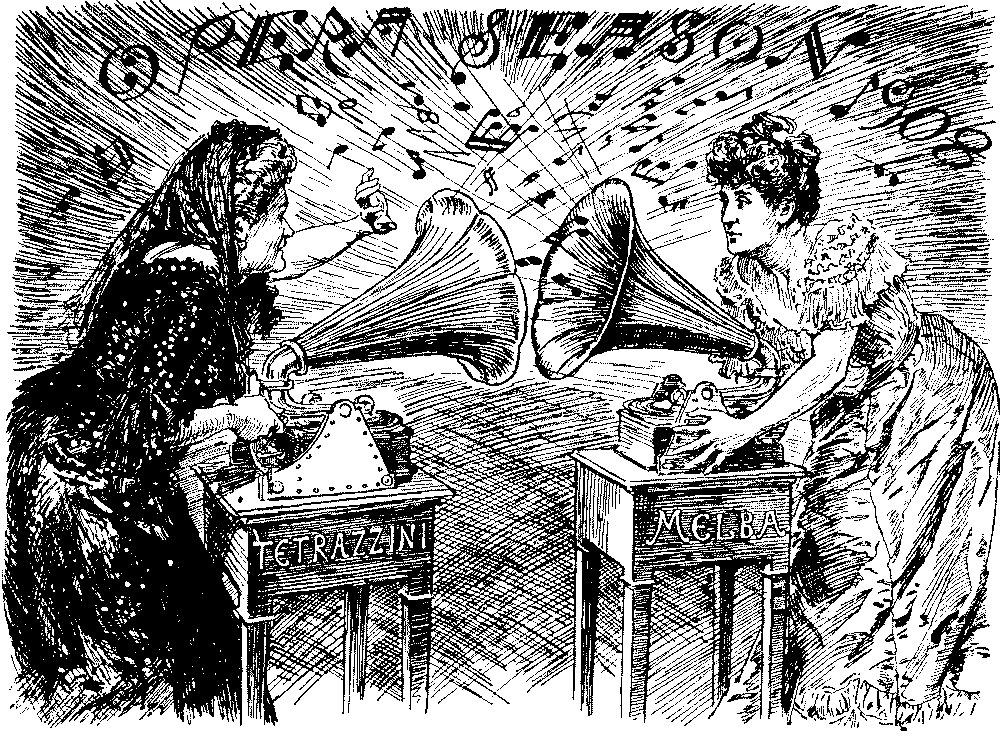
STARS IN OPPOSITION; OR, THE "RECORD" OPERATIC DUEL
Salome, so far as the book was concerned, was a tertiary deposit. Heine, in a few masterly stanzas in his fantastic narrative poem Atta Troll, tells the old legend of the unholy love of the daughter of Herodias for John the Baptist. Therein may be found the essence of Wilde's play, adapted to form the libretto of the opera. Punch, who attended the dress rehearsal, gives an interesting account of his experiences, but shirks the task of criticizing the opera: for that, as he observes, "no vocabulary could be too large or peculiar." But he mentions one orchestral interlude, in which "there was one sound, painfully iterated, like the chirrup of a sick hen, which appeared to come from some part of the violin that is usually left alone." At the close of June, 1914, Strauss's Légende de Joseph was produced at Covent Garden by Sir Thomas Beecham with the Russian Ballet. Punch abstained from detailed musical criticism, but condemned the "vulgar animalism" of the piece which he regarded as "a false move in every way," and his view cannot be laid down to prudery or Philistinism, since it was shared by many of the most devoted admirers of Strauss. Nor can he be charged with a wholesale depreciation of German music in view of the tribute to Humperdinck's Hänsel und Gretel, which appeared in his pages a few months earlier:—
Homage to Humperdinck
How strange that modern Germany, so gruesome in her Art, Where sheer sardonic satire has expelled the human heart, Should also be the Germany that gives us, to our joy, The perfect children's opera—pure gold without alloy. I know there are admirers of the super-normal Strauss Who hold him, matched with others, as a mammoth to a mouse, And, though they often feel obliged his lapses to deplore, His "cerebral significance" increasingly adore. In parts I find him excellent, just like the curate's egg, But not when he is pulling the confiding public's leg; Besides, the height of genius I never could explain As "an infinite capacity for giving others pain." No, give to me my Engelbert, my gentle Humperdinck, Whose cerebral development is void of any kink; Who represents in music, in the most enchanting light, That good old German quality, to wit Gemüthlichkeit. I love his gift of melody, now homely in its vein, Now rising, as befits his theme, to the celestial plane; I love the rich orchestral tide that carries you along; I love the cunning counterpoint that underpins the song. Though scientific pedagogues that golden realm have banned, He leads us back by pleasant paths to childhood's fairyland, Till, bald and grey and middle-aged, we watch with childish glee The very games we learned long since at our dead mother's knee.
There's not a bar of Hänsel's part that's not exactly right; There's not a note from Gretel that's not a pure delight; And having heard it lately for (I think) the fifteenth time, I know I'm talking reason though it happens to be rhyme. Then let us thank our lucky stars that in a squalid age, When horror, blood, and ugliness so many pens engage, One of our master-minstrels, by fashion unbeguiled, Keeps the unclouded vision of a tender-hearted child.
The sequel is curious, for while the gentle Humperdinck signed the anti-British manifesto issued at the outbreak of the War by leading German professors, men of science and artists, the name of Strauss was conspicuously absent. And as I write Strauss, middle-aged and grey, is revisiting London and, no longer in the van of musical progress, is regarded by our emancipated critics not exactly as a "back number" but certainly as very far from being the "Mad Mullah" of music. Even before the War German operatic music had been superseded in popularity by the Russian school. In June, 1914, Moussorgsky's Boris Godounov was the great feature of the season, and to this, as to Borodine's Prince Igor, Chaliapine, in Punch's phrase, "brought that gift of the great manner, that ease and splendour of bearing, and those superb qualities of voice which, found together, give him a place apart from his kind."
In the domain of light and comic opera the severance of the Gilbert and Sullivan partnership, though a personal reconciliation was effected, was final so far as collaboration was concerned. Composer and librettist both formed new or renewed old associations—Gilbert with Cellier in The Mountebanks, and Sullivan with Burnand in The Chieftain—but without repeating their old triumphs. When Sullivan died in 1900 his services to art and humanity are read aright in Punch's memorial stanzas:—
In the immortal music rolled from earth He was content to claim a lowly part, Yet leaves us purer by the grace and mirth, Human, that cling about the common heart. Now on the bound of Music's native sphere, Whereof he faintly caught some earthward strain, At length he reads the "Golden Legend" clear, At length the "Lost Chord" finds itself again.
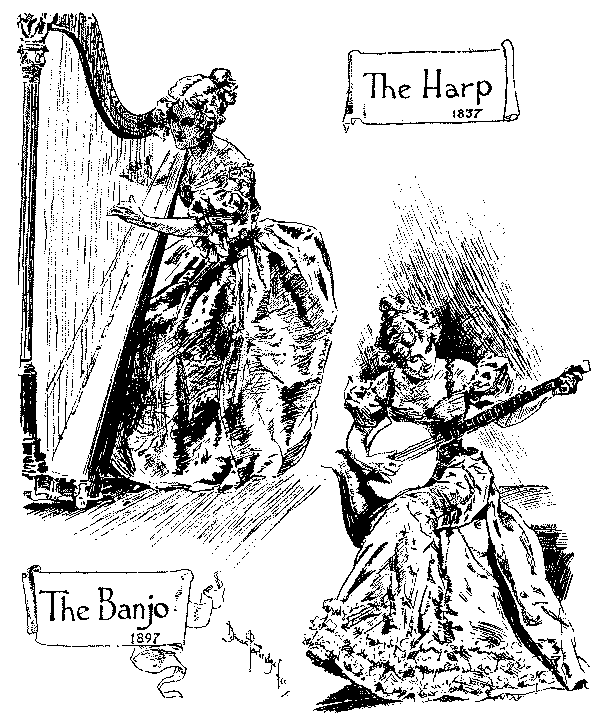
SIXTY YEARS OF "PROGRESS"
In musical comedy the high-water mark of popularity was attained by The Geisha in 1896, but though Punch speaks handsomely of Mr. Jones's tuneful numbers—as they deserved—he makes it clear that the success of the piece was chiefly due to the talent and humour of the performers—Marie Tempest and Letty Lind; Monkhouse, Huntley Wright and Hayden Coffin. In 1907 the devastating popularity of The Merry Widow amounted, in Punch's view, as expressed in his "Dirge" on the waltz of that name, to a tyranny rather than a delight; and in the spring of 1913 he was moved to protest, in the name of Music, against the wholesale importation of American coon songs, "Hitchy Koo!" and rag-time generally.
In the middle 'nineties the banjo was still fashionable, and the amateur singer a source of grief and wonderment to Punch:—
WHY DOST THOU SING?
Why dost thou sing? Is it because thou deemest We love to hear thy sorry quavers ring? My poor deluded girl, thou fondly dreamest! Why dost thou sing? Why dost thou sing? I ask thy sad relations— They shake their heads, and answer with a sigh. They can explain thy wild hallucinations No more than I. Why dost thou sing? Why wilt thou never weary? Why wilt thou warble half a note too flat? I can conceive no reasonable theory To tell me that. Why dost thou sing? O Lady, have we ever In thought or action done thee any wrong? Then wherefore should'st thou visit us for ever With thy one song?
Punch gave it up; but in 1910 he declared that "one of the finest efforts accomplished by the gramophone has been the obliteration of the inferior amateur singer."
Pioneers and Prodigies
The musical education of the million advanced apace. No more potent agency for the diffusion of a taste for orchestral music has existed in our times than the Promenade Concerts, directed since 1895 by Sir Henry Wood. The creation of this new audience is described with sympathy and delightful humour in The Promenade Ticket by the late and deeply lamented Arthur Hugh Sidgwick. While recognizing these new and beneficent activities, Punch did not forget the splendid pioneer work done by forerunners—notably Sir August Manns, whose seventieth birthday in 1895 is affectionately celebrated in punning verse. The action of the L.C.C. in 1897, which threatened to put a stop to the Queen's Hall Sunday Concerts, reawakened Punch's anti-Sabbatarian zeal. Not much account is taken of serious native composers, but the rise of Elgar's "star" is acknowledged as early as 1904 in the picture of Richter conducting The Dream of Gerontius.
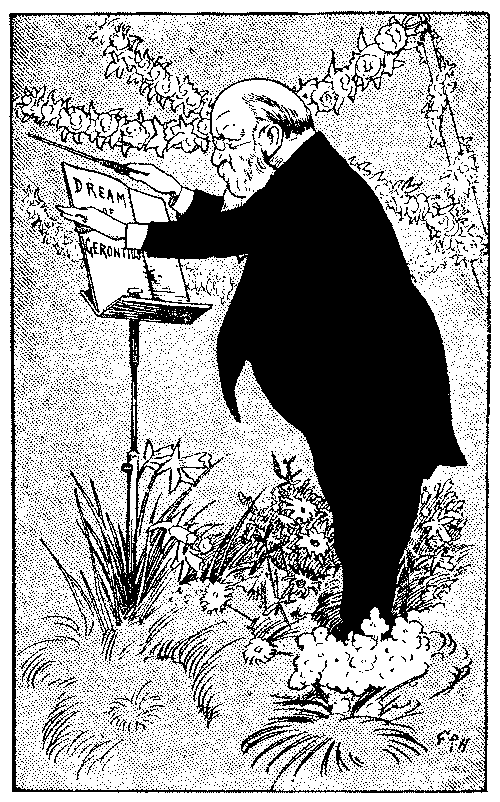
A SHOW OF HANS
(Richter interprets Elgar's Dream.)
In 1903 Punch was seriously perturbed by the glut of prodigies, and in a cartoon addresses the child violinist, "Get thee to a nursery. Go!" Yet in 1905, though "not as a rule favourably inclined to infant phenomena," he makes an exception in favour of the thirteen-year-old Mischa Elman. In 1908, in a burlesque account of "A Day in the Life of a Strenuous Statesman," the diarist records his reply to a Socialist Member that "the Government would think not once but twice before they refused to grant special pensions to the parents of infant prodigies earning less than £5,000 a year." On the compulsory musical teaching of the ingenuous youth Punch held views which may be gathered from his picture in 1911 of the unhappy small boy at the pianoforte, with the legend: "The only thing that comes between us, Mother, is this wretched music!" While Punch was benevolent to the little musician, he was decidedly hostile to the cult of bigness in musical scores and instrumentation, and more than once assails the prevalent "Jumbomania" as illustrated by huge bands and the extravagant explosion of all the sonorities. When Strauss in 1903 was the dernier cri of modernism, Punch addressed him in perversion of a much-parodied model:—
O teach us that Discord is duty, That Melody maketh for sin: Come down and redeem us from Beauty, Great Despot of Din.
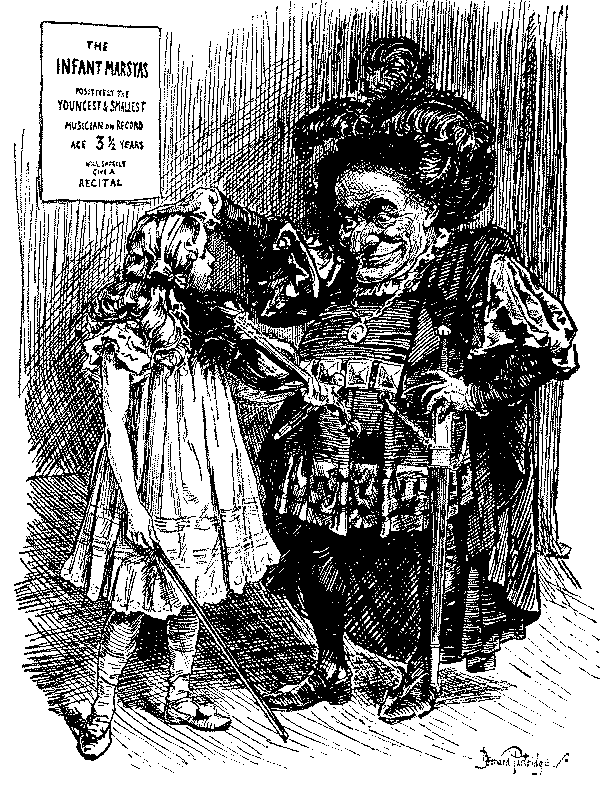
PLAY'S THE THING!
Hamlet (Mr. Punch) to Ophidlia (the Danish infant musical prodigy): "Get thee to a nursery. Go!"
Elegies and Eulogies
Many heroes and heroines of the Victorian musical world passed away in these years. I have already spoken of Sullivan, but may note the tribute to Rubinstein in 1894 and the song to Sims Reeves in 1895, in which Punch, who had on occasion handled him severely for his failures to fulfil his engagements, was now only concerned to chronicle the triumphs, in ballad and oratorio, of "the king of the tenor tribe" who had fallen in old age on evil days. Sims Reeves, when well over seventy, had been reduced to singing in the Music-Halls, and in 1897 Punch cordially supported the appeal for funds issued by the Daily Telegraph. The results of this public subscription, supplemented by a Civil List pension, helped to relieve his few remaining years.
Corney Grain's death in 1895 removed the most popular musical "entertainer" of the time. Punch, in his farewell salute, gave him the highest possible praise by describing him as having successfully succeeded to John Parry. In 1896 Punch bestowed the bâton of musical Field-Marshal on Lieut. Dan Godfrey on his retirement from the post of bandmaster to the Grenadier Guards, which he had held for fifty years. Dan Godfrey was the first bandmaster who ever held a commission in the army, and had rendered conspicuous service to the cause of military music. Punch's honour was well merited, and Dan Godfrey's son, Dan the Second, conductor of the admirable Bournemouth Municipal Orchestra for nearly thirty years, has added fresh lustre to the family name. In the same year Punch records the presentation, at Marlborough House, of a testimonial to Lady Hallé (Madame Norman Néruda). His account of the proceedings border on the burlesque, but there is nothing but admiration for the brilliant artist who had delighted British audiences ever since the days of her début as a prodigy nearly fifty years before, and who had been one of the glories of the "Pops" in their golden prime. Nor did Punch forget to add his congratulations to Henry Bird when that fine artist, respected and loved by all who knew him, celebrated his Jubilee in 1910:—
Minstrels, like bards, are irritable folk Whom trifles oft provoke To sudden fury or unseemly tears; But you, blithe spirit, from your earliest years Have been undeviatingly urbane, Free from all frills, considerate, courteous, sane, And to the end will so remain. Wherefore, with deepest reverence imbued For your supreme pianofortitude, And by melodious memories rarely stirred, Punch hails your Jubilee, O tuneful Bird!
The author of those lines, on another occasion, rendered Mr. Bird a serious disservice. A propos of the invasion of the Music-Halls by serious performers, he had published a purely fictitious announcement that Mr. Henry Bird would shortly appear on the Variety stage as "The Terrible Transposer"—an allusion to his notorious skill in that direction. This was copied into the parish magazine of St. Mary Abbot's, Kensington, where Mr. Bird had been for many years organist, but the editor's ironical comment was misinterpreted, and the announcement was taken seriously, with the result that Mr. Bird was bombarded with inquiries from applicants for the post. A man with a less angelic temper would have been annoyed; but Mr. Bird was only amused.