EDUCATION AND THE CHURCHES
Reading edition
The passing of the old order in Education had for its chief landmark the Act of 1871, but the change admits of endless illustrations. Many of these lie outside the scope of our survey; but no treatise on the Modern Child would be complete which did not take account of Punch's contributions to this engrossing problem. To take one example, the precocious representatives of the "younger generation" in Leech's pictures are almost invariably shown as the "sedulous apes" of their elders as men of the world. In the period under review in this volume imitation gives place to independence. The precocious child of both sexes—Leech's precocious children were almost without exception boys—is sometimes pedantic, but the distinctive note is one of scepticism and revolt. The young iconoclast has "found out all about Santa Claus and is now going to look into this Robinson Crusoe business." When the Rector asks Molly would she rather be beautiful or good, Molly audaciously replies: "I'd rather be beautiful and repent." Another version of the same retort is illustrated in Mr. Shepperson's charming picture. And when Uncle George, shocked by his little niece's declaration that she hated all her lessons, asks appealingly, "Come, now, you don't mean to say you hate history?" he receives the blunt answer: "Yes, I do. To tell you the truth, Uncle, I don't care a bit what anybody ever did." In this magnificent declaration of independence Punch sought to reduce to an absurdity the new doctrine of "self-expression" as adopted by the nursery. Punch's love of children was beyond question, but he remained in substantial accord with the Greek sage who said that the roots of education were bitter but the fruit sweet; that to avoid or evade the discipline of parents and teachers was to forgo learning and virtue. The modern and already fashionable inversion of the old method, by which education was to be "brightened" and sweetened at the outset, and every study turned into a game, seemed to Punch subversive of what was not merely an old but an inevitable order, and the new science of psychological "Pædology" found in him an invariably hostile critic. Passing over a burlesque article on the "Scientific Investigation of Infancy" based on a paper in the Fortnightly in 1895, I may note the first of his rejoinders to those austere educationists who have made war on Wonderland. In that year Mr. Holman, an inspector of schools, in an address delivered before the College of Preceptors, declared that "the race has outgrown fairy-tales, and to use them for early education is practically to bring about a reversion to type. They express the ideas of a profoundly ignorant primitive man. The hero has more often than not to lie, steal and cheat and to be an ingrate to accomplish his ends." A mass meeting of fairy-tale heroes and heroines, convoked by Punch, carried by acclamation a resolution of protest against this heresy, which, by the way, has of late years been espoused by the redoubtable Madame Montessori. Punch carried the war into the enemy's camp in a revised version of Cinderella, rewritten so as to combine instruction with amusement, and based on the latest scientific, ethnological, and psychological discoveries and theories; while in "New Lamps for Old" he retold other nursery tales so as to meet the supposed requirements of the modern child. I am afraid it must be taken as a confession of the failure of his efforts that in 1911 Punch described an "advanced child" replying to his grandmother's offer to tell him a story, "Oh, no, Granny, not a story, please! They're so stodgy and unconvincing and as out-of-date as tunes in music. We should much prefer an impressionist word-picture or a subtle character-sketch."
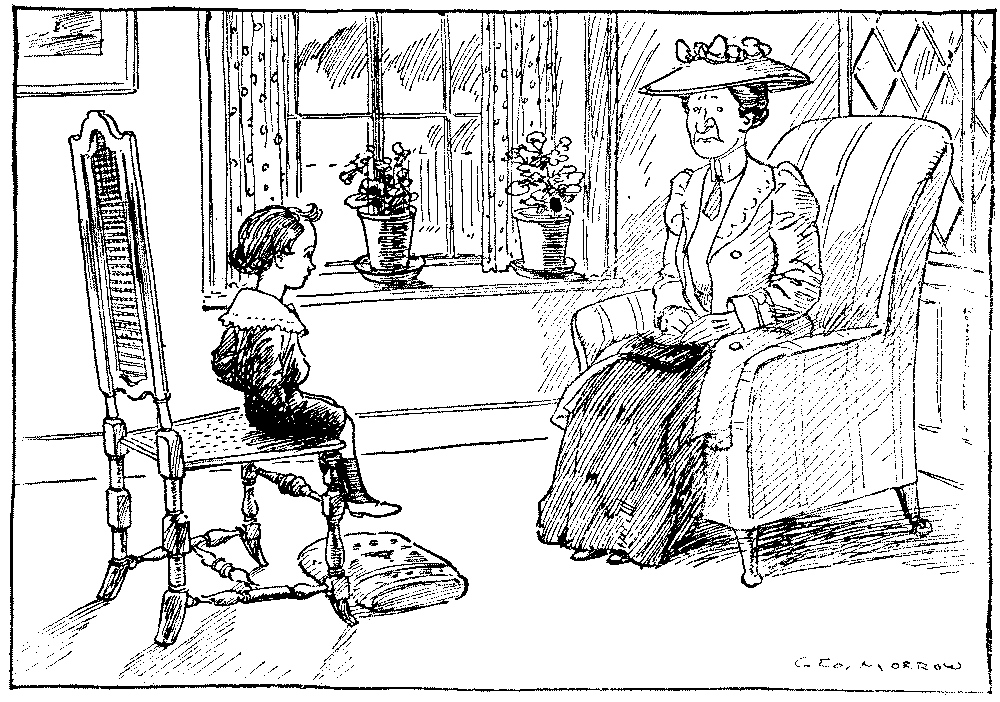
Tommy: "Do you believe in fairies, Mrs. Hardacre?"
Mrs. H.: "No, certainly not."
Tommy: "I'm so glad you're candid about it. There's such a pose among grown-ups nowadays to pretend they do."
The War on Wonderland
The attempt to teach gardening at certain schools in the 'nineties was "guyed" in the account of a disastrous imaginary experiment—the encouragement of Small Holdings for Small Boys at a fashionable Preparatory School. Here Punch is irresponsible and reactionary; but there is point in his criticism of the new-fangled cult of "nature study," on the ground that even playtime was now made a burden and toil for children by object lessons. In the same year (1900) the doctrine of self-expression was proclaimed in strident tones by Mr. Bernard Shaw in a lecture to the members of the Teachers' Guild of Great Britain. "Any grown-up person," said the prophet, "guilty of the crime of trying to form the character of children ought to be drowned. If there is to be any progress at all, it must be recognized that the children know better than their teachers." This was almost beyond the reach of comment or parody, but Punch did his best. Cranks, whether official or unofficial, he treated with impartial disrespect, and shortly before falling upon Mr. Shaw he had gibbeted a school inspector who had been alleged in his report to have penned this immortal sentence:—
The lower babies' mental arithmetic leaves much to be desired.
In the verses on "Spoilt Parents" in 1901 Punch expresses an obviously ironical approval of filial insubordination as encouraged in America, and a year later took for his text a passage quoted from an essay written by an Australian girl of thirteen, in which she had referred to "The Lady of Shalott" as "a fairy tale I remember in my childhood." In 1903 the activities of the "Pædologist" furnished Punch with abundant material. He celebrates, again with ironical applause, the expulsion of Euclid; he refers to an American lady who, in discussing suitable literature for children, had found a "moral squint" in Jack and the Beanstalk and Bluebeard; and he founds an excellent set of verses on an article in the Contemporary by Dr. Woods Hutchinson. The child, according to this eminent writer, passes through all the stages of evolution; "he is born not an Anglo-Saxon, but a Cave-dweller," and Punch proceeds to expound the "recapitulation theory" as follows:—
When Edward, crawling on the floor, Invades the eight-day clock, Pray do not spank him any more For dirtying his frock. He is a little troglodyte, As were our sires before us, Who vanished when there hove in sight The grim ichthyosaurus. When, ætat. four, with savage joy The hunter's art he plies Upon the panes, don't scold the boy For torturing the flies. He has but reached the second scene When men were all the scions Of mighty Nimrod, and were keen On slaying bears and lions. At six, ambitious Edward yearns A pirate king to be; The tables into ships he turns, And sails the fireside sea. Then if the things are smashed to bits, Don't give the boy a licking; He's reached a further phase, and its The æon of the Viking. A little, and the pirate bold A patriot becomes; He fights the rascal imps who hold In force the neighbouring slums. Pray don't repress his noble rage, E'en though his nose be gory; He is but passing through the age Of good Queen Bess's glory. Last scene of all that ends this slight But most eventful play Is symbol of the lofty height Achieved by man to-day. At ten can Edward understand What money means: he's willing To be a saint for sixpence, and An angel for a shilling.
Evolution and Self-Expression
As a rule, the most clamorous apostles of the new doctrines hailed from the New World. In 1904 Mr. G. Archibald, a "Child Specialist" of Montreal, gave utterance to the now familiar view that "Whenever you say 'Don't' to a child you crush the creative instinct within him which is the richest and most precious thing he has." Punch, it is hardly necessary to remind the reader, was not likely to subscribe to this view. Had not the Daily Telegraph referred to his advice to those about to marry—Don't—as "the memorable monosyllabic monition of the Democritus of Fleet Street"? So we are not surprised to find him enlarging ironically on the precept of Montreal:—
Should the genius of Marmaduke lead him to rear, From the dining-room floor to the ceiling, A palace of crystal and china, oh! fear To exhibit an atom of feeling. But your Satsuma bowl you will cheerfully bring, And, where others would threaten to skin him, You will beg him to do as he likes with the thing, Lest you crush the creative within him. If Lucy refuses potatoes and bread, And calls for méringues and for trifle, Or anything else that may enter her head, Such yearnings another would stifle. You will hand her a menu-card, beg her to state What she happens to fancy for dinner, And pray that you never may find it your fate To crush the creative within her.
Advancing years failed to reconcile Punch to the non-repressive method. As late as 1912 one of his artists depicted the chaotic results in an elementary school of realizing the ideals of one of the pamphlets of a Teachers' Association, viz., to place a child "in an atmosphere where there are no restraints, where he can move freely about in the schoolroom, where the teacher is essentially a passive agent and where there is no punishment."
The Sompting Experiment
In this context I may note that about this time Punch frequently dwells on the unsuitability and extravagant cost of the amusements provided for children. In "How to Befriend the Gilded Babes" he castigates without mercy a gentleman who had been writing on entertainments for titled juveniles, and outlines a children's party the cost of which is estimated at the modest figure of £250. Punch's repeated protests against the perversion of pantomimes to suit grown-ups are too familiar to call for detailed mention, but in connexion with youthful precocity I may mention a curious anticipation dating from the autumn of 1905. This is a "domestic drama, composed by an infant of ten summers who, after reaching mature years, retrieved it from a box containing his toy theatre and copied it out," exactly as it stood. The drama, which is entitled "The Sheep in Wolf's Clothing," bears all the stigmata of a bonâ fide child's essay in dramatic authorship, and foreshadows the exploits of "Daisy Ashford" without being either so funny or so vulgar as The Young Visiters. Punch had always been alive to the educative value of the theatre, and it speaks well for his vigilance that the remarkable experiment carried out in the little village of Sompting in Sussex did not escape his notice. The children were taught by making them act their lessons, and Punch in some whimsical verses anticipates the extension of the method to the public schools. It is true that he does not take the experiment quite seriously, but he does not "crab" it. It was reserved in later years for a brilliant and enthusiastic educational reformer, Mr. E. G. A. Holmes, to hail in the Sompting schoolmistress the "Egeria" of the new régime of elementary instruction. In less benevolent mood Punch quoted in 1907 an apparently genuine letter which had appeared in the Children's Realm, a paper which aimed at teaching "the higher way of living to the young." The letter describes a small boy who was "a very earnest vegetarian" and a super-prig into the bargain. Punch was exasperated by prigs in all walks of life, and it rejoiced his heart when Mr. Roosevelt compared President Wilson to a "Byzantine logothete." The high-browed infant filled him with dismay, and in 1910 he illustrated the "advance in elementary culture" by a highly imaginative account of the reply given by a very small boy who had been asked by a lady visitor whether he enjoyed his recent birthday party:—
Henry: "In the impression retained by the memory, shades have ceased to count: it stands, sharply, for a few estimated and cherished things rather than, nebulously, for a swarm of possibilities. I cut the silhouette, in a word, out of the curious confusion of it all, I save and fix the outline, and it is with my eye on this profiled distinction that as a critic I speak. It is the function of the critic to assert with assurance when once his impression has become final; and it is in noting this circumstance that I perceive how slenderly prompted I am to deliver myself on such an occasion upon the merits or attractiveness of the entertainment so generously provided for the diversion of myself and friends."
(Lady visitor before swooning has sufficient presence of mind to ring the bell for assistance.)
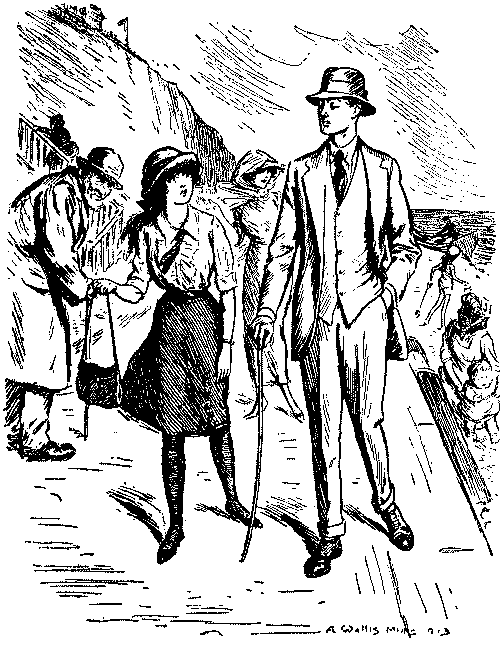
Brother: "What did you say to that old chap just now?"
Sister: "I only thanked him for picking up my bag."
Brother: "My dear girl, you must learn not to be so beastly grateful. It's not done nowadays."
Punch's "Universal Hymn"
This is an instance of the danger of trying to kill two birds with one stone, for the parody of Henry James's later manner distracts our attention from the main aim of the satire. Punch was more sorry for than annoyed at the children of Chelsea, of ages from five to sixteen, who were said in 1908 never to ask for Dickens or the Jungle Book at the Free Library, but to devour works on "science, sociology, fine arts and religion." In the same year the Sociological Society held an exhibition of charts and plans, to show parents how to select their children's toys "as a profound educational agency," but Punch saw in it nothing but an exhibition of the profoundest Prigmatism—to use a word which he coined in later years. His bitterest comment on the new spirit of the young belongs to the year 1913, when a boy of seventeen rebukes his sister of twelve for thanking an old man for picking up her bag. The best antidote to this spirit was furnished by the Boy Scout movement, which grafted on to the public-school code of "playing the game" the larger ideals of altruism and mutual-as opposed to self-help. I have already spoken of the origin and development of what was the greatest non-official and informal contribution to national education of our times. Logically perhaps it ought to have been discussed in this chapter, but in its wider implications it belongs to the social and political history of the last twenty years.
To turn from general tendencies to the controversies which arose out of the working of the Education Act of 1871, we find that Punch was, as usual, impartially critical of all extremists, whether clerical or secularist. Against the latter he inveighed in 1894 in his "Universal Hymn for School Board Hymnals, adapted to modern Educational requirements":—
Arise my soul—if soul I've got— And, vaguely vocal, thank For all the blessings of my lot The—Unknown Eternal Blank! I thank the—Streak of Azure Haze That on my birth has smiled, And made me, in post-Christian days, A happy School-Board child. I was not born, as myriads were, In ages dark and dim, And taught to pray a pious prayer, Or sing a holy hymn. I was not born a little slave To formula and creed, Or taught that Heaven must light the Grave, Or God-love banish greed. I was not born when priests might roam And teach the childish band To sing about Our Heavenly Home, Or of that Happy Land! Mere dogma muddles up the mind, And leaves it in a mess. Religion surely was designed To make our freedom less. The Conscience-Clause? It may secure Some freedom to the slave. But Where's the sense—unless we're sure That we a conscience have? We've lots of "Standards" which we treasure, There's one superfluous, quite, A Standard human wit can't measure (In Board Schools)—that of Right! Secular matters make our joys, And facts are our sole food. Do we turn out good girls and boys? Good heavens! What is "Good"? Through all the periods of my life One goodness I'll pursue; With rare "good things" this world is rife; I'll try to get a few.
At the close of the same year, however, Punch castigates sectarian bigots with equal vigour. He took for his text a letter by Dr. James Martineau to The Times, in which that "wise and gentle teacher" had appealed to the conflicting parties of School Board electors and members to reconcile themselves to a peaceful co-existence on the basis of our common Christianity. Punch does not spare "secular spleen" and "shortsighted super-thrift," but his severest criticisms are reserved for the sectarian zealots, Anglican and Nonconformist, who had broken up the compromise of 1871, and he concludes:—
Oh, self-elected shepherds, with your crooks, Fighting, while round your folds the wolves are creeping!— Pedagogues wrangling o'er your lesson-books, Whilst your wrath rages human love sits weeping! If of "a common Christianity" Ye were but practical and patient teachers, In Education's task ye might agree. Now sense is asking, "Who shall teach our teachers?"
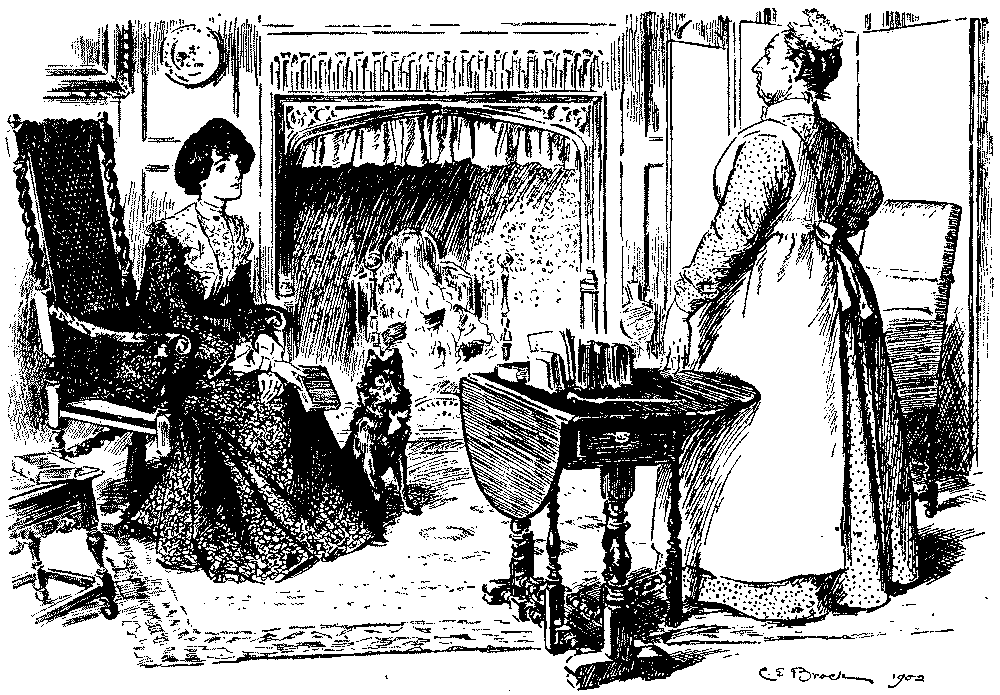
Inexperienced and Anxious Young Mistress: "The new housemaid, Maria, is a Roman Catholic; but I hope you will not allow any religious controversy in the servants' hall."
Cook (with much dignity): "You needn't have any fear, my lady. In really 'igh-class families religion is never mentioned!"
The Abortive Bill of 1896
Punch's comments foreshadowed the conflict that raged over the Education Bill of 1896, which had been framed to redeem the pledge given by the Government to aid voluntary schools. Denounced by the Opposition as a deliberate attempt to shatter the school-board system and promote the interest of a particular sect, while, on the other hand, all sects were agreed that the proposed aid was inadequate; swamped by amendments—1,238, to be precise, had been placed on the paper when the House met in June after the Whitsuntide Recess—the Bill was abandoned in Committee without exciting any real regret from any party. Punch chronicles its withdrawal without any comment, but his silence cannot be interpreted as expressing satisfaction with the existing régime. In 1899 he falls foul of Sir John Gorst, then the acting head of the Board of Education, for his alleged intention of entrusting the teaching of all other children to half-educated pupil teachers.
The progress and passage of the much-discussed Education Act of 1902 revived Punch's distrust of the so-called "friends" of the human child. He shows Mr. Balfour on a bicycle steering a perilous and devious course beset with obstacles, and develops the theme in a fable, based on that of the Old Woman going to Market, in which Lord Hugh Cecil, Mr. Bryce, Archbishop Temple, Mr. Lloyd George and Sir William Harcourt are brought in to represent the various and conflicting elements in the struggle. Punch's moral is that "if you don't all hurt each others' feelings a good deal, there's no chance of getting the Education Bill through Parliament." The truth of this comment was abundantly shown by the vehement controversy which arose over the famous Kenyon-Slaney amendment, limiting the right of an incumbent to give religious instruction in a Church School—a provision which infuriated the High Anglicans and was reluctantly acquiesced in by moderate Churchmen. Per contra Dr. Percival, the Bishop of Hereford, who voted with the Opposition, declared that the Bill had given great strength to the Opposition to the Church in the country and tended to destroy its spiritual influence. And Lord Rosebery, while not in favour of the refusal of Nonconformists to pay rates, confessed that if they submitted tamely to the enactments of the Bill they would cease to exist politically.
A Stepping-Stone Ministry
Punch had no sympathy with the "passive resistance" movement, and when Mr. Lloyd George in 1904 advocated the closing of all the elementary schools in Wales as a protest against the Education Act, he regarded him as more desirous to serve party ends than to save the souls of the young. In 1906 it was the turn of the Liberals to redeem their pledges, and Mr. Birrell was in charge of the measure. Punch accordingly depicted him as a schoolmaster saying to the Act of 1902, "My boy, this [the cane he is holding] can't hurt you more than it's going to hurt me." Punch evidently had no love for the new Bill, but his satire is impartially levelled at the irreconcilable sectarian differences of the supporters and antagonists of the measure. All this wrangling had nothing to do with the education of children. The gradual and inevitable transformation of the measure by the end of the year is happily hit off in an adaptation from "Alice in Wonderland," with Mr. Balfour as the Cheshire Cat and Mr. Birrell as Alice carrying what had been a baby, but was now a pig, as the Cheshire Cat expected.
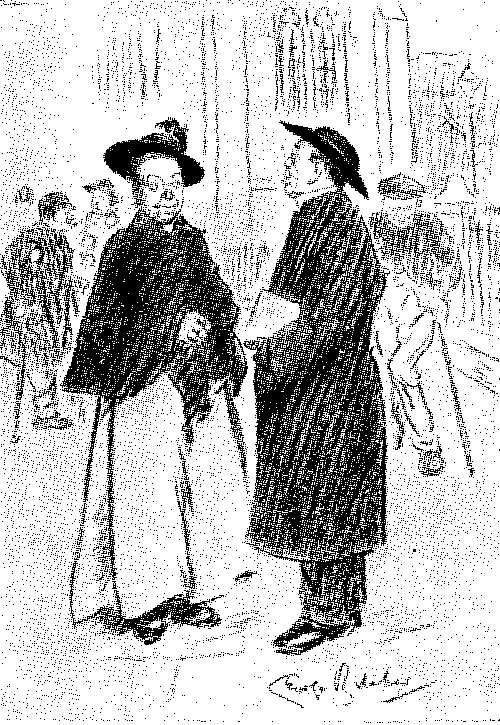
"I am glad to see you come so regularly to our evening services, Mrs. Brown."
"Yus. Yer see, me 'usband 'ates me goin' hout of a hevening, so I does it to spite 'im."
The Education Office in these years was the great jumping-off ground for aspirants to higher Ministerial office, and was occupied by a succession of "transient and (sometimes) embarrassed phantoms." Mr. Birrell quitted Whitehall to govern Ireland from Overstrand, and in 1908 Punch, in his cartoon on the tardy compromise achieved by the Church and Nonconformity, showed "Master Runciman," with his Bill, being carried safely through the waters of strife by the Archbishop of Canterbury and Dr. Clifford.
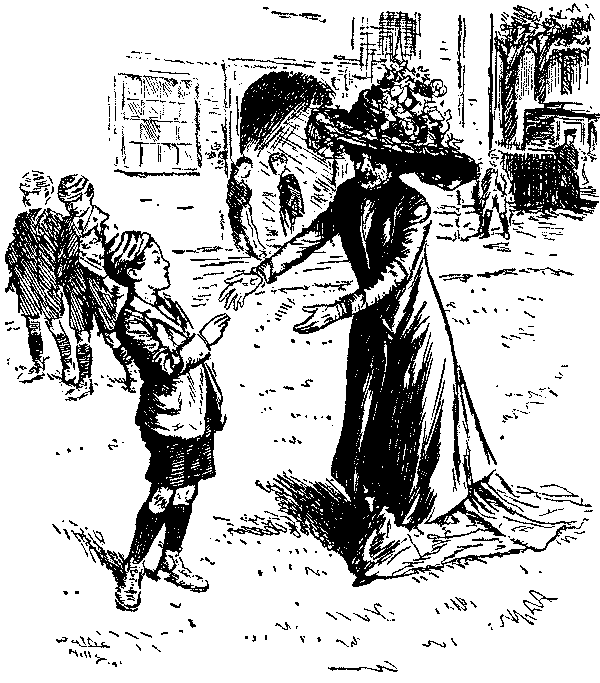
Mother (visiting son at preparatory school): "Well, my darling!"
Son: "I say, Mother, don't look so ghastly pleased before all these fellows."
In 1905, according to the Scotsman (quoted by Punch), the prospective Unionist candidate for Berwick maintained before a meeting of electors that "the only way to deal with the religious question was to allow each denomination to provide religious teaching in school hours for the parents of such children as desired it." The italics are provided by Punch, who threw further light on the need for this "vicarious religion" in an illustrated dialogue published in 1911:—
Schoolmistress: "And am I to give the child religious instruction?"
Mother: "I don't care wot yer do so long as yer don't bash 'er abaht the 'ead."
John Bull, Junior
Throughout this period Punch was perhaps more concerned with the youngest than with the younger generation—with the progress of the child than with that of the ingenuous youth. Yet he was not neglectful of the changes going on in public and preparatory schools. The picture of "John Bull, Junior," in 1905 represents the human boy of the public-school type as still primarily interested in pastime:—
For instance, his industry's tireless In getting his Wisden by rote; But of Signor Marconi (the wireless) He takes the most negligent note. That the primary use of the cable Is cricket, he's free to maintain— He associates cricket with Abel, And bats with the mention of Cain. He can't tell the whereabouts clearly Of Constantinople or Prague, But he'll talk by the hour about Brearley, He'll tell you the birthplace of Haigh. He cannot be sure if the Hooghly's A river, a town, or a hill; But then upon Bosanquet's "googlies" A volume he'd easily fill.
This was before the aeroplane and the motor had infected schoolboys with a passion for mechanics, and the view expressed is borne out by a suggestion made in 1907 by Sir J. J. Thomson, and duly noted in Punch, that boys should go to school in holiday time and during term time should "stay at home and learn something." A year earlier Punch had very properly laid his finger on a blot in the school system—the inadequate salaries of assistant masters. In "The Worm Turns" he had enlarged on the protest which one of the number had registered in the Westminster Gazette. It was all very well, as "Kappa" had done in the columns of that paper, to abuse schoolmasters, but what could you expect at the price when, at the best preparatory schools, £120 a year, resident, was considered adequate pay for a first-class man, and things were not much better in the public schools. Hence Punch's versified gloss, in which the much-maligned assistant master sums up the matter thus:—
Ah, well, it may be we are all past praying for, But in this world one gets what one is paying for, (That seems a fairly obvious remark); And I for one, although exposed so crushingly, Still mean to draw my salary unblushingly— That of a third-rate clerk.
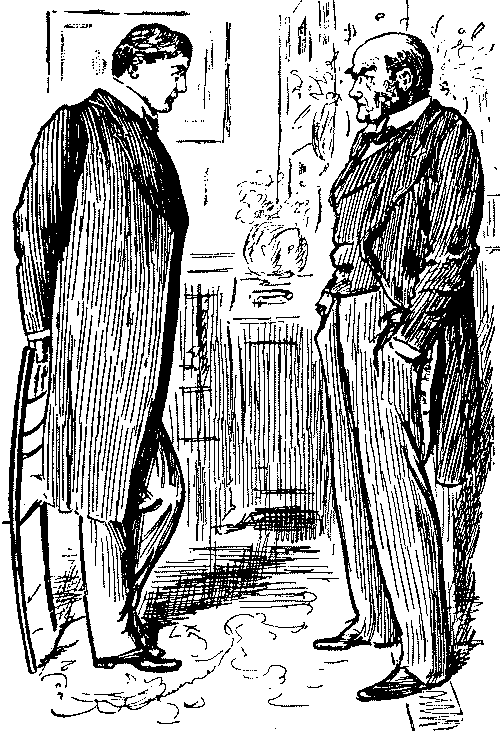
UNANSWERABLE
Young Hopeful: "'Shamefully ignorant'! Of course I'm ignorant, Father. But then why did you send me to a Public School? I always look upon a fellow who's learnt anything at a Public School as a self-educated man!"
Punch clearly admitted that all was not well with a system in which undue prominence was attached to the athletic prowess, and in 1909 he pilloried an advertisement for a schoolmaster which had appeared in the Spectator: "Rugby Blue required. Football is the chief subject, but elementary Latin, English and Mathematics are also looked for." On the other hand, Punch was no believer in the commercializing of our public schools. When Lord Rosebery in 1896 had said that "an inquiry by Chambers of Commerce into the progress of technical and commercial education in Germany would make our hair stand on end," Punch showed him as the Fat Boy in Pickwick saying, "I wants to make yer flesh creep." And when, in the fateful year 1914, a "Commercial Side," on lines already laid down in many secondary schools of a different type, was started at Bradfield College, Punch sought to reduce the plan to an absurdity by an imaginative account of its working.
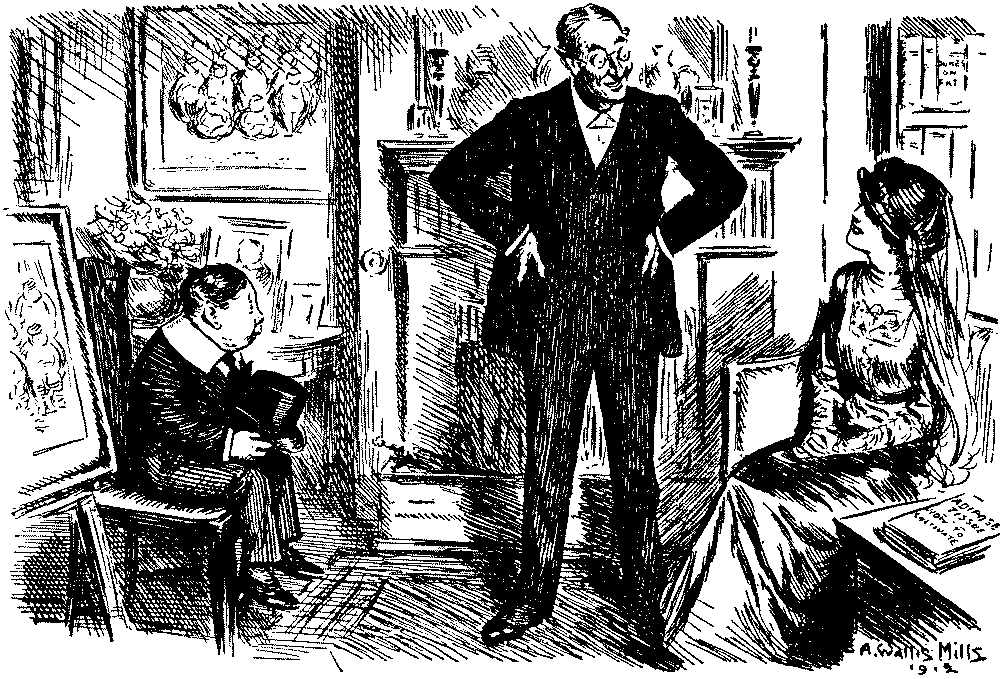
The Headmaster of Rugby is reported to have said at the recent Conference on School Diet that "while adults should rise from the table hungry, children should reach a sense of repletion before rising."
House-Master (with pride, to Parent): "Then with regard to food: we feed our boys to repletion five times a day, and our chef's puddings have no equal in any school in the kingdom."
School Diet
As regards the feeding of boys at school, the change from the Spartan régime of the previous generation can be vividly illustrated from the pages of Punch. Down to the close of the Victorian age, hampers were, if not an absolute necessity, at any rate a welcome supplement to the frugal diet provided at most schools. In 1899 Punch supported the continuance of hampers in some ironical verses inspired by a letter in the Daily Chronicle from a schoolmaster's wife. The good lady had complained of the effect of Tuck upon the ethics of schoolboys, and advocated ordinary school diet. Punch at the time regarded this as a counsel of stoical perfection utterly wasted on the ordinary human boy. A very different note was sounded by the Headmaster of Rugby in 1912, who was reported to have said at the Conference on School Diet that "while adults should rise from the table hungry, children should reach a sense of repletion before rising." Accordingly Punch published a picture of a mother with an alarmingly obese small boy interviewing a house-master who proudly remarks: "Then as to food, we feed our boys to repletion five times a day, and our chef's puddings have no equal in any school in the Kingdom." This was an exaggeration so far as the public schools were concerned, but it was fair satire of the sumptuousness of the fashionable and expensive preparatory school of pre-war days. There the pendulum had swung to the opposite extreme from the meagre diet of the 'seventies, when there was no luxury at preparatory schools and at many of the public schools the feeding was a scandal.
On the new relations that had sprung up between boys and masters—the "elder brother" theory—I do not find any notable mention in Punch. I suspect him of adhering to the old view that it was a far higher compliment to a master to describe him as a "just beast" than "popular." The decline of the classical side is touched on, while the continued inefficiency of instruction in modern languages is delightfully satirized in the late Mr. F. H. Townsend's picture of a young lord of creation, the centre of an adoring group of small sisters. "Now Guy," says his mother, "tell us about the school. Is everything all right?" "Oh, yes, Mother—except one thing." "My darling! What is it?" "Well, I wish you hadn't got us that French nurse to teach us the right pronunciation; it makes the other fellows laugh so." Punch's picture was true of a time now rapidly passing away, and furnishes a valuable comment on the solution of a century-old problem. The French master, generally a refugee in the old days, was never accorded a proper status and very seldom recognized as one of themselves by his colleagues. He was generally poor, and he was a standing proof of the saying of the Latin satirist that there is nothing more cruel about poverty than the fact that it makes people ridiculous. Also nine times out of ten he was unable to keep order; so that in the fullness of time headmasters found themselves confronted by this dilemma. They had to choose between foreigners with a correct accent who could not maintain discipline, and natives with a bad accent who could. And in pre-war days they often decided in favour of the latter.
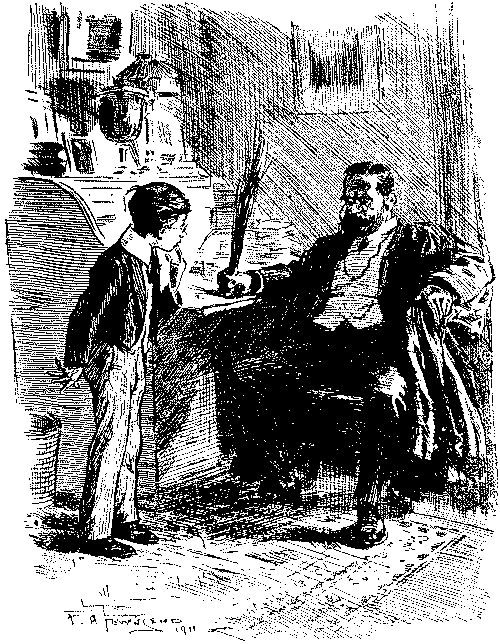
Smithson Junior (as the homily ends and the real business is about to start): "Please, sir, is it sterilized?"
Commerce at the Universities
Punch viewed the multiplication of universities with acquiescence rather than enthusiasm. He had been, as we have seen, a severe critic of academic obstructives at Oxford and Cambridge, but he was entirely opposed to their reconstruction on purely utilitarian lines. In his view there was room for universities of different types; to standardize them would be a blunder, almost a crime. So when a school of brewing was established at Birmingham, he gave a forecast of Oxford in the year 2000 a.d., completely commercialized, with the Ashmolean transformed into the University Co-operative Stores. In 1901 a daily paper had said that, compared with the University of Birmingham, Oxford must seem hopelessly out of date. Punch rejoined in a masque in which the claims of the old and new universities are reviewed and contrasted, but the last word is left to the Oxford chorus:—
Out of date and useless we, Commerce is beyond our ken— Let us thank the gods we be Twenty Oxford men.
Mr. Andrew Carnegie's gift of £2,000,000 to the Scottish universities in the same year is eulogized in the cartoon of "The Macmillion," but the prose comment, in which the extensions of the scheme are foreshadowed, is not lacking in an element of irony.
Mr. Rhodes's historic bequest to Oxford is discussed in an imaginary letter from a Cambridge to an Oxford don. The Cambridge don ridicules the notion that it would revolutionize Oxford, convert it into the University of the Empire, or transform the hoary old home of lost causes into a realization of the ideals of young barbarians from the bounding prairie or of the pipe-sucking beer-nurtured students of the Fatherland. The new-comers would find their level and, if really decent fellows, would do well enough. "Oxford will still remain Oxford, and that, at any rate, we may be thankful for." Nor did the Cambridge man anticipate any serious change in inter-'Varsity relations:—
As to ourselves at Cambridge, why, I fancy we shall be able to rub along quite comfortably, thank you. If I may use a commercial expression, we've got our own line of Australians and Canadians and Americans, and even of Afrikanders, and I think we shall be able to continue business at the old shop in the old style without any of the new-fangled additions that Mr. Rhodes has conferred upon Oxford. I'll wager that when fifty years are past we shall still be able to meet you on the river, at cricket, at football, nay, even at chess and billiards, on the same terms of average equality. And in after life we shall still manage to compete.
This letter, by the way, was virtually a rejoinder to a set of verses, published a few weeks earlier, in which Punch indulged in a fantastic forecast of the results of the invasion of the Rhodes scholars—including an entire revision of the system of examinations in accordance with the terms of Mr. Rhodes's will. The Craven would be awarded for manliness and the Ireland for muscle:—
Then at last shall Oxford Greats men Really be Imperial statesmen.
The sequel has shown that the views ascribed to the Cambridge don were much nearer the mark.
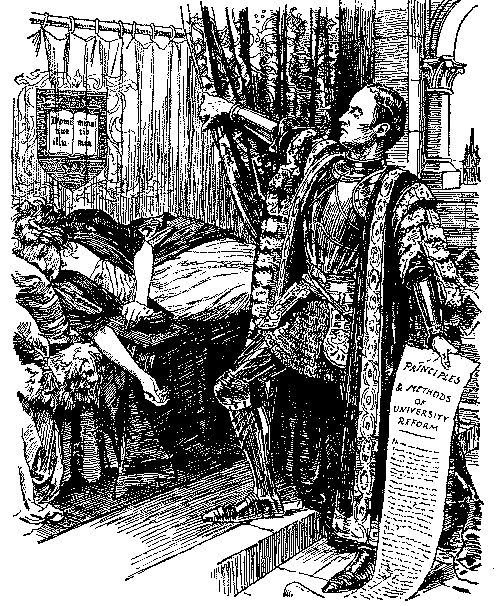
THE BREAKING OF THE CHARM
The Sleeping Beauty Oxford University.
The Fairy Prince Lord Curzon.
The Chancellor (after reading aloud his "Memorandum"): "Awake, adorable dreamer!"
The Awakening of Oxford
In 1904 Punch ranged himself unfalteringly on the side of compulsory Greek. Oxford had decided to retain it, and Punch, garbed as a Hellenic sage, appeals to Cambridge not to be outdone in loyalty to the old faith by her sister. It is hard to avoid reading into the cartoon "Breaking the Charm" in 1909 more than Punch meant to express. Lord Curzon, as the Fairy Prince, is seen, with his Memorandum on University Reform, appealing to the Sleeping Beauty in Matthew Arnold's phrase, "Awake, adorable dreamer!" Of course, the "adorable dreamer" was bound to be pictorially represented by a woman, but recent concessions have lent a special significance to the awakening. Strange to say, the most powerful and eloquent impeachment of the intrusion of women into Oxford comes from the New World; from the pen of the most brilliant of American essayists—Mr. Paul Elmer More. "With petticoats," he writes of Oxford, "came the world and the conventions of the world; manners were softened, the tongue was filed, angles of originality were ironed out; the drawing-room conquered the cloister."
Punch's practical abandonment of the rôle of religious controversialist was noticed in the previous volume. In the period under review references to the churches are for the most part confined to the part they played in connexion with the Education Bills already mentioned. The echoes of the "No Popery" campaign had so far died down that, on the publication in 1898 of Mr. Wilfrid Ward's review of Cardinal Wiseman's life, Punch's notice was not merely sympathetic but laudatory. "The storm that arose in England on his return from Rome to England with the rank of Cardinal was sufficient to have blown a punier man clean off the island. The Cardinal stood four square to it and lived it down." This is a notable tribute from Punch, who had blown and stormed with the best of the Cardinal's assailants. As for the now forgotten but once notorious "Kensitite" demonstrations, Punch's attitude is seen in his advertisement printed in the same year:—
To Prize-Fighters and others.—Wanted, MUSCULAR CHRISTIANS to act as sidesmen; used to mêlées and capable of using their fists. Liberal terms. Free doctor. Pensions in case of personal injury. Apply, stating qualifications, to High Church Clerical Agency, Kensiton, W.
A propos of muscular Christians, in 1900 Punch mentions that a country curate had recently received notice to quit because though unexceptionable in other respects, his vicar declared that "what this parish really needs is a good fast bowler with a break from the off." Modern clerical methods of acquiring popularity were satirized in 1905. A Congregational minister had taken part in a theatrical performance, and Punch gave a burlesque account of a bishop appearing at a music-hall in a travesty of Hamlet for the benefit of a Decayed Curates' Fund.
Anti-Clericalism in France
Bishops and deans have done wonderful things of late years, but this particular forecast remains fortunately unfulfilled hitherto. To 1906 belongs one of the few cartoons in this period in which the relations of Church and State are directly referred to. For this was the year in which the French Government cancelled the Concordat and laid an interdict on the Religious Orders. The policy found no favour from Punch. In "The Triumph of Democracy" he showed a French priest, a dignified figure, standing outside a doorway guarded by a French soldier, and bearing the notice: "République Française. Liberté, Egalité, Fraternité. Entrée interdite au Clergé."
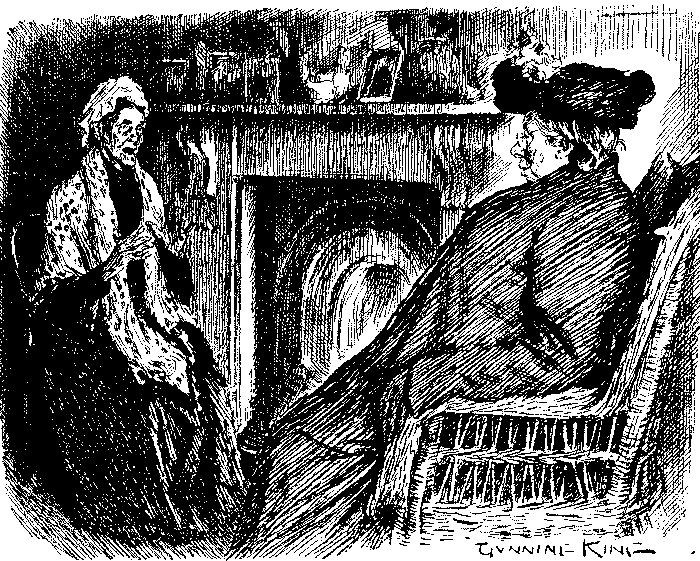
Hostess: "And do you really believe in Christian Science?"
Visitor: "Well, you see, I've been getting rather stouter lately, and it's such a comfort to know that I really have no body!"
Sabbatarianism gave Punch little or no chance, save for a mild protest against the action of the L.C.C. with regard to the Queen's Hall Concerts in 1898. The change is accurately reflected in the opening lines:—
Ah! County C., why stop our glee? For bigotry is dead; The broader mind can nowhere find Remotest cause to dread An instant fall of scruples all If Sunday's gloom should flee; We're all agreed in word and deed, Except the County C.
Punch's occupation as an anti-Sabbatarian was practically gone by the end of the last century. Bishops had ceased to provoke his satire by their opulence, though the balance-sheet, issued by the Bishop of London in 1905 to prove how hard it was to make both ends meet, excited some good-humoured raillery. Christian Science Punch left severely alone, save for an occasional negligible or oblique reference. His last and most forcible intervention in religious controversy was provoked by the action of the Bishop of Zanzibar in protesting against the administration of the Holy Communion to non-Anglican members. In the cartoon "The Black Man's Burden" in January, 1914, Punch drew two negroes singing as a duet "Why do de Christians rage?" and this scathing comment undoubtedly reflected the views of the great majority of moderate Churchmen at home as well as missionaries and colonial administrators abroad.
I have spoken elsewhere of Punch's share in the Dreyfus controversy, and may add that while laudably free from anti-Semitic partisanship, he did not refrain from satirizing the ostrich-like attitude of the Jews in transition who thought that the signs of race could be obliterated by a change of name.
Reverence and admiration in full measure inspire the tribute to the wise and sagacious Leo XIII, when he died in 1903:—
The long day closes and the strife is dumb, Thither he goes where temporal loss is gain, Where he that asks to enter must become A little child again. And since in perfect humbleness of heart He sought his Church's honour, not his own, All faiths are one to share the mourner's part Beside the empty throne.
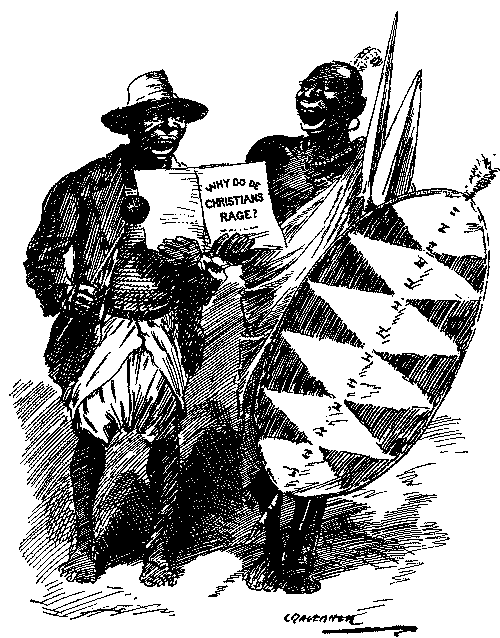
THE BLACK MAN'S BURDEN
Refrain by natives of South Africa and Kikuyu.
The amende to Cardinal Wiseman has been already noted, and I like to end this section with an even more striking palinode—the most notable that had appeared in Punch since his posthumous tribute to Lincoln. Punch had assailed the Salvation Army and its founder with all the weapons at his command in the early days of that movement. Happily he did not wait till General Booth's death to acknowledge his error. In the autumn of 1908 General Booth and Mr. John Burns had both been subjected to severe criticism at the Trade Union Congress, and are shown in a cartoon standing outside the door of the meeting saying to Mr. Punch: "You see before you two condemned criminals." Punch replies: "Well, I shouldn't worry about that," and they rejoin in unison: "We don't." This was indirect commendation; there were no reserves in the memorial verses on General Booth's death in August, 1912. Punch compares him with the warrior saints of old time and continues:—
Nay, his the nobler warfare, since his hands Set free the thralls of misery and her brood— Hunger and haunting shame and sin that brands— And gave them hope renewed. Bruised souls, and bodies broken by despair, He healed their heartache, and their wounds he dressed, And drew them, so redeemed, his task to share, Sworn to the same high quest. Armed with the Spirit's wisdom for his sword, His feet with tidings of salvation shod, He knew no foes save only such as warred Against the peace of God. Scorned or acclaimed, he kept his harness bright, Still, through the darkest hour, untaught to yield, And at the last, his face toward the light, Fell on the victor's field. No laurelled blazon rests above his bier, Yet a great people bows its stricken head Where he, who fought without reproach or fear, Soldier of Christ, lies dead.