Part 2 — CHAPTER XLIV
Reading edition
1867-1914
CITY IMPROVEMENT SINCE CONFEDERATION
THE RISE OF METROPOLITAN MONTREAL
THE METROPOLITAN ASPECT OF MONTREAL IN 1868—EDUCATIONAL BUILDINGS—THE CITY STREET RAILWAY AIDS SUBURBAN EXTENSION—FORECAST OF ANNEXATIONS—THE CITY HOMOLOGATED PLAN—THE ANNEXATION OF SUBURBAN MUNICIPALITIES IN 1883—TABLE OF ANNEXATION SINCE 1883—PREFONTAINE’S REVIEW OF THE YEARS 1884-1898—IMPROVEMENTS UNDER THE BOARD OF CONTROL—A REVIEW OF THE LAST TWO DECADES OF METROPOLITAN GROWTH—THE CHANGES DOWNTOWN—THE GROWTH UPTOWN.
STATISTICAL SUPPLEMENTS: 1. STATEMENT OF BUILDINGS. 2. REAL ESTATE ASSESSMENTS. 3. RECENT BUILDINGS ERECTED OR COMPLETED. 4. THE METROPOLITAN POPULATION; COMPARATIVE STUDIES ON THE POPULATION OF MONTREAL WITH THE CITIES OF THE CONTINENT. 5. OF THE WORLD. 6. OPTIMISTIC SPECULATIONS FOR THE FUTURE. 7. VITAL CITY STATISTICS IN 1912. 8. A PLAN FOR “GREATER MONTREAL”—THE HISTORY OF THE PRESENT MOVEMENT.
A traveler who visited the city in the year 1868 gives a criticism which reminds us that Montreal was now assuming metropolitan proportions: “I was much struck by the continued rapid growth of this now great northern city. But as it is almost wholly of stone in the business portions and along the extensive and massive quays which line the banks of the river, Montreal makes a dignified, indeed, an imposing effect. The beholder for the first time, unless marvelously well up in his geography, is surprised to find so large and so complete a city. To stand at a street corner for a moment is to see pass by the Indian woman, wrapped in her heavy blanket; the French habitant; Scotch, Irish and English residents; and emigrants of all social conditions, the “American” from the United States; officers of the British army in their different uniforms; Catholic priests in their robes; Sisters of Charity; crowds of neat-looking soldiers; and the burly policemen clad in a dark blue military uniform. The buildings everywhere in course of erection would dignify any city. There are none in the United States which present finer specimens of street architecture than are found, not isolated here and there, but in long blocks and throughout the entire city.”
Speaking of the buildings of this period, Sandham in his Ville Marie Past and Present, remarks: “A striking feature in the progress of the city was the number of buildings erected for educational and charitable purposes. Indeed, each year seemed to have a peculiarity in the character of its new buildings. In 1868 the tendency was in favour of dwelling houses; the year before it was stores; and before that again the erection of churches and religious edifices appeared mostly to employ the energies and surplus capital of the citizens.
“The year 1869 was marked by efforts in an educational direction. The Gentlemen of the Seminary nearly doubled the previously large accommodation at the college above Sherbrooke Street. The Roman Catholic bishop put up a large schoolhouse in Lagauchetière Street and the Catholic school commissioners erected a schoolhouse on Ontario Street and another in Fullum Street. They also erected a very spacious school on Alexander Street opposite St. Patrick’s church. A very large stone structure was erected on Visitation Street by the St. Vincent de Paul Society for educational and charitable uses. The extensive asylum or infant school in St. Catherine Street, near Bleury, had its size doubled, a neat chapel being added. The St. George’s (Episcopal) church was also commenced.”
The extension of the city toward the suburbs was being facilitated by the city railway commenced in the fall of 1861. “It is difficult,” says Sandham, writing in 1869, “to mark the distinction between the city and the villages of the outlying municipalities. It is apparent that these villages must eventually form part of the city and it would be advantageous if some preparatory arrangement were to be made for assimilating the building and sanitary laws of the municipalities to those of the city.” A remark equally pertinent today when having annexed many of these “villages” we are looking forward to do the same to many more till the city embraces the island of Montreal.
In 1867 paving and wood was adopted for Jacques Cartier Square, but stone was adopted for the rest. The year of 1875 saw great progress in paving, the expense of the outlay being not less than $431,090. The side paths in blue stone on St. Denis, Sherbrooke, Union, St. Catherine and Dorchester are of this date. This period of city improvement culminated in the homologated plan of the city still in use. The sanitary state of the city at this time was deplorable and Dr. William Hingston, afterwards knighted, was elected mayor for its amelioration. The construction of the chief collecting sewer on Craig Street, begun at this time, was finished in 1878. The year 1887 saw also a regular system established for the removal of rubbish. All these ameliorations reduced the mortality rate very much.
In 1883 there began a series of modern suburban annexation which has given the name of the “Greater Montreal” to our enlarging city.
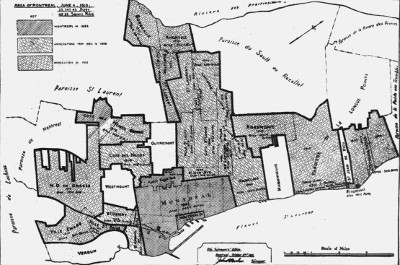
In 1883 the superficies of Montreal proper was 3,958 acres. Its population was, according to the census of 1881, 155,238 souls. Since the annexations began in 1883 there have been added up to 1910 21,767 acres. On the 4th of June, 1910, the total superficies of the city was 25,747.75 acres, about 40.23 square miles, and the population was 455,000 souls. At this time the following municipalities were still outside the city:
Maisonneuve22,500 Population
Westmount14,000 Population
Verdun10,500 Population
Outremont3,000 Population
Lachine11,000 Population
Summerlea500 Population
Ville St Pierre2,000 Population
Montreal West900 Population
St. Anne de Bellevue2,000 Population
It is expected that Greater Montreal will include these.
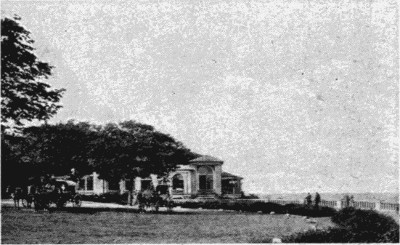
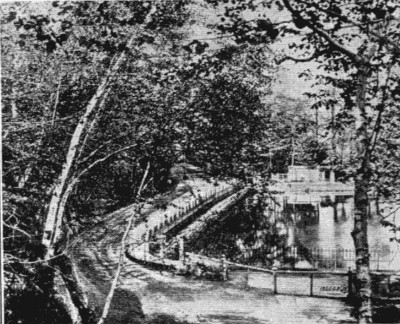
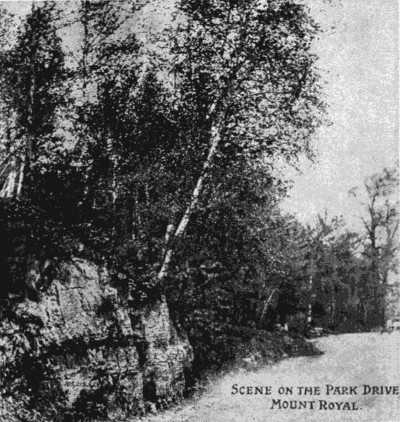
THE LOOKOUT AND SOME OF THE DRIVEWAYS IN MOUNT ROYAL PARK
The subjoined table of annexations since 1883 deserves to be recorded:
Date of annexation.Area (acres).Population when annexed.
HochelagaOct. 3, 18831,2306,000
St. Jean BaptisteMarch 8, 18863087,000
St. GabrielMay 25, 18873306,000
Cote St. LouisFeb. 1, 18948503,500
St. HenryOct. 30, 190545021,192
St. CunegondeDec. 4, 190512410,912
VilleraySept 11, 190560600
Rosemount (part)Jan. 15, 1906185—
Sault au RecolletNov. 5, 1906863.61,200
St. LaurentMarch 14, 1907960—
Cote des NeigesApril 25, 19081,148.3550
Rosemount (part)April 25, 1908249800
Sault au Recollet (part)April 25, 1908313.6—
De LorimierMay 29, 19093917,000
St. LouisJan. 1, 191072035,000
BordeauxJune 4, 1910868.28900
St. Laurent (part)June 4, 1910877.3700
AhuntsicJune 4, 1910726.54,000
Ville St. PaulJune 4, 19102633,257
BeaurivageJune 4, 1910461,400
TetreauvilleJune 4, 19103111,500
Longue PointeJune 4, 19104,164.21,693
Rosemount (part)June 4, 19101,431.51,200
Cote des Neiges (part)June 4, 19101,402.17600
Ville EmardJune 4, 19109515,000
Notre Dame de GraceJune 4, 19102,5364,100
Cote St. Luc1912373—
———————
22,162.45124,104
City in 18833,494
Mount Royal park464
————
Total area26,090.45
Annexation seems to have been successful. To illustrate the next period of fifty years of Greater Montreal the following official account of the year 1898 is useful as a brief summary of city improvements:
His Worship Mayor Préfontaine, wishing to give in his inaugural address, in 1898, an idea of the progress made by Montreal, during the past fifteen years, submitted the following figures:
“The taxable property, in 1884, was $73,584,644; in 1897, the same had reached $141,790,205; increase, $68,205,561.
“The value of the property exempted from taxation in 1884 was $15,324,084; in 1897, it had reached $36,023,295; increase, $20,697,211.
“In 1884, we had 133 miles of streets opened; in 1897, we had 178 miles. Increase, 45 miles.
“In 1884, we had less than one-half mile of paved streets; we now have 26½ miles.
“The territory of Montreal in 1884 was 3,788 square acres; in 1897, it was 6,547 square acres; increase, 2,761 square acres.
“In 1884 we had about 75 miles of brick sewers; we now have 104 miles; increase, 29 miles.
“The population increased during the same period of time, from 172,000 to 250,000, taking the lowest estimate of the present population; increase, about 78,000.”
From 1898 to 1910 the same corresponding increase of growth was marked.
Another epoch started with the later date on the advent of the Board of Control.
CIVIC IMPROVEMENT UNDER THE “BOARD OF CONTROL”
Among some of the outstanding civic works undertaken under the control régime may be chronicled the following, as recorded in the official reports:
THE MEURLING REFUGE
In 1911, Mr. Gustave Meurling died at Menton, France, bequeating all his property to the City of Montreal.
Following the correspondence between the late Mr. Meurling’s attorneys and Doctor J.J. Guerin, Mayor at the time, the Consulting City Attorney was instructed to take the necessary means to put the City in possession of the bequest.
To carry out the wishes of this generous benefactor, the Commissioners decided to build a refuge for the poor and homeless, giving it his name.
On the 29th of July, 1912, a report was made to Council to purchase a property on Champ de Mars Street and to erect thereon a refuge to be known as “The Meurling Municipal Refuge.” This report was adopted by the Council on the 1st of August, 1912. An architect was engaged to prepare the plans and specifications and the refuge was in full operation in March, 1914. It is thoroughly equipped with the most modern appliances.
MUNICIPAL ARCHIVES
The Commissioners decided to create a new department to be known as the Municipal Archives Department.
This action was deemed necessary, preventing the loss of documents, and the worry and loss of time spent in searching for them. All documents will be in charge of one official who will be the head of this Department. This Department came into existence and the head official appointed in 1913.
MAP BY WARDS OF MONTREAL
CHAMP DE MARS
In 1911, the Board of Commissioners had plans and specifications prepared and the necessary funds were voted by Council for improvements to the Champ de Mars.
The tenders received for this work exceeded the estimates prepared by the Public Works Department to such an extent that the Commissioners decided that it would not be in the City’s interest to award the contract.
The Chief Engineer was thereupon instructed to have new plans and specifications prepared; these being prepared by Mr. F.J. Todd, Architect. Tenders were called for and on the 10th of June, 1912, Council awarded the contract.
The Champ de Mars improvements, including the change of grade and paving of St. Gabriel Street, were completed during the course of the year 1913.
CITY HALL ANNEX
In 1910, the attention of the Commissioners was called to the congestion existing in the offices of the Police Department, Municipal Assistance Department, etc., and finally, in 1911, they decided that the efficient administration of those departments required that they should occupy more spacious quarters.
Consequently, they reported to Council for funds to purchase a property on Gosford Street, between Champ de Mars and St. Louis streets, for the site of a new building for this purpose. The report was adopted by the Council and the sum of $10,000 was voted for the preparation of the necessary plans and specifications for the erection of this building, as well as for repairs to the City Hall. Messrs. Marchand & Haskell, architects, were engaged for this work. Tenders were called for the construction of this building and on the 4th of June, 1912, on report of the Commissioners, Council awarded the contract to Messrs. Peter Lyall & Sons. The building was ready for occupation early in 1914.
EXPROPRIATIONS
During the last three years, 1910-13, many streets have been opened, widened or continued. A new system of expropriation has been adopted since 1910 by the City. When a street is to be widened or a new street opened up, the City is empowered to purchase the whole of a property to be expropriated, if it thinks fit, and then resell the residue. In most cases the City is reimbursed the whole of the expropriation, and in others a fair profit is made, as for instance, in the case of opening up St. Lawrence Boulevard to the River front.
For the opening of St. Lawrence Boulevard, the City purchased, from the Sisters of the Congregation of Notre-Dame,1 the whole of their property for the sum of $617,350.00, at the rate of $7.34 per foot; from the McArthur Estate, the whole of their property for the sum of $51,050.00, at the rate of $5.03 per foot; from the Masson Estate, a part of their property for the sum of $22,170.00 at the rate of $6.00 per foot; the sale expenses, etc., amounted to the sum of $7,933.08, making a total expenditure of $698,503.08.
The City then resold a part of the Sisters’ property for $694,184.74; a part of the McArthur Estate property for $27,005.40; the sale of the building materials brought $1,936.00; the whole proceeds of the resale amounted to $723,126.07; the City thus realizing a net profit of $24,622.00 on the whole transaction.
Taking the prices paid by the City, as a basis, to arrive at the whole cost of this transaction, we have part of the Sister’s property (36,740.2 square feet) used for the Boulevard at $7.34 per foot, making a total amount of $269,677.06; part of the property of the Masson Estate (3,695 square feet) at $6.00 per foot, making a total amount of $22,170.00; part of the property of the McArthur Estate (8,475 square feet) at $5.03 per foot, amounting to $42,659.53; the cost of the St. Lawrence Boulevard thus amounting to the sum of $334,502.59. By adding to this sum the above mentioned amount of $24,622.99, we see that the opening of St. Lawrence Boulevard, which was a matter of public convenience, not only cost the City nothing, but by this transaction, reaped a benefit of the value of $359,125.58.
These facts go to prove that while in some cases the City is obliged to purchase, in a limited time, a certain designated property and to pay a seemingly high price, yet in other cases with the new system of expropriations, the City is enabled not only to have improvements made that cost nothing, but also to make a good profit on its investment. This method was considered by the Cities of the United States a progressive movement.
TUNNELS
In 1913 the St. Lawrence Street tunnel, which was begun by Ville St. Louis, was completed and open to traffic.
The Commissioners have also under consideration the building of tunnels on St. Hubert and on Wellington Streets, and the widening of the Ontario Street tunnel, and to the widening of the St. Denis Street tunnel.
The expropriation of the land necessary for the construction of Park Avenue tunnel is now going on and as soon as the proceedings are finished, means will be taken so that this tunnel be constructed without delay.
FILTRATION WORKS
At present in accordance with the endorsation of a scheme presented for the improved state of the city’s future water supply there is being constructed a large filtration plant which promises Montreal the finest water supply on the continent.
The site of filtration plant will be mostly in the town of Verdun adjoining the low level pumping station, and will occupy an area of about eighty-five acres. After being conveyed to the filtration pumping station the water will be lifted to the prefilters, then flow by gravity to the final filters to the filtered water reservoir, and will finally reach a new hydro-electric pumping station, and from there it will be pumped up to the reservoirs on Mount Royal and distributed through the city.
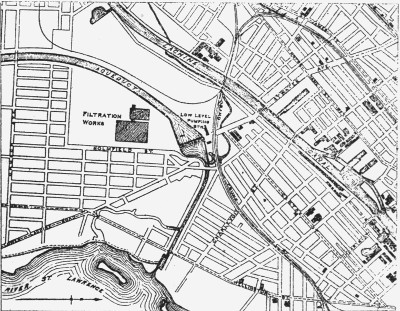
KEY MAP. SHOWING LOCATION OF FILTRATION WORKS
At present in accordance with the indorsement of a scheme presented for the improved state of the city’s future water supply there is being constructed a large filtration plan which promises Montreal the finest water supply on the continent.
THE BOULEVARDS ALONG THE AQUEDUCT
Incidentally the aqueduct is being broadened and a series of boulevards are being constructed on its banks. As this enterprise was an outcome of the city planning movement, which has favorably marked the last few years of civic improvement, it may be recorded.
On the 26th May, 1913, the City Council adopted the following report of the Board of Commissioners:—
1. That the principle of establishing boulevards along the canal of the Aqueduct, according to the plans prepared by the City Engineers, be adopted by Council, a duplicate of these plans to be deposited with the City Clerk.
2. That the offers of ceding the land gratuitously for these boulevards be accepted on the following conditions:—
(a) The work of planing and levelling the boulevards will be carried on as the work on the canal progresses, the City shall not be bound to open the proposed boulevards to traffic until the work on the canal is completed.
(b) The City shall, if possible, compel the contractors throwing up earth along the banks of the canal, to give the streets connecting with the boulevards a grade of not more than 6% from the line dividing the boulevards from the adjoining properties. Proprietors adjoining the boulevards shall have the exclusive privilege of having the material from the excavations deposited on their land in the way they may determine, provided, however, such material is not needed by the City.
That all properties which will not have been ceded on the above mentioned conditions within a delay of three months from the 1st of June, 1913, be expropriated according to the terms of the law 3 Geo. V., Chap. 54, Section 20, and that the cost of said expropriation be borne exclusively by the proprietors of land bordering the proposed boulevards, according to a roll made and prepared according to the prescriptions of Art. 450 of the Charter of the City of Montreal.
That in case of there being any doubt of the power of the City to give effect to the above mentioned recommendation, the Legislation Committee and the City Attorneys be requested to obtain from the Legislature any legislation necessary for the accomplishment of this undertaking.
That the City obtain from the Legislature:
1. Exemption from all taxes whether municipal, school, general or special which might be imposed upon the land forming part of the boulevards or of the Aqueduct and situated in other municipalities, without prejudice, however, to the rights of the Town of Verdun, in virtue of the Statute 1 Geo. V., 2nd Session, Chap. 60, Section 2, concerning the commutation of taxes on immovables owned by the City of Montreal in the Town of Verdun.
2. Authorization to apply to all proprietors of lots fronting on the proposed boulevards, the decrees of its Charter and of its By-laws relating to building, sewers, sidewalks and pavements, as well as by-laws relating to police and the maintenance of streets.
The opening of these boulevards is one of the greatest improvements that Montreal has made for years, and once they are completed, our City will be in a position to compare favourably with the most beautiful cities of America, in so far as its parks and boulevards are concerned.
CONCLUSION
THE LAST PHASE OF CITY DEVELOPMENT
In order to preserve the continuity of the historical pictures of the physical growth of this city from 1898 to 1914, the following picture summing up the confusing changes going on during the greater part of the last two decades of commercial activity, may serve as a review.
The city is now undergoing a reconstruction and remodeling that is confusing even to its middle aged citizens, who were born in the old humdrum city. Landmarks are disappearing; the buildings in the older part of the city and even parts of the new are being replaced with wondrous celerity, baffling the mind of one not a statistician. It is the age of the house-wrecker and steam-rivetter. Montreal is being modernized—becoming a second New York—but in spite of all, manages to preserve its unique, psychological and historical characteristics. Commenting on the changes, now undergoing in 1914, a writer in one of our daily journals (the Montreal Star of April 11, 1914, from which the following is adopted) describes the present period as the era of the house-wrecker and steam-welder.
This is a substantial description of the optimistic state of the city shortly before the war of 1914.
THE BOOM BEFORE THE WAR OF 1914
The dust of the house-wrecker, followed by the chatter of the steam-rivetter marks more than the mere replacement of building by building, it marks the gradual alteration of the very face of the city—and the house-wrecker and the steam-rivetter are abroad in the land six days in the week and fifty-two weeks in the year.
The truth of the matter is that plan and excavate and build as we can, we cannot keep abreast of our requirements. What seems enormous to-day, fit to withstand the demands of the next half century, is almost to-morrow found inadequate. In New York they are tearing down buildings erected but a few years ago, of modern construction, and climbing up nineteen or twenty stories into the air, because they do not pay, replacing them with the aid of night and day shifts by buildings which shoot upwards for forty stories. In a lesser degree that is what is happening here.
Let us take a few concrete instances of what has happened within the memory of hundreds, if not of thousands, of Montrealers, using St. James Street as an illustration.
The site of the new Bank of Commerce offices on St. James Street gives a good instance of the steady advance in the principal down-town street of Montreal. Where the great stone pillars rear their bulk to-day, a church once stood, the St. James Methodist Church. A congregation, receding before the steady advance of commerce, drove the church uptown, where the Allan private residence on St. Catherine and St. Alexander streets, was purchased, and the down-town church went the way of all old buildings. On its site rose the Temple Building, considered at the time to be adequate to meet all needs for many years. This was in the late ’80s, and the Temple Building lasted only till 1909, when it, although it still served a useful purpose, made way for the huge building now on the site. Where the London, Lancashire and Globe Building now stands, there stood a huddle of small shops and cottages built in the ’70s. These gave way to the Barron Block, which was a four-story brick affair, considered at the time to be the last word in office architecture. The Barron Block went up in flames eventually, but it was doomed anyway, and for the same cause that spelled the end of the Temple Building across and down the street; the space was needed. Freeman’s restaurant, a name associated with Montreal for many years, also located at this spot, suffered demolition about the same time, but sprung up again a few doors away.
The “Star” needed a permanent and adequate office on St. James Street, and to make way for it a famous old commercial house stepped aside, J. and W. Hilton, furniture makers. A little later and almost next door an even greater transformation was going on when the Dominion Express Building sprung into the air, shouldering the historic old St. Lawrence Hall back on to Craig Street. St. Lawrence Hall had for many years allowed the C.P.R. a corner of its space on the ground floor, together with a drug store of immemorial antiquity. Now, the ten-story Dominion Express stands as a monument to what commerce and industry demand. Across the street its bigger neighbour, the Transportation Building marks the spot where a three-story building once sheltered Picken, the broker; the R. & O. and several other tenants. The new Bank of British North America, one of the finest bank buildings in Montreal, is another illustration of what is continually happening, the steady inroad of the big building upon the small. Next to the present Transportation Building to the west stood at one time the Montreal Post Office, before the present one was erected; it too has undergone many interior changes and exterior enlargements.
The Royal Trust Building has replaced the Imperial Insurance Building. The Credit Foncier Building stands where a ramshackle collection of little buildings once stood on Little St. James Street and St. Lambert’s Hill. The courthouse annex has succeeded St. Gabriel Presbyterian church. During the last twenty years Craig Street has suffered less changes, the Montreal Light, Heat and Power Building, one of the biggest in its class in Canada, and the new Herald Building, being the only two outstanding structures which have gone up.
In Victoria Square, the changes have been numerous, the Eastern Townships Bank Building replacing the original Morgan store, as perhaps the most notable. McGill Street has changed since those disturbed days of flood when skiffs could be rowed across Youville Square. The McGill Building, the Shaughnessy Building, the Dominion Express Building, and the huge head offices of the Grand Trunk have all grown up within the memory of young men, and the completion of the new Customs House below Youville Square bids fair to transform the lower end of McGill Street completely.
It is, of course, impossible even to enumerate the buildings which have gone up north of Craig Street within the last two decades. St. Alexander Street is a good illustration of what is happening from day to day. No less than three huge office buildings have gone up on this short street in as many years, and apparently the end is not yet.
Rip Van Winkle is reported to have found many changes after his twenty year siesta. The Montrealer who has come to the years of discretion can share in Rip’s sensations of astonishment if he only stops to think what is going on, methaphorically speaking, under his nose. All he has to do is to imitate Rip, wake up, and realize that his city has changed during every one of the years when he has been too busy to note. And, incidentally, he will realize that these changes will become more instead of less frequent, in the years to come.
Another account summarizing the changes occurring in 1913-1914 is as follows:
On St. James Street and Notre Dame there have cropped up in the business section of La Sauvegarde, opposite the Court House, the Lewis Building on St. Francis Xavier; the Versailles, on St. James Street, near Place d’Armes; the Bank of British North America Building; and the Reford Building on Hospital Street, the latter a small four-story structure of unusually fine finish. Other big downtown buildings are the Shaughnessy, on McGill Street, and the McGill, at the corner of Notre Dame and McGill streets—all but the one in the ten storey class, and all completed within the last year.
The present shows the great advance in growth of uptown structures.
That big buildings soon will be common uptown has been shown by the coming into being of three that have been erected almost simultaneously,—the Drummond, at the corner of Peel and St. Catherine streets; the Guarantee Building on the Beaver Hall Hill; and the Dandurand, the first ten storey building east of the Main Street and North of Craig, at the corner of St. Catherine Street and St. Denis Boulevard. Accommodation has been booked heavily in all three, and already there are projects for more to be erected in the course of the next year. The Scroggie Building, erected by the Peter Lyall Company, who have built most of the “big stuff” in Montreal, including the Transportation and Express on St. James Street, constitutes something of a record—ground was broken in December, 1912, and the place was occupied by November 1, 1913. The area covered by the structure is 127 feet by 345.
Another large structure, that has gone up quietly with little interference with traffic and public convenience, is the ten-storey addition to the Power Building on Craig Street—work was begun in June and already the lower storeys are occupied by some of the office staff. One of the more remarkable of the newer buildings is the Southam Press Building, the novel front of which attracts the eye of many a traveller in Bleury Street. Four stately female figures support the front, which is frescoed with small colored lizards and snakes.
The ground floor has an area of 4,525 square feet.
The new Montreal High School in University Street, which covers about five acres of ground, and which has been in construction for more than a year, will be vacated by the builders in about two months. The new Sun Life Building on Dominion Square, which, the Company claims will have cost when finished upward of one and a quarter million dollars, has already been fitted with its skeleton of steelwork, and will be nearly completed by the end of the summer. Another large building on which a great deal of work remains to be done is the new custom house building on McGill Street, which will not be finished for two years, the object being to allow of the proper “seasoning” of the main structure, and the settling of the foundations. Considering the extent of building operation in the city, there are comparatively few accidents, the death list being proportionately smaller than that of New York, where every skyscraper exacts its toll of several deaths before completion.
The growth of the city of recent years has been so rapid and great that it can be best gauged about 1913 by the testimony of a Montrealer, Mr. Donald McMaster, who had been absent for a few years:
“As I came up the river last night on the boat, I was astounded by what I saw in the way of industrial development in the East End of the city.
“Belching chimneys, great mills and factories, the glow of furnaces, the signs of an eager and aggressive industrialism. And then today when I went westward and saw what was being done there in the way of expansion in the building up of the environs of the city, in the multiplicity of machine and car shops, along the Lachine canal, I said to myself that such growth surpassed that of London or Paris proportionately to population.
“Why, you will have a million, not in a decade, but in a lustrum. You don’t see all this growth as a stranger sees it. I am not a stranger, of course; but I have been absent. I tell you I am amazed at what I see, and proud of old Montreal.”
TYPES OF MODERN ARCHITECTURE IN MONTREAL
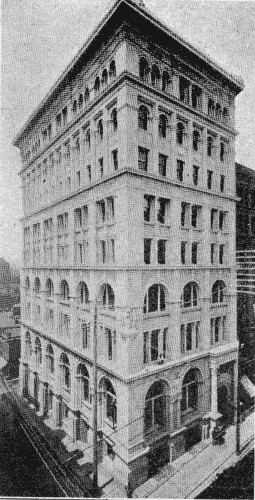
Canadian Life Assurance Building
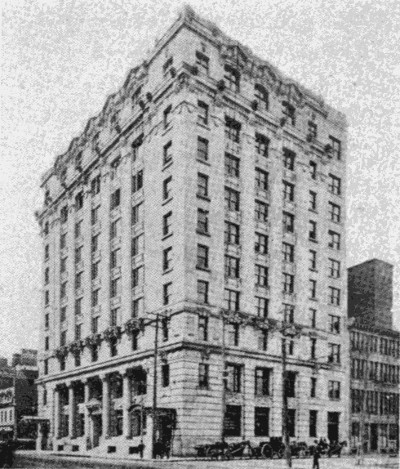
Canadian Express Building
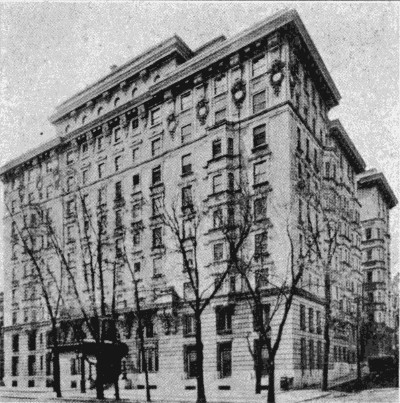
Linton Apartments
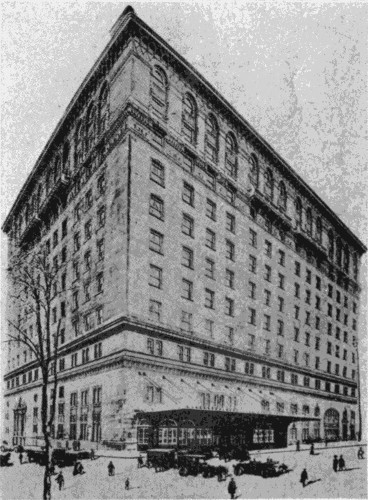
Ritz-Carlton Hotel
DURING THE GREAT REAL ESTATE BOOM
Montreal has been so steadily growing into metropolitan proportions that we must now let students use their imagination by a glance at the following figures and studies.
They are put on record here as reflecting the grounds on which optimistic calculators were looking to the future in 1913 before the outbreak of the Great International War.
I
REAL ESTATE ASSESSMENTS
The growth may be estimated by the following increase in real estate assessment values:
1880$ 78,387,759.00
1890122,859,859.00
1900185,744,531.00
1901190,952,235.00
1902194,045,075.00
1903200,622,335.00
1904207,338,585.00
1905219,047,960.00
1906255,013,389.00
1907272,761,032.00
1908299,157,416.00
1909329,933,089.00
1910428,585,356.00
1911501,291,812.00
1912638,021,625.00
1913791,820,595.00
To present a picture of the present activities the following list shows the buildings valued over $70,000 which are under construction in Montreal at the present time, or have been finished since April, 1912.
II
STATEMENT OF BUILDINGS OCCUPIED BY PROPRIETORS OR TENANTS, ALSO VACANT, AND IN ERECTION (1912)
Number of dwelling houses by tenants
Number of dwelling houses occupied by proprietors
Number of vacant dwelling houses
Number of dwelling houses in erection
Number of store and office buildings
Number of store and office buildings in erection
WardMiscellaneous buildings
East6042—165221
Centre2———20728
West1———306—6
St. Ann970170131532463
St. Joseph859159362282124
St. Andrew8736012819139—58
St. George7864393493796106
St. Lawrence1,3062414164181069
St. Louis1,650370279340277
St. James669184193134234
Lafontaine939562204121120
Papineau1,0804621714292228
St. Mary688438629239—18
Hochelaga1,0016425149106648
St. Jean Baptiste1,1374611117186223
Duvernay586396668955
St. Denis2,47920717144441352
St. Henry954610133270—57
St. Cunegonde3321131—59110
Mount Royal1271586916—11
De Lorimier799340314699914
Laurier2,1491,2654995241363
Notre Dame de Graces3743785111622—30
Emard697212291730—12
Longue Pointe55033018552—26
St. Paul2341723736—11
Bordeaux205158211115—7
Rosemount13912212409—5
Cote des Neiges5248244—6
St. Gabriel87742310256—34
Ahuntsic6411881416—7
———————-—-——-—-—
22,63911,6476365705,10071953
III
RECENT BUILDINGS
The buildings here listed represent a total value of $13,623,330 and aside from the Grain Elevator and Dominion Government warehouses are for the most part office buildings, apartment houses and factories. They give a good idea of the present prosperity of Montreal, and its growth of population and business:
Owner, Location and Description—Value.
Harbor Commission, foot of Berri Street, grain elevator$2,500,000
Canadian Steel Foundry, Maisonneuve, factory1,000,000
Dominion Government, McGill and Youville, storehouse900,000
City of Montreal, Gosford Street, City Hall Annex712,000
Ritz-Carlton Hotel Company, Sherbrooke and Drummond, hotel663,330
Royal Trust Company, 107 St. James, office building500,000
Bank of B.N.A., 140 St. James, bank and office building500,000
Alexander Building Company, St. Alexander Street, warehouse480,000
A. Sommer, Berthelet Street, office building and factory400,000
United Shoe Machinery Company, Boyce Street, Maisonneuve, factory400,000
Sir Thomas Shaughnessy, McGill and St. Paul, office building350,000
Lewis Building, St. John and Hospital, office building350,000
McGill Property Syndicate, McGill Street, office building300,000
Y.M.C.A., Drummond Street, club300,000
The Herald Building, Craig Street, office building275,000
Unity Building Company, Limited, Lagauchetiere Street, office building225,000
Frontenac Breweries, Casgrain Street, brewery220,000
La Sauvegarde Company, Notre Dame and St. Vincent, office building200,000
Séminaire St. Sulpice, St. Denis Street, seminary200,000
Sisters of Cong. of N.D., Sherbrooke and Atwater, school150,000
A.M. Vineberg, Duluth and St. Lawrence, office building150,000
Sir Rodolphe Forget, Ontario Avenue, residence142,000
Fabrique St. Stanislaus, Boulevard St. Joseph, church142,000
Quebec Amusement Company, Bleury Street, theater140,000
J.O. Gravel, Notre Dame and St. Sulpice, office building136,000
John W. Peck, St. Dominique Street, factory135,000
Séminaire St. Sulpice, Cote St. Antoine Road, apartments125,000
Protestant School Board, Esplanade Avenue, school120,000
Fabrique St. Irène, Atwater Avenue, church110,000
Regent Construction Company, Amesbury Avenue, apartments100,000
National Bridge Company, Longue Pointe, factory100,000
J.C. Wilson Company, Ltd., Lagauchetière and Alexander, warehouse100,000
J.A.E. Gauvin, St. Catherine and Maisonneuve, office building100,000
O.L. Henault, Bishop Street, apartments100,000
Johnston Bros., St. Catherine W., offices and store100,000
Imperial Tobacco Company, Bourget and Rose de Lima, factory100,000
Belgo-Canadian Realty, Bleury Street, offices95,000
Grand Trunk Railway Company, Wellington and St. Etienne, warehouse90,000
Imperial Tobacco Company, Bourget and Rose de Lima, factory100,000
Belgo-Canadian Realty, Bleury Street, offices95,000
Grand Trunk Railway Company, Wellington and St. Etienne, warehouse90,000
W.H. Creed, Cote des Neiges Road, apartments90,000
Northern Electric Company, Notre Dame and Guy, factory88,000
Harbor Commission, Notre Dame and Davidson, warehouse80,000
O. Lamoureux, Esplanade and St. Urbain, apartments80,000
P.A. and H.A. Adams, Prince Arthur and Oxenden, apartments79,000
Engineers’ Club, 9 Beaver Hall Square, club building76,000
D.C. Macarrow, Peel Street, residence70,000
University Club, Mansfield Street, club building70,000
St. Lawrence Flour Mills Company, Notre Dame West, factory70,000
Jas. H. Mayer, Cote des Neiges Road, apartments70,000
Canadian General Electric, St. Antoine Street, warehouse70,000
Winter Club, Drummond Street, club building70,000
IV
METROPOLITAN POPULATION
In 1891 the census returns showed for Montreal proper a population of 220,181; in 1901 a population of 266,826; in 1911, 466,197. Including the unnamed municipalities the total population of Montreal we may place in 1911 at 586,756. This allows us to make a comparative study of the growth of Montreal from the beginning of British rule.
CITY POPULATION
17603,000
17657,000
18009,000
180912,000
182522,000
183127,000
183935,000
184444,000
1870100,000
1890220,181
1901266,826
1911, city proper466,197
1911, Greater Montreal587,756
COMPARATIVE GROWTH
In the years from 1900 to 1910 Montreal has shown a greater percentage of growth than has any of the great cities of the United States.
The growth in Montreal’s population since 1900 has represented an increase of 188,270 people, or 70.3 per cent.
New York has shown the greatest growth of any city in the United States. The percentage of increase in the same ten years was 38.7.
The following are the comparative figures:
Per cent.Area
——Population——of increasein sq.
1910.1900.1900-1910.miles.
1New York4,766,8833,437,20238.7326¾
2Chicago2,185,2831,698,57528.7190½
3Philadelphia1,549,0081,293,69719.7129½
4St. Louis687,029575,23819.461⅓
5Boston670,585560,89219.642⅔
6Cleveland560,663381,76846.945
7Baltimore558,485508,9579.731½
8Pittsburg533,905451,51218.241
9Detroit465,766285,7046340
10Montreal (proper)456,000267,73070.318.7
11San Francisco—342,782—43
12Buffalo423,715352,38720.242
13Milwaukee373,357285,3153122¾
14Cincinnati364,463325,90211.843½
15Newark347,469246,07041.223
16New Orleans339,075287,10418.1192
17Washington331,069278,71818.869¼
A contemporary study of the population of Montreal for 1912 may also be put on record.
There are in regard to population, two Montreals: the people within the civic boundaries and the community of which Montreal city is the heart.
The whole is necessarily greater than the part, and in considering the size of Montreal, in the matter of population, it is the whole which should be discussed. To take the naked figures of the census would be utterly misleading, for they do not include even the whole of the area within the city’s limits. That is to say, between the taking of the census and the publication of the results, Montreal had annexed a number of large towns contiguous to it. But this is not the only respect in which the relation of Montreal to the census is unique. It contains, within the city’s limits, or bounded by the city on more than one side, but under distinct municipal government, three other cities—Westmount, Maisonneuve and Outremont It also possesses suburbs, such as Lachine, which are merely manufacturing outposts of the city proper, and others, such as Longueuil, St. Lambert and Montreal West, which are in effect the city’s dormitories.
In figures given below, therefore, are included the population of these and other suburbs which are to all intents and purposes part of Montreal. They are part of the communal life, and the only respect in which their people differ from those of Montreal is that they have distinct municipal administrations.
If we were to take the figures of the 1911 census, Montreal’s population would stand at 466,197, whereas the population of the metropolitan community, as given by the census, is 590,919. Here are the figures in substantiation of this claim:
Montreal466,197
St. Cunégonde11,172
St. Henry30,337
Westmount14,327
Lachine10,778
Longueuil4,016
St. Lambert3,350
Montreal South790
Montreal West703
St. Laurent3,502
Outremont4,745
Cote des Neiges2,447
Notre Dame de Grâce5,217
Verdun11,627
Longue Pointe3,037
Maisonneuve18,674
————
590,919
No one who knows the relation of these towns to Montreal will deny the justice of grouping them as integral parts of this community.
It must be remembered that these figures, first published a year ago, are the result of a census taken in June, 1911. During the decennial period 1900-1910, the city proper increased in population an average of 19,000 yearly. The increase during the latter years of the period was much greater than at its beginning, and it is a matter of common knowledge that it is the suburbs which of late years have shown the fastest growth. From these facts as a basis, it can be argued with every probability of accuracy that this community has grown since the census was taken, by at least 35,000 people, making the total population at this time not less than 625,000.
Of the seventeen cities mentioned in the foregoing table Montreal stood sixteenth in 1900, Newark only being below her. Now, assuming that the population of Greater Montreal is 625,000, she jumps to sixth place, taking rank above all except New York, Chicago, Philadelphia, St. Louis and Boston. In justice to the cities she has passed in the race, it must be acknowledged that they have doubtless also added to their population since the census was taken, but it will hardly be claimed that the leader among them, Cleveland, has jumped from 560,663, its census standing, to the 625,000 of Montreal. If it be urged that perhaps some of the cities which Montreal has passed should also be credited with the population of their suburbs, the answer is that neither Cleveland, Baltimore, Pittsburg, nor Detroit, possesses as many or as large suburbs as does Montreal. Boston is a striking exception to this rule, and if the community of which it is the nucleus was included in computation, the result would probably raise Boston to fourth place among the cities.
MONTREAL OF TO-DAY
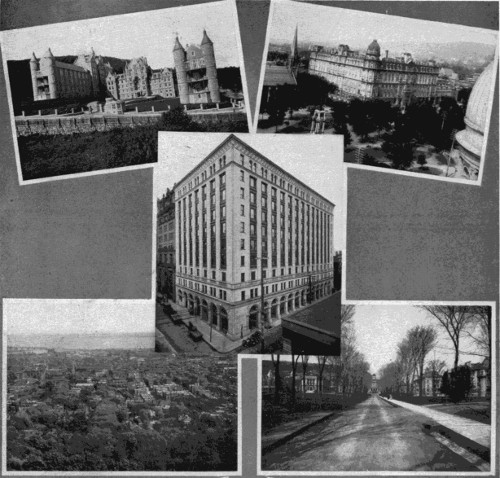
Royal Victoria Hospital Windsor Hotel
Transportation Building, 1912
Modern Montreal from the Mountain McGill University Grounds
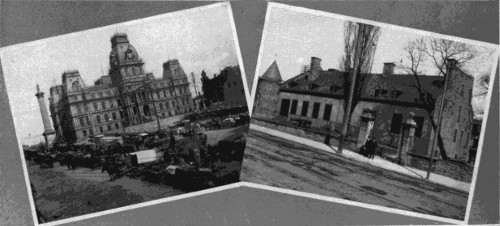
The City Hall and Jacques Cartier Square Chateau de Ramsay, 1912; built in 1705
V
MONTREAL AND WORLD CITIES
But there is still another interesting comparison to be made—how does Montreal stand among the cities of the world? Here is the answer:
1.London7,429,740
2.New York4,766,883
3.Paris2,763,393
4.Tokio, Japan2,186,079
5.Chicago2,185,283
6.Berlin2,101,933
7.Vienna2,085,888
8.St. Petersburg1,678,000
9.Canton1,600,000
10.Pekin, estimated1,600,000
11.Philadelphia1,549,000
12.Moscow1,359,254
13.Constantinople1,125,000
14.Osaka, Japan1,117,151
15.Calcutta1,026,987
16.Buenos Ayres1,000,250
17.Rio de Janeiro811,265
18.Hamburg802,793
19.Bombay776,006
20.Warsaw756,426
21.Glasgow735,906
22.Buda Pesth732,322
23.Liverpool702,247
24.St. Louis687,029
25.Boston670,585
26.MONTREAL, 1911625,000
27.Brussels612,401
28.Manchester606,751
29.Bangkok600,000
30.Cairo570,062
31.Naples563,541
32.Cleveland560,663
33.Baltimore558,485
34.Amsterdam557,614
35.Madrid539,885
36.Munich538,983
37.Pittsburg533,905
38.Barcelona533,090
39.Birmingham, Eng.522,182
40.Dresden516,996
41.Madras509,346
42.Leipzig503,672
43.Melbourne496,079
44.Milan491,460
45.Marseilles491,161
46.Sydney481,830
47.Copenhagen476,806
48.Breslau470,904
49.Detroit465,766
50.Rome462,783
51.Lyons459,099
52.Odessa449,673
53.Hyderabad448,466
54.Leeds428,953
55.Cologne428,722
56.Buffalo423,715
57.San Francisco416,912
58.Sheffield409,070
59.Toronto, and suburbs381,000
60.Kioto, Japan380,568
61.Shanghai, est.380,000
62.Milwaukee373,357
63.Rotterdam370,389
64.Cincinnati364,463
65.Lisbon356,009
66.Lodz351,570
67.Belfast349,180
68.Newark, N.J.347,469
69.Kobe, Japan345,952
70.Mexico City344,721
71.New Orleans339,075
72.Bristol339,042
73.Turin335,656
74.Frankfort334,538
75.Santiago334,538
76.Washington331,069
77.Yokohama326,035
78.Alexandria319,766
79.Kiev319,000
80.Stockholm317,964
81.Edinburgh316,479
82.Palermo309,694
83.Minneapolis301,408
84.Montevideo298,127
85.Nuremburg294,426
86.Antwerp291,949
87.Dublin290,638
88.Nagoya288,039
89.Hong Kong283,905
90.Teheran280,000
91.Bradford, Eng.279,809
92.Bucharest276,178
93.Havana275,000
94.Jersey City267,779
95.MONTREAL, 1901267,730
VI
OPTIMISTIC SPECULATIONS AND PROPHECIES
By this table Montreal jumps to twenty-sixth place in the list of great cities. In 1901 she stood ninety-fifth in the same list. This position, however, is not as conclusively Montreal’s due as is her rank in the table of North American cities, for the reason that it is not possible to speak with exactitude regarding the actual size of the cities below Montreal when their suburbs are included. Manchester, so considered, is no doubt much larger. However, the position accorded the city cannot be far wrong, and there is no gainsaying the fact that Montreal has grown in ten years from the ninety-fifth place among the cities of the world to a place in the first thirty or forty.
There is good reason for believing that Montreal is now the largest city in the self-governing Dominions of the Empire. Only London, Glasgow, Liverpool and Manchester, in the British Isles, can claim to exceed her in population. If we exclude from the calculation the densely populated cities of the East, and Occidental cities, she will rank among the first twenty. And is there a city, among those which now surpass her in population, which is showing as large a percentage of growth? As the metropolitan city of a virgin half-continent, towards which the tide of immigration is yearly rushing with greater force, Montreal is growing with Canada’s growth, and every man who is convinced of the tremendous development Canada will witness within the next decade must realize that this development will mean that Montreal must move, in that time, close to the million mark.
In 1901 Montreal had a population of 267,000. Her suburbs then were small, but supposing we put them at 33,000, and call the greater city 300,000. If today this greater city is 625,000 the growth in eleven years has been 325,000, or about 30,000 per year. Is it unreasonable to assume that in nine years’ time we will have a million souls on this island?
The following computation also will be interesting in later years as a specimen of current speculations and prophecies in 1914 of Montreal’s growth:
“At this rate,” says a contemporary writer, “the city’s population will be considerably over the million mark in 1919. By 1931, two years would be quite sufficient to add to the population of the spreading city, more people than are at present living in both the city and suburbs. If the present rate of increase should remain constant, twenty-six years from today would see a city containing a greater population than the whole of the Dominion of Canada can boast of today, and with seven and three-quarter millions of people, exclusive of suburbs, considerably larger than the London of the present time. A trip further in the future is too dizzy for the brain of any but the trained mathematician, but the array of figures are sufficient to show that within the life-time of the present citizens the city on the shores of the St. Lawrence is likely to stand in the fore-front of the leading centers of the world. Of course, it is only natural to expect that the increase will not be maintained at the present rate, but the addition of growing suburbs will likely prevent any considerable decrease in the rate of advance.”
Before concluding these statistical pictures we may sum up the vital figures of the metropolis:
VII
THE GREATER MONTREAL OF 1912
Population of Greater Montreal, estimated, 625,000.
Assessed valuation of city nearly equals $1,000 per head of entire population of greater city.
City’s revenue from all sources, $8,200,000.
Montreal’s customs receipts are $20,000,000 a year.
The city of Montreal is divided into 125,141 lots.
The city of Montreal is owned by 29,123 people.
If the land upon which the city is built was divided up among the population the per capita share would be about one and one-sixth lots.
Montreal’s assessed valuation this year is $601,000,000.
Exemptions from real estate assessment in the city amount to practically one-quarter of the whole.
Montreal has 1,200 streets and more are being opened up every week.
Montreal’s police force numbers close upon seven hundred officers and constables.
The city’s militia units have an enrolled strength of approximately four thousand two hundred officers, non-commissioned officers and men.
Montreal has over five hundred firemen, divided up among nearly thirty stations.
There are 150 churches in Montreal.
The longest street is Notre Dame Street, with a total length of nearly fifteen miles.
Montreal’s port is visited during the season by nearly eight hundred ocean steamers and thirteen thousand lake and river steamers, the whole fleet having a tonnage of approximately seven million tons.
Montreal has three grain elevators, with a total capacity of 4,750,000 bushels, which is to be added to by another 2,000,000 bushels.
Montreal’s annual snow removal bill amounts to over one hundred thousand dollars, a considerable portion of which is paid by the Montreal Tramways Company.
Montreal has sixty moving picture theaters, with half a dozen others building in different parts of the city.
St. Helen’s Island is visited annually by close upon two hundred and fifty thousand people, mostly children.
Montreal has nearly three thousand privately owned automobiles, representing capital worth approximately six million five hundred thousand dollars.
Greater Montreal comprises two cities, three towns, and half a score of small municipalities.
Montreal’s annual civic light bill is $200,000.
Investigations show that on an average 3,022 school children in Montreal spend $188.70 a week on picture shows.
Montreal has 805 acres of park area.
Montreal’s banks, head offices and branches, number 112.
Montreal’s bank clearings average between fifty-five million and sixty million dollars weekly.
Montreal has one general postoffice, nine branches and eighty sub offices.
One hundred and fifty passenger trains enter and leave Montreal railway depots every twenty-four hours.
The death rate of Greater Montreal is about 40.5 per 1,000.
The city building inspection department has so far this year issued 3,150 permits.
Montreal has 260 miles of streets, of which sixty-five miles are paved.
Montreal’s 240 miles of brick sewers, if placed end to end, would reach from here to Ottawa and back, with sufficient over to reach Coteau.
Montreal’s tramways system owns and operates 125 miles of line all over the island.
Montreal’s streets are illuminated by over three thousand separate lights.
Montreal street cars this year have carried over one hundred and twenty million passengers.
There are sixty-three parishes and 800 priests in the diocese of Montreal.
Montreal has 731 schools, public, high and convents.
There are seventy-two hospitals, public and private, and asylums in Montreal.
The city has two seminaries and two universities.
Other educational establishments in Montreal include eight classical colleges.
Property under the jurisdiction of the Montreal Harbor Commission on the Montreal side of the river is worth over twenty million dollars.
Montreal’s moving picture show theaters have a seating capacity of 35,000.
Realty transfers in Montreal this year are in the neighborhood of one hundred and twelve million dollars.
There are 172,000 names in the Montreal directory for 1912.
Montreal’s area is 27,747 acres.
Greater Montreal’s daily water supply exceeds sixty-eight million gallons.
The daily per capita consumption of water in Greater Montreal is 112 gallons.
The City of Montreal waterworks supply the needs of 351,000 people.
The Montreal Water and Power Company daily pumps 25,100,000 gallons for 251,000 people.
VIII
A CITY PLAN FOR GREATER MONTREAL
Seeing the future growth of the city, a movement was started in 1909 by the City Improvement League, an association of good citizens, desirous of the best for their city. The report of its secretary for 1912, states the progress of the city plan movement as follows:
The City Improvement League has, from its commencement, consistently promoted the movement for a preconceived city plan to be adopted for the future expansion of Montreal. Its City Planning Committee, backed by the cooperation of the great commercial and philanthropic bodies of the city, has been recognized as the exponent of the wishes of our best citizens, having already two years ago secured the appointment of a Metropolitan Parks Commission, whose duty it was to study the needs of the city for such a plan.
This Commission, after a careful study, reported to the Government on January 5, 1911, on the very urgent necessity of the city immediately undertaking some action in city planning, and it recommended the establishment of a permanent Metropolitan Parks Commission, to carry on the work already initiated by the present temporary use. The Commission presented a report drawn up for them by Mr. F.M. Olmstead, on subjects dealing with the selection of lands for parks and playgrounds, and with the location of boulevards and other main lines of urban and suburban transportation, as necessary preliminaries in the formation of a city plan for Montreal. In addition, the Commission presented a draft bill for an act to establish a permanent Metropolitan Parks Commission.
A bill based on the above draft was presented in March at the following session of the Provincial Parliament, but was not passed, being held over for the next year. In the meantime, the temporary Commission having presented its report, for which it was appointed, automatically expired. The efforts of the League, to overcome the difficulties in the way of the bill, have since occupied a great part of the last year’s work.
Apart from meetings, and consultations of experts of a technical nature, every occasion was used to keep up public interest in the demand for a permanent commission.
In October the Fourth General Assembly of the Royal Architectural Society of Canada was held in Montreal, and on October 2d, at a special meeting of the delegates of this convention, and a large and representative gathering of citizens called together by the City Improvement League, to discuss the town planning situation, the following resolutions were carried:
“That this assembly of the Royal Architectural Institute of Canada earnestly desires to urge upon the several Provincial Governments, the necessity of providing without delay, parks and playgrounds and housing commissions for each large city under their jurisdiction, especially with the object of preventing excessive mortality, and making better provisions for the health, comfort and recreation of the masses.
“That the Government of the Province of Quebec is especially urged to appoint a permanent Metropolitan Parks Commission with executive powers.”
In December the Public Health Association of Canada called its first convention, it being held in Montreal. A very valuable session on city planning, which was well attended by members of the League, provided much stimulating thought to Canadian public health officers and city planners.
A resolution to the following effect was proposed by Mr. H. Bragg, and seconded by Dr. Adami, president of the City Improvement League, viz., that this convention should recommend that Provincial legislatures should create Park Commissions, to regulate the growth of towns and cities, and to control their housing conditions, with powers of city planning and housing to extend even to suburban areas.
The matter was debated and finally left over to the Executive Committee of the Canadian Public Health Association, which next day passed the following modified resolution:
Moved by Doctor Bryce (Ottawa), and seconded by Doctor Sheriff (Ottawa), “that this association deems it worthy of urgent necessity that Provincial legislatures pass Acts making provision whereby urban municipalities can make house planning and land purchase schemes, whose operation may include suburban areas.”
During the year public bodies interested in the bill renewed their resolutions in its favour. Thus, for instance, at the annual meeting of the Board of Trade, it was resolved on the motion of Mr. R.W. Reford, seconded by Mr. Armand Chaput, “That the Montreal Board of Trade, which since February, 1910, has advocated the creation of a Metropolitan Parks Commission for the Island of Montreal, now notes with gratification that the Quebec Legislature is considering the appointment of such a commission and the board, in annual general meeting assembled, hereby prays that Legislature to adopt, during the present Session, legislation to that end.”
The above resolutions are quoted as indicative of the general trend of expert thought, which has helped to form public opinion in the city, in favour of a Metropolitan Parks Commission.
During the last two years every draft bill that has been drawn up for the above movement has always had conjoined with it clauses of a “housing” aspect, since city planning and the comfort of the working classes should never be separated. Consequently, the League has constantly promoted the study of city housing and advocated schemes for garden cities and for model workingmen’s dwellings, side by side with those for more parks, playgrounds and open spaces, as desired by all town planners.
The following associations lent valuable cooperation: The Board of Trade and La Chambre de Commerce, The Canadian Manufacturers’ Association, The Architects’ Association of the Province of Quebec, The Trades and Labor Council, The Parks and Playgrounds Association, The Citizens’ Association, The Canadian Club, The Local Council of Women, The Montreal Women’s Club, The Fédération Nationale, The Association St. Jean Baptiste, The Children’s Aid Society.
To Mr. W.D. Lighthall, K.C., Convenor of the City Planning Committee, and to its members, was due a large measure of the success of the bill. Among these may be mentioned J. George Adami, M.D.; Sir William Van Horne, E.P. Lachapelle, M.D.; J.L. Perron, K.C.; Hon. J.J. Guerin, M.D.; Controller Ainey, Sir Alexander Lacoste, L.A. Lavallee, K.C.; J.I. Finnie, M.D., M.L.A.; W.S. Maxwell, J.R. Gardiner, F.G. Todd, W. Rutherford, Prof. J.A. Dale, J.V. Desaulniers, Farquhar Robertson, Olivar Asselin, Leslie H. Boyd, K.C.; William Lyall, the late Professor Gregor, W. Johnson, H. Bragg, Dr. W.H. Atherton, secretary, and others.
Later an association entitled the Greater Montreal Housing and Planning Association was formed to assist in carrying on the above movement.
The plan movement has made uncertain progress, but still it is appreciable, especially as having overcome initial difficulties and in promoting preparatory measures and amelioration, leading toward the desired goal.
FOOTNOTES: