Part 2 — CHAPTER XXXIV (continued 2)
Reading edition
THE CATHOLIC SCHOOL FOR DEAF-MUTE GIRLS
The next school, for girl deaf mutes, was established in 1851 at the time when that for boys was in a precarious condition. Its home was first at Longue Pointe and it was opened, under the auspices of Mother Gamelin, the foundress of the Sisters of Providence, by Sister Marie de Bonsecours (Albina Gadbois) on February 19th, with two pupils. The work for the unfortunate children was not then understood in Canada, being even thought useless. In 1852 there were four pupils, in 1857, thirty-two. The school which had then become too small was transferred to the hospice St. Joseph in Montreal. In 1864, the institution was definitely established upon its present site on St. Denis Street. Its first buildings have been gradually enlarged. The first teachers studied for a year at Joliette under the Abbé Lagorce. In 1853 they went to New York to study under the celebrated Isaac Peet, director of the Institute for Deaf Mutes in New York. Two years later they returned thither for further instruction. In 1870 they went to Europe to familiarize themselves in the oral method, but it was not till 1879 that the intuitive pure oral method, replacing signs and imitation, was applied in its entirety. In this they were greatly assisted by the Abbé Trepanier, honorary canon of the Cathedral of Montreal, who was for eighteen years attached to the institution of the deaf mutes on St. Denis Street. In 1912 the establishment numbered 260 girl pupils and fifty-four religious.
THE MACKAY INSTITUTION FOR PROTESTANT DEAF-MUTES AND THE BLIND
Prior to the establishment of the institution known as the Mackay Institution for Protestant Deaf Mutes and the Blind, there was no school among the Protestant community for the unfortunates who might be either blind or deaf. During the year 1868 the subject was being agitated and on the 7th of January, 1869, a public meeting of those interested in this work was held and the following prominent citizens formed themselves into a society to establish an institution for Protestant deaf mutes and the blind in the Province of Quebec, then better known as Lower Canada:
Mr. Charles Alexander, Thomas Cramp, Frederick Mackenzie, Thomas Workman, John Dougall of the Montreal Witness, William Lunn, G. Moffatt, J.A. Mathewson, J.H.R. Molson, Hon. J.J.C. Abbott, Edward Carter, Q.C., P.D. Browne, John Leeming, W.H. Benyon, J.F. Barnard, S.J. Lyman; and the following ladies:
Mesdames Andrew Allan, R. Redpath, J.W. Dawson, Major, Bond, Cramp, Fleet, Moffatt, Brydges, Brown and Workman.
The following officers were elected: Mr. Charles Alexander, president; Thomas Cramp, vice president; Frederick Mackenzie, secretary-treasurer; Thomas Widd, principal; Mrs. Widd, matron.
On the 19th of January, 1869, another meeting was held at which it was announced that the sum of nearly $6,000 had been subscribed, and more promised. The members worked vigorously to raise sufficient funds.
The work of the honorable secretary-treasurer was no sinecure. He sent out hundreds of circulars to ministers in all parts of the province to obtain the names, age, sex and circumstances of all Protestant deaf mutes in the province. On the 26th of January, 250 circulars to Protestant ministers had brought only 23 replies, reporting 5 deaf mutes and 5 blind.
On the 10th of March, 112 replies had been received, reporting 38 deaf mutes, 8 of school age, and 34 blind, of whom only 5 were of school age. On April 30th, 210 replies had been received, reporting 57 deaf mutes, 35 males and 22 females; eligible for school, 8 males and 5 females.
On the 4th of May, another meeting of the committee was held and it was decided that Mr. Widd should look out for a suitable house and grounds to open school for September. A house and ample grounds were found in Côte St. Antoine at an annual rental of $400 with an option to purchase in five years for $8,000. The house contained accommodation for about twenty pupils but very scant provision for teachers.
The doors were opened on the 15th of September, 1870, and 11 pupils admitted, 9 boys and 2 girls. Six paid full fees of $90 for the scholastic year and 5 were free. The number in attendance was later increased to 16; 13 boys and 3 girls, one of the latter being deaf, dumb and blind.
The institution had a hard struggle for existence for many years, especially about 1876, which was a year of great financial depression; but with the help of kind friends it was kept open and attracted the attention of the late Mr. Joseph Mackay, who finally bought a piece of ground in Notre Dame de Grâce and erected thereon a handsome building capable of accommodating about eighty pupils and their teachers, and the name was then changed to the “Mackay Institution for Protestant Deaf Mutes and the Blind.”
Mr. Widd retired from the principalship about 1882 and was succeeded by Miss Harriet E. McGann as superintendent, who later married a most talented teacher, Mr. John I. Ashcroft, and after his death carried the superintendentship alone to the present date.
There are now about seventy pupils of whom eleven are in the blind class. The subjects taught the blind are the ordinary English branches, music, typewriting, raffia work, knitting, plain sewing, chair caning and piano tuning. For the deaf the Masterson method is used in the kindergarten classes, dressmaking and domestic economy, besides the ordinary public school course. In the industrial department the boys acquire a good knowledge of carpentry, wood carving, cabinet making, shoemaking and chair caning.
THE INSTITUT DES AVEUGLES
The “Institut des Aveugles,” or the Institute for the Blind, at “Nazareth,” St. Catherine Street, the first established in Canada, was founded in Montreal in 1860 by the Rev. V.B. Rousselot, a Sulpician, who sacrificed his private fortune for the work of his predeliction. The course given aims at providing a classical and religious education and follows the practical methods adopted in Paris at the Institution National for the young blind. Music is especially cultivated. In 1892 the Grey Sisters, who have charge of the institution, added an Institut Opthalmique. Eye diseases are also treated at the Hôtel Dieu and Notre Dame Hospital.
THE MONTREAL ASSOCIATION FOR THE BLIND
The latest development is now being enterprised by the non-Catholics under the foregoing name.
In response to a circular letter sent out by a blind citizen, Mr. P.E. Layton, inviting personal friends and others to meet at his residence on Tuesday evening, April 21, 1908, about fifteen blind men and their friends responded. The meeting having been arranged by Mr. Layton, it was unanimously agreed that he should take the chair. In a few well-considered words the chairman set forth what he considered to be a pressing need in our community, the establishment of an association to promote the interests of the English-speaking blind in the Province of Quebec. He was of the opinion that an up-to-date school for the blind was an urgent necessity and that in connection with this, workshops for blind adults should be established so that the non-seeing might by instruction and training become self-supporting. In the discussion which followed it was unanimously decided that such an association should be formed, having the aforesaid objects as its ultimate aim. The officers of the society were then elected as follows: Dr. A. Fisher, honorary president; Mr. C.W. Lindsay, president; Mr. W. Stewart, vice president; Mr. P.E. Layton, treasurer; and Mr. S. Fraser, secretary. The above officers, with the addition of Messrs. H. Baker and T. Stewart, formed an executive committee of management. At a subsequent meeting Messrs. A. Ross and I. Mullhollin were added to this committee. By the end of the first year $12,608.48 had been realized from subscriptions.
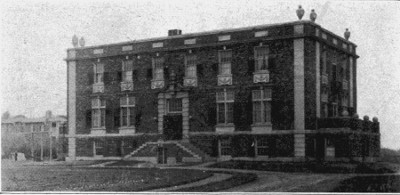
MONTREAL SCHOOL FOR THE BLIND
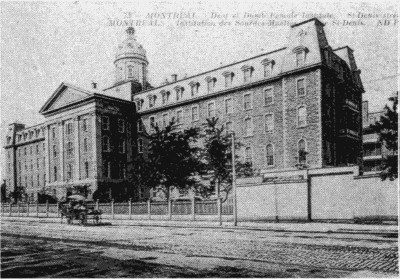
MONTREAL DEAF AND DUMB INSTITUTE
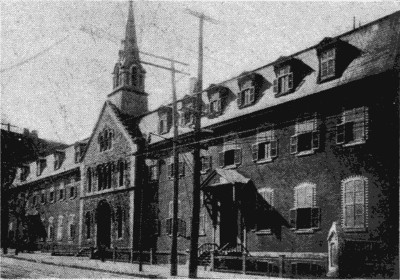
NAZARETH ASYLUM FOR THE BLIND
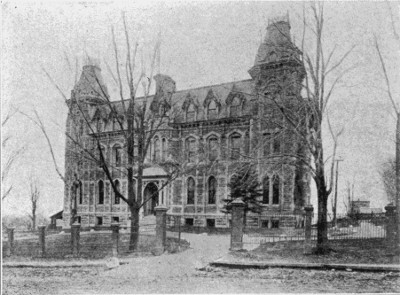
MACKAY INSTITUTION FOR THE PROTESTANT DEAF-MUTES AND THE BLIND
A library of books in the raised type has been established. A workshop for the training of blind adults in broom-making was opened on December 1, 1908.
On June 4, 1910, an act to incorporate “The Montreal Association for the Blind” was passed by the provincial legislature. The principal incorporators were Sir Edward Clouston, Baronet; Sir Thomas Shaughnessy, K.C.V.O.; Sir Melbourne Tait; Sir William Macdonald; Sir Hugh Graham; W.M. Aitken; George Smithers; Charles W. Lindsay; Philip E. Layton; H.F. Armstrong; E.B. Busteed, K.C.; Septimus Fraser, and other persons.
During the next four years Mr. and Mrs. Layton were actively engaged as treasurer and secretary of the society in collecting funds for the erection of a school for the English-speaking blind and a sum sufficient for the purpose was raised. A piece of land 8½ acres in extent was purchased at Sherbrooke Street, at the corner of Notre Dame de Grâce, in 1910, and in 1912 the school was built and opened for the admission of pupils in October of that year. It was almost entirely furnished by donations of friends. The official opening by the Premier of the Province, Sir Lomer Gouin, took place in October, 1913. Thirty-two pupils have been enrolled since that date. Funds have been raised during the present year, 1914, for the erection on the school grounds of an industrial home for the adult blind, and the building is now in progress and will be ready for occupation on March 1, 1915. This building will accommodate about twenty-five to thirty adults. Various trades will be taught and the boarding accommodations will be a great boon to the sightless workmen.
THE SCHOOL FOR CRIPPLES (Children’s Memorial Hospital)
The Montreal movement for a school for cripples is of especial sociological interest as a further instance of the trend of modern educational impulse.
Less than a year after the founding of the Children’s Memorial Hospital, in 1904, the members of the committee of that institution realized the dire ignorance of most of the little patients who were brought to the hospital for treatment, some having never attended school, others having attended school during but short and broken periods of their young lives.
A school was shortly organized in connection with the hospital for the young patients in the temporary quarters, 500 Guy Street. The scholars studied reading, writing, spelling, arithmetic, grammar and geography; in one or two instances shorthand, typewriting and music have been commenced. Some of these pupils could sew, knit, crochet embroidery and make bead chains.
The aim of the committee of the Children’s Memorial Hospital after the removal of the patients in 1909 to the new hospital has been to have a separate school building on its grounds on Cedar Avenue, which school would be not only the school for the resident patients but also the school to which the crippled and deformed children of Montreal and the surrounding vicinities would be brought every morning in special conveyances, and there receive instruction which would fit them to become independent and useful citizens as they grew to manhood and womanhood. The children would receive their mid-day lunch at the school and later in the afternoon be conveyed to their respective homes.
The first step taken was in approaching the Protestant School Commissioners, who gave permission for a collection to be taken by children in their schools for the School for Cripples.
The second step was that of forming a committee and having collecting cards printed. After the gracious permission was accorded by the Protestant School Board of Montreal, and that of Westmount, upwards of twenty thousand of these collecting cards were distributed to the scholars attending the schools under the control of these respective boards. The school inspectors of the Province of Quebec rendered valuable assistance, also supplying lists with the names of the schools and the teachers under their inspectorates. These schools were supplied with collecting cards also, together with a number of private schools and academies in Montreal and the surrounding districts. As a result of the efforts of the school children of the province and the kind supervision of the principals and teachers, a very large sum was collected.
The committee for the organization of the School for Cripples held its first meeting in February, 1910. At the last meeting which was held in May, a deputation, composed of the following members of the committee: Mr. C.J. Binmore, Mr. W.D. Lighthall, His Honor Mr. Recorder Weir, D.C.L., Doctor Rexford,—was appointed to attend a meeting of the committee of the Children’s Memorial Hospital, which was held the week after. At this meeting the following report, read by Mr. C.J. Binmore, recommended that provision should be made for three distinct divisions of children.
1. The inmates of the hospital who are able to go from the wards to the class-rooms.
2. The pupils who may be brought daily to the school from their homes.
3. The children resident in the hospital who are either temporarily or permanently unable to leave their cots.
The school has at last, in September, 1914, been completed in the grounds of the Children’s Memorial Hospital at the foot of the hill adjoining Cedar Avenue, and is ready for formal opening. It will have two departments, one for the hospital crippled children and the other for the same unfortunate class from the city. It will be taught on the same efficient lines as those employed in the city schools. But special vocational training will be added to equip the handicapped children for the battle of life.
The board of management, separate from that of the hospital, is as follows: President, McKenzie Forbes, M.D.; vice president, Rev. Herbert Symonds, D.D.; Mr. C.J. Binmore, treasurer; Miss Sarah Tyndale, and Mr. W.D. Lighthall, K.C., honorary solicitor.
VI
IMMIGRATION WORK
EARLY ACTIVITIES—YEAR OF CHOLERA—DOMINION AGENCY—THE WOMEN’S NATIONAL IMMIGRATION SOCIETY—CATHOLIC IMMIGRATION HOME.
Writing in 1839 Mr. Newton Bosworth, in “Hochelaga Depicta,” says that “the citizens of Montreal are distinguished by one feature which is highly honourable to them, standing out as it does in pleasing and strong relief—and that is a habit of active benevolence. Perhaps there is no place where in proportion to the number and wealth of the inhabitants more has been done to relieve the wretched and support the weak by deeds of real charity than in this city—and this not by thoughtless and indiscriminate profusion, but in the exercise of cautious and painstaking administration.” As an illustration of this fact he quotes, “On the authority of Nathaniel Gould, Esq., London, a warm and steady friend to Canada, that the Montreal Emigrant Society during the past year (1832) forwarded to their destination, or otherwise relieved, 10,744 of these poor creatures at an expense of £2,126 11s 4d. Too much praise cannot be bestowed on the exertions of those pure philanthropists, who during a season of much distress and danger gave up their time, money and health to so worthy a purpose.” The last quoted writer is speaking of the year of the cholera epidemic of 1832.
THE DOMINION IMMIGRATION AGENCY
But immigration from the institutional point of view may be dated at about 1834, when the national societies, as recorded elsewhere, arose to safeguard the interests of their own country people coming to the city. These societies either had houses such as the St. Andrew’s Home or St. George’s Home to receive them, or they did it by providing them lodging and care otherwise.
The Dominion Government has long had its immigration agency in the city. Its home is now at 150 St. Antoine Street, where the new building with its detention hospital was publicly opened on May 1, 1914. Its previous locations were 306 St. Antoine Street, the late one, the former residence of a former mayor, C.S. Rodier; then 219 Cathedral Street; before that 183 Common Street; 517 St. James Street; then at a point opposite the Grand Trunk Station (St. Bonaventure) and at Point St. Charles, etc. The present agent, Mr. John Hoolahan, was appointed in 1893 and he was preceded by Mr. Daly, father and son.
THE WOMEN’S NATIONAL IMMIGRATION SOCIETY
An important philanthropic movement was started in 1882 under the title of the Women’s Protective Society, which was changed some years later to its present name, “The Women’s National Immigration Society.” Its first president was Mrs. Gillespie, who was succeeded at her death in 1913 by Mrs. H. Vincent Meridith. As Montreal is a port of importance, the sociological value of the movement is apparent.
As Montreal is a port of importance the sociological value of this movement is apparent.
The home of the society situated at 87 Osborne Street is recognized as a government receiving home for the Dominion of Canada, where all newly arrived women immigrants are given twenty-four hours free board and lodging. It has no business connection with any employment agency in Great Britain or Canada.
The object of the society is the receiving and protecting of newly arrived immigrant women irrespective of creed or nationality. Should they remain in Montreal they can board in the home at a low charge and assistance is given to them in every way possible to obtain employment. If they are going further afield help is given them in preparing for their journey and they are seen safely onto the trains.
From the foundation of the society in 1882 to December, 1913, 11,366 newly arrived immigrants have been registered on the books. In the first two years of the society’s existence those registered totaled 459, as compared with the figures for the last two years, 1,697. A comparison of these figures will show how greatly the work has increased.
An outstanding feature of the work is the receiving and assisting of large parties of immigrants brought out under the auspices of the “British Women’s Emigration Society” of London, England. These parties traveling under the care of experienced matrons have been coming to the home for the past twenty-four years and have grown rapidly of late years both in frequency of arrival and numbers. At the present time they usually consist of from forty to fifty persons, though on one day of August, 1912, a party of over ninety was received and catered for at the home, while waiting for trains for different points in the country.
Individual passengers are met by request at the steamers and trains and assisted with their arrangements for their further journeys. These form a very large class annually and as they usually prefer to go forward with as little delay as possible they are generally taken direct to the stations and are thus not included in the above totals which only cover those newly arrived immigrants registered at the home.
THE CATHOLIC IMMIGRATION HOME
A similar work to that of the last named association is now being performed by the Catholic Immigration Home at 450 Lagauchetière Street.
On April 10, 1913, their property was purchased, but numerous alterations had to be made to make it suitable for immigration work.
The Home has become very popular with the young women, strangers in a strange land, who look upon it as their home where they are well looked after by a competent matron.
On Saturday, June 28, 1913, the Home was officially opened for the reception of the immigrants. Among those present were the following: His Grace the Archbishop of Montreal; Hon. J.J. Guerin, John Hoolihan, dominion immigration agent; E. Marquette, provincial immigration agent; Denis Tansey, M.L. A.; Mr. E. Dufault, deputy minister of colonization, Quebec Government; J.B. Lambkin, dominion agent for the suppression of white slavery; W.G. Kennedy, president of St. Patrick’s Society; J.L.D. Mason, M.D.
Representatives of the Home meet the incoming steamers and trains, and assist the immigrants, both male and female, arriving in the city. The young women are protected at the Home, and saved from the evil of white slavery while employment is secured for them. It is managed by a board of life governors with a chaplain, the Rev. F.J. Singleton of St. Patrick’s Church. It has a matron and staff for the internal government.
Among other immigration activities may be mentioned the National Societies, Union Nationale Francaise de Montreal, St. Anthony’s Villa.
VII
HUMANITARIAN MOVEMENTS FOR BOYS
THE BOYS’ HOME—THE PATRONAGE DE ST. JOSEPH—THE BOY SCOUTS—PARKS AND PLAY GROUNDS ASSOCIATION.
THE BOYS’ HOME.
Among the striking developments of humanitarian efforts for boys there are several which stand out conspicuously.
The Boys’ Home of Montreal is a logical and lineal descendant of the “Infant School Association,” which established a schoolhouse on Barre Street in 1868 in connection with Zion Congregational Church, Mr. Charles Alexander, James Baylis, J. Dougall, Fred Perry and others being associated with the work.
On the Protestant School Commissioners taking up infant teaching, as the charter of the above association permitted other charitable work, by a resolution of May 5, 1870, in the Mechanics Hall, it was utilized for the promotion of work for waifs and strays, and in 1871 the association changed its name to the Boys’ Home of Montreal and established itself in the building erected by Mr. Charles Alexander, on Mountain Street, known as the Shaftesbury Hall, after the model of the Lord Shaftesbury homes in England. The work commenced on February 1, 1871, with twelve boys, to whom were added six others next day. They were street boys of all religions and each boy paid ten cents for supper, bed and breakfast. These were a rough lot and it caused Mr. John Ritchie, the first superintendent, some trouble to handle them. Still the work progressed. Mr. and Mrs. J.R. Dick took charge of the boys about 1882 and have continued in this work till today. The growth of this home from such humble beginnings is best told by its buildings. In 1886 the present centre building, costing $13,000, was built; in 1893 the north building for educational purposes; and in 1904 the new Alexander wing, costing $30,000, including gymnasium, swimming bath, etc., replaced the old Shaftesbury Hall. The work has overflowed so that the home was instrumental in fathering the Shawbridge Boys’ Farm. This had long been projected through the efforts of Mr. Alexander, the president, who had desired to accomplish some betterment of the miserable conditions, officially acknowledged, attaching to the care and reform of the Protestant juvenile delinquent in the Sherbrooke reformatory, which was nothing more than a part of the Sherbrooke jail. As early as 1902 the matter was brought before the board by Mr. J. R. Dick. In 1906 it was again urged that the Boys’ Home board was the right corporation to bring about the reform so long required, through the establishment of an industrial farm, which eventually opened its doors to the fourteen boys from Sherbrooke Reformatory on March 31, 1909, the contract with the government having been concluded on March 8, 1909. The first immediate step, however, was taken in 1906 by the corporation of the Boys’ Home through its farm committee under Mr. J.S. Buchan, with Messrs. S.M. Bayliss, Frederick Hague and C.S.J. Phillipps. In 1907 the Goodfellow Farm of 300 acres and cattle was purchased at Shawbridge, forty miles from the city on the Nominique Division of the Canadian Pacific Railway. It has a station also on the Canadian Northern Quebec Railway, the farm being conveniently situated about a mile from the city. Its grounds were laid out under the direction of Professor Nobbs and Mr. F. Todd, with Mr. Cecil Burgess as the building architect. A simple inauguration was held in December, when the work was commenced. Mr. G.W. Mathews, late of the Kibble Institute, Paisley, Scotland, arrived in March, 1908, to take the position of superintendent on May 1st, when the farm came into the possession of the corporation. The formal opening of the Boys’ Farm took place on October 26, 1908. Its subsequent history belongs to the section on “Reformation.” The Boys’ Home, which still retains its original character, has merited the good will of the citizens. Since 1868 it has had only two presidents, Mr. Charles Alexander, who died on November 6, 1905, and Mr. J.E. Dougall, his successor.
PATRONAGE DE ST. JOSEPH
Although there are numberless forms of charity among the French-speaking population it was not till 1892 that young orphan boys of the apprentice class were specially catered for, when, on September 8th, the Patronage de St. Joseph was opened for such at the southeast corner of Dorchester Street and St. Charles Borromeo. The idea was conceived by the conference St. Laurent of the Society of St. Vincent de Paul, under the direction of its president, M. Sénécal, and its chaplain, the Rev. M. Hébert. Shortly after six months the location was removed by an offer of land from the Seminary of St. Sulpice to the corner of Lagauchetière and St. George streets. The new dwelling was even still too small for the growing number of apprentices and through the generous assistance of M. Froidevaux great enlargements were added within four months to the first building. Two years later, in 1895, a third building was commenced, but was not utilized till May, 1897, by the act of the Rev. M. Colin, superior of the Seminary, who has made it possible by furnishing the necessary funds.
The work has given asylum since its twenty-two years of existence to more than fifteen hundred young boys learning their trades, either in the Brothers’ workshops or in the town, returning to the Patronage at night. At present ninety apprentices are housed and only inadequate means prevents more from being served.
Other activities for boys beyond these two representative institutions are connected with the churches and social works of the city with numerous clubs for mental, moral and physical uplift.
THE BOY SCOUTS
The scout movement, founded in England by Lieut.-Gen. Sir Robert S.S. Baden-Powell, for building boys into strong, virile manhood, is really organized clubdom for boys, bringing to them physical, moral and intellectual training. It was intended at first by the founder to be used by existing boys’ organizations, such as the Y.M.C.A., Boys’ Brigade, School and Cadet Corps, but it grew beyond those bounds.
The first permanent work in connection with the Boy Scout organization in Montreal was undertaken by Mr. Nigel Young during the winter and summer of 1910. On September 2, 1910, Lieut.-Gen. Sir R.S.S. Baden-Powell, the Chief Scout and founder of the movement, visited Montreal and addressed a meeting of the citizens in the arena with the mayor, Doctor Guerin, in the chair. On the following day he reviewed the troop of the city and addressed the scoutmasters. The Chief Scout was accompanied by Lieutenant-Colonel Burland, who had the previous day been appointed commissioner for the Province of Quebec.
In July, 1912, eleven scouts and three scoutmasters were present at the rally and review held by His Majesty at Windsor during the coronation events. The whole Canadian contingent, numbering in all 136, was commanded by Lieut.-Col. Minden Cole, chairman of the Montreal council.
In the autumn of 1911 Mr. David Evans was appointed assistant commissioner and secretary for the province, since which time two others have held that office, Mr. Russell Patterson, in 1912-13, and Mr. Lordly, in 1914.
During the winter of 1911, through the efforts of the late Lieutenant-Colonel Whitehead, honorary treasurer of the Montreal Scout Council, a tract of land 300 acres in extent, with two fine lakes, was purchased in the Laurentian Mountains for a permanent camping ground for the scouts of the province. This has been improved and a new up-to-date men’s hall has been erected. A full equipment of tents, boats, etc., was supplied to accommodate 175 scouts at one time.
In September, 1914, Lieut.-Col. J. Burland resigned the commissionership of the province and his place has been taken by Lieutenant-Colonel Starke, appointed by H.R.H. the Duke of Connaught, chief scout for Canada.
At the present time there are in Montreal 12 local associations, 54 scout troops, 53 scoutmasters, 49 assistant scoutmasters, 1,423 scouts, 23 king scouts, and 3 silver cross scouts.
PARKS AND PLAY GROUNDS ASSOCIATION
A most important factor in the life of a city is the provision of open spaces and breathing places for the working classes, and especially for the children. In the winter of 1895-6 a few ladies founded the Parks’ Protective Association. Its first executive committee was: Mrs. N. Peterson, president; Mrs. Hugh Graham, Mrs. N.V. Meredith, Mrs. Frank Redpath, Mrs. John Cox, Mrs. Charles Hope, Mrs. F. Walton, Mrs. Kenneth Macpherson, Mrs. Charles Whitehead and Miss Edith Watt, honorary secretary. In April, 1900, its scope was enlarged by a larger association being formed, with men admitted to committee work, to carry on its work under the title of the “Parks and Playgrounds Association.” A special object of the new association is to promote public playgrounds for the children and urge the city authorities to do this. The association was incorporated in 1904. Its presidents have been: Sir William Hingston, Sir George Drummond and Sir Alexander Lacoste. It has fostered a growing sentiment in favour of public playgrounds and in 1913 it had seven of these under proper supervision. Admirable modern playing apparatus has been installed during the last two years. The movement has public favour and the association’s slogan of 1912 for “$1,000,000 for playgrounds” as the extent of a grant desired from the city hall, has had the result of urging the city to purchase a great quantity of land for definite further playground expansion. The city has now also undertaken the care and management of its own public playground property and the association at present confines itself to its own playgrounds at Hibernia Road, and two others. Its record is very creditable as a voluntary public service.
VIII
HEBREW SOCIAL WORKS
BARON DE HIRSCH INSTITUTE—LADIES’ BENEVOLENT ASSOCIATIONS—OTHER SOCIETIES.
The social work of the Hebrew as such may be treated separately as an indication of social endeavour on racial lines.
The philanthropic institutions of the Hebrews of Montreal have become numerous. The most important one is the “Baron de Hirsch Institute,” which was founded in 1863 under the name of “The Young Men’s Hebrew Benevolent Society.” When afterwards the late Baron de Hirsch sent them large sums as a fund for assisting in the onerous work which had fallen on this society through the large influx of Jews from Eastern Europe in the ’80s they changed the name to “Baron de Hirsch Institute and Hebrew Benevolent Society.” Among its founders were Lawrence L. Levy, who was its first president, Isidor Ascher, Tucker David, Charles Levy, Lawrence Cohen, M. Gutman, Moise Schwob and S.E. Moss. Among its presidents have been Jacob L. Samuel, Lyon Silverman, Jacob G. Ascher, Lewis A. Hart, N. Friedman, Harris Vineberg, David A. Ansell, Mortimer Davis, Lyon Cohen and Samuel W. Jacobs, K.C. Mr. Ansell held office for fourteen years. It was during his administration that the large building on Bleury Street, now occupied by the institute was acquired. He was a very active worker in the cause of education and his name will always be especially identified with that branch of the work of the Baron de Hirsch Institute. He also was Consul General for Mexico. Each of the above-mentioned presidents in turn did yeoman service for the advancement of the institute, which has grown in importance from year to year.
The Ladies’ Hebrew Benevolent Society, founded in 1877, is the oldest and most important of the Hebrew women’s charity organizations. The Hebrew Free Loan Society, which was founded some years ago, largely through the efforts of Z. Fineberg, does splendid work in making loans to those requiring aid who refuse to take charity and who pay back the loans thus made as their condition improves. The Herzl Free Dispensary, the Hebrew Sheltering Home, the Hebrew Sick Benefit Association, the Hebrew Young Ladies’ Sewing Society all do noble work in their separate branches, and there are a large number of other equally meritorious Hebrew organizations doing work in every field of philanthropy.
IX
COOPERATIVE MOVEMENTS
WOMEN’S WORK—THE MONTREAL WOMEN’S CLUB—THE LOCAL COUNCIL OF WOMEN—LA FEDERATION NATIONALE—THE MONTREAL SUFFRAGE ASSOCIATION—THE CITY IMPROVEMENT LEAGUE—THE CITIZENS’ ASSOCIATION—THE CHILD WELFARE EXHIBITION—ITS LESSONS—THE MILK STATION MOVEMENT.
Up to 1892 charitable and social work was conducted busily and self-sacrificingly, but often without sufficient inter-relation between the workers of the various institutions and bodies and churches. Accordingly the movements for cooperation which now began mark the beginning of a most fruitful epoch. The first signs of the new period were manifested by the foundation of the Montreal Women’s Club in 1892 and that of the local Council of Women in 1893, to be followed by La Fédération Nationale in 1907.
Lengthy notices are given of the women’s movements, for historically the period we are now in is peculiarly theirs. It is also indirectly a summing up of the very large part played by the women of Montreal in the charitable and humanitarian work of this city, as this chapter amply testifies.
THE MONTREAL WOMEN’S CLUB
The Montreal Women’s Club was founded by Mrs. Robert Reid, December 7, 1892—the object of the club being to promote agreeable and useful relations between women of artistic, literary, scientific and philanthropic tastes. The legal incorporation of this club was secured on April 4, 1893. The weekly programme, at first used as a means of personal culture, soon became an important factor in the life of its members, revealing to them abuses to be abolished or reforms to be instituted. To-day, like so many modern clubs of women originally of a literary origin, this club also is trying to assist in solving some of the many complex problems which affect childhood and womanhood, as regards industrial, educational, economic, civic and home conditions. The necessities soon arose for specialized efforts, hence the formation of the many standing committees, the success of whose work has brought credit to the club and much benefit to Montreal, through reforms promoted or actually initiated through the committees attached to departments bearing on “Home and Education,” “Social Science” and “Art and Literature.”
The first Social Science Committee, Medical Inspection of Schools (1902), laboured for four years, educating public opinion, and influencing other organizations whose consent was necessary before a system of medical inspection could be established.
The Hygiene Committee provides educative reports and recommendations along civic and natural lines of hygienic conditions.
The Moral and Social Reform Committee (1909) has given educative reports on the moral problem. This committee has been acquiring information, distributing literature, and through the publicity of the press seeking to make the public realize conditions as they are to-day in Montreal, caused by the influx of foreigners, overcrowding of tenements, poor wages, and lack of compulsory education.
The Forestry Committee (1908)—now Conservation—shows that the club has a national outlook.
The Juvenile Court Committee (1904) began its work by directing the movement in Montreal to assist in securing the passage of the Dominion Act, which established children’s courts (passed June, 1908). With the financial support of the club, this committee was the nucleus of the Children’s Aid Society of Montreal, formed in February, 1908. Subsequently when the Provincial Legislature adopted the Dominion Act, the City of Montreal agreed to its provisions, and then purchased and furnished the necessary detention home.
The Child Labour Committee (1906) took a very important part in the Child Welfare Exhibit of 1912.
The Civics Committee (1906) secured the placing of “anti-spitting” notices on street corners, and during 1912-1913 worked to secure the abolishment of the smoke nuisance, as well as for the suppression of noises caused by milk and coal carts, and by defective car wheels.
The efforts of The Industrial Committee (1906) were principally directed to the continuance of the work of the Mary Laura Ferguson Girls’ Club.
The establishment in the city of a Consumers’ League has been promoted through this committee.
It also organizes lectures on its main subjects of intellectual and artistic culture. On the social side it has committees of courtesy, library and hospitality. In general it cooperates with all civic movements to make Montreal a better place in which to live.
The gifts to philanthropic work included grants to the relief funds of the Royal Edward Institute and the Victorian Order of Nurses.
The club is affiliated with the Local Council of Women, the Civic Improvement League and the General Federation of Women’s Clubs, and is represented by delegates to the Parks and Playgrounds Association, and to the Child Welfare Moving Pictures Committee.
The club, this year attained its majority and celebrated the auspicious occasion by the usual Charter Day luncheon, entertaining as guests, the distinguished women of the National Council, in convention here. The felicitations and congratulations received, prove that the work, worth and earnest endeavours of the club have richly justified its existence.
The presidents of the club have been:
Mrs. Robert Reid1892-02
Miss Eglaugh1902-03
Mrs. F.H. Waycott1903-06
Miss Mary Ferguson1906-09
Mrs. Alfred Ross Grafton1909-11
Mrs. Ninian C. Smillie1911-13
Madame Héliodore Fortier1913—
THE MONTREAL LOCAL COUNCIL OF WOMEN
The Local Council of Women was organized as a component part of the National Council of Women, which was founded by Lady Aberdeen, the wife of the Governor-General of the time. As the aims of the Montreal Local Council of Women are modelled on those of the National Council, the following preamble to the constitution of the latter will illustrate the spirit of the local phase of the same movement:
“We, Women of Canada, sincerely believing that the best good of our homes and nation will be advanced by our own greater unity of thought, sympathy and purpose, and that an organized movement of women will best conserve the highest good of the Family and the State, do hereby band ourselves together to further the application of the Golden Rule to society, custom and law.”
The general policy is thus stated:
“This Council is organized in the interest of no one propaganda, and has no power over the organizations which constitute it, beyond that of suggestion and sympathy; therefore, no Society voting to enter this Council shall render itself liable to be interfered with in respect to its complete organic unity, independence or methods of work, or be committed to any principle or method of any other Society, or to any act or utterance of the Council itself, beyond compliance with the terms of this Constitution.”
In 1893 the Local Council of Women of Montreal was founded on a similar basis in relation to the many separate associations, which, in its turn it should hope to draw together.
It is therefore an organization which aims to secure the united action, of both men and women and all existing organizations of women, into closer relations through organized effort. Each society entering the Local Council preserves its own independence in aim or method, and is not committed to any principle or method of any other society in the council, the object of which is to serve as a medium of communication and a means of prosecuting any work of common interest.
Believing, therefore, that the more intimate knowledge of one another’s work would result in larger mutual sympathy and greater unity of thought, and therefore in more effective action, the various women’s associations interested in philanthropy, religion, education, literature, art and social reform thus formed a local council, its date of organization being November 30, 1893. Thirty societies united at first, the majority of which still adhere. There are now fifty societies affiliated with the local council. The first president was Lady Drummond, who is still active in the work of the body. The first board consisted of the following officers, in addition to the president: Madame Thibaudeau, vice president; ex-officio vice president, president of all affiliated societies; Miss Fairley, late principal of Trafalgar Institute, corresponding secretary; Mrs. Clarke Murray, recording secretary; Mrs. Carus Wilson, associate secretary; and Mrs. Wurtele, treasurer. Subsequent presidents have been Mrs. John Cox (deceased), Mrs. Bovey, Miss Carrie M. Derick and Dr. Ritchie England, now presiding.
Among those who served either on the presidential board or as officers for many years after the establishment of the local council were: Mrs. H.C. Scott, who was early elected secretary and served for several years; Mrs. William MacNaughton, Mrs. Robert Reed, Mrs. Learmont, Mrs. John Cox, Mrs. Frank Redpath, Mme. Gérin-LaJoie, Mme. Beïgue, Mme. Dandurand, Mrs. Warwick Chipman and Mrs. John Savage. Mrs. William MacNaughton, Mrs. Plumptre, Mrs. Walton and Miss Helen Reed served as chairman of the presidential board when this body conducted affairs instead of a president. The following names have also appeared on the roll of officers during the early years, for long or short terms: Lady Hingston, Mrs. A.D. Durnford, Mrs. E. McNutt, Mrs. F. McLennan, Mrs. E. Hanson, Mrs. Gillespie, Mrs. John McDougall, Miss Galt, Mrs. Hugh Allan, Mrs. Wolferston Thomas, Mrs. J.F. Stevenson, Mrs. DeSola and Mrs. Leo.
The present officers are: Dr. Ritchie England, president; Mrs. Warwick Chipman, Mrs. N.C. Smillie and Mrs. J. Henderson, vice presidents; Mrs. Walter Lyman, corresponding secretary; Miss Eleanor Tatley, recording secretary; and Mrs. A.K. Fiske, treasurer.
Individual local members represent the local council of Montreal in the National Assembly on committees such as laws for the better protection of women and children, the custodial care of feeble-minded women, work for dependent classes, finance, immigration, press, vacation schools and supervised play grounds, the equal moral standard and the prevention of traffic in women, on peace and arbitration, on public health, on education, covering problems of childhood.
It may be mentioned that the National Council was federated to the International Council in 1897. The value of this threefold relation established by so many women’s societies of Montreal makes their work likely to be very universally useful, for many questions suggested first at international or national meetings have been taken up locally and vice versa.
The publication of the many phases of the work that the Local Council of Women and the affiliated societies have enterprised in the civic life of Montreal, especially in the last twenty-one years, would fill many pages, but as there is no doubt that in the story of Montreal the action of women in every sphere of civic activity has done much for the uplift of the people, credit and notice must be given to this very important outlook on Montreal’s growth. Some of the particular activities of the council, therefore, may be recorded.
Its patriotic efforts have been of a two-fold nature, racial and imperial. Work for peace and arbitration was begun in 1894, and has continued as part of the work of the National Council. During the Boer War it gave aid to the volunteers and their families, and during the present war of 1914 it has worked in connection with the Canadian Patriotic Fund, the Canadian Women’s Fund, the Red Cross Society and work for unemployed.
It has worked to obtain reports, and has recommended local action, in regard to hygiene, education, labour, laws affecting women and children, the equal moral standard and prevention of traffic in women.
Since 1894 the council has promoted progressive reform in nursing facilities leading up to the establishment of the Victorian Order of Nurses. It has engaged actively in the crusade against infantile mortality and that which led to the Pure Milk League, out of which grew the movement for milk stations, which finally received subsidies from the city. It engaged in the preliminary anti-tuberculosis movements which finally ended in the establishment of the Royal Edward Institute in 1909, and subsequent institutions.
The local council has dealt in all matters which affect civic life, even in municipal government. It has entered into various departments of civic government, such as public baths, clean streets, eradication of the smoke nuisance, inspection of schools, the civic hospital for contagious diseases, etc.
One of the first committees established to obtain the appointment of women on the school boards was that of the council, but this plan never reached fruition. Many investigations and petitions were made by the council regarding training of teachers, the further extension of domestic science and manual training, school hours, home lessons, etc., and reports on these subjects were carefully made out and submitted. The Home Reading Union was established by the council and for some years was carried on as a part of this body.
The Aberdeen Association, to supply literature to people living far from larger centres, had its inception through the council, which has worked efficiently for the promotion of art, music and literature. It was instrumental in introducing band concerts in the public squares, has succeeded in obtaining public days at the Art Gallery, and has cooperated with the Natural History Society in matters of hygienic education.
The local council has done much to encourage Canadian handicrafts, having started through the attempt to help the Doukhabours. This work then passed from the council’s committee to the Women’s Art Society, and is now carried on by the Canadian Handicraft Guild, established for this purpose.
In 1896 a committee of the local council began to hold lectures on sex hygiene and advocated the suppression of impure literature, which work they still continue very effectively.
The Social Study Club, established between 1898 and 1902, which led up to the formation of the University Settlement, owes its existence to the Local Council, and as early as 1894 the latter body was considering the question of industrial education. Investigations into industrial conditions were made and reports presented to the Royal Commission. Laws affecting women and children, and labour conditions, have been promoted so that women factory inspectors and the amended shop act were obtained, and many other ameliorations for the women workers.
It has made careful study of the questions relating to special treatment of mentally defective children and the segregation of feeble-minded women of child-bearing age, while the matter of segregation of male defectives has also been considered.
The education of mentally defective children in the province has been studied and recommendations given to the provincial government, while another important matter which it has endeavoured to promote is compulsory education. Great interest has been taken in the recreational and social side of education, notably in the supervision of play grounds. At a meeting held under the auspices of the local council an outgrowth was the resolution to form a larger movement which developed from the already existing Parks Protective Association into a Parks and Playgrounds Association, as the new organization became in name, having the addition of women on its board.
Among other social reforms the council has secured the registration of births since 1899. Various jail and reformatory ameliorations, such as police matrons and assistance for discharged prisoners, have been accomplished, and the movement promoted which, through the efforts of the Montreal Women’s Club, led to the formation of the Children’s Aid Society, the chief result of which has been the establishment of the Juvenile Court. The preliminary agitation which ended in the formation of the Charity Organization Society was conducted by the local council, seven members of its executive becoming members of the first board of directors of the Charity Organization Society.
The cause of temperance has received careful attention from the council, in conjunction with the Fédération Nationale, so that 70,000 signatures were signed in favour of an amendment to the license law, the suggestion being adopted by Government.
Notably, since 1910, the local council with the Fédération Nationale and other women’s societies have cooperated with the Citizens’ Association and other bodies working for municipal reform. A large proportion of the 8,000 women voters of the city registered at the polls, showing the success of the new movement, which has been continued to 1914.
In 1912 the Child Welfare Exhibition found the local council from the first one of the coordinate cooperating societies organizing and carrying out the exhibition. In this the women’s societies of Montreal, French and English, took charge of the sections relating to their special aptitudes and previous experience. The council were represented on the executive and beyond special work in the exhibition, undertook the charge of the “Explainers” committee in English and Yiddish.
In aid of the combined women’s charities of Montreal the Local Council has cooperated with the Fédération Nationale in holding two successful tag days.
The council has also taken interest in the subject of immigration and suggested useful ameliorations.
The latest movement has been the promotion of the movement which led to the formation of the Montreal Suffrage Exhibition early in the same year.
The first concrete formation of the movement for women suffrage through the peaceful means of an educational campaign, took place on April 24, 1913, when at a meeting in the Stevenson Hall the officers for the Montreal Suffrage Association were elected as follows: President, Prof. Carrie M. Derick; vice presidents, Dean Walton, Mrs. C.B. Gordon, Reverend Dr. Symonds; corresponding secretary, Mrs. Oliver Smith; recording secretary, Mrs. John Scott; treasurer, Mrs. George Lyman; convenors of committees—legislative, Mr. C.M. Holt, K.C.; press, Mrs. F. Minden Cole; literature, Mrs. H.W. Weller; with an executive of Mrs. Walter Lyman, Miss Cartwright, Mrs. Alister Mitchell, Doctor Guthrie, Mrs. Macnaughton, Reverend Mr. Dickie, Mrs. Fenwick Williams, Mrs. Hayter Reed and Mrs. Rufus Smith.
Among the first to respond to the war call in the last days of August, 1914, was the Local Council of Women, which summoned its workers of the affiliated societies from their vacation homes to form together for the organization of the relief committees taken up in connection with the general patriotic fund of the Dominion.
LA FEDERATION NATIONALE
A second council of French-speaking women has since adopted similar methods for combined action in social work.
La Fédération Nationale St. Jean Baptiste is the name which a section of the ladies already connected with the St. Jean Baptiste Association took in 1907 with the idea of federating a number of existent women associations among the French-Canadians which arose in the winter of 1906-7 to meet various social problems peculiarly affecting women. While leaving to each association its own autonomy, a central board of delegates from each organization was formed with its central office in the Monument National. The association obtained a special charter in 1912 (3 George V) with a special seal “Vers La Justice par la Charité.” It still works, however, in union with the Men’s Association of St. Jean Baptiste. This union has been productive of great value for the life of the French-Canadian women in Montreal. It has made them study the principal obstacles to social, moral and intellectual progress in the various classes and callings in woman’s sphere.
The works undertaken by committees from the associations federated, such as those of the office employèes, shop workers, telephone operators, factory workers, the teachers and others, are divided into three classes, charitable, economical and educational. The charitable works are those which had the relief and aid of the neighbor as their goal, and thus their committees are engaged on church, hospital and social betterment bodies. The economical are those which develop the women’s interest in bettering their material conditions, while the educational are those which aim at the uplift and development of the individual. The movement is sanely progressive. It has effected many reforms in social conditions; it has attacked the evil of alcoholism and it has opposed movements destructive of the home life; while it has fostered all it builds up its well-being. In the great Child Welfare Exhibition of Montreal in 1912 it played a conspicuous part. Imitating other modern women’s movements it has held its congresses at regular intervals and it has gathered around the movement a body of writers and social experts well able to be of great value to the development of French-Canadian womanhood. The transactions of its congresses are printed, as well as those of its various committees in the annual reports of the works of the federated association.
It has an official organ called “La Bonne Parole,” issued monthly, which began in February, 1913. Among its chief writers is Madame Gérin Lajoie, its editor, and one of the most vigorous organizers of the fédération acting as its first secretary, with Madame Beïque as its first president. Madame Gérin Lajoie is now its president. The administration of the association is conducted by an executive committee with an inner “bureau de direction.” The executive includes the delegates of the various associations who elect the board of directors who control the organization. The following list of officers published in the report of 1911 may be reproduced as showing the constitution and personnel of this modern woman’s movement:
Déléguées des œuvres fédérées:
Dames patronnesses de l’Hôpital Notre-Dame: Mme Fitzpatrick, Mme D. Rolland.
Dames patronnesses des Sourdes Muettes: Mme Globensky, Mme O. Rolland.
Dames patronnesses de la Crêche de la Miséricorde: Mme J.L. Archambault, Mme Hénault.
Dames patronnesses de Nazareth: Mme Vaillancourt, Mme L.D. Mignault.
Dames patronnesses de l’Hôpital Ste-Justine: Mme L. de G. Beaubien, Mlle Rolland.
Dames de charité de l’Hospice St.-Vincent de Paul: Mlle Renauld, Mme Giroux.
Dames de l’Assistance Publique: Mme Tessier, Mme Lamoureux.
Le Foyer: Mlle Bonneville, Mlle Frappier.
Association des Institutrices: Mlle Bibaud, Mlle Bélanger.
Patronage d’Youville: Mlle Auclair, Mlle Vaillancourt.
Section française, société Aberdeen: Mme Terroux, Mlle Desjardins.
Association des Employées de manufacture: Mlle Robert, Mlle Vauthier.
Ass. des Employées de magasins: Mlle Marin, Mlle Simoneau.
Ass. des Employées de Bureau: Mlle Joubert, Mlle Godbout.
Ass. des Employées de téléphone: Mlle Longtin, Mlle Meunier.
Cercle des demoiselles de St. Pierre: Mlle L. Bélanger, Mlle N. Paquette.
Les écoles ménagères: Mme Mackay, Mlle Anctil.
Association Artistique: Mlle Idola St-Jean, Mme Baril.
Cercle Notre-Dame: Mlle M. Gérin-Lajoie, Mlle LeMoyne.
Cour de l’Immaculée Conception: Mme H. Papineau, Mme Lacombe.
Les Aides Ménagères: Mlle Leblanc, Mme Brossard.
THE CITY IMPROVEMENT LEAGUE
We have recorded movements of concentrated efforts through the cooperation of women associations; the year 1909 saw similar efforts mostly by men, viz., the organization of the City Improvement League and the Citizens’ Association. Both arose through dissatisfaction among the citizens with the municipal government, the former endeavouring to assist in promoting better hygienic, æsthetic and civic progress.
The City Improvement League of Montreal was founded on March 9, 1909, at a meeting held in the medico-chirurgical rooms. It grew directly out of the success of the anti-tuberculosis crusade held in the city shortly before, and its object, in the words of its original constitution, was “to unite the efforts of all who are trying to improve and to cultivate the spirit of right citizenship in order to make Montreal clean, healthful and beautiful.”
The league was designed to effect this, by becoming a central clearing house and bureau of intercommunication for existing city betterment societies, or for individual citizens anxious to assist the city, so that by economizing energy, time, money, by federation, by surveying the whole field of municipal activities, by the prevention of overlapping and by filling up of gaps and by judicious dovetailing of effort, a central and solid unifying organization might be found to put the force of all the societies behind any particular one or individual cause, and thus to make the strongest possible appeal when needed to the authorities and to public opinion.
The league was formally inaugurated at the Board of Trade assembly rooms on April 12th, being presided over by His Excellency the Governor-General.
The audience and the speakers were widely representative of cosmopolitan city life. All present hailed the new movement as likely to be of permanent value in uplifting the city which had long been suffering from a lowness of civic probity in high places, consequent upon a supine apathy and neglect of civic pride in the people generally, so that many scandals flourished openly unchallenged and unchecked.
The league seemed to provide the antidote for the hour by an appeal for the increased cultivation of an enlightened civic consciousness of responsibility in the citizens, and met with an immediate and warm welcome, notably in the press.
The league has since promoted and carried out useful reforms. Its especial successes have been the establishment of the Metropolitan Parks Commission, and the initiation and the call of the Child Welfare Exhibition, which came from the league, which, on January 27, 1910, discussed the matter, at the suggestion of Mrs. J.B. Learmont, and by resolution encouraged the secretary to proceed to New York to visit the first Child Welfare Exhibition then being held there, and to report concerning the possibility of some adaptable form for the conditions in Montreal. On February 17th, on a favorable demonstration of its feasibility, the secretary was thereupon empowered to call a meeting of the betterment associations for the city. On May 24th a meeting of delegates of sixty societies approved the holding of a Child Welfare Exhibition in the course of 1912. A joint meeting was held on April 25th of English and French-speaking organizations, called in the rooms of the St. Jean Baptiste Association, when Dr. J.G. Adami, Mr. Olivar Asselin and Dr. W.H. Atherton were appointed to draw up a scheme to suit the English and French communities of Montreal. This was placed before the latter on May 16th in the Monument Nationale. The scheme was adopted and the patrons, honorary presidents and vice presidents and the active executive board were elected.
Finally the Child Welfare Exhibition was carried out in October, 1912, by the special cooperation of coordinate associations of women, notably those of the Local Council of Women, La Fédération Nationale and the many associations affiliated with each of these.
The League has led the van in the city planning and better housing movements for the working classes and as an offshoot the Greater Montreal City Planning and Housing Association arose in 1912 to further promote these desired reforms. It initiated the City Cleaning Day adopted by the municipality in 1911 and 1912 and with the Montreal Publicity Association organized the larger “Clean-up Week” of 1913. The league has cooperated with many business, national, civic and women’s societies for municipal reform and general city progress, and has largely helped to develop the sense of combined citizenship in common causes throughout the various sections of the cosmopolitan city of today, and to foster a common civic pride. The league has had a wide outlook and has worked for a league of city improvement associations of Canada. At the International City Planning Congress, held in Toronto in 1914, it advocated the establishment of a Dominion town planning and housing bureau, which has already been partially established. Among its officers have been, since 1909: President, J. G, Adami, M.D., D. Sc.; vice presidents, Mrs. J.B. Learmont, Madame Archer, Madame Beïque, Prof. Leigh R. Gregor, Hon. J.J. Guerin, M.D., Messrs. U.H. Dandurand, J.V. Desaulniers, Farquhar Robertson; honorary secretaries, Prof. J.A. Dale, M.A., Messrs. Olivar Asselin, A. Lesage, M.D., J.U. Emard, K.C., C.H. Gould; honorary treasurers, Farquhar Robertson, J.F. Boulais, N.P., and the executive secretary, W.H. Atherton, Ph. D.
THE CITIZENS’ ASSOCIATION
The “Citizens’ Association,” which was organized in 1909 by the best and most representative citizens of Montreal, was a sequent of the various other associations then either existent, moribund or actually dead, among business men in the past whose aims were to seek charter reform for better municipal government. It arose out of the dissatisfactory state of municipal politics at this date.
Its lines are along those of civic vigilance and it aims at the suppression of attempts at corruption or malversation at the city hall by watching the conduct of those responsible and by seeing to it that future candidates coming up for municipal election should be honest and respected citizens. Its earliest work was the promotion of the amended charter which established the Board of Control system and of securing a “clean slate” at the election of 1910, as already told. It has also promoted reforms for the better regulation of public utilities and for better city management and administrative progress. It has endeavoured to act as a clearing house for other associations having a civic political tendency. In 1913, it sought to promote a simplification of the ward system and at the beginning of 1914 to secure a good representative slate in the municipal elections, but without the dramatic success of 1910. The career of such an organization is necessarily chequered, but good men stand by organized effort for the public good. While its activities should primarily be placed in the constitutional or municipal sections of this history, yet as sociological progress depends so much on good municipal government, it deserves record here as an adjunct of the bodies enumerated.
One gratifying aspect of the movements of late years has been the growth of the spirit of civic cooperation through the central representative associations of a now complex city life.
CHILD WELFARE EXHIBITION
References have been made to the great Child Welfare Exhibition of 1912. This took place in the Drill Hall on Craig Street, opposite the Champ de Mars, on October 8th and lasted for a fortnight. It was the work of all the social workers acting for their institutions of every class—national or religious—in the city. The movement arose out of a desire to combat, by a dramatic object lesson, the evils of infantile mortality, then becoming to be realized more and more in an ever-growing and congested city. But the welfare of the older child or the young person under tutelage was also illustrated by charts and lectures and living demonstrations of what was being done along progressive educational lines at home as well as abroad. It was practically an exhibition of modern social endeavour centering around the home of the children, in their city environment. While it was modelled on a similar exhibition in New York in 1910, it had a peculiar Montreal aspect, as it was conducted largely on local lines and embraced the phases of local endeavour. It had lessons, however, for the Dominion, in bringing to the attention the need of regard for human conservation as well as that of our forest and animal resources. The municipal, provincial and federal governments by gifts of $5,000 each, assisted local subscribers in the organization of the exhibition so that it was able to be thrown open to the public for a fortnight free of charge, with the result that as a public educative movement it surpassed anything previously attempted, at least, in Canada. Thousands of parents crowded the immense hall and annexes daily, as well as large numbers of civic officials, teachers, medical and professional men, clergymen and religious men and women in their habits. It has been the most notable public exhibition in the history of the city and was marked by the spirit of universal cooperation in a degree very gratifying to the promoters.
The exhibition paved the way to the immediate success of many forward movements already existing, notably those for better library and playground accommodations for the city, and the establishment of milk stations or gouttes de lait. As this latter was among the primary by-products of the main thesis of the exhibition which sought to lessen the dangers of infantile life, productive of infantile mortality, this may be now specially noticed. In 1913, from May 11th to the 13th, there was held the first convention of the French “Gouttes de lait,” which outlined hygienic ameliorations through organized educational campaigns that will be of great future value to the virility of our people. Similar movements were initiated or continued among the English-speaking sections.
To mark its approbation of the movement the municipal authorities largely came to the rescue by subsidizing the efforts of the social organizations of the city.
MILK STATION MOVEMENT
The following table of results obtained at each (subsidized) milk depot in 1913 may fitly sum up this notice:
Milk DepotsInfantsDeathsAverage death rateConsultationsOutdoor visits
M.L.C. of Women466102%3,2223,045
St. Peter Parish230115%252
St. Joseph Parish204115%2,041245
Mothers’ Clinic16143%13,320
St. Arsène Parish1531812%1,440160
St Cunégonde Parish15053%480340
St. Justine Hospital14785%5,816
St. Henry St. Zotique Parishes146128%28560
St. Enfant-Jésus Parish12386½%53920
St. Brigide Parish1121210%481631
St. Edouard Parish10944%6085
Iverley Settlement10299%462462
St. Clothilde Parish8589%166297
St. Jean-Baptiste Parish80810%452
Mtl. Babies Hospital720124
University Settlement7123%720770
Hochelaga Parish66710%13020
Babies Dispensary (Emard Ward)611220%18530
St.-Jean Berchmans Parish6035%174
St. Helen Parish5312%659218
Chalmer’s House Settlement33078110
St. James Parish2524%7515
Bonsecours Paris2015%80
—— ————————
23 Milk Depots2,7291566%31,7895,966
Pints of milk distributedPds of ice distributedReceiptsExpenditureSubsidy
M.L.C. of Women78,04824,210$5,165.81$5,149.56$900.00
St. Peter Parish2,776290.00289.15350.00A
St. Joseph Parish1,4772,000966.07888.28900.00A
Mothers’ Clinic10,7493,928.313,909.55500.00
St. Arsène Parish1,666515.00604.00400.00
St Cunégonde Parish1,000632.00638.00600.00
St. Justine Hospital10,9861,699.121,659.421,000.00
St. Henry St. Zotique Parishes1,326566.33508.99600.00
St. Enfant-Jésus Parish3,953996.77874.09700.00
St. Brigide Parish4,388700.00692.39700.00
St. Edouard Parish913530.00523.87500.00
Iverly Settlement4,500362.17362.47300.00
St. Clothilde Parish500.00495.47300.00
St. Jean-Baptiste Parish3,174847.03766.72700.00
Mtl. Babies Hospital1,042100200.00200.00200.00
University Settlement8,1101,206.89955.17450.00
Hochelaga Parish300.00278.84400.00A
Babies Dispensary (Emard Ward)4,5001,500400.00400.00400.00
St.-Jean Berchmans Parish3,111567.86621.16400.00
St. Helen Parish908467.11413.22400.00
Chalmer’s House Settlement9,126200300.00255.50300.00A
St. James Parish1,506410.00387.56400.00
Bonsecours Parish1,433165.00127.80100.00
———————————————
23 Milk Depots154,69228,010$21,715.77$21,001.21$11,700.00B
AA sum of $524.38 voted was returned in part as follows: St Joseph Parish, $60.00; St. Peter Parish, $60.00; Hochelaga Parish, $100.00; Chalmer’s House, $100.00; Convention of French Gouttes de lait, $64.38.
BIn addition the French Gouttes de lait Convention received $1,000.00.
X
MOVEMENTS FOR SAILORS AND SOLDIERS
THE MONTREAL SAILORS’ INSTITUTE—THE CATHOLIC SAILORS’ CLUB—THE SOLDIERS’ WIVES’ LEAGUE—THE DAUGHTERS OF THE EMPIRE—THE “LAST POST” IMPERIAL NAVAL AND MILITARY CONTINGENCY FUND.
MONTREAL SAILORS’ INSTITUTE
Montreal is well equipped in its seamen’s charities, having two institutions which supplement one another harmoniously in helping the seamen.
Philanthropic work among the sailors coming to Montreal can be traced back to the year 1836-7. “Rev. Father” Osgoode, a representative of the American Seamen’s Friends’ Society, who had associated with him, among others, Mr. J.A. Mathewson and Mr. J.T. Dutton, started the work in a little building called “The Bethel,” situated at the entrance to the canal at the foot of McGill Street.
Father Osgoode dying in 1850, the work was continued by the Rev. Samuel Massey and the Y.M.C.A., until in 1862 the Montreal Sailors’ Institute was organized with Mr. Hugh Allan as president. Among the founders were Messrs. J.P. Clarke, P.S. Ross, Charles Alexander, John Ritchie and others. Rooms were engaged on McGill Street and Mr. David Linton was installed as superintendent. These rooms served the purposes of the institute only for a few years when larger premises were secured on St. Paul Street, where the institute was housed until 1875.
In 1869 the Montreal Sailors’ Institute was incorporated by special act of the Quebec Legislature, with the following officers: President, Mr. Andrew Allan; vice presidents, Messrs. George Moffatt and John McLennan; treasurer, Mr. John Rankin; secretary, Mr. P.S. Ross; and a board of management of twenty gentlemen, prominent in shipping circles.
The rooms on McGill Street having been outgrown, in 1875 the two upper flats of Boyer’s Block, corner of Commissioners Street and Custom House Square, were rented and Mr. John Ritchie engaged as manager.
Upon the death of Mr. Ritchie in 1888, Mr. J. Ritchie Bell was appointed manager. The need of a building suitably situated and specially adapted for the purposes of the work had been constantly kept in mind from the beginning and many attempts had been made to secure such. In 1897 this was accomplished. The institute purchased the “Montreal House” an hotel which had been famous in the early days. This was rebuilt and in May, 1898, the institute moved into its own home. Continued growth of the shipping of the port made it necessary to enlarge the premises. This was done in 1907 when the adjoining property was purchased and the accommodation doubled, so that today the Sailors’ Institute has a building in which to carry on its work, conveniently situated on the water front, with an equipment which compares favourably with that of most of the great seaports of the world.
THE CATHOLIC SAILORS’ CLUB
The second activity for seamen is that carried on by the Catholic Sailors’ Club at 51 Common Street, a large building at the corner of St. Peter and Common streets. Its first home was in a humble garret at 300 St. Paul Street, close to the wharf. Its inception in 1893 was due to a Men’s Catholic Truth Society, formed by the Rev. E.J. Devine, S.J., in 1892. These, notably a Mr. J.J. Walsh, Mr. J.A. Feeley and Mr. H.C. Codd, approached Lady Hingston and Miss A.T. Sadlier and a joint association of ladies and gentlemen resulted for work for Catholic seamen. Lady Hingston became from the first the president of the ladies’ committee. In 1897 the Catholic Truth Society board had retired and the annual report gives the following officers for the club: President, Lady Hingston; vice president, Mrs. F.B. McNamee; second vice president, Mr. J.P.B. Casgrain; secretary-treasurer, Mrs. S.R. Thomson. In 1896, the present building was purchased and the mortgage paid in 1913. In 1900, the club was incorporated and two boards were again instituted, the ladies board, continuing with Lady Hingston as president till today, and Mr. F.B. McNamee as president of the general board.
The presidents have been as follows:
1900Mr. F.B. McNamee
1901Mr. Patrick Wright
1902Mr. F.B. McNamee
1907Mr. Felix Casey
1909Mr. Charles F. Smith
1911Commander J.T. Walsh, R.N.R.
In 1908, Mr. W.H. Atherton, Ph. D., entered into the life of the club as its first manager. The chaplains of the club have been distinguished Jesuits, among whom the present one, the Rev. E.J. Devine, has served three terms of varying lengths.
The club has had among its advisory board many prominent Catholic citizens and of the board of life governors, besides those mentioned, there are several who have been with the club from the inception, including the honorary treasurer, Mr. Bernard McNally; the honorary secretary, Mr. Arthur Phelan; Dr. F.J. Hackett, vice president, and the following ladies actively interested in the internal management: Lady Hingston, Mrs. Robert Archer, Mrs. J.B. Casgrain, Mrs. J. Cochrane, Miss K. Coleman, Mrs. P.S. Doyle, Mrs. Charles F. Smith, Mrs. F.B. McNamee, Miss L. O’Connell, Mrs. W.J. Tabb, Mrs. S.R. Thomson, and Mrs. J.T. Walsh.
THE SOLDIERS’ WIVES’ LEAGUE
On the outbreak of the Boer War in 1899, Lady Hutton founded the first branch of the Soldiers’ Wives’ League in Montreal, assisted by a small group of Montreal women. So urgent was the need of such an organization that it rapidly spread throughout all the military districts in Canada.
The aim of the league as defined in the constitution is “to bring the wives and relatives of all soldiers, whether of officers, non-commissioned officers or men of the staff, permanent corps and active militia of Canada, into closer touch and sympathy with one another so that whether in sickness or in health they may be able mutually to aid and assist one another and their families in times of difficulty, trouble or distress.”
It will readily be seen that at the present time there is pressing need for the active work of the league. The military authorities at Ottawa have always recognized the standing of the Soldiers’ Wives’ League. At the time of the Boer War the funds raised for the soldiers’ families were distributed in Montreal through the league by voluntary workers to the satisfaction of all concerned. At the military conference in Ottawa two years ago, the Montreal league was invited to send representatives.
In 1914, the league is repeating its useful services.
The present officers of the league are: Honorary president, Mrs. Denison; president, Mrs. Busteed; recording secretary, Mrs. Woodburn; corresponding secretary, Mrs. Minden Cole; treasurer, Mme. Ostell. Executives: Mrs. J.G. Ross, Mrs. Gibsone, Mrs. Fages, Mrs. Stewart, Mrs. Anderson, Mme. LeDuc, Mrs. Molson Crawford, Mrs. Gunn, Mrs. Carson, Mrs. Cooper, Mrs. Sadler, Mrs. Bridges, Mrs. Lacey Johnson, Mrs. Creelman, Mme. Labelle, Mme. des Trois Maisons, and Mrs. Kippen.
There is also a Westmount branch of the League.
THE DAUGHTERS OF THE EMPIRE
The Daughters of the Empire and the Children of the Empire, a junior branch, was formed in Montreal February 10, 1900, by Mrs. Clark Murray, with the motto “Pro regina et patria.” Its object was to stimulate and give expression to the sentiment of patriotism which bound the women of the Empire around the throne and person of their gracious and beloved sovereign. It was also to provide an efficient organization by which prompt and united action might be taken by the women of the Empire when such action was deemed necessary. It was promoted vigorously in Australia, South Africa, India, England and Scotland, and is now all over Canada as a great activity of chapter work. The movement is very warm in Canada. Toronto has become the head office. A journal entitled “Echoes” chronicles the doings of the chapters. There is a municipal chapter for each large town and a provincial chapter in the capital of each province, and individual chapters adopt patriotic names chosen from events in the history of the Empire. Imperial education in the schools, stimulated by prizes given for essays on imperial subjects, is one form of carrying out the object of this association. The occasion of the present war is just one of those special emergencies foreseen for the activity of the chapters of the Daughters of the Empire and they are busily engaged in all the charitable works required in connection with the patriotic movement for the welfare of the soldiers and their families.
THE “LAST POST” IMPERIAL NAVAL AND MILITARY CONTINGENCY FUND
In 1909, an association, sadly unique in the British Empire, was founded in Montreal under the name of the “Last Post” Imperial Naval and Military Contingency Fund under the viceregal patronage of Earl Grey. Its main object is to give honorable burial to any soldier or sailor who has served under the colours in the regular or auxiliary forces and has fallen into destitution in the Province of Quebec. It is also empowered to extend its operations to other parts. It is a voluntary association unsupported as yet by an Imperial grant or patriotic fund. When the association was formed, it received letters of commendation from the chief military authorities of the Empire, who were deeply in sympathy with the patriotic movement, which is an obvious need as a tribute of gratitude to the Empire’s defenders and at the same time they expressed surprise that it has been overlooked in the economy of the Imperial services. The first trustees of the fund were: Brig.-Gen. L. Buchan, C.V.O., C.M.G.; Commander J.T. Walsh, R.N.R., and the Rev. Canon Almond, who was also the first chairman. The first treasurer was Mr. Lucien C. Vallée and Mr. Arthur H.D. Hair, its secretary, was the original promoter. Among its vice presidents have been Col. C.E. Paterson and W.H. Atherton. Since its inception men who possessed medals gained in most of the campaigns of modern times have been interred with military honours in the Protestant and Catholic cemeteries of the city, through the auspices of the Fund.
XI
TEMPERANCE MOVEMENTS
SOCIETY FOR “PROMOTION OF TEMPERANCE”—THE YOUNG MEN’S TEMPERANCE SOCIETY—MONTREAL TEMPERANCE SOCIETY—ST. PATRICK’S TOTAL ABSTINENCE SOCIETY—THE SOCIETE DE TEMPERANCE DU DIOCESE DE MONTREAL—OTHER SOCIETIES.
The author of “Hochelaga Depicta,” writing in 1839, describes the temperance movement of his date, as follows:
“The increasing prevalence of drunkenness, and the awful consequences thence arising, have induced a general desire among the sober and virtuous part of the community to stay the progress of so fearful an evil. Temperance societies have been formed, with this express view, both in Europe and America, and have been productive of the happiest effects. Thousands of drunkards have been reclaimed from their destructive habits.”
A society for the “Promotion of Temperance” was formed in this city on the 9th of June, 1828, at the suggestion of the Rev. J.S. Christmas; the declaration was against the use of distilled spirits only.
The Young Men’s Temperance Society was formed on the 29th November, 1831. The two were afterwards united.
On the 27th of February, 1834, an executive committee was appointed by a convention then held, which continued to act till the formation of the Montreal Society for the Promotion of Temperance on the 22d of October, 1835.
This society had the two pledges of abstinence from ardent spirits, and total abstinence from all intoxicating liquors. On the 1st of September, 1837, the society was remodelled on the total abstinence principle alone under the name of the Montreal Temperance Society.
St. Patrick’s Total Abstinence Society was established on the 23d of February, 1840, by the Rev. Patrick Phelan and organized on the 12th of February, 1854, by the Rev. J.F. Connolly.
The Société de Temperance du Diocése de Montreal was established in the city on January 5, 1841, by His Grace, the Bishop of Nancy, and canonically erected by Mgr. Ignatius Bourget on January 25, 1842, when the patronal name of St. Jean Baptiste was given it. This society was established in various sectional branches.
Other movements have followed and Montreal has profited by them. Among the present societies working in the city today are: Missionaries of Temperance, La Ligue, Anti-Alcoolique de Montreal, the Temperance Committee of La Fédération Nationale St. Jean Baptiste, the Dominion Alliance (Montreal branch), Catholic Total Abstinence Union (Canadian), St. Ann’s Total Abstinence and Benevolent Society, St. Ann’s Juvenile Temperance Society, St. Gabriel’s, St Patrick’s, organized in 1854, St. Aloysius Society, Société de Temperance de l’Eglise de St. Pierre and the society organized by the Franciscan Fathers, etc.
The city has houses for inebriates as follows:
House of Good Shepherd, 64 Sherbrooke Street (women), and St. Benoit Joseph Asylum (men).
XII
THE IMPROVEMENT OF THE CONDITION OF WORKERS
EARLY ASSOCIATIONS OF WORKERS—PROTESTANT INDUSTRIAL ROOMS—THE LABOUR MOVEMENT—THE Y.M.C.A.—THE Y.W.C.A.—LE FOYER—THE CATHOLIC GIRLS’ CLUB, ETC.
EARLY ASSOCIATIONS FOR WORKERS
This chapter will record those movements which have tended to safeguard the varied economical and educational interests of the working classes. By consulting Mr. Huguet-Latour’s “Annuaire de Ville Marie” records of early bodies of a mutual benefit association character among French-Canadians will be found as follows:
In 1848, the Société St. Blandine was founded for domestic servant girls.
Then came the era of mutual benefit associations for working people, viz.: “Union St. Joseph,” founded March 22, 1852, by Louis Leclaire, and incorporated July 11, 1856.
Société de St. François Xavier, founded in 1853, by Rev. E. Picard, a Sulpician, and incorporated May 13, 1863.
Société Bienveillante de Notre Dame de Sécours, founded July 1, 1853, and incorporated May 30, 1855.
Société Canadienne des Carpentiers et Menuisiers, founded December 6, 1853, by Antoine Mayer, George Rivet and Edouard F. Duncan. Incorporated July 24, 1858.
Association St. Antoine, founded May 2, 1856, by Rev. E. Picard, a Sulpician, and incorporated April 10, 1861.
Union St. Pierre, founded April 19, 1859.
Union St. Jean Baptiste, founded May 18, 1861, by P. Cerat, A. Normandin, F.X. Caron and Charles Bourque. Incorporated May 5, 1863.
Union St. Louis (Coteau St. Louis), founded March 24, 1862, by Ignace Boucher and Dominique Dupré (fils).
St. Patrick’s Benevolent Society, founded on September 7, 1862, by Mr. Thomas Brennan, and incorporated on May 5, 1863.
Association de Bienveillance de Bouchers Canadiens-Francais, founded June 2, 1863.
Union St. Jacques, founded March 1, 1863.
Caisse de la Section St. Joseph de la Société de Tempérance, founded September 6, 1863.
The following provident movements for inculcating prevision and thrift may be recorded as follows:
Caisse d’Economie des Instituteurs, December 22, 1856.
Caisse d’Epargnes des Petites Servants de Pauvres (a lay association), founded February 6, 1859, by Rev. E. Picard.
Caisse d’Economie de la Congrégation St. Michel, founded March 6, 1859.
Of late years there has been founded in the Province of Quebec the Caisse Populaire, of which the Children’s Savings Banks in the Immaculate Conception and the Infant Jesus parishes, and that of the general caisse in the Immaculate Conception and St. Eusebe parishes are examples.
The numerous modern institutions of mutual assurance, public employment agencies and the helping associations for servants and workers which have arisen of late years need not be treated historically.
THE PROTESTANT INDUSTRIAL ROOMS
One of the best principles in all social amelioration in the condition of workers is to help the poor to help themselves. As an instance of this the history of the movement of the Protestant Industrial Rooms of Montreal, which is now more than half a century old, is rightly in place here. Sixty years ago Miss Hervey, who founded the Hervey Institute, did a wise and kind act when she opened a “Repository” for giving out to deserving females the surplus work of families, so creating the “Protestant Industrial Rooms” of Montreal, which has grown up observing the same fundamental principles. The first start was made in 1862 in the rooms of the Hervey Institute, then on Lagauchetière Street, and shortly a transfer was made to St. Antoine Street, then one of the principal streets. In 1864 the Home of Industry and Refuge was built on Dorchester Street and the governors invited the ladies to take up quarters there. Until 1900 the kind offer was accepted. The work of providing sewing work to be done at home by poor but respectable women is now carried on at 57 Metcalfe Street.
THE LABOUR MOVEMENT
French-Canadians began to learn the use of trade unions before 1836, when they had commenced to migrate to New England countries. In this year the first union was founded in Quebec, known as the Association Typographique de Quebec. About the same time there was founded at Montreal, the Shoemakers’ Union which was followed, in 1844, by the Stone Cutters’ Association. Little by little the work of organization developed and became so general that, at the time the movement of the Knights of Labour arose, numerous lodges in the cities of Montreal and Quebec were formed. But, in 1886, the order of the Knights of Labour were taken to task by the majority of the clergy with the result that all the lodges were broken up within a short time.
On the ruins of the Knights of Labour there arose the International Union of Cigar Makers, which concentrated for a certain time all the strength of the international labour movement and was the first one to inaugurate the celebration of Labour Day in Montreal.
Then it was the turn of the Typographical Union, No. 145, made up exclusively of French-speaking members, and the Montreal Typographical Union, No. 176, followed by the Carpenters’ Union, which has developed to such an extent that, today in Montreal, it has seven locals and about three thousand members. Local No. 134 of this union is made up exclusively of French-speaking workmen and comprises about two thousand three hundred members. An impetus had been given, and the international labour movement is still powerful. Today there are 194 international unions in the Province of Quebec with a membership of over forty thousand members, of which 109 locals, comprising over thirty thousand members, are in Montreal. The proportion of French-speaking members belonging to these unions is:
Building trades, 75 per cent; boot and shoe industry, 90 per cent; cigar and printing trades, 90 per cent; metallurgy, machinists, etc., 25 per cent; railway employees, 50 per cent; musicians and others, 80 per cent.
As an example of what can be accomplished by political action combined with trade unionism, it may be pointed out to the credit of the workingmen of the City of Montreal, that it is the only city throughout the whole Dominion which found a way of electing one of its own labour members to the House of Parliament, Mr. Alphonse Verville, who was returned in 1906 by a strong majority, being reelected twice since by a still larger majority.
In the City of Montreal, another worker, Joseph Ainey, was elected as city commissioner by a majority of 8,000 votes over and above that of the second commissioner elected in the City of Montreal.
It is well to place a record here of the average annual salary of various classes of wage-earners in Montreal at present:
Bricklayers$800.00
Carpenters700.00
Plumbers750.00
Plasterer750.00
Stone Cutters800.00
Granite Cutters800.00
Painters700.00
Electricians700.00
Structural Iron Workers600.00
Building Laborers500.00
Brass Workers750.00
Moulders750.00
Machinists750.00
Blacksmiths750.00
Typos900.00
Pressmen800.00
Bookbinders750.00
Stereotypers650.00
Cigarmakers750.00
Shoemakers650.00
Musicians800.00
Butchers650.00
Barbers600.00
Tailors600.00
Weavers600.00
Laundry Workers500.00
A central executive entitled “The Trades and Labour Council” has done very effective work in harmonizing difficulties and in promoting useful legislation for the working classes.
THE YOUNG MEN’S CHRISTIAN ASSOCIATION
3 The development of the modern moral and intellectual assistance for the worker may now be instanced. The work of the Y.M.C.A., now so largely developed on the American continent, owes its origin to Montreal. Its history is briefly thus. It was in the Baptist Church on St. Helen’s Street, in the ’50s, that the beginnings of the association took form. The official date given on a tablet placed on the Gault Building on St. Helen Street places the date as November, 1851.
Among those present were Messrs. F.E. Grafton, T. James Claxton, W.H. Milne, F.H. Marling, and John Holland. Mr. Marling, who was a student in the Congregational College, was chairman of the meeting. A canvass was made of the churches and encouragement obtained for the project. One of the planks in the constitution was that the association would never admit any intermeddling with those matters of faith and polity on which the Protestant church may differ.
There was a general committee appointed and this body rented the Odd Fellows’ Hall on St. James Street. In 1851, the Rev. Donald Fraser, the pastor of Coté Street Presbyterian Church, delivered the inaugural lecture.
The young association had much difficulty to realize growth, but a city missionary was appointed to give his whole time to the work of obtaining support, and of familiarizing the churches and the people generally with the objects of the work.
Mr. John Holland, one of the original members, moved to Toronto in 1853, and was instrumental in forming the first association in that city.
There was a confederation of all the associations on this continent in 1855, and to this the local association gave its adhesion. All the European associations met this same year at Paris, and reached what was known as the “Paris basis,” to which the local association also gave its adhesion.
In 1856 the Confederated Association met in Montreal, and adopted the basis of union. Montreal was, therefore, not only the birthplace of the organization on the continent, but at the meeting in the city the basis of union was adopted, which has since bound all the associations on this continent together.
The Montreal association moved to 205 Notre Dame Street, where its membership reached 205. Some of the names of the then members have an interest for the present generation of Montrealers. Men like Charles Alexander, James Baylis, George S. Bransh, T. James Claxton, J.P. Cleghorn, George Childs, W. Cooper, David Bentley, Robert Gardner, F.E. Grafton, E.K. Greene, Alexander Harte, W.R. Hibbard, Robert Irwin, F.W. Kay, Joseph Learmount, S.H. Burnett, Thomas Leeming, John Louson, Theodore Lyman, A. McGibbon, Samuel Massey, G. May, John Murphy, William Muir, A.A. Stevenson, Robert Dow, Henry Drummond, Kenneth Campbell, Henry Morton, J. Tees, J. Holland, P.L. Ross, H.A. Nelson, Alfred Savage, John Torrance, Joseph Rielle, John Dougall, John Lewis, R.C. Jamieson, and many others.
In 1857 the slavery question in the United States became acute, and was felt its influence here. It was the slavery question which was the cause of the Montreal association withdrawing from the confederation. A resolution was passed declaring that slave holders were ineligible for membership. The international convention was to be held in Richmond. The Montreal association was asked to vote on the question. It resolved that as southern associations which rejected men of color, were connected with the confederation, the Montreal association resigned its connection with the same. This slavery question created much feeling at the time. Many outside associations followed the Montreal example.
In 1858 the association removed to 90 McGill Street. It was in this year that the late Sir William Dawson connected himself with the work, remaining with it till his death. It was the habit, long before the erection of the present Sailors’ Institute, to visit all the ships coming into port and talk to the sailors who were given suitable literature.
The fortunes of the association were at a low ebb in 1862, and, in fact, there was talk of disbanding. A meeting for that purpose was called; but the result was a determination to prosecute the work with more energy than ever. Rooms were secured over the Bank of Upper Canada, then on St. James Street. The association began to flourish. A fire broke out in the building, and in 1863 a new suite of rooms was secured adjoining the postoffice. Each year onward showed from this point increased success.
The city was properly classified; the bands of workers increased. Mr. Alfred Sandham was secured as general secretary, and remained in the position till 1876, when he was succeeded by Mr. Budge.
In 1867 the association removed to the Bible House at the corner of Craig and Alexander streets. In this year, the twelfth international convention was held in the city. This convention represented 106 associations and 597 delegates. Major-General Russell, commander of the British forces, and Sir Henry Havelock were among the speakers on the important occasion. Occurring at the close of the Civil War, the meetings were remarkable for the interest and fervour, for the slaves had been freed, at fearful cost, and it was a sight to see the delegation of colored men who were, for the first time, received as accredited delegates.
The idea of the association was to have its own building, and great efforts were made in this connection. It was in 1870 that steps were taken to secure the property at the corner of Craig and Radegonde streets. The cornerstone was laid in 1872 by Mr. J.T. Claxton. Revs. G.C. Wells, Doctor Burns and Doctor Wilkes, were among the speakers. Comfortably installed in their new building, the work progressed. It had been in seven different buildings since its inception. It now owned its own premises. Mr. Budge began his work in 1874 as general secretary. The total membership was in this year 1,360.
It was the late Mr. Moody who decided upon the present site of the association. The work had become too large for the accommodation on Victoria Square. The population had greatly increased. The membership felt this increase. Enlarged interests had been cared for; and the training and education of boys had been undertaken. Mr. Moody had been in the city and held a most successful series of meetings in what was known as the old Crystal Rink on the corner of Metcalfe and Dorchester streets facing Dominion Square. There was doubt as to the location of the new association building. He was asked for his opinion. “Why not build it on the site of the Crystal Rink?” he said. His counsel prevailed, and in 1888 the deed was signed, which transferred the site of the present building to the association.
Here the work grew marvellously. It has branched out in many important directions. It has supported men in India; it has sent out men to South Africa during the Boer war; it has added to its membership and activities and its recent triumph, when it raised over $200,000 for the further extension of the work in the new and enlarged building, is within recent memory.
The new home on Drummond Street was entered on August 1, 1912, and was formally opened in September.
From the little Baptist Church on St. Helen Street to the palatial home of the association is a long step, but it is an answer to the demand for this sort of service on behalf of the young in our city.
THE MONTREAL YOUNG WOMEN’S CHRISTIAN ASSOCIATION
The Montreal Young Women’s Christian Association was organized and incorporated in 1874 under the presidency of Mrs. P.D. Brown, its central idea being that of helpfulness—physical, moral, and spiritual—for industrial women.
Its first purpose was to provide a boarding home which should be in no sense a charity, where young business women and students might find a safe home free from the numerous temptations which beset the young woman in the city. This part of the work has only been limited by the size of the building; today about eighty-five young women are housed in the association building, and fifty in an annex which was opened in 1908. Early in 1914 another building, to accommodate fifty more, was opened.
Its second purpose was to provide an employment bureau where suitable work was found for the stranger.
Some of the activities of the association may now be mentioned.
In 1880, the necessity for a diet kitchen was felt, and in the basement of the American Presbyterian Church, under the wing of the Young Women’s Christian Association, one was opened. Here the ladies themselves prepared suitable articles for diet for invalids, the food dispensed only to applicants provided with a card from clergy or the medical profession. In a few years this work became so necessary that it separated from the Young Women’s Christian Association and carried on its good work alone.
The Montreal Day Nursery, or crèche, was begun by the Young Women’s Christian Association in 1888, but like the Montreal Diet Dispensary it outgrew its sponsors and branched out for itself, and has long been one of the most popular of Montreal’s charities.
The Helping Hand sewing school was opened in 1875, its object being to teach the children of the poor to sew.
In 1894, the first school for cookery in Montreal was opened by the Young Women’s Christian Association, its object being to teach the poorer classes habits of thrift and economy. This continued for many years, or until the normal and technical schools took up the work.
Thus the Young Women’s Christian Association has been the pioneer in many of the flourishing charitable and philanthropic works of Montreal.
Educational classes have been a large factor in Young Women’s Christian Association work, classes being held nightly in dressmaking, millinery, shorthand, first aid to injured, French, bookkeeping, and elementary subjects.
The first Montreal Young Women’s Christian Association work began at 47 Metcalfe Street. Three moves were made as the work developed, until in 1897 the present building was bought, but even then the opportunity for progressive movement has been hampered by the limited space. Plans for a larger and more modern building are under consideration.
In addition there is the Fairmount Branch Y.W.C.A. and those branches at 323 Mackey Street and 25 St. Famille Street.
LE FOYER
An important work for French business girls on the same lines as the Young Women’s Christian Association is conducted by “Le Foyer,” which was established in March, 1903, under the direction of the Curé of St. Jacques, on St. Denis Street—M. Henri Gauthier. The first house of the society was at 207 Champ de Mars and its first directress was Mlle. Marie Imbleau. As the work progressed a branch house was instituted at 14 Osborne Street, the first directress of which was Miss Gabrielle Taschereau. Later a second branch house was opened at 55 St. Denis Street under the direction of Mlle. Leona Bonneville. In addition there is a country house at Ste. Adèle, which receives during the summer months thirty-five boarders a week. The organization has a central office at 60 Notre Dame Street and its government is under a committee of lay people of whom Mlle. Emma Beaudoin is the present president. Each of the three houses has its own secretary. There are 800 meals served daily in the three houses, with about five hundred at the chief house on Champ de Mars, while there are 125 regular boarders besides transients. The pension is $2.50 a week. The activities include the Bureau d’emplacement in which situations are arranged for, and the Bureau d’enseignement, which provides for culture and education through lectures, classes, etc. There are also social, musical, domestic science and other clubs in connection with this varied work.
THE CATHOLIC GIRLS’ CLUB
A work which is conducted on somewhat similar lines to the Young Women’s Christian Association is the Catholic Girls’ Club.