Part 1 — CHAPTER XXII
Reading edition
CONSTITUTIONAL LIFE UNDER CONFEDERATION
FEDERAL AND PROVINCIAL INFLUENCE
MONTREAL AN IMPORTANT FACTOR IN FEDERAL AND PROVINCIAL POLITICS—CONFEDERATION TESTED—CARTIER AND THE PARTI ROUGE AT MONTREAL—ASSASSINATION OF THOMAS D’ARCY M’GEE—THE HUDSON’S BAY TRANSFER—THE METIS AND THE RIEL REBELLION—LORD STRATHCONA—THE CANADIAN PACIFIC RAILWAY BILL—RESIGNATION OF SIR JOHN A. MACDONALD—SECOND FENIAN RAID—THE “NATIONAL POLICY”—VOTING REFORM—TEMPERANCE BILL—ORANGE RIOTS—SECOND NORTH WEST REBELLION—THE “SIXTY-FIFTH REGIMENT”—THE MANITOBA SCHOOL QUESTION—PROMINENT CITIZENS—BRITISH PREFERENTIAL TARIFF—BOER WAR—“STRATHCONA HORSE”—THE NATIONALIST LEAGUE—RECIPROCITY AND FEAR OF ANNEXATION—THE ELECTIONS OF 1911—NAVAL BILL—PROVINCIAL POLITICS—MONTREAL MEMBERS—PROVINCIAL OVERSIGHT OVER MONTREAL—HOME RULE—THE INTERNATIONAL WAR OF 1914—THE FIRST CONTINGENT—MONTREAL’S ACTION.
Constitutionally Montreal has always been an influence in the moulding of the Dominion. This has been brought about by its geographical situation and its public men. From the first the city has been favored in its sons—men who have controlled the destinies of the growing country, and who in turn have been influenced by their closer environments. This is seen in the constitutional acts of both the Province and the Dominion, for practically most public events, particularly since Confederation, have been shaped to meet the requirements of the commercial metropolis.
Confederation had its opponents, particularly amongst the younger members of the “parti rouge” or democratic party, who in Lower Canada, but now the Province of Quebec, had been waiting for an opportunity to break the power of Sir George Etienne Cartier, the great French Canadian leader in the confederation movement, so that in the elections called for to ratify the British North America Act, they determined, in spite of the advice to the contrary, of their brilliant leader (Dorion), to give Cartier the fight of his life. The new Federal government realized that the permanency of the constitution depended largely on the attitude of Quebec and much anxiety was felt as to the results of the elections which were to be held in the autumn of 1867—the British North America Act having come into force on July 1st.
Cartier particularly realized the crisis, and put his whole energy into the fight. He personally contested Montreal East, now St. James Division, having as opponent Médéric Lanctot, a popular labour leader. Every division in the Province was contested, but thanks to the strong stand made by the Roman Catholic1 church in approving Confederation, the party headed by Cartier, who beat his opponent, won and the new constitution was confirmed in the Province of Quebec forty-three out of sixty-five seats. In Ontario the government won sixty-eight out of eighty-five seats and in New Brunswick twelve out of fifteen seats, but in Nova Scotia, owing to the opposition of Joseph Howe, only one government supporter, Charles Tupper, was returned. On the whole, Confederation was confirmed by the people.
Practically this most momentous election—upon which depended the future of Canada’s national life—was decided in Montreal, for had Cartier failed in winning his own seat, the impetus given to the “parti rouge” would have been strong enough to have wrecked the government and consequently the British North America Act. The Provincial legislature returns showed a similar result, the first provincial premier being that brilliant Montreal writer and orator, the Hon. P.J.O. Chauveau, who held office until 1873, his two immediate successors in the premiership being Montrealers also, the Hon. G. Ouimet and Sir Charles E.B. de Boucherville. The last named is still living, in the best of health, though in his ninety-fourth year, and enjoying the dual offices of Senator for Canada, and member of the Legislative Council of Quebec. Sir Charles is the last of the dual office men.
During the adjourned session of the first Dominion parliament which had met in Ottawa in March, 1868, the Hon. Thomas D’Arcy McGee, who represented Montreal West, was assassinated just outside his Ottawa lodging. There is no doubt that this dastardly outrage was the consequence of Mr. McGee’s condemnation of the Fenian movement against Canada, and though one man, Whelan, an ex-soldier and tailor, suffered the extreme penalty for being the instrument, the real miscreants got away. The murder of D’Arcy McGee robbed this country of one of her best sons. Brilliant and large minded he had risen to cabinet rank before he was thirty-eight years of age and in the last government under the Union he held the port-folio of Agriculture. Always a believer in the closest union between the component parts of British North America, he was an eloquent advocate for Confederation and on the formation by Sir J.A. Macdonald of the first Dominion government (1868) McGee’s eminent services gave him every right to be included, but his sense of loyalty made him stand aside so as to allow Sir John to form his cabinet on territorial lines. This great man, whose remains rest in Cote de Neiges Cemetery, is still—forty-six years after his death—the outstanding figure of Irish Canadianism—an example in broad mindedness and patriotism.
Another Father of Confederation was the Hon. A.T. Galt, whose representation of Sherbrooke, P.Q., and his years of residence here, made him a local figure. Mr. Galt’s great financial ability was very helpful in making equitable arrangements in the consolidation of the Dominion. To commemorate the consummation of confederation the Hon. J.A. Macdonald received the honour of Knight Commander of the Bath, while his co-workers, including Cartier and Galt, received companionships of the Bath. The title was refused by both Cartier and Galt for the reason that being representatives of Lower Canada they could not accept a lesser title than Sir John Macdonald. The difficulty was overcome by a baronetcy conferred on Cartier and a K.C.M.G. on Galt.
In 1868 Cartier and William McDougall went to England on behalf of the Canadian government to negotiate the transfer of the Western territories from the Hudson’s Bay Company to the Dominion. The Hudson’s Bay Company asked the sum of $5,000,000 for the cession of its rights but had to be satisfied with $1,500,000 and a reservation of one-twentieth of the fertile belt. But a new difficulty had arisen in the transfer—in the territory itself—for in 1870 the half-breed settlers, who had the distinctive title of the “Metis,” feeling that they and their holdings had not been affected—stopped the new lieutenant-governor, the Hon. William McDougall at the border, and under Louis Riel the first North West rebellion was started, soon, however, to be broken. It was in this rebellion that the late Lord Strathcona, as chief officer of the Hudson’s Bay Company, was first brought into the public limelight. Mr. Donald Smith, as he was then known, and whose headquarters were at Montreal, was asked to go to Fort Garry (now Winnipeg) with Col. de Salaberry and Abbé Thibault with the object of pacifying the settlers, but the mission failed. On the breakdown of the rebellion Donald Smith administered the affairs of the territory until the arrival of Lieutenant-Governor Archibald.
Around this time (1870) the home government withdrew the Imperial troops from Canada—with the exception of a garrison left at Halifax—which was a blow to the social life of the commercial metropolis. The officers of the local garrison with their bright uniforms and gentlemanly manners and their cultivated entourage had been an acquisition to Montreal society, literary, social and artistic.
The material building up of Canada, and particularly Montreal, has been made possible by the splendid transportation facilities, both by stream, canal and rail, engineered by the big men of the time. During the ’70s and ’80s Montreal was well represented by names like Cartier, Dorion, and Sir John Rose, who though in separate political camps fought hard together for the Grand Trunk in parliament, and won.
Cartier in introducing the Victoria Bridge Bill met much opposition; the principal objection being that it would take the trade out of the country. His reply, which proved correct, was that the bridge would bring trade into the country. In the agitation for the Intercolonial Railway with its terminus at Montreal, Cartier was the leader. He was also the introducer into the parliament of 1872 of the first Canadian Pacific Bill. Both of these undertakings were urged as the best and most practical means of consolidating the new Dominion.
One cannot leave railway legislation without referring to what is known as the Canadian Pacific scandals, though Sir Charles Tupper in his “Reminiscences of Sixty Years” writes of it as the “Canadian Pacific Slanders,” because two of the principal actors were Montrealers and the place, Montreal. The bare facts are: Two companies, one of which was under the control of Sir Hugh Allan of Montreal, had competed for the construction of the railroad, the bill for which the Government, through Cartier, had passed in parliament. Owing to disputes an effort was made to amalgamate the companies but without avail, so that Sir Hugh formed a new company under the title of the Canadian Pacific Railway Company. This Company obtained a charter on February 19, 1873, to build the railway, and it was in connection with the granting of this charter that in the following April a Mr. L.A. Huntingdon charged the government with making a corrupt bargain with Sir Hugh Allan; in other words, that the Montreal promoter and his company had advanced large sums of money to the Conservative fund to secure the returns of candidates favourable to their obtaining the charter. The receiving of the money was neither contradicted by the government nor the contractors, and on behalf of the government it was offered as an extenuating circumstance that it was only in accordance with the “invariable custom,” and before a Royal Commission the ministers denied any corrupt bargain having been made. But the whole country was up in arms, and Sir John Macdonald, seeing inevitable defeat for his government, placed his resignation in the hands of the Governor-General. In the elections which followed, the new government, under the leadership of the new premier, the Hon. Alexander McKenzie, was sustained by a large majority.
When in 1870 the Fenians for the second time under “General” O’Neill made a raid into Canada, crossing the border at Trout Lake in the Eastern Townships, a flutter was caused at Montreal, but the “general” was soon routed by a small contingent made up largely by volunteers from Montreal.
Owing to a depression in trade, which set in about the fall of 1873 and which gradually grew worse in centres like Montreal as the years rolled by, Sir John A. Macdonald’s appeal to the country that it should protect its own industries by placing heavy duties against goods imported from other countries, met with success and he was returned at the elections of 1878 by a large majority. This became known as the “National Policy” and though immediate prosperity was the outcome, there is no doubt that the same policy has made possible the formation of trusts, which in this country go under the name of mergers.
The next constitutional act of importance that affected Montreal was the passing of an act which relieved the elections from the old time voting. On May 26, 1876, a Federal bill was passed introducing the vote by ballot, simultaneous elections, the abolition of property qualifications for members of the House of Commons and making stringent enactments against corrupt practices at elections.
The Canada Temperance Bill of 1878 (usually called the Scott Act) was the result of a great temperance movement that spread over the whole of Canada and has been the foundation in Montreal of scores of temperance societies. Practically all the churches have joined in lessening the drink evil and on the same platforms will be found the Roman Catholic and Anglican bishops of Montreal, as well as the ministers of other denominations. Montreal is a much more temperate city today than it was thirty years ago, in spite of a rapidly growing cosmopolitan population.
About this time (1878) there occurred in Montreal the Orange riots, which resulted in the death of one of the citizens named Hackett by shooting, an event of no importance, though magnified by certain writers.
In 1885 occurred the second North West rebellion. This was felt very deeply in Montreal for the reason that, the insurgents being French half-breeds, charges of disloyalty were made against the whole French speaking people. To show its sense of loyalty Montreal despatched a large contingent to the scene of the disturbance, including the French-Canadian regiment—The Mount Royal Rifles, now known as the Sixty-fifth Regiment. This regiment did some remarkable work, marching as many as forty-five miles a day through brush and muskeg and arriving in time to take part in the routing out at Frog Lake of Big Bear, the Cree Chief who was supporting Riel, the rebel leader. The spirit of loyalty underlying this splendid achievement was sufficient evidence of the patriotism of French Canadianism, even to satisfy the most rabid of partisans.
The execution of Riel, which took place in Regina in the latter part of the year, again raised the racial cry and many demonstrations were held in Montreal by both French and English partisans. To exaggerate the feeling of bitterness, about this time small-pox had broken out and the heads of the local industries having insisted on vaccination and the bulk of the employees being French Canadian, the cry was raised that the employers were interfering with the work of Providence.
Montreal has not been directly affected by what is commonly known as the “school question,” that has at different times raised so much bitterness in other parts of Canada, particularly in New Brunswick and Manitoba, but because the majority of its citizens are Roman Catholics, and the fact of its own separate school system working satisfactorily, the local political parties have always taken a keen interest in the school problem in the other provinces, and every government when dealing with it has to take Montreal sentiment into account. This Cartier found to his cost in the 1872 elections, when, because his government sided, though only on legal grounds, with the New Brunswick Provincial government in its determination not to have separate schools, he lost his seat to Mr. L.A. Jetté, who afterwards became Lieutenant-Governor of the Province. Again because in Manitoba in 1890 the provincial legislature, by adopting nonsectarian schools, had in the minds of Roman Catholics broken the clause of the Manitoba Act of 1870, which secured to the religious minority the right in respect to denominational schools, much bitterness was caused in Montreal. To this vexed question a settlement was brought about in 1896 by the Laurier government, by which the Manitoba Government while adhering to the principle of a national school system under provincial control, agreed to make provision for religious teaching during certain school hours.
In the year 1888 two Montrealers of cabinet rank died, Sir John Rose, a former cabinet member, and Hon. Thomas White, M.P., Minister of the Interior.
Montreal in 1891 was particularly honoured in one of its citizens in the person of Hon. J.J.C. Abbott, who had twice been mayor, becoming Premier of Canada on the death of Sir John A. Macdonald, though he only held office for little more than a year, resigning November, 1892, on account of ill-health. In this year also died Sir A.A. Dorion, Chief Justice of Queen’s Bench, Montreal, who had been a big factor in the public life of Canada. As leader of the Liberals, or “patri rouge,” he was Sir G.E. Cartier’s chief opponent, and on the formation of the Liberal Government of 1873, he was appointed Minister of Justice, which office he resigned on June 1, 1874, to become Chief Justice of Montreal.
On August 15, 1893, the Behring Sea Tribunal of Arbitration, of which Canada’s Prime Minister was a member, gave the decision that the Behring Sea was to be kept open and that seals be protected. At a banquet given in his honour by the citizens of Montreal, the Premier in a great speech explained Canada’s advantage by the arbitration.
In 1895 a treaty was made between this country and France which largely affected the trade of Montreal, because of the impetus given by the agreement to the importation of wines.
When the Liberals came into power in 1896, very largely on a Free Trade policy, it was found inexpedient by the government to change the general tariff of the country, but it made a compromise in 1899 by giving a preferential tariff of 25% to British made goods, which in 1901 was increased to 33⅓%. This was a popular move and no doubt, together with the wave of prosperity which spread itself over the country and in which Montreal largely participated, did much to keep the Liberals in power for fifteen years.
In 1898 the Boer war broke out, when the country as a whole demanded that the Federal government on behalf of Canada should take its share of the burden, although there was a certain contra agitation amongst a section of French Canadians, led by the eloquent and versatile grandson of Louis Joseph Papineau M. Henri Bourassa, who afterwards became the Chief of the young Nationalist Party.
In October of 1899, Mr. Bourassa gave up his seat for St. Hyacinthe in the Federal House in order to vindicate his position on the constitutional aspect of the participation of Canada in the South African war, contending that such participation, as contemplated and organized by the British Government and its representative in Canada, meant a deep change in our relations with Great Britain upon which the people of Canada should be thoroughly enlightened and directly consulted. In January of the following year he was returned by acclamation.
Though the attitude taken by Mr. Bourassa was mostly academic yet, like his renewal in 1914 of a similar obstructional and dialectical position, not always understood by the general public especially in time of war, it helped to encourage demonstrations of loyalty and patriotism throughout the Dominion, which forced the government to raise an expeditionary force. The first contingent embarked for the Transvaal October 30, 1899. At the beginning of the following year, Lord Strathcona equipped a mounted infantry regiment of 500, which became famous as “Strathcona’s Horse.” This body was despatched to South Africa with the second contingent. The Canadian regiments throughout the war did splendid service, particularly at Paardeburg, when the Boer general Cronje was completely surrounded and defeated. Montreal itself contributed largely to the contingent which represented Canada.
In 1902 the Nationalist League was organized by Mr. J.T. Olivar Asselin, who became president of the Montreal branch and Mr. Henri Bourassa became recognized as the outstanding leader. The Nationaliste was founded as the party organ in 1904 by its editor Mr. Asselin who, on its lapse, became a writer on the Devoir founded by Mr. Henri Bourassa.
A political event of far reaching importance took place in 1910 when the Hon. William Fielding and the late Hon. William Patterson on behalf of the Canadian Government signed an agreement with the government of the United States by which certain goods, principally food-stuffs, were to pass from one country to the other free of duty. Since 1866 the United States had steadily refused all offers to negotiate for reciprocal relations, but in the spring of 1910 they veered around and sent plenipotentiaries to Ottawa. The Dominion Government received them courteously and sent Messrs. Fielding and Patterson to Washington to carry on the negotiations, which resulted in what became known as the “Reciprocity Pact.” But in submitting the agreement to the country for ratification in the election of 1911 the government was badly defeated. It should be stated though that the main issue itself throughout the country, and especially in Montreal, had become involved, from a question originally of purely commercial reciprocity, into one also of fear of danger of annexation to the United States. This was sufficient to bring out the latent patriotism of the electors, who gave a very decided answer to those across the line who had any belief in the American slogan that reciprocity was to be but the first step to annexation. The Montreal election returns showed this very strongly, not in the change of representatives, for there was none, but in the comparison of the votes. In the country parts of the Province the Navy Bill of 1910, which was unpopular with the French Canadians, gave an opportunity to the Nationalists, who by joining forces with the opposition were enabled to reduce the Federal Government’s majority sufficiently to cause its downfall.
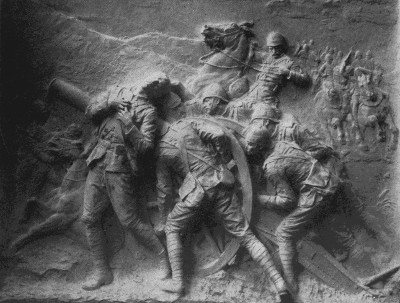
THE STRATHCONA HORSE
(From the plaque on the Strathcona Monument, Dominion Square)
The defeat of the Federal Government ended the lengthy premiership of Sir Wilfrid Laurier, one of the Empire’s great statesmen. Sir Wilfrid has many associations with Montreal and many of his triumphs, national as well as political, have taken place in the city. The new government in 1911 introduced a bill into Parliament giving a contribution of $35,000,000 to the British admiralty to represent Canada’s naval contribution to the Empire. The bill passed the Commons but failed in the Senate. It was in connection with this naval contribution that the late Hon. F.D. Monk, the member for the Jacques Cartier division of the city, and one of Montreal’s brightest and most upright minds, resigned from the government, his reason being that a plebiscite of the people should have been made on the naval question. His death following hard upon his departure from politics made the latter the more deplored.
Of importance to the Port of Montreal is the West Indian commercial agreement made in 1913 between Canada and the British West Indies. By this reciprocal pact Canada secured a new market on advantageous terms, and the principal factor in bringing it about was the Canadian West Indian League with its headquarters in Montreal.
As in Federal politics, so also in the life of the Provincial parliament, Montreal has also been a large factor, the principal reason being that it supplies the biggest share of the income of the Province, and also because the city’s representatives have usually been leaders of thought and probity. Practically all the premiers, from confederation to the present holder of the office, have been either citizens of Montreal or largely connected with the city. In the first legislative assembly of 1867 Montreal had four members; they being Sir George E. Cartier, Edward Cartier, his brother, and law partner, and who Sir George always said was the legal brains of the firm; A.W. Ogilvie, a prominent member of one of Montreal’s best known families; and the Hon. Louis Beaubien, who became Commissioner of Agriculture in the de Boucherville and Flinn administrations. Since that time Montreal has been represented at Quebec by such men as the Hon. L.O. Taillon (1875-1887) who became Premier in 1887, and afterwards joined the Federal government as Postmaster General; to-day he is Postmaster of Montreal; Hon. James McShane (1878-1891), who became in turn Provincial Minister of Public Works, Mayor of Montreal and Harbour Master of the Port; Hon. L.O. David (1886-1890), now Senator of Canada and City Clerk of Montreal; Dr. G. A. Lacombe (1897-1908), the author of the famous Lacombe Law of 1906, by which a debtor upon being too hard pressed by his creditors could come under the protection of the courts without any extra cost to himself; Sir Lomer Gouin, the present Premier, who first entered the legislature as member for St. James in 1897; Henri Bourassa (1908-1909); D.J. Decarie (1897-1904), and his son, the Hon. Jérémie Decarie, Provincial Secretary, who succeeded his father in the latter year; Hon. Dr. J.J.E. Guerin (1895-1904), Cabinet minister and Mayor of Montreal; Robert Bickerdike (1897-1900), the present federal member for St. Lawrence division of the city; the Hon. H.B. Rainville and the two George Washington Stephens—father and son—the one representing Montreal Centre from 1881 to 1886 and the other the St. Lawrence division, 1904 to 1908, being afterwards Chairman of the Harbour Commission.
The work of the Provincial legislature being largely of a constructive nature, such as the raising of taxes for the building of roads and the conserving of its vast resources, its principal effect on the city of Montreal itself is the oversight of the legislative work of the city council, and if acceptable to make it legal by passing it in the form of amendments to the city charter. In this respect a very important amendment to the charter was made in 1910 as a result of the report of the Cannon inquiry, which condemned the city administration of the period. Under the amendment the Council is cut in half by each ward having one instead of two representatives, and its work is of a legislative nature only, leaving the administration subject to the ratification of the council, in the hands of a board of control composed of four members, who with the mayor is elected by the city as a whole.
For a long time there has been a strong feeling that Montreal should have more freedom and a large measure of Home Rule in its local affairs, some even going so far as to urge that the island of Montreal should be a separate Province. At present, there is certainly a groping toward some such autonomy.
MONTREAL REPRESENTATIVES IN THE SENATE OF CANADA FROM CONFEDERATION
The Honourable:
Jacques Bureau
Louis Renaud
John Hamilton
James Ferrier
Thomas Ryan
F.X.A. Trudel
E.G. Penny
Hector Fabre
J.R. Thibaudeau
A.W. Ogilvie
A. Lacoste
L.A. Senecal
Sir J.J.C. Abbott
J.B. Rolland
Sir George A. Drummond
C.S. Rodier
E. Murphy
A. Desjardins
James O’Brien
J.C. Villeneuve
William Owens
Sir W.H. Hingston
L.J. Forget
A.A. Thibaudeau
Raoul Dandurand
J.P.B. Casgrain
Robert McKay
Frédéric L. Beique
Laurent O. David
Henry J. Cloran
Arthur Boyer
Joseph Marcellin Wilson
MEMBERS OF THE FEDERAL PARLIAMENT FOR MONTREAL SINCE CONFEDERATION
Date of Election. District. Member.
1867 MontrealCity
West Hon. T. D’Arcy McGee
Centre T. Workman
East Hon. G.E. Cartier
1868,April 30th West M.P. Ryan, vice Hon. T.D. McGee, deceased.
1872 MontrealCity
West Hon. J. Young
Centre M.P. Ryan
East L.A. Jetté
1874 MontrealCity
West F. McKenzie
Centre M.P. Ryan
East L.A. Jetté
1874,December MontrealCity F. McKenzie (re-elected, former election being voided)
1875 MontrealCity
West T. Workman, vice McKenzie (election voided)
1875,January 12th MontrealCity
Centre B. Devlin (elected vice Ryan, election voided)
November 26th B. Devlin (re-elected, former election declared void)
1878,November 21st MontrealCity
West M.H. Gault
Centre M.P. Ryan
East C.J. Coursol
1882 MontrealCity
West M.H. Gault
Centre J.J. Curran
East C.J. Coursol
1887 MontrealCity
West Sir Donald A. Smith
Centre J.J. Curran
East C.J. Coursol
1888 MontrealCity
East A.T. Lepine, vice Coursol (deceased)
1891 MontrealCity
West Sir Donald A. Smith, K.C.M.G.
Centre J.J. Curran
East A.T. Lepine
1892 MontrealCity
Centre J.J. Curran (re-elected on accepting office)
1895 MontrealCity
Centre James McShane
J.J. Curran (appt. Judge)
1896 Montreal(St. Anne) M.J.F. Quinn
(St. Antoine) T.G. Roddick
(St. James) William Demarais
(St. Lawrence) E.G. Penny
(St. Mary) Hercule Dupré
1900 Montreal(St. Anne) Daniel Gallery
(St. Antoine) T.G. Roddick
(St. James) William Demarais
(St. Lawrence) Robert Bickerdike
(St. Mary) Hon. J.J. Tarte
1902,June Montreal(St. James) Joseph Brunet (vice Demarais)
(St. James) Brunet (unseated Dec., 1902)
1904 Montreal(St. James) H. Gervais
1904 Montreal(St. Anne) D. Gallery
(St. Antoine) H.B. Ames
(St. James) H. Gervais
(St. Lawrence) R. Bickerdike
(St. Mary) C. Piché
1906 Montreal(St. Anne) C.J. Walsh
(St. Mary) Médéric Martin
1908 Montreal(St. Anne) C.J. Doherty
(St. Antoine) H.B. Ames
(St. James) H. Gervais
(St. Lawrence) R. Bickerdike
(St. Mary) M. Martin
1911 Montreal(St. Anne) Hon. C.J. Doherty
(St. Antoine) H.B. Ames
(St. James) L.A. Lapointe
(St. Lawrence) R. Bickerdike
(St. Mary) M. Martin
MEMBERS OF THE LEGISLATIVE ASSEMBLY FOR MONTREAL FROM THE CONFEDERATION, 1867, TO THE PRESENT
(From 1867 to 1890)
Date.District.Name.
1867-1871Montreal CentreEdward Cartier
1871-1874Montreal CentreThe Hon. Luther H. Holton
1874-1875Montreal CentreCharles Alexander
1875-1878Montreal CentreAlexander Walker Ogilvie
1878-1881Montreal CentreHoratio Admiral Nelson
1881-1886Montreal CentreGeorge Washington Stephens
1886-1890Montreal CentreJames McShane
1867-1871Montreal EastSir George Etienne Cartier
1871-1875Montreal EastFerdinand David
1875-1886Montreal EastLouis Olivier Taillon
1886-1890Montreal EastLaurent Olivier David
1867-1871Montreal WestAlexander Walker Ogilvie
1871-1873Montreal WestFrancis Cassidy
1873-1878Montreal WestJohn Wait McGauvran
1878-1886Montreal WestJames McShane
1886-1890Montreal WestJohn Smythe Hall
1867-1886HochelagaLouis Beaubien
1886-1887HochelagaJoseph Octave Villeneuve
1888-1890HochelagaChas. Laplante dit Champagne
(From 1890 to 1912)
1890-1891Montreal Division No. 1Joseph Béland
1892-1897Montreal Division No. 1Francois Martineau
1897-1908Montreal Division No. 1George Albini Lacombe
1908-1912Montreal Division No. 1Napoleon Séguin
1890-1891Montreal Division No. 2Joseph Brunet
1892-1897Montreal Division No. 2Olivier Maurice Augé
1897-1908Montreal Division No. 2Lomer Gouin
1908-1909Montreal Division No. 2Henri Bourassa
1909-1912Montreal Division No. 2Clément Robillard
1890-1891Montreal Division No. 3Henri Benjamin Rainville
1892-1897Montreal Division No. 3Damase Parizeau
1897-1904Montreal Division No. 3Henri Benjamin Rainville
1904-1912Montreal Division No. 3Godfroi Langlois
1890-1891Montreal Division No. 4William Clendenning
1892-1896Montreal Division No. 4Alexander Webb Morris
1896-1900Montreal Division No. 4Albert William Atwater
1900-1904Montreal Division No. 4James Cochrane
1904-1908Montreal Division No. 4G.W. Stephens
1908-1912Montreal Division No. 4John T. Finnie
1890-1897Montreal Division No. 5John Smythe Hall
1897-1900Montreal Division No. 5Robert Bickerdike
1900-1904Montreal Division No. 5Matthew Hutchison
1904-1906Montreal Division No. 5Christopher B. Carter
1907-1912Montreal Division No. 5Ernest C. Gault
1890-1891Montreal Division No. 6The Hon. James McShane
1892-1895Montreal Division No. 6Patrick Kennedy
1895-1904Montreal Division No. 6James John Edmund Guerin
1904-1908Montreal Division No. 6Michael James Walsh
1908-(election set aside)Montreal Division No. 6Denis Tansey
1908-1912Montreal Division No. 6Michael James Walsh
1890-1896HochelagaJoseph Octave Villeneuve
1897-1904HochelagaDaniel Jerome Décarie
1904-1912HochelagaJérémie Décarie
(from 1912)
1908Jacques CartierPhilémon Cousineau
1908LavalJoseph Wenceslas Lévesque
1912MaisonneuveThe Hon. Jérémie Décarie
1912Montreal DorionGeorges Mayrand
1912Montreal HochelagaSéverin Létourneau
1912Montreal LaurierNapoléon Turcot
1912Montreal Ste. AnneDenis Tansey
1912Montreal St. GeorgeC. Ernest Gault
1912Montreal St. JamesClément Robillard
1912Montreal St. LawrenceJohn T. Finnie
1912Montreal St. LouisJ.E. Godfroi Langlois
1912Montreal St. MaryNapoléon Séguin
1912WestmountCharles Allan Smart
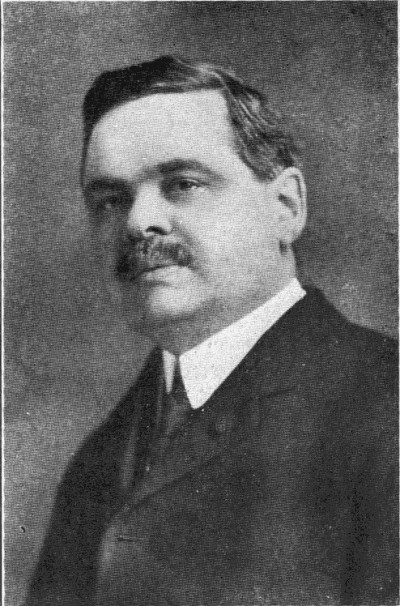
HON. LOMER GOUIN, K.C.
Prime Minister of Province of Quebec
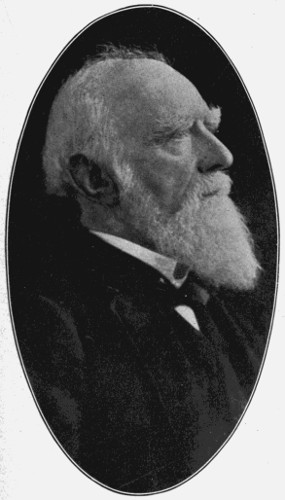
LORD STRATHCONA AND MOUNT ROYAL
A High Commissioner for Canada
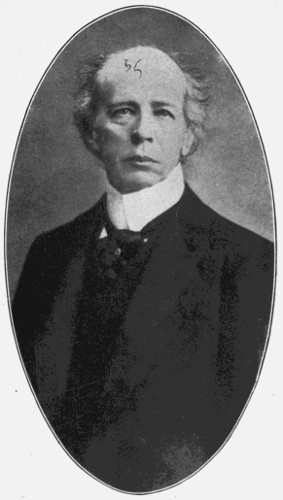
SIR WILFRID LAURIER
A Prime Minister of Canada
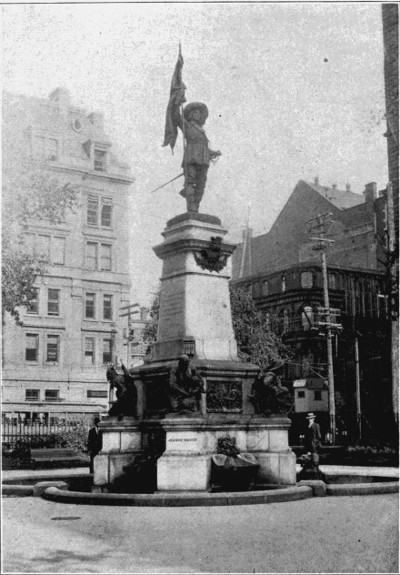
MONTREAL FOUNDED 1642
In 1905 this monument, by Philippe Hébert, was erected to the memory of the first Governor of Montreal, Paul de Chomedey, Sieur de Maisonneuve, and commemorates, with its bas reliefs and supplementary statuary, several of the principal personages and dramatic incidents in the early days of the settlement.
FOOTNOTES: