Part 2 — CHAPTER XXXIV
Reading edition
SOCIOLOGICAL MOVEMENTS
I
CARE OF THE AGED, FOUNDLINGS AND INFANTS
GREY NUNS—PROTESTANT ORPHAN ASYLUM—SISTERS OF PROVIDENCE—THE CHOLERA EPIDEMIC OF 1832—L’ASILE DE MONTREAL—MONTREAL LADIES BENEVOLENT SOCIETY—THE SHIP FEVER OF 1847—ST. PATRICK’S ORPHANAGE—HERVEY INSTITUTE—PROTESTANT INFANTS’ HOME—PROTESTANT INDUSTRIAL ROOMS—MONTREAL DAY NURSERY—L’ASSISTANCE PUBLIQUE—OTHER INSTITUTIONS.
A city’s life is not fully told unless the record of its charitable, philanthropic and sociological progress is at least indicated. That of Montreal will be found to be full, inspiring and satisfactory. The following record is a study of movements and origins rather. It is not a directory. Nor is it in any way meant to be a comparative appreciation of the work done by the various societies or institutions mentioned. Its scope is historical. Innumerable obstacles stand in the way of the preparation of such a chapter as that now offered, but it should nevertheless be attempted if only to gather together as many as possible of the early links of the many excellent social works of the city and to bind them to those larger ones which have been forged by the present day busy workers who in their active present are working busily and wholeheartedly for the growing needs of the hour and have not, through one cause or another, the historical means of surveying the early humble beginnings of works with which they or others have linked their names and their self-sacrificing endeavours.
The first pioneer social movements of Montreal under British rule were those embracing the care of the aged and that of foundlings and abandoned children. These were found together under one roof but in different departments in the Hôpital Général of the “Grey Nuns” or the “Sisters of Charity” according to their official title. At the time of the capitulation the above, with the Hôtel Dieu, founded on May 17, 1642, since the early days of the colony, sufficed for the charitable needs of the small community; for although the “Congregation” established in 1657 by Marguerite Bourgeoys, had cared for many orphans and thus in some sense might be said to have been the forerunner of the modern orphanages of the city and had shared in other social experiments, its work must be considered to have become specifically educational. Again although the Hôtel Dieu also still maintained, as it did until recent years, a number of aged persons and orphans, its special function had been mostly exercised as a hospital for the sick. Its history having been already told, that of the Grey Nunnery is now in place as the peculiar pioneering institution for the aged, orphans and general charity under British rule.
THE GREY NUNS
On taking possession of the Hôpital Général from the Charron Frères, in 1747, Madame d’Youville and her companions devoted themselves to works of charity of every kind, receiving into the institution all classes of unfortunates without distinction of age or sex, never refusing any. During several years the Sisters cared for fallen women and had rooms for twelve. In 1756 a ward was opened to receive English soldiers, sick and wounded, who had been taken prisoners at Oswego under Shirley and Pepperel and others during the “Seven Years’ War” before the capitulation of Montreal. On September 7, 1760, the hospital being mistaken by the English as an outwork of defence, was about to be reduced by the cannon when a soldier ran to the general and on his knees implored him to save the hospital where he and his companions had been tended in the “Salle des Anglais.” The result was that the officers went in and were hospitably received by Madame d’Youville with biscuits and wine.
After the capitulation the hospital, as well as those of other communities in the town, suffered by the depreciation of paper money, receiving a very small percentage of its worth from the French government, thereby losing more than a hundred thousand francs.
The work of caring for abandoned children began on November 16, 1754, but was not developed till shortly after the conquest in 1760, when Madame d’Youville one day found the body of a little child frozen in the ice with the dagger still in its throat and its little hands raised as in supplication for justice. This incident with others caused her to develop this work which was then first undertaken systematically on this continent. Funds, however, were wanting. Under the old régime certain moneys had been appropriated for “enfants trouvés,” foundlings. The new military government, approached by Madame d’Youville and the Rev. M. Montgolfier, the brother of the inventor of the balloon, and the superior of the Seminary, could only procure a sum of 288 francs. On September 13, 1771, Madame d’Youville approached the sympathetic Governor Carleton, but with no good results. Yet, in spite of the extreme poverty of the sisterhood the work continued, supported by their needlework. Another contributing cause for their poverty was the loss of their hospital in the great fire of May 18, 1765, which devastated the lower part of the town. This was more disastrous to them than the fire of 1745, for it reduced their home to ashes. The children and the aged poor were about to be transferred to the barns of the farm belonging to the Grey Nuns at Point St. Charles when M. Montgolfier came with an invitation from the nuns of the Hôtel Dieu offering their hospitality. As, however, the number was too considerable, the nuns of the “Congregation” shared the problem of housing them. Not losing heart, Madame d’Youville dared, on the 9th of June following, to begin rebuilding, relying on the sum of 6,000 francs contributed by the Montreal faithful and the Indians of the settlements of Caughnawaga and the Lake of Two Mountains.
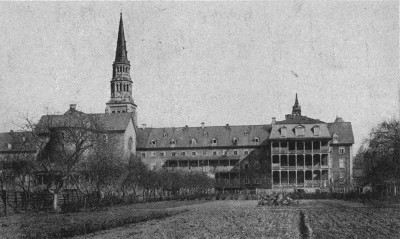
THE GREY NUNNERY OF TODAY
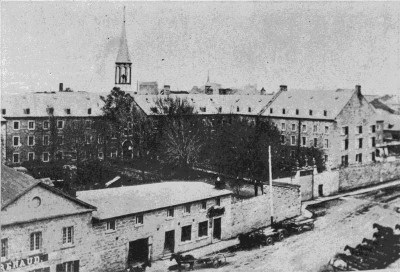
THE OLD “GREY” NUNNERY
As it looked from McGill Street in the late ’60s before the new building was erected on Dorchester Street. This site was that of the original General Hospital, founded by M. Charron in 1692, and transferred to Madame D’Youville in 1747. A portion of these buildings still remains in 1912, being employed as warehouses. The new Custom House is to be built on this spot.
But the Seminary came to her aid with a loan of 15,000 francs. By order of M. Montgolfier the workmen laboured constantly, even on Sundays, so that by September 23d the part for the aged men was ready. The Sisters entered their convent on December 5th and the poor women on Christmas Day. The rest of the buildings were not finished till 1767, the church being blessed on August 30th. Though housed, money was very scarce; yet Madame d’Youville had dared even nineteen days after the fire of 1765 to complete a contract already arranged since August 25, 1764, for the acquistion of the seigneury of Chateauguay, originally accorded in 1673 by Frontenac to M. Lemoyne of Longueuil, and then belonging to the family of Robutel de Lanouë. The development of this farm, which scarcely gave any revenue, was the object of the zealous solicitude of Madame d’Youville and now is the sanitarium and country house of the Grey Nuns for their different foundations. The property of Point St. Charles was afterward built upon for a country house for the children and the aged poor. It was burnt down in 1842 but re-erected in the following year. The death of this “mulier fortis” occurred at 8:30 P.M. on December 23, 1771, at the age of seventy years after a life full of fatigues, privations and sacrifices. The work undertaken by her devoted followers has spread from Montreal far and wide. On October 7, 1871, the Mother House was removed from its oldtime position “down town” to the block bounded by Guy Street, St. Catherine Street, Fort Street and Dorchester Street. The old buildings were converted by merchants into warehouses, part of which are still standing. The new custom house, being erected in 1914, marks the site of the southwest corner of their estate.
The following resumé of the work of the Grey Nuns is interesting:
In 1801, at the request of the government officials, the insane were admitted and a special annex built. Previous to this, the sisters had already received twenty-three such patients and until this work was discontinued in 1839, the number received was 114.
In 1823, the community undertook the care of Irish orphan girls.
In 1846, at the request of the priests of the Seminary, a “dispensary” for the poor was opened and a system of house to house visitation was established.
In 1847, the sisters nursed the poor Irish immigrants stricken with typhus fever.
In the same year a temporary “home” was opened for the women left without resources after this terrible plague epidemic.
In 1849, at the request of the mayor of Montreal, the sisters undertook the nursing of the cholera victims in the “sheds” constructed for the typhus patients.
In 1851, St. Patrick’s Orphan Asylum was opened and the Grey Nuns took charge.
In 1858, the first “kindergarten” conducted by the Grey Nuns in Montreal was founded on Bonaventure Street by the Rev. Father Rousselot, a Sulpician. It was known as Salle d’ Asile St. Joseph, but was ultimately closed, because its proximity to the railroad made it dangerous for the small children who came there to school.
In 1861, the Nazareth Asylum for the Blind on St. Catherine Street was opened.
In 1885, during an epidemic of small pox, forty Grey Nuns devoted themselves to the care of the victims in their homes and in the hospitals.
Since the days of their foundress, the Sisters each year have provided for a certain number of poor students who board in the establishment.
In the Mother House, on Guy Street, at present, the Grey Nuns care for foundlings, orphan boys and girls, poor and aged men and women, besides having an industrial school for young girls.
THE FOUNDLINGS
The number of foundlings received annually is between four hundred and fifty and five hundred. Since the founding, 37,168 infants have been admitted.
The number of children averages between one hundred and one hundred and twenty. There are at present in the nursery 126. The children who survive, when not kept in the nursery, are either placed out to board or adopted by good families. In 1911, fifty-five were adopted.
When about three years of age, the little children leave the nursery and are placed with the orphans. These foundlings come from all directions and belong to all nationalities.
A course of lectures has been opened at the nursery for the training of children’s maids.
THE ORPHANS
There are in the Grey Nunnery 300 orphans, of which 170 are boys from three years to twelve years of age, and 130 girls from three years to eighteen or twenty years of age.
Since 1748, when the first orphan girl was received, there have been admitted 5,788 orphans, 2,875 boys and 2,913 girls.
From 1823 to 1873, these children were almost exclusively of Irish origin. Since the latter date, the majority are from Montreal, though some few are from the suburbs. Almost all are French-Canadians, there being a few English speaking children and some Indians. The greater number are received gratuitiously, very few being able to pay their board.
At the age of twelve, the boys who are not claimed by relatives, are placed at the orphanages of Montfort or of St. Arsène, or adopted by respectable families.
The girls on leaving the orphanage enter the industrial school, where they are taught domestic economy.
Those who have relatives wishing to claim them can leave. The others are adopted by good families or placed out to earn their living.
THE INDUSTRIAL SCHOOL
The industrial school was opened in 1908. Since then 297 pupils have been received, 270 of these being Canadians, 19 English and 8 Indians. There are at present 60 pupils in this department.
These young girls are employed in the different departments and work rooms of the house.
In the sewing room they are taught sewing and mending as well as knitting, embroidery, etc. In the kitchen, laundry, book bindery, printing office and pharmacy, they are trained to become useful members of society.
Several hours are also spent each day in the schoolroom.
THE AGED AND INFIRM
There are 195 aged poor and infirm at present at the Mother House, 95 men and 100 women.
Since the founding of the institution in 1747, 6,250 aged poor and infirm have been received, of whom 2,952 were men and 3,298 women.
These comprise cripples of all kinds, and persons afflicted with epilepsy or cancer. The number of the latter cases has considerably diminished since the opening of the Hospital for Incurables in Montreal.
Until 1910 the only grant from the provincial or municipal authorities was $105.00, but the provincial government now grants for the different works of charity an annual appropriation of $2,905.00, in which is included the $105.00 for the nursery, the expenses of which amount to $25,000.00 annually.
In 1910 and in 1911, the City of Montreal allowed $1,000.00 to the institution. In 1912, this allowance was increased to $1,200.00. The balance of $98,550.00, which is the amount of the annual expense for the support of the 660 inmates, must be provided by the community. The average cost per capita is 41 cents a day.
Although there is no dispensary at the Grey Nunnery for outside poor, these are continually assisted in many ways. Thus in 1911, 1,200 meals were given, and 300 persons were assisted materially.
Besides the Mother House, the Grey Nuns have in Montreal:
Three hospitals with training-schools: Notre Dame Hospital, St. Paul’s Hospital, and the Ophthalmic Institute.
Four kindergartens: Nazareth, Bethlehem, St. Henry’s, and Ste. Cunegonde’s.
Five orphanages: St. Patrick’s, St. Henry’s, Ste. Cunegonde’s, Bethlehem, and St. Louis’.
One institution for the education of blind pupils.
Two homes for working girls: “Youville” and “Killarney.”
Three homes for the aged poor: St. Bridget’s, Ste. Cunégonde’s, and St. Anthony’s.
One industrial school: St. Joseph’s.
In Canada, outside the City of Montreal they have:
One school at Côte-des-Neiges, one at Chateauguay, and one at St. Benoit, with a home for infirm and aged women.
Four homes: in Varennes, Beauharnois, Chambly and Longueuil, for aged and infirm women and orphans. A few lady boarders are received in these homes to help support the works of charity. The sisters visit the sick.
One hospital at St. John’s, with a home for old men and women; also, a kindergarten.
In Western Canada, the Grey Nuns direct twenty-five establishments, and in the United States, fourteen.
THE PROTESTANT ORPHAN ASYLUM
The next movement for orphan children was on the part of the English ladies who formed before 1822 a Female Benevolent Society. This was followed by the “Protestant Orphan Asylum,” the connecting link being provided as follows by the following extract from the original minutes.1
“Upon the dissolution of the Female Benevolent Society in February, 1822, the officers and members of that institution consigned their orphan proteges and their flourishing little school to the care and maintenance of the Protestant churches of the city. The rector of the English Episcopal and the ministers of two Presbyterian churches accepted the charge.”
Founded therefore in 1822, without endowment the Protestant Orphan Asylum trusted entirely to the generosity of interested friends. The clergy of the city undertook to preach charity sermons for its benefit, and a substantial sum was thus raised. The constitution of the new charity was framed by the Rev. John Bethune, D.D., Dean of Montreal, and the Rev. Henry Esson, D.D., Pastor of St. Gabriel’s Presbyterian Church.
The first building occupied as an asylum (in 1833) was situated in St. Louis Street. The expenditure in this year was £211 10s 4d. In 1838 removal was made to more commodious premises in St. Antoine Street, the expenditure that year being £248 4s 5d.
In 1848 the annual reports were first published, and in the spring of the same year the foundations of a new home were laid, on land generously donated by Judge Smith on St. Catherine Street where Holland’s store now stands. This was sufficiently finished to permit the taking possession thereof June 4, 1849. The present building at 93 Côte des Neiges Road, was completed and occupied 1895.
It is interesting to compare the small beginnings of the earlier years with present conditions. For instance, in 1833, as previously stated, there was no endowment, and the expenditure for the year was £211 10s 4d, about $846. In 1911 the market value of its endowment fund amounted to $178,962, yielding a revenue of $9,143.50, and this with the annual subscriptions provided for the year, $10,109.80.
In the annual report for the year 1859 attention is called to the remarkable sanitary fact that out of upwards of six hundred children received into the home since its foundation, only forty-seven had died, notwithstanding the epidemic of cholera and typhus fever, at different times prevalent. And it may be added that this record has been maintained, and even surpassed, in the years that have followed.
THE MONTREAL LADIES’ BENEVOLENT SOCIETY
On the occasion of the epidemic of cholera in 1832 there arose a corresponding effort among the English Protestant ladies. The Montreal Ladies’ Benevolent Society was then founded “for the purpose of affording relief and support to destitute women and children” and the work which its founders inaugurated eighty-two years ago has been carried on ever since. The Society was incorporated in 1841.
The list of its presidents previous to 1849 was destroyed by fire. Since 1849 the following ladies have served it as president:
1849—Mrs. Renaud.
1850—Mrs. Davidson.
1853—Mrs. Tulford.
1855—Mrs. Geddes.
1873—Mrs. Mackenzie.
1875—Mrs. Molson.
1876—Mrs. Vanneck.
1877—Mrs. Wheeler.
1882—Lady Galt.
1883—Mrs. Cramp.
1889—Mrs. Edwyn Evans.
1890—Mrs. Cramp.
1896—Mrs. John G. Savage.
1907—Mrs. Lachlan Gibb.
1910—Mrs. Alister Mitchell.
Honorary President—Countess Grey.
Many names prominent in social and philanthropic work in Montreal during that period are to be found on the roll of its past and present committees.
The original building still stands with the added wings on Ontario, formerly Berthelet, Street.
There are seven old women and ninety-eight children in the home—fifty-two boys and forty-six girls between the ages of six and fourteen years. Every effort is made to start these children suitably in life. But unfortunately, when they reach a wage-earning age, they are frequently taken away by their parents or nearest relatives, who up to this period have, more often than not, ignored their existence—whereas if the children were only left long enough in the home, they could receive special and individual instruction and better positions could be found for them.
Fifty-five destitute children and children of delinquent parents have for many years been sent in through the city for whom the city pays $7 per month for girls and $8 per month for boys. The cost of each child averages $13.75 per month.
THE SISTERS OF PROVIDENCE
The succeeding movement in the charity for the aged, orphans and the poor was that started in 1828 by another Montreal lady, Madame Gamelin, who founded the “Sisters of Providence,” a religious congregation, in 1843, the Asile de la Providence having been incorporated on September 11, 1841, and being erected canonically in 1844.
By 1905 the congregation had spread over eighteen dioceses and had seventy-seven houses. In 1913 it had ninety-seven houses. Its foundress, Marie Emmeline Eugene Tavernier, was born on February 19, 1800. On June 4, 1823, she was married to Jean Baptiste Gamelin, a man of fifty, described in the marrage register as a “burgher,” the appellation then given to a proprietor living on his income. Three children were born of the union. Two died three months after birth. In 1827 Mr. Gamelin died and the following year the third child also. The widow’s heart now turned to the aged and poor. On March 4, 1828, she opened a modest refuge on the ground floor of a small parochial school, directed by the Sisters of the Congregation of Notre Dame, situated on the corner of St. Lawrence and St. Catherine streets. The first beneficiary was a widow named St. Onge, 102 years old. The refuge was shortly removed to two houses rented on St. Philippe Street with her charges, which soon reached the number of thirty, not always over-grateful.
About this time Madame Gamelin formed a society of lady auxiliaries, Mesdames François Tavernier, E.R. Fabre, Maurice Nolan, Augustine Tullock, R. St. Jean, Paul Joseph LaCroix, Joseph Gauvin, Simon Dalorme and Julien Tavernier. This society, founded on December 13, 1827, and organized on December 18th of the same year, still exists as the “Society of the Ladies of Charity.” Each of these agreed to pay a monthly board for one poor woman. During the cholera outbreak of 1832-1834 Madame Gamelin did not spare herself in visiting the sick. The “yellow” house was secured for the growing needs of the refuge by M. Olivier Berthelet, whose name is linked with Montreal’s charities. It was a modest frame building, two stories in height, standing on St. Catherine and Hubert streets. During the political troubles of 1837-38 there commenced the work, still pursued by her followers, of visiting the Montreal jails. Writing in his “Patriots of 1837-38” Mr. L.O. David, afterwards city clerk of Montreal, and a senator, said: “There are two names in particular deserving of special mention and which the prisoners have never forgotten, Madame Gamelin, who later became the foundress of the Providence, and Madame Gauvin, mother of Doctor Gauvin, who himself took part in the events of 1837.” In 1841 Madame Gamelin’s asylum obtained civil incorporation through a measure, introduced by the Hon. D. Viger and the Hon. J. Quesnel, under the name of “Corporation for Aged and Infirm Women of Montreal.”
In 1841 the work was so well founded that to secure its permanency as a constituted diocesan charity the ladies associated with it, under the beautiful name of the Ladies of Providence, determined to give it over to the Daughters of Charity of St. Vincent de Paul, then lately visited in Paris by Bishop Bourget. A new building was forthwith determined on to receive them, and for the funds for this, the first bazaar recorded in Montreal was organized, in Rasco’s Hotel on St. Paul Street, on May 15, 16, 1842, and netted 500 louis. The directresses were Mesdames Gamelin, Gauvin, St. Jean, Fabre, Levesque, Boyer, Moreau and Lafontaine. Other sums were raised and the corner stone of the house opposite the “yellow” house was blessed on May 10, 1842. About the middle of June, 1842, Bishop Bourget gave Madame Gamelin and the Ladies of Providence a rule modelled upon that which St. Vincent de Paul had drawn up for a society of ladies in Paris who had consecrated themselves to the work. The Daughters of St. Vincent de Paul did not come, after all, and Bishop Bourget determined to create a diocesan order of the Sisters of Charity of Providence. On March 25, 1843, the first clothing took place of the first six postulants in the “yellow” house, who were to obey Madame Gamelin as their superior. As yet she was not herself a religious, but on July 8th, on one of the postulant’s returning to the world, Madame Gamelin determined to take her place and she was accepted by the Bishop as one of the new order of the Sisters of Providence, one of whose early works was to carry on the work of the care of the aged and infirm already begun by Madame Gamelin in 1827. In 1860 her institute established an asylum for “abandoned” children, French Canadian and Irish, which was opened on September 25th.
The work for the insane at Longue Pointe, begun in 1849, is told elsewhere.
L’ASILE DE MONTREAL
Meanwhile the year of the cholera, 1832, had seen the birth, on July 18, of the “L’Asile de Mountréal pour les orphelins Catholiques Romains” or “Les Orphelins des Récollets,” so called because these orphans were first cared for in the convent of the Récollets. The asylum received its incorporation in September, 1841. The work was promoted by a Sulpician, the Rev. P. Phelan, and a widow, Madame Gabriel Cotté, who became its foundress and received her helpers from among the “Ladies of Charity.” Among the Ladies of Charity under whose auspices the new work was placed and still continues, were those of the best society of Montreal. The first president was Madame Marie Charles Joseph LeMoyne, Baroness de Longueuil, the wife of Captain David Alexander Grant, of the Ninety-fourth Regiment, who died on February 25, 1841. The vice presidents were Madame de Lothbinidère and Madame de Beaujeu. On the death of the Baroness de Longueuil she was succeeded as president by Madame Berthelet, Madame D.B. Viger, Madame C.S. Cherrier and Madame T. Bouthillier. Under the board of directors the asylum was conducted successively by Madame Chalifoux and Madamoiselle Morin. The present president is Madame J.O. Gravel and the vice president is Madame Rosaire Thibaudeau, niece of the esteemed foundress, Madame Cotté.
The institution has remained under lay control, although since 1889 the Grey Nuns have been invited to undertake the internal management. Madame Cotté was its first treasurer, being succeeded by her daughter, Madame Quesnel, who supported the work till her death. The foundress, Madame Cotté, endowed the work with a gift of land, that named “Pres de Ville,” on Lagauchetière Street, and with a legacy in money. Her heirs exchanged the original land for that on St. Catherine Street on which the institution stands today, a part of which was built by the legacies in money left by Madame Cotté and Madame Quesnel.
In 1913 the orphanage and grounds were sold and a spacious property bought for the new orphanage site at Notre Dame de Grâces. The new buildings have been commenced but have been interrupted by the European war of 1914.
The dire year of 1847, that of typhus fever, saw great activity among all these French and English institutions for charitable works. As the incoming immigrants were mostly Catholics the activities of the Catholic institutions of the period may naturally be recalled. The “Providence Sisters,” lately erected as a religious congregation, were called by Bishop Bourget to second the Grey Nuns, the Nuns of the Congregation and the Nuns of the Hôtel Dieu at the fever-stricken sheds at Point St. Charles. The work of caring for the 600 or more orphans of the emigrants was confided to the Sisters of Providence in the two provisory hospitals. The religious of the Good Shepherd, who had been called to Montreal in 1844, finally took charge of the girls, and Madame Gamelin’s “Providence” Sisters took the boys to Mrs. Nolan’s house on St. Catherine Street. Bishop Bourget’s pastoral letter of 1848 describing the transference of the children through the street states: “The spectacle of hundreds of children famishing with hunger, covered with rags and in danger of succumbing to the attacks of that terrible disease which had deprived them of their parents was so poignant that it can never be forgotten.” Twenty-seven of the “Providence” Sisters were stricken with the plague and three died, and similar disaster befell other charitable “Congregations” or lay associations of all sections.
On the 1st of October the orphans were removed from their temporary home in Mrs. Nolan’s house to the former convent of the Good Shepherd, situated on Beaudry Street, then Black Horse Street, the new Hospice of St. Jerome Emilianus. From the 11th of July Mother Gamelin had received 650 orphans. Of that number 332 died and 188 were placed out or adopted. In the month of March, 1848, 130 remained in addition to 99 who stayed in the sheds at Point St. Charles. An appeal at this time was made by Bishop Bourget and colleges, convents and lay people responded in adopting the children. Sixty remained with the Sisters of Providence and were distributed among the different houses or apprenticed to trades. “In adopting these poor children,” says the same pastoral, “they will become our companions in faith, good priests, fervent religious, excellent citizens,” as, indeed, they did.
THE ST. PATRICK’S ORPHANAGE
This leads up naturally to the history of the Irish Catholic charities, and of the St. Patrick’s Orphanage, in particular.
Before 1800 few Irish reached the city, yet they came early in the nineteenth century, so that by 1823 the number of orphan children of Irish parentage was such that M. Roux, the superior of the Sulpicians, arranged with the Grey Nuns2 to receive the first five of forty children in the “Salle des petites orphelines Irlandaises” which was opened February 14, 1823. Until 1886 the Sulpicians unostentatiously supported no less than 848 little Irish orphans.
In the fall of the year of “Black ’47” the Rev. M. Pinsonneault rented a house on Colborne Street of fifteen apartments, in which he lodged fifty families of those who, though destitute, had escaped the terrible ship fever. This was known as the “House.” Mrs. Brown, a good Catholic Irishwoman, undertook to teach the children and M. Pinsonneault founded a band of ladies for the purposes of organizing bazaars for the support of the struggling institution which was even vilified in the press. The “Ladies of Charity” were organized in 1849 as a permanent body to assume the upkeep of the work and to collect subscriptions.
Meanwhile during the visitation of 1847 it was rendered necessary for 650 little Irish orphans to be taken from the pest sheds of Point St. Charles and taken care of, as is told elsewhere, by the religious daughters of Mother Gamelin, the foundress of the Sisters of Providence.
On June 20, 1848, Father Dowd had arrived and, being appointed in September almoner of the poor, he became superior of the House. He quickly determined that a new asylum was needed. This was secured in a small house on Craig Street, opposite the Champ de Mars, generously loaned by M. Augustin Perreault, who added numerous other benevolent gifts and services. In October, 1849, the asylum was opened and Mrs. Brown was joined by Mrs. McMahon, better known as Mrs. “Mack.” A fire on June 9, 1850, nearly threatened the existence of the new house.
About 1850 a parishioner of St. Patrick’s church, M. Bartholomew O’Brien, bequeathed a sum of £1,000 for an orphan asylum. Father Dowd formed a building committee of Messrs. Charles T. Palgrave, Francis McDonnell, Charles Curran, P. O’Meara, P. Lawlor, J. McGovern, Patrick Brennan, Thomas O’Brien, Patrick Lynch and Mathew Ryan. The latter acted as secretary till February, 1850, when he was succeeded by Mr. Thomas Bell. A lot of ground, 100 feet by 10 in front on Dorchester Street, with 120 feet of rear, was given, in trust for the building of an Irish orphan asylum by the Fabrique of the parish of Montreal.
On November 21, 1851, the unfinished house was entered by the orphans, two or three planks laid against the principal entrance being the only door. The formal blessing of the building by the bishop took place on February 2, 1852. In this same year the treasurer, Mr. T.C. Palgrave, received a grant of £500 from the provincial parliament. The act of incorporation received the royal assent on May 30, 1855. In 1859 Father Dowd resigned his directorship, leaving a balance to the poor of $157.39. He was succeeded by the Rev. Michael O’Brien, who afterwards became the first superior of St. Ann’s church. In 1861 Mr. Edward Murphy, afterwards senator, joined the board of trustees, becoming secretary in the place of Mr. Bell.
His Excellency, Viscount Monck, governor-general, visited the orphan asylum on July 3, 1862, when an address was read by Mr. Thomas Ryan, afterwards senator. On the death of Mr. Bell, in 1864, Mr. John Fitzpatrick became a trustee. Dying in the same year, he made the orphanage his residuary legatee.
Through the efforts of the indefatigable Father O’Brien there was acquired the property on Lagauchetière Street, where the St. Bridget’s Refuge was afterwards built, the act of the transference by the corporation of the asylum to the refuge by resolution being dated June 24, 1866. In 1859 it was proposed to build St. Bridget’s church for the Irish in the Quebec suburbs and money was collected, but, as the bishop could not be prevailed upon to permit its creation, at a meeting of subscribers held on March 9, 1867, it was resolved unanimously on the motion of Mr. B. Devlin, and seconded by Mr. M.P. Ryan, that the money collected (about $8,000) by Fathers O’Brien and O’Farrell (afterwards bishop of Trenton) be appropriated as follows: “one-half to the Montreal St. Patrick’s Orphan Asylum and the other half to the Rev. Father O’Farrell and his successors for Irish Catholic charities in the St. Ann’s suburbs, the whole to be invested by them in stock in the new St. Patrick’s Hall, now in course of erection.”
The history of the ill-starred St. Patrick’s Hall, a magnificent structure, a credit to the Irish people of the city, tells of two disasters, in the last of which it perished by fire. The association determined to wind up its affairs, which resulted in the stockholders receiving 55% for their investment, the asylum being, therefore, a considerable loser.
On the death of the Rev. Michael O’Brien in 1870 Father Dowd was again appointed director by the bishop. In 1877 there was terminated a long dispute which was settled in the ecclesiastical court, resulting in the non-divergence of the funds, originally collected for St. Bridget’s church and given with the consent of the subscribers, half to the orphan asylum and half to the Fabrique of St. Marys, who claimed the original gift for the St. Bridget’s church, when permission to build this had been at last granted by the bishop in 1873. The case for the asylum in civil law was entrusted by the trustees to Mr. J.J. Curran, Q.C., M.P., afterwards the Hon. Justice Curran, his view in favour of the asylum being endorsed by Mr. Lacoste, Q.C., afterwards Sir Alexander Lacoste, chief justice, K.B.
In January, 1873, Lord Dufferin, the distinguished Irish governor general, visited the asylum. On January 30, 1874, Sister Forbes, who since 1853 had succeeded Sister Reed as superioress of the asylum, celebrated her “golden wedding” as a nun. Mother Forbes died three years later, on March 28, 1877, after her twenty-third year in the superiority of the asylum, to the great grief of the Irish population.
The last of the original trustees died on May 26, 1889, the Hon. Thomas Ryan, senator for the Victoria division of the province. On the 26th of December, 1889, the following gentlemen were trustees, Edward Murphy, J.S. Mullin, W.H. Hingston, Owen McGarvey, James O’Brien, John B. Murphy, Patrick Kennedy, Hon. Judge Doherty, James McCready, J.J. Curran, Q.C., M.P. In December, 1891, Father Dowd died. He was held in greatest respect by all denominations in the city. The flag on the city hall was placed at half mast and the funeral was a public demonstration. He was succeeded by Father Quinlivan, who had assisted him for some time before his death. In 1892 the Hon. Senator Murphy died. His name deserves to be remembered among the great philanthropists of the city. His memory is perpetuated in the “Edward Murphy School” and the Edward Murphy medal given by the Catholic School Commissioners. In 1902 the trustees of the orphanage were Hon. Sir William Hingston, Hon. Marcus Doherty, Hon. J.J. Curran, J.S.C., Mr. Michael Burke, Mr. Patrick Mullin, Hon. James O’Brien, Mr. J.C. Collins, Mr. C.A. McDonnell and Mr. P. McCrory.
In 1909 the orphanage, being declared unsafe, was removed to the new asylum built under the direction of Mr. W.E. Doran, architect, of gray stone, fireproof and three stories in height, on St. Catherine Road, Outremont. The estate is a valuable farm of forty-five acres, with its own orchards and vegetable gardens. Its internal direction is still under the Grey Nuns. Its trustees at the time of the change were the Rev. Gerald McShane, pastor of St. Patrick’s church, the Hon. C.J. Doherty, Messrs. M. Burke, P. Mullin, C.F. Smith, C.A. McDonnell, P. McCrory, J.A. Macdonald, M.D., who has also given his services free for thirty years, and Donald Hingston, M.D. At present Messrs. A.J. Trihey, H.J. McKeon, T.W. McNulty, W.J. Rafferty, have joined the board since the deaths of Messrs. M. Burke, C.F. Smith, C.A. McDonnell and P. Mullin.
The names of Dr. H. Schmidt, Dr. Henry Howard, Dr. J.A. Macdonald, Dr. Thomas J. Curran, should be remembered in connection with the medical care of the orphans.
The great burden of sustaining the funds of the institution fell during many years on the “Ladies of Charity.” The first annual bazaar was held in 1849 under their auspices. The first president was Mrs. Charles Wilson, the wife of the Hon. Charles Wilson, mayor of the city. In 1850 she was succeeded by Madame Vallières de St. Réal, the wife of the well known judge. This Irish lady remained president till 1861. Mrs. O’Meara succeeded but died in 1862, when Madame Vallières was recalled till 1866, when she was made honorary life president. Mrs. M.P. Ryan became president till 1882, when with Mrs. Campion she became honorary life president. Mrs. Brennan took office in 1882, and Mrs. Edward Murphy in 1883, remaining till 1900. In 1900 the following ladies were installed in office: Mrs. M.P. Ryan, Mrs. Campion and Mrs. E. Murphy, honorary life presidents; Mrs. E.C. Monk, president; Mrs. E.C. Amos, vice president; Mrs. D. Boud, second vice president; Mrs. Loye, third vice president; Mrs. Whitney, secretary. Of late years this organization has not been called upon for the same active services for the orphanage, but their members individually have been foremost in other growing English-speaking Catholic charities.
THE HERVEY INSTITUTE
Among non-Catholic charitable works called forth at the time of the ship fever was the Hervey Institute, founded in 1847.
Its first home was on St. Antoine Street; two small houses followed. Then the Home found itself at 215 Mountain Street, in 1875. The new Home, opened by their Excellencies, Earl and Countess Grey, on December 16, 1908, is situated at the corner of Windsor and Claremont avenues, Westmount.
Like most similar organizations the Hervey Institute rose from humble beginnings, little idea being in the minds of the group of ladies who began the work of the magnitude of the scale of future undertakings. It now has accommodation for eighty-five persons.
Miss Hervey, for whom the Home is named, was born in 1807 and came to this city from Scotland in 1846. The following year she started the home in a small way, calling it an industrial home. She was led to do this by the extreme need for such among the poor—for at that time there was little organized relief among the Protestants other than that given by the churches—and the mother left with her small children to support, owing to the death of the father, was in a sad plight. Miss Hervey and her associates gathered these children together, taught them to sew and also the elementary subjects of education as well as the performance of domestic duties.
Among well known names connected with the Home in those days were Mrs. John Stirling, Mrs. John Redpath, Mrs. Neil MacIntosh, Mrs. John McDougall, Mrs. Hannibal Whitney, Mrs. John Lovell—the last mentioned still showing an active interest in the Home—Mrs. (Doctor) Scott, another member of the original committee, worked unceasingly to accomplish a piece of work desired by Miss Hervey, that of a separate Home for the tiny children and young babies, as it was found impossible to continue the reception of children of all ages. Thus the Protestant Infants’ Home was established, as an offshoot in 1870, by this same untiring worker, Miss Hervey.
The following ladies have been the presidents of the institution:
1847-75Miss Hervey
1875-78Mrs. H.L. Routh
1878-81Mrs. J. Ross
1881-82Mrs. James Tasker
1882-86Mrs. J.H. Moody
1886-92Mrs. Alex Murray
1892-96Mrs. Langlois
1896-1904Mrs. G. Summer
1904Mrs. J. Henderson
The Home was incorporated in 1875 when Mrs. J. Routh was president, other signers of the charter were: Mrs. Holmes and Mrs. M.L. Clarke, the last mentioned being at present on the committee of management. The original intention of caring for, teaching, and training in domestic duties half orphan girls, has been carried on, but more than that, the special provision made for boys in the comparatively new Home on Windsor Avenue, Westmount, shows the result of many anxious thoughts directed to the problem of the growing boy without a home. Boys as well as girls are now trained for their work in the world; boys are kept until fourteen years of age, girls until sixteen.
In receiving girls and boys into the Home, the idea is to keep family life as nearly normal as possible, so the mother or father may place their children in the same home knowing they are at school and may play together.
Half-orphan children, between the ages of five and fourteen, are received, qualified teachers are in attendance, one children’s trained nurse and other nurses and over all a superintendent.
The parent pays whatever possible; all other cost of maintenance is met by the voluntary subscriptions.
A development of late years has been the purchase of a summer home at Morin Heights in the Laurentian Mountains, in healthy and beautiful surroundings. It is owing to this annex, to which the children have been sent for two months for nine years, that the directors owe the wonderful record of no annual drug account over $25.00. This for a home of seventy-five children is a record, as is the fact there have been but four deaths in the sixty-eight years in which the Home has been in operation.
Since the inception in 1847 many hundreds have passed through the Home and have made successes. The girls have become efficient nurses and teachers and the boys successful business men, while two of the more recent inmates are doing their duty by their King and Country in the Canadian overseas contingent.
THE PROTESTANT INFANTS’ HOME
As mentioned, it was through the energy of Miss Hervey and Miss Scott that the Protestant Infants’ Home was established on April 30, 1870, the by-laws being adopted on that date and the constitution in May following. The first home of Miss Hervey’s Institute was on St. Antoine Street. It was destined to receive unmarried mothers, together with their babies from the Maternity Hospital as well as destitute children and even those paid for. The age for children admitted is between fourteen days and five years.
Among the first directors were Mesdames Henry Baylis, J.M. Gibson, G. Ferrier, F. Henshaw, B. Christie, T. Campbell, J. Alexander, I. Harper, G. Brown, C. Hart, G. Aitken, Aikman, W.H. Clare, Godfrey G. Shaw, C. Pelton, Scott, Wilk, and C. Brown.
The home was transferred from St. Antoine Street to different places and is now located on Queen Mary’s Road.
THE MONTREAL DAY NURSERY
This was followed on the English side by the Montreal Day Nursery, located at 50 Belmont Park, which was started in 1888 and incorporated in 1900.
The object of the Day Nursery is to take care of the children of women who, for various reasons, are obliged to work by the day to support their families. The Nursery is open every week day from 7 A.M. to 7 P.M. Children from three weeks to twelve years of age are admitted by the day. They are fed, kept clean, medically treated, and, when necessary, clothed. The younger children are under the supervision of a resident governess, the older ones are sent to the Belmont Street and St. Patrick’s schools. The Nursery is non-sectarian, there are no restrictions as to creed, nationality or colour, and it is supported by voluntary contributions.
When the Nursery was first opened about ten children were taken care of daily. The increase in numbers has been steady until now there are from ninety-five to one hundred and ten cared for, divided as follows: Infants, twenty; runabouts, between two and four, forty; and about fifty between the ages of four and twelve. A charge of ten cents is exacted for one child, and five cents more for each additional child from the same family.
The Montreal Foundling and Baby Hospital was started in 1891 and has admirably carried out its title.
L’ASSISTANCE PUBLIQUE
A modern form of charity for the old and sick and for children was founded on October 30, 1903, by MM. L.H. Lesvesque, Joseph Hoostetter, A. Rivet, Ludger Gravel, G. L’Archevesque, Leo Fournier, Charlemagne Rodier, Dr. E. H. Desjardins, under the name of L’Assistance Publique, situated on 338-340 Lagauchetière Street. Its incorporation is dated January 28, 1907. Its object is the protection, housing, boarding and clothing, temporarily as long as the board shall see fit, of children, women, old people, the sick and other afflicted persons (with the exception of those suffering from incurable or contagious diseases). It aims at finding employment, or placing those in their charge into suitable charitable institutions. The work is restricted to citizens of Montreal, of all nationalities. The work has progressed so that it became necessary to build a large wing, which was inaugurated on February 5, 1911. It has four dormitories, an infirmary and three refectories. Over one hundred and five aged and poor persons dwell permanently in the hospital. The institution does not lodge casuals, this work being abandoned on the erection of the Meurling Institute in 1913, but it serves dinners to needy unemployed. The society is administrated by lay people, of whom the present officers are: MM. Joseph Lamoureux, president; A.A. Labresque, vice president; Trefflé Bastien, treasurer; and A. Godin, secretary. The internal management of the home for ten years has been in the hands of Mlle. Morache.
NOTE
The foregoing are types of the leading philanthropic institutions concerned in the movement for the care of the aged, orphans and children. There are others of great importance. The following list indicates most of the other activities under the above head:
Homes for the Aged:
Hospice Auclair (Sisters of Providence), Rachel and Sanguinet streets.
Hospice Bourget (Sisters of Providence), 2200 Ontario Street.
Hospice Gamelin (Sisters of Providence), 1281 St. Catherine, East Street.
Hospice du Sacré Cœur (Sisters of Providence), 401 Pie IX Avenue.
Sisters of Providence, 109 St. Dominique Street.
Hospice St. Antoine (Grey Nuns), 76 St. Paul Street.
Little Sisters of the Poor, Seigneur Street.
Providence Asylum, 369 St. Catherine Street.
St. Anthony’s Villa (Lay), 865 Dorchester Street.
St. Bridget’s Home (Grey Nuns), 297 Lagauchetière Street.
St. Cunegonde Home (Grey Nuns), corner Atwater Avenue and Albert Street.
Orphanages:
Bethlehem Asylum (Grey Nuns), St. Antoine Street.
Orphélinat Catholique (Grey Nuns).
Grey Nunnery, 25 St. Mathew Street.
Huberdeau (In the Laurentians) (Filles de la Sagesse).
Maison Ste. Genevieve (Sisters of Providence), Dorion and Gauthier streets.
Montfort (For Boys) (Fathers and Brothers of the Company of Mary).
Orphélinat St. Arsene (Brothers of St. Gabriel).
St. Alexis Orphanage (Sisters of Providence), 247 St. Denis Street.
St. Cunégonde Asylum (Grey Nuns), St. Cunégonde.
St. Henri Asylum (Grey Nuns), St. Henri ward.
Hospice Auclair (Sisters of Providence).
Hospice Bourget (Sisters of Providence).
Hospice du Sacré Cœur (Sisters of Providence).
St. Patrick’s Asylum (Lay Trustees and Grey Nuns).
St. Vincent de Paul Orphanage (Grey Nuns), 110 Visitation Street.
Filles de la Sagesse, 620 Notre Dame Street.
Infants:
The Sœurs de Miséricorde (Maison St. Janvier), Sault au Récollet.
Day Nurseries and Créches:
Bethlehem Asylum (Grey Nuns), 1 Richmond Square.
Hospice St. Antoine (Grey Nuns), 76 St. Paul Street.
Jardin L’Enfance (Grey Nuns), 110 Visitation Street.
Nazareth (Grey Nuns), Mance and St. Catherine streets.
Sisters of Providence, Mother House, 1271 St. Catherine Street.
St. Cunegonde Home (Grey Nuns), Atwater Avenue.
St. Henri Asylum (Grey Nuns), 63 College Street, St. Henri.
French Protestant Home—-Orphans and Children.
II
RELIEF MOVEMENTS
THE PROTESTANT HOME OF INDUSTRY—ST. VINCENT DE PAUL SOCIETY—THE OLD BREWERY MISSION—THE SALVATION ARMY SOCIAL WORK—THE CHARITY ORGANIZATION SOCIETY—THE MEURLING MUNICIPAL REFUGE—OTHER RELIEF AGENCIES.
THE PROTESTANT HOME OF INDUSTRY
The beginning of the nineteenth century marked a decided growth in the English population and there can now be seen its efforts to organize its relief work. The present chapter will also indicate the progress of the movement towards organized charity.
In 1818, an act was passed forming a corporation of the “Wardens of the House of Industry at Montreal.” This was in order to carry out the wish of a John Conrad Marsteller, who in 1808 had left two stone houses and other buildings on St. Mary Street for the erection of a House of Industry, but the amount not being sufficient, there was delay till the act of 1818 created the “wardens” or overseers and visitors of the poor. No regular steps seem to have been taken for the appointment of these wardens till April 2, 1827, when a commission, signed by the Governor General, Earl Dalhousie, appointed as wardens of the House of Industry, François Desrivières, Saveuse de Beaujeu, Samuel Gerard, Jean Bouthillier, Horatio Gates, Rèné Kimber, Henry McKenzie and James Kimber.
In 1863 an act of incorporation was granted for a “Protestant House of Industry.” A building site was secured at the corner of Dorchester and Bleury streets, for which the proprietor, Mr. John Donegani, was paid £3,750. Upon this property a large brick building was erected, three stories in height with a high basement. It became the center of sociological activity. “During the year 1865,” says Mr. Sandham, the historian, “the missionaries of the different religious societies formed themselves into a City Missionary Relief Society and were liberally aided by the citizens in carrying on their work. The following year it was thought advisable that all assistance should flow out through one channel and accordingly a United Board of Outdoor Relief was formed in connection with the institution.” This institution is still in operation in the city.
ST. VINCENT DE PAUL SOCIETY
St. Vincent de Paul Society, to which no work of charity is foreign, started poor visiting and relief in Montreal in 1848. The parent body was originally formed in Paris in May, 1833, by eight students under the direction of M. Bailly, the general council being established at Paris in 1840, and the particular council of Montreal being founded on March 18, 1848. The city is now divided into the central, northern, eastern and western particular councils with local parish conferences to each. In December, 1914, these were more than fifty-four.
THE OLD BREWERY MISSION
An English exponent of a further phase of the relief movement is the Old Brewery Mission, which was established in 1890 under the following circumstances:
About the middle of the winter of 1890 there were many suffering from cold and hunger through lack of work. A suggestion came that much good might be done could a soup-kitchen be opened to furnish cheap and nourishing food to the needy. A suitable place was found in an old house on Dalhousie Street. There were two rooms. The back one was used as a kitchen—the one in front as a reading-room. It was furnished with benches and tables on which were magazines. A grate-fire made the place homelike and cheerful. Young ladies voluntarily served the soup. As the place began to get crowded, it was thought best to have short addresses delivered to the men. The work was so satisfactory and evidently so badly needed that when the old house was torn down in the spring, larger quarters were found in an old brewery (hence the present name) on College Street. After this the work so grew that a missionary was engaged and regular evangelistic services were held. But there was so many disadvantages about this place, and the locality was found so unsuitable, that another site was chosen—a shop on St. James Street, near Inspector Street. About this time the movement was started to put up the present building, where for fourteen years the work has flourished.
THE SALVATION ARMY SOCIAL WORK
In 1884 the Salvation Army came to Montreal and its method of organized charity work has been one of gain to the city.
Early in its life the rescue work for men was instituted, as has been recorded. That for women and girls was also early inaugurated and this latter has since remained one of the important branches of the Army’s activities. Today the Young Women’s lodge receives young women and girls who are employed, furnishing pleasant rooms and good board at a nominal rate and at the same time a safe and congenial home.
In addition to this work the Army opened up, on the 1st of February, 1899, at 398 St. Antoine Street, a Working Women’s Home, where floor scrubbers, window cleaners, etc., are furnished room and board within their means and also employment when needed. During the last year 11,494 beds were occupied in this department and positions were found for 3,860 women.
With the erection of the Metropole, about 1903, the training college was removed to Toronto and this building became the home for the Social Corps for men. Board and lodgings are furnished at a small price to those able to pay and employment is found for those in need thereof.
The Industrial Home for men is located on Chatham Street, and here, if employment is not found for applicants within a week, they are put to work for the Army until permanent employment is secured. At this place there is a store, with departments for furniture repairing, shoe repairing, tailoring and paper sorting. The men are put to work at repairing furniture and shoes which are secured by the workers of the Army from all over the city, and these repaired articles are sold at the store at very low prices, the sale taking place about noon of each day. There, poor people, who are reluctant to ask for charity, are allowed to pay a very small price for furniture, clothes, shoes, etc., and thereby retain their independence. The material sold is fashioned from donations taken from all over the city and waste matter generally. In this way the aim of the Army is accomplished, to bring the waste matter of the city and the “down-and-outs” together, thus utilizing the one and saving the other with absolutely no cost to the city. The Industrial Home, through this means and through the sale of waste paper, which, when sorted, they are able to dispose of to the very best advantage and command the best price, is practically self-supporting, and the men are not only given board and lodging while waiting to find permanent employment, but also are paid a sum of money for their services, which they are advised to save up as a reserve capital upon which to start in their new line of work when secured.
The Army has recently purchased a lot at 520 Outremont Avenue, upon which it is planned to build a large building for hospital purposes.
THE CHARITY ORGANIZATION SOCIETY
The advent of the most modern form of organized charity work in Montreal dates from 1894, for in that year the Charity Organization Society really came into being, though it did not come officially into the name until 1900. The incorporators of the Society were George Hague, Lady Drummond, Charles F. Smith, Emanuel P. Lachapelle, Harry Bovey, Louis J. Forget, Herbert B. Ames, Frank J. Hart, Mrs. Margaret Thibeaudeau, Sir William Hingston, Lady Margaret Hingston, Joseph B. Learmont, Mrs. Charlotte Learmont, John C. Reid, Frederick L. Beique, John Cox, Mrs. Caroline O. Cox, R. Wilson Smith, J. Damien Rolland, Robert Craig, Miss Helen Reid, Jeffrey H. Burland, Trefflé Berthiaume, Daniel F. Hamilton and Alphonse Turcotte.
Its work began in the former year when the Local Council of Women took up the question of organized charity relief work. It collected and studied trunks full of information about it, mastered its principles and details, went about explaining it, drew up a constitution and was ready. Then, in conjunction with a number of influential men, it called a public meeting in the old Board of Trade hall, in December, 1899. Lady Minto came from Ottawa to be present. The hall was packed, and there and then, with much enthusiasm, the resolution was taken and the Charity Organization Society shortly opened its doors at 98 Bleury Street. There it remained for some twelve years, till last May it opened its new office at 70 Mance Street. Its first secretary, Mr. Francis McLean, guided it with wisdom and discretion through those first critical years. Then came the late Mr. Richard Lane, who won for it wide recognition and sympathy, through his unusual gifts and personality. At his death he was succeeded, about 1911, by Mr. Rufus Smith.
The work as developed by this association, in league with others of the same world-wide reputation for scientific efficiency in relief management, is an important factor in civic sociology. The society is very fortunate in having among its directors many of the original incorporators, who are all connected with divers other charities in this city, so that this central board has far-reaching influence as a bureau of exchange in the solution of relief problems.
THE MEURLING MUNICIPAL REFUGE
The latest relief movement in Montreal is the Meurling Municipal Refuge, installed by the municipality. Its establishment was brought about through a windfall in the form of a donation by a former Montreal citizen, Mr. Gustave Meurling, who died recently in France.
On the 19th of May, 1913, the contract was awarded for the erection of the Meurling Municipal Refuge to Mr. Théodore Lessard for the price of $116,000. The total cost of the Refuge amounted to $180,000. The city received from the Gustave Meurling estate, after deducting all expenses, $72,429.19, so that the city’s share amounts to $107,770.81.
The building, although it is simple and without luxury, is quite solid and safe. It is entirely fire-proof. In order to reduce to a minimum the cost of maintenance, the inside facing of all the outside walls and of all the divisions other than those which are glazed has been made of pressed brick. The foundation walls are of stone concrete. The floors, which are all of concrete finished with cement, have a slight slope, which permits of their being thoroughly washed. A steam and hot water heating system runs through the whole of the building. The tank is provided with a heater for summer. Improved appliances (among others three fumigators of the most modern type) have been installed in the laundry.
The walls have been constructed sufficiently thick to support the additional stones which may hereafter be erected. The Meurling Municipal Refuge is now, in 1914, in full operation.
The following table shows the number of destitute persons who have been harboured gratuitously in the police stations and night refuges since 1901:
190155,125
190250,207
190346,685
190461,400
190565,184
190662,228
190759,713
190878,548
190959,097
191058,726
191176,334
191282,731
191390,076
or 7,345 more than in 1912.
As will be seen by these figures, the establishment of a municipal refuge could no longer be delayed. The Meurling institution is undoubtedly of great service to the homeless poor.
Among other relief bodies are:
Refuge de Nuit (Ouimet); Refuge Français, 71 Viger Avenue; Refuge of the “Union Nationale Française,” founded October 20, 1886, by M. Victor Ollivon.
III
SICK VISITATION AND NURSING BODIES
GREY NUNS—SISTERS OF PROVIDENCE—OTHER BODIES—THE VICTORIAN ORDER OF NURSES
GREY NUNS
The visitation of the sick in their homes has always been one of the forms of charity in this city. As a more pronounced movement the Grey Nuns took up domiciliary visits on October 23, 1848. Among the works of the Grey Nuns for 1863 Jacques Viger, in his “Servantes de Dieu in Canada,” has the following:
Number of the poor helped in their homes1,418
Number of house visits4,943
Number of night attendances among the sick300
SISTERS OF PROVIDENCE
The Sisters of Providence who were engaged in the same work according to the Annuaire de Ville Marie of Huguet-Latour, in 1863, were thus active:
Number of poor and sick visited in 186313,243
Night attendances622
Assisted at death136-758
Thus the work was carried on by the early religious communities and their work is now supplemented by other new congregations, notably by the Sœurs del ’Esperance, on Sherbrooke Street, who make this work a specialty, and by the Tertiaries (lay) of St. François, and others. The work has also been carried on by groups of ladies connected with the Protestant churches and as well by nursing bodies organized of late years.
With regard to the modern organized nursing system, reference has been made to the training of nurses for hospital work. There are schools attached to each of the great hospitals. There are now, however, several bodies who are trained to work in the homes of the people, such as the Canadian Order of Nurses, Phillip’s School for Nurses and the Victorian Order of Nurses. The latter movement being the latest development and one that has reached Dominion prominence, deserves especial historical recognition.
THE VICTORIAN ORDER OF NURSES
The Victorian Order of Nurses was inaugurated in 1897 as the Memorial of Queen Victoria’s Jubilee in Canada. The suggestion that this should be the Canadian Memorial came from the National Council of Women of Canada, of which Her Excellency, the Countess of Aberdeen, was then the presidential head. In 1896 the urgent need of medical aid and trained nursing in the northwest territories and outlying districts of Canada had been brought home to the council through its affiliated societies in the Canadian west. A scheme was thought out and laid before the prime minister and other members of the government and at a public meeting at Ottawa in 1897 a resolution in its favour was moved by the Hon. Wilfrid Laurier, seconded by the Hon. Clifford Sifton, minister of the interior, and carried unanimously.
After consultation with some of the leading doctors, public meetings were held in Ottawa, Montreal and Toronto, and representative committees were formed in these and other cities for the promotion of the scheme. On the advice of the friends of the movement in Montreal it was decided that only fully trained hospital nurses, holding a diploma from a recognized hospital school, after training in maternity and district work, should be admitted into the order. Very strict rules were made forbidding the nurses to go to cases where no doctor was in attendance, placing the nurse in all cases under the control of the doctor and limiting the nurse’s attendance on the patient to visits of short duration, thus safeguarding the interests of the ordinary professional nurse.
It was agreed to administer the order through a central board and local boards of management who would supervise the nurses’ work and be responsible for their salaries, board and lodging. It was hoped that enough money would be collected for the permanent endowment of the order for work in all parts of Canada, but, owing mainly to the strong opposition of the large majority of medical men who misunderstood the objects of the order and pronounced against it, public opinion was adversely affected and only a tithe of the money required was collected and that mainly for local purposes. So many new facts, however, had been brought to light emphasizing the great need for such a nursing order throughout Canada that it was decided to make a start with the money in hand and four training centres, namely, Montreal, Toronto, Ottawa and Halifax, were established under district superintendents with a New Brunswick lady, Miss Charlotte Macleod, of the Waltham Training School, as chief lady superintendent.
Meantime a constitution and by-laws had been drawn up and an application made to Her Majesty for a royal charter for the new order, which was duly granted in 1898. By the end of the following year there were eighteen Victorian Order districts throughout the country with thirty nurses. Today in Montreal alone we have ten districts, with seventy-one Victorian Order nurses, while in Canada generally there are two hundred and thirty-two. Cottage hospitals have been started all through the country districts and in addition to these there are small centres with two nurses who attend patients scattered over a wide area and also receive emergency cases at the homes.
As the aim and object of the order became better understood the opposition on the part of the doctors and nurses changed into cordial sympathy and co-operation and the Victorian Order have now no better friends than the medical and nursing professions. So happily inaugurated with Lady Aberdeen as its first president, the order has always enjoyed the warm support of the successive governors general of Canada and their consorts. Lady Minto’s exertions secured the money for the Cottage Hospital fund, Lady Grey raised the necessary funds for the country nursing centres, and it was owing to the interest and energy of H.R.H., the Duchess of Connaught, that a large sum of money was collected last year for the central fund. The Victorian Order has been fortunate in attracting to its service devoted women to whose singleness of purpose no less than to their highly trained intelligence must be ascribed its marvellous growth and success.
IV
MOVEMENTS FOR THE “UNFORTUNATES”
FALLEN WOMEN—LA MISERICORDE—THE SHELTERING HOME—GIRL DELINQUENTS—THE “GOOD SHEPHERD”—THE GIRLS’ COTTAGE INDUSTRIAL SCHOOL—BOY DELINQUENTS—ECOLE DE REFORME—SHAWBRIDGE BOYS’ FARM—THE JUVENILE COURT—THE CHILDREN’S AID SOCIETY—THE MONTREAL SOCIETY FOR THE PROTECTION OF WOMEN AND CHILDREN—CANADIAN SOCIETY FOR THE PREVENTION OF CRUELTY TO ANIMALS. NOTE: COURT COMMITTALS.
The care of fallen women was early tentatively engaged in by Madame d’Youville before British rule. Doubtless this was also desultorily undertaken at a later period by her companions and other religious communities of women, but it was not specifically and regularly undertaken as a special work until Madame Jetté founded her work which is perpetuated in the Hôpital de la Miséricorde.
THE HOPITAL DE LA MISERICORDE
The Hôpital La Miséricorde owes its origin to Mgr. Ignace Bourget, to whom so many of the Catholic works of charity and education of the city owe their inspiration and encouragement during his thirty-six years in the episcopate, from 1840 to 1876. His name is written in indelible characters in this city. In the year 1845, after having long thought of means of founding some establishment for fallen girls he called to his aid a pious widow, Madame Jetté, who had been engaged in much private charity in helping unfortunate girls, and invited her to found a community to perpetuate the good already commenced by her. The first home, opened with one “penitent,” was called the Hospice Ste. Pélagie, a garret reached by a ladder above a dilapidated wooden building on St. Simon Street, in the tenement now numbered 208 St. George Street. Her family thought her demented and said that she was disgracing them, and there were not wanting the criticisms and sarcasm of the cynics. Madame Jetté was joined on July 20th by another devoted widow, Madame Raymond, who had worked towards the founding of the Good Shepherd Institution in Montreal. A more comfortable building was shortly secured on Wolfe Street (now numbered 207 and 209). More penitents were able to be received.
By 1846 there were five workers and in July, 1846, Bishop Bourget gave a “rule” to the Congregation de Sainte Pélagie. On April 26, 1847, they moved into another house at the corner of St. Catherine and St. André Street, today a common restaurant. On January 16, 1848, the little group of women was erected into a canonical body under the title of “Sœurs de Miséricorde” (Sisters of Mercy). Madame Jetté, the foundress, became Sister de la Nativité and Madame Galipeau, Sister St. Jeanne Chantal, was appointed superior. In 1848 the number of penitents reached eighty-seven and in 1851 it increased to ninety-seven. During the first six years the institution saved the lives of 390 new born infants. In 1851 the community moved to the corner of Campeau and Lagauchetière streets, the site where the present mother house now stands. New buildings were ready in October, 1854. By 1862 further ground had been purchased to extend to St. Hubert Street. On April 5, 1864, the foundress, Mother de la Nativité, died.
But the work progressed. At the end of 1872 there were fifty-six professed sister, ten novices, 323 penitents were received and there were 230 births in the hospital. In 1876 the west wing was completed. On April 26, 1887, the present maternity hospital, fronting St. Hubert Street, was dedicated. Up to 1889 the children born in the hospital had been transferred to the Grey Nuns. These Sisters now found themselves in this year unable to accept the children and the infant asylum in the rear of the Mother House was consequently built and entered into about 1898. At present the children born in the hospital are kept there until three months old, when they are sent to the country crèche at Sault au Récollet. At this establishment they are taken care of until six years of age, when they are placed, if possible, with responsible parties.
THE SHELTERING HOME
The next important development for fallen women was the founding of the Sheltering Home by Protestants.
Late in the ’50s, perhaps about 1858, work was instituted in Montreal by some of the officers of the regiments stationed here and by prominent men of the city, for fallen girls, mostly maternity cases, one of the leaders of this movement being T.M. Taylor. This home was called the “Magdalene” and continued for a number of years, disbanding, however, after the regiments left Montreal. On the 2d of March, 1868, the home on Seigneurs Street, a direct outgrowth of the previous disbanded Magdalene, was established for the reception of destitute and fallen girls. Major General Russell and Captain Malan were among the principal promoters and Mrs. T.M. Taylor and T.J. Claxton were trustees. This was called the “Female Home Society.” Mr. and Mrs. Taylor had general charge of the work, the former being president.
In 1878 Miss Barber, who had been closely connected with the work, was asked by the matron of the jail to visit a woman who, in company with her husband, had been imprisoned for theft. Miss Barber tried to find a home or place of employment for the woman, but was not successful, and finally she took her to the “Female Home” which, though crowded at the time, made a place for her. This incident brought to Miss Barber’s notice the need of a shelter for released prisoners, and at once she began a department of work in connection with the Home to cover that need. In May, 1885, owing to lack of funds, the board of trustees believed it necessary to close the Home, but Miss Barber, knowing the value of the work being done, begged for its continuance, stating that if they would give her the house and one year in which to continue it, she would take full charge and raise the funds to carry on the work for that length of time. This was permitted, and during the year 1885 she was responsible for the money.
At the end of that time when a meeting was held and her report given, she stated that the Home was too far from the centre of the city, where most of her work lay, and she asked the board to sell the property on Seigneurs Street and with the money thus acquired purchase another nearer the centre of the city. In 1885 Mrs. Frost became secretary of the Society, with Miss Barber continuing as its manager. The old property was sold for $9,000 and after all outstanding debts were paid, there was given over about $800 to Miss Barber and invested $8,000, the interest from which was to be used in carrying on the work. Two adjoining houses, in order to classify the inmates, were taken on Dorchester Street. The advisory board, chosen by Miss Barber, consisted of Mrs. M.H. Gault, Mrs. A.F. Gault, Mrs. S. Finley, Mrs. Aiken, Mrs. H. Botterell and Mrs. E. Frost, secretary-treasurer. By 1891 it was proved that the Home was in a good locality for the furtherance of its work, but as the street was to be widened about that time, the buildings were to be sold and it was again necessary to search for a home. The present location on St. Urbain Street was found and as the house was for rent Miss Barber called the old original trustees together and, making her report, placed the matter before them. It was decided to turn over the $8,000 invested to Miss Barber, with which she purchased the permanent home on St. Urbain Street. The house was remodelled and work has been carried on ever since.
The classes of inmates who are assisted are as follows:
1. Discharged prisoners and those whom the Recorder wishes to be placed in a home rather than imprisoned.
2. Inebriates, many of whom apply for shelter while others are placed by friends.
3. Girls from the streets and houses of infamy.
4. Maternity cases, many of whom are more sinned against than sinning.
5. What is called the “floating” class—patients discharged from hospitals before strong enough to work; the weak in body and mind; incompetent, idle girls, who, not vicious, would, however, if allowed, sink to the abandoned class.
The Sheltering Home was incorporated on the 29th of September, 1898, the incorporators being Mrs. Sarah Hibbard, Mrs. Enoch Frost, Mrs. John Murray Smith, Mrs. Ebenezer E. Shelton, Mrs. Matthew Hamilton Gault, Mrs. Robert Ward Shepherd, Mrs. George B. Burland, Mrs. James Day, Mrs. Joseph Savage, John Dillon, Herbert B. Ames, Seth P. Leet, Walter Drake, Samuel Finley, Hugh McLennan, Albert A. Ayer, Charles Alexander and George Hague.
GIRL DELINQUENTS
The work for girl delinquents was taken up by the Good Shepherd Nuns in 1870.
The Community of the Congregation of Our Lady of Charity of the Good Shepherd in Montreal is an offshoot of the original body founded in Caen, Normandy, in 1641, by Jean Eudes, founder of the Eudistes Fathers. June 11, 1844, marks the arrival of the four first sisters in Montreal from Angers, Mesdames Marie Fisson, Eliza Chaffaux, Alice Ward and Andrews. Their first home was on Brock Street in the Quebec suburbs. On July 25th they took possession of a fine stone convent of four stories built on ground given by Madame D. B. Viger. Their work was: (1) receive women penitents, (2) Magdalens from the first class, who, however, may never join the order itself, and (3) the education of young girls. The work of the Magdalens began in 1864 and that of the preservation of the “penitents” began in 1847.
The work of the reformation of young Catholic girl delinquents was inaugurated on May 3, 1870, with twenty subjects. These now are sent by the court or placed by their parents under a useful training in industrial works. In 1893 the industrial school was transferred to Laval des Rapids, near Montreal. In addition to the above work these Sisters have the direction of the female jail on Fullum Street.
THE GIRLS’ COTTAGE INDUSTRIAL SCHOOL
A recent effort by Montreal ladies to supply the need for the special treatment of young girl delinquents between the ages of twelve and sixteen, otherwise than in the Female Jail, hitherto their only harbour, was crystalized in the opening, in September, 1911, of a Girls’ “Cottage” Industrial School at Outremont, which, however, was shortly removed to Front Street, St. Lambert’s, in healthy and pleasant surroundings. It was incorporated by government in 1913. The work is carried on in connection with the juvenile court, but it is also open to friendless and destitute girls, being supported by voluntary subscriptions, and some government assistance. It has been placed under government inspection. Very useful lessons have been the outcome of this experiment. It has been shown that most of those “committed” by the law are the victims of the moron type of mental defectiveness and retarded intelligence and that others are the victims of a carelessly trained childhood and vicious environment. It has been found that the best method to rehabilitate these cases is by building up their health and by concentrating at present the educational part of their training upon domestic lines, to make them good housewives and able to support themselves hereafter. The “Cottage” system with its possibilities of homelike and industrial training is claimed to effect better cures than the cold and formal methods of the usual government reformatory. The presidents of the school have been: 1911, Mrs. F.H. Waycott; 1912, Mrs. J. Macnaughton; 1913-14, Miss Beatrice Hickson.
BOY DELINQUENTS
Modern reformatory work for boys began in Montreal in 1865. In 1858 a reformatory school for juvenile criminals was established at Isle aux Noix, near the frontier and at the head of the Richelieu river. Being an old military post it was again deemed necessary to occupy it and the reformatory was removed to St. Vincent de Paul, near Montreal, in 1861. In 1863 there were about fifty inmates in the institution.
The name of M. Berthelet and the Brothers of St. Vincent de Paul now became connected with this work. The latter Congregation was founded in Belgium, in 1807, by Rev. P. Priest, a Canon of the Diocese of Ghent, shortly after the French revolution, to care for the sick and poor, the aged and orphans left destitute through the expulsion of the religious orders.
Canada heard of their eminent services abroad. At the time, there was in Montreal a gentleman, named Berthelet, and relief of the poor seemed to be the goal of his ambition. In fact, M. Berthelet’s happiness consisted in relieving their wants. He, too, heard of the Brothers’ good work, and he begged Bishop Bourget to invite them out to Canada. They accepted the kind invitation and accepted the charge of a home for old people and neglected children of the city, at the Asile St. Antoine provided by M. Berthelet on Labelle Street. Four Brothers of Charity of St. Vincent de Paul arrived on February 22, 1865, but moved to a larger home on Dorchester Street, opposite the Convent of La Miséricorde, on May 10, 1865. From there they moved to the new home built by M. Berthelet on Mignonne Street, now De Montigny, taking possession of it on February 19, 1868. The same work was continued but with doubtful success, till it found its present vocation as an industrial school, in 1873.
In 1870, the Government of the Province of Quebec had founded a reformatory for youthful delinquents and incorrigible children. Recognizing that happier results would be obtained, if it was under the supervision of a religious body, familiar with the work, the Government made overtures to the superior of the Brothers, but it was only in 1872 that matters were definitely arranged to the satisfaction of both parties. The Brothers have been in charge ever since. The reformatory is a blessing in disguise for many a family and for the community at large. Hundreds of its inmates are today honorable and law-abiding citizens with trades in their possession or equipped for a livelihood. They would have always been so had their parents or guardians done their duty by them and given them the example of an industrious, sober, honest and Christ-like life.
The four Brothers have now grown to 150. In addition, since 1874 they have founded off shoots of their Community in Canada and the United States.
SHAWBRIDGE BOYS’ FARM
Reformation work for non-Catholic boys is conducted at Shawbridge in the Laurentian Mountains.
As told elsewhere the “Boys’ Farm and Training School” at Shawbridge owes its first active steps to the farm committee of 1906 of the “Corporation of the Boys’ Home,” and its immediate inception to the board of nine directors of the “Boys’ Farm and Training School,” chosen out of the board of fifteen governors of the “Boys’ Home” in accordance with the reconstituted amendments granted in March, 1909, to the original charter, these amendments having been prepared by Mr. J.S. Buchan, K.C., to provide for the twin corporations of the Boys’ Home and the Boys’ Farm, the latter, however, being a distinct but subsidiary corporation. The first board of directors of the Boys’ Farm were J.R. Dougall, Rev. Dr. Eagan Hill, J.C. Holden, S.M. Baylis, C.S.J. Phillips, J.S. Buchan, K.C., F. Hague, F.S. Todd and G.W. Stephens. This board elected as their officers the following: President, J.S. Buchan, K.C.; vice president, S.M. Baylis; honorary secretary, F. Hague; honorary treasurer, C.S.J. Phillips. Mr. J.R. Dougall shortly became president on the resignation of Mr. Buchan. The reformatory is conducted on the cottage system, the prison atmosphere being carefully eliminated, so that it is rather a country farm home school than anything else, although the pupils are those committed thither by the courts of justice. Everything at the farm makes for health, virtue and hope, and is a good demonstration of the modern view of juvenile reformation.
THE JUVENILE COURT AND THE CHILDREN’S AID SOCIETY OF MONTREAL
The Juvenile Court, which of recent years has been established to treat younger delinquents than those already mentioned, was largely the effort of the promotion of the Children’s Aid Society of Montreal.
This association developed out of a movement inaugurated by the Montreal Women’s Club, which, in 1905, formed a committee having as its object the establishment of reforms in the methods then in use in dealing with the children of the city who had offended against the law. The members of the club had become convinced from personal observation during the course of their charitable work that, not only was juvenile crime increasing to an alarming extent in Montreal, but also that the existing legal machinery was very badly adapted to cope with the situation. The “Juvenile Court” committee, therefore, began by collecting information regarding the methods in use in children’s courts and the probation system in various cities of the American continent and Europe, and interviewed many public men in Montreal in the interests of reform. Of these the first to offer definite encouragement and assurance of personal support was Judge F.X. Choquet, who, in an interview with some members of the committee on the 28th February, 1907, expressed his opinion that complete reformation of the law respecting juvenile offenders was urgently needed, and that a juvenile court with a special magistrate and officials was over-due in Montreal, in order that children’s cases might be promptly and efficiently dealt with, the circumstances and family history of the cases being investigated before sentence should be pronounced. It was recommended to the committee as their first step that a petition should be framed and sent to the Minister of Justice asking for a new law regulating the treatment of children’s cases before the courts.
Another public official to whom credit must be accorded for encouragement given in the initial stages of this reform is Governor Vallée of the Montreal jail, who stated as the result of personal experience that the greatest wrong was being done to the youth of the city by the system then in vogue; that he was familiar with the juvenile court methods, and heartily in favour of their introduction in Montreal.
A petition was prepared and was subsequently sent to the different branches of the Legislature bearing the signatures of over five thousand citizens. Public interest was increased in the movement by an address given by Mr. W.L. Scott, president of the Children’s Aid Society of Ottawa, before the Montreal Women’s Club, in the autumn of 1907, on juvenile courts and probation officers, and as a result of this address the club undertook to defray the cost of supporting a probation officer, for a time, provided the magistrates would sanction the innovation. Approval and promise of co-operation having been obtained from Judge Choquet, Mr. Recorder Weir, and Mr. Recorder Dupuis, a French lady, Mlle. Maria Clément, was engaged to fill the position.
It was now thought that the growth and prospects of the movement warranted the formation of a Children’s Aid Society, and the first meeting of ladies and gentlemen to form the executive board of such an association was assembled at the residence of Senator and Mme. Beïque on Sherbrooke Street, February 1, 1908, with Judge Eugène Lafontaine in the chair. Although the probation officer had only been at work during a few weeks it was stated at this meeting that her services had already proved of much value. Judge Choquet explained the purposes and need of the proposed society, whose officers were elected as follows: President, Judge F.X. Choquet; vice presidents, Mme. Beïque, Mme. Choquet, Judge Lafontaine, Miss Ferguson, president of the Montreal Women’s Club, Reverend Dr. Symonds, Mrs. Waycott, Mr. J.M. Wilson; secretaries, Mrs. Weller, Dr. St. Jacques; treasurer, Mr. F. Beïque.
By kind permission of the Protestant Board of School Commissioners, the meetings of the council of the Children’s Aid Society were subsequently held in the board room of the Protestant High School on Peel Street.
The members of the juvenile court committee of the Women’s Club were incorporated with the council of the new society, and subsequently, until the official organization of the juvenile court, held meetings twice a month with the probation officer at the home of Mme. Beïque in order to assist with the probation work.
In June, 1908, the Juvenile Delinquents Act was passed by the Dominion Parliament, and at the meeting of the Children’s Aid Society in September of that year a letter was read from Mr. W.L. Scott, one of the original framers of the bill, in which he stated that, “the success of the Juvenile Delinquents Bill has been due in great measure to your Society, and particularly to your having secured the interest of Senator Beïque and Mr. Bickerdike.”
The Society next exerted its effort towards having the act proclaimed by the Provincial Parliament as a preliminary to its being put into force in the province. To this end a public meeting was arranged, which was addressed by the Chief Justice, Sir Charles Fitzpatrick, and by Mr. J.J. Kelso, the originator of the juvenile court system in Toronto.
During the following year the Society continued to co-operate with the probation work, and endeavoured to effect regulation of newspaper selling on the streets by small children and girls, and to secure suppression of the deleterious features of the moving picture shows, which were just beginning to overrun the city.
In 1910, the Juvenile Delinquents’ Act was formally proclaimed by the provincial authorities, and arrangements as to division of expenses, etc., having been adjusted between the province and the municipality, a house at No. 209 Champ de Mars Street, was acquired and fitted up by the city for use as a detention home, the formal opening taking place on the 22d March, 1912.
In accordance with the provisions of the Juvenile Delinquents Act two Juvenile Court committees were appointed from the membership of the Children’s Aid Society, consisting of the following persons:
For the Catholic Juvenile Court Committee:—Madame Beïque, Lady Hingston, Mesdames Crevier, Moreau, Ethier, Miss Quigley, Miss Murphy, Mlle. Marie Mignault, Rev. Canon Gauthier.
For the Protestant Juvenile Court Committee:—Rev. F.R. Griffin, Reverend Doctor Symonds, Messrs. Owen Dawson, K.J. Hollingshead, Lyon Cohen, Maxwell Goldstein, Mesdames F.H. Waycott, H.W. Weller, W.S. Maxwell.
The society sent in a unanimous request to the provincial authorities for the appointment of Judge F.X. Choquet as judge of the Juvenile Court, for Mr. O.C. Dawson as clerk, and for the retention of acting probation officers, Mlle. Clément, and Mrs. Henderson, in a permanent capacity, and all of these appointments were made, as asked for.
In 1912 the Children’s Aid Society cooperated with the executive of the Child Welfare Exhibit by taking charge of the subsection of that exhibit dealing with delinquent and dependent children.
MONTREAL SOCIETY FOR THE PROTECTION OF WOMEN AND CHILDREN
An association which has done very effective work since 1882 among the sufferers at the hands of the delinquent classes is the Montreal Society for the Protection of Women and Children. Its work is largely preventative and has succeeded in the protection of women and children from every kind of wrong, abuse and cruelty, arising from nonsupport, wife beating, desertion, assaults, child cruelty and miscellaneous causes. The society has steadily pursued the aim of reform regarding prison labour wages in favour of those who suffer from the incarceration of the delinquent husband, the breadwinner.
THE CANADIAN SOCIETY FOR THE PREVENTION OF CRUELTY TO ANIMALS
The following movement may be chronicled sufficiently appropriately here among the charities for unfortunates:
The Canadian Society for the Prevention of Cruelty to Animals was incorporated in 1868, its charter being granted at the request of Thomas Workman, M.P., H.J. Joseph, Henry Bulmer, T.J. Claxton, E.A. Prentice, H.L. Boulter, J.J.C. Abbott, James Ferrier, Jr., R. Mowat, A.M. Foster, T. Mackenzie, George Stephens, James Hutton, G.W. Weaver, Jesse Joseph and others.
In 1898 a woman’s auxiliary was formed with Mrs. W.R. Miller as its first president.
The above association was the first in Canada. It is the head office of the Province of Quebec, having several branches in other towns. For the first twenty years progress was slow, but in 1913, as many as six thousand cases came to the association.
COURT COMMITTALS
The statistics for the year 1913 regarding the children committed to industrial schools by the City of Montreal is as follows:
Number of applications1,227
These applications were accepted or refused as follows:
Committals accepted330
Committals refused216
Recommittals accepted397
Recommittals refused53
Committals accepted by the Government4
Recommittals accepted by the Government5
Applications discontinued100
Applications for release126
Children in industrial schools* on the 31st of December, 1912:
At the expense of the city747
Half at the expense of the Government68
——
Total815
Committed during the year 1913:—
At the expense of the city330
Half at the expense of the Government4
Recommitted during the year 1913:—
At the expense of the city397
Half at the expense of the Government5
——
Total736
——
Grand total1,551
Released, discharged, etc., during the year 1913:—
At the expense of the city732
Half at the expense of the Government13
——
Total745
In industrial schools on the 31st December, 1913:—
At the expense of the city752
Half at the expense of the government54
——
Total806
* It is now desired to change the charter so that Reformatory schools should be renamed Industrial schools and former Industrial schools be renamed Trades and Labour schools.
Of the 806 Montreal children confined in the industrial schools on the 31st of December, 1913, 463 were Catholic boys committed to the Montfort Orphanage, 422 at the expense of the city and 41 at the joint expense of the city and Government, 290 were Catholic girls confided to the care of the Good Shepherd Nuns, 277 at the expense of the city and 13 at the joint expense of the city and Government, and 53 were Protestant children (33 boys and 20 girls) placed in the Ladies’ Benevolent Institution, Berthelet Street, Montreal.
Number of boys496
Number of girls310
The expenditure in connection with the maintenance of uncared for juveniles amounted to $69,450.15 in 1913, or an increase of $2,582.49 as compared with 1912.
V
VOCATIONAL TRAINING FOR THE HANDICAPPED
DEAF MUTES: BOYS (CLERICS OF ST. VIATEUR)—GIRLS (SISTERS OF PROVIDENCE)—THE MACKAY INSTITUTE FOR PROTESTANT DEAF MUTES AND BLIND—THE INSTITUT DES AVEUGLES—MONTREAL ASSOCIATION FOR THE BLIND—SCHOOL FOR CRIPPLES (CHILDREN’S MEMORIAL HOSPITAL).
In a separate chapter we have treated of education only in the old sense of the term, vocational training as such also being treated in the notice on the technical schools of the city. The origins of that for physically handicapped children, the deaf, the blind and the crippled, have now to be recorded. There is as yet no provision for the mentally handicapped in the city or province though the subject is being at present promoted. This section is, therefore, placed here rather than in the educational chapter since the institutions it deals with are as yet conducted on sociological and volunteer lines rather than as an established part of the recognized educational systems of the city.
There are at present in Canada seven institutions for deaf mutes.
1. The Catholic Institution of “Sourds Muets,” deaf mutes, boys, founded in 1848 and now conducted under the direction of the Clerics of St. Viateur at 1941 St. Dominique Street, Montreal. 2. The Catholic Institution of “Sourdes Muettes,” girl deaf mutes, founded in 1851 under the direction of the Sisters of Providence, 595 St. Denis Street, Montreal. 3. The Mackay Institute, for girls and boys, founded in 1870. 4. The Institution at Halifax, Nova Scotia, founded in 1857. 5. That at Belleville, founded in 1858. 6. Winnipeg, in 1888. 7. St. John, New Brunswick, in 1903.
THE CATHOLIC INSTITUTE FOR DEAF-MUTE BOYS
Montreal, therefore, might claim at present the lead in this great educational work. Quebec, however, opened a school for deaf mutes in 1831 under Mr. Macdonald, a lawyer who had studied at Hartford, Connecticut, under the direction of M. Laurent Clerc, a pupil of the Abbé Sicard, who had learnt under the famous Abbé de l’Epée. In 1817 Laurent Clerc came to Hartford to found under M.H. Gallaudet, the first institution for deaf mutes on the American continent. The school established by Macdonald was unfortunately closed in 1836, owing to the withdrawal of subsidy by government. The Abbé Prince, afterwards bishop of St. Hyacinthe, endeavoured to support a school under the direction of the young Caron, a pupil of Macdonald, but through want of funds it closed in 1840. Later the Abbé Lagorce, of St. Charles on the Richelieu, attempted to teach the deaf mutes of his parish by pictures. In 1848 he was invited by Bishop Bourget to establish a school for deaf mutes at Hochelaga, in the hospice of St. Jérome-Emilien (the old house of the Good Shepherd) on Brock Street in the Quebec suburbs. He was assisted by a young man named Reeves, a deaf mute and a pupil of Caron. The school was afterwards transferred to a house on Dufresne Street, given by M. Dufresne. In May, 1850, it was transferred to a building on Coteau St. Louis (Mile End) on a piece of land given by Dr. P. Beaubien. It was closed temporarily in May, 1851, on account of a visit made by the Abbé Lagorce to France for the purpose of study. He returned to Canada in October, 1852, and was installed at Joliette. In 1853 he returned to the house at Coteau St. Louis. There he remained till January, 1856, when he relinquished his work in favour of Brother J.M. Young, a cleric of St. Viateur. The latter, himself a deaf mute, had been invited by Bishop Bourget on his return from Rome in 1854, when he found M. Young a professor at the Forestier Institute in Lyons. M. Young entered the novitiate of the Clercs de St. Viateur at Vourles on the 15th of October, 1854, and after pronouncing his vows on October 21, 1855, embarked for Montreal, arriving in December. In view of his advent the classes had not recommenced in September but were again opened January 7, 1856. After the vacation of 1856, the establishment was removed to Chambly but, not succeeding, it was definitely reinstated in Coteau St. Louis after the vacation of 1857. Meanwhile, in 1856 Brother Young was joined by Father Bélanger. To him are due the many important developments, such as the opening in 1865 of the first workshops for printing, binding and shoemaking. In 1878 he added two stores to the principal house and in 1881 joined the workshops to it by a viaduct. In 1870, after a year’s study in Europe, he introduced teaching by words and again in 1880 the purely oral method. In 1883 he was forced to take a rest till 1895, but in 1900, he definitely retired, being succeeded by the Rev. Father Cadieux, of the Clerics of St. Viateur. The establishment gives a complete education to the pupils in its vast halls and workshops, where, besides printing, binding and shoemaking, other trades are taught, such as tailoring, sadlering, joinery, wheelwright’s work, painting, blacksmithing, etc. English Catholic children are also admitted.