Part 2 — CHAPTER XXXVI
Reading edition
COMMERCIAL HISTORY SINCE THE UNION
THE RISE OF MODERN MANUFACTURES AND INDUSTRIES
MONTREAL CENTER OF CANADIAN TRADE—LORD ELGIN’S OPINION OF THE CANADA CORN ACT—TRADE DEPRESSION BEGINNING IN 1847—SUGAR AND FLOUR INDUSTRIES—THE PANIC OF 1860—A PROSPEROUS DECADE—ANOTHER DEPRESSION—THE NATIONAL POLICY—PROSPERITY AGAIN IN THE EIGHTIES—ST. CATHERINE STREET—THE RISE OF FURTHER INDUSTRIES—THE RISE OF THE COMMERCIAL ASSOCIATIONS—THE COMMITTEE OF TRADE—ITS ACTIVITIES—THE BOARD OF TRADE—ITS ACTIVITIES IN CANAL, PORT, RAILWAY, CANADIAN AND EMPIRE EXPANSION—ITS INTEREST IN CIVIC GOVERNMENT AND GENERAL CIVIC BETTERMENT—ITS BUILDING—ITS SOCIAL FUNCTIONS—THE “CHAMBRE DE COMMERCE”—ITS ORIGIN—THE OTHER MERCHANTS’ ASSOCIATIONS OF THE CITY—A TRIBUTE TO THE MERCHANTS OF MONTREAL. NOTES: PRESIDENTS OF THE BOARD OF TRADE—CENSUS (1912) OF MONTREAL MANUFACTURES.
Trade at the time of the Union centered at Montreal. Quebec had been left behind. The Canada corn act brought in by Lord Stanley, the colonial secretary in Robert Peel’s cabinet, while it cheapened corn in England stimulated business in Canada, for the act lowered the duty on Canadian wheat and flour to one shilling in the quarter upon the condition that Canada should impose a duty of three shillings upon United States wheat. Montreal became the center of its distribution. This success was dashed to disappointment by Peel’s bill of 1846, described by Lord Elgin in writing to a friend shortly after, as drawing “the whole of the produce down the New York channels of communication, destroying the revenue which Canada expected to derive from canal duties and ruining at once mill owners, forwarders and merchants. The consequence is that private property is unsalable in Canada; not a shilling can be raised on the credit of the province.” To crown the disasters in 1847 there was the ship fever in the city. In 1848 the depression was continued, followed next year by the riots over the rebellion losses bill, so that many were ready in the same year for the annexation to the United States as a desperate remedy.
The year 1850 was not commercially satisfactory, but remains bright in the annals of trade on account of a most successful fair opened in Bonsecours Hall, October 17th, and attended by from 20,000 to 30,000 people. This fair was held in order to prepare for the great International Exhibition in London in the following year, and resulted in 200 packages being sent forward, by which the attention of Great Britain was called to Canada in a most practical manner. The war between Great Britain and Russia in 1854, while improving the demand for cereals, injuriously affected commerce in Montreal through stringent European money markets, etc., while American tourists, upon whom the retail trader then as now relied for no small portion of his summer trade, were deterred from visiting the city through the prevalence of cholera. This, coupled with the unusually late arrival of the spring importations, resulted in leaving large stocks on hand.
In 1854 the Canada Sugar Refinery business was established by Mr. John Redpath. The late Sir George Drummond was early connected with it as general manager.
An improvement in business characterized the following year, while the city was thronged in March with visitors to a fair held in anticipation of the Paris Exhibition, and which was very successful. In the same year Montreal was visited by Admiral Betveze to arrange for closer trade relations between Canada and France. The reciprocity treaty also of 1855, followed by the American Civil war, led to increased activity of trade in Montreal, her citizens, as well as those of other Canadian cities, supplying many of the needs of the army of 1,000,000 taken from pen and plough in those days of trial.
In 1858 a torchlight procession of about twenty thousand souls (including spectators), a general illumination and a military parade, expressed the jubilation of Montreal over the successful laying of the first Atlantic cable. The procession, composed of tradesmen and handicraftsmen, was a mile long and marched six abreast.
In 1859 the Victoria Tubular bridge was opened, but just before its completion in 1860, commercial panic struck the country, with disastrous effects.
The greatest disasters were those in the United States, where every bank but one suspended payment; but the calamity was sympathetically reflected in the Dominion.
The Bank of Montreal remained firm, thanks to Mr. Davidson, the cashier, who carried the Montreal merchants through that black time. It may be said that Mr. Davidson founded a school of banking.
Manufacturing made great progress in the ’60s, owing to the Civil war in the United States taking millions of men from the ordinary activities of the country to the battlefields, thus stimulating Canadians to manufacture sufficient to supply the resultant demand.
In the decade from 1860 to 1870, the investment in Montreal industries leaped from $800,000 to $11,000,000. Just about then, however, a period of depression set in, due to a variety of causes.
Chief among these were the inevitable slackening in Canadian outputs due to production being resumed in the United States, and the general stress caused by the financial losses incurred through wars both on this continent and in Europe. During this period the manufacturers of Montreal suffered possibly more than any other body; for the great population and easier developed natural resources of the United States, with other contributing factors, enabled nearly all lines of goods to be produced there at a lower cost; and with his goods barred from the States by high tariffs and his home market thrown open to American factories, the Montreal manufacturer suffered from his nearness to the American border, suffered, perhaps, more acutely than other Canadians. With the inauguration of the National Policy in 1879 conditions changed materially, and the beginning of 1880 found business booming again. Meanwhile St. James Street had become the chief business street. Morgan’s Colonial House was at the northeast corner abutting Victoria Square. When the head of the firm took an idea to open on St. Catherine Street, as yet an unimportant business thoroughfare, in the present location, it was a dangerous move according to the wiseacres, but instantly justified, being followed by other great departmental stores, such as Murphy’s, Hamilton’s and the rest. Substantial and steady progress was made in the ensuing twenty years, the products of the various factories doubling in value in each decade. Then came the remarkable development of the city, beginning about 1898, and in the ten years from 1900 to 1910 the production increased from about eighty-five million dollars to two hundred millions.
The origin of some further of our chief industries may now be recorded.
The cotton industry originated in the old Hudon Mill at Hochelaga, which was started in 1874. When founded there were employed at this mill some three hundred hands, and the buildings and plant were quite small. As the mill stands today, the ground covered is about four times that originally built upon and the number of men employed is upwards of eleven hundred.
The four other cotton mills of Montreal, all of which are under the ownership or control of the Dominion Textile Company, provide employment for between five thousand and six thousand persons in this city and must therefore be accounted amongst its very greatest industries. Some idea of the magnitude of the industry may be formed from the fact that the capitalization amounts to $13,500,000, including bonds. It may be noted in passing that the Dominion Textile Company, the chief offices of which are in this city, controls many other mills, some of them at considerable distances from Montreal.
Prior to 1883 there were no metal bridges manufactured in Montreal or vicinity and practically no structural steel work for buildings.
Since 1883, bridge and structural steel manufacture has developed greatly in Montreal. And there are now three large concerns engaged in this line of business: the Dominion Bridge Company, Limited, the National Bridge Company, Limited, and the Phoenix Bridge and Iron Works.
It is estimated that the combined output of these companies for 1912 was between seventy-five thousand and eighty thousand tons of bridge and building work, having a value of about four million and a half dollars.
It is also estimated that the number of hands employed in the shops and offices of these companies is about eighteen hundred, with a pay roll of about a million and a quarter dollars.
NATURAL ADVANTAGES
Of the great variety of natural advantages for manufacturing possessed by Montreal, it would be difficult to say which is the most important. With cheap transportation, it can assemble raw material and ship finished product with far greater facility than any other city on the American continent. Other cities have possibly equally good railway facilities, others have lake transportation; and other manufacturing cities, but not many, are ocean ports. No other city on the continent, however, combines all three advantages.
Coupled with these, Montreal has an important and rapidly expanding tributary territory in the Dominion, for products of its factories find their way all over Canada; it has a large class of skilled labor to draw on; and it commands cheaper power. Every requisite for successful manufacturing is found here. The cheapness with which power can be secured is a very important factor and with the development of important hydro-electric properties in the immediate vicinity industrial power costs are likely to be materially reduced in the near future. With both ocean and lake navigation at its disposal, Montreal taps both the Nova Scotia and the American coalfields and thus has unlimited supplies of fuel to draw on, which can be delivered here at a very low cost. Some of the largest ocean-going bulk cargo carriers in the world are running between the St. Lawrence ports and the Sydneys, freighting coal here at the lowest figures achieved anywhere for ocean transportation.
As far back as 1859 Sir William Dawson, the principal of McGill University, referred to Montreal’s position for commerce in words as apropos today as they were then:
“In its situation at the confluence of the two greatest rivers, the St. Lawrence and Ottawa; opposite the great natural highway of the Hudson and Champlain valley; at the point where the St. Lawrence ceases to be navigable for ocean ships, and where the great river, for the last time in its course to the sea, affords a gigantic water power; at the meeting point of the two races that divide Canada, and in the center of a fertile plain nearly as large as all England: in these we recognize a guarantee for the future greatness of Montreal, not based on the frail tenure of human legislation, but in the unchanging decrees of the Eternal, as stamped on the world he has made. We know from the study of these indications that were Canada to be again a wilderness, and were a second Cartier to explore it he might wander over all the great regions of Canada and the West, and, returning to our mountain ridge, call it again Mount Royal, and say that to this point the wealth and trade of Canada must turn.”
At this time of writing the industries have grown so numerous that the chronological method of relating their rise is impossible. We shall present a brief indicaton of their number and scope besides adding in tabulated form various statistical facts which will sum up the variety of the industries engaging attention in Montreal in 1912. Probably the most important industry of the city is the manufacture of clothing, both custom and factory. Nearly ten per cent of the factory workers of the city are engaged in this trade and they furnish two-thirds of the annual Canadian production.
But apart from this industry, manufacuring in Montreal covers a very wide range, embracing the chief Canadian car and engine manufactories, structural works, cotton factories, sugar refineries, rubber manufactories, rolling mills, cement works, and leather manufactories. In extent and value of output it easily heads the list of Canadian cities, having double the output of its two nearest competitors, Toronto and Hamilton. The extent to which manufacturing is carried on is strikingly shown by the per capita valuation of its product, which is $360 annually.
Tobacco is a principal single industry, while boots and shoes come next in importance. As to textiles, cotton takes the first place. Among food products, slaughtering and meat packing rank with flour, the largest flour mill in the British Empire being situated in Montreal. Of the miscellaneous industries, electric light and power and electrical apparatus and supplies are the chief.
Immediately outside of Montreal is a large business in iron and steel products. Among the largest are the Dominion Bridge Company’s works at Lachine and the Montreal Locomotive Works and the Structural Steel Company’s works at Longue Pointe. Again, in Montreal are to be found the great car and repair shops of the two chief railways: the Canadian Pacific Railway and the Grand Trunk Railway System.
The city is also the center of several industries, which though not actually situated in Montreal, are yet managed from it. The pulp industry is an example, yet there is not actually a single pulp mill in Montreal.
In the president’s address to the Canadian Manufacturers Association in September, 1912, it was pointed out that in the ten-year period Canadian exports showed an increase of $110,000,000, while manufactured articles showed an increase of $683,000,000. Probably no other country in the world can show such a satisfactory record as this. And when it is considered that more than one-sixth of all the manufactures in the Dominion come from Montreal, the part which the city has taken in this great industrial evolution will be appreciated.
Montreal is most favourably situated with regard to obtaining cheap power. Canada is essentially a land of rivers and lakes, and her water-power is undoubtedly her greatest asset. In 1911 the total electrical energy developed from Canada’s water-power was 1,016,521 horse-power, of which the province of Quebec developed 300,153 horse-power. At twenty-two tons of coal per horse-power per annum, this is the equivalent of about six and one-half million tons of coal. Eighty per cent of the power used in the province of Quebec is water-power.
The wood pulp and paper industry have contributed very largely to the development of this kind of industry, but other industries have taken advantage of it, such as lumber mills, textile mills and rubber factories.
The following companies supply power in Montreal:
1. The Montreal Light, Heat and Power Company, Limited, act as distributing agents in the City of Montreal for the Shawinigan Water and Power Company, whose plant is situated at Shawinigan Falls, on the St. Maurice River, eighty-four miles from Montreal. There is a fall of 135 feet, and 107,000 horse-power has been developed. The electricity is transmitted to Montreal and the Eastern Townships; a large portion supplying the asbestos mines with power. Thirty thousand horse-power is used in Shawinigan itself for the production of aluminum and carbide.
The company also obtains power from Chambly on the Richelieu River, and from the Lachine Rapids and the Soulange Canal.
2. The Montreal Public Service Corporation act as distributing agents in the City of Montreal for the Canadian Light and Power Company, which has a plant at St. Timothée, where 30,000 horse-power has been developed. Electrical and other power is also obtained from the Lachine Canal, where there is a total fall of thirty-five feet, to the extent of 4,642 horse-power. This is used for flour mills, rolling mills, and many others.
There are, in addition, one or two other power plants in process of development.
The manufactures carried on in Montreal are very varied, but of these we cannot speak in detail.1
OFFICIAL BUSINESS ASSOCIATIONS
Before closing this chapter showing the rise of many of the individual conmercial enterprises of our merchants we must refer to them again in a collective fashion. We have already indicated their combined effort in securing advanced governmental and municipal action. This has been carried on by the great official bodies or associations of commercial men organized during the last few decades of the commercial expansion of the city. The first of such organizations to arise was the Committee of Trade.
COMMITTEE OF TRADE
(1822)
Early in the last century, the merchants of Montreal realized that a country’s trade and progress are to be measured by its transportation facilities, and that until these are secured, there can be little advance. Accordingly, when on July 19, 1821, the first sod of the Lachine Canal was turned by one of their number, the Hon. John Richardson, a vista of a future inland waterway system and consequent commercial progress was unfolded. Individual action had prevailed so far, but now the value of union among the merchants was seized upon. A few months later, on April 11, 1822, the Hon. John Richardson presided at a preliminary meeting held in the Exchange on St. Joseph Street (St. Sulpice) of merchants and others interested in commerce, which gave birth to the “Committee of Trade.”
At this meeting a resolution was adopted stating “that the ruinous consequences now apprehended from the growing embarrassments of Canadian commerce can no longer be averted or even delayed by the solitary exertions of individuals or by the occasional hasty and inadequate deliberations of public meetings, and that the present alarming crisis demands the establishment of a standing committee of merchants to be authorized by their constituents to watch over the general interests of the trade of the country.”
The subscription of the members of this organization was placed at three guineas per annum, and the original subscribers numbered fifty-four, who elected the following thirteen gentlemen as the first committee of trade: Horatio Gates, George Auldjo, George Moffatt, Henry McKenzie, Campbell Sweeney, John Forsyth, Peter McGill, F.A. Larocque, John Fleming, Samuel Gerrard, Thomas Blackwood, Charles L. Ogden, James Leslie. This committee began its operations in a very humble way, for at its second meeting Mr. Auldjo was authorized to finish the proposed agreement with Mr. A.L. Macnider for a room for the accommodation of the committee, including fuel and attendance at the rate of thirty pounds per annum. The population of Montreal at this time was 18,767, increasing to 27,997 by 1831.
From the records we possess of this Committee of Trade, it is clear that Montreal recognized early its vocation as the commercial metropolis of Canada, for its rules “authorized and required the Committee to make to His Majesty and the Legislature of the United Kingdom, and others in authority, such representations on Trade matters as might be deemed advisable in the defence of such suits as involved the General Trade of the country.”
The securing of the construction of the Lachine Canal warranted this assumption of authority by the merchants of Montreal, who were not unopposed in Upper Canada through mistaken motives of jealousy. The Committee of Trade foreseeing that Montreal was to become the commercial port of Canada, set to work at once to encourage large vessels to come to the St. Lawrence. In 1825, it made strong efforts to induce the Government to deepen the channel in Lake St. Peter so that “vessels of nearly 250 tons burthen, might reach Montreal fully laden during the whole season.” It is a far cry from such vessels to the magnificent steamers which now perform the service between Great Britain and Montreal, some of which are nearly fifteen thousand tons.
Steadily the Committee of Trade began to prepare for the future destiny of the port. One of its number, the Hon. James Leslie, presented in Parliament a petition praying for aid to deepen the channel to sixteen feet. In spite of the cholera outbreaks of 1832 and 1834 and the rebellion of 1837 and 1838, the Committee of Trade went on, until 1839, effecting further improvements.
THE MONTREAL BOARD OF TRADE
(1842)
In April, 1840, when the Union was in the air, at a meeting under the chairmanship of the Hon. Peter McGill, the more active members of this committee took steps to reorganize as a Board of Trade, an act of incorporation being procured in 1841, but as in those days all important bills were “reserved,” it was not till March 2, 1842, that the Royal assent was signed by proclamation and the present Board of Trade came into existence, the number of original members being 106. On April 1st of that year the first meeting of the newly incorporated board was held, at which Mr. J.T. Brondgeest was elected chairman; Mr. Thomas Cringan, vice president; and Mr. J.W. Dunscomb, treasurer.
The board under its new name, pursued the same policy as hitherto. Realizing the value of Montreal’s water position, that all trade had to follow the waterways and that all the waters of the West flowed past Montreal, the merchant members of the board secured the fastest ships to Montreal and early controlled the import trade. The Lachine Canal had been opened in 1825 and in the first decade of the new board they had the satisfaction of seeing the whole magnificent St. Lawrence system of inland water communication fully opened up through the foresight and initial push of Montreal merchants.
In 1853 the first ocean steamer, the Genova, arrived, the new channel having been deepened to fifteen feet two inches and later to sixteen feet six inches. But in 1854 and 1855 this prosperity experienced a check, for during those years no ocean vessel reached Montreal; its rival, New York, with its navigation open all the year, had greater attractions for shipping. Trade became alarmingly bad, but the Montreal merchants were not supine, they rose to the occasion and determined to deepen the channel to twenty feet, and (in 1856) the Allan Brothers came to the rescue, establishing the Montreal Ocean Steamship Company, which commenced a fortnightly service with four steamers. Since then the shipping trade has prospered continuously. The Board of Trade has continuously urged and secured improvements along the St. Lawrence route, the channel depth having been gradually increased to thirty feet and a further increase to thirty-five feet has been promised by the Dominion Government.
A few other activities of the board, which are synonymous with those of the representative merchants of the city, may be here mentioned in connection with the port. The office of port warden was established through the board and its work of overseeing the loading of vessels sailing from this port has entirely prevented the sad loss of life and property which at one time so frequently resulted from the faulty loading of cargo. The question of harbour improvement and development has always received the earnest attention of the board and the council’s representations to the Government in 1906, urging that instead of eleven commissioners there should be three, were instrumental in securing such reduction. The result of the work of the smaller board has exceeded all expectations. The Board of Trade for many years agitated for the relief of the Harbour Commissioners from the cost of the channel through Lake St. Peter on the ground that it was a national work for the national waterway, and this agitation resulted successfully, for in 1888 the Dominion Government assumed the debt, which action relieved the Harbour Commissioners from the burdensome charge for interest on such expense. Similarly the board has succeeded in its efforts to induce the Dominion Government to free the canals from tolls. But while so much improvement has been obtained, there is at present one most urgent need, viz.: the establishment on the St. Lawrence of the dry dock now constructed in which the largest vessels trading on our river can be repaired in case of emergency.
Montreal has yet to become a free port. The Board of Trade hopes that its ceaseless representations to the Government on this matter will ultimately be successful.
It would be interesting similarly to trace the efforts of members of the Board of Trade and other Montreal merchants towards the provision of the great railways emanating from our city as their center. Space limit will only allow us to indicate, that when shortly before the canal system was perfected it began to be seen that the waterways would not be sufficient to accommodate the ever growing trade of Canada, Montreal men faced the railway transportation problem and greatly contributed to its present success. In this they were largely helped by the Grand Trunk Railway which, originally backed by English money, made splendid sacrifices for Canada. The Grand Trunk Railway has not always received its just need of appreciation, but it is now a great national institution stretching its arms across the Dominion and receiving its just reward. The enterprise of Montreal merchants, is, however, mostly to be discerned in that wonderful system of railroads, with its headquarters in Montreal—the Canadian Pacific Railway, which, conceived by Canadian brains, was started by Montreal men and carried out by Canadian executive force and capital. Men of wonderful courage, skill and judgment, prominent members of the Montreal Board of Trade, concluded a contract with the Government in 1880 to complete the whole road by May 1, 1891. On the 28th of June, 1886, the first through train to the Pacific Coast left Montreal for the Pacific terminus, Vancouver. On the first board of directors (1880) of the Canadian Pacific Railway Company we find the names of Mr. George Stephen (now Lord Mount Stephen), president; Mr. Donald A. Smith (Lord Strathcona), vice president; Messrs. R.B. Angus, Duncan McIntyre, and C.B. Rose; leading members of the Board of Trade.
With regard to the water transportation of the Dominion the Georgian Bay Canal prospect has been for some years the object of the Board of Trade and on March 14, 1912, a large deputation of boards of trade and municipal councils urged upon the Dominion Government an immediate commencement of work upon the Georgian Bay Canal.
The Premier promised his earnest consideration of the great question involved but said that the Government must have time for a full investigation.
In the spring of 1914 an immense delegation organized by the Chambre de Commerce of Montréal also approached the Government to the same effect.
All praise to the merchants of the Board of Trade, who by their undaunted push, character and political foresight have written their names in the history of the development of Canada, and have bound the Mother Country, through Montreal, by bands of steel and water to the extreme ends of the Dominion. Their influence extends even further, for it is a matter of record that the congresses of the chambers of commerce of the Empire are the result of a suggestion made by the Council of the Board. The last congress was held in September, 1909, in Sydney, Australia, where the board was represented by Mr. H.B. Ames, M.P., and its secretary, Mr. George Hadrill. Nothing but good for Empire trade can come of such conventions.
Again the Board of Trade looks far and wide. Apart from its present trade working relations between South Africa and Mexico it is looking for a larger and most interesting exchange of business, for a year ago an Imperial Royal Commission sat in the board’s rooms taking evidence regarding the trade between Canada and the West Indies.
By its internal constitution, as we have noticed, the Board of Trade is ever on the alert watching Dominion, Provincial and Civic legislation.
In the municipal life of the city it has urged improvements in the fire service, the water supply, the lighting service and the betterment of streets and interested itself in various other spheres of municipal government reform, among them the securing of the great modern amendment of the city charter which has necessitated the reduction of the number of aldermen to one for each ward, and the creation of a board of five commissioners for the disbursement of money, the awarding of contracts and the purchase of material.
It would be tedious to enumerate further the home activities of the Board of Trade, but this feature should not be omitted, viz.: that its work has made this city a manufacturing center of ever increasing possibilities. Montreal, as a manufacturing center, is hardly sufficiently advertised; Montreal should be made known not only as a gateway for export and import transportation, but also as the busy center of headquarters of numerous and constantly growing industries of its own. It is a distributing source of cheap power, light and heat. All that goes towards the making of a great and successful commercial metropolis has been planned by the merchants of modern Montreal, whose predecessors began humbly in 1822, and ever conscious of the future destiny of their city, were always led by visions of its future greatness as the commercial metropolis of Canada.
It has made representations to the Dominion and Provincial governments on the subject of industrial and technical education for the workers and has taken a lofty and ideal stand in more recent philanthropical and civic betterment schemes.
The Board since 1893 has occupied quarters in its own building, though the first building was destroyed by fire on the 23d of January, 1901. The present building which was entered into in May, 1903, while built on the same site and on a similar plan to the first, is of fireproof construction and, like the former building, faces on four streets. The board occupies the greater portion of the fourth floor, its premises consisting of a handsome exchange hall, branch association room, reading room, secretary’s office, council chamber and committee room. It has a membership of 1,400 and there are daily gatherings of various of its affiliated commercial associations.
In addition to being the center of the commercial life of Montreal, the building has been the locale of several important social functions, the most notable being its inauguration of the evening of 17th August, 1903, by the Rt. Hon. Lord Strathcona and Mount Royal, G.C.M.G., which was attended by the members of the board and the delegates to the Fifth Congress of Chambers of Commerce of the Empire (which was held in Montreal that year) and the president of the congress, the Rt. Hon. Lord Brassey, K.C.B.; the reception of Their Excellencies the Rt. Hon. Earl Grey, G.C.M.G., and the Countess Grey on the evening of the 24th of January, 1905, to welcome them on their arrival in this country, which, attended by over twelve hundred guests, was pronounced one of the most brilliant social functions in the history of the city.
CHAMBRE DE COMMERCE
(1887)
The next great commercial association was the “Chambre de Commerce,” of French business men. Up to 1886 the Board of Trade had been alone, though with individual French citizens, as at present, among its members, but in this year Mr. J.X. Perrault, not without opposition even among his compatriots, took the initiative of forming a second board to group together French-speaking citizens. An act of incorporation was applied for from the government at Ottawa and was granted on January 1, 1887. On February 2, 1887, the first reunion of French business representatives took place under the chairmanship of Mr. Jacques Grenier, the mayor of the city, and then president of “La Banque du Peuple,” in the offices of G.W. Parent, at the corner of St. Lambert and St. James streets. Its few hundreds of members have now surpassed a thousand. Its activities are similar to those of the Board of Trade with which there is mutual cooperation in points of common, civic, provincial and federal import. It has taken a great interest in the future commercial education of the merchant by promoting the “Ecole des Hautes Etudes Commerciales” recently erected.
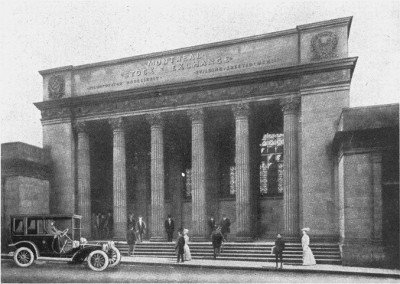
MONTREAL STOCK EXCHANGE BUILDING
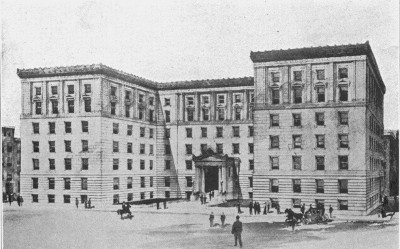
MONTREAL BOARD OF TRADE BUILDING
CHAMBRE DE COMMERCE FRANCAISE DE MONTREAL
There is also at present the “Chambre de Commerce Française de Montreal” for the promotion of trade by merchants of France settled here. It was originally proposed at a meeting in Montreal of French traders on May 27, 1886, by M.G. Dubail, the Consul General of France, and on June 26th of that year the projected constitution was received for approval. Since then its purpose of intercommunication and trade relations with France have been sustained under its presidents.
OTHER BODIES
There is also a Federation of the Chambers of Commerce of the Province of Quebec with its offices in this city and among the many mercantile bodies now promoting the trade and industries of Montreal may be mentioned the Montreal branch of the “Canadian Manufacturers’ Association,” the “Montreal Stock Exchange,” the “Montreal Mining Exchange,” the “Canadian Mining Institute,” the “Builders’ Exchange,” the “Corn Exchange Association,” the “Montreal Business Men’s League,” the “Association Immobiliére of Montreal,” the “Milk Shippers’ Association,” the “Wholesale Grocers’ Guild,” the “Wholesale Dry Goods Association,” the “Metal and Hardware Association,” the “Wholesale Hardware League,” the “Montreal Lumber Association,” the “Montreal Produce Merchants’ Association,” the “Retail Merchants’ Association of Canada,” with its office of the Provincial Board for the Province of Quebec at Montreal, the Province of Quebec Association of Architects, the “Licensed Victuallers’ Association,” the “Federation of Licensed Wine and Spirit Dealers of the Province of Quebec,” the “Dominion Association of Chartered Accounts,” the “Canadian Bankers’ Association,” with numerous other trade organizations, all cooperating and making for the commercial growth of Montreal and Canada.2 To all these may be applied in their degree the words of tribute spoken at the Board of Trade building in 1908 by the Governor General Earl Grey:
“I am glad to be able to stand here as the representative of the King and to signify by my acceptance of your hospitality His Majesty’s appreciation of the benefits you, the Montreal Board of Trade, have conferred by your energy, by your spirited enterprise, and by your imperial aspirations, not only on the Province of Quebec and the Dominion, but upon the population of the United Kingdom of the whole British Empire. * * * Thanks to the brains, energy and public spirit with which your board have met the requirements of a trade which is being borne in ever increasing volume to your doors, over the continuous bands of steel and mighty waterways which you have harnessed to your city, the doors of the great treasure house of the West, containing illimitable riches, have been unlocked for the benefit of impoverished mankind.
“I am aware that the proud consciousness of your past achievements has not made you indifferent to future improvements and that you are still busily engaged in honourable emulation of your predecessors, in promoting plans which will increase the Commercial strength and prosperity of Montreal and further advance the general welfare of the Dominion.”
CHAIRMEN OF COMMITTEE OF TRADE, MONTREAL
From Its Inception in 1822 to 1841 When It Was Changed into the Montreal Board of Trade
1822-25Thomas Blackwood
1825-33George Auldjo
1833-34James Miller
1834-35T.M. Smith
1835-36George Auldjo
1836-37J. Quesnel
1837-38A. Cuvillier
1838-39Adam Ferrie
1839-41A. Cuvillier
PRESIDENTS OF MONTREAL BOARD OF TRADE
1842-43J.T. Brondgeest
1844-45-46Hon. George Moffatt
1847Thomas Gringan
1848Hon. Peter McGill
1849-50Thomas Ryan
1851-52-53-54Hugh Allan
1855Hon. John Young
1856-57-58E.H. Holton
1859Thomas Kay
1860Hon. John Young
1861Edwin Atwater
1862Hon. E.H. Holton
1863Thomas Gramp
1864-65Peter Redpath
1866John McLennan
1867-68Thomas Rimmer
1869J.H. Winn
1870-71Hon. John Young
1872-73Hugh McLennan
1874-75William Darling
1876-77Andrew Robertson
1878-79Henry Lyman
1880-81-82-83T.W. Henshaw
1884-85John Kerry
1886-87-88Hon. Geo. A. Drummond
1889-90James P. Cleghorn
1891Robert Archer
1892G.B. Greenshields
1893-94W.W. Ogilvie
1895James A. Cantlie
1896Robert Bickerdike
1897John McKergow
1898James Crathorn
1899Charles F. Smith
1900Robert Mackay
1901Henry Miles
1902Alexander McFee
1903Arthur J. Hodgson
1904George E. Drummond
1905William I. Gear
1906F.H. Mathewson
1907George Caverhill
1908T.J. Drummond
1909F. Robertson
1910George E. Cains
1911Jeffrey H. Burland
1912Robert W. Reford
1913Huntley R. Drummond
1914Robert J. Dale
SECRETARIES
1842-49Fred’k A. Wilson
1849-50Charles Lindsay
1851-54Alex. Clerk
1854-63John Dinning
1863-86Wm. J. Patterson
1886George Hadrill
NOTE
PRESIDENTS OF LA CHAMBRE DE COMMERCE
1887
D. Parizeau, Ex-M.P.P.
l’ex-Maire J. Laporte
Joseph Contant
Damase Masson
L.E. Geoffrion
H.A.A. Brault
C.H. Catelli
Isaie Préfontaine
O.S. Perrault
Frédéric C. Larivière
Armand Chaput
le Lieut.-Col. A.E. Labelle
A. Fortier
PRESIDENTS OF LA CHAMBRE DE COMMERCE FRANCAISE
1886-90M. Schwob
1890-92C.H. Chouillon
1892A. Girard
1892-95E. Galibert
1895-97G. Herdt
1897-1900E. Galibert
1900-04H. Jonas
1904J. Helbronner
1904-08C.H. Chouillon
1908-09M. Chevalier
1910-11A.F. Revol
1912-14J. Obalski
THE CENSUS RETURNS OF 1912 ON MONTREAL’S MANUFACTURES
The Industries of Montreal City (Not Greater Montreal); the Capital Invested, Output, Hands Employed and Wages and Salaries Paid.
EstablishEmployees on salaries.
No.Name or kind of industry.ments.Capital.No.Amt.
CITY OF MONTREAL Totals1,093$135,044,7826,863$7,258,810
1.Aerated and mineral waters151,017,9007385,819
2.Axes and tools6351,5501921,790
3.Awnings, tents and sails557,5102115,827
4.Bags, cotton41,106,0003335,740
5.Baking powder and flavoring extracts7174,5852624,224
6.Blacking595,5821415,016
7.Blacksmithing594,00056,576
8.Boilers and engines82,909,729143131,987
9.Boots and shoes3910,386,852346380,461
10.Boot and shoe supplies5363,5362426,762
11.Boxes and bags (paper)10963,1006777,481
12.Boxes (wooden)3376,5001010,012
13.Brass castings6901,2383061,288
14.Bread, biscuit and confentionery482,326,662161132,158
15.Brooms and brushes529,2001813,114
16.Buttons361,60053,076
17.Car repairs3—2520,340
18.Carriages and wagons331,351,0786770,096
19.Cars and car works43,867,000166142,850
20.Clothing (men’s custom)641,244,917139156,131
21.Clothing (men’s factory)844,525,551447591,969
22.Clothing (women’s custom)48843,54812393,254
23.Clothing (women’s factory)22737,225182178,112
24.Cocoa and chocolate3269,0002316,515
25.Coffees and spices6563,1503433,488
26.Cooperage3114,346715,840
27.Cottons69,502,9737498,219
28.Drugs7614,5584839,158
29.Dyeing and cleaning12479,6095145,418
30.Electrical apparatus and supplies134,828,667157199,274
31.Electric light and power33,753,3921621,356
32.Elevators3266,3533132,610
33.Flour and grist mill products33,424,50061128,900
34.Foundry and machine shop products433,804,137305325,776
35.Fruit and vegetable canning375,500811,500
36.Furnishing goods (men’s)91,597,500162157,930
37.Furniture and upholstered goods15828,7005753,079
38.Furs (dressed)3134,0001315,220
39.Glass (stained, cut and ornamental)4109,50066,250
40.Gloves and mittens3485,5884030,052
41.Hairwork359,50023,380
42.Harness and saddlery81,527,153104124,800
43.Hats, caps and furs593,468,671231222,406
44.Hosiery and knit goods51,072,0933528,096
45.Housebuilding15504,0703030,398
46.Interior decorations9185,7681612,585
47.Iron and steel products84,092,900197187,929
48.Jewelry and repairs141,644,387141105,405
49.Leather goods91,000,2878359,508
50.Leather (tanned, curled and finished)4770,1632341,250
51.Liquors (malt)72,939,2234668,552
52.Lime3134,1001214,980
53.Log products3877,0001724,906
54.Lumber products343,460,328137164,971
55.Mattresses and spring beds7159,0003033,808
56.Mirrors and plate glass5335,0004842,201
57.Monuments and tombstones7257,8001215,991
58.Musical instruments4220,5002634,750
59.Oils4423,2001922,194
60.Optical goods334,1502420,707
61.Paints and varnishes73,829,538155175,576
62.Patent medicines689,8031410,903
63.Picture frames4101,5001912,980
64.Plumbing and tinsmithing263,796,433209203,363
65.Printers’ supplies334,20778,640
66.Printing and bookbinding642,414,200255252,650
67.Printing and publishing155,323,991473419,905
68.Roofing and roofing materials6499,5004455,254
69.Rubber clothing8383,7503030,498
70.Signs576,7002122,300
71.Silversmithing430,50064,916
72.Slaughtering and meat packing122,414,000116115,348
73.Soap4360,0002331,300
74.Stationary goods4166,6682425,282
75.Stone (cut)3386,07466,864
76.Tobacco (chewing, smoking and snuff)52,874,4892241,346
77.Tobacco (cigars and cigarettes)3010,068,784322425,327
78.All other industries *10514,442,976629632,579
Employees on wages.Cost of rawValue of
No.Name or kind of industry.No.Amt.material.products.
CITY OF MONTREAL Totals60,390$26,779,657$88,862,420$164,698,761
1.Aerated and mineral waters325165,140150,260575,330
2.Axes and tools11867,974155,649301,059
3.Awnings, tents and sails6728,15385,587167,553
4.Bags, cotton250105,0001,632,0002,982,000
5.Baking powder and flavoring extracts5527,39897,248449,425
6.Blacking288,08497,472162,494
7.Blacksmithing3416,53621,50077,000
8.Boilers and engines1,184831,9971,389,5273,267,873
9.Boots and shoes5,2912,228,7016,377,82311,462,566
10.Boot and shoe supplies253112,838134,933303,177
11.Boxes and bags (paper)792250,226457,9341,087,119
12.Boxes (wooden)16770,654120,000250,000
13.Brass castings245113,303822,7661,329,006
14.Bread, biscuit and confentionery1,095457,4351,808,5523,270,525
15.Brooms and brushes4013,88225,88066,500
16.Buttons7617,60013,00049,000
17.Car repairs433217,997223,464465,985
18.Carriages and wagons649340,286719,3171,594,787
19.Cars and car works3,3481,649,8894,064,8327,710,430
20.Clothing (men’s custom)1,562706,0871,428,1233,226,234
21.Clothing (men’s factory)5,3782,442,8106,306,47911,358,192
22.Clothing (women’s custom)967425,908994,8362,176,924
23.Clothing (women’s factory)1,976609,8211,232,3041,857,493
24.Cocoa and chocolate19053,856300,000443,480
25.Coffees and spices8545,241501,826748,599
26.Cooperage5016,90741,80084,992
27.Cottons3,4351,292,4934,531,2826,480,698
28.Drugs11651,274291,130627,488
29.Dyeing and cleaning630268,314213,750883,103
30.Electrical apparatus and supplies1,929898,9513,026,2286,841,124
31.Electric light and power9454,558——396,850
32.Elevators9752,99058,797315,170
33.Flour and grist mill products25510,9004,791,0005,686,000
34.Foundry and machine shop products1,9191,002,6732,269,8684,735,357
35.Fruit and vegetable canning4413,90085,000123,500
36.Furnishing goods (men’s)1,823467,1441,007,8312,820,816
37.Furniture and upholstered goods725383,144409,6711,358,310
38.Furs (dressed)18373,612854,7001,255,000
39.Glass (stained, cut and ornamental)4923,18415,900386,000
40.Gloves and mittens327112,431358,234707,449
41.Hairwork4328,40030,200107,000
42.Harness and saddlery429207,340688,6001,173,750
43.Hats, caps and furs1,268500,1552,598,0294,388,918
44.Hosiery and knit goods586192,137553,2981,016,901
45.Housebuilding462251,932390,5661,053,583
46.Interior decorations14875,720128,555294,342
47.Iron and steel products1,224794,4161,908,6663,880,597
48.Jewelry and repairs574312,244477,3481,184,351
49.Leather goods228101,038817,7101,112,035
50.Leather (tanned, curled and finished)276126,914735,7951,300,141
51.Liquors (malt)410238,326638,6151,627,311
52.Lime5728,0008,600149,000
53.Log products8441,429478,000630,400
54.Lumber products1,618877,2712,272,8764,904,573
55.Mattresses and spring beds274129,327307,509572,475
56.Mirrors and plate glass12354,022173,132342,830
57.Monuments and tombstones11465,99874,182237,032
58.Musical instruments15992,100112,167283,400
59.Oils6025,019744,068864,674
60.Optical goods5519,88245,271121,771
61.Paints and varnishes516299,0192,822,7064,722,477
62.Patent medicines3817,70523,074136,803
63.Picture frames6133,10628,975104,000
64.Plumbing and tinsmithing1,952691,5371,416,9172,767,034
65.Printers’ supplies219,32810,00023,500
66.Printing and bookbinding1,484703,392740,7702,367,655
67.Printing and publishing1,144631,994742,9562,595,180
68.Roofing and roofing materials307161,167526,695886,450
69.Rubber clothing291136,885384,100869,744
70.Signs7641,00036,400140,797
71.Silversmithing2817,0369,20051,128
72.Slaughtering and meat packing650310,6385,059,0006,123,125
73.Soap9934,660269,878495,862
74.Stationary goods19156,52284,159235,980
75.Stone (cut)270100,76025,060324,418
76.Tobacco (chewing, smoking and snuff)787255,9992,596,3563,564,736
77.Tobacco (cigars and cigarettes)3,1081,107,4644,809,17310,292,144
78.All other industries *4,8122,280,4798,995,32015,677,928
* All other industries comprises:—2 wire, 1 cutlery and edge tools, 1 oxygen gas, 1 time recorder, 1 window fixtures, 1 coffins and caskets, 2 glass, 2 vinegar and pickles, 1 wall paper, 1 paste flour, 1 pins, 1 washing blue, 1 sausage casings, 1 bells, 1 shoddy, 1 glue, 1 boats and canoes, 1 cement (Portland), 1 fertilizers, 1 paper, 1 batting, 2 brick, tile and pottery, 1 cordage, rope and twine, 1 malt, 1 plaster, 1 foods (prepared), 2 railway supplies, 1 refrigerators, 1 safes and vaults, 1 saw, 1 typewriters, 1 cement blocks and tiles, 1 lasts and pegs, 2 stone (artificial), 1 vaseline, 1 sewing machines, 2 silk and silk goods, 1 spray motors, 2 stamps and stencils, 1 sugar (refined), 2 umbrellas, 2 vacuum cleaners, 2 washing compounds, 1 woodworking and turning, 1 costumier and hairdresser, 1 cotton and wool waste, 1 paper (blue print), 1 stove polish, 1 automobile repairs, 1 bicycles, 2 gas (lighting and heating), 1 inks, 2 photographic materials, 2 stereotyping and electro-typing, 1 artificial limbs, 2 asbestos, 1 babbitt metal, 1 bridges (iron and steel), 1 butter and cheese, 2 corks, 1 fringes, cords and tassels, 1 gas machines, 1 miscellaneous, 2 plumbers’ supplies, 1 typewriter’s supplies, 1 dyes and colors, 1 typefounding, 1 fancy goods, 1 laces and braids, 1 scales, 1 church ornaments, 1 macaroni, 2 prepared flour, 2 statuary, 1 boxes (cigar), 1 corsets and supplies, 2 dies and moulds, 1 jewelry cases, 1 metallic roofing and flooring, 2 patterns, 1 showcases, 1 textile (dyeing and finishing), 1 window blinds and shades, 1 pipe and boiler covering.
THE MANUFACTURES OF GREATER MONTREAL
Capital.Wages.Production.
1910.1900.1910.1900.1910.1900.
Montreal$132,475,802$57,148,661$34,270,835$17,810,356$166,296,972$71,099,750
Laprairie112,000—31,940 —17,500—
Longueuil75,000—55,300—145,750—
Maisonneuve7,919,0804,147,5334,856,496912,78920,813,7746,008,780
Lachine7,496,6123,913,8461,301,545565,4326,295,7162,909,847
Outremont187,993—51,780—190,506—
St. Henri—4,303,362—1,154,383—4,139,391
St. Lambert191,638 —58,496—185,119—
St. Louis—101,053—52,988—200,140
Verdun426,051—102,547—229,299—
Westmount1,441,28848,947374,56226,3941,541,802102,500
———————————— ———————————— ————————————
Total$150,325,464$69,663,402$41,103,501$20,522,342$195,716,438$84,460,408
FOOTNOTES: