Chapter XXIII · (continued 2)
Reading edition
A GERTRUDE À LA CREME.
Slice a plain pound or rice cake as for the Charlotte à la Parisienne, and take a round out of the centre of each slice with a tin-cutter before the preserve is laid on; replace the whole in its original form, ice the outside with a green or rose coloured icing at pleasure, and dry 488it in a gentle oven; or decorate it instead with leaves of almond paste, fastening them to it with white of egg. Just before it is sent to table, fill it with well-drained whipped cream, flavoured as for a trifle or in any other way to the taste.
POMMES AU BEURRE.
(Buttered apples. Excellent.)
Pare six or eight fine apples of a firm but good boiling kind, and core without piercing them through, or dividing them; fill the cavities with fresh butter, put a quarter of a pound more, cut small, into a stewpan just large enough to contain the apples in a single layer, place them closely together on it, and stew them as softly as possible, turning them occasionally until they are almost sufficiently tender to serve; then strew upon them as much sifted sugar as will sweeten the dish highly, and a teaspoonful of pounded cinnamon; shake these well in and upon the fruit, and stew it for a few minutes longer. Lift it out, arrange it in a hot dish, put into each apple as much warm apricot jam as it will contain, and lay a small quantity on the top; pour the syrup from the pan round, but not on the fruit, and serve it immediately.
Apples, 6 to 8; fresh butter, 4 oz., just simmered till tender. Sugar, 6 to 8 oz.; cinnamon, 1 teaspoonful: 5 minutes. Apricot jam as needed.
Obs.—Particular care must be taken to keep the apples entire: they should rather steam in a gentle heat than boil. It is impossible to specify the precise time which will render them sufficiently tender, as this must depend greatly on the time of year and the sort of fruit. If the stewpan were placed in a very slow oven, the more regular heat of it would perhaps be better in its effect than the stewing.
SUÉDOISE OF PEACHES.
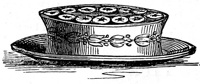
Suédoise of Peaches.
Pare and divide four fine, ripe peaches, and let them just simmer from five to eight minutes in a syrup made with the third of a pint of water and three ounces of very white sugar, boiled together for fifteen minutes; lift them out carefully into a deep dish, and pour about half the syrup over them, and into the remaining half throw a couple of pounds more of quite ripe peaches, and boil them to a perfectly smooth dry pulp or marmalade, with as much additional sugar in fine powder, as the nature of the fruit may require. Lift the other peaches from the syrup, and reduce it 489by very quick boiling, more than half. Spread a deep layer of the marmalade in a dish, arrange the peaches symmetrically round it, and fill all the spaces between them with the marmalade; place the half of a blanched peach-kernel in each, pour the reduced syrup equally over the surface, and form a border round the dish with Italian macaroons, or, in lieu of these, with candied citron, sliced very thin, and cut into leaves with a small paste-cutter. A little lemon-juice brings out the flavour of all preparations of peaches, and may be added with good effect to this. When the fruit is scarce, the marmalade (which ought to be very white) may be made in part, or entirely, with nonsuches. The better to preserve their form, the peaches are sometimes merely wiped, and then boiled tolerably tender in the syrup before they are pared or split. Half a pint of water, and from five to six ounces of sugar must then be allowed for them. If any of those used for the marmalade should not be quite ripe, it will be better to pass it through a sieve, when partially done, to prevent its being lumpy.
Large ripe peaches, pared and halved, 4: simmered in syrup, 5 to 8 minutes. Marmalade: peaches (or nonsuches) 2 lbs.; sugar, 1/2 to 3/4 lb.: 3/4 to 1 hour, or more. Strained lemon-juice, 1 tablespoonful. Citron, or macaroons, as needed.
Peaches, if boiled whole in syrup, 15 to 18 minutes.
Obs.—The number of peaches can, at pleasure, be increased to six, and three or four of the halves can be piled above the others in the centre of the dish.
AROCĒ DOCĒ (OR SWEET RICE, À LA PORTUGAISE.)
Wash thoroughly, then drain, and wipe dry in a soft cloth, half a pound of the best Carolina rice. Pour to it three pints of new milk, and when it has gently stewed for half an hour, add eight ounces of sugar broken into small lumps, let it boil until it is dry and tender, and when it is nearly so, stir to it two ounces of blanched almonds, chopped[163] or pounded. Turn the rice when done into shallow dishes or soup plates, and shake it until the surface is smooth; then sift over it rather thickly through a muslin, some freshly-powdered cinnamon, which will give it the appearance of a baked pudding. Serve it cold. It will remain good for several days. This is quite the best sweet preparation of rice that we have ever eaten, and it is a very favourite dish in Portugal, whence the receipt was derived. One or two bitter almonds, pounded with the sweet ones, might a little improve its flavour, and a few spoonsful of rich cream could occasionally be substituted for a small portion of the milk, but it should not be added until the preparation is three parts done.
Rice, 8 oz.; milk, 3 pints: 30 minutes. Sugar, 8 oz.: 1 hour or more. Pounded almonds, 2 oz.; cinnamon, 1 teaspoonful. Obs.—The rice must be frequently stirred while boiling, particularly 490after it begins to thicken; and it will be better not to add the entire quantity of milk at first, as from a quarter to half a pint less will sometimes prove sufficient. The grain should be thoroughly tender, but dry and unbroken.
COCOA-NUT DOCE.
This is merely fine fresh lightly grated cocoa-nut stewed until tender in syrup, made with one pound of sugar to half a pint of water (or more to the taste) and flavoured with orange-flower water.
BUTTERED CHERRIES. (CERISES AU BEURRE.)
Cut four ounces of the crumb of a stale loaf into dice, and fry them a light brown in an ounce and a half of fresh butter; take them up, pour the butter from the pan, and put in another ounce and a half; to this add a pound of Kentish cherries without their stalks, and when they are quite warmed through, strew in amongst them four ounces of sugar, and keep the whole well turned over a moderate fire; pour in gradually half a pint of hot water, and in fifteen minutes the cherries will be tender. Lay the fried bread into a hot dish, pour the cherries on it, and serve them directly.
Bread, 4 oz.; butter, 1-1/2 oz. Cherries, 1 lb.; butter, 1-1/2 oz.: 10 minutes. Sugar, 4 oz.; water, 1/2 pint: 15 minutes.
Obs.—Black-heart cherries may be used for this dish instead of Kentish ones: it is an improvement to stone the fruit. We think our readers generally would prefer to the above Morella cherries stewed from five to seven minutes, in syrup (made by boiling five ounces of sugar in half pint of water, for a quarter of an hour), and poured hot on the fried bread. Two pounds of the fruit, when it is stoned, will be required for a full-sized dish.
SWEET MACARONI.
Drop gently into a pint and a half of new milk, when it is boiling fast, four ounces of fine pipe macaroni, add a grain or two of salt, and some thin strips of lemon or orange rind: cinnamon can be substituted for these when preferred. Simmer the macaroni by a gentle fire until it is tolerably tender, then add from two to three ounces of sugar broken small, and boil it till the pipes are soft, and swollen to their full size; drain, and arrange it in a hot dish; stir the milk quickly to the well-beaten yolks of three large, or of four small eggs, shake them round briskly over the fire until they thicken, pour them over the macaroni and serve it immediately; or instead of the eggs, heat and sweeten some very rich cream, pour it on the drained macaroni, and dust finely-powdered cinnamon over 491through a muslin, or strew it thickly with crushed macaroons. For variety, cover it with the German sauce of page 403, milled to a light froth.
New milk, 1-1/2 pint; pipe macaroni, 4 oz.; strips of lemon-rind or cinnamon; sugar, 2 to 3 oz.: 3/4 to 1 hour, or more.
BERMUDA WITCHES.
Slice equally some rice, pound, or Savoy cake, not more than the sixth of an inch thick; take off the brown edges, and spread one half of it with Guava jelly, or, if more convenient, with fine strawberry, raspberry, or currant jelly of the best quality (see Norman receipt, 478); on this strew thickly some fresh cocoa-nut grated small and lightly; press over it the remainder of the cake, and trim the whole into good form; divide the slices if large, pile them slopingly in the centre of a dish upon a very white napkin folded flat, and garnish or intersperse them with small sprigs of myrtle. For very young people a French roll or two, and good currant jelly, red or white, will supply a wholesome and inexpensive dish.
NESSELRÔDE PUDDING.
We give Monsieur Carême’s own receipt for this favourite and fashionable dish, not having ourselves had a good opportunity of proving it; but as it originated with him he is the best authority for it. It may be varied in many ways, which the taste or ingenuity of the reader will easily suggest. Boil forty fine sound Spanish chestnuts quite tender in plenty of water, take off the husks, and pound the chestnuts perfectly with a few spoonsful of syrup; rub them through a fine sieve, and mix them in a basin with a pint of syrup made with a pound of sugar clarified, and highly-flavoured with a pod of vanilla, a pint of rich cream, and the yolks of twelve eggs; thicken the mixture like a boiled custard; when it is cold put it into a freezing pot, adding a glass of maraschino, and make it set as an iced cream; then add an ounce of preserved citron cut in dice, two ounces of currants, and as many fine raisins stoned and divided (all of which should be soaked from the day before in some maraschino with a little sugar); the whole thus mingled, add a plateful of whipped cream, and the whites of three eggs prepared as for Italian meringue. When the pudding is perfectly frozen, mould it in a pewter mould of the form of a pine-apple, and place it again in the ice till wanted to serve. Preserved cherries may be substituted for the raisins and currants.
Chestnuts, 40; syrup, 1 pint some spoonsful; vanilla, 1 pod; cream, 1 pint; yolk of eggs, 12; maraschino, 1 glassful; citron, 1 oz.; currants, 2 oz.; raisins, 2 oz.; whipped cream, 1 plateful; whites of eggs beaten to snow, 3.
Obs.—As Monsieur Carême directs the eggs for his Italian meringues 492to be prepared as follows, he probably intends that they should be mixed with the syrup before they are added to the pudding. Boil together half a pound of the finest sugar, and half a pint of water, until they begin to be very thick; then, with a wooden spoon, work the sugar against the side of the pan till it whitens; leave it to cool a little, work it again, and then with a whisk mingle with it the eggs whipped to a very firm froth, which ought to produce a preparation very white, smooth, and brilliant.
STEWED FIGS. (A VERY NICE COMPOTE.)
Put into an enamelled or a copper stewpan, four ounces of refined sugar, the very thin rind of a large and fresh lemon, and a pint of cold water. When the sugar is dissolved, add a pound of fine Turkey figs, and place the stewpan on a trivet above a moderate fire, or upon a stove, where they can heat and swell slowly, and be very gently stewed. When they are quite tender, add to them two glassesful of port wine, and the strained juice of the lemon; arrange them in a glass dish, and serve them cold. From two hours to two and a half of the gentlest stewing will generally be sufficient to render the figs fit for table. Orange-juice and rind can be used for them at pleasure, instead of the lemon; two or three bitter almonds maybe boiled in the syrup to give it flavour, and any wine can be used for it which may be preferred, but port is best.
This compôte may be served in the second course hot, in a rice-border; or cold for rice-crust.
493