STEAM POWER PLANTS
Reading edition
Aside from the compressed air engine there is the steam driven engine which has been used abroad to considerable degree of success. Owing to the difficulty in constructing and operating a steam driven engine, very few model flyers in America have devoted any attention to the development of this engine as a means of propulsion for model aëroplanes. But irrespective of the limitations of the steam engine a great deal of experimentation has been carried on in England, and without doubt it will soon be experimented with in America.
H. H. GROVES STEAM POWER PLANTS
Perhaps one of the most successful steam power plants to have been designed since the development of the Langley steam driven model, is the Groves type of steam power plant, designed by Mr. H. H. Groves, of England. On one occasion several flights were made with a model driven by a small steam engine of the Groves type weighing 3 lbs. The model proved itself capable of rising from the ground under its own power and when launched it flew a distance of 450 feet. This is not a long flight when compared with the flight made by Prof. Langley’s steam driven model on November 28, 1896, of three-quarters of a mile in 1 minute and 45 seconds, but the size of the models and also that Mr. Groves’ model only made a duration of 30 seconds, must be considered. The model was loaded 12 ounces to the square foot and had a soaring velocity of some 20 m.p.h. The total weight of the power plant was 1¹⁄₂ lbs. Propeller thrust 10 to 12 ounces. The total weight of the model was 48 ounces. The type of steam plant used in connection with this model was of the flash boiler, pressure fed type, with benzoline for fuel.
Mr. Groves has done considerable experimenting with the steam driven type power plant. Many of the designs used in the construction of steam plants for models are taken from his designs. A Groves steam power plant is employed in one of Mr. V. E. Johnson’s (Model Editor of Flight) model hydroaëroplanes, the first power-driven, or “mechanically driven” model hydroaëroplane (so far as can be learned) to rise from the surface of the water under its own power. This model has a total weight of 3 lbs. 4 ounces.
G. HARRIS’S STEAM ENGINE
Another advocate of the steam driven type model is Mr. G. Harris, also of England. Several good flights were made by Mr. Harris with his pusher type monoplane equipped with a steam driven engine. As a result of his experiments he concluded that mushroom valves with a lift of ¹⁄₆₄ part of an inch were best, used in connection with the pump, and at least 12 feet of steel tubing should be used for boiler coils. The first power plant constructed by Mr. Harris contained a boiler coil 8 feet long, but after he had replaced this coil with one 12 feet long, irrespective of the fact that the extra length of tube weighed a couple of ounces, the thrust was increased by nearly a half pound.
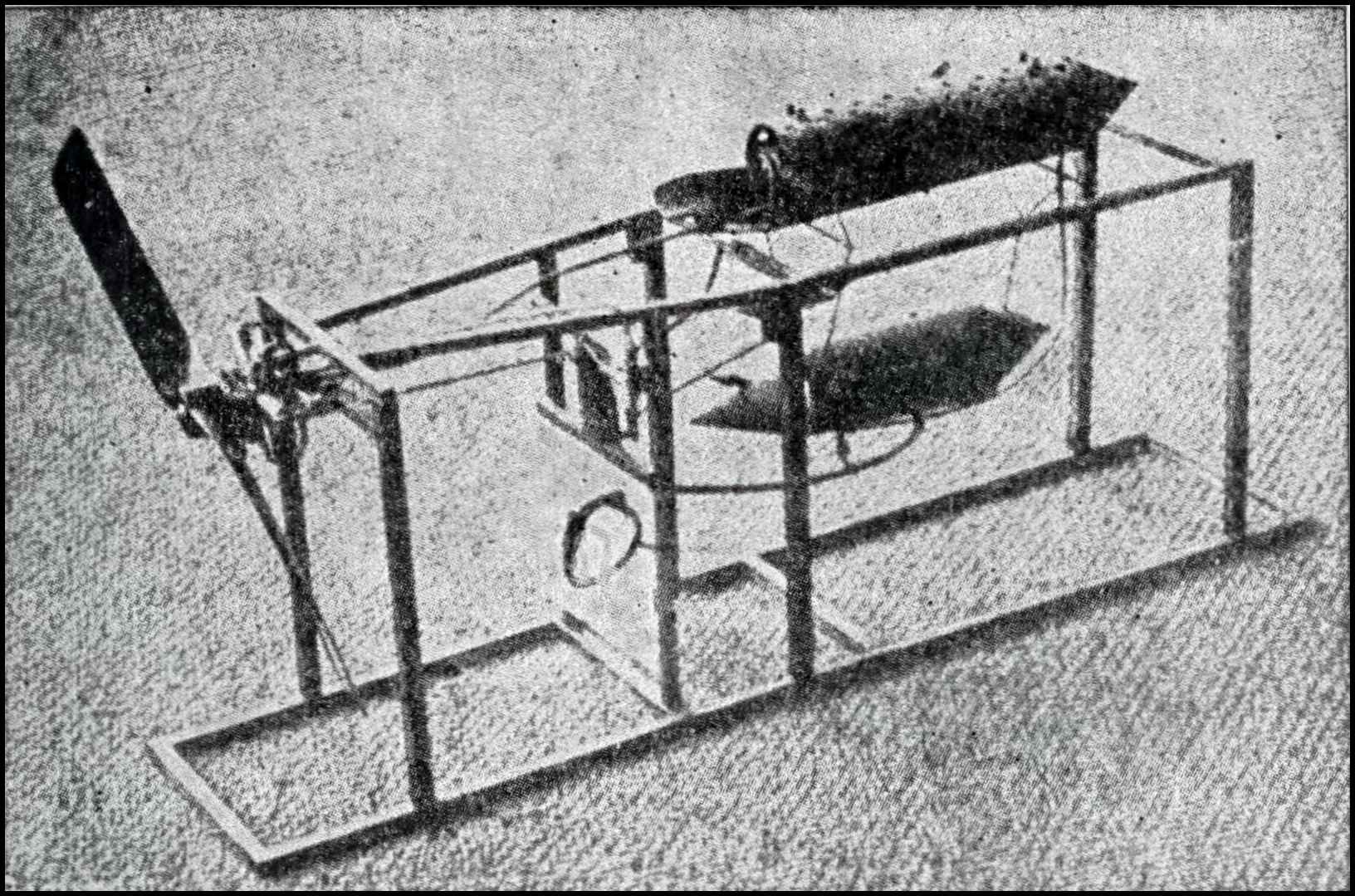
An English steam power plant for model aëroplanes. Courtesy Flight.
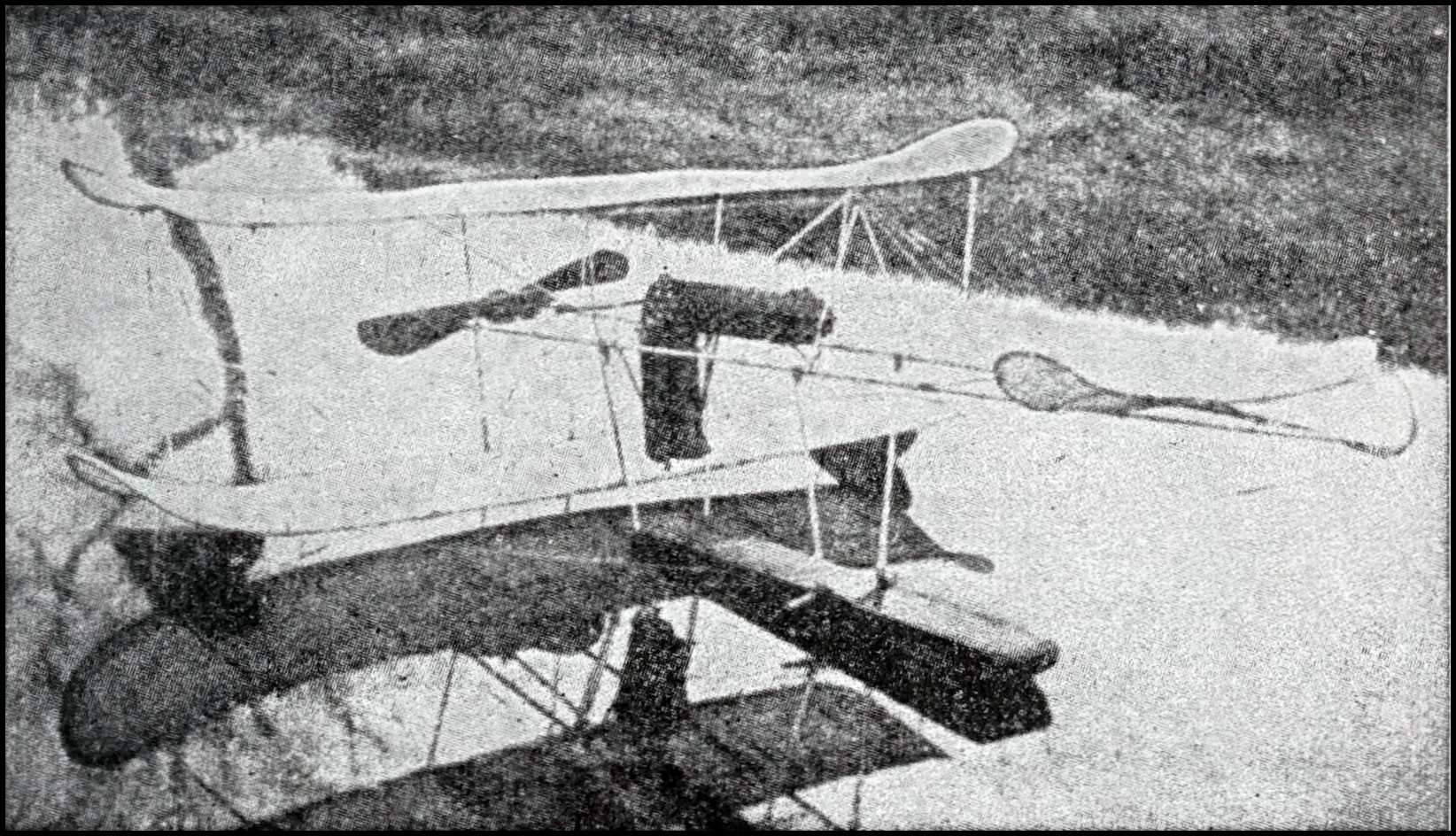
Model hydroaëroplane owned by V. E. Johnson, Model Editor of Flight, England, equipped with an H. H. Groves steam power plant. This model is the first power driven—as far as can be learned—to rise from the surface of the water under its own power. Courtesy Flight.
The principal parts used in Mr. Harris’s steam power plant was an engine of the H. H. Groves type, twin cylinder, ⁷⁄₈″ bore with a piston stroke of ¹⁄₂″. The boiler was made from 12″ of ³⁄₁₆″ × 20″ G. steel tubing, weighing 10.5 ounces. The blow lamp consisted of a steel tube, ⁵⁄₃₂″ × 22″ G. wound round a carbide carrier for a nozzle. The tank was made of brass ⁵⁄₁₀₀₀″ thick. The pump, ⁷⁄₃₂″ bore, stroke variable to ¹⁄₂″, fitted with two non-return valves (mushroom type) and was geared down from the engine 4.5 to 1.
PROFESSOR LANGLEY’S STEAM ENGINE
The Langley steam driven model, of which so much has been said, and which on one occasion flew a distance of one-half mile in 90 seconds, had a total weight of 30 lbs., the engine and generating plant constituting one-quarter of this weight. The weight of the complete plant worked out to 7 lbs. per h.p. The engine developed from 1 to 1¹⁄₂ h.p. A flash type boiler was used, with a steam pressure of from 150 to 200 lbs., the coils having been made of copper. A modified naphtha blow-torch, such as is used by plumbers, was used to eject a blast or flame about 2000 Fahrenheit through the center of this coil. A pump was used for circulation purposes. With the best mechanical assistance that could be obtained at that date, it took Professor Langley one year to construct the model.
FRENCH EXPERIMENTS WITH STEAM POWER PLANTS
About ten months after Langley’s results, some experiments were carried out by the French at Carquenez, near Toulon. The model used for the experiments weighed in total 70 lbs., the engine developing more than 1 h.p. As in the Langley case, twin propellers were used, but instead of being mounted side by side, they were mounted one in front and the other behind. The result of these experiments compared very poorly with Langley’s. A flight of only 462 feet was made, with a duration of a few seconds. The maximum velocity is stated to have been 40 m.p.h. The span of this model was a little more than 6 meters, or about 19 feet, with a surface of more than 8 square meters, or about 80 square feet.
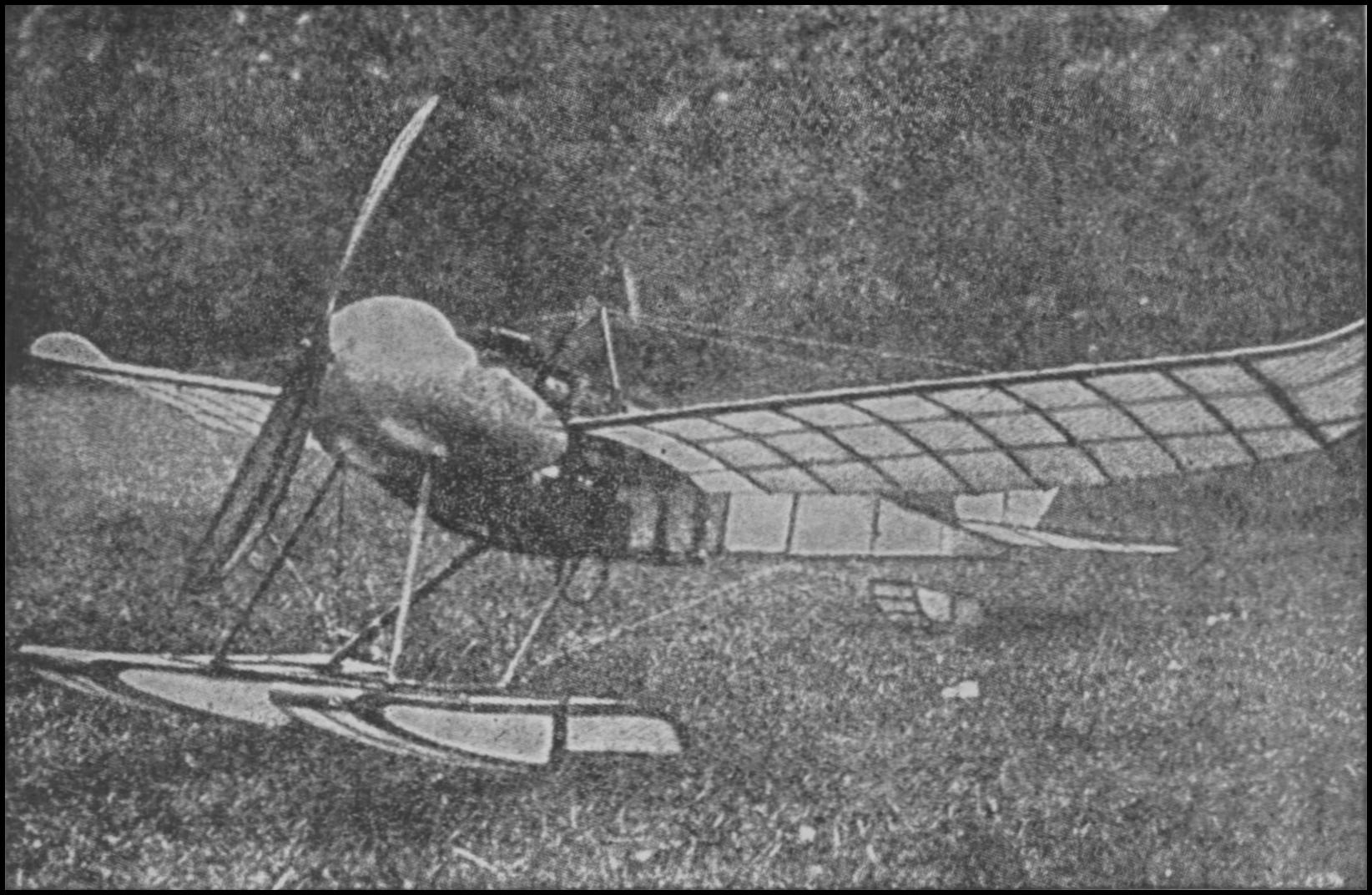
An English hydroaëroplane of tractor design equipped with steam power plant. Courtesy Flight.
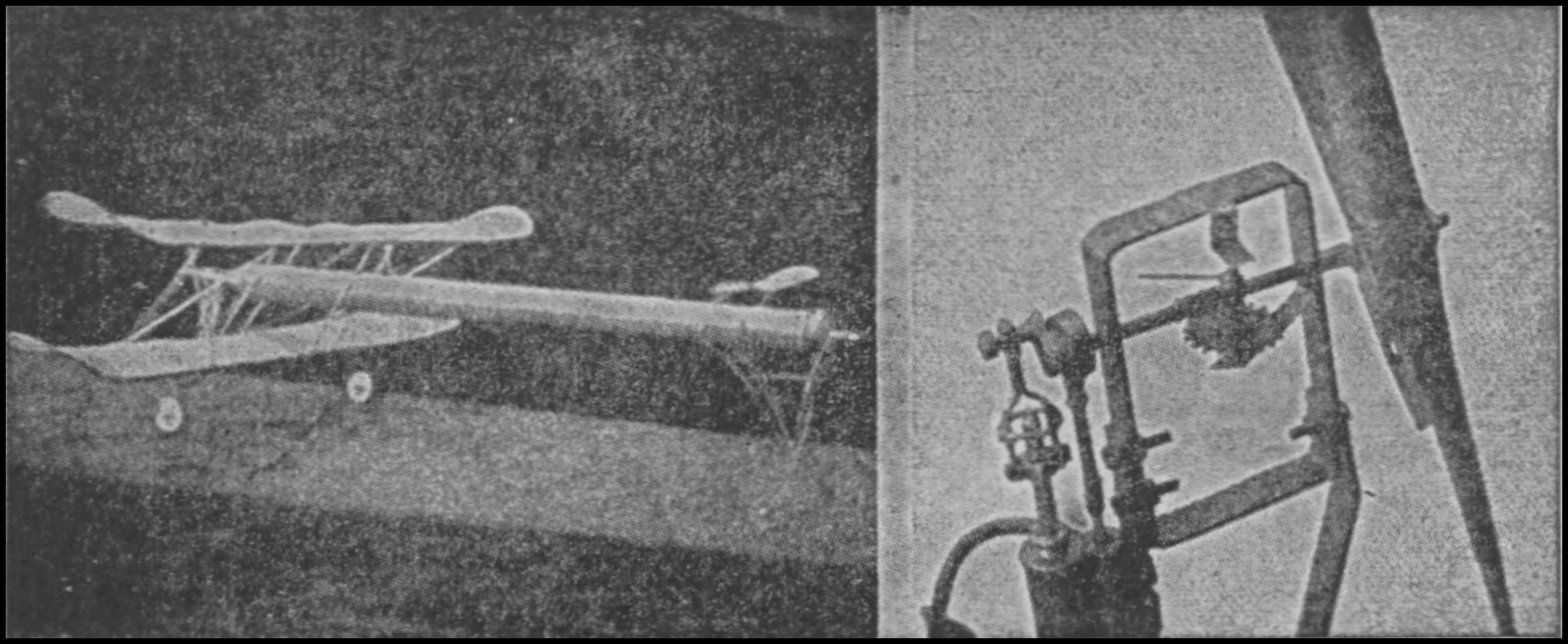
On the left an English 10 oz. Compressed air driven biplane. On the right, the engine shown fitted with a simple speedometer for experimental purposes. Courtesy Flight.