Chapter V
Reading edition
MAGDALENIAN TIMES—CLIMATE AND MAMMALIAN LIFE OF EUROPE—CUSTOMS AND LIFE OF THE CRÔ-MAGNONS; THEIR INDUSTRY IN FLINT AND BONE; THEIR DISTRIBUTION—DEVELOPMENT OF THEIR ART, ENGRAVING, PAINTING, SCULPTURE—ART IN THE CAVERNS—CLIMAX OF THE MAGDALENIAN ART AND INDUSTRY OF THE CRÔ-MAGNONS—APPARENT DECLINE OF THE RACE.
The art and industrial epoch of Magdalenian times is by far the best known and most fascinating of the Old Stone Age. This period forms the culmination of Palæolithic civilization; it marks the highest development of the Crô-Magnon race preceding their sudden decline and disappearance as the dominant type of western Europe. The men of this time are commonly known as the Magdalenians, taking their name from the type station of La Madeleine, as the Greeks in their highest stage took their name from Athens and were known as the Athenians.
We would assign the minimum prehistoric date of 16,000 B. C. for the beginning of the Magdalenian culture, and since we have assigned to the beginning of the Aurignacian culture the date of 25,000 B. C., we should allow 9,000 years for the development of the Aurignacian and Solutrean industries in western Europe.
Introduction. Industrial and Artistic Development
Well as this culture is known, its origin is obscured by the fact that it shows little or no connection with the preceding Solutrean industry, which, as we have noted (p. 331), seems like a technical invasion in the history of western Europe and not an inherent part of the main line of cultural development. Thus Breuil(1) observes that it appears as if the fundamental elements of the superior Aurignacian culture had contributed by some unknown route to constitute the kernel of the Magdalenian civilization while the Solutrean episode was going on elsewhere. Again, early Magdalenian art bears striking resemblances to the superior Aurignacian art of the Pyrenees, especially the parietal art, as shown by comparing the Aurignacian engravings of Gargas with the early Magdalenian of Combarelles. Moreover, the same author observes that, if there is one certain prehistoric fact, it is that the first Magdalenian culture was not evolved from the Solutrean—that these Magdalenians were newcomers in western France, as unskilful in the art of shaping and retouching flints as their predecessors were skilled. Ancient Magdalenian hearths are found in many localities close to the levels of the upper Solutrean industries with their shouldered spear points (pointes à cran) and highly perfected flint work. Yet the Magdalenians show a radical departure from the Solutrean type of flint working; both in Dordogne (Laugerie Haute and Laussel) and in Charente (Placard) the splinters of flint are massive, heavy, badly selected, often of poor quality, and poorly retouched, sometimes almost in an Eolithic manner; at the same time, the chance flints, that is, the piercers and graving-tools made from splinters of any accidental shape, are abundant. To these people flint implements appear to be altogether of secondary importance; although the flints are very numerous, they are not finished with any of the perfection of the Solutrean technique; the laurel-leaf spear head and shouldered dart head have disappeared entirely, but a great variety of smaller graving and chasing forms are employed for fashioning the implements of bone and horn. What a contrast to the beautiful flints so finely retouched and of such carefully selected materials, found in the very same stations in middle and upper Solutrean layers!
Thus Breuil, always predisposed to believe in an invasion of culture rather than in an autochthonous development, favors the theory of eastern origin for the Magdalenian industry, because this is not wanting either in Austria or in Poland; two sites of ancient Magdalenian industry have been found by Obermaier in the 'loess' stations of Austria, while in Russian Poland the grotto of Mas̆zycka, near Ojcow, exhibits workings in bone resembling those found at the grotto of Placard, Charente, in the layers directly succeeding the base of the Magdalenian. The fact that near the Ural Mountains there has also been found a peculiar Magdalenian culture, the origin of which is not western, inclines us to believe that the Magdalenian culture extended from the east toward the west, and then, later, toward the Baltic.
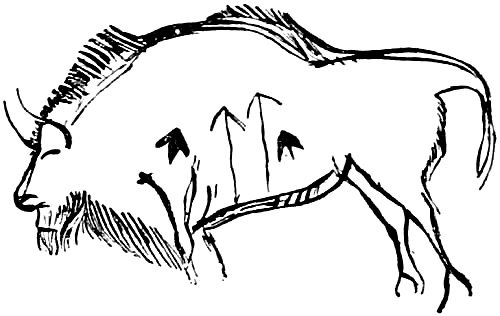
Fig. 174. One of the large bison drawings in the cavern of Niaux, on the Ariège, showing the supposed spear or arrow heads with shafts on its side. The artist's technique consists of an outline incised with flint followed by a painted outline in black manganese giving high relief. After Cartailhac and Breuil. Greatly reduced.
This theory of the eastern origin of the Magdalenian industry has, however, to face, first, the very strong counter-evidence of the close affinity between Aurignacian and Magdalenian art, which Breuil himself has done the most to demonstrate; second, the physical, mental, and especially the artistic unity of the Crô-Magnon race in Aurignacian and Magdalenian times. The recent discovery of two Crô-Magnon skeletons together with two carved bone implements of Magdalenian type, at Obercassel, on the Rhine, links the art with this race and with no other, because, as we remarked above, an artistic instinct and ability cannot be passed from one race to another like the technique of a handicraft. Breuil(2) himself has positively stated that the whole Upper Palæolithic art development of Europe was the work of one race: if so, this race can be no other than the Crô-Magnon.
We must, therefore, revert to the explanation offered in a preceding chapter, that the Solutrean technique was an intrusion or an invasion either brought in by another race or acquired from the craftsmen of some easterly race, perhaps that of Brünn, Brüx, and Předmost. Why the art of fashioning these perfect Solutrean spear, dart, and arrow heads was lost is very difficult to explain, because they appear to be the most effective implements of war and of the chase which were ever developed by Palæolithic workmen.
Larger Image
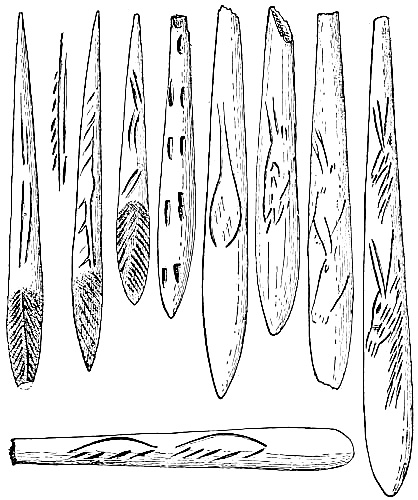
Fig. 175. Decorated sagaies, or javelin points, of bone; pointed at one end and bevelled at the other for the attachment of a shaft. After Breuil.
It is possible, although not probable, that the bow was introduced at this time and that a less perfect flint point, fastened to a shaft like an arrow-head and projected with great velocity and accuracy, proved to be far more effective than the spear. The bison in the cavern of Niaux show several barbed points adhering to the sides, and the symbol of the flèche appears on the sides of many of the bison, cattle, and other animals of the chase in Magdalenian drawings. From these drawings and symbols it would appear that barbed weapons of some kind were used in the chase, but no barbed flints occur at any time in the Palæolithic, nor has any trace been found of bone barbed arrow-heads or any direct evidence of the existence of the bow.
In compensation for the decline of flint is the rapid development of bone implements, the most distinctive feature of Magdalenian industry. In the late Solutrean we have noted the occasional appearance of the bone javelin points (sagaies) with their decorative motifs; these become much more frequent in Magdalenian times. They occur in the most ancient Magdalenian levels of the grotto of Placard, Charente, which are prior even to the appearance of prototypes of the harpoon, the evolution of which clearly marks off the early, middle, and late divisions of Magdalenian times. These primitive javelins, decorated in a characteristic fashion, are found in Poland, at the grotto of Kesslerloch and other places in Switzerland, at many stations in Dordogne and the region of the Pyrenees in southern France, and in the Cantabrian Mountains of northern Spain.
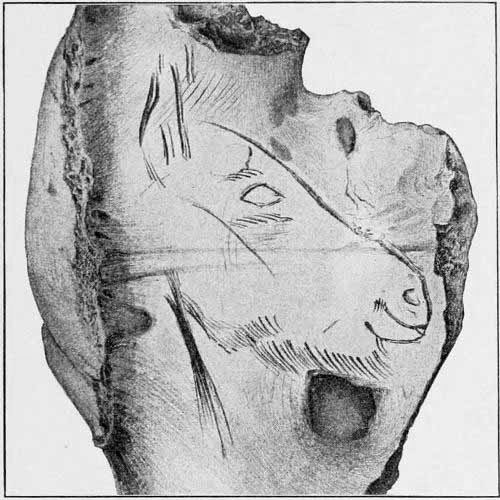
Fig. 176. Head of the forest or of the steppe horse engraved on a fragment of bone, from the Grotte du Pape, Brassempouy. After Piette.
It is only above the levels where early types of these javelin points occur that the rudimentary harpoons of the typical early Magdalenian are found. The discovery of the bone harpoon as a means of catching fish marks an important addition to the food supply, which was apparently followed by a decline in the chase. Later, to the javelin, lance, and harpoon is added the dart-thrower (propulseur), which gradually spreads all over western Europe, where also the evolution of these bone implements and of the decoration with which they are richly adorned enables the trained archæologist to establish corresponding subdivisions of Magdalenian time.
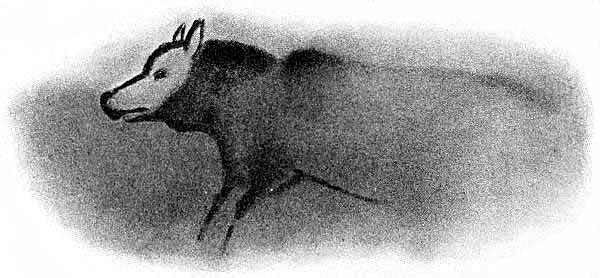
Fig. 177. Polychrome wall-painting of a wolf from the cavern of Font-de-Gaume. After Breuil.
From the uniform character of Palæolithic art in its highest forms of engraving, painting, and animal sculpture we may infer the probable unity of the Crô-Magnon race, especially throughout western Europe. During Magdalenian times various branches of art reached their highest point and were the culmination of a movement begun in the early Aurignacian. The artist, whose life brought him into close touch with nature and who evidently followed the movements both of the individual animals and of the herds for hours at a time, has rendered his observations in the most realistic manner. Among the animals represented are the bison, mammoth, wild horse, reindeer, wild cattle, deer, and rhinoceros; less frequent are representations of the ibex, wolf, and wild boar, and there are comparatively few representations of fishes or of any form of plant life; the nobler beasts of prey, such as the lion and the bear, are often represented, but there are no figures of the skulking hyæna, which at that time was a rare if not almost extinct animal. While many figures are of real artistic worth and reach a high level, others are more or less crude attempts; the composition of figures or of groups of animals is rarely undertaken.
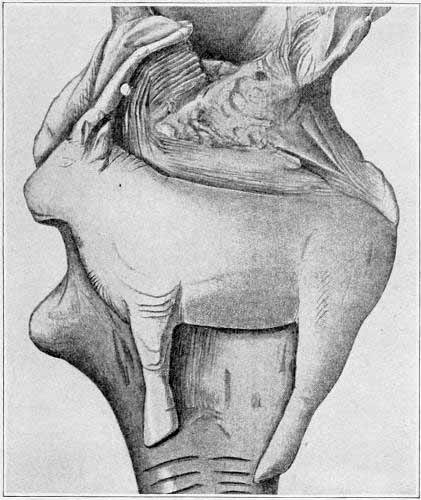
Fig. 178. Crude sculpture of the ibex, from the Magdalenian deposit at Mas d'Azil on the right bank of the Arize. After Piette. A little less than actual size.
The artistic sense of these people is also manifest in the decoration of their household utensils and weapons of the chase. Here the smaller animals of the chase, the saiga, the ibex, and the chamois, are executed with a sure hand. Sculpture of animal forms in the large, which begins in Solutrean times, is continued and reaches its highest point in the early Magdalenian. At this period the use of sculpture as a means of decoration arises and extends into the middle and late Magdalenian. These latter divisions are also distinguished by the reappearance of human figurines, nude, like the Aurignacian, and occasionally somewhat more slender. Thus it would appear that the artistic spirit, more or less dormant in Solutrean times, was revived.
In the variety of industries we find evidences of a race endowed with closely observant and creative minds, in which the two chief motives of life seem to have been the chase and the pursuit of art. The Magdalenian flints are fashioned in a somewhat different manner from the Solutrean: long, slender flakes or 'blades' with little or no retouch are frequent, and in other implements the work is apparently carried only to a point where the flint will serve its purpose. No attempt is made to attain perfect symmetry. Thus the old technical impulse of the flint industry seems to be far less than that among the makers of the Solutrean flints, while a new technical impulse manifests itself in several branches of art: arms and utensils are carved in ivory, reindeer horn and bone, and sculpture and engraving on bone and ivory are greatly developed. We find that these people are beginning to utilize the walls of dark, mysterious caverns for their drawings and paintings, which show deep appreciation for the perfection of the animal form, depicted by them in most lifelike attitudes.
We may infer that there was a tribal organization, and it has been suggested that certain unexplained implements of reindeer horn, often beautifully carved and known as 'bâtons de commandement,' were insignia of authority borne by the chieftains.
There can be little doubt that such diversities of temperament, of talent, and of predisposition as obtain to-day also prevailed then, and that they tended to differentiate society into chieftains, priests, and medicine-men, hunters of large game and fishermen, fashioners of flints and dressers of hides, makers of clothing and footwear, makers of ornaments, engravers, sculptors in wood, bone, ivory, and stone, and artists with color and brush. In their artistic work, at least, these people were animated with a compelling sense of truth, and we cannot deny them a strong appreciation of beauty.
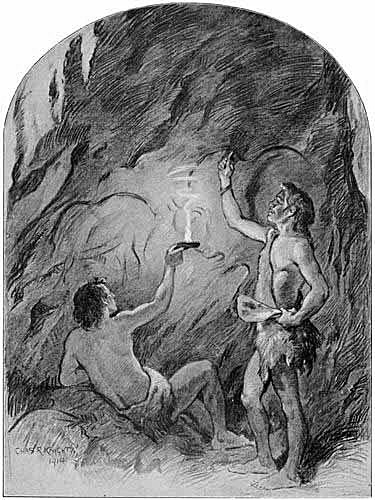
Pl. VII. Crô-Magnon man in the cavern of Font-de-Gaume, Dordogne, restored in the act of drawing the outlines of one of the bisons on the wall of the Galerie des Fresques. Drawn under the direction of the author by Charles R. Knight.
It is probable that a sense of wonder in the face of the powers of nature was connected with the development of a religious sentiment. How far their artistic work in the caverns was an expression of such sentiment and how far it was the outcome of a purely artistic impulse are matters for very careful study. Undoubtedly the inquisitive sense which led them into the deep and dangerous recesses of the caverns was accompanied by an increased sense of awe and possibly by a sentiment which we may regard as more or less religious. We may dwell for a moment on this very interesting problem of the origin of religion during the Old Stone Age, so that the reader may judge for himself in connection with the ensuing accounts of Magdalenian art.
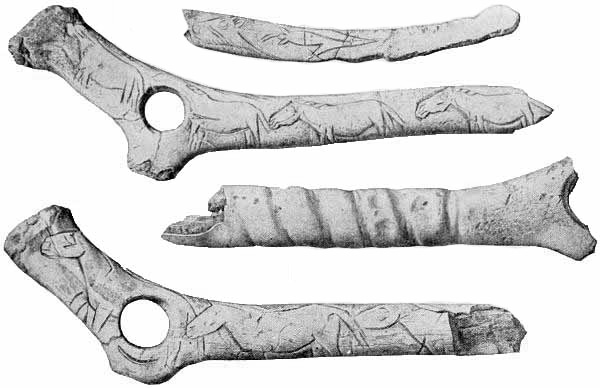
Fig. 179. Decorated bâtons de commandement carved from reindeer horn with a large perforation opposite the brow tine. After Lartet and Christy.
"The religious phenomenon," observes James,(3) "has shown itself to consist everywhere, and in all its stages, in the consciousness which individuals have of an intercourse between themselves and higher powers with which they feel themselves to be related. This intercourse is realized at the time as being both active and mutual.... The gods believed in—whether by crude savages or by men disciplined intellectually—agree with each other in recognizing personal calls.... To coerce the spiritual powers, or to square them and get them on our side, was, during enormous tracts of time, the one great object in our dealings with the natural world."
The study of this race, in our opinion, would suggest a still earlier phase in the development of religious thought than that considered by James, namely, a phase in which the wonders of nature in their various manifestations begin to arouse in the primitive mind a desire for an explanation of these phenomena, and in which it is attempted to seek such cause in some vague supernatural power underlying these otherwise unaccountable occurrences, a cause to which the primitive human spirit commences to make its appeal. According to certain anthropologists,[AU] this wonder-working force may either be personal, like the gods of Homer, or impersonal, like the Mana of the Melanesian, or the Manitou of the North American Indian. It may impress an individual when he is in a proper frame of mind, and through magic or propitiation may be brought into relation with his individual ends. Magic and religion jointly belong to the supernatural as opposed to the every-day world of the savage.
We have already seen evidence from the burials that these people apparently believed in the preparation of the bodies of the dead for a future existence. How far these beliefs and the votive sense of propitiation for protection and success in the chase are indicated by the art of the caverns is to be judged in connection with their entire life and productive effort, with their burials associated with offerings of implements and articles of food, and with their art.
The Three Climatic Cycles of Magdalenian Times
The culture of the Crô-Magnons was doubtless influenced by the changing climatic conditions of Magdalenian times, which were quite varied, so that we may trace three parallel lines of development: that of environment, as indicated by the climate and the forms of animal life, that of industry, and that of art.
The entire climatic, life, and industrial cycle of which the Magdalenian marks the conclusion has been presented in Chapter IV (p. 281). After a very long period of cold and somewhat arid climate following the fourth glaciation, it would appear that western Europe in early Magdalenian times again experienced a stage of increasing cold and moisture accompanied by the renewed advance of the glaciers in the Alpine region, in Scandinavia, and in Great Britain. This is known as the Bühl stage in the Alps, in which the snow-line descended 2,700 feet below its present level and the great glaciers thrust down along the southerly borders of Lake Lucerne a series of new moraines distinctly overlying those of the fourth glaciation. Another indication of the lowered temperature and increased moisture in the same geographic region is found in the return of the arctic lemmings from the northern tundras; these migrants have left their remains in several of the large grottos north of the Alps, especially in Schweizersbild and Kesslerloch, composing what is known as the Upper Rodent Layer, with which are associated the implements and art objects of the early Magdalenian culture stage.
We have adopted the minimum estimate of 25,000 years since the fourth glaciation, but Heim(4) has estimated that the much more recent prehistoric event of the advance of this minor Bühl glaciation began at least 24,000 years ago, that it extended over a very long period of time, and that the Bühl moraines in Lake Lucerne are at least 16,000 years of age.
The three climatic changes of Magdalenian times are therefore as follows:
First, the Bühl Postglacial Stage in the Alps, which corresponds with what Geikie has named the Fifth Glacial Epoch, or Lower Turbarian, in Scotland; for he believes that a relapse to cold conditions in northern Britain was accompanied by a partial subsidence of the coast lands, that snow-fields again appeared, that considerable glaciers descended the mountain valleys, and even reached the sea. At this time the arctic alpine flora of Scotland also descended to within 150 feet of the sea-level. The result of this renewed or fifth glaciation in western Europe was the advent of the great wave of tundra life and the descent to the plains of all the forms of Alpine life.
Larger Image
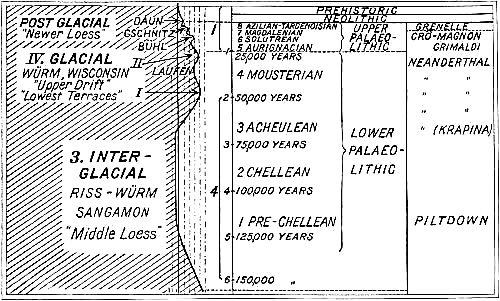
Fig. 180. Correlation of the Postglacial climatic changes with the four stages of Upper Palæolithic culture: the Aurignacian coincident with the final retreat of the fourth glaciation; the Solutrean coincident with the interval preceding the Bühl advance; the Magdalenian coincident with the Bühl and Gschnitz Postglacial advances; and the Azilian coincident with the Daun or third Postglacial advance. (Compare Fig. 14.)
Second, it would appear that in middle Magdalenian times, after the Bühl advance, there occurred a temporary retreat of the ice-fields, and that during this period the full tide of life from the steppes of western Asia and eastern Europe for the first time spread over western Europe, including especially such animals as the jerboa and the saiga antelope, the dwarf pika and steppe hamster. Correlation is very hazardous, but this ice retreat may correspond with the Upper Forestian, or Fifth Interglacial Stage in Scotland, described by Geikie, the stage which he mentions as marked by the elevation of the Scottish coast with the retreat of the sea beyond the present coast-lines; geographic changes which were accompanied by the disappearance of perennial snow and ice, and the return of more genial conditions. The tundra fauna still prevailed; such a typical arctic animal as the musk-ox wandered as far south as Dordogne and the Pyrenees, and became one of the objects of the chase. During what is known as the middle or 'full Magdalenian' the tundra, steppe, alpine, forest, and meadow faunæ spread over the plains and valleys throughout western Europe.
Third, the second Postglacial advance, known as the Gschnitz stage in the Alpine region, appears to have been contemporaneous with the closing period of Magdalenian culture. This was the last great effort of the ice-fields to conquer western Europe, and in the Alpine region the snow-line descended 1,800 feet below the present levels; it marked the closing stage of the long cold climatic period that had favored the presence of the reindeer, the woolly mammoth, and the woolly rhinoceros in western Europe, as well as the close of the 'Reindeer Epoch' of Lartet. Again, in the north of Britain Geikie observes an Upper Turbarian or Sixth Glacial Epoch, accompanied by a partial subsidence of the Scottish coast, and the return of a cold and wet climate; there is evidence of the existence of snow glaciers upon the high mountains only. The Gschnitz stage marks the end of glacial conditions in Europe, the retreat of the tundra and steppe faunæ, and the predominance of the forest and meadow environment and life.
In the Alps there was, however, still a final effort of the glaciers, known as the Daun stage, which, it is believed, broadly corresponds with the period of the Azilian-Tardenoisian industry, and a climatic condition in Europe favorable to the spread of the Eurasiatic forest and meadow life.
The key to this great prehistoric chronology is found in palæontology. The arctic tundra rodents especially are the most invaluable timekeepers; according to Schmidt(5) there is no doubt whatever that the Upper Rodent Layer, composed of the animals of the second invasion from the arctic tundras, corresponds, on the one hand, with the beginning of the Magdalenian industry and, on the other, with the renewed glacial advance in the Alpine region, known as the Bühl stage, and probably also with that in the north. The Upper Rodent Layer of Magdalenian times is found in the remarkably complete succession of deposits at the stations of Schweizersbild and Kesslerloch, which are more recent in time than the 'low terraces' bordering the neighboring River Rhine. The fossil animals prove that after the extreme cold of early Magdalenian times the tundra fauna gradually gave way to a wide-spread steppe fauna. Along the Rhine and the Danube the banded lemmings become less frequent; the jerboas, hamsters, and susliks of the steppes become more abundant. Exactly similar changes are observed in Dordogne. In Longueroche, on the Vézère, there occur for the first time in western Europe great numbers of rabbits (Lepus cuniculus); numerous hares (Lepus timidus) are also observed at the type station of La Madeleine, especially in the uppermost and lowermost culture layers. These small rabbits probably came from the Mediterranean region and denote a slight elevation of temperature. But it is only in the very highest Magdalenian layers that the animal life of western Europe begins to approach that of recent times, namely, that of the prehistoric forest and meadow faunæ.
Mammalian Life of Magdalenian Times
Thus it is very important to keep in mind that during Magdalenian times there were both cold and moist periods favorable to tundra life and cold and arid periods favorable to steppe life. In the latter were deposited the sheets of 'upper loess.'
The mammalian life of Magdalenian times is of interest not only in connection with the climate and environment of the Crô-Magnon race, but with the development of their industry and especially of their art. It is noteworthy that the imposing forms of animal life, the mammoth among the tundra fauna and the bison among the meadow fauna, made a very strong impression and were the favorite subjects of the draftsmen and colorists; but the eye was also susceptible to the beauty of the reindeer, the stag, and the horse and to the grace of the chamois. The artists and sculptors have preserved the external appearance of more than thirty forms of this wonderful mammalian assemblage, which accord exactly with the fossil records preserved in the fire-hearths of the grottos and shelters, and with the deposits assembled by beasts and birds of prey in the uninhabited caverns.
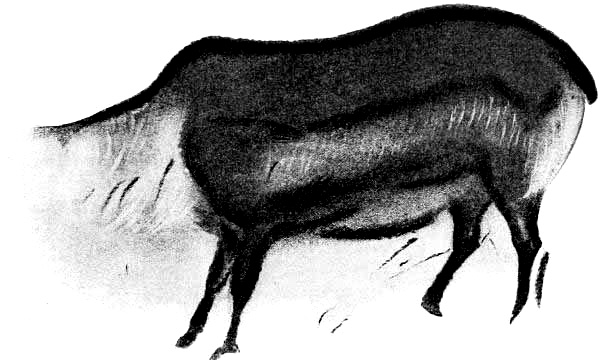
Fig. 181. Reindeer with outlines first engraved and then retraced with heavy lines of black manganese finely finished with a wash of gray tone, from the Galerie des Fresques at Font-de-Gaume. After Breuil.
No artists have ever had before them at the same time and in the same country such a wonderful panorama of animal life as that observed by the Crô-Magnons. Their representations in drawing, engraving, painting, and sculpture afford us a view of a great part of the life of the period, including its contingent of forms from the tundras, steppes, Alpine summits, and Eurasiatic forests and meadows, and the one surviving member of the Asiatic fauna, the lion.
The paintings and drawings of Dordogne chiefly represent the mammoth, reindeer, rhinoceros, bison, horses, wild cattle, red deer, ibex, lion, and bear. The caverns of the Pyrenees of southern France present chiefly bison, horses, deer, wild cattle, ibex, and chamois; the reindeer and mammoth are relatively rare, and in some cases entirely wanting in the parietal art; this is singular because in the Pyrenees the reindeer constituted the principal food of the authors of the drawings and frescos. In the caves of the Cantabrian Mountains representations of the reindeer are entirely absent, while the doe and stag of the red deer are frequently pictured; there are only a few representations of the mammoth and one of the cave-bear. In the drawings of eastern Spain deer and wild cattle are abundantly represented, and there is undoubtedly a representation of the moose at Alpera.
Favorite Art Subjects
Tundra Life. Mammoth. Woolly rhinoceros. Reindeer. Musk-ox. Steppe Life. Steppe horse. Saiga antelope. Wild ass, kiang. Asiatic Life. Lion. Desert horse. Alpine Life. Ibex. Chamois. Meadow Life. Bison. Wild cattle. Forest Life. Red deer, stag. Forest horse. Cave-bear. Wolf. Fox. Wild boar. Moose. Fallow deer. Sea Life. Seal. Reptiles, Birds, Fishes. (Rarely depicted.)
As regards the sources of this great fauna, we have observed that in late Aurignacian and Solutrean times, at Předmost, Moravia, and elsewhere, the steppe fauna was not richly represented in western Europe, for it included only the steppe horse and the wild Asiatic ass or kiang; that the contemporary tundra fauna lacked two of the smaller but most characteristic forms, the banded and the Obi lemmings, although all of the large tundra forms were still wide-spread and freely intermingled with the forest and meadow life; and that preying upon these herbivorous mammals were the surviving Asiatic lions and hyænas.
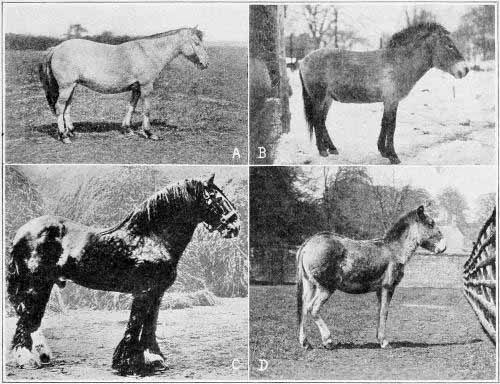
Fig. 182. Modern descendants of the four principal types of the horse family which roamed over western Europe in Upper Palæolithic times: (A) the plateau, desert, or Celtic horse, (B) the steppe or Przewalski horse, (C) the forest or Nordic horse, and (D) the kiang or wild ass of the Asiatic steppes.
The successive faunal phases of Magdalenian times, beginning with the early cold and moist or tundra period, have been determined with wonderful precision by Schmidt from the animal remains found associated with the lower, middle, and upper Magdalenian cultures in the grotto and cavern deposits of northern Switzerland, of the upper Rhine, and of the upper Danube. This region was lacking in some of the characteristic animals seen in Dordogne, yet these invaluable records show that throughout the entire period of Magdalenian times, probably extending over some thousands of years, the forests, meadows, and river borders of western Europe maintained the entire existing, or rather prehistoric, forest and meadow faunæ. The royal stag, or red deer (Cervus elaphus), was no longer accompanied by the giant deer (Megaceros), which apparently left this region of Europe in Aurignacian times, but the maral or Persian deer (Cervus maral) occasionally appears; both the stag and the roe-deer (Capreolus) were especially abundant in southwestern Europe and the Cantabrian Mountains of northern Spain, where the stag became the favorite subject of the Magdalenian artists at the same time that the reindeer was the favorite subject in the region of Dordogne. In the forests were also the brown bear, the lynx, the badger, the marten, and in the streams the beaver; tree squirrels (Sciurus vulgaris) appear for the first time; and in Dordogne rabbits and hares become numerous. Among birds we observe the grouse and the raven. The wild boar (Sus scrofa ferus) was occasionally found in the region of the Danube and the Rhine, but abounded in southwestern Europe and the Pyrenees. The two dominant forms of meadow life surviving from the earliest Pleistocene times, and widely distributed throughout the Magdalenian are the bison (B. priscus) and the wild cattle (Bos primigenius); of these animals the bison appears to have been the more hardy, and seeking a more northerly range, while the urus was extremely abundant in southwestern France and the Pyrenees.
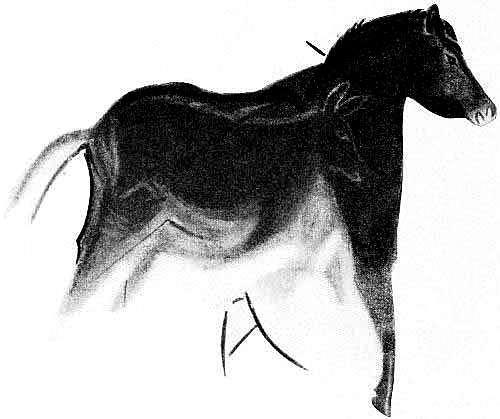
Fig. 183. The desert or Celtic horse, with delicate head, long, slender limbs, and short back, from a painting on the ceiling of Altamira, in northern Spain. The horse is painted in red ochre with black manganese outlines. The eye, ear, mouth, nostrils, and chin are carefully engraved. After Breuil.
In connection with art, the majestic form of the bison seemed to strike the fancy of the artist more than the less-imposing outlines of the wild cattle; there are perhaps fifty drawings of the bison to one of the Bos. Among the forest and meadow life, not recognized in the fossil remains, but clearly distinguished in the work of the artists, are two types of horses, the forest or Nordic horse, related to the northern or draught horse, and the diminutive plateau or desert horse (E. caballus celticus) related to the Arab. With the forest life should also be numbered the cave bear (Ursus spelæus) of southwestern Europe and the moose (Alces), indicated by the artists of Aurignacian times as present in the Cantabrian Pyrenees.
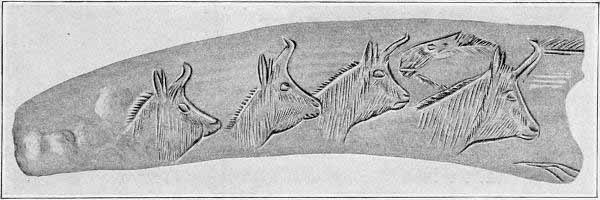
Fig. 184. Heads of four chamois engraved on a fragment of reindeer horn, from the grotto of Gourdan, Haute-Garonne. After Piette.
It is the above entire Eurasiatic forest and meadow fauna which survived all the climatic vicissitudes of Pleistocene time, and which alone remained in western Europe to the very close of the Upper Palæolithic culture, and into the period of the arrival of the Neolithic race.
The descent of the European and Asiatic alpine types of mammals to the lower hills and valleys is one of the most striking episodes of Magdalenian times. The argali sheep (Ovis argaloides) of western Asia had already appeared in the upper Danubian region during the Aurignacian; it is replaced in Magdalenian times by the ibex (Ibex priscus), and by the chamois, which descended along the northern slopes of the Alps and of the Pyrenees, and became numbered among the most highly favored subjects of the Magdalenian artists, especially in the mobile art of ivory and bone, and in the decoration of their spear throwers and bâtons de commandement. From the mountains also come the pikas or tailless hares (Lagomys pusillus), the alpine marmot (Arctomys marmotta), the alpine vole (Arvicola nivalis), and the alpine ptarmigan (Lagopus alpinus).
The Tundra Climate of Early Magdalenian Times
In the first cold moist period the full wave of arctic tundra life appeared in the whole region between the Alpine and Scandinavian glaciers during the renewed descent of the ice-fields; this was the tundra stage of early Magdalenian times, accompanying the Bühl advance. At the stations of Thaingen, Schweizersbild, Kastlhäng, and Niedernau, appears the musk-ox, together with the woolly mammoth, the woolly rhinoceros, and the reindeer. The discovery of the grotto of Kastlhäng, a reindeer hunting station in the Altmühltale of Bavaria(6) fills out what has long been a gap in the geographic distribution of the early Magdalenian. The principal objects of the chase here were the reindeer, the wild horse, the arctic hare, and the ptarmigan; the royal stag is very rare, and the bison is wanting entirely; a strong arctic character is given to the fauna by the presence of the banded lemming, the arctic wolverene, and the arctic fox. From this region the musk-ox migrated far to the southwest, reaching the northern slopes of the Pyrenees. At the same time the arctic grouse, the whistling swan, and other northern birds entered the region of the Rhine and the Danube. But the surest indicators of a cold tundra climate prevailing during the period of the Bühl advance are the banded lemming (Myodes torquatus) and the Obi lemming (Myodes obensis), which are found in the same deposits with the arctic hare, the reindeer, and the woolly mammoth mixed with the implements of the early Magdalenian industry at the stations of Sirgenstein, Wildscheuer, and Ofnet along the upper and middle Danube. There also appear the ermine and the arctic wolverene; in fact, almost all the characteristic forms of tundra life except the polar bear, which only enters the northern tundras in the summer season.
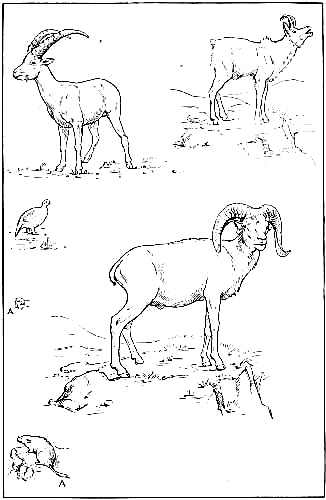
Fig. 185. Characteristic forms of alpine life, which descended from the mountains or migrated from the highlands of western Asia in Aurignacian and Magdalenian times: the ibex, the chamois, the alpine ptarmigan, the argali sheep, and the (A) alpine vole, all shown one-twenty-fifth life size; and the (A) alpine vole also one-fifth life size.
The regions of the northern Alps bordering the great glaciers of the Bühl and Gschnitz advances, were barren stretches of rock, and the valleys and plateaus now free from ice became tundras, where the swamps alternated with patches of polar willows and stunted fir-trees, while other areas were covered with low, scrubby birches, or reindeer moss and lichens. The return of these hard conditions of life undoubtedly exerted a great influence both upon the physical and mental development of the Crô-Magnon race; it was at the very period when the life conditions in western Europe were most severe that the artistic development of these people began to revive. Forced to return to the shelters and grottos, which certainly were less frequented in Solutrean times, there was time for the development of the imagination and for its expression both in the mobile and parietal arts. There was a less vigorous development of the flint industry, and apparently a degeneration in physique and stature.
In Germany and northern Switzerland, on the headwaters of the Rhine and the Danube, the entrance and departure of the northern waves of life are recorded, especially in the grottos of Sirgenstein, Schussenquelle, Andernach, Schmiechenfels, and Propstfels. It would appear that the woolly mammoth and the woolly rhinoceros were not hunted in this region, for their remains are not preserved in any of the grottos or stations mingled with the middle or late Magdalenian cultures. On the other hand, we find the steppe horse, the kiang, the stag, and the reindeer very abundant indeed. The bison is absent, and wild cattle are very rare; so that this region is not typical of the mammalian life of Magdalenian times as found in Dordogne and in the Pyrenees.
The migration of the woolly mammoth and woolly rhinoceros along the Pyrenees and westward into the Cantabrian Mountains, and the crossing of the Pyrenees by the reindeer, have already been described. In the mural frescos of Font-de-Gaume, Dordogne, it is noteworthy that the very latest engravings are those of the mammoth superposed on the fine polychromes which belong to the period of middle Magdalenian art.
The Dry Steppe Climate of Middle Magdalenian Times
The cold, dry period, when the full tide of steppe life reached western Europe, is of somewhat uncertain date; it probably began during the stage of the middle Magdalenian industry and continued into the late or high Magdalenian. There was certainly an environment attractive to these peculiar and very highly specialized mammals, which at the present time are neutral in color, swift of foot, inured to existence on very sparse vegetation, and adapted to extremes of heat and cold. Among the smaller steppe forms were the suslik or pouched marmot of the steppes (Spermophilus rufescens) and the steppe hamster (Cricetus phæus), also the Siberian vole (Arvicola gregalis); still more characteristic was the great jerboa (Alactaga jaculus), with long, springy hind legs, and the saiga antelope (Antilope saiga). With these mammals appeared the steppe grouse (Perdix cinerea), which is found along the Danube in late Magdalenian strata; another bird characteristic of the northern steppes and tundras is the 'woodcock owl' (Brachyotus palustris). Accompanying these mammals was undoubtedly the steppe horse (Equus przewalski), now restricted to the desert of Gobi; it is said to occur in the grottos of northern Switzerland.
It would appear that the saiga antelope may have reached eastern Europe in late Solutrean times, for its outline is said to be found in an engraving at Solutré. Widely spread over Europe was the giant Elasmothere; it would seem very unlikely that this animal was present in Magdalenian times, for it certainly would have attracted the attention of the artists. Neither have we any positive artistic records of the wild ass, or kiang, although certain of the drawings in the grottos of Niaux and Marsoulas, of the middle Magdalenian, also of Albarracin, in Spain, may be interpreted as representing this animal. Thus the Asiatic steppe and desert fauna, which in the region of the upper Rhine and Danube was restricted to two species of mammals in Aurignacian and Solutrean times, rises to nine or ten species in middle Magdalenian times, so that for the first time during the entire 'Reindeer Epoch' the steppe and tundra faunæ are equally balanced. There are also six or seven species of birds from the moors and uplands of central Asia. The bird life depicted in middle Magdalenian art includes the ptarmigan or grouse, the wild swan, geese, and ducks.
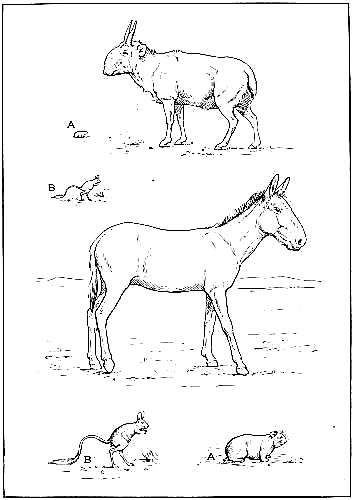
Fig. 186. Steppe mammals from the steppes and deserts of Asia, which invaded western Europe in Upper Palæolithic times; the first arrivals appearing during the cold, dry period of late Acheulean times, becoming more numerous in the dry period of Aurignacian and Solutrean times, and completely represented in Magdalenian times. The saiga antelope, the (A) steppe hamster, the (B) great jerboa, and the kiang, or Asiatic wild ass, are all shown one-twenty-fifth life size. The (A) steppe hamster is also shown one-fifth life size and the (B) great jerboa one-twelfth life size. Drawn by Erwin S. Christman.
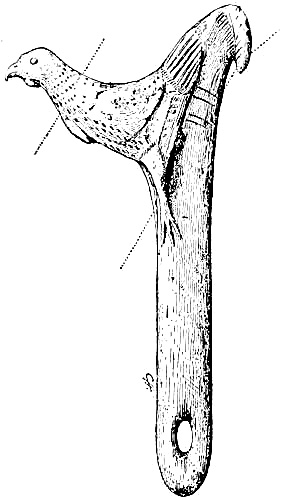
Fig. 187. Ptarmigan, or grouse, carved in reindeer horn, from Mas d'Azil. After Piette. The restored portions (head and feet) are indicated by dotted lines.
The present flora of the subarctic steppes in southeastern Russia and southwestern Siberia includes forests of pine, larch, birch, oak, alder, and willow, extending along the banks of the rivers and streams and interspersed with broad, low, grassy plains. There are many gradations between the low and high steppes;(7) the climate in summer is relatively warm, the temperature rising to 70°, while the average temperature in mid-winter hardly exceeds 30°; in general there is a strong contrast between the summer and winter seasons, the steppe lands in summer are practically rainless, so that the sand and dust rise with every wind. Thus, both in summer and winter sand and dust storms play an important rôle. The great snow-storms of the subarctic steppes are as destructive as those of the more northerly tundras and often result in great loss of life. Numerous discoveries tend to prove that similar conditions prevailed in western Europe during Magdalenian times. Thus at Châteauneuf-sur-Charente, a mingled tundra and steppe fauna is found containing the bones of many young animals which must have perished during a blizzard. It will be recalled that in this region is the station of Le Placard of late Solutrean and Magdalenian age. Near Würzburg, Bavaria, there is a fauna buried in the 'loess' containing twenty species of mammals of the tundras and steppes, together with the bison and the urus.(8)
Perhaps the strongest proof of the extension of cold, dry steppe conditions of climate is the migration of the saiga antelope (Saiga tartarica) into the Dordogne region, where it is represented both in carvings and engravings, and into other parts of southwestern France, where its fossil remains have been found in thirteen localities in association with a cold steppe fauna. In the same region have been found the remains of the musk-ox (Ovibos), one of the most distinctive members of the arctic fauna.
Human Races of Magdalenian Times
It appears that the Crô-Magnon race continued to prevail, yet anthropologists have long been divided in opinion as to the racial affinity of the men found in the Magdalenian industrial stage. The most famous burials are those of Laugerie Basse and Chancelade in Dordogne, each consisting of skeletons of inferior stature, not improbably belonging to women. They certainly represent a race somewhat different from the typical Crô-Magnons of Aurignacian times, as found at Crô-Magnon and in Grimaldi. The archæologist de Mortillet referred both these skeletons to a new race, the race de Laugerie. Schliz, who has most recently reviewed this subject, has, however, rightly treated all these people as Crô-Magnons of a modified type.
The Magdalenian skeleton of Laugerie Basse, found by Massénat in 1872, was resting on the back, with the limbs flexed, and with it was a necklace of pierced shells from the Mediterranean: the body apparently had been covered with a layer of Magdalenian implements. According to the length of the femur, the individual was 1.65 m., or 5 feet 1 inch in height; the bones were strong and compact; the skull was well arched, with a straight forehead and a cephalic index of 73.2 per cent.
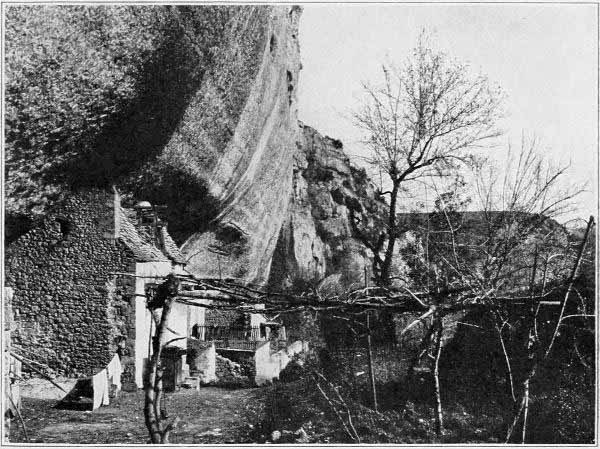
Fig. 188. The abri of Laugerie Basse, Dordogne, a famous Magdalenian station and burial site of the skeleton of Laugerie Basse. This ancient rock shelter, like that of Crô-Magnon and many others, shows at the present day a cluster of peasants' dwellings around its base. Photograph by Belvès.
The so-called Chancelade skeleton was found in the shelter of Raymonden in 1888, at a depth of 5 feet, and was also in a folded position, resting directly on the rock and covered with several layers of artifacts of the later Magdalenian culture; the limbs were so tightly flexed as to prove that they had been enveloped in bandages. This skeleton shows a well-arched skull, a high, wide forehead, and a dolichocephalic head form, but the limbs are comparatively small, the height not exceeding 1.50 m., or about 4 feet 7 inches; the upper arm and thigh are short, compact, and clumsy, and the femur is crooked with comparatively thick ends; this skeleton is generally classed with the Crô-Magnon race, but Klaatsch considers that it may belong to a distinct type. We cannot disregard, says Breuil,(9) the anatomical characters attributed by Testut to the man of Chancelade and its resemblances to the actual Eskimo type; this indication is in favor of a new element, arriving perhaps from Asiatic Siberia, but acquiring in western Europe the artistic culture realized and conserved in certain districts by the Aurignacian tribes and their derivatives. All of the Aurignacian, Solutrean, and Magdalenian races, however, recall very forcibly the race of Crô-Magnon, which tends to prove that these transformations in culture were not made without a notable element of human continuity.
DISCOVERIES OF MAGDALENIAN AGE CHIEFLY ATTRIBUTED TO THE CRÔ-MAGNON RACE[AV]
Date of Discovery Locality Nature of Remains
1863. Bruniquel (Tarn-et-Garonne, France). Skeletal fragments. Burial.
1864. La Madeleine (Dordogne, France). Skeletal fragments.
1869. Laugerie Basse I (Dordogne, France). Skeletal fragments.
1871. Gourdan (Haute-Garonne, France). Skeletal fragments.
1872. Laugerie Basse II (Dordogne, France). 1 skeleton. Burial.
1872-1873. Sorde (Duruthy) (Landes, France). 1 skeleton. Burial.
1874. Freudenthal (near Schaffhausen, Switzerland). Fragments of skulls and of pelvis.
1874. Kesslerloch (near Thaingen, Switzerland). Collar-bone.
1883. Le Placard (Charente, France). 8 skulls, chiefly fragmentary.
1888. Chancelade (Raymonden) (Dordogne, France). 1 skeleton, almost complete. Burial.
1894. Les Hôteaux (Ain, France). 1 skeleton, almost complete. Burial.
1914. Obercassel (near Bonn, Germany). 2 skeletons, male and female, almost complete. Burial. Early Magdalenian.
Les Eyzies (Dordogne, France). Skeletal fragments.
La Mouthe (Dordogne, France). 1 tooth, 1 vertebra.
Limeuil (Dordogne, France). Skull fragments.
Grotte des Hommes (Yonne, France). 3 skulls and other skeletal fragments.
Brassempouy (Landes, France). 2 teeth.
Grotte des Fées (Gironde, France). Fragments of upper and lower jaw.
Lussac (Vienne, France). Fragment of lower jaw.
Mas d'Azil (Ariège, France). 1 skull top. Early Magdalenian.
Lourdes (Hautes-Pyrénées, France). Skull fragments.
Castillo (Santander, Spain). Skull fragment. Early Magdalenian.
Gudenushöhle (Austria). 1 infant's tooth.
Andernach (north of Koblenz, Germany). 2 child's incisors and 7 rib fragments.
Another Magdalenian burial is that at Sorde, Landes, in the grotto of Duruthy; this skeleton was discovered in 1872, buried at a depth of 7 feet, the body being ornamented with a necklace and a girdle of the teeth of the lion and of the bear, pierced and engraved. Seven skulls found in 1883 in the grotto of Placard, Charente, also belong to the Magdalenian. The skeleton discovered in 1894 in the grotto of Les Hôteaux, Ain, was buried at a depth of 6 feet beneath Magdalenian implements; the body, resting on the back, was covered with red ochre; the thigh-bones were inverted, indicating that the limbs had been dismembered before burial—a custom observed among certain savages.
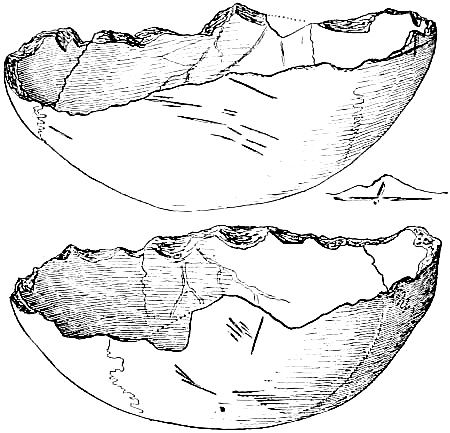
Fig. 189. Human skull-tops cut into ceremonial or drinking bowls, from the Magdalenian layer of Placard, Charente. After Breuil and Obermaier.
These are the best preserved Magdalenian remains which have been discovered in France up to the present time. The matter of chief significance is the survival of modes of burial characteristic of the Crô-Magnons in Aurignacian times, with the use of color and of ornaments and with the body in some instances folded and bandaged.
In the great grotto of Placard, near Rochebertier, Charente, a new feature in the mode of interment has been discovered—the separation of the head from the body.[AW] The previous ceremonial burials, which began certainly among the Neanderthals in Mousterian times, always show the custom of burying the entire body; in the Upper Palæolithic there commences the new custom of imbedding the body in ochre or red coloring matter, and this obtains from the Aurignacian burials of Grimaldi to the Azilian burial of Mas d'Azil. The flexing of the limbs is probably also an Upper Palæolithic custom. It would appear as if the new ceremonial of Placard had been introduced in the earliest Magdalenian times, for in the lowest Magdalenian layers four skulls were found closely crowded together, with the top of the cranium turned downward; of other portions of the skeleton only a humerus and a femur were found. In an upper layer of the same industrial stage a woman's skull and jaw were found, surrounded by snail shells, many of them perforated. Still more singular is the occurrence in Magdalenian strata of this grotto of two separate skull-tops, fashioned by some sharp flint implement into bowls (Fig. 189).
Again, at Arcy-sur-Cure three skulls have been discovered placed closely together, and with them a flint knife in a layer superposed upon an Aurignacian industry. The Placard type of burial of the head only is shown again in the Azilian stage at Ofnet, Bavaria.
The uncertainty regarding the racial affinity of the men of Magdalenian culture has now been entirely removed by the discovery, in February, 1914, of two skeletons at Obercassel, near Bonn, the first instance of complete human skeletons of Quaternary age being found in Germany.(12) As reported by Verworn,(13) the skeletons lay little more than a yard apart; they were covered by great slabs of basalt, and lay in a deposit of loam deeply tinged with red. This red coloring matter, which extended completely over the skeletons and surrounding stones, indicates that it was a ceremonial burial similar to that practised by the Aurignacian Crô-Magnons. Along with the skeletons were found bones of animals and several specimens of finely carved bone, but no flint implements of any kind. The bone implements include a finely polished 'lissoir' of beautiful workmanship, placed beneath the head of one of the skeletons; the handle is carved into a small head of some animal resembling a marten; the sides show the notched decoration so typical of the French Magdalenian. The second specimen of carved bone is one of the small, flat, narrow horse-heads, engraved on both sides, such as are found at Laugerie Basse and in the Pyrenees. One of the skeletons is of a woman about twenty years of age, and, as is usual in young female skeletons, it exhibits the racial characters in a much less marked degree than the male skeleton, which belongs to a man of between forty and fifty years; the cephalic index is 70 per cent; the supraorbital ridges are well developed, and the orbits are distinctly rectangular; the limb bones indicate a body about 155 cm., or 5 feet 1 inch, in height.
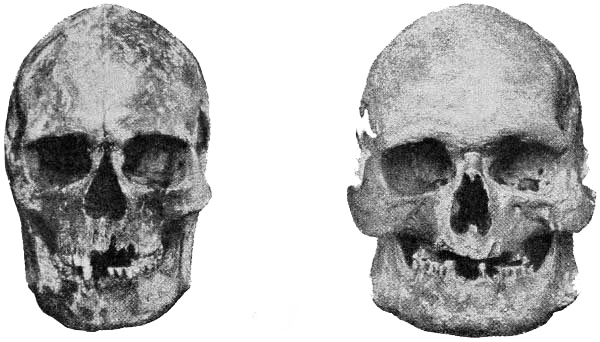
Fig. 190. The skulls of two skeletons of the Crô-Magnon race, one male (right) the other female (left), recently discovered at Obercassel near Bonn, associated with Magdalenian implements. After Bonnet.
In contrast to this more refined skull, the extremely broad and low face of the man is entirely disproportionate to the moderately broad forehead and well rounded skullcap; the breadth of the face is 153 mm. and exceeds the greatest width of the skull, which is only 144 mm. This is a markedly disharmonic type, the width of the face being due not only to the broad upper jaw but to the exceptional size and breadth of the cheek-bones. The skull is decidedly dolichocephalic, the cephalic index being 74 per cent; the brain capacity is about 1,500 c.cm.; the orbits are rectangular, and above them extends an unbroken supraorbital ridge, with a slight median frontal eminence; the nasal opening is relatively small; the lower jaw has a strongly marked chin; the crowns of the teeth have been worn down until the enamel has almost disappeared. While the muscular attachments indicate great bodily strength, the height does not exceed 5 feet 3 inches. As pronounced Crô-Magnon features, both of the Obercassel skulls show an unusually wide face; in both the profiles are straight and the root of the nose depressed, the nose is narrow, and the orbits are rectangular. But, observes Bonnet, the greatest width of these skulls is not found across the parietals, as in the typical Crô-Magnons, but just above the ear region, a much lower position; in this respect the Obercassel skulls resemble the skull of the Chancelade skeleton.
This very important discovery of two undoubted descendants of the Crô-Magnon race associated with bone implements of lower Magdalenian workmanship appears to prove conclusively that the Crô-Magnons were the art-loving race. The Obercassel skeletons confirm the evidence afforded by the burials in France that these people were of low stature; perhaps because of the severe climatic conditions of Magdalenian times they had lost the splendid physical proportions of the Crô-Magnons living along the Riviera in Aurignacian times. The skull also, while retaining all the pronounced Crô-Magnon characters, had undergone a modification in the point of greatest width.
In the reduction of the stature of the woman to 5 feet 1 inch and of the man to 5 feet 3 inches, and in the reduction of the brain capacity to 1,500 c.cm., we may be witnessing the result of exposure to very severe climatic conditions in a race which retained its fine physical and mental characteristics only under the more genial climatic conditions of the south.
The Four Industrial Phases of Magdalenian Culture
The industrial development belongs throughout to central and western Europe rather than to the Mediterranean. It is remarkable that it does not extend along the African coast, or even into Italy or southern Spain. It has been found to present four great steps or phases as follows:
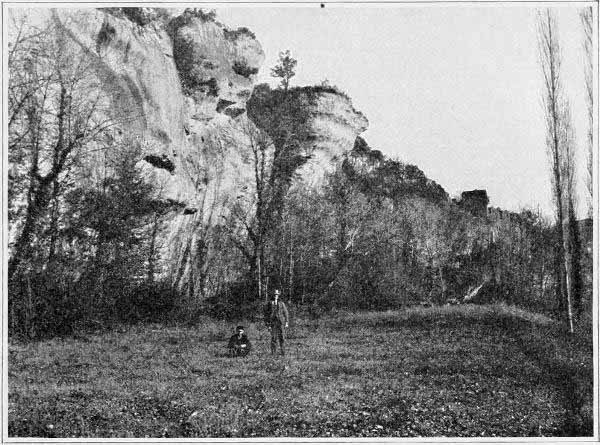
Fig. 191. The great abri, or rock shelter, of La Madeleine, type station of the Magdalenian industry. Ruins of the abbey beyond. Photograph by Belvès.
The earliest types(14) of the incipient Magdalenian culture, or Proto-Magdalenian, are nowhere better represented than under the great shelter of Placard, in Charente, where the deep successive deposits compel a realization of the long period of time required for the evolution of the Magdalenian with its wonderful artistic culmination. Even prior to any discovery of the harpoon or of any example of the art of engraving comparable to the classic series of higher levels we find three levels of incipient Magdalenian industry at Placard. Similar local horizons, recognizable from the type of their javelin points (sagaies) and from their decorative motifs, are also found at Kesslerloch, Switzerland, and as far east as Poland. From Dordogne they extend into the Pyrenees and into the Cantabrian Mountains of northern Spain, but not farther south. There is thus a very primitive Magdalenian industry wide-spread over central and western Europe, either autochthonous or influenced from the east, but certainly not from the Mediterranean. It is only above these primitive horizons that layers are discovered with the rudimentary harpoons, and then with the perfected harpoons with single and double rows of barbs. It would appear as if the basins drained by the Dordogne and the Garonne were at once the most densely populated and also the centres from which industry, culture, and art spread to the east and to the west.
In the heart of the Dordogne region is the great rock shelter of La Madeleine, the type station of Magdalenian culture, and around it are no less than fifteen stations. This station, in which the lowest industrial layer (niveau inférieur) is subsequent to the Proto-Magdalenian phase and belongs to the early Magdalenian, was extensively excavated by Lartet and Christy(15) during the decade following its discovery, in 1865, and more recently by Peyrony and others. The industrial deposit is situated at the base of an overhanging limestone escarpment on the right bank of the Vézère River; it extends for a distance of 50 feet with an average thickness of 9 feet, the lowest or early Magdalenian levels reaching down below the present level of the Vézère. It is a significant fact that the river floods which from time to time occur here also occasionally drove out the flint workers in Magdalenian times. It indicates an unchanged topography and similar conditions of rainfall. We must picture this cliff fringed with a northern flora, these river banks as the haunt of bison and reindeer, and the site of a long, narrow camp of skin-covered shelters.
Among the numerous specimens of typical Magdalenian industry and art which have been found here may be mentioned a geode of quartzite, apparently used to contain water, and stone crucibles, usually of rounded form, adapted to the grinding up of mineral colors for tattooing or artistic purposes; one of these crucibles, showing traces of color, still remains. The finest among the art objects is the spirited engraving, on a section of ivory tusk, of the woolly mammoth charging; this is one of the most realistic pieces of Palæolithic engraving which has ever been found; there are indications that the artist used this relatively small piece of ivory for the representation of three mammoths; but in the reproduction (Fig. 199) all the lines are eliminated except those belonging to the single charging mammoth; we observe especially the elevation of the head and the tail, also the remarkably lifelike action of the limbs and body.
Very numerous industrial levels are discovered in eight or ten overlying hearths, which are, however, divided into three main levels, as follows:
Niveau supérieur (late Magdalenian culture).
Harpoons with a double row of barbs. Indications that the climate was colder and drier, resembling that of the steppes. Bison, horses, and reindeer abundant.
Niveau moyen (middle Magdalenian culture).
Harpoons with barbs on one side only; also bâtons de commandement. Indications that the climate was more moist, with frequent inundations from the river. Bison, reindeer, and horses less abundant.
Niveau inférieur (early Magdalenian culture).
Harpoons with a single row of barbs. Indications of animal sculpture. Remains of bison and of reindeer, but those of horses especially numerous.
In the Early Magdalenian we note the invention of the harpoon; its first crude form is that of a short, straight point of bone, deeply grooved on one face, the ridges and notches along one edge being the only indications of what later develop into the recurved barbed points of the typical harpoon. As noted above, this invention was destined to exert a very strong influence on the habits of these people. Large fish undoubtedly were very abundant in all the rivers at that time, and this new means of obtaining an abundant food supply probably diverted the Crô-Magnons in part from the more ardent and dangerous pursuit of the larger kinds of game. The discovery soon spread, and among a number of localities where prototypes of the harpoon are found may be mentioned Placard, in Charente; Laugerie Basse, in Dordogne; Mas d'Azil, on the Arize; and Altamira, in northern Spain. In the early Magdalenian also a great variety of flint drills or borers are developed in connection with the fashioning of bone, including the 'parrot-beak' type, or recurved flint. The microlithic flints, exclusively designed for fine and delicate artistic work, are more abundant than in any previous stage, and were used to shape and finish the bone implements which chiefly distinguish the Magdalenian culture. Other implements which enable us to recognize the early Magdalenian culture layers are javelin points of bone or reindeer-horn with oblique bases, small staves of reindeer-horn or ivory, oval plates of bone frequently decorated with engraved designs, and slender, finely finished needles.
Larger Image
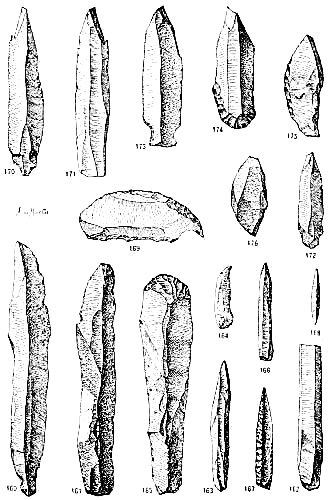
Fig. 192. Industrial and art implements of Magdalenian times, chiefly elongate flakes retouched at one or at both ends for various uses. After de Mortillet. 160. Long, narrow flint blade from the type station of La Madeleine. 161. A similar implement from the grotto of Mursens, Lot. 162. A 'knife' flake from Laugerie Basse, Dordogne. 163. A flint blade, very characteristic of the period, from La Madeleine. 164. A minute flake with cutting border and short, curved point. 165. An elongate flake shaped into a grattoir, or planing tool, at one end, from La Madeleine. 166. An elongate, pointed graving-tool, retouched at the end and at one side. 167. A pointed tool of chalcedony. 168. A minute pointed flake. 169. A 'parrot-beak' graving-tool of flint. 170. A straight flint graver, from Les Eyzies, Dordogne. 171. A similar graver, from Laugerie Basse. 172. A similar graver, from La Madeleine. 173. Flint graver with base retouched, from the Gorge d'Enfer. 174. A double-ended implement, burin and grattoir, from Laugerie Basse. 175. Flint burin, or graver, approaching the 'parrot-beak' type of 169, from Les Eyzies. 176. Double burin, or graver, of flint, from the Grotte du Chaffaud, Vienne. All figures are one-third actual size.
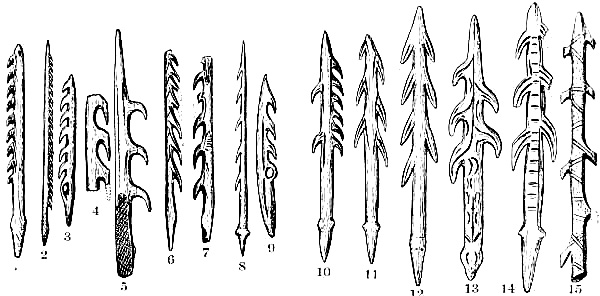
Fig. 193. Typical forms of Magdalenian bone harpoons. After Breuil. (A) 1 to 9, single-rowed harpoons, characteristic of the early and middle Magdalenian; 1, 4, 8, from Bruniquel; 2, 5, from Laugerie Basse; 6, from Mas d'Azil; 7, from La Mairie; 3 and 9, from Valle and Castillo. About one-quarter actual size. (B) 10 to 15, double-rowed harpoons, characteristic of the late Magdalenian; 10, 12, from Bruniquel; 11, from Massat; 13, from Mouthier; 14, from La Madeleine; 15, from Kesslerloch, Switzerland. About one-third actual size.
The Middle Magdalenian implements were more widely distributed than the early types, the most characteristic weapon being the harpoon with a well-defined single row of barbs (Breuil,(16) Schmidt(17)). According to Breuil, this single-rowed harpoon is rare in the lower layers but abundant in the upper layers of middle Magdalenian times; with it occur examples of the single-rowed harpoon with swallow-tail base. Other implements of this stage are the bone javelin points with cleft base, small bone staves richly decorated, also numerous needles, finer and more slender than those of the early Magdalenian. It is very interesting to note that there are no distinctive inventions in the flint industry, which shows no important advances, although microlithic flints are still more abundant than before. For industrial purposes scrapers continue to be very abundant, as well as borers for the perforation of bone implements. The middle Magdalenian industry is best represented in the deposits of central and southern France, at Raymonden, Bruniquel, Laugerie Basse, Gourdan, Mas d'Azil, and Teyjat.
The chief weapon of Late Magdalenian times is the harpoon with the double row of barbs, which is found at all the principal discovery sites extending from stations in southwestern and southern France far to the east. Besides the double-rowed harpoon, the cylindrical chisel of reindeer-horn frequently occurs, often pointed at the end and with a small curve at the side; this, like other bone implements, was richly decorated with engraving. This late Magdalenian level is distinguished everywhere by the rich decoration of all the bone implements and weapons, as well as of the 'bâtons de commandement.' The quantity of bone needles, more numerous in this stage than ever before, attests the greater refinement of finish in the preparation of clothing.
This was the culminating point both in Magdalenian industry and art, and probably also in the morale and modes of living. Characteristic types of this late Magdalenian culture are found at La Madeleine, Les Eyzies, and Teyjat, and extend into the northern Pyrenees, at Lourdes, Gourdan, and Mas d'Azil. Their easterly geographical distribution will be described on a later page. The microlithic flints now reach their culminating point; to the small bladed flakes with blunted backs are added little feather-shaped flint blades, and still others with oblique ends, which begin to suggest the geometric forms of the succeeding Tardenoisian industry. Among the flint borers we notice a prevalent type with a stout central point, also the so-called 'parrot-beak' borer; for the preparation of skins, scrapers are made, as before, of thin flakes, slightly retouched at both ends to give a rounded or rectangular form.
Following the late or high Magdalenian stage is a period of decline in industry. In southern France(18) both flint and bone implements show unmistakable indications of the approach either of the succeeding Tardenoisian or Azilian stage. In the Pyrenees both the flints and the great polishers of deer-horn begin to resemble those which occur in the post-Magdalenian levels. This industrial stage corresponds broadly with the period of decline in art, and with the change both in the industrial habits and in the artistic spirit of the Crô-Magnons.
The divisions of the Magdalenian are, therefore, as follows:
5. Decline of the Magdalenian art and industry.
4. Late Magdalenian typified at La Madeleine, Dordogne.
3. Middle Magdalenian typified at La Madeleine, Dordogne.
2. Early Magdalenian typified at La Madeleine, Dordogne.
1. Proto-Magdalenian typified at Placard, Charente.
Flint and Bone Industry
Through the four successive stages of development which we have already traced (p. 382) there are perceived certain general tendencies and characteristics which clearly separate the Magdalenian from the preceding Solutrean culture.
Compared with Solutrean times, when the art of flint working reached its high-water mark, the Magdalenian palæoliths show a marked degeneracy in technique, having neither the symmetry of form nor the finely chipped surfaces which distinguish the Solutrean types; indeed, they do not even equal the grooved marginal retouch of the best Aurignacian work. The Magdalenian retouch shows no influence of the Solutrean; it is even more blunt and marginal than the late Aurignacian. In compensation for this decadence in the art of retouch, the Crô-Magnons now show extraordinary skill in producing long, narrow, thin flakes of flint, struck off the nucleus with a single blow; these 'blades,' which are very numerous, are often not retouched at all; occasionally a few hasty touches are used to attain a rounded or oblique end; in other cases a very limited marginal chipping along the sides or the development of an elongated pedicle (soie) produces very effective implements for graving and sculptural work.
For the art of engraving perfect burins, burin-grattoirs, and burins doubles were rapidly made from these thin flakes; also burins with oblique terminal edge and with the 'parrot-beak' end. For industrial purposes some of the flints were denticulated around the border, doubtless for the preparation of fibres and of thin strips of leather for the attachment of clothing to the body and for binding of the flint and bone lance-heads to wooden shafts. Extremely fine perçoirs have been found adapted to perforating the bone needles; the grattoir, single or double, was also fashioned out of these flakes, and the nucleus of the flint was used as a hammer. Hammers of simple rounded stones are also found.
But the notable feature of Magdalenian industry is the extensive and unprecedented use of bone, horn, and ivory. From the antlers of the reindeer are early developed the sagaies or javelin points of varying size, usually ornamented along the sides and with several forms of attachment to the wooden shaft, either forked, bevelled, or rounded. The ornamentation consists of engraved elongate lines or beaded lines, and of deep grooves perhaps intended for the insertion of poisonous fluids or the outlet of blood.
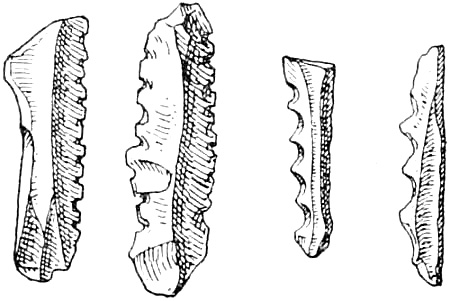
Fig. 194. Types of the flint blade with denticulated edge, a characteristic industrial tool of Magdalenian times, from Bruniquel, Les Eyzies, and Laugerie Basse. After Déchelette, by permission of M. A. Picard, Librairie Alphonse Picard et Fils.
Of all the Magdalenian weapons the most characteristic is the harpoon, the chief fishing implement, which now appears for the first time marked by the invention of the barb or point retroverted in such a manner as to hold its place in the flesh. The barb does not suddenly appear like an inventive mutation, but it very slowly evolves as its usefulness is demonstrated in practice. The shaft is very rarely perforated at the base for the attachment of a line; it is cylindrical in form, adapted to the capture of the large fish of the streams. That a barbed weapon was also used in the chase seems to be indicated by drawings in the grotto of Niaux and lines engraved on the teeth of the bear, but these drawings indicate the form of an arrow rather than of a harpoon. The length varies from two to fifteen inches. The harpoons may have been projected by means of the so-called propulseurs or dart-throwers, which resemble implements so employed by the Eskimo and Australians of to-day. These dart-throwers are often beautifully carved, as in the case of one found at Mas d'Azil, ornamented with a fine relief of the ibex.
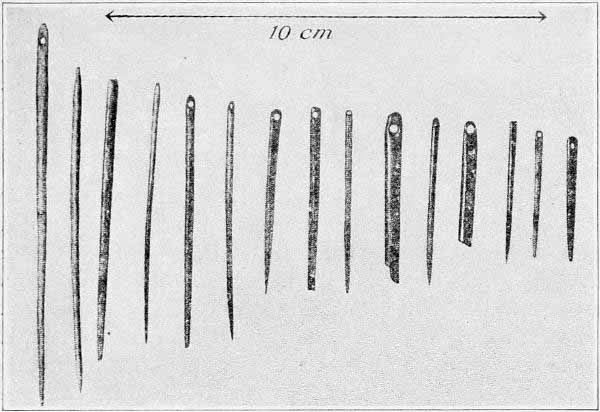
Fig. 195. Bone needles from the grotto of Lacave, Lot. After Viré.
Then there were bâtons de commandement, carved with scenes of the chase and with spirited heads of the horse and other animals, which quite probably were insignia of office. Reinach has suggested that bâtons were trophies of the chase, and according to Schoetensack they may have been used as ornaments to fasten the clothing. The discovery of mural painting and engraving suggests the possibility that these bâtons were believed to have some magical influence, and were connected with mysterious rites in the caverns, for a great variety of such ceremonial staffs is found among primitive peoples. Geographically, the bâtons spread from the Pyrenees into Belgium and eastward into Moravia and Russia.
Slender bone needles brought to a fine point on stone polishers indicate great care in the preparation of clothing. Associated with the borers are many other bone implements: awls, hammers, chisels, stilettos, pins with and without a head, spatulas, and polishers; the latter may have been employed in the preparation of leather. The borers, pins, and polishers appear from the very beginning of the period of sculpture. The name of poniard (poignard) is given to long points of reindeer-horn; one of these was found at Laugerie Basse.
History of Upper Palæolithic Art
Following the pioneer studies of Lartet, the history of the art of the Reindeer Period, as manifested in bone, ivory, and the engraved and sculptured horns of the deer, occupied the last thirty-five years of the life of Edouard Piette,(19) a magistrate of Craonne who pursued this delightful subject as an avocation. He was a pioneer in the interpretation of l'art mobilier, the mobile art. It must be remembered that in Piette's time the fourfold divisions of Upper Palæolithic culture so familiar to us were only partly perceived; his studies, in fact, related chiefly to the mobile art of Magdalenian times, and he undertook to follow its modifications in every successive grotto, beginning with his brochure La Grotte de Gourdan, in 1873, in which he first announced the idea which underlay all his later conclusions, that sculpture preceded line engraving and etching. He divided the art into a series of phases; that of the red deer (Cervus elaphus) he termed Elaphienne, that of the reindeer Tarandienne, that of the horse Hippiquienne, and that of the wild cattle Bovidienne. In concluding this early work of 1873, he remarked: "To write the history of Magdalenian art is to give the history of primitive art itself." He observed that in sculpturing the horn of the reindeer the artist was obliged to work in the hard exterior bone and to avoid the spongy interior; this defect in material suggested the invention of the bas-relief. The statuette he regarded as the assemblage of two bas-reliefs, one on either side of the bone. Thus he described the ivory head of the woman of Brassempouy, the only human face of Upper Palæolithic times which is even fairly well represented; also the two imperfect feminine torsos in ivory. In 1897, at the age of seventy, Piette undertook his last excavations, and the sum of his labors is preserved for us in the magnificent volume entitled l'Art pendant l'âge du Renne, published in 1907.
The pupil and biographer of Piette, l'Abbé Henri Breuil, observes that his scheme of art evolution is exact along its main lines.(20) It is true that human sculpture appears for the first time in the lower Aurignacian, that it survives the Solutrean, and even extends into middle Magdalenian times, but this enormous period cannot be placed in one archæological division as Piette supposed; in truth, he did not suspect the prolonged gestation of Quaternary art, but contracted into one small division the documents of numerous phases. At the same time, Piette was right in attributing the flower of the art of engraving accompanied by contours of animal forms in relief to the second and third levels of the Magdalenian industry, but he had no idea that this development had been preceded by a long period in which engraving had been practised in a timid and more or less sporadic manner as a parietal art on the walls of the caverns as well as on bone and stone. It is also true that a considerable facility in sculpture preceded the art of engraving, but it was arrested in its progress while engraving slowly developed; in the early choice of subjects the sculptors of middle and late Aurignacian times showed a preference for the human form, while later, in Solutrean and early Magdalenian times, they inclined principally toward animal figures, so that sculpture was not suddenly eclipsed. The first engravings made with fine points of flint on stone are hardly less ancient than the first sculptures, and modestly co-exist beside them up to the moment where engraving, greatly multiplied, largely supplants sculpture. Finally, observes Breuil, it is one of the glories of Edouard Piette to have understood that the painted pebbles of Mas d'Azil represented the last prolongation of the dying Quaternary art.
It is fortunate that the mantle of Piette fell upon a man of the artistic genius and appreciation of Breuil, to whom chiefly we owe our clear understanding of the chronological development of Upper Palæolithic art. In the accompanying table (p. 395) are assembled the results of the observations of Piette, Sautuola, Rivière, Cartailhac, Capitan, Breuil, and many others, largely in the order of sequence determined through the labors of Breuil.
Larger Image
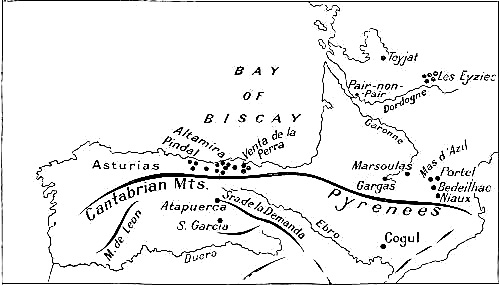
Fig. 196. Geographic distribution of the more important Palæolithic art stations of Dordogne, the Pyrenees, and the Cantabrian Mountains. After Breuil and Obermaier.
We are far from 1880, observes Cartailhac,(21) when the discovery by Sautuola of the paintings on the roof of the cavern of Altamira was met with such scepticism and indifference. Knowing the artistic instincts of the Upper Palæolithic people from their engraving and carving in bone and ivory, we should have been prepared for the discovery of a parietal art. The publication of the engravings in the grotto of La Mouthe by Rivière(22) in April, 1895, was the first warning of our oversight, and immediately Edouard Piette recalled Altamira to the memory of the workers on prehistoric art. The discovery of Sautuola ceased to be isolated. Led by the engravings found in La Mouthe, Daleau discovered the engravings in the grotto of Pair-non-Pair, Gironde. In 1902 there was the double discovery of the engravings in the grotto of Combarelles, and of the paintings in the grotto of Font-de-Gaume, communicated by Capitan and Breuil. Discoveries at Marsoulas, Mas d'Azil, La Grèze, Bernifal, and Teyjat soon followed.[AX]
STAGES IN THE DEVELOPMENT OF UPPER PALÆOLITHIC ART
Sculpture Incised Figures Painted Figures
Azilian. VI. No animaldrawings. VI. Conventional Azilian decoration. Flat pebbles (galets) colored in red and black. Mas d'Azil, Marsoulas, Pindal.
Late Magdalenian. V. Entirely wanting. V. No animal art. Various schematic and conventional figures and signs (bands, branches, lines, punctuated surfaces suggesting the Azilian galets).
Middle Magdalenian. Slender human figurines in ivory and bone. Animal forms in reindeer and stag horn on implements of the chase and ceremonial insignia. IV. Graffites feebly traced; fine lines indicating hair predominate in modelling obtained the drawings, as at Font-de-Gaume and Marsoulas. Perfected animal outlines and details. Fine animal outlines, Grotte de la Mairie, Marsoulas. Perfected engraving on bone and ivory. IV. Polychrome animal figures with the contour in black and interior through a mingling of yellow, red and black color. Constant association of raclage and of incisions with painting. Mains stylisées. Great, brilliant polychrome frescoes of Marsoulas, Font-de-Gaume, Altamira. Animal outlines in black, Niaux.
Early Magdalenian. Animal sculpture. Bisons of Tuc d'Audoubert; high reliefs of horses, Cap-Blanc. III. Deeply incised lines followed by light graffite contour lines. Incised outlines and hair, e. g. mammoths of Combarelles. Striated drawings, Castillo, Altamira, Pasiega. III. Figures of a flat tint and Chinese shading without modelling, also dotted animal figures as at Font-de-Gaume, Marsoulas, Altamira, Pasiega.
Soultrean. Bone sculpture in high relief; Isturitz, Pyrenees. Animal sculpture in the round, Předmost. Engravings.
Late Aurignacian. Heavy human statuettes (idols) of Mentone, Brassempouy, Willendorf, Brünn. Human bas-reliefs of Laussel. Heavy human figurines of Sireuil, Pair-non-Pair. II. Animal and human figures, at first very deeply incised, then less so; four limbs generally figured. Designs vigorous, somewhat awkward, as at La Mouthe, then more characteristic, as at Combarelles. II. Filling in lines at first feeble, then more and more strong, finally associated with contour modelling which ultimately covers the entire silhouette. Incised lines associated with painting as at Combarelles, Font-de-Gaume, La Mouthe, Marsoulas, Altamira.
Early Aurignacian. Animals in low relief. I. Figures deeply incised, heavy, in absolute profile; stiff in form as at Pair-non-Pair, La Grèze, La Mouthe, Gargas, Bernifal, Hornos de la Peña, Marsoulas, Altamira. Archaic animal outlines of Castillo. I. Linear tracings in monochrome, single black or red lines, indicating only a silhouette. Two limbs out of four are ordinarily figured. The most ancient paintings of Castillo, Altamira, Pindal, Font-de-Gaume, Marsoulas, La Mouthe, Combarelles, Bernifal.
Statuary and bas-relief. Mobile and parietal art in line. Parietal and mobile art in color.
In 1908 Déchelette listed eight caverns in Dordogne, six in the Pyrenees, and seven along the Cantabrian Pyrenees of northern Spain, but there are now upward of thirty caverns in which traces of parietal art have been found, and doubtless the number will be greatly enlarged by future exploration, because the entrances of many of the grottos have been closed, and the remote recesses in which drawings are placed, as in the recent discovery of Tuc d'Audoubert, are very difficult to explore.
The chief divisions of Upper Palæolithic art are as follows:
1. Drawing, engraving, and etching with fine flint points on surfaces of stone, bone, ivory, and the limestone walls of the caverns.
2. Sculpture in low or high relief, chiefly in stone, bone, and clay.
3. Sculpture in the round in stone, ivory, reindeer and stag horn.
4. Painting in line, in monochrome tone, and in polychromes of three or four colors, usually accompanied or preceded by line engraving, with flint points or low contour reliefs.
5. Conventional ornaments drawn from the repetition of animal or plant forms or the repetition of geometric lines.
Drawings and Engravings of the Early Magdlenian
We have already traced the art of engraving, as it first appears in late Aurignacian times, into the Solutrean; in the latter it is but feebly represented. Its further development in early Magdalenian times is found in the engravings made with more delicate or more sharply pointed flint implements, capable of drawing an excessively fine line; these were doubtless the early Magdalenian microliths. The animal outlines, with an indication of hair, are frequently sketched with such exceedingly fine lines as to resemble etchings; the figures are often of very small dimensions and marked by much closer attention to details, such as the eyes, the ears, the hair both of the head and the mane, and the hoofs; the proportions are also much more exact, so that these engravings become very realistic. Breuil ascribes to the early Magdalenian the engraved mammoth tracings of Combarelles. Engravings of this period are also found in the grottos of Altamira in Spain, and of Font-de-Gaume in Dordogne, and to this stage belongs the group of does at Altamira, distinguished by the peculiar lines of the hair covering the face. The subjects chosen are chiefly the red deer, reindeer, mammoth, horse, chamois, and bison. The striated drawings of Castillo and Altamira, which partly represent hair and are partly indications of shading, belong to this period.
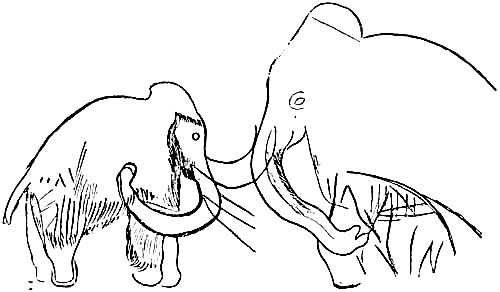
Fig. 197. Primitive outline engravings of woolly mammoths of Aurignacian or early Magdalenian times, from the walls of the cavern of Combarelles. After Breuil.
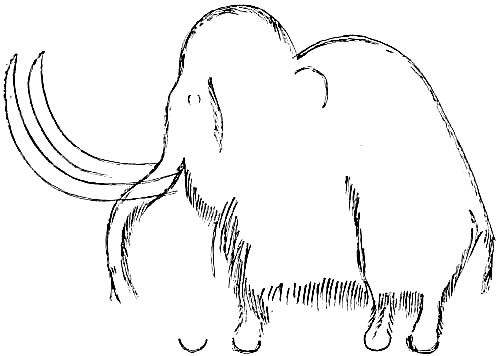
Fig. 198. Engraved outlines and hair underlying the painting of one of the mammoths, from the wall of the Galerie des Fresques, Font-de-Gaume. After Breuil.
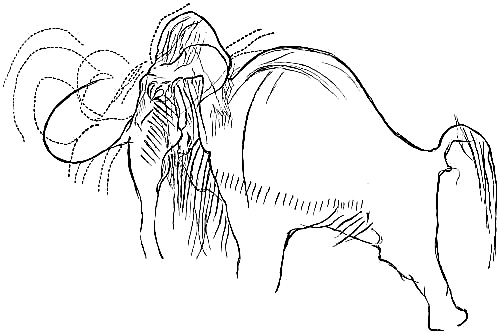
Fig. 199. Charging mammoth engraved on a piece of ivory tusk, from the station of La Madeleine. After E. Lartet. For the sake of showing this figure clearly, other outlines in this drawing, which were probably designed to indicate a herd of charging mammoths, are omitted or represented by dotted lines. This classic engraving, described on pages 384 and 385, is one of the most lifelike Palæolithic representations known of an animal in action.
The engravings in the grotto of La Mouthe were discovered by Rivière, in 1895, and were the means of directing attention afresh to the long-forgotten parietal art found in Altamira by Sautuola in 1880. The drawings at La Mouthe begin about 270 feet from the entrance and may be traced for a distance of 100 feet, scattered in various groups; they manifestly belong to a very primitive stage, probably early Magdalenian, the point of chief interest being that, while the greater part of the engravings are in simple incised lines, here and there the contour is enforced by a line of red or black paint; this is the beginning of a method pursued throughout the Magdalenian parietal art, in which the artist carefully sketches his contours with sharp-pointed flints before he applies any color. This treatment, at first limited to the simple outlines, led to tracing in many of the details with engraved lines, the eyes, the ears, the hair; thus Breuil has shown that in its final development a carefully worked-out engraving underlies the painting. In the La Mouthe drawings the proportions are very bad; they represent the reindeer, bison, mammoth, horse, ibex, and urus; spots of red are sometimes splashed on the sides of the animals; here and there is a bit of superior work, such as the reindeer in motion.
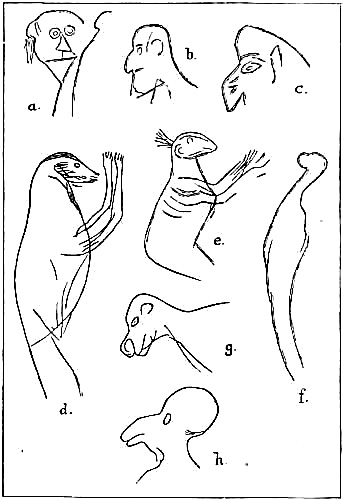
Fig. 200. Engraved outlines believed to represent human grotesques or masked figures found on the cavern walls of Marsoulas, Altamira, and Combarelles. After Obermaier.
The cavern of Combarelles, discovered in 1901, in Dordogne, near Les Eyzies, contains by far the most remarkable record of early Magdalenian art; there are upward of four hundred drawings and engravings representing almost every animal of early Magdalenian times, among them the horse, rhinoceros, mammoth, reindeer, bison, stag, ibex, lion, and wolf; there are also between five and six representations of the men of the time, both masked and unmasked; the style is more recent than that of the oldest drawings in Font-de-Gaume, but much more ancient than the period of polychrome art.[AY] The gallery is 720 feet long, and barely 6 feet broad; the drawings begin about 350 feet from the entrance, and are scattered at irregular intervals to the very end. In general the art is very fine and evidently largely the work of one artist; representations of the woolly rhinoceros and of the mammoth are very true to life; there is a pair of splendid lions, male and female; the drawings of the horse are abundant, and side by side we have a representation of several types of horses, the pure forest type with the arched forehead, the small, fine-headed Celtic type, and a larger type reminding us of the kiang, or wild ass. Here the greater part of the work is engraving, as contrasted with the painted outlines in the cavern of Niaux and with the etched outlines of the Grotte de la Mairie.
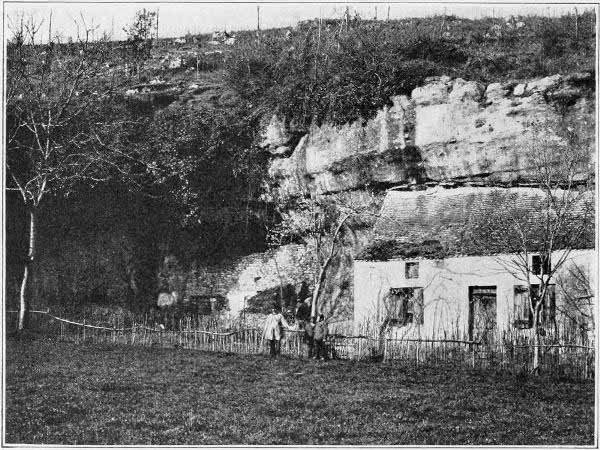
Fig. 201. Entrance to the cavern of Combarelles near Les Eyzies, Dordogne, where upward of four hundred wall engravings have been discovered. Photograph by Belvès.
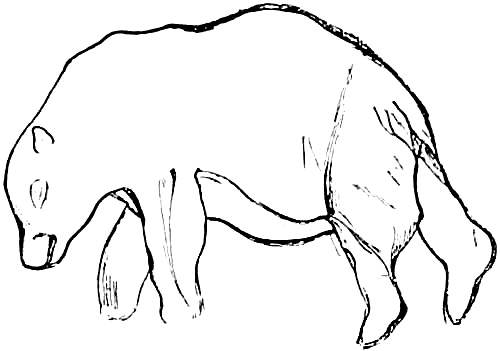
Fig. 202. Cave-bear engraved in outline, from the cavern of Combarelles. After Breuil.
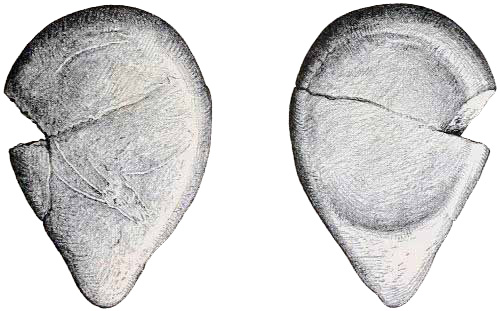
Fig. 203. Stone lamp of Magdalenian age discovered in the grotto of La Mouthe by E. Rivière. It is cut in sandstone and ornamented on the lower surface with the head and horns of the ibex. Such lamps were doubtless used by the artists to light the deep recesses of the caverns. After Rivière, redrawn by Erwin S. Christman. One-third actual size. (Compare Pl. VII.)
Even a large cavern like Combarelles offers comparatively few surfaces favorable to these engraved lines; but, small or large, such surfaces were eagerly sought, sometimes near the floor, sometimes on the walls, and again on the ceilings; even with the brilliant light of an acetylene lamp it is now difficult to discover all these outlines, some of which are drawn in the most unlooked-for places. If the extremely fine incisions, such as those representing the hair of the mammoth, are so difficult to detect with a powerful illuminant, one may imagine the task of the Crô-Magnon artists with their small stone lamps and wick fed by the melting grease. One such lamp has been found in the grotto of La Mouthe, about 50 feet from the entrance; the workman's pick broke it into four pieces, only three of which were recovered. The shallow bowl contained some carbonized matter, an analysis of which led Berthelot, the chemist, to conclude that an animal fat was used for lighting purposes. Like most other implements, this lamp is decorated—in this instance by an engraving of the head and horns of the ibex. Three of these lamps have been found in Charente and Lot, and it is noteworthy that lamps similar to those of the Magdalenian period are used in Dordogne at the present day.
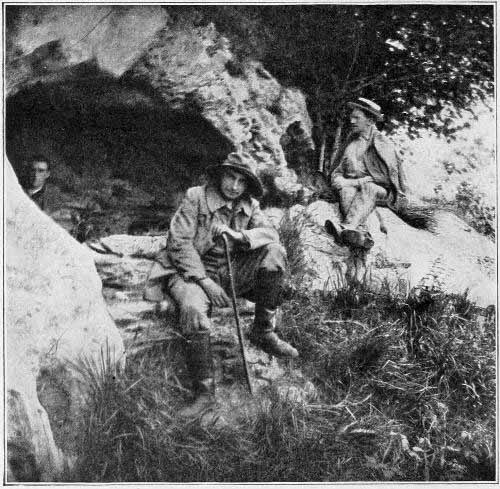
Fig. 204. Entrance to the cavern of La Pasiega, not far from Castillo. The seated figure with the staff is M. l'Abbé Henri Breuil, the present leader in the study of Upper Palæolithic art. Photograph by N. C. Nelson.
In the great cavern of Castillo,[AZ] at Puente-Viesgo, discovered in 1903 by Alcalde del Rio, which is entered by the majestic grotto already described on p. 162, the animal drawings are mostly of an archaic character, belonging to the very beginnings of early Aurignacian parietal art. The most abundant subjects are horses and deer, which entirely replace the reindeer drawings so abundant in central France, outlines of the stag and of the doe being very numerous; on the other hand, the bison and the ox are rarely drawn. Belonging to the category of most primitive painting are the simple outlines in black of a horse and of a mammoth, the two limbs of one side being represented as inverted triangles, terminating in a sharp point, like the drawings of children. Of more recent style are the rather crude polychrome bisons, numerous hands outlined in red, and a vast number of tectiform signs and symbols which represent inferior work of the middle Magdalenian period.
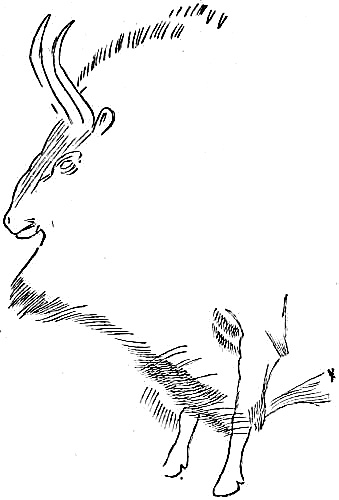
Fig. 205. Carefully engraved half-figure of a bison, from the cavern of Marsoulas; an example of the engraver's work preceding the application of color. After Breuil. One-eighth actual size.
On the other side of the same mountain is the grotto of Pasiega, discovered in 1912 by Doctor Hugo Obermaier. This small grotto, about 500 feet above the river, receives its name as a retreat of the shepherds. In the floor is a very narrow opening through which one rapidly descends by means of a tube of limestone barely large enough to admit the passage of the body. The interior is very labyrinthine. After passing through the Galerie des Animaux and the Galerie des Inscriptions, one reaches, after a most difficult détour, the terminal chamber, which Obermaier has called the Salle du Trône, the throne-room; here there is a natural seat of limestone, with supports at the sides for the arms, and one can still see the discoloration of the rock by the soiled hands of the magicians or of the artists. In this salle there are a few drawings and engravings on the walls, and a few pieces of flint have been discovered. In no other cavern, perhaps, is there a greater sense of mystery as to the influence, whether religious, magical, or artistic, which impelled men to seek out and enter these dangerous passages, the slippery rocks illumined at best by a very imperfect light, leading to the deep and dangerous recesses below, where a misstep would be fatal. The impulse, whatever it may have been, was doubtless very strong, and in this, as in other caverns, almost every surface favorably prepared by the processes of nature has received a drawing. No industrial flints have been found at the entrance to this cavern, but some have been traced into the interior. The art is considered partly of late Aurignacian, perhaps of Solutrean, and certainly in part of early Magdalenian times; in general it is much more recent than that of Castillo. It consists both of engravings and painted outlines, with proportions usually excellent and sometimes admirable. The paintings of deer are in yellow ochre, of the chamois in red. There are altogether 226 paintings and 36 engravings, in which are represented 50 roe-deer, 51 horses, 47 tectiforms, 16 Bos, 15 bison, 12 stags, 9 ibexes, 1 chamois, and 16 other forms, distributed in all parts of the cave. The outlines are in solid red color or in stripes of red or black, or there is a series of spots; the subjects are chiefly the stag, the doe, the wild cattle (which are rather common), the bison (which are less common), the ibex, and the chamois. Among the numerous representations of the horse there are two small engravings of a type with erect mane, both the feet and the hair being indicated with great care, the limbs well designed and of excellent proportions, clearly in early Magdalenian style. Of the utmost interest is the discovery here of two horses drawn with rounded forehead and drooping mane, the only instance in which the drooping mane of the modern type of horse (Equus caballus) has been observed in the cavern drawings.
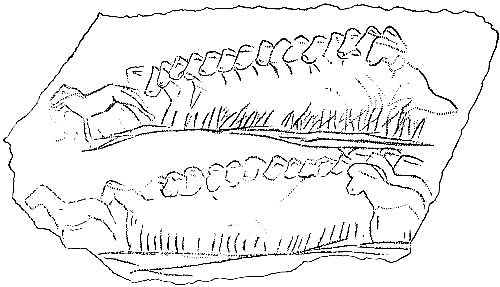
Fig. 206. Herd of horses engraved on a small slab of stone, found in the grotto of Chaffaud, Vienne, France. After Cartailhac. This impressionistic grouping and perspective is very exceptional in Palæolithic design. About nine-tenths actual size.
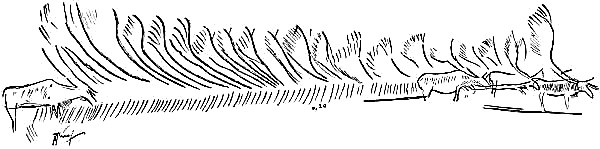
Fig. 207. Impressionistic design of a herd of reindeer engraved on the radius of an eagle nearly eight inches in length, found in the upper Magdalenian layers of the Grotte de la Mairie. After Capitan and Breuil.
In the advanced development of middle or high Magdalenian art, parietal engraving with finely pointed flint implements presents a nearer approach to the truth both of proportion and of detail than do the earlier stages. In this stage the engravings seem to consist chiefly of independent animal figures and to furnish a prelude to the application of color. A simple but striking example of approaching perfection of technique is seen in the bison (Fig. 205) engraved in the cavern of Marsoulas, where the profile is outlined and great shaggy masses of hair beneath the neck are admirably indicated. In these drawings the complicated details of the feet, with their characteristic tufts of hair, and of the head show far more careful observation. In the great series of bison at Font-de-Gaume the entire animal is sketched in with these finely engraved lines, as brought out through the wonderfully close observation and studies of Breuil. This is quite similar to the practice of the modern artist who sketches his figure in crayon or charcoal before applying the color.
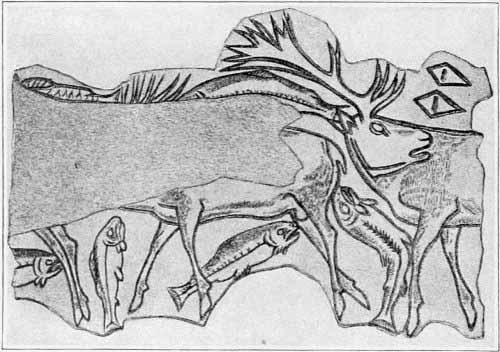
Fig. 208. Reindeer and salmon engraved on an antler, from Lorthet, Hautes-Pyrénées. After Piette. This design is believed to represent a herd of reindeer crossing a stream, one of the very rare Palæolithic attempts at composition.
There are two quite different styles in this engraving, one seen in the deep incised lines of the reindeer head in the cavern of Tuc d'Audoubert (Fig. 232), a complete design in itself, another seen in the deep incisions in the limestone outlining the horses and the bison as observed in the cavern of Niaux (Fig. 174). Here the engraved line is followed by the application of a black painted line, the effect being to bring out the body in the surrounding rock so as to give the silhouette a high relief.
In the drawings in the large on these curved wall surfaces, only part of which could be seen by the eye at one time, the difficulties of maintaining the proportions were extreme, and one is ever impressed by the boldness and confidence with which the long sweeping strokes of the flint were made, for one rarely if ever sees any evidences of corrected outline. Only a lifelong observer of the fine points which distinguish the different prehistoric breeds of the horse could appreciate the extraordinary skill with which the spirited, aristocratic lines of the Celtic are executed, on the one hand, and, on the other, the plebeian and heavy outlines of the steppe horse. In the best examples of Magdalenian engraving, both parietal and on bone or ivory, one can almost immediately detect the specific type of horse which the artist had before him or in mind, also the season of the year, as indicated by the representation of a summer or winter coat of hair.
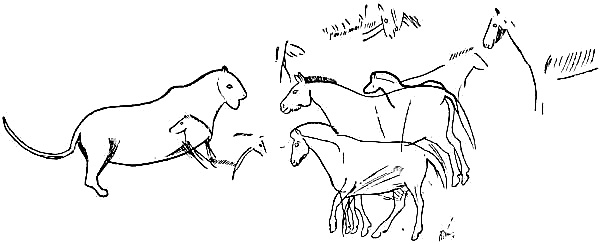
Fig. 209. Outlines of a lioness and a small group of horses of the Celtic or Arab type, a delicate wall engraving in the Diverticule final of the cavern of Font-de-Gaume. After Breuil.
The realism of most of the parietal art passes into the impressionism of the excessively fine engravings on bone or reindeer horn, executed with a few strokes, of a herd of horses or of reindeer (Fig. 207), or where a herd of deer is seen (Fig. 208) crossing a stream full of fishes, as in the well-known engravings on reindeer horn found in the grotto of Lorthet, in the Pyrenees. This is one of the very rare instances in Palæolithic art, either engraving or painting, which shows a sense of composition or the treatment of a subject or incident involving more than one figure. Others are the herd of passing reindeer found engraved on a bit of schist in the grotto of Laugerie Basse, the lion facing a group of horses engraved on a stalagmite at Font-de-Gaume, and the procession of mammoths engraved upon a procession of bison in the same cavern.
Beginnings of Painting
The beginnings of painting in Aurignacian times, consisting of simple contours and crude outlines in red or black, with little or no attempt at shading, pass in early Magdalenian time(24) into a long phase of monochromes, either in black or red, in which the technique pursues a number of variations, from simple linear treatment, continuous or dotted, to half tints or full tints, gradually encroaching on the sides of the body from the linear contour. Of this order are the figures in flat tints and shading, resembling those of the Chinese, without modelling; also the figures entirely covered with dots, such as are seen at Marsoulas, Font-de-Gaume, and Altamira. The tints, as in the drawing of the galloping steppe horse, pass inward from the black outline to enhance the effect of roundness or relief. In the splendid series of paintings in the cavern of Niaux there is little more than the black outline of the body, but the covering of the sides with lines, indicating the hair, lends itself to the rounded presentation of form. A somewhat similar effect is sought in the lines of the woolly rhinoceros painted in red in the cavern of Font-de-Gaume, which Breuil attributes to the Aurignacian stage, but which also suggests the early Magdalenian.
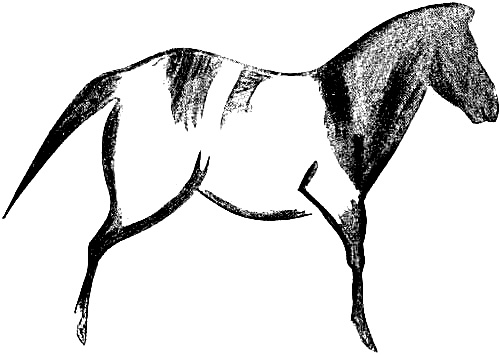
Fig. 210. Early painting. A small horse of the Celtic or Arab type, with painted outline and body colored in black, from a wall of the cavern of Castillo, Spain. After Breuil.
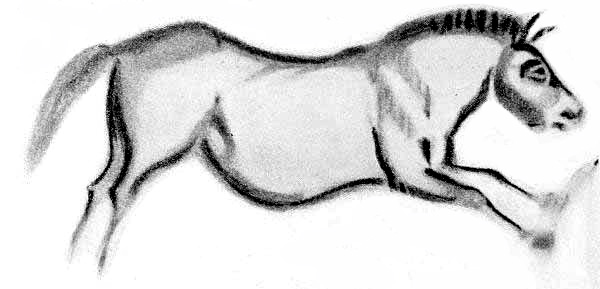
Fig. 211. Early painting. Galloping horse of the Celtic or of the steppe type painted in black and white, from a wall of the cavern of Font-de-Gaume. After Breuil.
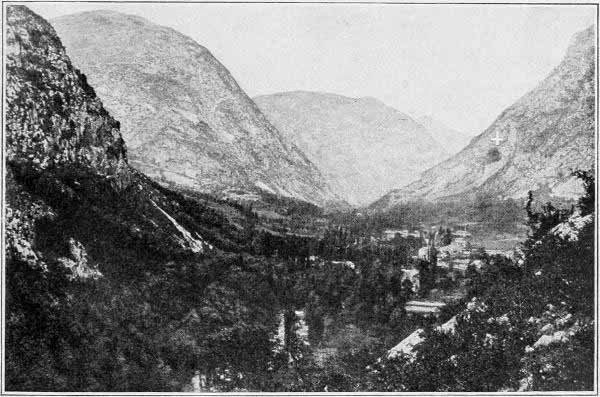
Fig. 212. Opening (cross) of the cavern of Niaux, in the Pyrenees, near Tarascon.
Drawings in Various Caverns of the Early and Middle Magdalenian
The grandest cavern thus far discovered in France is that of Niaux (1906), which from a small opening on the side of a limestone mountain and 300 feet above the River Vic de Sos extends almost horizontally 4,200 feet into the heart of the mountain.(25) Not far from Tarascon on the Ariège it lay near one of the most accessible routes between France and Spain. Passing through the long gallery beyond the borders of the subterranean lake which bars the entrance, at a distance of half a mile we reach a great chamber where the overhanging walls of limestone have been finely polished by the sands and gravels transported by the subglacial streams; on these broad, slightly concave panels of a very light ochre color are drawings of a large number of bison and of horses, as fresh and brilliant as if they were the work of yesterday; the outlines drawn with black oxide of manganese and grease on the smooth stone resemble coarse lithography. The animals are drawn in splendid, bold contours, with no cross-hatching, but with solid masses of bright color here and there; the bison, as the most admired animal of the chase, is drawn majestically with a superb crest, the muzzle most perfectly outlined, the horns indicated by single lines only, the eyes with the defiant expression highly distinctive of the animal when wounded or enraged. Here for the first time are revealed the early Magdalenian methods of hunting the bison, for upon their flanks are clearly traced one or more arrow or spear heads with the shafts still attached; the most positive proof of the use of the arrow is the apparent termination of the wooden shaft in the feathers which are rudely represented in three of the drawings. There are also many silhouettes of horses which strongly resemble the pure Asiatic steppe type now living in the desert of Gobi, the Przewalski horse, with erect mane and with no drooping forelock; in contrast to the bison, the eyes are rather dull and stupid in expression. There are also drawings of other types of horses, a very fine ibex, a chamois, a few outlines of wild cattle, and a very fine one of the royal stag; we find no reindeer or mammoth represented. In some of the narrower passages the rock has been beautifully sculptured by water, and the artists have been quick to take advantage of any natural lines to add a bit of color here or there and thus bring out the outline of a bison.