Chapter V · (continued 2)
Reading edition
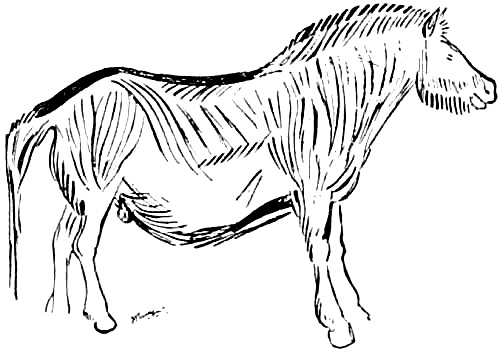
Fig. 213. Engraved and painted horse, apparently of the Celtic type and with heavy winter coat, from the cavern of Niaux. There is a mark behind the right shoulder which has been interpreted as the sign of an arrow or spear head. After Cartailhac and Breuil. (Compare Fig. 174.)
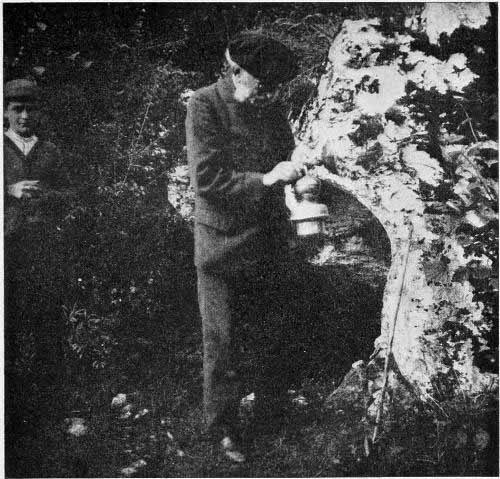
Fig. 214. Professor Emile Cartailhac at the entrance of the cavern of Le Portel, Ariège. Photograph by H. F. Osborn.
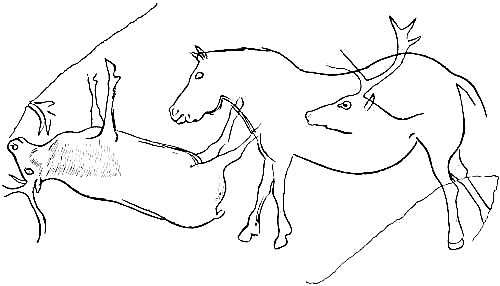
Fig. 215. Finely engraved outlines of the Celtic horse and of the reindeer, in the Grotte de la Mairie, near Teyjat, Dordogne. After Capitan and Breuil.
Presenting the widest possible contrast to Niaux is the cavern of Le Portel, west of Tarascon, with its contracted entrance and a very rapidly descending passage hardly broad enough to admit the body. This narrow and tortuous cave terminates in an extremely small passage, so narrow as barely to admit the athletic and determined artist explorer, the Abbé Breuil. Here, as in Font-de-Gaume and other caverns, is one of the greatest mysteries of the cave art, namely, that these terminal and dangerous diverticules finals were wrought with some of the most careful and artistic designs. Le Portel, like Niaux, reveals a single style, but one altogether different. Very numerous bison are drawn in outline both in red and black; the sides of the body are often dotted with red or hatched in close parallel lines. On a long horizontal panel are seen many bison in red, and one observes here a finely drawn pair of bison feet in the best Magdalenian style. The horse as represented here is of a quite different type with thin upper tail and a tail-tuft resembling that of the wild ass, so that one is almost tempted to believe that the kiang is intended, but the ears are too short; it has a high rump and a high, splendidly arched neck, like that of the stallion, and the eye is better drawn; the body is covered with long vertical or oblique lines which might be mistaken for stripes, but this hatching is a matter of technique only. Again, the mane is erect, and there is no forelock; in fact, none of these Magdalenian artists has represented the horse with the forelock, indicating that this character of the modern horse was unknown in western Europe and probably came in during Neolithic times.
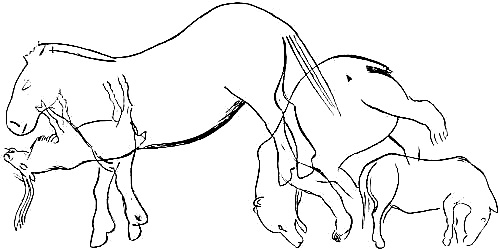
Fig. 216. Reindeer, cave-bear, and two horses of the large-headed forest type with arched forehead, engraved on a panel about twenty inches in length in the Grotte de la Mairie. After Capitan and Breuil.
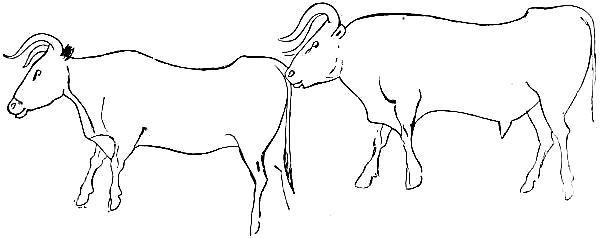
Fig. 217. Wild cattle, bull and cow (Bos primigenius), engraved in the Grotte de la Mairie, each figure being about twenty inches in length. After Capitan and Breuil.
Of an entirely different type are the beautifully engraved miniature figures of animals discovered in 1903 in the Grotte de la Mairie.(26) The outlines, from 18 to 20 inches in length, are sharply engraved on the limestone stalagmites; they are all in the middle Magdalenian style and include the stag, reindeer, bison, cave-bear, lion, wild cattle, and two very distinct types of horses: one of these types is large-headed with an arched forehead; this is probably the forest type and perhaps represents the horse most abundant at the Solutré encampment (see p. 288); the other horse is small-headed, with a perfectly flat, straight forehead, corresponding with the Arab or Celtic pony type.
Drawings and Paintings of the End of the Middle Magdalenian
The fourth and final developmental phase of painting flowers out toward the end of middle Magdalenian times in the grand period of polychromes. These are first etched with underlying lines engraved with flint, the surface of the limestone having been previously prepared by the thinning or scraping of the borders (raclage) to heighten the relief of the drawing; then a very strong contour is laid down in black, and this may be followed by a further contour line in red (the use of black and red is very ancient); an ochreous brown color is mixed in, conforming well with what we know to be the tints of the hairy portions of the bison. Thus gradually a complete polychrome fresco art develops. The final stage of this art follows, in which the filling out of various tones of color requires the use of black, brown, red, and yellowish shades. The underlying or preliminary engraving now begins to recede, being retained only for the tracing in of the final details of the hair, the eyes, the horns, and the hoofs. The early stages of this art are seen in the cavern of Marsoulas, and its height is reached in the mural frescos of Font-de-Gaume and in the ceiling of Altamira, the latter still in a perfect and brilliant state of preservation.
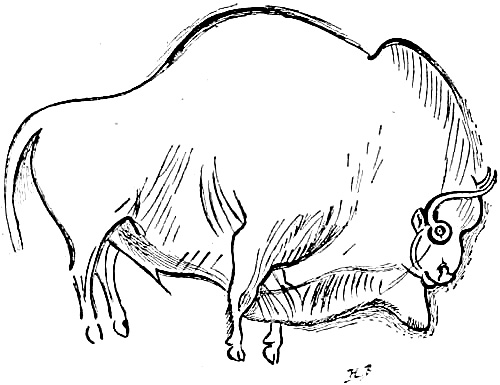
Fig. 218. Outline of one of the bison in the Galerie des Fresques at Font-de-Gaume, showing the preliminary etching or engraving preparatory to the polychrome fresco painting. After Breuil.
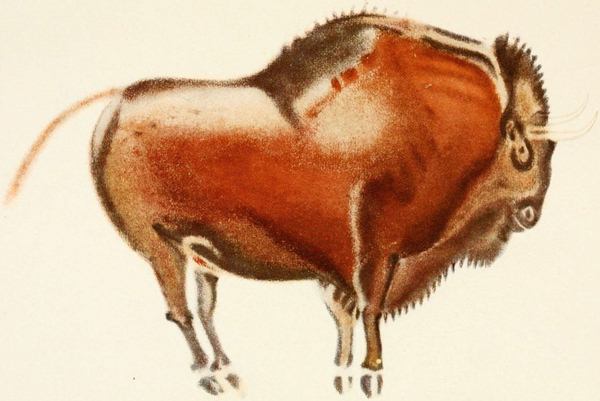
Pl. VIII. One of the bisons on the ceiling of Altamira, representing the final stage of polychrome art in which four shades of color are used. After Breuil.
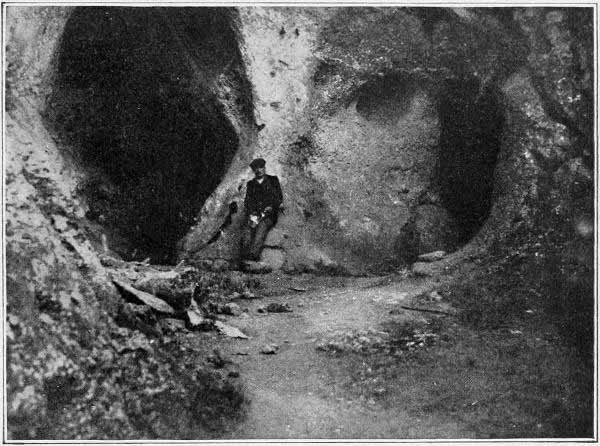
Fig. 219. Entrance on the right to the grotto leading to the great cavern of Font-de-Gaume on the Beune. Photograph by N. C. Nelson.
To prepare the colors, ochre and oxide of manganese were ground down to a fine powder in stone mortars; raw pigment was carried in ornamented cases made from the lower-limb bones of the reindeer, and such tubes still containing the ochre have been found in the Magdalenian hearths; the mingling of the finely ground powder with the animal oils or fats that were used was probably done on the flat side of the shoulder-blade of the reindeer or on some other palette. The pigment was quite permanent, and in the darkness of the Altamira grotto it has been so perfectly preserved that the colors are still as brilliant as if they had been applied yesterday.
The art of the grotto of Marsoulas, in the Pyrenees, is both of an earlier and of a later period; the engraved lines, as of the head and front of a bison, are beautifully done in advanced Magdalenian style, deep incisions representing the larger outlines and finer incisions representing the hair; here the outlines are also traced in color, and there are several masks or grotesques of the human face; these last are treated with a total disregard of the truth which characterizes the animal work. Among the few bison represented here, some are covered with dots or splashes of color, others show the painted outline which begins to extend over the surface with gradations of tint, anticipating the color effects attained in the finished paintings of Altamira and of Font-de-Gaume. All the details of the early technique are found here: the artist outlines the form with an engraved line; he traces in black color the contours of the head and of the body; he begins to apply masses of red over the figure. This beginning of polychrome art at Marsoulas is a step toward coloring the entire surface with red ochre and black, as in the finished paintings of a later period.
Larger Image
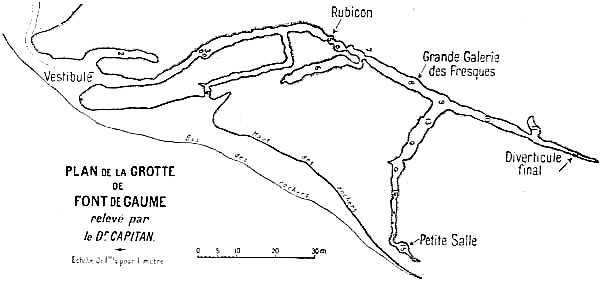
Fig. 220. Map of the cavern of Font-de-Gaume, showing the 'Rubicon,' the Grande Galerie des Fresques, in which the chief polychrome paintings are found, and the Diverticule final. After Capitan.
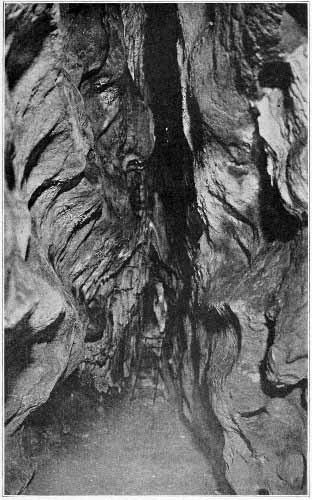
Fig. 221. Narrow passage in the cavern of Font-de-Gaume, known as the 'Rubicon.' On the left wall at this point are two painted bison, and on both walls are marks left by the claws of the cave-bear. After Lassalle.
The grand cavern of Font-de-Gaume,(27) on the Beune, not far from Les Eyzies, contains the most complete record of Upper Palæolithic art, especially from the close of Aurignacian to the close of Magdalenian times. There are crude Aurignacian drawings, simple outlines painted in black, outlines supplemented by the indication of hair (examples of the early stages in the development of polychrome work as well as of the very highest stages), compositions like the lion and the group of horses, and the murals in the Galerie des Fresques, which show a general composition in the processions of animals, as well as some special compositions such as the reindeer and bison facing each other. The life depicted is largely that of the tundras, mammoths, rhinoceroses, and reindeer, but it also includes the steppe or Celtic type of horse, represented galloping (Fig. 211), and a small group of horses of the Arab or Celtic type. Of the meadow fauna the bison is generally represented in preference to the wild ox or urus.
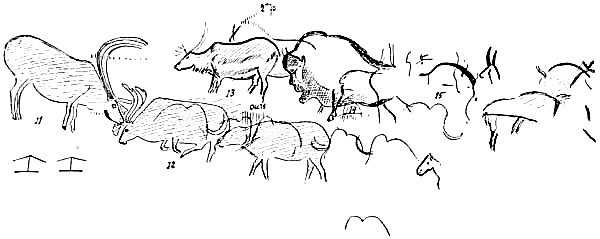
Fig. 222. Plan of a portion of the left wall decoration in the Galerie des Fresques at Font-de-Gaume, showing reindeer and the procession of bison. After Breuil.
Throughout the cavern the favorable surfaces of the walls are crowded with engravings, and in the Galerie des Fresques, beyond the narrow passage known as the 'Rubicon' (Fig. 221), we see altogether the finest examples of Upper Palæolithic art. On each side of this gallery is a peculiarly advantageous mural surface, broad, relatively smooth, and gently concave (Pl. VII), probably the best which any cavern afforded, and here we observe great processions of mammals superposed upon each other, like the records of a palimpsest, as if such a surface was so rare that it was visited again and again. The most imposing series is that of the bison, done in the finest polychrome style, mostly headed in one direction. The reindeer form another series and in some instances face each other, although mainly arranged in a long procession facing to the left. This superposition of drawing upon drawing ends with the latest superposition in finely incised lines of a great procession of mammoths upon that of the polychrome bisons. It is somewhat difficult to reconcile a religious or votive interpretation with the multiplication of these drawings upon each other. Moreover, it appears to be inconsistent with the reverent spirit which pervades the work in this and in all other caverns, for what impresses one most is the absence of trivial work or meaningless drawings.
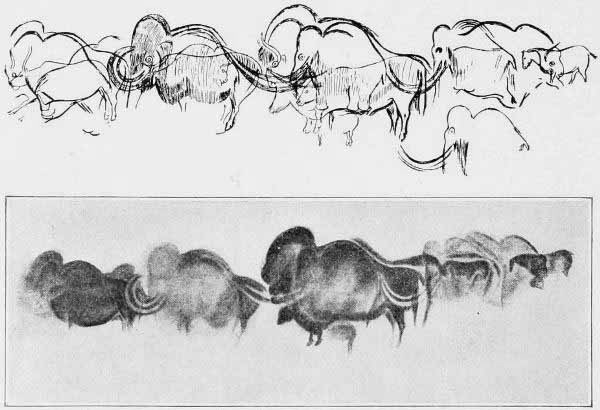
Fig. 223. Another portion of the left wall decoration of the Galerie des Fresques, showing the preliminary engraving (above), and the painting (below) of the great procession of mammoths, superposed upon drawings of the bison, reindeer, and horse. This section is about fourteen feet in length. After Breuil.
It seems as if at every stage in their artistic development these people were intensely serious about their work, each drawing being executed with the utmost possible care, according to the degree of artistic development and appreciation.
In the great gallery of frescos we find not less than eighty figures, in some cases partly covered by a fine sheen of stalagmitic limestone; these include 49 bison, 4 reindeer, 4 horses, and 15 mammoths. The bison polychromes have suffered somewhat in color and are far less brilliant than those at Altamira. In the polychromes the color is applied either in long lines of red or black surrounding the contours of the animal or in flat tints placed side by side, or again the two colors are mingled and give intermediate tints with striking effect. On one of the finest of these bison is the underlying drawing of a reindeer, a wild boar, and the superposition of an excellent engraving of a mammoth, which is represented on an altogether different scale, so that it falls well within the body lines of the bison (Fig. 224). In each of these mammoths the grotesque but truthful contour is preserved in the drapery of hair which almost completely envelops the limbs; the emphasizing of the sudden depression of the dorsal line behind the head is everywhere the same and undoubtedly conforms very closely to nature.
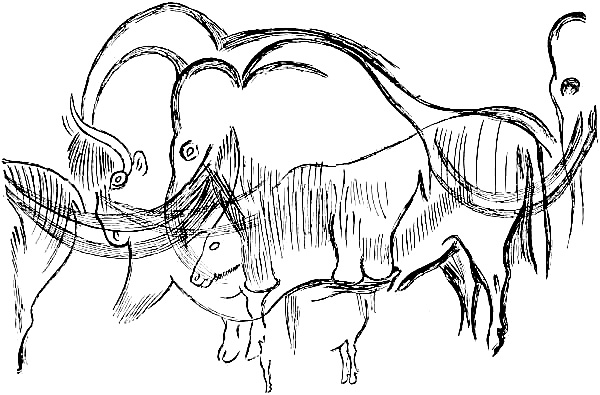
Fig. 224. Detail of the engraving of the central group of figures on the left wall decoration of the Galerie des Fresques (see Fig. 223), showing the etching of a mammoth superposed upon that of a bison, superposed in turn upon those of a reindeer and of a wild boar. These figures are on different scales, and in the present faded condition of the frescoes are difficult to detect. After Breuil.
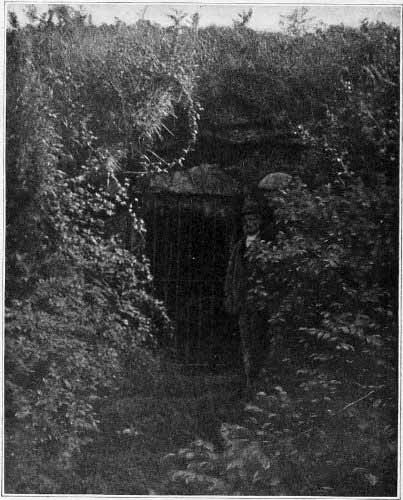
Fig. 225. Entrance to the cavern of Altamira, showing the proximity of the roof of the cavern to the present surface of the earth. Photograph by N. C. Nelson.
After passing the Galerie des Fresques we penetrate to the final recess called the Diverticule final, through excessively narrow tubular openings barely admitting the body, and we are again overcome with the mystery as to what impulse carried this art into the dark, deep portions of the caverns. If it were due to a feeling partly religious which, regarded the caverns with special awe, why do we find equally skilful and conscientious work on all the mobile utensils of daily life and of the chase, apart from the caverns? The superposition of one drawing upon another, which is especially characteristic of this cavern, does not seem to strengthen the religious interpretation.
It would appear that the love of art for art's sake, akin in a very rudimentary form to that which inspired the early Greeks, together with the fine spaces which these caverns alone afforded for larger representations, may be an alternative explanation. There is no evidence that numbers of people entered these caverns. If this had been the case there would be many more examples of inartistic work upon the walls. It is possible that the Crô-Magnon artists constituted a recognized class especially gifted by nature, quite distinct from the magician class or the artisan class. The dark recesses of the caverns opening back of the grottos may have been held in awe as mysterious abodes. In line with this theory is the suggestion that the artists may have been invited into the caverns by the priests or medicine-men to decorate the walls with all the animals of the chase.
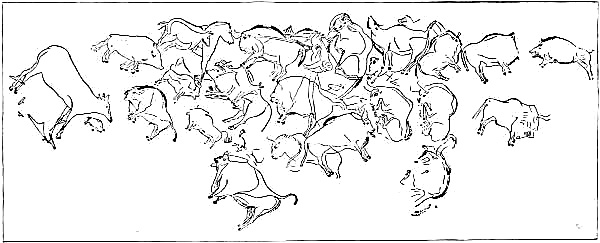
Fig. 226. Plan showing the grouping of bison, horses, red deer, and wild boar, in the polychrome paintings on the ceiling of Altamira. After Breuil.
The polychromes of the ceiling of Altamira in northern Spain, which rank in the crude art of Palæolithic times much as the ceiling of the Sistine Chapel does in modern art, are somewhat more conventional in technique than those of Font-de-Gaume, but they are manifestly the work of the same school, and prove that the technique of art spread like that of engraving, of sculpture, and of the preparation of flint and bone implements all over southwestern Europe. One could not have more striking proof of the unity of race, of a community of life, and of an interchange of ideas among these nomadic people than the close resemblance which is observed in the art of Altamira, Spain, and that of Font-de-Gaume, 290 miles distant, in Dordogne.
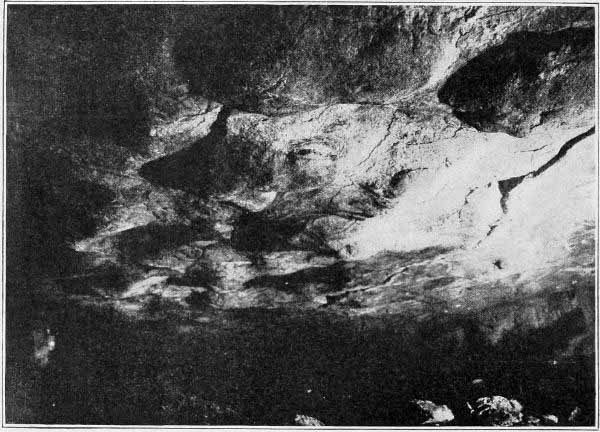
Fig. 227. The ceiling of Altamira, showing the round projecting bosses of limestone on which the recumbent figures of the bison are painted. After Lassalle.
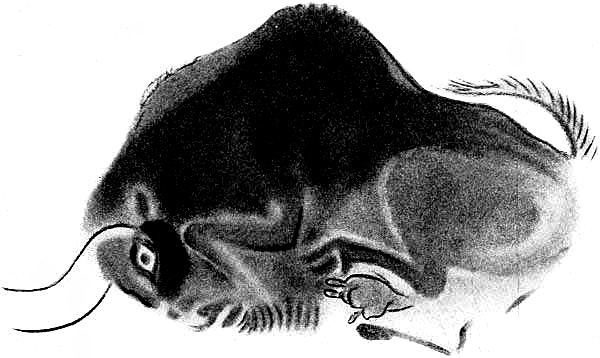
Fig. 228. Female bison lying down with the limbs drawn beneath the body, so that only the horns and tail project beyond the convex surface of the limestone boss on the ceiling of Altamira. After Breuil.
Very picturesque is the account of the discovery of this wonderful ceiling, made not by the Spanish archæologist Sautuola himself, but by his little daughter, who, while he was searching for flints on the floor of the cavern, was the first to perceive the paintings on the ceiling and to insist upon his raising his lamp aloft. This was in 1879, long before the discovery of parietal art in France. The ceiling is broad and low, within easy reach of the hand, and the oval bosses of limestone (Fig. 227), from 4 to 5 feet in length and from 3 to 4 in width, led to the development here of one of the most striking characteristics of all Palæolithic art, namely, the artist's adaptation of the subject to his medium and to the character of the surface upon which he was working. It seems to show a high order of creative genius that each of these projecting bosses was chosen for the representation of a bison lying down, with the limbs drawn up in different positions beneath the body (Fig. 228) and very carefully designed, and with the tail or the horns alone projecting beyond the convex surface to the surrounding plane surface. This is the only instance known where the bison are represented as lying down, in most lifelike attitudes, showing the soles of the hoof, observed with the greatest care and represented by a few strong and significant lines. Thus while the Altamira coloring inclines to conventionality, the pose of these animals indicates the greatest freedom of style and mastery of perspective anywhere observed. In this wonderful group there is also a bison bellowing, with his back arched and his limbs drawn under him as if to expel the air. One striking feature in all these paintings is the vivid representation of the eye, which in every case is given a fierce and defiant character, so distinctive of the bison bull when enraged. We also observe a wild boar in a running attitude and several spirited representations of the horse and of the female deer. The cavern of Altamira, besides this chef-d'œuvre, contains work of a very advanced character, as indicated in the imposing engraving of the royal stag (Fig. 229), which is altogether the finest representation of this animal which has thus far been discovered in any cavern.
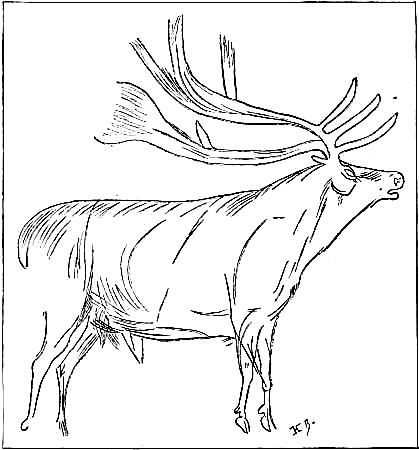
Fig. 229. The royal stag (Cervus elaphus) engraved on the ceiling of the cavern of Altamira. About twenty-six inches in length. After Breuil. One-eighth actual size.
Altamira, like Font-de-Gaume, presents many phases of the development of art in Magdalenian times. There is a Solutrean layer in the foyer of this great cavern, but Breuil is not inclined to attribute any of the art to this period. The first entrance of Altamira by the Crô-Magnon artists is dated by the discovery of engravings on bone of the female red deer, which are identical with those on the walls and which belong to very ancient Magdalenian times, the period at which the caverns of Castillo and La Pasiega were also entered.(28)
Sculpture
Animal sculpture in the round, which is indicated by the few statuettes found with the burial at Brünn, Moravia, and by the ivory mammoth statuette found at Předmost, continued into early Magdalenian times and certainly constitutes one of the most distinctive features of the art of that period, because in the later Magdalenian it took a different trend in the direction of decorative sculpture. Only two fine examples of early Magdalenian animal sculpture have been found, but these are of such a remarkable character as to indicate that modelling in the round was widely pursued at this time. These are the bisons discovered in 1912 in the cavern of Tuc d'Audoubert near Montesquieu, in the Pyrenees, and the fine bas-reliefs of horses at the shelter of Cap-Blanc, on the Beune, in Dordogne.
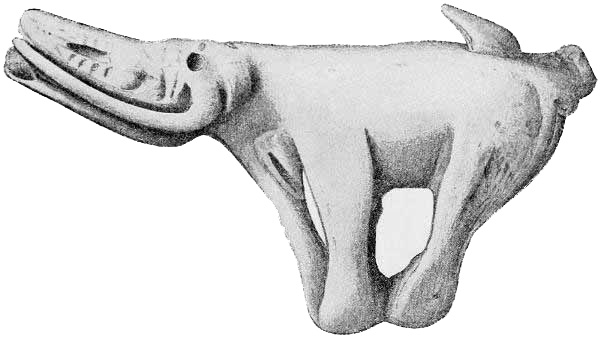
Fig. 230. Statuette of a mammoth in reindeer horn from the Abri de Plantade at Bruniquel. After Piette. "A statuette presenting the general form of the mammoth with some fantastic features. It formed part of a pendant of which the shank, terminating with a perforation, has been broken. The tusks were laid against this shank and strengthened it. The incisions bordered by notches suggest the nostrils of some imaginary monster. The trunk seems to grow out of the neck, not the head. The tail having been broken off in Palæolithic times, the owner made a hole in the back and inserted one there. The material was too thin to admit of representing the proper thickness of the animal. It was made to be viewed from the side."
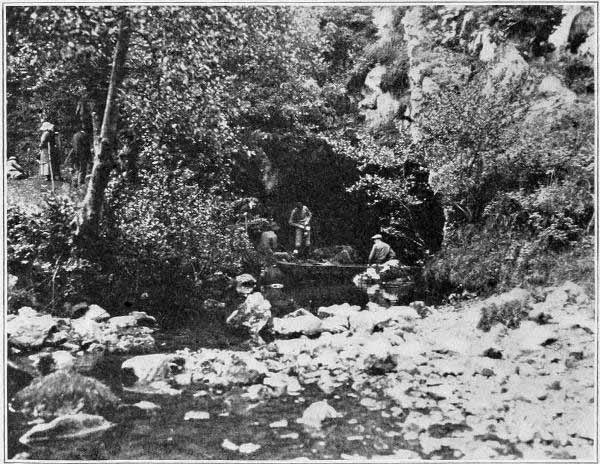
Fig. 231. Entrance to the cavern of Tuc d'Audoubert, near Montesquieu-Avantès in the Pyrenees. This is one of the rare instances in which the stream that formed the cavern is still flowing from the entrance. Photograph by N. C. Nelson.
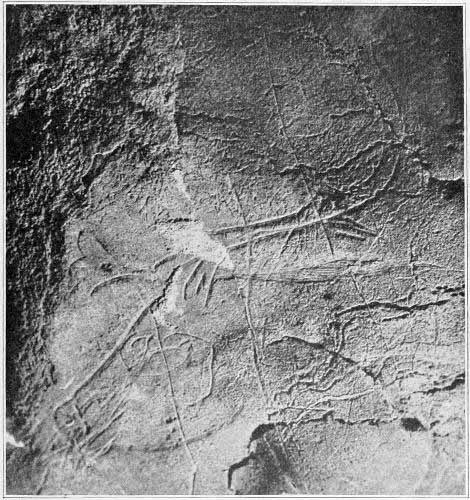
Fig. 232. Head of a reindeer deeply incised or engraved in the limestone wall of the cavern of Tuc d'Audoubert. After Bégouen.
In company with Professor Cartailhac the writer had the good fortune to enter the cavern of Tuc d'Audoubert a few days after its discovery by the Comte de Bégouen and his sons; it is still in the making, for out from the entrance flows a stream of water large enough to float a small boat, by which the first of a series of superbly crystallized galleries is reached. After passing through a labyrinth of passageways and chambers a favorable surface was found where the Bégouen party showed us a whole wall covered with low-engraving reliefs, very simply done, fine in execution, with sure and firm outlines of the bison, the favorite subject as in all other caverns; horses fairly well executed and of the same steppe type as those in the near-by cavern of Niaux; one superbly engraved contour of the reindeer, with its long, curved horns; the head of a stag with its horns still in the velvet; and a mammoth. All this work is engraved; there are no drawn outlines, but here and there are splashes of red and black color. Shortly afterward a great discovery was made in this cavern; it is described as follows by the Comte de Bégouen:[BA] "To-day I am happy to give you excellent news from the cavern Tuc d'Audoubert. As you were the first to visit this cavern, you will also be the first to learn that in an upper gallery, very difficult of access, at the summit of a very narrow ascending passage, and after having been obliged to break a number of stalactites which completely closed the entrance, my son and myself have found two superb statuettes in clay, about 60 cm. in length, absolutely unbroken, and representing bison. Cartailhac and Breuil, who have come to see them, were filled with enthusiasm. The ground of these chambers was covered with imprints of the claws of the bear, skeletons of which were buried here and there. The Magdalenians have passed through this ossuary and have drawn out all the canine teeth to make ornaments of them. Their steps left their fine impressions on the humid and soft clay, and we still see the outlines of several bare human feet. They had also lost several flakes of flint and the tooth of an ox pierced at the neck; we have collected them, and it seems as if they had only dropped yesterday; the Magdalenians also left an incomplete model of a bison and some lumps of kneaded clay which still carry the impression of their fingers. We produce the proof that in this period all branches of art were cultivated." This model of the male and female bison in clay has been described by Cartailhac as of perfect workmanship and of ideal art.
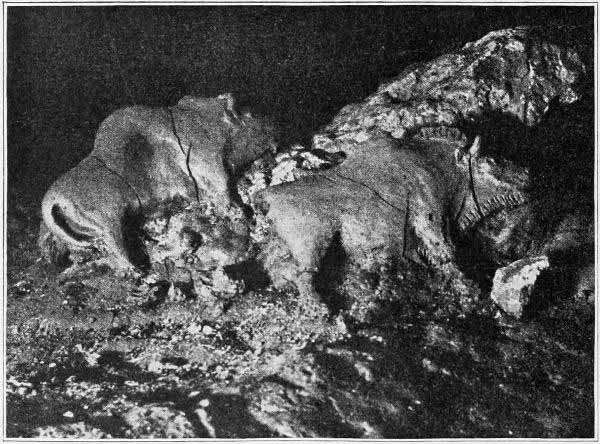
Fig. 233. Two bison, male and female, modelled in clay, discovered in the cavern of Tuc d'Audoubert. The length of each of these models is about two feet. After Bégouen.
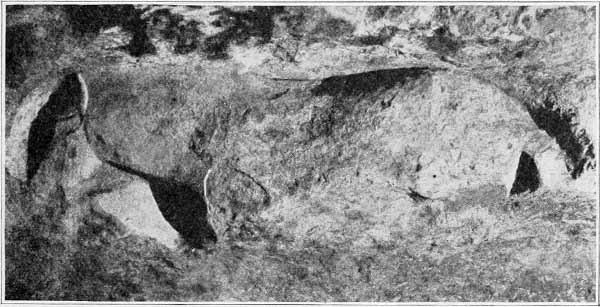
Fig. 234. One of a series of horses of the high-bred Celtic type, sculptured in high relief on the wall of the cliff shelter known as Cap-Blanc. The actual length of each of these sculptures is about seven feet. After Lalanne and Breuil.
The procession of six horses cut in limestone under the sheltering cliff of Cap-Blanc is by far the most imposing work of Magdalenian art that has been discovered. The sculptures are in high relief and of large size and are in excellent proportion; they appear to represent the high-bred type of desert or Celtic horse, related to the Arabian, so far as we can judge from the long, straight face, the slender nose, the small nostrils, and the massive angle of the lower jaw; the ears are rather long and pointed, and the tail is represented as thin and without hair; they were found partly buried by layers containing implements of middle Magdalenian industry, and they are therefore assigned to an early Magdalenian date in which animal sculpture in the round reached its climax.
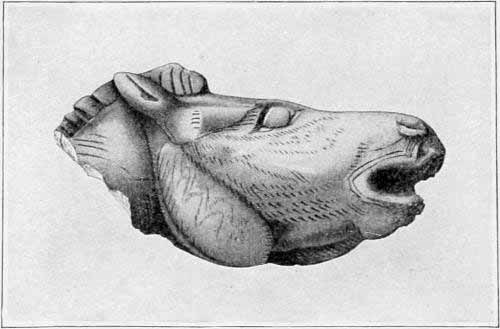
Fig. 235. Head of a horse sculptured on a reindeer antler, from the Magdalenian layer of Mas d'Azil on the right bank of the Arize. After Piette. Actual size.
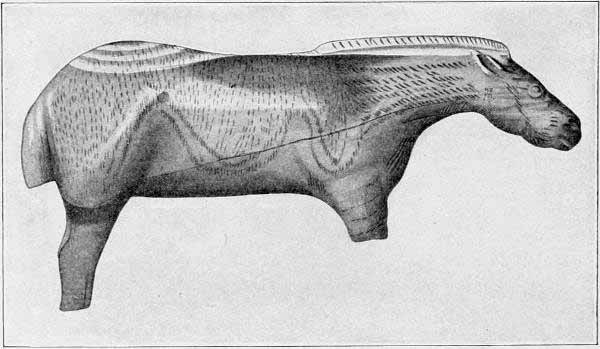
Fig. 236. Statuette carved on a fragment of mammoth tusk, representing a horse of Celtic type with mane erect, from the grotto of Les Espelugues, Lourdes. After Piette. About one and one-third actual size.
From the early to the middle Magdalenian period animal sculpture in bone, horn, and ivory was followed as decorative art in a bold and highly naturalistic manner. Adaptation of the animal figure to the surface and to the material employed is nowhere shown in a more remarkable way than in the bâtons, the dart-throwers, and the poniards. Of all the work of the Upper Palæolithic, these decorative heads and bodies are, perhaps, the most highly artistic creations in the modern sense. The famous horse found in the late Magdalenian levels of Mas d'Azil (Fig. 235) and the small horses from the grotto of Espelugues, of the middle Magdalenian, are full of movement and life and show such certainty and breadth of treatment that they must be regarded as the masterpieces of Upper Palæolithic glyptic art. The ibex carved on the dart-thrower from the grotto of Mas d'Azil (Fig. 178) indicates observation and a striking power of expression; while all the details are noted, the treatment is very broad.
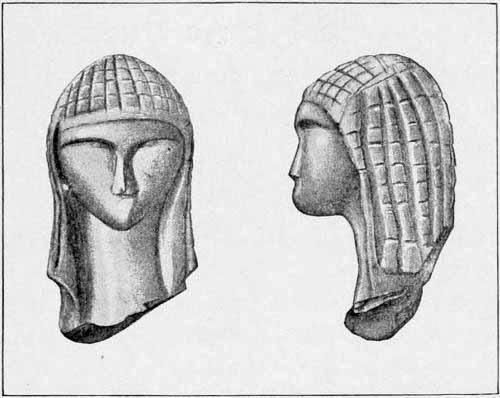
Fig. 237. Head of a woman with head-dress sculptured in ivory, from the Magdalenian levels of Brassempouy. After Piette. One and one-fifth actual size.
The continuation of animal sculpture in the round is seen in the well-known horse statuette from the grotto of Lourdes; the partly decorative striping is a step in the direction of conventional treatment. The sculptured reindeer discovered by Bégouen in the grotto of Enlène is treated in a somewhat similar style.
Small human figurines again appear in the form of statuettes in bone or ivory, representing the renaissance of the spirit of human sculpture. Some of this work is apparently in search of beauty and with altogether different motives from the repellent feminine statuettes of middle and late Aurignacian times, for the subjects are slender and the limbs are modelled with relative skill. As in the earlier works, there is a partial failure to portray the features, which is in striking contrast to the lifelike treatment of animal heads. Very few examples of this work have been found, and most of them have been broken. To this period belong the Venus statuette of Laugerie Basse and the head of a girl carved in ivory found at Brassempouy (Fig. 237) with the features fairly suggested and an elaborate head-dress.
Geographic Distribution of the Magdalenian Culture
In Magdalenian times the Crô-Magnon race undoubtedly reached its highest development and its widest geographic distribution, but it would be a mistake to infer that the boundaries of the Magdalenian culture also mark the extreme migration points of this nomadic people, because the industries and inventions may well have spread far beyond the areas actually inhabited by the race itself.
Absence of Magdalenian influence around the northerly coasts of the Mediterranean is certainly one of the most surprising facts. Breuil has suggested that Italy remained in an Aurignacian stage of development throughout Magdalenian times and indicates that there is much evidence that Magdalenian culture never penetrated into this peninsula, for in Italy the Aurignacian industrial stage is succeeded by traces of the Azilian. This geographic gap, however, may be filled at any time by a fresh discovery. In Spain, also, the Magdalenian culture is known only in the Cantabrian Mountains, but never farther south, one of the earliest sites found in this region being the grotto of Peña la Miel, visited by Lartet in 1865, and one of the most famous the cavern of Altamira, discovered by Sautuola in 1875; to the northeast is the station of Banyolas. So far the eastern provinces of Spain have not yielded any implements of engraved or sculptured bone.
Larger Image
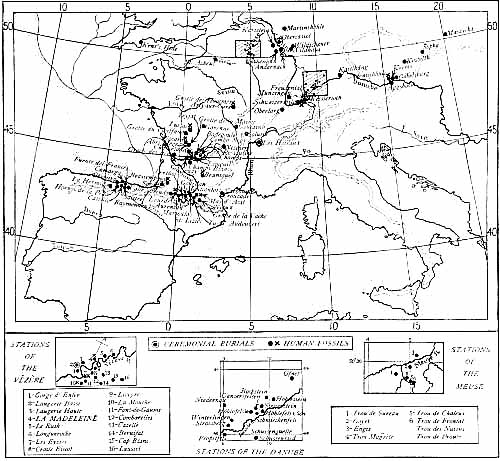
Fig. 238. Geographic distribution of the principal Magdalenian industrial stations in western Europe.
In contrast to this failure to reach southward, the Magdalenian culture is widely extended through France, Belgium, England, Germany, Switzerland, Austria, and as far east as Russia. It would appear either that the men of Magdalenian times wandered far and wide or that there was an extensive system of barter, because the discovery of shells brought for personal adornment from the Mediterranean seashores to various Magdalenian sites in France and in central Europe seems to indicate a wide-spread intercourse among these nomadic hunters and a system of trade reaching from the coasts of the Mediterranean and the Atlantic to the valley of the Neckar in Germany and along the Danube in Lower Austria. Another proof of this intercourse is the wide distribution not only of similar forms of implements but of very similar decorations; as an instance, Breuil notes the likeness of schematic engravings on reindeer horn in the two primitive Magdalenian layers of Placard, Charente, to those found in the Polish cavern of Mas̆zycka, near Ojcow, and to others in the corresponding layers of Castillo, near Santander, of Solutré on the Saône, and of various sites in Dordogne. A very distinctive geometric decoration on bone is that of broken zigzag lines with little intercalated transverse lines, which we notice at Altamira, in northern Spain, and which also occurs here and there in Dordogne and in Charente and extends to the grottos of d'Arlay in the Jura. Another style of ornament, with deep pectinate and punctuate lines, found in the very ancient Magdalenian of Placard, also occurs in the most ancient layers of Kesslerloch, Switzerland. Spiral ornaments like those on the bone weapons of Dordogne, of Arudy, and of Lourdes are found at Hornos de la Peña, in the Cantabrian Mountains. The spread of analogous decoration is still more striking when we find it occurring in the details of sculpture or in a certain type of dart-thrower (propulseur), which extended from the Pyrenees eastward to the Lake of Constance. Inventions like that of the harpoon and fashions like those of the decorative motifs were carried from point to point.
This influence does not lead to identity. Some of the phases of art and of decoration are confined to certain localities; for example, the engravings of deer on the bone shoulder-blades in the caverns near Santander, Spain, are not duplicated in France; also there are numerous local styles witnessed in the forms and decorations of the javelin, the lance, and the harpoon; these variations, however, do not conceal the element of community of culture and of similar fluctuations of industry and art between widely distant stations.
Many Magdalenian stations were crowded around the sheltered cliffs of Dordogne (Fig. 238). Besides these, we observe the Magdalenian sites of Champs, Ressaulier, and the grotto of Combo-Negro in Corrèze; south of Dordogne and Corrèze are other stations along the Garonne and the Adour. Some of the finest examples of Magdalenian art have come from Bruniquel, on the Aveyron, near the boundary between Tarn-et-Garonne and Tarn, where no less than four important sites have been excavated.
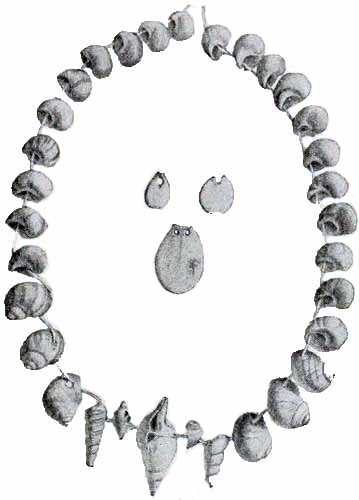
Fig. 239. Necklace of marine shells, from the cave of Crô-Magnon, mostly periwinkles, some related to species now living in the North Sea, Purpura, Turitella, and Fusus. After E. Lartet. The Crô-Magnon grotto dwellers used shells belonging to existing species, while in the deposits at La Madeleine and Laugerie Basse fossil shells are found. The use of seashore shells as ornaments in various parts of the interior of Europe indicates that they were brought long distances in trade. The remains of such ornaments were found with the skeleton of Aurignacian age from Paviland, Wales. Necklaces were also made of small plates of ivory and the perforated teeth of the cave-bear. One-third actual size.
The culture map of France in Magdalenian times is covered from north to south with these ancient camp sites, either clustered along the river borders, where erosion has created shelters, or in the great outcrops of limestone along the northern slopes of the Pyrenees, where the exposure of the limestone has led to the formation of grottos and caverns, or on the plateaus where game abounded or flint could be found for the rapidly declining flint industry. Near the Gulf of Lyons are the stations of Bise, Tournal, Narbonne, and Crouzade; extending westward toward the headwaters of the Ariège are La Vache, Massat, and the great tunnel station of Mas d'Azil, formed by the River Arize; here the Magdalenian levels discovered by Piette have yielded some of the most notable Magdalenian works of art, including animal statuettes, bas-reliefs, and engravings with incised contours.
Farther west, on the headwaters of the Garonne, is Gourdan, where Piette began his remarkable excavations in 1871 and discovered two of the ancient Magdalenian phases of sculpture; then comes the more westerly group of Aurensan, Lorthet, and Lourdes, the latter a grotto which has yielded one of the finest examples of the horse sculptured in ivory, and which has since become famous as the site of a miracle and of modern pilgrimage. Between the Garonne and the Bay of Biscay lie the stations of Duruthy and the Grotte du Pape of Brassempouy, the latter occupied in Magdalenian times, but best known as a centre of late Aurignacian sculpture of statuettes.
To the northeast, in the very heart of the mountainous region of Auvergne, is the station of Neschers, where a flow of lava from Mount Tartaret descended over the slopes of Mont-Doré and covered a Mousterian industrial deposit with its mammoth fauna and then, after a lapse of time, became the site of a Magdalenian industrial camp, so that Boule has been able to determine the geologic age of the most recent volcanic eruptions in France, those of the Monts d'Auvergne, as having occurred between the periods of Mousterian and Magdalenian industry.
In view of the frequent occurrence of Aurignacian and Solutrean camps as well as of Neolithic stations in southeastern France, we are surprised at the extreme rarity there of Magdalenian flint implements. However, Capitan has recognized a Magdalenian station at Solutré, near the headwaters of the Saône, and not far from this site is the station of Goulaine, which has yielded an enormous flint scraper or anvil, the largest Upper Palæolithic implement ever found; it is carefully chipped around the entire curved edge and weighs over 4¼ pounds. To the north of the Dordogne is the celebrated grotto of Placard, in Charente, where the dawn of the Magdalenian industry has been discovered, and again directly north of this is the grotto of Chaffaud, at Savigné, where the first engraved bone of the 'Reindeer Age' was discovered in 1834; not far from this is the shelter of Garenne, near St. Marcel (Indre), which has afforded a fine figure of a galloping reindeer.
Larger Image
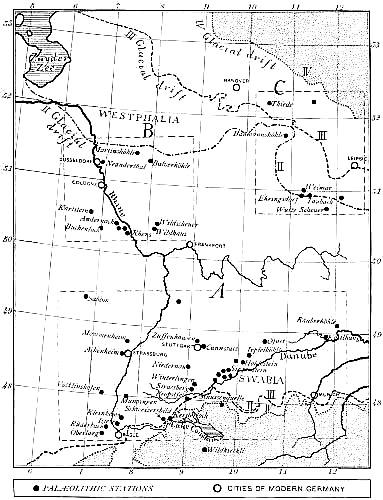
Fig. 240. Geographic distribution of the Magdalenian and other Palæolithic stations on the upper waters of the Rhine and of the Danube. The chief Magdalenian stations are: Andernach, Bockstein, Buchenloch, Gansersfelsen, Höhlefels bei Hütten, Höhlefels bei Schelklingen, Hohlestein, Kartstein, Kastlhänghöhle, Kesslerloch, Martinshöhle, Munzingen, Niedernau, Oberlarg, Ofnet, Propstfels, Schmiechenfels, Schussenquelle, Schweizersbild, Sirgenstein, Strassberg, Wildhaus, Wildscheuer, and Winterlingen. After R. R. Schmidt, modified and redrawn.
These geographic and artistic records are of intense interest as carrying the Périgord or Dordogne culture northward. Somewhat to the east, on the headwaters of the Cure, a tributary of the Yonne, there is an important group including over sixty open shelters formed in the Jurassic limestone, in which characteristic Magdalenian bone implements have been found. Of these the most famous are the Grotte des Fées, and the Grotte du Trilobite, both of which were first entered by the Neanderthals in Mousterian times and were again sought by the Crô-Magnons in Magdalenian times. Passing still farther north, the Crô-Magnons visited the borders of the Somme and sought the historic flint station of St. Acheul, which had been frequented by races of men for thousands of years previous, back to Pre-Chellean times.
To the northeast are the stations of Belgium, chiefly made known through the labors of Dupont, distributed along the valleys of the Lesse and of the Meuse and yielding characteristic Magdalenian flints as well as a number of engravings on bone. We may be sure that this region was under Crô-Magnon rule and that their control extended over into Britain, where, it will be recalled, a Crô-Magnon skeleton was found at Paviland, in western Wales. Here, again, in Magdalenian times the Crô-Magnon race was probably wide-spread over southern Britain. At Bacon's Hole, near Swansea, Wales, there is a wall decoration consisting of ten red bands, which, according to Breuil and Sollas, may possibly be of Palæolithic age. More definite is the Magdalenian industry observed at the Cresswell Crags, in Derbyshire; while near Torquay, Devonshire, is the famous station of Kent's Hole, discovered in 1824, in which a bone needle has been found and several harpoons with double rows of barbs belonging to the late Magdalenian industry.
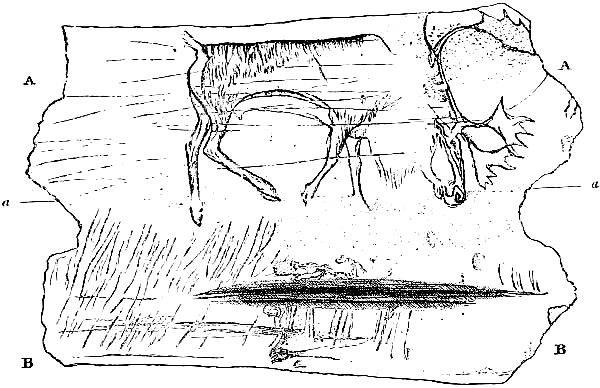
Fig. 241. Reindeer engraved around a piece of reindeer antler, from Kesslerloch, Switzerland. This is a unique instance of the portrayal of landscape in Palæolithic art. After Heim. Slightly more than three-quarters actual size.
In Germany, whereas only three Solutrean stations have been discovered,(29) there are no less than fourteen Magdalenian stations to attest the wide spread of that culture. Thus the favorite grotto of Sirgenstein, near the centre of the Magdalenian stations on the upper waters of the Danube, although abandoned in Solutrean times, was again entered by man during the early Magdalenian culture stage. Coincident with the return of man to this great grotto was the arrival of the banded lemming (Myodes torquatus), the herald of the cold tundra wave of life in the far north. At the very same time man with the banded lemming arrived at Schweizersbild, near the Lake of Constance; at a slightly earlier period, with the dawn of Magdalenian culture, man entered the sister station of Kesslerloch. It certainly appears that a cold moist climate accompanying the Bühl advance influenced all the Crô-Magnon peoples of this region just north of the Alpine glaciers and compelled them to seek the grottos and shelters. There are, however, some open stations in this general region, for example, at Schussenried, Württemberg; the Magdalenian culture layer is not found in a grotto, but lies under a deposit of peat mingled with the remains of the reindeer, horse, brown bear, and wolf. Again, among the best-known sites along the middle Rhine is the open-air station of Andernach. Demonstrating the eastward distribution of the art of engraving on ivory and bone is the presence in Andernach and in the grotto of Wildscheuer, near Steeten, on the Lahn, of engravings of this character. Thus far these are the only German stations in which such engravings have been found.
Of especial interest also is the open Magdalenian 'loess' station of Munzingen, on the upper Rhine, because it proves that the highest layers of the 'upper loess,' corresponding with the dry or steppe period of climate, were contemporaneous with the advanced or late Magdalenian industry, also because this final 'upper loess' stage about corresponds with the period when the last of the arctic tundra mammals began to abandon central Europe. It was at this critical geologic time that the late Magdalenian culture began to draw to a close. Kesslerloch, Switzerland, has yielded a considerable number of engravings on bone, including one of the finest examples of a browsing reindeer (Fig. 241), and Schweizersbild also has yielded a considerable number of rather crude engravings.
Frequented in Magdalenian times was that part of the Swabian Jura lying between the headwaters of the Neckar and of the Danube; along the course of the Danube, from Propstfels, near Beuron, in the southwest, to Ofnet, in the northeast, extend the other stations of Höhlefels bei Hütten, Schmiechenfels, and Bocksteinhöhle.
West of the Danube the industry was carried into the present region of Bavaria, as indicated by the recent discovery of Kastlhäng.(30) Here, beginning with the early Magdalenian (Gourdanien inférieur of the French school) and extending to the middle or high Magdalenian (Gourdanien supérieur), we find a complete series of Magdalenian stations; the middle Magdalenian layer is of exactly the same type as that found in the Abri Mège of Dordogne and in the lower levels of the Grotte de la Mairie; the same culture stage is again observed in southern Germany in the stations of Schussenquelle and of Höhlefels, and it extends eastward into Austria in the station of Gudenushöhle as well as into several Moravian stations, for example, that of Kostelík.
These facts are of extraordinary interest, for they show that the civilization, such as it was, of the Upper Palæolithic was very widely extended. This marks an important social characteristic, namely, the readiness and willingness to take advantage of every step in human progress, wherever it may have originated. At this point, therefore, it is interesting to compare the Magdalenian industry of Germany with that of France.(31) Germany shows the same technical and stylistic tendencies and the same evolutionary direction as France. The mammalian life was, of course, the same in both countries, for in each region the giant types of mammals still survived, and the banded lemming of the arctic appears in the sheltered valleys of the Dordogne as well as in Belgium and in Germany. The vicissitudes of climate were undoubtedly the same; we observe the alternation of cold moist climate in the early Magdalenian along the upper Danube as well as in the early Magdalenian of the type station of La Madeleine, Dordogne. Again, we observe the transition into the dry cold climate in the steppe character of the fauna both along the upper Rhine, at Munzingen, and also beneath the shelter station of La Madeleine, as recorded by Peyrony.
More vital still for this community of industrial culture was the community of race, for at Obercassel we find the same Crô-Magnon type as that discovered beneath the sheltering cliffs of Dordogne. It appears probable that the inventions of the central region of Dordogne travelled eastward when we note the fact that none of the prototypes of early forms of the harpoon which were common in southern France occur in any of the stations of central Europe, but the single-rowed harpoon is characteristic of the middle Magdalenian all over Germany. Other primitive Magdalenian bone implements, such as the bone spear point with the cleft base, the bâtons, and the needles, are also of rare occurrence in the German stations. In late Magdalenian times, however, a complete community of culture is established, for the industry of both countries in flint and bone appears to be very similar: flint microliths appear in increasing number and variety; beside the small flint flakes with blunted backs, numerous feather-shaped flakes of Pre-Tardenoisian type are found, as well as the types of graving flints. Some specialties of French Magdalenian culture did not find their way into Germany; for example, the graver of the 'parrot-beak' type has been found in France but has not been traced far eastward. In both countries, however, are found upper Magdalenian chisels of reindeer horn and perfected bone needles, bâtons, and harpoons with double rows of barbs. On the other hand, works of art and decorative designs in horn and bone are almost entirely wanting in German localities, with the exception of the stations of Andernach and Wildscheuer previously mentioned. In late Magdalenian times, both in Germany and France, we find the Eurasiatic forest fauna becoming more abundant.
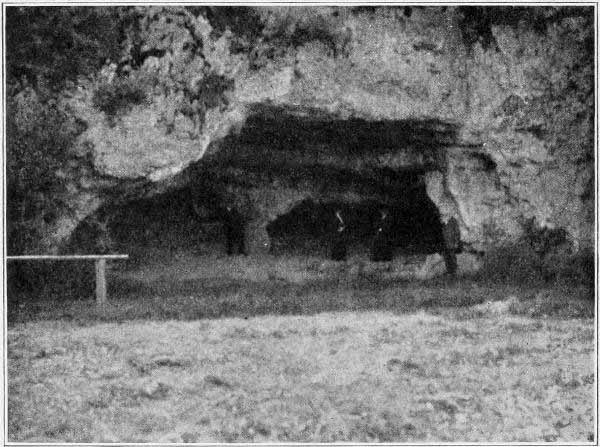
Fig. 242. Entrance to the grotto of Kesslerloch, near Lake Constance. Photograph by N. C. Nelson.
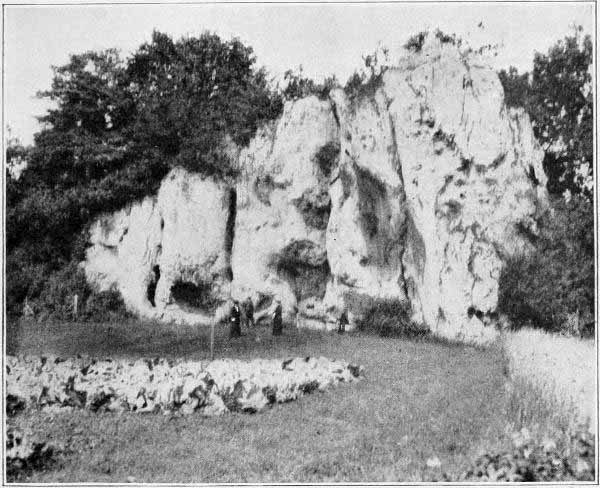
Fig. 243. The famous shelter station of Schweizersbild, under a protecting cliff of limestone, near Lake Constance, Switzerland. On the right stands Dr. Jakob Nüesch, who has devoted three years to the excavation and study of this site. Photograph by N. C. Nelson.
The two famous Swiss stations of Kesslerloch and Schweizersbild, near Lake Constance, appear throughout Magdalenian times to have been in very close touch with the cultural advances of Dordogne. Kesslerloch(32) has yielded 12,000 flints of small dimensions, resembling in their succession those of the type station of La Madeleine; also needles, single and double harpoons, dart-throwers, bâtons, as well as the fine engravings mentioned above; bone sculpture is represented here in the unique head of a musk-ox (Ovibos moschatus), in carvings of the reindeer and of other animals on the batons and weapons of the chase. Kesslerloch lies on the edge of a moderately wide valley, traversed by a brook; in this sheltered, well-watered, hilly region, the trees flourished and harbored the forest animals, while the glaciers, retreating and leaving damp and stony areas, were closely followed by the tundra fauna; the woolly rhinoceros and mammoth persisted here longer than in other parts of Europe; the horse of Kesslerloch is said to show resemblances to the Przewalski horse of the desert of Gobi, in central Asia, and is consequently referred to the steppe type. The development of the flints takes place step by step with that of the sister cavern of Schweizersbild, and in early Magdalenian times these flints are found associated with the arrival of the great migration of the arctic tundra rodents, the banded lemmings (Myodes torquatus). A hearth with ashes and coals and many charred bones of old and young mammals, including the woolly rhinoceros, has been found here; the animal life altogether includes twenty-five species of mammals, among them the woolly mammoth, woolly rhinoceros, reindeer, and lion.
Less than four miles distant from Kesslerloch, in a small valley about two miles north of Schaffhausen, is the other famous Swiss station of Schweizersbild. The Crô-Magnons were attracted to this spot by the protecting cliff of isolated limestone rock rising sheer from the meadow-land, at the base of which is a shelter facing southwest, with an entrance of about 30 feet in height, commanding a wide view of the distant valley. In the accumulations at the base of this shelter we find a complete prehistory of the human, industrial, faunal, and climatic changes of this region of Switzerland from early Magdalenian into Neolithic times. It was not until the true early Magdalenian, after both the Aurignacian and Solutrean stages had closed, that man first found his way here during the Bühl advance, the period of the deposition of the Upper Rodent Layer with its cold arctic and steppe fauna;(33) but from this time the grotto was occupied at intervals until full Neolithic times. The beginning of these industrial deposits is estimated by Nüesch as having occurred between 24,000 and 29,000 years ago, but we have adopted a somewhat lower and more conservative estimate. In descending order the various layers of this shelter, as studied by Nüesch, are as follows:
Section of the Schweizersbild Deposits
Neolithic
6. Layer of humous earth, between 15 and 19 inches in thickness, containing Neolithic implements.
5. Gray culture layer, about 15 inches in thickness, including many fire-hearths, ornaments of shell, polished Neolithic flints, and unglazed pottery. The true forest fauna includes the brown bear, badger, marten, wolf, fox, beaver, hare, squirrel, short-horned wild ox (Bos taurus brachyceros), and reindeer, also the domesticated goat and sheep.
Upper Palæolithic
4. Thin layer of forest-living rodents, principally squirrels. Split bones and worked flints; no carvings in bone or horn; industry of late Magdalenian or close of Magdalenian Upper Palæolithic age; evidences that climate was changing, steppe conditions passing away, and forests becoming more dominant; only a few steppe species; the forest species include the reindeer, hare, pika, squirrel, ermine, and marten.
3. Yellow culture layer, steppe period, rich in fire-hearths and yielding 14,000 flints of middle [? and late] Magdalenian age; engravings on reindeer antlers, ornaments of shells and teeth. Mixed fauna with steppe and forest types predominant; of the few tundra forms, reindeer very abundant and also arctic fox, but banded lemming and other tundra types entirely lacking; steppe and desert fauna includes the kiang, Persian maral deer, Pallas's cat (Felis manul), steppe horse, and steppe suslik; of alpine type, the ibex; numerous forest species, pine marten, beaver, squirrel, red deer, roe-deer, and wild boar.
2. Arctic tundra rodent layer, 20 inches in thickness; period of the Bühl Postglacial advance; the banded lemming (Myodes torquatus) most abundant, mingled with early Magdalenian flint and bone implements; one fire-hearth; abundant tundra fauna, including all tundra types except the Obi lemming, and the musk-ox (Ovibos moschatus) which is found in Kesslerloch; indications of a very cold, moist climate; the banded lemming, arctic fox, arctic hare, reindeer, wolverene, ermine, also such forest forms as the wolf, fox, bear, weasel, and a number of northern birds.
1. Gravel bed and old river deposit, recognized by Boule as belonging to the moraines of the fourth glaciation.
This wonderful deposit of human artifacts and animal remains gives us a complete registration of the changes of climate in this region accompanying the changes of culture and the development of the Magdalenian race.
Turning our survey to the course of the Danube, we note that several Magdalenian stations extend into the provinces of Lower Austria, chief among them being both the open 'loess' station of Aggsbach, and that of Gobelsburg; there is also the Hundssteig near Krems, better known as the station of Krems, and the cavern known as the Gudenushöhle; in the latter station the characteristic bâtons, javelins, and bone needles have been found.[BB]
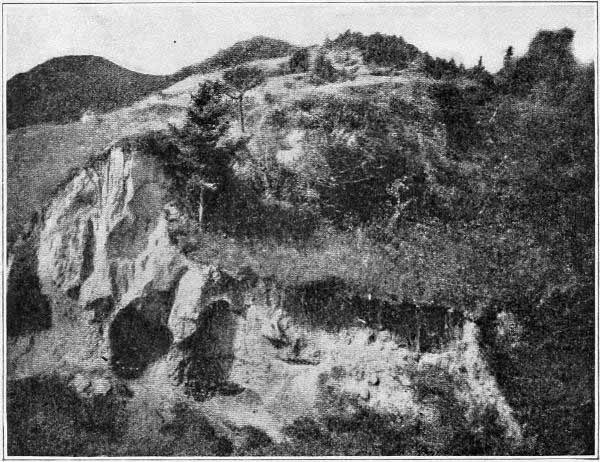
Fig. 244. The open loess station of Aggsbach, on the Danube, near Krems. After Obermaier.
The cavern district of Moravia attracted a relatively large population, and among the numerous stations are the grottos of Kr̆íz̆, Žitný, Kostelík, Bycis̆kala, Schoschuwka, Balcarovaskala, Kůlna, and Lautsch. Near the Russian border bone implements like those of Gudenushöhle on the Danube have been found at the station of Kůlna, and the industrial stratification of Šipka is very clear. Not far from Cracow, across the Russian border, the caverns in the region of Ojcow were entered by men carrying the Magdalenian culture. Another site in Russia is the grotto of Mas̆zycka, and characteristic Magdalenian harpoons, needles, and bâtons de commandement with other implements have also been found to the eastward, in the neighborhood of Kiev, in the Ukraine.
Decline of the Magdalenian Culture
The highest point touched by the Crô-Magnon race in the middle or high Magdalenian appears to correspond broadly with the cold arid period of climate in the interval between the Bühl and Gschnitz advances in the Alpine region, during which the steppe mammals spread widely over southwestern Europe. The saiga antelope, for example, a highly characteristic steppe type, is represented in one of the most skilful bone carvings found in the late Magdalenian layers of Mas d'Azil; also the steppe type of horse is frequently represented in the most advanced engravings of late Magdalenian times. How far this cold, relatively dry climate influenced the artistic and creative energy of the Crô-Magnons is largely a matter of conjecture. The entirely independent records of La Madeleine, of Schweizersbild, and of Kesslerloch concur in associating the highest stage of Magdalenian history of art with the predominance of the steppe fauna and evidences of a cold dry climate. That the mammoth still abounded is seen in the mammoth engravings which are superposed on those of the bison in Font-de-Gaume.
Larger Image
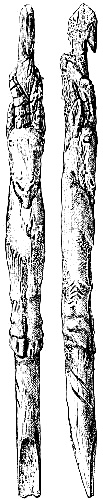
Fig. 245. Front and side views of a saiga antelope carved upon a bone dart-thrower from the Magdalenian deposits of Mas d'Azil. After Piette.
The succeeding life period is that of the retreat of the tundra and steppe mammals and of the increasing rarity of the reindeer and of the mammoth in southwestern Europe; it corresponds broadly with the returning cold and moist climate of the second Postglacial advance known in the Alps as the Gschnitz stage. With the spread of the forests and the retreat to the north of the reindeer, the principal source both of the supply of food and clothing and of all the bone implements of industry and of the chase, a new set of life conditions may have gradually become established. If it is true, as most students of geographical conditions and of the climate maintain, that Europe at the same time became more densely forested, the chase may have become more difficult, and the Crô-Magnons may have begun to depend more and more upon the life of the streams and the art of fishing. It is generally agreed that the harpoons were chiefly used for fishing and that many of the microlithic flints, which now begin to appear more abundantly, may have been attached to a shaft for the same purpose. We know that similar microliths were used as arrow points in predynastic Egypt.
Breuil(35) observes very significant industrial changes in closing Magdalenian times: first, the beginning of small geometric forms of flints suggesting the Tardenoisian types; second, the occasional use of stag horn in place of reindeer horn; third, a modification in the form of bone implements toward the patterns of Azilian times; fourth, the rapid decline—one may almost say sudden disappearance—of the artistic spirit. Schematic and conventional designs begin to take the place of the free realistic art of the middle Magdalenian.
Thus the decline of the Crô-Magnons as a powerful race may have been due partly to environmental causes and the abandonment of their vigorous nomadic mode of life, or it may be that they had reached the end of a long cycle of psychic development, which we have traced from the beginning of Aurignacian times. We know as a parallel that in the history of many civilized races a period of great artistic and industrial development may be followed by a period of stagnation and decline without any apparent environmental causes.
Crô-magnon Descendants in Modern Europe
We might attribute this great change, which affected all of western Europe, to the extinction of the Crô-Magnon race were it not for the existing evidence that the race survived throughout the Azilian-Tardenoisian or close of the Upper Palæolithic. On the close of the Palæolithic the race broke up throughout western Europe into many colonies, which can perhaps be traced into Neolithic and even into recent times. The anatomical evidence for this survival theory chiefly consists of the highly characteristic form of the head.
In Europe a very broad face and a long, narrow cranium is such an infrequent combination that anthropologists maintain that it affords a means of identifying the descendants of the prehistoric Crô-Magnon race wherever they persist to-day. Since Dordogne was the geographic centre of the race in Upper Palæolithic times, is it merely a coincidence that Dordogne is still the centre of a similar type? Ripley(36) has given us a valuable résumé of our present knowledge of this subject. The most significant trait of the long-headed people of Dordogne is that in many cases the face is almost as broad as in the normal Alpine round-headed type; in other words, it is strongly disharmonic; in profile the back part of the head rises and in front view the head is narrowed at the top; the skull is very low-vaulted; the brow ridges are prominent; the nose is well formed; the cheek-bones are prominent, and the powerful cheek muscles give a peculiarly rugged cast to the countenance. The appearance, however, is not repellent, but more often open and kindly. The men are of medium height, but very susceptible to environment as regards stature; they are tall in fertile places, and stunted in less prosperous districts. They are not degenerate at all, but keen and alert of mind. The present people of Dordogne agree with but one other type of men known to anthropologists, namely, the ancient Crô-Magnon race. The geographical evidence that here in Dordogne we have to do with the survivors of the real Crô-Magnon race seems to be sustained by a comparison of the characteristics of the prehistoric skulls found at Crô-Magnon, Laugerie Basse, and elsewhere in Dordogne, with the heads of the types of to-day. The cranial indices of the prehistoric skulls, varying from 70 per cent to 73 per cent, correspond with indices of the living head of 72 per cent to 75 per cent. None of the people of Dordogne are quite so long-headed as this, the average index of the living head in an extreme district being 76 per cent; but within the whole population there are much lower indices.
The probability of direct descent becomes stronger when we consider the disharmonic low-skulled shape of the Crô-Magnon head and the remarkable elongation of the skull at the back. In the prehistoric Crô-Magnons the brows were strongly developed, the eye orbits low, the chin prominent. The facial type has been characterized by de Quatrefages(37) as follows: "The eye depressed beneath the orbital vault; the nose straight rather than arched; the lips somewhat thick, the jaw and the cheek-bones strongly developed, the complexion very brown, the hair very dark and growing low on the forehead—a whole which, without being attractive, was in no way repulsive."
In southern France we observe a continuity not only of the head form but of the prevalence of black hair and eyes. Why should this Crô-Magnon type have survived at this point and have disappeared elsewhere? In order to consider the particular cause of this persistence of a Palæolithic race, we must, with Ripley, broaden our horizon, and consider the whole southwest from the Mediterranean to Brittany as a unit.
The survival is partly attributed to favorable geographical environment and partly to geological and racial barriers. On the north the intrusion of the Teutonic race was shut off and competition was narrowed down to the Crô-Magnon and Alpine types.
If the people of Dordogne are veritable survivors of the Crô-Magnons of the Upper Palæolithic, they certainly represent the oldest living race in western Europe, and is it not extremely significant that the most primitive language in Europe, that of the Basques of the northern Pyrenees, is spoken near by, only 200 miles to the southwest? Is there possibly a connection between the original language of the Crô-Magnons, a race which once crowded the region of the Cantabrian Mountains and the Pyrenees, and the existing agglutinative language of the Basques, which is totally different from all the European tongues? This hypothesis, suggested by Ripley,(38) is very well worth considering, for it is not inconceivable that the ancestors of the Basques conquered the Crô-Magnons and subsequently acquired their language.
The prehistoric Crô-Magnon men would seem, therefore, to have remained in or near their early settlements through all the changes of time and the vicissitudes of history. "It is, perhaps," observes Ripley, "the most striking instance known of a persistency of population unchanged through thousands of years."
The geographic extension of this race was once very much wider than it is to-day. The classical skull of Engis, Belgium, belongs to this type. It has been traced from Alsace in the east to the Atlantic in the west. Ranke asserts that it is to be found to-day in the hills of Thuringia, and that it was a prevalent type there in the past. Verneau considers that it was the type prevailing among the extinct Guanches of the Canary Islands. Collignon(39) has identified it in northern Africa, and regards the Crô-Magnons as a subvariety of the Mediterranean race, an opinion consistent at least with the archæological evidence that this race came into Europe with the Aurignacian culture, which was circum-Mediterranean in distribution. Traces of Crô-Magnon head formation are found among the living Berbers.
At present, however, this race is believed to survive only in a few isolated localities, namely, in Dordogne, at a small spot in Landes, near the Garonne in southern France, and at Lannion in Brittany, where nearly one-third of the population is of the Crô-Magnon type. It is said to survive on the island of Oléron off the west coast of France, and there is evidence of similar descent to be found among the people of the islands of northern Holland. The people of Trysil, on the Scandinavian peninsula, are characterized as having disharmonic features, possibly representing an outcrop of the Crô-Magnon type.
Our interest in the fate of the Crô-Magnons is so great that the Guanche theory may also be considered; it is known to be favored by many anthropologists: von Behr, von Luschan, Mehlis, and especially by Verneau. The Guanches were a race of people who formerly spread all over the Canary Islands and who preserved their primitive characteristics even after their conquest by Spain in the fifteenth century. The differences from the supposed modern Crô-Magnon type may be mentioned first. The skin of the Guanches is described by the poet Viana as light-colored, and Verneau considers that the hair was blond or light chestnut and the eyes blue; the coloring, however, is somewhat conjectural. The features of resemblance to the ancient Crô-Magnons are numerous. The minimum stature of the men was 5 feet 7 inches, and the maximum 6 feet 7 inches; in one locality the average male stature was over 6 feet. The women were comparatively small. The most striking characters of the head were the fine forehead, the extremely long skull, and the pentagonal form of the cranium, when seen from above, caused by the prominence of the parietals—a Crô-Magnon characteristic. Among the insignia of the chiefs was the arm-bone of an ancestor; the skull also was carefully preserved. The offensive weapons in warfare consisted of three stones, a club, and several knives of obsidian; the defensive weapon was a simple lance. The Guanches used wooden swords with great skill. The habitation of all the people was in large, well-sheltered caverns, which honeycombed the sides of the mountains; all the walls of these caverns were decorated; the ceilings were covered with a uniform coat of red ochre, while the walls were decorated with various geometric designs in red, black, gray, and white. Hollowed-out stones served as lamps. We may conclude with Verneau that there is evidence, although not of a very convincing kind, that the Guanches were related to the Crô-Magnons.(40) His observations on these supposed Crô-Magnons of the Canary Islands are cited in the Appendix, Note V. We regret that Verneau in his memoir(41) does not present his more recent views in regard to the prehistoric distribution of this great race.
(1) Breuil, 1912.7, p. 203.
(2) Op. cit., p. 205.
(3) James, 1902.1.
(4) Heim, 1894.1, p. 184.
(5) Schmidt, 1912.1, p. 262.
(6) Fraunholz, 1911.1.
(7) Geikie, 1914.1, pp. 25, 26.
(8) Boule, 1899.1.
(9) Breuil, 1912.7, pp. 203-205.
(10) Obermaier, 1912.1, pp. 341, 342.
(11) Martin, R., 1914.1, pp. 15, 16.
(12) Verworn, 1914.1.
(13) Op. cit., p. 646.
(14) Breuil, 1912.7, p. 201.
(15) Lartet, 1875.1.
(16) Breuil, 1912.7, p. 213.
(17) Schmidt, 1912.1, p. 136.
(18) Breuil, op. cit., pp. 216, 217.
(19) Breuil, 1909.3.
(20) Op. cit., p. 410.
(21) Cartailhac, 1906.1, pp. 227, 228.
(22) Rivière, 1897.1; 1897.2.
(23) Reinach, 1913.1.
(24) Breuil, 1912.1, p. 202.
(25) Cartailhac, 1908.1.
(26) Capitan, 1908.1, pp. 501-514.
(27) Ibid., 1910.1, pp. 59-132.
(28) Breuil, 1912.1, pp. 196, 197.
(29) Schmidt, 1912.1, p. 116.
(30) Fraunholz, 1911.1.
(31) Schmidt, 1912.1, p. 154.
(32) Déchelette, 1908.1, vol. I, pp. 191-194.
(33) Nehring, 1880.1; 1896.1.
(34) Bayer, 1912.1, pp. 13-21.
(35) Breuil, 1912.7, pp. 212, 216.
(36) Ripley, 1899.1, pp. 39, 165, 173, 174-179, 211, 406.
(37) Op. cit., p. 176.
(38) Op. cit., p. 181.
(39) Collignon, 1890.1.
(40) Verneau, 1891.1.
(41) Ibid., 1906.1.