Chapter III · (continued 2)
Reading edition
As contrasted with the very numerous Acheulean sites of Italy, it is surprising to note that only two Mousterian grottos have thus far been discovered in this region: the Grotte delle Fate in the mountains of Liguria, and the very important group of caves on the Riviera, near Mentone, known as the Grottes de Grimaldi, close to the seashore and at the very point where the Italian Alps abut upon the sea. Crossing to the north, we note the superb Swiss grotto of Wildkirchli, on the headwaters of the Rhine, 5,000 feet above sea-level.
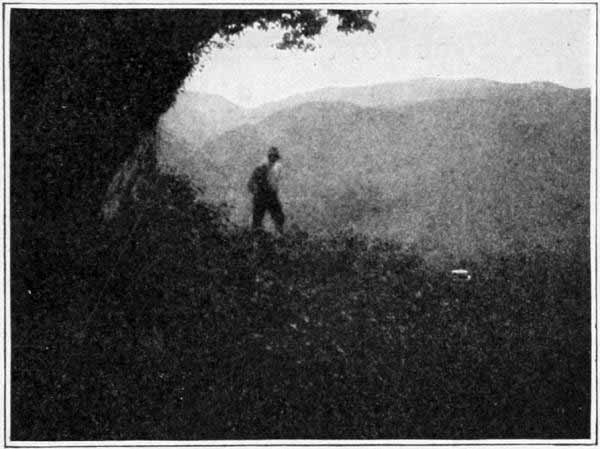
Fig. 127. Outlook from the cave of Hornos de la Peña. Photograph by N. C. Nelson.
In all Germany there are only about seven stations of unquestioned Mousterian age. Of these six are grottos, and the seventh, Mommenheim, is a fluvial redeposit of loess along a small stream, where only one implement has been found.(69) It is interesting to observe that in Germany these Mousterian sites occupy the great wedge of territory between the Scandinavian ice-fields on the north, and the Alpine on the south, and that Wildkirchli was actually within the area of glaciation; while the caves of Räuberhöhle and Šipka were not far from the glaciers which clothed the Carpathian Mountains, and Baumannshöhle was not so very remote from the great Scandinavian ice-field. In the region of the headwaters of the Rhine and Danube the industry of the Neanderthal race has thus far been traced only at the stations of Irpfelhöhle, Räuberhöhle, and Sirgenstein. The latter cavern is of especial importance because it comprises the entire Palæolithic history of this region, presenting a series of successive culture layers from Mousterian times up to the arrival of the Neolithic race. Further to the east are the Gudenushöhle, near Krems, in Lower Austria, and Ochos and Šipka, in Moravia, while over the Russian border are Wierschovie and Miskolcz. Well to the northwest of Wildkirchli are the stations of Mommenheim and Kartstein, and to the north that of Baumannshöhle.
Workmanship of the Neanderthals
The dense communal life of Mousterian times may have favored a social evolution, the development of the imagination and of tribal lore, and the beginnings of the religious belief and ceremonial of which apparent indications are found to be wide-spread among the entirely different races of Upper Palæolithic times. The life is not, however, marked by industrial progress or invention.
The successive stages of the Mousterian industry have not as yet been so clearly defined as those of the Acheulean (Schmidt(70)). In the open Mousterian stations and caverns of Belgium and England Schmidt has observed the stages of early, middle, and late Mousterian. Breuil and Obermaier consider La Micoque as belonging to the close of the Acheulean but as marking the transition into the Mousterian. Breuil considers the industry of the Combe-Capelle station as representing the oldest true Mousterian culture. The researches which have been carried thus far would appear to justify the following subdivisions of the Mousterian culture in southwestern France:
6. Abri Audit culture, marking the transition from late Mousterian to early Aurignacian industry.
5. Late true Mousterian industry. La Quina type of implements with scrapers and bone anvils.
4. Middle Mousterian industry, with a predominance of handsome, large Mousterian points carefully 'retouched' on the edge and sometimes on one side, a 'retouch' at times approaching the superior Solutrean technique.
3. Primitive early Mousterian industry, with a limited inventory of implements.
2. Combe-Capelle stage, with heart-shaped coups de poing and typical Mousterian 'points.' (Arrival of reindeer.)
1. La Micoque culture, transitional from Acheulean to Mousterian times. (No reindeer.)
The flint industry, although very different in its outward appearance, is recognizable as a direct evolution from the Acheulean, with the suppression or decline of certain implements and the improvements of others. It is the product of the same kind of mind at work with the same materials, but under different climatic conditions and with new demands, especially for clothing as protection against the severe weather. We also cannot avoid the feeling that the abandonment of the free, open life of Chellean and early Acheulean times and the crowding of the Neanderthal tribesmen beneath the shelters and in the grottos had a dwarfing effect both upon the physique and upon the industry itself. The Mousterian implements, as compared with the Acheulean, impress one as the work of a less muscular and vigorous race.
In addition to the many fine transitions that one observes(71) between the Acheulean and Mousterian industries at St. Acheul, strong evidence is also furnished in favor of a close connection between these cultures by the discoveries at Laussel, on the Vézère, near Les Eyzies. There, broad and deep before this shelter of Laussel, lies the Mousterian layer, and directly beneath it is a true Acheulean layer close to the waters of the valley of the Beune. This proves that in Acheulean times this valley was deepened to the same degree as to-day, and a close union of the Acheulean to the Mousterian is here again evident. In the valley of the Somme near St. Acheul Commont has also observed proofs of a similar close connection between these cultures. With such records in northern and southern France, the Neanderthal race, which is known toward the end of Acheulean times and especially covers the entire period of Mousterian time, comes much nearer to us. If we assign the Mousterian industry to the last glacial period, we give it a duration of some 30,000 years, and this is about the reckoning which thoughtful anatomists have already assigned for the Neanderthal man.
Special Mousterian Implements
Two instruments are especially typical of the Mousterian industry from beginning to end; these are the 'pointe' and the 'racloir.' The former, pointed and spear-shaped, is from 1 to 4 inches in length; the latter is a broad scraper, from 1 to 2 inches in width; and both have the distinctive peculiarity of being composed of a large flake of flint struck off from a larger bulb or nodule and of being retouched only on one side, leaving on the opposite side the smooth conchoidal surface of the flake.(72) This point and scraper are highly characteristic not only of the early stages but of the Mousterian industry throughout its entire course, including even the late La Quina types, and their manner of making is obviously a modified usage of the late Acheulean discovery of the flakes of Levallois.
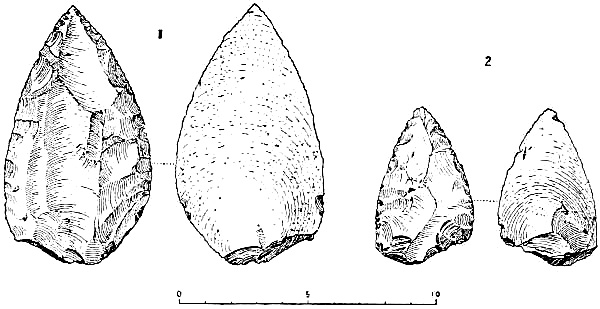
Fig. 128. Typical Mousterian 'points' from the type station of Le Moustier, made of a large flake of flint struck off from the nodule and retouched on only one side, leaving on the opposite side a smooth, conchoidal surface. After Déchelette, by permission of M. A. Picard, Librairie Alphonse Picard et Fils.
A matter of the greatest interest in the industrial development of western Europe at this time is the fact that this discovery of the utilization of the flake, whether in the 'lames de Levallois' or in the Mousterian point and scraper, led to the decline of the coup de poing. The retouched flakes of various shapes were easier to make and to repair and served equally well the purposes of skinning and dismembering game which had been previously served by the ancient coup de poing.(73)
Larger Image
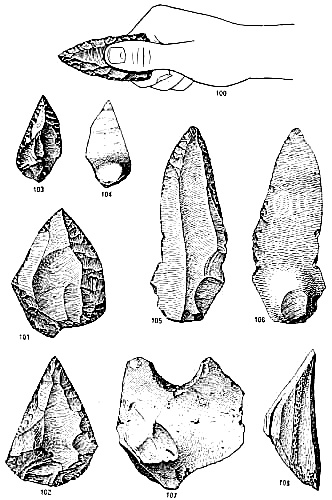
Fig. 129. Mousterian 'points' and scrapers from various parts of Europe, as interpreted by de Mortillet. In some cases both sides of the implement are shown; all are one-quarter actual size except 101, which is one-half actual size. 100—De Mortillet's theory of the manner of using the Mousterian 'point,' which was held in the hand and not shafted. 101—Mousterian point from Suffolk, England. 102—Mousterian point from Umbria, Italy. 103, 104—A single flake point from the Crimea, in southern Russia. 105, 106—A long, narrow Mousterian point from Oise, France. 107—A curved-in scraper, or grattoir, from Dordogne, France; perhaps an implement for dressing a wooden spear or lance. 108—Bone splinter, broken for the marrow, but not shaped.
In consequence, the coup de poing, fashioned from the core of the nodule, begins to play a very secondary rôle and occurs but rarely in the Mousterian levels. Even at St. Acheul, the very centre of its former reign, we begin to find decadent forms and poor workmanship, which make it difficult to recognize that these are the successors of the finely retouched Acheulean coups de poing. While the coups de poing at the type station of Le Moustier continue to retain the old Acheulean patterns—the oval, the heart-shaped, the sharp-pointed—they are all of smaller size and rather coarsely retouched. Thus, after thousands of years of development and employment, the coup de poing falls into a period of degeneration and of final disuse. The history of this. implement, which we have traced from its Pre-Chellean prototypes, presents a most interesting analogy with the course of evolution observed in so many animal and plant forms. It passes through many stages of improvement and reaches a climax of perfection and adaptation; it then comes into competition with another form evolving on a fundamentally different and superior plan and disappears in the struggle for existence through the greater usefulness of the replacing type.
Successive Stages in the Mousterian Industry
The succession of industrial stages is best shown along the Vézère. The oldest Mousterian industry is that of Combe-Capelle with its heart-shaped, roughly fashioned coups de poing, entirely lacking, however, any evidence of a surface prepared for the grasp of the hand.
In the valley of the Somme Commont(74) has observed the three following stages in the advance of the Mousterian industry:
3. A late Mousterian culture which lies on the upper layers near the top of the same gravel deposit and which shows entirely new technical elements. The old coup-de-poing culture is no longer valued, and all the implements found here are of flakes worked only on one side and with an extraordinarily fine retouch.
2. A middle Mousterian horizon which lies in the lower layers of a gravel deposit, belonging to the 'newer loess,' and which contains only one small coup de poing.
1. An early Mousterian, with quite numerous lance-shaped coups de poing, lies at the base of the 'newer loess,' showing that the coup-de-poing tradition still lingers and the coup-de-poing type is still preserved. With these are associated the new types of implements and especially the 'hand-points,' which are so typical of the Mousterian industry.
The more recent levels (2, 3) contain longer flakes, which already exhibit a tendency toward the blades, or 'lames,' of the Upper Palæolithic.
In the shelters and caverns of Dordogne the same industrial sequence may be observed, although the chronological succession of the strata is not always clearly defined. At the grotto of Combe-Capelle the heart-shaped coups de poing retain most strongly the old traditions, but even here these are outnumbered by the well-fashioned Mousterian 'points,' chipped only on one side.
The further development of the Mousterian industry may be observed in the type station of Le Moustier, where the lower levels show a primitive Mousterian consisting mostly of very fine, irregularly fashioned flakes, made into small scrapers, triangular points, borers, and disks. The overlying layer includes very carefully worked Mousterian points which are frequently retouched on one side over the entire surface; here the Mousterian technique reaches its highest development, so that Schmidt designates it as 'high Mousterian.'(75) Above this layer, again, is a level of typical late Mousterian forms, quite unlike the small primitive flakes of the lower level and resembling the characteristic forms of La Quina, the dominant type being the finely shaped La Quina racloir. The few diminutive coups de poing which occur in this level at Le Moustier furnish the only distinction between the industry here and that of La Quina, where no coups de poing are found. At Le Moustier also occur the typical bone anvils which were first recognized at La Quina.
The Mousterian industry of the Neanderthals was thus devoted mainly to the development of the smaller forms of implements, for the most part retouched on one side only, and with a constant improvement of technique. Yet the chief types of Mousterian implements remain the same as in Acheulean times, as shown in the accompanying table.
The implement known as the pointe, or the 'hand-point,' is a principal and very characteristic Mousterian form further perfected from its Acheulean stage. It is spear-headed in shape and chipped on one side only, and continues into late Mousterian times, being still found in the Mousterian levels of Spy, in Belgium.
The pointe double, a double-pointed, spear-shaped form, at times almost attains the elongate shape of the Solutrean pointe de laurier, though never its slenderness, symmetry, and perfection of technique.
Industrial. Coup de poing (decadent), hand-stone. ovoid. heart-shaped. sharp-pointed. Hachette, chopper. Grattoir, planing tool. Perçoir, drill, borer. Couteau, knife. Racloir, scraper. knife-edged. curved-out edge. saw-edged. double-edged. beak-shaped. many-edged. Pointe, 'hand-point.' Percuteur? hammer-stone? War and Chase. Pointe, 'hand-point.' Pointe double, spear head? Coup de poing, hand-stone. Pierre de jet, throwing stone. Couteau, knife.
There are five or six well-defined varieties of the racloir, or scraper, carefully fashioned out of flakes. The principal form is crescentic in shape, with outward-curved edge. Other forms are saw-like with straight edges or knife-edged. Another form with very neatly and symmetrically incurved borders has its edges sharply retouched, as if for the smoothing down of bone or wooden shafts. The borer is also fashioned of an elongate flake and sometimes finished with a very fine point at one of its extremities. It is noteworthy that the grattoir, or planing tool, so well developed in the Upper Palæolithic industries, appears only sporadically in Mousterian times. For example, at La Quina, in the closing stages of the Mousterian industry, out of 220 implements collected at hazard, there were 166 scrapers of six different forms, 45 'hand-points' of five different forms, and 5 double points, as compared with 5 grattoirs, or planing tools. There are very few knife-shaped forms. It would appear that the racloir and the perçoir were the principal implements employed in the preparation of skins for clothing.
In early Mousterian times the coup de poing may still have been used by the Neanderthals in the chase, and the fine, spear-headed 'point' and the rarer 'double point' may have been developed in response to the needs of hunters, who now ventured the chase of the bison, the urus, the wild horse, and the reindeer.
The most striking features of all the implements which may have been used in the chase are: first, the absence of any definite proof of their attachment to a shaft or handle; and second, the absence of any barbed or headed type of point. The use of the barb, as we shall see, appears to be a relatively recent discovery of the later cultures of Upper Palæolithic times.
Larger Image
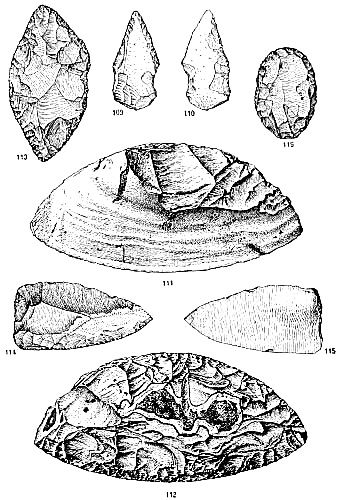
Fig. 130. Late Mousterian implements, after de Mortillet, one-quarter actual size. 109, 110—Point, finely retouched at one end, from Seine-et-Marne, France. The reverse shows a retouch on the flaked surface which suggests the double-face Solutrean retouch. 111, 112—A very large racloir, or scraper, from La Quina, Charente, France; part of the bulb of percussion has been chipped off. 113—Double-ended point from Le Moustier, retouched on both surfaces. 114, 115—Combination point and scraper from Le Moustier, Dordogne, France. 116—Double scraper, or racloir, with grattoir, or planing end.
The transition from the Mousterian to the Aurignacian appears in the Abri Audit, which also lies in the valley of the Vézère. Here we still find irregularly fashioned coups de poing, decadent followers of the heart-shaped types of the earliest Mousterian industry; this is nearly the last phase in the decline of the old coup-de-poing manufacture. While the lance-shaped coup de poing of the late Acheulean never appears in any true Mousterian industry, the shorter, more heart-shaped type of Combe-Capelle traverses the entire Mousterian and, after further stages of degeneration, passes into the Abri Audit culture and even lingers into the early Aurignacian. At this latter station the typical Mousterian 'points' are almost wanting.
The Mousterian, observes Schmidt,(75) which preserves the traditions of the Lower Palæolithic coup-de-poing culture, is one of the most interesting phases in the development of Palæolithic industry, in that its successive stages exhibit the very last phases of the great coup-de-poing industry, of which only the almond and oval scraper types appear, and that very rarely, in the early Aurignacian. On the other hand, in the late Mousterian we observe a trend toward the blade (lame) industry of the Upper Palæolithic. Careful study and observation of the subdivisions of Mousterian culture have thus far been limited to central and southern France, and they have not yet been traced in Spain; but in the grottos of Belgium and England the early, middle, and late Mousterian types are known to exist.
Bone anvils, fashioned out of the hard surfaces of the foreleg and foot bones of the bison and horse, were discovered at La Quina in 1906. They show a flattened surface with cross incisions too regular to be accidental and too far from the articulation to be the result of an inexpert attempt to sever the joint.(76) This was not the only use of bone in Mousterian times, however, for primitive pointed implements of bone are occasionally found in Dordogne, mingled with Mousterian flints. A variety of rudely fashioned bone implements also occurs at Wildkirchli, in Switzerland.
Disappearance of the Neanderthal Race
We have seen that the Neanderthals dwelt in Europe for a very long time, many thousands of years, during which they doubtless underwent considerable evolution from lower to higher types, and into varieties, under the modifying influences of climate, food, and racial habits. Consequently the known remains of Neanderthals exhibit a decided variation in head form, as well as in dentition: some are more primitive and ape-like; others, such as Spy II, are more like the modern races. The Krapina variety is more broad-headed than the typical Neanderthal variety. The Gibraltar variety is in many respects of low type. The individual known as Spy II is of higher type than the other Neanderthals. The variations in stature so far as known are slight.
For these and other reasons Hrdlička,(77) who has recently made a broad comparative study of the chief Neanderthal remains of Europe, is of the opinion that the Neanderthals partly evolved into the lower races of Homo sapiens; being not only in some measure ancestral to such very primitive forms as the Brünn or Předmost race of Upper Palæolithic times, but even contributing to the higher race of the Crô-Magnons. He also holds that traces of Neanderthal blood and physiognomy are not lacking even among modern Europeans.
A contrary view is set forth in the present volume; namely, that the Neanderthals represent a side branch of the human race which became wholly extinct in western Europe. This view the author shares with Boule and with Schwalbe. Certainly the evidence afforded by the known Upper Palæolithic burial sites does not support the theory that the Neanderthals persisted. It is possible, however, that the Upper Palæolithic skeletons discovered at Předmost, and now awaiting description by Maška, may modify this conclusion and demonstrate Hrdlička's theory that the Neanderthals survived and left descendants or men of mixed Neanderthal and Homo sapiens race along the valley of the Danube.
Whatever may have been their fate in other regions, certainly the most sudden racial change which we know of in the whole prehistory of western Europe is the disappearance of the Neanderthal race at the close of the Mousterian culture stage, which was the latest industrial period of Lower Palæolithic times, and their replacement by the Crô-Magnon race. From geologic evidence the date of this replacement is believed to have been between 20,000 and 25,000 years before our era. So far as we know at present, the Neanderthals were entirely eliminated; no trace of the survival of the pure Neanderthal type has been found in any of the Upper Palæolithic burial sites; nor have the alleged instances of the survival of the Neanderthal strain or of people bearing the Neanderthal cranial characters been substantiated. We incline to agree with Boule and Schwalbe that the supposed cases among modern races of the transmission of Neanderthal characters are simply low or reversional types, which, upon close analysis, are never found to present the highly distinctive and peculiar combination of Neanderthal characteristics.
There is some reason to believe that the Neanderthals were degenerating physically and industrially during the very severe conditions of life of the fourth glaciation, but the consequent inferiority and diminution in numbers would not account for their total extinction, and we are inclined to attribute this to the entrance into the whole Neanderthal country of western Europe toward the close of Lower Palæolithic times of a new and highly superior race. Archæologists find traces of a new culture and industry in certain Mousterian stations preceding the disappearance of the typical Mousterian industry. Such a mingling is found in the valley of the Somme in northern France.
From this scanty evidence we may infer that the new race competed for a time with the Neanderthals before they dispossessed them of their principal stations and drove them out of the country or killed them in battle. The Neanderthals, no doubt, fought with wooden weapons and with the stone-headed dart and spear, but there is no evidence that they possessed the bow and arrow. There is, on the contrary, some possibility that the newly arriving Crô-Magnon race may have been familiar with the bow and arrow, for a barbed arrow or spear head appears in drawings of a later stage of Crô-Magnon history, the so-called Magdalenian. It is thus possible, though very far from being demonstrated, that when the Crô-Magnons entered western Europe, at the dawn of the Upper Palæolithic, they were armed with weapons which, with their superior intelligence and physique, would have given them a very great advantage in contests with the Neanderthals.
(1) Commont, 1912.1, p. 294.
(2) Smith, W., 1894.1, chap. XV.
(3) Dietrich, 1910.1, pp. 329, 330.
(4) Penck, 1909.1.
(5) Leverett, 1910.1, pp. 306-314.
(6) Geikie, 1914.1.
(7) Op. cit., p. 272.
(8) Op. cit., pp. 265-266.
(9) Keith, 1911.1, p. 23, Fig. 5.
(10) Munro, 1912.1, pp. 46, 47.
(11) Lartet, 1861.1; 1875.1.
(12) De Vibraye, 1864.1.
(13) Massénat, 1868.1.
(14) Smith, W., 1894.1, chap. XIV.
(15) Geikie, 1914.1, p. 119.
(16) Smith, W., op. cit., pp. 196, 197.
(17) Op. cit., p. 224.
(18) Geikie, 1914.1, p. 118.
(19) Bächler, 1912.1.
(20) Schmidt, 1912.1, pp. 18-32, 165-171.
(21) Op. cit., Table opposite p. 270.
(22) Osborn, 1910.1, pp. 419, 420.
(23) Niezabitowski, 1911.1.
(24) Harlé, 1908.1, p. 302.
(25) Obermaier, 1912.1, p. 135.
(26) Keith, 1911.2.
(27) Boule, 1913.1, pp. 220, 221.
(28) Op. cit., p. 64.
(29) Fischer, 1913.1, pp. 336, 337.
(30) Schaaffhausen, 1875.1; 1858.1.
(31) Lyell, 1863.1, pp. 80-92.
(32) Schwalbe, 1897.1; 1901.1; 1901.2; 1904.1.
(33) King, 1864.1.
(34) Cope, 1893.1.
(35) Wilser, 1898.1.
(36) Fraipont, 1887.1.
(37) Schwalbe, 1914.2.
(38) Dupont, 1866.1.
(39) Maška, 1886.1.
(40) Rzehak, 1906.1.
(41) Fischer, 1913.1.
(42) Klaatsch, 1909.1.
(43) Bouyssonie, 1909.1.
(44) Boule, 1908.1; 1908.2; 1909.1; 1911.1; 1912.1.
(45) Boule, 1913.1.
(46) Martin, H., 1911.1.
(47) Nicolle, 1910.1.
(48) Keith, 1911.1.
(49) Fischer, 1913.1, p. 352.
(50) Schwalbe, 1914.1, p. 544, Figs. 4 and 5.
(51) Fischer, op. cit.
(52) Boule, 1913.1, p. 85.
(53) Gorjanovič-Kramberger, 1909.1.
(54) Boule, 1913.1, p. 104.
(55) Tomes, 1914.1, pp. 588-598.
(56) Schwalbe, 1901.2; 1914.1, pp. 534, 535.
(57) Schwalbe, 1901.1.
(58) Boule, 1913.1.
(59) Op. cit., pp. 66, 67, 72, 75.
(60) Berry, 1914.1.
(61) Johnson, 1913.1.
(62) Quatrefages, 1884.1, p. 394.
(63) Martin, R., 1914.1, p. 645.
(64) Boule, 1910.1; 1911.1.
(65) Anthony, 1912.1.
(66) Boule, 1913.1, p. 119.
(67) Op. cit., p. 120.
(68) Geikie, 1914.1, p. 130; Godwin-Austen, 1840.1.
(69) Schmidt, 1912.1, pp. 23, 32, 66, 75, 76, 101, 169.
(70) Op. cit., p. 128.
(71) Schuchhardt, 1913.1, p. 144.
(72) Déchelette, 1908.1, vol. I, pp. 98-101.
(73) Obermaier, 1912.1, p. 130.
(74) Commont, 1909.1.
(75) Schmidt, 1912.1, pp. 126-128.
(76) Déchelette, 1908.1, vol. I, pp. 104, 105.
(77) Hrdlička, 1914.1.