Chapter XLVI
Reading edition
POLITICAL ALARMS. — THE RADICALS. — LEVIES OF VOLUNTEERS. — PROJECT OF THE BUCCLEUCH LEGION. — DEATH OF SCOTT'S MOTHER, HER BROTHER DR. RUTHERFORD, AND HER SISTER CHRISTIAN. — LETTERS TO LORD MONTAGU, MR. THOMAS SCOTT, CORNET SCOTT, MR. LAIDLAW, AND LADY LOUISA STUART. — PUBLICATION OF IVANHOE.
1819
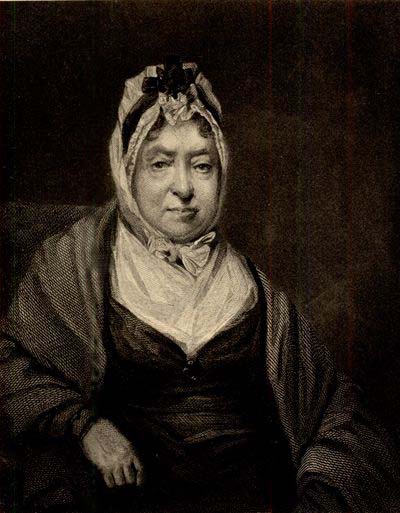
ANNE RUTHERFORD, MOTHER OF SIR WALTER SCOTT After the painting at Abbotsford.
Towards the winter of 1819 there prevailed a spirit of alarming insubordination among the mining population of Northumberland and the weavers of the West of Scotland; and Scott was particularly gratified with finding that his own neighbors at Galashiels had escaped the contagion. There can be little doubt that this exemption was principally owing to the personal influence and authority of the Laird of Abbotsford and Sheriff of the Forest; but the people of Galashiels were also fortunate in the qualities of their own beneficent landlords, Mr. Scott of Gala, and Mr. Pringle of Torwoodlee. The progress of the western Reformers by degrees led even the most important Whigs in that district to exert themselves in the organization of volunteer regiments, both mounted and dismounted; and, when it became generally suspected that Glasgow and Paisley maintained a dangerous correspondence with the refractory colliers of Northumberland—Scott, and his friends the Lairds of Torwoodlee and Gala, determined to avail themselves of the loyalty and spirit of the men of Ettrick and Teviotdale, and proposed first raising a company of sharpshooters among their own immediate neighbors, and afterwards—this plan receiving every encouragement—a legion or brigade upon a large scale, to be called the Buccleuch Legion. During November and December, 1819, these matters formed the chief daily care and occupation of the author of Ivanhoe; and though he was still obliged to dictate most of the chapters of his novel, we shall see that, in case it should be necessary for the projected levy of Foresters to march upon Tynedale, he was prepared to place himself at their head.
He had again intended, as soon as he should have finished Ivanhoe, to proceed to London, and receive his baronetcy; but as that affair had been crossed at Easter by his own illness, so at Christmas it was again obliged to be put off in consequence of a heavy series of domestic afflictions. Within one week Scott lost his excellent mother, his uncle Dr. Daniel Rutherford, Professor of Botany in the University of Edinburgh—and their sister, Christian Rutherford, already often mentioned as one of the dearest and most esteemed of all his friends and connections.
The following letters require no further introduction or comment:—
TO THE LORD MONTAGU, BUXTON.
Abbotsford, 12th November, 1819.
My dear Lord,—... I wish I had any news to send your Lordship; but the best is, we are all quiet here. The Galashiels weavers, both men and masters, have made their political creed known to me, and have sworn themselves anti-radical. They came in solemn procession, with their banners, and my own piper at their head, whom they had borrowed for the nonce. But the Tweed being in flood, we could only communicate like Wallace and Bruce across the Carron. However, two deputies came through in the boat, and made me acquainted with their loyal purposes. The evening was crowned with two most distinguished actions—the weavers refusing, in the most peremptory manner, to accept of a couple of guineas to buy whiskey, and the renowned John of Skye, piper in ordinary to the Laird of Abbotsford, no less steadily refusing a very handsome collection, which they offered him for his minstrelsy. All this sounds very nonsensical, but the people must be humored and countenanced when they take the right turn, otherwise they will be sure to take the wrong. The accounts from the West sometimes make me wish our little Duke five or six years older, and able to get on horseback. It seems approaching to the old song—
I am rather too old for that work now, and I cannot look forward to it with the sort of feeling that resembled pleasure—as I did in my younger and more healthy days. However, I have got a good following here, and will endeavor to keep them together till times mend.
My respectful compliments attend Lady Montagu, and I am always, with the greatest regard, your Lordship's very faithful
Walter Scott.
TO CORNET WALTER SCOTT, 18TH HUSSARS.
Edinburgh, 13th November, 1819.
Dear Walter,—I am much surprised and rather hurt at not hearing from you for so long a while. You ought to remember that, however pleasantly the time may be passing with you, we at home have some right to expect that a part of it (a very small part will serve the turn) should be dedicated, were it but for the sake of propriety, to let us know what you are about. I cannot say I shall be flattered by finding myself under the necessity of again complaining of neglect. To write once a week, to one or other of us, is no great sacrifice, and it is what I earnestly pray you to do.
We are to have great doings in Edinburgh this winter. No less than Prince Gustavus of Sweden is to pass the season here, and do what Princes call studying. He is but half a Prince either, for this Northern Star is somewhat shorn of his beams. His father was, you know, dethroned by Buonaparte, at least by the influence of his arms, and one of his generals, Bernadotte, made heir of the Swedish throne in his stead. But this youngster, I suppose, has his own dreams of royalty, for he is nephew to the Emperor of Russia (by the mother's side), and that is a likely connection to be of use to him, should the Swedish nobles get rid of Bernadotte, as it is said they wish to do. Lord Melville has recommended the said Prince particularly to my attention, though I do not see how I can do much for him.
I have just achieved my grand remove from Abbotsford to Edinburgh—a motion which you know I do not make with great satisfaction. We had the Abbotsford hunt last week. The company was small, as the newspapers say, but select, and we had excellent sport, killing eight hares. We coursed on Gala's ground, and he was with us. The dinner went off with its usual alacrity, but we wanted you and Sally to ride and mark for us.
I enclose another letter from Mrs. Dundas of Arniston. I am afraid you have been careless in not delivering those I formerly forwarded, because in one of them, which Mrs. Dundas got from a friend, there was enclosed a draft for some money. I beg you will be particular in delivering any letters entrusted to you, because though the good-nature of the writers may induce them to write to be of service to you, yet it is possible that they may, as in this instance, add things which are otherwise of importance to their correspondents. It is probable that you may have picked up among your military friends the idea that the mess of a regiment is all in all sufficient to itself; but when you see a little of the world you will be satisfied that none but pedants—for there is pedantry in all professions—herd exclusively together, and that those who do so are laughed at in real good company. This you may take on the authority of one who has seen more of life and society, in all its various gradations, from the highest to the lowest, than a whole hussar regimental mess, and who would be much pleased by knowing that you reap the benefit of an experience which has raised him from being a person of small consideration to the honor of being father of an officer of hussars. I therefore enclose another letter from the same kind friend, of which I pray you to avail yourself. In fact, those officers who associate entirely among themselves see and know no more of the world than their messman, and get conceited and disagreeable by neglecting the opportunities offered for enlarging their understanding. Every distinguished soldier whom I have known, and I have known many, was a man of the world, and accustomed to general society.
To sweeten my lecture, I have to inform you that, this being quarter-day, I have a remittance of £50 to send you whenever you are pleased to let me know it will be acceptable—for, like a ghost, I will not speak again till I am spoken to.
I wish you not to avail yourself of your leave of absence this winter, because, if my health continues good, I shall endeavor to go on the Continent next summer, and should be very desirous to have you with me; therefore, I beg you to look after your French and German. We had a visit from a very fine fellow indeed at Abbotsford,—Sir Thomas Brisbane, who long commanded a brigade in the Peninsula. He is very scientific, but bores no one with it, being at the same time a well-informed man on all subjects, and particularly alert in his own profession, and willing to talk about what he has seen. Sir Harry Hay Macdougal, whose eldest daughter he is to marry, brought him to Abbotsford on a sort of wedding visit, as we are cousins according to the old fashion of country kin; Beardie, of whom Sir Harry has a beautiful picture, being a son of an Isabel Macdougal, who was, I fancy, grand-aunt to Sir Harry.
Once more, my dear Walter, write more frequently, and do not allow yourself to think that the first neglect in correspondence I have ever had to complain of has been on your part. I hope you have received the Meerschaum pipe.—I remain your affectionate father,
Walter Scott.
TO THE SAME.
Edinburgh, 3d December, 1819.
I am concerned I cannot give a very pleasant account of things here. Glasgow is in a terrible state. The Radicals had a plan to seize on 1000 stand of arms, as well as a depôt of ammunition, which had been sent from Edinburgh Castle for the use of the volunteers. The Commander-in-Chief, Sir Thomas Bradford, went to Glasgow in person, and the whole city was occupied with patrols of horse and foot, to deter them from the meditated attack on the barracks. The arms were then delivered to the volunteers, who are said to be 4000 on paper; how many effective and trustworthy, I know not. But it was a new sight in Scotland on a Sunday to see all the inhabitants in arms, soldiers patrolling the streets, and the utmost precaution of military service exacted and observed in an apparently peaceful city.
They are embodying a troop of cavalry in Edinburgh—nice young men and good horses. They have paid me the compliment to make me an honorary member of the corps, as my days of active service have been long over. Pray take care, however, of my sabre, in case the time comes which must turn out all.
I have almost settled that, if things look moderately tranquil in Britain in spring and summer, I will go abroad, and take Charles, with the purpose of leaving him, for two or three years, at the famous institution of Fellenborg, near Berne, of which I hear very highly. Two of Fraser Tytler's sons are there, and he makes a very favorable report of the whole establishment. I think that such a residence abroad will not only make him well acquainted with French and German, as indeed he will hear nothing else, but also prevent his becoming an Edinburgh petit-maître of fourteen or fifteen, which he could otherwise scarce avoid. I mentioned to you that I should be particularly glad to get you leave of absence, providing it does not interfere with your duty, in order that you may go with us. If I have cash enough, I will also take your sister and mamma, and you might return home with them by Paris, in case I went on to Italy. All this is doubtful, but I think it is almost certain that Charles and I go, and hope to have you with us. This will be probably about July next, and I wish you particularly to keep it in view. If these dark prospects become darker, which God forbid! neither you nor I will have it in our power to leave the post to which duty calls us.
Mamma and the girls are quite well, and so is Master Charles, who is of course more magnificent, as being the only specimen of youthhead at home. He has got an old broadsword hanging up at his bed-head, which, to be the more ready for service, hath no sheath. To this I understand we are to trust for our defence against the Radicals. Anne (notwithstanding the assurance) is so much afraid of the disaffected, that last night, returning with Sophia from Portobello, where they had been dancing with the Scotts of Harden, she saw a Radical in every man that the carriage passed. Sophia is of course wise and philosophical, and mamma has not yet been able to conceive why we do not catch and hang the whole of them, untried and unconvicted. Amidst all their various emotions, they join in best love to you; and I always am very truly yours,
W. Scott.
P. S.—I shall set off for London on the 25th.
TO THE SAME.
Edinburgh, 17th December, 1819.
My dear Walter,—I have a train of most melancholy news to acquaint you with. On Saturday I saw your grandmother perfectly well, and on Sunday the girls drank tea with her, when the good old lady was more than usually in spirits; and, as if she had wished to impress many things on their memory, told over a number of her old stories with her usual alertness and vivacity. On Monday she had an indisposition, which proved to be a paralytic affection, and on Tuesday she was speechless, and had lost the power of one side, without any hope of recovery, although she may linger some days. But what is very remarkable, and no less shocking, Dr. Rutherford, who attended his sister in perfect health upon Tuesday, died himself upon the Wednesday morning. He had breakfasted without intimating the least illness, and was dressed to go out, and particularly to visit my mother, when he sunk backwards, and died in his daughter Anne's arms, almost without a groan. To add to this melancholy list, our poor friend, Miss Christie, is despaired of. She was much affected by my mother's fatal indisposition, but does not know as yet of her brother's death.
To all this domestic distress I have to add the fearful and unsettled state of the country. All the regular troops are gone to Glasgow. The Mid-Lothian Yeomanry and other corps of volunteers went there on Monday, and about 5000 men occupied the town. In the mean while, we were under considerable apprehension here, the Castle being left in the charge of the city volunteers and a few veterans.
All our corner, high and low, is loyal. Torwoodlee, Gala, and I, have offered to raise a corps, to be called the Loyal Foresters, to act anywhere south of the Forth. If matters get worse, I will ask leave of absence for you from the Commander-in-Chief, because your presence will be materially useful to levy men, and you can only be idle where you are, unless Ireland should be disturbed. Your old corps of the Selkirkshire Yeomanry have been under orders, and expect to be sent either to Dumfries or Carlisle. Berwick is dismantled, and they are removing the stores, cannon, etc., from one of the strongest places here, for I defy the devil to pass the bridge at Berwick, if reasonably well kept by 100 men. But there is a spirit of consternation implied in many of the orders, which, entre nous, I like worse than what I see or know of the circumstances which infer real danger. For myself I am too old to fight, but nobody is too old to die, like a man of virtue and honor, in defence of the principles he has always maintained.
I would have you to keep yourself ready to return here suddenly, in case the Duke of York should permit your temporary services in your own country, which, if things grow worse, I will certainly ask. The fearful thing is the secret and steady silence observed by the Radicals in all they do. Yet, without anything like effective arms or useful discipline, without money and without a commissariat, what can they do, but, according to their favorite toast, have blood and plunder? Mamma and the girls, as well as Charles, send kind love. Your affectionate father,
Walter Scott.
TO MR. WILLIAM LAIDLAW, KAESIDE.
Edinburgh, December 20, 1819.
My dear Willie,—Distress has been very busy with me since I wrote to you. I have lost, in the course of one week, my valued relations, Dr. and Miss Rutherford—happy in this, that neither knew of the other's dissolution. My dear mother has offered me deeper subject of affliction, having been struck with the palsy, and being now in such a state that I scarce hope to see her again.
But the strange times compel me, under this pressure of domestic distress, to attend to public business. I find Mr. Scott of Gala agrees with me in thinking we should appeal at this crisis to the good sense and loyalty of the lower orders, and we have resolved to break the ice, and be the first in the Lowlands, so far as I have yet heard of, to invite our laborers and those over whom circumstances and fortune give us influence, to rise with us in arms, and share our fate. You know, as well as any one, that I have always spent twice the income of my property in giving work to my neighbors, and I hope they will not be behind the Galashiels people, who are very zealous. Gala and I go hand in hand, and propose to raise at least a company each of men, to be drilled as sharpshooters or infantry, which will be a lively and interesting amusement for the young fellows. The dress we propose to be as simple, and at the same time as serviceable, as possible;—a jacket and trousers of Galashiels gray cloth, and a smart bonnet with a small feather, or, to save even that expense, a sprig of holly. And we will have shooting at the mark, and prizes, and fun, and a little whiskey, and daily pay when on duty or drill. I beg of you, dear Willie, to communicate my wish to all who have received a good turn at my hand, or may expect one, or may be desirous of doing me one—(for I should be sorry Darnick and Brigend were beat)—and to all other free and honest fellows who will take share with me on this occasion. I do not wish to take any command farther than such as shall entitle me to go with the corps, for I wish it to be distinctly understood that, in whatever capacity, I go with them, and take a share in good or bad as it casts up. I cannot doubt that I will have your support, and I hope you will use all your enthusiasm in our behalf. Morrison volunteers as our engineer. Those who I think should be spoke to are the following, among the higher class:—
Adam Ferguson thinks you should be our adjutant. John Ferguson I propose for captain. He is steady, right bold, and has seen much fire. The auld captain will help us in one shape or other. For myself, I know not what they propose to make of me, but it cannot be anything very active. However, I should like to have a steady quiet horse, drilled to stand fire well, and if he has these properties, no matter how stupid, so he does not stumble. In this case the price of such a horse will be no object.
John of Skye is cock-a-hoop upon the occasion, and I suppose has made fifty blunders about it by this time. You must warn Tom Jamieson, Gordon Winness, John Swanston (who will carry off all the prizes at shooting), Davidson, and so forth.
If you think it necessary, a little handbill might be circulated. But it may be better to see if Government will accept our services; and I think, in the situation of the country, when work is scarce, and we offer pay for their playing themselves, we should have choice of men. But I would urge no one to do what he did not like.
The very precarious state of my poor mother detains me here, and makes me devolve this troublesome duty upon you. All you have to do, however, is to sound the men, and mark down those who seem zealous. They will perhaps have to fight with the pitmen and colliers of Northumberland for defence of their firesides, for these literal blackguards are got beyond the management of their own people. And if such is the case, better keep them from coming into Scotland, than encounter the mischief they might do there.
Yours always most truly,
Walter Scott.
TO THOMAS SCOTT, ESQ., 70th REGIMENT, KINGSTON, CANADA.
Edinburgh, 22d December, 1819.
Walter Scott.
Scott's excellent mother died on the 24th December—the day after he closed the foregoing letter to his brother.
On the 18th, in the midst of these accumulated afflictions, the romance of Ivanhoe made its appearance. The date has been torn from the following letter, but it was evidently written while all these events were fresh and recent:—
TO THE LADY LOUISA STUART, DITTON PARK, WINDSOR.
I am not sure whether it was your Ladyship, or the poor Duchess of Buccleuch, who met my mother once, and flattered me by being so much pleased with the good old lady. She had a mind peculiarly well stored with much acquired information and natural talent, and as she was very old, and had an excellent memory, she could draw without the least exaggeration or affectation the most striking pictures of the past age. If I have been able to do anything in the way of painting the past times, it is very much from the studies with which she presented me. She connected a long period of time with the present generation, for she remembered, and had often spoken with, a person who perfectly recollected the battle of Dunbar, and Oliver Cromwell's subsequent entry into Edinburgh. She preserved her faculties to the very day before her final illness; for our friends Mr. and Mrs. Scott of Harden visited her on the Sunday; and, coming to our house after, were expressing their surprise at the alertness of her mind, and the pleasure which she had in talking over both ancient and modern events. She had told them with great accuracy the real story of the Bride of Lammermuir, and pointed out wherein it differed from the novel. She had all the names of the parties, and detailed (for she was a great genealogist) their connection with existing families. On the subsequent Monday she was struck with a paralytic affection, suffered little, and that with the utmost patience; and what was God's reward, and a great one to her innocent and benevolent life, she never knew that her brother and sister, the last thirty years younger than herself, had trodden the dark path before her. She was a strict economist, which she said enabled her to be liberal; out of her little income of about £300 a year, she bestowed at least a third in well-chosen charities, and with the rest lived like a gentlewoman, and even with hospitality more general than seemed to suit her age; yet I could never prevail on her to accept of any assistance. You cannot conceive how affecting it was to me to see the little preparations of presents which she had assorted for the New Year—for she was a great observer of the old fashions of her period—and to think that the kind heart was cold which delighted in all these acts of kindly affection. I should apologize, I believe, for troubling your ladyship with these melancholy details; but you would not thank me for a letter written with constraint, and my mind is at present very full of this sad subject, though I scarce know any one to whom I would venture to say so much. I hear no good news of Lady Anne, though Lord Montagu writes cautiously. The weather is now turning milder, and may, I hope, be favorable to her complaint. After my own family, my thought most frequently turns to these orphans, whose parents I loved and respected so much.—I am always, dear Lady Louisa, your very respectful and obliged
Walter Scott.
There is in the library at Abbotsford a fine copy of Baskerville's folio Bible, two volumes, printed at Cambridge in 1763; and there appears on the blank leaf, in the trembling handwriting of Scott's mother, this inscription: "To my dear son, Walter Scott, from his affectionate mother, Anne Rutherford,—January 1st, 1819." Under these words her son has written as follows: "This Bible was the gift of my grandfather Dr. John Rutherford, to my mother, and presented by her to me; being, alas, the last gift which I was to receive from that excellent parent, and, as I verily believe, the thing which she most loved in the world,—not only in humble veneration of the sacred contents, but as the dearest pledge of her father's affection to her. As such she gave it to me; and as such I bequeath it to those who may represent me—charging them carefully to preserve the same, in memory of those to whom it has belonged. 1820."
If literary success could have either filled Scott's head or hardened his heart, we should have no such letters as those of December, 1819. Ivanhoe was received throughout England with a more clamorous delight than any of the Scotch novels had been. The volumes (three in number) were now, for the first time, of the post 8vo form, with a finer paper than hitherto, the press-work much more elegant, and the price accordingly raised from eight shillings the volume to ten; yet the copies sold in this original shape were twelve thousand.
I ought to have mentioned sooner, that the original intention was to bring out Ivanhoe as the production of a new hand, and that, to assist this impression, the work was printed in a size and manner unlike the preceding ones; but Constable, when the day of publication approached, remonstrated against this experiment, and it was accordingly abandoned.
As a work of art, Ivanhoe is perhaps the first of all Scott's efforts, whether in prose or in verse; nor have the strength and splendor of his imagination been displayed to higher advantage than in some of the scenes of this romance. But I believe that no reader who is capable of thoroughly comprehending the author's Scotch character and Scotch dialogue will ever place even Ivanhoe, as a work of genius, on the same level with Waverley, Guy Mannering, or The Heart of Mid-Lothian.
There is, to me, something so remarkably characteristic of Scott's mind and manner in a particular passage of the Introduction, which he penned ten years afterwards for this work, that I must be pardoned for extracting it here. He says: "The character of the fair Jewess found so much favor in the eyes of some fair readers, that the writer was censured, because, when arranging the fates of the characters of the drama, he had not assigned the hand of Wilfred to Rebecca, rather than the less interesting Rowena. But, not to mention that the prejudices of the age rendered such a union almost impossible, the author may, in passing, observe that he thinks a character of a highly virtuous and lofty stamp is degraded rather than exalted by an attempt to reward virtue with temporal prosperity. Such is not the recompense which Providence has deemed worthy of suffering merit; and it is a dangerous and fatal doctrine to teach young persons, the most common readers of romance, that rectitude of conduct and of principle are either naturally allied with, or adequately rewarded by, the gratification of our passions, or attainment of our wishes. In a word, if a virtuous and self-denied character is dismissed with temporal wealth, greatness, rank, or the indulgence of such a rashly formed or ill-assorted passion as that of Rebecca for Ivanhoe, the reader will be apt to say, verily Virtue has had its reward. But a glance on the great picture of life will show that the duties of self-denial, and the sacrifice of passion to principle, are seldom thus remunerated; and that the internal consciousness of their high-minded discharge of duty produces on their own reflections a more adequate recompense, in the form of that peace which the world cannot give or take away."
I cannot conclude this chapter without observing that the publication of Ivanhoe marks the most brilliant epoch in Scott's history as the literary favorite of his contemporaries. With the novel which he next put forth, the immediate sale of these works began gradually to decline; and though, even when that had reached its lowest declension, it was still far above the most ambitious dreams of any other novelist, yet the publishers were afraid the announcement of anything like a falling-off might cast a damp over the spirits of the author. He was allowed to remain, for several years, under the impression that whatever novel he threw off commanded at once the old triumphant sale of ten or twelve thousand, and was afterwards, when included in the collective edition, to be circulated in that shape also as widely as Waverley or Ivanhoe. In my opinion, it would have been very unwise in the booksellers to give Scott any unfavorable tidings upon such subjects after the commencement of the malady which proved fatal to him,—for that from the first shook his mind; but I think they took a false measure of the man when they hesitated to tell him exactly how the matter stood, throughout 1820 and the three or four following years, when his intellect was as vigorous as it ever had been, and his heart as courageous; and I regret their scruples (among other reasons), because the years now mentioned were the most costly ones in his life; and for every twelvemonth in which any man allows himself, or is encouraged by others, to proceed in a course of unwise expenditure, it becomes proportionably more difficult for him to pull up when the mistake is at length detected or recognized.