Chapter XLVIII
Reading edition
SCOTT REVISITS LONDON. — HIS PORTRAIT BY LAWRENCE, AND BUST BY CHANTREY. — ANECDOTES BY ALLAN CUNNINGHAM. — LETTERS TO MRS. SCOTT, LAIDLAW, ETC. — HIS BARONETCY GAZETTED. — MARRIAGE OF HIS DAUGHTER SOPHIA. — LETTER TO "THE BARON OF GALASHIELS." — VISIT OF PRINCE GUSTAVUS VASA AT ABBOTSFORD. — TENDERS OF HONORARY DEGREES FROM OXFORD AND CAMBRIDGE. — LETTER TO MR. THOMAS SCOTT.
1820
At the rising of his Court on the 12th of March, Scott proceeded to London, for the purpose of receiving his baronetcy, which he had been prevented from doing in the spring of the preceding year by his own illness, and again at Christmas by accumulated family afflictions. On his arrival in town, his son, the Cornet, met him; and they both established themselves at Miss Dumergue's.
One of his first visitors was Sir Thomas Lawrence, who informed him that the King had resolved to adorn the great gallery, then in progress at Windsor Castle, with portraits by his hand of his Majesty's most distinguished contemporaries; all the reigning monarchs of Europe, and their chief ministers and generals, had already sat for this purpose: on the same walls the King desired to see exhibited those of his own subjects who had attained the highest honors of literature and science—and it was his pleasure that this series should commence with Walter Scott. The portrait was of course begun immediately, and the head was finished before Scott left town. Sir Thomas has caught and fixed with admirable skill one of the loftiest expressions of Scott's countenance at the proudest period of his life: to the perfect truth of the representation, every one who ever surprised him in the act of composition at his desk, will bear witness. The expression, however, was one with which many who had seen the man often were not familiar; and it was extremely unfortunate that Sir Thomas filled in the figure from a separate sketch after he had quitted London. When I first saw the head, I thought nothing could be better; but there was an evident change for the worse when the picture appeared in its finished state—for the rest of the person had been done on a different scale, and this neglect of proportion takes considerably from the majestic effect which the head itself, and especially the mighty pile of forehead, had in nature. I hope one day to see a good engraving of the head alone, as I first saw it floating on a dark sea of canvas.
Lawrence told me, several years afterwards, that, in his opinion, the two greatest men he had painted were the Duke of Wellington and Sir Walter Scott; "and it was odd," said he, "that they both chose usually the same hour for sitting—seven in the morning. They were both as patient sitters as I ever had. Scott, however, was, in my case at least, a very difficult subject. I had selected what struck me as his noblest look; but when he was in the chair before me, he talked away on all sorts of subjects in his usual style, so that it cost me great pains to bring him back to solemnity, when I had to attend to anything beyond the outline of a subordinate feature. I soon found that the surest recipe was to say something that would lead him to recite a bit of poetry. I used to introduce, by hook or by crook, a few lines of Campbell or Byron—he was sure to take up the passage where I left it, or cap it by something better—and then, when he was, as Dryden says of one of his heroes,—
'Made up of three parts fire—so full of heaven It sparkled at his eyes'—
It was also during this visit to London that Scott sat to Mr. (now Sir Francis) Chantrey for that bust which alone preserves for posterity the cast of expression most fondly remembered by all who ever mingled in his domestic circle. Chantrey's request that Scott would sit to him was communicated through Mr. Allan Cunningham, then (as now) employed as Clerk of the Works in our great Sculptor's establishment. Mr. Cunningham, in his early days, when gaining his bread as a stonemason in Nithsdale, made a pilgrimage on foot into Edinburgh, for the sole purpose of seeing the author of Marmion as he passed along the street. He was now in possession of a celebrity of his own, and had mentioned to his patron his purpose of calling on Scott to thank him for some kind message he had received, through a common friend, on the subject of those Remains of Nithsdale and Galloway Song, which first made his poetical talents known to the public. Chantrey embraced this opportunity of conveying to Scott his own long-cherished ambition of modelling his head; and Scott at once assented to the flattering proposal. "It was about nine in the morning," says Mr. Cunningham, "that I sent in my card to him at Miss Dumergue's in Piccadilly. It had not been gone a minute, when I heard a quick heavy step coming, and in he came, holding out both hands, as was his custom, and saying, as he pressed mine, 'Allan Cunningham, I am glad to see you.' I said something," continues Mr. C., "about the pleasure I felt in touching the hand that had charmed me so much. He moved his hand, and with one of his comic smiles, said, 'Ay—and a big brown hand it is.' I was a little abashed at first: Scott saw it, and soon put me at my ease; he had the power—I had almost called it the art, but art it was not—of winning one's heart and restoring one's confidence beyond any man I ever met." Then ensued a little conversation, in which Scott complimented Allan on his ballads, and urged him to try some work of more consequence, quoting Burns's words, "for dear auld Scotland's sake;" but being engaged to breakfast in a distant part of the town, he presently dismissed his visitor, promising to appear next day at an early hour, and submit himself to Mr. Chantrey's inspection.
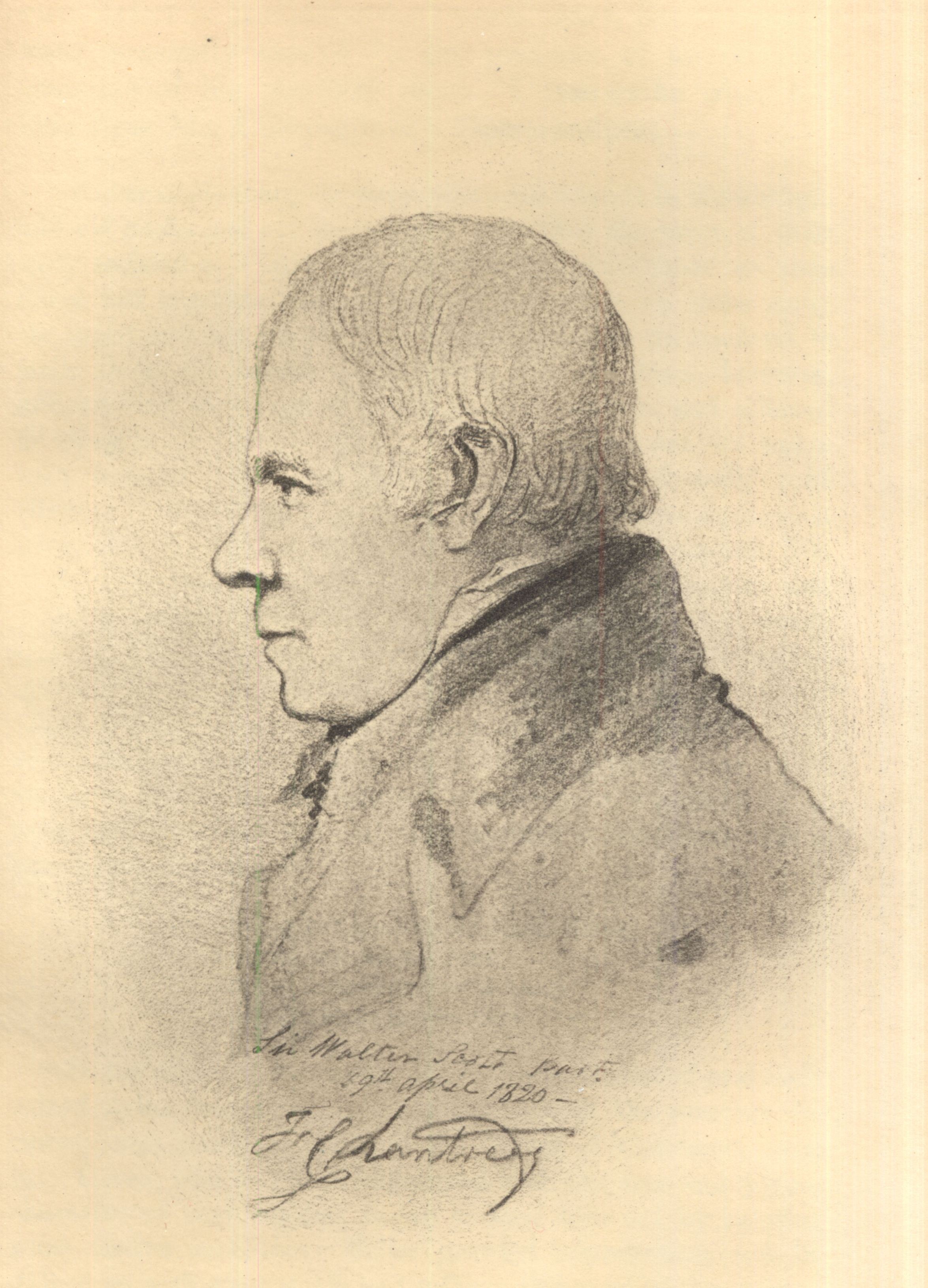
WALTER SCOTT IN 1820 The Chantrey Bust
Chantrey's purpose had been the same as Lawrence's—to seize a poetical phasis of Scott's countenance; and he proceeded to model the head as looking upwards, gravely and solemnly. The talk that passed, meantime, had equally amused and gratified both, and fortunately, at parting, Chantrey requested that Scott would come and breakfast with him next morning before they recommenced operations in the studio. Scott accepted the invitation, and when he arrived again in Ecclestone Street, found two or three acquaintances assembled to meet him,—among others, his old friend Richard Heber. The breakfast was, as any party in Sir Francis Chantrey's house is sure to be, a gay and joyous one, and not having seen Heber in particular for several years, Scott's spirits were unusually excited by the presence of an intimate associate of his youthful days. I transcribe what follows from Mr. Cunningham's Memorandum:—
"Heber made many inquiries about old friends in Edinburgh, and old books and old houses, and reminded the other of their early socialities. 'Ay,' said Mr. Scott, 'I remember we once dined out together, and sat so late that when we came away the night and day were so neatly balanced, that we resolved to walk about till sunrise. The moon was not down, however, and we took advantage of her Ladyship's lantern, and climbed to the top of Arthur's Seat; when we came down we had a rare appetite for breakfast.'—'I remember it well,' said Heber; 'Edinburgh was a wild place in those days,—it abounded in clubs—convivial clubs.'—'Yes,' replied Mr. Scott, 'and abounds still; but the conversation is calmer, and there are no such sallies now as might be heard in other times. One club, I remember, was infested with two Kemps, father and son; when the old man had done speaking, the young one began,—and before he grew weary, the father was refreshed, and took up the song. John Clerk, during a pause, was called on for a stave; he immediately struck up, in a psalm-singing tone, and electrified the club with a verse which sticks like a burr to my memory,—
"Now, God Almighty judge James Kemp, And likewise his son John, And hang them over Hell in hemp, And burn them in brimstone."'—
Scott's baronetcy was conferred on him, not in consequence of any Ministerial suggestion, but by the King personally, and of his own unsolicited motion; and when the poet kissed his hand, he said to him, "I shall always reflect with pleasure on Sir Walter Scott's having been the first creation of my reign."
TO MRS. SCOTT, 39 CASTLE STREET, EDINBURGH.
Piccadilly, 20th March, 1820.
My dear Charlotte,—I have got a delightful plan for the addition at Abb——, which I think will make it quite complete, and furnish me with a handsome library, and you with a drawing-room and better bedroom, with good bedrooms for company, etc. It will cost me a little hard work to meet the expense, but I have been a good while idle. I hope to leave this town early next week, and shall hasten back with great delight to my own household gods.
I hope this will find you from under Dr. Ross's charge. I expect to see you quite in beauty when I come down, for I assure you I have been coaxed by very pretty ladies here, and look for merry faces at home. My picture comes on, and will be a grand thing, but the sitting is a great bore. Chantrey's bust is one of the finest things he ever did. It is quite the fashion to go to see it—there's for you. Yours, my dearest love, with the most sincere affection,
Walter Scott.
TO THE SAME.
Piccadilly, March 27.
I conclude that the marriage will take place in Castle Street, and want to know where they go, etc. All this you will have to settle without my wise head; but I shall be terribly critical—so see you do all right. I am always, dearest Charlotte, most affectionately yours,
Walter Scott.
(For the Lady Scott of Abbotsford—to be.)
TO MR. JAMES BALLANTYNE, PRINTER, ST. JOHN'S STREET, EDINBURGH.
96 Piccadilly, 28th March.
Dear James,—I am much obliged by your attentive letter. Unquestionably Longman and Co. sell their books at subscription price, because they have the first of the market, and only one third of the books; so that, as they say with us, "let them care that come ahint." This I knew and foresaw, and the ragings of the booksellers, considerably aggravated by the displeasure of Constable and his house, are ridiculous enough; and as to their injuring the work, if it have a principle of locomotion in it, they cannot stop it—if it has not, they cannot make it move. I care not a bent twopence about their quarrels; only I say now, as I always said, that Constable's management is best, both for himself and the author; and, had we not been controlled by the narrowness of discount, I would put nothing past him. I agree with the public in thinking the work not very interesting; but it was written with as much care as the others—that is, with no care at all; and,
"If it is na weil bobbit, we'll bobb it again."
My occasions here will require that John or you send me two notes payable at Coutts's for £300 each, at two and three months' date. I will write to Constable for one at £350, which will settle my affairs here—which, with fees and other matters, come, as you may think, pretty heavy. Let the bills be drawn payable at Coutts's, and sent without delay. I will receive them safe if sent under Mr. Freeling's cover. Mention particularly what you are doing, for now is your time to push miscellaneous work. Pray take great notice of inaccuracies in the Novels. They are very, very many—some mine, I dare say—but all such as you may and ought to correct. If you would call on William Erskine (who is your well-wisher, and a little mortified he never sees you), he would point out some of them.
Do you ever see Lockhart? You should consult him on every doubt where you would refer to me if present. Yours very truly,
W. S.
You say nothing of John, yet I am anxious about him.
TO MR. LAIDLAW, KAESIDE, MELROSE.
London, April 2, 1820.
Dear Willie,—I had the great pleasure of your letter, which carries me back to my own braes, which I love so dearly, out of this place of bustle and politics. When I can see my Master—and thank him for many acts of favor—I think I will bid adieu to London forever; for neither the hours nor the society suit me so well as a few years since. There is too much necessity for exertion, too much brilliancy and excitation from morning till night.
I am glad the sheep are away, though at a loss. I should think the weather rather too dry for planting, judging by what we have here. Do not let Tom go on sticking in plants to no purpose—better put in firs in a rainy week in August. Give my service to him. I expect to be at Edinburgh in the end of this month, and to get a week at Abbotsford before the Session sits down. I think you are right to be in no hurry to let Broomielees. There seems no complaint of wanting money here just now, so I hope things will come round.
Ever yours truly,
Walter Scott.
TO MISS SCOTT, CASTLE STREET, EDINBURGH.
London, April 3, 1820.
Dear Sophia,—I have no letter from any one at home excepting Lockhart, and he only says you are all well; and I trust it is so. I have seen most of my old friends, who are a little the worse for the wear, like myself. A five years' march down the wrong side of the hill tells more than ten on the right side. Our good friends here are kind as kind can be, and no frumps. They lecture the Cornet a little, which he takes with becoming deference and good-humor. There is a certain veil of Flanders lace floating in the wind for a certain occasion, from a certain godmother, but that is more than a dead secret.
I write, wishing to know what I could bring Anne and you and mamma down, that would be acceptable; and I shall be much obliged to you to put me up to that matter. To little Charles also I promised something, and I wish to know what he would like. I hope he pays attention to Mr. Thomson, to whom remember my best compliments. I hope to get something for him soon.
To-day I go to spend my Sabbath quietly with Joanna Baillie and John Richardson, at Hampstead. The long Cornet goes with me. I have kept him amongst the seniors; nevertheless he seems pretty well amused. He is certainly one of the best-conditioned lads I ever saw, in point of temper.
I understand you and Anne have gone through the ceremony of confirmation. Pray write immediately, and let me know how you are all going on, and what you would like to have, all of you. You know how much I would like to please you.
Yours, most affectionately,
Walter Scott.
TO J. G. LOCKHART, ESQ., GREAT KING STREET, EDINBURGH.
London, 30th March, 1820.
You must, of course, recommend to Wilson great temper in his canvass—for wrath will do no good. After all, he must leave off sack, purge and live cleanly as a gentleman ought to do; otherwise people will compare his present ambition to that of Sir Terry O'Fag, when he wished to become a judge. "Our pleasant follies are made the whips to scourge us," as Lear says; for otherwise, what could possibly stand in the way of his nomination? I trust it will take place, and give him the consistence and steadiness which are all he wants to make him the first man of the age.
I am very angry with Castle Street—not a soul has written me, save yourself, since I came to London.
Yours very truly,
Walter Scott.
His excursions to Tweedside during Term-time were, with very rare exceptions, of the sort which I have described in the preceding chapter; but he departed from his rule about this time in honor of the Swedish Prince, who had expressed a wish to see Abbotsford before leaving Scotland, and assembled a number of his friends and neighbors to meet his Royal Highness. Of the invitations which he distributed on this occasion, I insert one specimen—that addressed to Mr. Scott of Gala:—
To the Baron of Galashiels The Knight of Abbotsford sends greeting.
Trusty and well-beloved,—Whereas Gustavus, Prince Royal of Sweden, proposeth to honor our poor house of Abbotsford with his presence on Thursday next, and to repose himself there for certain days, We do heartily pray you, out of the love and kindness which is and shall abide betwixt us, to be aiding to us at this conjuncture, and to repair to Abbotsford with your lady, either upon Thursday or Friday, as may best suit your convenience and pleasure, looking for no denial at your hands. Which loving countenance we will, with all thankfulness, return to you at your mansion of Gala. The hour of appearance being five o'clock, we request you to be then and there present, as you love the honor of the name; and so advance banners in the name of God and St. Andrew.
Walter Scott.
Given at Edinburgh, 20th May, 1820.
The visit of Count Itterburg is alluded to in this letter to the Cornet, who had now rejoined his regiment in Ireland. It appears that on reaching headquarters he had found a charger hors de combat.
TO WALTER SCOTT, ESQ., 18TH HUSSARS, CORK.
Castle Street, May 31, 1820.
Dear Walter,—I enclose the cheque for the allowance; pray take care to get good notes in exchange. You had better speak to the gentleman whom Lord Shannon introduced you to, for, when banks take a-breaking, it seldom stops with the first who go. I am very sorry for your loss. You must be economical for a while, and bring yourself round again, for at this moment I cannot so well assist as I will do by and by. So do not buy anything but what you need.
I was at Abbotsford for three days last week, to receive Count Itterburg, who seemed very happy while with us, and was much affected when he took his leave. I am sorry for him—his situation is a very particular one, and his feelings appear to be of the kindest order. When he took leave of me, he presented me with a beautiful seal, with all our new blazonries cut on a fine amethyst; and what I thought the prettiest part, on one side of the setting is cut my name, on the other the Prince's—Gustaf. He is to travel through Ireland, and will probably be at Cork. You will, of course, ask the Count and Baron to mess, and offer all civilities in your power, in which, I dare say, Colonel Murray will readily join. They intend to inquire after you.
I have bought the land adjoining to the Burnfoot cottage, so that we now march with the Duke of Buccleuch all the way round that course. It cost me £2300—but there is a great deal of valuable fir planting, which you may remember; fine roosting for the black game. Still I think it is £200 too dear, but Mr. Laidlaw thinks it can be made worth the money, and it rounds the property off very handsomely. You cannot but remember the ground; it lies under the Eildon, east of the Chargelaw.
Mamma, Anne, and Charles are all well. Sophia has been complaining of a return of her old sprain. I told her Lockhart would return her on our hands as not being sound wind and limb.
I beg you to look at your French, and have it much at heart that you should study German. Believe me, always affectionately yours,
Walter Scott.
In May, 1820, Scott received from both the English Universities the highest compliment which it was in their power to offer him. The Vice-Chancellors of Oxford and Cambridge communicated to him, in the same week, their request that he would attend at the approaching Commemorations, and accept the honorary degree of Doctor in Civil Law. It was impossible for him to leave Scotland again that season; and on various subsequent renewals of the same flattering proposition from either body, he was prevented, by similar circumstances, from availing himself of their distinguished kindness.
In the course of a few months, Scott's family arrangements had undergone, as we have seen, considerable alteration. Meanwhile he continued anxious to be allowed to adopt, as it were, the only son of his brother Thomas; and the letter, in consequence of which that promising youth was at last committed to his charge, contains so much matter likely to interest parents and guardians, that, though long, I cannot curtail it.
TO THOMAS SCOTT, ESQ., PAYMASTER 70th REGIMENT.
Abbotsford, 23d July, 1820.
My dear Tom,—Your letter of May, this day received, made me truly happy, being the first I have received from you since our dear mother's death, and the consequent breaches which fate has made in our family. My own health continues quite firm, at no greater sacrifice than bidding adieu to our old and faithful friend John Barleycorn, whose life-blood has become a little too heavy for my stomach. I wrote to you from London concerning the very handsome manner in which the King behaved to me in conferring my petit titre, and also of Sophia's intended marriage, which took place in the end of April, as we intended. I got Walter's leave prolonged, that he might be present, and I assure you, that when he attended the ceremony in full regimentals, you have scarce seen a handsomer young man. He is about six feet and an inch, and perfectly well made. Lockhart seems to be everything I could wish,—and as they have enough to live easily upon for the present, and good expectations for the future, life opens well with them. They are to spend their vacations in a nice little cottage, in a glen belonging to this property, with a rivulet in front, and a grove of trees on the east side to keep away the cold wind. It is about two miles distant from this house, and a very pleasant walk reaches to it through my plantations, which now occupy several hundred acres. Thus there will be space enough betwixt the old man of letters and the young one. Charles's destination to India is adjourned till he reaches the proper age: it seems he cannot hold a Writership until he is sixteen years old, and then is admitted to study for two years at Hertford College.
After my own sons, my most earnest and anxious wish will be, of course, for yours,—and with this view I have pondered well what you say on the subject of your Walter; and whatever line of life you may design him for, it is scarce possible but that I can be of considerable use to him. Before fixing, however, on a point so very important, I would have you consult the nature of the boy himself. I do not mean by this that you should ask his opinion, because at so early an age a well bred up child naturally takes up what is suggested to him by his parents; but I think you should consider, with as much impartiality as a parent can, his temper, disposition, and qualities of mind and body. It is not enough that you think there is an opening for him in one profession rather than another,—for it were better to sacrifice the fairest prospects of that kind than to put a boy into a line of life for which he is not calculated. If my nephew is steady, cautious, fond of a sedentary life and quiet pursuits, and at the same time a proficient in arithmetic, and with a disposition towards the prosecution of its highest branches, he cannot follow a better line than that of an accountant. It is highly respectable—and is one in which, with attention and skill, aided by such opportunities as I may be able to procure for him, he must ultimately succeed. I say ultimately—because the harvest is small and the laborers numerous in this as in other branches of our legal practice; and whoever is to dedicate himself to them, must look for a long and laborious tract of attention ere he reaches the reward of his labors. If I live, however, I will do all I can for him, and see him put under a proper person, taking his 'prentice fee, etc., upon myself. But if, which may possibly be the case, the lad has a decided turn for active life and adventure, is high-spirited, and impatient of long and dry labor, with some of those feelings not unlikely to result from having lived all his life in a camp or a barrack, do not deceive yourself, my dear brother—you will never make him an accountant; you will never be able to convert such a sword into a pruning-hook, merely because you think a pruning-hook the better thing of the two. In this supposed case, your authority and my recommendation might put him into an accountant's office; but it would be just to waste the earlier years of his life in idleness, with all the temptations to dissipation which idleness gives way to; and what sort of a place a writing-chamber is, you cannot but remember. So years might wear away, and at last the youth starts off from his profession, and becomes an adventurer too late in life, and with the disadvantage, perhaps, of offended friends and advanced age standing in the way of his future prospects.
This is what I have judged fittest in my own family, for Walter would have gone to the Bar had I liked; but I was sensible (with no small reluctance did I admit the conviction) that I should only spoil an excellent soldier to make a poor and undistinguished gownsman. On the same principle I shall send Charles to India,—not, God knows, with my will, for there is little chance of my living to see him return; but merely that, judging by his disposition, I think the voyage of his life might be otherwise lost in shallows. He has excellent parts, but they are better calculated for intercourse with the world than for hard and patient study. Having thus sent one son abroad from my family, and being about to send off the other in due time, you will not, I am sure, think that I can mean disregard to your parental feelings in stating what I can do for your Walter. Should his temper and character incline for active life, I think I can promise to get him a cadetship in the East India Company's service; so soon as he has had the necessary education, I will be at the expense of his equipment and passage-money; and when he reaches India, there he is completely provided, secure of a competence if he lives, and with great chance of a fortune if he thrives. I am aware this would be a hard pull at Mrs. Scott's feelings and yours; but recollect, your fortune is small, and the demands on it numerous, and pagodas and rupees are no bad things. I can get Walter the first introductions, and if he behaves himself as becomes your son, and my nephew, I have friends enough in India, and of the highest class, to insure his success, even his rapid success—always supposing my recommendations to be seconded by his own conduct. If, therefore, the youth has anything of your own spirit, for God's sake do not condemn him to a drudgery which he will never submit to—and remember, to sacrifice his fortune to your fondness will be sadly mistaken affection. As matters stand, unhappily you must be separated; and considering the advantages of India, the mere circumstance of distance is completely counterbalanced. Health is what will naturally occur to Mrs. Scott; but the climate of India is now well understood, and those who attend to ordinary precautions live as healthy as in Britain. And so I have said my say. Most heartily will I do my best in any way you may ultimately decide for; and as the decision really ought to turn on the boy's temper and disposition, you must be a better judge by far than any one else. But if he should resemble his father and uncle in certain indolent habits, I fear he will make a better subject for an animating life of enterprise than for the technical labor of an accountant's desk. There is no occasion, fortunately, for forming any hasty resolution. When you send him here, I will do all that is in my power to stand in the place of a father to him, and you may fully rely on my care and tenderness. If he should ultimately stay at Edinburgh, as both my own boys leave me, I am sure I shall have great pleasure in having the nearest in blood after them with me. Pray send him as soon as you can, for at his age, and under imperfect opportunities of education, he must have a good deal to make up. I wish I could be of the same use to you which I am sure I can be to your son.
Of public news I have little to send. The papers will tell you the issue of the Radical row for the present. The yeomanry behaved most gallantly. There is in Edinburgh a squadron as fine as ours was—all young men, and zealous soldiers. They made the western campaign with the greatest spirit, and had some hard and fatiguing duty, long night-marches, surprises of the enemy, and so forth, but no fight, for the whole Radical plot went to the devil when it came to gun and sword. Scarce any blood was shed, except in a trifling skirmish at Bonnymuir, near Carron. The rebels were behind a wall, and fired on ten hussars and as many yeomen—the latter under command of a son of James Davidson, W. S. The cavalry cleared the wall, and made them prisoners to a man. The Commission of Oyer and Terminer is now busy trying them and others. The Edinburgh young men showed great spirit; all took arms, and my daughters say (I was in London at the time) that not a feasible-looking beau was to be had for love or money. Several were like old Beardie; they would not shave their moustaches till the Radicals were put down, and returned with most awful whiskers. Lockhart is one of the cavalry, and a very good trooper. It is high to hear these young fellows talk of the Raid of Airdrie, the trot of Kilmarnock, and so on, like so many moss-troopers.
The Queen is making an awful bustle, and though by all accounts her conduct has been most abandoned and beastly, she has got the whole mob for her partisans, who call her injured innocence, and what not. She has courage enough to dare the worst, and a most decided desire to be revenged of him, which, by the way, can scarce be wondered at. If she had as many followers of high as of low degree (in proportion), and funds to equip them, I should not be surprised to see her fat bottom in a pair of buckskins, and at the head of an army—God mend all. The things said of her are beyond all usual profligacy. Nobody of any fashion visits her. I think myself monstrously well clear of London and its intrigues, when I look round my green fields, and recollect I have little to do, but to
——"make my grass mow, And my apple-tree grow."
I beg my kind love to Mrs. Huxley. I have a very acceptable letter from her, and I trust to retain the place she promises me in her remembrance. Sophia will be happy to hear from Uncle Tom, when Uncle Tom has so much leisure. My best compliments attend your wife and daughters, not forgetting Major Huxley and Walter. My dear Tom, it will be a happy moment when circumstances shall permit us a meeting on this side Jordan, as Tabitha says, to talk over old stories, and lay new plans. So many things have fallen out which I had set my heart upon strongly, that I trust this may happen amongst others.—Believe me, yours very affectionately,