Chapter LIV
Reading edition
NEW BUILDINGS AT ABBOTSFORD. — CHIEFSWOOD. — WILLIAM ERSKINE. — LETTER TO COUNTESS PURGSTALL. — PROGRESS OF THE PIRATE. — FRANCK'S NORTHERN MEMOIR, AND NOTES OF LORD FOUNTAINHALL, PUBLISHED. — PRIVATE LETTERS IN THE REIGN OF JAMES I. — COMMENCEMENT OF THE FORTUNES OF NIGEL. — SECOND SALE OF COPYRIGHTS. — CONTRACT FOR "FOUR WORKS OF FICTION." — ENORMOUS PROFITS OF THE NOVELIST, AND EXTRAVAGANT PROJECTS OF CONSTABLE. — THE PIRATE PUBLISHED. — LORD BYRON'S CAIN, DEDICATED TO SCOTT. — AFFAIR OF THE BEACON NEWSPAPER.
1821
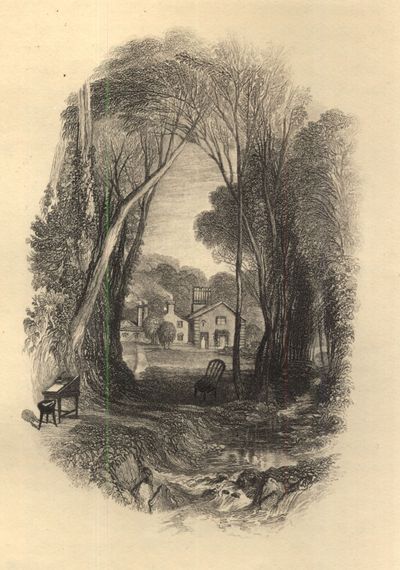
CHIEFSWOOD After the drawing by J. M. W. Turner
When Sir Walter returned from London, he brought with him the detailed plans of Mr. Atkinson for the completion of his house at Abbotsford; which, however, did not extend to the gateway or the beautiful screen between the court and the garden—for these graceful parts of the general design were conceptions of his own, reduced to shape by the skill of the Messrs. Smith of Darnick. It would not, indeed, be easy for me to apportion rightly the constituent members of the whole edifice;—throughout there were numberless consultations with Mr. Blore, Mr. Terry, and Mr. Skene, as well as with Mr. Atkinson—and the actual builders placed considerable inventive talents, as well as admirable workmanship, at the service of their friendly employer. Every preparation was now made by them, and the foundations might have been set about without farther delay; but he was very reluctant to authorize the demolition of the rustic porch of the old cottage, with its luxuriant overgrowth of roses and jessamines; and, in short, could not make up his mind to sign the death-warrant of this favorite bower until winter had robbed it of its beauties. He then made an excursion from Edinburgh, on purpose to be present at its downfall—saved as many of the creepers as seemed likely to survive removal, and planted them with his own hands about a somewhat similar porch, erected expressly for their reception, at his daughter Sophia's little cottage of Chiefswood.
During several weeks of that delightful summer, Scott had under his roof Mr. William Erskine and two of his daughters; this being, I believe, their first visit to Tweedside since the death of Mrs. Erskine in September, 1819. He had probably made a point of having his friend with him at this particular time, because he was desirous of having the benefit of his advice and corrections from day to day as he advanced in the composition of The Pirate—with the localities of which romance the Sheriff of Orkney and Zetland was of course thoroughly familiar. At all events, the constant and eager delight with which Erskine watched the progress of the tale has left a deep impression on my memory; and indeed I heard so many of its chapters first read from the MS. by him, that I can never open the book now without thinking I hear his voice. Sir Walter used to give him at breakfast the pages he had written that morning; and very commonly, while he was again at work in his study, Erskine would walk over to Chiefswood, that he might have the pleasure of reading them aloud to my wife and me under our favorite tree, before the packet had to be sealed up for the printer, or rather for the transcriber in Edinburgh. I cannot paint the delight and the pride with which he acquitted himself on such occasions. The little artifice of his manner was merely superficial, and was wholly forgotten as tender affection and admiration, fresh as the impulses of childhood, glistened in his eye, and trembled in his voice.
This reminds me that I have not yet attempted any sketch of the person and manners of Scott's most intimate friend. Their case was no contradiction to the old saying, that the most attached comrades are often very unlike each other in character and temperament. The mere physical contrast was as strong as could well be, and this is not unworthy of notice here; for Erskine was, I think, the only man in whose society Scott took great pleasure, during the more vigorous part of his life, that had neither constitution nor inclination for any of the rough bodily exercises in which he himself delighted. The Counsellor (as Scott always called him) was a little man of feeble make, who seemed unhappy when his pony got beyond a footpace, and had never, I should suppose, addicted himself to any out-of-doors sport whatever. He would, I fancy, have as soon thought of slaying his own mutton as of handling a fowling-piece: he used to shudder when he saw a party equipped for coursing, as if murder were in the wind; but the cool meditative angler was in his eyes the abomination of abominations. His small elegant features, hectic cheek, and soft hazel eyes, were the index of the quick sensitive gentle spirit within. He had the warm heart of a woman, her generous enthusiasm, and some of her weaknesses. A beautiful landscape, or a fine strain of music, would send the tears rolling down his cheek; and though capable, I have no doubt, of exhibiting, had his duty called him to do so, the highest spirit of a hero or a martyr, he had very little command over his nerves amidst circumstances such as men of ordinary mould (to say nothing of iron fabrics like Scott's) regard with indifference. He would dismount to lead his horse down what his friend hardly perceived to be a descent at all; grew pale at a precipice; and, unlike the White Lady of Avenel, would go a long way round for a bridge.
Erskine had as yet been rather unfortunate in his professional career, and thought a sheriffship by no means the kind of advancement due to his merits, and which his connections might naturally have secured for him. These circumstances had at the time when I first observed him tinged his demeanor; he had come to intermingle a certain wayward snappishness now and then with his forensic exhibitions, and in private seemed inclined (though altogether incapable of abandoning the Tory party) to say bitter things of people in high places; but with these exceptions, never was benevolence towards all the human race more lively and overflowing than his evidently was, even when he considered himself as one who had reason to complain of his luck in the world. Now, however, these little asperities had disappeared; one great real grief had cast its shadow over him, and submissive to the chastisement of heaven, he had no longer any thoughts for the petty misusage of mankind. Scott's apprehension was, that his ambition was extinguished with his resentment; and he was now using every endeavor, in connection with their common friend the Lord Advocate Rae, to procure for Erskine that long-coveted seat on the bench, about which the subdued widower himself had ceased to occupy his mind. By and by these views were realized to Scott's high satisfaction, and for a brief season with the happiest effect on Erskine's own spirits;—but I shall not anticipate the sequel.
Meanwhile he shrunk from the collisions of general society in Edinburgh, and lived almost exclusively in his own little circle of intimates. His conversation, though somewhat precise and finical on the first impression, was rich in knowledge. His literary ambition, active and aspiring at the outset, had long before this time merged in his profound veneration for Scott; but he still read a great deal, and did so as much I believe with a view to assisting Scott by hints and suggestions, as for his own amusement. He had much of his friend's tact in extracting the picturesque from old, and, generally speaking, dull books; and in bringing out his stores he often showed a great deal of quaint humor and sly wit.
Scott, on his side, respected, trusted, and loved him, much as an affectionate husband does the wife who gave him her heart in youth, and thinks his thoughts rather than her own in the evening of life; he soothed, cheered, and sustained Erskine habitually. I do not believe a more entire and perfect confidence ever subsisted than theirs was and always had been in each other; and to one who had duly observed the creeping jealousies of human nature, it might perhaps seem doubtful on which side the balance of real nobility of heart and character, as displayed in their connection at the time of which I am speaking, ought to be cast.
Among the common friends of their young days, of whom they both delighted to speak—and always spoke with warm and equal affection—was the sister of their friend Cranstoun, the confidant of Scott's first unfortunate love, whom neither had now seen for a period of more than twenty years. This lady had undergone domestic afflictions more than sufficient to have crushed almost any spirit but her own. Her husband, the Count Purgstall, had died some years before this time, leaving her an only son, a youth of the most amiable disposition, and possessing abilities which, had he lived to develop them, must have secured for him a high station in the annals of genius. This hope of her eyes, the last heir of an illustrious lineage, followed his father to the tomb in the nineteenth year of his age. The desolate Countess was urged by her family in Scotland to return, after this bereavement, to her native country; but she had vowed to her son on his deathbed, that one day her dust should be mingled with his; and no argument could induce her to depart from the resolution of remaining in solitary Styria. By her desire, a valued friend of the house of Purgstall, who had been born and bred up on their estates, the celebrated Orientalist, Joseph von Hammer, compiled a little memoir of The Two Last Counts of Purgstall, which he put forth, in January, 1821, under the title of Denkmahl, or Monument; and of this work the Countess sent a copy to Sir Walter (with whom her correspondence had been during several years suspended), by the hands of her eldest brother, Mr. Henry Cranstoun, who had been visiting her in Styria, and who at this time occupied a villa within a few miles of Abbotsford. Scott's letter of acknowledgment never reached her; and indeed I doubt if it was ever despatched. He appears to have meditated a set of consolatory verses for its conclusion, and the Muse not answering his call at the moment, I suspect he had allowed the sheet, which I now transcribe, to fall aside and be lost sight of among his multifarious masses of MS.
TO THE COUNTESS PURGSTALL, ETC., ETC.
My dear and much-valued Friend,—You cannot imagine how much I was interested and affected by receiving your token of your kind recollection, after the interval of so many years. Your brother Henry breakfasted with me yesterday, and gave me the letter and the book, which served me as a matter of much melancholy reflection for many hours.
Hardly anything makes the mind recoil so much upon itself, as the being suddenly and strongly recalled to times long past, and that by the voice of one whom we have so much loved and respected. Do not think I have ever forgotten you, or the many happy days I passed in Frederick Street, in society which fate has separated so far, and for so many years.
The little volume was particularly acceptable to me, as it acquainted me with many circumstances, of which distance and imperfect communication had either left me entirely ignorant, or had transmitted only inaccurate information.
Alas, my dear friend, what can the utmost efforts of friendship offer you, beyond the sympathy which, however sincere, must sound like an empty compliment in the ear of affliction? God knows with what willingness I would undertake anything which might afford you the melancholy consolation of knowing how much your old and early friend interests himself in the sad event which has so deeply wounded your peace of mind. The verses, therefore, which conclude this letter, must not be weighed according to their intrinsic value, for the more inadequate they are to express the feelings they would fain convey, the more they show the author's anxious wish to do what may be grateful to you.
In truth, I have long given up poetry. I have had my day with the public; and being no great believer in poetical immortality, I was very well pleased to rise a winner, without continuing the game till I was beggared of any credit I had acquired. Besides, I felt the prudence of giving way before the more forcible and powerful genius of Byron. If I were either greedy, or jealous of poetical fame—and both are strangers to my nature—I might comfort myself with the thought, that I would hesitate to strip myself to the contest so fearlessly as Byron does; or to command the wonder and terror of the public, by exhibiting, in my own person, the sublime attitude of the dying gladiator. But with the old frankness of twenty years since, I will fairly own, that this same delicacy of mine may arise more from conscious want of vigor and inferiority, than from a delicate dislike to the nature of the conflict. At any rate, there is a time for everything, and without swearing oaths to it, I think my time for poetry has gone by.
My health suffered horridly last year, I think from over-labor and excitation; and though it is now apparently restored to its usual tone, yet during the long and painful disorder (spasms in the stomach) and the frightful process of cure, by a prolonged use of calomel, I learned that my frame was made of flesh, and not of iron—a conviction which I will long keep in remembrance, and avoid any occupation so laborious and agitating as poetry must be, to be worth anything.
In this humor I often think of passing a few weeks on the Continent—a summer vacation if I can—and of course my attraction to Gratz would be very strong. I fear this is the only chance of our meeting in this world—we, who once saw each other daily! for I understand from George and Henry that there is little chance of your coming here. And when I look around me, and consider how many changes you would see in feature, form, and fashion, amongst all you knew and loved; and how much, no sudden squall, or violent tempest, but the slow and gradual progress of life's long voyage, has severed all the gallant fellowships whom you left spreading their sails to the morning breeze, I really am not sure that you would have much pleasure.
The gay and wild romance of life is over with all of us. The real, dull, and stern history of humanity has made a far greater progress over our heads; and age, dark and unlovely, has laid his crutch over the stoutest fellow's shoulders. One thing your old society may boast, that they have all run their course with honor, and almost all with distinction; and the brother suppers of Frederick Street have certainly made a very considerable figure in the world, as was to be expected from her talents under whose auspices they were assembled.
One of the most pleasant sights which you would see in Scotland, as it now stands, would be your brother George in possession of the most beautiful and romantic place in Clydesdale—Corehouse. I have promised often to go out with him, and assist him with my deep experience as a planter and landscape gardener. I promise you my oaks will outlast my laurels; and I pique myself more upon my compositions for manure than on any other compositions whatsoever to which I was ever accessary. But so much does business of one sort or other engage us both, that we never have been able to fix a time which suited us both; and with the utmost wish to make out the party, perhaps we never may.
This is a melancholy letter, but it is chiefly so from the sad tone of yours—who have had such real disasters to lament—while mine is only the humorous sadness, which a retrospect on human life is sure to produce on the most prosperous. For my own course of life, I have only to be ashamed of its prosperity, and afraid of its termination; for I have little reason, arguing on the doctrine of chances, to hope that the same good fortune will attend me forever. I have had an affectionate and promising family, many friends, few unfriends, and, I think, no enemies—and more of fame and fortune than mere literature ever procured for a man before.
I dwell among my own people, and have many whose happiness is dependent on me, and which I study to the best of my power. I trust my temper, which you know is by nature good and easy, has not been spoiled by flattery or prosperity; and therefore I have escaped entirely that irritability of disposition which I think is planted, like the slave in the poet's chariot, to prevent his enjoying his triumph.
As I may have no occasion hereafter to allude to the early friend with whose sorrows Scott thus sympathized amidst the meridian splendors of his own worldly career, I may take this opportunity of mentioning, that Captain Basil Hall's conjecture, of her having been the original of Diana Vernon, appeared to myself from the first chimerical; and that I have since heard those who knew her best in the days of her intercourse with Sir Walter, express the same opinion in the most decided manner. But to return.
While The Pirate was advancing under Mr. Erskine's eye, Scott had even more than the usual allowance of minor literary operations on hand. He edited a reprint of a curious old book, called Franck's Northern Memoir, and the Contemplative Angler; and he also prepared for the press a volume published soon after, under the title of "Chronological Notes on Scottish Affairs, 1680 to 1701, from the Diary of Lord Fountainhall." The professional writings of that celebrated old lawyer had been much in his hands from his early years, on account of the incidental light which they throw on the events of a most memorable period in Scottish history: and he seems to have contemplated some more considerable selection from his remains, but to have dropped these intentions, on being given to understand that they might interfere with those of Lord Fountainhall's accomplished representative, the present Sir Thomas Dick Lauder, Baronet. It is, however, to be regretted that Sir Thomas's promise of a Life of his eminent ancestor has not yet been redeemed.
In August appeared the volume of the Novelists' Library containing Scott's Life of Smollett; and it being now ascertained that John Ballantyne had died a debtor, the editor offered to proceed with this series of prefaces, on the footing that the whole profits of the work should go to his widow. Mr. Constable, whose health was now beginning to break, had gone southwards in quest of more genial air, and was at Hastings when he heard of this proposition. He immediately wrote to me, entreating me to represent to Sir Walter that the undertaking, having been coldly received at first, was unlikely to grow in favor if continued on the same plan—that in his opinion the bulk of the volumes, and the small type of their text, had been unwisely chosen, for a work of mere entertainment, and could only be suitable for one of reference; that Ballantyne's Novelists' Library, therefore, ought to be stopped at once, and another in a lighter shape, to range with the late collected edition of the first series of the Waverley Romances, announced with his own name as publisher, and Scott's as editor. He proposed at the same time to commence the issue of a Select Library of English Poetry, with prefaces and a few notes by the same hand; and calculating that each of these collections should extend to twenty-five volumes, and that the publication of both might be concluded within two years—"the writing of the prefaces, etc., forming perhaps an occasional relief from more important labors"!—the bookseller offered to pay their editor in all the sum of £6000: a small portion of which sum, as he hinted, would undoubtedly be more than Mrs. John Ballantyne could ever hope to derive from the prosecution of her husband's last publishing adventure. Various causes combined to prevent the realization of these magnificent projects. Scott now, as at the beginning of his career of speculation, had views about what a collection of English Poetry should be, in which even Constable could not, on consideration, be made to concur; and I have already explained the coldness with which he regarded further attempts upon our Elder Novelists. The Ballantyne Library crept on to the tenth volume, and was then dropped abruptly; and the double negotiation with Constable was never renewed.
Among other miscellaneous work of this autumn, Scott amused some leisure hours with writing a series of Private Letters, supposed to have been discovered in the repositories of a Noble English Family, and giving a picture of manners in town and country during the early part of the reign of James I. These letters were printed as fast as he penned them, in a handsome quarto form, and he furnished the margin with a running commentary of notes, drawn up in the character of a disappointed chaplain, a keen Whig, or rather Radical, overflowing on all occasions with spleen against Monarchy and Aristocracy. When the printing had reached the 72d page, however, he was told candidly by Erskine, by James Ballantyne, and also by myself, that, however clever his imitation of the epistolary style of the period in question, he was throwing away in these letters the materials of as good a romance as he had ever penned; and a few days afterwards he said to me—patting Sibyl's neck till she danced under him,—"You were all quite right: if the letters had passed for genuine they would have found favor only with a few musty antiquaries, and if the joke were detected, there was not story enough to carry it off. I shall burn the sheets, and give you Bonny King Jamie and all his tail in the old shape, as soon as I can get Captain Goffe within view of the gallows."
JENKIN HARMAN TO THE LORD ——.
My Lord,—Towching this new mishappe of Sir Thomas, whereof your Lordshippe makes querie of me, I wolde hartilie that I could, truth and my bounden dutie alweys firste satisfied, make suche answer as were fullie pleasaunte to me to write, or unto your Lordshippe to reade. But what remedy? young men will have stirring bloodes; and the courtier-like gallants of the time will be gamesome and dangerous, as they have beene in dayes past. I think your Lordshippe is so wise as to caste one eye backe to your own more juvenile time, whilest you looke forward with the other upon this mischaunce, which, upon my lyfe, will be founde to be no otherwise harmful to Sir Thomas than as it shews him an hastie Hotspur of the day, suddenlie checking at whatsoever may seem to smirche his honour. As I am a trew man, and your Lordship's poore kinsman and bounden servant, I think ther lives not a gentleman more trew to his friende than Sir Thomas; and although ye be but brothers uterine, yet so dearly doth he holde your favour, that his father, were the gode knight alyve, should not have more swaye with him than shalle your Lordship; and, also, it is no kindly part to sow discord betwene brethrene; for, as the holy Psalmist saythe, "Ecce quam bonum et quam jucundum habitare fratres," etc. And moreover, it needes not to tell your Lordshippe that Sir Thomas is suddene in his anger; and it was but on Wednesday last that he said to me, with moche distemperature,—Master Jenkin, I be tolde that ye meddle and make betwene me and my Lorde my brother; wherfore, take this for feyr warninge, that when I shall fynde you so dooyng, I will incontinent put my dager to the hilte in you:—and this was spoken with all earnestness of visage and actioun, grasping of his poinard's handle, as one who wolde presentlie make his words good. Surely, my Lord, it is not fair carriage toward you pore kinsman if anie out of your house make such reports of me, and of that which I have written to you in sympleness of herte, and in obedience to your commandemente, which is my law on this matter. Truely, my Lord, I wolde this was well looked to, otherweys my rewarde for trew service might be to handsell with my herte's blode the steel of a Milan poignado. Natheless, I will procede with my mater, fal back fal edge, trustyng all utterly in the singleness of my integretie, and in your Lordshippe's discretioun.
My Lorde, the braule which hath befallen chaunced this waye, and not otherwise. It hap'd that one Raines, the master of the ordinarie where his honour Sir Thomas eteth well nie dailie (when he is not in attendance at courte, wherein he is perchance more slacke than were wise), shoulde assemble some of the beste who haunte his house, havyng diet ther for money. The purpose, as shewn forthe, was to tast a new piece of choice wyne, and ther Sir Thomas must nedes be, or the purpos holdes not, and the Alicant becometh Bastard. Wel, my Lord, dice ther wer and music, lustie helthes and dizzie braines,—some saye fair ladyes also, of which I know nought, save that suche cockatrices hatch wher such cockes of the game do haunt. Alweys ther was revel and wassail enow and to spare. Now it chaunced, that whilst one Dutton, of Graie's-Inn, an Essex man, held the dice, Sir Thomas fillethe a fulle carouse to the helth of the fair Ladie Elizabeth. Trulie, my Lord, I cannot blame his devotioun to so fair a saint, though I may wish the chapel for his adoration had been better chosen, and the companie more suitable; sed respice finem. The pledge being given, and alle men on foote, aye, and some on knee, to drink the same, young Philip Darcy, a near kinsman of my Lorde's, or so callyng himself, takes on him to check at the helthe, askyng Sir Thomas if he were willinge to drink the same in a Venetian glasse? the mening of whiche hard sentence your Lordshippe shal esilie construe. Whereupon Sir Thomas, your Lordshippe's brother, somewhat shrewishly demanded whether that were his game or his earnest; to which demaunde the uther answers recklessly as he that wolde not be brow-beaten, that Sir Thomas might take it for game or ernest as him listed. Whereupon your Lordshippe's brother, throwing down withal the woodcocke's bill, with which, as the fashioun goes, he was picking his teeth, answered redily, he cared not that for his game or ernest, for that neither were worth a bean. A small matter this to make such a storie, for presentlie young Darcie up with the wine-pot in which they had assaid the freshe hogshede, and heveth it at Sir Thomas, which vessel missing of the mark it was aym'd at, encountreth the hede of Master Dutton, when the outside of the flaggon did that which peradventure the inside had accomplish'd somewhat later in the evening, and stretcheth him on the flore; and then the crie arose, and you might see twenty swords oute at once, and none rightly knowing wherfor. And the groomes and valets, who waited in the street and in the kitchen, and who, as seldom failes, had been as besy with the beer as their masters with the wine, presentlie fell at odds, and betoke themselves to their weapones; so ther was bouncing of bucklers, and bandying of blades, instede of clattering of quart pottles, and chiming of harpis and fiddles. At length comes the wache, and, as oft happens in the like affraies, alle men join ageynst them, and they are beten bak: An honest man, David Booth, constable of the night, and a chandler by trade, is sorely hurt. The crie rises of Prentices, prentices, Clubs, clubs, for word went that the court-gallants and the Graie's-Inn men had murther'd a citizen; all mene take the street, and the whole ward is uppe, none well knowing why. Menewhile our gallants had the lucke and sense to disperse their company, some getting them into the Temple, the gates wherof were presentlie shut to prevent pursuite I warrant, and some taking boat as they might; water thus saving whom wyne hath endaunger'd. The Alderman of the ward, worthy Master Danvelt, with Master Deputy, and others of repute, bestow'd themselves not a litel to compose the tumult, and so al past over for the evening.
And thus, my Lord, ye have the whole mater before you; trew ye shall find it,—my dutie demands it,—unpleasing, I cannot amende it: But I truste neither more evil in esse nor in posse, than I have set forth as above. From one who is ever your Lordshippe's most bounden to command, etc.—J. H.
I think it must have been about the middle of October that he dropped the scheme of this fictitious correspondence. I well remember the morning that he began The Fortunes of Nigel. The day being destined for Newark Hill, I went over to Abbotsford before breakfast, and found Mr. Terry (who had been staying there for some time) walking about with his friend's master-mason (John Smith), of whose proceedings he took a fatherly charge, as he might well do, since the plan of the building had been in a considerable measure the work of his own taste. While Terry and I were chatting, Scott came out, bare-headed, with a bunch of MS. in his hand, and said, "Well, lads, I've laid the keel of a new lugger this morning—here it is—be off to the waterside, and let me hear how you like it." Terry took the papers, and walking up and down by the river, read to me the first chapter of Nigel. He expressed great delight with the animated opening, and especially with the contrast between its thorough stir of London life, and a chapter about Norna of the Fitful-head, in the third volume of The Pirate, which had been given to him in a similar manner the morning before. I could see that (according to the Sheriff's phrase) he smelt roast meat; here there was every prospect of a fine field for the art of Terryfication. The actor, when our host met us returning from the haugh, did not fail to express his opinion that the new novel would be of this quality. Sir Walter, as he took the MS. from his hand, eyed him with a gay smile, in which genuine benevolence mingled with mock exultation, and then throwing himself into an attitude of comical dignity, he rolled out, in the tones of John Kemble, one of the loftiest bursts of Ben Jonson's Mammon:—
This was another period of "refreshing the machine." Early in November, I find Sir Walter writing thus to Constable's partner, Mr. Cadell: "I want two books, Malcolm's London Redivivus, or some such name, and Derham's Artificial Clock-maker." [The reader of Nigel will understand these requests.] "All good luck to you, commercially and otherwise. I am grown a shabby letter-writer, for my eyes are not so young as they were, and I grudge everything that does not go to press." Such a feeling must often have been present with him; yet I can find no period when he grudged writing a letter that might by possibility be of use to any of his family or friends, and I must quote one of the many which about this very time reached his second son.
TO MR. CHARLES SCOTT.
Care of the Rev. Mr. Williams, Lampeter.
21st November, 1821.
You ask me about reading history. You are quite right to read Clarendon—his style is a little long-winded; but, on the other hand, his characters may match those of the ancient historians, and one thinks they would know the very men if you were to meet them in society. Few English writers have the same precision, either in describing the actors in great scenes, or the deeds which they performed. He was, you are aware, himself deeply engaged in the scenes which he depicts, and therefore colors them with the individual feeling, and sometimes, doubtless, with the partiality of a partisan. Yet I think he is, on the whole, a fair writer; for though he always endeavors to excuse King Charles, yet he points out his mistakes and errors, which certainly are neither few nor of slight consequence. Some of his history regards the country in which you are now a resident; and you will find that much of the fate of that Great Civil War turned on the successful resistance made by the city of Gloucester, and the relief of that place by the Earl of Essex, by means of the trained bands of London,—a sort of force resembling our local militia or volunteers. They are the subject of ridicule in all the plays and poems of the time; yet the sort of practice of arms which they had acquired, enabled them to withstand the charge of Prince Rupert and his gallant cavalry, who were then foiled for the first time. Read, my dear Charles, read, and read that which is useful. Man only differs from birds and beasts, because he has the means of availing himself of the knowledge acquired by his predecessors. The swallow builds the same nest which its father and mother built; and the sparrow does not improve by the experience of its parents. The son of the learned pig, if it had one, would be a mere brute, fit only to make bacon of. It is not so with the human race. Our ancestors lodged in caves and wigwams, where we construct palaces for the rich, and comfortable dwellings for the poor; and why is this—but because our eye is enabled to look back upon the past, to improve upon our ancestors' improvements, and to avoid their errors? This can only be done by studying history, and comparing it with passing events. God has given you a strong memory, and the power of understanding that which you give your mind to with attention—but all the advantage to be derived from these qualities must depend on your own determination to avail yourself of them, and improve them to the uttermost. That you should do so, will be the greatest satisfaction I can receive in my advanced life, and when my thoughts must be entirely turned on the success of my children. Write to me more frequently, and mention your studies particularly, and I will on my side be a good correspondent.
I beg my compliments to Mr. and Mrs. Williams. I have left no room to sign myself your affectionate father,
W. S.
To return to business and Messrs. Constable.—Sir Walter concluded, before he went to town in November, another negotiation of importance with this house. They agreed to give for the remaining copyright of the four novels published between December, 1819, and January, 1821—to wit, Ivanhoe, The Monastery, The Abbot, and Kenilworth—the sum of five thousand guineas. The stipulation about not revealing the author's name, under a penalty of £2000, was repeated. By these four novels, the fruits of scarcely more than twelve months' labor, he had already cleared at least £10,000 before this bargain was completed. They, like their predecessors, were now issued in a collective shape, under the title of "Historical Romances, by the Author of Waverley."
"The active principle within Works on some brains the effect of gin;"
but in his case, every external influence combined to stir the flame, and swell the intoxication of restless exuberant energy. His allies knew, indeed, what he did not, that the sale of his novels was rather less than it had been in the days of Ivanhoe; and hints had sometimes been dropped to him that it might be well to try the effect of a pause. But he always thought—and James Ballantyne had decidedly the same opinion—that his best things were those which he threw off the most easily and swiftly; and it was no wonder that his booksellers, seeing how immeasurably even his worst excelled in popularity, as in merit, any other person's best, should have shrunk from the experiment of a decisive damper. On the contrary, they might be excused for from time to time flattering themselves that if the books sold at a less rate, this might be counterpoised by still greater rapidity of production. They could not make up their minds to cast the peerless vessel adrift; and, in short, after every little whisper of prudential misgiving, echoed the unfailing burden of Ballantyne's song—to push on, hoisting more and more sail as the wind lulled.
He was as eager to do as they could be to suggest—and this I well knew at the time. I had, however, no notion, until all his correspondence lay before me, of the extent to which he had permitted himself thus early to build on the chances of life, health, and continued popularity. Before The Fortunes of Nigel issued from the press, Scott had exchanged instruments, and received his bookseller's bills, for no less than four "works of fiction"—not one of them otherwise described in the deeds of agreement—to be produced in unbroken succession, each of them to fill at least three volumes, but with proper saving clauses as to increase of copy-money, in case any of them should run to four. And within two years all this anticipation had been wiped off by Peveril of the Peak, Quentin Durward, St. Ronan's Well, and Redgauntlet; and the new castle was by that time complete, and overflowing with all its splendor; but by that time the end also was approaching!
The splendid romance of The Pirate was published in the beginning of December, 1821; and the wild freshness of its atmosphere, the beautiful contrast of Minna and Brenda, and the exquisitely drawn character of Captain Cleveland, found the reception which they deserved. The work was analyzed with remarkable care in the Quarterly Review, by a critic second to few, either in the manly heartiness of his sympathy with the felicities of genius, or in the honest acuteness of his censure in cases of negligence and confusion. This was the second of a series of articles in that Journal, conceived and executed in a tone widely different from those given to Waverley, Guy Mannering, and The Antiquary. I fancy Mr. Gifford had become convinced that he had made a grievous mistake in this matter, before he acquiesced in Scott's proposal about "quartering the child" in January, 1816; and if he was fortunate in finding a contributor able and willing to treat the rest of Father Jedediah's progeny with excellent skill, and in a spirit more accordant with the just and general sentiments of the public, we must also recognize a pleasing and honorable trait of character in the frankness with which the recluse and often despotic editor now delegated the pen to Mr. Senior.
On the 13th December, Sir Walter received a copy of Cain, as yet unpublished, from Lord Byron's bookseller, who had been instructed to ask whether he had any objection to having the "Mystery" dedicated to him. He replied in these words:—
TO JOHN MURRAY, ESQ., ALBEMARLE STREET, LONDON.
Edinburgh, 17th December, 1821.
My dear Sir,—I accept with feelings of great obligation the flattering proposal of Lord Byron to prefix my name to the very grand and tremendous drama of Cain. I may be partial to it, and you will allow I have cause; but I do not know that his Muse has ever taken so lofty a flight amid her former soarings. He has certainly matched Milton on his own ground. Some part of the language is bold, and may shock one class of readers, whose tone will be adopted by others out of affectation or envy. But then they must condemn the Paradise Lost, if they have a mind to be consistent. The fiendlike reasoning and bold blasphemy of the fiend and of his pupil lead exactly to the point which was to be expected—the commission of the first murder, and the ruin and despair of the perpetrator.
I do not see how any one can accuse the author himself of Manichæism. The devil takes the language of that sect, doubtless; because, not being able to deny the existence of the Good Principle, he endeavors to exalt himself—the Evil Principle—to a seeming equality with the Good; but such arguments, in the mouth of such a being, can only be used to deceive and to betray. Lord Byron might have made this more evident, by placing in the mouth of Adam, or of some good and protecting spirit, the reasons which render the existence of moral evil consistent with the general benevolence of the Deity. The great key to the mystery is, perhaps, the imperfection of our own faculties, which see and feel strongly the partial evils which press upon us, but know too little of the general system of the universe, to be aware how the existence of these is to be reconciled with the benevolence of the great Creator.—Ever yours truly,
Walter Scott.
This tragedy occurred in the early part of 1822; and soon afterwards followed those debates on the whole business in the House of Commons, for which, if any reader feels curiosity about them, I refer him to the Parliamentary Histories of the time. A single extract from one of Scott's letters to a member of the then Government in London will be sufficient for my purpose; and abundantly confirm what I have said as to his personal part in the affairs of the Beacon:—
TO J. W. CROKER, ESQ., ADMIRALTY.
My Dear Croker,—... I had the fate of Cassandra in the Beacon matter from beginning to end. I endeavored in vain to impress on them the necessity of having an editor who was really up to the business, and could mix spirit with discretion—one of those "gentlemen of the press," who understand the exact lengths to which they can go in their vocation. Then I wished them, in place of that Bond, to have each thrown down his hundred pounds, and never inquired more about it—and lastly, I exclaimed against the Crown Counsel being at all concerned. In the two first remonstrances I was not listened to—in the last I thought myself successful, and it was not till long afterwards that I heard they had actually subscribed the Bond. Then the hasty renunciation of the thing, as if we had been doing something very atrocious, put me mad altogether. The younger brethren, too, allege that they are put into the front of the fight, and deserted on the first pinch; and on my word I cannot say the accusation is altogether false, though I have been doing my best to mediate betwixt the parties, and keep the peace if possible. The fact is, it is a blasted business, and will continue long to have bad consequences.—Yours in all love and kindness,
Walter Scott.