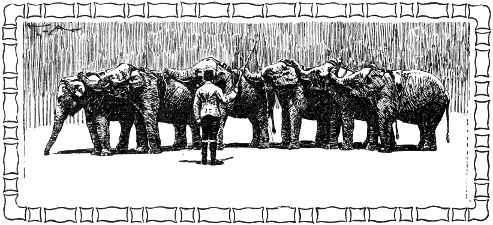
WILD BEASTS. HOW THEY ARE TRANSPORTED AND TRAINED.
Reading edition
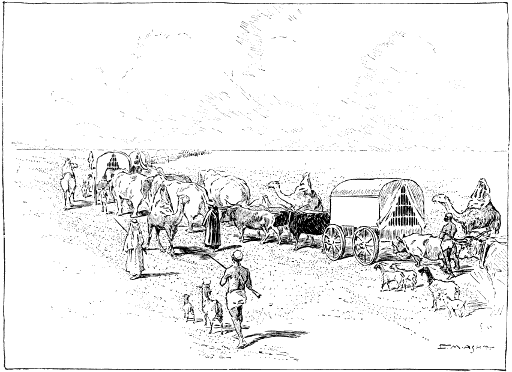
Few of those people who go to a menagerie realize what an immense undertaking it is to transport wild beasts from the land of their birth and of their freedom to the land of their imprisonment, and, too frequently, of their death. I will ask my readers to picture for themselves an African desert blazing beneath a burning sun. Across the weary waste of sand a long column of men and animals is wending its slow way. As it draws nearer we see that it is a caravan of wild animals on their way from the interior to the seaboard. And as it passes us, the vast mass of living creatures, as in a chemical process, slowly dissolves itself into distinct particles and individualities. Let us regard them carefully. In the first place we notice a procession of fourteen stately giraffes, then come five elephants, a huge rhinoceros, four wild buffaloes bellowing sadly after the mates they have forever left behind. Then there go lumbering by a number of enormous carts or wagons, in which are safely confined thirty hyenas, five leopards, six lions, two chetahs, sixteen antelopes, two lynxes, one serval, one wardbob, twenty smaller carnivorous animals, four African ant-eaters, and forty-five monkeys. And then there come slowly prancing by, wary, restless, cunning, twenty-six ostriches. There are twenty boxes of birds, from which sounds of shrill screaming are constantly proceeding. There are upwards of a hundred Abyssinian goats scattered here and there in the procession. These are to give milk for the young animals, and to serve as food and meat for the old. The caravan is on its way through the desert to Suakim, which is the first shipping place for Europe. There are no less than a hundred and twenty camels in it, which are required to carry the food for this caravan, and there are upwards of a hundred and sixty drivers in the procession. It takes the caravans upwards of thirty-six days to cover the distance which lies between Cassala in the interior of Nubia and the port of Suakim, for which they are bound. The same journey is usually performed by quick post camels in twelve days.
This is the exact account of a caravan which Karl Hagenbeck told me he brought across the desert in the year 1870. “It is tremendously anxious work,” said he, “the transportation of these animals across sea and land. The amount of water which we have to carry with us in goats’ hides upon camels’ backs is prodigious, for nothing would be more awful than to run short of water in the middle of the desert, and to be surrounded by a number of wild beasts, maddened with heat and unquenchable thirst. The principal food for the young elephants and rhinoceroses on the way home is a fruit called nabeck, that is, a kind of cherry of which they are very fond. Giraffes and antelopes and ostriches are provided with the doura corn that grows in the interior. All these bigger animals walk, and as they jog along my people feed them occasionally with hard ship biscuit, which appears to sustain them well through the journey. At four o’clock every morning the caravan strikes its tents and begins its march. They go plodding along till ten o’clock, when the day becomes too hot for further progress.”
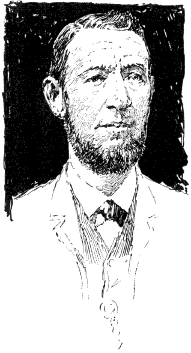
KARL HAGENBECK.
“But do the animals never attempt to escape?” said I.
“Well, not often,” replied Karl Hagenbeck; “but,” he added, with a hearty laugh of recollection, “I remember that once, in that very year 1870, of which I have just been telling you, the whole of the ostriches, twenty-six in number, ran away just as we were getting them into the railway station at Suakim. Away they went, heading straight for the desert. I never was in such a dreadful fix in my life. At last it struck me that it would be a good plan to drive all the goats and camels towards them; we did so, and, when the ostriches saw them advancing, they formed themselves into a flock, and we drove the whole lot into the station. The birds were caught one by one and put into the cars. That was the last transport, by-the-by, that poor Casanova ever brought over. Indeed, he died at Alexandria in the very midst of the whole business, and we buried him on the evening of his death. It was a dreadful time, and everything appeared to be against us, for at the very moment of his death, just as we were getting the animals on board ship, a fearful earthquake shook the whole land. I thought there was something about to happen, for the animals were very uneasy, the birds were twittering, the monkeys were chattering and trembling, the lions were roaring constantly, the elephants were deafening with their long trumpetings. Suddenly I felt the steamer quivering from stem to stern. The sea was tossing, the sun was hidden behind a thick yellow mist. I looked toward the land where the minarets were toppling down, and where the greatest horror and confusion appeared to prevail, and all the while poor Casanova lay dead or dying below. I shall never forget that awful morning.
“We had had the greatest possible difficulty just before, too, for at Suakim the railway people had told us that we had too many wagons, and that they would not transport us any farther. However, I soon settled that by going up to the directors of the railway and demanding from them an express train immediately; ‘for,’ said I, ‘these animals are for the Emperor of Austria,’ and to prove this I showed them a great document sealed by the emperor himself.”
ADVENTURES WITH ESCAPED ANIMALS.
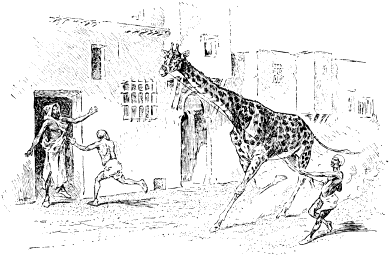
“On another occasion I was journeying through Suez with a giraffe which for five months had been living in the German Consul’s garden. I was leading it to the station when it suddenly took fright and ran away. For four long, weary miles I hung on to the wretched beast, but at last I was obliged to drop the rope and let it go. A smart little Nubian boy then took up the chase; he got hold of the rope and eventually tied it round a tree, and after a while we led the animal quietly back to the station.
“But one of the most alarming adventures that ever overtook me whilst I was transporting animals was that which occurred once when twelve elephants broke away from me and rushed through the streets of Vienna. The whole twelve had been deposited in a dépôt, where they had to rest for two days. I was taking six of the elephants to lead them to the station, and when my back was turned and I was engaged with these six elephants, the other six stealthily and quietly pulled up the iron rings by which they were fastened to the ground, trumpeted loudly, and, before I knew what had happened, the twelve animals were rushing through the streets of Vienna. At last, after a long chase, I caught the biggest elephant, and led it to the station, the others following quietly enough. But my troubles were not over yet, for I hardly got the first four into a railway van when the others began to howl. The four elephants in the train plunged and kicked about, and at last they broke their ropes and ran out of the van, followed by all the others, and into the open streets. Then began another hunt up the big fashionable streets, down little courts and alleys, once after one which ran into a big shop, all over a big park, and this went on for three hours, until, at last, greatly to my relief, I got them safely into the station and packed into the vans for their journey.”
WILD ANIMALS ABOARD SHIP.
“Perhaps the most difficult part of transportation, notwithstanding all the adventures I have had on land, is the getting the big animals on board ship. Take elephants for instance. They are placed in barges and then they are slung up in big slings on to the steamer. This is very difficult and very anxious work, for very often they are killed by the breaking of their necks or their legs. And then again, once they are on board ship, it is very difficult to bring elephants alive to Europe. They suffer dreadfully from sea-sickness, and cannot eat. Some of them are put between decks, and some of them have stables fitted up for them on deck.
“I remember once that Casanova left Africa with a cargo of forty elephants, thirteen only of which reached Trieste alive, and only twelve came here to me in Hamburg. On one occasion, in 1881 I think it was, I was bringing over a large cargo of forty-two ostriches from the Somali country. We were going through the Red Sea, when suddenly a violent storm broke upon us. It was pitch dark on deck, but I went below to look at my birds, and by the dim light of the lantern, and the flash of lightning that every now and again lit up the whole of the ship, I saw that the poor creatures were swaying to and fro, and that they were in the greatest possible discomfort. That night more than thirty of them broke their legs, and the next day we had to throw their bodies into the sea, and out of the forty-two I brought only nine home to Europe. But perhaps one of the most dangerous adventures that I ever had in transporting wild beasts was in 1871. I was taking a rhinoceros from the East India Docks to the Zoölogical Gardens in London. To do this I had to take it and lead it through the docks on a flat trolly. At last we got the beast hoisted on a wagon, and fastened by all four legs. Suddenly an engine drove by. The animal became hideously frightened, his eyes rolled white, then red. He then planted his horn under the seat upon which the man who was driving the wagon was seated. Away went the man, away went the seat, clean over the three horses. They in their turn became dreadfully frightened, too, and bolted. I hit the beast as hard as ever I could with a rope. We managed to tie another rope round his neck and fastened it down, and at last we got him safely down the Commercial Road, and then settled in some stables. I had a big box made for him, and at last conveyed him safely to his destination; but I wouldn’t go through that experience again for a million of money.
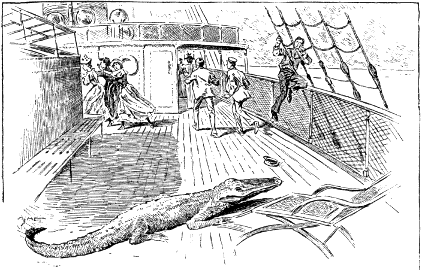
“I was once bringing home a full-grown alligator,” continued Mr. Hagenbeck, smiling at the thought of the adventure of which he was about to tell me, “and I was travelling on a passenger ship. One morning a most amusing incident occurred, but one which all the same might have been attended with serious consequences. I had paid my usual morning visit to my travelling companion, and had seen to his supply of food and water, and having assured myself that he was quite comfortable and well looked after, I retired to my cabin to lie down, the day being very hot. Suddenly I heard a great tramping overhead and the screaming of women and children. I could not think what was the matter, so I ran up on deck; as I went I passed a number of people rushing down the companion way. The male passengers were on the captain’s deck; the sailors were climbing the rigging as fast as they could. The deck was perfectly clear. In the midst of the empty deck stood my alligator, the innocent cause of this sudden commotion, with gently smiling jaws, looking wonderingly on. After a good long time and much difficulty I got the beast into his own habitation.”
TRAINING OF WILD BEASTS.
It is told of the mad King of Bavaria, that he used frequently to command great theatrical entertainments at which he himself was the only spectator. A similar experience befell myself when I was visiting Hamburg. For Mr. Karl Hagenbeck, at my special request, and with great good nature, gave two full performances in my honor, at which, like the mad Bavarian monarch, I was the only spectator. In the first performance only very young animals took part, but as they had been working since last January year, they were pretty well up to all the little tricks they had been taught. My readers will imagine a great circle carefully railed off from the outside world by iron bars. Round this circle, upon a number of little stands, sat the performing animals, waiting to take their respective “turns,” as they say in the music halls; in the midst of the circle sat myself, with a beautiful little baby lion on my knee, which amused itself by playing with my watch chain and handkerchief. Two little tigers which got tired of sitting still suddenly jumped down from their perches and ran up to play with me and the baby lion. A young lion on another perch yawned so loud that we all, animals and men, looked up to see what was the matter. Mr. Hagenbeck walked round the circle, stroking the animals, most of which affectionately kissed him as he passed.
YOUNG ANIMALS AT SCHOOL.
At this moment Mr. Mellermann, who is one of the finest wild beast trainers in the world, entered the circle with his whip in his hand, which, as he entered, he cracked smartly, causing the animals to spring sharply to attention upon their little seats. Karl Hagenbeck introduced me to Mr. Mellermann, who is indeed his own brother-in-law as well as being his trainer.
“What is your rule of training, Mr. Mellermann?” said I.
“Kindness and coolness and firmness,” he replied, “as you will see in this performance. Come on, pussies,” he continued, “show this gentleman how you can run round the circle.”
The pussies, as he called them, fairly big tigers as I should have considered them, unwillingly crept off their seats, growling not a little. Mr. Mellermann cracked his whip smartly, but did not hit them. The animals then began to run very prettily round and round the circle. So well did they do their little tricks that Mr. Mellermann said: “Now you shall have some sugar, you have been very good.” He placed in my hand a few lumps of sugar which I myself gave to them, greatly to their pleasure. Then a pyramid was formed by some young tigers, some lions, a couple of ponies, and four young goats. The pyramid itself consisted of a small double ladder upon the steps of which the animals somewhat nervously took their places, and upon which they stood gazing quietly down upon us, until they were told that they might go back to their places. After a while, when school was over, the goats and ponies left the arena, and then the door of a big cage, which gave upon the circle, was thrown wide open. It was pretty to see the little lions and tigers running home, for all the world like an infant school dismissed to play. The pretty creatures gambolled about for a short while in their cage, and then lay down to rest.
A WONDERFUL PERFORMANCE.
“And now,” said Mr. Hagenbeck, “the older animals are coming in to do their performance.”
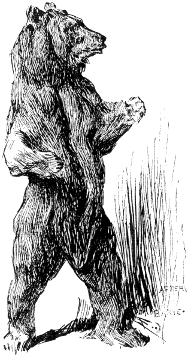
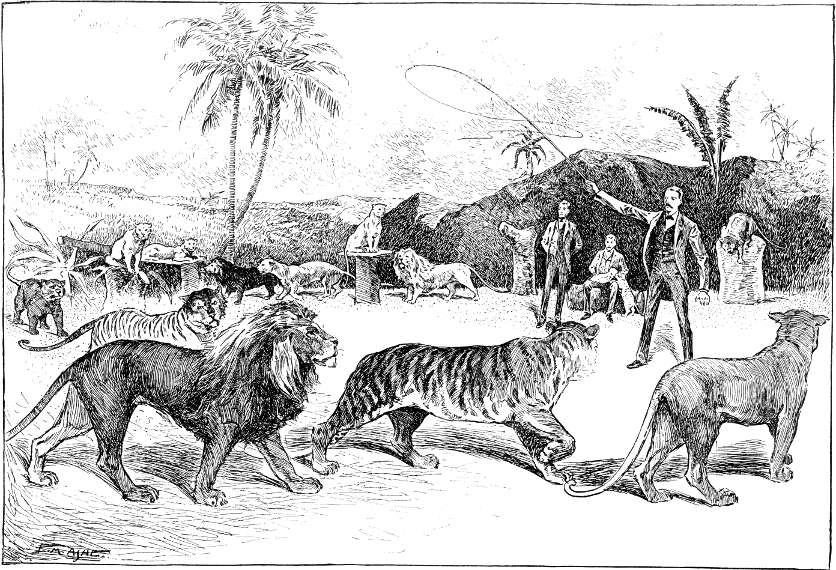
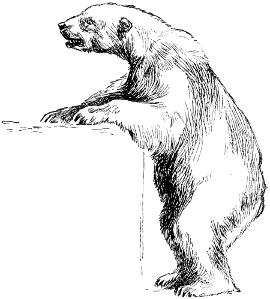
Several attendants entered the building as he spoke; for to handle a large number of fully grown wild animals is no light matter. The first animals to come rushing into the arena were a number of huge German boar-hounds—great affectionate beasts they were, too. I patted one of them as he passed me, and he reared himself on his hind legs, threw his forepaws round my neck, and delightedly covered my face with kisses. Each boar-hound on entering the circle went to his own allotted place with all the sense of a human being. A few moments afterwards a door was thrown open, and in walked the lions and tigers. Splendid big beasts these last were. Some looked very good-tempered, although it is to be acknowledged that one tiger had evidently got out of bed the wrong side, whilst a lion that had arrived comparatively recently from Nubia evinced now and again a strong disposition to rebel against the novel circumstances in which he found himself placed. Three bears then walked in—a polar bear, a sloth bear, and a black bear, the latter causing much amusement by quietly entering on its hind legs. Then came a couple of elephants, a camel, four ponies, several goats, and last of all a big, sleepy sheep, which seemed to be on particularly intimate terms with one of the lions.
One of the most remarkable things that I noticed in Karl Hagenbeck’s menagerie is the marvellous unity and loving-kindness which is brought to pass amongst his animals. They are fondling and playing with each other the whole day long. Like the younger animals, they took their seats upon the rickety pedestals which are provided for them. It was a wonder to me how such huge beasts were able to balance themselves so easily and comfortably as they did upon such small and slender supports. One of them, however, came to grief in a most amusing manner. The human beings were standing talking together in the middle of the circle, when suddenly a loud crash and an indignant howl was heard. We all turned to see what was the matter, as did also the wild beasts themselves; one of the lions had suddenly tumbled down off his perch, or rather the perch had fallen with him, and there he lay, more startled than hurt, wondering what on earth had happened. It was partly his own fault, poor dear fellow, for he had fallen asleep whilst waiting for the performance to begin, and so lost his balance. But his look of indignant surprise was so ludicrously human that none of us could help laughing. However, both he and his pedestal were speedily reinstated in their former position, and a lump of sugar soon restored him to his usual tranquillity of spirit.
“And will the animals be arranged round the Chicago circus like this, Mr. Hagenbeck?” said I.
“Everything will be exactly as you see it to-day,” he replied. “Perhaps, if anything, on a bigger scale.”
At this moment the band struck up a stirring tune, on hearing which the animals delightedly pricked their ears, and all became life and animation at once!
“My animals love music,” said Mr. Hagenbeck, “and they perform twice as well with a band as they do without.”
The first thing that took place was the riding round the circus on a pony by a full-grown lion. Round and round they went. The pony spiritedly enough; the lion, it must be confessed, looking, as wild beasts generally do when engaged in such performances, rather a fool.
“The ponies and dogs were at first dreadfully afraid of the lions and tigers,” explained Mr. Hagenbeck, “but they soon got over it. These two animals were the rage of all Paris when I was performing there a year or two ago. Four ponies refused altogether, but at last we managed to persuade this one to accomplish the trick.”
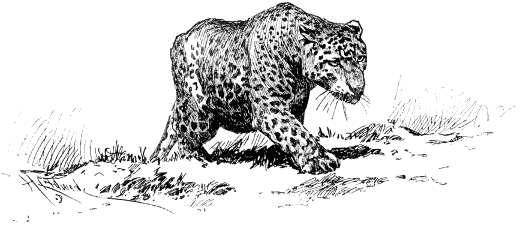
“Has your brother-in-law never been hurt by any of these animals?”
“Only once,” said he, “when he tried to separate a dog and a tiger which were fighting, and the dog bit him. The dogs are frequently very plucky, and sometimes attack the lions.”
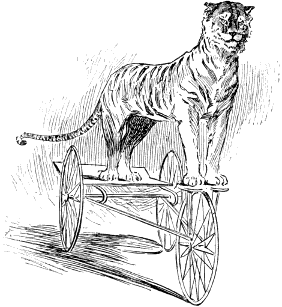
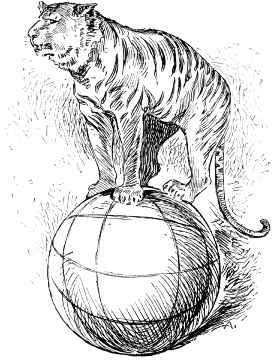
The next feature in the programme was that a tiger should ride round the circus on a tricycle. A man rolled in the tricycle, the tiger was called by name to come down from his perch, which he did slowly and unwillingly enough. “For,” said Mr. Hagenbeck, “he always hates this ride of his.” Then the tiger sullenly mounted the tricycle exactly as is shown in the picture, growling frequently the whole time; two of the boar-hounds walked behind as footmen, the band struck up a slow tune, the tiger set the tricycle in motion, and slowly and solemnly enough the little procession passed round the circus. “Now,” said the chief trainer, “I’ll show you how a tiger can roll a ball along, standing upon it the whole time.” Some trestles were brought in, placed at equal distances from each other, and a long plank was laid across them, and then there was placed upon it a huge wooden ball. “Come on, Cæsar,” cried Mr. Mellermann, “it’s your turn now.” To our surprise a beautiful lion jumped down from his pedestal and ran gayly up to Mr. Mellermann. “No, no, no, you dear old stupid,” said the trainer, leading him back to his perch; “I want Cæsar, not you.” But all our persuasion couldn’t get Cæsar the tiger to come down, so Mr. Mellermann went boldly up to him and gently flicked him with his whip. Cæsar got slowly down, snarling and growling the whole time. “Come on, then, there’s a good fellow,” said Mr. Mellermann, and after a while Cæsar was persuaded to balance himself on the ball which he rolled slowly along the plank. Having done it once or twice forwards and backwards, he was allowed to return to his seat, which he did with great joy and satisfaction. Mr. Mellermann then went up to him, told him he had been a good fellow, and gave him a special bit of meat all to himself. “I always do that,” said he, coming back to where I was standing, “when an animal has shown any unwillingness to perform his tricks, for there is nothing that encourages them like kindness.”
“Which animals show the most intelligence?” said I.
“Well,” replied Mr. Mellermann, “I don’t think there is much difference between them. Lions and tigers, males and females, are equally clever; and,” continued Mr. Mellermann, “I think it is all rubbish to say that tigers are not as affectionate or as easily tamed as lions. Why, look here,” he continued, going up to a splendid Royal Bengal tiger which greeted him with a most extravagant affection as he threw his arms round the creature’s neck and drew the great head down on a level with his own, “you couldn’t get a more affectionate beast than this is, I am sure.”
On this particular morning the animals seemed to be a little flighty, which Karl Hagenbeck explained to me was owing to the fact that the young animals were so close by, and the old ones wanted to play with them. Next, one of the bears was led forth to walk on the tight rope, this appliance really being a long narrow plank. Very cleverly he balanced himself on his hind legs, and walked, first forwards and then backwards, with wonderful skill and ease. The trainer walked beside him, encouraging him now and again with the words, “Steady, John, steady,” treating him, indeed, exactly as he would treat a boy at school. In the middle of his performance a loud snarling and growling was suddenly heard; a tiger and a leopard had begun quarrelling, and, as the leopard had been behaving very badly the whole morning, and distracting the attention of the school, he was sent back to his den in disgrace. Meanwhile the bear retired to his pedestal and sat down upon it with a graceful and self-satisfied air. “That bear very much pleased the Emperor of Austria and the King of Bavaria when they came here some years ago,” said Mr. Hagenbeck, and then he took a beautiful silver cigar-case out of his pocket, from which he offered me a very fine weed. This cigar-case, he told me, had been given him on that memorable occasion by the King of Bavaria himself.
Then a see-saw was constructed in the middle of the circus, upon one end of which stood a lion, and upon the other end of which stood a tiger. A bear standing in the middle preserved the peace between them. Two leopards stood on guard on either side, and then the bear set the see-saw in motion by walking alternately from one side to the other.
Then took place a curious and amusing performance. Four lions and tigers were arranged in a row at an equal distance from one another. Some of the German boar-hounds were let loose, and one after another they gayly started a game of leap-frog with the wild beasts, who seemed to enjoy it to the full as much as they did. After they had finished their performance, some enormous double ladders were brought in. The great Polar bear was persuaded to take his place at the very top; next to him on either side, on the next rung of the ladder, was a beautiful boar-hound; then came two royal Bengal tigers, and then a couple of the finest lions I ever saw. Round about the base of the pyramid were grouped, in picturesque profusion, lions, tigers, leopards, and dogs. There they stood perfectly still, and uttering not a single sound, until, very suddenly, Mr. Mellermann cracked his whip, when the animals joyfully quitted their strained positions and retired to their seats. “Ah!” said Mr. Hagenbeck, as he turned to me, “no living human being can imagine what it means to get those animals to do that. It makes a man old and sick and nervous before his time. I’ll never do it again after the Chicago Exhibition. Life is too short for such a strain. I wouldn’t take any money for those animals now that they are trained, although I was offered only the other day upwards of sixty thousand dollars for them.”
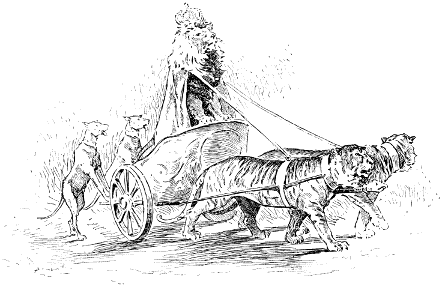
And now came the pièce de résistance of the whole affair. A large Roman chariot was rolled into the circus; two huge tigers were led forth, and, growling much, they were harnessed to it; and then there was ushered into the chariot, with no little state, a noble and stately lion. A robe of royal crimson was fastened round his neck, a gleaming crown was placed upon his head, the reins were thrown upon his shoulders, two boar-hounds took their position as footmen in the rear of the chariot, Mr. Mellermann cracked his whip, and the royal chariot drawn by the tigers rolled solemnly round the circus. After this a curious thing occurred. The entertainment was at an end, the band quitted the building, and the animals were allowed to play about, all jumbled up together. They seemed perfectly happy, gambolling with pure pleasure round Mr. Mellermann and his assistants, between whom and the animals the strongest affection most evidently exists. After they had played about for a few minutes, the order was given that they should retire to their cells, which they did by devious ways and by-paths, the last glimpse I caught of them being that of a tiger playfully sparring with a tawny African lion.