IN THE NAME OF THE LAW! By Stanley J. Weyman.
Reading edition
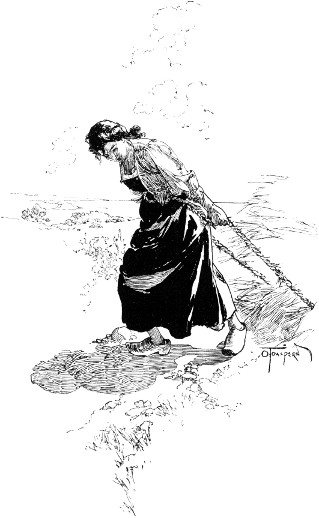
On the moorland above the old gray village of Carbaix, in Finistére—Finistére, the most westerly province of Brittany—stands a cottage, built, as all the cottages in that country are, of rough-hewn stones. It is a poor, rude place to-day, but it wore an aspect far more rude and primitive a hundred years ago—say on an August day in the year 1793, when a man issued from the doorway, and, shading his eyes from the noonday sun, gazed long and fixedly in the direction of a narrow rift which a few score paces away breaks the monotony of the upland level. This man was tall and thin and unkempt, his features expressing a mixture of cunning and simplicity. He gazed a while in silence, but at length uttered a grunt of satisfaction as the figure of a woman rose gradually into sight. She came on slowly, in a stooping posture, dragging behind her a great load of straw, which completely hid the little sledge on which it rested, and which was attached to her waist by a rope of twisted hay.
The figure of a woman—rather of a girl. As she drew nearer it could be seen that her cheeks, though brown and sunburned, were as smooth as a child’s. She looked scarcely eighteen. Her head was bare, and her short petticoats, of some coarse stuff, left visible bare feet thrust into wooden shoes. She advanced with her head bent and her shoulders strained forward, her face dull and patient. Once, and once only, when the man’s eyes left her for a moment, she shot at him a look of scared apprehension; and later, when she came abreast of him, her breath coming and going with her exertions, he might have seen, had he looked closely, that her strong brown limbs were trembling under her.
But the man noticed nothing in his impatience, and only chid her for her slowness. “Where have you been dawdling, lazy-bones?” he cried.
She murmured, without halting, that the sun was hot.
“Sun hot!” he retorted. “Jeanne is lazy, I think! Mon Dieu, that I should have married a wife who is tired by noon! I had better have left you to that never-do-well Pierre Bounat. But I have news for you, my girl.”
He lounged after her as he spoke, his low, cunning face—the face of the worst kind of French peasant—flickering with cruel pleasure, as he saw how she started at his words. She made no answer, however. Instead, she drew her load with increased vehemence towards one of the two doors which led into the building. “Well, well, I will tell you presently,” he called after her. “Be quick and come to dinner.”
He entered himself by the other door. The house was divided into two chambers by a breast-high partition of wood. The one room served for kitchen; the other, now half full of straw, was barn and granary, fowl-house and dove-cote, in one. “Be quick!” he called to her. Standing in the house-room, he could see her head as she stooped to unload the straw.
In a moment she came in, her shoes clattering on the floor. The perspiration stood in great beads on her forehead, and showed how little she had deserved his reproach. She sat down silently, avoiding his eyes; but he thought nothing of this. It was no new thing. It pleased him, if anything.
“Well, my Jeanne,” he said, in his gibing tone, “are you longing for my news?”
The hand she stretched out towards the pitcher of cider, which, with black bread and onions, formed their meal, shook, but she answered simply: “If you please, Michel.”
“Well, the Girondins have been beaten, my girl, and are flying all over the country. That is the news. Master Pierre is among them, I do not doubt, if he has not been killed already. I wish he would come this way.”
“Why?” she asked, suddenly looking up at last, a flash of light in her gray eyes.
“Why?” he repeated, grinning across the table at her, “because he would be worth five crowns to me. There is five crowns, I am told, on the head of every Girondin who has been in arms, my girl.”
The French Revolution, it will be understood, was at its height. The more moderate and constitutional Republicans—the Girondins, as they were called—worsted in Paris by the Jacobins and the mob, had lately tried to raise the provinces against the capital, and to this end had drawn together at Caen, near the border of Brittany. They had been defeated, however, and the Jacobins, in this month of August, were preparing to take a fearful vengeance at once on them and the Royalists. The Reign of Terror had begun. Even to such a boor as this, sitting over his black bread, the Revolution had come home, and, in common with many a thousand others, he wondered what he could make of it.
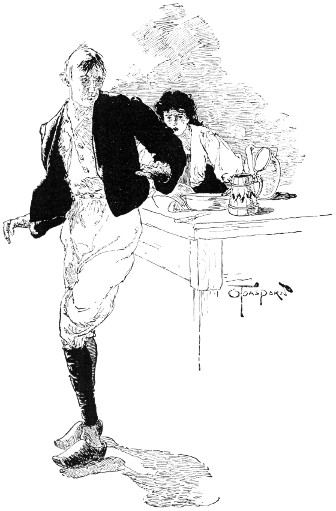
The girl did not answer, even by the look of contempt to which he had become accustomed, and for which he hated her; and he repeated, “Five crowns! Ah, it is money, that is! Mon Dieu!” Then, with a sudden exclamation, he sprang up. “What is that?” he cried.
He had been sitting with his back to the barn, but he turned now so as to face it. Something had startled him—a rustling in the straw behind him. “What is that?” he said again, his hand on the table, his face lowering and watchful.
The girl had risen also; and, as the last word passed his lips, sprang by him with a low cry, and aimed a frantic blow with her stool at something he could not see.
“What is it?” he asked, recoiling.
“A rat!” she answered, breathless. And she aimed another blow at it.
“Where?” he asked, fretfully. “Where is it?” He snatched his stool, too, and at that moment a rat darted out of the straw, ran nimbly between his legs, and plunged into a hole by the door. He flung the wooden stool after it; but, of course, in vain. “It was a rat!” he said, as if before he had doubted it.
“Thank God!” she muttered. She was shaking all over.
He stared at her in stupid wonder. What did she mean? What had come to her? “Have you had a sunstroke, my girl?” he said, suspiciously.
Her nut-brown face was a shade less brown than usual, but she met his eyes boldly, and said: “No,” adding an explanation which for the moment satisfied him. But he did not sit down again. When she went out he went out also. And though, as she retired slowly to the rye fields and work, she repeatedly looked back at him, it was always to find his eyes upon her. When this had happened half a dozen times, a thought struck him. “How now?” he muttered. “The rat ran out of the straw!”
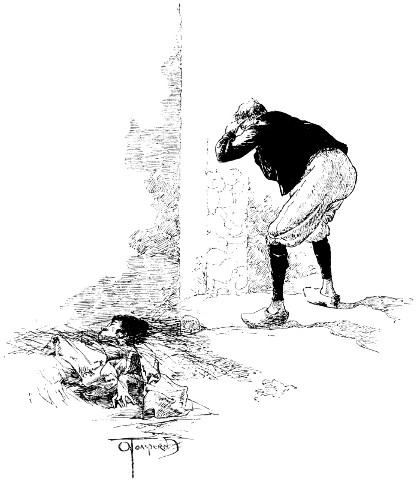
Nevertheless he still stood gazing after her, with a cunning look upon his features, until she disappeared over the edge of the rift, and then he crept back to the door of the barn, and stole in out of the sunlight into the cool darkness of the raftered building, across which a dozen rays of light were shooting, laden with dancing motes. Inside he stood stock still until he had regained the use of his eyes, and then he began to peer round him. In a moment he found what he sought. Half upon, and half hidden by, the straw, lay a young man, in the deep sleep of utter exhaustion. His face, which bore traces of more than common beauty, was now white and pinched; his hair hung dank about his forehead. His clothes were in rags; and his feet, bound up in pieces torn at random from his blouse, were raw and bleeding. For a short while Michel Tellier bent over him, remarking these things with glistening eyes. Then the peasant stole out again. “It is five crowns!” he muttered, blinking in the sunlight. “Ha, ha! Five crowns!”
He looked round cautiously, but could see no sign of his wife; and after hesitating and pondering a minute or two, he took the path for Carbaix, his native astuteness leading him to saunter slowly along in his ordinary fashion. After that the moorland about the cottage lay seemingly deserted. Thrice, at intervals, the girl dragged home her load of straw, but each time she seemed to linger in the barn no longer than was necessary. Michel’s absence, though it was unlooked-for, raised no suspicion in her breast, for he would frequently go down to the village to spend the afternoon. The sun sank lower, and the shadow of the great monolith, which, standing on the highest point of the moor, about a mile away, rose gaunt and black against a roseate sky, grew longer and longer; and then, as twilight fell, the two coming home met a few paces from the cottage. He asked some questions about the work she had been doing, and she answered briefly. Then, silent and uncommunicative, they went in together. The girl set the bread and cider on the table, and going to the great black pot which had been simmering all day upon the fire, poured some broth into two pitchers. It did not escape Michel’s frugal eye that there was still a little broth left in the bottom of the pot, and this induced a new feeling in him—anger. When his wife hailed him by a sign to the meal, he went instead to the door, and fastened it. Thence he went to the corner and picked up the wood-chopper, and armed with this came back to his seat.
The girl watched his movements first with surprise, and then with secret terror. The twilight was come, and the cottage was almost dark, and she was alone with him; or, if not alone, yet with no one near who could help her. Yet she met his grin of triumph bravely. “What is this?” she said. “Why do you want that?”
“For the rat,” he answered grimly, his eyes on hers.
“Why not use your stool?” she strove to murmur, her heart sinking.
“Not for this rat,” he answered. “It might not do, my girl. Oh, I know all about it,” he continued. “I have been down to the village, and seen the mayor, and he is coming up to fetch him.” He nodded towards the partition, and she knew that her secret was known.
“It is Pierre,” she said, trembling violently, and turning first crimson and then white.
“I know it, Jeanne. It was excellent of you! Excellent! It is long since you have done such a day’s work.”
“You will not give him up?”
“My faith, I shall!” he answered, affecting, and perhaps really feeling, wonder at her simplicity. “He is five crowns, girl! You do not understand. He is worth five crowns, and the risk nothing at all.”
If he had been angry, or shown anything of the fury of the suspicious husband; if he had been about to do this out of jealousy or revenge, she would have quailed before him, though she had done him no wrong, save the wrong of mercy and pity. But his spirit was too mean for the great passions; he felt only the sordid ones, which to a woman are the most hateful. And instead of quailing, she looked at him with flashing eyes. “I shall warn him,” she said.
“It will not help him,” he answered, sitting still, and feeling the edge of the hatchet with his fingers.
“It will help him,” she retorted. “He shall go. He shall escape before they come.”
“I have locked the doors!”
“Give me the key!” she panted. “Give me the key, I say!” She had risen and was standing before him, her figure drawn to its full height. He rose hastily and retreated behind the table, still retaining the hatchet in his grasp.
“Stand back!” he said, sullenly. “You may awaken him, if you please, my girl. It will not avail him. Do you not understand, fool, that he is worth five crowns? And listen! It is too late now. They are here!”
A blow fell on the door as he spoke, and he stepped towards it. But at that despair moved her, and she threw herself upon him, and for a moment wrestled with him. At last, with an effort he flung her off, and, brandishing his weapon in her face, kept her at bay. “You vixen!” he cried, savagely, retreating to the door, with a pale cheek and his eyes still on her, for he was an arrant coward. “You deserve to go to prison with him, you jade! I will have you in the stocks for this!”
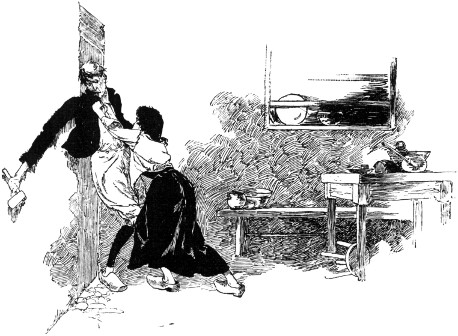
She leaned against the wall where she had fallen, her white, despairing face seeming almost to shine in the darkness of the wretched room. Meanwhile the continuous murmur of men’s voices outside could now be heard, mingled with the ring of weapons; and the summons for admission was again and again repeated, as if those without had no mind to be kept waiting.
“Patience! patience! I am opening!” he cried. Still keeping his face to her, he unlocked the door and called on the men to enter. “He is in the straw, M. le Mayor!” he cried in a tone of triumph, his eyes still on his wife. “He will give you no trouble, I will answer for it! But first give me my five crowns, mayor. My five crowns!”
He still felt so much fear of his wife that he did not turn to see the men enter, and was taken by surprise when a voice at his elbow—a strange voice—said, “Five crowns, my friend? For what, may I ask?”
In his eagerness and excitement he suspected nothing, but thought only that the mayor had sent a deputy. “For what? For the Girondin!” he answered, rapidly. Then at last he turned and found that half-a-dozen men had entered, and that more were entering. To his astonishment, they were all strangers to him—men with stern, gloomy faces, and armed to the teeth. There was something so formidable in their appearance that his voice faltered as he added: “But where is the mayor, gentlemen? I do not see him.”
No one answered, but in silence the last of the men—there were eleven in all—entered and bolted the door behind him. Michel Tellier peered at them in the gloom with growing alarm. In return the tallest of the strangers, who had entered first and seemed to be in command, looked round keenly. At length this man spoke. “So you have a Girondin here, have you?” he said, his voice curiously sweet and sonorous.
“I was to have five crowns for him,” Michel muttered dubiously.
“Oh! Pétion,” continued the spokesman to one of his companions, “can you kindle a light? It strikes me that we have hit upon a dark place.”
The man addressed took something from his pouch. For a moment there was silence, broken only by the sharp sound of the flint striking the steel. Then a sudden glare lit up the dark interior, and disclosed the group of cloaked strangers standing about the door, the light gleaming back from their muskets and cutlasses. Michel trembled. He had never seen such men as these before. True, they were wet and travel-stained, and had the air of those who spend their nights in ditches and under haystacks. But their pale, stern faces were set in indomitable resolve. Their eyes glowed with a steady fire, and they trod as kings tread. Their leader was a man of majestic height and beauty, and in his eyes alone there seemed to lurk a spark of some lighter fire, as if his spirit still rose above the task which had sobered his companions. Michel noted all this in fear and bewilderment; noted the white head and yet vigorous bearing of the man who had struck the light; noted even the manner in which the light died away in the dim recesses of the barn.
“And this Girondin—is he in hiding here?” said the tall man.
“That is so,” Michel answered. “But I had nothing to do with hiding him, citizen. It was my wife hid him in the straw there.”
“And you gave notice of his presence to the authorities?” continued the stranger, raising his hand to repress some movement among his followers.
“Certainly, or you would not have been here,” replied Michel, better satisfied with himself.
The answer struck him down with an awful terror. “That does not follow,” said the tall man, coolly, “for we are Girondins!”
“You are?”
“Without doubt,” the other answered, with majestic simplicity; “or there are no such persons. This is Pétion, and this Citizen Buzot. Have you heard of Louvet? There he stands. For me, I am Barbaroux.”
Michel’s tongue seemed glued to the roof of his mouth. He could not utter a word. But another could. On the far side of the barrier a sudden rustling was heard, and while all turned to look—but with what different feelings—the pale face of the youth over whom Michel had bent in the afternoon appeared above the partition. A smile of joyful recognition effaced for the time the lines of exhaustion. The young man, clinging for support to the planks, uttered a cry of thankfulness. “It is you! It is really you! You are safe!” he exclaimed.
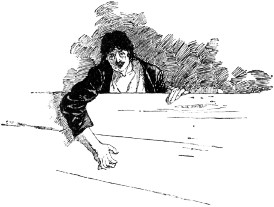
“We are safe, all of us, Pierre,” Barbaroux answered. “And now”—and he turned to Michel Tellier with sudden thunder in his voice—“this man whom you would have betrayed is our guide, let me tell you, whom we lost last night. Speak, man, in your defence, if you can. Say what you have to say why justice shall not be done upon you, miserable caitiff, who would have sold a man’s life for a few pieces of silver!”
The wretched peasant’s knees trembled, and the perspiration stood upon his brow. He heard the voice as the voice of a judge. He looked in the stern eyes of the Girondins, and read only anger and vengeance. Then he caught in the silence the sound of his wife weeping, for at Pierre’s appearance she had broken into wild sobbing, and he spoke out of the base instincts of his heart.
“He was her lover,” he muttered. “I swear it, citizens.”
“He lies!” cried the man at the barrier, his face transfigured with rage. “I loved her, it is true, but it was before her old father sold her to this Judas. For what he would have you believe now, my friends, it is false. I, too, swear it.”
A murmur of execration broke from the group of Girondins. Barbaroux repressed it by a gesture. “What do you say of this man?” he asked, turning to them, his voice deep and solemn.
“He is not fit to live!” they answered in chorus.
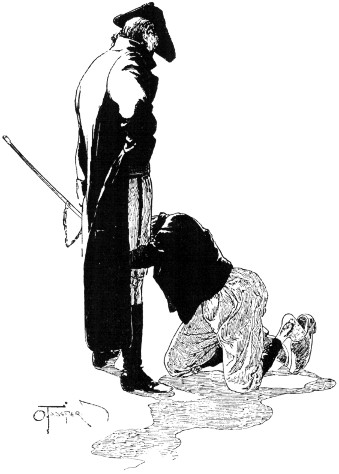
The poor coward screamed as he heard the words, and, flinging himself on the ground, he embraced Barbaroux’s knees in a paroxysm of terror. But the judge did not look at him. Barbaroux turned, instead, to Pierre Bounat. “What do you say of him?” he asked.
“He is not fit to live,” said the young man solemnly, his breath coming quick and fast.
“And you?” Barbaroux continued, turning and looking with his eyes of fire at the wife, his voice gentle, and yet more solemn.
A moment before she had ceased to weep, and had stood up listening and gazing, awe and wonder in her face. Barbaroux had to repeat his question before she answered. Then she said, “He is not fit to die.”
There was silence for a moment, broken only by the entreaties of the wretch on the floor. At last Barbaroux spoke. “She has said rightly,” he pronounced. “He shall live. They have put us out of the law and set a price on our heads; but we will keep the law. He shall live. But, hark you,” the great orator continued, in tones which Michel never forgot, “if a whisper escape you as to our presence here, or our names, or if you wrong your wife by word or deed, the life she has saved shall pay for it.
“Remember!” he added, shaking Michel to and fro with a finger, “the arm of Barbaroux is long, and though I be a hundred leagues away, I shall know and I shall punish. So, beware! Now rise, and live!”
The miserable man cowered back to the wall, frightened to the core of his heart. The Girondins conferred a while in whispers, two of their number assisting Pierre to cross the barrier. Suddenly there came—and Michel trembled anew as he heard it—a loud knocking at the door. All started and stood listening and waiting. A voice outside cried: “Open! open! in the name of the law!”
“We have lingered too long,” Barbaroux muttered. “I should have thought of this. It is the Mayor of Carbaix come to apprehend our friend.”
Again the Girondins conferred together. At last, seeming to arrive at a conclusion, they ranged themselves on either side of the door, and one of their number opened it. A short, stout man, girt with a tricolor sash, and wearing a huge sword, entered with an air of authority—being blinded by the light he saw nothing out of the common—and was followed by four men armed with muskets.
Their appearance produced an extraordinary effect on Michel Tellier. As they one by one crossed the threshold, the peasant leaned forward, his face flushed, his eyes gleaming, and counted them. They were only five. And the others were twelve. He fell back, and from that moment his belief in the Girondins’ power was clinched.
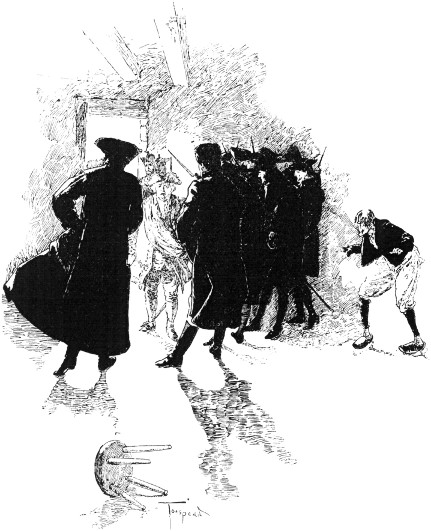
“In the name of the law!” panted the mayor. “Why did you not—” Then he stopped abruptly, his mouth remaining open. He found himself surrounded by a group of grim, silent mutes, with arms in their hands, and in a twinkling it flashed into his mind that these were the eleven chiefs of the Girondins, whom he had been warned to keep watch for. He had come to catch a pigeon and had caught a crow. He turned pale and his eyes dropped. “Who are—who are these gentlemen?” he stammered, in a ludicrously altered tone.
“Some volunteers of Quumpen, returning home,” replied Barbaroux, with ironical smoothness.
“You have your papers, citizens?” the mayor asked, mechanically; and he took a step back towards the door, and looked over his shoulder.
“Here they are!” said Pétion rudely, thrusting a packet into his hands. “They are in order.”
The mayor took them, and longing only to see the outside of the door, pretended to look through them, his little heart going pit-a-pat within him. “They seem to be in order,” he assented, feebly. “I need not trouble you further, citizens. I came here under a misapprehension, I find, and I wish you a good journey.”
He knew, as he backed out, that he was cutting a poor figure. He would fain have made a more dignified retreat. But before these men, fugitives and outlaws as they were, he felt, though he was Mayor of Carbaix, almost as small a man as did Michel Tellier. These were the men of the Revolution. They had bearded nobles and pulled down kings. There was Barbaroux, who had grappled with Marat; and Pétion, the Mayor of the Bastille. The little Mayor of Carbaix knew greatness when he saw it. He turned tail, and hurried back to his fireside, his body-guard not a whit behind him.
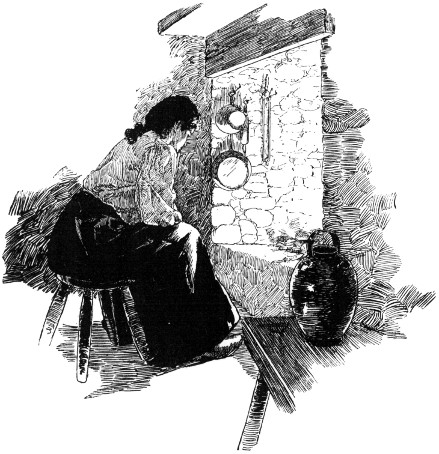
Five minutes later the men he feared and envied came out also, and went their way, passing in single file into the darkness which brooded over the great monolith; beginning, brave hearts, another of the few stages which still lay between them and the guillotine. Then in the cottage there remained only Michel and Jeanne. She sat by the dying embers, silent, and lost in thought. He leaned against the wall, his eyes roving ceaselessly, but always when his gaze met hers it fell. Barbaroux had conquered him. It was not until Jeanne had risen to close the door, and he was alone, that he wrung his hands, and muttered: “Five crowns! Five crowns gone and wasted!”