AN EXPEDITION TO THE NORTH MAGNETIC POLE. By W. H. Gilder. Author of “Schwatka’s Search,” “Ice Pack and Tundra,” etc.
Reading edition
On the Fourth of July, 1879, after a long and tedious journey over territory never before crossed by man, I stood with Lieutenant Schwatka on Cape Felix, the most northern point of King William’s Land.
Looking in the direction of the Isthmus of Boothia, not more than twenty miles to the eastward, across the frozen surface of McClintock Channel, we could see the snow-covered hills of Cape Adelaide, radiant with all the tints of the rainbow, in the light of the midnight sun. It was there that, nearly half a century before, Sir James Ross had located the North Magnetic Pole. The place is invested with deep interest to all explorers, but, with us, the pleasure was mitigated by the knowledge that we were entirely devoid of instruments with which to improve the opportunity of either verifying the work already done or continuing it upon the same line of research.
Ever since that time I have been strongly imbued with the desire to return to that field of labor with a party of observers properly equipped to make an exhaustive search through that storehouse of hidden knowledge.
About three years ago I brought the subject uppermost in my mind to the attention of Professor T. C. Mendenhall, Superintendent of the United States Coast and Geodetic Survey, in Washington, and to that of his assistant, Professor Charles A. Schott, in charge of the computing division of that bureau. From the first both of these gentlemen have been strong advocates of such an expedition.
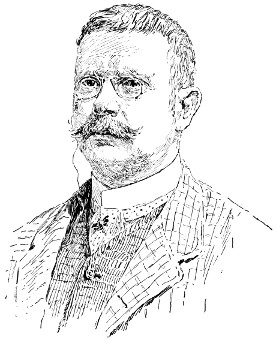
COLONEL W. H. GILDER.
“The importance of a redetermination of the geographical position of the North Magnetic Pole,” said Professor Mendenhall, in a letter to the Secretary of the Treasury written at that time, “has long been recognized by all interested in the theory of the earth’s magnetism or its application. The point as determined by Ross in the early part of this century was not located with that degree of accuracy which modern science demands and permits, and, besides, it is altogether likely that its position is not a fixed one. Our knowledge of the secular variation of the magnetic needle would be greatly increased by better information concerning this Magnetic Pole, and, in my judgment, it would be the duty of the Government to offer all possible encouragement to any suitably organized exploring expedition which might undertake to seek for this information.”
Acting upon a further recommendation in this letter, the Secretary of the Treasury requested the President of the National Academy of Sciences to appoint a committee of its members, or others familiar with the difficult problems involved, “to formulate a plan or scheme for carrying out a systematic search for the North Magnetic Pole, and kindred work,” and such a committee was subsequently appointed, with Professor S. P. Langley, Secretary of the Smithsonian Institution, as chairman.
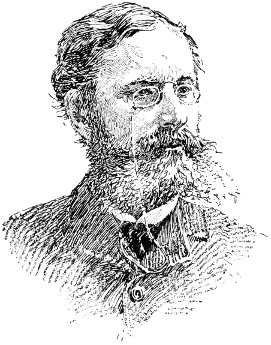
GENERAL A. W. GREELY.
The work proposed by this expedition has attracted the attention and held the interest of scientists everywhere, and material aid from several scientific bodies has already been pledged toward the securing of the necessary funds for transporting the party to the field of its labors, and its maintenance while at work there.
The observers will be selected from among the officers of the United States Navy attached to the Coast Survey, who have had special training in magnetic field work. That bureau will also provide the necessary instruments, but, in the absence of any appropriation that could be applied to the transportation and maintenance of the party in the field, the funds for that purpose have to be obtained by the voluntary contribution of those with means and inclination to aid so important an enterprise.
Said the late Professor Trowbridge of Columbia College, in a lecture upon the data to be obtained by this expedition for subsequent expert discussion, “We are living in an epoch in the world’s history when man is struggling for a higher and more perfect life, not only against the degrading tendencies of his inherited nature, but to make the forces of nature subservient to his advancement and well being. Among these forces there are none which seem to affect or control the conditions of animal life on the earth more than heat, light, electricity, and magnetism, all, perhaps, the manifestations of one cosmical agent. As the variations of the magnetic force appear to follow lesser and greater cycles, it is not impossible that nearly all terrestrial phenomena, which depend on causes allied to magnetism, follow similar cycles. We can now predict the course of storms; may we not hope to determine their origin and predict their recurrence, as far as they depend upon the forces which have been mentioned? A knowledge of the laws of the cycles through which these forces pass is the first and only step in this direction to be taken, and this step must be made by patient, long-continued observations.”
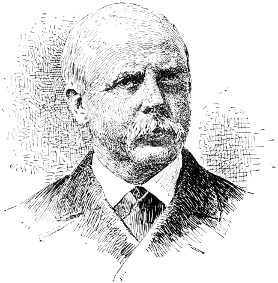
PROFESSOR T. C. MENDENHALL.
An immediate practical use of the observations to be made is their application to the correction of compass errors. Every one can see that such work as tends to render the mariner’s compass a more reliable instrument must be of immediate and direct benefit, not only to the sailor, but to the surveyor on land.
Admitting that the observations of such an expedition as that to the North Magnetic Pole will be of scientific and general value, it remains to explain something of the personnel of the party, how the work is to be conducted, and by what route it will reach the field of its labor.
Besides the two observers of terrestrial magnetism to be supplied by the Coast Survey, there will be a physician fitted by education and habits of study to take charge of some scientific portion of the work, in which he will be specially instructed by the Superintendent of the Coast Survey or his assistant. There will also be three sailors selected from the whaling fleet, who will have charge of the three whale boats belonging to the outfit, and act as assistants to the several observers. The writer of this article, by reason of his experience in Arctic travel, will have charge of the expedition in all except the scientific work, the reports on which will be turned over directly to the officers of the United States Coast and Geodetic Survey for reduction and discussion upon the return of the party from the field.
The scheme of work has already been prepared by Professor Charles A. Schott, who is looked upon as probably the best informed on all the details of terrestrial magnetism of all men in this or any other country. In the course of his exhaustive report upon this subject he says: “The magnetic observations proper will comprise the measure of the three elements, the declination, the dip, and the intensity, which fully define the magnetic force at a place. The measures will be partly absolute and partly differential, and will be considered under two heads; those to be taken while travelling, and those to be attended to at winter quarters.” Detailed instructions for this work are given which are too technical to be interesting except to the specialist. He recommends that a single cocoon thread carrying a sewing needle shall be used to observe the declination where by proximity to the Magnetic Pole the horizontal force is weak. For it must be borne in mind that the Magnetic Pole is the point where the vertical force, called “dip,” is greatest—represented by 90°—while the horizontal force, called “declination,” is 0°.
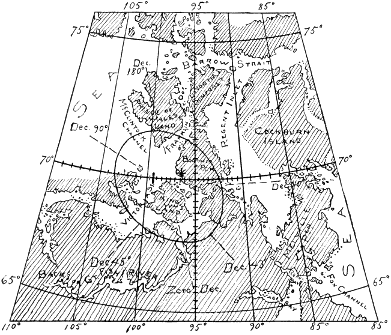
DIAGRAM OF THE NORTH MAGNETIC POLE REGION.
The observations for dip, naturally the most important of the survey, will be made with a Kew Dip Circle employing two needles; the usual reversals of circle, face, and polarity should be attended to at each station, to place the instrument in the plane of the magnetic meridian. The usual method of finding the plane of the meridian will probably not answer in that part of the world for want of sufficient accuracy; the direction of the magnetic meridian should, therefore, be taken as indicated by the delicately suspended needle of the declination instrument, and, where this method fails, dip observations should be made in any two planes 90° apart, of which the first plane is preferably that of the meridian as guessed at.
It is proposed to charter a steam whaler to take the party from St. John’s, Newfoundland, to the northern part of Repulse Bay, which, being directly connected with Hudson’s Bay, is the nearest point to the pole-containing area that is accessible any year. There a permanent station is to be erected where regular observations will be continued all the time and from which each spring a field party (perhaps two) will start to locate the geographical position of the pole.
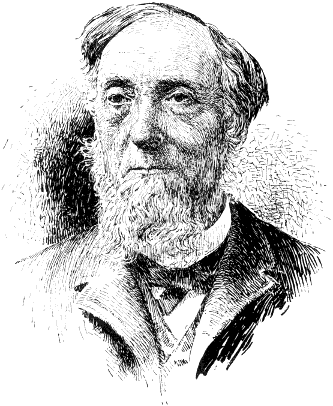
PROFESSOR C. A. SCHOTT.
It may be well to repeat that the Magnetic Pole is that point where the needle of the dip circle is absolutely vertical—where it stands at exactly 90° to the plane of the horizon.
To find this unknown spot the observer follows as nearly as possible the direction indicated by the delicately poised needle of the declinometer. The magnetic meridian is not always a straight line, and may therefore indicate a very circuitous route, but by a system something like the regular approaches to a besieged fort one may be certain of arriving there eventually.
For instance, when the needle indicates a dip of 89° the stations should be nearer together—say not farther apart than twenty miles, if possible, and these intervals should be less as the dip increases.
Suppose the observer to have reached a point where the dip is found to be 89° 30´, and at the next station he has 89° 35´, at the next 89° 40´. At the next he may find only 89° 37´; he then returns to where he found the greatest dip and starts off at right angles, one way or the other, to that course. As long as the dip continues to increase, he knows he is travelling in the right direction. When it again decreases he returns to the point of his last greatest dip and travels at right angles to his last course as long as the dip increases. In this way he will eventually see the absolute verticity of the suspended needle marked and know he has reached the North Magnetic Pole at last. Sir James Ross did not succeed so well, the needle marking only 89° 59´ of verticity. But as this would indicate that he was within one and a quarter to two miles of the point sought, he was justified in feeling elated at his success.
It is believed, however, that with the improved instruments of the present day, and in the light of our increased knowledge of terrestrial magnetism, absolute accuracy is now demanded. These observations will have to be repeated from time to time until at last we shall know with certainty whether or not the North Magnetic Pole is a fixed or movable point, and if it is found to move, the direction and rate of that motion shall be positively determined.