LIEUTENANT PEARY’S EXPEDITION. By Cleveland Moffett.
Reading edition
Before the end of June, Civil Engineer Robert E. Peary of the United States Navy will have sailed on another expedition for the Arctic regions. The party will go by the way of Newfoundland, Baffin’s Bay, and Whale Sound, to Inglefield Gulf, which lies just southeast of Smith Sound and south of the promontory containing the great Humboldt glacier. The winter camp will be established at the head of Bowdoin Bay, some forty miles to the east of Redcliffe House, where Lieutenant Peary passed the winter of ’91, ’92.
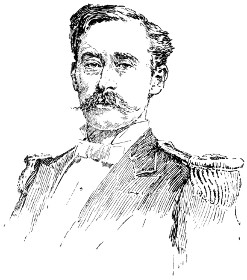
ROBERT E. PEARY.
The programme of the expedition may be briefly summarized as follows:
The party will be absent about two years and a half, a three years’ leave of absence having been accorded Lieutenant Peary by the Navy Department. They expect to be in camp, as indicated, by the last week in July, when the staunch “Falcon,” a sealing steamer which carries them, will land the expedition and return to Newfoundland. The months of August and September, all they will have before the Arctic night sets in, will be utilized in three ways: a party will be sent inland over the ice-cap with a large store of provisions, which will be stored as far to the north as possible, to await the expedition of the ensuing spring; another party, under Lieutenant Peary himself, will make a careful survey of Inglefield Gulf, which is of rare scientific interest on account of the tremendous glaciers which discharge into it; and a third party will busy itself hunting reindeer and other game to supply the expedition with fresh meat.
By November 1, 1893, they will go into winter quarters, all occupying a single house, which will be made as comfortable as possible. During the five or six months of darkness, scientific work will be carried on, including a thorough study of Esquimo habits and institutions. Clothing will be made of reindeer skins, and, in general, preparations be completed for the advance over the ice-cap. Lieutenant Peary hopes to start the sledges northward early in March, thus gaining two months on the start made in ’92. The season of ’94 will be spent in advancing as rapidly as possible to the northern extremity of Greenland, to Independence Bay, discovered by Lieutenant Peary in his recent expedition. At this point the party will divide, several men being detailed to explore the northeastern coast of Greenland as far to the south as Cape Bismarck, while Lieutenant Peary with two picked men will push across the fjord separating Greenland from the land beyond, and will advance thence still farther to the north, as circumstances may direct. It is probable that Lieutenant Peary will spend the winter of ’94 to ’95 somewhere in the neighborhood of northernmost Greenland, very probably in the most extreme northern latitude in which any white man has wintered. In the spring of ’95, or as soon as the season will permit, he will make a further and final advance, leaving time enough for the party to return to Inglefield Gulf before the fall. There a relief ship will be in waiting to carry the expedition back to New York with the results of their explorations.
So much for Lieutenant Peary’s time-table; now for what he hopes to accomplish.
To begin with, the party expect to attain the highest north ever reached by any Arctic expedition. The present record is held by the Greely expedition, two members of which reached 83° 24´ north latitude. The farthest north reached by Lieutenant Peary in his last expedition was 82° north latitude, which is some eighty-four geographical miles south of the point reached by Lieutenant Lockwood of the Greely party. Then, as already mentioned, a complete survey will be made of Inglefield Gulf, and also of the entirely unknown stretch of land on the northeastern coast of Greenland, between Independence Bay and Cape Bismarck.
In addition to this, the main object of the expedition is to make a complete map of the land lying to the north of Greenland, or, rather, the Archipelago, for it is believed that this region is occupied by an extensive group of islands. Unfortunately there is reason for thinking that the lofty ice-cap which will allow the explorers to reach the northernmost point of Greenland by sledging over the inland ice does not continue in the same way over the islands to the north of Greenland. Both Lieutenant Peary in his observations on the east, and Lieutenant Lockwood on the west, remarked that the land stretching away to the north was in many places bare of ice and snow, and rugged in its character. One reason for this absence of an inland ice-cap here is the fact that these islands to the north lie low in the ocean compared with mountainous Greenland. Hence, in the summer, which is the only season when an advance would be possible, the ice and snow melt to a great extent and leave the land bare. Now in case Lieutenant Peary finds that there is no continuous ice on this northern land, he will skirt around the shore on the ice of the open sea, for this is present winter and summer alike. It is likely that such an advance over the ice-pack will be attended by very serious difficulties, the ice being heaped up in broken and uneven surfaces, with mountains and chasms to baffle the party. There may also be spaces of open water where boats or rafts will have to be used instead of sledges. At any rate, the advance will be made as far as possible, and the land to the north of Greenland studied and mapped as far as may be.
It is not the purpose of the expedition to seek the North Pole itself. They may and very probably will get nearer to the Pole than anyone has hitherto done. Lieutenant Peary is confident that he will make the farthest north, and General Greely is inclined to admit this, and told me some days ago in Washington that he should not be surprised if Lieutenant Peary reached 85° north latitude. In any event, an approach to the North Pole will be an incident in the expedition, and not its main object.
Several important considerations make it probable that Lieutenant Peary’s present expedition will attain a considerable measure of success. In the first place, in starting from Bowdoin Bay instead of from Redcliffe House, there will be a gain of forty miles rough hauling, which meant in the recent expedition two weeks’ valuable time. From Bowdoin Bay, the party will be able to climb to the inland ice-cap by the shortest and easiest possible route. The fact that an abundant supply of provisions will be sent ahead during the present summer will be a great advantage, and will do away with the necessity of a supporting party such as was employed on the last expedition. To save the carrying of a ton or so of provisions for even a hundred miles is a matter of great importance. Lieutenant Peary expects to make a further saving in time by choosing a course midway between the one taken on his last journey to Independence Bay and the one taken on his return journey. These two courses, it will be remembered, were unsatisfactory, because in the advance to Independence Bay he went too far to the west and was caught in immense fissures and depressions leading to the glaciers, while on the return journey he went so far to the east that the great elevation above the sea level, often eight thousand feet or more, made it difficult to find the way or take observations on account of perpetual fogs. Now he proposes to avoid the two extremes, and to search for an easier course in a happy medium. A still greater gain in time will be made by starting the expedition early in March, 1894, instead of waiting until May, as was the case before.
A novel feature of the expedition, and one that will be of great service, it is believed, in hauling the loads, will be the use of pack horses in addition to the dog teams. Lieutenant Peary, during his recent western trip, secured a number of hardy burros in Colorado, which he believes will be able to endure the Arctic winter. At any rate, they will be very valuable in carrying the advance provisions this present season, and on a pinch they can be turned into steaks. It has been found possible to fit snow shoes to the hoofs of these pack horses, so as to allow them to advance as rapidly as the dogs. An experiment similar to this has been tried in Norway, where ponies have been used successfully on snow, and also in Alaska.
As to the size of the exploring party, it will be small, comprising not more than ten men in all, and several of these will be left behind at the winter quarters. Lieutenant Peary fully realizes that an exploring party is no stronger than the weakest of its members, and will take along with him only men whose endurance and loyalty have been fully demonstrated. From the winter camp the line of advance will be Independence Bay, where the party will divide, Lieutenant Peary pushing on to the north, and his other men exploring southward to Cape Bismarck. From that point the latter party will be instructed to return to the winter camp directly across Greenland. There is no human way of knowing how Lieutenant Peary will return.
One question which will occur to anxious friends of the explorer is, how Lieutenant Peary and his two companions will live during the winter of ’94 and ’95, at the northernmost point of Greenland, where the foot of man has never trod, and where no supplies could reach them. The answer to this question is, that the party will take with them a very large supply of dried meat and other necessaries, and that they count on finding musk oxen in the region where they will camp. In his previous expedition, Lieutenant Peary killed five of these musk oxen near Independence Bay, and he saw many others. With such a supply of fresh meat, and with abundant means of protecting themselves against the cold, there is no reason why the party may not live through the winter without serious danger or even extraordinary discomfort. Leigh Smith was able to pass a winter on Franz-Josef Land under much less favorable conditions.
In a general way it may be said, in conclusion, that the present Peary expedition starts out with bright prospects. Advantage has been taken of errors and oversights made by others in the past. Dangers and difficulties have been foreseen, and will be guarded against. A sensible, and to a great extent feasible, plan of advance has been adopted. In a word, everything would seem to have been done to prevent the recurrence of one of those wretched tragedies which have stained and saddened the records of Arctic exploration.
Editor’s Note.—The expedition of Lieutenant Peary is undertaken at his own expense, with the aid of voluntary subscriptions.
Contributions from one dollar up may be sent to Professor Angelo Heilprin, Academy of Natural Sciences, Philadelphia, Pennsylvania.