WILD ANIMALS.—I HOW THEY ARE CAPTURED, TRANSPORTED, TRAINED, AND SOLD. By Raymond Blathwayt.
Reading edition
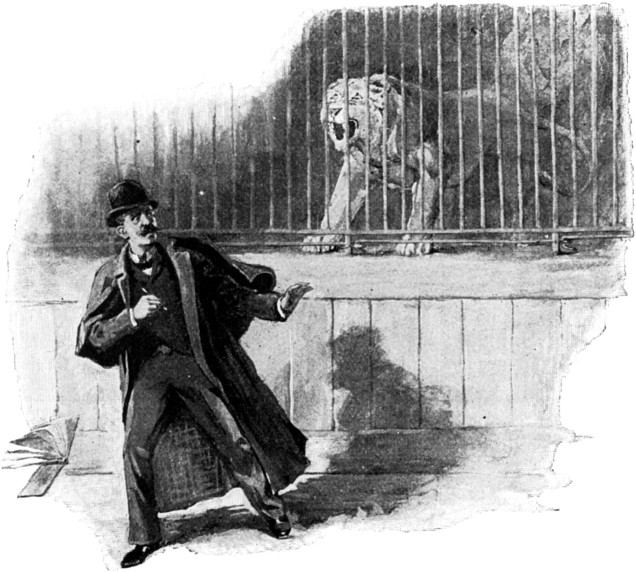
The greatest wild animal trader in the world is Karl Hagenbeck of Hamburg. To hear, therefore, how he captures and transports the brutes that compose his stock in trade, how he trains them, and some of the peculiarly strange adventures which have befallen him in dealing with them, cannot fail to be of interest. A few days ago I went to his Hamburg menagerie, where, on opening a door, I found myself in a great shed full of caged wild beasts. As visitors, except those on business, are not allowed within those notable precincts, my unexpected appearance excited the cages’ occupants to set up a grand concerto of roars and howls. Awestruck at the sight and sounds, I stood dazed until suddenly recalled to myself by a Nubian lion, who laid hold of my cloak-flaps with unsheathed claws. At once I leaped forward, while the beast retired snarling to the farthest corner of its cage, where in the dark shadows its eyes glared like two living coals. At this moment Mr. Hagenbeck came forward and gave me a hearty welcome, coupled with a word of warning against venturing too near the cages. He is a tall man, singularly pleasant looking, with keen eyes and a decisive manner. Later we sat in his office, and there I heard many incidents of the interesting life which he has led for so many years.
“My father,” said he, “who started in life as a fish dealer in this very town, never dreamed that he would one day be the founder of the greatest menagerie in the world. But it chanced that, in the year 1848, some fishermen, who usually traded with him, brought him some seals which they had caught in their sturgeon nets. They were fine animals, and he could not help being delighted with them, and straightway resolved to take them to Berlin. There he opened a small exhibition in Kroll’s Gardens, charging an admission fee. But there came a revolution; business was at a standstill, and he was glad enough to get rid of the seals for a small sum of money, and to return to his fish-dealer’s shop in Hamburg. But he was bitten with the wild-beast fever; live animals had more attractions for him than dead fish, and so he told the fishermen that he would always be ready to buy any queer animals they might choose to bring him. A short time after that a sailor from a whaling vessel brought him a polar bear; this he exhibited here in Hamburg. It was a great novelty, and the people flocked in crowds to see it. From that time forward, sailors from all parts of the world would bring him animals for sale—monkeys, parrots, deer, snakes, and so on; once a young lion. Gradually he got together quite a small menagerie, but I am bound to say that at first there was not much profit in the business. When I left school in 1859, at the age of fifteen, father asked me which of his two callings I would rather choose as mine. Of course, being a boy, I chose the wild beasts. He gave me a hundred and fifty pounds to spend as best I could in buying animals. Fortune favored me from the start. I made some capital bargains, increased the business rapidly, and in 1866 father handed the whole business over to me.”
HAGENBECK AND BARNUM.
At this moment my eye fell upon a large photograph of the celebrated Mr. P. T. Barnum, which hung upon the wall. Mr. Hagenbeck, noting the direction of my gaze, said: “I suppose you know who that is?”
I replied, “Why, it’s P. T. Barnum.”
“Exactly,” said he. “I was walking about the menagerie one day in 1872, when Mr. Barnum was announced. He said: ‘I’ve just come to have a look round. I’ve got an hour or two to spare, and I thought I might as well spend it here as anywhere else.’ Well, sir,” continued Mr. Hagenbeck, smiling at the recollection of his first momentous interview with the great showman, “he stayed fourteen days, and he filled two big note-books before he left me. He was delighted with all he saw, and still more so with all I told him. I spoke about ostrich riding, suggested that it would be a splendid thing if he got up a regular wild-beast hunt in his hippodrome. He was immensely taken with the idea, and wanted me to join him as partner, but this I was not able to do. For many years I supplied him with his animals.”
“Why,” I said, “Mr. Hagenbeck, that opened up quite a new field.”
“Exactly,” he replied. “The training of wild animals is now one of the most important parts of my business. I also undertake the establishment of menageries all over the world. I supply people with their buildings, with their animals, with their keepers, with their trainers. Take, for instance, the Zoölogical Gardens at Cincinnati. I filled them from top to bottom. I recently made one in Rio Janeiro.”
THE PRICES OF WILD ANIMALS.
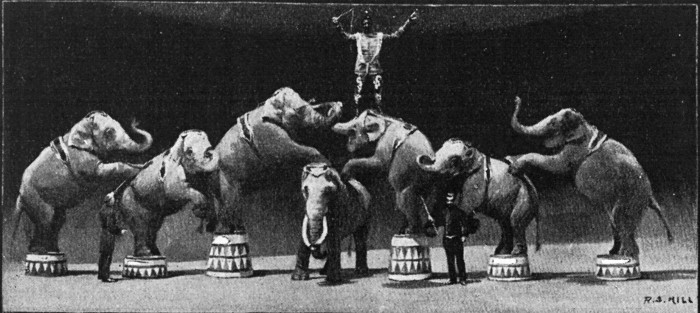
“And can you tell me anything about the prices of wild animals, Mr. Hagenbeck?” said I.
“Well,” he replied, “prices differ from time to time, according to the fashion; for I can assure you that there is as much fashion in wild animals as there is in ladies’ dresses. Prices are also rising and falling, according as the market supply is high or low. I can remember that once I sold in one day a cargo of African beasts for thirty thousand dollars. A full grown hippopotamus is now worth £1,000. A two-horned rhinoceros, which was worth £600 in 1883, cannot now be obtained at any price. An Indian tapir costs £500, an American tapir £150. Elephants vary according to size and training, from £250 to £500. A good forest-bred lion, full grown, will fetch from £150 to £200, according to species. Tigers run from £100 to £150, according to their variety. Do you know,” he continued, “that there are five varieties of royal tigers? And, besides them, there are the tigers which come from Java, Sumatra, Penang, and even from the wastes of Siberia, Snakes are very much down in the market at present. Those which formerly fetched £5 or £10, you can now get for £2. Very large ones sometimes run up to £50. Leopards £30. Black panthers £40 to £60. Striped and spotted panthers £25. Jaguars run from £30 to £100. A good polar bear will fetch from £30 to £40. Brown bears from £6 to 10£. Black American bears from £10 to £20. A sloth from Thibet £25 to £30. Monkeys run from six shillings apiece. They are most expensive in the spring, when they will sometimes fetch as much as £1 6s. Giraffes are altogether out of the market,” continued Mr. Hagenbeck with a sigh, “for there are none now to be obtained. I have sold one as low as £60, whilst the last one which I sold, four years ago, to the Brazils, I was paid upwards of £1,100 for.
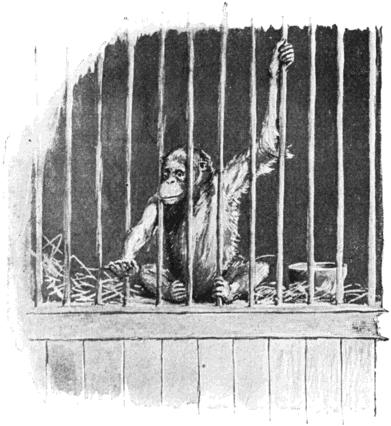
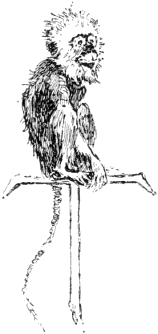
“And now you might just have a look round at some of the animals. Here,” said he, as we stood before a cage of very charming monkeys, “are some very clever little animals. They can ride horses in a circus, they jump through hoops; in fact, they are trained exactly like human beings, and can do almost everything but talk. I have just sent people to Abyssinia to fetch me some big silver-gray lion-monkeys, sometimes called hamadryads. I said just now,” continued Mr. Hagenbeck, with a laugh, “that monkeys can’t talk; and yet I must believe in Professor Garner, for you give me any monkey, you like to name, and I’ll guarantee I’ll make it talk. But you can only do it by imitating them closely. Take, for instance, that chimpanzee over there,” continued the clever trainer, pointing to a little animal fast asleep on a crossbar. “Now listen,” he went on, making a peculiar noise with his lips. At once the animal woke up, jabbered a reply in chimpanzee, flew to the bars of the cage, put his tiny paw out ready for the nuts which he knew were forthcoming. “There,” said Mr. Hagenbeck, “don’t tell me monkeys can’t talk.”
A little farther on we came across a tiny baby elephant, two feet nine inches in height. It was as black as coal, and had just arrived from Singapore. It was very playful, but when I began pushing it about, as one might roll a big beer barrel, it indulged in a fretful growling, which much amused us. Seven beautiful elephants stood in one big stable together, and as I admired their huge proportions and wondered at their entire gentleness, I said to Mr. Hagenbeck, “Is it true, as the great English circus proprietor George Sanger told me last summer, that the Asiatic elephant is far more intelligent than its African brother?”
“Certainly not,” replied Mr. Hagenbeck. “The African elephants are just as clever, just as gentle, just as intelligent as the Asiatic elephants. There’s no difference between them; and I ought to know, for I have had to do with them for thirty years, and in only one year I have imported as many as seventy-six of them.”
HOW WILD BEASTS ARE CAPTURED.
Karl Hagenbeck and I stood in his beautiful gardens, beside the enclosure in which the lions and tigers spend the long, hot summer days so frequent in Hamburg. Most artistically this enclosure has been made to resemble an African desert. In the foreground there are bushes and a few small palm trees, whilst in the far-off distance there rise, towering to a blue tropical sky, grim mountains and sun-stricken rocks. There is thus conveyed to the mind an impression of the great Nubian deserts—an impression whose force and reality is strengthened by the appearance of the wild beasts themselves, basking in the heat of the sun, or restlessly prowling about the enclosure.
“I should very much like to hear, Mr. Hagenbeck,” said I, “everything you can tell me of the way in which your wild beasts are captured.”
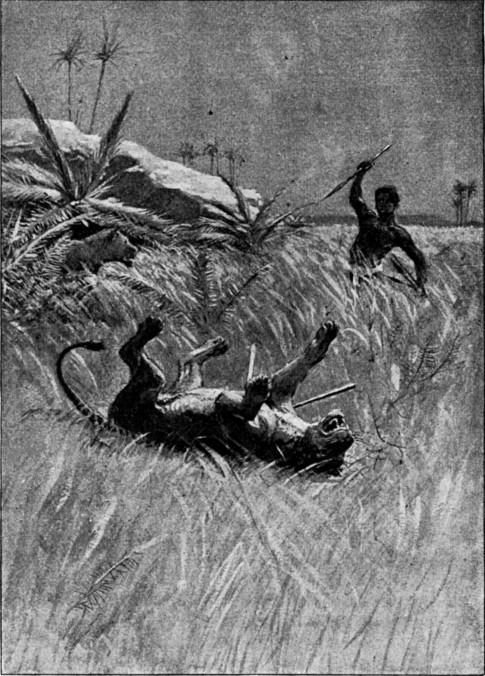
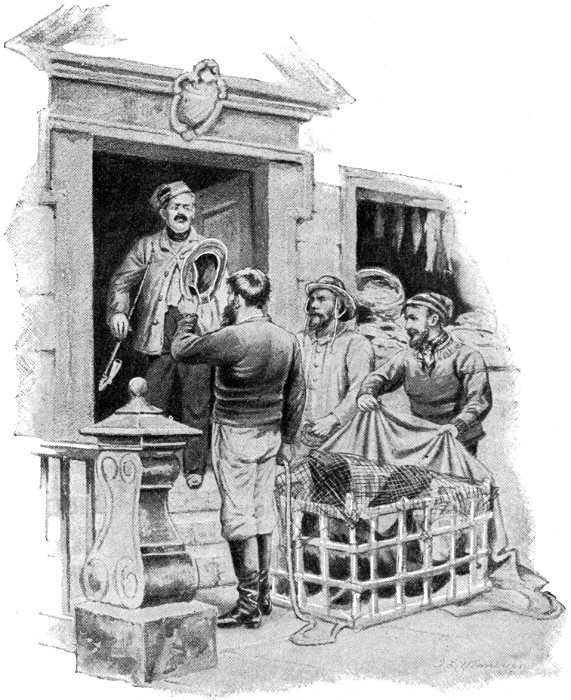
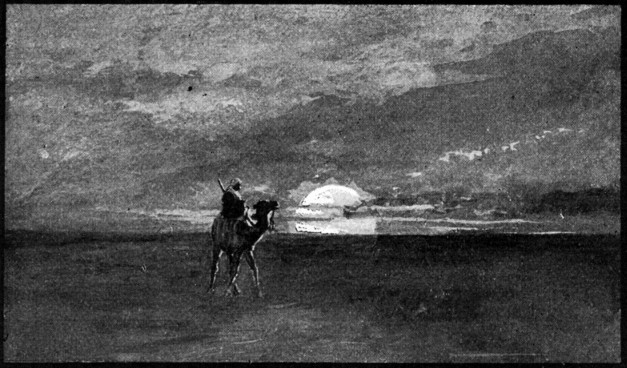
“Well,” he replied, “I will tell you as much as I can. Let us begin with the animals from the deserts of Nubia, for I have hunting parties all over the world. I send out a special messenger, who goes provided with a lot of silver coin. Nubians know my courier, who goes on ahead of this special messenger. When the courier reaches Suakim, it is announced that my messenger is coming, and a great fête is proclaimed. Guns are fired off, tom-toms are beaten, and for at least two days before he arrives there are the greatest rejoicings. Then the people go out to meet him, and conduct him with great state to a place on the borders of the desert where they have built a zereba. My messenger then gives advance money to the hunters, who go into Abyssinia to buy horses for the great hunt. As soon as the whole party is collected, business begins. They are armed with assegais and long hunting-swords like the old German swords. They are as broad as your hand, sharp at both ends, and two handled. Men upon fast horses hunt up the animals. Large animals, such as elephants and rhinoceroses, with sucklings, are the best game. The hunters, forming a circle, follow them. Having caught a rhinoceros with its young one, a man jumps down from his horse and cuts the old beast in a vein, whilst some of the other men chase another animal in front to distract attention. Then the black fellow lets go the big rhinoceros, catches the little one, ties its legs, and after it has calmed down brings it to my collector, who is waiting for him in the zereba. The old one is killed, skinned, and eaten. The natives make their best shields from the hide. Elephants and giraffes are hunted in the same manner. I have been describing to you chiefly the old method of hunting animals in Nubia. Of late years they generally use guns. The young animals are always brought up with goat’s milk.”
At this moment we were passing a large cage full of the finest lions I had ever seen. As soon as they caught sight of Mr. Hagenbeck, they began to purr loudly, and when he spoke, came up to the bars of the cage to be stroked and petted.
“There,” said my host, “these are some very beautiful lions from Nubia. You can see that they are in perfect condition, and this is chiefly owing to the fact that they are being trained for their performances. There is nothing that keeps them in good health so much as constant exercise; that, I think,” added Mr. Hagenbeck, with a laugh, “is a very good argument in favor of training wild beasts, and goes a long way to prove that there really is very little cruelty in it. Now, I’ll tell you how lions are caught in the Nubian desert. The Kauri negroes, when my messenger arrives, form parties to go in search of young lions. When they discover the spoor of a lioness, they creep about the bush until they find the animal’s lair. It is usually one man alone who does this, and he has only a bundle of assegais under his left arm. Before the lioness can spring upon him, she has these spears in her body. Look at this skin,” continued Mr. Hagenbeck, pointing to a magnificent tawny skin hanging up in the hall. “There,” said he, “that skin has no less than twenty-four holes in it. The poor mother made a brave fight for her young ones. Well,” continued Mr. Hagenbeck, “when the old lioness is killed he takes the young ones to the zereba. The little lions are suckled by goats three times a day, and get quite fond of their foster-mothers.
“Leopards and hyenas are caught in Nubia in traps which are made out of wood or cut out of stone in the mountains. These traps are baited with meat, and catch the big cats precisely as a mouse-trap catches a mouse. Once trapped, the hunters can tie the creature’s legs, and bear it in triumph to the zereba.”
“And how are the Asiatic animals caught?” I asked Mr. Hagenbeck.
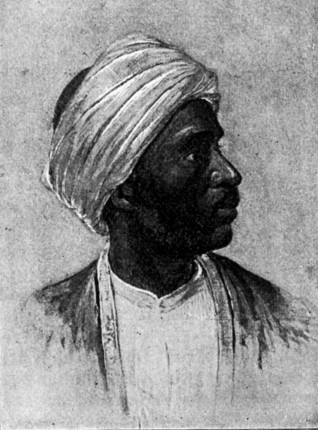
“Well,” he replied, “very much the same method is pursued there that we adopt in Africa. For instance, in Borneo and Java, animals are caught in trapfalls and pitfalls, and some in huge mouse-traps. In these we often catch full-grown tigers, black panthers, and leopards. In the pitfalls we find two horned rhinoceroses and saddlebacked tapirs. The animals, running through the forest, run over these pitfalls and drop in. The greater part of these unfortunately die directly after they are caught; some kill themselves in their excitement, others won’t feed, and so pine away. A rhinoceros or a tapir dies because it is often hurt internally, although we frequently do not discover that they have been hurt until they have been with us for one or two months. I can remember that I once imported seven big rhinoceroses, and I sold only one of them, as the other six died. Bengal tigers are caught young, brought up by the natives in much the same way as the young lions in Africa, on milk and fowls. Most of these come by way of Calcutta.”
Standing in front of a great glass cage full of snakes, I said to Mr. Hagenbeck: “Now, how do you manage to get hold of these reptiles? They must be very dangerous.”
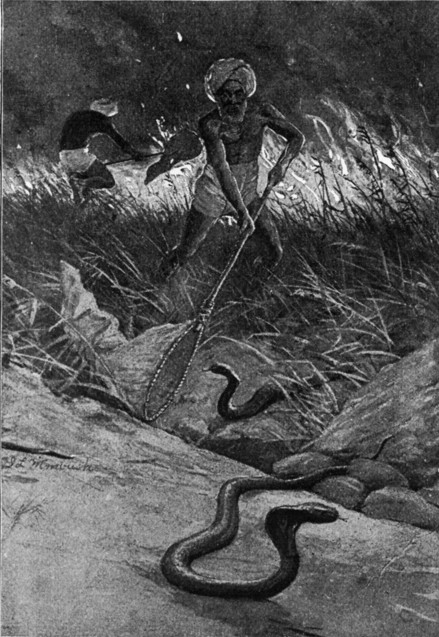
“Ah!” he replied, with a thoughtful look, “I’ll tell you later on one or two stories of dreadful adventures that I myself have had with snakes. In the meantime this is the way they are caught in India. In the dry season the jungle is set on fire. As the snakes run out in all directions, they are caught by the natives with long sticks having a hoop at the end, to which is attached a big bag, a sort of exaggerated butterfly net. After that the reptiles are packed in sacks made of matting, which are fastened to long bamboos, and carried to Calcutta on the shoulders of the natives. When Calcutta is reached, they are packed in big boxes, from twelve to sixteen in a box, that is when they are only eight or ten feet long; big snakes, from fourteen to sixteen feet in length, are only packed from two to three in a box. They are then sent direct to Europe without food or water on the journey, for they require neither. The principal thing is to keep them warm. Cold gives them mouth disease, which is certain death. I remember once,” continued Mr. Hagenbeck, “that I had one hundred and sixty-two snakes reach London in perfect condition; a violent snow-storm then came on, and when the boxes were opened in Hamburg every snake was dead.
“The majority of my Asiatic elephants come from Ceylon, although a few of them are exported from Burma. I remember one year there was a great demand in the American market for Asiatic elephants; Barnum and Forepaugh each wanted twelve. I couldn’t get enough from Burma, so sent direct to Ceylon, and got no less than sixty-seven elephants, all of which I disposed of in the next twelve months. Most of these were caught by noosing. This is done by Afghans who take out a license from the Ceylon Government. They go out with dogs, find a herd, follow it up, and drive the elephants into different flights; they then give their attention to the younger elephants. Each man has a long raw-hide rope with a noose in the end of it. He chases an elephant, throws the noose round its hind legs, and follows it until a tree is reached, round which the line is fastened. When the elephant drops down in despair, the rope is fastened round its other legs, and it is left for several days until calmed down; it is then taken and easily tamed. I can well remember,” said Mr. Hagenbeck, “how interested Prince Bismarck was when I told all about the capture of my elephants.
“I was sitting in my room one day, when a servant came in and told me that he believed that Prince Bismarck was in the menagerie. I went out, and as soon as I saw his tall, erect figure and white moustache, I knew it was the great man himself. I never came across so intelligent a man, or one who asked so many questions. I should think he must be something like your Gladstone.”
“And how did you first start buying animals on such a big scale, Mr. Hagenbeck?” said I.
“Well,” he replied, “it was in this way. In 1863 the first big lot of animals that ever appeared in Europe at one time were brought over by an Italian named Casanova. He couldn’t sell them, and we had not the money to buy them, so they were sold to a menagerie at Kreutzburg, then the biggest in Germany. Next year Casanova came over with a few from Egypt, which I bought for the Dresden Zoo. This was the beginning of the African business. I then gave Casanova a big order, and arranged that he should bring over elephants, giraffes, and young lions at a fixed price. It’s always cheaper,” added Mr. Hagenbeck, with a laugh, “to get your dinner at the table d’hôte than by the card, and I thought it would be cheaper and better to get all these animals in one lot. Well, in 1866 he returned with a large cargo, in which there were seven African elephants. At that time an African elephant was a great novelty, both in Europe and in America. I sold these elephants to America, where they excited great interest, as they were the first African elephants that had ever been seen in that country.” As we were going back to Mr. Hagenbeck’s office he pointed out to me some very beautiful zebu bulls which he was going to send out to South America to be used for agricultural and breeding purposes. “There,” said he, “you can see those animals nowhere else in Europe except in my place. I got them from Central India; I have been after them for ten years, and succeeded in getting them only two years ago.” Just then we passed a slaughter-yard, where a couple of horses were being cut up for the carnivorous animals.
“It must be a very difficult matter,” said I, “to know how to feed all these animals properly.”
“I should think it was,” he replied. “Animals are most dainty and delicate as regards their food. Now, for instance, those lions and tigers which were exhibiting at the Crystal Palace last year were fed on such bad food that they were quite ill when they came back here. Besides, a number of young animals were seized with what appeared to be cholera. I lost three thousand pounds’ worth of them in three weeks. It is a very anxious business, indeed, I can tell you.”
Note.—In the July number will be published an article on “The Training of Wild Animals,” which includes a description of a special performance given by Mr. Hagenbeck, at which Mr. Blathwayt, the writer of the articles, was the only spectator.