UNDER SENTENCE OF THE LAW. THE STORY OF A DOG. By Mrs. Robert Louis Stevenson.
Reading edition
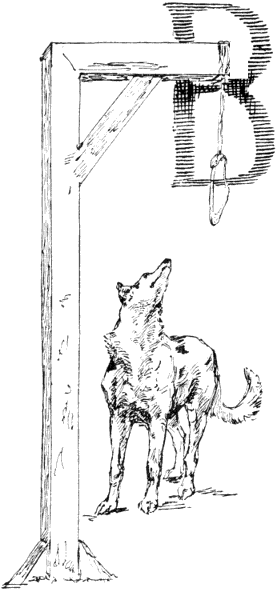
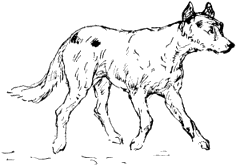
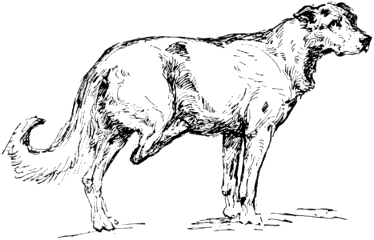
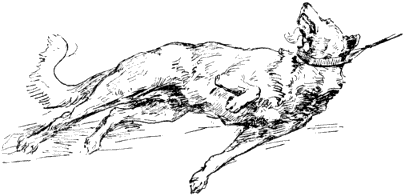
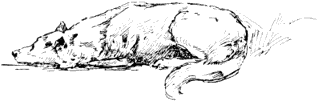
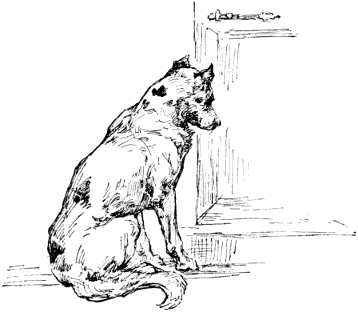
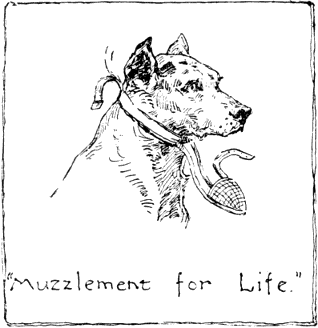
By mandate of law, Rick wore a muzzle, not often on his nose, but generally hanging under his chin. It was not because his present character was a vicious one that Rick was thus distinguished, but owing to an awkward circumstance in early life. For Rick had been tried in a court of law for the crime of murder, convicted, and sentenced to death. I believe Canton Grison is the only province in Switzerland where the law enforcing capital punishment has not been repealed; and in Canton Grison it applies to beasts as well as men.
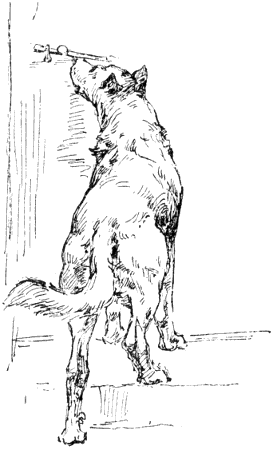
Rick first appeared, a starveling puppy with a large frame and weak, shambling legs, before the windows of a charitable Scotswoman, who was a lover of dogs and a person of sensibility. Rick, whatever his intellectual shortcomings, was a shrewd judge of human nature, and knew where to find a sure welcome. Naturally he soon discovered the hour for meals, and seldom failed to be on hand in good season. Once he found the glass door shut through which he was accustomed to enter. Spectators on the other side saw his discomfiture, but, before they could reach the door, Master Rick had lifted the latch and was walking triumphantly in. A later friend of his declared that, when he asked, “What has become of that enormous dish of meat?” Rick tipped him an arch wink and touched his corpulent stomach with a hind paw. Another instance of his supposed intelligence was his habit of accompanying intending customers to the confectioner’s shop, where he gorged himself at their expense. This indulgence in sweets, and his visits to adjacent villages, where he dined at the hotels à la carte, his bills to be sent to the Belvedere, induced early obesity, which was particularly observable in his great tail. I always thought the general belief in Rick’s mental capacity rested on insufficient grounds. I have lived too much with dogs not to know a dull fellow, though kindly, when I see him; but, as an individual, I loved Rick, and could not deny him a certain charm. The fact that one day Rick (who at that time belonged to a butcher) did not put in an appearance simultaneously with the ringing of the luncheon-bell caused the charitable Scotswoman misgivings. She should have known him better. Fortunately she happened to glance out of the window in the nick of time, for there was poor Rick, flat on his side, his head turned piteously towards the door of his friend, being dragged along the road at the tail of a terrible cart—the cart of a man who bought dead and living cats and dogs for the sake of their skins. A maid was hastily despatched to the rescue, and Rick was bought for the price of his hide. His trials were over (it was little he cared for the trial and sentence), for he was now adopted by the Hotel Belvedere.
Here he passed several uneventful, greedy years, until the day when the Belvedere was startled by the appearance of the officers of the law with an official document—a summons for Rick. How it was served I cannot imagine, but Rick was cited to appear, on a given date, at the Rathhaus, under the appellation of Tiger Hund. Tiger Hund was a fine, dashing name, but hardly applicable to Rick, who had more of the characteristics of the sheep than of the tiger. The two leading hotels, the Belvedere and the Bual, were shaken to their base by the threatened danger to Rick. Foreign counsel was appointed to plead his cause; I cannot now remember whether the chosen advocate was Herr Coester of the Belvedere, or Mr. J. Addington Symonds of the Bual. One, I know, appeared for Rick at the trial; while the other, after conviction, got up a petition for his pardon.
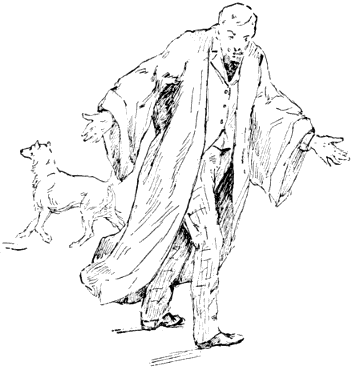
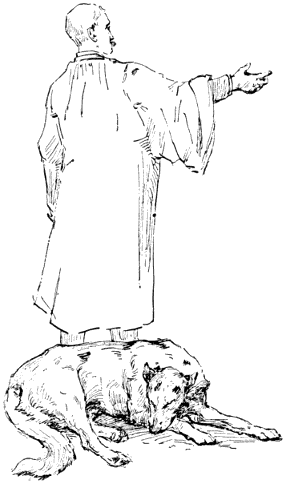
The eventful day arrived; the learned gentleman, honest Rick at his heels, took his way to the ancient Rathhaus, the gloomy aspect of whose exterior, with its narrow, barred, windowy and high-pitched roof under the eaves of which were many a row of wolves’ heads now dried into mummies, should have thrilled with apprehension the heart of the least imaginative dog. But Rick, poor innocent, trotted through the portals as he would have trotted into the confectioner’s, and curled himself up for a nap at the feet of his counsel.
His affection for the accused, and the sympathy of the large audience assembled to hear his pleading, inspired the learned gentleman with unwonted eloquence. The only creature unconcerned was Rick, who, having finished his nap, thought it a fitting occasion to make a little excursion into the next canton.
After a brilliant peroration in which he dilated on the fidelity of the accused, who, he asserted, never left the Hotel Belvedere except in company with some of the guests, Rick’s advocate wound up with these words: “Behold at my feet the Tiger Hund!” But, alas! Rick was not at his feet, nor could he be found in any of his usual haunts, though eager searchers beat the precincts for him. And so, through Rick’s own fault, his case was lost and his friends put to open shame. Sentence of death was passed in the absence of the culprit, and things for a time looked black for Rick. Strenuous efforts, however, were made to secure a pardon; and finally, after the presentation of a petition pleading for mercy, numerously signed by the foreign and native residents, the magistrate was induced to commute the sentence to muzzlement for life. I cannot myself believe that Rick had the courage to attack a sheep, even in company. I know that his first meeting with a donkey threw him into such fits of terror that his reason was despaired of for days.