PARABLES OF A PROVINCE.—I. THE NYMPH OF THE EDDY. By Gilbert Parker.
Reading edition
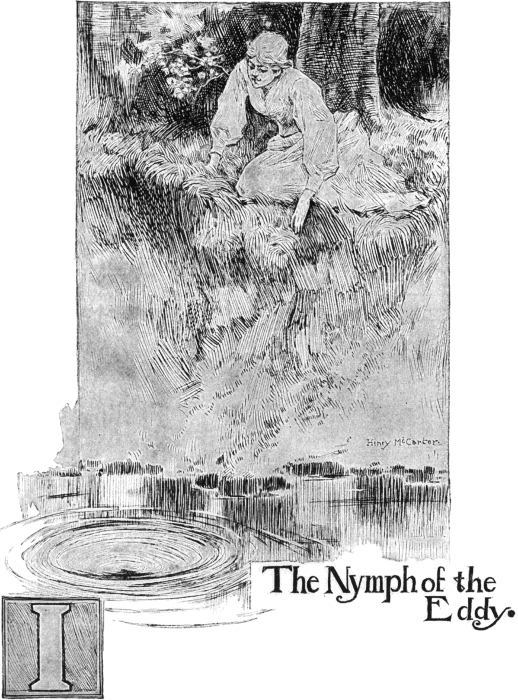
It lay in the sharp angle of a wooded shore near Pontiac. When the river was high it had all the temper of a maelstrom, but in the hot summer, when the logs had ceased to run, and the river wallowed idly away to the rapids, it was like a molten mirror which, with the regularity of a pulse, resolved itself into a funnel, as though somewhere beneath there was a blowhole. It had a look of hunger. Even the children noticed that, and they fed it with many things. What it passed into its rumbling bowels you never saw again. You threw a stick upon the shivering surface, and you saw it travel, first slowly, then very swiftly, round and round the sides, till the throat of the eddy seemed to open suddenly, and it ran straight down into darkness, and presently the funnel filled up again. It was shadowed by a huge cedar tree. If you came suddenly into the thicket above it, you were stilled with wonder. The place was different from all others on the river. It looked damp, it was so strangely green; the grass and trees showed so juicy; you fancied you could slice the fallen logs through with a penknife. Every sound there carried with a peculiar distinctness, yet the air was almost painfully still. Through the stillness there ran ever a sound, metallic, monotonous, pleasant—a clean cling-clung, cling-clung. It never varied, was the river high or low. If you lay down in the mossy grass you were lulled by that sing-song vibration, behind which you heard the low sucking breath of the eddy. The two sounds belonged to each other, and had a peculiar sympathy of tone. The birds never sang in the place, not because it was gloomy, maybe, but as though not to break in upon other rights.
There was nothing mysterious about that unceasing cling-clung, it was merely the ram of a force-pump. If you followed the pipe that led from the ram up the hill, you came to a large white house.
Many a summer day, and especially of a morning, a young girl came dancing down to the eddy, to sit beside it. She and it were very good friends; she used to tell it her secrets, and she made up a little song about it—a simple, almost foolish little song such as a clever young girl can write—Laure had been to the convent in Montreal, so she was not a common village maid.
“Green, so green, is the cedar tree, And green is the moss that’s under; Can you hear the things that he says to me? Do you like them? O Eddy, I wonder.”
It was very foolish. But she had such a soft, thrilling voice that you would have thought it beautiful. She was young—about sixteen—and her hair was so light that it fell about her like spray. But suddenly she ceased to be quite happy.
Armand, the avocat’s clerk, was a Protestant, and she had been meeting him at the eddy secretly. What did she care about the Catechism, or the curé, or an unblessed marriage, if Armand blessed her? She was afraid of nothing; she would dare anything while she was certain of him. But the curé discovered something—she ceased to go to confession, and, though he was a kind man, he had his duty to do.
There was trouble, and the ways of Laure’s people were devious and hard. It was said that she must go to the convent again, and they kept her prisoner in the house. One day they brought her a letter which, they said, was from Armand. It told her that he was going away, and that he had given her up. She had never seen his writing—they had trusted nothing to the village post-office—and she believed that the letter was from him. She had wept so much that tears were all done; her eyes only ached now. At first she thought that she would get away and go to him, and beg him not to give her up—what does a child know of pride all at once? But the pride came to her a little later, and she tried to think what she must do. While her thoughts went waving to and fro, and she could make nothing of them, she heard all the time the long, sighing breath of the eddy and the cling-clung of the force-pump. She never slept, and after a time it grew in her mind that she never would sleep till she went down to the cedar tree and the eddy; they seemed always calling her. She had said her Ave Marias over and over again, but they seemed to do her no good. Nothing could quiet her, not even the music of the twelfth mass, played on the little reed organ by the organist of St. Savior’s, when they took her to church against her will—a passive rebel. The next day she was to go to the convent again.
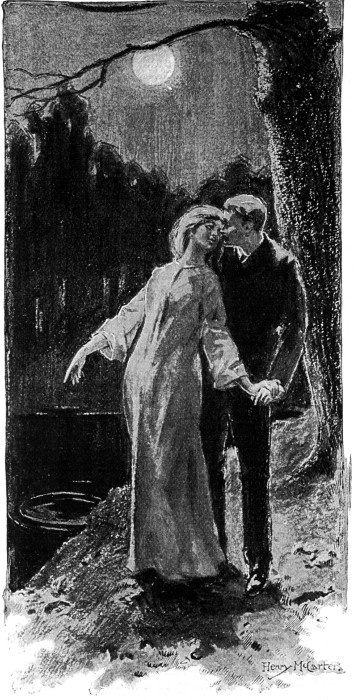
That night she stole from the house into the light of the soft harvest moon, and ran down through the garden, over the road, and into the cedar thicket. She did not hear behind her the footsteps of a man who, night after night, had watched the house, hoping that she would come out. She hastened to the cedar tree, and looked down into the eddy. From far up the river there came the plaintive cry of a loon; but she heard no other sound in the night, save this and the cling-clung of the ram muffled by fallen branches, and the loud-breathing eddy which invited—until an arm ran round her waist and held her fast.
A minute later he said: “You will come, then? And we shall be man and wife very quick.”
“Wait a minute,” she said, and she picked up handfuls of leaves and dropped them softly into the funnel of water.
“What’s that for?” he asked.
“I am a cock-robin,” she said with her old gayety. “There’s a girl drowned there. Yes, but it’s true. She was a good Catholic and unhappy. I’m a heretic now, and happy.”
But she said her Ave Marias again just the same; being happy, they did her more good. And she says that the eddy is spiteful to her now. It had counted on a different end to her wooing.