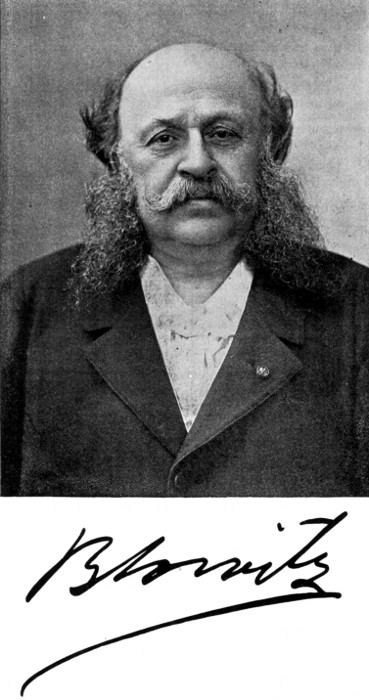
EUROPE AT THE PRESENT MOMENT. By Mr. De Blowitz, Paris Correspondent Of The “London Times.”
Reading edition
Paris, April 20, 1893.
Let me say, at the very start, that it is imperative not to forget the date which heads this article. This date has a significance of the highest importance, for it marks the opening of a new era. The political situation of Europe is to-day widely different from what it was only yesterday. Yesterday the entire world turned an eye feverishly intent towards Belgium, upon the spectacle there of the decisive struggle between an established government and an unestablished proletariat. There was to be seen in Belgium the constitutional authority of an entire realm, backed by the force of arms, opposed by a militant labor democracy. On the one side, law, authority, armed force; on the other, lack of authority, of capital, and of arms; in a word, vague nothingness struggling against omnipotence. Yet it is the former that has won the day. Omnipotence has belied its name, and has been driven to the wall; the defeat has been crushing. But more than this, it has been significant. I repeat, it marks the opening of a new era.
For the world-wide association of laborers now comprehends that it holds the Old World in its hands. It has discovered the invincible power of the strike, in obedience to the watchword emanating from its irresponsible leaders. Here is a force which is negative, perhaps, but one against which nothing henceforth can prevail. Lo, a silent word of command, and the towers of Jericho fall! Before a general strike of this sort the Old World is to-day powerless, like the child at the breast to whom the mother refuses to give suck.
This is a fact so big with suggestion, so sudden, so almost terrifying, that it changes all our former points of view. I could not have written yesterday what I can write to-day; for when I saw unexpectedly breaking out “the troubles in Belgium,” I could not but postpone till all was over the writing of the article for which I had been asked. No one has as yet fairly grappled with the meaning of the new social pact prepared in mystery, a pact of which the dark elaboration had been only suspected, but which has just become so startlingly revealed. The idea of the strike as applied to political problems upsets all preconceived notions. What has hitherto been regarded as the only real force is now as if paralyzed; instead, sheer, silent will-power remains the only sovereign. In such circumstances who would venture to draw the horoscope of the Europe of to-morrow?
For consider the situation. Recognized constitutional government has actually thought itself fortunate in treating with “strikers,” and in attempting to conceal the reality of its defeat behind the vain show of an arrangement, the actual significance of which deceives nobody. The face of Europe has changed in an instant. The Old World is conquered. Socialism bestirs itself, and begins its conquering march. The dangerous problems, hitherto so vague, become instantly pressing. Yet no one is ready with a solution, and few care even to discuss these problems. Even the leaders of the hostile army, the strike generals, do not, can not, measure all the consequences of their orders. Drunk with their new power they forget for the moment its unseen bearings. When first, more used to the sensation of omnipotence, they look about them to see what their action may have precipitated, they will draw back in horror.
The phrase, “the present situation of Europe,” therefore, can have reference now only to a very indefinite and a future thing. The present is big with uncertainties for the morrow, and the prospect would be really distressing, if the established wielders of power did not realize—what now is inevitable—the imperative necessity of coming to some understanding with this fresh force; the hopelessness, henceforward, of playing with theories of repression, and the duty of negotiating with this great amorphous army, which, once it is on the march, may drink dry the cisterns at which human society is accustomed to assuage its thirst. And it is in the light of these events in Belgium, that I do not hesitate to say, that Europe for a long time still will not be menaced by war. The social problem is now too pressing. It requires the entire attention. Woe to the blind! The hour of rest is past; a new world awakes. It knows its strength. It has everything to gain, nothing to lose. Follow it with anxious eye, ye who sleep now in possession, for if ye sleep too long, ye will awake in chains!
But apart from this event, which is the prelude of a social struggle to be of long duration, yet absolutely inevitable, it is possible at this moment, when the European world is preparing to turn westward beyond the Atlantic, there to entrust to the proud loyalty of the United States immense and untold treasures, to predict for this continent a prolonged peace—a peace, however, which is as the uncertain tranquillity of an old man heavily dozing on a bed where there is no real rest. It is alone one of those incidents, impossible to anticipate, which seize whole nations as with madness, driving them to arms and carnage, and leaving them at the end of the disillusion of the struggle stupefied with their victory, or terrified in their defeat, that can break the uncertain spell of this restless sleep. But incidents such as these, which bring to naught all human calculation, can, indeed must, be left out of account, when considering the character of a given moment, and the prospects of peace or war.
Europe, just now, is divided up rather arbitrarily, but none the less really. This is partly due to a premeditated combination, partly to chance, partly also to the bungling or ignorance of rulers. The Triple Alliance, due to the decisive action of Prince Bismarck, is the only truly scientific conception of the sort, the only one possessing a stable and seriously laid foundation. It includes Austria, which relies on Germany to shield it from Russia, as its directly menacing foe, or to bar against Russia the route to Constantinople whenever Russia shall appear fatally dangerous to the existence of the combined empire of Austria-Hungary. It includes Germany, which, as careful organizer of the Alliance, is thus protected against any possible simultaneous action of France and Russia. It includes Italy, which, otherwise weak in the presence of the disdainful hostility of France, is thus assured a certain security and repose. Aside from this great Triple Alliance, the European states have no real collective organization; there are only affinities badly defined, private interests, or uncertain situations from which they do not venture to think of extricating themselves. What is called the Franco-Russian understanding is limited at the moment to an exchange of notes which might serve as the basis of a military convention; to demonstrations at once noisy and platonic, in which France is playing a sort of Potiphar role; and to the chance eventuality of Russia’s one day finding herself engaged in some formidable struggle when she could count on the irresistible and unthinking enthusiasm of France, who would place blood and treasure at her disposal.
When has human history ever afforded such a spectacle?
No real alliance exists between Russia and France, but no French government could resist popular pressure, were the question to come up of helping Russia in the case of a war direct or indirect against Germany. Yet at a single gesture of the autocratic czar, Russia would shoulder arms and fight in whatever deadly combat France found itself involved. The Emperor of Russia is to-day, perhaps, the most formidable monarch who has ever existed. He has at his unchecked beck and call the vastest empire in Europe, but an empire without gold, sunlight, or liberty. Stop! It is a force, blind and brutal, and capable of a frightful impact; a force which the finger of a single man can set in motion, and which may be made to fall crushingly at the exact point designated by the imperious and imperial gesture. To this force which does not reason, the czar can, with a gleam of his sword, rally the power of France. France, the country of sunlight and liberty, where gold flows in rivulets, where every citizen thinks and wills, and where every soldier would fight to the death, conscious that it is only with Russia, in common struggle against common enemies, that a great conflict may be undertaken. The spectacle of such power, dormant in one human brain, is almost overwhelming; and the psychologist who portends that every man disposing of autocratic power, whether czar, sultan or pope, must inevitably go mad, utters a thought perhaps not so paradoxical after all.
However, this autocrat so formidably armed is well known to be absolutely pacific. He turns a constantly listening ear to the counsels of an experienced queen, herself full of the spirit of peace, the Queen of Denmark. This queen loves Germany; she adores the young emperor whom she calls “an angel.” She has already smoothed down many rough places. It was she who brought about the Kiel interview and the visit of the czarevitch to Berlin. She has strengthened the idea of peace in the brain of this emperor, whence, instead, war might spring full-armed; war fin de siècle; the new, mysterious, unprecedented form of it; the war of infinitely multiplied murder, covering the Old World with corpses of the slain. The special factor of armed explosion most to be dreaded in Europe is thus held in check by an all-powerful hand gently directed. It is nothing less than the work of God that has made him who holds the chief of the arsenals of power, pacific, and thus reassuring to the world.
Turn your vision from this tacit though vague understanding between France and Russia, and look beyond the regularly organized Triple Alliance; the eye falls on three great isolated powers, directed by various motives, and the action of which, determined upon only at the last moment, is constantly in the thought of the other ruling nations. Of these three the first is England. No minister of foreign affairs in any country would ever think of committing towards the English nation the crime of supposing its policy subservient to that of any other nation. The dream or the fear of a quadruple alliance has haunted only the crudest brains. England remains free in its movements, and it will preserve this liberty to the last. This is, moreover, for the happiness of all; for, except in those accesses of madness, a sort of factor of which, as I said, no account can be taken, no power will think of taking up a struggle in which the intervention of England, on one side or the other, can determine the issue.
The second great power which remains free of all entanglement is that which dominates the Bosphorus. A strange power, indeed! It has no friends. There it remains alone on this European soil, of which it occupies certain extreme points, like a bit of abandoned booty tempting the cupidity of the Christian world. The whole of Europe looks thither with dull hate, and each power would willingly bear away a bit of the trappings and the hangings that render soft and resplendent the gilded cage where lies the sick lion of Yildiz Kiosk. If ever the war which appears to me so distant breaks out, Abdul Hamid, or his successor, will have his hands free; and at the supreme moment when the conqueror, whomsoever he may be, cannot reject them, will impose his conditions. If the then sultan neglects to seize the event, it is not at all sure that the crescent will cease to mark its silhouette on the firmament of Europe; but at all events, until then European peace is the surest safeguard of the Ottoman Empire, and this Abdul Hamid well knows.
The third of the great isolated powers of which I speak is personified to-day by the grand old man whom an heroic pertinacity, henceforward to be traditional, keeps a prisoner at the Vatican. No one can have any idea of the life and movement which reigns in this voluntary prison which lies over against the Quirinal. Thither flow innumerable missives from every corner of the world, and could I only tell some of them, it would be seen how long still is the arm extending from the shadow of St. Peter’s; how dreadful still are the lips that speak in the shade of the Vatican. I should show the Holy Father and his cardinals writing to the Emperor of Austria, directing him by counsel and advice, and sometimes almost by their orders. I should show Prince Bismarck continuing, since his fall, to hold before the eyes of the pope, glimpses of the more or less partial restoration of the temporal power. I should show Leo XIII. now trying to unite, now to alienate, France and Russia, according as at the moment this or that policy seems to him most propitious for his own cause or the cause of peace; and I should show, at the same time, the Vatican divided within itself, and Cardinal Vauncelli working, in secret letters addressed to powerful sovereigns, against the policy of Cardinal Rampolla, and acting on the mind of Leo XIII. to detach him from his secretary of state, and wean him from the democratic policy on which he is now launched. I should show, also, all the leading politicians of France, whether in power or out, soliciting the support, the protection, the favor of Leo XIII., and the latter working with astounding insight for the fusion, more and more complete, of the liberal monarchical party with the Republic. I should show again how, owing to mysterious action, instability has become the normal state of France; and how the action of Russia, driven by the double current from the north and the south, not only has been not a source of strength for M. Ribot, but even forced him to his fall. Not only did the czar refuse to send the Russian fleet to France, and to let the czarevitch pass through Paris under pretext of going from Berlin to London, but he has just of late imposed on the French prime minister exigencies of such a nature that the latter has preferred to lay down the power rather than to submit. When M. Ribot, minister of foreign affairs, committed the political stupidity of carrying to the tribune the name of Baron Mohrenheim in connection with the Panama scandal, the Emperor of Russia showed that he was much irritated and wounded. M. Develle, minister of foreign affairs, hurried to the baron with excuses. But the czar declared these excuses unsatisfactory. M. Ribot then went himself to see the ambassador and give him certain explanations and excuses. Still the czar was not satisfied. He demanded a letter written by the prime minister and addressed to the Russian minister of foreign affairs, M. de Giers, who was then stopping at the gates of France. M. Ribot could not accept this demand. He had already endured the insult of M. Stambouloff during the affair of the Chadourne expulsion. He did not wish to leave behind him a letter of excuse addressed to M. de Giers. He preferred to fall, and he fell.
This is a fair instance of the hidden forces which sweep through the side-scenes of international European politics. In the preceding rapid summary of the present state of politics in the Old World, the conclusion must come irrefutably, and that is the ground of these remarks, that no war is in sight, nor will be for yet a long time. The Triple Alliance wishes, and necessarily wishes, peace. The young German emperor, from whom people have affected to anticipate some mad and irresponsible conduct, has no doubt uttered some imprudent words, but he has never committed any dangerous action. Really, his mouth seems a sort of safety-valve for the boiling steam within. So far he is satisfied with the conquests already secured. He is trying to bring back to him the Emperor of Russia. The meeting which he is now having with the pope is intended to bring about a formal rapprochement between the Quirinal and Vatican. Leo XIII., in turning his face towards the democracy, disquiets all thrones; but he disquiets especially the throne of Italy, since he is showing the Italians that the Papacy is not only not an enemy of republics, but that it might be the protector of future republics in Italy, if the Italian fatherland, dreaming of the former brilliant prosperity, tried to found a democratic federation, with the pope as the centre and beneficent father. But at the same time Leo XIII. will whisper peace in the ear of William II. The young emperor wishes for a long era of peace. The new military law, with its far-reaching bearings, proves this. Even to-day he would never think of undertaking a war which left Prince Bismarck out of account, and he will never undertake a war which might cause his return.
So, too, the Emperor of Austria, King of Hungary; he too is inclined to peace. He cannot risk a war. The bonds which link the different portions of the empire are too fragile to be exposed to the rude strain of armed strife. Italy, perhaps, by a fortunate war might be a gainer; but it is not strong enough to provoke one, or even to carry one on. It would regard the Papacy at the Vatican as too great a danger at its back; and, with little hope of conquering anything without its borders, it might legitimately fear to find Rome no longer intact on its return.
As for the Emperor of Russia, he is moderate at once in his love for France and his hatred of Germany. So far, a man of genius has been wanting to cement the bonds of alliance between France and Germany. There is already an understanding, vague, platonic, and with no morrow assured to it. The French Republic will recoil before the thought of war, so long as Russian action does not precipitate an explosion. The Republic knows that war would be at its peril; that vanquished it is submerged under floods of anarchy, that victorious it brings forth a Cæsar, and it wishes peace.
England, rich, industrial, devoted to its own internal problems, preserves an attitude which is an earnest of peace. So that, when one casts a steady glance over the Europe of the present hour, one is minded to say to the world about to repair to the great centre of industry, of letters, and of art, which Chicago is so soon to be: “Go in peace. War is distant. Gather in peace the fruit of your peaceful victories.”
Blowitz.