Volume 23 — CHAPTER XXV ACCOUNT OF THE MANDAN INDIANS
Hannibal Evans Lloyd translation
In communicating the information contained in the following chapters, in which I mean to treat especially of some tribes of the aborigines of North America, I shall take it for granted that the reader is acquainted with the interesting and important particulars which have been given us by Messrs. Edwin James, T. Say, and Schoolcraft. Dr. E. James speaks especially of the origin of the North American Indians, of their near affinity to each other; of the recently broached hypothesis of their descent from the Israelites, which he proves to be groundless, and which is contradicted by the bodily conformation of the Indians, and also of the injudicious and unjust treatment which they suffer from the Anglo-Americans. According to him many of the Indian nations would long since have been converted to the Christian religion, and have settled in fixed abodes, like the Cherokees, &c., if the earlier missionaries had better understood the work on which they were sent. It is notorious that this subject was treated, in early times, with the most unwarrantable want of discretion, and positive ignorance; that the greatest injustice was exercised towards the Indian population, and that, even now, wrongs untold are heaped on this much to be pitied and oppressed race. A large portion of those nations has entirely disappeared, and the accounts which have been preserved of them are extremely imperfect; others are expelled from their native seats, mixed together in small fragments of various tribes, half degenerated, and consequently now affording but little that can interest the inquirer. Such were the Indians whom Volney saw: only to the west and north-west of the Mississippi may the Indians be yet found in their original state. Before, however, I speak of them in general, I will describe more in detail a small tribe which has hitherto been very imperfectly known.
The Mandans (called by the Canadians, les Mandals),[207] by which name these Indians are generally known, though it was originally given them by the Sioux, were formerly a numerous people, who, according to the narrative of an aged man, lately deceased, inhabited thirteen, and {335} perhaps more villages.[208] They call themselves Numangkake (i. e., men), and if they wish to particularize their descent, they add the name of the village whence they came originally.[209] Some, for instance, call themselves Sipuske-Numangkake, the men of the pheasant or prairie hens, from the village Sipuska-Mihte, pheasant village; others, Mato-Numangkake, the men of the bear, from the village Mato-Mihte, bear village, &c. &c. Another general name of this people is Mahna-Narra, the sulky, because they separated from the rest of their nation, and went higher up the Missouri.
The early history of the Mandans is involved in obscurity; their own traditions and legends will be discussed in the sequel, when treating on their religious ideas. They affirm that they descend originally from the more eastern nations, near the sea-coast.[210] Though the above-named villages do not all exist at this time, these Indians still call themselves by their several names. They formerly dwelt near the Heart River:[211] when Charbonneau arrived here at the end of the last century, the two Mandan villages, which are still standing, were about six or eight miles further down the Missouri. The smallpox and the assaults of their enemies have so reduced this people, that the whole number now reside in two villages, in the vicinity of Fort Clarke. These two villages are Mih-Tutta-Hang-Kush (the southern village), about 300 paces above Fort Clarke, and on the same side of the river, and Ruhptare,[212] about three miles higher up, likewise on the same bank. The first had, at the time of our visit, sixty-five huts, and contained about 150 warriors; the other, thirty-eight huts and eighty-three warriors. According to this, the tribe had not more than 230 or 240 warriors; and, on the whole, scarcely 900 or 1000 souls; Dr. {336} Morse,[213] therefore, estimates the number of these people rather too high, when he states it at 1250 souls.
The Mandans are a vigorous, well-made race of people, rather above the middling stature, and very few of the men could be called short. The tallest man now living was Mahchsi-Karehde (the flying war eagle), who was five feet ten inches two lines, Paris measure (above six feet English). In general, however, they are not so tall as the Manitaries. Many of them are robust, broad-shouldered, and muscular, while others are slender and small limbed. Their physiognomy is, in general, the same as that of most of the Missouri Indians, but their noses are not so long and arched as those of the Sioux, nor have they such high cheek bones. The nose of the Mandans and Manitaries is not broad—sometimes aquiline, or slightly curved, and often quite straight. Their eyes are, in general, long and narrow, of a dark brown colour; the inner angle is often rather lower in childhood, but it is rarely so in maturer age. The mouth is broad, large, rather prominent, and the lower jaw broad and angular. No great difference occurs in the form of the skull: in general I did not find the facial angle smaller than in Europeans, yet there are some exceptions.[214] Their hair is long, thick, lank, and black, but seldom as jet and glossy as that of the Brazilians: that of children is often only dark brown, especially at the tips; and Bradbury speaks of brown hair among the Mandans. There are whole families among them, as well as among the Blackfeet, whose hair is grey, or black mixed with white, so that the whole head appears grey.[215] The families of Sih-Chida and Mato-Chiha are instances of this peculiarity. The latter chief was particularly remarkable in this respect: his hair grew in distinct locks of brown, black, silver grey, but mostly white, and his eyebrows perfectly white, which had a strange effect in a tall otherwise handsome man, between twenty and thirty years of age. They encourage the growth of their hair, and often lengthen it by artificial means. Their teeth, like those of all the Missouri Indians, are particularly fine, strong, firm, even, and as white as ivory. It is very seldom that you see a defect or a tooth {337} wanting even in old people, though, in the latter, they are often worn very short, which is chiefly to be attributed to their chewing hard, dry meat. The women are pretty robust and sometimes tall, but, for the most part, they are short and broad shouldered. They are but few who can be called handsome as Indians, but there are many tolerable and some pretty faces among them. It is usually said of the Mandan women that they, in some respects, have a natural conformation, such as Le Vaillant and Péron[216] ascribe to the Hottentot women; but it seems to be owing, in the Mandan women, less to nature than to artificial means.[217] The children have frequently slender limbs, and very prominent bellies. Deformed persons are very rare among the Mandans. I, however, saw a very little dwarf with a long, narrow face, and one man who squinted. Persons who had lost the sight of one eye, or with a cataract, are by no means uncommon. There were several deaf and dumb, among whom two brothers and a sister were all born with this defect. Some goîtres, or, rather, thick necks among the women, are, doubtless, caused by too great exertions in carrying burdens on their backs. Instances where joints of the fingers are wanting are frequent, but these come under the head of voluntary mutilations.
The colour of these Indians is a fine brown, sometimes reddish, more or less dark, which might, sometimes, come under the denomination of copper colour. In some it is more of a greyish-brown, in others yellowish; after a thorough ablution the skin of some of them appears almost white, and even some colour in their cheeks.[218] They do not disfigure their bodies, only they make some apertures in the outer rim of the ear, in which they hang strings of beads, brass or iron rings of different sizes, or shells, the last of which they obtain from other Indian tribes. If they are questioned respecting these shells, they answer that they were brought from the sea. These Indians are vain, and in this respect childish, like all savage nations. They are very fond of ornament, and the young men have always a little looking-glass suspended from their wrists. The traders sell these looking-glasses in a pasteboard case, which, however, is immediately changed for a solid wooden frame, and attached to the wrist by a red ribbon or a leather strap. The looking-glasses are framed in various ways; the rude frame is often painted red, or with stripes of different colours, with footsteps of bears or buffaloes carved on it. Nay, sometimes these {338} frames are of a considerable size, divided at one end like a boot-jack, and ornamented with brass nails, ribbons, pieces of skin and feathers.[219] Some had very ingeniously fastened this important appendage to their fan made of an eagle's wing. The Indian dandy is constantly consulting his mirror, and, if he has been travelling, especially in the high winds so prevalent here, he immediately has recourse to his looking-glass, and his disordered dress is most carefully arranged.
It is remarkable that the men are far more vain than the women, and the latter are obliged to be greatly inferior to the lords of the creation in their attire and adornments. The costume of the Mandans is rather simple: by far the greatest attention is paid to the head-dress. Their hair is parted transversely across the middle of the head, the front hair combed smoothly down, and generally divided into three flat bands, two of which hang down on the temples, and are generally plaited. To these plaits they attach the ornament already mentioned, which consists of two strips of leather or cloth closely embroidered with white or azure glass beads, and intertwined with brass wire, as represented in the portrait of Pehriska-Ruhpa.[220] If the ground of this ornament is red or blue, it is studded with white beads, and if the ground is white the beads are blue. They put this ornament in their hair and pull it over the temples; a long string is fastened to the underpart, which reaches to the waist, and is adorned with alternate rows of blue beads and white dentalium shells. Between these two singularly decorated plaits there is, in the centre of the forehead, a smooth flat lock reaching to the nose, which is not ornamented, but only tied with a red ribbon. The back hair falls smoothly from the crown of the head to the waist, and is divided into many tails, an inch and a half or two inches broad, which are smeared with brownish or red clay. When the hair is not naturally long enough it is frequently lengthened with other human hair, often that of enemies whom they have killed, which is fastened on with rosin. At the back of the head they sometimes wear a long stiff ornament in the shape of a ruler, three or four fingers broad, made of small sticks entwined with wire, which is fastened to the hair, and reaches down to the shoulders. It is covered with porcupine quills, dyed of various colours, in very neat patterns. At the upper end of this ornament an eagle's feather is affixed horizontally, the quill end of which is covered with red cloth, and the tip is ornamented with a bunch of horse-hair dyed yellow. The lower white half of the feather is frequently dyed red with vermilion, and the quill covered with dyed porcupine quills.[221] When the Indians are not in their best dress, when they are travelling, or going to the chase, they fasten their long hair in a thick bunch. {339} When, however, they are full dressed, they put a variety of feathers in their hair, frequently a semicircle of feathers of birds of prey, like radii, or sunbeams, or a bunch of tail feathers of the raven placed in a similar manner. Sometimes they have a thick tuft of owl's feathers, or small rosettes made of broad raven's feathers, cut short, in the centre of which is the tail of a bird of prey spread out like a fan. These feather ornaments are frequently determined according to the several bands or unions, of which I shall speak in the sequel. They likewise wear the large horned feather cap; this is a cap consisting of strips of white ermine, with pieces of red cloth hanging down behind as far as the calves of the legs, to which is attached an upright row of black and white eagle's feathers, beginning at the head and reaching to the whole length. Only distinguished warriors, who have performed many exploits, may wear this head-dress.[222]
If they give away one or more of these head-dresses, which they estimate very highly, they are immediately considered men of great importance; the regular price of such a cap is a good horse; for a single eagle's feather is always valued at one or two dollars. On their buffalo robes they often represent this feather cap, under the image of a sun. Very celebrated and eminent warriors, when most highly decorated, wear in their hair various pieces of wood, as signals of their wounds and heroic deeds. Thus Mato-Topé[223] had fastened transversely in his hair a wooden knife, painted red, and about the length of a hand, because he had killed a Chayenne chief with his knife; then six wooden sticks, painted red, blue, and yellow, with a brass nail at one end, indicating so many musket wounds which he had received. For an arrow wound he fastened in his hair the wing feather of a wild turkey; at the back of his head he wore a large bunch of owl's feathers, dyed yellow, with red tips, as the badge of the Meniss-Ochata (the dog band). The half of his face was painted red, and the other yellow; his body was painted reddish-brown, with narrow stripes, which were produced by taking off the colour with the tip of the finger wetted. On his arms, from the shoulder downwards, he had seventeen yellow stripes, which indicated his warlike deeds, and on his breast the figure of a hand, of a yellow colour, as a sign that he had captured some prisoners. A warrior so adorned takes more time for his toilette than the most elegant Parisian belle. The colour with which they paint their bodies is mixed with grease. When in mourning they colour the face and hands white. The women and children paint only their faces red, leaving the hair its natural colour. The Mandans and Manitaries, and all the Indians of the Upper Missouri, often wear the handsome necklace made of the claws of the grizzly bear. These claws are very large in the spring, frequently three inches long, and the points are tinged of a white colour, which is much esteemed; only the claws of the fore feet are used for necklaces, which are fastened to a strip of otter skin, lined with red cloth, and embroidered with glass beads, which hangs down the back like a long tail. Such a {340} necklace is seldom to be had for less than twelve dollars; and very often the owners of them will not part with them on any terms. The Mandans adorn themselves with many other kinds of necklaces, such as strings of glass beads, scented roots, or fungi, elks' teeth, for 100 or 150 of which they will, in exchange, give a horse, or something equivalent. These Indians generally wear no covering on the upper part of the body; the leather shirt of the Assiniboins, Sioux, Crows, Blackfeet, and other nations that live more to the north and north-west, are seldom used among them; yet a few individuals have obtained them from those Indians, either as presents, or by barter. Even in the midst of winter, the Mandans wear nothing on the upper part of the body, under their buffalo robe.[224] They paint their bodies of a reddish-brown colour, on some occasions with white clay; and frequently draw red or black figures on their arms. The face is, for the most part, painted all over with vermilion, or yellow, in which latter case the circumference of the eyes and the chin are red. There are, however, no set rules for painting, and it depends on the taste of the Indian dandy; yet, still, a general similarity is observed. The bands, in their dances, and also after battles, and when they have performed some exploit, follow the established rule. In ordinary festivals, and dances, and whenever they wish to look particularly fine, the young men paint themselves in every variety of way, and each endeavours to find out some new mode. Should he find another dandy painted just like himself, he immediately retires and makes a change in the pattern, which may happen three or four times during the festival. If they have performed an exploit, the entire face is painted jet black. Sometimes, though seldom, the Mandans adorn the wrist and upper arm with polished steel bracelets, which they obtain from the merchants; often they wear many brass rings on their fingers, and are, on the whole, excessively fond of ornaments and finery. The chief article of their dress is the ample buffalo robe, called mahita, or mih-sha, which is often very elaborate and valuable. In dry weather these buffalo robes are worn with the hair inwards, and in rainy weather with the hairy side outwards. They are tanned on the fleshy side, and painted either white or reddish-brown, and ornamented with a transverse band of blue or white glass beads, and three large rosettes of the same beads, often of very tasteful patterns, at regular intervals. The centre is frequently red, surrounded with sky blue, embroidered with white figures, or sometimes the reverse. The transverse band is worked with variously dyed porcupine quills, and is then narrower. This, however, is now old-fashioned, and was worn before the coloured glass beads were obtained in such numbers from the Whites. Other robes are painted with a reddish-brown ground, and black figures, especially of animals; others have a white ground, with representations of their heroic deeds in black, or in gay colours, with the wounds they received, the loss of blood, the killed, the prisoners, the arms they have taken, the horses stolen (the number of which is indicated by the number of horseshoes), in black, red, green, or yellow figures, executed in their yet rude style of painting. The {341} nations on the Missouri are all in the habit of painting such robes; but the Pawnees, Mandans, Manitaries, and Crows, are the most skilful in this art.[225] Another mode of painting their robes is, to represent the number of valuable presents they have made. By these presents, which are often of great value, they acquire reputation and respect among their countrymen. On such robes we observed long red figures, with a black circle at the termination, placed close to each other in transverse rows; they represent whips, indicating the number of horses given, because the whip belonging to the horse is always bestowed with the animal. Red or dark blue transverse figures indicate cloth or blankets given; parallel transverse stripes represent fire-arms, the outlines of which are pretty correctly drawn. The robe is frequently cut, at the bottom, into narrow strips, like fringe, and ornamented on the sides with tufts of human hair, and horse-hair dyed yellow and green, and with glass beads. Formerly the Indians painted these robes more carefully than they now do, and it was possible to obtain one for five musket balls and some powder; now they are far inferior, and eight or ten dollars is not unfrequently paid for them. A robe handsomely painted is equal in value to two not painted.
Their leggins are fastened with straps to their leathern girdles, and are embroidered at the outer seam with stripes, one or two inches in breadth, of porcupine quills, of beautiful various colours, and often with blue and white beads, and long leathern fringes, which form at the ankle a thick bunch, which trails upon the ground. The leather of which their leggins are made is, for the most part, stained of a reddish-brown, or pale red, usually with clay, sometimes white, and often marked below the knee with black transverse stripes. They, as well as all the tribes of North America, use what the English call a breechcloth (Nokka), which is a narrow strip of woollen cloth, striped black and white, which passes between the thighs under the girdle, before and behind, where it hangs down. Their shoes, which are made of buck skin, or buffalo leather, are generally plain, or very slightly ornamented; but, in full dress, they are embroidered with coloured rosettes, or strips of dyed porcupine quills or beads. Those men who have performed exploits wear, round the ankles, wolf's tail, or pieces of otter skin, which are lined with red cloth, and trail on the ground. In the summer, when the men are at home, and go about in state, they carry the fan of eagle's feathers in their hands, which we have before described. What the Anglo-Americans call "the crow," which is worn by the warriors of the nations of the Mississippi, and the Lower Missouri, is wholly unknown among the tribes of the Upper Missouri, the Sioux, Assiniboins, Crows, Mandans, Arikkaras, Manitaries, and Blackfeet.[226]
The boys are generally naked, and in winter merely have a robe thrown over them; the girls are dressed in leather in summer as well as winter. The women wear a long leather {342} garment, with open sleeves, and a girdle round the waist; the hem of this dress is often scolloped and fringed; they ornament the wrists with iron rings, and tie strings of glass beads round their necks, and sometimes in their ears. Their leggins, called, by the Canadians, mitasse, are short, reaching only from the ankle to the knee. Their shoes are simple, and without any ornament.
Tattooing is in use among these people, but by no means general. Most commonly only the left half of the breast and the corresponding arm are marked with black parallel stripes, and a few other figures. The lower arm and some of the fingers are occasionally marked; the men do not tattoo their faces, and they are far inferior in this art to the New Zealanders and other nations of the South Seas. Among the women such designs are sometimes seen, but not frequently, and they are chiefly among the women's band of the white buffalo cow. The point of the needle is dyed a dark blue with the bark of the willow soaked in water.
In Major Long's Travels to the Rocky Mountains it is stated that the Crows rub their bodies with castoreum, on account of its pleasant scent.[227] I must observe, however, that the custom is not confined to one nation, but is practised by the Mandans, Manitaries, Crows, and Blackfeet, and most of the other tribes of the Upper Missouri. They mix the castoreum with a red colour, and with it rub their face and frequently their hair.
Having obtained a clear idea of the outward appearance of these Indians, we will next consider their habitations, villages, and domestic life. Their villages are assemblages of clay huts, of greater or less extent, placed close to each other, without regard to order. Mih-Tutta-Hang-Kush, the largest of the Mandan villages, was about 150 or 200 paces in diameter, the second was much smaller. The circumference forms an irregular circle, and was anciently surrounded with strong posts, or palisades, which have, however, gradually disappeared as the natives used them for fuel in the cold winters. At four places, at nearly equal distances from each other, is a bastion built of clay, furnished with loop-holes, and lined both within and without with basket-work of willow branches. They form an angle, and are open towards the village; the earth is filled in between the basket-work; and it is said that these bulwarks, which are now in a {343} state of decay, were erected for the Indians by the Whites.[228] There is nothing of the kind at Ruhptare. The huts, as I have before remarked, stand close to each other, leaving, in the centre, an open circular space, about sixty paces in diameter, in the centre of which (among the Mandans) the ark of the first man is set up, of which we shall speak in the sequel. It is a small cylinder, open above, made of planks, about four or five feet high, fixed in the ground, and bound with climbing plants, or pliable boughs, to hold them together.[229]

Hand looking-glass
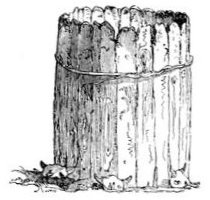
Cylinder of planks
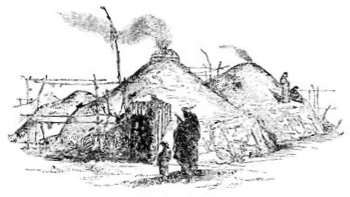
Mandan huts
At the north end of this circular space is the medicine lodge, in which festivals are celebrated, and certain customs practised, which are connected with the religious notions of this people, which we shall treat of in the sequel. At the top of a high pole, a figure is here placed, made of skins, with a wooden head, the face painted black, and wearing a fur cap and feathers, which is intended to represent the evil spirit, Ochkih-Hadda (corresponding with the devil), or a wicked man, as they affirm, who once appeared among them, had neither wife nor child, and vanished, and whom they now stand greatly in dread of. Other grotesque figures, made of skins and bundles of twigs, we saw hanging on high poles, most of them being offerings to the deity. Among the huts are many stages of several stories, supported by poles, on which they dry the maize. The huts themselves are of a circular form, slightly vaulted, having a sort of portico entrance. When the inmates are absent the entrance is shut up with twigs and thorns; and if they wish merely to close the door they put up a skin stretched out on a frame, which is shoved aside on entering. In the centre of the roof is a square opening for the smoke to find vent, over which is a circular sort of screen made of twigs, as a protection against the wind and rain, and which, when necessary, is covered with skins.[230]
The interior of the hut is spacious, tolerably light, and clean. Four strong pillars towards the middle, with several cross beams, support the roof. The inner circumference of the hut is formed by eleven or fifteen thick posts, four or five feet in height, between which other rather shorter ones are placed close to each other. On these shorter posts, which are all of an equal {344} height, are long rafters, inclining to the centre; they are placed near each other, and bear the roof. On the outside the huts are covered with a kind of mat, made of osiers, joined together with bark, and now the skeleton of the hut is finished. Over this hay is spread, and the outer covering is of earth. The men and women work together in erecting these huts, and the relations, neighbours, and friends, assist them in the work. The building of the huts, manufacturing of their arms, hunting, and wars, and part of the labours of the harvest, are the occupations of the men; every other kind of work is left to the women, who, though in general well treated, are obliged to perform all the really laborious work. The women fetch fuel, in heavy loads, frequently from great distances, carry water, and, in winter, blocks of ice into the huts, cook, tan the skins, make all the clothing, lay out the plantations, perform field labour, &c. &c. In the centre of the hut a circular place is dug for the fire, over which the kettle is suspended. This fire-place, or hearth, is often enclosed with a ledge of stones. The fuel is laid, in moderately thick pieces, on the external edge of the hearth, crossing each other in the middle, when it is kindled, and the pieces gradually pushed in as they burn away. The Indians are not fond of large fires. The inmates sit round it, on low seats, made of peeled osiers, covered with buffalo or bear skin. Round the inner circumference of the hut lie or hang the baggage, the furniture, and other property, in leather bags, the painted parchment travelling bags, and the harness of the horses; and on separate stages there are arms, sledges, and snow-shoes, while meat and maize, piled up, complete the motley assemblage.[231] The beds stand against the wall of the hut; they consist of a large square case, made of parchment or skins, with a square entrance, and are large enough to hold several persons, who lie very conveniently and warm on skins and blankets.[232]
In the winter huts they place, at the inside of the door, a high screen of willow boughs, covered with hides, which keeps off the draught of air from without, and especially protects the fire.
The summer huts are very cool, and, generally speaking, have no unpleasant smell. Mr. Say gives a very good description, and a tolerably accurate print, of a Konza lodge, or hut,[233] and, with {345} some slight differences, the mode of building resembles, in the main, those of the Mandans, Manitaries, and Arikkaras. Among these differences are the mats which are fastened all round in the first hut, and which I did not observe among the tribes that I visited. The beds, too, are arranged in a different manner. The Mandans and Manitaries are seen in their huts, sitting round the fire, employed in all kinds of domestic labour. The man has, generally, no clothing except the nokka, and is often merely smoking, but the women are never idle. In winter, that is, at the beginning or middle of November, these Indians remove, with the greater part of their effects, to the neighbouring forest, where their winter huts are situated. These consist of precisely similar huts, of rather smaller dimensions. Their departure from the summer huts is determined by the weather, but, as before-said, is generally about the middle of November; and their return, in the spring, is usually about the latter end of February, or the beginning of March, so that we may reckon that they may pass above eight months in their summer quarters. Inside of the winter huts is a particular compartment, where the horses are put in the evening, and fed with maize. In the daytime they are driven into the prairie, and feed in the bushes, on the bark of poplars. There are, probably, above 300 horses in the two Mandan villages; some of the people, indeed, do not possess any, while others, again, have several. The Mandans and Manitaries, like all the other Indians of this country, sometimes make what are here called caches, or hiding-places, in the vicinity of their villages. These caches are holes, or magazines, underground, often so artfully contrived that it is very difficult to discover them.[234] The Indians frequently go from their winter to their summer village, to fetch any articles they may happen to want, as they invariably leave part of their property behind. When they quit their huts for a longer period than usual, they load their dogs with the baggage, which is drawn in small sledges, made of a couple of thin, narrow boards, nine or ten feet in length, fastened together with leather straps, and with four cross-pieces, by way of giving them firmness. Leather straps are attached in front, and drawn either by men or dogs. The load is fastened to the sledge by straps.[235] When the snow is deep, they use snow-shoes,[236] which are described by Captain Franklin, only those of the Mandans are much smaller, about two feet and a half long; whereas in the north their length is from four to six feet. The Mandans and Manitaries have not, by any means, so many dogs as the Assiniboins, Crows, and Blackfeet. They are rarely of the true wolf's colour, but generally black, or white, or else spotted with black and white. Among the nations further to the north-west they more nearly resemble the wolf, but here they are more like the prairie wolf (Canis latrans).[237] We likewise found, among these animals, a brown race, descended from European pointers, hence the genuine bark of the dog is more frequently heard here, whereas among the western nations they only howl. The Indian dogs are worked very hard, have hard blows, and hard fare; in fact, they are treated just as this fine animal is treated among the Esquimaux.
{346} The Mandans are hospitable, and often invite their acquaintance to come and see them. Their pipes are made of the red-stone, or of black clay. They obtain the red pipe-heads chiefly from the Sioux; sometimes they have wooden heads lined with stone; the tube is plain, long, round or flat, on the whole, of the same shape as among the Sioux, but they are not so fastidious about ornamenting their pipes as other tribes. They smoke the leaves of the tobacco plant, which is cultivated by them; the bark of the red willow (Cornus sericea), which they obtain from the traders, is sometimes mixed with the tobacco, or the latter with the leaves of the bearberry (Arbutus uva ursi). The tobacco of the Whites, unmixed, is too strong for the Indians, because they draw the smoke into their lungs; hence they do not willingly smoke cigars.
The meals of the Mandans are served in wooden dishes. The spoons are generally large and deep; they are made of the horn of the bighorn;[238] sometimes they are yellow, or else they are shallow, made of black buffalo's horn. They have a considerable variety of dishes. The Indians residing in permanent villages have the advantage of the roving hunting tribes, in that they not only hunt, but derive their chief subsistence from their plantations, which afford them a degree of security against distress. It is true, these Indians sometimes suffer hunger when the buffalo herds keep at a great distance, and their crops fail; but the distress can never be so great among the Missouri Indians, as in the tribes that live further northwards. The plants which they cultivate are maize, beans, French beans, gourds, sunflowers, and tobacco (Nicotiana quadrivalvis), of which I brought home some seeds, which have flowered in several botanic gardens.
Of maize there are several varieties of colour, to which they give different names. The several varieties are:—1. White maize. 2. Yellow maize. 3. Red maize. 4. Spotted maize. 5. Black maize. 6. Sweet maize. 7. Very hard yellow maize. 8. White, or red-striped maize. 9. Very tender yellow maize.[239]
The beans are likewise of various sorts—small white beans, black, red, and spotted beans. The gourds are—yellow, black, striped, blue, long, and thick-shelled gourds.
The sunflower is a large helianthus, which seems perfectly to resemble that cultivated in our gardens. It is planted in rows between the maize. There are two or three varieties, with red, and black, and one with smaller seeds. Very nice cakes are made of these seeds. The tobacco {347} cultivated by the Mandans, Manitaries, and Arikkaras, attains a great height, and is suffered to grow up from the seeds, without having any care whatever bestowed upon it. It is not transplanted. When it is ripe the stalks are cut, dried, and powdered; or the leaves, with the small branches, are cut into little pieces. The taste and smell are disagreeable to an European, resembling camomile rather than tobacco. The plant is not now so much cultivated as formerly, being superseded by the more pleasant tobacco of the Whites; but the species is still preserved.[240] It is only on solemn occasions, for instance, in negotiations for peace, that this tobacco is still smoked; the seed is, therefore, preserved in the medicine bag of the nation, that the plant may never be lost. When they mean to smoke this tobacco, a small quantity of fat is rubbed on it.
The cultivation of the maize and other fields, of which each family prepares three, four, or five acres, takes place in the month of May. Rows of small furrows are made, into which the grains of maize are thrown singly, and covered with earth. Three times in the summer the plants are hoed, and the earth heaped up against them, that the moisture may have better access to them. The harvest takes place in October, when men, women, and children, each lend a helping hand. At present the women use, in their field labour, a broad iron hoe, with a crooked wooden handle, which they obtain from the merchants. Charbonneau recollected the time when they used the shoulder blade of the buffalo for this purpose. The fields are never fenced, but lie quite open and exposed.
The wild plants of the prairie are used by the Mandans, and other people of the Upper Missouri; and to those before-mentioned, I can only add the feverolles (Faba minor equina), a fruit resembling the bean, which is said to grow in the ground, but which I did not see; there are many other roots in the prairie, which are used for food. The gourds are eaten fresh as well as dry. The beans are seldom eaten of one kind, but many sorts are mixed together. The maize is boiled or roasted, then pounded, mixed with fat, and made up into small cakes and baked. There are, of course, many other ways of dressing it. The sweet maize has a very pleasant taste, especially when it is in what is called the milky state; it is then boiled, dried, and laid by for use.
All kinds of animals serve the Mandans for food; the bear, when it is young and fat, the wolf, the fox, in short, everything except the horse; the ermine is not eaten by many; and of birds they dislike the turkey-buzzard, and the raven, because they feed on the dead bodies deposited on the stages. They have a great aversion from serpents, but eat the turtle; the buffalo is the chief object of their chase, as it supplies them with skins, meat, tallow, marrow-bones, sinews, and many other necessaries. Next to the buffalo the beaver is the most indispensable to them, since it not only furnishes them with valuable skins, but supplies them with delicate food, the fat tail, especially, being considered quite a dainty morsel by the Indians. Pemmican,[241] {348} which is so favourite a dish among the northern Indians, is not much in use among the Mandans. Their only drink is water, for they are unacquainted with the method of preparing fermented liquors. They did not obtain any spirits, either from the American Fur Company, or the agents of Messrs. Soublette and Campbell; hence an intoxicated person is scarcely ever seen. They are extremely fond of sugar, and likewise of salt, which they procure from their lakes, and, if the supply is insufficient, purchase from the Whites. They are likewise fond of coffee and tea, well sweetened. It has been affirmed, that several North American nations, especially those which speak the Algonquin language, are cannibals, and more particularly the Chippeways and the Potawatomis; but I found no trace of this unnatural custom among the Missouri nations.[242]
Two, and sometimes three, families usually live together in an Indian hut, commonly the father, with his married sons or sons-in-law. Polygamy is everywhere practised, and the number of wives differs; however, they have very seldom more than four, and, in general, only one.[243] The women are very skilful in various kinds of work, particularly in dyeing and painting the buffalo robes. They extract a red colour from the roots of the savoyenne, or from buffalo berries; yellow from a lichen of the Rocky Mountains; black from helianthus, as well as from a black stone or clay; blue and green they extract from European substances. Among the Mandans, Manitaries, and Arikkaras, the women, as Lewis and Clarke relate, manufacture beads from coloured glass. They powder those which they have obtained from the traders, and mould them into different shapes.[244] This custom is, however, no longer common. The dyeing of the skins, of which many travellers have spoken, employs a great portion of the women's time. These three nations understand the manufacture of earthen pots and vessels, of various forms and sizes. The clay is of a dark slate colour, and burns a yellowish-red, very similar to what is seen in the burnt tops of the Missouri hills. This clay is mixed with flint or granite, reduced to powder by the action of fire. The workwoman forms the hollow inside of the vessel by means of a round stone which she holds in her hand, while she works and smooths the outside with a piece of poplar bark. When the pot is made, it is filled and surrounded with dry shavings, and then burnt, when it is ready for use. They know nothing of glazing.[245] With respect to their boats, the North Americans are far more expert than the Brazilians, Patagonians, and other South Americans, who live on the banks of rivers, and yet have contrived no means to pass them. The Chippeways and other northern nations have handsome vessels of birch bark; the Esquimaux makes his kiack, which is curiously covered with seal skin; and on the Missouri, especially among the Mandans, there are boats of buffalo skin, which are represented in the plates accompanying this work.[246] They are very light, of a circular form, stretched on a frame of several pieces of wood crossing each other, and may be carried on the shoulder of a single individual.
If a young Indian desires to marry, and has obtained the consent of the girl, he endeavours to procure that of her father; when he is certain of this, he brings two, three, nay, even eight or {349} ten horses, and fastens them to the hut of the young woman, who gives them to her father. The latter then takes other horses, and if he has them not himself, his relations assist him, and these horses are fastened, in return, to the hut of the intended son-in-law. In such a case an estimate is previously made of the number of horses possessed by the woman's relations, for all presents are returned in equal number. The bride next boils some maize, and daily carries a kettle or dish filled with it to the hut of the bridegroom. After some time has elapsed, the young man repairs to the hut of his bride, where he passes the night with her, and the marriage is considered as complete. The young couple often continue to reside in the hut of the father-in-law, but they more frequently build a new hut for themselves; sometimes, however, they afterwards separate. The father-in-law is, subsequently, the principal person in the hut; everything depends on him, and is done on his account, and for him; if game is killed, the flesh is first presented to him, &c.[247] There are often many children in these Indian families; some had as many as ten; yet, on the whole, the Indians have not so many children as the Whites, doubtless because they keep them longer at the breast. They are extremely fond of them, but the children are often weak and sickly, in consequence, it is supposed, of the hard labour which the women have to perform. I was universally assured that the new-born children are of a reddish colour. The births are, in general, extremely easy, and the mother bathes in the river immediately afterwards, even if it is frozen; in ten days the child is considered as safe, having got over the most dangerous period. A person is paid to give it the name chosen by the parents and relations. The child is held up, then turned to all sides of the heavens, in the direction of the course of the sun, and its name proclaimed. They have cradles for their infants, consisting of a leather bag, which is suspended by a strap to a cross beam in the hut. These cradles of the Mandans are not so elegant and beautifully worked as those which we saw among the Sioux and Assiniboins. The children of these Indians are subject to no kind of discipline whatever; they may do and say whatever they please, and nobody finds fault with them. Everything is done to excite a spirit of independence and self-will in the boys; if the mother speaks to one of them, he will very likely slap her face, or kick her, nay, sometimes he will do the same to his father, who says, coolly, bowing his head, this boy will one day become a famous warrior. The men sometimes treat their wives very brutally; and it has not unfrequently happened, that a woman, after such treatment, has left the hut and hanged herself on a tree. This lately happened in the case of an aged woman, whose grown-up son had ill-treated her. She was missed, and was afterwards found suspended from a tree. The women have nothing to indemnify them for their incessant and laborious work, not even good clothing, for this right of the fair sex in Europe is claimed among the Indians by the men. It is singular that these women, who are condemned constantly to work like slaves, refuse to do any work whatever if they marry a white man, and, the Whites being entirely in the power of the Indians, and the relations of their wives, they are obliged to submit to this. Sisters have great {350} privileges among these Indians. All the horses which a young man steals, or captures in war, belong to them. If an Indian returns from an expedition on horseback, and meets his sister, he will immediately alight, and give her the horse; on the other hand, if he wishes to possess some object of value belonging to his sister, for instance, a dress, he goes and abruptly demands it, and immediately receives it; even should it be the very dress she is wearing, she will take it off at once, and give it to her brother.
Prudery is not a virtue of the Indian women; they have often two, three, or more lovers: infidelity is not often punished. There was only one woman among the Mandans, a piece of whose nose was cut off, a circumstance which is very common among the Blackfeet. If an Indian elopes with a married woman, the husband whom she has abandoned avenges himself by seizing the seducer's property, his horses and other things of value, to which the latter must quietly submit. Such a woman is never taken back. If a man has the eldest daughter of a family for his wife, he has a right to all her sisters. A chief business of the young men among these Indian tribes is to try their fortune with the young maidens and the women, and this, together with their toilet, fills up the greater part of their time. They do not meet with many coy beauties.[248] In the evening, and generally till late at night, they roam about the villages, or in the vicinity, or from one village to the other. They have a singular mode of displaying their achievements in this field, especially when they visit the women in their best dresses. On these occasions they endeavour to gain credit by the variety of their triumphs, and mark the number of conquered beauties by bundles of peeled osier twigs, painted red at the tips. These sticks are of two kinds. Most of them are from two to three feet in length, others five or six feet. The latter, being carried singly, are painted with white and red rings alternately, which indicates the number of conquests. The shorter sticks are only painted red at the tips, and every stick indicates an exploit, the number of which is often bound up into a pretty large bundle. Thick fasces of this kind are carried about by the dandies in their gallant excursions. Among the Mandans these sticks are generally quite plain; among the Manitaries, on the contrary, there is, usually, in the middle of the bundle, one larger stick, at the end of which there is a tuft of black feathers. These feathers indicate the favourite, and the dandies tell everybody that she is the person for whom this honour is intended.[249]
If these people have had familiar intercourse with a person who wore the white buffalo robe, a piece of skin of that colour is fastened to the stick; if she wore a red blanket, or buffalo robe, a piece of red cloth is fastened to the stick. This custom, which is well known among the Mandans and Manitaries, has not, to my knowledge, been mentioned by any traveller.
They have distinct names for the several degrees of relationship. The father's brother is called father, and the mother's sister, mother; cousins are called brothers and sisters. The {351} mother-in-law never speaks to her son-in-law; but if he comes home, and brings her the scalp of a slain enemy, and his gun, she is at liberty, from that moment, to converse with him.[250] This custom is found among the Manitaries, who have, doubtless, borrowed it from the Mandans, but not among the Crows and Arikkaras. Among the Chippeways, and the Algonquins in general, the name must not be changed; and persons with the same name must not marry, but consider each other as brothers and sisters. Among all the North American Indian nations there are men dressed and treated like women, called by the Canadians, Bardaches, of whom Mc Kenzie, Tanner, Langsdorff, and others, have spoken;[251] but there was only one such among the Mandans, and two or three among the Manitaries.
Volney, and some other writers, have spoken rather too unfavourably of the moral character of the aborigines of North America, and their domestic habits. According to them, distrust and hostile feeling prevail among them, for which reason they never leave their huts unarmed; but I can bear witness that they are frequently seen in their villages, as well as in the environs, without arms, and that it is only at greater distances, and when they appear in state, that they carry their weapons in their hands. I have never observed any disputes among them, but, on the contrary, much more unity and tranquillity than in civilized Europe. It has often been asserted that the Indians are inferior in intellectual capacity to the Whites; but this has been now sufficiently refuted; and Harlan is not wrong in saying that, among the races of men, of which Blumenbach reckons five,[252] the American should be ranked immediately after the Caucasian. If man, in all his varieties, has not received from the Creator equally perfect faculties, I am, at least, convinced that, in this respect, the Americans are not inferior to the Whites. Many of the Mandans manifest a great thirst for knowledge, and many desire to hear something of objects of a higher order; and if they were not so much attached to the prejudices inherited from their ancestors, many of them might be very easily instructed. The bad examples which they so often observe in the white men, who roam about their country in quest of gain, are not calculated to inspire them with much respect for our race, or to improve their morality. And if they have not been found inclined to the Christian religion, this is, certainly, in some measure, the consequence of the bad conduct of the Whites, who call themselves Christians, and are often worse, and more immoral, than the most uncivilized of the Indians. Many American and foreign works have taken notice of the striking good sense and wit, the correct judgment of the Indians, in all the occurrences of daily life, and it would be mere repetition here to quote examples. One is often at a loss to answer their questions, founded on correct and natural judgment. The inactive mode of life natural to the Indians, which disdains all laborious exertion, is a great obstacle to their adopting a different system. But they are not deficient in talent for drawing, music, &c., and this is quite manifest at first sight. Several Mandans not only took much pleasure in drawing, but had a decided talent for it. The hieroglyphics are well known, which the Indians employ {352} instead of writing; for instance, the figures on their robes, the drawing of Mato-Topé, and the subjoined Indian letter from a Mandan to a fur trader.[253]
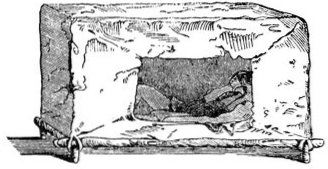
Mandan bed
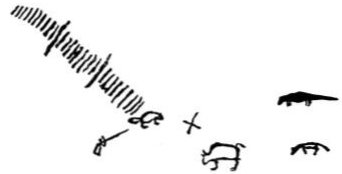
A Mandan letter, in hieroglyphics
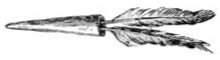
Child's dart, of stag-horn
The following is the explanation of the hieroglyphic figures contained in it:
The cross signifies, "I will barter, or trade." Three animals are drawn on the right hand of the cross: one is a buffalo; the two others, a weasel (Mustela Canadensis), and an otter. The writer offers, in exchange for the skins of these animals (probably meaning that of a white buffalo), the articles which he has drawn on the left side of the cross.
He has, in the first place, depicted a beaver very plainly, behind which there is a gun; to the left of the beaver are thirty strokes, each ten separated by a longer line; this means, I will give thirty beaver skins and a gun for the skins of the three animals on the right hand of the cross.
Many of them dispute, with great earnestness, on more elevated subjects; thus, they inquired our ideas of the various heavenly bodies, and of the origin of the universe, as they, themselves, declare their own silly traditions to be insufficient. Some, indeed, thought our ideas on these subjects much more silly than their own. They laughed outright, when we affirmed that the earth was round, and revolved about the sun. Others, however, would not reject our views, and were of opinion that, as the Whites could do so much which was incomprehensible to them, it was possible they might be right on this point also.
In all works that treat of these remarkable people, we find recorded very energetic and well-digested speeches of their chiefs. They frequently use very appropriate figures, and often said bitter truths to their white oppressors. Dr. Morse quotes some such phrases, used at the conclusion of treaties of peace, or declarations of war, which express much in a few words. Thus, in declarations of war: "The blood of our wives and children smokes on the ground! The bones of our warriors and old men are uncovered, and whiten the earth! The tomahawk is raised!" And on the conclusion of peace: "The bones of our warriors are buried! the tomahawk is buried! the blood of our women and children is covered! The path which leads to them must be kept clean; no weeds may grow there. The chain which binds us together must not become rusty." {353} Or, on the contrary: "The chain begins to rust," &c. &c. Though these people often manifest great energy of character, many have committed suicide on account of disappointments in love, or of wounded honour, of which Dr. Morse relates a remarkable instance, where an Indian killed himself because he was reproached with cowardice, after his mother had suffered death for him. Many travellers speak of the extraordinary memory of the Indians; several of them relate the entire history of their people in a continuous narrative.
The Mandans and Manitaries are proud, and have a high sense of honour. If a person expresses a wish to possess some article belonging to them, he generally receives it as a present, but a present of equal, or greater value, is always looked for in return. They estimate all their effects at a very high rate, ascribing to them an imaginary and far too great value; and a trifling thing is often paid for with one or two horses. Among the articles of great value is the skin of a white buffalo cow. Fifteen florins are paid for a small ermine skin; whereas, a wolf's skin may be purchased for a small quantity of tobacco. One or two horses are frequently given for a feather cap; a horse for 100 or 150 elks' teeth, or for a handful of dentalium shells.[254] The men are much given to indolence, when they cannot pursue their chief avocations, hunting and war. In general, the Mandans and Manitaries are not dangerous, and, though there are many rude and savage men among them, they are, on the whole, well-disposed towards the Whites: the former, especially, manifest this, and have many good and trustworthy men among them. Some of them are addicted to thieving, especially the women and children; and it is said, that many of the Manitaries, when they meet the Whites in the prairie, though they do not kill them, as they used to do, generally plunder them.
They have always free access to the forts of the trading companies; and, as at Fort Clarke, there was no separate apartment for the Indians, we were molested by them, during the whole day, in every room; nay, they often took the place of the owners, which, during the severe cold in the winter time, was quite intolerable, as they stood in front of the fire, with their large buffalo robes, and kept the warmth from coming into the apartment. They require to be always regaled, which is generally done, and it was estimated that in one year they smoked 200 lbs. of tobacco at the expense of the Company. A few among them, indeed, manifested a much greater delicacy of feeling than the mass of them, and left the dining-room when the dinner-hour approached; but only a very small proportion possessed this correct sense of propriety, for the others generally came just at our dinner time; it is true they had but little meat in the winter season, and fared but badly. Disputes and quarrels are very rare among them; but duels are frequent; and revenge for blood is still exercised.
Many of them are particularly cleanly in their persons, and bathe daily, both in winter and summer; their hands, however, are often smeared with colours and fat, nay, sometimes the whole body is bedaubed. The women are, in general, less cleanly, particularly their hands, {354} which arises from their continual and severe labour. They generally let their nails grow long.
The rude inhabitants of the prairies are extremely agile and hardy; they bathe, in the depth of winter, in the half frozen rivers, and wear no covering on the upper part of their body under the buffalo robe; they are very expert swimmers, even when quite young. I have already observed that all these nations swim in the same manner as the Brazilian Tapuyas, which is confirmed by other writers. They often practise riding on horseback without a saddle, and very swift horse-racing.[255] They are capital marksmen with the bow; all their senses are remarkably acute.
Among the Mandans, and all the nations of the Upper Missouri, as well as among most of the North American tribes, there are certain bands or unions or companies, which are distinguished from the others, and kept together by certain external badges and laws.[256] They have three kinds of war or signal pipes, which are hung round the neck, and are among the badges of the unions, which divide the men into six classes, according to their age. The first band or union is composed of "the foolish dogs," or "the dogs whose name is not known." They are young people from ten to fifteen years of age, and wear a pipe made of the wing bone of the wild goose, which is but small. When they dance, three of them have a long broad piece of red cloth hanging from the back of the neck to the ground. Like every distinct class they have a particular song to accompany their dance. Formerly old people likewise belonged to this band, but then they never dared to retreat before the enemy; this has since been changed to the present limited rule. If a boy desires to enter the first band in order to become a man, he goes to a member of it, addresses him by the appellation of father, and endeavours to purchase the rank, the dance, the song, and the war pipe belonging to it, for certain articles of value, such as blankets, cloth, horses, powder, ball, and the like, which the father pays for him. If this place is sold to him he has a right to all the distinctions and privileges of the band, and he who sold it thereby renounces all claim to it, and endeavours to purchase admission to a higher band. The dances of the several classes are in the main very similar, but there is a particular song belonging to each, and sometimes even a different step. The drum and schischikué must likewise be purchased at the same time. The latter, among this band, is spherical, with a handle, and is made of leather.
The second class or band is that of the crows or ravens; it consists of young men from twenty to twenty-five years of age. Frequently young people are in none of the bands for half a year or more. They then go to the band of the crows, and say, "Father, I am poor, but I wish to purchase from you." If the possessor agrees, they then receive the raven's feathers, which the band wear on their heads, a double war-pipe, consisting of two wing bones of a goose joined together, a drum, schischikué, the song and the dance. Each of these bands has a leader, called, {355} by the Americans, head-man, who decides on the sale of its rights and attributes. This head-man is chiefly applied to when any one wishes for admission; a festival then takes place in the medicine lodge, which is continued for forty successive nights, of which I shall speak in the sequel.[257] They dance, eat, and smoke there; the purchasers defray the expenses, and give up their wives every night to the sellers, till the fathers, as they are called, are satisfied, and transfer their rights to the purchasers, with which the festival concludes.
The third class or band is that of the soldiers, the most eminent and esteemed warriors. In their dances they paint the upper part of the face red, and the lower part black. Their war pipe is large, and made of the wing bone of a crane. Their badges are two long straight sticks bound with otter skin, to which owl's feathers are appended. When they go to war, they plant these sticks in the ground in front of the enemy, and, this done, they dare not leave them, not unlike the colours in a European army. They have a similar stick ornamented with raven's feathers.[258] They likewise have a dance and song peculiar to their band, and must purchase their admission into higher classes. Their schischikué or rattle is made of iron plate, in the form of a small kettle, with a handle. They likewise possess two tobacco pipes, which are used for smoking on special occasions. Two men keep and carry with them these pipes. All the higher classes may, at the same time, belong to the band of the soldiers, who act as police officers; it is, however, understood that all the members must be satisfied with the purchase. If but one object to the sale, the bargain cannot be concluded. It often happens that some individuals do not immediately give their consent, in order to raise the price and sell to more advantage afterwards. These soldiers, as they are called, form a kind of committee, which decides all the principal affairs, particularly general undertakings, such as changes of their places of abode, buffalo hunting, and the like. If the buffalo herds are in the vicinity, they watch them, and do not suffer them to be disturbed by individuals, till a general chase can be undertaken.
If, during this time, any one fires at a wolf or other animal, the soldiers take away his gun, ill-use, and sometimes beat him, to which he must submit; even the chiefs are not spared on these occasions. The Whites living in the neighbourhood are subject, during such a time, to the same laws, and the soldiers have often taken their hatchets from the woodcutters of the fort, or forbidden them to cut wood, that the buffaloes might not be disturbed by the noise.
The fourth band, that of the dogs, wear in their dance a large cap of coloured cloth, to which a great number of raven's, magpie's, and owl's feathers is fastened, adorned with dyed horse-hair and strips of ermine; they have a large war pipe of the wing bone of a swan. Three of them have the same strips of red cloth hanging down the back, as have been mentioned, when speaking of the first band. The head is generally adorned with a thick tuft of owl's, magpie's, and raven's feathers hanging down behind, and often all the three kinds of feathers are mixed together. {356} The three men before-mentioned, who wear the strips of red cloth (the dogs, properly so called), are obliged, if any one throws a piece of meat into the ashes, or on the ground, saying, "There, dog, eat," to fall upon it, and devour it raw, like dogs or beasts of prey. The schischikué of this band is a stick, a foot or a foot and a half long to which a number of animals' hoofs are fastened. The costume of these three dogs is shown in the portrait of Pehriska-Ruhpa.[259]
The fifth band is that of the buffaloes. In their dance they wear the skin of the upper part of the head, the mane of the buffalo, with its horns, on their heads; but two select individuals, the bravest of all, who thenceforward never dare to fly from the enemy, wear a perfect imitation of the buffalo's head, with the horns, which they set on their heads,[260] and in which there are holes left for the eyes, which are surrounded with an iron or tin ring. This band alone has a wooden war pipe, and in their union they have a woman, who, during the dance, goes round with a dish of water, to refresh the dancers, but she must give this water only to the bravest, who wear the whole buffalo's head. She is dressed, on these occasions, in a handsome new robe of bighorn leather, and colours her face with vermilion. The men have a piece of red cloth fastened behind, and a figure representing a buffalo's tail; they also carry their arms in their hands. The men with the buffaloes' heads always keep in the dance at the outside of the group, imitate all the motions and the voice of this animal, as it timidly and cautiously retreats, looking around in all directions, &c.[261]
The sixth band is that of the black-tailed deer. It consists of all the men above fifty years of age, who, however, likewise dance. Two women belong to the band, who wait on them at the dance, cook, carry water round to refresh them, and the like. All the men of this band wear a garland of the claws of the grizzly bear round their heads, and all insignia of their warlike exploits about their bodies, such as feathers on their heads, tufts of hair on their arms and legs, scalps, painting, &c.[262]
All these bands, as well as the following dances, are bought and sold, and, as has been already observed, on these occasions, the buyer must give up his wife to the seller during the festivity. But if a young man is still unmarried, he will sometimes travel to a great distance to another village, to ask a friend or companion for his wife, who accordingly goes with him, and, on the evenings of the dance, gives up his wives for him. A man often brings three or four, and even more, wives, and gives them to his father, as he is called, as soon as the dancing, eating, smoking, and the relating of their exploits, are concluded. Thus one woman after the other comes, as will be described in the account of the buffalo medicines of the Manitaries, strikes, with her hand, the arm of the man whom she will favour, and goes to the entrance of the tent, where she waits till he follows her. The man so invited often keeps his seat, and bows down his head; the woman then goes home, brings articles of value, such as guns, robes, blankets, &c., which she lays, piece by piece, before him, till he is satisfied, stands up, and follows her.
{357} There are other dances which are bought and sold, among which are a second dance of the third band, and the dance of the half-shorn heads, which the lower class may buy before they are old enough to belong to the third band.
The medicine feast, the insignia, and the dance belonging to the half-shorn heads, will be described in the sequel. Another dance is that of the old dogs. The band of the dogs can buy it of the buffaloes before they can become buffaloes, or purchase their admission to the fifth band. In the dance of the old dogs they paint themselves white, the hands red and black, and wear a girdle of the skin of the grizzly bear, and a bunch of feathers hanging down at the back of the head.
What is called the hot dance is now danced at Ruhptare, and by the Manitaries, who bought it from the Arikkaras. It is executed by the little dogs, whose name is not known. A large fire is kindled on the occasion, and a quantity of live coals is scattered on the ground, about which the young men dance, quite naked and barefooted. The hands, with the lower part of the arms, and the feet and ankles, are painted red. A kettle, with meat cut in small pieces, is hung over the fire; and when the meat is done they plunge their hands into the boiling water, take out the meat, and eat it, at the risk of scalding themselves. The last comers are the worst off, having to dip their hands the deepest into the boiling water. During the dance they have in their hands their weapons and the schischikué.
There is another dance which will be described in one of the following chapters. The dance is accompanied with the schischikué and drum, and is generally performed in a circle: the dancers carry in their hands the bow-lance,[263] which is adorned with feathers and bears' entrails.
The Mandan women are divided precisely in the same manner as the men, into four classes, according to their age. The youngest band is called "the band of the gun." They wear in their hair some down feathers of the eagle, and have their peculiar dance.
The next class into which they obtain admission by purchase is "the river class." When they dance they wear an eagle's feather, fastened to the fore part of the head with a piece of white ribbon, which projects on the left side, and is entwined round the quill with grass.
The third class consists of the women of the hay, who, when they dance, put on their best clothes, and sing the scalp song.
The fourth and last class is the band of the white cow. They paint one eye with some colour according to their taste, generally sky-blue. On the chin, this class, mostly consisting of aged women, tattoo themselves with black lines; round their heads they wear a broad piece of the skin of a white buffalo cow, something like a hussar's cap, with a tuft of feathers in it. A more {358} particular description of the dress of this band is given in the sequel.[264]
These unions, or bands, give occasion to many festivities, with singing, music, and dancing, but they have likewise other dances and diversions. One of these is the scalp dance, which may be more appropriately described among the usages of war. Their musical amusements are very simple. The mode of singing varies but little among all the American Indians; it consists of broken, deep exclamations, often intercepted by loud shouts, and is accompanied by a violent beating of time on the drum, and the rattling of the schischikué. Besides these two instruments, the Mandans have long wooden pipes, at the lower end of which there is generally an eagle's feather hanging by a string.[265] Other pipes are thicker, about twenty inches long, and are perforated with holes; in this respect they differ from the war pipe. They are sometimes ornamented with pieces of skin, &c. These are the only musical instruments of the Indians besides the war pipes.[266]
The Indians have also many games; the game called billiards, by the French Canadians, is played by two young men, with long poles, which are often bound with leather, and have various ornaments attached to them. On a long, straight, level course, or a level path in or near the village, they roll a hoop, three or four inches in diameter, covered with leather, and throw the pole at it; and the success of the game depends upon the pole passing through it. This game is also practised among the Manitaries, and is described, in Major Long's Travels to the Rocky Mountains, as being played by the Pawnees, who, however, have hooked sticks, which is not the case with the tribes here mentioned.[267]
The women are expert at playing with a large leathern ball, which they let fall alternately on their foot and knee, again throwing it up and catching it, and thus keeping it in motion for a length of time without letting it fall to the ground. Prizes are given, and they often play high. The ball is often very neat and curiously covered with dyed porcupine quills.[268] Card-playing has not yet reached these Indians, though it is in use among the Osages and other tribes. The children of the Mandans and Manitaries play with a piece of stag's horn, in which a couple of feathers are inserted; this is thrown forward, the piece of horn being foremost.[269] About the middle of March, when the weather is fine, the children and young men play with a hoop, in the interior of which strips of leather are interwoven; its diameter is about a foot. This hoop is either rolled or thrown, and they thrust at it with a pointed stick; he who approaches the centre most nearly is the winner.[270] {359} As soon as the ice in the rivers breaks up, they run to the banks and throw this interlaced hoop into the water. In the summer time the Mandans and Manitaries often amuse themselves with races in the prairie, for which they have the best opportunity in the vicinity of their villages; twenty young men, or more, often run at once, and on these occasions there is always high betting. Some of them are very swift runners, and can hold out a long time.
The Mandans and Manitaries are extremely superstitious, and all their important actions are guided by such motives. They have most strange ideas of surrounding nature, believe in a multitude of different beings in the heavenly bodies; offer sacrifices to them; invoke their assistance on every occasion; howl, lament, fast, inflict on themselves cruel acts of penance, to propitiate these spirits; and, above all, lay very great stress upon dreams.[271] Some of their traditions have a resemblance to the revelations of the Bible; for instance, Noah's Ark and the Deluge, the history of Samson, &c. The question here arises whether these particulars have not been gradually introduced among them, from their intercourse with Christians, and this seems highly probable. If they have not yet embraced the Christian religion, it would, however, appear that they have adopted some portions which strike them as being either remarkable or interesting.[272] The belief in a future life, or a better state of things after death, exists among all the American nations; this is confirmed by D'Orbigny (Voyages, tom. iii. p. 90), who justly blames Azara for denying all religious ideas to the people of Paraguay.[273] In order to obtain correct information respecting all their traditions and ideas, we persuaded Dipauch[274] to enliven our long winter evenings by his narratives, which he readily agreed to do. He spoke with much seriousness and gravity, and I had a most excellent interpreter in Mr. Kipp. I give these narratives, which are often extremely silly, as they were written down from his communications, though I must beg my reader's patience and indulgence. It was not possible to curtail them or to choose only the more interesting parts, since all their traditions and legends have a certain connection, and really possess some influence on the actual mode of life of this people.
According to Dipauch, these Indians believe in several superior beings, of whom the lord of life, Ohmahank-Numakshi, is the first, the most exalted and the most powerful; who created the earth, man, and every existing object.[275] They believe that he has a tail, and appears sometimes {360} in the form of an aged man, and, at others, in that of a young man. The first man, Numank-Machana, holds the second rank; he was created by the lord of life, but is likewise of a divine nature. The lord of life gave him great power, and they, therefore, worship and offer sacrifices to him. He is nearly identical with Nanabush among the Chippeways, or the people of the Algonquin language, who, according to the notion of those tribes, acts as mediator between the creator and the human race. Nanabush and the creator frequently had disputes, and the Mandans have similar legends. Omahank-Chika, the evil one of the earth, is a malignant spirit, who has, likewise, much influence over men, but who is not as powerful as the lord of life and the first man. The fourth being is Rohanka-Tauïhanka, who lives in the planet Venus, and it is he who protects mankind on the earth; for without his care the race would have been long since extinct. A fifth being, who, however, has no power, is something like the wandering Jew, ever in motion, and walking on the face of the earth in human form. They call him the lying prairie wolf. Besides these there is a sixth being, Ochkih-Hadda, whom it is difficult to class, and of whom they have a tradition, that whoever dreams of him is doomed soon to die. He appears to figure in their traditions as a kind of devil, is said to have once come to their villages, and taught them many things, but has not since appeared. They are afraid of him, offer sacrifices to him, and have in their villages a hideous figure representing him.[276] They worship the sun, because they believe it to be the residence of the lord of life. All their medicines or sacrifices are offered chiefly to the sun, or rather to the lord of life, as inhabiting it. In the moon, say they, lives the old woman who never dies, and who wears a white band from the front to the back of the head; sacrifices and offerings are likewise made to her. They do not know who she is, but her power is great. She has six children, three sons and three daughters, who all live in certain stars. The eldest son is the day (the first day of the creation), the second is the sun, in which the lord of life has his abode. The third son is the night. The eldest daughter is the star that rises in the east, the morning star; and they call her, "the woman who wears a plume." The second daughter, called "the striped gourd," is a high star which revolves around the polar star; and, lastly, the third daughter is the evening star which is near to the setting sun.
The old woman in the moon desired to find a wife for her son, and brought a girl, whom she desired to wait outside the door. When the old woman sent out to fetch her, they found in her place a toad; indignant at the exchange, the toad was boiled in a vessel, that it might be destroyed. But this could not be done, nor could it be eaten, and it was, therefore, cursed, on which it remained always visible as a spot in the moon. The narrator could not say whether the sun was large or small, but, at all events, it was glowing hot. The son married a woman whom they called "the narrow-leaved wormwood." They had a son, of great promise, who appeared destined to act an important part. He was very skilful in making arrows, and versed in all kinds of hunting and catching of animals. He shot birds for his mother, though she had {361} forbidden him to kill the prairie larks, yet he shot all his arrows at these birds, but he was unable to kill any. Upon this, one of the birds said to him, "Why will you kill me, since I am related to you?" He dug up in the moon the pomme blanche (Psozalea esculenta), for which his mother reproved him, because, through the hole which he had dug, they could see the Manitari villages in the earth beneath. And his mother said, "See, all those men are our relations; I did not intend to descend to the earth yet, but now we must go thither." The father once ordered the son to shoot a buffalo for him, and to bring him all the sinews of the animal; but the son twisted a rope with part of those sinews, in order thereby to let himself down to the earth. Accordingly he descended to the earth in the vicinity of the Little Missouri, but his rope reached only to the top of the trees. If he had had all the sinews of the buffalo, his rope would have reached the ground, but now remained suspended, and swung backwards and forwards. A large stone was thrown at him from the moon, which stone was in existence not very long since. The stone, however, could not kill him, he being medicine, that is, charmed.
The Mandans believe that the thunder is produced by the motion of the wings of a gigantic bird. When this bird flies softly, as is usually the case, he is not heard, but when he flaps his wings violently, he occasions a roaring noise. This huge bird is said to have only two toes on each foot, one behind and the other before. It lives in the mountains, where it builds an immense nest, as big as Fort Clarke. Its food consists of deer and other large animals, the horns of which are heaped up round the nest. The glance of its eyes produces lightning; it breaks through the clouds, the canopy of heaven, and makes a way for the rain. The isolated and peculiarly loud claps of thunder are produced by a gigantic tortoise, which lives in the clouds. When the lightning strikes, it is a sign of anger. They believe the stars to be deceased men. When a child is born, a star descends and appears on the earth in human form; after death it reascends and appears again as a star in the heavens.
The rainbow is a spirit accompanying the sun, and is especially visible at its setting. Many affirm that the northern lights are occasioned by a large assembly of the medicine men and distinguished warriors of several nations in the north, who boil their prisoners and slain enemies in immense cauldrons. The Chippeways are said to call this phenomenon "the dancing spirit," and the milky way, "the path of the ghosts."
Dipauch related a history of the creation and the origin of the Mandan tribe, in the following manner. Though this narrative is equally silly and tiresome, I subjoin it, as giving an idea of the intellectual condition of this people, and the nature of their conversations.
Before the existence of the earth, the lord of life created the first man, Numank-Machana, who moved on the waters, and met with a diver or duck, which was alternately diving and rising again. The man said to the bird, "You dive so well, now dive deep and bring up some earth." {362} The bird obeyed, and soon brought up some earth, which the first man scattered upon the face of the waters, using some incantations, commanding the earth to appear, and it appeared. The land was naked; not a blade of grass was growing on it; he wandered about and thought that he was alone, when he suddenly met with a toad. "I thought I was here alone," said he, "but you are here, and who are you?" It did not answer. "I do not know you, but I must give you a name. You are older than I am, for your skin is rough and scaly; I must call you my grandmother, for you are so very old." He went further and found a piece of an earthen pot. "I thought I was here alone, but men must have lived here before me." Thereupon he took the potsherd and said, "I will give you also a name, and, as you were here before me, I must, likewise, call you my grandmother." On going further he met with a mouse: "It is clear," said he to himself, "that I am not the first being; I call you also my grandmother." A little further on he and the lord of life met. "Oh, there is a man like myself," exclaimed he, and went up to him. "How do you do, my son?" said the man to Omahank-Numakshi; but he answered, "I am not your son, but you are mine." The first man answered, "I dispute this." But the lord of life answered, "You are my son, and I will prove it; if you will not believe me, we will sit down and plant our medicine sticks which we have in our hands in the ground; he who first rises is the youngest, and the son of the other." They sat down and looked at each other for a long time, till, at length, the lord of life became pale, his flesh dropped from his bones, on which the first man exclaimed, "Now you are surely dead." Thus they looked at each other for ten years, at the end of which time, when the bare bones of the lord of life were in a decomposed state, the first man rose, exclaiming, "Now he is surely dead." He seized Omahank-Numakshi's stick, and pulled it out of the ground; but at the same moment the lord of life stood up, saying, "See here, I am your father, and you are my son," and the first man called him his father. As they were going on together, the lord of life said, "This land is not well formed, we will make it better." At that time the buffalo was already on the earth. The lord of life called to the weasel, and ordered him to dive and bring up grass, which was done. He then sent him again to fetch wood, which he brought in like manner. He divided the grass and the wood, giving one half to the first man. This took place at the mouth of Heart River. The lord of life then desired the first man to make the north bank of the Missouri, while he himself made the south-west bank, which is beautifully diversified with hills, valleys, forests, and thickets. The man, on the contrary, made the whole country flat, with a good deal of wood in the distance. They then met again, and, when the lord of life had seen the work of the first man, he shook his head and said, "You have not done this well: all is level, so that it will be impossible to surprise buffaloes or deer, and approach them unperceived. Men will not be able to live there. They will see each other in the plain at too great a distance, and will be unable to avoid each other, consequently they will destroy each other."
{363} He then took the first man to the other side of the river, and said, "See here, I have made springs and streams in sufficient abundance, and hills and valleys, and added all kinds of animals and fine wood; here men will be able to live by the chase, and feed on the flesh of those animals." They then both proceeded to the mouth of the Natke-Passaha (Heart River), in order, according to the directions of the lord of life, to make medicine pipes. He himself made them of ash, lined with stone. The man, on the contrary, made his pipes of box-alder, a soft wood. They placed these pipes together, and the lord of life said, "This shall be the heart, the centre of the world; and this river shall be the Heart River." Each of them had now his pipe in his hand, and when they met any creature, the lord of life laid the pipe down before it: on doing this to a buffalo, it said, "This is not enough; there must be something to smoke in the pipe." And the lord of life said, "Then do you get something to smoke." On which the buffalo cleared a spot on the ground with his fore foot, and said, "When the rutting time of the buffaloes approaches, come here and you will find something to smoke." The lord of life accordingly sent at the time appointed to fetch tobacco, but it was not yet dry and prepared; he therefore ordered the buffalo to be called, which at once spread out the leaves and dried them; and the lord of life smoked, and found the tobacco very good. The bull then taught him to pull off and smoke the flowers and the buds, for these are the best parts of the plant.
The lord of life and the first man were now resolved to create the human race. They began their operations near the bank of the Missouri; and, in order to promote the increase of the species, they placed the part necessary for that purpose in the forehead; but the frog came up out of the water, and said, "How foolish you are!" and altered the situation of the part. "What business have you to speak?" said the lord of life, and struck the frog upon the back with his stick, and since that time the frog has had a humped back. God had made man, and told him he should increase and multiply, but not live longer than a hundred years; since, otherwise, there would not be room enough for all. The first man now said to his father, "When buffaloes are hunted, the skins of the animals killed must be immediately taken off to wear as robes, the stomach must be emptied, and pemmican made of the flesh." The lord of life, however, answered, "This would not be advisable. Men would then quarrel and destroy each other. Let them rather take the animals home, and tan the hides, then they will have robes for their own use, and for sale." And it appeared that the lord of life was always right.
The first man was once on the banks of the Missouri, when a dead buffalo cow, in the side of which the wolves had eaten a hole, floated down the stream. A woman was on the bank, who called to her daughter, "Make haste, pull off your clothes, and bring the cow on shore." The first man heard this, and brought the cow to the spot. The girl eat some of the flesh, which the first man gave her, and became pregnant. She was ashamed, and said to her mother, that "she could not tell how she came into this state, as she had had no intercourse with any man," and her mother was {364} ashamed with her. The daughter was afterwards delivered of a son, who grew with extraordinary rapidity, and soon became a robust young man.[277] He was immediately the first chief of his people—a great leader among men. The first thing he did was to build a boat, which understood whatever he said to it. He filled it with men, ordered it to cross the river and come back, and in this manner he sent it over several times. The new chief was of the nation of the Numakshi (the Mandans). A saying was then current among these people, that on the other side of the great water, or the sea, there lived white men, who possessed wampum shells. Bodies of fifteen or twenty men were frequently sent thither, but they were all killed. Hereupon the chief said, "I will send my boat thither, with eight men; this is the right number." And the boat went, arrived at the right place, and brought to the white men the red mouse hair (beaver hair), which they highly valued. They were well received, feasted in the dwellings, and materials for smoking were given them. Each received buffalo skins filled with wampum shells, and the boat returned quickly. The boat then went, for the second time, with eleven men, and the lord of life accompanied it. He had dressed himself in mean apparel, and took with him a large hollow cane. On their arrival they went into a village, but the first man remained sitting near the boat, and dug a deep hole, over which he seated himself. The inhabitants of the village agreed to kill the strangers by overfeeding them, and, with this view, gave them abundance of food. The first man, to whom the overplus of the provisions was brought, let them drop through his cane into the hole, and the white men were astonished at the quantity of provisions consumed. They then agreed to kill them by smoke; but the first man made the smoke pass through his cane, and their plan was again defeated. They now thought of killing them by means of women, all of whom they left at their disposal.[278] As they could not kill the strangers either by eating, smoking, or women, they gave them as many wampum shells as they could take in their boat, and sent them away. When the children learnt that the boat understood what was said to it, they ordered it to go down the river to the white people; it obeyed, and was never afterwards seen.
The first man now said to the Numangkake that he should leave them, and never return; that he was going to the west; but that, in case of need, they might apply to him, and he would assist them. They were living in a small village, on Heart River, when their enemies surrounded them, and threatened to destroy them. In this great distress they resolved to apply to their protector; but how were they to get to the first man? One man proposed to send a bird to him; but birds could not fly so far. Another thought that the eyesight must be able to reach him; but the prairie hills were in the way. At last, a third said that thought would undoubtedly be the best means of reaching the first man. He wrapped himself in his robe and fell to the ground. Soon afterwards he said, "I think!—I have thought!—I return!" He threw off his {365} robe, and was in a profuse perspiration all over. "The first man will quickly come," he exclaimed; and he was soon there, fell furiously on the enemy, drove them away, and immediately vanished. Since that time he has not been again seen.