Front matter (continued 8)
Reading edition
In order to realize what happens to the light in passing through the prism, let us remember that it is a characteristic of an ordinary light-beam to direct itself through space in a straight line if not interfered with, and to illuminate equally any cross-section of the area it fills. Both these features are altered when the light is exposed to a transparent medium of prismatic shape - that is, to an optically resistant medium so shaped that the length of the light's passage through it changes from one side of the beam to the other, being least at the so-called refracting edge of the prism, greatest at the base opposite to that. The dimming effect of the medium, therefore, has a different magnitude at each point of the width of the beam. Obviously, the ratio between levity and gravity inside such a light-realm, instead of being constant, varies from one side to the other. The result is a transverse dynamic impulse which acts from that part of the light-realm where the weakening influence of the prism is least towards the part where it is strongest (see long arrow in Plate C, Fig. i).3 This impulse manifests in the deflection of the light from its original course. Apart from this, nothing is noticeable in the light itself when caught by an observation screen, the reason being that the transverse impulse now immanent in the light-realm has no effect on the reflecting surface.
The situation changes when the light-realm is narrowed down from one side or the other - in other words, when an abrupt change of the field-conditions, that is, a sudden leap from light to dark or from dark to light, is introduced within this realm. In this case, clearly, the effect of the transverse field-gradient on such a leap will be different, depending on the relation between the directions of the two (see small arrows in Fig. i). Our eyes witness to this difference by seeing the colours of the blue pole of the colour-scale appear when the field-gradient is directed towards the leap (a), and the colours of the yellow pole when the gradient is directed away from it (b).
For our further investigation it is very important to observe how the colours spread when they emerge at the edge of the shadow-casting object thus introduced into the light-realm from the one side or the other. Figs, ii and iii on Plate C show, closely enough for our purpose, the position of the colour-bearing areas in each case, with the dotted line indicating the direction which the light would have at the place of origin of the colours if there were no object interfering with its free expansion.4 We observe a distinct difference in the widening out of the two colour-areas on both sides of the original direction of the light: in each case the angle which the boundary of the colour-area forms with this direction is smaller on the side of the colours nearest the light-realm (blue and yellow respectively) than on the opposite side (violet and red).
Remembering what we have learnt about the dynamic characteristics of the two colour-poles, we are now in a position to state the following. When a light-area subject to a lateral gradient is narrowed down, so that the gradient is directed towards the narrowing object, colours arise in which the interaction between the two polarically opposite forms of density is such that positive density makes for lightness, and negative density for darkness. Whereas, when the border is so situated that the gradient is directed away from it, the interaction is such that positive density makes for darkness, and negative density for lightness. Further, the fact that on both occasions the darkness element in the colour-band increases in the outward direction tells us that in this direction there is on the blue-violet side a gradual decrease in positive, and increase in negative, density, while on the opposite side we find just the reverse. We note again that both processes occupy a considerable part of the space originally outside the boundaries of the light-area - that is, at the violet end the part towards which the light-beam is deflected, and at the red end the part from which it turns away.
The visual ray, when penetrating actively into the two colour-phenomena thus described, receives evidence of a dynamic happening which may be expressed as follows.
Where the transverse impulse, which is due to the varying degree of Trübung in the light-realm, is directed towards the latter's edge, the intermingling of the Dark-ingredient and the Light-ingredient, contained in that realm, is such that Dark follows Light along its already existing gradient, thereby diminishing steadily. Hence our visual ray, meeting conditions quite similar to those occurring when we look across the light-filled atmosphere into universal space, notifies us of the presence of the blue-violet colour-pole. If, on the other hand, the edge is in the wake of the transverse impulse, then a kind of dynamic vacuum arises in that part of space from which the beam is deflected, with the effect that the Dark-ingredient, imprinted on the light within the prism, is drawn into this vacuum by following a kind of suctional influence. Consequently Dark and Light here come to oppose one another, and the former, on its way out of the light-area, gains in relative strength. On this side our visual ray meets conditions resembling those which occur when we look across the darkening atmosphere into the sun. Accordingly our optical experience tells us of the presence of the yellow-red colour-pole.
From our description of the two kinds of dynamic co-ordination of positive and negative density at the two ends of the spectrum it follows that the spatial conditions prevailing at one end must be quite different from those at the other. To see this by way of actual perception is indeed not difficult. In fact, if we believe that we see both ends of the spectrum lying, as it were, flatly on the surface of the observation screen, this is merely an illusion due to our superficial way of using our eyes. If we gaze with our visual ray (activated in the manner previously described) into the two sides of the spectrum, while turning our eyes alternately in one or other direction, we soon notice that the colours of the yellow-red rise towards the eye so as to give the impression of protruding almost corporeally from the surface of the screen. We feel: Density obtains here in a state of fiery radiation. When turning to the other side we feel our visual ray, instead of being as before caught up in the colours, passing freely across the colours as if carried by them into the infinite. On the blue-violet side, space itself seems to fluoresce mysteriously5. Following Goethe's conception of the physical-moral effect of colours, we may describe the experience received thus from the two poles of the spectrum by saying that an 'other-worldly' character belongs to the colours of the blue-violet pole; an 'earthly' character to those of the yellow-red; while that of green, which appears when both sides are made to overlap, witnesses to its mediating nature between the two.
*
In our endeavour to view the fundamental experiment of Newtonian optics with the eyes of Goethe we have been led from the wide expanse of the earth's sunlit periphery into the confines of the darkened experimental chamber. With the aid of the results gained from studying the artificially produced spectrum phenomenon, we shall now return to our original field of observation in order to study the same phenomenon in nature. There it meets us in the form of the rainbow, which we shall now be able to read as a chapter in the great book of nature.
From what we have learnt already we can say at once that the rainbow must represent some sort of border-phenomenon, thus pointing to the existence of a boundary between two space-regions of differing illumination. Our question therefore must be: what is the light-image whose boundary comes to coloured manifestation in the phenomenon of the rainbow? There can be no doubt that the image is that of the sun-disk, shining in the sky. When we see a rainbow, what we are really looking at is the edge of an image of the sun-disk, caught and reflected, owing to favourable conditions, in the atmosphere. (Observe in this respect that the whole area inside the rainbow is always considerably brighter than the space outside.)
Once we realize this to be the true nature of the rainbow, the peculiar order of its colours begins to speak a significant language. The essential point to observe is that the blue-violet part of the spectrum lies on the inner side of the rainbow-arch - the side immediately adjoining the outer rim of the sun-image - while the yellow-red part lies on the outer side of the arch - the side turned away from the sun-image. What can we learn from this about the distribution of positive and negative density inside and outside the realm occupied by the sun-disk itself in the cosmos?
We remember that along the gradient from blue to violet, negative density (Light) increases and positive density (Dark) decreases, while from yellow to red it is just the reverse-positive density increases and negative density decreases. The rainbow therefore indicates a steady increase of Dark towards the outer rim, and of Light towards the inner. Evidently, what the optical image of the sun in the atmosphere thus reveals concerning the gradation of the ratio between Light and Dark in the radial direction, is an attribute of the entire light-realm which stretches from the sun to that image. And again, the attribute of this realm is but an effect of the dynamic relation between the sun itself and the surrounding cosmic space.
The rainbow thus becomes a script to us in which we read the remarkable fact that the region occupied by the sun in the cosmos is a region of negative density, in relation to which the region surrounding the sun is one of positive density. Far from being an accumulation of ponderable matter in a state of extremely high temperature, as science supposes, the sun represents the very opposite of ponderability. (It would be beyond the scope of this book to show how in the light of this fact one learns to re-read the various solar phenomena known to science.)
Once we realize this, our judgment of all that our terrestrially devised optical instruments, such as the telescope and spectroscope, tell us about the nature of the sun and its surroundings, will change accordingly. For it becomes clear that for the interpretation of solar phenomena shown by these instruments we cannot properly use concepts derived from observations within the earth's realm of positive density.
To compare adequately solar and terrestrial phenomena, we must keep in mind that they are in every respect polar opposites. For instance, the fact that the spectroscope reveals phenomena in the sun's light which are strikingly similar to others occurring when earthly matter is first caused to emit light - that is, brought near the upper border of its ponderable existence - and then studied spectroscopically, should not impose on us the illusion that the sun consists of matter in this same condition. On the contrary, the similarity should tell us that imponderable substance, while on its way between sun and earth to ponderable existence, assumes, at the point of transition, aspects exactly like those revealed by ponderable substance at the corresponding point in its upward transformation.
What we observe, when we study the sun through a spectroscope, is not the sun itself, but the conditions obtaining in this border-region, where imponderable substance enters the earth-realm.
The rainbow, directly we learn to see it as the border-phenomenon that it is, tells us something of itself which revives in modern form a conception held generally in former ages, when it was seen as a mediator between the cosmic-divine and the earthly-human worlds. Thus the Bible speaks of it as a symbol of God's reconciliation with the human race after the great Flood. Thus the Greeks beheld it when they saw it as the bridge of Iris, messenger of the Gods; and similarly the Germanic mythology speaks of it as the pathway along which the souls of the fallen warriors draw near to Valhalla. By recovering this old conception in a new and scientifically grounded form we are enabled also to rectify the misunderstanding from which the ancient bridge-conception of the rainbow has suffered in later days, when tradition had begun to replace direct insight into the truth.
When with the rise of man's onlooker-relation to the world of the senses, the rainbow could appear to him only as a form flattened against the sky, people began to think that the ancient picture of it as a bridge had been derived from its likeness to the latter's arched form. Representations of the rainbow from these times indeed show supersensible beings, such as the souls of the dead, moving upwards and downwards along the two halves of the arch. It is not in this abstract way that ancient man formed his cosmic imagery. What was seen going on between the upper and nether worlds when a rainbow appeared in the heights of the atmosphere was no traffic over the arch, but an interplay across the rainbow between the realm of levity, glimmering down in the rainbow's violet border, and the realm of gravity glowing up from the red. And this is how we have now learnt to see it again.
*
At one point in our optical studies (page 259) we referred to some words of Ruskin in which he deplored the influence exerted on the soul-life of modern man by the world-conception of science. He illustrated this by showing how much less inspiration a man trained in the science of optics receives from the sight of a rainbow than does a 'simple peasant'. One lesson of our studies is that training in optics, if it proceeds on Goethean lines, has no such detrimental effect. There is, however, a further problem, outside Ruskin's scope, which we are now able to approach in the same healthy way.
Ruskin distinguishes between three possible stages in man's relation to the world of the senses. The first stage he calls that of 'inactive reverie'; the second - in a certain respect more advanced - that of 'useful thought', the stage of scientifically awakened man to whom all things disintegrate into countable and nothing but countable parts. Beyond this, Ruskin conceives of a third, still higher stage, in which man becomes capable of raising himself through 'higher contemplation' into an artistic-ethical relation to the content of the sense-world. Now, in the way Ruskin represents the second and third stages they seem to be exclusive of one another. That was as far as he could go, in his own day. Natural observation along Goethean lines leads to a form of higher contemplation which unites the second and third stages by nourishing man's ethical being and at the same time furnishing him with useful knowledge-knowledge, that is, which enables him to improve the conditions of the human race on the earth. The following is an example of the practical possibilities that open up in the field we are discussing if we apply the knowledge gained through our new approach to the forces working in nature.
We shall speak here of a task of experimental research which was mentioned by Rudolf Steiner in connexion with the renewal of natural science.
Rudolf Steiner felt the need for pioneers who, by advancing along the paths opened up by Goethe, would press forward into the realm of undiscovered phenomena on the upper border of nature, and this prompted him to give to those who were ready to listen various pointers towards new ways of experimental research. In so far as practical results have already been reached along these lines, they lie in the fields of biology and physiology (and of chemistry, in a certain respect) rather than in that of physics. Now, among the indications given in this latter field, and not yet worked out, there is one which deals with a way, unknown to-day, of influencing the spectrum by the magnet.
The possibility of a magnetic influence on the spectrum is, in itself, not unknown to modern physics. It was the Dutchman, Zeeman, who first observed a change in the appearance of certain spectral lines as a result of light passing through a magnetic field. This discovery, however, is in two respects typical of modern science. The Zeeman effect consists in the splitting up of certain spectral lines into other lines - hence, of a breaking up of a whole into parts. And by seemingly providing a decisive confirmation of contemporary views concerning the electromagnetic nature of light, Zeeman's discovery has formed one of the milestones in the progress of modern physical thought - with the usual result that an enlargement of man's knowledge of the behaviour of natural forces has served to entangle his conception of nature still more deeply in illusion.
Apart from the fact that our own way of combining observation and thought guards us against drawing theoretical conclusions from Zeeman's discovery, Rudolf Steiner's indication opens up the prospect of achieving quite practical results, opposite in character to those of the Zeeman effect. For in contradistinction to the use of a magnetic field for splitting the spectrum, Rudolf Steiner has made us aware of the possibility of uniting into a higher synthesis parts of the spectrum which normally appear in separated form. His indication points to nothing less than a leading over of the optically produced spectrum from its usual linear form, with two boundaries on either side, into a closed circular form, and of doing this by an adequate application - as yet undiscovered - of magnetic force. Further, according to his statement, the point where the two ends of the spectrum meet will prove to be a fountain-head of certain higher natural forces which otherwise are not directly accessible.
In order to understand how this is possible, we must remember that in two respects the spectrum is not a complete phenomenon. There is, to begin with, the fact that the colour-band visible on the observation screen is only apparently confined to the surface of the screen. For, as we have seen, because of the differing co-ordination of levity and gravity at the two ends of the spectrum, the conditions of space prevailing at each are polarically opposite. Negative space opens up spherically behind the blue-violet colours on one side, while positive space, filled by the radially shining yellow-red colours, arises on the other. So we see that what we found earlier for the two poles of magnetism and electricity holds good also for the spectrum. That is, the two processes bringing about the relevant phenomena are not confined to the part of space which these phenomena seem to occupy; for the whole positive and negative realms of the universe share in them. Hence the spectrum, though apparently bounded at its two ends, proves by its very nature to be part of a greater whole.
Once before we were led to recognize - though from a different aspect - that the spectrum is a phenomenon which, when rightly viewed, calls for a certain completion. In following Goethe's initial observations we realized that the known spectrum, extending from red via green to violet, has a counterpart extending from violet via peach-blossom to red. The reader may have wondered why we never returned to this other spectrum, in spite of the role it played in making Goethe aware of Newton's error. The reason was that in order to gain the understanding we needed of the spectrum, we had to observe the two border-phenomena independently - that is, without regard to their relative positions. Moreover, with ordinary optical means it is possible to produce only one type of spectrum at a time, so that each is left in need of being complemented by the other. In order to have both together in finite space, as part of one and the same phenomenon, space itself must be dynamically transformed in such a way that the continuation of the finite spectral band running through infinity enters into the finite as well.
Our understanding of magnetism as a specific representation of the polarity of the second order enables us to comprehend, at least in principle, how magnetism might influence - not light itself, as present-day physics erroneously believes - but the secondary polarity of the spectral colours formed out of the primary polarity Light and Dark. To see this in all necessary detail is a task of the future, beyond the scope of this book. We have here to continue our account of Rudolf Steiner's statement by communicating what he indicated concerning the particular nature of the new source of force which would appear in the normally infinite part of the spectrum, if this were brought into the region of the finite.
In order to understand the significance of this indication we must turn our attention to parts of the ordinary spectrum, well known in themselves, which we have purposely left out of our study so far. These are the regions of the ultra-violet and the infra-red, invisible in themselves, but forming part of the spectrum as a whole. The ultraviolet manifests through chemical effects, the infra-red through thermal effects. We have left them out of our considerations because these regions of the spectrum differ from the visible part not only quantitatively, as present-day science believes, but qualitatively also, and in a fundamental way. We must regard them as dynamic realms of particularly extreme spherical and radial activities. As such they represent metamorphoses, in the Goethean sense, of the levity-gravity interaction represented by the optically visible part of the spectrum. In this way the spectrum discloses a threefold differentiation of that region of force, which up to now we have called simply levity, into activities producing chemical, optical and thermal effects.
So far physical investigation is able to lead us, but no further. If, however, we let nature herself speak to us, while holding this differentiated concept of levity in mind, she tells us that beyond the three metamorphoses envisaged so far, there must be a fourth.
Let us remember that it was certain phenomena of life which first made us aware of the existence of a realm of forces with the attributes of anti-gravity, and that these forces revealed themselves first as creators of form. Now it is obvious that warmth, light and chemical energy, though they all play an essential part in living organisms, could never by themselves bring about that 'catching from chaos, carbon, water, lime and what not and fastening them into a given form' which Ruskin describes as the activity of the spirit in the plant. In order to be in this sense an instrument of the spirit active in nature, levity must be capable of yet another metamorphosis into an activity which controls the other three, so that through their action, definitely shaped organic structures may come into being.
The reason why this fourth and highest metamorphosis of Light does not appear in the ordinary spectrum is because it is of too spiritual a quality to be caught by the optical apparatus. In nature herself a creative life-process requires always the presence of a germ already imbued with life. And so, in order to call this fourth metamorphosis of Light into the spectrum, stronger means are needed than the mere optical transformation of light-filled spaces. This stronger agent, according to Rudolf Steiner, is magnetism. With the aid of this it will be possible to organize together round a common spatial centre that part of the activity of levity which escapes the optical instrument and thus remains cosmic, and that part which appears by itself in terrestrial space.
Once this is practically carried out, we may expect a complete colour-circle to appear as already divined by Goethe. The full circle consists of twelve discernible colours, with the Goethean peach-blossom diametrically opposite the green. It is in this region of the peach-blossom that - again according to Rudolf Steiner - we shall find a source of actively working life-forces, springing from the fourth metamorphosis of levity. Such is the prospect for research work guided on the new lines.
POSTSCRIPT
The fact of our having disclosed here one of Rudolf Steiner's indications concerning as yet undetected possibilities of scientific research, makes it necessary to deal with an objection which may be raised, particularly by some readers who already know this indication through their own relation to Rudolf Steiner's work. They may object to a discussion of the subject in a publication such as this, feeling it dangerous to hand over to the world information which in the economic battles of to-day might be used in a sense contrary to the social-moral aims to which the work of Rudolf Steiner was dedicated.
In reply it may be said that all we have gone through in this book has shown that concrete knowledge of the world cannot be gained without a certain ethical effort by the seeker. Therefore, anyone who receives such knowledge with a passive attitude of soul will find it meaningless, and will be quite unable to turn it to practical account. We may therefore rest assured that the solution of the problem related here, as of any other experimental task set by Rudolf Steiner, will contain in itself a guarantee that no use will be made of it detrimental to the true progress of mankind.
On the other hand, the present world-situation, which to so high a degree is determined by the vast liberation of the sub-physical forces of the earth, makes one feel it is essential not to close the considerations of the fields of knowledge dealt with in these chapters, without a hint at the practical possibilities which arise from a continuation of Goethe's strivings in this field.
1 See, in Rudolf Steiner's edition of Goethe's scientific writings, his footnote to Goethe's criticism of Nuguet's theory of the spectrum in the historical part of the Farbenlehre (Vol. IV, p. 248, in Kürschner's edition).
2 It is obvious that the reader who wishes to appreciate fully the significance of the observations described in the following paragraphs, must, as in previous cases, carry out these observations himself.
3 In this and the two following diagrams the light-realm has been represented as being less wide than the space obtained by the prism. To avoid unnecessary complexity the colours which, in such a case, actually appear at the border of the light-realm where it emerges from the prism are not shown in any of the diagrams.
4 This direction can be established with sufficient exactitude by holding a very thin object right in front of the prism and marking with a stretched thread the direction which leads from the object to its shadow on the screen. The colour-producing edge must then be introduced from either side so that it just touches the thread.
5 The difference in character of the various parts of the spectrum, as described above, comes out particularly impressively if for capturing the colour-phenomenon one uses instead of a flat white surface, a clear crystal of not too small size, or else a cluster of crystals - moving it slowly along the coloured band from one end to the other. (I am indebted to Fr. Julius, teacher of Natural Science at the Free School in The Hague, for this suggestion.)
PART III
Towards a New Cosmosophy
CHAPTER XIX
The Country in which Man is not a Stranger
I question not my Corporeal or Vegetative Eye any more than I question a window concerning sight. I look through it and not with it. WILLIAM BLAKE.
(a) INTRODUCTORY NOTE
A fundamental achievement along our path of study was the recognition that a force of levity exists, polar to that of gravity, and that these two together represent a primary polarity in nature which in turn is the source of nature's manifold secondary polarities.
In the last part of these studies a vista opened up of an inner differentiation of levity itself into warmth, light, chemical action and the formative activity of life. Our next task will be to develop a clearer conception of these four modes of action of levity.
In undertaking this task, however, we shall have to extend our observations of nature beyond the frontier that can be reached by using only what we can learn from Goethe. It is here that Rudolf Steiner comes to our aid by what he was able to impart through his researches in the realm of the supersensible itself.
This turning to information given by another mind, whose sources of knowledge are beyond our own immediate reach, seems at first sight to be incompatible with the principles guiding all our studies hitherto; for in gaining insight into the How and Whence of a phenomenon of the sense-world we have up to now admitted only what is yielded by an observation of the phenomenon per se (though with the aid of the 'eye of the spirit') and of other phenomena related to it. This is what we have called 'reading in the book of nature', and we have found it to be the method on which a science aspiring to overcome the onlooker-picture of the universe must be based. So we must first make sure that the step we now propose to take does not violate
this principle.
*
The assurance we want will be found in two characteristics of the communications made by Rudolf Steiner from his researches. The content of these communications was acquired by way of a 'reading' which is nothing but a higher metamorphosis of the reading first employed by Goethe; and the acceptance of this content by another mind is itself nothing but another act of reading, save that the direction of the reading gaze differs from the usual one.
In order to understand this we must go back to what we learnt in the course of our optical studies as to the two forms of vision arising from the activity of the eye's inner light - the dream-vision and the seeing of after-images. Of these two, seeing in dream is in a certain sense the purer form of inner seeing in that it arises without any outer stimulus exercised upon the physical organ of sight. On the other hand, it lacks that objective conformity to law characteristic of the after-images which mirror the order of the external world. There is an arbitrary, enigmatic element in dream-pictures, and their logic often seems to run counter to that of waking consciousness. A further characteristic of dream-perception is that we are tied to the level of consciousness prevailing in the dream. While we are dreaming we cannot awaken to the extent of being able to make the pictures the object of conscious observation.
With the after-images it is different. Although to begin with they are present in our consciousness with a clarity no greater than that of the dream-pictures, nevertheless we are able so to enhance our consciousness of them as to bring them under observation like any external phenomenon. As previously shown, it is possible, even while the eye is riveted on an impression from outside, to develop such awareness in the activity of the inner light called forth by this impression, that together with the results of the deeds and sufferings of the light we can perceive something of these deeds and sufferings themselves. Perception of the after-images thus turns into what we may call perception of simultaneous images. (This activity of the eye corresponds with what Goethe, in a different connexion, called an 'alliance of the eyes of spirit with the eyes of the body'.)
These two forms of visual perception - which we may briefly call: (1) perception of post-images, and (2) perception of co-images - represent successive rungs on a 'spiritual ladder' pointing beyond themselves to a further rung. By the logic of succession this may be expected to consist in some sort of seeing of pre-images, with the characteristic of being a still less physical mode of seeing than the two others. This seeing must be based on an activity of the inner light which will be similar to that in dream by its arising without any stimulus from external light-impressions, yet at the same time there must be no arbitrariness in the contents of this perception. Further, our consciousness in this perceptive activity must be such as to allow us to be in full control of it, as we are of ordinary day-waking seeing.
This kind of pure sense-free perception does indeed exist, and it can be aroused by means of a well-ordered training from the dormant state in which it is present in every human being. Anyone who learns to see in this way gains perception of the activity of cosmic light, contacting it directly with his own inner light - that is to say, without mediation of his corporeal eye which is subject to gravity. So this eye-of-the-spirit becomes capable of perceiving the levity-woven archetypes (ur-images), which underlie all that the physical eye discerns in the world of ordinary space.
In respect of the intrinsic character of the world-content thus perceived, Rudolf Steiner called this mode of perception, Imaginative perception, or, simply, Imagination. By so doing he invested this word with its due and rightful meaning.
From what we found in our optical studies concerning the nature of after-images (Chapter XV), it is clear that the acquisition of Imaginative perception rests on a re-awakening in the eye (and thus in the total organism behind the eye) of certain 'infant' forces which have grown dormant in the course of the growing up of the human being. It thus represents a fulfilment of Thomas Reid's philosophic demand. Consequently we find among the descriptions which Traherne gives of the mode of perception peculiar to man when the inner light, brought into this world at birth, is not yet absorbed by the physical eye, many helpful characterizations of the nature of Imaginative perception, some of which may be quoted here.
Consider, in this respect, the following passage from Traherne's poem The Praeparative, quoted earlier. In describing the state of soul at a time when the physical senses are not yet in operation, Traherne says:
'Then was my Soul my only All to me,
A living, endless Ey, Whose Power, and Act, and Essence was to see:
I was an inward Sphere of Light Or an interminable Orb of Sight, Exceeding that which makes the Days, A vital sun that shed abroad its Rays: All Life, all Sense, A naked, simple, pure Intelligence.''
This is the condition of soul of which Traherne says in the same poem that through it a man is still a recipient of the 'true Ideas of all things'. In this condition the object of sight is not the corporeal world which reflects the light, but light itself, engaged in the weaving of the archetypal images. In a later passage of the same poem Traherne expresses this by saying:
'Tis not the Object, but the Light That maketh Hev'n. ...'
And more clearly still in the following part of his poem An Infant Eye: 'A simple Light from all Contagion free, A Beam that's purely Spiritual, an Ey That's altogether Virgin, Things doth see Ev'n like unto the Deity; That is, it shineth in an hevenly Sense, And round about (Unmov'd) its Light dispense.
'The visiv Rays are Beams of Light indeed, Refined, subtil, piercing, quick and pure; And as they do the sprightly winds exceed, Are worthy longer to endure; They far out-shoot the Reach of Grosser Air, With which such Excellence may not compare. But being once debas'd, they soon becom Less activ than they were before.'
How at this stage the soul experiences the act of perception in itself is shown in the following passage from the poem Wonder:
'A Nativ Health and Innocence Within my Bones did grow And while my God did all his Glories show I felt a vigour in my Sense That was all SPIRIT: I within did flow With seas of Life like Wine.'
Utterances of this kind illustrate the fact that perception of the ur-images of the world consists in a reading with the eye-of-the-spirit, which has been rendered so strong that for its action no support from the physical eye is any longer required. This faculty of spiritual Imagination (which Rudolf Steiner was able to exercise in advance of other human beings) is acquired on a path of training which is the direct continuation of the Goethean path.1
It remains to show that acceptance of information obtained through spiritual Imagination, without ourselves being as yet in actual command of it, is not in contradiction with the principles of 'reading'. Let us, to this end, think of reading in the ordinary sense of this word, calling to mind that for the acquisition of this faculty we depend on someone who can teach it because he already has it. Exactly the same holds good for the reading with which we are here concerned. Here, too, a teacher already possessing this faculty is required. Thus Goethe became for us a teacher of reading, and it would be a mistake to imagine that he, for his part, needed no teacher. In his case this function was fulfilled partly by what he learned through his studies of the earlier fruits of man's spiritual activity, that is, from an epoch when vestiges at least of the original, instinctive faculty of spiritual Imagination were still extant. A similar function on our own path of study was performed by our occupation with the old doctrine of the four elements and the basic concepts of alchemy.
Indispensable as is such a training in reading by turning to past conceptions of man, it does not suffice to meet the present-day demands of a scientific understanding of the universe. For this, we need a 'technique' of reading that cannot be attained along these lines alone. Awareness of this fact led Rudolf Steiner to pursue his spiritual-scientific investigations and to communicate the results in such a way that they can be a 'school of reading' for those who study them.2 In point of fact we have already made use in this sense of one of the results of Rudolf Steiner's researches, for at the very beginning of this book his picture of the threefold psycho-physical organism of man was taken as the basis of our own investigations. The reason why the present remarks were not then included is that the relevant results of higher research were in that case of such a nature that, once known, they could be confirmed by the simplest kind of self-observation. The fact, however, remains that from the very beginning we have called upon one fully trained in reading, to help in deciphering certain facts of nature - in this case of human nature.
A similar need, though now in an amplified form, arises at the present stage of our studies. And here, out of the wealth of knowledge conveyed by Rudolf Steiner from the realm of supersensible Imagination, it is his characterization of the four modifications of levity which will now give the guidance necessary for our own observation. Adopting the terminology chosen by him for the description of this sphere, we shall in future speak of it as of the 'Ether' pervading the universe (thus using this word also in its true and original meaning). Accordingly, we shall refer to its fourfold differentiation as to the four kinds of ether: Warmth-Ether, Light-Ether, Chemical Ether and Life-Ether.
(b) WARMTH
We begin with the warmth-ether as the only modification of ether which combines certain etheric with certain physical properties. Constituting as it does a border-condition between the two worlds, the warmth-ether has, on the one hand, the function of receiving the picture-weaving transmitted to it by the higher ethers, and, on the other, of bringing physical matter into the state where it becomes receptive to the working of the etheric forces. The warmth-ether achieves this by freeing matter from being controlled one-sidedly by the centre-bound forces of the earth. It thus calls forth, when acting physically, the processes of melting of solids and of evaporation of liquids: phenomena which yielded the initial observations for our introduction of the concept of levity. In processes of this kind we now recognize the physical manifestation of a universal function of the warmth-ether, namely, to divest matter of all form and to lead it over from the realm dominated by gravity into that of levity. Provided we attach the right meaning to the word, we may say that the function of the warmth-ether is to bring about chaos at the upper border of physical nature. It is thus that we have already found it working in the plant, when through the union of the pollen with the seed a state of chaos is produced within the seed, which enables the type to impress anew its form-principle into it.
Another instance of the warmth-ether's anti-gravitational effect, also discussed earlier, is the earth's seismic activity. True, it appears at first sight as if little were gained by speaking of warmth-ether, instead, as we did previously, of levity in general. But it must not be forgotten that in the ether-realm as a whole, warmth - that is, the overcoming of earthly gravity - is only one of the four modes of etheric action, albeit the one which enables the other three to work into the physical world. We shall see, later on, that only by taking into account the action of the higher modifications of the ether is it possible to gain insight into the true causes of the apparently so arbitrary occurrences of volcanic and kindred phenomena. Here, too, it is the function of the warmth-ether to produce in the physical sphere the chaos which is necessary to make the physical sphere receptive to the activities going on in higher spheres.
In view of this universal function of the warmth-ether, which distinguishes it from the other modifications of ether, we may give it as a second name that of 'chaoticizing ether'.
* * *
(c) LIGHT
The function of the light-ether, the second of the four modes of ether, can best be envisaged by thinking of the difference between a plant growing in darkness (perhaps a potato sprouting in a cellar) and another of the same species exposed to the influence of the light. On Plates VII and VIII two kinds of unicellular organisms are shown, of one which - the green algae - is accustomed to live in light, the other - the bacilli - in darkness. These things are, of course, well-known facts. Our purpose here, however, is not merely to record them as 'fact', but, by re-creating them within ourselves, to use them to gain an experience of the function of the light-ether.
The following passages from Goethe's Metamorphosis of Plants are a classical example of observation of the activity of the light-ether in the plant. They are taken from the second part of the essay, where Goethe is describing leaf-development:
'While the leaves owe their first nourishment principally to the more or less modified watery parts, which they draw from the stem, they are indebted for their increased perfection and refinement to the light and air. The cotyledons which are formed beneath the closed seed-sheath are charged, so to speak, with only a crude sap; they are scarcely and but rudely organized and quite undeveloped. In the same way the leaves are more rudely organized in plants which grow under water than in others which are exposed to the open air. Indeed, even the same species of plant develops smoother and less intricately formed leaves when growing in low damp places, whereas, if transplanted to a higher region, it will produce leaves which are rough, hairy and more delicately finished.'
'So it is also with the anastomosis of the vessels which spring forth from the larger veins, seeking each other with their ends and coalescing, and thus providing the necessary basis for the leaf-skin or cuticle. All this, if not entirely caused by subtle forms of air, is at least very much furthered by them. If the leaves of many water-plants are thread-like or assume the form of antlers, we are inclined to attribute it to lack of complete anastomosis. The growth of the water buttercup, Ranunculus aquatilis, shows this quite obviously, with its aquatic leaves consisting of mere thread-like veins, while in the leaves developed above water the anastomosis is complete and a connected plane is formed. Occasionally, indeed, in this plant, the transition may be still more definitely observed, in leaves which are half anastomosed and half thread-like.'
The second of these paragraphs describes the phenomenon of vascular anastomosis which, having already been more than once an object of our study, here reveals a new meaning. If, following Goethe's method, we re-create in our mind the repeated separations and reunions of the sap-vessels, while keeping in view the fact that the leaf's outer form is the result of a purposive, many times repeated anastomosis, then the picture of the activity of weaving arises before our mind's eye. (Hence the word 'tissue' for the flesh of a living being.) In truth all nature's forms are woven of light, including the crystals.3
How clear a picture Goethe had of the conformity of man's act of thinking with nature's way of producing her forms - both being an act of supersensible weaving - is shown by the following two verses. That on the left is a passage from Faust, from the scene in which Mephisto (disguised as Faust) instructs the young Scholar. The other is an altered version of it, written by Goethe at a later time to conclude an essay (Bedenken und Ergebung) in which he deals with the problem of the relation between Experience and Idea:
Truly, when men their thoughts conceive 'Tis as if some masterpiece they weave. One thread, and a thousand strands take flight, Swift to and fro the shuttles going, All unseen the threads a-flowing, One stroke, and a thousand close unite.1
So with a modest eye perceive Her masterpiece Dame Nature weave. One thread, and a thousand strands take flight, Swift to and fro the shuttles going, Each to the other the threads a-flowing, One stroke, and a thousand close unite.4 -
What Goethe wants to show here by applying to the activity of nature the same image which he used originally to depict the act of thinking, we can express to-day by saying that it is the identity of the activity of the light-ether in human thinking and in external nature which is responsible for the fact that the objective ideas operating in nature can become the content of man's consciousness in the form of thoughts.5
Following our previous procedure when we gave the warmth-ether a second name by calling it chaoticizing ether, we can denote the light-ether also as 'weaving ether'.
*
If at this point in our discussion we revert once more to the realm of physical manifestations of light, dealt with in the preceding chapters, we do so because by studying them in the present context we shall gain further insight into the fact that one plane of nature provides illustrations of processes which on another plane remain more or less veiled. At the same time this will help us to learn more about the properties of levity-space. The optical phenomenon which we shall discuss in this sense is that of the so-called pin-hole camera. (The pin-hole camera effect is easily produced by a keyhole in a closed door which on one side faces a window and on the other leads to a comparatively dark room.)
The usual explanation of the appearance of the optical image on the back inside wall of such a camera is that light-rays, emanating from every point outside, cross each other in the aperture of the camera and so - again point by point - create the inverted image. No such explanation, clearly, is open to us. For the world of external objects is a whole, and so is its image appearing in the camera. Equally, the light entering the camera is not a sum of single rays. Pure observation leads to the following description of the optical process.
By surveying the path which the light takes from the illuminated surface of the outer objects via the pin-hole to the optical image inside the camera, we realize that the light-realm engaged in this process has the shape of a double cone, with its apex in the opening of the camera. Within this cone the light carries the image across the space stretching in front of the light-reflecting objects up to the point where the image becomes visible by being caught on the back wall of the camera.
Thus in every section of the cone the image is present in its totality - even in the very apex of the cone. There, too, the image in all its details is present as a whole, though without (ideally) any spatial extension. Seen thus, on this level of its action the light-ether reveals as one of its characteristics the faculty of making present in a spaceless point an image originally expanded in space, and of letting it emerge from this point in spatial expansion.
Further, there is the fact that, wherever we set up a pin-hole camera, the aperture in its front will cause the formation of an optical image inside it. This shows that each point in space filled with light is the bearer of an optical image, contracted to a point, of the entire world of light-reflecting objects surrounding it. All we do with such a camera is to select a particular image and bring it to separate visibility.
Through these observations we grow aware of light's faculty of communicating simultaneously to space as a whole, and to each point in it, a potential image of the light-reflecting object.
What we observe here in the sphere of physical light-activity is exactly what the light-ether performs on a higher level of nature when with its help the spiritual archetype of a plant takes on spatial appearance. For to this end the archetype, itself without spatial limitations, imprints its image into the tiny seed, whence the growing plant organism carries it again into space. And there is in principle no limitation to the number of such seeds, each of which will bear the complete image of the archetype.
* * *
(d) SOUND
The characteristics of the third modification of ether are such that they prompted Rudolf Steiner to give it as a second name, besides chemical ether, that of sound-ether. In view of the fact, stressed at the beginning of this chapter, that perception of the ether is achieved by a heightening of the power of the spirit-eye, it must cause surprise to learn that a certain mode of activity of the ether has a quality which makes appeal to aural experiences. The full answer to this riddle must await the discussion that follows this chapter. Two points, however, may be brought forward at once. Firstly, where gravity, with its tendency to individualize, is absent, no such sharp distinctions exist between one form of perception and another as are found in the sphere of the physical senses.6 Secondly, even in ordinary sense-perception a certain overlapping of visual and aural experiences is known to us. We need only think how common it is to give musical attributes, such as 'consonant' and 'dissonant' to colours, and to describe tones as 'light' and 'dark'. The reason is that subconsciously we accompany visual experiences with tone-sensations, and vice versa. Cases are even known of human beings in whom the secondary sensation occurs with such intensity as to equal the primary one. Such people say that they 'see' sounds and 'hear' colours.
*
Everything that is true of the supersensible sphere we may expect to come to expression in some form in the world of sense-perception. The sphere of the ether is the sphere of the creative archetypes of the world, and when we learn that to one part of this world the character of sound is attributed, we must search for a phenomenon, perceptible to our senses, which reveals to us the secret of the sound's form-creating power. This we have in the so-called sound-figures, discovered by the German physicist Chladni (1756-1827) and called after him 'Chladni's sound-figures'. A short description of how they are produced will not be out of place.
A round or square plate of glass or brass, fixed at its centre so that it can vibrate freely at its edges, is required. It is evenly and not too thickly covered with fine sand or lycopodium powder and then caused to vibrate acoustically by the repeated drawing of a violin-bow with some pressure across the edge of the plate until a steady note becomes audible. Through the vibrations thus caused within the plate, the particles of sand or powder are set in movement and caused to collect in certain stationary parts of the plate, thereby creating
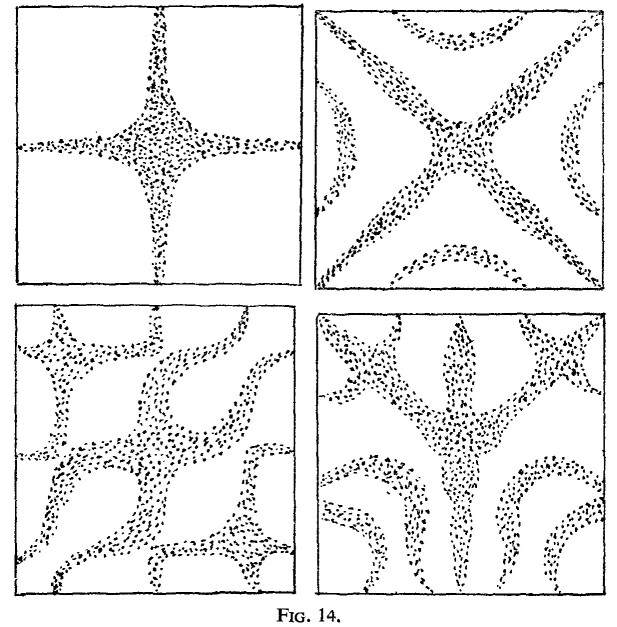
figures of very regular and often surprising form. By stroking the plate at different points on the edge, and at the same time damping the vibrations by touching the edge at other points with the finger, notes of different pitch can be produced, and for each of these notes a characteristic figure will appear (Fig. 14).7
The significance for us of Chladni's experiment will emerge still more clearly if we modify it in the following way. Instead of directly setting the plate with the powder into vibration by stroking it with the bow, we produce a corresponding movement on a second plate and let it be transmitted to the other by resonance. For this purpose the two plates must be acoustically tuned to each other and placed not too far apart. Let us imagine, further, that the whole experiment was arranged - as it well might be - in such a way that the second plate was hidden from a spectator, who also lacked the faculty of hearing. This gives us a picture of the situation in which we find ourselves whenever the higher kinds of ether by way of a tone-activity inaudible to our physical ear, cause shapeless matter to assume regularly ordered form.
*
This comparison of the activity of the sound-ether, as the form-creating element in nature, with Chladni's phenomenon is drawn correctly only if we recognize that the conception of form, as an expression of that which is called forth through the etheric forces in nature, comprises more than the external spatially bounded shape of an organic or inorganic entity. Apart from the fact already indicated, that for the formation of such entities the co-operation also of life-ether is necessary, we can judge the activity of sound-ether correctly only if we conceive it as a much more inward activity, compared with the formation in external space of Chladni's figures. In the latter case, the reason why the influence of sound causes nothing beyond the ordering of form in outer space is because on this plane of nature the only changes that can occur are changes in the positions of separate physical bodies. Where the forces of sound in ether-form are able to take hold of matter from within, they can produce changes of form of a quite different kind. This effect of the activity of sound-ether has given it its other name: chemical ether.
We have mentioned once before that our conception of 'form' in organically active nature must not be limited merely to that of a body's spatial outline. This was in connexion with Ruskin's definition of the spiritual principle active in plant-formation as 'the power that catches out of chaos charcoal, water, lime and what not, and fastens them down into a given form'. Besides the external order of matter revealed in space-form, there exists also an inner qualitative order expressed in a body's chemical composition. Upon this inner chemical order is based all that we encounter as colour, smell, taste, etc., of a substance, as well as its nourishing, healing or harmful properties. Accordingly, all these parts of an organism, both in the plant-kingdom and within the higher organisms, have a certain inner material order, apart from their characteristic space-structure. The one is never present without the other, and in some way they are causally connected.
In this inner order of substance we must see in the very first place the work of the sound or chemical ether. And we should be aware that by the word 'chemistry' in this connexion we mean something much more far-reaching than those chemical reactions which we can bring about by the reciprocal affinity of physical substances, however complicated these reactions may be. A few examples will illustrate the difference between chemical processes caused by direct influence of the chemical ether, and others in which only the physical consequences of the ether are effective.
In his book, Man the Unknown, Professor Carrel shows very impressively, by an example from the human organism, the difference of quantitative ratio in externally similar processes, one of which occurs within the domain of life, the other, outside it. He compares the quantity of liquid necessary to keep artificially alive a piece of living tissue which has been reduced to pulp, with the quantity of blood doing the same within the living organism. If all the tissues of a human body were treated in this way, it would take 45,000 gallons of circulating fluid to keep them from being poisoned in a few days by their own waste products. Within the living organism the blood achieves the same task with 1J gallons.
Very many chemical changes within living organisms are effected by the two polar processes of oxidation and reduction. We have discussed them repeatedly as hieroglyphs of much that occurs in nature by way of polarity. In accordance with the principle ruling the physical plane of nature, that differences of level tend to disappear, oxidation can occur by itself, whereas reduction requires the expenditure of energy. Let us from this point of view compare the transformation of oxidized into reduced iron, as it takes place inside and outside the realm of life.
An example of this process in its purely physical form is the reduction of iron-ore to metallic iron in blast-furnaces, where, with the help of high temperature and high pressure, carbon is made to combine with the oxygen ingredient of the ore and to impart to it its own imponderable energy. Precisely the same process is going on continuously and unobtrusively within the human body under normal bodily conditions of temperature and pressure, when the oxy-haemoglobin of the arterial blood changes over into the haemoglobin of the venous blood. A macrotelluric counterpart of this is the transformation of the red river-mud into the blue-black continental mud at the bottom of the sea, around the continental shores. Here, again, reduction takes place without those preliminaries that are necessary for carrying through the process by technical means.
Through examples of this kind we gain insight into the nature of the chemical ether as a 'magic' force (in the sense in which we have introduced this term at the beginning of the book). What the chemical ether is capable of effecting in a gentle manner, so to speak, in cooperation with the inertness-overcoming power of the warmth-ether, can be imitated physically only by an extraordinary concentration of external energy and the use of masses of material substance. At the same time the imitation is never complete. For to all that happens through the action of the chemical ether there belongs the quality of cosmic youth, while everything brought about in a purely physical manner is of necessity cosmically old.8
Of all the provinces of nature towards which man's exploring eye has turned since the dawn of the onlooker-consciousness, none has furthered his purely quantitative thinking more than chemistry, ever since the discovery that the chemical reactions of the various substances are conditioned by a quite definite and constant numerical relationship. It was these relationships which impelled the rise of the atomic conception of matter and all its consequences. For since the onlooker-consciousness is quite unable to conceive the existence of numerical relationships in the physical world except as sums of computable units in space, it was natural for this type of consciousness to reduce all empirically established numerical relationships to correspending relationships among quantities of the smallest possible material or matter-like units.
Scientific thinking, if guided by knowledge of the existence of etheric forces and their action, has no need of such an interpretation of the numerical relationships revealed in the physical world; for it knows them to be nothing but the last expression of the action of the chemical ether (hence occasionally also called 'number-ether' by Rudolf Steiner). To do justice to the appearance of measurable numerical relationships in nature, in whatever sphere, it is necessary to free ourselves from the abstract conception of number which governs modern scientific thought and to replace it by a more concrete one. We shall rind that for the existence of a certain number there may be two quite different reasons, although the method of establishing the number itself is the same in each case. A simple example will illustrate this.
Let us look at a number of similar objects, say a group of five apples. We observe that the relation of the number five to the group of objects in front of us is purely external and accidental. In applying to it the conception 'five' we combine the single objects into a group and give it a name, or numerical label, which has nothing to do with the nature of the items making up the group. This way of thinking, we may observe, is of exactly the kind which the nominalists of the Middle Ages attributed to every conception formed by the human mind. In fact, the process of counting is a process of pure abstraction. The more differentiated are the things which we want to combine into a group through the process of counting, the further this abstraction has to go. We can count apples and pears together under the collective conception of 'fruit'; if turnips are added, we must help ourselves out with the conception 'vegetable products'; until finally we deal only with 'things', without considering any qualitative differentiation. Thus the conception of number is created solely within the human mind, which applies it to things from outside.
From the moment when human consciousness was unable to attribute to itself any other than a purely nominalistic mode of comprehension it was inevitable that all explanations of natural phenomena would have two results: (1) the exclusion from observation of everything that could not be conceived in terms of numbers, and (2) an endeavour to find for every numerical relationship capable of empirical proof an explanation which could be interpreted as the result of taking qualitatively identical units and counting them. For this method of forming conceptions is the only one which nominalism can accept with a good conscience. The fact that in so doing it is led ad absurdum has only quite lately occurred to it. For if by the logical following of this path - as in modern theoretical physics - the whole universe is dissolved into units which can no longer be distinguished from each other, then it will become impossible to count these parts, for it cannot be established whether any given one of these hypothetical elemental particles has been counted or not. None the less, Eddington claimed to have found the exact number of particles composing the universe - a number with 80 figures - by using a special calculus, but this number is valid only on the supposition that the particles cannot be counted because they are indistinguishable!9
However correct the nominalistic conception of number may be in such a case as that of numbering the five apples, it is wholly incorrect to restrict the concept of number itself to one valid for this kind of occurrence. We shall see this immediately if we take one of the apples and cut it across. There we find the number five confronting us in the well-known star-like figure, represented by the fivefold pericarp in the centre of the apple. What man, restricted as he was to the mode of understanding, has completely overlooked is this: although the act of counting, by which we establish the number five, is the same in both cases, the quality of the number five is totally different. For in the case of the five pericarps this number is a quality immanent in the apple, which it shares with the whole species of Rosaceae. The apple itself is just as much 'five' as it is 'round', 'sweet', etc. In the supersensible type which creates in the plant its own organ of manifestation, the creation of a number - in the apple the number five - is part of the form-creating activities characteristic of the type. The numerical relationships which appear between natural phenomena depend upon the way in which the chemical ether participates. This is true equally of those discovered by chemistry in the sphere of inorganic matter and used to-day with such great success.
Let us be quite clear that the relationship of unity to plurality in the case of the five apples is totally different from what it is in the fivefold pericarp. In the first case unity is the smallest quantity represented by each of the five apples. There, the step from one to two is made by joining together two units from outside. The path from one to many is by way of continuous addition. In the second case the unity is represented by the pericarp - i.e. by the one comprising the many, the latter appearing as parts of the whole. In such a case two is part of one and so are three, four, five, etc. Plurality arises from a continuous process of division of unity.
The ancient world knew the idea of number only in the last-mentioned form. There unity appeared as an all-embracing magnitude, revealed through the Universe. The world's manifoldness was felt to be not a juxtaposition of single things, externally connected, but the content of this unity, and therefore derived from it. This was expressed by the pre-Socratic Greek philosophers in the formula Îν και Ïαν (the One and the All).
With the appearance of the Arabs on the scene of history, human thought turned to the additive concept of number, and the original distributive concept receded gradually into oblivion. The acceptance of the new concept made it possible for the first time to conceive the zero. It is clear that by a continuous division of unity one is carried to a constantly growing number of constantly diminishing parts, but without ever reaching the nothing represented by the number zero. To-day we should say that in this way we can reach zero only by an infinite series of steps. Yet the idea of the infinite did not exist in this form for ancient man. On the other hand, in the arabic conception of number the steps necessary to reach zero are finite. For just as by the external addition of unities we can step forward from one number to the next, so we can also step back on the same path by repeated subtractions of unities. Having thus reached One, nothing can stop us from going beyond it by one more such step. The arabic numeral system, therefore, is the only one to possess its own symbol for zero.
It has been correctly noted that the penetration into European thought of this additive concept of number was responsible for developing the idea of the machine; for it accustomed human beings to think calmly of zero as a quantity existing side by side with the others. In ancient man the idea of nothingness, the absolute void, created fear; he judged nature's relation to the void accordingly, as the phrase 'natura abhorret vacuum' indicates. His capacity to think fearlessly of this vacuum and to handle it thus had to be developed in order to bring about the Machine Age, and particularly the development of efficient steam engines. Consider also the decisive part played by the vacuum in Crookes's researches, through which the path to the sub-physical realm of nature was laid open.
Yet nature makes use of number as a regulating factor in quite a different way from its appearance in the purely electrical and gravitational connexions of inorganic matter, namely where sound-ether from the upper boundary of nature so regulates nature's dynamic that the manifold sense-qualities appear in their time-and-space order. When we interpret the arrangement of numbers found there on a nominalistic basis, as is done when the axis- and angle-relationships of crystals are reduced to a mere propinquity of the atoms distributed like a grid in space, or when the difference in angle of the position of the various colours in the spectrum is reduced to mere differences in frequency of the electromagnetic oscillations in a hypothetical ether - then we bar the way to the comprehension not only of number itself, as a quality among qualities, but also of all other qualities in nature.
*
(e) LIFE
As already mentioned, the three kinds of ether, warmth, light and sound, are not sufficient in themselves to bring into existence what in its proper sense we call 'life' in nature, i.e. the formation of single living organisms. This requires the action of a fourth kind of ether, the life-ether, ranged above the other three. We can best comprehend the life-ether's contribution to the total activity of the ether in nature by considering the interaction of the four kinds of ether with the four physical elements.
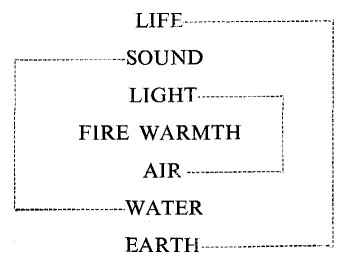
We have seen that the warmth-ether has the double function of being at once the lowest ether and the highest physical element, thus acting as a sphere of reflexion for the other kinds of ether and the elements respectively. Each stage in the etheric has its reflexion in the physical, as the above table shows. Thus to the physical air the etheric light is related. (The affinity of light and air is best seen in the plant and its leaf-formation.) To bring about real changes in the material composition of the physical world requires the stronger powers of the chemical ether. Therefore it is also the first ether of which we had to speak as 'magical' ether. Its effects reach into the watery element which is already bound up with gravity, but by its own strength it cannot penetrate beyond that. The causation of material changes in the liquid sphere would in fact be all that these three kinds of ether could achieve together.
Only when the power of the life-ether is added to the three others can etheric action reach as far as the sphere of solid matter. Thus the life-ether is responsible for all solid formation in nature, both in her organic and inorganic fields (the latter-crystal-formation-being the effect of external ether-action).10 It is to the action of the life-ether that nature owes the existence in her different realms of multitudes of separate solid forms. To mention an instance from our previous studies: in the same way as volcanic phenomena manifest the warmth-ether's gravity-overcoming power on a macrotelluric scale, so snow-formation illustrates the life-ether's matter-shaping might.
Through its power to bind flowing action into solid form, the life-ether is related to the sound-ether in the same way as the articulated word formed by human speaking is related to the mere musical tone. The latter by itself is as it were fluid. In human speech this fluidity is represented by the vowels. With a language consisting only of vowels man would be able to express feelings, but not thoughts. To let the word as carrier of thought arise out of sound, human speech possesses the consonants, which represent the solid element in it.
The emergence of the sense-bearing word from the merely ringing sound is an exact counterpart to what takes place in nature when the play of organic liquids, regulated by the chemical ether, is caused by the life-ether to solidify into outwardly perceptible form. By reading in this way the special function of the life-ether among the other three, we are led to the term ' Word-ether' as an appropriate second name for it, corresponding to the term sound-ether for the chemical ether.
*
Thus Levity presents itself to us as being engaged in the fourfold activity of Chaoticizing, Weaving, Sounding and, lastly, Speaking the form-creative Cosmic Word into the realm of Gravity.
1 To avoid misunderstandings, it should be emphasized that spiritual Imagination is not attained by any exercise involving directly the sense of sight and its organ, the eye, but by purely mental exercises designed to increase the 'seeing' faculty of the mind.
2 Indeed, it is a misunderstanding of the whole meaning of Anthroposophy when its contents are quoted - as they sometimes are even by adherents - in such a way as to suggest that by their help a better 'explanation' may be gained of matters for which there is otherwise no, or at least no satisfactory, explanation. The question: 'How does Anthroposophy explain this or that?' is quite wrongly put. We ought rather to ask: 'How does Anthroposophy help us to read more clearly this or that otherwise enigmatical chapter of the script of existence?'
3 See Space and the Light of Creation, by G. Adams, where this 'weaving' is shown with the help of projective geometry.
4 Translation by J. Darrell.
5 We may recall here also the passage from Ruskin's The Queen of the Air, quoted earlier, p. 118).
6 That the ether, apart from being supersensibly seen, is also heard, was empirically known to Goethe. See the opening words of the 'Prologue in Heaven" (Faust, I) and the call of the Spirit of the Elements in the first scene of the Second Part of the drama, which follow upon the stage direction: 'The sun announces his approach with overwhelming noise.'
7 By attending Chladni's lectures on his discovery in Paris the French physicist Savart became acquainted with this phenomenon and devoted himself to its study. Chladni and Savart together published a great number of these figures.
8 Understanding the attributes of the chemical ether enables us to see in their right perspective Rudolf Steiner's suggestions to farmers for the preparation of the soil and for keeping healthy the crops growing on it. Attempts have been made to dismiss these suggestions by calling them 'mysticism' and 'mediaeval magic'. Both terms are titles of honour if we understand by the one the form of insight into the supersensible realm of nature acquired by the higher mode of reading, and by the other a faculty of nature herself, whose magic wand is the chemical or sound-ether.
9 See Eddington's humorous and at the same time serious treatment of this problem in his Philosophy of Physical Science.
10 Of the difference between external and internal ether-action more will be said in the concluding chapter.
CHAPTER XX
Pro Anima
Thy functions are ethereal, As if within thee dwelt a glancing mind, Organ of vision! And a Spirit aëreal Informs the cell of Hearing, dark and blind. W. WORDSWORTH
(a) THE WELL-SPRINGS OF NATURE'S DEEDS AND SUFFERINGS
As our observations have shown, gravity and levity not only exist side by side as a primary polarity; the manifold interaction of their fields gives rise to all sorts of secondary polarities. Obviously, this interaction must be brought about by a further kind of force to which gravity and levity are subordinate.
In what follows we shall try, so far as is possible within the scope of this book, to throw light on the nature of this force. Since the direct experience of the dynamic realm constituted by it is based on faculties of the mind other than those needed for the Imaginative perception of the etheric realm, we shall have to examine also the nature and origin of these faculties. This will lead us again to the study of one of man's higher senses, this time his sense of hearing, with the aim of finding the spiritual function that is hidden in it. But our order of procedure will have to differ from the one followed in the last chapter, because it will be necessary first to make ourselves acquainted with the nature of the new force and then to turn to an examination of the sense-activity concerned.
*
Let our first object of observation be man himself in so far as he illustrates a polarity of the second order.
When studying man's nature with the idea of understanding the genesis of his onlooker-consciousness, it will be remembered, we had to examine the ordering of his consciousness into waking, dreaming and sleeping in the different members of his organism. We recognized three different organic systems, the sensory-nerve system, the rhythmic system and the metabolic-limb system, as the bodily foundation of three different soul activities. These are the thought-forming activity which belongs to waking consciousness; the feeling activity which belongs to dream consciousness; and the willing activity which belongs to sleep consciousness. We then saw in these three systems representatives of the three alchemical functions - 'sulphurous' in the metabolic, 'saline' in the nervous, 'mercurial' in the mediating rhythmic system.
Regarded thus, man's nature reveals itself as being endowed with a physical organization, and an etheric organization, which are brought into different relationships by being acted upon by a third organization consisting of forces of the kind here to be studied. At his lower pole these forces co-ordinate the ether and physical organizations in a manner corresponding to the function of the 'sulphur'-pole of the alchemical triad. Here, therefore, the warmth-ether takes the lead and acts in such a way that the higher kinds of ether are able to come to expression in material processes of the body. At the upper pole corresponding forces co-ordinate the physical and ether organizations in a way characteristic of the 'salt'-pole. This gives the lead to the life-ether, so that the physical organism provides the foundation for the activity of the ether-forces without, however, being actually penetrated by them (at least after completion of the embryonic and first post-embryonic development). As a result, consciousness lights up in this part of the body. The rhythmic sphere, being the 'mercurial' middle, is distinguished by an alternation of the two conditions described. With each diastole it becomes more akin to the pole below, and with each systole more akin to the pole above. Here, therefore, the lighting up of consciousness is only partial.
By means of these observations we realize that the third type of force, in so far as it is active in man, has the capacity, by co-ordinating the physical and etheric parts of the organism in one way or another, to promote happenings either of a more corporeal or a more psychical nature - namely, motion at one pole, sensation at the other, and feeling in the middle between them.1 Remembering Goethe's formula, 'colours are deeds and sufferings of light', we realize how deeply true the concepts were to which he was led by his way of developing observation and thought.
What we have now brought to our awareness by studying man, holds good in some sense also for the animal. The animal, too, is polarized into motion and sensation. (What makes the animal differ from man need not concern us here, for it belongs to a dynamic realm other than the one we are now studying. This other realm will come under consideration in the next chapter.) Quite a different picture arises when we turn to the plant. The plant, too, is characterized by a threefold structure, root, stem with leaves, and florescence, which in their way represent the three alchemical functions. Consequently, there is also motion in the plant, although this is confined to internal movements leading to growth and formation. And at the opposite pole there is sensation, though again very different from the sensation experienced by higher living beings. What we mean here by 'sensation' can be best expressed by quoting the following passage from Ruskin's The Queen of the Air, in which the dual activity of the dynamic which we seek to understand is brought out particularly clearly.
In describing the forming of blossom in the plant as the climax of the 'spirit' active in it, Ruskin says: 'Its (the plant's) form becomes invested with aspects that are chiefly delightful to our own human passions; namely, first, with the loveliest outlines of shape and, secondly, with the most brilliant phases of the primary colours, blue, yellow, red or white, the unison of all; and to make it more strange, this time of peculiar and perfect glory is associated with relations of the plants or blossoms to each other, correspondent to the joy of love in human creatures and having the same object in the continuance of the race.'2
If we wish to understand why the same dynamic action working on the physical and etheric organisms of the plant, on the one hand, and of man and the animal, on the other, brings about effects so different, we must turn to the realm whence this action originates in both cases. For the animal and for man this realm is situated within their organisms because in addition to their individual physical and etheric organizations they are endowed also with an individual organization of the higher kind. Not so with the plant. For the rhythms of its growth, the successive formation of its various organs, the production of its colours, etc., the plant depends on outer conditions.
What strikes us first in this respect is the plant's dependence on the succession of the seasons. These in turn are an outcome of the changing mutual positions of earth and sun. That which forms part of the individual organism in higher living beings is located in the cosmic surroundings of the plant. In fact, it is our planetary system which provides the forces that stir the etheric and physical forces of the earth to their various interactions, thus bringing about all the manifold secondary polarities.
*
Before we embark on a description of further phenomena which testify to the cosmic nature of the forces with which we are here concerned, it will be well (following a principle applied before) to establish the historical antecedents of the conception of the universe we are about to develop.
We realize that the type of force with which we are here seeking to become familiar is the one responsible for the existence of what we commonly call 'soul'. The creation of a body-bound soul, however, is only one particular form of the activity of these forces. Another is the one which we have just seen manifest in the plant. In yet another way the same forces function as movers and stirrers of the macro-telluric processes of the earth, and beyond this of the happenings in the body of our planetary system, including the movements of the various planets.
This is an aspect which was by no means unfamiliar to ancient man. It was naturally lost when the onlooker-consciousness awoke. In this respect it is of historical significance that the same man, G. A. Borelli (1608-79), a member of the Florentine Academy, who was the first to inquire into the movements of the animal and human body from a purely mechanical point of view, made the first attempt to deduce the planetary movements from a purely physical cause.3 Through this fact an impulse comes to expression which we may term Contra Animam, and against which we have to put our Pro Anima, in much the same way that we put our Pro Levitate against the Contra Levitatem call of the Florentine Academicians.
*
It will help our further descriptions if we introduce at this point the name which Rudolf Steiner adopted for the type of forces we are concerned with here. In view of the fact that their origin lies in the extra-terrestrial realm of the universe, he called them 'astral' forces, thereby giving back to this term, also, its true and original meaning. It is under this name that we shall speak of them henceforth. To make ourselves more familiar with the character of the astral forces, it will be well to observe them first of all in their macrotelluric form of activity.
There is, as already mentioned, the rhythmic occurrence of the seasons in connexion with the varying relative positions of earth and sun. Alongside this we may put the rhythm of the tides, coincident with the phases of the moon. Just as the solar rhythm manifests in an alternating rise and fall of the saps in the plants, so also does the lunar rhythm.4 (Note how this fact actually vitiates the usual explanation that the tidal rhythm of the sea is caused by a gravitational pull exerted by the moon's body on the oceanic water.) In neither instance is the change of position of the relevant cosmic body - in our examples that of the sun or moon in relation to the earth - the 'cause' of the corresponding rhythmic events on the earth. Together with all other rhythmic events of equal periodicity, it is itself the effect of the activity of a force-sphere constituting the cosmic realm to which the relevant planetary body belongs.
From this statement three major questions arise, which need to be answered before we can carry on our description of the astral forces themselves:
Firstly, by the way we have spoken of the varying relations of the sun and moon to the earth, seeing in them the effects of certain astral activities, we have treated them as if they were of like nature, namely, resulting from a movement of the relevant heavenly body round the earth. According to the Copernican conception, however, only the moon rotates round the earth, whereas the apparent yearly progression of the sun is actually caused by the earth's motion round the sun. This raises the question of how far the Copernican, heliocentric aspect is valid in a science which strives to embrace the astral realm of the universe in its inquiries.
Secondly, what roles do the other members of our planetary system play as compared with those of the sun and the moon?
Thirdly, if it is true that the essential solar and lunar effects - and presumably the effects of the other planets - on the earth do not spring from physical influence exerted by the visible bodies of the planets concerned, but from certain astral force-fields of which these bodies themselves form part, what is the significance of such a body within the planet's dynamic whole?
Starting with the answer to the first question, we shall quote the following passage from a lecture on theoretical physics given by Professor Planck in 1909 at the Columbia University, New York:
'Only the hypothesis of the general value of the principle of Relativity in mechanics could admit the Copernican system into physics, since this principle guarantees the independence of all processes on the earth from the progressive motion of the earth. For, if we had to make allowance for this motion, then I should, for instance, have to reckon with the fact that the piece of chalk in my hand possesses the enormous kinetic energy corresponding to a velocity of about 30 km/sec.'
The implications for us of these remarks by an eminent physicist can be expressed as follows:
In a science which knows how to deal with movement as an event of absolute dynamic reality, the Copernican aspect loses its significance as the only valid aspect of our cosmic system. For its application as a means of describing the dynamic happenings within this system presupposes the acceptance of Einstein's relativistic conception of motion. Indeed, for the building up of a picture of the dynamic structure of our system, the Copernican view-point is inadequate.
This statement must not be taken to deny all justification to the heliocentric view-point. There is, after all, the fact that the orbits which the heavenly bodies appear to follow when viewed in this way, assume a particular geometrical character which cannot be accidental. And more than that, when the heliocentric aspect is seen in its true setting, it forms (as will be shown later) an extremely revealing part of the script which tells us of the nature of the astral forces. All that is required is that the heliocentric picture be taken for what it is, namely, a purely kinematic aspect of the true dynamic ordering of our cosmic system, which in itself calls for quite other means of conceptual representation.
From the point of view of the astral order of the universe, the earth appears in the centre of a number of force-fields which penetrate each other and in their peripheral region extend beyond one another in accordance with the respective orbits of the various planetary bodies. How many force-fields there are, and what is the respective character of each, will become clear from the following consideration, which will also provide the answer to the second of our three questions.
As the originator of the secondary polarities in earthly nature the astral realm must undoubtedly itself be structured polarically, one part of it forming the cause of all the happenings by which levity is brought into interaction with gravity, the other of all the happenings by which gravity is brought into interaction with levity. There must be a further part which is responsible for the establishment of the 'mercurial' mean between the two poles of the secondary polarity. This leads us to a threefold aspect of the astral realm.
Closer inspection reveals a repetition of this threefold order within each of the two polar regions. In Chapter XII we learnt to distinguish the material happenings at the two poles of the secondary polarity by observing their appearance in the plant as 'sublimation', on the one hand, and 'assimilation' on the other. Of the former process, by which matter is carried from its gravity-bound to its gravity-free condition, we know that it takes place in three stages, of which the first implies the lifting of matter from the solid to the liquid condition, the second from the liquid to the aeriform condition, and the third to the condition of pure heat. There are three corresponding stages by which ether becomes susceptible to gravity. It is in their nature that they are not in the same degree manifest as are their polar opposites. Still, properly guided observation is able to detect them and enables us to describe them as follows. At the first stage, ether, which in itself has a purely peripheral orientation, becomes linked to some all-relating point; at the second stage, the various ether-activities, already point-related, are brought into some characteristic interrelationship so as to become the cause of a particular formative action in the material realm; at the third stage, the etheric aggregate thus organized receives the impulse to link itself with some particular portion of ponderable matter.
In these six forms of astral activity, observation, if guided by modern spiritual science, recognizes the characteristics of the six planetary spheres, known as 'Moon', 'Mercury', 'Venus', on the one hand, 'Saturn', 'Jupiter', 'Mars', on the other. In the same way the dynamic sphere of the 'Sun' is found to provide the astral activity which mediates between the two groups of planetary spheres.5 The following observations may help us to become familiar with the different modes of activity of the force-spheres.
Let us start with the astral forces corresponding to the three cosmic bodies nearest to the earth - Moon, Mercury, Venus. Their activity can be discerned, for example, by watching the successive stages of plant development - the formation of the sap-bearing parts; the flower-substance already partly transformed into aeriform condition; finally the propagating processes which belong essentially to the sphere of activity of the warmth-ether.6 In the human organism we find the same sequence in the step-by-step transformation of nutriment right up to the moment when earthly form passes into chaos, as we learnt previously. The so-called enzyme action, ascribed by physiology to the various digestive juices, is in reality the product of an activity of the lower part of man's astral organization, for which the relevant juices exercise the function of physical 'carriers'. In the field of macrotelluric phenomena, the metamorphosis of the atmospheric moisture extending beyond the different cloud-stages up to the stage of pure warmth is an example of the activity of the same forces.
Within all three-stage transitions of this kind, the astral forces connected with the Moon preponderate during the first stage, those connected with Mercury during the second, those connected with Venus during the third. We have already come across some examples of the outstanding share taken by the Moon in the events of the earth's watery sphere. To these phenomena, which show by their rhythm their connexion with the Moon, we may add the fertility rhythm in the female human organism which coincides, not in phase but in duration, with the rhythm set by the Moon's course in the heavens. If we consider that the formation of a new human body in the womb needs the play of formative forces from out of the whole world environment, and that for this purpose matter must be brought into a receptive condition for these forces, then we can better understand the preparatory part played by the Moon-forces. In order, however, that the substance of the female germ should reach that condition of chaos suitable for embryonic development, there is still necessary the influence of the supra-lunar astral forces. Entry for these is provided by the union of the germ-cell with the male sperm-cell.7
As the three sub-solar planetary spheres are responsible for events of a 'sulphurous' (radial) character, so are the three supra-solar spheres responsible for those of a 'saline' (spherical) character. For example, we meet with Saturn-activity in everything which radiates from the human head and brings about the hardening both of the head itself and of the entire skeleton. Observation has shown that, even if the human being, as usually happens, stops growing in the early twenties, so that the skeleton undergoes no further lengthening, it nevertheless reaches its final shape and its final hardening only between the twenty-eighth and thirtieth years. This is the time in man's life when Saturn returns for the first time to the position in which it stood relatively to the earth at his birth, or, more correctly, at his conception.
If the activity of the Saturn-force is most clearly manifest in the formation of the hard skull, that of Jupiter, the planet of 'Wisdom', is shown in the formation of the complicated structure of the brain, which enables it to co-ordinate the bodily and psychic functions of the entire man. In the realm of physical nature, man's brain is indeed the most perfect example of cosmic Intelligence at work in a manner resembling that activity of human intelligence which one usually understands by 'organizing'.
In order that Form should come about, the forces of Saturn are required; for the formative process to take place in Wisdom-filled order, Jupiter's forces are necessary. If form and order are to become manifest in the realm of earthly substance, both require the assistance of Mars. We can best form an idea of the part which Mars contributes to the coming into being of the world of Form in nature if we observe what takes place when we make use of speech as a medium for expressing our thoughts. In order to be able to shape a thought we have to participate in the formative force of Saturn. We depend upon Jupiter to bring about logical connexion between the single thoughts. To announce them to the world, we need the motive force of Mars, which enables us so to set external matter in motion that it becomes a carrier and relayer of our thoughts. (We here touch upon the field of the acoustic movements of the air which will occupy us more closely later on.)