Front matter (continued 7)
Reading edition
The following passage from Ruskin's Ethics of the Dust (Lecture X) brings out his criticism of the scientific way of treating of optical phenomena:
'With regard to the most interesting of all their [the philosophers'] modes of force-light; they never consider how far the existence of it depends on the putting of certain vitreous and nervous substances into the formal arrangement which we call an eye. The German philosophers began the attack, long ago, on the other side, by telling us there was no such thing as light at all, unless we choose to see it.2 Now, German and English, both, have reversed their engines, and insist that light would be exactly the same light that it is, though nobody could ever see it. The fact being that the force must be there, and the eye there, and 'light' means the effect of the one on the other - and perhaps, also - (Plato saw farther into that mystery than anyone has since, that I know of) - on something a little way within the eyes.'
Remarks like these, and the further quotation given below, make it seem particularly tragic that Ruskin apparently had no knowledge of Goethe's Farbenlehre. This is the more remarkable in view of the significance which Turner, with whom Ruskin stood in such close connexion, ascribed to it from the standpoint of the artist. For the way in which Ruskin in his Modern Painters speaks of the effect of the modern scientific concept of colours upon the ethical-religious feeling of man, shows that he deplores the lack of just what Goethe had long since achieved in his Farbenlehre where, starting with purely physical observations, he had been able to develop from them a 'physical-moral' theory of colour.
Ruskin's alertness to the effect on ethical life of a scientific world-picture empty of all qualitative values led him to write:
'It is in raising us from the first state of inactive reverie to the second of useful thought, that scientific pursuits are to be chiefly praised. But in restraining us at this second stage, and checking the impulses towards higher contemplation, they are to be feared or blamed. They may in certain minds be consistent with such contemplation, but only by an effort; in their nature they are always adverse to it, having a tendency to chill and subdue the feelings, and to resolve all things into atoms and numbers. For most men, an ignorant enjoyment is better than an informed one, it is better to conceive the sky as a blue dome than a dark cavity, and the cloud as a golden throne than a sleety mist. I much question whether anyone who knows optics, however religious he may be, can feel in equal degree the pleasure and reverence an unlettered peasant may feel at the sight of a rainbow.'
What Ruskin did not guess was that the rudiments of the 'moral theory of light' for which he craved, as this passage indicates, had been established by Goethe long before.
*
In the section of his Farbenlehre dealing with 'physiological colours', Goethe devotes by far the most space to the so-called 'afterimages' which appear in the eye as the result of stimulation by external light, and persist for some little time. To create such an afterimage in a simple way, one need only gaze at a brightly lit window and then at a faintly lit wall of the room. The picture of the window appears there, but with the light-values reversed: the dark cross-bar appears as light, and the bright panes as dark.
In describing this phenomenon Goethe first gives the usual explanation, that the part of the retina which was exposed to the light from the window-panes gets tired, and is therefore blunted for further impressions, whereas the part on which the image of the dark frame fell is rested, and so is more sensitive to the uniform impression of the wall. Goethe, however, at once adds that although this explanation may seem adequate for this special instance, there are other phenomena which can be accounted for only if they are held to derive from a 'higher source'. Goethe means experiences with coloured after-images. This will be confirmed by our own discussion of the subject.
What we first need, however, is a closer insight into the physiological process in the eye which causes the after-images as such. Wherever Goethe speaks of a simple activity of the retina, we are in fact concerned with a co-operation of the retina with other parts of our organ of sight. In order to make this clear, let us consider how the eye adapts itself to varying conditions of light and darkness.
It is well known that if the eye has become adjusted to darkness it is dazzled if suddenly exposed to light, even though the light be of no more than quite ordinary brightness. Here we enter a border region where the seeing process begins to pass over into a pathological condition.4 A 'secret' of the effect of light on the eye is here revealed which remains hidden in ordinary vision, for normally the different forces working together in the eye hold each other in balance, so that none is able to manifest separately. This equilibrium is disturbed, however, when we suddenly expose the eye to light while it is adapted to darkness. The light then acts on the eye in its usual way, but without the immediate counter-action which normally restores the balance. Under these conditions we notice that the sudden dazzling has a painful influence on the eye - that is, an influence in some way destructive. This will not seem surprising if we remember that when light strikes on the background of the eye, consciousness is quickened, and this, as we know, presupposes a breaking down of substance in some part of the nervous system. Such a process does in fact occur in the retina, the nerve-part of the eye, when external light falls upon it. If the eye were solely a structure of nerves, it would be so far destroyed by the impact of light that it could not be restored even by sleep, as are the more inward parts of the nervous system. But the eye receives also a flow of blood, and we know that throughout the threefold human organism the blood supplies the nervous system with building-up forces, polarically opposite to the destructive ones. In sleep, as we have already seen, the interruption of consciousness allows the blood to inundate the nervous system, as it were, with its healing, building-up activity. It is not necessary, however, for the whole of the body to pass into a condition of sleep before this activity can occur. It functions to some extent also in the waking state, especially in those parts of the organism which, like the eye, serve in the highest degree the unfolding of consciousness.
Having established this, we have a basis for an understanding of the complete process of vision. We see that it is by no means solely the nerve part of the eye which is responsible for vision, as the spectator-physiology was bound to imagine. The very fact that the place where the optic nerve enters the eye is blind indicates that the function of mediating sight cannot be ascribed to the nerve alone. What we call 'seeing' is far more the result of an interplay between the retina carrying the nerves, and the choroid carrying the blood-vessels. In this interplay the nerves are the passive, receptive organ for the inworking of external light, while the blood-activity comes to meet the nerve-process with a precisely correlated action. In this action we find what Goethe called the 'inner light'.
The process involved in adaptation now becomes comprehensible. The cause of the dazzling effect of light of normal intensity on an eye adapted to the dark, is that in such an eye the blood is in a state of rest, and this prevents it from exercising quickly enough the necessary counter-action to the influence of the light. A corresponding effect occurs when one suddenly exposes to darkness the eye adapted to light. One can easily observe what goes on then, if, after looking for a time at an undifferentiated light surface such as the evenly luminous sky, one covers the opened eyes with the hollowed hands. It will then be found that the space before the eyes is filled by a sort of white light, and by paying close attention one recognizes that it streams from the eyes out into the hollowed space. It may even be several minutes before the field of vision really appears black, that is, before the activity of the inner light in the choroid has so far died away that equilibrium prevails between the non-stimulated nerves and the non-stimulated blood.
With this insight into the twofold nature of the process of vision we are now able to describe more fully the negative after-image. Although in this case, as Goethe himself remarked, the ordinary explanation seems to suffice, yet in view of our later studies it may be well to bring forward here this wider conception.
On the basis of our present findings it is no longer enough to trace the appearing of the after-image solely to a differential fatigue in the retina. The fact is that as long as the eye is turned to the bright window-pane a more intensive blood-activity occurs in the portions of the eye's background met by the light than in those where the dark window-bar throws its shadow on the retina. If the eye so influenced is then directed to the faintly illumined wall of the room, the difference in the activity of the blood persists for some time. Hence in the parts of the eye adapted to darkness we experience the faint brightness as strongly luminous, even dazzling, whereas in the parts more adapted to light we feel the same degree of brightness to be dark. That the action of the inner light is responsible for the differences becomes clear if, while the negative after-image is still visible, we darken the eye with the hollowed hands. Then at once in the dark field of vision the positive facsimile of the window appears, woven by the activity of the blood which reproduces the outer reality.
Having traced the colourless after-image to 'higher sources' - that is, to the action of the blood - let us now examine coloured afterimages. We need first to become conscious of the colour-creating light-activity which resides in the blood. For this purpose we expose the eyes for a moment to an intense light, and then darken them for a sufficient time. Nothing in external nature resembles in beauty and radiance the play of colour which then arises, unless it be the colour phenomenon of the rainbow under exceptionally favourable circumstances.
The physiological process which comes to consciousness in this way as an experience of vision is exactly the same as the process which gives us experiences of vision in dreams. There is indeed evidence that when one awakens in a brightly lit room out of vivid dreaming, one feels less dazzled than on waking from dreamless sleep. This indicates that in dream vision the blood in the eye is active, just as it is in waking vision. The only difference is that in waking consciousness the stimulus reaches the blood from outside, through the eye, whereas in dreams it comes from causes within the organism. The nature of these causes does not concern us here; it will be dealt with later. For the moment it suffices to establish the fact that our organism is supplied with a definite activity of forces which we experience as the appearance of certain images of vision, no matter from which side the stimulus comes. All vision, physiologically considered, is of the nature of dream vision; that is to say, we owe our day-waking sight to the fact that we are able to encounter the pictures of the outer world, brought to us by the light, with a dreaming of the corresponding after-images.
Just as the simple light-dark after-image shows a reversal of light-values in relation to the external picture, so in the coloured afterimages there is a quite definite and opposite relationship of their colours to those of the original picture. Thus, if the eyes are exposed for some time to an impression of the colour red, and then directed to a neutral surface, not too brightly illuminated, one sees it covered with a glimmering green. In this way there is a reciprocal correspondence between the colour-pairs Red-Green, Yellow-Violet, Blue-Orange. To whichever of these six colours one exposes the eye, an after-image always appears of its contrast colour, forming with it a pair of opposites.
We must here briefly recall how this phenomenon is generally explained on Newtonian lines. The starting-point is the assumption that the eye becomes fatigued by gazing at the colour and gradually becomes insensitive to it. According to Newton's theory, if an eye thus affected looks at a white surface, the sum of all the colours comes from there to meet it, while the eye has a reduced sensitivity to the particular colour it has been gazing at. And so among the totality of colours constituting the 'white' light, this one is more or less non-existent for the eye. The remaining colours are then believed to cause the contrasting colour-impression.
If we apply the common sense of the Hans Andersen child to this, we see where it actually leads. For it says no less than this: as long as the eye is in a normal condition, it tells us a lie about the world, for it makes white light seem something that in reality it is not. For the truth to become apparent, the natural function of the eye must be reduced by fatigue. To believe that a body, functioning in this way, is the creation of God, and at the same time to look on this God as a Being of absolute moral perfection, would seem a complete contradiction to the Hans Andersen child. In this contradiction and others of the same kind to which nowadays every child is exposed repeatedly and willy-nilly in school lessons and so on - we must seek the true cause of the moral uncertainty so characteristic of young people today. It was because Ruskin felt this that he called for a 'moral' theory of light.
Since Goethe did not judge man from artificially devised experiments, but the latter from man, quite simple reflexions led him to the following view of the presence of the contrasting colour in the coloured after-images. Nature outside man had taught him that life on all levels takes it course in a perpetual interplay of opposites, manifested externally in an interplay of diastole and systole comparable to the process of breathing. He, therefore, traced the interchange of light-values in colourless after-images to a 'silent resistance which every vital principle is forced to exhibit when some definite condition is presented to it. Thus, inhalation presupposes exhalation; thus every systole, its diastole. When darkness is presented to the eye, the eye demands brightness, and vice versa: it reveals its vital energy, its fitness to grasp the object, precisely by bringing forth out of itself something contrary to the object.'
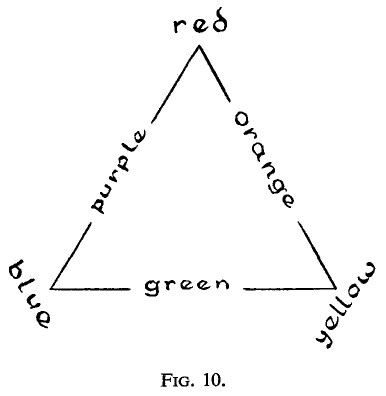
Consequently he summarizes his reflexions on coloured afterimages and their reversals of colour in these words: 'The eye demands actual completeness and closes the colour-circle in itself.' How true this is, the law connecting the corresponding colours shows, as may be seen in the following diagram. Here, red, yellow and blue as three primary colours confront the three remaining colours, green, violet and orange in such a way that each of the latter represents a mixture of the two other primary colours. (Fig. 10.)
Colour and contrast-colour are actually so related that to whatever colour the eye is exposed it produces a counter-colour so as to have the sum-total of all the three primary colours in itself. And so, in consequence of the interplay of outer and inner light in the eye, there is always present in it the totality of all the colours.
It follows that the appearance of the contrast-colour in the field of vision is not, as the Newtonian theory asserts, the result of fatigue, but of an intensified activity of the eye, which continues even after the colour impression which gave rise to it has ceased. What is seen on the neutral surface (it will be shown later why we studiously avoid speaking of 'white light') is no outwardly existing colour at all. It is the activity of the eye itself, working in a dreamlike way from its blood-vessel system, and coming to our consciousness by this means.
Here again, just as in the simple opposition of light and dark, the perception of coloured after-images is connected with a breaking-down process in the nerve region of the eye, and a corresponding building-up activity coming from the blood. Only in this case the eye is not affected by simple light, but by light of a definite colouring. The specific destructive process caused by this light is answered with a specific building-up process by the blood. Under certain conditions we can become dreamily aware of this process which normally does not enter our consciousness. In such a case we see the contrasting colour as coloured after-image.
Only by representing the process in this way do we do justice to a fact which completely eludes the onlooker-consciousness - namely, that the eye produces the contrasting colour even while it is still exposed to the influence of the outer colour. Since this is so, all colours appearing to us in ordinary vision are already tinged by the subdued light of the opposite colour, produced by the eye itself. One can easily convince oneself of this through the following experiment. Instead of directing the eye, after it has been exposed to a certain colour, to a neutral surface, as previously, gaze at the appropriate contrasting colour. (The first and second coloured surfaces should be so arranged that the former is considerably smaller than the latter.) Then, in the middle of the second surface (and in a field about the size of the first), its own colour appears, with a strikingly heightened intensity.
Here we find the eye producing, as usual, a contrast-colour from out of itself, as an after-image, even while its gaze is fixed on the same colour in the outer world. The heightened brilliance within the given field is due to the addition of the after-image colour to the external colour.
The reader may wonder why this phenomenon is not immediately adduced as a decisive proof of the fallacy of the whole Newtonian theory of the relation of 'white' light to the various colours. Although it does in fact offer such a proof, we have good reason for not making this use of it here. Throughout this book it is never our intention to enter into a contest of explanations, or to defeat one explanation by another. How little this would help will be obvious if we realize that research was certainly not ignorant of the fact that the opposite colour arises even when the eye is not turned to a white surface. In spite of this, science did not feel its concept of white light as the sum of all the colours to be an error, since it has succeeded in 'explaining' this phenomenon too, and fitting it into the prevailing theory. To do so is in thorough accord with spectator-thinking. Our own concern, however, as in all earlier cases, is to replace this thinking with all its 'proofs' and 'explanations' by learning to read in the phenomena themselves. For no other purpose than this the following facts also are now brought forward.
*
Besides Rudolf Steiner's fundamental insight into the spiritual-physical nature of the growing human being, through which he laid the basis of a true art of education, he gave advice on many practical points. For example, he indicated how by the choice of a suitable colour environment one can bring a harmonizing influence to bear on extremes of temperament in little children. To-day it is a matter of practical experience that excitable children are quietened if they are surrounded with red or red-yellow colours, or wear clothes of these colours, whereas inactive, lethargic children are roused to inner movement if they are exposed to the influence of blue or blue-green colours.
This psychological reaction of children to colour is not surprising if one knows the role played by the blood in the process of seeing, and how differently the soul-life of man is connected with the blood-nerve polarity of his organism in childhood and in later life. What we have described as the polar interplay of blood and nerve in the act of sight is not confined to the narrow field of the eye. Just as the nerve processes arising in the retina are continued to the optic centre in the cerebrum, so must we look for the origin of the corresponding blood process not in the choroid itself, but in the lower regions of the organism. Wherever, therefore, the colour red influences the whole nerve system, the blood system as a whole answers with an activity of the metabolism corresponding to the contrasting colour, green. Similarly it reacts as a whole to a blue-violet affecting the nerve system, this time with a production corresponding to yellow-orange.
The reason why in later years we notice this so little lies in a fact we have repeatedly encountered. The consciousness of the grown man to-day, through its one-sided attachment to the death-processes in the nerve region, pays no attention to its connexion with the life-processes centred in the blood system. In this respect the condition of the little child is quite different. Just as the child is more asleep in its nerve system than the grown-up person, it is more awake in its blood system. Hence in all sense-perceptions a child is not so much aware of how the world works on its nerve system as how its blood system responds. And so a child in a red environment feels quietened because it experiences, though dimly, how its whole blood system is stimulated to the green production; bluish colours enliven it because it feels its blood answer with a production of light yellowish tones.
From the latter phenomena we see once more the significance of Goethe's arrangement of his Farbenlehre. For we are now able to realize that to turn one's attention to the deeds and sufferings of the inner light means nothing less than to bring to consciousness the processes of vision which in childhood, though in a dreamlike way, determine the soul's experience of seeing. Through placing his examination of the physiological colours at the beginning of his Farbenlehre, Goethe actually took the path in scientific research to which Thomas Reid pointed in philosophy. By adapting Reid's words we can say that Goethe, in his Farbenlehre, proclaims as a basic principle of a true Optics: that we must become again as little children if we would reach a philosophy of light and colours.
1Wär' nicht das Auge sonnenhaft, Wie könnten wir das Licht erblicken? Lebt' nicht in uns des Gottes eigne Kraft, Wie könnt' uns Göttliches entzucken!
2 Inquiry, VI, 1. The italics are Reid's.
3 Presumably Kant and his school. Schopenhauer was definitely of this opinion.
4 As regards the principle underlying the line of consideration followed here, see the remark made in Chapter V in connexion with Goethe's study of the 'proliferated rose' (p. 76f.).
CHAPTER XVI
Seeing as 'Deed' - II
The observation of our own visual process, which we began in the last chapter, will serve now to free us from a series of illusory concepts which have been connected by the onlooker-consciousness with the phenomena brought about by light.
There is first the general assumption that light as such is visible. In order to realize that light is itself an invisible agent, we need only consider a few self-evident facts - for instance, that for visibility to arise light must always encounter some material resistance in space. This is, in fact, an encounter between light, typifying levity, and the density of the material world, typifying gravity. Accordingly, wherever visible colours appear we have always to do with light meeting its opposite.
Optics, therefore, as a science of the physically perceptible is never concerned with light alone, but always with light and its opposite together. This is actually referred to in Ruskin's statement, quoted in the last chapter, where he speaks of the need of the 'force' and of the intercepting bodily organ before a science of optics can come into existence. Ruskin's 'light', however, is what we have learnt with Goethe to call 'colour', whereas that for which we reserve the term 'light' is called by him simply 'force'.
All this shows how illusory it is to speak of 'white' light as synonymous with simple light, in distinction to 'coloured' light. And yet this has been customary with scientists from the time of Newton until today, not excluding Newton's critic, Eddington. In fact, white exists visibly for the eye as part of the manifested world, and is therefore properly characterized as a colour. This is, therefore, how Goethe spoke of it. We shall see presently the special position of white (and likewise of black), as a colour among colours. What matters first of all is to realize that white must be strictly differentiated from light as such, for the function of light is to make visible the material world without itself being visible.
To say that light is invisible, however, does not mean that it is wholly imperceptible. It is difficult to bring the perception of light into consciousness, for naturally our attention, when we look out into light-filled space, is claimed by the objects of the illuminated world, in all their manifold colours and forms. Nevertheless the effect of pure light on our consciousness can be observed during a railway journey, for instance, when we leave a tunnel that has been long enough to bring about a complete adaptation of the eyes to the prevailing darkness. Then, in the first moments of the lightening of the field of vision, and before any separate objects catch the attention, we can notice how the light itself exercises a distinctly expanding influence on our consciousness. We feel how the light calls on the consciousness to participate, as it were, in the world outside the body.
It is possible also to perceive directly the opposite of light. This is easier than the direct perception of light, for in the dark one is not distracted by the sight of surrounding objects. One need only pay attention to the fact that, after a complete adapting of the eyes to the dark, one still retains a distinct experience of the extension of the field of vision of both eyes. We find here, just as in the case of light, that our will is engaged within the eye in a definite way; a systolic effect proceeds from dark, a diastolic effect from light. We have a distinct perception of both, but not of anything 'visible' in the ordinary sense.
With regard to our visual experience of white and black, it is quite different. We are concerned here with definite conditions of corporeal surfaces, just as with other colours, although the conditions conveying the impressions of white or black are of a special character. A closer inspection of these conditions reveals a property of our act of seeing which has completely escaped scientific observation, but which is of fundamental importance for the understanding of optical phenomena dynamically.
It is well known that a corporeal surface, which we experience as white, has the characteristic of throwing back almost all the light that strikes it, whereas light is more or less completely absorbed by a surface which we experience as black. Such extreme forms of interplay between light and a corporeal surface, however, do not only occur when the light has no particular colour, but also when a coloured surface is struck by light of the same or opposite colour. In the first instance complete reflexion takes place; in the second, complete absorption. And both these effects are registered by the eye in precisely the same manner as those mentioned before. For example, a red surface in red light looks simply white; a green surface in red light looks black.
The usual interpretation of this phenomenon, namely, that it consists in a subjective 'contrast' impression of the eye - a red surface in red light looking brighter, a green surface darker, than its surroundings, and thereby causing the illusion of white or black - is a typical onlooker-interpretation against which there stands the evidence of unprejudiced observation. The reality of the 'white' and the 'black' seen in such cases is so striking that a person who has not seen the colours of the objects in ordinary light can hardly be persuaded to believe that they are not 'really' white or black. The fact is that the white and the black that are seen under these conditions are just as real as 'ordinary' white and black. When in either instance the eye registers 'white' it registers exactly the same event, namely, the total reflexion of the light by the surface struck by it. Again, when the eye registers 'black' in both cases it registers an identical process, namely, total absorption of the light.1
Seen thus, the phenomenon informs us of the significant fact that our eye is not at all concerned with the colour of the light that enters its own cavity, but rather with what happens between the light and the surface on which the light falls. In other words, the phenomenon shows that our process of seeing is not confined to the bodily organ of the eye, but extends into outer space to the point where we experience the visible object to be.2
This picture of the visual process, to which we have been led here by simple optical observation, was reached by Thomas Reid through his own experience of how, in the act of perceiving the world, man is linked intuitively with it. We remember that he intended in his philosophy to carry ad absurdum the hypothesis that 'the images of the external objects are conveyed by the organs of sense to the brain and are there perceived by the mind'. Common Sense makes Reid speak as follows: 'If any man will shew how the mind may perceive images of the brain, I will undertake to shew how it may perceive the most distant objects; for if we give eyes to the mind, to perceive what is transacted at home in its dark chamber, why may we not make the eyes a little longer-sighted? And then we shall have no occasion for that unphilosophical fiction of images in the brain.' (Inq., VI, 12.) Reid proceeds to show this by pointing out, first, that we must only use the idea of 'image' for truly visual perceptions; secondly, that the sole place of this image is the background of the eye, and not any part of the nervous system lying beyond; thirdly, that even this retina-image, as such, does not come to our consciousness, but serves only to direct the consciousness to the cause of the image, namely, the external object itself. In what follows we shall deal with an observation which will show how right Reid was in this respect.
Those familiar with this observation (well known indeed to those living in the hilly and mountainous districts both here and on the Continent) know that when distant features of the landscape, in an otherwise clear and sunlit atmosphere, suddenly seem almost near enough to touch, rainy weather is approaching. Likewise a conspicuous increase in distance, while the sky is still overcast, foreshadows fine weather.
This effect (the customary 'explanation' of which is, as usual, of no avail to us and so need not concern us here) ranks with phenomena described in optics under the name of 'apparent optical depth', a subject we shall discuss more fully in the next chapter. It suffices here to state that it is the higher degree of humidity which, by lending the atmosphere greater optical density (without changing its clarity), makes distant objects seem to be closer to the eye, and vice versa. (If we could substitute for the air a much lighter gas - say, hydrogen - then the things we see through it would look farther off than they ever do in our atmosphere.)
Observations such as these show us that (a) when external light strikes the retina of our eye, our inner light is stimulated to move out of the eye towards it; (b) in pressing outward, this inner light meets with a certain resistance, and the extent of this determines at what distance from the eye our visual ray comes to rest as the result of a kind of exhaustion. Just as the outer light reaches an inner boundary at our retina, so does the inner light meet with an outer boundary, set by the optical density of the medium spread out before the eye, Outer and inner light interpenetrate each other along the whole tract between these two boundaries, but normally we are not conscious of this process. We first become conscious of it where our active gaze - that is, the inner light sent forth through the eye - reaches the limit of its activity. At that point we become aware of the object of our gaze. So here we find confirmed a fact noted earlier, that consciousness - at least at its present state of evolution - arises where for some reason or other our volition conies to rest.
*
The foregoing observations have served to awaken us in a preliminary way to the fact that an essential part of our act of seeing takes place outside our bodily organ of vision and that our visual experience is determined by what happens out there between our gaze and the medium it has to penetrate. Our next task will be to find out how this part of our visual activity is affected by the properties of the different colours. We shall thereby gain a further insight into the nature of the polarity underlying all colour-phenomena, and this again will enable us to move a step further towards becoming conscious of what happens in our act of seeing.
We shall start by observing what happens to the two sides of the colour-scale when the optical medium assumes various degrees of density.
For the sky to appear blue by day a certain purity of the atmosphere is needed. The more veiled the atmosphere becomes the more the blue of the sky turns towards white; the purer and rarer the atmosphere, the deeper the blue, gradually approaching to black. To mountain climbers and those who fly at great heights it is a familiar experience to see the sky assume a deep indigo hue. There can be no doubt that at still higher altitudes the colour of the sky passes over into violet and ultimately into pure black. Thus in the case of blue the field of vision owes its darkening to a decrease in the resistance by which our visual ray is met in the optical medium. It is precisely the opposite with yellow. For here, as the density of the medium increases, the colour-effect grows darker by yellow darkening first to orange and then to red, until finally it passes over into complete darkness.
This shows that our visual ray is subject to entirely different dynamic effects at the two poles of the colour-scale. At the blue pole, the lightness-effect springs from the resistant medium through which we gaze, a medium under the influence of gravity, while the darkness is provided by the anti-gravity quality of cosmic space, which as a 'negative' resistance exercises a suction on the eye's inner light. At the yellow pole it is just the reverse. Here, the resistant medium brings about a darkening of our field of vision, while the lightness-effect springs from a direct meeting of the eye with light, and so with the suctional effect of negative density.
Our pursuit of the dynamic causes underlying our apperception of the two poles of the colour-scale has led us to a point where it becomes necessary to introduce certain new terms to enable us to go beyond Goethe's general distinction between Finsternis (darkness) and Licht (light). Following Goethe, we have so far used these two terms for what appears both in blue and yellow as the respective light and dark ingredients. This distinction cannot satisfy us any more. For through our last observations it has become clear that the Finsternis in blue and the Licht in yellow are opposites only in appearance, because they are both caused by Levity, and similarly that the lightening effect in blue and the darkening effect in yellow are both effected by Gravity. Therefore, to distinguish between what appertains to the primary polarity, Levity-Gravity, on the one hand, and their visible effects in the secondary polarity of the colours, on the other, we shall henceforth reserve the term darkness and, with it, lightness for instances where the perceptible components of the respective colours are concerned, while speaking of Dark and Light where reference is made to the generating primary polarity.
*
If we are justified in thus tracing the colour-polarity to a polarically ordered interplay between levity and gravity, we may then pursue the following line of thought. We know from earlier considerations that wherever such an interplay between the poles of the primary polarity takes place, we have to do, in geometric terms, with the polarity of sphere and radius. We may therefore conclude that the same characteristics will apply to the way in which the blue of the sky and the yellow of the sunlight are encountered spatially. Now we need only observe how the blue heavens arch over us spherically, on the one hand, and how the yellow brightness of the sun penetrates the air ray-wise, on the other, in order to realize that this really is so.
Having thus established the connexion of the two poles of the colour-scale with the spherical and radial structure of space, we are now able to express the Goethean ur-phenomenon in a more dynamic way as follows: On the one hand, we see the blue of the heavens emerging when levity is drawn down by gravity from its primal invisibility into visible, spherical manifestation. In the yellow of the sunlight, on the other hand, we see gravity, under the influence of the sun's levity, gleaming up radially into visibility. The aspect of the two colour-poles which thus arises before us prompts us to replace Goethe's 'lightened Dark' by Earthward-dawning-Levity, and his 'darkened Light' by Heavenward-raying-Gravity.
We have now to show that this picture of the dynamic relationship which underlies the appearance of the colour-polarity in the sky is valid also for other cases which are instances of the ur-phenomenon of the generation of colour in Goethe's sense, but seem not to lend themselves to the same cosmic interpretation. Such a case is the appearance of yellow and blue when we look through a clouded transparent medium towards a source of light or to a black background. There is no special difficulty here in bringing the appearance of yellow into line with its macrotelluric counterpart, but the appearance of blue requires some consideration.
We have seen that a corporeal surface appears as black if light striking it is totally absorbed by it. Thus, wherever our eye is met by the colour black, our visual ray is engaged in a process whereby light disappears from physical space. Now we need only bring this process into consciousness - as we have tried to do before in similar instances - to realize that what happens here to the visual ray is something similar to what it undergoes when it is directed from the earth into cosmic space.
Note, in this respect, the principle of the mirror as another instance of the fact that the interplay between light and an illumined surface can have on the visual ray an effect similar to that of external space. For the optical processes which occur on the surface of a mirror are such that, whilst taking place on a two-dimensional plane, they evoke in our consciousness pictures of exactly the same nature as if we were looking through the mirror into the space behind it.
*
The value of our picture of the colour-polarity is shown further if we observe how natural phenomena based on the same kind of polarity in other realms of nature fit in with it. We remember that one of Goethe's starting-points in his investigation of the riddle of colour was the observation that of the totality of colours one part is experienced as 'warm' and the other as 'cold'. Now we can go further and say that the colours of the spherical pole are experienced as cold, those of the radial pole as warm. This corresponds precisely to the polarity of snow-formation and volcanic activity. The former, being the spherically directed process, requires physically low temperatures; the latter, being the radially directed process, requires high temperatures. Here, once more, we see with what objectivity the human senses register the facts of the outer world.
Another realm of phenomena based on a similar polar order is that of electricity. When we studied the negative and positive poles of the vacuum tube, with regard to the polar distribution of radius and sphere, our attention was drawn to the colours appearing on the two electrodes - red at the (positive) anode, blue at the (negative) cathode. Again we find a coincidence with the natural order of the colours.
Note how the qualitative dynamic method employed here brings into direct view the relationship between light and electricity, while it precludes the mistake of tracing light processes to those of electricity, as modern science does. Nor are electric processes 'explained' from this point of view merely as variations of light processes. Rather is the relation between light and electricity seen to be based on the fact that all polarities arising perceptibly in nature are creations of the same primeval polarity, that of Levity and Gravity. The interplay of Levity and Gravity can take on many different forms which are distinguished essentially by differences in cosmic age. Thus the colour-polarity in its primal form, made manifest by the heavens, differs as much from the corresponding polarity shown by the vacuum tube, as does the lightning in the heights from the electric spark.
*
With the aid of what we have learnt here concerning outer light-processes we shall turn once more to the activity of our own inner light.
We may expect by now that our eye is fitted with two modes of seeing activity, polar to each other, and that the way in which they come into operation depends on whether the interplay of positive and negative density outside the eye leads to the appearance of the blue-violet or of the yellow-red side of the colour-scale. Such a polarity in the activity of the eye can indeed be established. Along with it goes a significant functional difference between the two eyes (not unlike that shown of the two hands).
To observe this we need simply to compare the two eyes of a person in a photograph by covering alternately the right and the left half of the face. Nearly always it will be found that the right eye looks out clearly into the world with an active expression, and the left eye with a much gentler one, almost held back. Artists are well aware of this asymmetry, as of others in the human countenance, and are careful to depict it. An outstanding example is Raphael's Sistine Madonna, where in the eyes and whole countenance both of Mother and Child this asymmetry can be studied in a specially impressive way.
Inner observation leads to a corresponding experience. A convenient method is to exercise the two eyes in complete darkness, in the following way. One eye is made to look actively into the space in front of it, as if it would pierce the darkness with its visual ray, while the activity of the other eye is held back, so that its gaze rests only superficially, as it were, on the darkness in front of it. Experience shows that most people find it natural to give the active note to the right eye, and the passive note to the left.
Once one has grown conscious of this natural difference between the two eyes, it is quite easily detected while one is looking normally into the light-filled environment. We thereby realize that for the two eyes to act differently in this way is the usual thing.
As an instance where this fact is well observed and effectively made use of, that of shooting may be mentioned here, especially shooting at flying game. Those who train in this sport learn to make a completely different use of the two eyes in sighting the target. The naturally more active eye - only once in about fifty cases is it the left - is called by them the 'master-eye'. Whilst the less actively gazing eye is usually employed for surveying the field as a whole into which the target is expected to enter, the master-eye is used for making active contact with the target itself ('throwing' oneself on the target 'through' the eye).
One further observation may be added. If one looks with rested eyes and in very faint daylight (perhaps in the early morning on awakening) at a white surface, while opening and closing the eyes alternately, then the white surface looks faintly reddish to the 'master-eye', and faintly bluish to the other.
*
Following the lines of our treatment of after-images in the last chapter, we will next inquire into the anatomical and physiological basis of the two opposite sight-activities. In the previous instance we found this in the polarity of nerve and blood. This time we must look for it in a certain twofold structure of the eye itself. We shall best perceive this by watching the 'becoming' of the eye, thus again following a method first shown by Goethe.
Fig. 11 shows the human eye in different stages of its embryonic formation. The eye is clearly seen to consist of two parts essentially different in origin. Growing out from the interior of the embryonic organism is a structure that is gradually pushed in, and in its further development becomes the entire posterior part of the eye, destined to carry its life-imbued functions. A second independent part grows towards this from outside; this is at first a mere thickening of the embryonic skin formation, but later it loosens itself and presses forward into the interior of the cup-shaped structure. It is gradually enclosed by this, and evolves finally into that part of the finished eye which embodies the optical apparatus functioning according to purely physical laws.
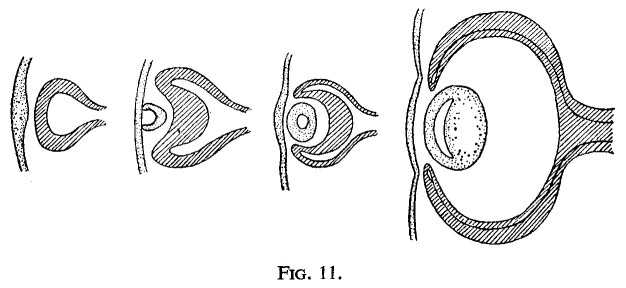
This series of forms shows that in the embryonic formation of the eye we are confronted with two processes, one of spherical, and the other of radial orientation. Consequently the two parts of the eye are differentiated in such a way that the posterior part, which has grown forth radially from the embryonic organism, as the life-filled element represents the sulphur-pole of the total eye, while the anterior part, with its much more crystalline nature, having grown spherically towards the organism, represents the eye's salt-pole.
Closer inspection into the connexion of the two visual activities of the eye with its basic corporeal parts reveals that here, at the outermost boundary of the human organism, we encounter once more that peculiar reversal of functions which we have already several times met in various realms of nature. For the anterior part of the eye - its salt-pole - which has come into being through a spherically directed formative process, seems to be the one through which we exercise the perceptive activity streaming out radially from the eye, whilst the posterior part - the eye's sulphur-pole - which has come into being through radially directed formative action, serves that form of seeing which is more receptive and is carried out in a plane-wise manner.
Considerations of this kind, and they alone, enable us also to draw true comparisons between the different sense-organs. Take the organ of hearing. Usually the ear is assumed to fill the same role in the field of hearing as does the eye in the field of seeing. In fact the ear corresponds to only one half of the eye; the other half must be looked for in the larynx. In other words, the two parts of the eye are represented in the realm of hearing by two separate organs, ear and larynx. Speaking from the aspect of metamorphosis, the vital part of our eye may be regarded as our 'light-ear'; the crystalline part, as our 'light-larynx'. In order to come consciously to a perception of sight we must 'listen' to the 'deeds and sufferings' of light, while at the same time we meet them with the help of the 'speaking' of our inner light. Something similar holds good for hearing. In fact, observation reveals that we take in no impression of hearing unless we accompany it with an activity of our larynx, even though a silent one. The significance of this fact for the total function of hearing will occupy us more fully later.
*
Our insight into the polar nature of visual activity will enable us now to link the external interplay of Light and Dark - to which the physical colours owe their existence - to that play of forces which we ourselves set in motion when our eye meets the world of colours in their polar differentiation.
We established earlier that in the cold colours the role of darkness belongs to the pole of levity or negative density, and the role of lightness to the pole of gravity or positive density, whereas in the case of the warm colours the roles are reversed. Let us now unite with this the insight we have meanwhile gained into the two kinds of activity in seeing - the receptive, 'left-eyed' and the radiating, 'right-eyed' - which mediate to us the experience of the positive or negative density of space spread out before our eyes. Taking together the results of outer and inner observation, we can express the polarity ruling in the realm of colour as follows.
If lightness and darkness as elements of colour, meet us in such a way that lightness, by reason of its positive density, calls forth 'left-eyed' activity, and darkness, by reason of its negative density, 'right-eyed' activity, then our soul receives the impression of the colour blue and colours related to blue. If lightness and darkness meet us so that we see the former in a 'right-eyed', and the latter in a 'left-eyed' way, then we experience this as the presence of yellow and the colours related to it.
The reason why we usually fail to observe the different kinds of interplay of the two modes of seeing, when we perceive one or other of the two categories of colour, is because in ordinary sight both eyes exercise each of the two activities without our becoming aware which is the leading one in a particular eye. If, however, one has come to a real experience of the inner polarity of the visual act, one needs only a little practice to realize the distinction. For example, if one looks at the blue sky, notably at noon-time, on the side away from the sun, or at the morning or evening sky, shining yellow and red, one quickly becomes conscious of how our eyes take hold of the particular contribution which Light and Dark make to one or other of the two colour appearances.
*
In the natural course of our argument we had to keep at first to the appearance of colours as they come freely before us in space. The results we have obtained, however, hold good equally well for the permanent tints of material objects, as the following example will show.
A fact known to science is that red and blue surface colours, when illumined by light of steadily diminishing intensity, are seen to reverse their normal ratio of brightness. This phenomenon can be seen in nature, if, for instance, one observes a bed of blue and red flowers in the fading evening light and compares the impression with that which the same flowers make in bright daylight. If the phenomenon is reproduced artificially, the actual transition from one state to the other can be clearly observed. The easiest way is to place a red and a blue surface side by side under an electric light whose intensity can be gradually lessened by means of a sliding resistance. Here, as much as in the natural phenomenon, our reason finds it difficult to acknowledge that the surface gleaming in a whitish sheen should be the one which ordinarily appears as darkling blue, and that the one disappearing into darkness should be the surface which normally presents itself as radiant red.
This riddle is readily solved if we apply what we have learnt about the particular shares of lightness and darkness in these two colours, and if we link this up with the respective forms of seeing exercised by our two eyes. To the dim light, clearly, our eyes will respond more with the 'left-eyed' than with the 'right-eyed' form of vision. Now we know that it is 'left-eyed' vision which is roused by the lightness-component in blue and the darkness-component in red. It is only to be expected, therefore, that these elements should become conspicuous when in the dim light our seeing is mainly 'left-eyed'. This solution of the problem makes us realize further, that the laws which Goethe first found for the coming into appearance of colours freely hovering in space are indeed applicable to the fixed material colours as well.
1 It will be well to remember here the discussion of our experience of temperature through the sense of warmth in Chapter VIII (p. 134f.).
2 Along these lines the true solution of the problem of the so-called coloured shadows will be found, Goethe studied this without finding, however, a satisfactory answer.
CHAPTER XVII
Optics of the Doer
Three basic concepts form the foundation for the present-day scientific description of a vast field of optical phenomena, among them the occurrence of the spectral colours as a result of light passing through a transparent medium of prismatic shape. They are: 'optical refraction', 'light-ray', and 'light-velocity' - the latter two serving to explain the first. In a science of optics which seeks its foundation in the intercourse between man's own visual activity and the doings and sufferings of light, these three concepts must needs undergo a decisive change, both in their meaning and in their value for the description of the relevant optical phenomena. For they are all purely kinematic concepts typical of the onlooker-way of conceiving things - concepts, that is, to which nothing corresponds in the realm of the actual phenomena.
Our next task, therefore, will be, where possible, to fill these concepts with new meaning, or else to replace them by other concepts read from the actual phenomena. Once this is done the way will be free for the development of the picture of the spectrum phenomenon which is in true accord with the Goethean conception of Light and Colour.
*
The first to be brought in this sense under our examination is the concept of the 'light-ray'.
In present-day optics this concept signifies a geometrical line of infinitely small width drawn, as it were, by the light in space, while the cone or cylinder of light actually filling the space is described as being composed of innumerable such rays. In the same way the object producing or reflecting light is thought of as composed of innumerable single points from which the light-rays emerge. All descriptions of optical processes are based upon this conception.
Obviously, we cannot be satisfied with such a reduction of wholes into single geometrically describable parts, followed by a reassembling of these parts into a whole. For in reality we have to do with realms of space uniformly filled with light, whether conical or cylindrical in form, which arise through certain boundaries being set to the light. In optical research we have therefore always to do with pictures, spatially bounded. Thus what comes before our consciousness is determined equally by the light calling forth the picture, and by the unlit space bordering it.
Remembering the results of our earlier study, we must say further of such a light-filled realm that it lacks the quality of visibility and therefore has no colour, not even white. Goethe and other 'readers', such as Reid and Ruskin, tried continually to visualize what such a light-filled space represents in reality. Hence they directed their attention first to those spheres where light manifests its form-creative activity, as in the moulding of the organ of sight in animal or man, or in the creation of the many forms of the plant kingdom - and only then gave their mind to the purely physical light-phenomena. Let us use the same method to form a picture of a light-filled space, and to connect this with the ideas we have previously gained on the co-operation in space of levity and gravity.
Suppose we have two similar plant-seeds in germ; and let one lie in a space filled with light, the other in an unlit space. From the different behaviour of the two seeds we can observe certain differences between the two regions of space. We note that within the light-filled region the spiritual archetype of the plant belonging to the seed is helped to manifest itself physically in space, whereas in the dark region it receives no such aid. For in the latter the physical plant, even if it grows, does not develop its proper forms. This tells us, in accordance with what we have learnt earlier, that in the two cases there is a different relation of space to the cosmically distant, all-embracing plane. Thus inside and outside the light-region there exists a quite different relation of levity and gravity - and this relation changes abruptly at the boundaries of the region. (This fact will be of especial importance for us when we come to examine the arising of colours at the boundary of Light and Dark, when light passes through a prism.)
*
After having replaced the customary concept of the light-bundle composed of single rays by the conception of two dynamically polar realms of space bordering each other, we turn to the examination of what is going on dynamically inside these realms. This will help us to gain a proper concept of the propagation of light through space.
In an age when the existence of a measurable light-velocity seems to belong to the realm of facts long since experimentally proved; when science has begun to measure the universe, using the magnitude of this velocity as a constant, valid for the whole cosmos; and when entire branches of science have been founded on results thus gained, it is not easy, and yet it cannot be avoided, to proclaim that neither has an actual velocity of light ever been measured, nor can light as such ever be made subject to such measurement by optical means - and that, moreover, light, by its very nature, forbids us to conceive of it as possessing any finite velocity.
With the last assertion we do not mean to say that there is nothing going on in connexion with the appearance of optical phenomena to which the concept of a finite velocity is applicable. Only, what is propagated in this way is not the entity we comprise under the concept of 'light'. Our next task, therefore, will be to create a proper distinction between what moves and what does not move spatially when light is active in the physical world. Once more an historical retrospect will help us to establish our own standpoint with regard to the existing theories.
The first to think of light as possessing a finite velocity was Galileo, who also made the first, though unsuccessful, attempt to measure it. Equally unsuccessful were attempts of a similar nature made soon afterwards by members of the Accademia del Cimento. In both cases the obvious procedure was to produce regular flashes of light and to try to measure the time which elapsed between their production and their observation by some more or less distant observer. Still, the conviction of the existence of such a velocity was so deeply ingrained in the minds of men that, when later observations succeeded in establishing a finite magnitude for what seemed to be the rate of the light's movement through space, these observations were hailed much more as the quantitative value of this movement than as proof of its existence, which was already taken for granted.
A clear indication of man's state of mind in regard to this question is given in the following passage from Huygens's famous Traité de la Lumière, by which the world was first made acquainted with the concept of light as a sort of undulatory movement.
'One cannot doubt that light consists in the movement of a certain substance. For if one considers its production one finds that here on the earth it is chiefly produced by fire and flame, which without doubt contain bodies in rapid motion, for they dissolve and melt numberless other bodies. Or, if one considers its effects, one sees that light collected, for instance, by a concave mirror has the power to heat like fire, i.e. to separate the parts of the bodies; this assuredly points to movement, at least in true philosophy in which one traces all natural activity to mechanical causes. In my opinion one must do this, or quite give up all hope of ever grasping anything in physics.'
In these words of Huygens it must strike us how he first provides an explanation for a series of phenomena as if this explanation were induced from the phenomena themselves. After he has drawn quite definite conclusions from it, he then derives its necessity from quite other principles - namely, from a certain method of thinking, accepting this as it is, unquestioned and unalterably established. We are here confronted with an 'unlogic' characteristic of human thinking during its state of isolation from the dynamic substratum of the world of the senses, an unlogic which one encounters repeatedly in scientific argumentation once one has grown aware of it. In circles of modern thinkers where such awareness prevails (and they are growing rapidly to-day) the term 'proof of a foregone conclusion' has been coined to describe this fact.1
'Proof of a foregone conclusion' is indeed the verdict at which one arrives in respect of all the observations concerned with the velocity of light - whether of existing phenomena detectable in the sky or of terrestrial phenomena produced artificially - if one studies them with the attitude of mind represented by the child in Hans Andersen's story. In view of the seriousness of the matter it will not be out of place if we discuss them here as briefly as possible, one by one.2
The relevant observations fall into two categories: observations of certain astronomical facts from which the existence of a finite velocity of light and its magnitude as an absolute property of it has been inferred; and terrestrial experiments which permitted direct observation of a process of propagation connected with the establishment of light in space resulting in the measurement of its speed. To the latter category belong the experiments of Fizeau (1849) and Foucault (1850) as well as the Michelson-Morley experiment with its implications for Einstein's Theory of Relativity. The former category is represented by Roemer's observations of certain apparent irregularities in the times of revolution of one of Jupiter's moons (1676), and by Bradley's investigation into the reason for the apparent rhythmic changes of the positions of the fixed stars (1728).
We shall start with the terrestrial observations, because in their case alone is the entire path of the light surveyable, and what is measured therefore is something appertaining with certainty to every point of the space which spreads between the source of the light and the observer. For this reason textbooks quite rightly say that only the results drawn from these terrestrial observations have the value of empirically observed facts. (The interpretation given to these facts is another question.)
Now, it is a common feature of all these experiments that by necessity they are based on an arrangement whereby a light-beam can be made to appear and disappear alternately. In this respect there is no difference between the first primitive attempts made by Galileo and the Academicians, and the ingeniously devised experiments of the later observers, whether they operate with a toothed wheel or a rotating mirror. It is always a flash of light - and how could it be otherwise? - which is produced at certain regular intervals and used for determining the speed of propagation.
Evidently what in all these cases is measured is the speed with which a beam of light establishes itself in space. Of what happens within the beam, once it is established, these observations tell nothing at all. The proof they are held to give of the existence of a finite speed of light, as such, is a 'proof of a foregone conclusion'. All they tell us is that the beam's front, at the moment when this beam is first established, travels through space with a finite velocity and that the rate of this movement is such and such. And they tell us nothing at all about other regions of the cosmos.
That we have to do in these observations with the speed of the light-front only, and not of the light itself, is a fact fully acknowledged by modern physical optics. Since Lord Rayleigh first discussed this matter in the eighties of the last century, physicists have learnt to distinguish between the 'wave-velocity' of the light itself and the velocity of an 'impressed peculiarity', the so-called 'group-velocity', and it has been acknowledged that only the latter has been, and can be, directly measured. There is no possibility of inferring from it the value of the 'wave-velocity' unless one has a complete knowledge of the properties of the medium through which the 'groups' travel. Nevertheless, the modern mind allows itself to be convinced that light possesses a finite velocity and that this has been established by actual measurement. We feel reminded here of Eddington's comment on Newton's famous observations: 'Such is the glamour of a historical experiment.' (Chapter XIV.)3
Let us now turn to Roemer and Bradley. In a certain sense Roemer's observations and even those of Bradley rank together with the terrestrial measurements. For Roemer used as optical signals the appearance and disappearance of one of Jupiter's moons in the course of its revolution round the planet; thus he worked with light-flashes, as the experimental investigations do. Hence, also, his measurements were concerned - as optical science acknowledges - with group-velocity only. In fact, even Bradley's observations, although he was the only one who operated with continuous light-phenomena, are exposed to the charge that they give information of the group-velocity of light, and not of its wave-velocity. However, we shall ignore these limitations in both cases, because there are quite other factors which invalidate the proofs they are held to give, and to gain a clear insight into these factors is of special importance for us.
Roemer observed a difference in the length of time during which a certain moon of Jupiter was occulted by the planet's body, and found that this difference underwent regular changes coincident with the changes in the earth's position in relation to Jupiter and the sun. Seen from the sun, the earth is once a year in conjunction with Jupiter, once in opposition to it. It seemed obvious to explain the time-lag in the moon's reappearance, when the earth was on the far side of the sun, by the time the light from the moon needed to cover the distance marked by the two extreme positions of the earth - that is, a distance equal to the diameter of the earth's orbit. On dividing the observed interval of time by the accepted value of this distance, Roemer obtained for the velocity of light a figure not far from the one found later by terrestrial measurements.
We can here leave out of account the fact that Roemer's reasoning is based on the assumption that the Copernican conception of the relative movements of the members of our solar system is the valid conception, an assumption which, as later considerations will show, cannot be upheld in a science which strives for a truly dynamic understanding of the world. For the change of aspect which becomes necessary in this way does not invalidate Roemer's observation as such; it rules out only the customary interpretation of it. Freed from all hypothetical by-thought, Roemer's observation tells us, first, that the time taken by a flash of light travelling from a cosmic light-source to reach the earth varies to a measurable extent, and, secondly, that this difference is bound up with the yearly changes of the earth's position in relation to the sun and the relevant planetary body.
We leave equally out of account the fact that our considerations of the nature of space in Chapter XII render it impermissible to conceive of cosmic space as something 'across' which light (or any other entity) can be regarded as travelling this or that distance in this or that time. What matters to us here is the validity of the conclusions drawn from Roemer's discovery within the framework of thought in which they were made.
Boiled down to its purely empirical content, Roemer's observation tells us solely and simply that within the earth's cosmic orbit light-flashes travel with a certain measurable speed. To regard this information as automatically valid, firstly for light which is continuously present, and secondly for everywhere in the universe, rests again on nothing but a foregone conclusion.
Precisely the same criticism applies to Bradley's observation, and to an even higher degree. What Bradley discovered is the fact that the apparent direction in which we see a fixed star is dependent on the direction in which the earth moves relatively to the star, a phenomenon known under the name of 'aberration of light'. This phenomenon is frequently brought to students' understanding by means of the following or some similar analogy.
Imagine that a machine-gun in a fixed position has sent its projectile right across a railway-carriage so that both the latter's walls are pierced. If the train is at rest, the position of the gun could be determined by sighting through the shot-holes made by the entrance and exit of the bullet. If, however, the train is moving at high speed, it will have advanced a certain distance during the time taken by the projectile to cross the carriage, and the point of exit will be nearer the rear of the carriage than in the previous case. Let us now think of an observer in the train who, while ignorant of the train's movement, undertook to determine the gun's position by considering the direction of the line connecting the two holes. He would necessarily locate the gun in a position which, compared with its true position, would seem to have shifted by some distance in the direction of the train's motion. On the other hand, given the speed of the train, the angle which the line connecting the two holes forms with the true direction of the course of the projectile - the so-called angle of aberration - provides a measure of the speed of the projectile.
Under the foregone conclusion that light itself has a definite velocity, and that this velocity is the same throughout the universe, Bradley's observation of the aberration of the stars seemed indeed to make it possible to calculate this velocity from the knowledge of the earth's own speed and the angle of aberration. This angle could be established by comparing the different directions into which a telescope has to be turned at different times of the year in order to focus a particular star. But what does Bradley's observation tell us, once we exclude all foregone conclusions?
As the above analogy helps towards an understanding of the concept of aberration, it will be helpful also to determine the limits up to which we are allowed to draw valid conclusions from the supposed occurrence itself. A mind which is free from all preconceived ideas will not ignore the fact that the projectile, by being forced to pierce the wall of the carriage, suffers a considerable diminution of its speed. The projectile, therefore, passes through the carriage with a speed different from its speed outside. Since, however, it is the speed from hole to hole which determines the angle of aberration, no conclusion can be drawn from the latter as to the original velocity of the projectile. Let us assume the imaginary case that the projectile was shot forth from the gun with infinite velocity, and that the slowing-down effect of the wall was great enough to produce a finite speed of the usual magnitude, then the effect on the position of the exit hole would be precisely the same as if the projectile had moved all the time ' with this speed and not been slowed down at all.
Seeing things in this light, the scientific Andersen child in us is roused to exclaim: 'But all that Bradley's observation informs us of , with certainty is a finite velocity of the optical process going on inside the telescope!' Indeed, if someone should claim with good reason (as we shall do later on) that light's own velocity is infinite, and (as we shall not do) that the dynamic situation set up in the telescope had the effect of slowing down the light to the measured velocity - there is nothing in Bradley's observation which could disprove these assertions.
*
Having thus disposed of the false conclusions drawn by a kinematically orientated thinking from the various observations and measurements of the velocity which appears in connexion with light, we can carry on our own studies undisturbed. Two observations stand before us representing empirically established facts: one, that in so far as a finite velocity has been measured or calculated from other observations, nothing is known about the existence or magnitude of such a velocity except within the boundaries of the dynamic realm constituted by the earth's presence in the universe; the other, that this velocity is a 'group'-velocity, that is, the velocity of the front of a light-beam in process of establishment. Let us see what these two facts have to tell us when we regard them as letters of the 'word' which light inscribes into the phenomenal world as an indication of its own nature.
Taking the last-named fact first, we shall make use of the following comparison to help us realize how little we are justified in drawing from observations of the front speed of a light-beam any conclusions concerning the kinematic conditions prevailing in the interior of the beam itself. Imagine the process of constructing a tunnel, with all the efforts and time needed for cutting its passage through the resisting rock. When the tunnel is finished the activities necessary to its production are at an end. Whereas these continue for a limited time only, they leave behind them permanent traces in the existence of the tunnel, which one can describe dynamically as a definite alteration in the local conditions of the earth's gravity. Now, it would occur to no one to ascribe to the tunnel itself, as a lasting quality, the speed with which it had been constructed. Yet something similar happens when, after observing the velocity required by light to lay hold on space, this velocity is then attributed to the light as a quality of its own. It was reserved for a mode of thought that could form no concept of the real dynamic of Light and Dark, to draw conclusions as to the qualities of light from experiences obtained through observing its original spreading out into space.
To speak of an independently existing space within which light could move forward like a physical body, is, after what we have learnt about space, altogether forbidden. For space in its relevant structure is itself but a result of a particular co-ordination of levity and gravity or, in other words, of Light and Dark. What we found earlier about the qualities of the two polar spaces now leads us to conceive of them as representative of two limiting conditions of velocity: absolute contraction representing zero velocity; absolute expansion, infinite velocity (each in its own way a state of 'rest'). Thus any motion with finite velocity is a mean between these two extremes, and as such the result of a particular co-ordination of levity and gravity. This makes it evident that to speak of a velocity taking its course in space, whether with reference to light or to a physical body in motion, is something entirely unreal.
Let us now see what we are really told by the number 186,000 miles a second, as the measure of the speed with which a light-impulse establishes itself spatially. In the preceding chapter we learnt that the earth's field of gravity offers a definite resistance to our visual ray. What is true for the inner light holds good equally for the outer light. Using an image from another dynamic stratum of nature we can say that light, while appearing within the field of gravity, 'rubs' itself on this. On the magnitude of this friction depends the velocity with which a light-impulse establishes itself in the medium of the resisting gravity. Whereas light itself as a manifestation of levity possesses infinite velocity, this is forced down to the known finite measure by the resistance of the earth's field of gravity. Thus the speed of light which has been measured by observers such as Fizeau and Foucault reveals itself as a function of the gravitational constant of the earth, and hence has validity for this sphere only.1 The same is true for Roemer's and Bradley's observations, none of which, after what we have stated earlier, contradicts this result. On the contrary, seen from this viewpoint, Roemer's discovery of the light's travelling with finite speed within the cosmic realm marked by the earth's orbit provides an important insight into the dynamic conditions of this realm.
*
Among the experiments undertaken with the aim of establishing the properties of the propagation of light by direct measurements, quoted earlier, we mentioned the Michelson-Morley experiment as having a special bearing on Einstein's conceptual edifice. It is the one which has formed the foundation of that (earlier) part of Einstein's theory which he himself called the Special Theory of Relativity. Let us see what becomes of this foundation - and with it the conceptual edifice erected upon it - when we examine it against the background of what we have found to be the true nature of the so-called velocity of light.
It is generally known that modern ideas of light seemed to call for something (Huygens's 'certain substance') to act as bearer of the movement attributed to light. This led to the conception of an imponderable agency capable of certain movements, and to denote this agency the Greek word ether was borrowed. (How this word can be used again to-day in conformity with its actual significance will be shown in the further course of our discussions.) Nevertheless, all endeavours to find in the existence of such an ether a means of explaining wide fields of natural phenomena were disappointed. For the more exact concepts one tried to form of the characteristics of this ether, the greater the contradictions became.
One such decisive contradiction arose when optical means were used to discover whether the ether was something absolutely at rest in space, through which physical bodies moved freely, or whether it shared in their movement. Experiments made by Fizeau with running water seemed to prove the one view, those of Michelson and Morley, involving the movement of the earth, the other view. In the celebrated Michelson-Morley experiment the velocity of light was shown to be the same, in whatever direction, relative to the earth's own motion, it was measured. This apparent proof of the absolute constancy of light-velocity - which seemed, however, to contradict other observations - induced Einstein to do away with the whole assumption of a bearer of the movement underlying light, whether the bearer were supposed to be at rest or itself in motion. Instead, he divested the concepts of space and time, from which that of velocity is usually derived, of the absoluteness hitherto attributed to them, with the result that in his theory time has come to be conceived as part of a four-dimensional 'space-time continuum'.
In reality the Michelson-Morley experiment presents no problem requiring such labours as those of Einstein for its solution. For by this experiment nothing is proved beyond what can in any event be known - namely, that the velocity of the propagation of a light-impulse is constant in all directions, so long as the measuring is confined to regions where the density of terrestrial space is more or less the same. With the realization of this truth, however, Einstein's Special Theory loses its entire foundation. All that remains to be said about it is that it was a splendid endeavour to solve a problem which, rightly considered, does not exist.1
*
Now that we have realized that it is inadmissible to speak of light as consisting of single rays, or to ascribe to it a finite velocity, the concept of the refraction of light, as understood by optics to-day and employed for the explanation of the spectrum, also becomes untenable. Let us find out what we must put in its place.
The phenomenon which led the onlooker-consciousness to form the idea of optical refraction has been known since early times. It
consists in the fact, surprising at first sight, that an object, such as a coin, which lies at the bottom of a vessel hidden from an observer by the rim, becomes visible when the vessel is filled with water. Modern optics has explained this by assuming that from the separate points of the floor of the vessel light-rays go out to all sides, one ray falling in the direction of the eye of the observer. Hence, because of the positions of eye and intercepting rim there are a number of points from which no rays can reach the eye. One such point is represented by the coin (P in Fig. 12a). Now if the vessel is filled with water, light-rays emerging from it are held to be refracted, so that rays from the points hitherto invisible also meet the eye, which is still in its original position. The eye itself is not conscious of this 'break' in the light-rays,
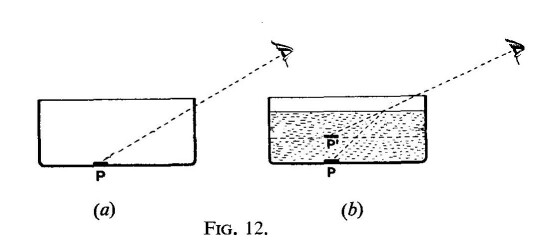
because it is accustomed to 'project' all light impressions rectilinearly out into space (Fig. 12b.). Hence, it sees P in the position of P'. This is thought to be the origin of the impression that the whole bottom of the vessel is raised.
This kind of explanation is quite in line with the peculiarity of the onlooker-consciousness, noted earlier, to attribute an optical illusion to the eye's way of working, while charging the mind with the task of clearing up the illusion. In reality it is just the reverse. Since the intellect can form no other idea of the act of seeing than that this is a passive process taking place solely within the eye, it falls, itself, into illusion. How great is this illusion we see from the fact that the intellect is finally obliged to make the eye somehow or other 'project' into space the impressions it receives - a process lacking any concrete dynamic content.
Once more, it is not our task to replace this way of 'explaining' the phenomenon by any other, but rather to combine the phenomenon given here with others of kindred nature so that the theory contained in them can be read from them direct. One other such phenomenon is that of so-called apparent optical depth, which an observer encounters when looking through transparent media of varying optical density. What connects the two is the fact that the rate of the alteration of depth, and the rate of change of the direction of light, are the same for the same media.
In present-day optics this phenomenon is explained with reference to the former. In proceeding like this, optical science makes the very mistake which Goethe condemned in Newton, saying that a complicated phenomenon was made the basis, and the simpler derived from the complex. For of these two phenomena, the simpler, since it is independent of any secondary condition, is the one showing that our experience of depth is dependent on the density of the optical medium. The latter phenomenon we met once before, though without reference to its quantitative side, when in looking at a landscape we found how our experiences of depth change in conformity with alterations in atmospheric conditions. This, then, served to make us aware that the way we apprehend things optically is the result of an interplay between our visual ray and the medium outside us which it meets.
It is exactly the same when we look through a vessel filled with water and see the bottom of it as if raised in level. This is in no sense an optical illusion; it is the result of what takes place objectively and dynamically within the medium, when our eye-ray passes through it. Only our intellect is under an illusion when, in the case of the coin becoming visible at the bottom of the vessel, it deals with the coin as if it were a point from which an individual ray of light went out.. .. etc., instead of conceiving the phenomenon of the raising of the vessel's bottom as one indivisible whole, wherein the coin serves only to link our attention to it.
*
Having thus cleared away the kinematic interpretation of the coin-in-the-bowl phenomenon, we may pass on to discuss the optical effect through which the so-called law of refraction was first established in science. Instead of picturing to ourselves, as is usually done, light-rays which are shifted away from or towards the perpendicular at the border-plane between two media of different optical properties, we shall rather build up the picture as light itself designs it into space.
We have seen that our inner light, as well as the outer light, suffers a certain hindrance in passing through a physical medium - even such as the earth's gravity-field. Whilst we may not describe this retardation, as is usually done, in terms of a smaller velocity of light itself within the denser medium, we may rightly say that density has the effect of lessening the intensity of the light. (It is the time required for the initial establishment of a light-filled realm which is greater within such a medium than outside it.) Now by its very nature the intensity of light cannot be measured in spatial terms. Yet there is a phenomenon by which the decrease of the inner intensity of the light becomes spatially apparent and thus spatially measurable. It consists in the alteration undergone by the aperture of a cone of light when passing from one optical medium to another.
If one sets in the path of a luminous cone a glass-walled trough filled with water, then, if both water and surrounding air are slightly clouded, the cone is seen to make a more acute angle within the water than outside it (Fig. 13). Here in an external phenomenon we meet the same weakening in the light's tendency to expand that we recognized in the shortening of our experience of depth on looking through a dense medium. Obviously, we expect the externally observable narrowing of the light-cone and the subjectively experienced change of optical depth to show the same ratio.
In order to compare the rate of expansion of a luminous cone inside and outside water, we must measure by how much less the width of the cone increases within the water than it does outside. (To be comparable, the measurements must be based upon the same distances on the edge of the cone, because this is the length of the way the light actually travels.) In Fig. 13 this is shown by the two distances, a-b and a'-b'. Their ratio is the same as that by which the bottom of a vessel appears to be raised when the vessel is filled with water (4:3).
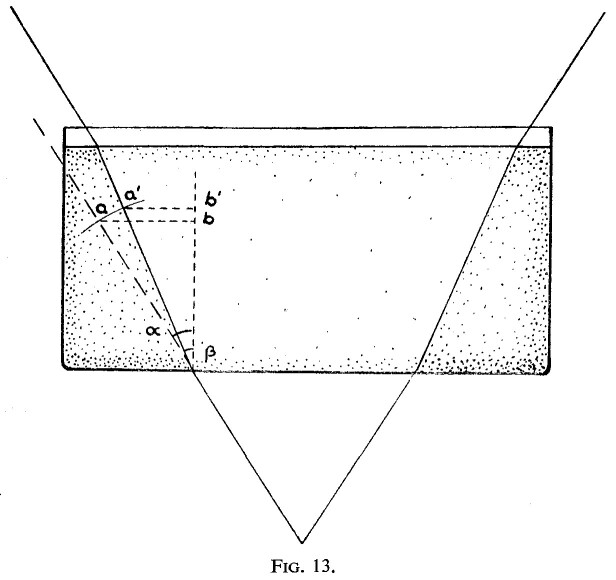
Thus by means of pure observation we have arrived at nothing less than what is known to physical optics as Snell's Law of Refraction. This law was itself the result of pure observation, but was clothed in a conceptual form devoid of reality. In this form it states that a ray of light in transition between two media of different densities is refracted at their boundary surface so that the ratio of the angle which is formed by the ray in either medium with a line at right angles to the boundary surface is such that the quotient of the sines of both angles is for these media a constant factor. In symbols sin α / sin β = c.
It will be clear to the reader familiar with trigonometry that this ratio of the two sines is nothing else but the ratio of the two distances which served us as a measure for the respective apertures of the cone. But whereas the measurement of these two distances is concerned with something quite real (since they express an actual dynamic alteration of the light), the measuring of the angle between the ray of light and the perpendicular is founded on nothing real. It is now clear that the concept of the ray, as it figures in the usual picture of refraction, is in reality the boundary between the luminous space and its surroundings. Evidently the concept of the perpendicular on the boundary between the two media is in itself a complete abstraction, since nothing happens dynamically in its direction.
To a normal human understanding it is incomprehensible why a ray of light should be related to an external geometrical line, as stated by the law of refraction in its usual form. Physical optics, in order to explain refraction, had therefore to resort to light-bundles spatially diffused, and by use of sundry purely kinematic concepts, to read into these light-bundles certain processes of motion, which are not in the least shown by the phenomenon itself. In contrast to this, the idea that the boundary of a luminous cone is spatially displaced when its expansion is hindered by an optical medium of some density, and that the measure of this displacement is equal to the shortening of depth which we experience in looking through this medium, is directly evident, since all its elements are taken from observation.
*
From what we have here found we may expect that in order to explain the numerical relationships between natural phenomena (with which science in the past has been solely concerned), we by no means require the artificial theories to which the onlooker in man, confined as he is to abstract thinking, has been unavoidably driven. Indeed, to an observer who trains himself on the lines indicated in this book, even the quantitative secrets of nature will become objects of intuitive judgment, just as Goethe, by developing this organ of understanding, first found access to nature's qualitative secrets. (The change in our conception of number which this entails will be shown at a later stage of our discussions.)
1 Compare with this our account in Chapter X of the rise of the atomistic-kinematic interpretation of heat.
2 The following critical study leaves, of course, completely untouched our recognition of the devotion which guided the respective observers in their work, and of the ingenuity with which some of their observations were devised and carried out.
3 The assumption is that the wave-velocity differs from the group-velocity, if at all, by a negligible amount.
4 Once this is realized there can be no doubt that with the aid of an adequate mathematical calculus (which would have to be established on a realistic understanding of the respective properties of the fields of force coming into play) it will become possible to derive by calculation the speed of the establishment of light within physical space from the gravitational constant of the earth.
5 The grounds of Einstein's General Theory were dealt with in our earlier discussions.
CHAPTER XVIII
The Spectrum as a Script of the Spirit
The realization that Newton's explanation of the spectrum fails to meet the facts prompted Goethe to engage in all those studies which made him the founder of a modern optics based on intuitive participation in the phenomena. In spite of all that he achieved, however, he never reached a real solution of the riddle of the colour-phenomenon produced when light passes through a transparent body of prismatic shape. For his assumption of certain 'double images', which are supposed to appear as a result of the optical displacement of the boundaries between the Light-filled and the Dark-filled parts of space and the mutual superposition of which he believed to be responsible for the appearance of the respective colours, does not solve the problem.1
What hindered Goethe in this field was his limited insight into the nature of the two distinct kinds of forces which, as we have noted in the course of our own inquiries, correspond to his concepts of Licht and Finsternis.
With the aid of this distinction - which we have indeed established through a consistent application of Goethe's method - we shall now be able to develop precisely that insight into the coming-into-being of the spectral colours which Goethe sought.2
*
Dynamically, the process of the formation of the spectrum by light that passes through a prism divides into two clearly distinguishable parts. The first consists in the influence which the light undergoes inside the prism as a result of the latter's special shape, the other, in what happens outside the prism at the boundary between the Light-space - influenced by the shape of the prism - and the surrounding Dark-space. Accordingly, we shall study these two parts of the process separately.
As an aid to distinguishing clearly one process from the other, we shall suppose the prism experiment to be so arranged that the light area is larger than the width of the prism, which will then lie completely within it. We shall further suppose the dimensions of the whole to be such that the part observable on the screen represents only a portion of the total light-realm situated between the boundaries of the prism. The result is that the screen depicts a light-phenomenon in which there is no trace of colour. For normal eyesight, the phenomenon on the screen differs in no way from what it would be if no prism intervened in the path of the light.
These two seemingly identical light-phenomena reveal at once their inner dynamic difference if we narrow the field of light from either side by introducing into it an object capable of casting shadow. If there is no prism we see simply a black shadow move into the illumined area on the screen, no matter from which side the narrowing comes. If, however, the light has come through a prism (arranged as described above) certain colours appear on the boundary between the regions of light and shadow, and these differ according to the side from which the darkening is effected. The same part of the light area may thus be made to display either the colours of the blue pole of the colour-scale, or those of the yellow pole. This shows that the inner dynamic condition of the light-realm is altered in some way by being exposed to an optically resistant medium of prismatic shape. If we are to find the cause and nature of this alteration we must revert to the prism itself, and inquire what effect it has on light in the part of space occupied by it. By proceeding in this way we follow Goethe's model: first, to keep the two border-phenomena separate, and, secondly, not to ascribe to the light itself what is in fact due to certain boundary conditions.