Front matter (continued 4)
Reading edition
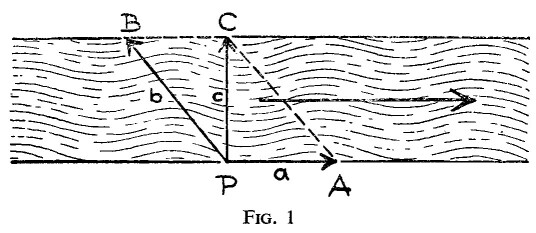
theorem is practically applied is the well-known case of a rower who sets out from P in order to cross at right angles a river indicated by the parallel lines. He has to overcome the velocity a of the water of the river flowing to the right by steering obliquely left towards B in order to arrive finally at C.
It is essential to observe that the content of this theorem does not need the confirmation of any outer experience for its discovery, or to establish its truth. Even though the recognition of the fact which it expresses may have first come to men through practical observation, yet the content of this theorem can be discovered and proved by purely logical means. In this respect it resembles any purely geometrical statement such as, that the sum of the angles of a triangle is two right angles (180°). Even though this too may have first been learnt through outer observation, yet it remains true that for the discovery of the fact expressed by it - valid for all plane triangles - no outer experience is needed. In both cases we find ourselves in the domain of pure geometric conceptions (length and direction of straight lines, movement of a point along these), whose reciprocal relationships are ordered by the laws of pure geometric logic. So in the theorem of the Parallelogram of Velocities we have a strictly geometrical theorem, whose content is in the narrowest sense kinematic. In fact, it is the basic theorem of kinematics.
We now turn to the second theorem which speaks of an outwardly similar relationship between forces. As is well nown, this states that
two forces of different magnitude and direction, when they apply at the same point, act together in the manner of a single force whose magnitude and direction may be represented by the diagonal of a parallelogram whose sides express in extent and direction the first two forces. Thus in Fig. 2, R exercises upon P the same effect as F1 and F2 together.
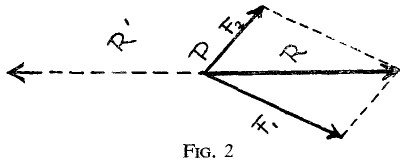
Expressed in another way, a force of this magnitude working in the reverse direction (R') will establish an equilibrium with the other two forces. In technical practice, as is well known, this theorem is used for countless calculations, in both statics and dynamics, and indeed more frequently not in the form given here but in the converse manner, when a single known force is resolved into two component forces. (Distribution of a pressure along frameworks, of air pressure along moving surfaces, etc.)
It will now be our task to examine the logical link which is believed to connect one theorem with the other. This link is found in the well-known definition of physical force as a product of 'mass' and 'acceleration' - in algebraic symbols F=ma. We will discuss the implications of this definition in more detail later on. Let us first see how it is used as a foundation for the above assertion.
The conception of 'force' as the product of 'mass' and 'acceleration' is based on the fact - easily experienced by anyone who cycles along a level road - that it is not velocity itself which requires the exertion of force, but the change of velocity - that is, acceleration or retardation ('negative acceleration' in the sense of mathematical physics); also that in the case of equal accelerations, the force depends upon the mass of the accelerated object. The more massive the object, the greater will be the force necessary for accelerating it. This mass, in turn, reveals itself in the resistance a particular object offers to any change of its state of motion. Where different accelerations and the same mass are considered, the factor m in the above formula remains constant, and force and acceleration are directly proportional to each other. Thus in the acceleration is discovered a measure for the magnitude of the force which thereby acts.
Now it is logically evident that the theorem of the parallelogram of velocities is equally valid for movements with constant or variable velocities. Even though it is somewhat more difficult to perceive mentally the movement of a point in two different directions with two differently accelerated motions, and to form an inner conception of the resulting movement, we are nevertheless still within a domain which may be fully embraced by thought. Thus accelerated movements and movements under constant velocity can be resolved and combined according to the law of the parallelogram of movements, a law which is fully attainable by means of logical thought.
With the help of the definition of force as the product of mass and acceleration it seems possible, indeed, to derive the parallelogram of forces from that of accelerations in a purely logical manner. For it is necessary only to extend all sides of an a parallelogram by means of the same factor m in order to turn it into an F parallelogram. A single geometrical figure on paper can represent both cases, since only the scale needs to be altered in order that the same geometrical length should represent at one time the magnitude a and on another occasion ma. It is in this way that present-day scientific thought keeps itself convinced that the parallelogram of forces follows with logical evidence from the parallelogram of accelerations, and that the discovery of the former is therefore due to a purely mental process.
Since the parallelogram of forces is the prototype of each further mathematical representation of physical force-relationships in nature, the conceptual link thus forged between it and the basic theorem of kinematics has led to the conviction that the fact that natural events can be expressed in terms of mathematics could be, and actually has been, discovered through pure logical reasoning, and thus by the brain-bound, day-waking consciousness 'of the world-spectator. Justification thereby seemed to be given for the building of a valid scientific world-picture, purely kinematic in character.
*
The line of consideration we shall now have to enter upon for carrying out our own examination of what is believed to be the link between the two theorems may seem to the scientifically trained reader to be of an all too elementary kind compared with the complexities of thought in which he is used to engage in order to settle a scientific problem. It is therefore necessary to state here that anyone who wishes to help to overcome the tangle of modern theoretical science must not be shy in applying thoughts and observations of seemingly so simple a nature as those used both here and on other occasions. Some readiness, in fact, is required to play where necessary the part of the child in Hans Andersen's fairy-story of The Emperor's New Clothes, where all the people are loud in praise of the magnificent robes of the Emperor, who is actually passing through the streets with no clothes on at all, and a single child's voice exclaims the truth that 'the Emperor has nothing on'. There will repeatedly be occasion to adopt the role of this child in the course of our own studies.
*
In the scientific definition of force given above force appears as the result of a multiplication of two other magnitudes. Now as is well known, it is essential for the operation of multiplication that of the two factors forming the product at least one should exhibit the properties of a pure number. For two pure numbers may be multiplied together - e.g. 2 and 4 - and a number of concrete things can be multiplied by a pure number - e. g. 3 apples and the number 4 - but no sense can be attached to the multiplication of 3 apples by 4 apples, let alone by 4 pears! The result of multiplication is therefore always either itself a pure number, when both factors have this property; or when one of the two factors is of the nature of a concrete object, the result is of the same quality as the latter. An apple will always remain an apple after multiplication, and what distinguishes the final product (apples) from the original factor (apples) is only a pure number.
If we take seriously what this simple consideration tells us of the nature of multiplication, and if we do not allow ourselves to deviate from it for whatever purpose we make use of this algebraic operation, then the various concepts we connect with the basic measurements in physics undergo a considerable change of meaning.
Let us test, in this respect, the well-known formula which, in the conceptual language of physics, connects 'distance' (s), 'time' (t), and 'velocity' (c). It is written c = s / t, or s = ct.
In this formula, s has most definitely the meaning of a 'thing', for it represents measured spatial distance. Of the two factors on the other side of the second equation, one must needs have the same quality as s: this is c. Thus for the other factor, t, there remains the property of a pure number. We are, therefore, under an illusion if we assume the factor c to represent anything of what velocity implies in outer cosmic reality. The truth is that c represents a spatial distance just as s does, with the difference only that it is a certain unit-distance. Just as little does real time enter into this formula - nor does it into any other formula of mathematical physics. 'Time', in physics, is always a pure number without any cosmic quality. Indeed, how could it be otherwise for a purely kinematic world-observation?
We now submit the formula F=ma to the same scrutiny. If we attach to the factor a on the right side of the equation a definite quality, namely an observable acceleration, the other factor in the product is permitted to have only the properties of a pure number; F, therefore, can be only of the same nature as a and must itself be an acceleration. Were it otherwise, then the equation F=ma could certainly not serve as a logical link between the Velocity and Force parallelograms.
Our present investigation has done no more than grant us an insight into the process of thought whereby the consciousness limited to a purely kinematic experience has deprived the concept of force of any real content. Let us look at the equation F=ma as a means of splitting of the magnitude F into two components m and a. The equation then tells us that F is reduced to the nature of pure acceleration, for that which resides in the force as a factor not observable by kinematic vision has been split away from it as the factor m. For this factor, however, as we have seen, nothing remains over but the property of a pure number.
Let us note here that the first thinker to concern himself with a comprehensive world-picture in which the non-existence of a real concept of force is taken in earnest-namely, Albert Einstein - was also the first to consider mass as a form of energy and even to predict correctly, as was proved later, the amount of energy represented by the unit of mass, thereby encouraging decisively the new branch of experimental research which has led to the freeing of the so-called atomic energy. Is it then possible that pure numbers can effect what took place above and within Nagasaki, Hiroshima, etc.? Here we are standing once again before one of the paradoxes of modern science which we have found to play so considerable a part in its development.
To find an interpretation of the formula F=ma, which is free from illusion, we must turn our attention first of all to the concepts 'force' and 'mass' themselves. The fact that men have these two words in their languages shows that the concepts expressed by them must be based on some experience that has been man's long before he was capable of any scientific reflexion. Let us ask what kind of experience this is and by what part of his being he gathers it.
The answer is, as simple self-observation will show, that we know of the existence of force through the fact that we ourselves must exert it in order to move our own body. Thus it is the resistance of our body against any alteration of its state of motion, as a result of its being composed of inert matter, which gives us the experience of force both as a possession of our own and as a property of the outer world. All other references to force, in places where it cannot be immediately experienced, arise by way of analogy based on the similarity of the content of our observation to that which springs from the exertion of force in our own bodies.
As we see, in this experience of force that of mass is at once implied. Still, we can strengthen the latter by experimenting with some outer physical object. Take a fairly heavy object in your hand, stretch out your arm lightly and move it slowly up and down, watching intently the sensation this operation rouses in you.2 Evidently the experience of mass outside ourselves, as with that of our own body, comes to us through the experience of the force which we ourselves must exert in order to overcome some resisting force occasioned by the mass. Already this simple observation - as such made by means of the sense of movement and therefore outside the frontiers of the onlooker-consciousness - tells us that mass is nothing but a particular manifestation of force.
Seen in the light of this experience, the equation F=ma requires to be interpreted in a manner quite different from that to which scientific logic has submitted it. For if we have to ascribe to F and m the same quality, then the rule of multiplication allows us to ascribe to a nothing but the character of a pure number. This implies that there is no such thing as acceleration as a self-contained entity, merely attached to mass in an external way.
What we designate as acceleration, and measure as such, is nothing else than a numerical factor comparing two different conditions of force within the physical-material world.
Only when we give the three factors in our equation this meaning, does it express some concrete outer reality. At the same time it forbids the use of this equation for a logical derivation of the parallelogram of forces from that of pure velocities.
*
The same method which has enabled us to restore its true meaning to the formula connecting mass and force will serve to find the true source of man's knowledge of the parallelogram of forces. Accordingly, our procedure will be as follows.
We shall engage two other persons, together with whom we shall try to discover by means of our respective experiences of force the law under which three forces applying at a common point may hold themselves in equilibrium. Our first step will consist in grasping each other by the hand and in applying various efforts of our wills to draw one another in different directions, seeing to it that we do this in such a way that the three joined hands remain undisturbed at the same place. By this means we can get as far as to establish that, when two persons maintain a steady direction and strength of pull, the third must alter his applied force with every change in his own direction in order to hold the two others in equilibrium. He will find that in some instances he must increase his pull and in other instances decrease it.
This, however, is all that can be learnt in this way. No possibility arises at this stage of our investigation of establishing any exact quantitative comparison. For the forces which we have brought forth (and this is valid for forces in general, no matter of what kind they are) represent pure intensities, outwardly neither visible nor directly measurable. We can certainly tell whether we are intensifying or diminishing the application of our will, but a numerical comparison between different exertions of will is not possible.
In order to make such a comparison, a further step is necessary. We must convey our effort to some pointer-instrument - for instance, a spiral spring which will respond to an exerted pressure or pull by a change in its spatial extension. (Principle of the spring balance.) In this way, by making use of a certain property of matter - elasticity - the purely intensive magnitudes of the forces which we exert become extensively visible and can be presented geometrically. We shall therefore continue our investigation with the aid of three spring balances, which we hook together at one end while exposing them to the three pulls at the other.
To mark the results of our repeated pulls of varying intensities and directions, we draw on the floor on which we stand three chalk lines outward from the point underneath the common point of the three instruments, each in the direction taken up by one of the three persons. Along these lines we mark the extensions corresponding to those of the springs of the instruments.
By way of this procedure we shall arrive at a sequence of figures such as is shown in Fig. 3.
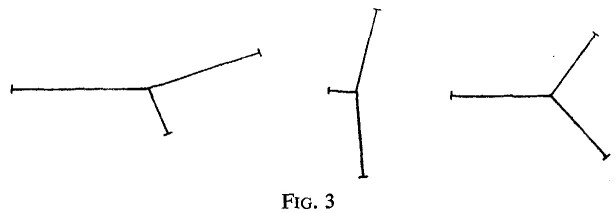
This is all we can discover empirically regarding the mutual relationships of three forces engaging at a point.
Let us now heed the fact that nothing in this group of figures reveals that in each one of these trios of lines there resides a definite and identical geometrical order; nor do they convey anything that would turn our thoughts to the parallelogram of velocities with the effect of leading us to expect, by way of analogy, a similar order in these figures. And this result, we note, is quite independent of our particular way of procedure, whether we use, right from the start, a measuring instrument, or whether we proceed as described above.
*
Having in this way removed the fallacious idea that the parallelogram of forces can, and therefore ever has been, conceived by way of logical derivation from the parallelogram of velocities, we must then ask ourselves what it was, if not any act of logical reason, that led Galileo to discover it.
History relates that on making the discovery he exclaimed: 'La natura è scritta in lingua matematica!' ('Nature is recorded in the language of mathematics.') These words reveal his surprise when he realized the implication of his discovery. Still, intuitively he must have known that using geometrical lengths to symbolize the measured magnitudes of forces would yield some valid result. Whence came this intuition, as well as the other which led him to recognize from the figures thus obtained that in a parallelogram made up of any two of the three lines, the remaining line came in as its diagonal? And, quite apart from the particular event of the discovery, how can we account for the very fact that nature - at least on a certain level of her existence - exhibits rules of action expressible in terms of logical principles immanent in the human mind?
*
To find the answer to these questions we must revert to certain facts connected with man's psycho-physical make-up of which the considerations of Chapter II have already made us aware.
Let us, therefore, transpose ourselves once more into the condition of the child who is still entirely volition, and thus experiences himself as one with the world. Let us consider, from the point of view of this condition, the process of lifting the body into the vertical position and the acquisition of the faculty of maintaining it in this position; and let us ask what the soul, though with no consciousness of itself, experiences in all this. It is the child's will which wrestles in this act with the dynamic structure of external space, and what his will experiences is accompanied by corresponding perceptions through the sense of movement and other related bodily senses. In this way the parallelogram of forces becomes an inner experience of our organism at the beginning of our earthly life. What we thus carry in the body's will-region in the form of experienced geometry - this, together with the freeing and crystallizing of part of our will-substance into our conceptual capacity, is transformed into our faculty of forming geometrical concepts, and among them the concept of the parallelogram of movements.
Looked at in this way, the true relationship between the two parallelogram-theorems is seen to be the very opposite of the one held with conviction by scientific thinking up to now. Instead of the parallelogram of forces following from the parallelogram of movements, and the entire science of dynamics from that of kinematics, our very faculty of thinking in kinematic concepts is the evolutionary product of our previously acquired intuitive experience of the dynamic order of the world.
If this is the truth concerning the origin of our knowledge of force and its behaviour on the one hand, and our capacity to conceive mathematical concepts in a purely ideal way on the other, what is it then that causes man to dwell in such illusion as regards the relationship between the two? From our account it follows that no illusion of this kind could arise if we were able to remember throughout life our experiences in early childhood. Now we know from our considerations in Chapter VI that in former times man had such a memory. In those times, therefore, he was under no illusion as to the reality of force in the world. In the working of outer forces he saw a manifestation of spiritual beings, just as in himself he experienced force as a manifestation of his own spiritual being. We have seen also that this form of memory had to fade away to enable man to find himself as a self-conscious personality between birth and death. As such a personality, Galileo was able to think the parallelogram of forces, but he was unable to comprehend the origin of his faculty of mathematical thinking, or of his intuitive knowledge of the mathematical behaviour of nature in that realm of hers where she sets physical forces into action.
Deep below in Galileo's soul there lived, as it does in every human being, the intuitive knowledge, acquired in early childhood, that part of nature's order is recordable in the conceptual language of mathematics. In order that this intuition should rise sufficiently far into his conscious mind to guide him, as it did, in his observations, the veil of oblivion which otherwise separates our waking consciousness from the experiences of earliest childhood must have been momentarily lightened. Unaware of all this, Galileo was duly surprised when in the onlooker-part of his being the truth of his intuition was confirmed in a way accessible to it, namely through outer experiment. Yet with the veil immediately darkening again the onlooker soon became subject to the illusion that for his recognition of mathematics as a means of describing nature he was in need of nothing but what was accessible to him on the near side of the veil.
Thus it became man's fate in the first phase of science, which fills the period from Galileo and his contemporaries up to the present time, that the very faculty which man needed for creating this science prevented him from recognizing its true foundations. Restricted as he was to the building of a purely kinematic world-picture, he had to persuade himself that the order of interdependence of the two parallelogram-theorems was the opposite of the one which it really is.
*
The result of the considerations of this chapter is of twofold significance for our further studies. On the one hand, we have seen that there is a way out of the impasse into which modern scientific theory has got itself as a result of the lack of a justifiable concept of force, and that this way is the one shown by Reid and travelled by Goethe. 'We must become as little children again, if we will be philosophers', is as true for science as it is for philosophy. On the other hand, our investigation of the event which led Galileo to the discovery that nature is recorded in the language of mathematics, has shown us that this discovery would not have been possible unless Galileo had in a sense become, albeit unconsciously, a little child again. Thus the event that gave science its first foundations is an occurrence in man himself of precisely the same character as the one which we have learnt to regard as necessary for building science's new foundations. The only difference is that we are trying to turn into a deliberate and consciously handled method something which once in the past happened to a man without his noticing it.
Need we wonder that we are challenged to do so in our day, when mankind is several centuries older than it was in the time of Galileo?
1 As to the terms 'kinetic' and 'kinematic', see Chapter II, page 30, footnote.
2 For the sake of our later studies it is essential that the reader does not content himself with merely following the above description mentally, but that he carries out the experiment himself.
CHAPTER IX
Pro Levitate
(a) ALERTNESS contra INERTNESS
In the preceding chapter we gained a new insight into the relationship between mass and force. We have come to see that our concept of force is grounded on empirical observation in no less a degree than is usually assumed for our concept of number, or size, or position, provided we do not confine ourselves to non-stereoscopic, colourless vision for the forming of our scientific world-picture, but allow other senses to contribute to it. As to the concept mass, our discussion of the formula F=ma showed that force and mass, as they occur in it, are of identical nature, both having the quality of force. The factors F and m signify force in a different relationship to space (represented by the factor a). This latter fact now requires some further elucidation.
In a science based on the Goethean method of contemplating the world of the senses, concepts such as 'mass in rest' and 'mass in motion' lack any scientific meaning (though for another reason than in the theory of Relativity). For in a science of this kind the universe - in the sense propounded lately by Professor Whitehead and others - appears as one integrated whole, whose parts must never be considered as independent entities unrelated to the whole. Seen thus, there is no mass in the universe of which one could say with truth that it is ever in a state of rest. Nor is there any condition of movement which could be rightly characterized by the attributes 'uniform' and 'straight line' in the sense of Newton's first law. This does not mean that such conditions never occur in our field of observation. But as such they have significance only in relation to our immediate surroundings as a system of reference. Even within such limits these conditions are not of a kind that would allow us to consider them as the basis of a scientific world-picture. For as such they occur naturally only as ultimate, never as primeval conditions. All masses are originally in a state of curvilinear movement whose rates change continuously. To picture a mass as being in a state of rest, or of uniform motion in a straight line, as the result of no force acting on it, and to picture it undergoing a change in the rate and direction of its motion as the result of some outer force working on it, is a sheer abstraction. In so far as mass appears in our field of observation as being in relative rest or motion of the kind described, this is always the effect of some secondary dynamic cause.
If we wish to think with the course of the universe and not against it, we must not start our considerations with the state of (relative) rest or uniform motion in a straight line and derive our definition of force from the assumption that there is a primary 'force-free' state which is altered under the action of some force, but we must arrange our definitions in such a way that they end up with this state. Thus Newton's first law, for instance, would have to be restated somewhat as follows: No physical body is ever in a state of rest or uniform motion in a straight line, unless its natural condition is interfered with by the particular action of some force.
Seen dynamically, and from the aspect of the universe as an interrelated whole, all aggregations of mass are the manifestation of certain dynamic conditions within the universe, and what appears to us as a change of the state of motion of such a mass is nothing but a change in the dynamic relationship between this particular aggregation and the rest of the world. Let us now see what causes of such a change occur within the field of our observation.
*
In modern textbooks the nature of the cause of physical movement is usually defined as follows: 'Any change in the state of movement of a portion of matter is the result of the action on it of another portion of matter.' This represents a truth if it is taken to describe a certain kind of causation. In the axiomatic form in which it is given it is a fallacy. The kind of causation it describes is, indeed, the only one which has been taken into consideration by the scientific mind of man. We are wont to call it 'mechanical' causation. Obviously, man's onlooker-consciousness is unable to conceive of any other kind of causation. For this consciousness is by its very nature confined to the contemplation of spatially apparent entities which for this reason can be considered only as existing spatially side by side. For the one-eyed, colour-blind spectator, therefore, any change in the state of movement of a spatially confined entity could be attributed only to the action of another such entity outside itself. Such a world-outlook was bound to be a mechanistic one.
We cannot rest content with this state of affairs if we are sincerely searching for an understanding of how spirit moves, forms, and transforms matter. We must learn to admit non-mechanical causes of physical effects, where such causes actually present themselves to our observation. In this respect our own body is again a particularly instructive object of study. For here mechanical and non-mechanical causation can be seen working side by side in closest conjunction. Let us therefore ask what happens when we move, say, one of our limbs or a part of it.
The movement of any part of our body is always effected in some way by the movement of the corresponding part of the skeleton. This in turn is set in motion by certain lengthenings and contractions of the appropriate part of the muscular system. Now the way in which the muscles cause the bones to move falls clearly under the category of mechanical causation. Certain portions of matter are caused to move by the movement of adjacent portions of matter. The picture changes when we look for the cause to which the muscles owe their movements. For the motion of the muscles is not the effect of any cause external to them, but is effected by the purely spiritual energy of our volition working directly into the physical substance of the muscles. What scientific measuring instruments have been able to register in the form of physical, chemical, electrical, etc., changes of the muscular substance is itself an effect of this interaction.
To mark the fact that this type of causation is clearly distinguished from the type called mechanical, it will be well to give it a name of its own. If we look for a suitable term, the word 'magical' suggests itself. The fact that this word has gathered all sorts of doubtful associations must not hinder us from adopting it into the terminology of a science which aspires to understand the working of the supersensible in the world of the senses. The falling into disrepute of this word is characteristic of the onlooker-age. The way in which we suggest it should be used is in accord with its true and original meaning, the syllable 'mag' signifying power or might (Sanskrit maha, Greek megas, Latin magnus, English might, much, also master). Henceforth we shall distinguish between 'mechanical' and 'magical' causation, the latter being a characteristic of the majority of happenings in the human, animal and plant organisms.1
*
Our next step in building up a truly dynamic picture of matter must be to try to obtain a direct experience of the condition of matter when it is under the sway of magical causation.
Let us first remember what is the outstanding attribute with which matter responds to mechanical causation. This is known to be inertia. By this term we designate the tendency of physical matter to resist any outwardly impressed change of its existing state of movement. This property is closely linked up with another one, weight. The coincidence of the two has of late become a puzzle to science, and it was Albert Einstein who tried to solve it by establishing his General Theory of Relativity. The need to seek such solutions falls away in a science which extends scientific understanding to conditions of matter in which weight and inertia are no longer dominant characteristics. What becomes of inertia when matter is subject to magical causation can be brought to our immediate experience in the following way. (The reader, even if he is already familiar with this experiment, is again asked to carry it out for himself.)
Take a position close to a smooth wall, so that one arm and hand, which are left hanging down alongside the body, are pressed over their entire length between body and wall. Try now to move the arm upward, pressing it against the wall as if you wanted to shift the latter. Apply all possible effort to this attempt, and maintain the effort for about one minute. Then step away quickly from the wall by more than the length of the arm, while keeping the arm hanging down by the side of the body in a state of complete relaxation. Provided all conditions are properly fulfilled, the arm will be found rising by itself in accordance with the aim of the earlier effort, until it reaches the horizontal. If the arm is then lowered again and left to itself, it will at once rise again, though not quite so high as before. This can be repeated several times until the last vestige of the automatic movement has faded away.
Having thus ascertained by direct experience that there is a state of matter in which inertia is, to say the least, greatly diminished, we find ourselves in need of giving this state (which is present throughout nature wherever material changes are brought into existence magically) a name of its own, as we did with the two types of causation. A word suggests itself which, apart from expressing adequately the peculiar self-mobility which we have just brought to our experience, goes well alongside the word 'inert' by forming a kind of rhyme with it. This is the term 'alert'. With its help we shall henceforth distinguish between matter in the inert and alert conditions. We shall call the latter state 'alertness', and in order to have on the other side a word as similar as possible in outer form to alertness, we suggest replacing the usual term inertia by 'inertness'. Thus we shall speak of matter as showing the attribute of 'inertness', when it is subject to mechanical causation, of 'alertness', when it is subject to magical causation.
Anyone who watches attentively the sensation produced by the rising arm in the above experiment will be duly impressed by the experience of the alertness prevailing in the arm as a result of the will's magical intervention.
*
In our endeavour to find a modern way of overcoming the conception of matter developed and held by science in the age of the onlooker-consciousness, we shall be helped by noticing how this conception first arose historically. Of momentous significance in this respect is the discovery of the gaseous state of matter by the Flemish physician and experimenter, Joh. Baptist van Helmont (1577-1644). The fact that the existence of this state of ponderable matter was quite unknown up to such a relatively recent date has been completely forgotten to-day. Moreover, it is so remote from current notions that anyone who now calls attention to van Helmont's discovery is quite likely to be met with incredulity. As a result, there is no account of the event that puts it in its true setting. In what follows pains are taken to present the facts in the form in which one comes to know them through van Helmont's own account, given in his Ortus Medicinae.
For reasons which need not be described here, van Helmont studied with particular interest the various modifications in which carbon is capable of occurring in nature - among them carbon's combustion product, carbon dioxide. It was his observations of carbon dioxide which made him aware of a condition of matter whose properties caused him the greatest surprise. For he found it to be, at the same time, 'much finer than vapour and much denser than air'. It appeared to him as a complete 'paradox', because it seemed to unite in itself two contradictory qualities, one appertaining to the realm of 'uncreated things', the other to the realm of 'created things'. Unable to rank it with either 'vapour' or 'air' (we shall see presently what these terms meant in van Helmont's terminology), he found himself in need of a special word to distinguish this new state from the other known states, both below and above it. Since he could not expect any existing language to possess a suitable word, he felt he must create one. He therefore took, and changed slightly, a word signifying a particular cosmic condition which seemed to be imaged in the new condition he had just discovered. The word was CHAOS. By shortening it a little, he derived from it the new word GAS. His own words explaining his choice are: 'Halitum ilium GAS vocavi non longe a Chaos veterum secretum.' ('I have called this mist Gas, owing to its resemblance to the Chaos of the ancients.')2
Van Helmont's account brings us face to face with a number of riddles. Certainly, there is nothing strange to us in his describing carbon dioxide gas as being 'finer than vapour and denser than air'; but why did he call this a 'paradox'? What prevented him from ranking it side by side with air? As to air itself, why should he describe it as belonging to the realm of the 'uncreated things'? What reason was there for giving 'vapour' the rank of a particular condition of matter? And last but not least, what was the ancient conception of Chaos which led van Helmont to choose this name as an archetype for the new word he needed?
To appreciate van Helmont's astonishment and his further procedure, we must first call to mind the meaning which, in accordance with the prevailing tradition, he attached to the term Air. For van Helmont, Air was one of the four 'Elements', EARTH, WATER, AIR, and FIRE. Of these, the first two were held to constitute the realm of the 'created things', the other two that of the 'uncreated things'. A brief study of the old doctrine of the Four Elements is necessary at this point in order to understand the meaning of these concepts.
*
The first systematic teaching about the four elementary constituents of nature, as they were experienced by man of old, was given by Empedocles in the fifth century B.C. It was elaborated by Aristotle. In this form it was handed down and served to guide natural observation through more than a thousand years up to the time of van Helmont. From our earlier descriptions of the changes in man's consciousness it is clear that the four terms, 'earth', 'water', 'air', 'fire', must have meant something different in former times. So 'water' did not signify merely the physical substance which modern chemistry defines by the formula H2O; nor was 'air' the mixture of gases characteristic of the earth's atmosphere. Man in those days, on account of his particular relationship with nature, was impressed in the first place by the various dynamic conditions, four in number, which he found prevailing both in his natural surroundings and in his own organism. With his elementary concepts he tried to express, therefore, the four basic conditions which he thus experienced. He saw physical substances as being carried up and down between these conditions.
At first sight some relationship seems to exist between the concept 'element' in this older sense and the modern view of the different states of material aggregation, solid, liquid, aeriform. There is, however, nothing in this modern view that would correspond to the element Fire. For heat in the sense of physical science is an immaterial energy which creates certain conditions in the three material states, but from these three to heat there is no transition corresponding to the transitions between themselves. Heat, therefore, does not rank as a fourth condition by the side of the solid, liquid and aeriform states, in the way that Fire ranks in the older conception by the side of Earth, Water and Air.
If we were to use the old terms for designating the three states of aggregation plus heat, as we know them to-day, we should say that there is a border-line dividing Fire from the three lower elements. Such a border-line existed in the older conception of the elements as well. Only its position was seen to be elsewhere - between Earth and Water on the one hand, Air and Fire on the other. This was expressed by saying that the elements below this line constituted the realm of the 'created things', those above it that of the 'uncreated things'. Another way of expressing this was by characterizing Earth and Water with the quality Cold; Air and Fire with the quality Warm. The two pairs of elements were thus seen as polar opposites of one another.
The terms 'cold' and 'warm' must also be understood to have expressed certain qualitative experiences in which there was no distinction as yet between what is purely physical and what is purely spiritual. Expressions such as 'a cold heart', 'a warm heart', to 'show someone the cold shoulder', etc., still witness to this way of experiencing the two polar qualities, cold and warm. Quite generally we can say that, wherever man experienced some process of contraction, whether physical or non-physical, he designated it by the term 'cold', and where he experienced expansion, he called it 'warm'. In this sense he felt contractedness to be the predominant characteristic of Earth and Water, expansiveness that of Air and Fire.
With the help of these qualitative concepts we are now in a position to determine more clearly still the difference between the older and the modern conceptions: in particular the difference between the aeriform condition of matter, as we conceive of it to-day, and the element Air. Contractedness manifests as material density, or the specific weight of a particular substance. We know that this characteristic of matter diminishes gradually with its transition from the solid to the liquid and aeriform states. We know also that this last state is characterized by a high degree of expansiveness, which is also the outstanding property of heat. Thus there is reason to describe also from the modern point of view the solid and liquid states as essentially 'cold', and the aeriform state as 'warm'. But aeriform matter still has density and weight, and this means that matter in this state combines the two opposing qualities. Contrary to this, Air, as the second highest element in the old sense, is characterized by the pure quality, warm. Thus, when man of old spoke of 'air', he had in mind something entirely free from material density and weight.3
By comparing in this way the older and newer conceptions of 'air', we come to realize that ancient man must have had a conception of gravity essentially different from ours. If we take gravity in the modern scientist's sense, as a 'descriptive law of behaviour', then this behaviour is designated in the older doctrine by the quality 'cold'. If, however, we look within the system of modern science for a law of behaviour that would correspond to the quality 'warm', we do so in vain. Polarity concepts are certainly not foreign to the scientific mind, as the physics of electricity and magnetism show. Yet there is no opposite pole to gravity, as there is negative opposite to positive electricity, etc.4
In the older conception, however, the gravitational behaviour 'cold' was seen to be counteracted by an autonomous anti-gravitational behaviour 'warm'. Experience still supported the conviction that as a polar opposite to the world subject to gravity, there was another world subject to levity.
We refrain at this point from discussing how far a science which aspires to a spiritual understanding of nature, including material processes, needs a revival - in modern form - of the old conception of levity. In our present context it suffices to realize that we understand man's earlier view of nature, and with it the one still held by van Helmont, only by admitting levity equally with gravity into his world-picture. For the four elements, in particular, this meant that the two upper ones were regarded as representing Levity, the two lower ones Gravity.
In close connexion with this polar conception of the two pairs of elements, there stands their differentiation into one realm of created, another of uncreated, things. To understand what these terms imply, we must turn to the ancient concept, Chaos, borrowed by van Helmont.
To-day we take the word Chaos to mean a condition of mere absence of order, mostly resulting from a destruction of existing forms, whether by nature or by the action of man. In its original sense the word meant the exact opposite. When in ancient times people spoke of Chaos, they meant the womb of all being, the exalted realm of uncreated things, where indeed forms such as are evident to the eye in the created world are not to be found, but in place of them are the archetypes of all visible forms, as though nurtured in a spiritual seed-condition. It is the state which in the biblical narration of the creation of the world is described as 'without form and void'.
From this Chaos all the four elements are born, one by one, with the two upper ones retaining Chaos's essential characteristic in that they are 'without form' and tend to be omnipresent, whilst the two lower ones constitute a realm in which things appear in more or less clearly outlined space-bound forms. This is what the terms 'uncreated' and 'created' imply.
How strictly these two realms were distinguished can be seen by the occurrence of the concept 'vapour'. When with the increasing interest in the realm of created things - characteristic of the spectator-consciousness which, in view of our earlier description of it, we recognize as being itself a 'created thing' - the need arose for progressive differentiation within this realm, the simple division of it into 'earth' and 'water' was no longer felt to be satisfactory. After all, above the liquid state of matter there was another state, less dense than water and yet presenting itself through more or less clearly distinguishable space-bound objects, such as the mists arising from and spreading over ponds and meadows, and the clouds hovering in the sky. For this state of matter the term 'vapour' had become customary, and it was used by van Helmont in this sense. By its very properties, Vapour belonged to the realm of the created things, whereas Air did not. It was the intermediary position of the newly discovered state of matter between Vapour and Air, that is, between the created and the uncreated world, which caused van Helmont to call it a paradox; and it was its strange resemblance, despite its ponderable nature, to Chaos, which prompted him to name it - Gas.
*
Since it could not have been the gaseous state of matter in the form discovered by van Helmont, what particular condition of nature was it to which the ancients pointed when using the term Air? Let us see how the scriptures of past human cultures speak of air.
In all older languages, the words used to designate the element bound up with breathing, or the act of breathing, served at the same time to express the relationship of man to the Divine, or even the Divine itself. One need think only of the words Brahma and Atma of the ancient Indians, the Pneuma of the Greeks, the Spiritus of the Romans. The Hebrews expressed the same idea when they said that Jehovah had breathed the breath of life into man and that man in this way became a living soul.
What lies behind all these words is the feeling familiar to man in those times, that breathing was not only a means of keeping the body alive, but that a spiritual essence streamed in with the breath. So long as this condition prevailed, people could expect that by changing their manner of breathing they had a means of bringing the soul into stronger relationship with spiritual Powers, as is attempted in Eastern Yoga.
Remembering the picture of man's spiritual-physical evolution which we have gained from earlier chapters, we are not astonished to find how different this early experience of the breathing process was from our own. Yet, together with the recognition of this difference there arises another question. Even if we admit that man of old was so organized that the experience of his own breathing process was an overwhelmingly spiritual one, it was, after all, the gaseous substance of the earth's atmosphere which he inhaled, and exhaled again in a transformed condition. What then was it that prevented men - apparently right up to the time of van Helmont - from gaining the slightest inkling of the materiality of this substance? To find an answer to this question, let us resort once more to our method of observing things genetically, combined with the principle of not considering parts without considering the whole to which they organically belong.
In modern science the earth is regarded as a mineral body whereon the manifold forms of nature appear as mere additions, arising more or less by chance; one can very well imagine them absent without this having any essential influence on the earth's status in the universe. The truth is quite different. For the earth, with everything that exists on it, forms a single whole, just as each separate organism is in its own way a whole.
This shows that we have no right to imagine the earth without men, and to suppose that its cosmic conditions of being would then remain unaltered - any more than we can imagine a human being deprived of some essential-organ and remaining human. Mankind, and all the other kingdoms of nature, are bound up organically with the earth from the start of its existence. Moreover, just as the highest plants, seen with Goethe's eyes, are the spiritual originators of the whole realm of plants - the creative Idea determining their evolution - so we see man, the highest product of earth evolution, standing behind this evolution as its Idea from the first, and determining its course. The evolutionary changes which we observe in the earth and in man are in fact a single process, working through a variety of manifested forms.
From this conception of the parallel evolution of earth and man light falls also on the historic event represented by van Helmont's discovery. Besides being a symptom of a revolution in man's way of experiencing the atmosphere, it speaks to us of some corresponding change in the spiritual-physical condition of the atmosphere itself. It was then that men not only came to think differently about air, but inhaled and exhaled an air that actually was different. To find out what kind of change this was, let us turn once more to man's own organism and see what it has to say concerning the condition under which matter is capable of being influenced by mechanical and magical causation respectively, in the sense already described.
What is it in the nature of the bones that makes them accessible to mechanical causation only, and what is it in the muscles that allows our will to rouse them magically? Bones and muscles stand in a definite genetic relationship to each other, the bones being, in relation to the muscles, a late product of organic development. This holds good equally for everything which in the body of living nature takes the form of mineralized deposits or coverings. Every kind of organism consists in its early stages entirely of living substance; in the course of time a part of the organism separates off" and passes over into a more or less mineralized condition. Seen in this light, the distinction between bones and muscles is that the bones have evolved out of a condition in which the muscles persist, though to a gradually waning degree, throughout the life-time of the body. The substance of the muscles, remaining more or less 'young', stands at the opposite pole from the 'aged' substance of the bones. Hence it depends on the 'age' of a piece of matter whether it responds to magical or mechanical causation.
Let us state here at once, that this temporal distinction has an essential bearing on our understanding of evolutionary processes in general. For if mineral matter is a late product of evolution - and nothing in nature indicates the contrary - then to explain the origins of the world (as scientific theories have always done) with the aid of events similar in character to those which now occur in the mineral realm, means explaining them against nature's own evidence. To find pictures of past conditions of the earth in present-day nature, we must look in the regions where matter, because it is still 'youthful', is played through by the magical working of purposefully active spiritual forces. Thus, instead of seeing in them the chance results of blind volcanic and similar forces, we must recognize in the formation and layout of land and sea an outcome of events more closely resembling those which occur during the embryonic development of a living organism.
What, then, does van Helmont's discovery of the gaseous state of matter tell us, if we regard it in the light of our newly acquired insight into the trend of evolution both within and without man? When, in the course of its growing older, mankind had reached the stage which is expressed by the emergence of the spectator-consciousness-consciousness, that is, based on a nervous system which has grown more or less independent of the life forces of the organism - the outer elements had, in their way, arrived at such a state that man began to inhale an air whose spiritual-physical constitution corresponded exactly to that of his nervous system: on either side, Spirit and Matter, in accordance with the necessities of cosmic evolution had lost their primeval union.
*
Our extension of the concept of evolution to the very elements of nature, whether these are of material or non-material kind, and our recognition of this evolution as leading in general from a more alert to a more inert condition, at once open the possibility of including in our scientific world-picture certain facts which have hitherto resisted any inclusion. We mean those manifold events of 'miraculous' nature, of which the scriptures and the oral traditions of old are full. What is modern man to make of them?
The doubts which have arisen concerning events of this kind have their roots on the one hand in the apparent absence of such occurrences in our day, on the other in the fact that the laws of nature derived by science from the present condition of the world seem to rule them out.5 In the light of the concept of the world's 'ageing' which we have tried to develop here, not only do the relevant reports become plausible, but it also becomes understandable why, if such events have taken place in the past, they fail to do so in our own time.
To illustrate this, let us take a few instances which are symptomatic of the higher degree of youthfulness which was characteristic in former times in particular of the element of Fire.
The role which Fire was capable of playing in man's life at a time when even this element, in itself the most youthful of all, was more susceptible to magic interference than of late, is shown by the manifold fire-rites of old. In those days, when no easy means of fire-lighting were available, it was usual for the needs of daily life to keen a fire burning all the time and to kindle other fires from it. Only in cases of necessity was a new fire lit, and then the only way was by the tedious rubbing together of two pieces of dry wood.
Then both the maintenance of fires, and the deliberate kindling of a new fire, played quite a special role in the ceremonial ordering of human society. Historically, much the best known is the Roman usage in the Temple of Vesta. On the one hand, the unintentional extinction of the fire was regarded as a national calamity and as the gravest possible transgression on the part of the consecrated priestess charged with maintaining the fire. On the other hand, it was thought essential for this 'everlasting' fire to be newly kindled once a year. This took place with a special ritual at the beginning of the Roman year (1st March).
The conception behind such a ritual of fire-kindling will become clear if we compare with it certain other fire-rites which were practised in the northern parts of Europe, especially in the British Isles, until far on in the Christian era. For example, if sickness broke out among the cattle, a widespread practice was to extinguish all the hearth-fires in the district and then to kindle with certain rites a new fire, from which all the local people lit their own fires once more. Heavy penalties were prescribed for anyone who failed to extinguish his own fire - a failure usually indicated by the non-manifestation of the expected healing influence. In Anglo-Saxon speaking countries, fires of this kind were known as 'needfires'.
The spiritual significance of these fires cannot be expressed better than by the meaning of the very term 'needfire'. This word does not derive, as was formerly believed, from the word 'need', meaning a 'fire kindled in a state of need', but, as recent etymological research has shown, from a root which appears in the German word nieten - to clinch or rivet. 'Needfire' therefore means nothing less than a fire which was kindled for 'clinching' anew the bond between earthly life and the primal spiritual order at times when for one reason or another there was a call for this.
This explanation of the 'needfire' throws light also on the Roman custom of re-kindling annually the sacred fire in the Temple of Vesta. For the Romans this was a means of reaffirming year by year the connexion of the nation with its spiritual leadership; accordingly, they chose the time when the sun in its yearly course restores - 're-clinches' - the union of the world-spirit with earthly nature, for the rebirth of the fire which throughout the rest of the year was carefully guarded against extinction.
Just as men saw in this fire-kindling a way of bringing humanity into active relation with spiritual powers, so on the other hand were these powers held to use the fire element in outer nature for the purpose of making themselves actively known to mankind. Hence we find in the records of all ancient peoples a unanimous recognition of lightning and thunder on the one hand, and volcanic phenomena on the other, as means to which the Deity resorts for intervening in human destiny. A well-known example is the account in the Bible of the meeting of Moses with God on Mount Sinai. As occurrence in the early history of the Hebrews it gives evidence that even in historical times the fire element of the earth was sufficiently 'young' to serve the higher spiritual powers as an instrument for the direct expression of their will.
(b) LEVITY contra GRAVITY
We said earlier in this chapter that a science which aspires to a spiritual understanding of the physical happenings in nature must give up the idea that inertness and weight are absolute properties of matter. We were able at once to tackle the question of inertness by bringing to our immediate observation matter in the state of diminished inertness, or, as we proposed to say, of alertness. We are now in a position to go into the other question, that of weight or gravity. Just as we found inertness to have its counterpart in alertness, both being existing conditions of matter, so we shall now find in addition to the force of gravity another force which is the exact opposite of it, and to which therefore we can give no better name than 'levity'.
*
Already, indeed, the picture of nature which we gained from following Goethe's studies both of the plant and of meteorological happenings has brought us face to face with certain aspects of levity. For when Goethe speaks of systole and diastole, as the plant first taught him to see them and as later he found them forming the basic factors of weather-formation, he is really speaking of the ancient concepts, 'cold' and 'warm'. Goethe's way of observing nature is, in fact, a first step beyond the limits of a science which kept itself ignorant of levity as a cosmic counterpart to terrestrial gravity. To recognize the historical significance of this step, let us turn our glance to the moment when the human mind became aware that to lay a proper foundation for the science it was about to build, it had to exclude any idea of levity as something with a real existence.
Many a conception which is taken for granted by modern man, and is therefore assumed to have been always obvious, was in fact established quite deliberately at a definite historical moment. We have seen how this applies to our knowledge of the gaseous state of matter; it applies also to the idea of the uniqueness of gravity. About half a century after van Helmont's discovery a treatise called Contra Levitatem was published in Florence by the Accademia del Cimento. It declares that a science firmly based on observation has no right to speak of Levity as something claiming equal rank with, and opposite to, Gravity.
This attitude was in accord with the state into which human consciousness had entered at that time. For a consciousness which is itself of the quality 'cold', because it is based on the contracting forces of the body, is naturally not in a position to take into consideration its very opposite. Therefore, to speak of a force of levity as one felt able to speak of gravity was indeed without meaning.
Just as there was historical necessity in this banishing of levity from science at the beginning of the age of the spectator-consciousness, so was there historical necessity in a renewed awareness of it arising when the time came for man to overcome the limitations of his spectator - relationship to the world. We find this in Goethe's impulse to search for the action of polarities in nature. As we shall see later, it comes to its clearest expression in Goethe's optical conceptions.
Another witness to this fact is Ruskin, through a remark which bears in more than one sense on our present subject. It occurs in his essay, The Storm-Cloud of the Ninteenth Century. In its context it is meant to warn the reader against treating science, which Ruskin praises as a fact-finding instrument, as an interpreter of natural facts. Ruskin takes Newton's conception of gravity as the all-moving cause of the universe, and turns against it in the following words:
'Take the very top and centre of scientific interpretation by the greatest of its masters: Newton explained to you - or at least was once supposed to explain, why an apple fell; but he never thought of explaining the exact correlative but infinitely more difficult question, how the apple got up there.'
This remark shows Ruskin once again as a true reader in nature's book. Looking with childlike openness and intensity of participation into the world of the senses, he allows nature's phenomena to impress themselves upon his mind without giving any preconceived preference to one kind or another. This enables him not to be led by the phenomenon of falling bodies to overlook the polarically opposite phenomenon of the upward movement of physical matter in the living plant. Ruskin's remark points directly to the new world-conception which must be striven for to-day - the conception in which death is recognized as a secondary form of existence preceded by life; in which levity is given its rightful place as a force polar to gravity; and in which, because life is bound up with levity as death is with gravity, levity is recognized as being of more ancient rank than gravity.
*
In proceeding now to a study of levity we shall not start, as might be expected, with plants or other living forms. We are not yet equipped to understand the part played by levity in bringing about the processes of life; we shall come to this later. For our present purpose we shall look at certain macrotelluric events - events in which large areas of the earth are engaged - taking our examples from meteorology on the one hand and from seismic (volcanic) processes on the other.
In pursuing this course we follow a method which belongs to the fundamentals of a Goetheanistic science. A few words about this method may not be out of place.
When we strive to read the book of nature as a script of the spirit we find ourselves drawn repeatedly towards two realms of natural phenomena. They are widely different in character, but studied together they render legible much that refuses to be deciphered in either realm alone. These realms are, on the one hand, the inner being of man, and, on the other, the phenomena of macrotelluric and cosmic character. The fruitfulness of linking together these two will become clear if we reflect on the following.
The field of the inner life of man allows us, as nothing else does, to penetrate it with our own intuitive experience. For we ourselves are always in some sense the cause of the events that take place there. In order to make observations in this region, however, we need to bring about a certain awakening in a part of our being which - so long as we rely on the purely natural forces of our body - remains sunk in more or less profound unconsciousness.
If this realm of events is more intimately related than any other to our intuitive experience, it has also the characteristic of remaining closed to any research by external means. Much of what lies beyond the scope of external observation, however, reveals itself all the more clearly in the realms where nature is active on the widest scale. Certainly, we must school ourselves to read aright the phenomena which come to light in those realms. And once more we must look to the way of introspection, previously mentioned, for aid in investing our gaze with the necessary intuitive force. If we succeed in this, then the heavens will become for us a text wherein secrets of human nature, hidden from mere introspection, can be read; while at the same time the introspective way enables us to experience things which we cannot uncover simply by observing the outer universe.
Apart from these methodological considerations, there is a further reason for our choice. Among the instances mentioned earlier in this chapter as symptoms of a greater 'youthfulness' prevailing in nature, and particularly in the element Fire, at a comparatively recent date, were the manifestations of the Divine-Spiritual World to man reported in the Bible as the event on Mount Sinai. There, thunder and lightning from above and volcanic action from below form the setting for the intercourse of Jehovah with Moses. To-day the function of these types of phenomena, though metamorphosed by the altered conditions of the earth, is not essentially different. Here, more than in any other sphere of her activities, nature manifests that side of her which we are seeking to penetrate with understanding.
*
Let us start with an observation known to the present writer from a visit to the Solfatara, a volcanic region near Naples.
The Solfatara itself is a trough surrounded by hilly mounds; its smooth, saucepan-like bottom, covered with whitish pumice-sand, is pitted with craters containing violently boiling and fuming mud - the so-called fango, famous for its healing properties. All around sulphurous fumes issue from crevices in the rocks, and in one special place the Solfatara reveals its subterranean activity by the emergence of fine, many-coloured sand, which oozes up like boiling liquid from the depths below. The whole region gives the impression of being in a state of labile balance. How true this is becomes apparent if one drops pieces of burning paper here and there on the ground: immediately a cloud of smoke and steam rises. The effect is even more intense if a burning torch is moved about over one of the boiling fango holes. Then the deep answers instantly with an extraordinary intensification of the boiling process. The hot mud seems to be thrown into violent turmoil, emitting thick clouds of steam, which soon entirely envelop the spectator near the edge.
The scientific mind is at first inclined to see in this phenomenon the mechanical effect of reduced air-pressure, due to the higher temperatures above the surface of the boiling mud, though doubts are raised by the unusual intensity of the reaction. The feeling that the physical explanation is inadequate is strengthened when the vapours have thinned out and one is surprised to see that every crack and cranny in the Solfatara, right up to the top of the trough, shows signs of increased activity. Certainly, this cannot be accounted for by a cause-and-effect nexus of the kind found in the realm of mechanical causation, where an effect is propagated from point to point and the total effect is the sum of a number of partial effects. It looks rather as if the impulse applied in one spot had called for a major impulse which was now acting on the Solfatara as a whole.
As observers who are trying to understand natural phenomena by recognizing their significance as letters in nature's script, we must look now for other phenomena which can be joined with this one to form the relevant 'word' we have set out to decipher.
All scientific theories concerning the causes of seismic occurrences, both volcanic and tectonic, have been conceived as if the spatial motion of mineral matter were the only happening that had to be accounted for. No wonder that none of these theories has proved really satisfactory even to mechanistically orientated thinking. Actually there are phenomena of a quite different kind connected with the earth's seismic activities, and these need to be taken into equal account.
There is, for instance, the fact that animals often show a premonition of volcanic or tectonic disturbances. They become restive and hide, or, if domestic, seek the protection of man. Apparently, they react in this way to changes in nature which precede the mechanical events by which man registers the seismic occurrence.
Another such phenomenon is the so-called earthquake-sky, which the present writer has had several occasions to witness. It consists of a peculiar, almost terrifying, intense discoloration of the sky, and, to those acquainted with it, is a sure sign of an imminent or actual earthquake somewhere in the corresponding region of the earth. This phenomenon teaches us that the change in the earth's condition which results in a violent movement of her crust, involves a region of her organism far greater than the subterranean layers where the cause of the purely mechanical events is usually believed to reside.6
That man himself is not excluded from experiencing directly the super-spatial nature of seismic disturbances is shown by an event in Goethe's life, reported by his secretary Eckermann, who himself learnt the story from an old man who had been Goethe's valet at the time.7
This is what the old man, whom Eckermann met by accident one day near Weimar, told him: 'Once Goethe rang in the middle of the night and when I entered his room I found he had rolled his iron bed to the window and was lying there, gazing at the heavens. "Have you seen nothing in the sky?" asked he, and when I answered "No", he begged me to run across to the sentry and inquire of the man on duty if he had seen nothing. He had not noticed anything and when I returned I found the master still in the same position, gazing at the sky. "Listen," he said, "this is an important moment; there is now an earthquake or one is just going to take place." Then he made me sit down on the bed and showed me by what signs he knew this.' When asked about the weather conditions, the old man said: 'It was very cloudy, very still and sultry.' To believe implicitly in Goethe was for him a matter of course, 'for things always happened as he said they would'. When next day Goethe related his observations at Court, the women tittered: 'Goethe dreams' ('Goethe schwärmt'), but the Duke and the other men present believed him. A few weeks later the news reached Weimar that on that night (5th April, 1783) part of Messina had been destroyed by an earthquake.
There is no record by Goethe himself of the nature of the phenomenon perceived by him during that night, except for a brief remark in a letter to Mme de Stein, written the following day, in which he claims to have seen a 'northern light in the south-east' the extraordinary character of which made him fear that an earthquake had taken place somewhere. The valet's report makes us inclined to think that there had been no outwardly perceptible phenomenon at all, but that what Goethe believed he was seeing with his bodily eyes was the projection of a purely supersensible, but not for that reason any less objective, experience.
In a picture of the seismic activities of the earth which is to comprise phenomena of this kind, the volcanic or tectonic effects cannot be attributed to purely local causes. For why, then, should the whole meteorological sphere be involved, and why should living beings react in the way described? Clearly, we must look for the origin of the total disturbance not in the interior of the earth but in the expanse of surrounding space. Indeed, the very phenomenon of the Solfatara, if seen in this light, can reveal to us that at least the volcanic movements of the earth's crust are not caused by pressure from within, but by suction from without - that is, by an exceptional action of levity.
We recall the fact that the whole Solfatara phenomenon had its origin in a flame being swayed over one of the fango holes. Although it remains true that the suction arising from the diminished air pressure over the hole cannot account for the intense increase of ebullition in the hole itself, not to speak of the participation of the entire region in this increase, there is the fact that the whole event starts with a suctional effect. As we shall see in the next chapter, any local production of heat interferes with the gravity conditions at that spot by shifting the balance to the side of levity. That the response in a place like the Solfatara is what we have seen it to be, is the result of an extraordinary lability of the equilibrium between gravity and levity, a characteristic appertaining to the earth's volcanism in general.
For the people living near the Solfatara it is indeed common knowledge that there are times when this lability is so great that the slightest local disturbance of the kind we have described can provoke destructive eruptions of great masses of subterranean mud. (At such times access to the Solfatara is prohibited.) We shall understand such an eruption rightly if we picture it as the counter-pole of an avalanche. The latter may be brought about by a fragment of matter on a snow-covered mountain, perhaps a little stone, breaking loose and in its descent bringing ever-accumulating masses of snow down with it. The levity-process polar to this demonstration of gravity is the production of a mightily growing 'negative avalanche' by comparatively weak local suction, caused by a small flame.
*
Earlier in this chapter (page 150) we said that if we want to understand how spirit moves, forms and transforms matter, we must recognize the existence of non-mechanical (magical) causes of physical effects. We have now found that the appearance of such effects in nature is due to the operations of a particular force, levity, polar to gravity. Observation of a number of natural happenings has helped us to become familiar in a preliminary way with the character of this force. Although these happenings were all physical in appearance, they showed certain definitely non-physical features, particularly through their peculiar relationship to three-dimensional space. More characteristics of this kind will appear in the following pages.
In this way it will become increasingly clear that in levity we have to do with something which, despite its manifesting characteristics of a 'force' not unlike gravity and thereby resembling the latter, differs essentially from anything purely physical. It is only by its interactions with gravity that levity brings about events in the physical world-events, however, which are themselves partly of a physical, partly of a superphysical kind. Seeing things in this aspect, we are naturally prompted to ask what causes there are in the world which make gravity and levity interact at all. This question will find its answer in due course. First, we must make ourselves more fully acquainted with the various appearances of the gravity-levity interplay in nature.
1 In this sense Ruskin's description of the working of the spirit in the plant as one that 'catches from chaos water, etc., etc., and fastens them into a given form' points to magical action.
2 For Van Helmont, owing to the Flemish pronunciation of the letter G, the two words sounded more alike than their spelling suggests.
3 In a later chapter we shall have opportunity to determine what distinguishes Air from Fire, on the one hand, and Water from Earth on the other.
4 It is this apparent uni-polarity of gravity which has given Professor Einstein so much trouble in his endeavour to create a purely gravitational world-picture with bipolar electricity and magnetism fitting into it mathematically.
5 See the 'Bishop Barnes' controversy of recent date.
6 To the same category belong the mighty thunderstorms which in some parts of the world are known to occur in conjunction with earthquakes.
7 See Goethe's Conversations with Eckermann (translated by J. Oxenford), 13th November, 1823.
CHAPTER X
The Fourth State of Matter
When William Crookes chose as one of the titles of his paper on the newly discovered properties of electricity, 'The Fourth State of Matter', it was to express his belief that he had found a state of matter, additional to the three known ones, which represented 'the borderland where matter and force seem to merge into one another, the shadowy realm between known and unknown' for which his soul had been longing ever since the death of his beloved brother.1 All that has followed from his discovery, down to the transformation of matter itself into freely working energy, shows that he was right in thinking he had reached some borderland of nature. But the character of the forces which are thus liberated makes it equally clear that this is not the borderland he was looking for. Nature - by which we mean physical nature - has in fact two borders, one touching the realm of the intramaterial energies which are liberated by disrupting the structure of atomic nuclei, the other leading over into creative Chaos, the fountain-head of all that appears in nature as intelligent design.
It was Crookes's fate to open the road which has brought man to nature's lower border and even across it, although he himself was in search of her upper border. What he was denied, we are in a position to achieve to-day, provided we do not expect to succeed by methods similar to those of atomic physics, and do not look for similar results.
To show that there is a fourth state of matter, rightly so called, which represents in actual fact the upper border of nature, and to point the way that leads to it and across it, is the purpose of this chapter.
*
From our previous comparison of the older conception of the four elementary conditions of nature with that now held of the three states of ponderable matter, we may expect that the fourth state will have something in common with heat. Heat is indeed the energy which transforms matter by carrying it from the solid to the liquid and gaseous states. Not so obvious is the fact that heat, apart from being an agent working at matter in this way, is the very essence underlying all material existence, out of which matter in its three ponderable states comes into being and into which it is capable of returning again. Such a conception of matter was naturally absent from the age of the Contra-Levitatem orientation of the human mind. To create this conception, a new Pro-Levitate orientation is required.
Apart from producing liquefaction and vaporization, heat has also the property of acting on physical matter so that its volume increases. Both facts are linked together by science through the thermodynamic conception of heat. As this conception firmly blocks the road to the recognition of the role of heat as the fourth state of matter, our first task will be to determine our own standpoint with regard to it. Further obstacles on our way are the so-called Laws of Conservation, which state that no matter and no energy - which for present-day science have become one and the same thing - can ever disappear into 'nothing' or come into being out of 'nothing'. This idea, also, will therefore require our early attention.2
*
In the light of our previous studies we shall not find it difficult to test the reality-value of the thermodynamic conception of heat.
As we know of mass through a definite sense-perception, so we know of heat. In the latter case we rely on the sense of warmth. In Chapter VIII we took the opportunity to test the objectivity of the information received through this sense. Still, one-eyed, colour-blind observation is naturally unable to take account of these sense-messages. To this kind of observation nothing is accessible, we know, except spatial displacements of single point-like entities. Hence we find Bacon and Hooke already attributing the sensation of warmth to minute fast-moving particles of matter impinging on the skin. Some time later we find Locke taking up the same picture. We see from this how little the mechanical theory of heat owes to empirical facts. For even in Locke's time the connexion between heat and mechanical action, as recognized to-day, was completely unknown.
With this idea firmly rooted in his mind, modern man had no difficulty in using it to explain both thermal expansion and the effect of heat on the different states of matter, and so, finally, these states themselves. Thermal expansion was thus attributed to an increase in the average distance between the assumed minute particles, caused by an increase in their rate of movement; the liquid state was held to differ from the solid, and similarly the gaseous from the liquid, by the interspaces between the particles becoming relatively so great that the gravitational pull between them became too weak to hold them together.
Tested from a view-point outside the onlooker-consciousness, this whole picture of the interaction between matter and heat appears to run counter to the cosmic order of things in a way typical of other spectator-theories. Ancient man, if confronted with this picture, would have said that it means explaining the element Fire by the quality Cold. For each of those minute particles, in its solidity and state of spatial separation from the others, represents an effigy of the earth and thereby the element Earth itself. He would be unable to understand why phenomena of the 'warm' element Fire should be explained by its very opposite. Moreover, Fire forms part of the ever 'youthful' realm of the world, whereas anything which exists as a spatially discernible entity, capable of being moved about mechanically, must have grown cosmically 'old'.
That Ruskin was as much on the alert in regard to this theory as he was in regard to Newton's theory of gravitation, is shown by the following utterance from his The Queen of the Air. Obviously stirred by Tyndall's newly published treatise, Heat as a Mode of Motion, Ruskin felt the need to criticize the endeavour of contemporary science 'to simplify the various forms of energy more and more into modes of one force, or finally into mere motion, communicable in various states, but not destructible', by declaring that he would himself 'like better in order of thought3 to consider motion as a mode of heat than heat as a mode of motion'.
These words of Ruskin touch also on the law of conservation of energy, of which we said that it also called for a preliminary examination. What we now have to find out is the factual basis on which this law rests.
*
The conception of the law of conservation of energy arose from the discovery of the constant numerical relation between heat and mechanical work, known as the mechanical equivalent of heat. This discovery was made at about the same time by Joule in England and J. R. Mayer in Germany, although by entirely different routes. Joule, a brewer, was a man of practical bent. Trained by Dalton, the founder of the atomic theory, in experimental research, he continued Rumford's and Davy's researches which they had undertaken to prove that heat is not, as it was for a time believed to be, a ponderable substance, but an imponderable agent. As a starting-point he took the heating effect of electric currents. The fact that these could be generated by turning a machine, that is, by the expenditure of mechanical energy, gave him the idea of determining the amount of work done by the machine and then comparing this with the amount of heat generated by the current. A number of ingenious experiments enabled him to determine with increasing exactitude the numerical relation between work and heat, as well as to establish the absolute constancy of the relation.
This he regarded as proof of the mechanical theory of heat, which he had taken from Rumford and Davy. What simpler explanation could there be for the constant numerical relation between work and heat than the conception that transformation of one form of energy into another was simply a transmission of motion from one object to another? From the quantitative equality of expended and generated energy was it not natural to argue the qualitative similarity of the two forms of energy, which only externally seemed different?
It was by quite a different path that the Heilbronn doctor, Mayer, arrived at his results. To escape from the narrowness of his South German home town, he went, while still a youth, as doctor to a Dutch ship sailing to Java. When in the tropics he treated a number of sailors by blood-letting, he observed that the venous blood was much nearer in colour to the paler arterial blood than was usual at home. This change in the colour he attributed to the diminished intensity of bodily combustion, due, he believed, to the higher temperature of the tropics.
Scarcely had this thought passed through his mind than it induced another - that of a universal interrelationship between all possible forms of energy. This last idea so took possession of him that during the return voyage, as he himself related, he could scarcely think of anything but how to prove the correctness of his idea and what the consequences would be for the general view of nature. From the moment of his return he devoted his life to practical research into the connexion between the various manifestations of energy. It was in this way that he was led to the determination of the so-called mechanical equivalent of heat, shortly before the same discovery was made in a quite different manner by Joule.
If one considers how slender a connexion there was between Mayer's observation on the sailors in Java and the idea of the quantitative equilibrium of all physical nature-forces, and if one contrasts this with the fanaticism he showed during the rest of his life in proving against all obstacles the correctness of his idea, one must feel that the origin of the thought in Mayer's mind lay elsewhere than in mere physical observations and logical deductions. Confirmation of this may be found in what Mayer himself declared to be his view concerning the actual grounds for the existence of a constant numerical association between the various manifestations of natural energy.
So far as science allowed Mayer any credit for his work, this was based on the opinion that through his discovery he had provided the final vindication of the mechanical theory of heat. This judgment, however, was only piling one wrong upon another. Mayer's destiny was truly tragic. When he began to publicize his conviction of the numerical equilibrium between spent and created energy, he met with so much scepticism, even derision, that from sheer despair his mind at times became clouded. When at last toward the end of his life he received the recognition his discovery deserved (not before being dragged through a painful priority dispute which Joule forced upon him and lost), the scientists had begun to use his idea for bolstering up a hypothesis directly counter to the idea which had led him to his discovery, and for the sake of which he had accepted so much suffering.
Mayer's spiritual kin are not to be found among the heat-theorists of his time, such as Helmholtz and others, but among thinkers of the stamp of Goethe, Howard and Ruskin. His basic idea of the inner connexion between all forms of energy in nature corresponds entirely with Goethe's idea of metamorphosis. Just as Goethe saw in the ur-plant the Idea common to all plant-forms or, in the various plant-organs, the metamorphosis of one and the same ur-organ, so was Mayer convinced of the existence of an ur-force which expressed itself in varying guises in the separate energy-forms of nature. In the picture of the physical universe which hovered before him, the transformation of one form of energy into another - such as mechanical energy into electrical, this into chemical and so on - was somewhat similar to Goethe's picture of the organic life of the earth, in which the metamorphosis of one living form into another constantly occurred. 'There is in nature', said Mayer, 'a specific dimension of immaterial constitution which preserves its value in all changes taking place among the objects observed, whereas its form of appearance alters in the most manifold ways.'
For the physicist, accustomed to a purely quantitative observation of nature, it is difficult to comprehend that Mayer could have arrived at the thought of a constant quantitative relation between the various manifestations of natural energy, without deriving from it the conviction of their qualitative indentity - i.e., without concluding from the existence of the mechanical heat - equivalent that heat is itself nothing else than a certain form of spatial movement. Mayer actually had a picture directly contrary to the mechanistic conception. For him, the arising of heat represented a disappearance of mechanical energy.
If this, then, was Mayer's belief, what was it that convinced him of the existence of a numerical balance between appearing and vanishing energy, even before he had any experimental proof?
Later in this book there will be occasion to introduce a concept of number in tune with our qualitative world-outlook. What led Mayer to look upon number as an expression of existing spiritual associations in nature will then become clear. Let this much be said here, that number in the universe has quite different functions from that of serving merely as an expression for a total of calculable items, or as a means of comparing spatial distances. It is in the nature of the onlooker-consciousness that it is unable to interpret numerical equality between natural phenomena save as indicating the presence of an equal number of calculable objects or of spatial movements of equal magnitude. It was therefore consistent for such a consciousness to regard the discovery by Mayer of the mechanical heat-equivalent as a confirmation of the existing mechanical conception of heat.
For Mayer such an interpretation was not necessary. His conviction of the existence of an ur-force, manifesting through metamorphosis in all natural forces, led him to expect a constant numerical relation amongst these, without requiring him to deny the objective existence of qualitative differences, as these displayed themselves in the field of phenomena. He was spiritually akin to Goethe, also, in that he guarded himself strictly against substituting for the contents of our perception conveyed by nature purely hypothetical entities which, while fashioned after the world of the senses, are, in principle, imperceptible. Mayer sought after a truly empirically founded concept of force, and his method was that of reading from all the various manifestations of force which were open to sense observation. One such manifestation, capable of empirical determination, was the balance between appearing and disappearing energy.
Science treated Mayer in the same way as it treated Howard. It took from him what it wanted for its purpose without concerning itself with the epistemological principle which had led him to his discovery. Thus it was that Mayer's discovery led to most important consequences for the development of modern technical devices, whereas it was the fate of his guiding idea to be first derided, then misunderstood and finally forgotten. The consequence was that the knowledge of the numerical equilibrium between created and expended energy in the economy of nature has widened more and more the abyss separating spirit and matter in human life, instead of leading, as indeed it might have done, to a bridging of the abyss. The thought, therefore, regarding the appearing and disappearing of measurable cosmic substance, to which we are led when following Goethe's method of observing nature, stands in no sort of contradiction to what Mayer himself conceived as the relation of the various forms of energy to one another, and the maintenance of the numerical balance between them.