Front matter (continued 5)
Reading edition
*
Having thus determined our standpoint with regard to the thermodynamic theory of heat and the law of conservation, we may proceed to the study, first of the phenomenon of thermal expansion, and then of the effect of heat on the various states of physical matter, by applying to them, unimpeded by any preconceived mechanistic idea, what we have learnt through our previous studies. We must start by developing a proper picture of the dynamic condition of matter in the solid state.
In a solid body the material substance is centred on an inner point, the so-called centre of gravity - a characteristic which such a body shares with the earth as a whole. Likewise, two such bodies exert on one another the same influence that the earth exerts on each of them: they try to assume the shortest possible distance from each other. Since the days of Faraday science has been accustomed to ascribe these phenomena to the existence of certain fields of force, connected with each body and working on one another through the intermediary space. It is to this concept of the field of force that we must now give special attention. For the field-concept, in the form introduced by Faraday into scientific thinking, is one of the few scientific concepts which have been obtained by being 'read' from the corresponding phenomena themselves, and which therefore retain their validity in a science which is based on the method of reading.
According to the field-concept, terrestrial manifestations of gravity are due to the earth's being the bearer of a gravitational field centred within the globe, and extending thence in all directions through space, across and beyond the earth's body. Every point in space, both inside and outside the earth, is characterized by a definite intensity of this field, the so-called gravitational potential. This is subject to variations due to the presence of other physical masses, which carry their own fields of gravity. What happens between such masses and that of the earth, as well as mutually between such masses themselves, is brought about by the particular conditions in space resulting from the interpenetration of the various fields.
It is essential to realize that all fields dealt with by physical science, the gravitational, electric, magnetic - however much they differ otherwise - have this one characteristic in common, that they have a centre where the field is at its highest intensity, diminishing as the distance from the centre increases. Motion in such a field naturally takes place from regions of lower to those of higher intensity - in other words, it follows the rising potential of the field. This accounts for the tendency of physical masses to arrive at the shortest possible distance between them.
It was natural for the modern mind to picture a dynamic condition of the kind just described, that is, one in which the centre and source, as it were, is a point round which the dynamic condition spreads with steadily diminishing strength as the distance from the point grows. For such is the condition of man's head-bound consciousness. The locus from which modern man watches the world is a point within the field of this consciousness, and the intensity with which the world acts on it diminishes with increasing spatial distance from this point. This is the reason why levity was banished from scientific inquiry, and why, when the field-concept was created by the genius of Faraday, it did not occur to anyone that with it the way was opened to comprehend field-types other than the centric one characteristic of gravity and kindred forces. To make use of the field-concept in this other way is one of the tasks we have to undertake if we are to overcome the impasse in which present-day scientific cognition finds itself.
To develop a picture of the type of field represented by levity, let us recall certain results from the observations of the last chapter.
There the volcanic phenomenon, when taken in its wider implications, made us realize that the upward movement of physical masses, in itself part of the total phenomenon, is due to a dynamic cause which we had to describe, in contrast to centripetally working pressure, as peripherally working suction. Of this concept of suction we must now observe that we may apply it with justification only if we realize that suction can be caused in two different ways. In the sense in which we are wont to use the term, suction is the result of a difference of pressure in adjacent parts of space, the action taking place in the direction of the minor pressure. Apart from this, however, suction can occur also as a result of the outward-bound increase of the strength of a levity-field.
It is in this sense that we may speak of the seismic movements of the earth as being caused by suction acting from without. In the same sense we may say that the upward movement of the saps in the plant (to which Ruskin pointed as being responsible for the apple appearing at the top of the tree) and with it the entire growth-phenomenon in the plant world, is due to peripheral suction.
Considerations of this kind lead one to a picture in which the earth is seen to be surrounded and penetrated by a field of force which is in every respect the polar opposite of the earth's gravitational field. As the latter has its greatest intensity at its centre, which is identical with the centre of the earth's globe, so has the levitational field its greatest intensity at its circumference which is somewhere in the width of the universe. (Later considerations will enable us to locate its position more precisely.)
As the gravity-field decreases in strength with increasing distance from the centre of the field, that is, in the outward direction, so does the levity-field decrease in strength with increasing distance from its periphery, or in the inward direction. In both fields the direction of movement is from regions of lower to those of higher intensity. This is why things 'fall' under the influence of gravity and 'rise' under the influence of levity.4
*
How does thermal expansion read as a letter in nature's script when seen in the light of the two contrasting field-concepts?
Let us, for simplicity's sake, imagine a spherically shaped metallic body, say, a ball of copper, which we expose to the influence of heat. As we have seen, it is the centrically orientated gravity-field which gives the ball its permanency of shape. Consequently, the dynamic orientation of the material constituting its body is directed towards the interior of the body itself.
Now, the moment we bring heat to bear on the body we find its surface moving in the outward direction. The whole mass is clearly under the influence of some suction which is directed on to the body from outside. Just as the plants grow in the anti-gravitational direction as a result of the suctional effect of levity (other factors which account for its growing into a particular shape, etc., being left out of consideration), so our copper ball grows in volume by being sucked away from its centre of gravity. It is the action of heat which has changed the ratio between gravity and levity at this spot in such a way as to allow levity to produce this effect.5
What we have thus found to be the true nature of the event perceived as a body's growth in volume under the influence of heat has a definite effect on our conception of spatially extended matter as such. For a physical body is always in some thermal state which may be regarded as higher than another, and it may therefore be regarded as being at all times thermally expanded to some extent. Hence, it is all the time under the sway of both gravitational pressure and anti-gravitational suction. In fact, we may say ideally that, if there were no field working inwards from the cosmic periphery, the entire material content of the earthly realm would be reduced by gravitation to a spaceless point; just as under the sole influence of the peripheral field of levity it would dissipate into the universe.
To ordinary scientific thinking this may sound paradoxical, but in reality it is not. Observation of the nature of solid matter has led atomistic thought to regard a physical body as a heap of molecules so far apart that by far the greater part of the volume occupied by the body is just 'empty' space. In the scientific picture of molecules constituting a physical body, of atoms constituting the molecules, of electrons, protons, etc., constituting the atoms, all separated by spaces far exceeding the size of the elementary particles themselves, we find reflected, in a form comprehensible to the onlooker-consciousness, the fact that matter, even in the solid state, is kept in spatial extension by a field of force relating it to the cosmic periphery.
*
With this picture of solid matter as being held in spatial extension by its subjection to gravity and levity alike, we proceed to a study of the liquid and gaseous states of matter, while taking into account the role of heat in bringing these states about.
Following out our method of seeking to gain knowledge of a phenomenon by regarding it as part of a greater whole, let us ask what sort of change a portion of physical substance undergoes in its relation to the earth as a whole when, for instance, through the influence of heat, it passes from a solid to a liquid state. Here we must keep in mind that it is part of the nature of a liquid to have no form of its own. The only natural boundary of a liquid substance is its upper surface. Since this surface always lies parallel with the surface of the earth it forms part of a sphere, the centre point of which is identical with that of the gravitational centre of the earth. The passage of a portion of matter from solid to liquid thus signifies that it ceases to possess a centre of gravity of its own and is now merely obedient to the general gravity-field of the earth. We can thus speak of a transition of matter from the individual to the planetary condition. This is what heat brings about when a solid body melts.
A large part of the heat used in melting is known to be absorbed by the substance during the process of melting. This is indicated by the thermometer remaining at the temperature of the melting-point once this has been reached, until the whole of the melting substance has liquefied. Physics here speaks of 'free' heat becoming 'latent'. From the Goethean point of view we see heat passing through a metamorphosis. Whereas, previously, heat was perceptible to our sense of warmth, it now manifests as a gravity-denying property of matter.
In order to obtain an idea of the liquid state of matter corresponding to reality, we must take into account yet another of its characteristics. When the heat becomes latent, it goes even further in contradicting gravity than by robbing matter of its own point of gravity and relating it to the earth's centre of gravity. This effect is shown in the well-known urge of all liquids to evaporate. Hence we must say that even where matter in a liquid state preserves its own surface, this does not by any means represent an absolute boundary. Above the surface there proceeds a continuous transition of substance into the next higher condition through evaporation. We see here the activity of heat going beyond the mere denial of gravity to a positive affirmation of levity.
With the help of this conception of the integration of the liquid state within the polarity of gravity and levity, we are now able to draw a picture of the earth which, once obtained, answers many a question left unanswered by current scientific notions, among them the question why the earth's volcanic activity is confined to maritime regions.
Regarding the distribution of land and water on the earth's surface, we may say that to an observer in cosmic space the earth would not look at all like a solid body. Rather would it appear as a gigantic 'drop' of water, its surface interspersed with solid formations, the continents and other land masses. Moreover, the evidence assembled ever since Professor A. Wegener's first researches suggests that the continents are clod-like formations which 'float' on an underlying viscous substance and are able to move (very slowly) in both the vertical and horizontal directions. The oceanic waters are in fact separated from the viscous substratum by no more than a thin layer of solid earth, a mere skin in comparison with the size of the planet. Further, this 'drop' of liquid which represents the earth is in constant communication with its environment through the perpetual evaporation from the ocean, as well as from every other body of water.
This picture of the earth shows it lying under the twofold influence of the compressive force of gravity and the sucking force of levity. Wherever land meets sea, there levity tends to prevail over gravity. It is in maritime regions, accordingly, that the inner strata of the earth succumb most readily to those sudden changes in the gravity-levity tension wherein we have recognized the origin of seismic occurrences.
*
Turning to the gaseous condition, we realize that although even here matter retains traces of a connexion with terrestrial gravity, levity is now the dominant factor. There are three characteristics of the gaseous condition which bring this out. One is the extreme readiness of gases to expand when heated; we see here how much easier than with solid substances it is for heat to overcome the influence of gravity. The second characteristic is the property of gases, peculiar to them, of expanding spontaneously, even when not heated. Here we find gaseous matter displaying a dynamic behaviour which at lower stages occurs only under the stimulus of heat. The third characteristic is shown by the fact that all gases, unlike solids or liquids, respond with the same increase of volume to a given rise of temperature, however diverse their other qualities may be. Once gases are mixed, therefore, they cannot be separated merely by raising or lowering the temperature. Here we find the unifying effect of the cosmic periphery prevailing over the differentiating effect of terrestrial gravity.
At this point we may recall Goethe's reply to the botanist, Wolff, who had ascribed the metamorphosis of plant-organs from root to blossom to a gradual stunting or atrophy of their vegetative force, whereas it was clear to Goethe that simultaneously with a physical retrogression, there is a spiritual progress in the development of the plant. The fact that all Wolff's efforts to see clearly did not save him from 'seeing past the thing' seemed to Goethe an inevitable result of Wolff's failure to associate with the eyes of the body those of the spirit.
Exactly the same thing holds good for the sequence of physical states of matter which we are considering here. Observation of this sequence with the bodily eyes alone will show nothing but a reduction of the specific gravity of the material concerned. He who is at pains to observe also with the eye of the spirit, however, is aware of a positive increase of lightness going hand in hand with a decrease of heaviness. Regarded thus, the three ponderable conditions form what Goethe would have called a 'spiritual ladder'. As 'rungs' of such a ladder they clearly point to a fourth rung - that is, a fourth state in which levity so far prevails over gravity that the substance no longer has any weight at all. This picture of the fourfold transformation of matter calls for an inquiry into the transition between the third and fourth states, corresponding to the well-known transitions between the
three ponderable states.
*
Our observations have led us to a concept of heat essentially different from that held by modern science. Science looks on heat simply as a condition of ponderable matter. We, on the contrary, are led to recognize in heat a fourth condition into which matter may pass on leaving the three ponderable conditions, and out of which it may emerge on the way to ponderability.
Before showing that such transitions are actually known in nature, it may be well to discuss here an objection which the customary way of thinking might plausibly advance against our whole method. It could be said that to assume a continuation of the sequence of the three ponderable conditions in the manner suggested is justified only if, as solids can be turned into liquids and these into gases, so gases could be transformed into a fourth condition and, conversely, be produced from the latter.
In reply it can be said that the fact of our not being able at present to change gases artificially into pure heat does not justify the conclusion that this is in principle impossible. We know from previous considerations that the earth has reached an evolutionary stage at which all elements, including fire, have in certain degree grown 'old'. This applies in quite a special degree to the manipulations to which man, led by his death-bound consciousness, has learnt to submit matter in his laboratories. To decide what is possible or not possible in nature, therefore, can by no means be left to the judgment of laboratory research. As is shown by the following instance, taken from the realm of vegetable life, a case of the creation of matter 'out of nothing' is already known to biology - though biology, bound in its concepts to the Law of Conservation, shows some natural reluctance to recognize the true significance of the phenomenon.
The plant which performs this strange feat is the Tillandsia usneoides, indigenous to tropical America, and generally known as 'Spanish Moss'. Its peculiarity is that it grows and flourishes without taking from its support any material whatsoever for the building up of its substance. Its natural habitat is the dry bark of virgin forest trees. Since civilization invaded its home it has acquired the habit of growing even on telegraph wires, which has given it the popular name of 'telegraph tresses'. Chemical analysis of this plant shows the presence of an average of 17 per cent iron, 36 per cent silicic acid and 1·65 per cent phosphoric acid. This applies to samples taken from districts where the rainwater - the only source from which the plant could extract these substances in physical form - contains at most 1·65 per cent iron, 0·01 per cent silicic acid and no phosphoric acid at all.
The Tillandsia phenomenon is to a certain extent reminiscent of another well-known plant activity. This is the process of assimilation of carbon from the carbon dioxide of the air. If we leave aside the change in the chemical combination which the carbon undergoes, there remains the picture of the plant drawing this matter to itself from its environment and at the same time subjecting it to a spatial condensation. A similar but even more far-reaching process is exhibited by the Tillandsia as regards the three substances referred to above. From the conditions given, it follows that the plant cannot possibly get these substances elsewhere than out of the surrounding atmosphere, and that in drawing upon them it submits them to a high degree of condensation. A special role, however, is played by the phosphorus, which shows that the assimilative power of the plant is sufficient to transform phosphorus from a physically not traceable state into one of spatially bounded materiality. Following Goethe in his coining of the concept of 'spiritual anastomosis' for the pollinating process of plants, we can here speak of 'spiritual assimilation'.
In this respect Tillandsia provides an instance 'worth a thousand, bearing all within itself. For what nature here unmistakably demonstrates serves as an eye-opener to a universal fact of the plant kingdom and of nature in general. The problem of the so-called trace-elements may serve as an illustration of this.
Modern agricultural chemistry has found of a number of chemical elements that their presence in the soil in scarcely traceable amounts is necessary in order to enable the plant to unfold healthily its latent characteristics. All sorts of deficiencies in cultivated plants have led to a recognition that the soil is impoverished of certain elements by intensive modern cultivation, and that it is to the lack of these elements that the deficiencies are due. Much work has meanwhile been done in classifying the various deficiencies and in devising ways of giving the soil chemical substitutes for what is lacking.
A large part of the work here involved could be saved were it only to be acknowledged that the soil owes the natural occurrence of the proper elements to a process which the plants themselves bring about in the soil, if men refrain from hindering them by cleverly thought-out methods of cultivation which fail to reckon with the nature of a living organism.
Let us be clear what it is that occurs when a plant exhibits any of the observed abnormalities. Expressed in a Goethean manner, these are the consequence of an insufficient direction of the organic processes in the plant body by the spiritual plant-type underlying it. That which Ruskin called the 'spirit' of the plant, and to which he drew attention in his aphorism 'Stand by Form against Force' (by 'form' all the peculiar qualities of the plant are to be understood), is unable to express itself in full measure. Now we know that, in order to unfold its activities on the physical plane, spirit requires 'young' matter - that is, matter which is either in, or has just emerged from, a purely dynamic state. Normally a definite spiritual type co-ordinates the dynamic functions present in the superphysical sphere of nature in the manner required to give the plant-organism its appropriate form. As, through the action of the type, these functions are brought down from the sphere of levity into that of gravity, they condense to the corresponding material elements and thus reach the soil in material form via the physical organism of the plant.
The pattern as usually seen is now reversed; the presence of the various elements in the soil no longer appears as the origin of one or another function in the building up of the plant-body, but quite the reverse. The functions appear now as the cause, and the soil-elements as the effect. We may thus recognize the value of the latter as symptoms from which we can read the existence of a healthy connexion between the plant and the corresponding form-creating functions working on it from its surroundings.
With this reversal of the relationship between cause and effect it is not, however, intended to represent the commonly accepted order of things as entirely incorrect. In the realm of life, cause and effect are not so onesidedly fixed as in the realm of mechanical forces. We may therefore admit that a reverse effect of the soil-elements upon the plant does take place. This is plainly demonstrable in the case of phosphorus which, however, by reason of its appearance in the soil in proportions hardly to be called a mere 'trace', represents a borderline case. What may apply within limits to phosphorus is wholly valid for the trace-elements - namely, that they are playing their essential role while they are themselves about to assume ponderable form.
It thus becomes clear how mistaken it is to attempt to cure deficiencies in plants by adding to the soil chemical substitutes for the trace-elements. In the condition in which this material is offered to the plant, it is truly 'old' material. In order to be able to use it functionally, the plant has first to convert it into the 'young' condition. This indeed happens whilst the material is rising in the plant combined with the juices drawn by the plant from the soil under the influence of levity-force. Only when this has occurred are the chemical elements able to serve the plant functionally. Thus, by trying to give help to the plant in this way, we injure it at the same time. For by forcing it to perform the operation described, its general life-forces are diminished. A seeming success brought about in this manner, therefore, will not last long.6
There is, nevertheless, a way of helping the plant by adding to the soil certain material substances, provided these are first brought into a purely dynamic condition. That this can be done is a fact long since known, even if not recognized in its true significance. So far then, as serves the purpose of this book, we shall deal with it here.
*
The method in question is associated with the school of medicine known as Homoeopathy, founded by the German doctor, Hahnemann. The word 'homoeopathy' means 'healing through like'; the basic principle is to treat disease symptoms with highly diluted substances which produce similar symptoms if ingested in normal quantity. Experience has in fact shown that the physiological effect of a substance taken from external nature is reversed when the substance is highly diluted.
The method of diluting, or 'potentizing', is as follows: A given volume of the material to be diluted is dissolved in nine times its volume of distilled water. The degree of dilution thus arrived at is 1:10, usually symbolized as Ix. A tenth part of this solution is again mixed with nine times its bulk of water. The degree of dilution is now 1:100, or 2x. This process is continued as far as is found necessary for a given purpose. Insoluble substances can be dealt with in the same manner by first grinding them together with corresponding quantities of a neutral powder, generally sugar of milk. After a certain number of stages the powder can be dissolved in water; the solution may then be diluted further in the manner described. Here we have to do with transfer of the quality of a substance, itself insoluble, to the dissolving medium, and then with the further treatment of the latter as if it were the original bearer of the quality concerned.
This fact alone shows that potentization leads into a realm of material effects at variance with the ordinary scientific conception of matter. Moreover, we can carry the dilutions as far as we please without destroying the capacity of the substance to produce physiological reactions. On the contrary, as soon as its original capacity is reduced to a minimum by dilution, further dilution gives it the power to cause actually stronger reactions, of a different and usually opposite kind. This second capacity rises through stages to a variable maximum as dilution proceeds.
A simple calculation shows - if we accept the ordinary scientific view as to the size of a molecule - that not a single molecule of the original substance will remain in the solution after a certain degree of dilution has been reached. Yet the biological and other reactions continue long after this, and are even enhanced.
What this potentizing process shows is that, by repeated expansions in space, a substance can be carried beyond the ponderable conditions of matter into the realm of pure functional effect. The potentizing of physical substances thus gains a significance far wider than that of its medical use.7 There opens up, for example, the possibility of stimulating deficient functions in the plant by giving it the corresponding elements in homoeopathic doses. By this means the plant is brought into direct connexion with the relevant spiritual energy, and then left to carry out for itself the necessary process of materialization, instead of being forced by mere chemical additions to the soil first to potentize the substance itself.8
The same principle holds good for man and beast. They also need 'young material' for their nourishment, so that the type active in them - which in animals is the group-soul of the species and in man is the single individual - can express its true form and character. (We saw earlier that the will requires 'young' material in order to penetrate into the material layers of the muscles, as happens when the limbs are set in motion). In this respect, the difference between ensouled creatures and plants is that, what is harmful to plants is natural for men and animals: when taking nourishment the latter are able to bring about quickly and purposefully a transformation of matter into the purely dynamic state. Their metabolic system is designed to enable them to take alien material from outer nature and to transform it through the forces of the various digestive enzymes; in the course of this process the material passes through a condition of complete 'chaos'.
*
Having in this way established the existence of certain processes of materialization and dematerialization in single organisms within the earth's vegetable and other kingdoms, we shall now turn to the earth as a whole to find out where - organic being that she herself is - she manipulates corresponding processes on a macrotelluric scale.
In an age following van Helmont's discovery of the gaseous state of matter and the statement of the Contra Levitatem maxim, men were bound to think that the circulation of atmospheric moisture was limited to the three stages of liquid, vaporous (peculiar to the clouds, etc.) and the invisible aeriform condition. Yet the role played by clouds in the myths of early peoples shows that they were once given a quite different status, between the 'created' and 'uncreated' worlds. Our observations lead to a corresponding conception, but along the path of knowledge, guided by sense-perception, as befits our own age.
In discussing Howard's discovery of the stages of cloud-formation we found something lacking, for it was clear that the three stages of cloud proper - stratus, cumulus and cirrus - have a symmetry which is disturbed by the addition of a fourth stage, represented by the nimbus. This showed that there was need for a fifth stage, at the top of the series, to establish a balanced polarity. We can now clear up this question of a fifth stage, as follows.
In the three actual cloud-forms, gravity and levity are more or less in equilibrium, but in the nimbus gravity predominates, and the atmospheric vapour condenses accordingly into separate liquid bodies, the drops of rain. The polar opposite of this process must therefore be one in which cloud-vapour, under the dominating influence of levity, passes up through a transitional condition into a state of pure heat.
Such a conception by no means contradicts the findings of external research. For meteorology has come to know of a heat-mantle surrounding the earth's atmosphere for which various hypothetical explanations have been advanced. Naturally, none of them envisages the possibility of atmospheric substance changing into the heat-condition and back again. But if we learn to look on the chain of cloud-forms as a 'spiritual ladder', then we must expect the chain to conclude with a stage of pure heat, lying above the cirrus-sphere.9
The line of consideration pursued in the last part of this chapter has led us from certain observations in the plant kingdom, concerning the coming into being of ponderable matter from 'nothing', to a corresponding picture of the earth's meteorological sphere. When discussing the plant in this respect we found as an instance 'worth a thousand, bearing all within itself the case of Tillandsia and more particularly the surprising appearance of phosphorus in it. Now, in the meteorological realm it is once more phosphorus which gives us an instance of this kind. For there is the well-known fact of the presence of phosphorus in conspicuous quantities in snow without a source being traceable in the atmosphere whence this substance can have originated in ponderable condition. The phosphorus appearing in snow, therefore, brings before our very eyes the fact that the heights of the atmosphere are a realm of procreation of matter. (In our next chapter we shall learn what it is in phosphorus that makes it play this particular role in both fields of nature. What interests us in the present context is the fact itself.)
*
The knowledge we have now gained concerning the disappearance and appearance of physical water in the heights of the atmosphere will enable us to shake off one of the most characteristic errors to which the onlooker-consciousness has succumbed in its estimation of nature. This is the interpretation of thunderstorms, and particularly of lightning, which has held sway since the days of Benjamin Franklin.
Before developing our own picture of a thunderstorm let us recognize that science has found it necessary to reverse the explanation so long in Vogue. Whereas it was formerly taken for granted - and the assumption was supposed to rest upon experimental proof - that the condensing of atmospheric vapour which accompanied lightning was the consequence of a release of electrical tension by the lightning, the view now held is that the electrical tension responsible for the occurrence of lightning is itself the effect of a sudden condensing process of atmospheric moisture.
The reason for this uncertainty is that the physical conditions in the sphere where lightning occurs, according to other experiences of electric phenomena, actually exclude the formation of such high tensions as are necessary for the occurrence of discharges on the scale of lightning. If we look at this fact without scientific bias we are once again reminded of the Hans Andersen child. We cannot help wondering how this child would behave in a physics class if the teacher, after vainly trying to produce a lightning-flash in miniature with the help of an electrical machine, explained that the moisture prevalent in the air was responsible for the failure of the experiment, and that he would have to postpone it to a day when the air was drier. It would scarcely escape the Hans Andersen child that the conditions announced by the teacher as unfavourable to the production of an electric spark by the machine, prevail in a much higher degree exactly where lightning, as a supposed electric spark, actually does occur.
To conclude from the presence of electric tensions in the earth's atmosphere as an accompaniment of lightning, in the way first observed by Franklin, that lightning itself is an electrical process, is to be under the same kind of illusion that led men to attribute electrical characteristics to the human soul because its activity in the body was found to be accompanied by electrical processes in the latter. The identification of lightning with the electric spark is a case of a confusion between the upper and lower boundaries of nature, characteristic of the onlooker-consciousness. As such, it has stood in the way of a real understanding both of non-electrical natural phenomena and of electricity itself.
What we observe in lightning is really an instantaneous execution of a process which runs its course continually in the atmosphere, quietly and unnoticed. It is the process by which water reverts from the imponderable to the ponderable condition, after having been converted to the former through levity set in action by the sun (as usually happens in a high degree just before a thunderstorm). We form a true picture of the course of a storm if we say that nature enables us to witness a sublime display of the sudden bringing to birth of matter in earthbound form. What falls to the ground as rain (or hail) is substantially identical with what was perceptible to the eye, a moment before, as a majestic light-phenomenon. The accompanying electrical occurrence is the appropriate counter-event at nature's lower boundary. Since the two form part of a larger whole they necessarily occur together; but the electrical occurrence must not be identified with the event in the heavens. The reason for their conjunction will become clear later, when we shall show how electrical polarity arises from the polarity between gravity and levity.
If one learns to view a thunderstorm in this way, its spiritual connexion with the earth's volcanic processes becomes manifest; there is in fact a polar relationship between them. For just as in volcanic activity heavy matter is suddenly and swiftly driven heavenwards under the influence of levity, so in a storm does light matter stream earthwards under the influence of gravity.
It is this combination of kinship and polar opposition which led people of old to regard both lightning in the heights and seismic disturbances in the depths as signs of direct intervention by higher powers in the affairs of men. A trace of this old feeling lingers in the Greek word θειον (theion), divine, which was used to denote both lightning and sulphur. Influenced by the same conception, the Romans regarded as holy a spot where lightning had struck the earth; they even fenced it off to protect it from human contact. Note in this respect also the biblical report of the event on Mount Sinai, mentioned before, telling of an interplay of volcanic and meteorological phenomena as a sign of the direct intervention of the Godhead.
1 See Chapter IV. The other title of the paper, 'Radiant Matter', will gain significance for us in a later context.
2 Since the above was written, certain conclusions drawn from modern subatomic research have led some astro-physicists to the idea that hydrogen is continuously created in the cosmos 'out of nothing'. This does not affect the considerations of the present chapter.
3 Note the expression!
4 For a vivid description of the interplay of both types of force in nature, see E. Carpenter's account of his experience of a tree in his Pagan and Christian Creeds.
5 Note how this picture of thermal expansion fits in with the one obtained for the Solfatara phenomenon when we took into account all that is implicit in the latter,
6 This throws light also on the problem of the use of chemicals as artificial fertilizers.
7 See L. Kolisko: Wirksamkeit kleinster Entitäten ('Effects of Smallest Entities'), Stuttgart, 1922, an account of a series of experiments undertaken by the author at the Biological Institute of the Goetheanum following suggestions by Rudolf Steiner. Her aim was to examine the behaviour of matter on the way to and beyond the boundary of its ponderable existence.
8 Instead of using the trace-elements in mineral form, it is still better to use parts of certain plants with a strong 'functional tendency', specially prepared. This is done in the so-called Bio-Dynamic method of farming and gardening, according to Rudolf Steiner's indications.
9 Note, in this respect, the close of Goethe's poem dedicated to the cirrus-formation and the poem inspired by his sight of a waterfall in the Bernese Alps as indications of the fact that he was himself aware of the water-rejuvenating process in the higher reaches of the atmosphere.
CHAPTER XI
Matter as Part of Nature's Alphabet
In the preceding chapter we drew attention to the fact that any spatially extended mass is under the sway of both gravity and levity. We then saw that with the transition of matter from the solid via the liquid to the gaseous state, not only does the specific gravity of the substance decrease, but at the same time an increase takes place of what we might call 'specific levity'. In the gaseous state, therefore, we find gravity-bound matter becoming so far levity-bound that it assumes the property of actively expanding in space.
Having once adopted the Goethean way of thinking-in-polarities, we may feel sure that there is somewhere in nature a phenomenon which represents the polar opposite of the levity-gravity relationship peculiar to the gaseous state. In this latter state we find ponderable matter so far brought under the sway of levity that its behaviour is of a kind which van Helmont, when he first observed it, could not help describing as 'paradoxical'. Where, we must now ask, do we find imponderable essence so much under the sway of gravity that it shows the correspondingly paradoxical features? In other words, where does nature show levity concentrated in a limited part of space - that is, in a condition characteristic of ponderable matter?
Such concentrations of levity do indeed exist in varied forms. One is the 'warmth-body' represented by the blood-heat of the higher animals and man. There is, however, an occurrence of this kind also on the purely mineral level of nature, and it is this which has particular significance for our present study of matter. We meet it in all physical substances which have the peculiarity of being combustible.
Our next task is to study certain fundamentals in regard to the different ways in which levity and gravity are found to be intertwined in combustible substances, manifesting through the difference of their relation to the process of combustion - that is, the process by which levity is restored to its original condition. It is the aim of the present chapter to show that by doing justice to the imponderable aspect of combustion, the way is opened to a view of the 'elements', as scientific chemistry understands them, which will be in line with our dynamic conception of matter.
There is nothing surprising in the fact that a new conception of the chemical element can arise from a re-study of the process of combustion, if we remember that it was the picture of combustion, characteristic of the spectator-consciousness, which determined the conception of the chemical element as it prevails in modern science. Let us see how this conception came to pass historically in order to find where we stand to-day.
*
With the establishment of the knowledge of a state of physical matter which, as the definition ran, 'neither results from a combination of other physical substances nor is resolvable into such', the conviction arose that man's searching mind had reached 'rock-bottom'. This conviction, however, was shaken when, with the discovery of radium, an element became known whose property it is to disintegrate into two other elements, helium and lead. Although this did not force science to abandon the element-concept altogether, it became necessary to find a new definition for it.
This definition was established by Professor W. Ostwald at the beginning of the present century, when he stated that the chemical element represents a condition of physical matter in which 'any chemical change results in an increase of weight'. In this way, the chemical concept of the element achieved a meaning which had actually been implicit in it from its first conception. For its very formation had been the outcome of the Contra-Levitatem maxim. The following glance over the history of chemistry will show this.
The birth of chemistry as a science, in the modern sense, is closely connected with a revolutionary change in the conception of what can be called the chemical arch-process-combustion, or, to use a more scientific term, oxidation. This change arose out of the Contra-Levitatem maxim and the new conception of heat which this maxim required. In the old doctrine of the four Elements, Heat had been conceived as a manifestation of the element of Fire, and so, together with Air, as belonging to the realm of the 'uncreated things'. Hence the release of heat from created substance was always felt to be a sacred act, as is shown by the fire rites of old.
Modern man's conception of the same process is revealed in the answer one invariably receives from both layman and scientist when they are asked what they understand by combustion. It is described as a process through which oxygen combines with the combustible substance. And yet this side of combustion, first observed by J. Priestley (1771), is neither the one for the sake of which man produces combustion in the service of his everyday life, nor is it at all observed by ordinary sense-perception. Nevertheless, to describe the obvious fact, that combustion is liberation of heat from the combustible substance, will hardly occur to anyone to-day. This shows to what extent even the scientifically untrained consciousness in our time turns instinctively to the tangible or weighable side of nature, so that some effort is required to confess simply to what the eye and the other senses perceive.
During the first hundred years after the establishment of the Contra-Levitatem maxim, man's situation was in a certain sense the opposite of this. Then, people were struggling hard to get away from the old concept which saw in combustion nothing but the liberation of a super-terrestrial element from earthly fetters. This struggle found expression in a theory of heat which at that time greatly occupied scientific thinking. It is the so-called phlogiston-theory first proposed by the chemist Stahl (1660-1734).
This theory reveals the great uncertainty into which man's thinking about the world of the senses had arrived at that time. Clinging to ideas inherited from antiquity, man's consciousness was already so far restricted to the forming of pure matter-bound concepts that he was tempted to conceive heat as a material element. To this heat-substance the name 'phlogiston' was given. At the same time, under the Contra-Levitatem maxim, it was impossible to conceive of substance except as ponderable substance. This led to the conviction that whenever heat appears as a result of some treatment of matter (combustion or friction), the material substance subject to this treatment must lose weight.
The experiments of Lavoisier (1743-94), which he undertook following Priestley's discovery of the role of oxygen in combustion, put an end to this theory. These experiments are rightly regarded as the actual beginning of modern chemistry. In Lavoisier we find an observer of nature who was predominantly interested in what the scales could tell about changes in substances. It was from this aspect that he investigated the process of oxidation. What had already been observed by a few others, though without being taken seriously by them, he found confirmed - that, contrary to the phlogiston - theory, matter does not lose weight through oxidation but gains weight. Further experiments proved beyond doubt that in all chemical reactions the total weight of the components remained constant. However much the substance resulting from the chemical reaction of others might differ from these, its weight always proved to be the same as their total weight. What else could be concluded from the apparent unchangeability of weight throughout all the chemical happenings in nature than that the ponderable world-content was of eternal duration? We see here how much modern chemistry and its concept of the chemical element has been ruled right from the start by the one-sided gravity concept of the onlooker-consciousness.
Together with the overcoming of the fallacy that heat is a ponderable substance (full certainty was indeed established only some time later through the investigations of Davy and Rumford into heat generated by friction) - human thinking was led into a one-sided conception of combustion which was merely the opposite of the one held earlier. Whereas formerly man's mind was pre-eminently occupied by the liberation of the imponderable element through combustion, it now turned entirely to what goes on in the ponderable realm.
As we have seen, one outcome of this one-sided view of combustion was the modern concept of the chemical element. To-day our task is to overcome this concept by taking a step corresponding to the one that led to it, that is, by a study of combustibility which does justice to both sides of the process involved.
*
As objects of our observation we choose three chemical elements all of which have the property of combustibility: Sulphur, Phosphorus, and Carbon. As will become clear, our choice of these three is determined by the fact that together they represent an instance 'worth a thousand, bearing all within itself.
We begin by comparing Sulphur and Phosphorus. In their elementary state they have in common the fact that any chemical change is bound up with an increase in their weight. In this state both are combustible. Apart from this similarity, there is a great difference between them, as the way of storing them illustrates. For while elementary sulphur needs only an ordinary container, phosphorus has to be kept under cover of water in order to prevent the atmospheric oxygen from touching it. The reason is that the combustible state is natural for sulphur, but not for phosphorus, the latter's natural state being the oxidized one. This different relationship of sulphur and phosphorus to the oxidizable (reduced) and the oxidized state manifests itself in all their chemical reactions.
To object here that the different reactions of the two substances are due only to the difference of their respective temperatures of ignition, and that above these temperatures the difference will more or less disappear (all combustible substances at a sufficiently high temperature becoming more or less similar to phosphorus), would not meet the argument. For what matters here is just how the particular substance behaves at that level of temperature on which the earth unfolds her normal planetary activity. To ignore this would be to violate one of the principles we have adopted from Goethe, which is never to derive fundamental concepts of nature from observations obtained under artificial conditions.
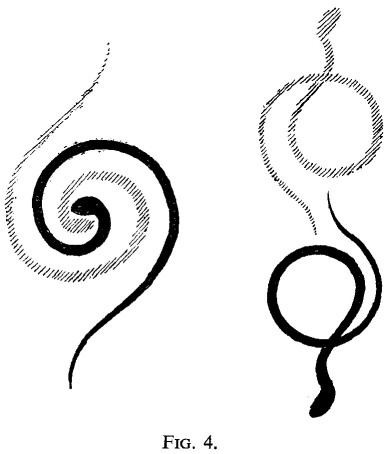
Sulphur and phosphorus are thus seen to represent two polarically opposite tendencies with regard to the levity-gravity coherence which breaks up when combustion occurs. In the case of sulphur, the ponderable and imponderable entities appear to cling together; in the case of phosphorus, they seem to be anxious to part. These two different tendencies - which are characteristic of many other substances and represent a basic factor in the chemical happenings of the earth - are in their own way a pair of opposites. Since each of them represents in itself a relationship between two poles of a polarity-gravity and levity - so in their mutual relationship they represent a 'polarity of polarities'. In Fig. 4 an attempt has been made to represent this fact by a symbolic diagram.
In this figure the shaded part represents the imponderable, the black part the ponderable entity. In the left-hand symbol both are shown in a relationship corresponding to the one characteristic of sulphur; in the right-hand figure the relationship is characteristic of phosphorus.
Here we have an instance of a kind of polarity which belongs to the fundamentals of nature as much as does the levity-gravity polarity itself. Wherever two poles of a polarity meet, they have the possibility of being connected in two ways which in themselves are again polarically opposite. Our further studies will bring up various other instances of this kind, and will show us that part of the epistemological trouble in which science finds itself to-day results from the fact that the scientific mind has been unable to distinguish between the two kinds of polarity - that is, as we shall say henceforth, between polarities of the first order (primary polarities) and polarities of the second order (secondary polarities).
In actual fact, the distinction between the two orders of polarity has been implicit in the descriptions given in this book right from the start. Remember, in this respect, how the picture of the threefold psycho-physical structure of man, which has proved a master-key for unlocking the most varied scientific problems, was first built up. There, 'body' and 'soul' represented a polarity which is obviously one of the first order. By our observation of the human organism, in relation both to the different functions of the soul and to the different main organic systems, we further recognized the fact that the ways in which body and soul are interrelated are polarically opposite in the region of the brain and nerves and in the region of the metabolic processes, which again results in two polarically opposite activities of the soul, mental on the one hand, and volitional on the other. In what we called the pole-of-consciousness and the pole-of-life we therefore have a clear polarity of the second order, and so in everything that is connected with these two, as our further discussions will show.
Remembering that our first occasion to concern ourselves overtly with the concept of polarity was in connexion with the four elements, we may now ask whether the old doctrine did not embrace some conception of secondary polarity as well as of primary polarity, and if so, whether this might not prove as helpful in clarifying our own conceptions as was the primary polarity, cold-warm. That this is indeed so, the following description will show.
Beside the two qualities cold and warm the doctrine of the four elements pointed to two further qualities forming in themselves a pair of opposites, namely, dry and moist. Just as the four elements were seen as grouping themselves in two pairs, Fire-Air on the one hand,
Water-Earth on the other, the first being characterized by the quality warm, the second by cold, so were they seen to form two opposing groups, Fire-Earth and Air-Water, of which one was characterized by the quality dry, the other by the quality moist. Fig. 5 shows how the four elements in their totality were seen to arise out of the various combinations of the four qualities.
In this diagram the element Earth appears as a combination of the qualities Dry and Cold; Water of Cold and Moist; Air of Moist and Warm; Fire of Warm and Dry. As a result, Earth and Fire, besides representing opposite poles, are also neighbours in the diagram. Here we encounter a picture characteristic of all earlier ways of looking at the world: the members of a system of phenomena, when ranked in
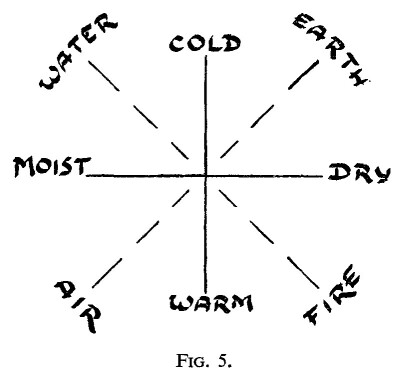
due order of succession, were seen to turn back on themselves circle-wise - or, more precisely, spiral-wise.
In what way do the qualities dry and moist form a polarity of the second order, and how do they represent the chemical polarity characteristic of sulphur and phosphorus as well as all the other secondary polarities dealt with in this book? To understand this we must submit the couple dry-moist to the same scrutiny as we applied to cold and warm in our earlier discussion of the four elements.
It lies in the nature of things that we instinctively associate these qualities with the solid and liquid states of matter respectively. This certainly agrees with the diagram given above, where the elements Earth and Water are distinguished precisely by their connexion with these two characteristics. Yet, in addition to this, the qualities dry and moist are found to be characteristic also of Fire and Air respectively, though with the difference that they are linked not with the quality cold, as in the case of the lower elements, but with the quality warm. So we see that the concepts Dry and Moist, as they lived in the old picturing of them, mean a good deal more than we understand by them to-day.
That these two respective attributes do not belong exclusively to the solid and the liquid states of matter can be seen at once by observing the different reactions of certain liquids to a solid surface which they touch. One need only recall the difference between water and quicksilver. If water runs over a surface it leaves a trail; quicksilver does not. Water clings to the side of a vessel; again, quicksilver does not. A well-known consequence of this difference is that in a narrow tube the surface of the liquid - the so-called meniscus - stands higher at the circumference than at the centre in the case of water; with quicksilver it is just the reverse. In the sense of the two qualities, dry and moist, water is a 'moist' liquid; quicksilver a 'dry' one. On the other hand, the quality of moistness in a solid substance appears in the adhesive power of glue.
Let us now see how, in accordance with the scheme given in Fig. 5, the four qualities in their respective combinations constitute the four elements. From the description we shall give here it will be realized how little such ancient schemes were based on abstract thoughts, and how much they were read from the facts of the world. Moreover, a comparison with our description of the four stages of matter, given in the previous chapter, would show how far the conceptual content of the old doctrine covers the corresponding facts when they are read by the eye of the modern reader in nature, notwithstanding the changes nature has undergone in the meantime.
The element Fire reveals its attributes of warm and dry in a behaviour which combines a tendency to dynamic expansion with a disinclination to enter into lasting combination with the other elements. Correspondingly, the behaviour of the element Earth unites a tendency to contraction with an inclination to fall out of conjunction with the other elements. Thus the attribute, dry, belongs equally to pure flame and sheer dust, though for opposite reasons. Distinct from both these elements are the middle elements Water and Air; with them the attribute, moist, comes to expression in their tendency both to interpenetrate mutually and to absorb their neighbours - the liquid element absorbing solid matter and the aeriform element taking up heat. What distinguishes them is that water has a 'cold' nature, from which it gains its density; while air has a 'warm' nature, to which it owes its tendency to expand.
In the most general sense, the quality 'moist' applies wherever two different entities are drawn into some kind of intimate relationship with one another; 'dry' applies where no such relationship prevails. Seen thus, they reveal themselves as a true polarity of the second order, for they describe the relationship between two entities which already exists, and, in the case of the four elements, are themselves a polarity. As such, they characterize precisely those polar relationships of the second order on which the threefold structure of man, we found, is based. For from the physical, as much as from the superphysical aspect the nerve-system represents the 'dry' part, and the metabolic system the 'moist' part of man's being. The same is true of the relationship between the soul and the surrounding world at both poles. Here we have the antithesis between the 'dry' onlooker-relationship of the intellect to the world, conceived as a mere picture whose essence remains outside the boundaries of the soul, and the 'moist' intermingling of the will-force with the actual forces of the world.
*
It needs no further explanation to realize that sulphur and phosphorus, by the way in which levity and gravity are interlinked in each of them, are representatives of these very qualities 'moist' and 'dry'. As such they are universally active bearers of these qualities in every realm of nature's varied activities, as their physical presence in such cases confirms. Consequently, sulphur is found in the protein-substances of the human body wherever they are bearers of metabolic processes, while the presence of phosphorus is characteristic of the nerves and bones. (Although its full significance will become clear to us only later, the fact may here be mentioned that the composition of the bone-material in the different parts of man's skeleton, as scientific analysis has shown, is such that the content of phosphate of calcium in proportion to carbonate of calcium is higher in all those parts which are spherically shaped, such as the upper parts of the skull and the upper ends of the limb-bones.)
In particular the plant reveals clearly the functional significance of phosphorus as the bearer of the quality 'dry'. For its healthy growth the plant needs the quality 'dry' in two places: at the root, where it unites with the element earth, and in the flower, where it opens itself to the fire element. Root and flower as distinct from the middle parts of the plant are both 'dry' formations. In a still higher degree this applies to the seed, which must separate itself from the mother plant to produce a separate new organism. All these are functions in the plant which, as was mentioned in the last chapter, require phosphorus for their healthy performance.
Our examination of phosphorus and sulphur from the functional point of view throws light also on their effect on the alternating conditions of waking and sleeping, necessary for the life of the higher organisms. This rhythmic change, which affects especially the nervous system, is an alternation between the qualities dry and moist. Disturbance of this alternation in one direction or the other makes it difficult for the organism to react in full wakefulness or normal sleep. It follows that treatment with phosphorus or sulphur in suitable preparations, according to the nature of the disturbance, can be beneficial.
If we study the functional properties of such substances we see that they can teach us a rational understanding of therapeutic practices, which otherwise must remain mere results of trial and error. The same applies to phosphorus and sulphur treatment in cases where in the functionally 'dry' bone system or in the functionally 'moist' metabolic system of the organism the wrong quality predominates. If the bones remain too 'moist' there is a tendency to rickets; against this, certain fish-oils are a well-known remedy on account of their highly phosphoric nature. Conversely, the application of sulphur can help where weakness of the metabolic forces produces rheumatic or gouty sediments in parts of the body whose function is to serve by their mobility the activities of the will. In this case the abnormal predominance of the quality 'dry' can be counteracted by the medical application of sulphur.
*
Having observed the action of sulphur and phosphorus in the laboratory and in living organisms, we will now turn to phenomena of a macrotelluric nature which reveal the participation of sulphur and phosphorus. There, sulphur points unmistakably to the earth's volcanism. It is a fact that, wherever mineral sulphur occurs in the earth, there we find a spot of former or present volcanic activity. Similarly, there is no such spot on the earth without sulphur being present in one form or another. Hence the name Solfatara for the fumarole described in Chapter IX.
Once again it is the Solfatara which offers us a phenomenon, this time in connexion with the special role sulphur plays in its activities, which, regarded with the eye of the spirit, assumes the significance of an instance 'worth a thousand'.
In spite of the very high temperature of the sulphurous fumes emitted from various crevices on the edge of the Solfatara, it is possible, thanks to the complete dryness of the fumes, to crawl a little way into the interior of these crevices. Not far away from the opening of the crevice, where the hot fumes touch the cooler rock surface, one is met by a very beautiful spectacle - namely, the continual forming, out of nothing as it seems, of glittering yellow sulphur crystals, suspended in delicate chains from the ceiling.
In this transformation of sulphurous substance from a higher material state, nearer to levity, to that of the solid crystal, we may behold an image of the generation of matter. For every physical substance and, therefore, every chemical element, exists originally as a pure function in the dynamic processes of the universe. Wherever, as a result of the action of gravity, such a function congeals materially, there we meet it in the form of a physical-material substance. In the same sense, sulphur and phosphorus, in their real being, are pure functions, and where they occur as physical substances, there we meet these functions in their congealed state.
One of the characteristics of the volcanic regions of the earth is the healing effect of substances found there. Fango-mud, for instance, which was mentioned in the last chapter, is a much-used remedy against rheumatism. This is typical of functional sulphur. We may truly characterize the earth's volcanism as being qualitatively sulphurous. It is the sulphur-function coming to expression through a higher degree of 'moistness' in the relationship between gravity and levity which distinguishes volcanic regions from the rest of the otherwise 'dry' earth's crust.
*
To develop a corresponding picture of the function of phosphorus, we must try to find the macrotelluric sphere where this function operates similarly to that of sulphur in volcanism. From what has been said in the last chapter it will be evident that we must look to the atmosphere, as the site of snow-formation. It is this process which we must now examine more closely.
In the atmosphere, to begin with, we find water in a state of vapour, in which the influence of the terrestrial gravity-field is comparatively weak. Floating in this state, the vapour condenses and crystallization proceeds. Obeying the pull of gravity, more and more crystals unite in their descent and gradually form flakes of varying sizes. The nearer they come to earth, the closer they fall, until at last on the ground they form an unbroken, more or less spherical, cover.
Imagine a snow-covered field glistening in the sun on a clear, quiet winter's day. As far as we can see, there is no sign of life, no movement. Here water, which is normally fluid and, in its liquid state, serves the ever-changing life-processes, covers the earth in the form of millions of separate crystals shaped with mathematical exactitude, each of which breaks and reflects in a million rays the light from the sun (Plate V). A contrast, indeed, between this quiet emergence of forms from levity into gravity, and the form-denying volcanism surging up out of gravity into levity, as shown by the ever-restless activity of the Solfatara. As we found volcanism to be a macrotelluric manifestation of functional sulphur, we find in the process of snow-formation a corresponding manifestation of functional phosphorus.
In the formation of snow, nature shows us in statu agendi a process which we otherwise meet in the earth only in its finished results, crystallization. We may, therefore, rightly look upon snow-formation as an ur-phenomenon in this sphere of nature's activities. As such it allows us to learn something concerning the origin in general of the crystalline realm of the earth; and, vice versa, our insight into the 'becoming' of this realm will enable us to see more clearly the universal function of which phosphorus is the main representative among the physical substances of the earth.
It has puzzled many an observer that crystals occur in the earth with directions of their main axes entirely independent of the direction of the earthly pull of gravity. Plate VI shows the photograph of a cluster of Calcite crystals as an example of this phenomenon. It tells us that gravity can have no effect on the formation of the crystal itself. This riddle is solved by the phenomenon of snow-formation provided we allow it to speak to us as an ur-phenomenon. For it then tells us that matter must be in a state of transition from lightness into heaviness if it is to appear in crystalline form. The crystals in the earth, therefore, must have originated at a time when the relation between levity and gravity on the earth was different from what it is, in this sphere, to-day.
The same language is spoken by the property of transparency which is so predominant among crystals. One of the fundamental characteristics of heavy solid matter is to resist light - in other words, to be opaque. Exposed to heat, however, physical substance loses this feature to the extent that at the border of its ponderability all matter becomes pervious to light. Now, in the transparent crystal matter retains this kinship to light even in its solid state.
A similar message comes from the, often so mysterious, colouring of the crystals. Here again nature offers us an instance which, 'worth a thousand', reveals a secret that would otherwise remain veiled. We refer to the pink crystals of tourmaline, whose colour comes from a small admixture of lithium. This element, which belongs to the group of the alkaline metals, does not form coloured salts (a property only shown by the heavier metals). If exposed to a flame, however, it endows it with a definite colour which is the same as that of the lithium-coloured tourmaline. Read as a letter in nature's script, this fact tells us that precious stones with their flame-like colours are characterized by having kept something of the nature that was theirs before they coalesced into ponderable existence. In fact, they are 'frozen flames'.
It is this fact, known from ancient intuitive experience, which prompted man of old to attribute particular spiritual significance to the various precious stones of the earth and to use them correspondingly in his rituals.
Crystallization, seen thus in its cosmic aspect, shows a dynamic orientation which is polarically opposite to that of the earth's seismic activities. Just as in the latter we observe levity taking hold of ponderable matter and moving it in a direction opposite to the pull of gravity, so in crystallization we see imponderable matter passing over from levity into gravity. And just as we found in volcanism and related processes a field of activity of 'functional sulphur', so we found in snow-formation and related processes a field of activity of 'functional phosphorus'. Both fields are characterized by an interaction between gravity and levity, this interaction being of opposite nature in each of them.
Here, again, sulphur and phosphorus appear as bearers of a polarity of the second order which springs from the two polarically opposite ways of interaction between the poles of the polarity of the first
order: levity-gravity.
*
As in man there is a third system, mediating between the two polar systems of his organism, so between sulphur and phosphorus there is a third element which in all its characteristics holds a middle place between them and is the bearer of a corresponding function. This element is carbon.
To see this we need only take into consideration carbon's relationship to oxidation and reduction respectively. As it is natural for sulphur to be in the reduced state, and for phosphorus to be in the oxidized state, so it is in the nature of carbon to be related to both states and therefore to oscillate between them. By its readiness to change over from the oxidized to the reduced state, it can serve the plant in the assimilation of light, while by its readiness to make the reverse change it serves man and animal in the breathing process. We breathe in oxygen from the air; the oxygen circulates through the blood-stream and passes out again in conjunction with carbon, as carbon dioxide, when we exhale. In the process whereby the plants reduce the carbon dioxide exhaled by man and animal, while the latter again absorb with their food the carbon produced in the form of organic matter by the plant, we see carbon moving to and fro between the oxidized and the reduced conditions.
Within the plant itself, too, carbon acts as functionary of the alternation between oxidation and reduction. During the first half of the year, when vegetation is unfolding, there is a great reduction process of oxidized carbon, while in the second half of the year, when the withering process prevails, a great deal of the previously reduced carbon passes into the oxidized condition. As this is connected with exhaling and inhaling of oxygen through carbon, carbon can be regarded as having the function of the lung-organ of the earth. Logically enough, we find carbon playing the same role in the middle part of the threefold human organism.
Another indication of the midway position of carbon is its ability to combine as readily with hydrogen as with oxygen, and, in these polar combinations, even to combine with itself. In this latter form it provides the basis of the innumerable organic substances in nature, and serves as the 'building stones' of the body-substances of living organisms. Among these, the carbohydrates produced by the plants show clearly the double function of carbon in the way it alternates between the states of starch and sugar.
When the plant absorbs through its leaves carbonic acid from the air and condenses it into the multiple grains of starch with their peculiar structure characteristic for each plant species, we have a biological event which corresponds to the formation of snow in the meteorological realm. Here we see carbon at work in a manner functionally akin to that of phosphorus. Sugar, on the other hand, has its place in the saps of the plants which rise through the stems and carry up with them the mineral substances of the earth. Here we find carbon acting in a way akin to the function of sulphur.
This twofold nature of carbon makes itself noticeable down to the very mineral sphere of the earth. There we find it in the fact that carbon occurs both in the form of the diamond, the hardest of all mineral substances, and also in the form of the softest, graphite. Here also, in the diamond's brilliant transparency, and in the dense blackness of graphite, carbon reveals its twofold relation to light.
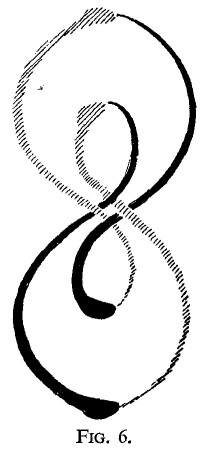
In Fig. 6 an attempt has been made to represent diagrammatically the function of Carbon in a way corresponding to the previous representation of the functions of Sulphur and Phosphorus.
*
By adding carbon to our observations on the polarity of sulphur and phosphorus we have been led to a triad of functions each of which expresses a specific interplay of levity and gravity. That we encounter three such functions is not accidental or arbitrary. Rather is it based on the fact that the interaction of forces emanating from a polarity of the first order, produces a polarity of the second order, whose poles establish between them a sphere of balance.
Through our study of levity and gravity in the matter-processes of the earth, a perspective thus opens up into a structural principle of nature which is actually not new to us. We encountered it at the very beginning of this book when we discussed the threefold psycho-physical order of man's being.
In the days of an older intuitive nature-wisdom man knew of a basic triad of functions as well as he knew of the four elementary qualities. We hear a last echo of this in the Middle Ages, when people striving for a deeper understanding of nature spoke of the trinity of Salt, Mercury and Sulphur. What the true alchemists, as these seekers of knowledge called themselves, meant by this was precisely the same as the conception we have here reached through our own way of studying matter ('Salt' standing for 'functional phosphorus', 'Mercury' for 'functional carbon'). Only the alchemist's way was a different one.
This is not the place to enter into a full examination of the meaning and value of alchemy in its original legitimate sense (which must not be confused with activities that later on paraded under the same name). Only this we will say - that genuine alchemy owes its origin to an impulse which, at a time when the onlooker-consciousness first arose, led to the foundation of a school for the development of an intuitive relationship of the soul with the world of the senses. This was to enable man to resist the effects of the division which evolution was about to set up in his soul-life - the division which was to give him, on the one hand, an abstract experience of his own self, divorced from the outer world, and on the other a mere onlooker's experience of that outer world. As a result of these endeavours, concepts were formed which in their literal meaning seemed to apply merely to outwardly perceptible substances, while in truth they stood for the spiritual functions represented by those substances, both within and outside the human organism.
Thus the alchemist who used these concepts thought of them first as referring to his own soul, and to the inner organic processes corresponding to the various activities of his soul. When speaking of Salt he meant the regulated formative activity of his thinking, based on the salt-forming process in his nervous system. When he spoke of Mercury he meant the quickly changing emotional life of the soul and the corresponding activities of the rhythmic processes of the body. Lastly, Sulphur meant the will activities of his soul and the corresponding metabolic processes of the body. Only through studying these functions within himself, and through re-establishing the harmony between them which had been theirs in the beginning, and from which, he felt, man had deviated in the course of time, did the alchemist hope to come to an understanding of their counterparts in the external cosmos.
Older alchemical writings, therefore, can be understood only if prescriptions which seem to signify certain chemical manipulations are read as instructions for certain exercises of the soul, or as advices for the redirection of corresponding processes in the body. For instance, if an alchemist gave directions for a certain treatment of Sulphur, Mercury and Salt, with the assertion that by carrying out these directions properly, one would obtain Aurum (gold), he really spoke of a method to direct the thinking, feeling and willing activities of the soul in such a way as to gain true Wisdom.1
*
As in the case of the concepts constituting the doctrine of the four elements, we have represented here the basic alchemical concepts not only because of their historical significance, but because, as ingredients of a still functional conception of nature, they assume new significance in a science which seeks to develop, though from different starting-points, a similar conception. As will be seen in our further studies, these concepts prove a welcome enrichment of the language in which we must try to express our readings in nature.
1 Roger Bacon in the thirteenth, and Berthold Schwartz in the fourteenth century, are reputed to have carried out experiments by mixing physical salt (in the form of the chemically labile saltpetre) with physical sulphur and - after some initial attempts with various metals - with charcoal, and then exposing the mixture to the heat of physical fire. The outcome of this purely materialistic interpretation of the three alchemical concepts was not the acquisition of wisdom, or, as Schwartz certainly had hoped, of gold, but of ... gunpowder!
CHAPTER XII
Space and Counter-Space
With the introduction, in Chapter X, of the peripheral type of force-field which appertains to levity as the usual central one does to gravity, we are compelled to revise our conception of space. For in a space of a kind we are accustomed to conceive, that is, the three-dimensional, Euclidean space, the existence of such a field with its characteristic of increasing in strength in the outward direction is a paradox, contrary to mathematical logic.
This task, which in view of our further observations of the actions of the levity-gravity polarity in nature we must now tackle, is, however, by no means insoluble. For in modern mathematics thought-forms are already present which make it possible to develop a space-concept adequate to levity. As referred to in Chapter I, it was Rudolf Steiner who first pointed to the significance in this respect of the branch of modern mathematics known as Projective Geometry. He showed that Projective Geometry, if rightly used, carries over the mind from the customary abstract to a new concrete treatment of mathematical concepts. The following example will serve to explain, to start with, what we mean by saying that mathematics has hitherto been used abstractly.
One of the reasons why the world-picture developed by Einstein in his Theory of Relativity deserves to be acknowledged as a step forward in comparison with the picture drawn by classical physics, lies in the fact that the old conception of three-dimensional space as a kind of 'cosmic container', extending in all directions into infinity and filled, as it were, with the content of the physical universe, is replaced by a conception in which the structure of space results from the laws interrelating this content. Our further discussion will show that this indeed is the way along which, to-day, mathematical thought must move in order to cope with universal reality.
However, for reasons discussed earlier, Einstein was forced to conceive all events in the universe after the model of gravity as observable on the earth. In this way he arrived at a space-structure which possesses neither the three-dimensionality nor the rectilinear character of so-called Euclidean space - a space-picture which, though mathematically consistent, is incomprehensible by the human mind. For nothing exists in our mind that could enable us to experience as a reality a space-time continuum of three dimensions which is curved within a further dimension.
This outcome of Einstein's endeavours results from the fact that he tried by means of gravity-bound thought to comprehend universal happenings of which the true causes are non-gravitational. A thinking that has learnt to acknowledge the existence of levity must indeed pursue precisely the opposite direction. Instead of freezing time down into spatial dimension, in order to make it fit into a world ruled by nothing but gravity, we must develop a conception of space sufficiently fluid to let true time have its place therein. We shall see how such a procedure will lead us to a space-concept thoroughly conceivable by human common sense, provided we are prepared to overcome the onlooker-standpoint in mathematics also.
Einstein owed the possibility of establishing his space-picture to a certain achievement of mathematical thinking in modern times. As we have seen, one of the peculiarities of the onlooker-consciousness consists in its being devoid of all connexion with reality. The process of thinking thereby gained a degree of freedom which did not exist in former ages. In consequence, mathematicians were enabled in the course of the nineteenth century to conceive the most varied space-systems which were all mathematically consistent and yet lacked all relation to external existence. A considerable number of space-systems have thus become established among which there is the system that served Einstein to derive his space-time concept. Some of them have been more or less fully worked out, while in certain instances all that has been done is to show that they are mathematically conceivable. Among these there is one which in all its characteristics is polarically opposite to the Euclidean system, and which is destined for this reason to become the space-system of levity. It is symptomatic of the remoteness from reality of mathematical thinking in the onlooker-age that precisely this system has so far received no special attention.1
For the purpose of this book it is not necessary to expound in detail why modern mathematical thinking has been led to look for thought-forms other than those of classical geometry. It is enough to remark that for quite a long time there had been an awareness of the fact that the consistency of Euclid's definitions and proofs fails as soon as one has no longer to do with finite geometrical entities, but with figures which extend into infinity, as for instance when the properties of parallel straight lines come into question. For the concept of infinity was foreign to classical geometrical thinking. Problems of the kind which had defeated Euclidean thinking became soluble directly human thinking was able to handle the concept of infinity.
We shall now indicate some of the lines of geometrical thought which follow from this.
*
Let us consider a straight line extending without limits in either direction. Projective geometry is able to state that a point moving along this line in one direction will eventually return from the other. To see this, we imagine two straight lines a and b intersecting at P. One of these lines is fixed (a); the other (b) rotates uniformly about C. Fig. 7 indicates the rotation of b by showing it in a number of positions with the respective positions of its point of intersection with a (P1, P2. . .). We observe this point moving along a, as a result of the rotation of b, until, when both lines are parallel, it reaches infinity. As a result of the continued rotation of b, however, P does not remain in infinity, but returns along a from the other side. We find here two forms of movement linked together - the rotational movement of a line (b) on a point (C), and the progressive movement of a point (P) along a line (a). The first movement is continuous, and observable throughout within finite space. Therefore the second movement must be continuous as well, even though it partly escapes our observation. Hence, when P disappears into infinity on one side of our own point of observation, it is at the same time in infinity on the other side. In order words, an unlimited straight line has only one point at infinity.
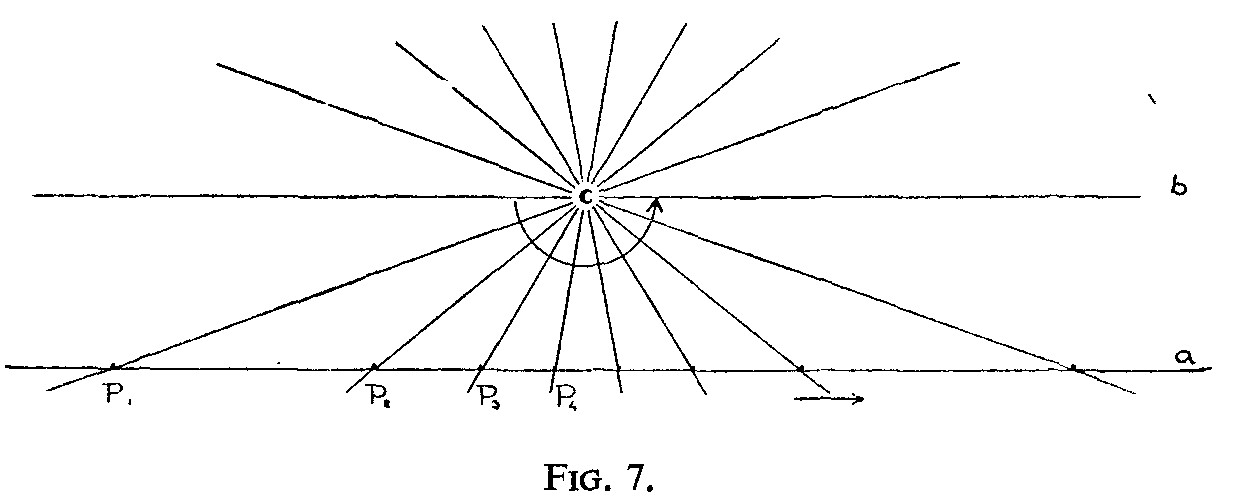
It is clear that, in order to become familiar with this aspect of geometry, one must grow together in inward activity with the happening which is contained in the above description. What we therefore intend by giving such a description is to provide an opportunity for a particular mental exercise, just as when we introduced Goethe's botany by describing a number of successive leaf-formations. Here, as much as there, it is the act of 're-creating' that matters.
The following exercise will help us towards further clarity concerning the nature of geometrical infinity.
We imagine ourselves in the centre of a sphere which we allow to expand uniformly on all sides. Whilst the inner wall of this sphere withdraws from us into ever greater distances, it grows flatter and flatter until, on reaching infinite distance, it turns into a plane. We thus find ourselves surrounded everywhere by a surface which, in the strict mathematical sense, is a plane, and is yet one and the same surface on all sides. This leads us to the conception of the plane at infinity as a self-contained entity although it expands infinitely in all directions.
This property of a plane at infinity, however, is really a property of any plane. To realize this, we must widen our conception of infinity by freeing it from a certain one-sidedness still connected with it. This we do by transferring ourselves into the infinite plane and envisaging, not the plane from the point, but the point from the plane. This operation, however, implies something which is not obvious to a mind accustomed to the ordinary ways of mathematical reasoning. It therefore requires special explanation.
In the sense of Euclidean geometry, a plane is the sum-total of innumerable single points. To take up a position in a plane, therefore, means to imagine oneself at one point of the plane, with the latter extending around in all directions to infinity. Hence the journey from any point in space to a plane is along a straight line from one point to another. In the case of the plane being at infinity, it would be a journey along a radius of the infinitely large sphere from its centre to a point at its circumference.
In projective geometry the operation is of a different character. Just as we arrived at the infinitely large sphere by letting a finite sphere grow, so must we consider any finite sphere as having grown from a sphere with infinitely small extension; that is, from a point. To travel from the point to the infinitely distant plane in the sense of projective geometry, therefore, means that we have first to identify ourselves with the point and 'become' the plane by a process of uniform expansion in all directions.
As a result of this we do not arrive at one point in the plane, with the latter extending round us on all sides, but we are present in the plane as a whole everywhere. No point in it can be characterized as having any distance, whether finite or infinite, from us. Nor is there any sense in speaking of the plane itself as being at infinity. For any plane will allow us to identify ourselves with it in this way. And any such plane can be given the character of a plane at infinity by relating it to a point infinitely far away from it (i.e. from us).
Having thus dropped the one-sided conception of infinity, we must look for another characterization of the relationship between a point and a plane which are infinitely distant from one another. This requires, first of all, a proper characterization of Point and Plane in themselves.
Conceived dynamically, as projective geometry requires, Point and Plane represent a pair of opposites, the Point standing for utmost contraction, the Plane for utmost expansion. As such, they form a polarity of the first order. Both together constitute Space. Which sort of space this is, depends on the relationship in which they are envisaged. By positing the point as the unit from which to start, and deriving our conception of the plane from the point, we constitute Euclidean space. By starting in the manner described above, with the plane as the unit, and conceiving the point from it, we constitute polar-Euclidean space.
The realization of the reversibility of the relationship between Point and Plane leads to a conception of Space still free from any specific character. By G. Adams this space has been appositely called archetypal space, or ur-space. Both Euclidean and polar-Euclidean space are particular manifestations of it, their mutual relationship being one of metamorphosis in the Goethean sense.
Through conceiving Euclidean and polar-Euclidean space in this manner it becomes clear that they are nothing else than the geometrical expression of the relationship between gravity and levity. For gravity, through its field spreading outward from an inner centre, establishes a point-to-point relation between all things under its sway; whereas levity draws all things within its domain into common plane-relations by establishing field-conditions wherein action takes place from the periphery towards the centre. What distinguishes in both cases the plane at infinity from all other planes may be best described by calling it the all-embracing plane; correspondingly the point at infinity may be best described as the all-relating point.
In outer nature the all-embracing plane is as much the 'centre' of the earth's field of levity as the all-relating point is the centre of her field of gravity. All actions of dynamic entities, such as that of the ur-plant and its subordinate types, start from this plane. Seeds, eye-formations, etc., are nothing but individual all-relating points in respect of this plane. All that springs from such points does so because of the point's relation to the all-embracing plane. This may suffice to show how realistic are the mathematical concepts which we have here tried to build up.
*
When we set out earlier in this book (Chapter VIII) to discover the source of Galileo's intuition, by which he had been enabled to find the theorem of the parallelogram of forces, we were led to certain experiences through which all men go in early childhood by erecting their body and learning to walk. We were thereby led to realize that man's general capacity for thinking mathematically is the outcome of early experiences of this kind. It is evident that geometrical concepts arising in man's mind in this way must be those of Euclidean geometry. For they are acquired by the will's struggle with gravity. The dynamic law discovered in this way by Galileo was therefore bound to apply to the behaviour of mechanical forces - that is, of forces acting from points outward.
In a similar way we can now seek to find the source of our capacity to form polar-Euclidean concepts. As we were formerly led to experiences of man's early life on earth, so we are now led to his embryonic and even pre-embryonic existence.
Before man's supersensible part enters into a physical body there is no means of conveying to it experiences other than those of levity, and this condition prevails right through embryonic development. For while the body floats in the mother's foetal fluid it is virtually exempt from the influence of the earth's field of gravity.
History has given us a source of information from these early periods of man's existence in Traherne's recollections of the time when his soul was still in the state of cosmic consciousness. Among his descriptions we may therefore expect to find a picture of levity-space which will confirm through immediate experience what we have arrived at along the lines of realistic mathematical reasoning. Among poems quoted earlier, his The Praeparative and My Spirit do indeed convey this picture in the clearest possible way. The following are relevant passages from these two poems.
In the first we read:
'Then was my Soul my only All to me, A living endless Ey, Scarce bounded with the Sky Whose Power, and Act, and Essence was to see: I was an inward Sphere of Light, Or an interminable Orb of Sight, Exceeding that which makes the Days . . .'
In the second poem the same experience is expressed in richer detail. There he says of his own soul that it -
... being Simple, like the Deity, In its own Centre is a Sphere, Not limited but everywhere.
It acts not from a Centre to Its Object, as remote; But present is, where it doth go To view the Being it doth note ...
A strange extended Orb of Joy Proceeding from within, Which did on ev'ry side display Its force; and being nigh of Kin To God, did ev'ry way Dilate its Self ev'n instantaneously, Yet an Indivisible Centre stay, In it surrounding all Eternity. 'Twas not a Sphere; Yet did appear One infinite: 'Twas somewhat everywhere.'
Observe the distinct description of how the relation between circumference and centre is inverted by the former becoming itself an 'indivisible centre'. In a space of this kind there is no Here and There, as in Euclidean space, for the consciousness is always and immediately at one with the whole space. Motion is thus quite different from what it is in Euclidean space. Traherne himself italicized the word 'instantaneous', so important did he find this fact. (The quality of instantaneousness - equal from the physical point of view to a velocity of the value âž - will occupy us more closely as a characteristic of the realm of levity when we come to discuss the apparent velocity of light in connexion with our optical studies.)
By thus realizing the source in man of the polar-Euclidean thought-forms, we see the discovery of projective geometry in a new light. For it now assumes the significance of yet another historical symptom of the modern re-awakening of man's capacity to remember his prenatal existence.
We know from our previous studies that the concept of polarity is not exhausted by conceiving the world as being constituted by polarities of one order only. Besides primary polarities, there are secondary ones, the outcome of interaction between the primary poles. Having conceived of Point and Plane as a geometrical polarity of the first order, we have therefore to ask what formative elements there are in geometry which represent the corresponding polarity of the second order. The following considerations will show that these are the radius, which arises from the point becoming related to the plane, and the spherically bent surface (for which we have no other name than that again of the sphere), arising from the plane becoming related to the point.
In Euclidean geometry the sphere is defined as 'the locus of all points which are equidistant from a given point'. To define the sphere in this way is in accord with our post-natal, gravity-bound consciousness. For in this state our mind can do no more than envisage the surface of the sphere point by point from its centre and recognize the equal distance of all these points from the centre. Seen thus, the sphere arises as the sum-total of the end-points of all the straight lines of equal length which emerge from the centre-point in all directions. Fig. 8 indicates this schematically. Here the radius, a straight line, is clearly the determining factor.