Front matter (continued 6)
Reading edition
We now move to the other pole of the primary polarity, that is to the plane, and let the sphere arise by imagining the plane approaching an infinitely distant point evenly from all sides. We view the process realistically only by imagining ourselves in the plane, so that we surround the point from all sides, with the distance between us and
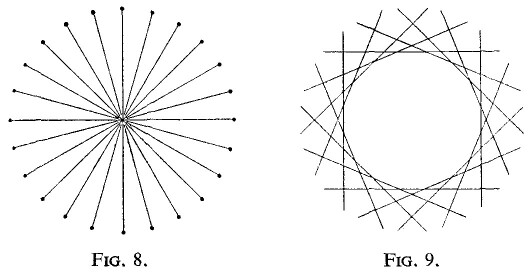
the point diminishing gradually. Since we remain all the time on the surface, we have no reason to conceive any change in its original position; that is, we continue to think of it as an all-embracing plane with regard to the chosen point.
The only way of representing the sphere diagrammatically, as a unit bearing in itself the character of the plane whence it sprang, is as shown in Fig. 9, where a number of planes, functioning as tangential planes, are so related that together they form a surface which possesses everywhere the same distance from the all-relating point.
Since Point and Plane represent in the realm of geometrical concepts what in outer nature we find in the form of the gravity-levity polarity, we may expect to meet Radius and Sphere as actual formative elements in nature, wherever gravity and levity interact in one way or another. A few observations may suffice to give the necessary evidence. Further confirmation will be furnished by the ensuing chapters.
The Radius-Sphere antithesis appears most obviously in the human body, the radial element being represented by the limbs, the spherical by the skull. The limbs thus become the hieroglyph of a dynamic directed from the Point to the Plane, and the skull of the opposite. This indeed is in accord with the distribution in the organism of the sulphur-salt polarity, as we learnt from our physiological and psychological studies. Inner processes and outer form thus reveal the same distribution of poles.
In the plant the same polarity appears in stalk and leaf. Obviously the stalk represents the radial pole. The connexion between leaf and sphere is not so clear: in order to recognize it we must appreciate that the single plant is not a self-contained entity to the same degree as is the human being. The equivalent of the single man is the entire vegetable covering of the earth. In man there is an individual centre round which the bones of his skull are curved; in the plant world the equivalent is the centre of the earth. It is in relation to this that we must conceive of the single leaves as parts of a greater sphere.
In the plant, just as in man, the morphological polarity coincides with the biological. There is, on the one hand, the process of assimilation (photosynthesis), so characteristic of the leaf. Through this process matter passes over from the aeriform condition into that of numerous separate, characteristically structured solid bodies - the starch grains. Besides this kind of assimilation we have learnt to recognize a higher form which we called 'spiritual assimilation'. Here, a transition of substance from the domain of levity to that of gravity takes place even more strikingly than in ordinary (physical) assimilation (Chapter X).
The corresponding process in the linear stalk is one which we may call 'sublimation' - again with its extension into 'spiritual sublimation'. Through this process matter is carried in the upward direction towards ever less ponderable conditions, and finally into the formless state of pure 'chaos'. By this means the seed is prepared (as we have seen) with the help of the fire-bearing pollen, so that after it has fallen to the ground, it may serve as an all-relating point to which the plant's Type can direct its activity from the universal circumference.
In order to find the corresponding morphological polarity in the animal kingdom, we must realize that the animal, by having the main axis of its body in the horizontal direction, has a relationship to the gravity-levity fields of the earth different from those of both man and plant. As a result, the single animal body shows the sphere-radius polarity much less sharply. If we compare the different groups of the animal kingdom, however, we find that the animals, too, bear this polarity as a formative element. The birds represent the spherical (dry, saline) pole; the ruminants the linear (moist, sulphurous) pole. The carnivorous quadrupeds form the intermediary (mercurial) group. As ur-phenomenal types we may name among the birds the eagle, clothed in its dry, silicic plumage, hovering with far-spread wings in the heights of the atmosphere, united with the expanses of space through its far-reaching sight; among the ruminants, the cow, lying heavily on the ground of the earth, given over entirely to the immensely elaborated sulphurous process of its own digestion. Between them comes the lion - the most characteristic animal for the preponderance of heart-and-lung activities in the body, with all the attributes resulting from that.
Within the scope of this book it can only be intimated briefly, but should not be left unmentioned for the sake of those interested in a further pursuit of these lines of thought, that the morphological mean between radius and sphere (corresponding to Mercurius in the alchemical triad) is represented by a geometrical figure known as the 'lemniscate', a particular modification of the so-called Cassinian curves.2
1 For further details, see the writings of G. Adams and L. Locher-Ernst who, each in his own way, have made a beginning with applying projective geometry on the lines indicated by Rudolf Steiner. Professor Locher-Ernst was the first to apply the term 'polar-Euclidean' to the space-system corresponding to levity.
2 For particulars of the lemniscate as the building plan of the middle part of man's skeleton, see K. König, M.D.: Beitrage zu einer reinen Anatomic des menschlichen Knochenskeletts in the periodical Natura (Dornach, 1930-1). Some projective-geometrical considerations concerning the lemniscate are to be found in the previously mentioned writings of G. Adams and L. Locher-Ernst.
CHAPTER XIII
'Radiant Matter'
When man in the state of world-onlooker undertook to form a dynamic picture of the nature of matter, it was inevitable that of all the qualities which belong to its existence he should be able to envisage only those pertaining to gravity and electricity. Because his consciousness, at this stage of its evolution, was closely bound up with the force of gravity inherent in the human body, he was unable to form any conception of levity as a force opposite to gravity. Yet, nature is built bipolarically, and polarity-concepts are therefore indispensable for developing a true understanding of her actions. This accounts for the fact that the unipolar concept of gravity had eventually to be supplemented by some kind of bipolar concept.
Now, the only sphere of nature-phenomena with a bipolar character accessible to the onlooker-consciousness 'was that of electricity. It was thus that man in this state of consciousness was compelled to picture the foundation of the physical universe as being made up of gravity and electricity, as we meet them in the modern picture of the atom, with its heavy electro-positive nucleus and the virtually weightless electro-negative electrons moving round it.
Once scientific observation and thought are freed from the limitations of the onlooker-consciousness, both gravity and electricity appear in a new perspective, though the change is different for each of them. Gravity, while it becomes one pole of a polarity, with levity as the opposite pole, still retains its character as a fundamental force of the physical universe, the gravity-levity polarity being one of the first order. Not so electricity. For, as the following discussion will show, the electrical polarity is one of the second order; moreover, instead of constituting matter as is usually believed, electricity turns out to be in reality a product of matter.
*
We follow Goethe's line when, in order to answer the question, 'What is electricity?' we first ask, 'How does electricity arise?' Instead of starting with phenomena produced by electricity when it is already in action, and deriving from them a hypothetical picture, we begin by observing the processes to which electricity owes its appearance. Since there is significance in the historical order in which facts of nature have come to man's knowledge in the past, we choose as our starting-point, among the various modes of generating electricity, the one through which the existence of an electric force first became known. This is the rousing of the electric state in a body by rubbing it with another body of different material composition. Originally, amber was rubbed with wool or fur.
By picturing this process in our mind we become aware of a certain kinship of electricity with fire, since for ages the only known way of kindling fire was through friction. We notice that in both cases man had to resort to the will-power invested in his limbs for setting in motion two pieces of matter, so that, by overcoming their resistance to this motion, he released from them a certain force which he could utilize as a supplement to his own will. The similarity of the two processes may be taken as a sign that heat and electricity are related to each other in a certain way, the one being in some sense a metamorphosis of the other. Our first task, therefore, will be to try to understand how it is that friction causes heat to appear in manifest form.
There is no friction unless the surfaces of the rubbed bodies have a structure that is in some way interfered with by the rubbing, while at the same time they offer a certain resistance to the disturbance. This resistance is due to a characteristic of matter, commonly called cohesion. Now we know that the inner coherence of a physical body is due to its point-relationship, that is to the gravitational force bound up with it. Indeed, cohesion increases as we pass from the gaseous, through the liquid, to the solid state of matter.
Whilst a body's cohesion is due to gravity, its spatial extendedness is, as we have seen, due to levity. If we reduce the volume of a piece of physical matter by means of pressure, we therefore release levity-forces previously bound up in it, and these, as always happens in such cases, appear in the form of free heat. Figuratively speaking, we may say that by applying pressure to matter, latent levity is pressed out of it, somewhat like water out of a wet sponge.
The generation of free heat by friction rests on quite similar grounds. Obviously, friction always requires a certain pressure. This alone, however, would not account for the amount of heat easily produced by friction. To the pressure there is in this case added a certain measure of encroachment upon the unity of the material substance. In the case of friction between two solid bodies, this may go so far that particles of matter are completely detached from the cohesive whole. The result is an increase in the number of single mass-centres on the earth, as against the all-embracing cosmic periphery. This diminishes the hold of levity on the total amount of physical matter present on the earth. Again, the levity thus becoming free appears as external heat. (In the reverse case when, for instance through melting, a number of single physical bodies become one, free heat becomes latent.)
Both the diminishing of spatial extension and the breaking up of a whole into parts entail an increase in the quality 'dry'. This applies not only in the sense that the parts which have become independent units are 'dry' in relation to each other - formerly coherent matter being turned into dust - but also in the other sense, and one valid in both cases, that levity and gravity are losing part of their previous inter-connexion. If this twofold process of 'becoming dry' reaches a certain intensity, the substances concerned, provided they are inflammable, begin to burn, with the result that dry heat escapes and dry ash is formed. We note that in each case we are dealing with a change in the relationship between the poles of a polarity of the first order.
We will now apply this picture of the process of friction to the instance when, as a result of this action, electricity appears.
Originally the evoking of the electric condition was ascribed solely to the nature of amber, the only substance known to possess this property. To-day we know that not the amber alone, but its coming together with another substance of different nature, in this instance an animal substance of the nature of hair or silk, is required. Whatever substances we use for friction, they must always be different in nature, so as to allow both kinds of electricity to appear at once. Which of the two kinds imposes its presence the more strongly upon the observer depends on purely extraneous conditions which have nothing to do with the process itself.
Obviously, if we wish to understand the qualitative difference between the two kinds of electricity, we must investigate the qualitative difference in the material substances, which give rise to electricity when they are rubbed together. We shall again follow the historical line by examining the two substances which first taught man the polar nature of electricity. They are glass and resin, after which, as we mentioned, the two electricities were even named in the beginning.
Our functional conception of matter, developed earlier (Chapter XI), allows us to recognize in these two substances representatives of the Salt-Sulphur polarity. Indeed, glass as a mineral substance, which actually owes its specific character to the presence of silicon in it, clearly stands on the phosphoric-crystalline side, while resin, being itself a sort of 'gum', on the sulphurous-volcanic side. In fact, sulphur itself was soon found to be a particularly suitable substance for producing 'resin'-electricity.
Now the usual way of producing one kind of electricity is by rubbing resin (or sulphur, or ebonite) with wool or fur, and the other by rubbing glass with leather. At first sight, it does not seem as if the two counter-substances represent the required alchemic counter-poles to resin and glass. For both hair and leather are animal products and therefore seem to be of like nature. Closer inspection, however, shows that they do obey the rule. For hair, like all horny substances, is a dead product of external secretion by the animal organism. An ur-phenomenal example of it, showing its kinship to glass-like substances, is the transparent cornea of the eye, close to the crystal-lens. Leather, on the other hand, is a product of the hypodermic part of the body and, as such, belongs to those parts of the organism which are filled with blood, and, therefore, permeated with life. (Note as a characteristic of leather that it requires a special treatment, tanning, to make it as immune from decay as hair is by nature.) Hair and leather, therefore, represent in themselves a salt-sulphur polarity, and thus fulfil the corresponding function when brought together with resin or glass respectively.
What is true for the particular substances which originally led man to discover the dual nature of electricity, holds good equally for any pair of substances capable of assuming the electric state when rubbed against each other. If we examine from this point of view the series of such substances, as usually given in the textbooks on electricity, we shall always find a substance of extreme salt-character at the one end, and one of extreme sulphur-character at the other, the substances as a whole forming a gradual transition from one extreme to the other. Which kind of electricity appears on each, when submitted to friction, depends on whether the counter-substance stands on its right or left, in the series. It is the particular relation between the two which makes them behave in one way or the other.
There are cases which seem to elude this law, and investigation has shown that other characteristics of the rubbed bodies, such as surface quality, can have a modifying influence. For lack of a guiding idea they are treated in the textbooks as 'irregularities'. Observation led by a true polarity concept shows that in these cases also the rule is not violated. In this respect, interesting information can be gained from the observations of J. W. Ritter (1776-1810), an ingenious Naturphilosoph from the circle round Goethe, but to whom, also, physical science is indebted for his discovery of the ultra-violet part of the spectrum and of galvanic polarization. Among his writings there is a treatise on electricity, giving many generally unknown instances of frictional electricity which are in good accord with our picture and well worth investigating. According to Ritter, even two crystalline substances of different hardness, such as Calcite and quartz, become electric when rubbed together, the softer playing the part of 'resin' and the harder that of 'glass'.
These few facts connected with the generation of frictional electricity are enough to allow us to form a picture of the nature of the polarity represented by the two kinds of electricity.
We remember that in the case of the generation of heat through friction, as a result of an encroachment upon the cohesion of the material body involved, the relationship between levity and gravity in it changes from 'moist' to 'dry' and that the effect of this is the appearance of 'fire' and 'dust' as poles of a primary polarity. This process, however, is altered when the bodies subjected to friction are opposed to each other in the sense of a salt-sulphur polarity. The effect then is that the liberated levity, under the influence of the peculiar tension between the two bodies, remains bound in the realm of substance and becomes itself split up polarically.
Clearly, then, in the case of electrical polarity we encounter a certain form of gravity-bound levity, and this in a twofold way. Owing to the contrasting nature of the two bodies involved in the process, the coupling of gravity and levity is a polar one on both sides. The electrical polarity thus turns out to be itself of the nature of a secondary polarity.
Two more recently discovered means of evoking the electric condition in a piece of matter confirm this picture. They are the so-called piezo-electricity and pyro-electricity. Both signify the occurrence of the electrical polarity at the two ends of an asymmetrically built (hemimorphous) crystal, as the result of changing the crystal's spatial condition. In piezo-electricity the change consists in a diminution of the crystal's volume through pressure; in pyro-electricity, in an increase of the crystal volume by raising its temperature. The asymmetry of the crystal, due to a one-sided working of the forces of crystallization, plays the same role here as does the alchemic opposition between the two bodies used for the production of frictional electricity.
*
It is typical of the scientist of the past that he was dependent on phenomena brought about by a highly developed experimental technique for becoming aware of certain properties of the electrical force, whereas for the realistic observer these properties are revealed at once by the most primitive electric phenomena. We remember Eddington's description of the positron as 'negative material', and his subsequent remarks, which show the paradoxical nature of this concept if applied to the hypothetical interior of the atom (Chapter IV). The quite primitive phenomenon of electrical repulsion and attraction shows us the same thing in a manner of which it is not difficult to form a conception.
Modern physics itself, with the help of Faraday's field-concept, describes these phenomena as caused by pressure - resulting from the meeting in space of two similar electrical fields - and suction - resulting from the meeting of two dissimilar fields. In the first case the space between the two electrically charged bodies assumes a degree of density, as if it were filled with some elastic material. In the second instance the density of the space where the two fields intermingle is lower than that of its surroundings. Here, clearly, we have a state of negative density which acts on the electrically charged bodies just as a lowering of pressure acts on a gas: in both cases movement occurs in the direction leading from the higher to the lower density. Electricity thus shows itself capable of producing both gravity and levity effects, thereby once more confirming our picture of it.
*
Our next task will be to examine the galvanic form of generating electricity, in order to gain further light on our picture of the electrical polarity.
Galvanism, as it became established through Volta's work, rests on certain properties of the metallic substances of the earth. Compared with the substances which may be used for producing electricity through friction, the metals hold a mid-position. They are all essentially mercurial substances. (In quicksilver, which for this reason was given the name 'mercury' by the alchemists, this fact comes to an ur-phenomenal appearance.) Among the many facts proving the mercurial nature of the metals, there is one of particular interest to us. This is their peculiar relationship to the processes of oxidation and reduction.
Metals, in their metallic state, are bearers of latent levity, which can be set free either through combustion or through corrosion. They differ from one another by their relative degree of eagerness to enter into and remain in the metallic, that is, the reduced state, or to assume and keep the state of the oxide (in which form they are found in the various metallic oxides and salts). There are metals such as gold, silver, etc., for which the reduced state is more or less natural; others, such as potassium, sodium, etc., find the oxidized state natural and can be brought into and kept in the reduced state only by artificial means. Between these extremes there are all possible degrees of transition, some metals more nearly resembling the 'noble', others more nearly the 'corrosive', metals.
We remember that it was the different relationship of sulphur and phosphorus to reduction and oxidation which led us to envisage them as ur-phenomenal representatives of the alchemic polarity. We may therefore say that there are metals which from the alchemic point of view more nearly resemble sulphur, others more nearly phosphorus, whilst others again hold an intermediary position between the extremes. It is on these differences among the various metals that their galvanic properties are based.
Let us from this point of view contemplate the following series of chemical elements, which is a representation of the so-called voltaic series:
Graphite, Platinum, Gold, Silver, Copper, Iron, Tin, Lead, Zinc, Aluminium, Magnesium, Sodium, Potassium.
Any two of these metals constitute a voltaic cell. Its electromotive force is determined by the distance in the series between the metals used. Just as in the case of frictional electricity, the kind of electricity which is supplied by a certain metal depends on whether the other metal with which it is coupled stands to the right or to the left of it in the series.1
Let us now see what happens in a galvanic cell when the two different metals are simultaneously exposed to the chemical action of the connecting fluid. Each metal by itself would undergo oxidation with greater or less intensity, and the calorific energy hidden in it would become free in the form of heat. This process suffers a certain alteration through the presence of the second metal, which sets up an alchemic tension between the two. Instead of a proper segregation of the primary polarity, heat-dust (in this case, heat-oxide), the heat remains matter-bound and appears on the surface of the two metals in a secondarily split form as positive and negative electricity.
The similarity between this process and the frictional generation of electricity is evident.
*
Our observations have shown that the emergence of the electric state, whether it be caused by friction or galvanically, depends on matter entering into a condition in which its cohesion is loosened - or, as we also put it, on its being turned into 'dust' - and this in such a way that the escaping levity remains dust-bound. This picture of electricity now enables us to give a realistic interpretation of certain phenomena which, in the interpretation which the physicist of the past was bound to give them, have contributed much to the tightening of the net of scientific illusion.
Some sixty years after Dalton had established, purely hypothetically, the theory of the atomistic structure of matter, scientific research was led to the observation of actual atomistic phenomena. Crookes found electricity appearing in his tubes in the form of discrete particles, with properties hitherto known only as appertaining to mass. What could be more natural than to take this as evidence that the method of thought developed during the past era of science was on the right course?
The same phenomena appear in quite a different light when we view them against the background of the picture of electricity to which our observations have led. Knowing that the appearance of electricity depends on a process of atomization of some sort, we shall expect that where electricity becomes freely observable, it will yield phenomena of an atomistic kind. The observations of electricity in a vacuum, therefore, yield no confirmation whatsoever of the atomistic view of matter.
The same is true of the phenomena bound up with radioactivity, which were discovered in direct consequence of Crookes's work. We know that the naturally radioactive elements are all in the group of those with the highest atomic weight. This fact, seen together with the characteristics of radioactivity, tells us that in such elements gravity has so far got the upper hand of levity that the physical substance is unable to persist as a spatially extended, coherent unit. It therefore falls asunder, with the liberated levity drawn into the process of dispersion. Seen thus, radioactivity becomes a symptom of the earth's old age.
*
Before entering into a discussion of the question, which naturally arises at this point, as to how levity and gravity by their two possible ways of interaction - 'sulphurous' or 'saline' - determine the properties of so-called positive and negative electricity, we shall first study the third mode of generating electricity, namely, by electromagnetic induction. Along this way we shall arrive at a picture of the magnetic force which corresponds to the one already obtained of electricity. This will then lead us to a joint study of the nature of electric polarity and magnetic polarity.
The discovery of the phenomena we call electromagnetic depended on the possibility of producing continuous electrical processes. This arose with Volta's invention. When it became necessary to find a concept for the process which takes place in an electric conductor between the poles of a galvanic cell, the concept of the 'current', borrowed from hydrodynamics, suggested itself. Ever since then it has been the rule to speak of the existence of a current within an electric circuit; its strength or intensity is measured in terms of a unit named in honour of Ampere.
This concept of the current has had a fate typical of the whole relation of human thought to the facts connected with electricity. Long after it had been coined to cover phenomena which in themselves betray no movement of any kind between the electrical poles, other phenomena which do in fact show such movements became known through Crookes's observations. Just as in the case of atomism, they seemed to prove the validity of the preconceived idea of the current. Soon, however, radiant electricity showed properties which contradicted the picture of something flowing from one pole to the other. The cathode rays, for instance, were found to shoot forth into space perpendicularly from the surface of the cathode, without regard to the position of the anode. At the same time Maxwell's hydrodynamic analogy (as our historical survey has shown) led to a view of the nature of electricity by which this very analogy was put out of court. By predicting certain properties of electricity which come to the fore when its poles alternate rapidly, he seemed to bring electricity into close kinship with light. Mathematical treatment then made it necessary to regard the essential energy process as occurring, not from one pole to the other, but at right angles to a line joining the poles (Poynting's vector). This picture, however, satisfactory though it was in the realm of high frequency, failed as a means of describing so-called direct-current processes.
As a result of all this the theory of electricity has fallen apart into several conceptual realms lying, as it were, alongside one another, each consistent in itself but lacking any logical connexion with the others. Although the old concept of the electric current has long lost its validity, scientific thought (not to speak of the layman's) has not managed to discard it. To do this must therefore be our first task, if we want to attain to a realistic picture of electromagnetism.
*
While keeping strictly to the historical order of things, we shall try first to form a picture of what happens when we connect two electrically charged bodies by a conductor. We know that we rightly describe the change of the dynamic properties of the part of space, in which the two bodies are present, by saying that a certain electric field prevails in it. This field possesses different 'potentials' at its various points and so there exists a certain potential difference between the two electric charges. What then happens when a so-called 'conductor' is brought into such a field?
From the point of view of the field-concept, conductivity consists in the property of a body not to allow any change of potential along its surface. Such a surface, therefore, is always an equipotential. In the language of alchemy, conductivity is a mercurial property. In the presence of such a body, therefore, no Salt-Sulphur contrasts can obtain. In view of what we found above as the mean position of the metals in the alchemic triad, it is significant that they, precisely, should play so outstanding a role as electrical conductors.
If we keep to pure observation, the only statement we can make concerning the effect produced by the introduction of such a body into the electric field is that this field suddenly disappears. We shall see later in which direction this vanishing occurs. For the present it is sufficient to have formed the picture of the disappearance of the electrical condition of space as a result of the presence of a body with certain mercurial properties.
Nothing else, indeed, happens when we make the process continuous by using a galvanic source of electricity. All that distinguishes a galvanic cell from the sources of electricity used before the time of Volta is its faculty of immediately re-establishing the field which prevails between its poles, whenever this field becomes extinguished by the presence of a conductor. Volta himself saw this quite correctly. In his first account of the new apparatus he describes it as 'Leyden jars with a continuously re-established charge'. Every enduring electrical process, indeed, consists in nothing but a vanishing and re-establishment of the electrical field with such rapidity that the whole process appears continuous.
Here, also, pure observation of the effect of a conductor in an electric field tells us that its action consists in the annihilation of the field. There is no phenomenon which allows us to state that this process takes place along the axis of the conductor. If we wish to obtain a picture of the true direction, we must consider the condition of space which arises in place of the electric condition that has disappeared.
With the possibility of turning the cancellation of the electrical condition of space into a continuous process, it became possible to observe that the neutralization of electric charges entails the appearance of heat and magnetism. We must now ask which are the qualities of electricity on the one hand, and of heat and magnetism on the other, which account for the fact that where electricity disappears, the two latter forces are bound to appear. Since magnetism is the still unknown entity among the three, we must now deal with it.
*
Unlike electricity, magnetism was first known in the form of its natural occurrence, namely as a property of certain minerals. If we follow the same course which led us to start our study of electricity with the primitive process of generating it, we shall turn now to the basic phenomenon produced by a magnetic field already in existence. (Only when we have learnt all we can from this, shall we proceed to ask how magnetism comes into being.) Obviously, we shall find this basic phenomenon in the effect of a magnet on a heap of iron filings.
Let us, to begin with, compare a mass of solid iron with the same quantity of it in powdered form. The difference is that the powder lacks the binding force which holds the solid piece together. Now lei us expose the powdered iron to the influence of a magnet. At once a certain ordering principle takes hold of the single particles. They no longer lie at random and unrelated, apart from the inconspicuous gravitational effect they exert on one another, but are drawn into a coherent whole, thus acquiring properties resembling those of an ordinary piece of solid matter.
Read thus, the phenomenon tells us that a part of space occupied by a magnetic field has qualities which are otherwise found only where a coherent solid mass is present. A magnetic piece of solid iron, therefore, differs from a non-magnetic piece by giving rise in its surroundings to dynamic conditions which would otherwise exist only in its interior. This picture of the relatedness of magnetism to solidity is confirmed by the fact that both are cancelled by heat, and increased by cold.2
By its magnetic properties iron thus reveals itself as a substance capable of assuming the condition of solid matter to a degree surpassing ordinary solidity. As an exceptional kind of metal it forms the counter-pole to mercury, in which the solid-fluid condition characteristic of all metallic matter is as much shifted towards the fluid as in iron it is to the solid. (Note in this respect the peculiar resistance of iron to the liquefying effect which mercury has on the other metals.)
This picture of magnetism enables us to understand at once why it must occur together with heat at the place where an electric polarity has been cancelled by the presence of a conductor. We have seen that electricity is levity coupled in a peculiar way with gravity; it is polarized levity (accompanied by a corresponding polarization of gravity). An electric field, therefore, always has both qualities, those of levity and of gravity. We saw a symptom of this in electrical attraction and repulsion, so called; the attraction, we found, was due to negative density, the repulsion to positive density, imparted to space by the electrical fields present there. Now we see that when, through the presence of a conductor, the electrical field round the two opposing poles vanishes, in its place two other fields, a thermal and a magnetic, appear. Clearly, one of them represents the levity-part, the other the gravity-part, of the vanished electric field. The whole process reminds one of combustion through which the ponderable and imponderable parts, combined in the combustible substance, fall apart and appear on the one hand as heat, and on the other as oxidized substance ('ash'). Yet, between these two manifestations of heat there is an essential qualitative difference.
Although, from our view-point, magnetism represents only one 'half of a phenomenon, the other half of which is heat, we must not forget that it is itself a bipolar force. Thus, despite its apparent relation to gravity it does not represent, as gravity does, one pole of a primary polarity, with heat as the other pole. Rather must it carry certain qualities of levity which, together with those of gravity, appear in a polarically opposite manner at its two poles. (Details of this will be shown later when we come to investigate the individual qualities of the two poles of magnetism and electricity.) Hence the heat that forms the counterpart to magnetism cannot be pure levity either. As the result of a certain coupling with gravity, it too has somehow remained polarically split.
This can easily be seen by considering the following. Unlike the levity-gravity polarity, in which one pole is peripheral and the other point-centred, both Doles of the electrical polarity are point-centred; both are located in physical space, and thereby determine a definite direction within this space. It is this direction which remains a characteristic of both the magnetic and the thermal fields. The direction of the thermal field as much as that of the magnetic is determined by its having as its axis the conductor joining the poles of the antecedent electrical field. Both fields supplement each other in that the thermal radiation forms the radii which belong to the circular magnetic lines-of-force surrounding the conductor.3
Our picture of the process which is commonly called an electric current is now sufficiently complete to allow us to make a positive statement concerning the direction in which it takes place. Let us once more sum up: In order that this process may occur, there must be present in an electrically excited part of space a body which does not suffer the particular polarization of space bound up with such a field. As a result, the electrical field disappears, and in place of it appear a thermal field and a magnetic field, both having as their axis the line connecting the two poles. Each of them spreads out in a direction at right angles to this fine. Obviously, therefore, it is in this radial direction that the transformation of the electrical into the thermo-magnetic condition of space must take place.
This picture of the electro-thermo-magnetic happening, as regards its direction, is in complete accord with the result obtained (as indicated earlier) by the mathematical treatment of high-frequency phenomena. Once more we see that quite primitive observations, when properly read, lead to findings for which scientific thought had to wait until they were forced on it by the progress of experimental technique - as even then science was left without a uniformly valid picture of the dynamic behaviour of electricity.
Further, we can now see that when we apply electricity to practical purposes, we are in fact seldom using electricity itself, but other forces (that is, other combinations of gravity and levity) which we make effective by making electricity disappear. The same is true of most of the methods of measuring electricity. As a rule, the force which sets the instrument in motion is not electricity but another force (magnetism, heat, etc.) which appears in the place of the vanishing electricity. Thus the so-called intensity of an electric current is actually the intensity with which the electricity in question disappears! Electricity serves us in our machines in the same way that food serves a living organism: it gets itself digested, and what matters is the resulting secondary product.
Just as alterations in the electrical condition of space give rise to the appearance of a magnetic field, any alteration of the magnetic state of space gives rise to the appearance of an electrical field. This process is called electromagnetic induction. With its discovery, the generation of electricity through friction and in the galvanic way was supplemented by a third way. By this means the practical use of electricity on a large scale became possible for the first time. If our picture of the two earlier processes of generating electricity is correct, then this third way must also fit into the picture, although in this case we have no longer to do with any direct atomization of physical matter. Our picture of magnetism will indeed enable us to recognize in electromagnetic induction the same principle on which we found the two other processes to rest.
Magnetism is polarized gravity. Hence it has the same characteristic of tending always to maintain an existent condition. In bodies subject to gravity, this tendency reveals itself as their inertia. It is the inertia inherent in magnetism which we employ when using it to generate electricity. The simplest example is when, by interrupting a 'primary current', we induce a 'secondary current' in a neighbouring circuit. By the sudden alteration of the electric condition on the primary side, the magnetic condition of the surrounding space is exposed to a sudden corresponding change. Against this the magnetic field 'puts up' a resistance by calling forth, on the secondary side, an electrical process of such direction and strength that the entire magnetic condition remains first unaltered and then, instead of changing suddenly, undergoes a gradual transformation which ideally needs an infinite time for its accomplishment (asymptotic course of the exponential curve). This principle rules every process of electromagnetic induction, whatever the cause and direction of the change of the magnetic field.
We know that electromagnetic induction takes place also when a conductor is moved across a magnetic field in such a way that, as the technical term goes, it 'cuts' the field's lines of force. Whereas the process discussed above is employed in the transformer, this latter process is used in generation of electricity by dynamo. We have seen that a magnetic field imparts to the relevant part of space qualities of density which otherwise prevail only in the interior of solid masses. We remember further that the appearance of electricity, in the two other modes of generating it, is caused by the loosening of the coherence of the material substance. A similar loosening of the coherence of the magnetic field takes place when its field-lines are cut by the movement of the conductor across it. Just as heat occurs when we move a solid object through a liquid, electricity occurs when we move a conductor across a magnetic field. In each case we interfere with an existing levity-gravity relationship.
*
Having established thus far the picture of both electricity and magnetism which shows each as an outcome of certain levity-gravity interactions, we now ask how, in particular, negative and positive electricity on the one hand and north and south magnetism on the other are determined by these interactions. Let us again begin with electricity.
We remember that Galvani was led to his observations by the results of Walsh's study of the electric fishes. While Galvani clung to the view that in his own experiments the source of the electrical force lay within the animal bodies, Volta saw the fallacy of that. He then conceived the idea of imitating with purely inorganic substances the set-up which Galvani had come upon by accident. The paradoxical result - as he himself noticed with surprise - was that his apparatus turned out to be a close replica of the peculiar organ with which the electric fishes are endowed by nature. We must now take a closer view of this organ.
The electric organ of such a fish consists of many thousands of little piles, each made up of a very great number of plates of two different kinds, arranged in alternating layers. The two kinds differ in substance: in one case the plate is made from a material similar to that present in the nervous system of animals; in the other the resemblance is to a substance present in the muscular system, though only when the muscles are in a state of decay. In this way the two opposing systems of the animal body' seem to be brought here into direct contact, repeated many thousands of times.
In the electric fishes, accordingly, sensation and will are brought into a peculiar interrelation. For the will-pole is related to its bodily foundation in a manner which otherwise obtains only between the nervous system and the psychological processes co-ordinated with it. These fishes then have the capacity to send out force-currents which produce in other animals and in man 'concussion of the limbs', or in extreme cases paralysis and even death. Through describing the process in this way we realize that electricity appears here as metamorphosed animal will, which takes this peculiar form because part of the animal's volitional system is assimilated to its sensory system in an exceptional manner.
It is known to-day that what nature reveals so strikingly in the case of the electric fish, is nothing but the manifestation of a principle at work in the bodies of all beings endowed with sensation and volition - in corporeal terms, with the duality of a nervous and a muscular system - and therefore at work also in the human body. Observation has shown that the activities of these two systems in man and animal are accompanied by the occurrence of different electric potentials in different parts of the body. Plate A, Fig. iii, shows the distribution of the two polar electric forces in the human body. The bent lines in the diagram stand for curves of equal electric potential. The straight line between them is the neutral zone. As might be expected, this line runs through the heart. What seems less obvious is its slanting position. Here the asymmetry, characteristic of the human body, comes to expression.
If we remember that the nervous system represents the salt-pole, and the metabolic system the sulphur-pole, of the human organism, and if we take into account the relationship between levity and gravity at the two poles, we can see from the distribution of the two electricities that the coupling of levity and gravity at the negative pole of the electrical polarity is such that levity descends into gravity, while at the positive pole gravity rises into levity. Negative electricity therefore must have somehow a 'spherical' character, and positive electricity a 'radial'.
This finding is fully confirmed by electrical phenomena in the realm of nature most remote from man (though it was an effort to solve the enigma of man which led to the discovery of this realm). Since Crookes's observations of the behaviour of electricity in a vacuum it is common knowledge that only the negative kind of electricity occurs as a freely radiating force (though it retains some properties of inertia), whereas positive electricity seems to be much more closely bound to minute particles of ponderable matter. Here again we find gravity-laden levity on the negative side, levity-raised gravity on the positive.
The same language is spoken by the forms in which the luminous phenomena appear at the two poles of a Crookes tube. Fig. i on Plate A represents the whole phenomenon as far as such a diagram allows. Here we see on the positive side radial forms appear, on the negative side planar-spherical forms. As symbols of nature's script, these forms tell us that cosmic periphery and earthly centre stand in a polar relation to each other at the two ends of the tube. (Our optical studies will later show that the colours which appear at the anode and cathode are also in complete accord with this.)
At this point in our discussion it is possible to raise, without risk of confusing the issue, the question of the distribution of the two electric forces over the pairs of substances concerned in the generation of electricity both by friction and in the galvanic way. This distribution seems to contradict the picture to which the foregoing observations have led us, for in both instances the 'sulphurous' substances (resin in one, the nobler metals in the other) become bearers of negative electricity; while the 'saline' substances (glass and the corrosive metals) carry positive electricity. Such a criss-crossing of the poles-surprising as it seems at first sight - is not new to us. We have met it in the distribution of function of the plant's organs of propagation, and we shall meet a further instance of it when studying the function of the human eye. Future investigation will have to find the principle common to all instances in nature where such an interchange of the poles prevails.
While the electric field arising round an electrified piece of matter does not allow any recognition of the absolute characteristics of the two opposing electrical forces, we do find them revealed by the distribution of electricity in the human body. Something similar holds good for magnetism. Only, to find the phenomena from which to read the absolute characteristics of the two sides of the magnetic polarity, we must not turn to the body of man but to that of the earth, one of whose characteristics it is to be as much the bearer of a magnetic field as of gravitational and levitational fields. There is significance in the fact that even to-day, when the tendency prevails to look for causes of natural phenomena not in the macrocosmic expanse, but in the microscopic confines of space, the two poles of magnetism are named after the magnetic poles of the earth. It indicates the degree to which man's feeling instinctively relates magnetism to the earth as a whole.
In our newly developed terminology we may say that magnetism, as a polarity of the second order, represents a field of force both of whose poles are situated within finite space, and that in the macro-telluric mother-field this situation is such that the axis of this field coincides more or less with the axis of the earth's physical body. Thus the magnetic polarization of the earth as a letter in nature's script bids us rank it alongside other phenomena which in their way are an expression of the earth's being polarized in the north-south direction.
The Austrian geographer, E. Suess, in his great work The Countenance of the Earth, first drew attention to the fact that an observer approaching the earth from outer space would be struck by the onesided distribution and formation of the earth's continents. He would notice that most of the dry land is in the northern hemisphere, leaving the southern hemisphere covered mainly with water. In terms of the basic elementary qualities, this means that the earth is predominantly 'dry' in its northern half, and 'moist' in its southern.
In this fact we have a symbol which tells us that the earth represents a polarity of the second order, with its 'salt'-pole in the north and its 'sulphur'-pole in the south. Hence the magnetism called 'North' must be of saline and therefore spherical nature, corresponding to the negative pole in the realm of electricity, while 'South' magnetism must be of sulphurous - i.e. radial-nature, corresponding to positive electricity. Moreover, this must hold good equally for the fields of magnetic force generated by naturally magnetic or artificially magnetized pieces of iron. For the circumstance that makes a piece of matter into a magnet is simply that part of the general magnetic field of the earth has been drawn into it. Of especial interest in this respect is the well-known dependence of the direction of an electrically produced magnetic field on the position of the poles of the electric field.
*
The insight we have now gained into the nature of electricity has led us to the realization that with every act of setting electromagnetic energies in motion we interfere with the entire levity-gravity balance of our planet by turning part of the earth's coherent substance into cosmic 'dust'. Remembering our picture of radioactivity, in which we recognized a sign of the earth's old age, we may say that whenever we generate electricity we speed up the earth's process of cosmic ageing. Obviously this is tremendously enhanced by the creation of artificial radioactivity along the lines recently discovered, whereby it has now become possible to transmute chemical elements into one another, or even to cancel altogether their gravity-bound existence.
To see things in this light is to realize that with our having become able to rouse electricity and magnetism from their dormant state and make them work for us, a gigantic responsibility has devolved upon mankind. It was man's fate to remain unaware of this fact during the first phase of the electrification of his civilization; to continue now in this state of unawareness would spell peril to the human race.
The fact that modern science has long ceased to be a 'natural' science is something which has begun to dawn upon the modern scientific researcher himself. What has thus come to him as a question finds a definite answer in the picture of electricity we have been able to develop. It is again Eddington who has drawn attention particularly to this question: see the chapter, 'Discovery or Manufacture?' in his Philosophy of Physical Science. It will be appropriate at this point to recall his remarks, for they bear not only on the outcome of our own present discussion, but also, as the next chapter will show, on the further course of our studies.
Eddington starts by asking: 'When Lord Rutherford showed us the atomic nucleus, did he find it or did he make it?' Whichever answer we give, Eddington goes on to say, makes no difference to our admiration for Rutherford himself. But it makes all the difference to our ideas on the structure of the physical universe. To make clear where the modern physicist stands in this respect, Eddington uses a striking comparison. If a sculptor were to point in our presence to a raw block of marble saying that the form of a human head was lying hidden in the block, 'all our rational instinct would be roused against such an anthropomorphic speculation'. For it is inconceivable to us that nature should have placed such a form inside the block. Roused by our objection, the artist proceeds to verify his theory experimentally - 'with quite rudimentary apparatus, too: merely using a chisel to separate the form for our inspection, he triumphantly proves his theory.'
'Was it in this way', Eddington asks, 'that Rutherford rendered concrete the nucleus which his scientific imagination had created?' One thing is certain: 'In every physical laboratory we see ingeniously devised tools for executing the work of sculpture, according to the designs of the theoretical physicist. Sometimes the tool slips and carves off an odd-shaped form which he had not expected. Then we have a new experimental discovery,'
To this analogy Eddington adds the following even more drastic one: 'Procrustes, you will remember,' he says, 'stretched or chopped down his guests to fit the bed he constructed. But perhaps you have not heard the rest of the story. He measured them up before they left the next morning, and wrote a learned paper On the Uniformity of Stature of Travellers for the Anthropological Society of Attica.'
*
Besides yielding a definite answer to the question of how far the seemingly discovered facts of science are manufactured facts, our newly won insight into the nature of the electric and magnetic polarties throws light also on the possibility of so handling both that their application will lead no longer to a cancellation, but to a true continuation, of nature's own creative deeds.
An example of this will appear in the next part of our studies, devoted to observations in the field of optics.
1 Note that the series starts on the left with graphite, i.e. with carbon. This substance appears here as a metal among metals, and indeed as the most 'noble' of all. Electricity in this way reveals a secret of carbon well known to the mediaeval alchemist and still known in our day to people in the Orient.
2 There is even a gas which assumes magnetic properties when exposed to extreme cold-oxygen in the solid state.
3 By watering plants with water that had been exposed to heat from different sources, E. Pfeiffer has shown in the chemical laboratory of the Goetheanum that heat engendered by means of electricity is 'dead' heat. It follows that it is not the same for human health whether the heat used for cooking or heating purposes is obtained by burning wood or coal, or by means of electricity.
CHAPTER XIV
Colours as 'Deeds and Sufferings of Light'
'As for what I have done as a poet, I take no pride in it whatever. Excellent poets have lived at the same time as myself; poets more excellent have lived before me, and others will come after me. But that in my century I am the only person who knows the truth in the difficult science of colours - of that, I say, I am not a little proud, and here I have a consciousness of a superiority to many.'
In these words spoken to his secretary, Eckermann, in 1829, a few years before his death, Goethe gave his opinion on the significance of his scientific researches in the field of optical phenomena. He knew that the path he had opened up had led him to truths which belong to the original truths of mankind. He expressed this by remarking that his theory of colour was 'as old as the world'.
If in this book we come somewhat late to a discussion of Goethe's colour-theory, in spite of the part it played in his own scientific work, and in spite of its significance for the founding of a physics based on his method, the reasons are these. When Goethe undertook his studies in this field he had not to reckon with the forms of thought which have become customary since the development of mechanistic and above all - to put it concisely - of 'electricalistic' thinking. Before a hearing can be gained in our age for a physics of Light and Colour as conceived by Goethe, certain hindrances must first be cleared away. So a picture on the one hand of matter, and on the other of electricity, such as is given when they are studied by Goethean methods, had first to be built up; only then is the ground provided for an unprejudiced judgment of Goethe's observations and the deductions that can be made from them to-day.
As Professor Heisenberg, in his lecture quoted earlier (Chapter II), rightly remarks, Goethe strove directly with Newton only in the realms of colour-theory and optics. Nevertheless his campaign was not merely against Newton's opinions in this field. He was guided throughout by the conviction that the fundamental principles of the whole Newtonian outlook were at stake. It was for this reason that his polemics against Newton were so strongly expressed, although he had no fondness for such controversies. In looking back on that part of the Farbenlehre which he had himself called 'Polemical' in the title, he said to Eckermann: 'I by no means disavow my severe dissections of the Newtonian statements; it was necessary at the time and will also have its value hereafter; but at bottom all polemical action is repugnant to my nature, and I can take but little pleasure in it.'
The reason why Goethe chose optics as the field of conflict, and devoted to it more than twenty years of research and reflexion, amidst all the other labours of his rich life, lay certainly in his individual temperament - 'zum Sehen geboren, zum Schauen bestellt'.1 At the same time one must see here a definite guidance of humanity. Since the hour had struck for mankind to take the first step towards overcoming the world-conception of the one-eyed, colour-blind onlooker, what step could have been more appropriate than this of Goethe's, when he raised the eye's capacity for seeing colours to the rank of an instrument of scientific cognition?
In point of fact, the essential difference between Goethe's theory of colour and the theory which has prevailed in science (despite all modifications) since Newton's day, lies in this: While the theory of Newton and his successors was based on excluding the colour-seeing faculty of the eye, Goethe founded his theory on the eye's experience of colour.
*
In view of the present scientific conception of the effect which a prismatic piece of a transparent medium has on light passing through it, Goethe's objection to Newton's interpretation and the conclusions drawn from it seems by no means as heretical as it did in Goethe's own time and for a hundred years afterwards. For, as Lord Rayleigh and others have shown, the facts responsible for the coming into being of the spectral colours, when these are produced by a diffraction grating, invalidate Newton's idea that the optical apparatus serves to reveal colours which are inherent in the original light. Today it is known that these colours are an outcome of the interference of the apparatus (whether prism or grating) with the light. Thus we find Professor R. W. Wood, in the opening chapter of his Physical Optics, after having described the historical significance of Newton's conception of the relation between light and colour, saying: 'Curiously enough, this discovery, which we are taking as marking the beginning of a definite knowledge about light, is one which we shall demolish in the last chapter of this book,2 for our present ideas regarding the action of the prism more nearly resemble the idea held previous to Newton's classical experiments. We now believe that the prism actually manufactures the coloured light.'
We find ourselves faced here with an instance of the problem, 'Discovery or Manufacture?' dealt with by Eddington in the manner described in our previous chapter. This very instance is indeed used by Eddington himself as a case in which the answer is definitely in favour of 'manufacture'. Nevertheless, Eddington complains, experts, in spite of knowing better, keep to the traditional way of speaking about the spectral colours as being originally contained in the light. 'Such is the glamour of a historical experiment.'3 It is for the same reason that Goethe's discovery continues to be unrecognized by the majority of scientists, who prefer, instead of examining the question for themselves, to join in the traditional assertion that 'Goethe never understood Newton'.
*
As Goethe relates at the conclusion of the 'historical' part of his Farbenlehre,4 he was drawn to study colour by his wish to gain some knowledge of the objective laws of aesthetics. He felt too close to poetry to be able to study it with sufficient detachment, so he turned to painting - an art with which he felt sufficiently familiar without being connected with it creatively - hoping that if he could discover the laws of one art they would prove applicable to others.
His visit to Italy, a land rich both in natural colour and in works of art, gave him a welcome opportunity to pursue this inquiry, but for a long time he made no headway. The paintings he saw suggested no inherent law in their arrangement of colours, nor could the painters he questioned tell him of one. The only qualitative distinction they seemed to recognize was between 'cold' and 'warm' colours.
His own observations led him to a definite experience of the quality of the colour blue, for which he coined the phrase 'feebleness of blue' ('Ohnmacht des Blau'). In some way this colour seemed to him to be related to black. In order to rouse his artist friends and to stimulate their reflexions, he liked to indulge in paradoxes, as when he asserted that blue was not a colour at all. He found, however, as time went on, that in this way he came no nearer his goal.
Although the splendour of colour in the Italian sky and the Italian landscape made a powerful impression on Goethe, he found not enough opportunity for systematic study to allow him to arrive at more than a dim surmise of some law underlying the occurrence of colour in nature. Still, there was one thing he took home with him as a result of his labours. He had grown convinced that 'the first approach to colours as physical phenomena had to be sought from the side of their occurrence in nature, if one would gain an understanding of them in relation to art'.
Back at home, he strove to recollect the theory of Newton as it was being taught in schools and universities - namely, that 'colours in their totality are contained in light'. Hitherto he had had no occasion to doubt the correctness of this theory. Like everyone else, he had heard it expounded in lectures as an incontestable result of empirical observation, though without this ever having been shown to him by way of experiment. He convinced himself by consulting a manual that his recollection was correct, but at the same time he found that the theory there set forth gave no help in answering his questions.5 So he decided to examine the phenomena for himself.
For this purpose he borrowed a set of prisms from a friend living in near-by Jena, the physicist, Büttner. Since, however, he had at that time no opportunity of arranging a dark chamber on Newton's lines, where the necessary ray of light from a tiny hole in the window-covering was sent through a prism, he postponed the whole thing, until in the midst of all his many other interests and duties it was forgotten. In vain Büttner pressed many times for the return of the prisms; at last he sent a mutual acquaintance with the injunction not to return without them. Goethe then searched for the long-neglected apparatus and determined to take a rapid glance through one of the prisms before he gave them back.
He recalled dimly his pleasure as a boy at the vision of the world given him through a bit of similarly shaped glass. 'I well remember that everything looked coloured, but in what manner I could no longer recollect. I was just then in a room completely white; remembering the Newtonian theory, I expected, as I put the prism to my eye, to find the whole white wall coloured in different hues and to see the light reflected thence into the eye, split into as many coloured lights.
'But how astonished was I when the white wall seen through the prism remained white after as before. Only where something dark came against it a more or less decided colour was shown, and at last the window-bars appeared most vividly coloured, while on the light-grey sky outside no trace of colouring was to be seen. It did not need any long consideration for me to recognize that a boundary or edge is necessary to call forth the colours, and I immediately said aloud, as though by instinct, that the Newtonian doctrine is false.'
For Goethe, there could be no more thought of sending back the prisms, and he persuaded Büttner to leave them with him for some time longer.
Goethe adds a short account of the progress of the experiments he now undertook as well as of his efforts to interest others in his discovery. He makes grateful reference to those who had brought him understanding, and who had been helpful to him through the exchange of thoughts. Among these, apart from Schiller, whom Goethe especially mentions, we find a number of leading anatomists, chemists, writers and philosophers of his time, but not a single one of the physicists then active in teaching or research. The 'Guild' took up an attitude of complete disapproval or indifference, and so have things remained till a hundred years after his death, as Goethe himself prophesied.
One of the first systematic pieces of work which Goethe undertook in order to trace the cause of the Newtonian error was to go through Book I of Newton's Optics, sentence by sentence, recapitulate Newton's experiments and rearrange them in the order which seemed to him essential. In so doing he gained an insight which was fundamental for all future work, and often proved very beneficial in the perfecting of his own methods. His examination of the Newtonian procedure showed him that the whole mistake rested on the fact that 'a complicated phenomenon should have been taken as a basis, and the simpler explained from the complex'. Nevertheless, it still needed 'much time and application in order to wander through all the labyrinths with which Newton had been pleased to confuse his successors'.
*
It seems a small thing, and yet it is a great one, which Goethe, as the above description shows, discovered almost by chance. This is shown by the conclusions to which he was led in the systematic prosecutions of his discovery. An account of them is given in his Beiträge zur Optik,6 published in 1791, the year in which Galvani came before the public with his observations in the sphere of electricity.
Goethe describes in this book the basic phenomena of the creation of the prismatic colours, with particulars of a number of experiments so arranged that the truth he had discovered, contrary to Newton's view, comes to light through the very phenomena themselves. Only much later, in the year 1810, and after he had brought to a certain conclusion four years previously the researches which he had pursued most carefully the whole time, did he make public the actual masterpiece, Entwurf einer Farbenlehre.7 (An English translation of the didactic part appeared about ten years after Goethe's death.)
While leaving a more detailed description of the composition of Goethe's Entwurf for our next chapter, we shall here deal at once with some of the essential conclusions to which the reader is led in this book. As already mentioned, Goethe's first inspection of the colour-phenomenon produced by the prism had shown him that the phenomenon depended on the presence of a boundary between light and darkness. Newton's attempt to explain the spectrum out of light alone appeared to him, therefore, as an inadmissible setting aside of one of the two necessary conditions. Colours, so Goethe gleaned directly from the prismatic phenomenon, are caused by both light and its counterpart, darkness. Hence, to arrive at an idea of the nature of colour, which was in accord with its actual appearance, he saw himself committed to an investigation of the extent to which the qualitative differences in our experience of colours rests upon their differing proportions of light and darkness.
It is characteristic of Goethe's whole mode of procedure that he at once changed the question, 'What is colour?' into the question, 'How does colour arise?' It was equally characteristic that he did not, as Newton did, shut himself into a darkened room, so as to get hold of the colour-phenomenon by means of an artificially set-up apparatus. Instead, he turned first of all to nature, to let her give him the answer to the questions she had raised.
It was clear to Goethe that to trace the law of the genesis of colour in nature by reading her phenomena, he must keep a look-out for occurrences of colours which satisfied the conditions of the Ur-phänomen, as he had learned to know it. This meant that he must ask of nature where she let colours arise out of light and darkness in such a way that no other conditions contributed to the effect.
He saw that such an effect was presented to his eye when he turned his gaze on the one hand to the blue sky, and on the other to the yellowish luminous sun. Where we see the blue of the heavens, there, spread out before our eyes, is universal space, which as such is dark. Why it does not appear dark by day as well as by night is because we see it through the sun-illumined atmosphere. The opposite role is played by the atmosphere when we look through it to the sun. In the first instance it acts as a lightening, in the second as a darkening, medium. Accordingly, when the optical density of the air changes as a result of its varying content of moisture, the colour-phenomenon undergoes an opposite change in each of the two cases. Whilst with increasing density of the air the blue of the sky brightens up and gradually passes over into white, the yellow of the sun gradually darkens and finally gives way to complete absence of light.
The ur-phenomenon having once been discovered in the heavens, could then easily be found elsewhere in nature on a large or small scale-as, for instance, in the blue of distant hills when the air is sufficiently opaque, or in the colour of the colourless, slightly milky opal which looks a deep blue when one sees it against a dark background, and a reddish yellow when one holds it against the light. The same phenomenon may be produced artificially through the clouding of glass with suitable substances, as one finds in various glass handicraft objects. The aesthetic effect is due to the treated glass being so fashioned as to present continually changing angles to the light, when both colour-poles and all the intermediate phases appear simultaneously. It is also possible to produce the ur-phenomenon experimentally by placing a glass jug filled with water before a black background, illuminating the jug from the side, and gradually clouding the water by the admixture of suitable substances. Whilst the brightness appearing in the direction of the light goes over from yellow and orange to an increasingly red shade, the darkness of the black background brightens to blue, which increases and passes over to a milky white.
It had already become clear to Goethe in Italy that all colour-experience is based on a polarity, which he found expressed by painters as the contrast between 'cold' and 'warm' colours. Now that the coming-into-being of the blue of the sky and of the yellow of the sun had shown themselves to him as two processes of opposite character, he recognized in them the objective reason why both colours are subjectively experienced by us as opposites. 'Blue is illumined darkness - yellow is darkened light' - thus could he assert the urphenomenon, while he expressed the relation to Light of colours in their totality by saying: 'Colours are Deeds and Sufferings of Light.'
With this, Goethe had taken the first decisive step towards his goal - the tracing of man's aesthetic experience to objective facts of nature.
If we use the expressions of preceding chapters, we can say that Goethe, in observing the coloured ur-phenomenon, had succeeded in finding how from the primary polarity, Light-Dark, the opposition of the yellow and blue colours arises as a secondary polarity. For such an interplay of light and darkness, the existence of the air was seen to be a necessary condition, representing in the one case a lightening, in the other, a darkening element. That it was able to play this double role arose from its being on the one hand pervious to light, while yet possessing a certain substantial density. For a medium of such a nature Goethe coined the expression trübes Medium.
There seems to be no suitable word in English for rendering the term trübe in the sense in which Goethe used it to denote the optical resistance of a more or less transparent medium. The following remarks of Goethe's, reported by his secretary Riemer, will give the reader a picture of what Goethe meant by this term, clear enough to allow us to use the German word. Goethe's explanation certainly shows how inadequate it is to translate trübe by 'cloudy' or 'semi-opaque' as commentators have done. 'Light and Dark have a common field, a space, a vacuum in which they are seen to appear. This space is the realm of the transparent. Just as the different colours are related to Light and Dark as their creative causes, so is their corporeal part, their medium, Trübe, related to the transparent. The first diminution of the transparent, i.e. the first slightest filling of space, the first disposition, as it were, to the corporeal, i.e. the non-transparent - this is Trübe.'8
After Goethe had once determined from the macrotelluric phenomenon that an interplay of light and darkness within Trübe was necessary for the appearance of colour in space, he had no doubt that the prismatic colours, too, could be understood only through the coming together of all these three elements. It was now his task to examine in what way the prism, by its being trübe, brings light and darkness, or, as he also expressed it, light and shadow, into interplay, when they meet at a boundary.
We must remember that on first looking through the prism Goethe had immediately recognized that the appearance of colour is always dependent on the existence of a boundary between light and darkness - in other words, that it is a border phenomenon. What colours appear on such a border depends on the position of light and darkness in relation to the base of the prism. If the lighter part is nearer to the base, then blue and violet tints are seen at the border, and with the reverse position tints of yellow and red (Plate B, Fig. i). Along this path of study Goethe found no reason for regarding the spectrum-phenomenon as complete only when both kinds of border-phenomena appear simultaneously (let alone when - as a result of the smallness of the aperture through which the light meets the prism - the two edges lie so close that a continuous band of colour arises). Hence we find Goethe - unlike Newton - treating the two ends of the spectrum as two separate phenomena.
In this way, the spectrum phenomenon gave Goethe confirmation that he had succeeded in expressing in a generally valid form the law of the origin of the blue and the yellow colours, as he had read it from the heavens. For in the spectrum, too, where the colour blue appears, there he saw darkness being lightened by a shifting of the image of the border between light and dark in the direction of darkness; where yellow appears, he saw light being darkened by a shifting of the image in the direction of light. (See the arrow in Fig. i.)
In the colours adjoining these - indigo and violet on the blue side, orange and red on the yellow side - Goethe recognized 'heightened' modifications of blue and yellow. Thus he had learnt from the macro-telluric realm that with decreasing density of the corporeal medium, the blue sky takes on ever deeper tones, while with increasing density of the medium, the yellow of the sunlight passes over into orange and finally red. Prismatic phenomenon and macrotelluric phenomenon were seen to correspond in this direction, too.
Faithful to his question, 'How does colour arise?' Goethe now proceeded to investigate under what conditions two borders, when placed opposite each other, provide a continuous band of colour - that is, a colour-band where, in place of the region of uncoloured light, green appears. This, he observed, came about if one brought one's eye, or the screen intercepting the light, to that distance from the prism where the steadily widening yellow-red and the blue-violet colour-cones merge (Fig. ii).9 Obviously, this distance can be altered by altering the distance between the two borders. In the case of an extremely narrow light-space, the blue and yellow edges will immediately overlap. Yet the emergence of the green colour will always be due to a union of the blue and yellow colours which spread from the two edges. This convinced Goethe that it is inadmissible to place the green in the spectrum in line with the other colours, as is customary in the explanation of the spectrum since Newton's time.
This insight into the relation of the central colour of the continuous spectrum to its other colours still further strengthened Goethe's conviction that in the way man experiences nature in his soul, objective laws of nature come to expression. For just as we experience the colours on the blue side of the spectrum as cold colours, and those on the yellow side as warm colours, so does green give man the impression of a neutral colour, influencing us in neither direction. And just as the experience of the two polar colour-ranges is an expression of the objective natural law behind them, so too is the experience of green, the objective conditions of whose origin give it a neutral position between the two. With this it also became clear why the vegetative part of the plant organism, the region of leaf and stem formation, where the light of the sun enters into a living union with the density of earthly substance, must appear in a garment of green.
*
Having in this way found the clue to the true genesis of the spectrum, Goethe could not fail to notice that it called for another - a 'negative' spectrum, its polar opposite - to make the half into a whole. For he who has once learnt that light and darkness are two equally essential factors in the birth of colour, and that the opposing of two borders of darkness so as to enclose a light is a 'derived' (abgeleitet) experimental arrangement, is naturally free to alter the arrangement and to supplement it by reversing the order of the two borders, thus letting two lights enclose a darkness between them.
If one exposes an arrangement like this to the action of the prism, whose position has remained unchanged, colours appear on each of the two edges, as before, but in reverse order (Fig. iii). The spectral phenomenon now begins at one side with light blue and passes into indigo and violet, with uncoloured darkness in the centre. From this darkness it emerges through red and passes through orange to yellow at the other end.
Again, where the two interior colour-cones merge, there an additional colour appears. Like green, it is of a neutral character, but at the same time its quality is opposite to that of green. In Newtonian optics, which assumes colour to be derived from light only, this colour has naturally no existence. Yet in an optics which has learnt to reckon with both darkness and light as generators of colour, the complete spectrum phenomenon includes this colour equally with green. For lack of an existing proper name for it, Goethe termed it 'pure red' (since it was free from both the blue tinge of the mauve, and the yellow tinge of the red end of the ordinary spectrum), or 'peach-blossom' (pfirsichblüt), or 'purple' (as being nearest to the dye-stuff so called by the ancients after the mollusc from which it was obtained).10
It needs only a glance through the prism into the sunlit world to make one convinced of the natural appearing of this delicate and at the same time powerfully luminous colour. For a narrow dark object on a light field is a much commoner occurrence in nature than the enclosing by two broad objects of a narrow space of light, the condition necessary for the emergence of a continuous colour-band with green in the middle. In fact, the spectrum which science since the time of Newton regards as the only one, appears much more rarely among natural conditions than does Goethe's counter-spectrum.
With the peach-blossom a fresh proof is supplied that what man experiences in his soul is in harmony with the objective facts of nature. As with green, we experience peach-blossom as a colour that leaves us in equilibrium. With peach-blossom, however, the equilibrium is of a different kind, owing to the fact that it arises from the union of the colour-poles, not at their original stage but in their 'heightened' form. And so green, the colour of the plant-world harmony given by nature, stands over against 'purple', the colour of the human being striving towards harmony. By virtue of this quality, purple served from antiquity for the vesture of those who have reached the highest stage of human development for their time. This characteristic of the middle colours of the two spectra was expressed by Goethe when he called green 'real totality', and peach-blossom 'ideal totality'.
From this standpoint Goethe was able to smile at the Newtonians. He could say that if they persisted in asserting that the colourless, so-called 'white' light is composed of the seven colours of the ordinary spectrum - red, orange, yellow, green, blue, indigo, violet - then they were in duty bound to maintain also that the colourless, 'black' darkness is composed of the seven colours of the inverted spectrum - yellow, orange, red, purple, violet, indigo, blue.
Despite the convincing force of this argument, the voice of the Hans Andersen child speaking through Goethe failed to gain a hearing among the crowd of Newtonian faithful. So has it been up to the present day - regardless of the fact that, as we have shown, modern physics has reached results which make a contradiction of the Newtonian concept of the mutual relation of light and colour no longer appear so heretical as it was in Goethe's time.
*
When we compare the way in which Goethe, on the one hand, and the physical scientist, on the other, have arrived at the truth that what Newton held to be 'discovery' was in actual fact 'manufacture', we find ourselves faced with another instance of a fact which we have encountered before in our study of electricity. It is the fact that a truth, which reveals itself to the spectator-scientist only as the result of a highly advanced experimental research, can be recognized through quite simple observation when this observation is carried out with the intention of letting the phenomena themselves speak for their 'theory'.
Furthermore, there is a corresponding difference in the effect the knowledge of such truth has on the human mind. In the field of electricity we saw that together with the scientist's recognition of the absolute qualities of the two polar forms of electricity a false semblance of reality was lent to the hypothesis of the atomic structure of matter. Something similar has occurred in the field of optics. Here, after having been forced to recognize the fallacy of Newton's theory, the spectator's mind has been driven to form a concept of the nature of light which is further than ever from the truth. For what then remains of light is - in Eddington's words - a 'quite irregular disturbance, with no tendency to periodicity', which means that to light is assigned the quality of an undefined chaos (in the negative sense of this word) sprung from pure chance.
Moreover, as Eddington shows, the question whether the optical contrivance 'sorts out' from the chaotic light a particular periodicity, or whether it 'impresses' this on the light, becomes just 'a matter of expression'.11 So here, too, the modern investigator is driven to a resigned acknowledgment of the principle of Indeterminacy.
No such conclusions are forced upon the one who studies the spectrum phenomenon with the eyes of Goethe. Like the modern experimenter, he, too, is faced with the question 'Discovery or Manufacture?' and he, too, finds the answer to be 'Manufacture'. But to him nature can disclose herself as the real manufacturer, showing him how she goes to work in bringing about the colours, because in following Goethe he is careful to arrange his observations in such a way that they do not veil nature's deeds.
1 'To see is my dower, to look my employ.' Words of the Tower-Watcher in Faust, II, 5, through which Goethe echoes his own relation to the world.
2 The last chapter but two in the edition of 1924.
3 For the drastic and as such very enlightening way in which Eddington presents the problem, the reader is referred to Eddington's own description.
4 Konfession des Verfassers.
5 Colour as quality being no essential factor in the scientific explanation of the spectrum.
6 Contributions to Optics.
7 Outline of a Theory of Colour.
8 See Rudolf Steiner's edition of Goethe's Farbenlehre under Paralipomena zur Chromatik, No. 27.
9 Goethe's own representation of the phenomenon. (The diagram is simplified by omitting one colour on each side.)
10 This is not to be confused with the meaning of 'purple' in modern English usage.
11 This follows from the application of Fourier's Theorem, according to which every vibration of any kind is divisible into a sum of periodic partial vibrations, and therefore is regarded as compounded of these.
CHAPTER XV
Seeing as 'Deed' - I
Having made ourselves so far acquainted with the fundamentals of Goethe's approach to the outer phenomena of colour involved in the spectrum, we will leave this for a while to follow Goethe along another no less essential line of inquiry. It leads us to the study of our own process of sight, by means of which we grow aware of the optical facts in outer space.
*
The importance which Goethe himself saw in this aspect of the optical problem is shown by the place he gave it in the didactic part of his Farbenlehre. The first three chapters, after the Introduction, are called 'Physiological Colours', 'Physical Colours', and 'Chemical Colours'. In the first chapter, Goethe summarizes a group of phenomena which science calls 'subjective' colours, since their origin is traced to events within the organ of sight. The next chapter deals with an actual physics of colour - that is, with the appearance of colours in external space as a result of the refraction, diffraction and polarization of light. The third chapter treats of material colours in relation to chemical and other influences. After two chapters which need not concern us here comes the sixth and last chapter, entitled 'Physical-Moral Effect of Colour' ('Sinnlich-sittliche Wirkung der Farben'), which crowns the whole. There, for the first time in the history of modern science, a bridge is built between Physics, Aesthetics and Ethics. We remember it was with this aim in view that Goethe had embarked upon his search for the solution of the problem of colour.
In this chapter the experiencing of the various colours and their interplay through the human soul is treated in many aspects, and Goethe is able to show that what arises in man's consciousness as qualitative colour-experience is nothing but a direct 'becoming-inward' of what is manifested to the 'reader's' eye and mind as the objective nature of colours. So, in one realm of the sense-world, Goethe succeeded in closing the abyss which divides existence and consciousness, so long as the latter is restricted to a mere onlooker-relationship towards the sense-world.
If we ask what induced Goethe to treat the physiological colours before the physical colours, thus deviating so radically from the order customary in science, we shall find the answer in a passage from the Introduction to his Entwurf. Goethe, in giving his views on the connexion between light and the eye, says: 'The eye owes its existence to light. Out of indifferent auxiliary animal organs the light calls forth an organ for itself, similar to its own nature; thus the eye is formed by the light, for the light, so that the inner light can meet the outer.' In a verse, which reproduces in poetic form a thought originally expressed by Plotinus, Goethe sums up his idea of the creative connexion between eye and light as follows:
' Unless our eyes had something of the sun, How could we ever look upon the light? Unless there lived within us God's own might, How could the Godlike give us ecstasy?1
(Trans. Stawell-Dickinson)
By expressing himself in this way in the Introduction to his Farbenlehre, Goethe makes it clear from the outset that when he speaks of 'light' as the source of colour-phenomena, he has in mind an idea of light very different from that held by modern physics. For in dealing with optics, physical science turns at once to phenomena of light found outside man - in fact to phenomena in that physical realm from which, as the lowest of the kingdoms of nature, the observations of natural science are bound to start. Along this path one is driven, as we have seen, to conceive of light as a mere 'disturbance' in the universe, a kind of irregular chaos.
In contrast to this, Goethe sees that to gain an explanation of natural physical phenomena which will be in accord with nature, we must approach them on the path by which nature brings them into being. In the field of light this path is one which leads from light as creative agent to light as mere phenomenon. The highest form of manifestation of creative light most directly resembling its Idea is within man. It is there that light creates for itself the organ through which, as manifest light, it eventually enters into human consciousness. To Goethe it was therefore clear that a theory of light, which is to proceed in accord with nature, should begin with a study of the eye: its properties, its ways of acting when it brings us information of its deeds and sufferings in external nature.
The eye with its affinity to light comes into being in the apparently dark space of the mother's womb. This points to the possession by the human organism of an 'inner' light which first forms the eye from within, in order that it may afterwards meet the light outside. It is this inner light that Goethe makes the starting-point of his investigations, and it is for this reason that he treats physiological colours before physical colours.
*
Of fundamental significance as regards method is the way in which Goethe goes on from the passage quoted above to speak of the activity of the inner light: 'This immediate affinity between light and the eye will be denied by none; to consider them identical in substance is less easy to comprehend. It will be more intelligible to assert that a dormant light resides in the eye, and that this light can be excited by the slightest cause from within or from without. In darkness we can, by an effort of imagination, call up the brightest images; in dreams, objects appear to us as in broad daylight; if we are awake, the slightest external action of light is perceptible, and if the organ suffers a mechanical impact light and colours spring forth.'
What Goethe does here is nothing less than to follow the development of sight to where it has its true origin. Let us remember that a general source of illusion in the modern scientific picture of the world lies in the fact that the onlooker-consciousness accepts itself as a self-contained ready-made entity, instead of tracing itself genetically to the states of consciousness from which it has developed in the course of evolution. In reality, the consciousness kindled by outer sense-perception was preceded by a dreaming consciousness, and this by a sleeping consciousness, both for the individual and for humanity as a whole. So, too, outer vision by means of the physical apparatus of the eye was preceded by an inner vision. In dreams we still experience this inner vision; we use it in the activity of our picture-forming imagination; and it plays continuously upon the process of external sight. Why we fail to notice this when using our eye in the ordinary way, is because of that dazzling process mentioned earlier in this book. Goethe's constant endeavour was not to become the victim of this blindness - that is, not to be led by day-time experience to forget the night-side of human life. The passage quoted from the Introduction to his Farbenlehre shows how, in all that he strove for, he kept this goal in view.
How inevitably a way of thinking that seeks an intuitive understanding of nature is led to views like those of Goethe is shown by the following quotations from Reid and Ruskin, expressing their view of the relationship between the eye, or the act of seeing, and external optical phenomena. In his Inquiry, at the beginning of his review of visual perceptions, Reid says:
'The structure of the eye, and of all its appurtenances, the admirable contrivances of nature for performing all its various external and internal motions and the variety in the eyes of different animals, suited to their several natures and ways of life, clearly demonstrate this organ to be a masterpiece of nature's work. And he must be very ignorant of what hath been discovered about it, or have a very strange cast of understanding, who can seriously doubt, whether or not the rays of light and the eye were made for one another with consummate wisdom, and perfect skill in optics.''3