NATURALISM IN ENGLAND (continued 6)
Mary Morison translation
As already mentioned, Shelley in 1817 published a pamphlet on the subject of Parliamentary Reform. As a proof of the moderation and practicability of the views elaborated in its pages, it need only be mentioned that the Tories in 1867 passed almost the very scheme of Reform which the "atheist and republican" had planned fifty years before. He "disavowed any wish to establish universal suffrage at once, or to do away with monarchy and aristocracy." And on many other occasions he declared himself to be against precipitate changes. His Radicalism consisted simply in his being fifty years ahead of his day.
Attacked and persecuted by the narrow-minded society of the period, Shelley now hurled his poems of liberty at England. His political poems are written with his blood. The employment of such similes for Castlereagh and Sidmouth as "two bloodless wolves whose dry throats rattle" and "two vipers tangled into one," was allowable in his case. It must not be forgotten that to him Castlereagh, Sidmouth, and Eldon, were not men, but personifications of a principle—of the great, fateful principle of reaction to which his career and his happiness had been sacrificed. He writes in The Masque of Anarchy:
"I met Murder on the way— He had a mask like Castlereagh. Very smooth he looked, yet grim; Seven bloodhounds followed him. . . . . . . . . . . . . . . Clothed with the bible as with light, And the shadows of the night, Like Sidmouth next, Hypocrisy On a crocodile came by. . . . . . . . . . . . . . . One fled past, a maniac maid, And her name was Hope, she said, But she looked more like Despair; And she cried out in the air: 'My father Time is weak and grey With waiting for a better day; See how idiot-like he stands, Fumbling with his palsied hands! 'He has had child after child, And the dust of death is piled Over every one but me— Misery! oh Misery!'"
It was not, however, only in bellicose lyrics that Shelley incorporated his political and social ideas and passions at this period. In the year 1818 he wrote two very characteristic narrative poems, Julian and Maddalo and Rosalind and Helen. The first-mentioned gives a vivid description of the poet's life in Venice with Byron, and affords one of the many proofs of his noble and ardent admiration for Byron's poetry. It contains an account of a visit paid by the two friends to a lunatic asylum in the neighbourhood of Venice and describes the impression produced upon Shelley. The man "whose heart a stranger's tear might wear as water-drops the sandy fountain-stone," and who "could moan for woes which others hear not," could not but be deeply moved by compassion for the unfortunates who at that time were still kept in fetters and punished by flogging.
We gain the best idea of the utter want of understanding of mental disease in those days, and the barbarity displayed in its treatment, from reading of the manner in which an insane patient of such rank as King George the Third was treated in 1798. The King's mental alienation displayed itself chiefly in excessive talkativeness; there was no inclination to any kind of violence. Nevertheless from the very beginning, and throughout the whole duration of the attack, he was kept in a strait-waistcoat, was closely confined, deprived of the use of knife and fork, and subjected to the whims of his pages, who knocked him about, struck him, and used abusive language to him. All this is known because the King retained a distinct remembrance after his recovery of what had happened during his illness.
Shelley's gentleness and love of his fellow-men are evident in the plea which he, ignorant of the humaner treatment of the insane inaugurated in France during the Revolution, utters for these afflicted ones:
"Methinks there were A cure of these with patience and kind care, If music thus can move."
The second poem, Rosalind and Helen, which gives a powerful general impression of the misery which prejudice and intolerance have brought upon the human race, has not hitherto been properly understood or valued according to its deserts. It attempts to give a comprehensive representation of all that truly good and liberal-minded human beings have to suffer from antiquated ideas and principles in combination with human malignity. We have the description of a father who was a coward to the strong, a tyrant to the weak; hard, selfish, false, rapacious; the torturer of his wife and terror of his children, who became pale and silent if they heard, or thought they heard, his footstep on the stair. He dies, and Rosalind, the mother, is distressed because her children involuntarily rejoice at their father's death, and because she herself cannot but feel it to be a relief. The dead man had been strictly orthodox. He has, as it appears when his will is read, decreed that the children shall inherit nothing if they continue to live with their mother, because she secretly holds the Christian creed to be false, and he must save his children from eternal fire. The mother feels that she must leave her children. "Thou know'st," she says—
"Thou know'st what a thing is poverty Among the fallen on evil days. 'Tis crime, and fear, and infamy, And houseless want in frozen ways Wandering ungarmented, and pain, And, worse than all, that inward stain, Foul self-contempt, which drowns in sneers Youth's starlight smile, and makes its tears First hot like gall, then dry for ever. And well thou know'st a mother never Could doom her children to this ill,— And well he knew the same."
Rosalind's fate serves, above all else, to show the misery of an unhappy marriage, more particularly the wife's condition of dependence on a bad and tyrannical husband. Shelley's own grief over the loss of his children is also distinctly perceptible in the poem; and Helen's fate recalls the persecution to which the author in his character of philosopher was subjected. The whole representation of Lionel's life and ideas is self-representation. Could there be a better description of Shelley's own love of his fellow-man than this:—
"For love and life in him were twins, Born at one birth. In every other, First life, then love, its course begins, Though they be children of one mother."
Young, rich, well-born, Lionel at the time of the Revolution enthusiastically takes his place in the ranks of the reformers whose aim it is to emancipate humanity from the tyranny of creeds.
"Men wondered, and some sneered to see One sow what he could never reap: 'For he is rich,' they said, 'and young, And might drink from the depths of luxury. If he seeks Fame, Fame never crowned The champion of a trampled creed: If he seeks Power, Power is enthroned 'Mid ancient rights and wrongs, to feed Which hungry wolves with praise and spoil Those who would sit near Power must toil.'"
The reaction comes:
"None now hoped more. Grey Power was seated Safely on her ancestral throne; And Faith, the python, undefeated. Even to its blood-stained steps dragged on Her foul and wounded train; and men Were trampled and deceived again."
Lionel's enemies succeed in imprisoning him because he has blasphemed their gods. He passes a long time in solitary confinement, separated from the woman he loves. Then he meets her again, and they celebrate their nuptials under the starry sky.
Rosalind and Helen is a poem which bears traces of having been written in a mood of profound despair; in no other work does Shelley go to such extremes in his war upon all traditional law and convention. We have, in a previous volume of this work, touched upon the fact that many writers at the beginning of this century occupied themselves with the theory that the horror of incest has its source in prejudice. Both in Rosalind and Helen and in The Revolt of Islam, the hero and heroine of which would, but for the earnest entreaties of the publisher, have been brother and sister, Shelley wasted much eloquence on this sinister paradox—which also greatly occupied Byron's mind, and was to give occasion to a foolish and revolting attack upon his memory.
The year 1820 was the year of the scandalous royal divorce case. On the 8th of April 1798, the Prince Regent, compelled by his position to marry, had wedded Princess Caroline of Brunswick. So little regard did he show from the very beginning for even the decencies of the situation, that at their first meeting in St. James's Palace, when the Princess was kneeling before him, he called to Lord Malmesbury: "Get me a glass of brandy! I don't feel well." Lord Malmesbury asked if a glass of water would not be preferable, upon which the Prince rushed out of the room, swearing, without a word to his fiancée. He was drunk at the wedding, and hiccupped incessantly during the ceremony. Ere long he was not content with displaying the utmost indifference to his wife and slighting her by his liaisons with numbers of other women, but actually treated her with great brutality—kept her in confinement, surrounded her with spies, and, on the ground of a false accusation, took her daughter from her, a proceeding which gave occasion to constant scenes at court. The Princess's conduct does not seem to have been long irreproachable. She was at first only incautious, but in course of time sought consolation in behaviour which was neither blameless nor dignified. At the age of fifty she was travelling all over Europe in the company of her courier and chamberlain Bergami—a man who had formerly been her footman—an Italian Ruy Blas, on whom she conferred one honour and order after another, and whom she loved devotedly.
When, at the time of her husband's accession to the throne, she returned to England, expecting to be crowned Queen, the miserable, contemptible sovereign determined to employ, in procuring a divorce, all the evidence against her which he had obtained by means of paid spies. She was accused before the House of Lords of unfaithfulness. Whole shiploads of foreign hotel waiters and chambermaids were landed in England amidst the angry demonstrations of the populace, to give witness against the Queen. Anything more indecent than this trial it would be difficult to find. Investigations into the positions of bedrooms and beds, descriptions of the clothing or absence of clothing of a Queen and her chamberlain, filled the English newspapers day after day until—the accusation was withdrawn; partly on account of the supposed insufficiency of the proofs, partly on account of the pitch which public contempt for the King, as the author of the scandal, had reached.
It was this divorce case which gave occasion to Shelley's excellent satire, Œdipus Tyrannus, or Swellfoot the Tyrant, an essay in political comedy. The action of the play passes in Bœotia. A people, who call themselves Bulls (i.e. John Bulls), nevertheless make their appearance as pigs; consequently, the nature and power and spirit of the English are comprehensively expressed by the word piggishness:—
"The taxes, that true source of piggishness (How can I find a more appropriate term To include religion, morals, peace, and plenty, And all that fit Bœotia as a nation To teach the other nations how to live?) Increase with piggishness itself."
The hypocrisy of the royal husband, the Queen's impudent asseverations of her own chastity, the hypocritical attitude of Castlereagh and Sidmouth—all this is caricatured with the pen of a master.
But Shelley's genius was not of a nature to spend much of its force in satirising the distortions of the age. Untrammelled and ethereal, it was supremely fitted to present to the intellects of the day a glorious conception of the century's ideal of liberty.
And from his boyhood this had been the aim of all Shelley's endeavours. His first works were long, melodious, but, unfortunately, formless poems, which are in their essence protests against kings and priests, against the religions which "people the earth with fiends, hell with men, and heaven with slaves," against the injustice of governments and the servility of the administrators of the law, against compulsory marriages, against the exclusion of women from free competition in bread-winning occupations, against cruelty in the slaughtering of animals. They are protests, in short, against every form of oppression and intolerance, written with no less ambitious an aim than the reformation of humanity, which is to be brought about by showing it how it may remove the causes of its misfortunes and attain to a state which, in comparison with the existing, would be a true golden age.
Shelley had, as he himself laughingly acknowledges, "a passion for reforming the world." In spite of his aversion for didactic poetry, it was (as he puts it in the preface to The Revolt of Islam) his object to excite in his reader a generous impulse, an ardent thirst for excellence.
"The panic," he writes, "which, like an epidemic transport, seized upon all classes of men during the excesses consequent upon the French Revolution, is gradually giving place to sanity. It has ceased to be believed that whole generations of mankind ought to consign themselves to a hopeless inheritance of ignorance and misery, because a nation of men who had been dupes and slaves for centuries were incapable of conducting themselves with the wisdom and tranquillity of freemen so soon as some of their fetters were partially loosened.... If the Revolution had been in every respect prosperous, then misrule and superstition would lose half their claims to our abhorrence, as fetters which the captive can unlock with the slightest motion of his fingers, and which do not eat with poisonous rust into the soul."
Shelley's purpose was to set forth the principles of the Revolution in a transfigured form. Hence his poetry became a sermon; his imagination embodied, not his observations, but his wishes.
He was firmly persuaded that imagination is the true reformatory power. The man whom crass ignorance has reviled as a materialist had, in the school of Hume and Berkeley, saturated himself with the extremest idealism. To him everything was thought—things were layers of thoughts; the universe itself was but a gigantic coagulation of old thoughts, images, ideas. Hence it is that the poet, whose calling it is to create new imagery of the kind which makes the strongest impression, is always agitating, disturbing, remodelling the world. "Imagination," says Shelley, "is the faculty of human nature on which every gradation of its progress—nay, every, the minutest, change—depends." Either by gently inducing the congealed ideas to flow again, or by forcibly breaking through the crust of outworn opinions, the poet shows himself to be the true reformer.
In his youth devoted to philosophy, but indifferent to history, Shelley, during the one completed period of his life—that preceding the writing of The Cenci—sought no foundation in time or space for his visions of reformation; being merely desires, they had no historic reality. And this deficiency entails the absence of various essential qualities in his personages, which only historical and local relations can confer. The qualities they do possess are mainly the deepest seated, original qualities of human nature. In constructing his characters, he goes back to the earliest records of the race. They are half mystical personages—gigantic, vaguely outlined, spiritualised figures; no ordinary human sympathies can lay hold of them, for the reason that "history"—what the ordinary mind regards as the interesting element in a poem—is despised and ignored by Shelley. Hence his unsuitability for the multitude. An author like Sir Walter Scott will never cease to find a public among all who can read; Shelley will always be the author only of the few elect.
When, however, Shelley chooses a theme suited to his peculiar turn of mind he produces poetry of the very highest rank. His productive gift, from the point of view from which we are now considering it, was of the Greek type; and the same may be said of his religious feeling and of the whole development of his imaginative and reasoning powers. "We are all Greeks," he says somewhere. It was true of himself.
It was, however, only the earliest Greek poetry which treated of such natural phenomena, such gods, and such heroes as we find in Shelley's; therefore it is only with it that his is to be compared. Shelley's lyrics remind us of the Homeric hymns; his political comedy recalls Aristophanes both by its reckless satire and the lyric vigour of its songs, and is worthy of comparison with Aristophanes; it remains to be told that in serious drama he was a worthy rival of Æschylus. His Prometheus Unbound is the modern counterpart of the Greek tragedian's Prometheus Bound; his Hellas, a prophecy of the triumph of Greece, the modern counterpart of The Persians.
Let us linger for a moment over Prometheus, the magnificent poem in which his poetry of freedom culminates. In Prometheus, Shelley at last found, and succeeded in representing, the typical figure of his poetry and his period. Many types had passed through his mind, amongst others Job and Tasso, who at this time were also engrossing the imagination of Byron and Goethe. He chose Prometheus. High above the lakes and hills of contemporaneous English poetry, Byron's Alps with his Manfred, and Shelley's Caucasus with his Prometheus, soar into the sky.
Ever since the emancipation of the human mind had begun in real earnest, this typical figure had given occupation to all the great poets. It suggests itself about the beginning of our century to Goethe, Byron, and Shelley. Goethe's beautiful poem represents the labours, the artistic productivity, of the human spirit which has freed itself from faith in gods—the man, proud of his hut, which no god built for him, occupied in forming figures in his own image. Goethe's Prometheus is the creative and free. Byron's hard, short, fiery lines describe the martyr who suffers with clenched teeth, silently; from whom no torture can extract confession, and whose ambition it is that no one shall divine his sufferings; this is a Titan who would never, in the manner of the Prometheus of the ancients, have accepted consolation from the daughters of Oceanus or told his woes to them. Byron's is the defiant and bound Prometheus.
Shelley's resembles neither of these. His is the beneficent human spirit which, warring with the principle of evil, is for an immeasurable length of time held in subjugation and tortured by it—and not by it alone, but by all other beings, even the good, who are fooled into accepting evil as necessary and right. He is the spirit who can only for a time be imprisoned and fettered; long as that time may be, the day comes when, to the joy of all, he is released—he is Prometheus unbound, Prometheus triumphant, greeted by the acclamations of all the elements and all the heavenly spheres.
Even during his sufferings he is perfectly calm; for he knows that Jupiter's reign is but a passing period in the life of the universe. He would not exchange his place of torture for all the voluptuous joys of Jupiter's court. When the Furies "laugh into his lidless eyes," and threaten him, he only says:
"I weigh not what ye do, but what ye suffer, Being evil."
How differently a Byronic Prometheus would have answered! This Titan is full of love—love for his enemies and for the whole human race. Nor have his sufferings closed his heart to the more earthly love passion. In the midst of his agony he remembers his bride—
"Asia, who, when my being overflowed, Wert like a golden chalice to bright wine."
Asia is nature herself, who loves the Titan. She is the child of light, the life of life, whose
"lips enkindle With their love the breath between them, And whose smiles, before they dwindle, Make the cold air fire."
When the age of suffering and injustice has passed, Jupiter sinks into the abyss of eternity, with cowardly wails and supplications to Prometheus to have mercy on him. The Promethean age begins; the air becomes a sea of sweet, eternally new love melodies; the mighty, deep-toned jubilation of the Earth is heard in alternation with the Moon's enchanting song of bliss; and then the whole universe chimes in in a chorus of rejoicing unsurpassed even by that with which Beethoven's Ninth Symphony ends.
We cannot do much more than allude to the fact that Shelley, after competing with Æschylus, began to produce on Shakespeare's lines. Taking a sudden excursion into the realms of history, he gave England what even Byron pronounced to be the best tragedy written by any of her sons since the days of Shakespeare. The Cenci reminds the reader slightly of such a play as Measure for Measure, although Shakespeare was not possessed by the ardent hatred of tyranny which inspired Shelley's play.
To the Romans the name of Beatrice Cenci is to this day the great symbol of liberty. The young girl who defended her honour against her atrocious father (whose deed of violence was indirectly sanctioned by the corruption of the rulers of the country from the Pope downwards) is still regarded by the Roman as a heroine and martyr. Whenever, during the long oppression of the Papacy, there has been a little clearing of the air, a little brightening of the horizon, her name has been heard, her picture has circulated, in Rome. Shelley, forgetting all theories, is here entirely absorbed by history. But what evidently impressed him in this tragic collision of duties, was the violent break with all traditional morality which the father's crime necessitated; and he was also attracted by the opportunity the situation offered for throwing a glaring search-light on the accepted theological doctrine of the paternal benevolence displayed in the regulation of the universe. Beatrice says:
"Thou great God, Whose image upon earth a father is, Dost thou indeed abandon me?"
And when she is asked:
"Art thou not guilty of thy father's death?"
She answers:
"Or wilt thou rather tax high-judging God That he permitted such an act as that Which I have suffered, and which he beheld; Made it unutterable, and took from it All refuge, all revenge, all consequence, But that which thou hast called my father's death?"
In the torture chamber she says:
"My pangs are of the mind and of the heart And of the soul: ay, of the inmost soul, Which weeps within tears as of burning gall To see, in this ill world where none are true, My kindred false to their deserted selves; And with considering all the wretched life Which I have lived, and its now wretched end; And the small justice shown by Heaven and Earth To me or mine; and what a tyrant thou art, And what slaves these; and what a world we make, The oppressor and the oppressed."
It is plain that what specially attracted Shelley in Beatrice's character was its combination of energy and gentleness. When the hour of death has come, a horror seizes her at the thought that after death she may meet her father again. She cries:
"If there should be No God, no heaven, no earth, in the void world, The wide, grey, lampless, deep, unpeopled world! If all things then should be my father's spirit, His eye, his voice, his touch, surrounding me, The atmosphere and breath of my dead life! If sometimes, as a shape more like himself, Even the form which tortured me on earth, Masked in grey hairs and wrinkles, he should come, And wind me in his hellish arms, and fix His eyes on mine, and drag me down, down, down! For was he not alone omnipotent On earth, and ever present? Even though dead Does not his spirit live in all that breathe, And work for me and mine still the same ruin, Scorn, pain, despair? Who ever yet returned To teach the laws of Death's untrodden realm? Unjust perhaps as those which drive us now, Oh whither, whither?"
It was of this, the most mature and best planned of Shelley's works, that the Literary Gazette wrote: "The Cenci is the most abominable work of the time, and seems to be the production of some fiend." The reviewer hopes never again to see a book "so stamped with pollution, impiousness, and infamy."
The hostility evinced depressed Shelley, who thought that this time he had done his best. He was not intimidated by it, but his desire to produce became less strong. During the last two years of his life no long works came from his pen. In November 1820 he writes: "The reception the public have given me might go far to damp any man's enthusiasm."
His last letters are full of remarks on the criticism meted out to him.
April 1819:—"As to the Reviews, I suppose there is nothing but abuse; and this is not hearty enough or sincere enough to amuse me."
March 1820:—"If any of the Reviews abuse me, cut them out and send them; if they praise, you need not trouble yourself. I feel ashamed if I could believe that I should deserve the latter: the former, I flatter myself, is no more than a just tribute."
In 1821 he writes the poem on Keats with the terrible outburst against the reviewer who is supposed to have been the cause of the young poet's death:
"Hot shame shall burn upon thy secret brow, And like a beaten hound tremble thou shalt—as now."
June 1821:—"I hear that the abuse against me exceeds all bounds. Pray, if you see any one article particularly outrageous, send it me. As yet, I have laughed; but woe to these scoundrels if they should once make me lose my temper. I have discovered that my calumniator in the Quarterly Review was the Reverend Mr. Milman. Priests have their privilege."
August 1821:—"I write nothing, and probably shall write no more."
Byron, when his enemies irritated him, stopped his work for a moment and showed them the lion's claw. Shelley was of a different nature. The satire of the reviewers contained in his Peter Bell the Third is sportiveness in comparison with Byron's sanguinary attacks on Southey and the others. Whenever Shelley made his appearance the creeping things of literature began to swarm and stir beneath his feet. They stung his heel; he could not bruise their heads, for such creatures have, as Swinburne has observed, too little head to be perceived and bruised. Byron's poetry had, moreover, made for him friends and admirers by the thousand; he shared Parnassus with Goethe; he had begun to set the stamp of his spirit on the continent of Europe. Shelley was too far in advance of his age. The crowd will follow a leader who marches twenty steps in advance; but if he is a thousand steps in front of them, they do not see and do not follow him, and any literary freebooter who chooses may shoot him with impunity.
Moore was a man of great talent, and exercised influence as such. What Shelley had was not talent, either great or small, but genius. He was the very genius of poetry; and he had all the power which genius gives; where he fell short was in his grip of reality. He has influenced the succeeding generations of English poets throughout this whole century, but he had not the twentieth part of the merely talented Moore's influence upon his own contemporaries. Byron was, as none had ever been before, the poet of personality, and as such was excessively egotistic; prejudice and vanity could not in his case be entirely eradicated without nobler qualities suffering from the process. Shelley, perfectly free from vanity and egotism, was absorbed in his ideals; he expanded his Ego until it embraced the universe. But what was ideal virtue in him as a man entailed a fatal defect in his poetry, at any rate in the works produced during the first part of his too short life. This poet, so devoid of all thought of self, was long entirely deficient in self-restraint. A sense of form as regarded a great composition in its entirety was for many years denied him. In making his first appearance as a poet he stumbled over the threshold, and it takes more than genius to make the reading public forget such an entrance. The Revolt of Islam, with all the beauty of its detail, is vague and formless; it hovers transcendentally in the air. With its shadowy, bloodless characters, it is distended to such proportions that it is a task to read it to the end; and it was a task which few accomplished. Until Shelley wrote The Cenci he seems to have had no idea of the infinite attractiveness and infinite value of the characteristics of the individual. Even Prometheus and Asia in their quality of types are destitute of any peculiarly distinguishing feature; their names are merely headings to the most beautiful lyric verse which England has ever produced. The Cenci shows how capable Shelley was of acquiring what he was naturally deficient in; but, alas! he was carried off before he could fulfil the rich promise of his youth, and before his contemporaries had had their eyes opened to what they possessed in him. Although his shorter lyrics surpass in depth and freshness, naturalness and charm, everything else in the shape of lyric poetry that the century has produced, they could not influence his own generation, as most of them were not even printed during his lifetime.
Thus Shelley was no more capable than Moore or Landor of bringing about the spiritual revolution of which Europe stood in need and expectancy. It required a poet who was as personal as Shelley was universal, as passionate as Shelley was idealistic, as savagely satirical as Shelley was harmonious and graceful, to perform the Herculean task of clearing the political and religious atmosphere of Europe, awaking the slumberers, and plunging the mighty into the abyss of ridicule. A man was required who could win the sympathies of his age alike by his vices and his virtues, his excellences and his faults. Shelley's instrument was an exquisite violin; a trumpet was what was needed to pierce the air and give the signal for battle.
Little remains to be told of Shelley's life—only the story of his last sail from Leghorn to Lerici, of the sudden gale in which he perished, of the long days spent by his despairing wife in searching the coast, and of the discovery of the almost unrecognisable corpse. The Tuscan law required any object thus cast ashore to be burned. Shelley's body was committed to the flames by Byron and Trelawny with Grecian and pagan observances that were in harmony with his character. Frankincense, wine, salt, and oil, were poured on the fuel. The day was beautiful and the surroundings were glorious—the calm sea in front, the Apennines behind. A curlew wheeled round the pyre, and would not be driven away. The flame arose golden and towering. The body was consumed, but, to the surprise of all, the heart remained entire. Trelawny snatched it from the glowing furnace, severely burning his hand. The ashes were deposited near the Pyramid of Cestius in Rome, which Shelley had spoken of as an ideal resting-place.
The first-mentioned of the men who consigned his body to the flames was his spiritual heir. This man's name is to be read on every page of the history of his day. We see his way prepared by Wordsworth, Coleridge, and Scott; he is hated by Southey, misunderstood by Landor, loved by Moore, admired, influenced, and sung by Shelley. He occupies a place in every one's life. It is he who sets the final and decisive stamp on the poetical literature of the age.
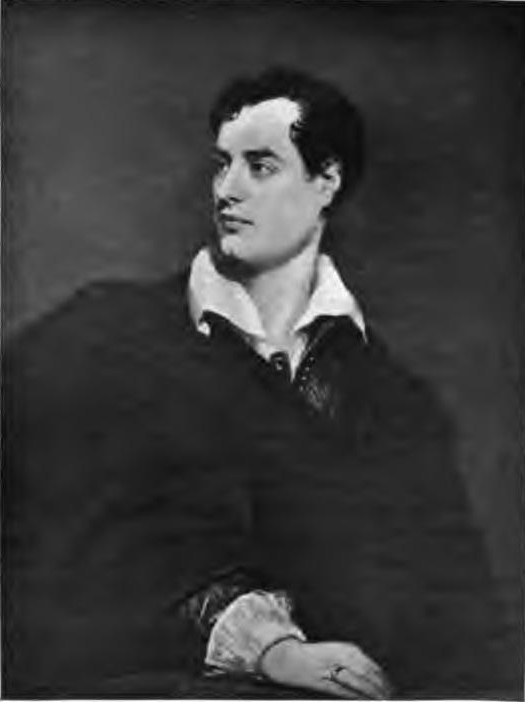
LORD BYRON
XVII
BYRON: THE PASSIONATE PERSONALITY
Entering the Thorvaldsen Museum in Copenhagen, and turning to the right, the first work that meets one's eye is the marble bust of a noble-looking young man, with beautiful features and curly hair—the bust of Lord Byron. In room No. 12 we find the same work in plaster, and in No. 13 stands the statue executed (after Byron's death) from the bust. Let us examine the plaster bust, which is without doubt the most speaking likeness. Beauty and distinction are the first qualities that strike us in this head and face; but the next moment we are attracted by an expression of energy, which comes chiefly from a restless quiver of the brow—indicating that clouds might gather on it and lightning flash from the clouds—and from something imperiously compelling in the glance. This brow betokens irresistibility.
When one remembers the dissimilarity of Thorvaldsen's and Byron's natures, remembers that in all probability Thorvaldsen never read a line of Byron's poetry, and also that the poet did not show his best side to the sculptor, the result of the meeting of the two great men must be regarded as extraordinarily satisfactory. The bust gives what is necessarily a feeble and incomplete, but nevertheless a true and beautiful representation of a main aspect of Byron's character which one would hardly have expected Thorvaldsen to grasp. The idyll is that sculptor's real province. When he sets himself to represent Alexander's triumphal entry into Babylon, he is much more successful with the shepherds, the sheep, the fishermen, the women, the children, the procession in general, than with the hero himself; the heroic is not to the same extent his affair; how much less, then, the combatant nature in the complicated, modern form of it which has been dubbed the dæmonic. And yet he understood Byron. In the bust (not in the statue) he has given the world a monument of him, which, although it satisfied neither the Countess Guiccioli nor Thomas Moore, is worthy both of the poet and of the artist. If Thorvaldsen had really known Byron, the work would probably have been still better; the face would have had a touch of the frankness and attractiveness which impressed all who knew him well. This is absent. But the Danish sculptor has succeeded in penetrating into what lay beneath the gloomy expression which he considered an assumed one, and showing us the suffering, the restlessness, the genius, the noble and terrible power.
It was, undoubtedly, with the Byron of the Museum that the next generation to his in Denmark grew up. But the image presented to them there was invariably connected in their minds with the story of the poet's visit to Thorvaldsen's studio, and with the latter's observation: "It was his fancy to be unhappy;"[1] and they wondered why such a great man should not have been perfectly natural. And so the first attitude of the Danes to Byron was a wrong, or at any rate an uncertain one. And an uncertain one it still remains. He is little fitted to be the hero of the present age. The very things which were much more effectual than his greatness as a poet in arousing the admiration of our grandfathers and grandmothers, are the things that repel the present generation—all those mythical traditions (which really obscure his history to us) of Byron the stage hero, with the tie which every one imitated; Byron, the hero of romance, whose pistols were his constant companions, and whose amorous adventures were as famous as his verse; Byron, the aristocrat, with the title which he valued so highly, but which makes little impression on a generation that recognises no aristocracy but that of the intellect. And our practical age has, moreover, a distinct contempt for what Byron sometimes imagined his honour required him to be, and sometimes really was—the dilettante.
It was a matter of honour with him to practise his art in a non-professional manner. His position and his pursuits (so he writes in the preface to his first volume of poetry) make it highly improbable that he will ever take up the pen again. In 1814, at the very summit of the celebrity won for him by his first narrative poems, he determines to write no more poetry, and to suppress all that he has written. A month afterwards he writes Lara. Jeffrey criticised the character of the hero as too elaborate. Byron asks (in a letter of 1822): "What do they mean by 'elaborate?' I wrote Lara while undressing after coming home from balls and masquerades, in the year of revelry 1814." We feel that he lays stress on the careless manner of production and the planlessness consequent thereon, from a desire to show that he is not a professional poet, but, in the first instance, a man of the world, in the second, that which his gifts forbade his being, namely, a poetical dilettante.
Though he was incapable of being a dilettante in the calling in which he was determined to play that part (a determination which nowadays detracts from our respect for him), he was indisputably one in another field of activity, where it was by no means his intention, namely, in politics. Practical though he always showed himself to be when it came to political action, his politics were in reality—whether he took part in the conspiracies of the Carbonari at Ravenna or led the Suliotes at Missolonghi—the politics of the emotionalist and the adventurer. His first proceeding after he had resolved to go to Greece was to order for himself and his friends gilded helmets with his crest and motto engraved on them. The great politician of our days is the man who lays plans, adheres to them and develops them year after year, and, obstinate and regardless of side issues, carries them out in the end, without the heroic apparatus, but with the hero's determination.
It must not be forgotten that a whole succession of Byron's admirers and imitators have forced themselves in between him and us, obscuring the figure, and confusing our impression, of the great departed. Their qualities have been imputed to him, and he has been blamed for their faults. When the literary reaction set in against those who had understood him half and wrongly—against the brokenhearted, the blasés, the enigmatical, writers—his great name suffered along with theirs; it was swept aside along with the lesser ones. It had deserved better of fate.
George Gordon Byron, born on the 22nd of January 1788, was the son of a passionate and unhappy mother, who a short time before his birth left her dissipated, brutal husband. This man, Captain Byron, who had served for a time in America as an officer in the Guards, was known in his youth as "mad Jack Byron." He eloped to the Continent with the wife of the Marquis of Carmarthen, married her when her husband obtained a divorce from her, spent all her money, and treated her so badly that she died of grief a few years after her marriage. Captain Byron returned to England with his little daughter, Augusta, and, solely with the view of improving his circumstances, married a wealthy Scottish heiress, Miss Catherine Gordon of Gight, who became the mother of the man who still enjoys a world-wide fame. Immediately after the wedding Captain Byron began to make away with the fortune of his second wife. In the course of a year he had reduced it from £24,000 to £3000. She left him in France and, coming to London, gave birth there to her only child. By an accident, said to have occurred at the time of his birth, one of the child's feet was malformed.
Two years later the mother went with her boy to Scotland, and took up her residence at Aberdeen. Captain Byron, during a pause in his dissipations, followed them there, in the hope of extracting more money from his wife. She generously gave him the shelter of her roof for a time, and afterwards they still continued to visit each other, until Captain Byron, to evade his creditors, was obliged to return to France, where he died in 1791. When the news of his death reached his wife, who had never ceased to love him, her grief bordered on distraction, and her shrieks were so loud as to be heard in the street.
Uncontrollable passionateness, differing only in its manifestations and its force, was thus a characteristic of both Byron's parents. And farther back in the families of both, we find the same temperament, revealing itself in the mother's family in attempts at suicide and poisoning, and in the father's, now in heroic daring, now in reckless excess. Byron's paternal grandfather, Admiral John Byron, generally known as "hardy Byron," took part in the naval warfare against Spain and France, made voyages of discovery in the South Sea, circumnavigated the globe, and went through perils and adventures without number; the peculiarity that he could never take a voyage without encountering terrible storms gained him the nickname among the sailors of "foul-weather Jack." Byron compares his own fate with his grandfather's. The family temperament shows itself in its worst form in the poet's grand-uncle, William, Lord Byron, a dissolute brawler, who achieved notoriety by killing his neighbour, Mr. Chaworth (after a quarrel), in a duel fought without seconds. It was only in his quality of peer of England that he escaped sentence for murder; ever after his trial he lived on his estate of Newstead, shunned like a leper. He was hated by all around him; his wife procured a separation from him; among the superstitious country people extravagantly horrible stories of his doings circulated and were believed.
Thus the poet had wild blood in his veins. But it was also very aristocratic blood. On the mother's side he claimed descent from the Stuarts, from King James the First of Scotland; on his father's he was the descendant (though with a bar-sinister in the arms, a circumstance Byron himself never alludes to) of the Norman noble Ralph de Burun, who accompanied William the Conqueror into England. And when the grand-uncle just named lost, first his only son, and then, in 1794, his only grandson, it became probable that "the little lame boy who lives at Aberdeen," as his uncle called him, would inherit both Newstead and the family title.
It was with this prospect before him that the lame boy grew up. He was proud and uncontrollable by nature. When he was still in petticoats, his nurse reprimanding him angrily one day for having soiled a new frock, he got into one of his "silent rages" (as he himself called them), turned as pale as a sheet, seized his frock with both hands, and tore it from top to bottom. His mother's treatment of him was little calculated to correct these tendencies. She alternately overwhelmed him with reproaches and with passionate caresses; when she was in a rage she vented on him the anger which his father's treatment of her aroused; she sometimes even reproached him with his lameness. The fault lies partly with her that this physical infirmity cast such a dark shadow over little George's mind; he heard his own mother call him "a lame brat." Bandaging and various kinds of surgical treatment only increased the evil; the foot gave him much pain, and the proud little boy exercised all the strength of his will in concealing his suffering, and, as much as possible, his limp. Sometimes he was unable to bear any allusion to his deformity; at other times he would speak with a mocking bitterness of his "club-foot."
Though Byron was not diligent at school, he developed a passion, the moment he could read, for history and books of travel; the seeds of his longing for the East were sown in his earliest youth. He himself tells that before he was ten he had read six long works on Turkey, besides other books of travel and adventure, and Arabian tales. As a little boy his favourite story was Zeluco, by John Moore, the hero of which is a youth whose mother's bad education of him after his father's death has led to his giving way to all his own caprices; he becomes "as inflammable as gunpowder." In this hero of romance, who reminds us of William Lovell, the boy saw himself reflected. One of the qualities which were to play a decisive part in the poet's life revealed itself very early, namely, his passionate attraction towards the other sex. At the age of five he was so deeply in love with a little girl, Mary Duff, that when, eleven years afterwards, he heard of her marriage, his feelings nearly threw him into convulsions.
With pride, passionateness, melancholy, and a fantastic longing for travel, there was combined, as the determining quality of his character, an ardent love of truth. Naïve sincerity distinguished the child who was destined as a man to be the great antagonist of the hypocrisies of European society. His defiant spirit was only one of the forms of his truthfulness. His nurse took him one night to the theatre to see The Taming of the Shrew. In the scene between Catherine and Petruchio, where Petruchio insists that what Catherine knows to be the moon is the sun, little Geordie (as they called the child) started from his seat and cried out boldly: "But I say it is the moon, sir."
When George was ten, his grand-uncle, Lord Byron, died. One of the child's first actions after being told what had happened, was to run to his mother and ask if she noticed any difference in him since he had become a lord. On the morning when his name was first called out in school with the title of "Dominus" prefixed to it, he was so much agitated that he was unable to give utterance to the usual answer, "Adsum"; after standing silent for a moment he burst into tears. Byron's intensest pleasures were at first, and for long, those of gratified vanity. But to understand his agitation properly in this case, one must remember what the title of "lord" implied, and still implies, in England. The nobility proper of that country consists of not more than about four hundred titled persons—about the number of princes in Germany. On their own estates these noblemen exercise an almost unlimited political and social influence; their position is not much inferior to that of reigning princes, and, as a rule, their wealth corresponds to their rank. Such, however, was not the case in this instance; Byron had no private fortune, and the property of Newstead Abbey was in a neglected condition, and heavily mortgaged.
In the autumn of 1798 Mrs. Byron took her little son to Newstead. When they came to Newstead toll-bar, affecting to be ignorant of the neighbourhood, she asked the woman of the toll-house, to whom the park and mansion they saw before them belonged. She was told that the owner of it had been some months dead. "And who is the next heir?" asked the proud and happy mother. "They say," answered the woman, "it is a little boy who lives in Aberdeen." "And this is he, bless him!" exclaimed the nurse, no longer able to contain herself, and turning to kiss with delight the young lord, who was seated on her lap.
In 1801 the boy was sent to Harrow, one of the great English public schools which is much in favour with the aristocracy. The system of instruction (strictly classical) was uninteresting and pedantic, and did not produce much effect on Byron, whose relations with his masters were as strained as his friendships with his comrades were enthusiastic. "My school friendships," he writes in his diary in 1821, "were with me passions (for I was always violent)." As a friend he was generous, and loved to play the part of protector. When Peel, the future Prime Minister, was one day being unmercifully thrashed by the elder boy whose fag he was, Byron interrupted, and, knowing he was not strong enough to fight the tyrant, humbly begged to be allowed to take half the stripes the latter meant to inflict. When little Lord Gort, after having had his hand burned with a piece of red-hot iron by one of the monitors, as a punishment for making bad toast, refused, when the matter was investigated into, to tell the name of the culprit, Byron offered to take him as his fag, promising that he should not be ill-used. "I became his fag," said Lord Gort (see Countess Guiccioli's Reminiscences), "and was perfectly delighted when I found what a good, kind master I had, one who was always giving me cakes and sweets, and was most lenient with my faults." To his favourite fag, the Duke of Dorset, Byron, in his Hours of Idleness, addressed some charming lines in memory of their school days.
When the boy was at home in the holidays, his mothers behaviour towards him was as erratic, her temper as uncontrollable, as ever; but now, instead of being afraid of her, he could not resist laughing at the fat little woman's outbreaks. Not content with smashing cups and plates, she sometimes employed poker and tongs as missiles.[2]
Let us imagine, after such a scene as that described in the note, a smiling, golden-haired girl entering the room and softening the defiant boy's mood with a look, and we have a situation such as cannot have been at all uncommon at Annesley, the residence of the Chaworth family (relations of the man whom Byron's grand-uncle killed in the notorious duel), when Mrs. Byron and her son were visiting there. The golden-haired girl, Mary Anne Chaworth, was seventeen when Byron was fifteen. He loved her passionately and jealously. At balls, where she was in great request as a partner, and his lameness prevented his dancing, it occasioned him agonies to see her in the arms of other men. The climax was put to his sufferings when he overheard her one evening saying to her maid: "Do you think I could care anything for that lame boy?" He darted out of the house, late though it was, and, scarcely knowing where he was running, never stopped till he came to Newstead. Thirteen years later, in the Villa Deodati, by the Lake of Geneva, he wrote, with the tears streaming from his eyes, a poem, The Dream, which treats of this attachment, and shows the deep impression made by the early disappointment.[3]
The cleverer Byron became in preserving a sarcastically calm attitude during his mother's fits of rage, the more unnatural became the relations between mother and son. The scenes were sometimes terrible. It is told as a curious example of their idea of each other's violence, that, after parting one evening, each went privately later in the night to the apothecary's to inquire whether the other had been to purchase poison, and to caution the man not to attend to such an application, if made. In his letters young Byron writes with melancholy humour of the manner in which he is every now and then driven to take flight, to escape from scenes at home. He gives not the slightest hint to any one of the intended excursions, for fear, he says, of rousing "the accustomed maternal war whoop."
In 1805 Byron went to Cambridge, where he spent his time less in study than in the practice of all the varieties of athletic exercise to which from his childhood he had eagerly devoted himself, in the hope of atoning by his proficiency in them for his bodily infirmity. Riding, swimming, driving, shooting, boxing, cricket-playing, and drinking, were accomplishments in which he was determined to excel. He began to develop the signs of a dandy; and it satisfied his youthful love of bravado to take excursions in company with a pretty young girl, who went about with him in male attire, and played the part of his valet, or sometimes of his younger brother—in which character he was impertinent enough to introduce her to a lady at Brighton who was unacquainted with his family.
Newstead Abbey had been let for a term of years. As soon as it was vacant, Byron went to live there. It is a real old Gothic abbey, with refectory and cells, the earliest parts of it dating from 1170. The house and gardens are surrounded by a battlemented wall. In the courtyard is a Gothic well. In front is a park, with a large lake. At Newstead, Byron and his friends, in their youthful, defiant antipathy to all rules, led a life of dissipation which showed traces of the mania for originality to which, as history shows, men of genius have not unfrequently been subject before becoming conscious of their proper tasks and aims. These young men got up at 2 P.M. and fenced, played shuttlecock, or practised with pistols in the hall; after dinner, to the scandal of the pious inhabitants of the neighbourhood, a human skull filled with Burgundy went round. It was the skull of some old monk, which the gardener had unearthed when digging; Byron, in a capricious mood, had had it mounted in silver as a drinking-cup, and he and his companions took a childish pleasure in using it as such, themselves dressed up as monks, with all the proper apparatus of crosses, beads, tonsures, &.[4] It is a mistake, however, to regard the action simply as an evidence of that want of feeling which so often—among medical students, for instance—accompanies joviality; to a man like Byron the sight of this memento mori in the midst of his carousals probably acted as a kind of bitter stimulant. In the lines which he addressed to it he writes that, to the dead man, the touch of human lips must be preferable to the bite of the worm.
Byron's excesses did not proceed from too high spirits. He was oppressed, not only by the melancholy which attacks most youths of remarkable ability when they find themselves, with their untried powers, face to face with nothing but questions, but, in addition to this, by the melancholy which was a result of his passionate character and his upbringing. Two stories, which to most of his biographers seem very pathetic, are told of him at this period of his life. The first is in connection with his dog, Boatswain. In 1808, he composed an excessively misanthropic inscription for this favourite's grave, in which he lauds him at the expense of the whole human race; and at the same time he made a will (afterwards cancelled), in which he desired that he should be buried beside his dog, his only friend. The other proof of his forlorn mood is the manner in which he spent his twenty-first birthday, the day of his coming of age, an occasion which is celebrated among the English nobility with all manner of festivities—illuminations, fireworks, a ball, and the entertainment of all the tenants. Byron was so poor that he was obliged to have recourse to the money-lenders for the wherewithal to give his tenants a ball and roast the customary ox for them. But no long train of carriages bringing visitors of high degree drew up at the doors of Newstead Abbey on the 22nd of January 1809; neither mother, sister, guardians, nor relations, near or distant, were there. Byron himself spent the day at a hotel in London. In a letter of the year 1822 he writes: "Did I ever tell you that the day I came of age I dined on eggs and bacon and a bottle of ale? For once in a way they are my favourite dish and drinkable; but as neither of them agree with me, I never use them but on great jubilees—once in four or five years or so."
It is, naturally, pleasanter to be rich than to be poor, and more flattering to one's self-esteem to receive the congratulations of relatives and friends than to feel one's self homeless and solitary; but in comparison with the difficulties and privations and humiliations which every young modern plebeian has to encounter at the outset of his career, the adversities of this young patrician dwindle into nothing. What gave them their importance was that they early drove Byron, who, as a young aristocrat, might otherwise have been absorbed by the pursuits and ideas of his class and kin, exclusively to those resources which he possessed as the single, isolated individual.
It was not one of the great political events of the day, no transport of joy or anger occasioned by the great political revolutions in which the period was so fertile, that tore Byron away from the disorderly, aimless life at Newstead. Such events as the death of Fox, or that proceeding which redounded so little to the honour of England—the bombardment of Copenhagen, made no impression whatever on the youth who, as a man, was to be so strongly affected by every historical occurrence, every political deed or misdeed. It was a private literary contrariety which made the first turning-point in his life. Whilst living (from the summer of 1806 till the summer of 1807) in the little town of Southwell, Byron had produced his first attempts at poetry, which had met with much appreciation from the younger members of a family named Pigot, who were his intimates at the time. In March 1807 a collection of these poems was published under the title, Hours of Idleness. The volume contained nothing very remarkable; the poems which really testify to strength of feeling are swamped by quantities of school-boy verses, some of them translations and imitations of the school classics and Ossian, the rest, sentimental poems of love and friendship, immature in conception and style. In one or two, we readers of the present day, wise after the event, can plainly detect Byron's future personality and style. In the poem To a Lady, which is addressed to Mary Chaworth, occur two genuinely Byronic verses:—
"If thou wert mine, had all been hush'd:— This cheek now pale from early riot, With passion's hectic ne'er had flush'd, But bloomed in calm domestic quiet. . . . . . . . . . . . . . . But now I seek for other joys: To think would drive my soul to madness; In thoughtless throngs and empty noise, I conquer half my bosom's sadness."
The poems were really of little value, and the ample provision of childish, foolish notes, the pretentious preface, and the appendage of the words "A Minor" to the author's name on the title-page, lent themselves to ridicule.
In January 1808, the Edinburgh Review, at that time the highest literary court of appeal, contained an extremely sarcastic review of the volume, probably written by Lord Brougham. "The noble author," writes the reviewer, "is peculiarly forward in pleading minority; we have it in the title-page, and on the very back of the volume.... If any suit could be brought against Lord Byron, for the purpose of compelling him to put into court a certain quantity of poetry, and if judgment were given against him, it is highly probable that an exception would be taken, were he to deliver for poetry the contents of this volume. To this he might plead minority; but, &c. &c.... Perhaps however, in reality all that he tells us about his youth is rather with a view to increase our wonder than to soften our censures. He possibly means to say, 'See how a minor can write! This poem was actually composed by a young man of eighteen, and this by one of only sixteen!' ... So far from hearing, with any degree of surprise, that very poor verses were written by a youth from his leaving school to his leaving college, inclusive, we really believe that it happens in the life of nine men in ten who are educated in England, and that the tenth man writes better verse than Lord Byron.... We must beg leave seriously to assure him that the mere rhyming of the final syllable, even when accompanied by the presence of a certain number of feet—nay, although (which does not always happen) those feet should scan regularly, and have been all counted accurately upon the fingers—is not the whole art of poetry. A certain portion of liveliness, somewhat of fancy, is necessary to constitute a poem ... &c. &c."
The reviewer's advice to Byron is to give up poetry and employ his gifts and his leisure hours better. As an exhortation addressed to the epoch-making English poet of the age by one whose profession it was to assay and value the works of literary aspirants, the article, in spite of its partial justification, was undeniably a gross blunder. But as far as Byron himself was concerned, nothing better could have happened to him. It affected him like a challenge; it was a terrible blow to his vanity, and roused that which was to survive him—his pride. A friend who saw him in the first moments of excitement after reading the article, has described the fierce defiance of his looks, and added that it would be difficult for sculptor or painter to imagine a subject of more fearful beauty than the young poet in his wrath.
Byron concealed his feelings from every one. In a letter written about this time he expresses regret that his mother has taken the affair so much to heart, and assures his correspondent that his own repose and appetite have not been discomposed—that these "paper bullets of the brain" have only taught him to stand fire. But a dozen years afterwards he writes: "I well recollect the effect which the critique of the Edinburgh Reviewers on my first poem had upon me—it was rage and resistance, and redress; but not despondency nor despair. A savage review is hemlock to a sucking author, and the one on me knocked me down—but I got up again ... bent on falsifying their raven predictions, and determined to show them, croak as they would, that it was not the last time they should hear from me." Thus came the stimulus from the outside world which for the first time drove all the young man's passionate, scattered emotions into one channel, and made of them one feeling, one aim. With obstinate determination he set to work; he slept during the day, rising after sunset in order to be less disturbed, and for several months worked every night and all night long at his first famous satire.
XVIII
BYRON: THE PASSIONATE PERSONALITY—(Continued)
Famous it is, and famous it deserved to become, though not because of its wit and humour, for it has neither the one nor the other—nor yet because of its effectiveness, for it is satire which for the most part hacks and hews blindly, here, there, and everywhere—but because of the power, the self-consciousness, the unexampled audacity, which underlie and which found expression in the whole. The attacks of the reviewers had produced in Byron for the first time the feeling which was soon to become constant and dominant in his breast, the feeling which first made him completely conscious of himself, and which may be expressed in the words: "Alone against you all!" To him, as to the other great combative characters of history, this feeling was the elixir of life. "Jeer at me with impunity! Crush me, who am stronger than all of them together!" was the refrain that rang in his ears whilst he wrote. The Edinburgh Reviewers were accustomed, when they crushed a trumpery little poet and flung him on the ground like a fly, or by mischance shot a poor little song-bird, to no resistance on the part of the victim. He either rebelled against the verdict in silence, or humbly laid the blame on his own want of ability. In either case what followed was profound silence. But now they had lighted upon the man whose prodigious strength and weakness lay exactly in the peculiarity that he never blamed himself for a misfortune, but furiously turned upon others as its authors. In this case, too, a silence of a year and a half followed upon the review. But then happened what we read of in Victor Hugo's poem (Les Châtiments. "La Caravane"):
"Tout à coup, au milieu de ce silence morne Qui monte et qui s'accroît de moment en moment, S'élève un formidable et long rugissement! C'est le lion."
And the image is the correct one. For this satire, with its deficiency in beauty, grace, and wit, is more a roar than a song. The poet who has the throat of the nightingale, rejoices when he for the first time hears that his own voice is melodious; the ugly duckling becomes happily conscious of its swan-nature when it is cast into its own element; but the roar which tells him that now he is grown up, that now he is a lion, startles the young lion himself. It is in vain, therefore, to look in English Bards and Scotch Reviewers for sword-thrusts, given with a steady hand and sure aim; these wounds are not the work of a hand; they are torn with a claw—but the claw is the claw of a lion. It is in vain to search for criticism, moderation, reason; does the wounded beast of prey display discernment and tact when a bullet, intended to kill it, has only slightly wounded it? No; its own blood, which it sees flowing, dims its eyes, and it desires nothing but to shed blood in revenge. It does not even seek the firer of the shot alone; if one of the troop has wounded the young lion, then woe to the troop! All the literary celebrities of England, even the greatest and most popular—all who were in favour with the Edinburgh Review and all who wrote in it—are in this satire treated like schoolboys by a youth of twenty, scarcely more than a schoolboy himself. They run the gauntlet one after the other, English poets and Scotch reviewers. There is many a hard hit that does not miss its mark. The empty fantasticalness of Southey's Thalaba, and its author's abnormal productivity; the proofs afforded by Wordsworth's own poems of the truth of his doctrine that verse is the same as prose; Coleridge's childish naïveté; Moore's licentiousness—all these receive their due share of attention. An attack is made on Scott's Marmion which reminds us of the jeers of Aristophanes at the heroes of Euripides. But by far the greater proportion of the attacks made, are so rash and graceless that they became the occasion of much more annoyance to their author than to the persons attacked. Byron's guardian, Lord Carlisle, to whom he had but lately dedicated Hours of Idleness, but who had declined to introduce him to the House of Lords; and men like Scott, Moore, and Lord Holland, who at a later period were among the poet's best friends, were here abused on perfectly incorrect premises, and with a want of judgment which is paralleled only by the astonishing alacrity with which Byron, as soon as he was convinced that he had been in the wrong, apologised and strove to efface the impression of his errors. Some years later he tried in vain to put an end to the existence of the satire by destroying the whole fifth edition.
In the meantime it created a great sensation, and produced the desired effect, the rehabilitation of its author.
In the beginning of 1809 Byron had gone to live in London, partly to superintend the publication of his satire, partly for the purpose of taking his seat in the House of Lords. As he had no friend among the peers to introduce him, he was obliged, contrary to custom, to present himself alone. His friend, Mr. Dallas, has described the scene. When Byron entered the House he was even paler than usual, and his countenance betrayed mortification and indignation. The Chancellor, Lord Eldon, put out his hand warmly to welcome him, and paid him some compliment. But this was thrown away upon Lord Byron, who made a stiff bow, and put the tips of his fingers into the Chancellor's hands. The Chancellor did not press a welcome so received, but resumed his seat. Byron carelessly seated himself on one of the empty Opposition benches, remained there for a few minutes to indicate to which party he belonged, and then left. "I have taken my seat," he said to Dallas, "and now I will go abroad."
He left England in June 1809. He had, as he wrote to his mother in 1808, long felt, that "if we see no nation but our own, we do not give mankind a fair chance—it is from experience, not books, we ought to judge of them. There is nothing like inspection, and trusting to our own senses." He now went first to Lisbon (see the poem Huzza! Hodgson!) The description of Cintra in the First Canto of Childe Harold is a recollection of the impressions received during his short stay in Portugal. From Lisbon he and his friend Hobhouse travelled on horseback to Seville and Cadiz, and thence to Gibraltar by sea.
None of the magnificent historical monuments of Seville made any impression on Byron, but both there and at Cadiz he was deeply interested in the women. The advances made by various beautiful Spanish ladies flattered the young man, who took with him as a remembrance from Seville a lock of hair about three feet in length. Gibraltar, being an English town, is, of course, a "cursed place."
But, though little impressed by the historical memories of the countries he is visiting, he is already beginning to interest himself in their political relations. Those of Spain with England occupy him first. The first two cantos of Childe Harold show that he felt nothing but contempt for the foreign policy of England. He jeers at what the English called their victory of Talavera, where they lost 5000 men without doing the French much harm; and he is audacious enough to call Napoleon his hero.
From Spain Byron went to Malta. Its memories of the days of yore, which so delighted old Sir Walter Scott, made no more impression on the young nobleman than those of Seville had done. He was as entirely devoid of the romantic historical sense as of romantic national feeling. What he thought of, and longed for, were not the green pastures of England, or the misty hills of Scotland, but the Lake of Geneva in all its glory of colour, and the bright Ægean Sea. His mind did not dwell on the historical exploits of his countrymen, on wars like the War of the Roses; it was occupied with the politics of the day; and in the past nothing interested him but the great struggles for liberty. To him the old statues were only stone; the living women were more beautiful in his eyes than the ancient goddesses ("than all the nonsense of their stone ideal," as he puts it in Don Juan); but on the field of Marathon he fell into a deep reverie, and he celebrates its memories in both his long narrative poems. When, during the last year of his life, he visited Ithaca, he rejected all offers to show him the remains of antiquity on the island, remarking to Trelawny: "I detest antiquarian twaddle. Do people think I have no lucid intervals, that I came to Greece to scribble more nonsense?" The poetic enthusiasm for liberty was in the end swallowed up by the practical. With Byron Romantic sentimentality comes to an end; with him the modern spirit in poetry originates; therefore it was that he influenced not only his own country but Europe.
At Malta he was greatly captivated by a beautiful young lady, a Mrs. Spencer Smith, who for political reasons was subjected to persecution by Napoleon. An enthusiastic friendship sprang up between the two, which is commemorated in several of Byron's poems. (Childe Harold, ii. 30. To Florence. Lines Written in an Album, Stanzas composed during a Thunderstorm. Stanzas Written in Passing the Ambracian Gulf.) From Malta the travellers went by way of Western Greece to Albania, the "rugged nurse of savage men," as Byron in Childe Harold calls the country,
"(Where) roams the wolf, the eagle whets his beak, Birds, beasts of prey, and wilder men appear."
It is characteristic of him, that in his first travels he visited regions which lay practically without the pale of civilisation, countries where the personality of the inhabitant was almost entirely untrammelled by convention. Natural affinity attracted him to these scenes and these beings. Like the young man in Wordsworth's Ruth,
"Whatever in those climes he found Irregular in sight or sound Did to his mind impart A kindred impulse, seem'd allied To his own powers, and justified The workings of his heart."
A direct descendant of Rousseau, he had a strong sympathy for all the races still living in "the state of nature."[1] The Albanians were at that time almost as savage as their Pelasgian ancestors. Their law was the law of the sword, the vendetta their idea of justice. The people of the country, as Byron first beheld them assembled, the setting sun illuminating their magnificent dresses and the rich trappings of their horses, whilst drums beat and the muezzins called the hour from the minaret of the mosque, presented such a spectacle as we read of in the Thousand and One Nights.
Janina proved to be a more important town than Athens. It was on their journey to or from Janina that the travellers were deserted by their guide. In their perilous condition among these wild mountains, with the prospect before them of dying of hunger, Byron was the member of the party who kept up the spirits of all the others by that dauntlessness which distinguished him in all dangerous situations.
The day after their arrival in the capital, Byron was introduced to Ali Pacha, "the Turkish Bonaparte," whom he had always admired in spite of his savage cruelty. Ali received his visitor standing, was extremely friendly, desired his respects to Byron's mother, and flattered Byron himself very agreeably by telling him that he knew him at once to be a man of noble birth by his small ears, curling hair, and little white hands. The visit to Ali provided matter for some of the principal scenes in the Fourth Canto of Don Juan. Lambro and several other Byronic figures are drawn from him. (He is also described by Victor Hugo in Les Orientales.) Ali treated Byron like a spoiled child, sending him almonds and sugared sherbet, fruit and sweetmeats, twenty times a day.
Protected by a guard of fifty men given him by Ali from the numerous troops of brigands which infested the country, Byron now travelled all through Albania. His wild followers became so attached to him that, when he had an attack of fever, they threatened to kill the doctor if the patient were not cured. The doctor ran away—and the patient recovered. It was in the course of this tour, before retiring to rest for the night in a cave by the shore of the Gulf of Arta, that Byron saw the scene (the Pyrrhic war-dance to the accompaniment of song) which he afterwards described in Childe Harold, ii. 71, 72, and which inspired the beautiful song, "Tambourgi, Tambourgi!"
During his stay in Athens, the indignation he felt at the plundering of the Parthenon by England, in the person of Lord Elgin, inspired him with the poem, The Curse of Minerva; and a transient attachment to one of the daughters of the English consul produced the song, Maid of Athens, the heroine of which, even after she had become a little pale old lady, continued to be tormented with visits from English tourists. On the 3rd of May, Byron performed his famous feat of swimming across the Dardanelles, from Sestos to Abydos, in an hour and ten minutes; he writes of it in Don Juan, and was proud of it all his life.
All that he saw and did on this tour was, a few years later, to provide him with poetic material. In Constantinople he one day saw the street dogs devouring the flesh of a corpse; on this real scene are based the descriptions of horrors in The Siege of Corinth and in the Eighth Canto of Don Juan (assault of Ismail). After his return to Athens from a tour in the Morea, he would seem himself to have been concerned in the love affair on which The Giaour is based. (See the Marquis of Sligo's letter to Byron.) What we know for certain is, that one day, as he was returning from bathing at the Piræus, he met a detachment of Turkish soldiers carrying, sewn up in a sack, a young girl, who was to be thrown into the sea because she had accepted a Christian as her lover. Pistol in hand, Byron compelled the savage troop to turn back, and partly by bribery, partly by threats, procured the girl's release.
This life of travel and adventure did not produce the mental equilibrium which Byron lacked. His last letters from abroad reveal settled melancholy. The disgust with life which is the result of aimlessness seems to weigh him to the earth. And he feels that he is coming home deep in debt, "with a body shaken by one or two smart fevers," and to a country where he has no friends. He expects to be met only by creditors. What did meet him was the news of his mother's dangerous illness. He hastened to Newstead to see her once more, but she had died the day before he arrived. Her maid found him in the evening sitting beside the corpse. She had heard his sobs through the closed door. On her begging him to try to control his grief, he burst into tears, and exclaimed: "Oh, Mrs. By, I had but one friend in the world, and she is gone!" Nevertheless, his excessive dislike to his grief being witnessed by others, was sufficient to prevent his following his mother's remains to the grave. He stood at the Abbey door till the funeral procession had moved off; then, turning to his attendant, young Rushton, desired him to fetch the sparring-gloves, and proceeded to his usual exercise with the boy. At last, the struggle to keep up seeming too much for him, he flung away the gloves and retired to his room. During the protracted fit of melancholy into which he sank, he made a will, in which he again ordered that he should be buried beside his dog.
Byron had hardly landed before his friend Dallas asked him if he had brought any poetry back with him from his travels. The young poet, who was tolerably destitute of the critical sense, produced, not without pride, Hints from Horace, a new satire in Pope's style. With this work Mr. Dallas was very justifiably disappointed. On returning it next morning he asked if his friend had written nothing else, on which Byron handed him some short poems, and what he called "a number of stanzas in Spenser's measure" chiefly descriptive of the countries he had visited. These last were the first two cantos of Childe Harold; and at the urgent request of Dallas they were at once given to the printer.
In the mind of the reader of to-day, the impression produced by these two cantos is apt to be mixed up with that produced by the last two (written six or seven years later); but whoever desires to understand Byron's development must be careful to keep the two impressions perfectly distinct from each other. The gap between the first and the second half of Childe Harold is as wide as the gap between this same second half and Don Juan.
The stanzas which Byron showed Dallas are melodious, sincere in feeling, and occasionally grand; they were the first of the full, harmonious strains which were henceforward to issue from the lips of this poet as long as he breathed the breath of life. But they only faintly forecast what the man was to be, with whose fame, ten years later, the continent of Europe rang. As yet, powerful descriptions of nature form the main ingredient in his poetry; the lyric outbursts are few and far between; to the casual reader these stanzas would seem simply to convey a world-weary young English aristocrat's impressions of travel, ennobled by the stateliness of the style—for the tone of Childe Harold is as idealistic and serious as that of Don Juan is realistic and humorous.
The mood is one of monotonous melancholy. Byron is not yet the poet who bounds from one feeling to another, by preference its exact opposite, in order to make each as strong as possible, and then hacks and hews at them—the harder, the extremer the tension he has produced. But though we as yet only catch the outline of this poet's countenance, though we perceive nothing of its keenly satirical expression or of its now impudent, now merry smile, we nevertheless divine from the fervent youthful pathos that we are in the presence of the strongest personality in the literature of the day. There is an Ego in this poem which dominates every detail, an Ego which does not lose itself in any feeling, does not forget itself in any cause.
The other literary personalities of the day could metamorphose—could etherealise, liquefy, crystallise—themselves; they could become invisible behind another personality, or transform themselves into cosmic beings, or merge themselves entirely in sensations received from without; but here we have an Ego which, whatever happens, is always conscious of itself, and always comes back to itself; and it is an agitated, passionate Ego, of whose emotions the movement of even the most unimportant lines reminds us, as the whisper of the shell reminds us of the roar of the ocean.
Childe Harold (in the first draft Childe Burun) leaves his country after an ill-spent youth, in a mood of splenetic melancholy, leaving behind no friends and no loved one. His is the youthful weariness of life induced by a constitution and state of health inclining to melancholy, and by an all too early satiety of pleasure. There is not a trace in him of the confident gaiety of youth or of its desire for amusement and fame; he believes, little as he has seen of life, that he has done with everything; and the poet is so completely one with his hero that not for one moment does he ever soar above him on the wings of irony.
All this, which made such a powerful impression on the public of Byron's day, is tolerably unattractive to a critical modern reader; the aim at effect is plainly discernible, and the time when vague world-weariness was interesting is past. But no one with a practised eye can fail to see that in this case the mask—for mask it is—covers an earnest and a suffering countenance. The mask is that of a hermit; pluck it off, and there still remains a man of a solitary nature! The mask is grandiose melancholy; throw it away; beneath it there is real sadness! Harold's shell-bedecked pilgrim's cloak may be nothing but a kind of ball domino; but it covers a youth of ardent feelings, with a keen understanding, gloomy impressions of life, and an unusually strong love of freedom. In Childe Harold's better Ego there is no insincerity; Byron himself will be answerable for all his hero thinks and feels. And to those who remember what Byron's own conduct, immediately after he wrote Childe Harold, was, and who see a direct contradiction between the fictitious personage's elderly melancholy and the real personage's youthfully ardent pursuit of sensual pleasures, we reply, that the reason of the apparent contradiction is simply this—that Byron, who in his poetry was still an idealist, was unable to reveal his whole nature in the earlier cantos of Childe Harold. All that is there is certainly Byron, but there was in him, along with this, another and perfectly different man; and it was not until he wrote Don Juan that he succeeded in introducing this other Byron, as he lived and thought and spoke, into his poetry. The incompleteness of the self-description must not be mistaken for simulation or affectation.
In February 1812 Byron made his maiden speech in Parliament. He spoke in behalf of the poor weavers of Nottingham, whom it was proposed to punish most severely for having destroyed the machinery that was depriving them of their bread. It is a youthful and rather elaborate speech, but full of life and warmth. Byron was quite in his element in pleading the cause of the starving and desperate crowd. He very sensibly pointed out to his countrymen that a tenth part of the sum which they had willingly voted to enable the Portuguese to carry on war, would be sufficient to relieve the misery which it was proposed to reduce to silence by imprisonment and the gallows. Byron's vigorous and obstinate hatred of war is one of the grains of sound commonsense which are to be found in solution in his poetry; it lends animation to the earlier cantos of Childe Harold.
His second Parliamentary speech was on the subject of Catholic Emancipation. Though it did not please, it is an excellent one; in it Byron acknowledges, and with correct logic disposes of, one of the arguments against giving religious liberty to the Catholics, namely, that it might equally well be given to the Jews. In reference to this same emancipation question, we find the following youthfully facetious entry in his notebook: "On one of the debates on the Catholic question, when we were either equal or within one (I forget which), I had been sent for in great haste to a ball, which I quitted, I confess, somewhat reluctantly, to emancipate five millions of people." Playful utterances of this kind (as another example of which take his saying: "After all we must end in marriage; and I can conceive nothing more delightful than such a state in the country, reading the county newspaper, &c., and kissing one's wife's maid") have, because they are so little in keeping with Childe Harold's melancholy, amply proved to stupid people that nothing was sacred to him. The truth was that, being very young and somewhat of a coxcomb, he considered it derogatory to his dignity to express himself with any feeling; he unconsciously adopted as his motto the saying of St. Bernard: Plus labora celare virtutes quam vitia!
The maiden speech was a great success, and helped to draw the attention of the public to the first two cantos of Childe Harold, which came out only two days after the speech had been made. The impression produced by Childe Harold was astounding; Byron instantaneously became a celebrity—London's new lion, the lawful sovereign of society for the year 1812. The metropolis, as represented by its most beautiful, most distinguished, most brilliant, and most cultivated inhabitants, prostrated itself at the feet of this youth of twenty-three. If these earlier cantos of Childe Harold had been distinguished by the qualities of the later, namely, profound originality and vigorous honesty, they would not have made the noise in the world they did. Great honesty and great originality never find favour at once with the general public. It was the veiledness, the vague weariness of the world and its pleasures, which impressed the crowd; the power of which they caught a glimpse, produced all the more effect by revealing itself in a somewhat theatrical manner.
This was the heyday of dandyism. The upper class of London society, with Beau Brummell as its master of ceremonies, gave itself up to a luxuriousness and licentiousness which had not had their parallel since the days of Charles II. Dinner-parties and balls, the play-house, the gaming-table, pecuniary entanglements, amorous intrigues, seductions and the duels consequent thereon, occupied the days and nights of the aristocracy. And Byron was the hero of the day—nay, of the year. Could there have been a more suitable object for the admiration and worship of a society which was bored and burdened by its own inanity? So young, so handsome, and so wicked! For no one doubted but that he was as dangerous a roué as his hero. Byron had not Scott's coldbloodedness and mental equilibrium to oppose to temptations and flattery. He allowed himself to glide with the stream which supported him on its surface. The artist in him craved for an experience of every mood, and rejected none. He maintained his fame as a poet with ease; there followed on one another with short intervals his narrative poems, The Giaour (May 1813), The Bride of Abydos (December of the same year), and The Corsair (completed on New Year's Day 1814). Of this last work 13,000 copies were sold in one day. The bitter Ode to Napoleon, on the occasion of his abdication, showed that Byron, in his pursuit of poetry, was not entirely oblivious of the political events of the day. In 1815 he wrote Parisina and The Siege of Corinth. The novelty, the foreignness, and the passion of these works, entranced the blasé aristocratic society of London. Their author was the prodigy on whom all eyes were turned. In the drawing-rooms young ladies trembled with the delightful hope that he might take them in to dinner, and at the dinner-table hardly dared to partake of what was set before them, because it was known that he did not like to see women eating. Owners of albums in which he had deigned to write a few lines were objects of envy. A specimen of his handwriting was in itself a treasure. People talked of all the Greek and Turkish women to whom his love must have meant death, and wondered how many husbands he had killed. His brow and his glancing eye suggested wickedness. He wore his hair unpowdered, and it was as wild as his passions. Different in everything from ordinary mortals, he was as abstemious as his Corsair; the other day at Lord -----'s had he not let eleven courses go by untasted and asked for biscuits and soda-water? What an uncomfortable position for the lady of the house, who was so proud of her cook! And what an extraordinary piece of eccentricity in a country where a hearty appetite is one of the national virtues!
We see Childe Harold transformed into Don Juan. The solitary pilgrim becomes the drawing-room lion. On the ladies, Byron's rank, youth, and remarkable beauty naturally made almost more impression than his poetry. In the Life of Sir Walter Scott we find the following opinion given by him on the subject of his fellow-author's personal appearance: "As for poets, I have seen, I believe, all the best of our own time and country—and, though Burns had the most glorious eyes imaginable, I never thought any of them would come up to an artist's notion of the character except Byron.... And the prints give one no impression of him—the lustre is there, but it is not lighted up. Byron's countenance is a thing to dream of." One of the beauties of the day said to herself the first time she saw him: "That pale face is my fate."
Women had, undoubtedly, always occupied a large share of Byron's time and thoughts; but expressions in Childe Harold gave rise to the report that he had maintained a regular harem at Newstead—the harem appearing as a matter of fact to have consisted of one odalisque. Absurdly exaggerated stories were in circulation of the amorous adventures in which he had played the part of hero during his travels. The consequence of all this was that he was positively besieged by women; his table was covered every day with letters from ladies, known and unknown to him. One came to his house (probably in imitation of Kaled in Lara) disguised as a page; many came undisguised. He told Medwin that one day very soon after his wedding he found three married ladies in his wife's drawing-room, whom he at once recognised as "all birds of the same feather."
This life, crowded with empty pleasures and with triumphs for his vanity, at any rate suited Byron better than quiet; for, as he says in Childe Harold, "quiet to quick bosoms is a hell." But, in all this whirl of excitement, did his heart ever really come into play? It would seem not. The love-affair which engrossed him much at this time and also influenced his future, was, as we know from his own letters, only a whirlpool within the whirlpool, and as such attracted him; but it left his heart quite cold.
Lady Caroline Lamb, a young lady of good family, and wife of the statesman afterwards known as Lord Melbourne, had long cherished an ardent desire to make the acquaintance of the author of Childe Harold. Hers was a wild, fantastic, restless nature, which rebelled against every kind of control and promptly followed the inspiration of the moment; therefore she was in so far a kindred spirit of the poet. She was three years older than Byron, fair-haired, with a slender, beautiful figure, and a soft voice; her manner, though affected, was exceedingly attractive. She played in Byron's life the part which Frau von Kalb played in Schiller's.[2] Her connection with him made the lady so much talked of, that her mother did everything in her power to break it off. Lady Caroline was at last persuaded to go to Ireland on a visit. Byron wrote a farewell letter to her, of which she allowed Lady Morgan to make a copy—a letter which is typical of his style in his immature years, and in which no one with any knowledge of the human heart will find the language of love. It reminds us of Hamlet's ambiguous letter to Ophelia.
"If tears which you saw, and know I am not apt to shed,—if the agitation in which I parted from you,—agitation which you must have perceived through the whole of this most nervous affair, did not commence until the moment of leaving you approached,—if all I have said and done, and am still but too ready to say and do, have not sufficiently proved what my real feelings are, and must ever be towards you, my love, I have no other proof to offer.... Is there anything in earth or heaven that would have made me so happy as to have made you mine long ago? You know I would with pleasure give up all here and beyond the grave for you, and in refraining from this, must my motives be misunderstood? I care not who knows this, what use is made of it,—it is to you and to you only that they are, yourself, I was and am yours freely and entirely to obey, to honour, love, and fly with you when, where, and how yourself might and may determine."
It will surprise no one to learn that a few months later Byron himself put an end to the liaison; his love had never been anything but the kind of reflected love which imitates in a mirror all the motions of the flame, without fire of its own. Meeting Byron at a ball soon afterwards, Lady Caroline, maddened by his indifference, seized the first sharp thing that she could lay hold of—some say a pair of scissors, others a broken glass—and tried to cut her throat with it. After the ineffectual attempt at suicide, she (according to Countess Guiccioli) made "the most incredible promises" to a young nobleman on condition that he would challenge and kill the faithless one; nevertheless she herself soon called at her quondam lover's apartments, "by no means with the intention of cutting either her own throat or his." He was not at home. The words which she wrote on a title-page of a book she found on his table, inspired the epigram: "Remember thee!" which is to be found amongst Byron's poems.