NATURALISM IN ENGLAND (continued 2)
Mary Morison translation
Again and again this last idea recurs in Wordsworth's poetry. We have it very marked, for instance, in No. xv. of the Poems of Imagination, in which he tells of the impression produced on him, during a lonely walk, by the sudden sight of "a host of golden daffodils,"
"Beside the lake, beneath the trees, Fluttering and dancing in the breeze. . . . . . . . . . . . . . . . . . . . . . I gazed—and gazed—but little thought What wealth the show to me had brought. For oft when on my couch I lie In vacant or in pensive mood, They flash upon that inward eye Which is the bliss of solitude, And then my heart with pleasure fills, And dances with the daffodils."
Nothing could be more unlike the lyric poet's usual habit of living in the present, than this lyric poet's conscious saving of the present for future use. He himself tells us that he is of a saving disposition; he collects a winter store of bright summer moments; and there is in this something genuinely human, which is too often overlooked. But there is, above all, something national in it; it is not surprising that English Naturalism should begin by carefully and economically providing itself with a store, a capital, of impressions of nature.
We are all familiar with the feelings that might lead to the attempt. Many of us, gazing on the boundless blue ocean, sparkling in the sunlight, have felt that to have this sight before our eyes every day would widen the soul and cleanse it of all its little meannesses; and we have turned away unwillingly and with the conscious desire to preserve the impression so as to be able to renew its effect. Or with beautiful landscapes before our eyes, especially those which we have seen in the course of travel, with the certainty of not being able to enjoy their beauty soon again, we have tried to be as passive as possible, so as to allow the picture to impress itself firmly on our memory. And we have often instinctively recalled the beautiful scene to mind; for the soul involuntarily calls up bright memories to draw strength and courage from them. But in us such impressions have been almost effaced by stronger ones. We have not been able to preserve them efficaciously for the future, or to ruminate over them again and again. The preoccupations of society and of our own passions have made it impossible for us to find our deepest and most inspiring joy in memories of sunlight falling upon flowers, or of entwisted giant trees. But the soul of the English poet, whose mission it was to re-awaken the feeling for all these elementary moods and impressions, was of a different stamp; unagitated by any practical activity, it vegetated in these day-dreams of natural beauty. And it is undeniable that this constant occupation of himself with the simplest natural impressions, kept his soul pure and free to perceive and to feel beauty in its simple, earthly manifestations, without fancifulness and without excitement.
How rare is this capacity! how often wanting in the very greatest and best minds! And how quickly was it lost again in English poetry! It displays itself most exquisitely and completely in the few lightly-sketched female figures of the short poems. The heroes and heroines of the narrative poems, some of them portrayed with the design of arousing sympathy with the rural population and the lowest classes, others with the intention of edifying, are of distinctly inferior quality. But these few delicately-drawn figures, seen with the same tranquil and yet loving eyes with which Wordsworth looked at trees and birds, are nature itself. They are the English feminine nature; and never have the essential qualities of this nature been more exactly expressed. Take as an example of what I mean, the following little poem:—
"She was a phantom of delight When first she gleamed upon my sight; A lovely apparition, sent To be a moment's ornament; Her eyes as stars of twilight fair; Like twilight's too, her dusky hair: But all things else about her drawn From May-time and the cheerful dawn; A dancing shape, an image gay, To haunt, to startle, and waylay. I saw her upon nearer view, A spirit, yet a woman too! Her household motions light and free, And steps of virgin liberty; A countenance in which did meet Sweet records, promises as sweet; A creature not too bright or good For human nature's daily food; For transient sorrows, simple wiles, Praise, blame, love, kisses, tears, and smiles. And now I see with eye serene The very pulse of the machine; A being breathing thoughtful breath, A traveller between life and death; The reason firm, the temperate will, Endurance, foresight, strength, and skill; A perfect woman, nobly planned, To warn, to comfort, and command; And yet a spirit still, and bright With something of angelic light."
This is a genuine, faithful portrait of the pattern English woman; and to compare this sober, truthful description with the ideal women whom the greatest English poets a few years later found satisfaction in depicting, is to prepare an easy victory for Wordsworth. Take Shelley's description, in The Sensitive Plant, of the ethereal protectress of flowers and insects. The picture of the fairy-like beauty is charming, as everything is that comes from Shelley's pen; her tenderness for the plants and her touching compassion for all the small, ugly, despised animals, "the poor banished insects, whose intent, although they did ill, was innocent," are genuine human traits; and yet she is not a real human being, any more than the Witch of Atlas is, or the dim heroine of Epipsychidion. Shelley, like the lark he sang of, was a "scorner of the ground." Or take the passionate Oriental heroines of Byron's earliest poetic narratives—Medora, Gulnare, Kaled. They never attain to the beautiful simplicity of this woman described by Wordsworth. Their passionateness is the principal quality impressed upon us; their love, their devotion, their determination know no bounds. They are heroines invented for readers in whom the numbing life of crowded London and the constant occupation with contemporary great historical events, have induced a kind of nervous craving for the strongest intellectual stimulants. But from the very beginning Wordsworth regarded it as a pleasant and profitable task to show how profoundly men's minds may be moved without the employment of coarse or violent stimulants. He knew that those who were accustomed to striking effects would be unlikely at first to appreciate works the distinguishing feature of which was their soft and natural colouring; but he resolved that he would turn the reader's expectations in the matter of the agencies of a poem back into the natural track.
VI
RURAL LIFE AND ITS POETRY
It is impossible thoroughly to understand Wordsworth's poetic strength and limitations without a glance at his life. We discover it to have been an unusually idyllic and comfortable one. Belonging to the well-to-do middle class (his father was an attorney), he studied at Cambridge and then travelled. In 1795, not long after his return from abroad, he received a legacy of £900 from an admirer of his genius, which, added to his share of a debt of £8500 due to his father by an English nobleman, and paid to the family about this time, placed him in a position to live without taking up any profession. In 1802 he married; in 1813 he settled at Rydal Mount in the Lake district. He held the appointment of Distributor of Stamps, which was practically a sinecure, from 1813 to 1842, when he resigned in favour of one of his sons. The salary of this appointment was £500. In 1843 he succeeded Southey as Poet Laureate, and as such enjoyed a pension of £300 a year till his death, which occurred in 1850, when he had just completed his eightieth year. Sheltered on every side from the outward vicissitudes of life, he regarded them from a Protestant-philosophical point of view.
A career such as this was not calculated to stir the passions; nor is passion discoverable either in Wordsworth's life or his poetry. In the lives of most eminent authors we find some preponderant circumstance, one or more turning-points, one or other ostensible source of melancholy, or of strength of character, or of productivity; in Wordsworth's nothing of the kind is to be found. No congenital misfortune crippled him, no implacably violent animosity goaded him and set its mark on his spirit. The critics did not spare him with mockery and contempt, and they continued their attacks for a long time. From 1800 to 1820 his poetry was trodden underfoot; from 1820 to 1830 it struggled; after 1830 it received universal recognition. But the animosity was not stupid and violent enough, the struggle was not hot enough, the victory not brilliant enough, to give colour and lustre to his career, or to make it a subject of song. His inmost, personal life was never so intense that it could absorb his poetry or provide it with subjects. On the contrary, it led him to look outwards. The wars on the Continent, the natural surroundings of his home, and the little, insignificant set of human beings amongst whom he lived, engrossed his thoughts. He was not, like Byron, too much absorbed in his own affairs to have tranquillity of mind to dwell upon the small things and the small people whom he exhibits and describes with tender sympathy.
He undoubtedly felt himself the centre of his world. From his retired, idyllic home there issued from time to time collections of short poems or single long ones, provided with explanatory prefaces which, piling example on example, demonstrated to the reader that all great poets have been misunderstood or despised by their contemporaries; that every author, in so far as he is great and at the same time original, is obliged to create the taste by means of which his works can be enjoyed. His predecessors have, no doubt, smoothed the way for all that he has in common with them; but for what is peculiarly his own he is in the condition of Hannibal among the Alps. (Preface of 1815.)
Wordsworth was well aware that no intellectual pioneer can expect complete recognition from any but his younger contemporaries. But the criticism meted out to him, which was not aggressive enough to rouse in him a recklessly bellicose spirit like Byron's, made him self-absorbed and arrogant. The one variety in his daily life was provided by occasional visits from admirers who were making a tour in the neighbourhood and had letters of introduction to him. These strangers he received surrounded by his admiring family; he conversed with them in a cold and dignified manner, and not unfrequently repelled them by the egotism with which he quoted and praised his own works, the indifference he manifested to everything else, the rigour with which he insisted on every outward sign of respect being shown him, and the solemnity with which he repeated even the most insignificant things that had been said in his praise.
A number of anecdotes illustrating his egotism have been preserved. Thomas Moore (Memoirs, iii. 163) tells how one day, in a large party, Wordsworth, without anything having been previously said to introduce the subject, called out suddenly from the top of the table to the bottom: "Davy, do you know the reason why I published the 'White Doe' in quarto?" "No, what was it?" "To show the world my opinion of it." He never read any works aloud but his own. At the time when Rob Roy, which has a motto taken from one of his poems, was published, he happened to be visiting a family who received the book the day it came out. They were all looking forward with eagerness to the new tale. Wordsworth seized the book, and every one expected him to read the first chapters aloud; but instead of doing this, he went to the bookcase, took out a volume of his own poetry, and read his poem aloud to the company.
We have Emerson's notes written immediately after two different visits to Wordsworth, paid with a year's interval. After the second, he writes: "He was nationally bitter on the French: bitter on Scotchmen too. No Scotchman, he said, can write English.... His opinions of French, English, Irish, and Scotch seemed rashly formalised from little anecdotes of what had befallen himself and members of his family, in a diligence or stage-coach." After his first visit (in 1833) Emerson writes: "He had much to say of America, the more that it gave occasion for his favourite topic—that society is being enlightened by a superficial tuition, out of all proportion to its being restrained by moral culture. Schools do no good. Tuition is not education.... He wished to impress on me and all good Americans to cultivate the moral, the conservative, &c.... He proceeded to abuse Goethe's Wilhelm Meister heartily. It was full of all manner of fornication. It was like the crossing of flies in the air. He had never gone farther than the first part; so disgusted was he that he threw the book across the room.... He cited his sonnet 'On the Feelings of a High-minded Spaniard' which he preferred to any other (I so understood him), and 'The Two Voices'; and quoted, with evident pleasure, the verses addressed to the Skylark." These jottings give us an excellent idea of what Wordsworth was in ordinary intercourse: the contemptuous verdicts passed on all foreign races, the objection to modern civilisation (the same which the Mohammedans in Asia and Africa prefer against it to this day) that it is compatible with great immorality; the eulogy on conventional morality as the society-preserving element (true morality being the most radical element in existence), the displeasure with Goethe (which reminds us of Novalis), and the recital of his own verses as finale!
Emerson sums up his impressions in the following words: "His face sometimes lighted up, but his conversation was not marked by special force or elevation.... He honoured himself by his simple adherence to truth, and was very willing not to shine; but he surprised by the hard limits of his thought. To judge from a single conversation, he made the impression of a narrow and very English mind; of one who paid for his rare elevation by general tameness and conformity."
In 1843 Wordsworth and Dickens met for the first time. Wordsworth had a great contempt for all young men, and the mutual friend at whose house the meeting took place was, consequently, curious to learn his impression of the great humorist. "After pursing up his lips in a fashion peculiar to him, and swinging one leg over the other, the bare flesh of his ankles appearing over his socks, Wordsworth slowly answered, 'Why, I am not much given to turn critic on people I meet; but, as you ask me, I will candidly avow that I thought him a very talkative, vulgar young person—but I dare say he may be very clever. Mind, I don't want to say a word against him, for I have never read a line he has written." Some time after this the same querist guardedly asked Dickens how he had liked the Poet Laureate? "Like him? Not at all. He is a dreadful old ass."[1]
The reader will naturally refuse to subscribe to so sweeping a judgment. But so much is certain, that in private intercourse there must have been something extremely irritating about Wordsworth. A contemporary declares that when he spoke he blew like a whale, and uttered truisms in an oracular tone. The word "truism" is applicable to more than his verbal utterances; it applies to the whole reflective and didactic side of his poetry. In it there is no remarkable force or passion, but a Hamlet-like dwelling upon the great questions of "to be or not to be." "Birth, death, the future, the sufferings and misdeeds of man in this life, and his hopes of a life to come; the littleness of us and our whole sphere of knowledge, and the awful relations in which we stand to a world of the supernatural—these, if any," says Masson, "are the permanent and inevitable objects of all human, as they were peculiarly of Wordsworth's, contemplation and solicitude."[2] But these ideas, lying, as they do, rather at the circumference of the sphere of our knowledge than within it, unfortunately tempt us into certain ancient and well-worn tracks of thought that lead nowhere; they go round in a ring, and we can follow them with a tranquil and dignified melancholy, but without much benefit either to ourselves or others. The fact that Wordsworth is perpetually finding his way to this said circumference of the sphere of our knowledge, which adherents of the so-called revealed religions regard as the natural centre of our thoughts, has contributed more than anything else to prevent his fame, great as it is in England, from spreading to any considerable extent in other countries.
When Coleridge made Wordsworth's personal acquaintance, the latter had already written enough to show plainly what was the nature of his originality. What struck Coleridge in Wordsworth's poetry "was the union of deep feeling with profound thought; the fine balance of truth in observing, with the imaginative faculty in modifying the objects observed; and, above all, the original gift of spreading the tone, the atmosphere of the ideal world around forms, incidents, and situations of which, for the common view, custom had bedimmed all the lustre."
Wordsworth and Coleridge's first conversations turned upon what to them appeared the two cardinal points of poetry, the power of exciting the sympathy of the reader by a faithful adherence to the truth of nature, and the power of giving the interest of novelty by the modifying colours of imagination. The sudden charm which accidents of light and shade, which moonlight or sunset, diffuse over a known and familiar landscape, appeared to represent the practicability of combining both. These are the poetry of nature, and these were to be reproduced. It was not simply nature that was to be imitated, but the poetry of nature.
The thought suggested itself that a series of poems might be composed of two sorts. In the one the incidents and agents were to be, in part at least, supernatural, and the excellence aimed at was to consist in the interesting of the affections by the dramatic truth of such emotions as would naturally accompany such situations, supposing them real. And real in this sense they have been to every human being who, from whatever source of delusion, has at any time believed himself to be under supernatural agency. The execution of this part of the undertaking fell to Coleridge's share, and there can be no doubt whatever that the successful accomplishment of it was due to him. Any one at all well acquainted with European literature sees at once how closely related this task is to those which German Romanticism set itself and accomplished. The only thing peculiarly English is, that the emphasis is not laid upon the supernatural and fantastic, but upon the realistic element, so that Romanticism in this case becomes simply one of the forms of Naturalism.
In the poems of the other sort the themes were to be chosen from real life. But Wordsworth, to whose share this division fell, resolved to communicate to the commonest and most natural events an unusual, new, almost supernatural colour by awakening the mind from the slumber of custom, and forcing it to direct its attention to the beauty and the marvels which the natural world is constantly offering to heedless man. He made the attempt for the first time in the Lyrical Ballads, which in the preface are designated an "Experiment"—an experiment intended to prove the possibility of making themes unsuited to ornate representation attractive, even when presented to the reader in the language of real life—and he repeated it in hundreds of poems of extremely varied quality, whose heroes and heroines all belong to the lower and lowest classes, have followed rural avocations from their youth, and are represented on a background of rural life.
In Danish literature there is no series of poems of this description; but the careful student of Wordsworth will every now and then be reminded, by the form given to a poetic anecdote or by the tone of the narrator, of (the Swedish poet) Runeberg's Fänrik Stål. There is occasionally even a resemblance of rhythm and metre. It would be interesting to know if Runeberg had any acquaintance with the works of the English poet. Possibly the whole faint resemblance is due to the fact that the incidents in the poems of both writers all occur in one small district—the neighbourhood of the English, and the neighbourhood of the Finnish Lakes. The difference is far more striking than the resemblance. In Runeberg we have a warlike background and mood, a fiery lyric style, patriotic ardour; in Wordsworth, stagnant, rurally peaceful life, an epic attitude, and a purely local patriotism—attachment to the life and history of a couple of parishes. Runeberg's is a soldier's feeling for the army; Wordsworth's, a parish priest's for his flock.
Resolution and Independence, one of Wordsworth's most characteristic, though certainly not one of his best poems, is a good example of his capacity and manner of casting over the most everyday incidents and phenomena a tinge of almost supernatural colour. The poet describes his walk on a summer morning—the glistening of the dew, the song of the birds, the fleet racing of the hare across the moor. Then it occurs to him that he himself has lived as thoughtlessly as the beasts of the field and the birds of the air, and that such a life is only too likely one day to bring its own punishment. He calls to mind how many great poets have ended in misery, and the most prosaic fears for the future depress him. Then suddenly, in that lonely place, he comes upon an old man:—
"The oldest man he seemed that ever wore grey hairs. As a huge stone is sometimes seen to lie Couched on the bald top of an eminence; Wonder to all who do the same espy, By what means it could thither come and whence; So that it seems a thing endued with sense: Like a sea-beast crawled forth, that on a shelf Of rock or sand reposeth, there to sun itself; Such seemed this man, not all alive nor dead, Nor all asleep—in his extreme old age: His body was bent double, feet and head Coming together in life's pilgrimage; As if some dire constraint of pain, or rage Of sickness felt by him in times long past, A more than human weight upon his frame had cast. . . . . . . . . . . . . . . . . . . . . . . . . . . . . . . . Motionless as a cloud the old man stood, That heareth not the loud winds when they call; And moveth all together, if it move at all."
How clever the double simile is, and what a feeling of mystery it produces! The old man is like the gigantic stone on the top of the hill; and the stone in its turn resembles some sea-beast which must have crawled up there. The impression of great age is most forcibly produced. This old man seems the oldest man that has ever lived. If we were in Germany or any other territory of Romanticism, we should not be surprised to learn that we had the shoemaker of Jerusalem before us. But we are in England, and our guide is Wordsworth; and the old man turns out to be a most ordinary human being, by trade a leech-gatherer, an occupation suited to the capacity of the frail old inhabitants of a marshy district. The old man's confident, piously resigned words, his tranquillity of mind even in extreme loneliness and poverty, allay the young man's fears for the future; and he resolves, whenever such fears beset him, to think of the leech-gatherer on the lonely moor. "This is not ode-flight," as Ewald[3] remarks somewhere or other; but it is a good specimen of Wordsworth's power of giving a certain imprint of fantasy and grandeur to the most everyday, most realistic material by his manner of treating it.
The attempt to exercise this capacity has, in not a few of Wordsworth's poems, resulted in caricature. It has always done so when he has tried to produce a mystically religious or terrifying effect by endowing some simply painful or odd incident with the so-called supernatural quality. We can call it nothing but childish when, in the poem entitled The Thorn, the narrator (whose position in life is not indicated, but whom Wordsworth himself told Coleridge he had imagined as an old ship captain, almost in his dotage) tells in the strain of horror with which one relates a ghost story, the tale of the poor mad woman who sits at night in a scarlet cloak, weeping and wailing, under the thorn tree. And Peter Bell, the poem which Wordsworth presented to the public with such a flourish of trumpets, but which, had it not been for Shelley's satire of the same name, would have been forgotten by this time, produces the effect of a parody. It tells of the terror induced in a coarse, cruel man by the supernatural fortitude with which a poor ass bears the most terrible blows rather than move—a terror which, in combination with the excited imaginings due to the darkness, brings about a complete change in the man. Time showed the reason of the ass's fortitude to have been its desire to draw attention to the fact that its master had fallen into the river at the spot where it was standing. We have here a striking contrast—the moral greatness of the brute and the brutish stupidity of the man—and Wordsworth, who had no sense of the comic, did not fail to enlarge on the subject.
And that he does so is not a mere accident, but a characteristic trait. The new school, with its dislike of the brilliant and its love of the simple and plain, felt a real attraction towards asses, these obstinate, patient, and peculiarly misunderstood children of nature, which are always outshone by less contented animals. Coleridge, in his poem, To a Young Ass—its mother being tethered near it, allowed himself to be carried away by his enthusiasm to the extent of exclaiming: "I hail thee Brother!" and declaring that if it were granted him in a better and more equitably ordered state of society to provide peaceful pasture for this ass, its joyful bray would sound more melodious in his ears than the sweetest music. It is not surprising that the scoffer Byron promptly made merry over this fraternal greeting in his first satire, English Bards and Scotch Reviewers. But in Coleridge this extreme Naturalism did not go deep; he himself was the first to denounce his own excesses. Wordsworth, on the contrary, who was by nature consistent, not to say obstinate, carried purely literary Naturalism to its final and extreme conclusions.
He almost always chose his themes from humble and rustic life; and this he did, not for the same reason as the French writers of the previous century, who, themselves elegant and cultivated, enjoyed inelegance and uncultivatedness with a feeling of superiority, but because he believed that in that condition of life the essential passions of the heart find a better soil in which they can attain their maturity, are less under restraint, and speak a plainer language. He was of opinion that in that condition our elementary feelings co-exist in a state of greater simplicity, and consequently may be more accurately contemplated than in town life; and he was also persuaded that constant association with the beautiful and permanent forms of nature, in combination with the necessary and unchanging character of rural occupations, must make all feelings more durable and strong.
Here, at the moment of the century's birth, we find the germs of the æsthetic movement, which, spreading from country to country, continued for more than fifty years to produce, in Germany, France, and Scandinavia, peasant poetry and peasant tales, and in several countries a cult of the peasant dialect. By dissecting these germs in the manner of the botanist, we shall learn the complete natural history of the plant.
Wordsworth's point of departure is purely topographical. There is more topography, taking the word in its widest sense, in his works than even in Scott's. His life-task was to describe English nature and English natures as he saw them, face to face. He would never describe anything with which he was not perfectly familiar, and he finally evolved the theory that it was necessary for every poet to associate himself closely with some one particular spot. He associated himself with the English Lake district, which provided him with backgrounds for most of his poems. He went so far as to assert that the birthplace of the individual is the place best suited to be the scene of the activity of his whole life.
Thus it was that he became the painter specially of English nature, and that his descriptions have an essentially local interest. Ruskin was right when he called Wordsworth the great poetical landscape painter of the period. Whilst Byron time after time escaped from his own country to paint the nature of Greece and the East in glowing foreign colours; whilst Shelley shrank from the climate of England as death to a man of his delicate constitution, and never wearied of extolling the coast and rivers of Italy; whilst Scott sang the praises of Scotland, and Moore tirelessly proclaimed the beauty of green Erin, Wordsworth stood alone as the pure-bred Englishman, deep-rooted in his native soil as some old spreading oak. His ambition was to be a true English descriptive poet. He had the most intimate, circumstantial acquaintance with the life of the lower classes, and the rural life generally, of the district in which he had his home, walked, sailed, went to church, and received visits from his admirers. He has the same eye for it as a worthy and benevolent parish priest of the type he describes in The Excursion. To his special province belong all the events and calamities of common occurrence in an English country parish—the return of a totally forgotten son of the place, to find his home gone and the names of those dear to him carved on gravestones (The Brothers); the fate of a deceived and deserted girl (Ruth); an idiot boy's night ride for the doctor, with its mischances (The Idiot Boy); the strange adventure of a blind Highland boy, with its fortunate ending (The Blind Highland Boy); the sorrow caused to an excellent father by the degeneracy of his son (Michael); the unfortunate carouse of a carrier beloved by the whole district, and his consequent dismissal from his post (described in four cantos under the title The Waggoner).
The only thing un-English about the manner in which these events, even the more cheerful and amusing ones, are communicated to us, is the complete absence of humour. In the place of humour Wordsworth has, as Masson aptly puts it, "a hard, benevolent smile." But the pathos with which he relates the tragic or serious among these simple local stories is pure and heartfelt. It has neither the Pythian tremor nor modern fervour, but its effect is all the more powerful in the case of the great majority of readers, who prefer that the poet should not rise too high above their level, and are conscious of the helpful, healing quality in the compassion which is the source of the pathos—a compassion which resembles that of the clergyman or the doctor, and which, though less spontaneous than professional, moves us by the perfection of its expression.
Nowhere more beautiful is this expression than in such poems as Simon Lee and The Old Cumberland Beggar. The former tells of an old huntsman who in his youth had surpassed all others in his skill with hounds and horn, his fleetness on foot and on horseback, but who has become so feeble that when the poet meets him one day he is struggling in vain to unearth the rotten root of an old tree.
"You're overtasked, good Simon Lee, Give me your tool," to him I said; And at the word right gladly he Received my proffered aid. I struck, and with a single blow The tangled root I severed, At which the poor old man so long And vainly had endeavoured. The tears into his eyes were brought, And thanks and praises seemed to run So fast out of his heart, I thought They never would have done. I've heard of hearts unkind, kind deeds With coldness still returning; Alas! the gratitude of men Hath oftener left me mourning."
Few poets have shown such beautiful reverence as Wordsworth for those humble ancients of the human race who, from no fault of their own, are helpless and useless. Of this The Old Cumberland Beggar is the best example. The poet tells how this man, whom every one knows, goes round the neighbourhood calling at every house.
"Him from my childhood have I known; and then He was so old, he seems not older now: He travels on, a solitary man, So helpless in appearance, that for him The sauntering horseman-traveller does not throw With careless hand his alms upon the ground, But stops,—that he may safely lodge the coin Within the old man's hat; nor quits him so, But still, when he has given his horse the rein, Watches the aged beggar with a look Sidelong—and half-reverted. She who tends The toll-gate, when in summer at her door She turns her wheel, if on the road she sees The aged beggar coming, quits her work, And lifts the latch for him that he may pass. The post-boy, when his rattling wheels o'ertake The aged beggar in the woody lane, Shouts to him from behind; and, if thus warned The old man does not change his course, the boy Turns with less noisy wheels to the road-side, And passes gently by—without a curse Upon his lips or anger in his heart. . . . . . . . . . . . . . But deem not this man useless.—Statesmen! Ye Who are so restless in your wisdom, ye Who have a broom still ready in your hands To rid the world of nuisances; ye proud, Heart-swoln, while in your pride ye contemplate Your talents, power, and wisdom, deem him not A burthen of the earth! Tis nature's law That none, the meanest of created things, Of forms created the most vile and brute, The dullest or most noxious, should exist Divorced from good—a spirit and pulse of good, A life and soul; to every mode of being Inseparably linked. . . . . . . . . . . . . . Where'er the aged beggar takes his rounds, The mild necessity of use compels To acts of love; and habit does the work Of reason; yet prepares that after-joy Which reason cherishes. And thus the soul, By that sweet taste of pleasure unpursued, Doth find itself insensibly disposed To virtue and true goodness. . . . . . . . . . . . . . . . . . . The easy man Who sits at his own door,—and, like the pear That overhangs his head from the green wall, Feeds in the sunshine; the robust and young, The prosperous and unthinking, they who live Sheltered, and flourish in a little grove Of their own kindred;—all behold in him A silent monitor, which on their minds Must needs impress a transitory thought Of self-congratulation."
Though it must be confessed that this is a sermon, it is a sermon in the very best style. In that same Naturalism which in due time consistently developed into pure humanism and revolt against convention, there was at first an inclination to admonition and to evangelic piety. It sought out the simple-hearted, the poor, the mean in the eyes of the world—for this was Gospel morality. It rejected the highly cultured, and chose as its heroes fishermen and peasants—in this also following Gospel example. Hence it is that we have in Wordsworth perfectly consistent worship of nature along with the exhortatory and evangelically homiletic element which finds such favour in England. And even his purely didactic poems are not to be indiscriminately rejected. There is often a peculiar grandeur in the manner in which the simple lesson is enforced. There is, for instance, real sublimity in the passage in Laodamia in which it is impressed upon the sorrowing wife that, instead of craving for the return of her husband, she ought to renounce her desire, and purify herself through her love to enjoy another, nobler, more spiritual life:—
"Learn by a mortal yearning to ascend Towards a higher object.—Love was given, Encouraged, sanctioned, chiefly for that end: For this the passion to excess was driven— That self might be annulled."
Even the abstract Ode to Duty, which is inspired by an enthusiasm of the nature of Kant's, contains a couple of magnificent lines which are as contrary to reason as one of the sublime paradoxes of the Fathers of the Church. It is to Duty that the poet cries:
"Thou dost preserve the Stars from wrong; And the most ancient Heavens, through thee, are fresh and strong."
From all the poems of this species, however, the reader will quickly turn again to Wordsworth's specialty, his idylls.
Let us cast another glance at these, and at the theory which their author intended them to illustrate. It is quite certain that Wordsworth attributed more poetical importance to the representation of rural life than is really its due. His surroundings were calculated to produce this theoretical overvaluation. The possibility of making heroes of the shepherd-farmers of Cumberland and Westmoreland was due to the fact that these men (who, though they were independent enough not to be compelled to work for others, were nevertheless obliged to lead an industrious, frugally simple life) possessed real poetical qualifications. The theory that rural life in itself improves and ennobles, is a superstition; it is quite as apt to dull and blunt. Coleridge has, for example, pointed out that when the manner in which the poor-laws were administered in Liverpool, Manchester, and Bristol, was compared with the manner in which relief was distributed in the country, the result was distinctly in favour of the towns.
Wordsworth has, further, over-estimated the importance of the part which the representation of rural occupations plays in his own poetry. Not only do we observe that many of the principal personages in his best poems (such as Ruth, Michael, The Brothers) are not expressly peasants or dwellers in the country; but we are also conscious that his passion for Naturalism and, in close connection with this, his inclination to try to edify by glorification of the lower classes, have often led him to attribute to a man or woman of low position, qualities and powers which there is little probability of his or her possessing. A paradox which he enounces with evident satisfaction in The Excursion is, that many a gifted poet exists, unsuspected, among the lower classes.[4] It is satisfactory to a man with Wordsworth's religious tendencies to believe that talent is independent of wealth and outward position. But even allowing this to be true, would it not still be absurd to make the poet-hero of a poem a chimney-sweep by profession, and then explain in a carefully invented biography how it came to pass that he was, at one and the same time, poet, philosopher, and sweep? Only in real biography are such phenomena permissible; in fiction, Naturalism carried to such an extreme repels by its unlikeliness. And what difference is there between this and the many cases in which Wordsworth puts into the mouth of a pedlar, a leech-gatherer, a labourer, words which we cannot but be astonished to hear from such lips? Hence, to justify and explain his characters, he is obliged to introduce numbers of accidental, subordinate details of the kind required to prove the possibility of a fact in real life, but of the kind which we willingly forgo in poetry. The excessive attention paid to probability, the petty anxiety to explain the reason of everything, have a fatiguing effect—especially in the long introductions and descriptions in The Excursion, which Byron wittily calls Wordsworth's "eternal: Here we go up, up, and up, and here we go down, down, and here round about, round about!"
Wordsworth's choice of themes leads him, moreover, to a singularity in the matter of language which may be termed the extreme literary issue of this Naturalism. It was his theory that the language spoken by the class which he described was, when purified from its defects, the best of all, "because such men hourly communicate with the best objects from which the best part of language is originally derived; and because, from their rank in society and the sameness and narrow circle of their intercourse, being less under the influence of social vanity, they convey their feelings and emotions in simple and unelaborated expressions." It is, consequently, his opinion, that it is impossible for any author to find a better manner of expression, no matter whether he is writing in prose or in verse. And this leads him to the enunciation of his famous and interesting paradox: that there neither is nor can be any essential difference between the language of prose and metrical composition. If this only meant disapprobation of all the tiresome and foolish distortions of language, to which the scarcity of rhymes and the lack of the gift of rhythm have driven so many of even the most eminent poets, we should heartily agree with him. Théodore de Banville has, with reason on his side—though it is the severe reason which demands the impossible—given as contents to the chapter in his Petit Traité de Poésie française entitled Licentia poetica, simply the words: "Il n'y en a pas." But it is an entirely different meaning which Wordsworth intends his maxim to convey. He maintains not only that the language of a large portion of every good poem must necessarily, except with reference to the metre, in no respect differ from that of good prose, but likewise that some of the most interesting parts of the very best poems will be found to be strictly the language of prose. For, however lively and truthful the poet's language may be, there cannot be a doubt, says Wordsworth, that it must, in liveliness and truth, fall far short of that which is uttered by men in real life; in other words—it can never surpass, and only at its best approach, the prose of reality. This theory he defended with genuine English obstinacy against the attacks made upon it from every direction. He quotes, as a specimen of the parodies of poetry in which the language closely resembles that of life and nature, Dr. Johnson's stanza:
"I put my hat upon my head And walked into the Strand, And there I met another man, Whose hat was in his hand."
This is not poetry, says the public. Granted! says Wordsworth. But the proper thing to be said is not: This is not poetry; but: This is wanting in meaning; it is neither interesting in itself, nor can it lead to anything interesting; consequently it cannot excite thought or feeling in the reader. "Why take pains to prove that an ape is not a Newton, when it is self-evident that he is not a man?" The accepted idea is, according to Wordsworth, that an author, by the act of writing in verse, makes a formal engagement that he will gratify certain known habits of association, that certain classes of idea and expression will be found in his book, but that others will be carefully excluded. This doctrine Wordsworth opposes with the declaration of his conviction of the similarity of good poetry and good prose, a conviction which was founded on dislike of poetic affectation, but which led him in his own poetry, now to the narrowest limitation, now to the utmost possible flattening out of his own in many respects masterly and model style.
There is more than one argument against the extremely high estimation of the language of the rural population which forms Wordsworth's starting-point, and which is not without its resemblance to the cult of the peasant language initiated in Denmark by Grundtvig and in Norway by the "Maalstrævere" (agitators for the universal employment of a Norwegian based on the peasant dialects). The principal one is, that the language of the peasant, purified, as Wordsworth demands, from provincial expressions and subjected to the rules of grammar, is not different from that of any other sensible man, except in this, that the peasant's ideas are fewer and vaguer. By reason of its inferior degree of development, his mind dwells only upon single, isolated facts, drawn from his own narrow experience, or from the records of traditional belief, whereas the educated man sees the connection between things, and seeks for universal laws. Wordsworth is of opinion that the best part of language is derived from the objects which surround and occupy the peasant. But the ideas connected with food, shelter, safety, comfort, are surely not those which provide the best part of language. Nor can we agree with him when he asserts that nothing but the infusion of a certain degree of passion into this language is required to entitle it to be called poetic; for passion neither creates new thoughts nor new provision of words; it only increases the force of those already in existence; it cannot be expected to make the language of daily intercourse poetry, when it is hardly capable of making it prose.
What strikes us from the very first in Wordsworth's vindication of Naturalism is his confounding of two things—prose, and what he calls "ordinary language" terms which he applies indiscriminately. Good prose is language which has been purified from the vain and meaningless repetitions and the uncertain, halting phraseology which are the inevitable outcome of the confusion due to insufficient education. Wordsworth has too frequently neglected this purifying process, when introducing dramatic dialogue into his own poems. It is this unfortunate passion for the most grovellingly exact imitation, which produces the sudden and disagreeable transitions from passages in a noble, elevated style, to passages with no style at all. See, for example, The Blind Highland Boy.
"Poetry," says Wordsworth, "takes its origin from emotion recollected in tranquillity." The aim of the poet is the truthful imitation of nature, with the one restriction, that of the necessity of giving pleasure—not merely the straightforward, direct truth; therefore he employs the metrical form of composition, which provides the reader with small, but continual and regular impulses of pleasurable surprise. Metre produces its effect by continually arousing and satisfying curiosity, but in such a simple manner that it does not draw any separate attention to itself. It acts powerfully but unobservedly upon the mind, like artificially altered air, or the wine drunk during an eager discussion. By its steady recurrence it tempers and modifies the excitement or pain produced by the intelligence communicated; and by its tendency to divest language of its reality, it throws a sort of half consciousness of unsubstantial existence over the whole composition. Except for this, declares Wordsworth, even the best poetry can in no respect differ from prose. He forgets to ask himself if there are not numbers of common phrases and expressions which, though they are perfectly allowable in prose, would produce a most unpleasant effect in poetry; and forgets, too, to ask if it is not possible that in every serious poem there may occur, without any artificiality, sentences of a construction, and imagery of a kind, which would be impossible in prose.
The only way in which the best poetry corresponds with "the very language of men," is in its expressions resembling those which some few of the most highly cultivated would use on the rarest occasions. In daily converse language wanders unrestrainedly; in public speech it is restrained by imperative connection and continuity of thought; in the prose work, the carefully elaborated sentence progresses naturally through all its twists and turnings; in verse, the form cannot be too exquisite or too compact. Here the doctrine applies which Théophile Gautier preached in his splendid poem, L'Art:—
"Oui, l'œuvre sort plus belle D'une forme au travail Rebelle, Vers, marbre, onyx, émail! Point de contraintes fausses! Mais que pour marcher droit Tu chausses, Muse, un cothurne étroit!"
But, however much there is to be said against Wordsworth's poetics, or "prosaics," as they might more correctly be called—against theories which were at first accepted as synonymous with the "Fair is foul, and foul is fair" of the witches in Macbeth—they are in the highest degree interesting to the student of literature to-day as an accurate and unambiguous expression of the first literary extreme to which English Naturalism went.
VII
NATURALISTIC ROMANTICISM
We have for a moment lost sight of Coleridge. When Wordsworth and he divided the new kinds of poetry between them, there fell to his share, as the reader will remember, a task which was the exact opposite of Wordsworth's, namely, the treating of supernatural subjects in a natural manner. He fulfilled it in his contributions to the volume published under the title of Lyrical Ballads, and indeed in the greater proportion of the little collection of poems which entitles him to rank high among English poets.
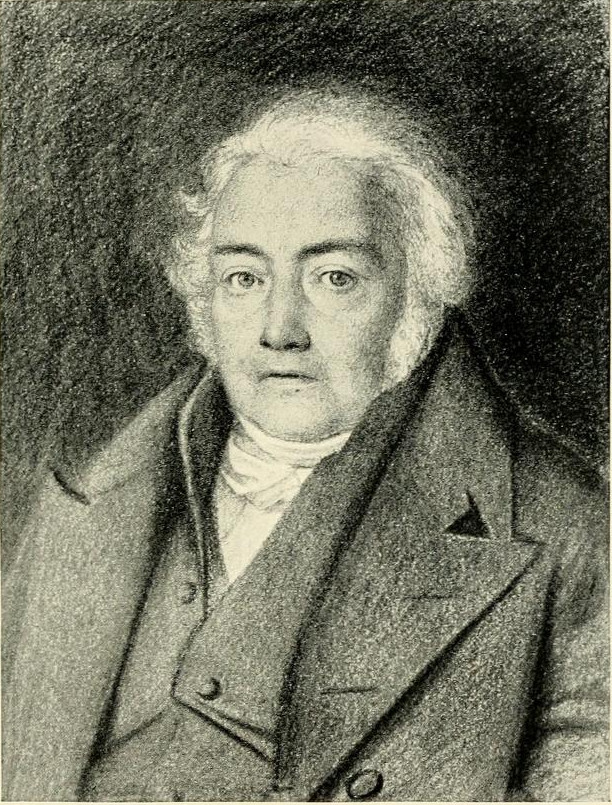
S. T. COLERIDGE
Samuel Taylor Coleridge was a country boy, the son of a Devonshire clergyman. He was born in October 1772. From 1782 to 1790 he was at school in London. It was during those school-days, spent at Christ's Hospital, that his friendship with another English Romanticist, his warm admirer, Charles Lamb, was formed. From 1791 to 1793 he studied at Cambridge. He had neither means nor prospects, and in a fit of despair, occasioned either by his debts or by an unhappy love affair, he suddenly enlisted in the 15th Regiment of Light Dragoons, under the name of Silas Titus Cumberback.[1] It certainly does not seem to have been ambition (as in the case of Johannes Ewald a few years earlier) which prompted him to try his fortune as a soldier, but simply want of any other means of subsistence. He was only four months a dragoon. On the stable wall underneath his saddle, he one day scribbled the Latin lament:—
"Eheu quam infortuni miserrimum est fuisse felicem!"
This was discovered by his captain, who inquired into the position of affairs, and arranged with Coleridge's family for his return to Cambridge. On this followed the short period during which the young poet was an anti-orthodox democrat. As such he could expect no advancement in the University. His and Southey's glorification of Robespierre (the first act of The Fall of Robespierre was written by Coleridge, the second and third are Southey's) and their wild project of a communistic settlement have been already mentioned. The little emigrant society they founded consisted only of themselves and two other members, a young Quaker named Lovell, and George Burnet, a school friend of Southey's. But the God Hymen had decided that the year 1795 should witness the wreck of the plans which boded so ill for society. In 1795 Coleridge went to lecture at Bristol, where he displayed the eloquence which (as in the case of the similarly eloquent and persuasive Welhaven) seems to have sapped his power of poetic production. A young lady in the town of Bristol won his heart; and before the year was over, Sara Fricker was married to Coleridge, her sisters, Edith and Mary, to Lovell and Southey—and the emigration plan was abandoned. Coleridge, who was without will-power all his life, could never have carried out a plan laid so long beforehand. He never succeeded in doing anything except what he had not determined to do, or what, from its nature, could not be determined beforehand.
In 1796 the young man, who was still an enthusiastic Unitarian, allowed himself to be persuaded by some other philanthropists—he is always "persuaded"—to publish a weekly magazine called The Watchman, which was to consist of thirty-two pages, large octavo, and to cost the reasonable price of fourpence. Its flaming prospectus bore the motto, "Knowledge is power." With the object of enlisting subscribers, the young and ardent propagandist undertook a tour of the country between Bristol and Sheffield, preaching in most of the great towns, "as an hireless volunteer, in a blue coat and white waistcoat, that not a rag of the woman of Babylon might be seen on me." The description he has given of this, his Odyssey, shows us the young English Romanticist as he was then and as he continued to be—imprudent in worldly matters, enthusiastic in behalf now of this, now of that religious or political half-truth, yet with a humorous appreciation of his own and others' ridiculousness.
"My campaign commenced at Birmingham; and my first attack was on a rigid Calvinist, a tallow-chandler by trade. He was a tall, dingy man, in whom length was so predominant over breadth that he might almost have been borrowed for a foundry poker. O that face! I have it before me at this moment. The lank, black, twine-like hair, pinguinitescent, cut in a straight line along the black stubble of his thin gunpowder eyebrows, that looked like a scorched after-math from a last week's shaving. His coat collar behind in perfect unison, both of colour and lustre, with the coarse yet glib cordage that I suppose he called his hair, and which with a bend inward at the nape of the neck (the only approach to flexure in his whole figure) slunk in behind his waistcoat; while the countenance, lank, dark, very hard, and with strong perpendicular furrows, gave me a dim notion of some one looking at me through a used gridiron, all soot, grease, and iron! But he was one of the thorough-bred, a true lover of liberty, and (I was informed) had proved to the satisfaction of many, that Mr. Pitt was one of the horns of the second beast in the Revelation, that spoke like a dragon." For half-an-hour Coleridge employed all the resources of his eloquence—argued, described, promised, prophesied, beginning with the captivity of nations and ending with the millennium. "My taper man of lights listened with perseverance and praiseworthy patience, though (as I was afterwards told on complaining of certain odours that were not altogether ambrosial) it was a melting-day with him. 'And what, sir,' he said, after a short pause, 'might the cost be?' 'Only fourpence, only fourpence, sir, each number, to be published on every eighth day.' 'That comes to a good deal of money at the end of the year. And how much did you say there was to be for the money?' 'Thirty-two pages, sir! large octavo, closely printed.' 'Thirty and two pages? Bless me, why, except what I does in a family way on the Sabbath, that's more than I ever reads, sir! all the year round. I am as great a one as any man in Brummagem, sir! for liberty and truth and all them sort of things, but as to this, no offence, sir, I must beg to be excused.'"
Thus ended Coleridge's first attempt at recruiting for the war against the Holy Trinity. His second he made in Manchester, where he tried to enlist a stately and opulent wholesale dealer in cottons. This man measured him from top to toe, and asked if he had any bill or invoice of the thing. Coleridge presented him with the prospectus. He rapidly skimmed and hummed over the first side, and still more rapidly the second and concluding page, then most deliberately and significantly rubbed and smoothed one part against the other, put it in his pocket, turned his back with an "Overrun with these articles!" and retired into his counting-house.
After these unsuccessful attempts, the young man gave up the plan of canvassing from house to house, but nevertheless returned from this memorable tour with almost a thousand names on his list of subscribers. But, alas! the publication of the very first number was, as any one knowing Coleridge might have expected, delayed beyond the day announced for its appearance; the second, which contained an essay against fast-days, lost him nearly five hundred subscribers at a blow; and the two following numbers, which were full of attacks on French philosophy and morals, and directed against those "who pleaded to the poor and ignorant instead of pleading for them," made enemies of all his Jacobin and democratic patrons. Coleridge, who communicates all these details himself, does not seem to have any suspicion that he was only receiving a natural punishment for his indecision—an indecision which consisted in never being prepared to accept the consequences of his own theories. He was undecided in politics, undecided in religion. Writing, as an old man, of this time, he himself says: "My head was with Spinoza, though my whole heart remained with Paul and John;" and he hastens to provide his readers with those convincing proofs of the existence of God and the Holy Trinity which he had not been capable of perceiving in his youth.[2] After the appearance of about a dozen numbers, The Watchman had to be given up, and Coleridge took to writing for the newspapers. He began by attacking Pitt's Government, but in course of time, his opinions tending ever more in a conservative direction, he became its ardent supporter, and also, after the occupation of Switzerland by the French, an enemy of France. So hostile to that country were his articles in the Morning Post, that they even attracted the attention of Napoleon, and Coleridge became the object of the First Consul's special enmity. He would probably have been arrested during his residence in Italy, if he had not received timely warning from the Prussian ambassador, Wilhelm von Humboldt, and, through an inferior official, from Napoleon's own uncle, Cardinal Fesch.
The year 1797, in the course of which Coleridge became acquainted with Wordsworth, was, as regards his poetry, the most important in his life; for it was in this year that he wrote his famous ballad, The Ancient Mariner, and Christabel, the fragment which marks a new era in English poetry.
Christabel was planned as the first of a series of poetical romances, the remainder of which never came into being. It is, without doubt, the first English poem which is permeated by the genuine Romantic spirit; and the new cadences, the new theme, the new style of versification, the novelty generally, made a powerful impression on contemporary poets. The irregular and yet melodious metre appealed so strongly to Scott that he employed it in his first Romantic poem, The Lay of the Last Minstrel. He frankly confesses how much he owed to the beautiful and tantalising fragment, Christabel, which he, like the other poets of the period, made acquaintance with in manuscript; for Coleridge read it aloud in social gatherings for twenty years before it saw the light as public property. Byron, too, heard it first on one of these occasions. Before hearing it he had, in one of his longer poems (The Siege of Corinth, xix.), written some lines which were not unlike some in Christabel. To these lines he, on a future occasion, appended a note in which he praises Coleridge's "wild and singularly original and beautiful poem." But we see from Moore's Life and Letters that there were critics who refused the meed of admiration accorded to Christabel by Scott and Byron, and still more freely by Wordsworth. Jeffrey and Moore himself consider it affected (Memoirs, ii 101; iv. 48). Danish critics, thoroughly initiated into the mysteries of this style by Tieck and the brothers Schlegel, and by their own poet Ingemann, cannot possibly attach so much importance to this fragment. Its excessive naïveté and simplicity, the intentional childishness in style and tone, are to us what buns are to bakers' children. The chief merit of the poem, apart from its full-toned, sweet melody, lies in the peculiar power with which the nature of the wicked fairy is presented to us, the dæmonic element, which had never been present in such force in English literature before. We must, however, remember that, though the first part of the poem was written in 1797, the second was written and the first revised in 1800—that is to say, after Coleridge had travelled with Wordsworth in Germany, and there made acquaintance with contemporary German poetry, its medieval ground-work, and its latest tendency.
Coleridge's one other poem of any length, The Ancient Mariner, which is even more artificially naïve in style than Christabel, and is provided, in the manner of the medieval ballads retailed in the little shops in back streets, with a prose index of contents on the margin of the pages, is now the most popular of all his poems, although it was fiercely attacked on its first appearance. On a very unnatural introduction (three guests on their way to a wedding are stopped, and one of them is led to forget his destination, so eloquent is the ancient mariner—"and on the street, too," as Falstaff says) follows a story of all the horrors, ghostly and material, which ensue, because one of the sailors on a ship has been thoughtless enough to kill an albatross which had alighted on the rigging. The whole crew, with the exception of this one man, die, as a punishment for the act of inhospitality. Swinburne tells that, when the poem was new, the English critics were greatly occupied with the question whether its moral (that one should not shoot albatrosses) was not so preponderant that it destroyed the fantastic effect of the poem; whilst others maintained that the defect of the poem was its want of a practical moral. Long afterwards the same matter formed the subject of a dispute between Freiligrath and Julian Schmidt. Modern criticism would willingly excuse the absence of any moral in the ballad if it could find a poetic central idea in it.
A comparison may serve to show its chief shortcoming. In a collection of poems by the Austrian lyric poet, Moritz Hartmann, entitled Zeitlosen, there is to be found one which, although it does not profess to owe its origin to The Ancient Mariner, at first sight strikes the reader as being a direct imitation of it. The metrical form is the same, and in the theme there is a close resemblance. Der Camao is the title of the poem. The Camao, which answers to Coleridge's albatross, is a bird which, in the Middle Ages, was kept in every house in the Pyrenean Peninsula, and treated with a reverence which had its source in a widespread superstition. It was believed, namely, that this bird could not thrive in a house on which rested the stain of a wife's infidelity; it died if there was even the slightest spot on the honour of its master. Its beautiful cage generally hung in the entrance chamber. In Hartmann's poem the old, deranged man who answers to Coleridge's demented mariner, tells how he, as a page, was seized with a violent passion for his master's wife, and how, every time he rushed from her presence, in despair at her coldness and displeasure, he was tortured as he left her apartments by the bird's song in honour of the chastity of the lady to whom it owed its life. The master of the house returns from the war bringing with him his friend, a handsome young minstrel and hero, whom the lady honours with her friendship, and who is, in consequence, soon hated by the jealous page. Quite beside himself, the young man denounces the lady and her friend to his master; but the latter calmly answers that Camao is still alive, and at that moment singing in his mistress's honour. In his jealous, vindictive rage the page kills the bird; Vasco kills his wife; and thenceforward the criminal wanders, demented and restless, from country to country, seeking rest, but finding it nowhere.
As regards virtuosity and originality in the matter of diction, Der Camao is not for a moment to be compared with The Ancient Mariner; but as regards the poetic central idea, the German poem is not only much superior to its English model, but is in itself a complete, satisfactory criticism of Coleridge's ballad and all the artificial English theories which it represents. In Der Camao the slaughter of the bird is a real human action performed with a real human motive; the punishment is not a caprice, but a just and natural consequence of the misdeed. The misfortune which the killing of the bird brings to Vasco and his wife has a natural cause and effect connection with that deed, whilst the death of the whole ship's crew, as the result of the cruelty shown to the albatross, is folly. The comparison assists us to a clear understanding of the difference between a true poetical conception of the superstitious idea and a Romantic treatment of it. The story in both poems is founded on a superstition. Hartmann has no desire to submit the superstition to the criticism of reason; but he forces it upon no one; the beauty of his poem is quite independent of the belief or disbelief of his reader in the miraculous susceptibility of the Camao. Romantic extravagance, on the other hand, proclaims reverence for the marvellous and inexplicable to be the sum and substance of all wisdom and of all poetry.
But though The Ancient Mariner may not take a high place when compared with poetry which has extricated itself from Romantic swaddling-bands, it stands high above most of the kindred productions of German Romanticism. In spite of all its Romantic fictitiousness, it breathes of the sea, the real, natural sea, whose changing moods and whose terrifying, menacing immensity it describes. The fresh breeze, the seething foam, the horrible fog, and the hot, copper-coloured evening sky with its blood-red sun—all these elements are nature's own; and the misery of the men tossing helplessly on the ocean, the starvation, the burning thirst that drives them to suck the blood from their own arms, the pallid countenances, the terrible death-rattle, the horrible putrefaction—all these elements are realities, represented with English realistic force.
And it is a very English trait that Coleridge himself should have been thoroughly capable of seeing the weak points of such a poem as his own famous ballad. The national quality of humour assisted him to this independence of judgment. We have the following anecdote from his own pen. "An amateur performer in verse expressed a strong desire to be introduced to me, but hesitated in accepting my friend's immediate offer, on the score that he was, he must acknowledge, the author of a confounded severe epigram on my Ancient Mariner, which had given me great pain. I assured my friend that if the epigram was a good one, it would only increase my desire to become acquainted with the author, and begged to hear it recited, when, to my no less surprise than amusement, it proved to be one which I had myself inserted in the Morning Post." When Coleridge tells us, too, that he himself wrote three sonnets expressly for the purpose of exciting a good-natured laugh at the artificial simplicity and doleful egotism of the new poetical tendency, and that he took the elaborate and swelling language and imagery of these sonnets from his own poems, we cannot deny that his endeavours to keep free from the entanglement in theories which was the weak point in German Romanticism, bespeak rare intellectual superiority.
It was, nevertheless, from Germany that Coleridge's intellect received its most invigorating and essential nourishment. He was the first Englishman who penetrated into the forest of German literature, which was as yet unexplored by foreigners; he made his way into it about the same time as Madame de Staël, the pioneer of the Latin races. Whilst he was producing the famous poems just described, he began the study of German. Schiller and Kant attracted him first. In 1798 he and Wordsworth went to Germany on a literary voyage of discovery. In Hamburg they visited the patriarch Klopstock, who praised Bürger to them, but spoke coldly and disparagingly of the rest of the younger literary men, and especially of Coleridge's idols, Kant and Schiller. The latter's Die Räuber he professed himself unable to read. But he had plenty to say on the subject of The Messiah and his extreme satisfaction with the English translations of it. While in Germany, Coleridge studied the Gothic language, and read the Meistersingers and Hans Sachs; and on his return he published a translation of Schiller's Wallenstein, the play which Benjamin Constant was soon afterwards to adapt for the French stage.
It was about this time that Coleridge settled in the Lake district, where Wordsworth and Southey had already taken up their abode—the district which gave its name to the literary school constituted, as their contemporaries chose to consider, by these three poets. The name, as a matter of fact, does not mean much more than if, in Denmark in 1830, Hauch, Ingemann, Wilster, and Peder Hjort, had been dubbed Sorists. The English poets of the Lake School were quite as unlike each other in their gifts as were these Sorö professors[3] But the criticism of the day always coupled Coleridge's name with Wordsworth's and Southey's because it was known that he was on intimate and friendly terms with them, because he never missed an opportunity of praising them, nor they of praising him, and because he and the other Lakists were crowned every three months with fresh laurels in the Quarterly Review, whilst the sinner Byron was chastised with fresh scorpions. Though Coleridge published almost nothing, Wordsworth and Southey were hardly ever under the cascade of criticism without some drops of it falling upon him. The circumstance that the Lake poets aimed (in much the same manner as the Pre-Raphaelite and the Nazarene painters) at poetic intensity, a childlike disposition and a childlike faith, pious blandness and priestly unction, exposed the man who could not but be regarded as the teacher of the school to much satire and derision. As a youth, in his poem Fire, Famine, and Slaughter, Coleridge had made all the horrors, one by one, reply to the question: Who bid you rage? with the following refrain, applying to Pitt:—
"Who bade you do't? The same! the same! Letters four do form his name. He let me loose, and cried Halloo! To him alone the praise is due."
Now he was Mr. Pitt’s journalistic henchman, and, like all the other members of the Lake School, a strict Tory, the enemy of liberal opinions in everything relating to church and state. What wonder that he was classed along with the others in the constant party attacks made by the Liberals! And yet it would have been so easy and so natural to distinguish him as a poet from all the others, and to pay him the honour which was due to his originality. The few poems which he wrote in the course of a comparatively long life are distinguished by the exquisite melodiousness of their language; their harmonies are not only delicate and insinuating like Shelley's, but contrapuntally constructed and rich; they have a peculiar, ponderous sweetness; each line has the taste and weight of a drop of honey. In poems such as Love and Lewti, which are the two sweetest, and in an Oriental fantasy like Kubla Khan, which was inspired by a dream, we hear Coleridge flute and pipe and sing with all the changing cadences of the most exquisite nightingale voice. It is Swinburne who makes the apt remark that, in the matter of harmonies, Shelley is, compared with Coleridge, what a lark is compared with a nightingale.
But Coleridge's poetry is as unplastic as it is melodious, and as unimpassioned as it is mellifluous. It is of the fantastic Romantic order; that is to say, it neither expresses strong, personally experienced emotions, nor reproduces what the author has observed in the surrounding world. In this last connection it is interesting to know that Coleridge's long tour in the south was altogether without results as far as his poetry was concerned. The only poem he brought home with him, the Hymn Before Sunrise in the Vale of Chamouni, a valley in which he never set foot, was composed with the assistance of the description of the locality given by the well-known Danish authoress, Friederike Brun. His historic sense was as defective as his sense of locality. He says himself: "Dear Sir Walter Scott and myself are exact, but harmonious opposites in this—that every old ruin, hill, river, or tree called up in his mind a host of historical or biographical associations ... whereas for myself, I believe I should walk on the plain of Marathon without taking more interest in it than in any other plain of similar features.... Charles Lamb wrote an essay on a man who lived in past time:—I thought of adding another to it on one who lived not in time at all, past, present, or future—but beside or collaterally."[4] His poetry is, thence, in the literal sense of the word, visionary; the poem which the best critics consider the finest, he composed in a dream.
In his own life there was as little of will and plan as in a dream. Somewhat indolent by nature, he became more and more procrastinating as years went on; and the result of his procrastination was an accumulation of difficulties which he had not energy and application enough to overcome. To relieve physical suffering he had recourse to opium, and soon became a confirmed opium-eater, thereby increasing his incapacity to carry out any plan. After a period of wandering, living first in one, then in another friend's house, and either writing for magazines or giving lectures on the history of literature, he decided that he was unfit to manage himself and his affairs, and from 1816 onwards he lived at Highgate in the house and under the control of a doctor named Gillman—separated from his own family, whom he left to the care of his friend and brother-in-law, Southey.
On the indulgence in opium followed remorse and self-reproach and increasingly orthodox piety. Most of what Coleridge now wrote was written with the object of refuting the heresies of his youth and defending the doctrine of the Trinity and the Church of England against all attacks.[5] Emerson, who paid him a visit, describes him as "old and preoccupied"; enraged by the effrontery with which a handful of Priestleians dared to attack the doctrine of the Trinity propounded by Paul and accepted unchallenged for centuries; and falling in his talk into all manner of commonplaces. Eighteen years passed, spent in dreaming, talking, and composing edifying essays. His influence during this period was due much less to his productive power than to the manner in which he incited to production. He stimulated and goaded others to the pitch of expressing themselves publicly. Residing close to London, and constantly visited, because of his conversational powers, by the best writers of the day—Charles Lamb, Wordsworth, Southey, Leigh Hunt, Hazlitt, Carlyle—he was a looker-on on life during the years when the great representatives of the opposite intellectual tendency to his, Shelley and Byron, were pouring forth their fiery denunciations of the order of society and state which he considered so excellent. Without will of his own, under control, and himself protected like a child, Coleridge became ever more and more the would-be protector of society, whilst the two great poets of liberty, banished from their homes and thrown entirely on their own resources, developed an independence unexampled in the history of literature, and, protected neither by themselves nor any one else, were shattered long before their time by the ardour of conflict. The right of personal investigation and personal liberty were as precious treasures to them as the Church of England was to Coleridge.
VIII
THE LAKE SCHOOL'S CONCEPTION OF LIBERTY
Coleridge and the other members of the Lake School would never have dreamt of calling themselves anything but warm friends of liberty; the days were past when the reactionaries called themselves by another name. Coleridge wrote one of his most beautiful poems, the Ode to France, in the form of a hymn to liberty, to his constant love for which he calls clouds, waves, and forests to testify; and Wordsworth, who dedicated two long series of his poems to liberty, regarded himself as her acknowledged champion. A cursory glance at the works of these poets might well leave us with the impression that they were as true lovers of liberty as Moore, or Shelley, or Byron. But the word liberty in their mouths meant something different from what it did in Moore's, or Shelley's, or Byron's. To understand this we must dissect the word by means of two simple questions: freedom, from what?—liberty, to do what?
To these conservative poets freedom is a perfectly definite thing, a right which England has and the other countries of Europe have not—the right of a country to govern itself, un-tyrannised over by an autocratic ruler of foreign extraction. The country which has this privilege is free. By liberty, then, the men in question understood freedom from foreign political tyranny; there is no thought of liberty of action in their conception at all. Look through Wordsworth's Sonnets Dedicated to Liberty, and see what it is they celebrate. It is the struggle of the different nations against Napoleon, who is described as a species of Antichrist. (Scott calls him "the Devil on his burning throne.")
The poet mourns the conquest of Spain, Switzerland, Venice, the Tyrol, by the French; he chants the praises of Hofer, the undaunted, of brave Schill, and daring Toussaint L'Ouverture, the men who ventured to face the fierce conquerors; and he sings with quite as great admiration of the King of Sweden, who with romantically chivalrous folly threw down the gauntlet to Napoleon, and proclaimed his longing for the restoration of the Bourbons. (Ere long Victor Hugo and Lamartine, in their character of supporters of the Legitimist monarchy, followed suit in singing the praises of the Swedish king and his son, Prince Gustavus Vasa.) Hatred of Napoleon becomes aversion for France. In one of the sonnets ("Inland, within a hollow vale, I stood") Wordsworth tells how the "barrier flood" between England and France for a moment seemed to him to have dwindled to the dimensions of a river, and how he shrank from the thought of "the frightful neighbourhood"; in another he rejoices in the remembrance of the great men and great books England has produced, and remarks that France has brought forth "no single volume paramount ... no master spirit," that with her there is "equally a want of books and men."
He always comes back to England. His sonnets are one long declaration of love to the country for which he feels "as a lover or a child," the country of which he writes: "Earth's best hopes are all with thee." He follows her through her long war, celebrating, like Southey, each of her victories; and it is significant of his attitude that, appended to the Sonnets Dedicated to Liberty, we find the great, pompous thanksgiving ode for the battle of Waterloo. We of to-day ask what kind of liberty it was that Waterloo gained; but we know full well that the group of poets whose heroes were the national heroes—Pitt, Nelson, and Wellington, and who sang the praises of the English constitution as being in itself liberty, and lauded England as the model nation, won a degree of favour with the majority of their countrymen to which their great poetic antagonists have not even yet attained. Wordsworth and his school considered the nation ideal as it was, whereas the others tried to compel it to turn its eyes towards an ideal, not only unattained, but as yet unrecognised; the former flattered it, and were rewarded with laurels; the latter educated and castigated it, and were spurned by it. Scott was offered the post of Poet Laureate, and Southey and Wordsworth in turn occupied it; but to this day the English nation has shown no public recognition of what it owes to Shelley and Byron.[1] And the reason is, that these men's conception of liberty was utterly different from that of the Lake School. To them it was not realised in a nation or a constitution—for it was no accomplished, finished thing; neither was their idea of the struggle for liberty realised in a highly egoistic war against a revolutionary conqueror. They felt strongly what an absence of liberty, political as well as intellectual, religious as well as social, there might be under a so-called free constitution. They had no inclination to write poems in honour of the glorious attainments of the human race, and more especially of their own countrymen; for in the so-called land of freedom they felt a terrible, oppressive want of freedom—of liberty to think without consideration of recognised dogmas, to write without paying homage to public opinion, to act as it was natural to men of their character to act, without injury from the verdict of those who, because they had no particular character of their own, were the most clamorous and unmerciful condemners of the faults which accompanied independence, originality, and genius. They saw that in this "free" country the ruling caste canted and lied, extorted and plundered, curbed and constrained quite as much as did the one great autocrat with his absolute power—and without his excuse, the authority of intellect and of genius.
To the poets of the Lake School, coercion was not coercion when it was English, tyranny was not tyranny when it was practised under a constitutional monarchy, hostility to enlightenment was not hostility to enlightenment when it was displayed by a Protestant church. The Radical poets called coercion coercion, even when it proceeded to action with the English flag flying and the arms of England as its policemen's badge; they cherished towards monarchs generally, the objection of the Lake School poets to absolute monarchs; they desired to free the world not only from the dominion of the Roman Catholic priesthood, but from priestly tutelage of every description. When they heard poets of the other school, who in the ardour of youth had been as progressive as themselves, extolling the Tory Government of England with the fervour which distinguishes renegades, they could not but regard them as enemies of liberty. Therefore it is that Shelley, in his sonnet to Wordsworth, writes:—
"In honoured poverty thy voice did weave Songs consecrate to truth and liberty. Deserting these, thou leavest me to grieve, Thus having been, that thou shouldst cease to be."
Therefore it is that Byron is tempted again and again "to cut up Southey like a gourd." And therefore it is that the love of liberty of the Radical poets is a divine frenzy, a sacred fire, of which not a spark is to be found in the Platonic love of the Lake School. When Shelley sings to liberty:—
"But keener thy gaze than the lightning's glare, And swifter thy step than the earthquake's tramp; Thou deafenest the rage of the ocean; thy stare Makes blind the volcanoes; the sun's bright lamp To thine is a fen-fire damp;"
we feel that this liberty is not a thing which we can grasp with our hands, or confer as a gift in a constitution, or inscribe among the articles of a state-church. It is the eternal cry of the human spirit, its never-ending requirement of itself; it is the spark of heavenly fire which Prometheus placed in the human heart when he formed it, and which it has been the work of the greatest among men to fan into the flame that is the source of all light and all warmth in those who feel that life would be dark as the grave and cold as stone without it. This liberty makes its appearance in each new century with a new name. In the Middle Ages it was persecuted and stamped out under the name of heresy; in the sixteenth century it was championed and opposed under the name of the Reformation; in the seventeenth it was sentenced to the stake as witchcraft and atheism; in the eighteenth it became first a philosophical gospel, and then, through the Revolution, a political power; in the nineteenth it receives from the champions of the past the new nickname of Radicalism.
What the poets of the Lake School extolled was a definite, actually existing sum of liberties—not liberty. What the revolutionary poets extolled was undoubtedly true liberty; but their conception was so extremely ideal, that in practical matters they too often shot beyond the mark. In the weakening of all established government they saw only the weakening of bad government; in the half-barbaric revolts of oppressed races they saw the dawn of perfect liberty. Shelley had so little knowledge of his fellow-men that he thought the great victory would be won if he could exterminate kings and priests at a blow; and Byron's life was almost over before he learned by experience how few republican virtues the European revolutionists leagued together in the name of liberty possessed. The poets of the Lake School were safeguarded against the generous delusions and overhastiness of the Radical poets; but posterity has derived more pleasure and profit from the aberrations due to the love of liberty in the latter than from the carefully hedged in and limited Liberalism of the former.
IX
THE LAKE SCHOOL'S ORIENTAL ROMANTICISM
This is the time to notice the man who was Byron's and Shelley's worst enemy and Coleridge's best friend, and who, inferior as his productions are to those of his friend, deserves also to have his name coupled with Coleridge's as a famous English Romanticist.
Robert Southey, born in Bristol in 1774, was the son of a linen-draper there, and to the end of his life a man who produced the impression that he had been born in narrow circumstances, in a corner of the world with a narrow spiritual horizon. After studying a short time at Oxford, he, like the other poets of the Lake School, became infected by the spirit of the Revolution. In 1794 he wrote an extremely Jacobinical poem, Wat Tyler. About the same time he composed the following inscription for the room in which Martin, the regicide, had been confined:—
"For thirty years secluded from mankind Here Martin linger'd. Often have these walls Echo'd his footsteps, as with even tread He paced around his prison. Not to him Did Nature's fair varieties exist; He never saw the sun's delightful beams, Save when through yon high bars he pour'd a sad And broken splendour. Dost thou ask his crime? He had rebell'd against the King, and sat In judgment on him; for his ardent mind Shaped goodliest plans of happiness on earth, And peace and liberty. Wild dreams! but such As Plato lov'd...."
The following rather clever parody was inserted by Mr. Canning in the Anti-Jacobin:—
"INSCRIPTION FOR THE DOOR OF THE CELL IN NEWGATE, WHERE MRS. BROWNRIGG, THE 'PRENTICE-CIDE, WAS CONFINED, PREVIOUS TO HER EXECUTION.
"For one long term, or ere her trial came, Here Brownrigg linger'd. Often have these cells Echo'd her blasphemies, as with shrill voice She scream'd for fresh geneva. Not to her Did the blithe fields of Tothill, or thy street, St. Giles, its fair varieties expand; Till at the last in slow-drawn cart she went To execution. Dost thou ask her crime? She whipp'd two female 'prentices to death, And hid them in the coal-hole. For her mind Shaped strictest plans of discipline. Sage schemes! Such as Lycurgus taught...."
After Southey, too, had given up his project of emigration and won the hand of his Miss Fricker, he settled in London, in 1797. From 1807 onwards the Government granted him an annual allowance of £150, and after Pye's death he became Poet Laureate, with a salary of £300. This post, which entailed the obligation to compose a poem on the occasion of every special event in the royal family, had first been offered by the Prince Regent to Scott, who asked his friend and patron, the Duke of Buccleuch, for advice in the matter. The Duke wrote: "Only think of being chanted and recitatived by a parcel of hoarse and squeaking choristers on a birthday, for the edification of the bishops, pages, maids of honour, and gentlemen-pensioners! Oh horrible! thrice horrible!" &c., &c. Scott declined the proffered honour, and suggested Southey, a loyal and needy poet, as a fit recipient. For the greater part of his life Southey was obliged to live by his pen, and consequently often wrote under compulsion. Industrious, economical, a model of all the domestic virtues, he amassed a capital of £12,000. With him, as with the Germans, Romanticism, instead of precluding the bourgeois virtues, throve along with them. It had, after all, so little connection with real life. His respectable Philistinism did not forbid of his allowing his imagination to take the wildest Oriental flights.
During the first, the liberal-minded, stage of Southey's career, we are conscious of a sympathetic ardour in his writing. He possessed both enthusiasm and courage. His epic, Joan of Arc, published in 1797, is a poem inspired by as fervent an admiration for the heroine of France as that displayed by Schiller five years later in his Jungfrau von Orleans. Southey's work is, like Schiller's, of an exactly opposite character to Voltaire's Pucelle, which, the English poet in his preface informs his readers, is a book he has "never been guilty of looking into." In Joan of Arc Southey is not yet the Romanticist. Once or twice he projects his vision as far as his own day. In the Third Book he extols Madame Roland as "the martyred patriot," in the Tenth he refers to Lafayette's as "the name that Freedom still shall love." And in his representation of Jeanne's exploits we have not, as in Schiller, any reference to witchcraft. At a decisive moment, when the Maid is being questioned as to her beliefs, she (and through her, her poet) makes such a frank confession of her faith in nature that we feel satisfied that in Southey's case too, the Naturalism which dominates the English poetry of the day is the foundation upon which everything rests.
"Woman," says a priest to Joan of Arc,—
"Woman, thou seem'st to scorn The ordinances of our holy Church; And, if I rightly understand thy words, Nature, thou say'st, taught thee in solitude Thy feelings of religion, and that now Masses and absolution and the use Of the holy wafer, are to thee unknown. But how could Nature teach thee true religion, Deprived of these? Nature doth lead to sin, But 'tis the priest alone can teach remorse, Can bid St. Peter ope the gates of Heaven, And from the penal fires of purgatory Set the soul free."
The Maid replies:—
"Fathers of the holy Church, If on these points abstruse a simple maid Like me should err, impute not you the crime To self-will'd reason, vaunting its own strength Above eternal wisdom. True it is That for long time I have not heard the sound Of mass high-chaunted, nor with trembling lips Partook the holy wafer: yet the birds Who to the matin ray prelusive pour'd Their joyous song, methought did warble forth Sweeter thanksgiving to Religion's ear In their wild melody of happiness, Than ever rung along the high-arch'd roofs Of man: ... yet never from the bending vine Pluck'd I its ripen'd clusters thanklessly, Or of that God unmindful, who bestow'd The bloodless banquet. Ye have told me, Sirs, That Nature only teaches man to sin! If it be sin to seek the wounded lamb, To bind its wounds, and bathe them with my tears, This is what Nature taught! No, Fathers, no! It is not Nature that doth lead to sin: Nature is all benevolence, all love, All beauty! In the greenwood's quiet shade There is no vice that to the indignant cheek Bids the red current rush; no misery there; No wretched mother, who with pallid face And famine-fallen hangs o'er her hungry babes, With such a look, so wan, so woe-begone, As shall one day, with damning eloquence Against the oppressor plead!..."[1]
In this little harangue the attentive reader is conscious, not only of the echo of the revolutionary cries on the other side of the Channel, repeated in the language of English nature-worship, but also of the young poet's want of ability to give his subject the proper local colouring or to impart to it the spirit of the age. France and the Middle Ages are to him here what the East and the world of legend were to become—a costume in which his English and Protestant ideas figure. Of one thing, however, there is no doubt, namely, that it required courage to sing the praises of the French national heroine at a moment when the animosity to France was so strong; and the poem, in spite of its aridity both as regards feeling and colour, is a work which does honour to a young poet. But the brave spirit which elevated his talent was soon to disappear from his writings.
The lower the flood of unselfish enthusiasm for the great tasks and dreams of humanity ebbed in Southey's soul, the stronger became the impulse to remedy the aridity by pouring in a stream of purely external Romanticism. He had by degrees attained to a certain mastery over the resources of language, had acquired the art of writing loosely constructed but melodious verse, expressive in spite of its vagueness and monotony. Employing this melodious, flexible metre in the representation of the superstitions of Arabia and the most fantastic dreams of the Oriental races, he now produced his two principal works, The Curse of Kehama and Thalaba the Destroyer. The Oriental tendency is common to Romanticism in every country. Oehlenschläger, the Dane, displays it simultaneously with Southey; it reaches France a little later, when Victor Hugo writes Aly et Gulhyndi and Les Orientales. But in the case of the English poets, the colourless, Protestant life of their own country, with its severe, cold propriety, must have invested the East with a peculiarly attractive charm. It required an Irishman, however—Thomas Moore, a colourist with Celtic blood in his veins—to arrive at anything resembling an understanding of a race like the ancient Persians and of their legends, and to reproduce the nature of the East in a style loaded with jewels and barbaric ornaments. Lalla Rookh is no masterpiece; its personages and ideas are far too European and tame; but Thalaba, a work which enjoyed a certain amount of celebrity in its day, is tame in comparison with Lalla Rookh, and as moral as an English sermon. It suffers from the sharp contrast between the gaudy tinsel of the scenery and the sober modesty of the feelings represented. We are transplanted into a world which is not less marvellous than that of the Thousand and One Nights, but a world in which, nevertheless, love of our fellow-men and faith in one God are perpetually inculcated. The hero's life is presided over by the most special providence. When the fit time has arrived for him to leave his foster-father's house, the flight of a swarm of Syrian grasshoppers, pursued by a flock of birds, is directed so as to pass above the house. A grasshopper which one of the birds drops from its bill bears on its forehead in minute letters the inscription:—