NATURALISM IN ENGLAND (continued 5)
Mary Morison translation
If Byron's domain is that of the tortures of the luckless or forsaken lover, Shelley's is, as we see, that of the pain of the happy lover, of self-annihilation in the rapture of love. But for the very reason that the erotic domain of both these great poets was thus definitely limited, neither of them wrote many erotic poems; to neither was this one of the most important fields of his productivity.
Moore, on the contrary, was a born erotic poet, of the type of our (Danish) Christian Winther. What the majority of love-poets are possessed by is the erotic passion; Moore's distinguishing characteristic is erotic fancy. He loves everything that is beautiful, exquisite, delicate, soft, and bright, for its own sake, without requiring any background to throw it into relief. He never tells any eventful story, never sets off by any strong contrast, never undermines by deep brooding. He loves the blossoms of the tree, not its roots. The objects which fascinate him, fascinate with the first impression; they are beautiful and bright; they dazzle the senses; they enthral the eye and the ear more than the heart; they are exchanged for other objects possessing the same qualities—there is a constant gleam and flutter. But all essentially erotic poets have butterfly natures. In this matter no more striking contrast can be imagined than that between Wordsworth and Moore. The former deliberately chooses themes which in themselves are insignificant, or unattractive, or even ugly, in order to endow them with a moral or spiritual beauty; the latter detests the sordid details of human life, recoils from all its adversities, and evades every moral with a Wieland-like smile and bow. When he is forced to give the ugly a place, he cannot resist casting a soft, glittering veil over it. His style has been blamed for its overweight of gorgeous adjectives, its propensity to let every passion lose itself in a simile, and its restless glitter and gleam. It has been called artificial in comparison with Wordsworth's. "Artificial!" cries one of his Irish admirers, "when every human being can enjoy Moore's poetry, whilst a new taste has to be created to enable one to enjoy Wordsworth's!" Is it really the case, then, we are led to ask, that study and a cultivated taste are required for the enjoyment of the natural, whilst only ordinary feeling is demanded for the enjoyment of artificial beauty? Wordsworth and Coleridge were poets for a cultivated, literary public; Moore was the poet for a nation. The faults with which he may fairly be charged are the consequences of his natural limitations, of his being a musician and a colourist, but not a draughtsman; he is incapable of drawing or describing a whole object, what he does is to paint the separate attributes of beautiful objects. He devotes verse after verse to the praises of a blush, a smile, the melody of a voice; instead of beautiful outlines he gives us a list of beauties. Employing Voltaire's clever definition of love—"nature's cloth, which imagination has embroidered"—it must be confessed that in Moore's love-poetry the embroidery is often so gorgeous and abundant that it hardly permits the cloth to appear at all. But the cloth is there, and is nature's.
And it is only fair to add that in Moore's best and most beautiful poems the over-abundance of imagery has disappeared. Where the true Irish melancholy has taken possession of his soul, it has blown away all the tinsel and found expression in imperishable language. The style of "Take back the virgin page" and "The last rose of summer" is as simple as their metre is perfect. There is not a simile in either of them. Nor is there a single simile in the beautiful little song which, in spite of its brevity, has for Ireland all the significance of a national epic—the simple song of the lovely young girl who, though adorned with precious jewels and with a beauty still more alluring, went without fear from one end of Ireland to the other, knowing that Erin's sons, "though they love woman and golden store," love honour and virtue more. ("Rich and rare were the gems she wore.") Of the man who wrote such a song Byron might safely assert: "Moore's Irish Melodies will go down to posterity with their music; and both will last as long as Ireland or as music and poetry."
Moore's was a happy life. At the age of thirty-one he married a beautiful and amiable girl, Miss Bessy Dyke; and their married life was a most harmonious one. He was not always in good circumstances, but after his fame was established, his works provided him with a handsome income. Though in the Grand Dinner of Type and Co. he makes the rich publishers (in the manner of the legendary warriors who after death drank mead out of the skulls of their enemies) drink their wine out of the skulls of poor authors, he himself had no reason to complain of his publisher, who offered him £3000 for Lalla Rookh before seeing a line of it, and gave him £4200 for his excellent Life of Lord Byron. Moore was held in equal honour by the Irish and English. In 1818 he was entertained at a banquet in Dublin by all the most famous literary and public men of the country, and when he went to Paris in 1822 he was fêted by the British nobility there. It was not till he grew old that misfortunes came upon him. Then he lost his health and had severe trials with his children. He died in 1842.
XIV
THE BRITISH SPIRIT OF FREEDOM
The poet Thomas Campbell, descended from an ancient Highland family, and born and brought up in Scotland, was, like Scott, an ardent Scottish patriot; he also felt warm sympathy for Ireland, and, like Moore, sang her national memories and sorrows; but he combined love of the two subordinate countries with an ardent and martial British patriotism.
He was, however, not only a national poet in the sense in which Wordsworth was one, but also, from his youth to his death, an enthusiastic lover of liberty. His epic poems and his ballads are not superior to corresponding productions of Wordsworth's; but he had true lyric genius. He is the Tyrtæus or Petöfi of the Naturalistic School. To him the cause of his country and the cause of liberty are one and the same thing, and in his best verse there is a spirit, a swinging march time, and a fire, that entitle him, if only for the sake of half-a-dozen short pieces, to a place among great poets.
His poem The Battle of the Baltic is, naturally, little calculated to make a favourable impression on Danes. His pride in the victory Nelson won over a force so much weaker than his own, but which the poem magnifies into the same size as England's, is the very extravagance of patriotism. But, side by side with this poem, and written at the same time, we have Ye Mariners of England, a masterpiece, in the rhythm of which we seem to hear the gale rattling among English sails. Here the true son of the Queen of the Sea, singing of the British sailor, celebrates his mother's praises.
Notice the rushing, sweeping force and exultation compressed into the last four lines of this stanza:—
"Ye Mariners of England! That guard our native seas; Whose flag has braved a thousand years The battle and the breeze! Your glorious standard launch again To match another foe! And sweep through the deep, While the stormy winds do blow; While the battle rages loud and long, And the stormy winds do blow.
And observe the expression of pride in England's sovereignty of the sea:—
Britannia needs no bulwarks, No towers along the steep; Her march is o'er the mountain-waves, Her home is on the deep. With thunders from her native oak, She quells the floods below,— As they roar on the shore, When the stormy winds do blow; When the battle rages loud and long, And the stormy winds do blow.
Campbell's life was a well regulated and tranquil one. Born in Glasgow in 1777, he received an excellent education there and in Edinburgh. At the age of twenty-one he published his Pleasures of Hope, which, though now antiquated, created a sensation on its appearance, and with the proceeds undertook a tour in Germany, during the course of which he wrote several poems inspired by the hostilities with Denmark—among them the two above mentioned. In 1803 he married his cousin and settled in London. He wrote, lectured, and from 1820 onwards edited a newspaper. After 1830 his health was precarious and his powers were enfeebled. He lived, a shadow of himself, until 1844.
It is the same with Campbell as with all the other authors of the group to which he belonged—his poetic faculty is based upon the freshness of his receptivity to natural impressions. He has written a poem to the rainbow which, in spite of a rather prosaic and argumentative introduction, is a little masterpiece of simplicity and fancy. He begins by imagining the feelings of "the world's grey fathers" when they came forth to watch its first appearance:—
"And when its yellow lustre smiled O'er mountains yet untrod, Each mother held aloft her child To bless the bow of God. Methinks, thy jubilee to keep, The first made anthem rang On earth delivered from the deep, And the first poet sang. Nor ever shall the Muse's eye Unraptured greet thy beam: Theme of primeval prophecy, Be still the poet's theme! How glorious is thy girdle cast O'er mountain, tower, and town, Or mirrored in the ocean vast, A thousand fathoms down! As fresh in yon horizon dark, As young thy beauties seem, As when the eagle from the ark First sported in thy beam."
And one of his latest poems, The Dead Eagle, written at Oran in Africa, bears witness to the same, unenfeebled, receptivity to all the phenomena of nature as this early one. In the later work we are conscious of a joy in natural strength and power which is characteristically English. "True" the poet writes:
"True the carr'd aëronaut can mount as high; But what's the triumph of his volant art? A rash intrusion on the realms of air. His helmless vehicle, a silken toy, A bubble bursting in the thunder-cloud; His course has no volition, and he drifts The passive plaything of the winds. Not such Was this proud bird: he clove the adverse storm And cuff'd it with his wings. He stopp'd his flight As easily as the Arab reins his steed, And stood at pleasure 'neath heaven's zenith, like A lamp suspended from its azure dome, Whilst underneath him the world's mountains lay Like molehills, and her streams like lucid threads. Then downward, faster than a falling star, He near'd the earth, until his shape distinct Was blackly shadow'd on the sunny ground; And deeper terror hush'd the wilderness, To hear his nearer whoop. Then, up again He soar'd and wheel'd. There was an air of scorn In all his movements, whether he threw round His crested head to look behind him, or Lay vertical and sportively display'd, The inside whiteness of his wing declined In gyres and undulations full of grace. . . . . . . . . . . . . . . . . . He—reckless who was victor, and above The hearing of their guns—saw fleets engaged In flaming combat. It was nought to him What carnage, Moor or Christian, strew'd their decks. But if his intellect had match'd his wings, Methinks he would have scorn'd man's vaunted power To plough the deep; his pinions bore him down To Algiers the warlike, or the coral groves That blush beneath the green of Bona's waves; And traversed in an hour a wider space Than yonder gallant ship, with all her sails Wooing the winds, can cross from morn till eve. . . . . . . . . . . . . . . . . . . . . . . . . . . . . . . . . . . . . The earthquake's self Disturb'd not him that memorable day, When o'er yon table-land, where Spain had built Cathedrals, cannon'd forts, and palaces, A palsy-stroke of Nature shook Oran, Turning her city to a sepulchre, And strewing into rubbish all her homes."
There is wealth of imagination in this as well as wealth of observation.
But Campbell is greatest in his poetry of freedom, in poems like Men of England, Stanzas on the Battle of Navarino, Lines on Poland, the Power of Russia, and such noble, profound expressions of spiritual freedom as that entitled Hallowed Ground. In such productions as these he plainly shows his spiritual superiority to the poets of the Lake School, who, like him, wrote glorious verse in honour of the nations who were struggling for their independence. The Lake poets honoured the struggle only when it was against the tyranny of Napoleon, England's enemy. Campbell makes no difference of this kind; in the name of freedom he often exhorts and even rebukes England, whereas to the other poets she is freedom's very hearth and home.
Note, in Men of England, the warmth with which he insists that the records of valour in war are as nothing compared with the glowing love of liberty in the breasts of living men, and that the glory of the martyrs of freedom is worth a hundred Agincourts.
Campbell's joy at the liberation of Greece is as genuine as his grief over the fall of Poland; but the poem on Poland is more ardent, in its indignation, its hope, its lament that "England has not heart to throw the gauntlet down." And the verses on the power of Russia display as clear an understanding of the danger to civilisation which lies in the success of Russia, and of the real significance of the defeat of Poland, as if a statesman had turned poet.
"Were this some common strife of States embroil'd;— Britannia on the spoiler and the spoil'd Might calmly look, and, asking time to breathe, Still honourably wear her olive wreath. But this is Darkness combating with Light; Earth's adverse Principles for empire fight."
These are weighty words; and not less pregnant is the line:
"The Polish eagle's fall is big with fate to man."
The poem Hallowed Ground is, in its bold simplicity, a plain protest against all superstition, whatever name it bears, and a manly confession of faith in the gospel of liberty as proclaimed by the eighteenth century. What is hallowed ground? asks Campbell:
"What's hallow'd ground? Has earth a clod Its Maker meant not should be trod By man, the image of his God, Erect and free, Unscourg'd by superstition's rod To bow the knee? That's hallow'd ground—where, mourn'd and miss'd. The lips repose our love has kiss'd;— But where's their memory's mansion? Is't Yon churchyard's bowers? No! in ourselves their souls exist, A part of ours. A kiss can consecrate the ground Where mated hearts are mutual bound; The spot where love's first links were wound, That ne'er were riven, Is hallow'd down to earth's profound, And up to heaven!"
And, though the ashes of those who have served mankind may be scattered to the winds, they themselves, he says, live on in men's hearts as in consecrated ground; until the high-priesthood of Peace, Independence, Truth, shall make earth at last all hallowed ground.
Campbell cannot be numbered among the greatest poets of the Naturalistic School; but in his lyrics there is a simple, powerful, and melodious pathos which reminds us of the old Greek elegiac poets. Although Scotch by birth, his sympathies were with Ireland, and his spirit was British. Although, like the poets of the Lake School, ardently patriotic, he was distinctly the lover and champion of liberty, and of liberty as a divinity, not as an idol. He forms the connecting link between the national poets of Scotland and Ireland and the three great English poet-emigrants of this period.
XV
REPUBLICAN HUMANISM
During the period when England, as a European power, was doing the errands of the Holy Alliance, and within her own borders was oppressing the Roman Catholics and reducing the lower classes to distressful poverty by unduly favouring the landowners, there was a steady increase in the number of Englishmen who left their own country to live the life of knights-errant of freedom, and, as it were, remind the world of England's ancient fame as the protector of national independence. Such Englishmen were General Wilson, who, under Bolivar, liberated South America, and Admiral Cochrane, who won fame first in the Brazilian and then in the Greek war of liberation. And to this class also belongs Walter Savage Landor, the proudest and most singular figure in the literary world of his period.
Landor, born at Warwick in 1775, was the descendant of an ancient family and the heir of princely wealth. He studied at Oxford. In 1802 he resided for a time in Paris. On his return he sold the greater part of his property in Warwickshire and bought one in another county, on which he introduced every possible kind of improvement, to ensure that his numerous tenants should live under more favourable conditions than their class elsewhere in England. He spent £70,000 on these attempts at reform, which he carried out with less understanding of human nature than desire for human welfare. His benevolence was shamefully abused by its recipients, many of whom took advantage of his unselfishness and generosity to defraud him on a large scale. Enraged by the ingratitude and bad behaviour of his tenants, he determined to sell all his property, even the land which had been in the possession of his family for seven hundred years, and to live thenceforward as a free citizen of the world. This resolution he carried out in 1806.
As soon as he heard of the Spanish rebellion against the tyranny of Napoleon, Landor went to Spain, equipped a small troop at his own expense, and fought with the rebels. He received a public letter of thanks from the Spanish Junta, along with a commission as colonel in the Spanish army. This commission he returned when King Ferdinand was restored, with a letter in which he declared that, although he should always be devoted to the cause of Spain, he could have nothing to do with "a perjurer and traitor" like its King. In this one act we have the man's character—precipitate and reckless, but proud and high-minded. In this author's breast beat the heart of an independent chieftain.
In 1815 Landor settled in Italy, where he had his home for nearly thirty years.[1] From 1835 to 1858 he lived in England (at Bath). Throughout his long life—he died in 1864, at the age of 90—he was the mortal enemy of tyranny in all its manifestations, and the ardent champion of freedom in everything. To the last he was the unwearied benefactor of political refugees and persons suffering for their opinions.
The literary activity displayed during this long, honourable life was prodigious. Landor wrote twice as much as Byron. And it is with a feeling of reverence that we open many of his books; but during the whole literary period with which we are immediately concerned, his writings were neither understood nor valued. Landor wrote without any connection with a reading public, and without receiving any encouragement from the critics, who told him nothing but that he was stiff and cold, and that his English was like a translation from a foreign language; he never enjoyed the smallest amount of popularity or any species of literary triumph. After his death he began to be admired, and about 1870 to exercise influence.
To pass from Moore to Landor is like setting foot on firm ground after rocking on the waves. Landor's distinguishing characteristic is a manly decision; he stands high as an author, but higher still as a man. He is, unfortunately, so little read that one cannot presuppose acquaintance with any of his writings, or find any point of support in the memory or fancy of one's reader on which to base criticisms; and he is not easy to describe. His decision found its most remarkable expression in an estimate of himself which is startling to many. We come upon such verdicts as this: "What I write is not written upon a slate: and no finger, not of Time himself, who dips it in the clouds of years, can efface it"; and upon such answers to the reviewers of his Imaginary Conversations as: "Let the sturdiest of them take the ten worst of them, and if he equals them in ten years I will give him a hot wheaten roll and a pint of brown stout for breakfast." Such pride would have made a smaller man ridiculous, but it does not harm Landor; it occasionally becomes him. It reminds us at times of the not unjustifiable, but uncontrollably arrogant feeling which Schopenhauer had of his own deserts, only that Landor's manner is always that of the refined aristocrat, whilst Schopenhauer, with his utter disregard of the laws of common politeness, is a thorough plebeian. And on rare occasions the peculiar temperament, with its grand passionateness and its even grander productivity, reminds us of a man whose name is too great to be lightly named, but who, though infinitely Landor's intellectual superior, would perhaps have acknowledged the intellectual kinship—the solitary, severe Michael Angelo.
There was something severe in Landor's nature—the severity which goes along with firmness of character and absolute truthfulness to one's self and others. In his work there is a certain salutary harshness. The poem "Hyperbion," from the Hellenics, may be given as a good and very characteristic example of it.
"Hyperbion was among the chosen few Of Phœbus; and men honored him awhile, Honoring in him the God. But others sang As loudly; and the boys as loudly cheer'd. Hyperbion (more than bard should be) was wroth, And thus he spake to Phœbus: 'Hearest thou, O Phœbus, the rude rabble from the field, Who swear that they have known thee ever since Thou feddest for Admetus his white bull?' 'I hear them,' said the God. 'Seize thou the first, And haul him up above the heads of men, And thou shalt hear them shout for thee as pleas'd.' Headstrong and proud Hyperbion was: the crown Of laurel on it badly cool'd his brow: So, when he heard them singing at his gate, While some with flints cut there the rival's name, Rushing he seized the songster at their head: The songster kickt and struggled hard, in vain. Hyperbion claspt him round with arm robust, And with the left a hempen rope uncoil'd, Whereon already was a noose: it held The calf until its mother's teat was drawn At morn and eve; and both were now afield. With all his strength he pull'd the wretch along, And haul'd him up a pine-tree, where he died. But one night, not long after, in his sleep He saw the songster: then did he beseech Apollo to enlighten him, if perchance In what he did he had done aught amiss. 'Thou hast done well, Hyperbion!' said the God, 'As I did also to one Marsyas Some years ere thou wert born: but better 'twere If thou hadst understood my words aright, For those around may harm thee, and assign As reason that thou wentest past the law. My meaning was that thou shouldst hold him up In the high places of thy mind, and show Thyself the greater by enduring him.' Downcast Hyperbion stood: but Phœbus said: 'Be of good cheer, Hyperbion! if the rope Is not so frayed but it may hold thy calf, The greatest harm is, that, by hauling him, Thou hast chafed sorely, sorely, that old pine; And pine-tree bark will never close again.'"
Seldom has an Apollo expressed himself in a less sickly-sentimental manner on the subject of mediocrity in art. Landor's contempt for it was based on the severity of the artistic demands he made on himself. He is the severest stylist among English prose writers—not stylist in the sense of virtuoso in language, for no English is less flexible than his—but in this sense, that he represents all his characters, the most commonplace and the grandest, the ancient and the modern, in the same simple Attic style. To his marked preference for the heroic and the grand is due the majestic tranquillity which as a rule characterises his Conversations (the branch of literature he specially cultivated); the dialogue is Grecian in its beautiful simplicity, Anglo-Roman in its proud decision. His style is pure, correct, concise; and its antique quality specially fits it for the representation of ancient Greek and Roman characters. The public assemblies in the market-place of Athens, the Senate and Forum of Rome, these live in his Conversations with the life of their own day. Modern dialogue flowed much less easily and naturally from his pen; he was successful in the more modern Conversations only when the situation was of such a nature as to be receptive of life and warmth from his own concealed indignation.
To make acquaintance with Landor in his full vigour and brilliancy one must read his Pericles and Aspasia, a tale in epistolary form. It is a work of the same description as Wieland's Aristippus, but written in a very different spirit and style. Where Wieland is florid and coquettish, Landor is distinguished by manly grace; where Wieland is sentimental, Landor is noble and proud. This correspondence is chiselled rather than written; it represents Pericles as the republican type of noble humanity and political wisdom; and in it Aspasia is not the hetæra, but a personification of Hellenic beauty and delicacy of feeling, of pagan womanhood, and of the emancipated antique intellect and culture. There is consequently not a trace of anything resembling coquetry in the letters; everything that is small and undignified seems to lie beyond the horizon of the work and its author. But the old-fashioned epistolary form and the length of the letters make the book tedious, and the reader who has not enough patience for it will do well to turn from it to Landor's masterpiece, the Conversation between Epicurus, Leontion, and Ternissa.
This Conversation is inferior to a dialogue of Plato only in profundity of thought; it rivals Plato in grace, in revelation of character, and in naturalness. The amiable philosopher, now approaching middle-age, is walking in his beautiful garden with two young Greek girls, talking of the trivial events of the day and the serious events of life. An Attic atmosphere, a dignified sensuousness, a chaste and charming grace, distinguish the whole scene, striking us perhaps most in the little touches which describe the two girls, particularly the younger, aged sixteen, with her mixture of bashfulness and attractive straightforwardness. Landor has here created the feminine counterpart of Plato's youths; he has discovered the Greek maiden, whom Plato neglected, whom Greek tragedy represented only in solemn or majestically tragic situations, and whose outward appearance alone has been preserved for us in beautiful reliefs.
One is well repaid for one's trouble in following the windings of this Conversation. It begins with a pretty description of the surrounding scene, and with praise of the solitude which is necessary to the man who desires to think, and to write his thoughts. Behind the figure of Epicurus we here catch a glimpse of Landor, who had this same love of a retired life, at a distance from the traffic and noise of the busy world. (See Conversation between Southey and Landor.) Then Epicurus discusses playfully and charmingly with Ternissa the question whether the myth of Boreas, Zethes, and Caläis is to be accepted literally or not, whilst the elder girl teases Ternissa because of her credulousness. After this the Conversation, touching lightly for a moment on the delicious scent of the vine-leaves and on the new olive plantations, turns into an affecting, profound discussion on the fear of death. The calm, dignified attitude of Epicurus arouses the girls' admiration, and leads them violently to upbraid those who condemn and persecute him as an atheist. It comes out that Leontion has written a whole book for the purpose of refuting the charges against him made by Theophrastus. Epicurus proves to her with gentle dignity how useless replies to such attacks are, and explains to her why he will contend with no one. "I would not contend even with men able to contend with me.... Whom should I contend with? The less? it were inglorious. The greater? it were vain." Here we perceive Landor himself again. This was the very argument of the man who a few years before his death prefixed to his last book the motto:
"I strove with none, for none was worth my strife: Nature I loved, and, next to nature, Art; I warmed both hands before the fire of life; It sinks, and I am ready to depart."
The first of these lines contains both a confession and a justification of what appeared to be his arrogance—that which small minds found it so difficult to understand or to pardon. The second tells what was the chief subject of his earnest study, and what, supplementing it, came next in order. The third line is an expression of the noble philosophy which supported and nourished his spirit under so much misunderstanding and opposition; and the last shows him prepared, with the quiet dignity which harmonised with his character, to fold his mantle round him and depart when his time came.[2]
Leontion continues the Conversation. "The old," she says, "are all against you, for the name of pleasure is an affront to them: they know no other kind of it than that which has flowered and seeded, and of which the withered stems have indeed a rueful look. What we call dry they call sound; nothing must retain any juice in it: their pleasure is in chewing what is hard, not in tasting what is savoury." Landor, who had to submit to reproaches for the licentiousness of his writings even from Byron (see preface to A Vision of Judgment), evidently derives his philosophy, as John Stuart Mill did his system of morality, from Epicurus, the pagan.
The Conversation passes lightly from one subject to another; now it turns on Ternissa's blushes at the remembrance of the statues of satyrs and fauns in the bath chamber, now on Leontion's feminine objections to Aristotle and Theophrastus. It concludes in a genuinely Greek, Epicurean, erotic manner; Epicurus and Ternissa act the scene between Peleus and Thetis, which ends with a kiss.
In this Conversation we have Landor's art and his tranquil humanism at their best. But when we turn to the modern Conversations we become acquainted with the soldier in him, the writer ever armed, ever ready for the fray, who, assuming a thousand different disguises, exposes and strikes at every form of falsehood and oppression which challenges him to the attack in his character of pagan, republican, and philanthropist. In his 125 Imaginary Conversations he roams, displaying an astonishing amount of information, over the whole face of the earth—from London to China, from Paris to the South Sea Islands; and throughout the whole of history—from Cicero to Bossuet, from Cromwell to Petrarch, from Tasso to Talleyrand; in every country and every age uttering a vigorous protest against tyranny, and speaking a word, sharp as a sword, in the cause of liberty. We overhear what the Empress Catharine and her favourite maid of honour say to each other while they are in the act of murdering the former's husband; and the Conversation in question is not much inferior to one of Vitet's incomparable historical scenes, which are models in this style. We hear Louis XVIII, talking politics with the supercilious, polished Talleyrand, and notice how the uncontrollable longing for plenty of pheasants and pheasants' eggs twines itself, like a scarlet thread, through the web of all His Majesty's political plans. We listen to General Kleber talking with his staff-officers in Egypt, and are conscious of the dissatisfaction with Napoleon's tyrannical measures which runs, like a subdued murmur, through all they say. We are present at the assassination of Kotzebue, and hear Sandt, in the course of his attempts to induce Kotzebue to quit the path he is treading, pronounce his own acquittal.
It was an article of Landor's political creed that the oppressor ought to fall by the sword. All his life he advocated the death of tyrants; he was not afraid openly to express his wish that Napoleon III. might be assassinated. He was a friend and spiritual kinsman of the great European revolutionists who, with Mazzini at their head, had sworn implacable enmity to the oppressors of the nations. But it is not only as a politician that Landor shoots beyond the mark; by far the greater number of his historical Conversations suffer from the too open pursuit of some aim of his own. We are always catching sight of Landor himself. Take, for example, his representation of Catharine of Russia at the terrible moment above referred to: Landor cannot resist seizing the opportunity to discourse, in the disguise of Princess Dashkoff, on the ungodliness of Voltaire's character and the immorality of his Pucelle, with the aim of impressing upon us what a bad influence the French spirit had upon Russia. For with all his liberal-mindedness he is sufficiently the Englishman of his day to lay the blame of everything bad on France, and never to represent a Frenchman in any but a ridiculous or contemptible light. When, for example, he writes a Conversation between Louis XVIII, and Talleyrand, he cannot refrain from making his satire so severe—Louis' foolish speeches so imbecile, Talleyrand's tone to his sovereign so ironical—that no one can believe in the historic truthfulness of the whole. Landor desires to hear the English and Wellington praised, and desires to have Louis' incapacity plainly shown, and he is rash enough to put both the eulogy of England and the mockery of Louis into the mouth of the judicious French courtier.
In the handling of the weapons of satire, Landor might have learned much from the Frenchmen whom he disliked so heartily. But he had as great a contempt for their literature as for their politics, and despised Voltaire, the author, quite as much as Voltaire, the man. In the Conversation between himself and the Abbé Delille he uses, as a critic of French tragedy, even severer language than Lessing, and shows no more appreciation than Lessing did of the great stylistic capacity inherent in the characteristically French intellect. It strikes us as comical to hear one man reproaching another with the utmost insolence for being too polished.
One hardly needs to be told that a man with this opinion of French classic poetry was a despiser of Pope, an enthusiastic admirer of Milton, and a pronounced supporter of the reform of English poetry demanded by Wordsworth. Most of the Conversations upon literary topics are written for the purpose of eulogising Wordsworth and Southey, and reproaching the reading public for its want of appreciation of such fine poetry as theirs.[3] Keats and Shelley are also warmly praised; and Landor expresses regret that he had not made the personal acquaintance of either, and, in particular, that a false report concerning Shelley's behaviour to his first wife had kept him from calling upon that poet at Pisa. He writes of Shelley that he "united, in just degrees, the ardour of the poet with the patience and forbearance of the philosopher," and that "his generosity and charity went far beyond those of any man at present in existence." But no sooner is Byron mentioned than Landor expresses himself exactly like a poet of the Lake School. The man who believed that the two fingers which held his pen had more power than the two Houses of Parliament (see conclusion of the Conversation between Landor and Marchese Pallavicini) could never forget Byron's satire of his Gebir. And the remarkable friendship existing, in spite of all their political and religious differences, between him and Southey, made it equally impossible for him to forget the blows which Byron had struck at his admirer. Byron's egotism and excitable restlessness were, undoubtedly, antipathetic to Landor, but it was the treatment of Southey which influenced him most, and blinded him to many of the great poet's best qualities. The connection with Southey is, on the whole, little creditable to Landor, and Forster's long Life of Landor is rendered the more unreadable by the disproportionate space allotted in it to letters from and to such an uninteresting personage as Southey. In Landor's eyes Southey had the great, and certainly rare, merit of being one of the two persons who had read and bought the poem Gebir when it came out. De Quincey, who was the other, tells that in his youth he was hooted in the streets of Oxford as the one reader of that poem in the University. So we can understand how Southey, who not only bought and read, but praised it, and who, moreover, wrote a favourable review of Landor's dull Count Julian in the Quarterly, must have seemed to the self-satisfied author a man of the rarest intellectual penetration.
It is undeniable that Gebir, in spite of all its passionate republicanism, is a stilted, valueless composition, which bears evident traces of having been, by a characteristic whim of its author, first written in Latin verse. There was, throughout, a Latin quality in Landor's verse. Even Gosse, who admires it, feels obliged to confess that its character, like the taste of olives, is peculiar enough to acquit any person who does not like it of the charge of affectation. It is in his prose alone that his strength lies.
But a writer whose poetry is lacking in charm of expression and lyric soul, whose dramas were neither played nor read, and who found his true province in lengthy prose dialogue, spoken in all parts of the world and at all periods of history, but unconnected with any play—such a writer could not, however noble his principles and unmistakable his Radicalism, be the man to bring about a general European revulsion to liberal opinions. He repelled by his whimsicalities and crotchets, of which such instances may be given as his defence of the burning of Rome by Nero as a hygienic measure, his characterisation of Pitt as a mediocrity, and Fox as a charlatan, or, greatest absurdity of all, his advice to the Greeks, during their struggle with the Turks, to give up the use of firearms and resort to their old weapon, the bow. He was too peculiar and too much of the solitary to have admirers and imitators; he was too incomprehensible by the ordinary mind to exercise any influence upon the general public; his virtues contributed as much as his faults—his wild manliness as much as his excessive self-sufficiency—to render him unapproachable. And if he was incapable of compromising like Moore, that is to say, of ever becoming a Whig poet, he was equally incapable of ever imparting to his Radicalism a poetic form that would entrance and captivate a whole reading public. His partial understanding of the great modern movements in religion, government, and society, entitles him to be grouped with two younger and greater men, Shelley and Byron. He fought for his ideals like a brave and proud republican soldier; but he was neither fitted to be a general nor to submit to rule; and he had not the power of inspiring a multitude of other minds.[4]
The eldest of the three freedom-loving exiles, he outlived the other two—lived so long, indeed, that he became the contemporary of an entirely different generation of English poets. Browning was his friend; Swinburne's cordial admiration sweetened the last years of his life; the dedication of Atalanta shows the young man's feelings towards the old. Landor's great shade, extending one hand to Wordsworth, the other to Swinburne, seems to hover over the whole poetic development of England during a period of not less than eighty years.
XVI
RADICAL NATURALISM
If in the year 1820, any respectable, well-educated Englishman had been asked: "Who is Shelley?" he would undoubtedly, if he could answer the question at all, have replied: "He is said to be a bad poet with shocking principles and a worse than doubtful character. The Quarterly Review, which is not given to defamation, says that he himself is distinguished by 'low pride, cold selfishness, and unmanly cruelty' and his poetry by its frequent and total want of meaning.' He has lately published a poem called Prometheus Unbound, the verse of which the same review calls 'drivelling prose run mad.' And the press is unanimous in this opinion. The Literary Gazette writes that, if it were not assured to the contrary, it would take it for granted that the author of Prometheus Unbound was a lunatic—as his principles are ludicrously wicked, and his poetry is a mélange of nonsense, cockneyism, poverty, and pedantry. It calls the work in question 'the stupid trash of this delirious dreamer.'"
And it is quite possible that our Englishman would have added, in an undertone: "There are very bad reports in circulation about Shelley. The Literary Gazette, which is always specially severe on the enemies of religion, hints at incest. It declares that 'to such a man it would be a matter of perfect indifference to rob a confiding father of his daughters, and incestuously to live with all the branches of a family whose morals were ruined by the damned sophistry of the seducer.' These expressions may be too strong, but it is hardly credible that they are entirely undeserved; for Blackwood's Magazine, the only periodical which has been at all favourable to Shelley, writes of his Prometheus; 'It seems impossible that there can exist a more pestiferous mixture of blasphemy, sedition, and sensuality.' And you may possibly have heard Theodore Hook's witty saying: 'Prometheus Unbound—it is well named: who would bind it?'"
And if, two years later, when this harshly reviewed poet was already dead, the same curious inquirer had applied to the publisher for information as to the saleableness of the fiercely attacked works, the latter would quite certainly have complained of them as a bad business speculation, and told his questioner that, during Shelley's lifetime, not a hundred copies of any of his works, except Queen Mab and The Cenci, had been sold, and that, as far as Adonais and Epipsychidion were concerned, ten would be nearer the number.
If any one were to ask now: Who was Shelley? what a different answer would be given! But to-day there is no one in England who would ask.
It was on the 4th of August 1792 that England's greatest lyric poet was born. On the same day on which, in Paris, the leaders of the Revolution—Santerre, Camille Desmoulins, and others—were meeting in a house on the Boulevards to make the arrangements which resulted, a few days later, in the fall of monarchy in France, there came into the world at Field Place, in the English county of Sussex, a pretty little boy with deep blue eyes, whose life was to be of greater and more enduring significance in the emancipation of the human mind than all that happened in France in August 1792. Not quite thirty years later his name—Percy Bysshe Shelley—was carved upon the stone in the Protestant cemetery in Rome under which his ashes lie; and below the name are engraved the words: Cor cordium.
Cor cordium, heart of hearts—such was the simple inscription in which Shelley's young wife summed up his character; and they are the truest, profoundest words she could have chosen.
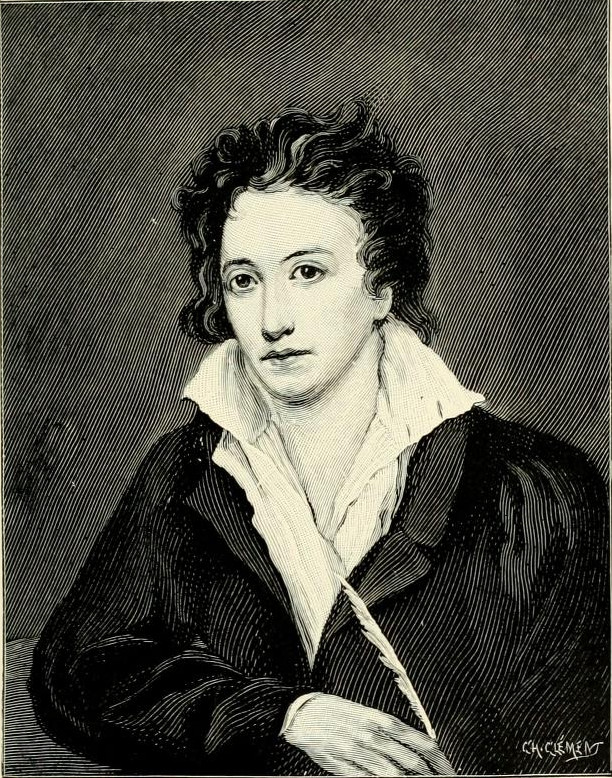
P. B. SHELLEY
The Shelleys are an ancient and honourable family. The poet's father, Sir Timothy Shelley, was a wealthy landowner. He was a narrow-minded man, a supporter of the existing, for the simple reason that it existed. But revolt against rule and convention was hereditary in Shelley's family, as wildness and violence of temper were in Byron's. Percy's grandfather, a strange, restless man, eloped with two of his three wives; and two of his daughters in their turn eloped. Of these incidents we are reminded by similar occurrences in the life of the grandson—just as many an action of Byron's reminds us of the sum of untamed and reckless passionateness which was his indisputable inheritance from father and mother. Unconventionality, revolt against hard and fast rule, was, however, but an outward and comparatively unimportant part of Shelley's character and life. It was only a sign of the alert receptivity and the keen sensitiveness, the early development of which strikes every student of his biographies. At school, ill-used himself, he rebels against the ill-treatment to which, according to the prevalent English custom, the weaker and younger boys were subjected by the older boys, and in this case also by the masters. Shelley seems to have been in a very special manner the victim of this species of brutality, just as he was in later life of many other species; there was a natural antipathy between him and everything base and stupid and foul, and he never entered into a compromise with any one or any thing of this nature.
We gain a distinct idea of what his impressions were on his entrance into life, from a fragment found after his death upon a scrap of paper:—
"Alas! this is not what I thought life was. I knew that there were crimes and evil men, Misery and hate; nor did I hope to pass, Untouched by suffering, through the rugged glen. In mine own heart I saw as in a glass The hearts of others."
He wrought for his soul, he tells us, "a linked armour of calm steadfastness." But passionate indignation had preceded this mood of quiet resistance; and the soul which he armed with steadfastness was too enthusiastic and ardent not to lay plans of attack behind its defences.
In the introduction to the Revolt of Islam, he recalls "the hour which burst his spirit's sleep":—
"A fresh May-dawn it was, When I walked forth upon the glittering grass, And wept, I knew not why: until there rose From the near schoolroom voices that, alas! Were but one echo from a world of woes— The harsh and grating strife of tyrants and of foes. And then I clasped my hands, and looked around: But none was near to mock my streaming eyes, Which poured their warm drops on the sunny ground. So, without shame, I spake: 'I will be wise, And just, and free, and mild, if in me lies Such power; for I grow weary to behold The selfish and the strong still tyrannise Without reproach or check.' I then controlled My tears, my heart grew calm, and I was meek and bold."
The generation which was born at the same time and under the same planet as the first French Republic was precocious in its criticism of all traditional beliefs and conventions. Shelley, who at school saw tyranny and feigned piety attendant on one another, and who became acquainted at a very early age with the writings of the French Encyclopædists and of Hume, Godwin, and other English freethinkers, brooded deeply, long before he was grown up, on the history, the destiny, and the errors of the human race. His thoughts were the thoughts of an immature youth, but their spirit was the spirit of liberty, as understood by the eighteenth century.
What his comrades remembered about him in later years was his defiant attitude towards authority, more particularly a habit he had of "cursing his father and the king." He went among the boys by the name of "mad Shelley," and "Shelley the atheist." Thus early was the opprobrious word applied to him which was to be coupled with his name all his life, and serve as a pretext for abuse and defamation.
It is unnecessary to dwell upon those events in Shelley's life of which every one who has heard his name has at least a superficial knowledge. We need merely recall to mind the fact that, as the undergraduate of eighteen, he had the curious habit of writing down his heresies on such subjects as God, government, and society, in the form of letters, which he sent to people personally unknown to him, with the request that they would refute his theories and provide him with the proofs against his arguments which he himself was unable to find; that, out of these letters, which consisted chiefly of extracts from the works of Hume and the French materialists, grew a little anonymous pamphlet (no longer in existence) which was entitled The Necessity of Atheism and ended with a Q.E.D.; and that Shelley, in the childish hope of exercising a reforming influence on the spirit of his age, sent a copy of this pamphlet to the Bench of Bishops. What followed is equally well known. Shelley, denounced as the author, was not only expelled from the University, but from his father's house.
No one nowadays considers that any serious scientific conviction, in whatever manner it may be expressed, should bring disgrace and punishment upon its exponent; and Shelley's punishment appears to us doubly unreasonable when we discover that in his pamphlet (the substance of which he reprinted in the notes to Queen Mab) he is no more an atheist than, for example, our Oersted[1] is in his well-known work, The Spirit in Nature. He has not yet arrived at any logical and consistent theory of life; he is only clear on the one main point, that he is not, and never can become, an adherent of any so-called revealed religion. The materialistic impressions received from the books he has read are blent in his mind with the ardent pantheism which distinguished him to the last. When Trelawny asked him in 1822, the year in which he died: Why do you call yourself an atheist? Shelley replied: "I used the name to express my abhorrence of superstition; I took up the word, as a knight took up the gauntlet, in defiance of injustice."
Shelley had grown up tall and slight, narrow-chested, his features small and not regular except the mouth, which was beautiful, clever, and fascinating; there was a feminine and almost seraphic look in the eyes, and the whole face was distinguished by an infinite play of expression. He sometimes looked the age he was—nineteen, sometimes as if he were forty. In the course of the ten remaining years of his life he became more manly in appearance, but still often struck people as boyish and feminine looking—witness Trelawny's surprise at his first meeting with Shelley: "Was it possible this mild-looking beardless boy could be the veritable monster at war with all the world, and denounced by the rival sages of our literature as the founder of a Satanic school?" His countenance assumed every expression—earnest, joyful, touchingly sorrowful, listlessly weary; but what it suggested most frequently in later years was promptitude and decision. He often expressed in his face the feeling he put into words in his poem To Edward Williams:
"Of hatred I am proud,—with scorn content; Indifference, that once hurt me, now is grown Itself indifferent."
To all this we may add, employing words used by a friend of his youth, that he looked "preternaturally intelligent"; and that Mulready, a distinguished painter of the day, said it was simply impossible to paint Shelley's portrait—he was "too beautiful."
It is, then, as a youth of this nature—excitable as a poet, brave as a hero, gentle as a woman, blushing and shy as a young girl, swift and light as Shakespeare's Ariel—that we must think of Shelley going out and in among his friends. Mrs. Williams said of him: "He comes and goes like a spirit, no one knows when or where."
His health was extremely delicate all his life, and would probably have given way altogether if he had not rigidly adhered to the simplest diet. About 1812 he adopted vegetarianism, with doubtful benefit. He was of a consumptive habit and subject to nervous and spasmodic attacks, which were sometimes so violent that he rolled on the floor in agony, and had recourse to opium to dull the pain; when he had his worst attacks he would not let the opium bottle out of his hand. When he was visiting the London hospitals and studying medicine with the aim of being able to assist the poor, he himself became seriously ill, and an eminent physician prophesied that he would die of consumption. But his lungs completely righted themselves some years later. In 1817, in attending some of the poor in their cottages, he caught a bad attack of ophthalmia; and he had a relapse of the same malady at the end of the year, and another in 1821, each time severe enough to prevent his reading.
The lofty philanthropy which to him was a religion, demanded many offerings. He displayed it wherever he went. When he was living at Marlow, in anything but affluent circumstances, he made all the poor of the neighbourhood his pensioners; they came to his house every week for their allowances, and he went to them when they were kept at home by sickness. One day he appeared barefooted at the house of a neighbour; he had given away his shoes to a poor woman. Of his own accord, almost immediately after his expulsion from Oxford, he gave up, for the benefit of his sisters, his claim to the greater part of his father's estate. At the time when he was enjoying an income of about £1000 a year, he spent most of it in assisting others, especially poor men of letters, whose debts he paid, and to whom he showed generosity almost unjustifiable in a man of his means.
The story of his first marriage is as follows. Exaggerated and mistaken chivalry led him at the age of nineteen to elope with a schoolgirl of sixteen, named Harriet Westbrook, who was very much in love with him, and had complained bitterly to him of her father's ill-treatment of her (he had forbidden her to love Shelley, and tried to compel her to go to school!). Shelley, after various meetings with her, made his plans, carried her off to Scotland, and married her in Edinburgh. The censure of public opinion fell most severely on the poet for this behaviour; but W. M. Rossetti's remark is very much to the point, namely, that it would be interesting to know "what percentage of faultlessly Christian young heirs of opulent baronets would have acted like the atheist Shelley, and married a retired hotel-keeper's daughter offering herself as a mistress." The hasty union, contracted without any proper consideration, proved an unhappy one; and it was dissolved when, in 1814, Shelley made the acquaintance of Mary Wollstonecraft Godwin, then in her seventeenth year, and was inspired by her with an irresistible passion. Mary Godwin, the daughter of Mary Wollstonecraft, the first famous pleader for the emancipation of woman, and of William Godwin, the free-thinking author of the works which had had such an influence on Shelley in his earliest youth, gave him her love frankly and freely, and in so doing acted strictly according to her own code of right. The young couple's theories of marriage, which were too ideal not to be regarded as vile by the vile, were also too impracticable. Although in their eyes mutual love alone, and not any ecclesiastical or civil formality, constituted the sacred marriage tie, they nevertheless for practical reasons, and especially for the sake of their children, went through the customary marriage ceremony in 1816, after the suicide of Shelley's first wife. Before this they had been twice abroad, first on a short tour, great part of which was taken on foot, and then for a longer period of travel, during which they met Byron. Shelley's name was, accordingly, coupled with Byron's, and the English press attacked them both with the utmost fury, going so far as to put a shameful interpretation on their noble and manly friendship.
Southey found occasion for a perfect explosion of abuse in the circumstance, insignificant and harmless enough, that Shelley had written in the album kept for visitors at the Chartreuse at Montanvert in the valley of Chamounix, below a number of pious platitudes about "Nature and Nature's God," a misspelled line in Greek hexameter said:
εἰμι φιλάνθρωπος δημωκράτικός τ' ἄθεός τε[2] PERCY B. SHELLEY.
The well-known outburst against Lord Byron, which has been already touched on, has this utterance as its point of departure.
Such is, given in a few words, the overture to Shelley's life and poetry.
Cor cordium was his rightful appellation—for what he understood and felt was the innermost heart of things, their soul and spirit; and the feelings to which he gave expression were those inmost feelings, for which words seem too coarse, and which find vent only in music or in such verse as his, which is musical as richly harmonised melodies.
The suppressed melancholy of Shelley's lyrics sometimes reminds us of Shakespeare. The little spinning song in The Cenci, for example, recalls Amiens' song in As You like It or the songs of Desdemona and Ophelia.
But where Shelley is most himself he surpasses Shakespeare in delicacy; and there is no other poet with whom he can be compared; no one surpasses him. The short poems of 1821 and 1822 are, one may venture to say, the most exquisite in the English language.
Take as a specimen the little poem entitled A Dirge:—
"Rough wind that moanest loud Grief too sad for song; Wild wind when sullen cloud Knells all the night long; Sad storm whose tears are vain, Bare woods whose branches stain. Deep caves and dreary main, Wail for the world's wrong!"
And wondrous in melody and restraint of expression is a verse like this:—
"One word is too often profaned For me to profane it; One feeling too falsely disdained For thee to disdain it; One hope is too like despair For prudence to smother; And pity from thee more dear Than that from another."
The words are few, and there is nothing remarkable in the rhythm, yet there is not a line that could have come from any pen but Shelley's.
In these short poems we are clearly conscious of the poet's melancholy, a melancholy which in his longer works is veiled, or else overpowered by his belief in a bright future, his faith in the progress of the human race. The inmost recesses of his own being were penetrated by a sadness produced by the feeling of the mutability of everything, and by early experience of the manner in which feeling leads astray, love disappoints, and life deceives.
He has given imperishable expression to the feeling of mutability:—
"The flower that smiles to-day To-morrow dies: All that we wish to stay Tempts and then flies. What is this world's delight? Lightning that mocks the night. Brief even as bright. Virtue, how frail it is! Friendship how rare! Love, how it sells poor bliss For proud despair! But we, though soon they fall, Survive their joy, and all Which ours we call. Whilst skies are blue and bright, Whilst flowers are gay, Whilst eyes that change ere night Make glad the day, Whilst yet the calm hours creep, Dream thou—and from thy sleep Then wake to weep."
The first verse indicates the transitoriness of all earthly beauty and happiness; the second, the suffering that lies concealed in the very happiness; and the third is an exhortation to enjoy the dream of happiness as long as possible.
A mood of like nature has found expression in the incomparable poem which bears the simple title, Lines. This poem Shelley could not have written unless one after another of his own fond beliefs had evaporated, unless his passions for Harriet, for Mary, for Emilia Viviani, had ended in a sorrowful awakening. Yet it bears no trace of being a personal confession. It is an impassioned proclamation of the universal laws of life, first softly hummed, and then sung in a voice which has never had its equal.
"When the lamp is shattered, The light in the dust lies dead; When the cloud is scattered, The rainbow's glory is shed; When the lute is broken, Sweet notes are remembered not; When the lips have spoken, Loved accents are soon forgot."
The lines on the human heart in the third verse are as condensed as a couplet of Pope's and as melodious as bars of Beethoven:—
"O, Love, who bewailest The frailty of all things here, Why chose you the frailest For your cradle, your home, and your bier?"
And the poem ends with this prophecy, in which we can hear the passions that have taken possession of the heart taking their wild will with it:—
"Its passions will rock thee, As the storms rock the ravens on high: Bright reason will mock thee, Like the sun from a wintry sky. From thy nest every rafter Will rot, and thine eagle home Leave thee naked to laughter When leaves fall and cold winds come."
A certain characteristic of Shelley, one which readers who know him only from anthologies will at once cite as his chief characteristic, seems to be strongly at variance with this unexampled personal intensity. I refer to the well-known fact that the most famous of his lyric poems are inspired by subjects outside of the emotional life, nay, outside of the world of man altogether; they treat of the cloud and the gale, of the life of the elements, of the marvellous freedom and stormy strength of wind and water. They are meteorological and cosmical poems. Yet there is no real contradiction in the most intimately emotional of lyric poets being, to all appearance, the most occupied with externals. We find the reason for it given by Shelley himself in a short essay On Love. He describes the essence of love as an irresistible craving for sympathy: "If we reason, we would be understood; if we imagine, we would that the airy children of our brain were born anew within another's; if we feel, we would that another's nerves should vibrate to our own, that lips of motionless ice should not reply to lips quivering and burning with the heart's best blood. This is Love ... The meeting with an understanding capable of clearly estimating our own; an imagination which should enter into and seize upon the subtle and delicate peculiarities which we have delighted to cherish and unfold in secret ... this is the invisible and unattainable point to which Love tends.... Hence in solitude, or in that deserted state when we are surrounded by human beings, and yet they sympathise not with us, we love the flowers, the grass, the waters, and the sky. ... There is eloquence in the tongueless wind, and a melody in the flowing brooks which bring tears of mysterious tenderness to the eyes, like the voice of one beloved singing to you alone."
In a note on The Witch of Atlas, Mrs. Shelley, too, writes that it was the certainty of neither being able to arouse the sympathy nor win the approbation of his countrymen, in combination with a shrinking from opening the wounds of his own heart by portraying human passion, which led her husband to seek forgetfulness in the airiest flights of fancy.
It was this very craving for a sympathy which his fellow-creatures refused him, that made his feeling for nature an ardent desire, and gave it its wonderful originality. Such a thing was unknown in English poetry. The stiff, artificial school of Pope had been superseded by the Lake School. Pope had perfumed the air with affectation; the Lake School had thrown open the windows and let in the fresh air of the mountains and the sea. But Wordsworth's love of nature was passionless, whatever he may say to the contrary in Tintern Abbey. Nature was to him an invigorator and a suggester of Protestant reflections. That meanest flower which gave him thoughts that often lay too deep for tears, he put into his buttonhole as an ornament, and looked at sometimes in a calmly dignified manner, revolving a simile. Shelley flees to nature for refuge when men shut their doors upon him. He does not, like others, feel it to be something entirely outside of himself—cold, or indifferent, or cruel. Its stony calm where man's woe and weal are concerned, its divine impassibility as regards our life and death, our short triumphs and long sufferings, are to him benevolence in comparison with man's stupidity and brutality. In Peter Bell the Third he jeers at Wordsworth because in the latter's love of nature it was "his drift to be a kind of moral eunuch"; he himself loves her like an ardent lover; he has pursued her most secret steps like her shadow; his pulse beats in mysterious sympathy with hers. He himself, like his Alastor, resembles "the Spirit of Wind, with lightning eyes and eager breath, and feet disturbing not the drifted snow."
He calls animals and plants his beloved brothers and sisters, and compares himself, with his keen susceptibility and his trembling sensitiveness, to the chameleon and the sensitive plant. In one of his poems he writes of the chameleons, which live on light and air, as the poet does on love and fame, and which change their hue with the light twenty times a day; and compares the life led by the poet on this cold earth with that which chameleons might lead if they were hidden from their birth in a cave beneath the sea. And in one of the most famous of all he tells how
"A Sensitive Plant in a garden grew; And the young winds fed it with silver dew; And it opened its fan-like leaves to the light, And closed them beneath the kisses of night. . . . . . . . . . . . . . . . . (And) each (flower) was interpenetrated With the light and the odour its neighbour shed, Like young lovers whom youth and love make dear. Wrapped and filled by their mutual atmosphere. But the Sensitive Plant, which could give small fruit Of the love which it felt from the leaf to the root, Received more than all; it loved more than ever, Where none wanted but it, could belong to the giver:— For the Sensitive Plant has no bright flower; Radiance and odour are not its dower; It loves even like Love,—its deep heart is full; It desires what it has not, the beautiful."
Even more characteristically, even more personally, does Shelley's inmost feeling, his heart's heart, such as it became after hard fate had set its stamp upon it, express itself in the beautiful elegy on Keats, which was written in a frame of burning indignation produced by the base and rancorous attack in the Quarterly Review. He is describing how all the poets of the day come to weep over their brother's bier:—
"'Midst others of less note came one frail form, A phantom among men, companionless As the last cloud of an expiring storm Whose thunder is its knell. He, as I guess, Had gazed on Nature's naked loveliness Actæon-like; and now he tied astray With feeble steps o'er the world's wilderness, And his own thoughts along that rugged way Pursued like raging hounds their father and their prey. A pard-like Spirit beautiful and swift— A love in desolation masked—a power Girt round with weakness; it can scarce uplift The weight of the superincumbent hour. It is a dying lamp, a falling shower, A breaking billow;—even whilst we speak Is it not broken? On the withering flower The killing sun smiles brightly: on a cheek The life can burn in blood even while the heart may break. His head was bound with pansies overblown, And faded violets, white and pied and blue; And a light spear topped with a cypress cone, Round whose rude shaft dark ivy-tresses grew Yet dripping with the forest's noonday dew, Vibrated, as the ever-beating heart Shook the weak hand that grasped it. Of that crew He came the last, neglected and apart; A herd-abandoned deer struck by the hunter's dart. All stood aloof, and at his partial moan Smiled through their tears. Well knew that gentle band Who in another's fate now wept his own. As in the accents of an unknown land He sang new sorrow, sad Urania scanned The Stranger's mien, and murmured, 'Who art thou?' He answered not, but with a sudden hand Made bare his branded and ensanguined brow, Which was like Cain's or Christ's—Oh I that it should be so."
Shelley here compares himself to Actæon, whom the sight of Nature's naked loveliness drove distracted. It is plain that the strength of his strong will was required to keep this man with the fragile, delicate body from positive destruction by the visions and apparitions of his imagination. He often felt as if they were more than his brain could bear; and when he then, an exile in a foreign land, sought alleviation in solitude, he experienced such impressions of nature as that which is preserved in the entrancing Stanzas Written in Dejection near Naples, stanzas which contain the very essence of Shelley's poetry. He does not describe the landscape. He never does describe. It is not the outward forms and colours of things which he shows us, but that to which he is extraordinarily alive, what we have called their spirit and soul.
One or two touches, and the Bay is before us:—
"The sun is warm, the sky is clear, The waves are dancing fast and bright; Blue isles and snowy mountains wear The purple noon's transparent might."
The waves break upon the shore "like light dissolved, in star-showers thrown. "The lightning of the noontide ocean is flashing, and a tone arises from its measured motion. "How sweet," cries the poet, "did any heart now share in my emotion!"
"Alas! I have nor hope nor health, Nor peace within nor calm around; Nor that content, surpassing wealth, The sage in meditation found, And walked with inward glory crowned; Nor fame nor power nor love, nor leisure. Others I see whom these surround— Smiling they live, and call life pleasure;— To me that cup has been dealt in another measure. Yet now despair itself is mild, Even as the winds and waters are; I could lie down like a tired child, And weep away the life of care Which I have borne and yet must bear,— Till death like sleep might steal on me; And I might feel in the warm air My cheek grow cold, and hear the sea Breathe o'er my dying brain its last monotony. Some might lament that I were cold, As I when this sweet day is gone, Which my lost heart, too soon grown old, Insults with this untimely moan. They might lament—for I am one Whom men love not, and yet regret; Unlike this day, which, when the sun Shall on its stainless glory set, Will linger, though enjoyed, like joy in memory yet."
The man over whose dying brain cruel waves were so soon to close, feels, with a gentle mournfulness, his being dissolve into the beneficent elements of nature, and compares his last breath to that of the beautiful southern summer day. He did not, like Byron, love nature only in its agitated, wild moments; simple of heart himself, he loved its simplicity, its holy calm.
But this is not his most characteristic feature. Himself of the race of Titans and giants, he loves the Titanic and gigantic beauty of nature—his manner of doing so again differing entirely from Byron's. It is not the tangible, easily accessible poetry of nature, that of the flowers of the field or the trees of the forest, which inspires him at his highest. No! the finest inspirations of his great spirit are received from the grand and the distant, from the forceful motions of the sea and the air and the dance of the spheres in the firmament of heaven. In this familiarity with the great phenomena and the great vicissitudes of nature Shelley resembles Byron, but he resembles him as a fair genius resembles a dark, as Ariel resembles Lucifer the Son of the Morning.
The poetry of the sea was to Byron the poetry of shipwreck, of the raging hurricane, of the insatiable cry of the waves for prey; to him the poetry of the sky lay in the howling of the storm, the roaring of the thunder, the crackle of the lightning. It is nature as the annihilator that he lives with and glories in. The famous passage in the Fourth Canto of Childe Harold, beginning: "Roll on, thou deep and dark blue Ocean, roll!" is a jubilant record of the sea's exploits in sweeping argosies from its surface and sinking empires into its depths. It boasts that nothing longer-lived than a bubble tells where man has gone down. The passage is like a prelude to the magnificent Deluge scene which is entitled Heaven and Earth, and which is a glorification of the lust of annihilation.[3]
After such verse read Shelley's famous poem, The Cloud. In it we hear all the elementary forces of nature playing and jesting, with the gaiety of giants, benevolent giants, who joy in pouring bounteous gifts upon the earth. What freshness in the lines:
"I bring fresh showers for the thirsty flowers From the seas and the streams; I bear light shade for the leaves when laid In their noonday dreams."
How wanton is the cloud when it sings:
"I wield the flail of the lashing hail And whiten the green plains under; And then again I dissolve it in rain, And laugh as I pass in thunder, I sift the snow on the mountains below, And their great pines groan aghast; And all the night 'tis my pillow white, While I sleep in the arms of the Blast"
And
"The volcanoes are dim, and the stars reel and swim, When the Whirlwinds my banner unfurl."
How proud when it shouts:
"The sanguine Sunrise, with his meteor eyes, And his burning plumes outspread, Leaps on the back of my sailing rack, When the morning star shines dead."
What calm is in this:
"And, when Sunset may breathe, from the lit sea beneath, Its ardours of rest and of love, And the crimson pall of eve may fall From the depth of heaven above, With wings folded I rest on mine airy nest, As still as a brooding dove."
What consciousness of power in:
"From cape to cape, with a bridge-like shape, Over a torrent sea, Sunbeam-proof, I hang like a roof; The mountains its columns be. The triumphal arch through which I march With hurricane, fire, and snow, When the Powers of the air are chained to my chair, Is the million-coloured bow."
Yet the real spirit of the Cloud is playfulness, the playfulness of a child. Even when the sun has swept it from the sky, it only laughs:—
"I silently laugh at my own cenotaph,— And out of the caverns of rain, Like a child from the womb, like a ghost from the tomb, I arise, and unbuild it again."
It is not only the unlikeness to Byron's gloomy passion which strikes us in the sublime childlikeness and bounty and all-embracing love of this Cloud; there is another characteristic in this poetry, which we shall merely mention here, and devote more attention to later, namely, its antique, its absolutely primitive, spirit. We are reminded of the most ancient Aryan poetry of nature, of the Vedas, of Homer. In comparison with this, Byron is altogether modern. When the Cloud sings:
"That orbèd maiden with white fire laden Whom mortals call the Moon, Glides glimmering o'er my fleece-like floor By the midnight breezes strewn! And wherever the beat of her unseen feet Which only the angels hear, May have broken the woof of my tent's thin roof, The Stars peep behind her and peer;"
and when it speaks of "the sanguine Sunrise, with his meteor eyes," the poet transports us, by the primitive freshness of his imagination, back to the time when the phenomena of nature in all their newness were transformed into myths.
To Shelley these phenomena were ever new. He lived among them in a way which no poet had done before or has done since. By far the greater part of his short life of thirty years was spent under the open sky. The sea was his passion; he was constantly sailing; his most beautiful poems were written while he lay in his boat with the sun beating on him, browning his soulful face and delicate hands. It was a passion that was the pleasure of his life and the cause of his death. Everything that had to do with boats and sailing had an attraction for him. He had a childlike hobby for floating paper boats; it is said that on one occasion, having no other paper at hand, he launched a £50 bank-note on the pond in Kensington Gardens.
He never learned to swim. At the time when he was constantly, by day and by night, sailing on the Lake of Geneva with Lord Byron, their boat was once very nearly upset. Shelley refused all help, and calmly prepared himself to go down. "I felt in this near prospect of death," he afterwards wrote, in a mixture of sensations, among which terror entered, though but subordinately. My feelings would have been less painful had I been alone, but I knew that my companion would have attempted to save me, and I was overcome with humiliation when I thought that his life might have been risked to preserve mine." A few years later he had no painful feelings at all in contemplating such an end. When some months before his death, Trelawny rescued him from drowning, all he said was: "It's a great temptation; if old women's tales are true, in another minute I might have been in another planet."
In Italy he lived in the open air; now he would be riding with Byron in the country near Venice, Ravenna, or Pisa; now spending whole days in a rowing-boat on the Arno or the Serchio; now out at sea in his yacht. It is interesting to observe how frequently a boat serves him as a simile. He wrote often out at sea, very seldom under the shelter of a roof. Prometheus he wrote in Rome, upon the mountainous ruins of the Baths of Caracalla; wandering among the thickets of odoriferous trees on the immense platforms and dizzy arches, he was inspired by the bright blue sky of Rome and the vigorous, almost intoxicating, awakening of spring in that glorious climate. The Triumph of Life he wrote partly on the roof of his house at Lerici, partly lying out in a boat during the most overpowering heat and drought. Shelley belonged to the salamander species; broiling sunshine was what suited him best.
It was while lying in a grove on the banks of the Arno, near Florence, that he wrote the most magnificent of his poems, the Ode to the West Wind.
In its first stanza the wind is the breath of autumn, driving the dead leaves, "yellow, and black, and pale, and hectic red, pestilence-stricken multitudes"; and of spring, filling "with living hues and odours plain and hill"—we hear it blowing, and we hear its echo in the appealing refrain: "Hear, oh hear!"
In the second stanza we are again reminded of the old mythologies, when the poet sings of the loose clouds on the Wind's stream, "shook from the tangled boughs of heaven and ocean," and of "the locks of the storm" spread on the blue surface of the airy surge "like the bright hair uplifted from the head of some fierce Mænad."
But along with the breath of the West Wind we have Shelley's whole soul in the final outburst:
"Oh! lift me as a wave, a leaf, a cloud! I fall upon the thorns of life! I bleed! A heavy weight of hours has chained and bowed One too like thee—tameless, and swift, and proud. Make me thy lyre, even as the forest is: What if my leaves are falling like its own? The tumult of thy mighty harmonies Will take from both a deep autumnal tone, Sweet though in sadness. Be thou, Spirit fierce, My spirit! be thou me, impetuous one! Drive my dead thoughts over the universe, Like withered leaves to quicken a new birth; And, by the incantation of this verse. Scatter as from an unextinguished hearth Ashes and sparks, my words among mankind! Be through my lips to unawakened earth The trumpet of a prophecy! O Wind, If Winter comes, can Spring be far behind?"
Compare this Ode with the beautiful passage in the Third Canto of Childe Harold, in which Byron cries:
"Could I embody and unbosom now That which is most within me,—could I wreak My thoughts upon expression, and thus throw Soul, heart, mind, passions, feelings, strong or weak, All that I would have sought, and all I seek, Bear, know, feel, and yet breathe—into one word, And that one word were Lightning, I would speak; But as it is, I live and die unheard, With a most voiceless thought, sheathing it as a sword."
Or with his apostrophe to night, during the wild storm on the Lake of Geneva:—
"Most glorious night! Thou wert not sent for slumber! let me be A sharer in thy fierce and far delight,— A portion of the tempest and of thee!"
There could not be a better example of the difference between the attitude towards nature of an all-embracing and an all-defying poetic intellect. Shelley does not, like Byron, desire to possess himself of her thunderbolts. He loves her, not as his weapon, but as his lyre; loves her, unappalled by her gigantic proportions, familiar with her prodigious forces, feeling that the universe is his home. His imagination delights in occupying itself with the heavenly bodies; he is fascinated by their beauty and life as others are by the beauty of the forget-me-not and the rose.
What powerful, all-compelling imagination in the poem which he writes on hearing of the death of Napoleon!
"What! alive and so bold, O Earth? Art thou not over-bold? What! leapest thou forth as of old In the light of thy morning mirth, The last of the flock of the starry fold? Ha! leapest thou forth as of old? Are not the limbs still when the ghost is fled, And canst thou move, Napoleon being dead? How! is not thy quick heart cold? What spark is alive on thy hearth? How! is not his death-knell knolled, And livest thou still, Mother Earth? Thou wert warming thy fingers old O'er the embers covered and cold Of that most fiery spirit, when it fled— What, Mother, dost thou laugh now he is dead? . . . . . . . . . . . . . . . . . . . . . . 'Still alive and still bold,' shouted Earth, 'I grow bolder and still more bold. The dead fill me ten thousandfold Fuller of speed and splendour and mirth. I was cloudy and sullen and cold, Like a frozen chaos uprolled, Till by the spirit of the mighty dead My heart grew warm: I feed on whom I fed.'"
With the eyes of his soul Shelley beheld the soulèd spheres circling in space, glowing within, sparkling without, lighting up the night; his gaze sounded the unfathomable abysses where verdant worlds and comets with glittering hair, and pale, ice-cold moons, glide past each other. He compares them to the drops of dew which fill the flower chalices in the morning; he sees them whirl, world after world, from their genesis to their annihilation, like bubbles on a stream, glittering, bursting, and yet immortal, ever generating new beings, new laws, new gods, bright or sombre—garments wherewith to hide the nakedness of death. He sees them as Raphael painted them in Rome in the church of Santa Maria del Popolo, each governed and guided by its angel; and, wielding the absolute poetic power of his imagination, he assigns to the unfortunate Keats, lately dead, the throne of a yet kingless sphere.
His Witch of Atlas has her home in the ether. Like Arion on the dolphin, she rides on a cloud, "singing through the shoreless air," and "laughs to hear the fire-balls near behind." In this poem Shelley plays with the heavenly bodies like a juggler with his balls; in Prometheus Unbound he opens them as the botanist opens a flower. In the Fourth Act of Prometheus the earth is represented transparent as crystal; the secrets of its deep heart are laid bare; we see its wells of unfathomed fire, its "water-springs, whence the great sea even as a child is fed," its mines, its buried trophies and ruins and cities. Shelley's genius hovers over its surface, inhaling the fragrant exhalations of the forests, watching the emerald light reflected from the leaves, and listening to the music of the spheres. But to him the earth is not a solid, composite sphere; it is a living spirit, in whose unknown depths there slumbers an unheard voice, the silence of which is broken when Prometheus is unbound.
When Jupiter has fallen, has sunk into the abyss, the Earth and the Moon join in an exulting antiphon, a hymn of praise that has not its equal. The Earth exults over its deliverance from the tyranny of the Deity; the Moon sings its burning, rapturous love-song to the Earth—tells how mute and still it becomes, how full of love, when it is covered by the shadow of the Earth. Its barrenness is at an end:—
"Green stalks burst forth, and bright flowers grow, And living shapes upon my bosom move: Music is in the sea and air, Winged clouds soar here and there, Dark with the rain new buds are dreaming of: 'Tis Love, all Love!"
Shelley's imagination resolves nature into its elements, and rejoices over each of them with the naïveté of a child. The Witch of Atlas delights in fire:—
"Men scarcely know how beautiful fire is; Each flame of it is as a precious stone Dissolved in ever-moving light, and this Belongs to each and all who gaze thereon."
And she loves the beauty of sleep:—
"A pleasure sweet doubtless it was to see Mortals subdued in all the shapes of sleep. Here lay two sister-twins in infancy; There a lone youth who in his dreams did weep; Within, two lovers linked innocently In their loose locks which over both did creep Like ivy from one stem; and there lay calm Old age with snow-bright hair and folded palm."
Shelley feels with the streams, which are loved by the sea and disappear in his depths; he sings by the death-bed and bier of nature in autumn and winter; he remembers the flowers that were strewn over Adonis; he describes the goddess of the summer and of beauty, who (like a female Balder) tends the flowers of the gardens; and he paints the progress of the Spirits of the Hours through the heavens (Arethusa, Hymn of Apollo, Hymn of Pan, Autumn, The Sensitive Plant, the Hours in Prometheus Unbound),
For everything in life and nature he has found the fitting poetic word—for the waste and solitary places,
"Where we taste The pleasure of believing what we see Is boundless, as we wish our souls to be";
for time,
"Unfathomable sea, whose waves are years! Ocean of time, whose waters of deep woe Are brackish with the salt of human tears!"
for snow, "and all the forms of the radiant frost."
The whole poem in which these last words occur ought to be read. Into it, in a sad mood, he has compressed all his love of nature. It is called simply Song, and is addressed to the Spirit of Delight. This Spirit, the poet complains, has deserted him; it forgets all but those who need it not; and such an one as he, can never win it back again, for it is dismayed with sorrow, and reproach it will not hear. Yet, he goes on to say,
"I love all that thou lovest, Spirit of Delight! The fresh earth in new leaves dressed, And the starry night, Autumn evening, and the morn When the golden mists are born. I love snow, and all the forms Of the radiant frost; I love waves and winds and storms,— Everything almost Which is Nature's, and may be Untainted by man's misery. I love tranquil solitude. And such society As is quiet, wise, and good. Between thee and me What difference? But thou dost possess The things I seek, not love them less."
But Shelley's spirit rises on the wings of his sublime enthusiasm for liberty high into the clear air above all these mournful moods. His ode To a Skylark, the poem which indicates the transition to the poetry of liberty, is written in a perfect intoxication of joy and freedom from care. It is almost safe to assert that there had been nothing in the older English literature finer in its way than the best of Wordsworth's songs to the lark, which are so typical of the spirit and art of the Lake School.
"Leave to the nightingale her shady wood; A privacy of glorious light is thine,"
writes Wordsworth; and, as the true conservative poet, he goes on to apostrophise the lark as
"Type of the wise, who soar, but never roam— True to the kindred points of Heaven and Home."
Turn from this to Shelley's lark:—
"Like a cloud of fire The blue deep thou wingest, And singing still dost soar, and soaring ever singest."
We seem to hear all the winds ringing with its "shrill delight," and seem to glide into and be engulfed by a sea of eternally fresh melody. This is the youngest, freshest, gladdest pæan of the pure spirit of freedom. It forms the transition to the long series of poems of freedom, the great group of works in which Shelley's genius is the loud herald of the approaching revolutions. His poetry of freedom is one long war-cry, garbed in ever-changing melodies. Whether it takes the shape of odes to liberty and its champions (poems as beautiful and grand as the Marseillaise), of political satires levelled at customs or persons, of Aristophanic comedy ridiculing the abuses and follies of the day in England, or of mythical or historical tragedy, it is in its essence always the same mighty wail over injustice and hypocrisy, the same powerful appeal to all of his contemporaries who were still capable of feeling anything whatsoever a degradation.
Immediately after his first marriage Shelley began to play the part of a political agitator. He went to Dublin to further the cause of Catholic emancipation, wrote a very juvenile address to the Irish people, in which he besought them to refrain from the violent deeds with which the French Revolution had been stained, and was childish enough to throw down copies of it from the balcony of his hotel, in front of any of the passers-by who looked as if they might be responsive. We gain some idea of the childish spirit in which both he and his young wife regarded the matter, from reading that, one day when they were walking together, he could not resist amusing himself by popping the address into the hood of a lady's cloak, a performance which made his wife, as she herself writes, "almost die of laughing." Shelley attended several political meetings, and on one occasion spoke for more than an hour in the presence of O'Connell and other celebrities. The accounts of his eloquence given by contemporaries are so enthusiastic that they might almost lead us to believe him to have been even greater as an orator than as a poet.
The next time Shelley came into collision with the party in power, the collision was of a much more violent and tragic nature. Harriet was dead, and her father had filed a petition in Chancery to determine which was the fit and proper person to educate her children—he, their grandfather, the retired hotel-keeper, or their father, Shelley, the author of Queen Mab and Alastor, who was accused of atheism, and would in all probability bring up his children as atheists.
Lord Eldon's judgment was to the effect that, seeing that Shelley's conduct had hitherto been highly immoral, and that, far from being ashamed of this, he was proud of his immoral principles and tried to impress them upon others, the law was in its right in depriving him entirely of the custody of his children, and at the same time decreeing that he should be deprived of a fifth of his income for their maintenance. The children were placed in charge of a clergyman of the Church of England. Shelley felt this blow so terribly that even his most intimate friends never dared speak of the children to him.
In his poem To the Lord Chancellor he cries:
"I curse thee by a parent's outraged love; By hopes long cherished and too lately lost; By gentle feelings thou could'st never prove; By griefs which thy stern nature never crossed. . . . . . . . . . . . . . . . . . . . By the false cant which on their innocent lips Must hang like poison on an opening bloom; By the dark creeds which cover with eclipse Their pathway from the cradle to the tomb. . . . . . . . . . . . . . . . . . . . (By) the despair which bids a father groan, And cry, 'My children are no longer mine; The blood within those veins may be my own, But, tyrant, their polluted souls are thine.'"
And in the poem to William Shelley, his little son by Mary, he writes:
"They have taken thy brother and sister dear, They have made them unfit for thee; They have withered the smile and dried the tear Which should have been sacred to me. To a blighting faith and a cause of crime They have bound them slaves in youthly time; And they will curse my name and thee Because we are fearless and free. . . . . . . . . . . . . . . . . . . Fear not the tyrants will rule for ever, Or the priests of the evil faith; They stand on the brink of that raging river Whose waves they have tainted with death. It is fed from the depths of a thousand dells, Around them it foams and rages and swells; And their swords and their sceptres I floating see Like wrecks, on the surge of eternity."
Fearing that this son of his second marriage might also be taken from him, Shelley left his native country, never to return. At the time when the Lord Chancellor was branding him as less fit for the most rudimentary duties of social life than any other man in England, he was preparing to prove that he was one of the few men then in existence who were predestined to immortality. He left England, stamped as a criminal, and most of the Englishmen whom he met abroad feared and hated him as capable of any crime. He appears to have been actually once or twice subjected to personal molestation.