GEORGE BRANDES (continued 6)
Mary Morison translation
When we make the acquaintance of the young priestess she is seated in a boat which is tossing on the waves of a tempestuous sea, trying to still the storm with her incantations; for she, like Fouqué's Undine, has, or believes she has, a certain power over the sea. Later we hear her, in an eloquent speech, calling on her countrymen to take up arms against the Romans and reconquer their liberty. We see her, as the priestess of Teutates, sharpening her sickle to offer a human sacrifice. How beautiful she is as her creator describes her to us—tall and straight, scantily clothed in a short, black, sleeveless tunic, her golden sickle hanging from a girdle of steel! Her eyes are blue, her lips rose-red; her fair flowing hair is bound with a slender oak-branch or a wreath of verbena.
Hardly has she seen Eudore than she loves him. But such simple and natural passion is not enough for the age; it demands that Velléda shall be a devotee of Vesta, shall have taken the oath of eternal virginity. "I am a virgin, the virgin of the island of the Seine; whether I keep my oath or break it I die—die for your sake." Eudore admires her, but does not love her. His relation to her is that of the pious Æneas to Dido, a fact to which the author makes him draw our attention. The unfortunate Velléda tries all her magic arts. At one time she determines to steal her way in to Eudore on the moonbeams; at another she is preparing to fly into the tower which he inhabits and win his love in the shape of another woman, but the very thought arouses her jealousy and causes her to desist. Eudore, though he does not return her passion, feels himself, as it were, infected by its atmosphere when he is beside her. As a Christian he shrinks with horror from the temptation. "At least twenty times while Velléda was telling me of her sad and tender feelings, I was on the point of throwing myself at her feet, announcing her victory, and making her happy by the acknowledgment of my defeat. At the moment when I was about to succumb, the compassion with which the unhappy woman inspired me saved me. But this very compassion, which saved me at first, in the end proved my destruction; for it deprived me of the last remnant of my strength." Looking at the matter from the purely artistic point of view, it offends our taste to hear a man dilate thus upon his struggles to preserve his virtue; Eudore's outbursts of shame and remorse do not become him well. "O Cyrille," he says, "how can I go on with such a story! I blush with shame and confusion." When at last, after Velléda has attempted to kill herself, this knight of the doleful countenance has yielded and is lying at her feet, nothing less will serve him than to set all the powers of hell loose on the occasion. "I fell at Velléda's feet. ... Hell gave the signal for these terrible nuptials; the spirits of darkness howled from their abyss, the chaste spouses of our forefathers turned away their faces, my guardian angel hid his with his wings and returned to heaven." Even at the supreme moment this depressing hero is incapable of self-surrender; he is ashamed; he resembles a boy who, with a feeling compounded of gluttony and fear of flogging, devours a stolen apple. "My happiness resembled despair, and any one seeing us in the midst of our rapture would have taken us for two criminals who had just received their sentence of death. From that moment I felt that I was stamped with the seal of divine wrath. Thick darkness spread like a smoke-cloud in my soul; I felt as if a host of rebellious spirits had suddenly taken possession of it. Thoughts filled my mind which until this moment had never occurred to me; the language of hell poured from my lips; I uttered such blasphemies as are heard in the place where there is weeping and gnashing of teeth."
It is, thus, on a background of hell-fire that Chateaubriand depicts the love of the Christian confessor and the heathen prophetess. In Atala, where we have a kindred representation of combined suffering and pleasure, the insincere anathema against earthly love was not yet launched.
We come upon much the same idea in one of Alfred de Vigny's youthful works, Eloa, a beautiful and notable poem which describes the seduction of a charming young angel of the female sex by the Prince of Darkness. The Satan of Les Martyrs was a revolutionist, but De Vigny's Satan is hardly to be distinguished from the Eros of the ancients. Without telling who he is, he ensnares the fair angel with his personal charms and his eloquence, and draws her with him into the abyss. He himself describes his power in the following words:
Je suis celui qu'on aime et qu'on ne connaît pas. Sur l'homme j'ai fondé mon empire de flamme Dans les désirs du cœur, dans les rêves de l'âme, Dans les liens des corps, attraits mystérieux, Dans les trésors du sang, dans les regards des yeux. C'est moi qui fait parler l'épouse dans ses songes; La jeune fille heureuse apprend d'heureux mensonges; Je leur donne des nuits qui consolent des jours, Je suis le Roi secret des secrètes amours.
We are irresistibly reminded of the song to Eros in the Antigone of Sophocles.
As the period is now rapidly descending the incline leading to the conception of Eros as the devil himself, it is only natural that in the descriptions of "real" love on which it prides itself it should be more frigid and impotent, more seraphic and platonic than any other age we are acquainted with. Let us see how the Velléda of the day, Madame de Krüdener herself, describes love in Valerie.
Although Valerie is an imitation of Werther, it is in many ways extremely unlike Werther. It is the story of a young Swede, Gustave Linar by name, who in his childhood learned from his mother "to love virtue," and who continues to love it until he dies. Along with virtue he loves Valérie, but Valérie is the wife of the Count, his master and ideal, and is herself such a quintessence of all the virtues that he regards her with a reverence which makes desire impossible. Alexander Stakjev confessed his feelings to Krüdener, but Gustave utters not a word to the Count, nor does he ever speak of his sufferings to the woman he loves.[3] Preyed upon by uncomprehended and unavowed love, and far too well-behaved to shoot himself, he dies of consumption.
This is his style: "O my friend, how criminal of me to have yielded to a passion which I was well aware would be my destruction! But I will at least die in the love of virtue and sacred truth; I will not charge Heaven with my misfortunes, as so many men in my plight do (what virtue); I will endure without complaint the suffering which I have brought upon myself, and which I love, although it is killing me. I will go when the Almighty calls me, burdened with many sins, but not with that of suicide." (ii. 63.)
Gustave is not a man. It is generally acknowledged that the portraiture of men is not the strong point of female authors. They almost invariably depict them as entirely absorbed in their relations with women. Gustave is, as already observed, a Scandinavian; but Scandinavians have no reason to be proud of this compatriot, in whom the vigour of the Northerner is conspicuously absent. The national colouring of the story is confined almost entirely to the Teutonic sentimentality in which the descriptions are immersed, and to a variety of Swedish names, which, it goes without saying, are as a rule incorrectly spelt. At Venice Gustave gives a fête in Valerie's honour; the decorations are intended to remind her of the home of her youth, amongst the birches and pines; when she catches sight of them she cries: "Ah! c'est Dronnigor" (Drottninggård).
There is nothing characteristically Swedish about Gustave. Really beautiful in the description of his character is the gleam of youthful philanthropic enthusiasm shed over his confessions. It seems to him that in most men's lives the period of love is succeeded by that of ambition. There is something fine and sincere in the language in which he tells that the glory others desire is not that which in his eyes has seemed desirable. "The glory of which I dreamed was won by occupying one's self with the happiness of all, as love occupies itself with the happiness of a single individual. It was virtue in the man who possessed it, before his fellow-men gave it the name of fame." And he adds: "What has real glory in common with the petty vanity of the many, with the pitiful contention that one is something because one is striving hard to be it?" It is strange to find sentiments like these in a book the fame of which was due to such artifices as were employed to puff Valérie.
The heroine is equipped with all the charms which a lady as passionately in love with herself as Madame de Krüdener was could communicate to her own portrait. She is a thorough woman, whilst the unfortunate Gustave, though quite aware of the foolishness and hopelessness of his passion, is absolutely unable to burst his bonds and begin to live the life of a man. He is obliged to content himself with such humble expressions of his adoration as kissing a child whom his mistress has kissed on the spot which her lips have touched, or kissing the outside of the window-pane on the inside of which she is resting her bare arm during the pause between two dances at a ball, or pressing her hand and feeling the ring given her by her husband, or fainting in her presence, so that she is obliged to bathe his brow with eau-de-Cologne.
A faint perfume of eau-de-Cologne may be said to pervade the whole story. It is significant that the first service which Valérie asks Gustave to do her after they have become intimate is to procure her secretly a little rouge, which her husband objects to her using. With the odour of eau-de-Cologne is blended an odour of propriety and veneration which is so powerful that it is almost obnoxious, and a supernaturalness in the matter of the affections which is both silly and unbeautiful. Valérie is enceinte when Gustave conceives his passion for her, but this circumstance has no curative effect on him, though he lives in intimate companionship with her until her son is born. They wax enthusiastic together over Ossian and Clarissa Harlowe. Gustave never feels the slightest jealousy of the Count, nor does the Count of him. It is with the Count's hand in his that Gustave dies. Love is, in short, so purified, so unnaturally seraphic, that with its passion it has also lost its poetry. This is doubly significant when we happen to know how little seraphic was the life with which this poetess of love had prepared herself to write her novel, and how cleverly she herself managed to reconcile the sacred with the more carnal aspects of love.
Lamartine and his Elvire are the last couple on whose relations we have time to dwell.
Lamartine's youthful poems treated of love, but of a love so pure that it was called "une prière à deux." It was depicted with the transfiguring ideality which is the result of the death of the beloved one. The poet presses to his lips the crucifix which she kissed before she died, and the poem Le Crucifix is so soulful that we believe Lamartine when he tells us in a note appended to it: "I never re-read these verses." In his novel, Raphael, a much later work, he gives us the real facts of the same love story, and these throw a new light on the famous poems.
Julie, to give the lady known by the name of Elvire her real name, is a créole, aged twenty-eight. She is an orphan, and has married a man of seventy, a famous scientist, that she may have a protector; but her actual relation to him has never been anything but that of a daughter to a father. She has an affection of the heart which may at any time prove fatal. By the Lake of Bourget in Savoy (the lake of which Lamartine has sung so beautifully), where she is spending the autumn for the sake of her health, she meets Raphael, the young hero of the book, a man differing in nothing but name from its author, who in its pages gives us not only real facts, but even calls his friends and acquaintances by their real names. He describes himself as he was then—twenty-four years old, young and poor, solitary and shy, tender-hearted and given to enthusiasms, already a little blasé from much dissipation, tired of all the commonplace and dissolute amours in which he had hitherto indulged.
It cannot be said that Lamartine gave an altogether too unfavourable description of himself. The delicacy and refinement of Raphael's feelings was such that his comrades used laughingly to declare that he was home-sick for heaven. In a somewhat clumsy manner Lamartine attempts to give us an idea of this refinement: "If he had wielded the brush, he would have painted the Madonna of Foligno; if the chisel, he would have sculptured Canova's Psyche. If he had been a poet, he would have written the lamentations of Job, Tasso's Herminia stanzas, Shakespeare's moonlight scene in Romeo and Juliet, and Lord Byron's description of Haydee." Fortunately it was not required of him to do any of these things, as they had been done by others. We know that in his efforts at a later period in one of the three directions, namely, as a poet, he did not attain to the level of the masters named.
In Raphael we have a masterly description of a young man's ardent love, a love which, though it has taken possession of him heart and soul, is of an almost altogether spiritual nature, partly because its object inspires such a degree of reverence and compassion that the senses are not allowed to come into play, partly because the young man, after leading a loose life with women for whom he has felt no respect, shudders at the very idea of his relation to this woman, whom he reveres, becoming one of the same nature with his past amours.
He has had love affairs, but he has never been truly in love before. It seems to him as if, when she looks at him, there is a remoteness in her gaze which he has never felt before in human eye. It reminds him of the gleam of the stars, which has traversed millions of miles of space. He has a hesitation in approaching her which makes the distance between them seem impassable. When he at last succeeds in making her acquaintance, it is the name and the position of a brother which she gives him, and with this he is contented and happy. No sooner have they found one another than he feels as if he were relieved from a heavy burden—the burden of his heart. As soon as he gives it away he learns what life in all its fulness is. He feels as if he were floating in the purest ether; his joy is infinite and luminous as the air of heaven. During the first hours which he spends with her he loses all perception of time; he is certain that a thousand years spent thus would to him be so many seconds. He does not feel like a human being, but like a living hymn of praise.
And this ecstatic mood lasts as long as he breathes the same air with her. They are happy together during the beautiful summer days, and prolong their summer into autumn: "Our summer was in ourselves."
We feel that this description of the bliss of young love is a description of something that really has existed. The young couple are living not far from the place where Rousseau, as a youth, loved Madame de Warens. Raphael is rather younger than Julie—he is twenty-four, she twenty-eight; this gives their relation a certain resemblance to that between Rousseau and his protectress; but the emotions of Raphael and Julie are as incorporeal and romantic as those of the other couple were substantially human.
And not only the happiness produced by the presence of the loved one, but the pain of separation, the longing for letters, the fever of expectation when the time of meeting draws near, and the agonies of parting are described, with many admirable realistic touches, in a manner worthy of a great writer.
Raphael lives in the country, Julie in Paris. When he takes a walk, his steps involuntarily turn towards the north, to diminish the distance which separates him from her. His day contains only one happy hour, that which brings the postman with her letter. As soon as he hears the postman's step he is at the window; he meets him at the street door, hides the letter in his pocket, and hastens with trembling knees to his room, where he locks himself in to read it in privacy. Later in the story, when Raphael is in Paris, we have the admirable description of his wanderings on the winter evenings back and forwards across one of the Seine bridges, waiting for the moment when the lamp in her window shall show him that her guests have taken their departure, and that he is certain to find her alone. Note the blind beggar on the bridge, into whose tin cup he never forgets to throw his mite; the striking of the hour and the half-hour by the church clocks; and another delicate little touch—Raphael's hearing gradually becomes so acute that he distinguishes the separate chime of each clock in the chorus.
All this is excellent. Unfortunately the novel as a whole is spoiled by its religious purpose.
The authors of this period could not write of love pure and simple; they felt obliged to mix religion up with it. Lamartine makes his lovers go through whole courses of philosophy and theology together. They hold different opinions, and she is intellectually his superior. He still retains the beliefs of his childhood. In the house of her famous husband she has associated with intellectually emancipated men of science, whose opinions, marked with the stamp of the eighteenth century, she has imbibed. He and she really belong to different generations—she to the generation of the empire, he to that of the monarchy. Faust, when he is catechised by his Gretchen, is obliged to parry her attempt to convert him by explaining his unbelief to her in palliating euphemisms; the opposite happens here; Raphael makes long, fruitless attempts to convert his Julie to faith in God and Christianity. The first time the innocent youth recommends her to seek aid from God, he is astonished when, instead of answering him, she looks sad and indifferent and turns away her face. He timidly asks her reason for so doing. She answers: "That word distresses me." "What! the word which signifies life, love, and everything that is good—how can it distress the most perfect of God's creatures?" &c., &c. Then she is obliged to explain to him that what he calls God is what she calls law—an infinite greatness, an absolute, inevitable necessity, something that it is impossible to move with prayers.
To this conviction of hers is due Julie's easy and yet dignified moral attitude. She says: "I was educated by a philosopher, and in my husband's house I have lived in the society of free-thinking men, who have severed themselves entirely from the dogmas and observances of a church which they have helped to undermine; hence I have no superstitions and none of the weak-minded scruples which impel most women to bow their heads under a second yoke, superadded to that which our consciences impose upon us."
It is Raphael who plays the girl's part when, time after time, he supplicates a woman of a spirit like this to return to the bosom of the Roman Catholic Church. "I besought her to seek in a religion of love and tenderness, in the sacred gloom of our churches, in the mysterious faith in that Christ who is the God of tears, in genuflections and prayer, the relief and the comfort which I myself had found in them in my youth." Raphael's attempt at conversion was not entirely successful; he himself was satisfied with the result, but a more strictly orthodox Christian would hardly have been so.
It is love, we are led to understand, which teaches Julie to believe in God. "There is a God," she said; "there is an infinite love, of which ours is only one drop, a drop which falls back into the divine ocean from which we have drawn it. This ocean is God. At this moment I feel, I see, I understand Him by means of my happiness.... Yes," she continued, with even more ardour in her glance and voice, "let the perishable names by which we have called the attraction which draws us to one another be forgotten. There is only one name which expresses it—that is God. He has revealed Himself to me in your eyes. God, God, God!" she called, as if teaching herself a new language; "God is you; God is what I am to you. We are God."
All this impresses us as having more purpose in it than truth to nature. Not such is the eloquence of happy love.
Had Julie's husband, the old philosopher, happened to overhear these effusions, he could have told the lovers that such doctrines and such emotions, far from being Christian, are pure pantheism. We cannot doubt that he would have done so with perfect calmness, for he does not feel the slightest jealousy. He knows that Julie and Raphael write to each other every day, and he also knows the ethereal nature of their love. When Raphael comes to Paris, all he says to him is: "Remember that you have not one friend but two in this house. Julie could not make a better choice of a brother, nor I of a son." It is comical that Raphael, for his part, should feel no disquietude concerning the old man, unless we reckon as such a feeling of regret that he is drawing near to the grave without any belief in immortality; and it is characteristic of the period that even the aged scientist is in the end converted.
The old man has, in a manner, no ground for jealousy. Lamartine has very naïvely introduced into his novel a piece of realism, which, while it explains many things, weakens the edifying effect which he aimed at producing. Julie's reply to Raphael's first confession of love decides once and for all the nature of their mutual relations. She says: "I believe only in an invisible God, who has imprinted His image upon nature, His law upon our instincts, and His morality upon our reason. Reason, feeling, and conscience are the only revelations I acknowledge. None of these three oracles of my life would forbid me to belong to you; my whole soul would prostrate itself at your feet, if this could purchase your happiness. But are we not more certain of the spirituality and eternity of our love when it remains on the heights of pure thought, in regions inaccessible to change and death, than when it degrades and profanes itself by descending to the base regions of sensuality?"
It is, we observe, the love that despises the senses which Julie somewhat affectedly extols. Now, certain as it is that love can continue to exist even when circumstances forbid its complete gratification, it is equally certain that renunciation for the sake of renunciation and of spirituality is contrary to nature. When the religious reaction set in in Denmark, Ingemann, in his youthful works, preached such renunciation. The question whether Julie really favoured the principle, or whether we are not in reality indebted for it to Lamartine, who admired without practising it, must be left undecided. In his reminiscences of his love affairs, Lamartine is in the habit of describing himself as emancipated from all sensual desire. And we know them all, these love affairs; for the man who, according to his own account, had always such complete control over his passions, had very little control over his pen. We know (from his Confidences) how during his meetings with Lucy, the beautiful girl of sixteen, in the cold frosty weather, he was as cold as the winter night. We remember the sentence in Graziella: "We slept two steps from each other; my cold indifference protected me." It may be doubtful whether it was really Julie who enounced the principle of renunciation, but there can be no doubt of the genuineness of the next speech attributed to her. She adds, blushing deeply, that the renunciation she demands of him is imperative—on account of her health; she has medical authority for what she says; she would leave his arms like a shadow, like a corpse: "The sacrifice would be the sacrifice not only of my dignity, but of my life."
It is impossible to deny that there is an extraordinary inconsistency between this last utterance and those which precede it, and that this exceedingly practical explanation deprives the spiritual friendship of much of its spirituality. We seem to come down from the seventh heaven and feel the solid earth beneath our feet again.
There follow scenes like those in Valérie—projects of suicide which are never carried into execution; nights spent by the lovers in tender converse, with a thick oaken door between them; rapt, sentimental ecstasies. This is a love which finds expression only in lingering looks, languishing that reaches the verge of insanity, sighs that are almost screams, long silences and endless outpourings—never a caress or an embrace. Unpleasant, almost offensive, in any case unnatural, is the manner in which, in this love-story too, our attention is perpetually drawn to the fact that the lovers keep their vow, that their love remains platonic. On the one solitary occasion when there seems to be real danger, there arrives at the critical moment—who? None other than that estimable old man, Monsieur Bonald, with whose theories on the subject of woman and of marriage we are acquainted. He is coming to stay with Julie, arrives at twelve o'clock at night, and is thus saved the grief of seeing his pupils rebel against order. Even in his novel, Lamartine does not miss the opportunity of proclaiming that he was at variance with Bonald, especially as regarded his doctrine of theocratic government. It became the fashion to disagree with Bonald. Chateaubriand himself remarks in his Memoirs (iv. 23): "Monsieur de Bonald was a clever man. His sagacity was mistaken for genius."
Whenever Julie pities Raphael, he answers her with pious outbursts in which he compares her and himself to Abélard and Héloïse. "Have I ever let you feel that I desire ought else than to share this suffering with you? Does it not make both of us voluntary and pure victims? Is not this the eternal burnt-offering of love, which has perhaps not been offered before the eyes of the angels since the days of Héloïse until now?"
When, after studying Raphael, we re-read Lamartine's poems to Elvire, we have a new key to the understanding of the idealism and vagueness of this poetic love, which, obliged to renounce sensual pleasures, pretends that the corporeal world does not exist for it. A distinction must, however, be drawn between the later poems and some written much earlier and in a perfectly different tone, a tone which recalls the eighteenth century. Take as examples the poems À Elvire (which is in reality addressed to Graziella) and Sapho.
We have now enough of examples; let us consider to what conclusion they have led us. Choosing a simple emotion, but one of those which every school of literature sets itself to express and interpret, and which each expresses and interprets in a characteristic manner, we have examined a number of different specimens of the manner in which it is interpreted by this particular school. Here, as in all the other domains of literature which we have inspected, we have found the natural side of life ignored, or concealed, or blackened, or represented as something to be ashamed of. Chateaubriand and Madame de Krüdener seek out cases in which love is considered to be criminal and sinful, and either describe the triumphant yells of the powers of hell when the hero succumbs or the jubilations of the principalities and powers when the infamy is not perpetrated. We have the same paraphernalia in Alfred de Vigny's writings:
Les Chérubins brûlants qu'enveloppent six ailes, Les tendres Séraphins, Dieux des amours fidèles, Les Trônes, les Vertus, les Princes, les Ardeurs, Les Dominations, les Gardiens, les Splendeurs, Et les Rêves pieux, et les saintes Louanges, Et tous les Anges purs, et tous les grands Archanges.
De Vigny makes Satan speak like Eros, that is to say, Eros like Satan. Lamartine enthrones love in his poetry as seraphic, as emancipated from all earthly passion, but in Raphael describes it as what it really was, ethereal against its will—which, however, only adds to the merit of the lovers and provides angels and burnt-offerings, these latter of a sweet savour unknown since the days of poor Abélard.
And below everything there is an under-current of hypocrisy. Eudore, who would have us believe that he is made utterly miserable by Velléda's passion, is nevertheless secretly flattered by her having cut her white throat for his sake. He bewails his fall in expressions which convey the idea that he feels tempted to fall again. The authoress of Valerie proclaims the moral purity of her heroine in the market-place and clamours of chastity and renunciation in all the newspapers at a time when she herself is peculiarly unfit to be a teacher of morality. Lamartine, as novelist, naïvely gives an explanation of his relations with Elvire which differs entirely from the impression of them that the public had naturally gathered from the ethereal ecstasies of Les Méditations, and ends by smothering the real beauties of his literary art in languid, lachrymose sentimentality.
In the representation of love, as in everything else, men aimed at supernaturalness, and only succeeded in either crippling or hypocritically ignoring nature.[4]
XI
DISSOLUTION OF THE THEORETICAL PRINCIPLE OF AUTHORITY
In the lyric poetry of Lamartine and Victor Hugo, as in the prose of Chateaubriand, there was, in spite of the unconditioned assertion of the principle of authority, a hidden or germinating antagonism to that principle in literature, as demanding unqualified reverence for the past, its writers, and its forms.
It has already been remarked that the great political and social revolution in France did not affect literary form. As regarded this, there was no necessity to re-establish the principle of authority; it had never been overthrown. In no domain are the French less revolutionary than in that of literature. The Academy is the one institution of the country which has held its ground since the days of Richelieu, and to-day it has the same name, the same aims, and even the same number of members that it had then. In literature the principle of authority was known by the name of the classic spirit, and the Revolution, far from weakening the classic spirit, had strengthened it. The Revolution itself is a classic French tragedy. Like all other French tragedies, it clothes its heroes in Greek and Roman garb. In their style and language they imitate the republicans of ancient Rome, and it is significant that it is the most cultivated and literary revolutionary party, the Girondists, who adopt the antique "thou" and the antique designation of "citizen." The Jacobins are the direct descendants of Corneille—the same toga style of oratory, the same love of magnificent laconicism. With the same enthusiasm with which Cromwell's soldiers metamorphosed themselves into ancient Hebrews, adopting their names and singing their psalms, the Frenchmen of the Revolution metamorphosed themselves into ancient Romans; and when David, the Jacobin and intimate friend of Robespierre, left his seat in the Legislative Assembly to paint the Horatii or the Brutus exhibited in 1791, he simply took his associates as models; as painter he did not need to go a step beyond the boundaries of his own period.
Just as French tragedy, when it came into being, had refused to build upon the foundation of the history of its own country, had turned its back on French tradition and laid its scenes in far-away Rome in the far-off, dimly discerned past, now the Revolution, heedless of history, heedless of the France of its own day, took far-off, un-historically appreciated antiquity, with its republicans, evolved under such different conditions, as the model to be exactly imitated. The modern Gracchi and Horatii imitated the ancient. There is, as has often been remarked, a Roman loftiness of style in Madame Roland's letters to Buzot. The ladies of the Directory at times took Cornelia, and more frequently Aspasia, as their model, even in dress. In the language of some of Napoleon's earliest letters to Josephine the influence of Latin models is to be traced; and even when he no longer stands in need of a model, his style is as classic as his profile. His taste in literature was also classic; his attachment to "les règles" and his admiration of Corneille are matter of history. As long as he is the ruler of France, even those authors who make an attempt at a species of opposition, such as Raynouard, keep in the classic track. A comparison of Werner's Söhne des Thals (Sons of the Vale) with Raynouard's Les Templiers will show how differently the same subject can be approached. The German poet is as mysterious and incomprehensible, as extravagant and fantastic in his treatment of the theme as the Frenchman with his obligatory alexandrines, his king and his queen, his five acts and his three unities, is well-regulated and law-abiding. Raynouard's play represents a sort of lawsuit between church and state; the king conducts his case in a most orderly manner; the Knights Templar conduct theirs in an equally orderly manner, and are thereupon burnt in an orderly manner—orderly, for we see as little as possible of the execution and of what precedes it; we only hear of it all in one of those long concluding narrations which were in vogue as far back as the days of Euripides. And the metre is still the metre prescribed by Boileau, that father of evil. The meaning of the clause, which is cut in two by the cæsura, ends with the line, and the lines are as like each other as one penny bun is like another penny bun. There is neither harmony, nor animation, nor rhythm, nor rhyme in them, for larmes and armes, époux and coups, souffrir and mourir can hardly be called rhymes. They resemble molluscs, these lines; and one of the features they have in common with molluscs is, that it is possible to cut them in two without their showing any less sign of life because of it.
One consequence of this retention of the classic spirit is the exact resemblance between the style of some of the most eminent prose authors of this day and the style of their abhorred opponents, the philosophers of the eighteenth century. We have the most conspicuous instance of this in Joseph de Maistre. De Maistre's inability to comprehend history, his want of the critical faculty and of any deep religious feeling, his tendency to systematise, his argumentativeness, which tempted him to draw hard and fast conclusions—all this in combination, really deriving from the eighteenth century, found expression in the style of that century. Bonalds cold, argumentative style, his craze for reducing everything to formulas, his persuasion that he makes his positions mathematically obvious, show that he too is a child of the century which produced Condillac, and his work a product of the very spirit which he combated. The only difference is, that such a man as Condillac is as clear and consistent as Bonald is changeable and self-contradictory.
A distinguishing feature in both classic prose and poetry is the domination of reason. It is against this ruler that literature makes its first revolt in Madame de Staël's emotional style and Chateaubriand's richly coloured prose. Emotion and colour—these are the two great exiles who now return from a long banishment. And, curiously enough, it is not only his talents but his art theories which make of Chateaubriand a rebel against the principle of authority in literature, the very principle which it was his aim by means of literature to uphold. For classical poetry from its earliest days had sought its subjects and its inspiration in heathen antiquity and heathen mythology, and he was calling upon his fellow authors to open their own and their countrymen's eyes and ears to a poetry diametrically opposed to this, namely, the poetry of Christianity—was, in other words, attacking literary tradition as the champion of Christian tradition. His artistic principles show him to be of the new age, his political and social principles mark him as the man of the past; he is two-faced; he gives poetical expression to all the modern emotions, wearing a mask of unchangeable reverence for all the official authorities of the past. It is more especially his style which makes of him a Romanticist before the days of Romanticism. Hence, when first Lamartine and then Hugo follow his example, forsake heathen, and seek their themes in Christian mythology, society is for a time at a loss to know whether it is to recognise a conservative or a revolutionary spirit in these attempts to uphold the sacredness of religion in new ways. But by degrees the germ of revolt against the principle of authority latent in the new literary standpoint develops to such an extent that the countenance of the new school is changed.
It is interesting to trace the stages of this development in Victor Hugo's different prefaces to his Odes. In the first (of 1822), which consists of only a few lines, the young poet asserts that loyalty and Christian faith are the standards of true poetry. The nineteenth century, he declares, has first revealed to the world the truth that poetry does not depend upon the form given to ideas, but upon the ideas themselves. In his preface to the second edition (published the same year) he further observes that the poet's task now is to substitute for the faded, false colours of the heathen mythology those new and true ones which belong to the Christian conception of the origin of the universe. The ode ought now to speak the severe, the consolatory, the pious language of which an old society, quitting with trembling steps "the revels of atheism and anarchy" stands in such need.
He earnestly hopes that his readers will not think that he is so conceited as "to wish to strike out a new path or create a new literary style." In the preface of 1824 the same assurances are repeated, in very characteristic words; but we feel that the young poet is now the object of suspiciously observant criticism, and that the name "Romanticist," as synonymous with transgressor of the laws of classic art, is one which men will be very apt to apply to him. He is eager to prove his literary orthodoxy. What is needed, he says, is not novelty, but truth. It is this need which he aims at supplying. Taste, "which is neither more nor less than authority in literature," shows him that works which are true as regards their matter ought also to be true as regards their style. This leads to the demand for "local colouring," a demand which the classic authors can hardly be said to have supplied. But it is an understood matter that the laws imposed upon the language by Boileau are to be religiously observed. Of him Hugo writes: "Boileau shares with Racine the unique merit of having given its permanent form to the French language; this in itself is a sufficient proof that he too possessed creative genius!" Boileau a creative genius! With what derisive laughter will Victor Hugo, ere many years have passed, receive such an assertion!
Of the poet Hugo writes that it is his duty to lead the vanguard of the people like a pillar of fire, lead them back to the great principles of order, morality, and honour. The flaw in the literature of the century of Louis "the Great" is that its authors invoke the gods of heathendom instead of the God of Christianity. If in this matter, Hugo naïvely remarks, they had acted differently, the "triumph of the sophistical writings" of the eighteenth century would have been much impeded. What might not have been the fate of "philosophy," if the cause of God had been championed by genius instead of by virtue alone!
He vigorously objects to being called romantic. He affirms that he "has not the slightest idea of what is meant by classic and romantic literature." Refusing to be influenced by all the nonsense written on the subject at that time, he in the following sensible utterance declares the distinction to be an empty and meaningless one: "It is an acknowledged fact that every literature receives an impression, in some cases strong, in some weak, from the climate, customs, and history of the nation of which it is the expression. David, Homer, Virgil, Tasso, Milton, Corneille, men each one of whom represents a literature and a nation, have nothing in common but genius." It is impossible, therefore, to divide them into classical and romantic poets. He combats the assertion that the literary revival (evidently referring to Chateaubriand) is an outcome of the political revolution. "The literature of to-day may to a certain extent be the result of the Revolution, without on that account being its expression. Revolutionary society had its literature, ugly and foolish as itself. That society and that literature are dead and will never come to life again. Order has revived in all the institutions of society; it is also reviving in literature.... Just as the Revolution originated in literature, so the literature of our day is the anticipatory expression of the pious and loyal society which will most certainly arise from those ruins."
Hugo was mistaken; the literature in question was the exact expression of the intellectual mood of its day, and the attempts at reform which aroused such anxiety were really forerunners of a literary revolution. For they destroyed faith in authority as authority—in this particular case faith in Boileau. From the moment when it was discovered that there were spots even in this sun, it was not possible to confine doubt to the few points where it had first modestly and cautiously insinuated itself. Literary tradition was a principle; it had to be either accepted or rejected.
In reading Hugo's second last preface to the Odes (1826) we feel that his thoughts, always turning upon order, that favourite idea of the day, are about to drive him from the shore of literature out on to the open sea. He has discovered that order is in reality something different from the regularity which is attained by discipline and coercion. Employing a simile which occurred naturally to a youth brought up in the neighbourhood of Versailles, with Chateaubriand's descriptions of the luxuriant landscape of North America as his leisure reading, he compares the gardens of Versailles and their carefully clipped, symmetrically trimmed trees with a forest in the New World, and exclaims: "We will not ask, Where here is splendour, where grandeur, or beauty? but simply, Where is order and where disorder?" He recognises now that regularity concerns only the outward form of things, but that order lies at their very foundation, and is a result of the skilful arrangement of their elements. "A writer is not classic," he says, "because he slavishly treads in the footprints which others have left on the road."
We have thus followed Hugo step by step along the path which leads him towards the final breach with the literary principle of authority. One year more, and he throws off the yoke, assumes the leadership of the Romantic School in France, and in its first manifesto, the preface to Cromwell (October, 1827), declares that there is a tyranny of the past in literature exactly as there is in politics, and that this tyranny lies like a nightmare on the breast of the young generation: "The train of the eighteenth century still stretches into ours, but should not we young men who have seen Bonaparte be too proud to bear such a train?" Observe that he now, in direct antagonism to the spirit of the Restoration, invokes Napoleon as a species of liberator. And he writes of "that rouged, powdered and patched poetry, that literature of hoops and furbelows." He is aiming his first blow at Boileau.
New as Lamartine had seemed, both in style and matter, he had retained many of the classic circumlocutions. In spite of his aversion to the lyre, he often named it in his poetry, and in choosing his subjects he preferred the abstract to the concrete.
Victor Hugo was as yet almost equally cautious. "Granted that it is advantageous and at times necessary," he writes, "to renew a few worn-out expressions, to replace a few old phrases, and perhaps even to endeavour to improve our verse by increasing the sonority of its metre and the purity of its rhyme, it cannot be too often repeated that this must be the limit of all attempts at perfecting it. Every reform at variance with the natural accent and genius of our mother-tongue must be regarded as an attack on the first principles of taste."
Neither alteration of the rhythm, nor variability in the position of the cæsura, nor the continuation of the phrase from one line to another (changes all of which he afterwards vindicated), does he as yet consider permissible. In the Odes he conforms to the old poetic court fashion (he does not, for instance, say Convention, but Senate, does not say shawl, but drapery or treasure of Kashmir), only making a few cautious attempts at a change of metre, with the object of rendering the ode style less stiff and heavy.
That court fashion was of the following nature. A small collection had been made of refined expressions, of choice words—the elect, as it were, of language—which alone had admission into poetry. Poets did not say sword, but brand, did not say soldier, but warrior, and they never mentioned such things as guns or knives; just as Danish poetry for long acknowledged only roses, lilies, violets, woodruff, and at the outside a dozen other flowers as representatives of the whole floral world. The consequence of this was that the supply of words was extremely limited, that there were only a few hundred pairs of noble rhymes, and that the same expressions, which had to be constantly repeated, brought with them exactly the same thoughts and feelings. The poetic oratory of those days was very much on a par with the pulpit oratory of our own. Sublime was the adjective applied to the dignified flow of words in which things were spoken of as far as possible without ever calling them by their real names—and, be it observed, only things that reminded men as little as possible of their earthly nature, of the material side of their being. One result of this was that the direct, unambiguous mention of common things in any work which laid claim to the privilege of classic style at once produced a comic effect. When Lebrun's Cid was acted, the word chambre called forth a murmur of disapproval. It also explains how the attempt made about the time of the earliest experiments in the Romantic style to introduce Shakespeare into France created such consternation. Every one knows that Othello, acted in the translation of Alfred de Vigny at the Odéon—that is to say to an audience of students, the least prejudiced and least prudish of Parisian audiences—was hissed because of the occurrence in it of the word "pocket-handkerchief."
Count Alfred de Vigny, who was born in 1797, belonged to a family of ancient lineage, and was brought up a loyal adherent of monarchy by the grace of God. In 1814 he received a lieutenant's commission in the army of Louis XVIII, and he quickly developed into one of the most attractive and most independent literary characters of the day. In several branches of literature it was he who took the first step in the new direction, Hugo who followed. He wrote a historical novel in the style of Sir Walter Scott before Hugo did (Cinq-Mars, 1826), had a play acted before Hugo (the rhymed translation of Othello, 1829), the style of which created a great sensation, and he forestalled Hugo in introducing freedom and flexibility into lyric poetry. He was the Columbus of the new movement, Hugo the Amerigo Vespucci who gave the newly discovered continent its name.
It is not a matter for surprise that, at a time when authority was upheld on every side, Hugo should have begun by accommodating himself to existing literary rules, nay, by actually believing in them as real laws of poetry and language. But presently he commenced to experiment with them a little, to shake them a little, to doubt them a little, to interpret them in his own way, doing it all with the profoundest reverence, until it became no longer possible for him to observe them, upon which he overthrew them. In one of his poems (Les Contemplations, i., vii.) he gives a witty description of the revolution which he ended by making:
Je suis ce monstre énorme, Je suis le démagogue horrible et débordé Et le dévastateur du vieil ABCD; Causons, Quand je sortis du collège, du thème, Des vers latins, farouche, espèce d'enfant blême Et grave, au front penchant, aux membres appauvris; Quand, tâchant de comprendre et de juger, j'ouvris Les yeux sur la nature et sur Part, l'idiome Peuple et noblesse, était l'image du royaume; La poésie était la monarchie; un mot Était un duc ou pair ou n'était qu'un grimaud; Les syllabes, pas plus que Paris et que Londres, Ne se mêlaient; ainsi marchent sans se confondre Piétons et cavaliers traversant le pont Neuf; La langue était l'État avant quatre-vingt-neuf; Les mots, bien ou mal nés, vivaient parqués en castes; Les uns, nobles, hantant les Phèdres, les Jocastes, Les Méropes, ayant le décorum pour loi, Et montant à Versaille aux carosses du roi; Les autres, tas de gueux, drôles patibulaires, Habitant les patois, quelques-uns aux galères Dans l'argot; dévoués à tous les genres bas, Déchirés en haillons dans les halles; sans bas, Sans perruque; créés pour la prose et la farce. * * * * * * * * Alors, brigand, je vins; je m'écriai: Pourquoi Ceux-ci toujours devant, ceux-lâ toujours derrière? Et sur l'Académie, aïeule et douairière, Cachant sous ses jupons les tropes effarés, Et sur les bataillons d'alexandrins carrés Je fis souffler un vent révolutionnaire. Je mis un bonnet rouge au vieux dictionnaire. Plus de mot sénateur! plus de mot roturier! Je fis une tempête au fond de l'encrier, Et je mêlai parmi les ombres débordées, Au peuple noir des mots l'essaim blanc des idées; Et je dis; Pas de mot où l'idée au vol pur Ne puisse se poser, tout humide d'azur!
But Hugo, even when he doubts, has not yet reached this stage. He still styles his poetry "cavalier" poetry, stamping himself by a word which recalls the restoration of royalty in England as the poet of the restoration of royalty in France. The rock on which he splits is the impossibility of harmonising religious and literary tradition. This is especially felt in the ballads. Hugo revives memories of the Middle Ages and feudalism. What could be more royalist? But the literature of the age of Louis XIV. had utterly rejected the Middle Ages and their memories—so what could be less classical? One of the ballads (La ronde du sabbat) describes a witches' dance, another treats of sylphs and fairies; the motley superstitions of the old popular legends are revived—Romanticism is not far off. And the tone is anything but classic; in France, as in Germany and Denmark, the style of the popular ballad supplants the dignified, literary style. There is, moreover, in these poems a new patriotic element (Le géant, Le pas d'armes du roi Jean) which turns from classic antiquity to the France of the far-off past. Of this national movement, too, Chateaubriand had been the leader; his description of the ancient Gauls in Les Martyrs was the first attempt in the new direction; it made a powerful impression (according to his own confession) on such a man as Augustin Thierry, the future author of The Age of the Merovingians; we may safely say that it gave the impulse generally to a more graphic and animated historical style. But even this patriotic element was new and foreign to French poetry, was consequently a rebellion against tradition. The revival of old French subjects was accompanied by a revival of old French metres. Here also Chateaubriand led the way with that charming exile's song beginning with the beautiful lines:
Combien j'ai douce souvenance Du joli lieu de ma naissance! Ma sœur, qu'ils étaient beaux, ces jours De France!
a song which was sung on the little rocky island in the Bay of St. Malo as he was laid to rest in the grave which he had hewn for himself there. And the tones of the days of Ronsard and the Pleiades are re-echoed simultaneously by Alfred de Vigny, the brothers Deschamps, Sainte-Beuve, and Hugo.
In May 1828 Alfred de Vigny published, in Madame de Soubise, lines like:
La voyez-vous croître, La tour du vieux cloître? Et le grand mur noir Du royal manoir? Entrons dans le Louvre. Vous tremblez, je croi, Au son du beffroi? La fenêtre s'ouvre, Saluez le roi.
In June he is followed and surpassed by Hugo in the admirable lines in Le pas d'armes du roi Jean:
Cette ville Aux longs cris, Qui profile Son front gris. Des toits frêles, Cent tourelles, Clochers grêles, C'est Paris!
The metre, the picturesqueness, the melodiousness, and the concision which distinguish such verse were something quite new in French poetry.
It seemed at first as if the principle of authority had received new and powerful support from the re-engrafting of the traditions of Christianity and monarchy upon literature. But it soon became evident that religious and literary tradition could not thrive together. The former at first took refuge under the wings, in the very bosom of the latter, but the inherent antagonism soon revealed itself, and the principle of authority in its literary shape was set aside, nay, overthrown by the new spirit, which had all the appearance of sincerely desiring to uphold the practical, that is to say, the politico-religious principle of authority.
We have now to see how the practical principle of authority came to share the fate of the theoretical, the literary principle.[1]
XII
DISSOLUTION OF THE PRACTICAL PRINCIPLE OF AUTHORITY
On a dark, foggy day in February 1854, a little company of friends followed the remains of one of France's most notable men to a Paris cemetery. The procession made its way between two ranks of soldiers, who were there not to show honour, but to preserve order, to the "common trench." Such had been the will of the deceased. When the earth had been thrown on the coffin, the grave-digger asked: "Is there no cross?" "No," was the answer.
No monument shows where that dead man was laid, though his name was known throughout Europe, and there is no cross upon his grave, though he had been an abbé and a priest, in fact for a long period the most notable champion of the church. It was Lamennais who by his own wish was buried thus.
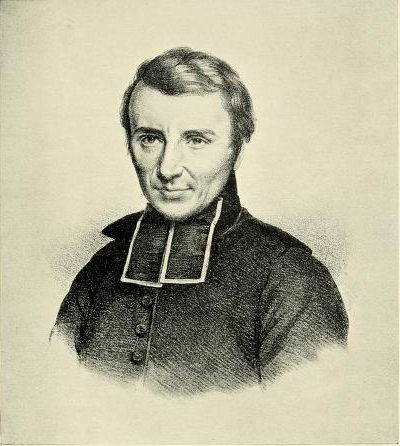
LAMENNAIS
Félicité de la Mennais (it was not till late in life that he gave his name the more democratic form) was born in 1782 at St. Malo; so he, like Chateaubriand, is a Breton; and the obstinacy of his race was innate in his character. The Breton authors constitute what may be called the Vendée of literature; they continue with words the fight which their fathers fought with material weapons.
As a youth Lamennais was slight, thin, and of an excitably lively temperament. At an early age he lost his mother, and after this was even more determined and self-willed than he had been before. His religious vocation was long doubtful; as a youth he devoted much time to music and mathematics, played the flute, and learned the use of various weapons. He fought a serious duel, which proved a hindrance to him in the career which he subsequently chose, had love affairs, and wrote poetry.[1] He was so little inclined to accept the dogmas of Christianity that he did not make his first communion till he was twenty-two, when he had attained to settled religious convictions. After this he began to study theology, and in 1808, at the age of twenty-six, he took the tonsure. But when the time of his ordination as a priest drew near, he was seized with such horror of the vow he was about to take that he again and again postponed the decisive step, and did not really become a priest until he was thirty-five. His letters of these years show the distracted condition of his soul; the proud heart winced and writhed at the thought of giving the power over itself into strange hands. And things were no better when all was over and the irrevocable vow taken. The first letter he wrote to his brother after the dreaded ordination, to which he had finally been persuaded to consent, had actually taken place, gives a gloomy description of his mental condition:
"Although silence has been imposed on me, I believe that it is both allowable and right to let you know once and for all exactly how matters stand with me. I am extremely unhappy, and it is impossible that I can henceforward be anything else. They may reason as they like, may twist and turn things as they please, to persuade me of the opposite, but there is not the slightest probability that they will ever succeed in convincing me of the non-existence of a fact which I perceive. The only consolation I can accept is the cheap counsel to make a virtue of necessity.... All I desire is forgetfulness, in every acceptation of the word. Would to God I could forget myself!"
With such throes as these was the birth of Lamennais' faith in his religious vocation accompanied. He overcame his despair; he, to whom it was a necessity to be whatever he was with his whole soul—even if it was the opposite of what he had been before—became with his whole soul a priest. So absolutely did he feel himself one that his first angry exclamation when Rome left him in the lurch in 1832 was: "I will teach them what it means to defy a priest!" He had a strong character and a narrow mind; a born party man, it was his nature to take a side obstinately and blindly, to defend what he for the moment regarded as absolute truth with passionate love and eloquent hate. Hence as soon as the ruling idea of the period takes hold of him he becomes its doughtiest champion—the most ardent, the most consistent, the most sincere and most undaunted defender of the autocratic principle of authority and the unconditional submission which that principle demands. The man who had suffered such agony of mind in yielding up his own reason and will to the will of the church, the one real priest of the Neo-Catholic school, seems, as it were, to grudge other men better conditions than had been granted to himself. When, in language ominous of storm, he proclaims the gospel of authority and obedience, he, beyond all others, makes us feel how personal passion finds satisfaction in the sweeping, universal demand, how the Ego which has felt itself compelled once for all to submit to authority asserts itself by bending and bowing the wills and thoughts of all other men to that rule with which it now identifies itself.
Violent and obstinately independent, Lamennais certainly recognised no authority within his own camp. His remarks upon the other leaders of the school form a pleasing collection of invectives. Of Bonald, for instance, he writes: "Poor humanity! How M. de Bonald should be suggested to me by the word 'humanity' passes my comprehension. The transition is an abrupt one. They say that the poor man has become quite feeble-minded lately." Of Chateaubriand: "The King and he, he and the King—this is the whole history of France.... No one can understand, he least of all, how Europe is to dispense with his talents. He prophesies that Europe will fare ill." Of Frayssinous, who as leader of the Gallican party in the church was his opponent: "You call him moderate. Why? Because your attention has been drawn to something cold in him, which you take to be moderation, but which is only congealed hatred." Such is the tone of Lamennais' letters. There was, nevertheless, in his vigorous and, if not blindly precipitate, at least blindly impetuous character the very stuff to make a matchless champion of the absolute authority of the church—and this, till the end came, he proved to be—a champion whose capacity of subjecting others to discipline was greater than his capacity of allowing himself to be persuaded against his honest conviction.
In 1808 he published his Reflections on the Position of the Church in France, a work which was suppressed by Napoleon's government. He greeted the returning Bourbons with enthusiasm. But he was not yet famous. Between 1817 and 1823, however, there was published, volume by volume, a work which kept men's minds in a constant ferment, and gave occasion to violent controversy; between the publication of the second and third volumes its author had to take up his pen in his own defence. This work was the Abbé de la Mennais' Essai sur l'indifférence en matière de religion. In it the period of the restoration of ecclesiasticism collects all its powers for a last, decisive battle. We find all the leading principles of the day enunciated with a peremptoriness and a determined consistency in the drawing of conclusions which seem to indicate that the revulsion is at hand.
The tendency and even the title of this book suggest comparison with the work which inaugurated the religious revival in Germany in the beginning of the nineteenth century, Schleiermacher's famous Reden über die Religion an die Gebildeten unter ihren Verächtern (Lectures upon Religion to the Educated amongst those who despise it). Both works aim at counteracting the same thing, the indifference towards religion, the positive contempt for it, prevailing amongst the educated classes. Both make an attempt, now that faith has become weak, to rebuild the edifice of piety upon a new foundation. It is in this attempt that the different nationality of the authors makes itself strongly felt.
Schleiermacher, emotional and fervent, is of opinion that the only hope for religion lies in surrendering all its outworks and leading it back to its inmost stronghold, the purely personal feeling of the individual. He tries to penetrate to the very foundation of human existence, to the depth where both consciousness and action originate, to the sources of personal life. He calls upon his reader to try to realise the original condition of the soul, in which the Ego and the object are blent in one, where there is consequently no question either of perception of the object or of perception of a self differing from the object. He describes this as a condition which we are incessantly experiencing and yet not experiencing, since all life consists in its perpetual cessation and recurrence. It is, he says, evanescent and invisible, like the fragrance exhaled by dew-laden flowers and fruits, chaste and light, like a virginal kiss, and holy and fecund, like a bridegroom's embrace; nay, it is not only like all this, it is all this; for this condition of the human soul is the marriage of the universe, of the All, with reason personalised; in this condition the individual is for a moment the world-soul and feels its infinite life to be his own. "This," says Schleiermacher, "is the nature of the first conception of every living and original energising force in your lives, to whatever province it may belong; it is such a condition that produces every religious emotion."[2]
In consequence of this theory Schleiermacher regards every feeling, every emotion, in so far as it expresses the united life of the Ego and the All in the manner described, as religious. "The feelings, the feelings alone, provide the elements of religion." He maintains that there is no feeling which is not religious, unless it is the product of a diseased or depraved condition, adding a note to the effect that this holds good even of the feelings of sensual enjoyment, so long as they are not contrary to nature or depraved. His endeavour is to rescue religion from antagonism with science and culture by making it out to be the essence of every noble, nay, of every healthy feeling. A true German, he pantheistically maintains that the broad stream of life which flows through all created beings is the sacred fountain of all piety and all religions. Therefore he would do away with every definite religious system; even belief in God and immortality does not seem to him to be essential to religion. He exclaims enthusiastically: "Join with me in reverently offering a lock to the holy, outcast soul of Spinoza in the realm of shades. He apprehended the great world-spirit; the infinite was to him all in all, the universe his one and eternal love; with holy innocence and deep humility he mirrored himself in it, and it in return found its most pleasing mirror in him. He was full of religion and of the spirit of holiness."
Even the age of enlightenment did not deal so-called revealed religion a severer blow than did this emotionalism. Schleiermacher, as we see, resolves religion into feeling, and in so doing destroys its authority by making over this authority to the human soul in all its endless variability. All rules, ordinances, dogmas, and principles disappear; each individual is, by a special process, to make everything his own. For Schleiermacher maintains that "however perfectly a man may understand such principles, however firmly he may be convinced that he possesses them, if he does not know and cannot prove that they have arisen in himself as expressions of his own spiritual life and are consequently originally his own, we must not let ourselves be persuaded to believe that such a man is a religious man. He is not; his soul has never conceived; his religious ideas are only supposititious children, the offspring of other souls, whom he, in the secret feeling of his own impotence, has adopted."
Thus essentially Protestant in the good (hence not the sectarian) sense of the word is the religious revival in Germany in its beginnings. It asserts personal originality to be the one essential factor in religion, and defines as the province of religion the whole widespread realm of our warm, true feelings. Natural, healthy feeling is always holy, at no time peculiarly holy.
A marked and significant contrast to all this is provided by the principles set forth in Lamennais' great work, which forms the Latin and Catholic counterpart to Schleiermacher's Lectures. These principles, the programme of pure externality, are as follows:
1. That feeling or indirect revelation is not the means by which men are intended to attain to the knowledge of true religion.
2. That scientific research or reasoning is not the means by which men are intended to attain to the knowledge of true religion.
3. That authority is the means by which men are intended to attain to the knowledge of true religion; and that consequently the true religion is unquestionably the religion which rests upon the strongest possible visible (!) authority.
It is to prove these three remarkable and droll assertions that Lamennais has written his four thick volumes. Let us make ourselves acquainted with their very imperfect chain of reasoning.
It is of paramount importance to us human beings to discover an infallible criterion of what is true and what is false. What we seek is certainty. But where are we to find it?
We cannot derive it from our senses, for our senses deceive us, says Lamennais. That the senses conjointly correct such false impressions as each sense separately produces, is a fact of which he does not take cognisance. We are, in his opinion, the less certain of any necessary connection between the impressions of our senses and the reality of things, from our not even being certain of our own existence. How we, if we are not certain of that, can be certain of anything whatsoever, is a question he leaves unanswered.
Conviction, the inward feeling that the thing must be so, is, he affirms, as deceptive as are the impressions of the senses. The irresistible force with which a principle imposes itself upon our reason affords no proof of the truth of that principle. Error is always possible. That one may quite well acknowledge one's fallibility generally speaking, and yet regard one's self as certain of the truth in many single, definite cases, is another fact he leaves out of reckoning.
Next comes the turn of scientific research or reasoning. This, he maintains, leads to doubt of everything, for the highest of all principles do not admit of proof; we are not certain, moreover, of the reliability of memory. It is impossible to parry this attack upon the scientific method in so far that it is of course impossible to prove the reliability of memory without pre-supposing the reliability of the memory which is to be proved. But of the indirect proofs of the reliability of memory provided by human experience Lamennais does not say a single word.
He touches provisionally upon the subject of complete doubt. Complete doubt would lead to complete insanity. The spirit of self-preservation compels us to believe and to act according to our belief. It is, in the Abbé's opinion, this want of ability to doubt, or the knowledge that one will, if one doubts, be regarded by other men as ignorant or mad, which forms the foundation of all human certainty. Common consent (sensus communis) thus becomes for us the seal of truth, and there is no other. Difference of opinion at once begets uncertainty. A principle or a fact is more or less certain according as it is more or less universally accepted and borne witness to. Hence Lamennais' definition of a science is: A science is a collection of thoughts and facts on which all men are agreed. Though his standpoint is a different one, he resembles the English empirical philosophers of a later day in refusing even to such a science as geometry any foundation but that of common consent. The fact that many a mistaken scientific conclusion has been taken for truth is due, he believes, to the circumstance that science has reached only a small number of human beings. What, he exclaims, are a few hundred savants compared with the whole human race! He strangely enough forgets that the human race has never unanimously accepted a single scientific truth previous to its discovery by men of science, in fact has never shown original unanimity in any belief.
Lamennais asks: When two persons disagree, what do they do after they have in vain attempted to over-persuade one another? and he answers: They appeal to arbitration. But what is arbitration? Arbitration is authority, and this authority declares with which of the differing opinions certainty, or if not certainty, at least probability rests. The fact that the arguments of reason, as such, only create doubt, and the fact that the strongest proof of the mistakenness of an assertion always is: "You are the only one who thinks thus," direct us to the principle of authority as the only true and final principle.
Lamennais' theory, consistently developed, would lead to acceptance of the vote of the majority as the proof of truth. But our final destination is, as we know, the Catholic religion. It is interesting to follow the vaults by which the principle of authority, conceived of as it is in this work, carries us straight into the arms of the church.
Lamennais begins by defining all learning, all apprehension, as the obeying of an authority. This is the same as Bonald's theory, that we accept language upon the authority of those who teach us it, and accept along with it the truths which are necessary to self-preservation, truths which God in his all-powerful word (i.e. language) has revealed to every people upon earth. Our intellectual life, the law of which is obedience, is, then, simply a participation in the highest reason, a perfect harmony with the witness which the infinite being has borne of himself. Divine reason, which communicates itself by means of language, is the first cause of the existence of reasonable beings, and faith their necessary manner of being. Thus the principle of certainty and the principle of life are one.
Man being created for truth, the reason of universal humanity cannot err. Very different is it with the reason of the individual, which can be overwhelmed by doubt. If it separates itself from society it dies. Væ soli! exclaims Lamennais. The proud man imagines when he is required to bow to authority that what is demanded of him is that he shall yield up his reason. He is mistaken. Authority is simply universal reason, reason revealed through a witness. "It animates and preserves the universe which it has created. Without it no existence, no truth, no order."
It is, then, authority alone which gives us certainty concerning religion. "Religion is not only doctrine, not only systematised knowledge—it is also, it is essentially, a law." But there is no law without authority; these two ideas involve each other. Thus religion is necessarily based upon authority—the true religion upon supreme authority. It is defined as: "The sum of the laws which follow from the nature of reasonable beings;" and to learn what these are we must, consequently, have recourse to authority.
Let us follow the connecting thread in this network of sophisms, that we may be able to pull it to pieces. It runs thus: Reason is developed only by the aid of language, the witness. The witness is only to be found in society. Hence man can only live in society. Hence there must have been society, intercourse, between God and the first man. (Observe the unproved assertion of the existence of an Adam, also Bonald's doctrine that God gave Adam language—in short, elements taken from so-called revealed religion as authority, employed to prove that so-called revealed religion rests upon authority.) The necessity of witness involves the necessity of faith, without which witness would be of no effect. Hence faith lies in the very nature of man, is the first condition of life. The certainty of faith is founded upon its harmony with reason, i.e. upon the strength of the authority which bears witness. Hence the witness of God is infinitely certain, since it is nought else but the revelation of infinite reason or of supreme authority. No witness is possible except where there is society. Hence no authority or certainty is possible without a society. No human society can exist except in virtue of that original society of God and man which came into being by virtue of the truths or laws originally revealed by his word. Hence these truths cannot be lost in any society without the destruction of that society resulting from the loss. They are consequently to be found in every society. These essential truths are preserved only by means of witness, which has no power or effect without authority. Hence, as there is no authority except in society, there is also no society without authority; where there is no authority, there is no society. But it is to be noted that there are two species of society; for man stands both in temporal relations to his fellow-men, and in eternal relations to them and to God. These two societies are the political or civil (temporal) society and the spiritual (eternal) society. Consequently there are two authorities, and these authorities are infallible, each in its own domain.
This all sounds extraordinarily logical; if ergo were a sufficient proof, there would be no want of proofs. But let us examine one or two of the links in the chain of argument.
The Ego, says Lamennais, cannot alone, in solitude, develop self-consciousness. The premise is correct, and we infer from it what there is to infer when we say that the I has consequently developed with the assistance of a you. This is a thought to which Feuerbach has devoted special attention, and which he has followed out in a variety of directions. But Lamennais, taking as his premise the Old Testament supposition of a single man existing before the rest of the race, builds the doctrine of the communication between this man and God, and all that follows thereon, upon this foundation, which sinks with the edifice erected on it.
Lamennais declares the infallible sign of the truth to be universal consent. But upon what does the authority of this consent rest? Has it a cause, or is it simply a fact?
If it has a cause, if the reason of all is to provide the law for the reason of the individual, then that very individual reason for which Lamennais has such a profound contempt is, after all, the supreme judge of the truth. For it is it which, in the first place, invests universal consent with its great importance, and in the second, determines in each separate case whether or not universal consent is to be bestowed.
If, on the other hand, the authority of common consent is a fact, that is to say, a thing which simply follows from our nature, then the certainty with which it inspires us is in no wise different from any other certainty. But Lamennais himself has just been opposing the idea of certainty resulting from an inward feeling, been denying our certainty even of our own existence, the certainty which we require being infallible certainty. What on earth should make belief in authority more infallible than any other certainty?
Lamennais' chain of argument leads us finally to two infallible authorities. The word "infallible" tells us that the Roman Catholic Church is not far off. Infallibility insinuates itself as an inevitable consequence of authority.
There is one point on which all the writers who help to bring about the revival of ecclesiasticism agree, on which Joseph de Maistre, the inaugurator of the revival, is in perfect harmony with Lamennais, its last exponent, little favour though he shows to the other paradoxes of his latest disciple. This point is the infallibility of the Pope. It must be remembered that in the eighteenth century the Papal power had appeared to be defunct. A Pope had corresponded with Voltaire and accepted the dedication of his Mahomet. The Pope had himself done away with his faithful Janissaries, the Jesuits. The religious reaction begins by the re-assertion, nay, by the exaggeration even from a Roman Catholic point of view, of the power and importance of the Pope. De Maistre said: "Without the Pope, no authority; without authority, no faith"—that is, without a Pope, no faith. The supremacy of the Pope thus becomes the very fountain, the very kernel of Christianity; in our days (in the writings of Bishop Ségur) the Pope has actually become a sacrament, "the real presence of Jesus upon earth."
De Maistre argued thus: There is no religion without a visible church; there is no church without government, no government without sovereignty, and no sovereignty without infallibility. He cited the principle of the irresponsibility of the king, which, in his estimation, was essentially the same as that of the infallibility of the Pope. Every government, he insisted, is from its very nature absolute, endures no insubordination; from the moment when it becomes permissible to oppose it, on the pretence of its being unjust or mistaken, it can no longer be called a government. And he attempted, as we have already seen, to prove, by appeal to the unquestioned discipline prevailing on board ship and the unquestioned decisions of the courts of justice, how familiar men are in all other domains of life with that idea of infallibility which it is considered correct to take umbrage at where the Pope is concerned.
This dexterous defence has every merit conceivable in a defence of an irredeemably lost case. That we are obliged to regard the temporal sovereign, though he is not infallible, as being so, does not prove that the Pope, as the spiritual sovereign, really is infallible. The fact that there must always be a supreme power, qualified to demand outward submission, does not prove that this power has also the right to demand intellectual submission. But perhaps outward submission is sufficient? Joseph de Maistre in reality grants that it is. He writes: "As regards the dogma of the infallibility of the Pope, we have no interest in throwing doubt upon it. When one of those theological questions which must of necessity be submitted to the arbitration of a supreme court occurs, it is of no interest to us whether it is decided in this way or that, but it is of great interest that it should be decided at once and without appeal."
Lamennais, who like De Maistre arrives at the conclusion that there are two infallible authorities, the authority of the state and the authority of the church, goes, as being a generation younger than his master, a stage farther on the road they both tread. When it proves to be impossible in the long run to uphold the two authorities, each in its own domain, he does not hesitate to decide which of them, in case of a collision, must give way to the other. He draws his final inference thus; "Spiritual authority corresponds to the inalterable law of justice and truth, temporal authority to the force which compels rebellious wills to submit to this law. Force is necessarily subordinate to the law, the state to the church. Otherwise we should have to acknowledge two independent powers—the one the preserver of justice and truth, the other blind, and therefore by its nature destructive of justice and truth."[3] A haughty conclusion this, and most characteristic of the beginning of the nineteenth century!
It proves what power Lamennais desired the Catholic Church to possess. We have still to note the last vault, by which it is proved that the Catholic Church is the authority of which so much has been written. Lamennais writes: "In the choice of a religion, then, the question reduces itself to this—Is there anywhere to be found such an authority as that which we have described, or, in other words, is there a spiritual and visible society which declares (!!) that it possesses this authority? We say a visible society, for every witness is external (remember that the witness of the inward voice is rejected), and we affirm that such witness would afford conclusive proof of the authority spoken of, because it would be the expression of the most universal reason."
"If such a society did not exist, the only true religion would be the traditional religion of the human race, i.e. the sum of the dogmas and precepts which are hallowed by their being traditional in every nation, and which were originally revealed by God."
"But if there is such a society, then its dogmas and precepts constitute the true religion." From this climax the rest of the argument follows of itself: "Since the death of Jesus Christ Christian society has incontestably been in possession of the highest authority. Of the various Christian communities the Catholic Church is clearly stamped as that possessing most authority. In it alone are to be found all the truths of which man stands in need; it alone provides him with perfect knowledge of the duties or laws of reason; in it alone he finds certainty, salvation, and life."
Now we have reached the desired haven. But it is not enough that we have reached it in a perfectly disabled condition—we suffer shipwreck within the harbour. For Lamennais frankly confesses at the end of his book that all religions rest upon authority, but that nevertheless the original traditions of all except one have been more or less corrupted by additions which must be regarded as errors. These errors have, however, also been validated by authority, exist only by its permission. What a confession! It destroys the virtue of his whole argument.
But of this Lamennais is quite unconscious. He approvingly quotes the following utterance of a Catholic writer: "The Catholic religion is a religion of authority, and therefore it alone is a religion of certainty and peace," and triumphantly recalls Rousseau's saying, that if any one could persuade him on Sunday that he was in duty bound to submit in matters of faith to the decision of another, he would on Monday become a Catholic, and that every thoughtful, truthful man placed in the same position would act in exactly the same manner. Lamennais claps his hands with delight at having produced such a proof of its being right for the individual to submit to authority in matters of faith. A pretty proof!
One of two things must be the case. The authority of the Catholic Church either does, or does not, rest upon the universal acknowledgment of its validity. If it does, then the authority of the church is universally acknowledged and needs no vindication, since no one denies it. If it does not, then, according to Lamennais' own theory, it is invalid, and no defence is of any avail.
But we cannot stop here. The doctrine that universal consent is the criterion of what is true, must itself prove its truth by being universally accepted. Can one imagine a more cruel instance of the irony of fate than that the doctrine in question should have been not only universally disputed but actually (in 1832) repudiated by the church itself? Lamennais was then suddenly left in the lurch, alone with the doctrine that it is the complete unanimity of all which proves truth. Can one imagine a more absurd contradiction? Yes, a more absurd is possible, namely, the very thing which presently happened—Lamennais, the obedient son of the church, bowing to its authority, himself renounced and abjured his doctrine that the authority of the church is the infallible seal of the truth.
But we do not need to look so far ahead as 1832 to see how the supporters of the principle of authority came into conflict with their own principle. Whatever men may support, their first requirement is liberty to speak. The divine thing about liberty is that even those who hate it need it and demand it. The Conservateur began by ardently vindicating the liberty of the press, but was soon exceedingly inconvenienced by it. One party could not well deny the other's right to a liberty which it had claimed for itself; it could not well do it—but it did it. And the very same thing happened in the matter of parliamentary government, or, as it was then called, the parliamentary prerogative. It was the journalists and orators of the Catholic and royalist school who, immediately after the restoration of the monarchy, overthrew the first ministry, a ministry chosen by the king. The Catholics desired to get the helm of the state into their own hands. Thus it was the school of the principle of authority which first sanctioned the very opposite principles—liberty of the press in the widest sense of the word and the power of the parliamentary majority. It undermined the ground upon which authority rested.
Following the career of the haughty, passionate priest, Lamennais, we can trace the process stage by stage. The constitution (la Charte), between which and the monarchy there was an inseparable connection, ensured liberty of religion, on paper at least. But this liberty of religion incensed Lamennais, who knew that one religion alone was the true one. The foolish phrase was then in vogue, that the right to freedom of conscience is the right to be free from conscience. Lamennais and his followers maintained that a man ought to obey his conscience; and this, in their opinion, their opponents did not do. But they forgot that there is a duty which comes before that of obeying one's conscience, namely, the duty of enlightening it. If it be immoral to act against one's conscience, it is not less immoral to manufacture a conscience with the aid of false and arbitrary principles.
In the name of conscience and authority, then, Lamennais published a protest against the irreligion of the state, that is, against its recognition of no confession—what he called "political atheism." He started the cry: The laws of France are atheistical. He went farther. In a famous letter addressed to Bishop Frayssinous, and published in the newspaper Le Drapeau blanc, he declared that as the generation now to be brought up was a generation born in blood, hard by the scaffold of Louis XVI. and the altar of the goddess of reason, it could only be saved by Christ, only educated by Christianity. But all education in France was, he maintained, atheistic. "Am I exaggerating, Monseigneur, when I say that there are in France educational institutions, more or less closely connected with the University, where children are brought up in practical atheism and hatred of Christianity? In one of these horrible dens of vice and irreligion thirty of the pupils have been known to approach the table of the Lord, receive the sacred wafer, keep it, and commit a sacrilege which formerly would have been punished by law, namely, use it to seal the letters which they wrote to their parents. ... The influence of the University is producing an ungodly, depraved, rebellious generation."
These indiscreet revelations were very unwelcome to the party in power, who were much annoyed by such attacks on the constitution from a quarter where they had looked for warm support. When Lamennais found that he was treated with coldness and received reprimands instead of thanks, he went a step farther.
We have already seen that his doctrine led to the sacrificing of secular to ecclesiastical infallibility in cases of collision between them. But this was in reality equivalent to acknowledging that the heretical, free-thinking school was right in repudiating the quality of inviolability and irreversibility which the royalist writers ascribed to the monarchy by the grace of God. It moreover made the temporal power dependent on the spiritual, namely, on the Pope. All the bishops of France responded with a manifesto in which they declared the secular to be independent of the Papal power.
Lamennais, the champion of authority, now stood in the most strained relations with both the ecclesiastical and the temporal authorities.
His democratic period does not lie within the scope of the present work. We shall only note the germs of the later development which exist in his original theory of authority. This new theory of authority is fascinatingly unlike the good old hard and fast doctrine propounded by Bonald and De Maistre immediately after the Revolution. The reaction is now much more an affair of reason, consequently much less an affair of immovable principles. Every serious attempt to show the grounds upon which the principle of authority rests must inevitably deal the principle a death-blow; for authority does not rest upon grounds. Lamennais' doctrine, which at first sight seemed so favourable to autocracy, proved on closer inspection to be extremely democratic. The whole edifice rested upon the principle of the authority of the human race. But beneath this fundamental idea—the authority of the human race—another was perceptible; and what was this other but the idea so repugnant to the reactionaries, Rousseau's old idea—the sovereignty of the people! Lamennais' readers did not observe this at once; he did not see it himself; but it lay dormant there, and one fine day it awoke and was recognised by all.
Lamennais desired to substitute theocracy for monarchy. But theocracy was not popular, was at any rate only popular when the word was interpreted in the sense of the old proverb: vox populi, vox Dei—when God's voice meant the voice of the people. The practical result of his doctrine was, then, merely the weakening of that secular authority which it asserted to be subject to the fiat of the reason of all; for the reason of all, which had at first been personified in the sovereign church, was very soon personified in the sovereign people. When Lamennais at last, in Les Paroles d'un Croyant, instigated to intellectual revolt, all the difference in his position was that he now desired theocracy for the sake of the people, instead of, as formerly, for the sake of their rulers.
The Revolution of July produced liberty of the press, and the first use Lamennais made of this was to publish a demand for the emancipation of education from state control and for the separation of the church from the state. He hoped by this means to get education altogether into the hands of the church, and thereby restore its old religious tendency. In the autumn of 1830 he started the famous newspaper L'Avenir, the watchword of which was the separation of church and state. Appeal to Rome was his answer to every attack; his newspaper was supposed to reflect the exact state of opinion there; but the Vatican remained obstinately silent. The fact of the matter was that it regarded Lamennais' liberal ideas with anything but favour, and had no inclination whatever to relinquish the state grant to the church. His opponents continuing to maintain that his opinions were incompatible with Catholic orthodoxy, Lamennais went to Rome in February 1831, to inquire of the Pope if it was (as he himself put it) a crime to fight for God, justice, and truth, and if it was desirable that he should continue his efforts. He was detained in Rome on one pretext or another until August 1832.
Presently the bull was published in which he, the opponent of indifference on the subject of religion, is declared guilty of religious indifferentism. In it we read: "From the impure source of this indifference springs also the erroneous and absurd, or, more correctly speaking, insane theory that liberty of conscience should be allowed and secured to all.... But, as St. Augustine said, what worse death is there than liberty to go astray? For it stands to reason that when every restraint is removed that can keep men to the paths of truth, their nature, which inclines to evil, will plunge into the abyss.... Amongst these must be reckoned that abominable liberty which we can never sufficiently loathe and dread, the liberty of the press to publish any work whatsoever, a liberty which some dare to champion with such ardour".[4]