GEORGE BRANDES (continued 5)
Mary Morison translation
Not long after this visit to Karlsruhe she met Queen Hortense, who was so fascinated by her that she gave her a private audience every morning. But it would seem that Madame de Krüdener ingratiated herself in this case chiefly by reading to the Queen the manuscript of a novel she was writing, Othilde by name, the pious moral of which did not prevent its being a "truly delicious" love-story.
She was now a pattern of every kind of Christian humility. When at Karlsruhe she climbed up to the dirtiest garrets to do deeds of charity. One day when she found a servant-girl crying in the street because she had been sent out to sweep, the great lady took the broom and swept the pavement herself.
The spiritual condition of Alsace at this time was somewhat remarkable. To some of its most intellectually advanced inhabitants the irreligion of the Revolution had communicated itself, but the great mass of the Protestant population had been terrified into a kind of religious mysticism, the distinctive feature of which was the belief in the near approach of the millennium. The most eminent clergyman in Alsace was the universally respected Pastor Oberlin of Waldbach, a man of the most sincere piety, who was, however, crazy enough to draw maps of the kingdom of heaven and publish a plan of the heavenly Jerusalem. He knew the exact order of precedence of the blessed dead, and was in regular communication with departed friends. Madame de Krüdener, provided with letters of introduction to this gentleman and others of the same persuasion, made her appearance in Alsace.
She had heard that a German pastor at Markirch, named Fontaines, had the power of working miracles, and that in his house lived a famous prophetess, Marie Kummer (generally known as "die Kummerin"), a hysterical Würtemberg peasant woman, who held constant communication with angels, and in her trances revealed the will of God. And she had also been told that Fontaines had expressed a wish to make the acquaintance of the divinely inspired lady from the North whom Marie Kummer had seen in a vision. In June 1808 Madame de Krüdener arrived at his house. He welcomed her solemnly on the threshold with the words of John to Jesus: "Art thou that one that should come, or do we look for another?" Flattered and delighted, Madame de Krüdener remained under the roof of this man, who was now generally supposed to be her lover. They spent their time in the study of the Revelation of St. John, and every day the lady listened to Marie Kummer's prophecies of the high mission and the great future awaiting her, and also Fontaines, who was to be her apostle. She wrote to a friend: "I am the happiest creature in the world.... The fulness of time is at hand; great calamities are about to happen, but you need not be afraid. The kingdom of the Lord is near, and He Himself will reign upon the earth for a thousand years." She goes on to say: "Imagine that I have literally experienced miracles. You have no conception of the happiness felt by those who give themselves entirely to Jesus Christ. He in His goodness and mercy has given me the distinct promise that He will answer the prayers I offer for my relations and friends."
It is not to be denied that the language in which she describes this new ardent devotion has a suspicious similarity to the language of a love which is not at all heavenly. Of God she writes: "It is impossible for me to tell what tenderness burns in my heart, how many tears I shed, what words tremble through my whole being when I feel myself loved thus—I, poor worm of the earth! I said to God the other day: 'What can I say to Thee, O my Beloved! (O mon bien-aimé!) Would that I could shout over the whole earth, and through all the heavens, how much I love Thee! Would that I could lead not only all men, but all the rebel spirits back to Thee!"
In the Vatican hangs a picture by a modern Italian painter which represents a nun kneeling at the feet of Christ, who returns her tearful gaze with the tenderest of glances. One involuntarily thinks of this picture when reading Madame de Krüdener's outbursts during her period of divine intoxication. She writes on another occasion: "All we have to do is to love, and to persuade others to love, the kindest, the best, the tenderest of all fathers." During her pious wanderings about the country, preaching and converting, she was joined by a young missionary. He was one of the many in whom she was afterwards disappointed, but shortly after he came to her she describes their feelings when worshipping together in such words as these: "What emotion! Can you imagine the bliss of our communions? No language can express it. We could not even hear the words spoken." It is impossible in reading this not to think of a passage in the writings of one of Madame de Krüdener's early admirers: "Lezay prétend (dit Chênedollé) que Madame de Krüdener dans les moments les plus décisifs avec son amant fait une prière à Dieu, en disant: Mon Dieu, que je suis heureuse! Je vous demande pardon de l'excès de mon bonheur?" He adds: "Elle reçoit ce sacrifice comme une personne qui va recevoir sa communion."[1] Similar pious emotionalism is, however, common to all the mystics of the day.
Madame de Krüdener did not know that both Fontaines and Marie Kummer had a past which was anything but confidence-inspiring.
At the outbreak of the Revolution Fontaines, then aged twenty, was a violent Jacobin; during the Reign of Terror he cast in his lot with Eulogius Schneider, and was one of the most eager of that man's followers in denouncing the clergy, closing churches, plundering Strasburg Cathedral, &c. He held orations in the temples of Reason, got himself appointed a Protestant pastor, married, and behaved in such a scandalous manner that he was compelled to give up his charge. Nevertheless, when the reaction against the Revolution set in, he received another call, as representative of the extremest Pietism, and soon gained a great reputation as an exorciser of evil spirits. When it came out that he had managed in three years (1801-4) to make away with almost all the means of his congregation, he had to retire into obscurity for a time. In 1805 he received a call to Markirch. There, two years later, he took Marie Kummer into his house. This woman, though she was a simple vagrant, and had changed her religion several times, was held in great reverence by the Pietists. A certain Pastor Hiller consecrated her to be the bride of Jesus. In the course of time she bore this same pastor a son, who was destined, they declared, to become the witness mentioned in the third verse of the eleventh chapter of the Book of Revelation. The worldly-minded civil authorities none the less condemned Marie to the pillory and a term of imprisonment. When she came out of prison she proclaimed the end of the world to be at hand, and advised a general emigration of believers to the Holy Land. She actually persuaded a number of foolish persons to set out with her for Jerusalem, and to entrust her with the travelling funds; but when they reached Vienna she was taken into custody. After a term of imprisonment there she went back to Alsace. The comet of 1807 furnished her with a pretext for sensational prophecies of plague, famine, and war, and on hearing the report of the arrival of the Russian baroness she had a vision, in which that lady's high destiny was revealed to her.
When Madame de Krüdener had lived in the edifying company of Fontaines and Marie Kummer for fully eight months, Fontaines began to feel that he was no longer safe in Markirch. Tales of his past life were being circulated. Marie Kummer consequently had a vision in which she received a divine command to go to Würtemberg and found a colony of true Christians there. The three at once set out. At their religious meetings in Würtemberg Fontaines was always dressed in black, Madame de Krüdener in blue, and Marie in grey. Besides prophesying the approaching end of the world they incautiously inveighed against the ungodly sovereign of the country, who had introduced a new liturgy. This led to Marie's imprisonment and the banishment of the other two. Marie joined Fontaines and Madame de Krüdener in Baden as soon as she was released, and there they again lived in intimate companionship, occupying themselves as before with devotional exercises and prophesying.
Madame de Krüdener, called to Riga by her mother's last illness, held meetings there too, at which she interpreted the Book of Revelation and dispensed the sacrament. At these meetings she was assisted by the pious shoemaker's pious mother, Frau Blau, in her character of prophetess. Towards the close of the year 1811 Madame de Krüdener returned to Karlsruhe. Fontaines had by this time been ordered off, but she continued to work in company with Marie Kummer, who was looked up to as a great prophetess because she had foretold the victory of the white over the black angel, and had announced that the people from the north of whom Jeremiah had written would presently make their appearance. The Russian war established her reputation, and after the news of the conflagration of Moscow came she was regarded as a positively sacred personage.
There is not the slightest doubt that Madame de Krüdener was entirely persuaded of the purity of her motives, and that she acted in all sincerity. She is not merely converted herself; she is possessed by a passion for converting. Again and again the idea of converting the very denizens of hell and the devil himself occurs to her. It was but natural that she had to bear much and painful misunderstanding on the part of those who were unable to believe in the change that had taken place in her. Even her own mother despised her and stopped writing to her. But no misunderstanding cooled her enthusiasm, which made an impression even upon rationalists. One of these, Sonntag, the chief dignitary of the Livonian church, who had carefully observed her behaviour at Riga in 1811, wrote many years afterwards that, though in his official capacity he had been obliged to sever his connection with her, he owed it to her to bear witness that she showed the deepest, purest, most active, most self-forgetful and self-sacrificing sympathy with every suffering and need of humanity.
Soon she, too, receives the gift of prophecy. It was not an uncommon gift at this time. Both De Maistre and Bonald prophesied the restoration of the royal family many years in advance, thereby winning considerable renown. But whenever their prophecies are of a more definite nature, it happens with them as with the prophecies of old—they do not come to pass. De Maistre, for instance, writing on the subject of the proposed seat of government in America, says: "I may safely wager ten to one that the town will not be built, or that it will not be called Washington, or that the Congress will not meet there;" which three things all happened. In 1807 he wrote (Opuscules, p. 98): "Nothing can restore the power of Prussia. This famous edifice, built of blood, filth, false coin, and pamphlets, has collapsed in one moment and is gone for ever." He also prophesied that the restoration of the Bourbons would take place quite peacefully, without foreign interference, and that autocratic rule and the power of the aristocracy would in the end be strengthened by the Revolution, &c., &c. Some of Bonald's prophecies (in his Théorie du Pouvoir) were rather more successful, for the simple reason that he who prophesies the end of the transient, prophesies what is certain to come true some day; there are things concerning the future to which Horatio's words apply: "There needs no ghost come from the grave to tell us this."
But Madame de Krüdener's prophecies attracted more attention than those of any of her contemporaries. In October 1814 she wrote from Strasburg to a lady at the Russian court: "We shall soon witness the punishment of guilty France, a punishment which Providence would have spared it if it had continued to bow beneath the cross." How was it possible, after Napoleon's return from Elba, to interpret this otherwise than as a mysterious prevision of this return?
She also wrote: "The storm is approaching; the lilies which the Eternal had preserved—the pure, delicate, symbolic flowers which had been crushed by a sceptre of iron, because such was the will of the Eternal—those lilies, which ought to have pled their cause before the tribunal of the purity and love of God, have only shown themselves to disappear." What could this be but a prophecy of the flight of Louis XVIII?
The fame of these predictions sped over Europe. One of the first to hear of them was Czar Alexander. Worn out by the campaigns of 1813 and 1814, tormented by an uneasy conscience, grieved by the sudden death of his only child and by the desertion of its mother, a lady who had been his mistress for eleven years, but whose affections were now transferred to one of his aides-de-camp, enfeebled by excesses of every kind, Alexander was exactly in the condition to be influenced by pious mysticism.[2]
He had been brought up without any religious education whatever. When, during his depression after the capture of Moscow, Prince Galitzin recommended him to seek comfort in the study of the Bible, such a thing as a Russian Bible was not to be found in the Winter Palace, and he had to be contented for the time with a French translation of the Vulgate. The proceedings at the Congress of Vienna, the faithlessness of Austria, the ingratitude of France, and the animosity aroused by his favourite project, the rehabilitation of Poland, in that country itself, had completely shaken his faith in human nature. The surprise of Napoleon's return from Elba had shaken his nerves. From the moment of his mistress's desertion he came under the influence of his wife, the Empress Elizabeth, who in her deserted condition had long ago taken refuge in melancholy mysticism. She persuaded him when he was at Karlsruhe to visit Jung-Stilling and learn what was his opinion of the political situation, viewed from the standpoint of the Book of Revelation. Jung-Stilling assured him that Napoleon was none other than the Apollyon mentioned in the ninth chapter of that book, and that the millennium was at hand.
In 1814, at the court of Baden, Madame de Krüdener had made the acquaintance of the Czarina, and since then the ardent prophetess had carried on a correspondence with one of Elizabeth's maids of honour who had an enthusiastic admiration for the Czar, with the full intention that her letters should be shown to him. Certain sentences in them were unmistakably written for his reading, such as the following: "What you tell me of the Czar's great and noble qualities I have long known. I know, too, that the Lord will grant me the happiness of seeing him—that the Prince of Darkness will in vain endeavour to prevent our meeting. I have much to say to the Czar." Immediately after the despatch of the letter here quoted from, Madame de Krüdener moved to Heilbronn; the Russian headquarters were presently transferred there, and late in the evening of the 4th of June 1815, heedless of the aide-de-camp's rebuffs, she made her way, unannounced, into the Czar's presence, and remained closeted with him for three hours. When she left him, Alexander's eyes were full of tears, and he was much agitated. Soon her influence over him was complete. They would shut themselves up together for half a day at a time, praying, reading the Bible, and discussing theological problems.
The days immediately preceding the battle of Waterloo they spend at Heidelberg, occupied in studying the Psalms. The intelligence of the reverses at Ligny and Quatre-Bras on the 16th and 17th of June reaches Alexander when he is thus employed; the Psalms console him and convince him of the justice of his cause. He prays and fasts. On the 18th of June the battle of Waterloo is fought. Alexander immediately sets out for Paris, but with the understanding that Madame de Krüdener is to follow promptly. His greatest grief at this moment is that his brother Constantine is not converted too. Before leaving Heidelberg our prophetess visits the prisoners who are awaiting their sentence of death and preaches to them with great effect; then she follows the Czar, whose Christian disposition affords her intense satisfaction.
In Paris her influence reaches its culminating point. The Czar calls upon her on the evening of her arrival. Her apartments in the Hôtel Montchenu are so situated that he can come to her at any hour of the day from the Elysée-Bourbon Palace by a private garden door. No dissipation, no amusement had now any temptation for the man whom the Parisians remembered as being so gay but a few years previously. "I am a disciple of Christ," he said; "I go about with the Gospel in my hands, and know nothing else." And Madame de Krüdener writes of him: "Alexander is the elect of God. He is treading the path of renunciation." Only language borrowed from the Apocalypse could express what she saw in him—a founder of the kingdom of Christ upon earth, an angel of peace with the flaming sword of power, the prince of light, &c., &c. Napoleon, on the other hand, she, like Adam Müller and his followers, believed to be the devil himself. Alexander was to restore the power of Christianity upon earth, and to obliterate the last trace of the Revolution and its deeds.
Alexander's reverence and gratitude knew no bounds. In the beginning of September a great review of 150,000 Russian troops was held at the Camp des Vertus in Champagne. Madame de Krüdener's presence could not be dispensed with. The Czar's carriage was sent for her early in the morning, and he received her, not like a favourite subject, but like a messenger from heaven, sent to lead his troops to victory. "Bare-headed, or wearing the little straw-hat which she generally carried hanging from her arm; her still fair hair hanging in plaits upon her shoulders, with a stray curl falling on her brow; dressed in a plain, dark robe, to which its cut and her bearing imparted elegance, and which was confined at the waist by a simple girdle—thus she arrived at dawn of day, thus she stood at the moment of prayer in front of the astonished army."[3]
About a year before this Alexander had read a book by the German mystic Franz von Baader, On the Necessity Produced by the Revolution for a New and More Intimate Connection between Religion and Politics. Under its influence he had formed a vague project for uniting the Christian monarchs of Europe in a mysterious alliance, which was to be in a very special manner commended to the protection of God; but at Vienna he had been obliged to give up all thoughts of carrying this project into effect. Now he discussed it with Madame de Krüdener. She entered into it eagerly, declaring that she herself had already, by the grace of God, conceived the very same idea. And who dare say that it is impossible or even unlikely that such an idea as this, the plan of the Holy Alliance, should have originated in the brain of a poor, silly woman, whose head had been turned by the amours of her youth and the religious enthusiasm of her later years? It is, as a matter of fact, more than probable that Europe and civilisation owe their thanks to her for it. A man who is distinctly inclined to undervalue her influence, and who is wrong where he denies it, Queen Louisa of Prussia's beloved brother, the Grand Duke of Mecklenburg-Strelitz, writes: "Madame de Krüdener never exercised the smallest influence over my angelic sister of Prussia, nor yet over the King, her husband, who judged this lamentably famous woman perfectly correctly. Of the Emperor Alexander she had, on the contrary, taken such complete possession that the Holy Alliance, which he proposed and succeeded in forming, may be regarded as entirely her work; you may be sure that I should not say this unless I were certain of it."
Some days after her arrival in Paris, Alexander said to Madame de Krüdener: "I am leaving France; but before my departure I shall publish a manifesto, acknowledging our gratitude to God the Father, the Son, and the Holy Ghost, for His protection, and calling on all nations to unite in common submission to the Gospel." With these words he handed her a paper. It was the draft of the compact between the three sovereigns. Capefigue, who actually saw this document, writes: "I have lying before me the rough draft of the compact; it is from beginning to end in the Emperor Alexander's handwriting, with corrections by Madame de Krüdener. The words The Holy Alliance are written by that extraordinary woman." Thus even the name is of her devising. She chose it with a reference to the prophecies of the end of the world in the Book of the Prophet Daniel.
Having traced this woman's career from the very beginning, we know who and what she was; we have also some idea of what the Revolution was; consequently our first feeling is one of astonishment that these pious maxims and reminiscences of the Apocalypse written, with the same pen which wrote the Elegy to Sidonie, by the lady who a few years before was buying scarfs and hats à la Valérie, should have had power to stem the renewed impetus of the current of the Revolution for fifteen years. Not for fifteen years did inevitable evolution, the progress of science, the audacity of art, the rebellion of hearts, take shape in action which broke the charm.
The three monarchs "solemnly declare, in the name of the most holy and indivisible Trinity, that their intention in the present proclamation is to assert in face of the universe their irrevocable determination to be guided, both in the government of their own dominions and in their political relations with other governments, entirely by the rules of justice, love, and truth contained in the Christian religion. Far from being only applicable in private life, these prescriptions ought directly to influence the conduct of rulers, as indicating the only means of placing the institutions of society on a solid foundation and remedying their imperfections."
So much for the words of the compact. What was really sincere and benevolent intention on the part of the foolish imperial enthusiast was sagacious hypocrisy on that of his brother monarchs. Who does not know the rest? Who does not know what the Holy Alliance came to mean—the introduction of a general European reaction, in essence barbarism, in its outward form a lie? It was in the name of the Holy Alliance that, during the saddest decades of our century, even the very feeblest endeavours in the direction of intellectual and political liberty were checked or crushed.
The Alliance received the voluntary adhesion of the potentate who had most to gain from it, the Pope. Without any petty consideration of his own position as head of the Roman Catholic Church, Pius lauded to the skies the resolution of his compeers—Alexander, the Greek Pope; the King of Prussia, the Lutheran Pope; and the King of England, the Anglican Pope. At the Congress of Vienna he proposed a plan of restoration in comparison with which the dreams of all the reactionaries of other days paled and all previous attempts to restore pre-Revolutionary conditions sank into nothingness. With one stroke of the pen the existence of the Revolution and the Empire was blotted out. The Holy Roman Empire was to be restored, and along with it all the social conditions and institutions of the Middle Ages—tithes, church property, exemption of the clergy from taxation, and the Inquisition.
The last years of Madame de Krüdener's life present no events of historical interest. She became ever more sincerely and fanatically religious, and her desire to display her faith in deeds became ever more ardent. It was now the one desire of her heart and object of her life to help the poor and the sick. She preached to the poor, founded churches, and proclaimed the advent of the kingdom of God. But from the moment when her Christianity took a practical form the character of her position changed. The royal personages, the authorities, all the great, who as long as she remained the court lady had smiled upon her, instinctively divined an enemy in her as soon as she began to address herself to the people. On one occasion she traversed Switzerland from frontier to frontier in a sort of mad religious triumphal procession; the next time she visited that country she was driven out of one town after the other. At Basle, where she distributed tracts among the soldiers and according to her own account converted half the garrison, the infuriated clergy succeeded in having her expelled from the town. In Baden, where her charities during a famine were truly munificent, her house was surrounded by gendarmes, and the people who had sought refuge with her were dispersed. She was expelled from Lucerne by the police authorities. When she tried to make her way into France through Alsace, she was turned back, and was at the same time forbidden to return to Baden. She was finally conducted under police escort to the Russian frontier, being passed on by the Würtemberg to the Bavarian, by the Bavarian to the Saxon, by the Saxon to the Prussian police, and by these last handed over to the authorities of her own country. She had lost Alexander's favour for ever, partly because she had been much too communicative about the origin of the Holy Alliance, partly because of the mixed and often bad company in which she travelled about. The accounts which she gave in her religious periodicals and pamphlets of social evils, of the boundless distress of the poor and the unjust oppressions of their rulers, were denounced as socialism and communism. Christianity as she understood it could not but be obnoxious to the authorities. She was, moreover, foolish enough to express her enthusiastic sympathy with the Greek war of independence in a very incautious manner, and presumptuous enough to declare openly that the Emperor, as founder of the Holy Alliance, was in duty bound to place himself in the forefront of a crusade against Turkey. Cast off by Alexander, she left St. Petersburg, and from this time onwards lived, as a missionary, a life of self-inflicted penance. She underwent all kinds of hardships, suffering voluntarily herself, and alleviating the sufferings of others whenever it was possible. She died in 1824 while on a missionary expedition in the Crimea.
An interesting contrast to the French-Russian Madame de Krüdener is to be found in the German-Russian Princess Galizin, a lady who belongs to the end of the eighteenth, as Madame de Krüdener does to the beginning of the nineteenth century. Madame de Krüdener's characteristics stand out more sharply on such a background as the life of Madame de Galizin. The Princess's is a genuinely German type of character. She is as simple as her younger contemporary is polished and complex; she is ingenuous and at the same time sentimental, full of soul and wanting in brain-power. Her husband was, like Krüdener, a man of the world. He was a friend and admirer of Diderot; it was, indeed, Diderot who first inspired the Princess with the desire and the courage to study, but she soon became that philosopher's ardent opponent. As careless of her feminine attractions as Madame de Krüdener was coquettish, Madame de Galizin had her head shaved to make it impossible for her to go into society, and from the age of twenty-four lived a life of seclusion. To cure herself entirely of egoism she "offered to the God of love the sacrifice of her understanding." As an instance of her ignorance of the world it may be mentioned that, when her son desired to enter the military service of a foreign country, she applied first to the Prussian, then to the Austrian commander-in-chief for permission to send along with him a tutor who was to guard him against the irregular habits of military life, and was astonished by receiving the answer from both that it was impossible for an officer to join the army accompanied by a male governess of this description.
In spite of Princess Galizin's warm-hearted sincerity, her tone is as pietistically supernatural as Madame de Krüdener's is mystically sensual.[4]
In Madame de Krüdener we have before us a being whose original equipment would seem to mark her as destined to act some important part. She possesses a vigour of life and a vividness of emotion sufficient for two ordinary human beings; only it is not healthy vigour and emotion, but an inward restlessness, an inward fire, which gives out sparks incessantly on every side. There is in her an original capital of Russian volatility and pliability, German sentimentality, French sense of proportion, and "Asiatic" sensual charm.
She enters life with no thorough education behind her, no serious aim before her, with a strong craving for happiness, and a poetic turn—predestined, therefore, to live in illusions. When she finds herself surrounded by admirers she gives herself up to dizzy enjoyment of this gratification, and begins to regard herself as a superior being. As long as she preserves outward fidelity to her husband she lives in the illusion that she is the heroine of duty. When she becomes unfaithful, she chooses a new model, and is transformed in her own estimation into another ideal, the ideal fair sinner. She writes of the ladies of Geneva, that they have neither the charm of virtue nor "the charm of sin." This latter she herself acquired. She continued to be ideal in so far as it is ideal to be the first of one's own species, unique. On this supposition of her own ideality is founded her belief that it was she who brought happiness (orders and titles) to her husband.
All illusion consists in a wrong association of cause and effect—religious illusion like the rest. But religious illusion is a double illusion; the individual subject to it does not trace the effect to its cause, but to a vague origin, the centre of existence—illusion number one—and in the centre of existence he places, not, as he imagines, the Deity, but himself—illusion number two. The beautiful wife believes that her husband receives his decorations direct from God, but also that she herself is the cause of God's bestowing them. She is the real cause, God is the means by which she works. She continues to lead her gay life as long as it continues to provide her with illusions. But a clever woman, with highly-strung nerves, tires in the long run of such a life, tires of the new admirer's jealousy of his predecessor, and of fooling herself and another for, say, the tenth time with the words: "You are the only man I have ever loved." After this life has lost its illusions, and existence for the time being its charm, the possibility of a new illusion presents itself. Madame de Krüdener regards the apoplectic shock which killed her lover in the same light as St. Augustine, Pascal, and Luther regarded similar occurrences. It is a hint, a warning to her. The happy shoemaker tells her of his certainty of being one of the elect of God. When she learns the secret of his happiness, she resolves that she too will be one of the elect.
Faith in God is in her case the satisfaction of the desire to be elect, to be the chosen one. She believes herself to be converted, and is, at the bottom of her heart, what she was. When she puts into the mouth of the Deity the words in which He assures her of His love, what is she doing but once again writing letters and elegies to Sidonie? The echo of her own self-adoration sounds to her like a voice from heaven, and she thanks God now as she did before for being thus distinguished—by herself. What she desires now as before is to be loved. As Chateaubriand proceeded to his earthly Alhambra via the earthly Jerusalem, she seeks her heavenly Alhambra by the way of the heavenly Zion. The only difference in their cases is, that he wishes to deceive others; she deceives herself. She is a coquette; so is he, and so is Lamartine; they are haughty coquettes, and she is a humble one.
What chiefly distinguishes her from them is, however, not her character, but her gifts and her feminine nature. Chateaubriand, as a man, has at least a sufficient glimmering of science to make it impossible for him to be imposed on by miracle-workers and village sibyls. Madame de Krüdener is a woman, and in a reactionary age the definition holds good: Woman is the natural prey of the priests. Destitute of any scientific basis of thought, she sooner or later, except in rare, unusually favourable circumstances, becomes a prey to her enthusiasm, which does not know on what to expend itself, to her vague longings after she knows not what, to her cowardice, which is terrified by the calamities of life, to her various illusions; and all these powers—enthusiasm, longing, fear, and imagination—deliver up their victim bound hand and foot as a prey to the Church, whose authority has, moreover, been imprinted upon her soul by her education from her earliest youth. Such was the case with Madame de Krüdener. All that she comes into contact with of the intellectual life of her day—its great wars of liberation, its research, its philosophy, its enthusiasm for enlightenment—passes by her without being understood; the one quality of the spirit of her age that she understands and appropriates is its dissoluteness. When the reaction against the 18th century sets in, and it is, naturally, first and foremost taxed with impiety and frivolity, Madame de Krüdener immediately joins in the cry, because she herself has had no eyes for anything else in it, has comprehended nothing in it but its frivolousness and loose morality.
The reaction gains strength; it soon has a literature of its own, a literature treating of all those supernatural things which the authors persuade their readers that they believe in. They write whole volumes about thrones and principalities, cherubim and seraphim; they appear to be in sober earnest, but it never occurs to them that any human being will take them seriously. After any amount of ability has been displayed in the championing of tradition, there appears a woman who is simple enough to take everything literally, to believe that Marie Kummer has talked with angels, and that Fontaines has had such supernatural visions as it was the height of the fashion to describe in verse. Poets had begun to hymn the praises of the miracle-worker and the prophet—a poor naïve Magdalen takes them at their word, believes in the miracles which are shown her, and tries her hand at prophesying. We are preparing to shake our heads with a smile, when we perceive that the powers of the day are taking her seriously. She herself becomes a power. Chateaubriand, who neither believes in her nor with her, but who believes in her influence, tries to gain her support for his political projects, but in vain. She has but one desire, to restore to Christianity that authority which the Revolution had destroyed. In her eyes the Revolution has only accomplished one deed, the overthrow of sacred tradition; she, for her part, desires to do only the one, opposite, deed—to give back to Christianity its world-overshadowing power.
Alexander takes up the idea; the other powers adopt it as a useful political lever. As long as her sole desire is to vindicate the authority of Christianity, as long as she aims at improving and converting the nations from above, and in concert with their sovereigns, Madame de Krüdener stands upon the pinnacle of honour and glory. But the revulsion comes. The consistent development of her religious tendency compels her to attempt a conversion of the nations from below, to go forth among them and, after the manner of the old apostles, practise Christianity in action instead of merely proclaiming it as doctrine. What childishness! So naïve is she that she believes the potentates will regard her new endeavours with the same favour which they showed to her earlier ones. She does not understand that authority dreads all interference with its own principle except official interference. From the moment when she begins really to act as a Christian, she is treated as a revolutionist. In the feeling of the universal brotherhood of humanity which inspires her, and in the enthusiasm with which she pleads the cause of the poor and the oppressed, the champions of authority see proof that she is—a socialist and a communist.
And thus it fell to Madame de Krüdener's lot to give practical proof of what the rehabilitation of Christianity as authority meant. For it was only as authority, as power, as order, that Christianity was wanted. It was employed as the police, the army, the prisons were employed, to keep everything quiet and support the principle of authority. From the moment when it began to be regarded as a personal matter, as a thing in itself, and to be practised in a manner which threatened to produce social disturbances, from that moment it was disorder, and the authorities expedited it, in the person of Madame de Krüdener, as promptly as possible from frontier to frontier.[5]
IX
LYRIC POETRY: LAMARTINE AND HUGO
When the Hundred Days were over, and Louis XVIII, had returned for the second time, a mixed feeling, in which melancholy was the chief ingredient, took possession of the French people. Their king's first return had partaken of the appearance of a recall by the nation. But, seeing that he himself had made no attempt whatever to resist Napoleon with the troops which remained faithful to him, it was not possible to disguise the fact that he had been brought back by the bayonets of foreign armies. Hence in the eyes of the great majority his second accession bore the appearance of a humiliation inflicted upon France. But, on the other hand, it meant the restoration of lawful liberty after the terrible military despotism under which France had now sighed for so many years.
To literature the restoration of the monarchy was, to all appearance at least, a herald of liberty. After the lapse of twenty-five years, free discussion of ideas was again possible. The heavy hand which had lain so crushingly on the press had been removed. The fettered intellects and suppressed ideas were free to bestir themselves; men were at liberty to investigate into and judge the past, the Empire as well as the Revolution; and no great hindrances were placed in the way of their deliberating the future of France.
They were free to do it, but had they any inclination? If they had, it was of the slightest. The mood of France was the mood which follows on a long illness or on a war which has ended in defeat. Not that men longed for redress on the field of battle. Towards the close of Napoleon's reign no echo was awakened in their hearts when the cannon in front of the Invalides proclaimed a victory. They longed for peace, as the sick man, exhausted by blood-letting, longs for rest.
To Frenchmen the idea of living a long, peaceful life once more became a familiar one. For years mothers had trembled when they saw their sons approaching the age of manhood, that is to say, the age at which they became first soldiers and ere long corpses; now they began to hope that these sons had a long life before them. The youths, to whom in their boyhood the rattle of drums and blare of trumpets had been familiar sounds, who even at school had accustomed themselves to the thought of early won honour and an early death, were now obliged to familiarise themselves with the idea of life in time of peace. The natural death to which they now looked forward seemed hideous in comparison with death as it had displayed itself to them heretofore, gloriously beautiful in the purple of victory; what was almost a feeling of disappointment came over them, and they began to brood. Most of the young men who had so long been forced to sacrifice their personal life to the life of the State, the requirements of war, the general aims of their country, welcomed with delight the news that they might break the ranks, and were no longer bound to walk in step behind the drum; they shook the dust of the highways off their feet, threw off their uniforms, and tried to banish every remembrance of military discipline. Coming straight from the battle-fields of the Empire, from the noise and bloodshed of war, they took refuge in the quietness of a country life, far from the bustle and uproar of human crowds. Such was the mood of the moment—a wearied, but complex mood. There was disappointment in it, and hope, and inclination to personal day dreaming. It was not a mood favourable to action, but to brooding, reflection, deliberation.
This national mood explains how it was possible for such poetry as Lamartine's Les Méditations to become the favourite literature of the day. No book since Chateaubriand's Génie du Christianisme had made such a sensation as did the First Part of this work; 45,000 copies of it were sold in four years. Strange as it may seem to us now, the Restoration period found in Lamartine's poetry an interpretation of its feelings and of all that moved its inmost heart—a picture of its ideal longings, painted in the clearest, loveliest dream-colours. It was poetry that resembled the music of an Æolian harp, but the wind that played upon the strings was the spirit of the age. The poems were not so much songs as reflections, not so much heart as spirit harmonies; but in real life there had for long been enough, and more than enough, of the positive—definite forms, decided characters, solid substance, silent acceptance of the strokes of fate. It was by no means considered a fault that there was no strong passion in the poems, no tendency to see the dark and dreadful sides of life, or, in fact, life as it is. There had been enough of all this in reality. After a period during which so many instincts had been forcibly suppressed, men rejoiced in this purely poetic instinct, in this most melodious poet, who had, as he himself said, a chord for every feeling and mood. They longed for just such lyric restfulness after philosophy, revolution, and wars without end. The poem Le Lac was read with delight by the whole French-speaking world, just because it was so long since men had felt in sympathy with nature, so long since they had looked at the face of the earth from any point of view but the tactical one. It was not only, however, as the poet of feeling that Lamartine represented the spirit of the day; he also represented it in his character of orthodox Christian. The leading note in his poetry was the note of Christian royalism, and devotion to the Bourbon family in particular.
To us, who are acquainted with a Lamartine in whom the Revolution of 1848 seemed to find its incarnation, a Lamartine who was universally regarded as a prophet of humanism, it is of interest to examine the poet's spiritual starting-point.
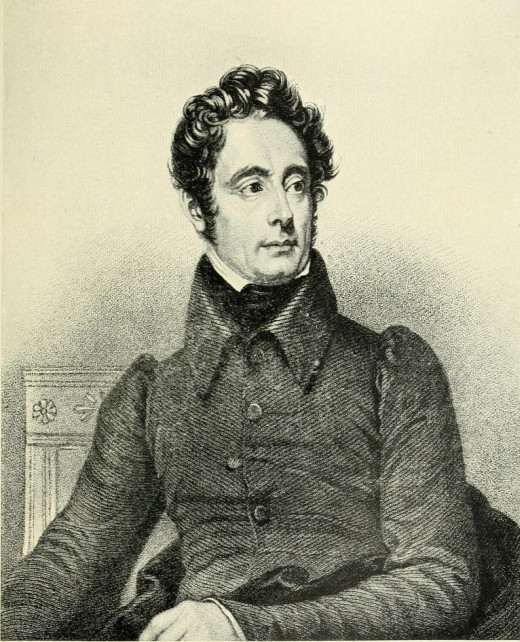
LAMARTINE
Alphonse de Lamartine was born at Mâcon in 1790, of a family belonging to the ranks of the lesser nobility. His father was one of the king's last faithful adherents at the time of the Revolution, and suffered for his devotion. Alphonse's loving, pious mother taught him to read in an illustrated Bible. He thus received his first literary and artistic impressions from scenes in the lives of the Patriarchs, the stories of Joseph and Samuel, of Sarah, and of Tobias and the Angel. After 1794 the family lived a very retired life upon small means on their little property of Milly. The son was at first taught at home by an amiable abbé, then sent to a school at Lyons, the rough, coarse tone of which was terribly repellent to a boy of a naturally refined disposition. By his mother's and his own wish he was removed to a school at Belley, kept by certain Jesuits who had managed to elude the laws banishing them from France, and who called themselves Fathers of the Faith. Here young Lamartine felt himself inexpressibly happy. The teachers were kind and refined; one of them reminded him of Fénélon; in the present century the Jesuits are undoubtedly not only the most unscrupulous, but also the most amiable, cleverest, and consequently most dangerous of all ecclesiastics. Amongst his fellow-pupils Lamartine soon found friends of his own standing, scions of French and Sardinian noble families. Among these were a young Alfieri, young Virieu, who, as V., plays a part in Graziella, and a nephew of Joseph de Maistre, Louis de Vignet. Through de Vignet Lamartine made acquaintance with all the members of the famous de Maistre family; Count Joseph attracted him least as a personality, but influenced him both by letters and by his works.
One day at Belley a master read some passages of Chateaubriand to the boys. The grandeur and charm of the majestic style made the deepest impression upon Lamartine, who had never heard anything like it before. But he declares in his Memoirs that he almost immediately assumed a critical attitude; he fell, he says, into a frenzy of admiration, but "not into a frenzy of bad taste." And he maintains that he presently, in talking to his comrades about the Génie du Christianisme, summed up his objections in the following pronouncement: "The main element in all perfect beauty, naturalness, is wanting. It is beautiful; but it is too beautiful." In other words, Lamartine, who himself wrote so instinctively, thought Chateaubriand's style strained. It is probable that he slightly antedates this criticism. In any case his admiration was such that as late as 1824, when hymning the consecration of Charles X., he wrote:—
L'ARCHEVÊQUE. Et ce preux chevalier qui sur l'écu d'airain Porte au milieu des lis la croix du pélerin, Et dont l'œil, rayonnant de gloire et de génie, Contemple du passé la pompe rajeunie? LE ROI. Chateaubriand! Ce nom à tous les temps répond; L'avenir au passé dans son cœur se confond: Et la France des preux et la France nouvelle Unissent sur son front leur gloire fraternelle.
Tasso was another poet whom Alphonse read with enthusiastic admiration. Ossian taught him that it is possible for true poetry to be vague and misty. Bernardin de Saint-Pierre, with his sweetness and his harmony, was Lamartine's, as well as Madame de Krüdener's, favourite model.
Some of the entertaining and immoral books of the eighteenth century which fell into the boy's hands delighted him, and excited his youthful imagination for a short time, but these impressions were effaced by those of the Jesuit school. A combination of religious enthusiasm and delight in the freshness and beauty of nature purified his mind and inspired it with activity.
"Were I to live a thousand years," he writes in his Memoirs, "I should never forget those days of study, those hours of prayer, those nights spent in meditation, and the raptures of joy with which I fulfilled my duties, thinking all the time of God." And almost in the same breath he tells of the bliss of skimming in winter on his skates across the frozen marshes, as if borne on spirit wings, or of sitting under the hornbeams in the mild, still spring air, lost in devotional feeling, and happy in perfect peace of conscience.
The return of the Bourbons was hailed with rejoicing by the Lamartine family, including Alphonse, now a young man. The father (who had been wounded on the 10th of August 1792) conducted his son to Paris, and had him enrolled in the King's Guard. It fell one day to the young officer's lot to walk by the King's bath-chair, when he was being wheeled through the galleries of the Louvre to inspect the art treasures brought back by Napoleon from his various campaigns. The profound reverence of the youth's own mind made him imagine Louis's voice to be melodious, his person majestic and distinguished, his glance commanding, his speech brilliant, his silence eloquent. Several times after this the King addressed a few words to him when he was riding by the side of the royal carriage.
When Napoleon had landed at Cannes and was making his triumphal progress through France, Lamartine followed the Court to the Flemish frontier; there the Guard was disbanded and sent home, and after the Hundred Days Lamartine did not re-enter it, nor did he ever see the King again. But when, in 1820, Louis read the first volume of Lamartine's poems, he remembered their writer as a young officer of his Guard, and sent him, by way of reward, an edition of the poets of ancient Greece and Rome. Lamartine, apropos of this, makes the somewhat hasty remark, that King Louis evidently looked upon himself as an Augustus, who had discovered a Virgil.
The new poet openly proclaims himself to be a disciple of Chateaubriand and Bonald. In his Raphael (chap. 1.) he tells how he came to make Bonald's acquaintance. When he was at Chambéry (in his twenty-fifth year) worshipping the beautiful young Creole celebrated in his poems under the name of Elvire, that lady asked him to write an ode to Bonald, who was a frequent and honoured visitor at her house, Lamartine informs us that all he then knew of Bonald was his name, and the halo shed around it by its owner's fame as a Christian legislator. "I imagined to myself," he says, "that I was addressing a modern Moses, who derived from the rays of a new Sinai the divine light with which he illuminated human laws." And so the ode which is to be found in the first collection of Lamartine's poems under the title Le Génie was written. In it the young poet affirms—
Ainsi des sophistes célèbres Dissipant les fausses clartés, Tu tires du sein des ténèbres D'éblouissantes vérités. Par le désordre à l'ordre même L'univers moral est conduit.
Here, as everywhere, we come upon that meagre conception of good—order. Bonald responded by sending Lamartine a complete edition of his works. The poet read them with enthusiasm. In notes appended to his ode at a later period he denies that they made any really profound impression on him; but he is confusing his earlier with his later conviction. He writes: "I read these works with that poetical enthusiasm for the past and that emotional reverence inspired by ruins which youthful imagination so easily transforms into dogma and doctrine. For some months I tried to believe, on the authority of Chateaubriand and Bonald, in revealed governments; but in my case, as in other people's, the tendency of the day and the development of human reason dispelled these beautiful illusions, and I comprehended that God reveals nothing to man but his social inclinations, and that the various systems of government are revelations of the age, of circumstances, of the vices and virtues of humanity." It is certain that Lamartine considerably antedates this conviction of his. All the Méditations are in the same tone as the ode to Bonald. The one entitled Dieu is dedicated to Lamennais, the dithyramb on the subject of sacred poetry to Genoude, the translator of the Bible. Lamartine himself wrote for Le Conservateur, a newspaper from the first appearance of which Chateaubriand dated the pronounced European reaction; and when this paper was given up, he, along with Lamennais and Bonald, started a new one on the same lines, Le Défenseur, the special aim of which was to oppose constitutional government. It fell to Lamartine's lot to solicit a contribution from Joseph de Maistre. It is significant that our poet, who by this time was aged thirty, should write to the author of Du Pape in such a tone as this: "Monsieur le Comte! At the time I received your book and your kind and flattering letter, I was very ill. I employ my earliest returning strength to thank you for both, but specially for the honour you do me in calling me nephew, a title of which I boast to all who know you. It is a title which in itself is a reputation, in such estimation is your name held by all those who in this misled and contemptible age understand true and profound genius. M. de Bonald and you, Monsieur le Comte, and one or two others who at a distance follow in your steps, have founded an imperishable school of high philosophy and Christian politics, the influence of which is steadily increasing, especially among the younger generation."
In this same letter Lamartine defines Joseph de Maistre's position in literature to be that of leader of the best writers, and attributes the antagonism to him to "that absurd Gallican presumption" which De Maistre has discountenanced in a manner worthy of all admiration. Lamartine, thus, unmistakably favours the unlimited ecclesiastical authority of the Pope—but, note well, only in theory. In his poetry he is not nearly so dogmatic. When, for example—responding to Chateaubriand's appeal—he considers it his duty, as a Christian poet, to drive heathen mythology out of poetry, it is not really a pious, but an artistic instinct by which he is inspired. The old myths had, as far as lyric poetry was concerned, long ago dwindled into mere allegories or paraphrases, things far too vapid to have an injurious effect upon any one's religion. A crusade against faith in Apollo and Amor was a perfectly unnecessary undertaking.
Lamartine's influence was due to the fact that he uttered, now the sad, now the comforting, now the inspiring words which thousands craved to hear. They did not feel the want of new thoughts in his utterances; they were moved by the sound of his sympathetic voice. They felt once more vibrating within them fibres which, during the period of universal depression, had been completely benumbed; he conjured tones from strings which had long given forth no sound; and men delighted in the novelty which consisted in a revival of old memories. But, besides all this, there was one really new element. For Lamartine the ugly and the bad, nay, even the petty and the mean, did not exist. He clothed everything in a garment of shining light. There was a heavenly radiance over his poetry. For the first time for long years, a wealth of beautiful feeling found expression in melodious verse.
The great naturalist Cuvier, in his speech on the occasion of Lamartine's reception into the Academy in 1830, declared that men, in the profound obscurity which surrounds their reason, require a leader who can snatch them out of the black perplexity of doubt and draw them along with him into the region of light and certainty. He accused Byron of having seen nothing in the universe but a temple for the God of evil, and greeted Lamartine as the poet of hope. Thus did France, like some poor creature recovering from a dangerous illness, confuse hope with belief, comfort with dogma, vital energy with determined vindication of Papal authority—until at last the force of circumstances dispelled the mist, and forced men of letters as well as the general public to adopt definite standpoints.
Even later than this, Lamartine was still the man of the period. Only four months before the outbreak of the Revolution of July, a eulogium of Daru is prescribed as the theme of his oration before the French Academy. He accomplishes the feat of pronouncing it without naming Napoleon's name; and he says frankly: "This century will be dated from our double restoration of lost blessings, the restoration of liberty by the throne and of the throne by liberty.... Let us not forget that our future is inseparably bound up with that of our kings, that it is impossible to separate the tree from its root without drying up the trunk, and that in our country it is monarchy which has borne everything, even the perfect fruit of liberty."
Lamartine now enjoys a period of triumph, the period of budding fame. Fame did not come to him early, for he was thirty years old; but it penetrated like the first rays of the rising sun into his ambitious soul. Let us picture to ourselves a salon in the days of Louis XVIII, as described by writers of the day. About a hundred persons are assembled in a suite of drawing-rooms in the house of some important personage, say General Foy. Lamartine, then an attaché of the embassy in Florence, but for the moment in Paris on one of his short visits, is among the invited guests.[1] A movement of admiration passes through the assembly as he enters—young, erect, handsome, aristocratic in mien and bearing. A crowd, chiefly of ladies, gathers round him; he is conscious of charming faces, splendid toilettes, smiles and flattery on every side. People forget for a moment to offer their congratulations to the deputies present on their last speeches. Even those who have not seen Lamartine before know him at once, for he outshines all. General Foy goes up to him, enthusiastically presses his hand, and assures him that it is in his power, whenever he chooses, to become an ornament of the Chamber, which has long stood in need of just such a talented champion of the sacred principles of royalty. Then Lamartine, in the melodious voice which as yet has never uttered a political catchword, repeats one or two of his first poems—L'Enthousiasme, Souvenir, Le Désespoir, La Prière, La Foi, or some such reflective pieces—thereby producing boundless ecstasy, and calling forth outbursts of every shade of enthusiasm and gratitude. Benjamin Constant comes up with his impenetrable, solemnly ironic mien, congratulates him on having discovered this new fountain of poetical inspiration, and assures him that he knows of no such loftiness and purity of thought and expression except in Schiller's reflective poems. The ladies are of opinion that this comparison is very flattering indeed to Schiller, an unknown German bourgeois poet, whose name they just remember having heard. What is he compared with Lamartine!
Various circumstances contributed to heighten the effect produced by the poems themselves—in the first place, the uncommon and almost feminine personal beauty of their author; in the second, the rumours in circulation regarding the lady whose praises were sung with such seraphic enthusiasm, such supernatural purity. It was reported that the poet had loved, and that death had deprived him of the object of his affections. Much trouble was taken to discover the actual circumstances of the case. Who was this Elvire? What was her real name?
We of to-day have been sufficiently enlightened by Lamartine's own later prose works, but with the satisfaction of curiosity on this subject interest in Lamartine's lyric poetry is not extinguished.
It was natural that the contemporaries of the youthful Lamartine should see in him first and foremost the poet of the throne and the altar. His earliest published poem was a heart-felt expression of gratitude to the Jesuit school which had sheltered him in his boyhood. Such a poem as his Ode was simply the essence of Chateaubriand's Génie du Christianisme versified. His lines on the birth of the Duke of Bordeaux (Comte de Chambord), after the death of his father, the Duc de Berry, with their refrain: "He is born, the miraculous child!" expressed the feelings of the most loyal Catholics. And on every occasion, in almost all of the poems, he lauds and magnifies, justifies and adores God, Providence. At times, as for instance in the poem La Semaine Sainte, written during a visit to the young Duc de Rohan, who later in life became an archbishop and a cardinal, his verse is almost like a fervently devotional burning of incense. If he is to be taken at his word when he asserts, in writing of this poem many years afterwards, that he alone, among the young men who gathered round the Duke, had no relish whatever for the church's mystic joys, all we can conclude is that his poetic talent was carried away by the current of the tendency of the day.
Most of the purely religious poetry of Lamartine's youthful period is, from its want of simplicity and real feeling, almost unreadable nowadays. It is not lyric; it is not concise; it is reflection without matter, meditation without thoughts, breadth without depth. A good example is the poem dedicated to Byron, entitled L'Homme. The French poet's conception of his English contemporary is the traditional, stereotyped, inexpressibly silly one of the day, namely, that he touches only the chords of despair, that his eye, like Satan's, fathoms abysses, &c. To show Byron how the true poet ought to sing, Lamartine strikes up the most servile hymn of praise to a God who, he himself tells us, plagues, tortures, plunders, overwhelms with misfortune and misery, and concludes with the exhortation:
Jette un cri vers le ciel, ô chantre des enfers!
The notes appended at a later period to this poem betray an astonishing ignorance of Lord Byron's history; almost everything affirmed of him is incorrect. Though Lamartine added a poem to Child Harold, he never so much as learned to spell the name correctly.
The same admonitory tone which he here assumes towards Byron he adopted many years later in writing of Alfred de Musset, to whom he also offered pious and moral truisms as medicaments.
The piety which Lamartine felt in duty bound to display is less offensive, because more sincere, in the ode entitled L'Immortalité. This poem is addressed to the beloved of his youth, Elvire, whose scepticism was a great grief to him, and its aim is to comfort her on her death-bed with the prospect of an immortality in which until now she has refused to believe. But even here we have such frigid allegorical ideas as: "And Hope, standing by thy side, O Death! dreaming upon a grave, opens to me a fairer world."
In only one of the poems which invoke the Deity is Lamartine really the lyric poet and not merely the fluent verse-writer, namely in Le Désespoir, a Meditation which expresses revolt against our idea of God. In this poem we have rhythmic flow, passion, and two qualities rarely found in Lamartine's productions—vigour and conciseness. What has God seen since the creation of the world?
La vertu succombant sous l'audace impunie, L'imposture en honneur, la vérité bannie; L'errante liberté Aux dieux vivants du monde offerte en sacrifice; Et la force, par-tout, fondant de l'injustice Le règne illimité.
And in its original form the poem contained verses, suppressed at the time of publication, which expressed sentiments far more bitter and impious than these. It is characteristic that almost immediately after the appearance of Le Désespoir, Lamartine, at his mother's request, refuted the ideas it expressed in a reply-poem, Dieu à l'Homme which, though not wanting in melodious sonority, is, as even its author perceived, not to be compared with the first. The first, he himself correctly observes, is the product of inspiration, the second of reflection.
But all the theological trappings were, as one might say, only glued on to Lamartine's poetry. Or one might perhaps with more propriety liken them to a carelessly constructed raft, which for a time floats upon the bosom of the stream and then breaks up into its component parts and disappears. All this pious dogmatism soon resolved itself into love of nature, worship of nature, a sincerely religious philosophy of nature.
What really lived and breathed in those early poems was something independent of their religious dogmatism, namely, the whole emotional life of a gentle, yet dignified soul. The soul which found expression in them had this characteristic of the new century, that it loved solitude, and only in solitude found itself and felt itself rich. It was an unsociable soul, only disposed to vibrate in harmony with nature. It was sad and pathetically earnest; under no circumstances whatever cheerful or gay. And, finally, it was never erotic; one only of the poems was an expression of the happiness of satisfied love; the feeling pervading all the rest was sorrow over the loss of the loved one, whom death had claimed as his prey. The poetry of the eighteenth century had resolved love into gallantry, had taken neither it nor woman seriously, but in this new poetry love was the silent worship of a memory, and woman was adored and glorified as she had been in the days of the Minnesingers; only now it was woman as the departed one, as the spirit.
Never did Lamartine depict the wild grief of loss at the moment of the loss; in his poems grief has become a condition, a silent despair which blunts, stiffens, tortures, and at a rare time dissolves into tears.
This new song was song which flowed naturally from its fountain, plentiful and pure; it was music like harp-strains blended with the tones of celestial violins. And, borne on these tones, simple, familiar emotions communicated themselves to the reader's mind, such thoughts as that of the poem La Retraite—happiness awaits me nowhere; or of L'Automne—nature's autumnal mourning garb harmonises with my sorrow and is pleasant to my eyes; or of Le Golfe de Baya—this spot, once the scene of such great events, preserves not a trace of them; in like manner we ourselves shall disappear, leaving no trace behind. But, note well; a thought like this last was expressed in such wonderfully beautiful lines as the following:
Ainsi tout change, ainsi tout passe; Ainsi nous-mêmes nous passons, Hélas! sans laisser plus de trace Que cette barque où nous glissons Sur cette mer où tout s'efface.
There was never any systematic description of nature, or any attempt at painting; the momentary impression of nature was caught, even as it passed, by genius, and preserved for all time.
The poet is sitting at evening on the bare mountain side. Venus rises above the horizon (Le Soir). A ray from the star seems to glide across his brow and touch his eyes, and he feels as if the departed one, in whose companionship he had lived here, were hovering near him. He addresses the ray from Venus:
Mon cœur à ta clarté s'enflamme, Je sens des transports inconnus, Je songe à ceux qui ne sont plus: Douce lumière, es-tu leur âme?
Or, sitting on a rock by the lake (Le Bourget), where in bygone happy days he had sat by her side, he is painfully affected by the feeling of the mutability of everything human as compared with the unchangeableness of inanimate nature. This is the emotion to which he gives expression in his poem Le Lac, which, in spite of its extraordinary popularity, is probably the best he ever wrote. It is an excellent type of his poetry; flowing gently, with no exertion perceptible, not even that exertion which we call art, it is as naturally melodious as the rippling of the lake. The emotion which the poet desires to express is indicated with admirable precision in the metaphor with which the first verse concludes: Is it impossible to cast anchor on the ocean of time even for a single day? The lake is described with its waves breaking upon the rocks as they did a year ago, when the beloved one heard their murmur; and the bereaved lover recalls the words which she spoke in the stillness of night, as their boat floated on the waters—an invocation to time, that happy time, to stay its flight, a prayer to it to hasten for the unhappy and suffering, but to linger with those who love and are beloved. He repeats her concluding cry: Prayer is fruitless; let us love one another and enjoy the passing hour! For man there is no haven, time has no shore; it flows on and we disappear. On this memory of the thoughts of his dead love follows the poet's own invocation to nature. He invokes the lake, the silent rocks, the caves, the dark woods, the things which time spares and those which it re-animates, and beseeches them to preserve the remembrance of that night.
And Lamartine, so spiritual in his expression of the grief and loneliness of the bereaved lover, is almost as spiritual when for once he gives expression to happy love. This he does in Chant d'amour, a poem which he himself naïvely describes as a modern Song of Solomon, quieter in tone and less Oriental in colouring than the old, but which in reality has as little resemblance to that song as the chastest spirituality of the West has to the glowing sensuality of the East. Here, as elsewhere, the chord which he touches is the chord of plaintive tenderness, gradually modulating into that of religious devotion.
Of Lamartine's youthful verse these purely human poems are all that we really care for nowadays. We are terribly bored by the vapid compositions which, following the prescribed rule for religious poetry, consist of nothing but adoration of the Deity as he reveals himself in his works.
The poet whose acquaintance we make in the human poems is unmistakably very vain, much engrossed with himself and his own lovableness, and at times too honeyed in his language. But his vanity is so childlike and innocent that it does not affect us unpleasantly; and we are favourably impressed by the fact that it is not literary vanity. Lamartine rejoices that he is good-looking, a favourite with distinguished women, a good horseman, in course of time an eloquent orator; but he is not conceited about his poetical gifts, not even proud of them. The man whose talent was that of the true improvisatore with proud humility describes himself in his prefaces and memoirs as one who cultivates art for his pleasure, and who does not belong to the number of the specially initiated. And he really is the dilettante in so far as he is too careless to be called a true artist. He has unconscious technique, he has flexibility and ease, but along with these an inclination to long-windedness and repetition which at times spoils his effects, and a want of the power of self-criticism which makes it difficult, nay, almost impossible, for him to correct and improve. Nevertheless, all his life long he was a poet, a true poet—in spite of his artistic defects one of the most genuine whom France has produced. It was not his fault that he made his appearance in literature under the unpropitious planet of the reaction period.
It was under the influence of the same planet that the man destined to become the most famous French poet of the nineteenth century won a name for himself. Victor Hugo, born in 1802, is for a long period of his life as good a Catholic and royalist as Lamartine, his senior by twelve years. Hugo's literary career corresponds closely with the political career of the French nation. He is an adherent of the Bourbons as long as they are the reigning family. When the Revolution of July takes place, he sympathises with it, and he is an adherent of the new monarchy from the moment it is founded. During the reign of King Louis Philippe, at whose court he is a frequent guest, he becomes an enthusiastic eulogist of Napoleon when the cult of Napoleon is revived in France. He warmly supports the candidature of Louis Napoleon for the post of President of the Republic, continues to lend him his support when he occupies that post, and is even favourable to the idea of an empire, until the feeling that he is despised as a politician estranges him from the Prince-President, and resentment at the coup d'état drives him into the camp of the extreme Republicans. His life may be said to mirror the political movements of France during the first half of the century. He was, as is so often the case with poets, not a leading spirit, but an organ.
In the last preface to his Odes et Ballades Hugo, in his pompous manner, writes of his own career: "History goes into ecstasies over Michel Ney, who, born a cooper, became a marshal of France, and over Murat, who, born an ostler, became a king. The obscurity of their origin is considered to give them an additional claim to respect, and to add to the glory of the position to which they have attained. Of all the ladders which lead from darkness to light, the one which it is most difficult and most meritorious to mount by is undoubtedly that which leads from the position of loyal aristocrat to that of democrat. To rise from a hut to a palace is, no doubt, an uncommon and admirable achievement, but to rise from error to truth is more uncommon and more admirable. In the case of the first ascent, the man gains something, increases his comfort, his power, his wealth, with every upward step; in the case of the second, exactly the opposite happens ... he must pay for his spiritual growth with one sacrifice of temporal well-being after another ... and if it is true that Murat could with pride lay his postillion's whip beside his sceptre, saying: 'This is what I began with,' then certainly the poet may with more justifiable pride and greater inward satisfaction point to the royalist odes which he wrote as a child and youth, and lay them beside the democratic poems and works which he has written as a grown man. And the pride is perhaps especially justifiable in one who at the end of his ascent, on the topmost step of the ladder of light, has found banishment, in the man who can date this preface from exile."
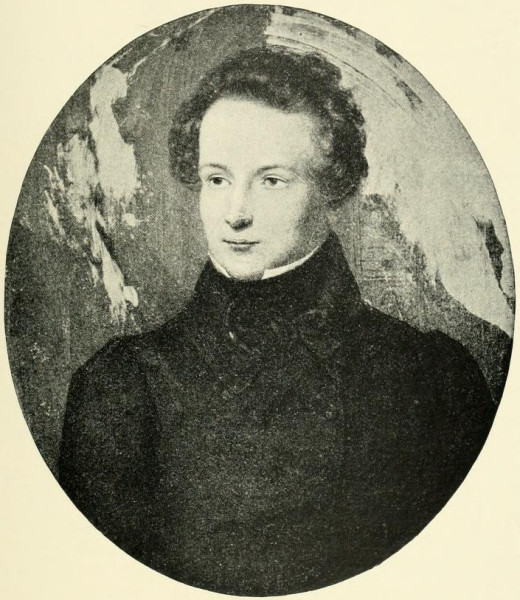
VICTOR HUGO
Victor Hugo was the son of one of Napoleon's officers who had originally been a violent revolutionist, and as such had exchanged his Christian name, Joseph, for that of Brutus, which, however, he dropped again when the Revolution was at an end. Joseph Hugo was at Besançon, in command of a battalion, when his famous son was born. A few weeks later he was sent to Corsica. From Corsica he was transferred to Elba, thence to Genoa and the Italian army. He entered the service of Napoleon's brother Joseph when Joseph became King of Naples, and at Naples his wife and children joined him in October 1807. When in 1808 Joseph was made King of Spain, Colonel Hugo followed him to that country, sending his wife and three little sons to Paris, where they lived from 1808 till 1811. In the spring of 1811 they accompanied a strong detachment of troops to Madrid, but Hugo thought it prudent to send them back to Paris in the following year, while he himself, who had been promoted with extraordinary rapidity to be aide-de-camp to the King, major-domo of the palace, general, Count of Cisuentes, inspector-general of the Peninsular army, and governor of three provinces, took part in the war until the defeat of Vittoria, in June 1813, obliged Joseph to abdicate. Napoleon, who could not bear General Hugo, and always treated him badly, refused to confirm his appointment as general and his title as count (his other preferments he had lost), and ordered him to enter the French army again with the rank of major. In 1814 and 1815 Joseph Hugo distinguished himself by his able defence of the fortress of Thionville. His son writes of him as if he had been an ardent votary of Napoleon. This he most certainly was not, and when the Bourbons returned they at once gained his complete allegiance by restoring him to his rank of general, with promotion dating from 1809, the year in which he had received it from King Joseph. Thus it was not only Victor Hugo's mother, the daughter of a loyal shipowner of the Breton town of Nantes, who was a devoted royalist; his father, too, was strongly attached to the restored royal house. Causes entirely unconnected with politics produced a misunderstanding between the parents, and they separated. The sons, Abel, Eugène, and Victor, remained with their mother in Paris.
All three possessed literary ability, though only the youngest lived long enough to display his full power and win fame. All three were, to begin with, champions of royalty and the church. Victor said as a boy: "I will be Chateaubriand, or no one."
After winning prizes for their poems in Paris and at Toulouse, the three brothers, with the view of earning a living, started a literary periodical (in 1819). Chateaubriand was at this time editing the extreme Conservative newspaper Le Conservateur. The brothers named their venture Le Conservateur littéraire, and Chateaubriand gave it a warm welcome. The new periodical came out twice a month until March 1821, and Victor Hugo alone supplied more poems and articles than all the other contributors together. In Le Conservateur littéraire are already to be found some of his most famous odes—Les Vierges de Verdun, the odes on the fate of La Vendée, on the death of the Duke of Berri, on the birth of the Duke of Bordeaux, and the beautiful, more personal song of rejoicing on the occasion of the restoration of the statue of Henry IV. And in it we also find, to the number of over a hundred, his first essays in criticism, of which only a few, and these much tampered with, have been included in the collection entitled Littérature et Philosophie mêlées.
At this period poetry is to Victor Hugo the daughter of religion. Apropos of an ode on the existence of God, he writes: "The desire to thank a bountiful God in language worthy of Him begat poetry. From its birth it shared in the triumphs of religion, which united the earliest societies and began the civilisation of the world. At the present day, when, in order to demolish society, men attack religion, the only bridle upon man, the only lasting tie which holds societies together, it is not surprising that they should seek to make an ally of poetry. But the divine muse does not allow herself to be inspired by that which is nought."
And at this period, too, he proclaims the superiority of Corneille and Racine to Shakespeare and Schiller: "We have never understood the difference alleged to exist between classic and romantic art. Shakespeare's and Schiller's dramas differ from Corneille's and Racine's only in being more faulty."
The first edition of Victor Hugo's Odes appeared in 1822. Louis XVIII., who read them over and over again, settled an annuity of 1000 francs a year on the poet out of his private purse; in the following year the Ministry of the Interior conferred on him a pension of 2000 francs; and in 1826 the King, on being applied to, increased the amount of his yearly grant.
The King had good reason to show approval, for these first poems of Victor Hugo contain the whole system of orthodox political and religious principles valid under the Bourbon monarchy. They are a faithful image of the period during which they were written.
They pass in review the history of France from 1789 to 1825. In those of them which treat of the Revolution we observe, as in the corresponding poems by Lamartine, that two words occur more frequently than any others—executioners and victims. In the history of the Revolution Hugo sees nothing else. For its leading spirits he has but this one designation—executioners; the Convention he describes as a creation of the devil (livre i. ode 4); and, little as he loves heathen mythology, he cannot resist using the expression, Hydra of anarchy, when he wishes to depict the horrors of the revolutionary period. For the enemies of the Revolution victims is the stereotyped designation; the revolt of La Vendée is eulogised in every second poem, and odes are addressed to its heroes and heroines (La Vendée, Quiberon, Mlle. Sombreuil). The guillotine is always present to the poet's imagination, and is the constant object of his anathemas, except when, as in the ode Le Dévouement (livre iv. ode 4), he is carried away to the extent of desiring martyrdom for himself, "because the martyrs' angel is the most beautiful of all the angels who bear the souls of men to heaven."
Following in the footprints of Chateaubriand, Victor Hugo goes back to the Christian martyrs of ancient Rome, and in no fewer than four odes (Le repas libre, L'homme heureux, Le chant du cirque, Un chant de fête de Néron) describes the agonising triumph of the martyrs over the brutal and voluptuous cruelty to which they in outward appearance succumb. And the symbolism, too, is the same as in Chateaubriand's poetry; it is the death of the orthodox noble or priest which is represented under the form of the butcheries of the circus.
One of the finest of these poems of the Revolution is the oldest, written in memory of a little company of innocent young girls who, under the Reign of Terror, were executed after a long imprisonment without being brought to trial, on the vague and incorrect suspicion that they had testified pleasure when the Prussians entered their town (Les vierges de Verdun). Hugo paints the tribunal of the Convention blacker than is necessary, by crediting the public prosecutor, Fouquier-Tinville, with impure designs upon his victims and putting insulting proposals into his mouth; but even without the addition of unhistorical incidents, the sentence of these girls was so shameful, their fate so tragic, and their behaviour so beautiful and dignified, that they well deserved a poetic monument, even a better one than Hugo raised to them.[2]
The poet's pathos is entirely justifiable in cases like this, where the Revolution showed its dark and unjust side in its dealings with youth and innocence, but it becomes grating and false as soon as his dogmas come into play. His tone in writing of the monarchy and the glories of royalty is positively insufferable. In the Ode to Louis XVIII. God calls upon the seraphs, the prophets, and the archangels to do obeisance to the newly arrived heir to the throne: "Courbez-vous, c'est un Roi." And not content with this, the Deity Himself calls him by his title, not his name: "O Roi!" and reminds him that God's own Son was, like him, a king with a crown of thorns. In the poem on the occasion of the baptism of the Comte de Chambord, the language is even stronger: "God has given us one of His angels, as He gave us His Son in the days of old." We are reminded that the water of the river Jordan (brought home by Chateaubriand) in which the child has been baptized is the same in which Jesus was baptized; it is the will of Heaven, we are told, "that the reassured world should, even by the very water used for his baptism, recognise a Saviour." In La Vision the eighteenth century is summoned before the judgment-seat of God, and there accused of having in the pride of its knowledge mocked at the dogmas which are the support of the law and of morality. It timidly expresses the hope that the future will view its actions in a more favourable light, but it is mercilessly condemned; the "guilty century" is plunged into the abyss, pursued as it falls by the inexorable voice of the judge.
The standpoint from which Napoleon (who is always called Buonaparte) is viewed harmonises with that from which the Revolution is judged; he is the usurper, the savage soldier, the murderer of Enghien; and again and again it is impressed on us that lilies are better than laurels. Under the name of Colonel G. A. Gustaffson (livre iii. ode 5), Gustavus IV., who lived as an exile in France during the reign of Louis XVIII, is eulogised as the representative of the fallen kings. The personality and story of Gustavus are represented in a manner which witnesses to Hugo's remarkable ignorance of foreign history—the king's whole life is a model life; his great mind is like a temple, whence proceeds the voice of God; he dictates the history of the future; he is the successor of the ancient seers; actuated by disgust at seeing the monarchs bow their necks to Napoleon's yoke, he has voluntarily taken off his crown, and thereby raised his head high above all the other royal heads on earth. Could folly go farther than this? The wretched, insane Gustavus a model king! The Bourbons are of course exalted to the skies. All their family events—birth, baptism, death, ascension, consecration—are treated as of world-wide import. In a poem on the subject of the reprehensible war which France, at Chateaubriand's instigation, carried on with Spain in the interests of the European reaction, royalty, the royal power, is declared to be miraculous; and in the same poem the king is expressly described as the war-lord, supporting himself by the power of the sword; war is, we are told, the companion of royalty:
Il faut, comme un soldat, qu'un prince ait une épée; Il faut, des factions quand l'astre impur a lui, Que, nuit et jour, bravant leur attente trompée Un glaive veille auprès de lui; Ou que de son armée il se fasse un cortège; Que son fier palais se protège D'un camp au front étincelant; Car de la Royauté la Guerre est la compagne: On ne peut briser le sceptre de Charlemagne, Sans briser le fer de Roland.
It is not surprising that all these odes should have mottoes taken either from the Bible or from religious works, notably Chateaubriand's Les Martyrs, a book by which men's minds were so powerfully impressed that the younger poets of the day took a pride in transposing whole pages of it into verse.[3] Lamartine addressed his ode Le Génie to Bonald; Hugo dedicates an ode with the same name to Chateaubriand, of whom he writes that "he suffers the double martyrdom of genius and virtue."
He addresses several poems to Lamartine—it is his desire, he writes, to go into battle on the same war-chariot as his friend, to manage the horses while Lamartine wields the spear—and these poems are among the most attractive of all, partly because they are remarkably beautiful, and testify to the respectful and yet at the same time brotherly feeling of the younger for the elder poet, partly because in them we have, along with Hugo's views on religious and social questions, the expression of his ideas on the subject of art. All the poems prove with what earnestness, but also with what exaggerated and almost offensive self-consciousness, the young poet has apprehended his mission—it is always called a prophet's mission; the poet is a seer, a shepherd of the people; of Lamartine, Hugo goes the length of declaring that one feels as if God had revealed Himself to him face to face. But it is in the poems to Lamartine that we perceive most clearly what is Hugo's conception of the position and relation of the new literature to that of the eighteenth century. It bears a remarkable resemblance to a kindred literary phenomenon in Denmark, namely, Oehlenschläger and his friends' conception of their position to Baggesen. Read, for example, the poem La Lyre et la Harpe (livre iv. ode 2). The lyre represents the frivolous, licentious poetry of the preceding century, which chants the praises of Jupiter, Mars, Apollo, and Eros, and inculcates an intellectual epicureanism, whereas in the tones of the harp we hear the admonition to watch and pray, to remember the seriousness of life, to think of death, to support and help our stumbling brethren. The poem is dedicated to "Alph. de L."; the word harp in itself pointed to Lamartine.
This offensive attitude towards the past is the first symptom of the approaching breach with that past's whole system of ideas, from which Hugo's significance as an author and leader of a literary movement dates.[4]
X
LOVE IN THE LITERATURE OF THE PERIOD
Of great significance as regards the whole character of the period is the answer to the question: What is the nature of the amatory sentiment in the writings of the authors of this group?
Of all the emotions treated of in literature the emotion of love is that which receives most attention, and as a rule makes most impression on the reader. Knowledge of the manner in which it is apprehended and represented is an important factor in any real understanding of the spirit of an age. In the age's conception of the passion of love we have, as it were, a gauge by which we can measure with extreme accuracy the force, the nature, the temperature of its whole emotional life. We see gallantry transformed into passion in the works of Rousseau. In the writings of Germany's great poets this passion is chastened and humanised. The German Romanticists turn love into a sort of moonlight sentimentality. In revolutionary times it is represented as at war with existing and regular social relations. In the works of the sceptical authors of the nineteenth century, such as Heine, it is undermined by doubt of its existence.[1]
In such a period as that at present under consideration, a period which rejects the claims of the body, pins its faith to authority, and prizes order above all things, love necessarily receives a characteristic imprint. If we glance at the most notable descriptions of love which the period has bequeathed to us, we gain some idea of its main types of humanity, male and female.
The first pair to meet our eyes are Eudore and Velléda in Les Martyrs.
The hero of Les Martyrs is peculiarly interesting to us because Chateaubriand has painted him with many of the features of his own expressive countenance. So great is the similarity of their circumstances that the words and the reflections with which Chateaubriand and Eudore begin to tell the stories of their lives are almost identical. Eudore says: "Born at the foot of Mount Taygetus, the melancholy murmur of the sea was the first sound that fell upon my ear. On how many shores have I since then watched those waves break that I am now gazing on! Who could have told me a few short years ago that I should hear the waves moaning on the beaches of Italy, on the shores of the Batavians, the Britons, and the Gauls, which I then saw laving the bright sands of Messenia?" And Chateaubriand, in his Voyage en Italie, writes: "Born on the rocky shores of Brittany, the first sound which fell on my ear when I came into the world was the roar of the sea; and on how many shores have I since then seen the billows break on which I am now gazing! Who could have told me a few short years ago that I should hear moaning by the graves of Scipio and Virgil the waves that rolled at my feet on English beaches and the shores of Maryland?" &c.
Both these heroes are, thus, far-travelled and sorely tried men of the type of Odysseus and Æneas. Common to both are astonishment at the many and strange adventures of their own lives, and admiration of themselves, who have been protected throughout all these dangers by higher powers. But more significant is another feature which they have in common. Eudore, like Chateaubriand, is the hero who brings about the triumph of Christianity upon earth. Chateaubriand does in the reign of Napoleon what Eudore did in the reign of Galerius; and it is not his fault that he is not a martyr; the thought of martyrdom was one which often occupied him in his youth; he repeatedly said to friends that he would not have drawn back if his life had been required of him. The heroic figure always present to his imagination as a pattern is nothing less than the sacrificial victim who atones for the ungodliness and apostasy of the age, and who by his life-work and his sufferings appeases an angry God. In the first edition of Les Martyrs Eudore is plainly called a lesser Christ. In writing of him the author uses the expression that the Almighty demanded "une hostie entière." In the later editions this particular expression was, on religious grounds, omitted, but in another place the same idea has been inadvertently retained, with an almost comic effect. In the account of Eudore's martyrdom we read: "The chair of fire was now ready. Seated on its glowing bars, the Christian teacher preached the Gospel more eloquently than before. Seraphims shed the dew of heaven on him, and his guardian angel sheltered him with his wings. Il paraissait dans la flamme comme un pain délicieux préparé pour les tables célestes."
We have here the fundamental idea that distinguishes the type. The first sacrifice, the first saviour, the first "host," is not enough. Although he is a Christian, Chateaubriand does not believe that the sacrificial death of Christ has been a complete atonement, has done all that was required. To ensure the triumph of religion minor saviours, such as Chateaubriand himself and his hero Eudore, are still needed. In German Romanticism even a miserable creature like Golo in Tieck's Genoveva is understood to have a resemblance to Christ; the same is the case with Eudore.[2] Though he errs in his youth and for a short time treads the path of destruction in beautiful Naples (Chateaubriand knew by experience that the best resolutions are no security against such backsliding), he reforms, stands steadfast in every trial, and dies a shining light.
His love for Velléda is one of these trials.
Velléda is undoubtedly the most remarkable and most influential female character in the French literature of this period. She is a Gallic maiden of the third century, and in her Chateaubriand depicts the French national type. "This was no ordinary woman. She had that attractive waywardness which distinguishes the women of Gaul. Her glance was quick and keen, the expression of her mouth slightly satirical, her smile peculiarly gentle and expressive. Her bearing was now proud, now voluptuous. Her whole personality was a mixture of gentleness and dignity, of artlessness and art." But Velléda is not simply French; she bears the distinct impress of the age of her creation; she is an ideal of 1808. She is a priestess, and belongs to the family of the Arch-Druid. In the first decade of the nineteenth century the feminine character was not perfect unless it was marked by religious enthusiasm. It was also obligatory that Velléda should not be purely and simply the child of nature; she is so only to the same extent as were the ladies of 1808. We are expressly and somewhat pedantically told of her that in the family of the Arch-Druid she had been "carefully instructed in the literature of Greece and in the history of her own country." Velléda is the last priestess of the Druids, as Cymodocée is the last priestess of Homer. A short time ago Corinne had been the model of the ambitious young Frenchwoman, now she was supplanted by Velléda; and, literature not being merely a medium of expression for society, but also an important agent in remoulding it, we see the type pass from the world of imagination into the world of reality. What is Madame de Krüdener, standing in front of the Russian army, but a Christian Velléda?