GEORGE BRANDES (continued 2)
Mary Morison translation
In this contemptuous manner did the restorer of religion speak of the power he intended to restore.
It is, therefore, not altogether surprising that, as in the case of a similar attempt made by Julian the Apostate 1500 years before, laughter, sometimes only dreaded, sometimes actual, was the inseparable adjunct of each step taken towards the reinstitution of the old religion. When Bonaparte read Pius VII.'s first brief at a Council of State, the brief in which the Pope intimates that he takes "his dear son Talleyrand" into favour again, sounds of half-stifled laughter were heard among the audience. Even Bonaparte himself was not always able to preserve his gravity. On the day when Cardinal Consalvi, apparelled in Roman purple, publicly presented him with a copy of the Concordat, the First Consul was suddenly seized with a convulsive fit of laughter which struck the whole assembly with consternation. And some years later than this he was still so little edified by religious rites, and so unable to control his countenance during their performance—he who as a rule showed himself a master in the art—that when the Pope was anointing him Emperor in 1804 he scandalised the spectators by yawning incessantly during the whole ceremony. Charles X., true Bourbon as he was, showed the proper seriousness when his turn came in 1825. With unmoved countenance, without the shadow of a smile, he allowed himself to be stripped to the waist and anointed, first on the head, then on breast, back, and arms.
Everything connected with the restoration of priestly authority and the reinstitution of Catholic worship was so utterly at variance with the customs and ideas which had prevailed in France since the Revolution that the witnesses of such rites could hardly believe their own eyes; they could not persuade themselves to take them seriously. In proof of this let me quote the words of such an eye-witness, De Pradt, Archbishop of Malines. He says: "If one single individual, by laughing, had given the signal, there would have been a perfectly inextinguishable Homeric outburst. This was the reef on which it was possible that everything might be wrecked. Fortunately Fouché, the Chief of Police, had taken the proper precautions, and, thanks to him, Paris kept a serious face."[3]
The occasion to which this utterance more particularly refers was that of the Pope's visit to Paris. A Pope in Paris! This was a risky experiment after all that had happened there during the last fifteen years, and with "a population so light-hearted and still so strongly influenced by philosophy." In hopes of inducing the Pope to give up the journey, his advisers at the last moment laid the above quoted Egyptian proclamation upon his table. But it was too late to shake his resolve. The meeting of the two potentates took place at Fontainebleau. After the first exchange of compliments and cordialities, they drove to the Palace in the same carriage. Napoleon's face beamed with satisfaction, and as he handed the Pope up the steps, each of his unusually lively glances seemed to say: "Do you see my prize? I have him." By a comical inadvertency, the great procession to Paris was led by a troop of mounted Mamelukes. The sight of the bronze-hued visages of these Mahometan horsemen transported the spectator in fancy to Mecca. They made the entrance seem more like that of a Mahometan than of a Christian high priest. The Pope's own face betrayed the embarrassment he felt on finding himself in such an entirely new world. It was easily seen that his foot, though it was kissed by multitudes, did not tread this soil with perfect confidence. His priestly retinue, resplendent in gorgeous episcopal vestments, and the military court which came to meet it, shining in burnished mail, presented a strange contrast. One might, says Archbishop de Pradt, have imagined one's self suddenly transported to Japan at the moment of a visit from its spiritual to its temporal emperor.
In order thoroughly to understand the First Consul's reasons for determinedly adhering to and carrying out a project which at the first glance seems unpatriotic and impolitic, we must consider the matter in the first place from the purely economic point of view.
The Revolution had plunged France into economic distress. Prosperity was at an end; the population was threatened by famine; in the middle of the nineties more than half of the country lay uncultivated. The lands of the émigrés and the church had been paid for by their purchasers in paper-money, but this paper-money was valueless. The economic salvation of the country could only be accomplished by turning to account the resources which had been made available by the new distribution of the state property.
The land which had been taken from the nobility and the church had long been left entirely uncultivated because, since the fruits of the earth require time to blossom and mature, no one was willing to plough and sow without the certainty that the ground would remain in his possession long enough to reward him for his labour. But such certainty was impossible as long as the old owners of the land were in the country and had not renounced their right to it. Nothing but their extermination could make the cultivation of the new national property a reasonable proceeding. It was because the Reign of Terror exterminated them that it was demanded and endured. When it had fulfilled its double task of saving the Republic and ensuring the security of the new distribution of property, it was overthrown. What the owners of property demanded after its fall was, first and foremost, a government under which it was possible for them to utilise their newly acquired land.
There were in France still only the elements of a modern social organism, of new conditions of proprietorship, of a new code of laws—everything was incomplete. The Estates had disappeared; classes did not as yet exist. The new order of things had not yet become, as it were, a part of the family and the individual ethical consciousness. Security, durability, was what now had to be achieved.
This could not be done by restoring the monarchy; for at this period monarchy still meant the old order of things, the old laws, the old distribution of property. Bonaparte gave France the security she desired. And he did more than this; by his victories he spread the new French ideas and customs abroad throughout Europe.
The weak point in the international position of France at the beginning of the century lay in the antagonism between its new social order and the old social order prevailing in all the other countries. For the sake of its own security it was necessary that the French nation should metamorphose the social institutions of the nations it overcame. Bonaparte understood this, and introduced the new order of things wherever his influence permitted him to do so.
But, on the other hand, he considered it necessary to make concessions, real or apparent, in those matters in which he could not otherwise bring about uniformity between French conditions and those of the rest of Europe. To ensure the stability of the new order of things, he felt obliged to do what he himself called mettre les institutions de la France en harmonie avec celles de l'Europe. He imagined that the imperial crown upon his head would reconcile the powers to the French Revolution; he believed that the creation of a nobility would promote a more harmonious feeling between foreign nations and his own; and in the same manner he considered it good policy to give France back a state church bearing some resemblance to the churches of other countries.
He began at the foundation, that is to say, with the church. The Concordat was concluded in 1802. In the same year was founded the order of the Legion of Honour, which satisfactorily answered its purpose as a mark of military distinction, but failed in what it was really intended to accomplish, the creation of an aristocracy. In 1804 the Empire was created. In 1807 the law of entail was reintroduced. In 1808 an entirely new aristocracy was created.
All this, however, did not produce real similarity between France and the rest of Europe. There was little resemblance between Napoleon, the elected emperor, and the kings and emperors of the old dynasties; and Napoleon's aristocracy was an aristocracy without privileges, his church a church without endowments. But, although his various attempts at restoration resulted in the estrangement of many of the best elements in French society, it cannot be denied that they evidenced political sagacity in both internal and international questions.
There was sound political economy in the idea of the Concordat.
It had not as yet been possible to efface the species of disgrace which attached to the ownership of the confiscated property of the church and the nobles. Consequently it did not yet possess the same market value as other property. An inherited estate and an estate belonging to the nation yielding the same revenue did not find purchasers at the same price; the latter had to be sold for forty per cent. less. The state could only alter this condition of matters in one way, namely, by inducing the former possessors of what was now state property to make a distinct renunciation of their right to it. In most cases this could not be accomplished. As regarded church property, however, it was possible; for the church had a head, whose decisions were binding on all his subjects.
By means of the Concordat with the Pope Bonaparte succeeded in giving the purchasers of church property that security which they had so long desired in vain. The Pope declared distinctly that neither he nor his successors would ever lay claim to the church lands which had been sold. So now there was no longer either risk or sin in owning them. In return the state promised the church a fixed income. The clergy of all ranks were to receive remuneration—a comparatively modest yearly payment in money and a dwelling-house. The churches which had not been sold were made over to them. As regarded the expenses entailed by the maintenance of public worship, the clergy were referred to their Commune or Department (which was entitled to levy a tax for this purpose) and to the charity of the faithful. Agreements of the same kind were come to in the matter of the church educational and charitable institutions. The state had deprived the Catholic church of at least 5000 millions of capital and 270 millions of revenue; in return it promised a yearly revenue of seventeen millions—thus doing a good stroke of business at the same time that it tranquillised both the owners of church property and the great body of orthodox Catholics.
The Concordat placed the three chief Christian confessions and the Jewish religion in the same position; they were all under state protection and their clergy were all dependent on the state for their incomes. Napoleon evidently overestimated the power which this gave him over the Catholic church, the only one of any importance in France. It soon opposed him, upon which he used violence, actually carrying off the Pope and keeping him prisoner. He himself set his Concordat at naught.
But its sound political and tactical basis enabled it to survive both this breach and its projector's fall.
The very important part which Bonaparte's personal ambition must have played in the evolution of the Concordat need only be suggested. With the authority of the church had been overthrown the authority of the monarchy. What was required was the restoration of the principle of authority. All the ceremonial of the old monarchy returned of its own accord at the moment when religion again became a power in the state. The revivification of the idea of authority which the Revolution misunderstood and scorned has been described as Napoleon's greatest and most arduous achievement.[4] It has been said with truth that no one ever developed the instinct and the gift of ruling as naturally and as boldly as he. But from the moment when, no longer content with being a power in virtue of his genius and of the new social order, he attempted to restore autocratic monarchy, what he relied on was not that idea of authority which amalgamates with the idea of right, and is an expression of the reasonableness of things, but the idea of authority which influences by dazzling and which is accepted blindly. And from that moment the alliance with the church was a necessity. When, in 1808, Wieland asked the Emperor why he had not adapted the religion he had reintroduced somewhat more to the spirit of the times, Napoleon laughed and replied: "Yes, my dear Wieland! It is certainly not a religion intended for philosophers. The philosophers believe neither in me nor my religion; and for the people who do believe one cannot do miracles enough or allow them to retain too many." It would hardly be possible to assert more plainly that authority is a dazzling, deluding power. On other occasions Napoleon employed the word which became the intellectual catchword of the following period—he described religion as order. Johannes Müller writes to his brother in 1806: "The Emperor spoke of what lay at the foundation of all religions, and of their necessity, and said that men required to be kept in order."
In this conception of religion as order we seem to trace some resemblance between Napoleon and the Jacobins, just as there is certainly a similarity between his attempts to rehabilitate the church and Robespierre's endeavours to reanimate religious feeling. As a politician Robespierre believed in the ordering, regulating power of religion, and as a politician at a period when the great majority of educated men were deists, he feared atheism as an idea altogether foreign to his age.
Bonaparte perceived what an invaluable instrument in the hand of a ruler a traditional religion and form of public worship was, and, if for no other reason than this, was determined on an alliance with the clergy, whom he, when a victor in Italy, had flattered and favoured with a view to eventualities. He was well aware that in France as in other countries the ignorant majority were still attached to the traditional religion, and that the teachings of the eighteenth-century philosophers could not possibly as yet have penetrated to the lowest and widest layer of the population. At an earlier period he had openly avowed his aims. At a meeting of his Council of State in the year 1800 he exclaimed: "With my government functionaries, my armed police, and my priests I am in a position to do whatever I please." To him the priest was a police official like the others, simply with a different uniform. In the notes which he dictated to Montholon he plainly intimates that the Concordat originated in his wish to attach the clergy to the new order of things, and to break the last tie which bound them, and the country with them, to the old royal house. He had carefully weighed in his own mind the choice which lay open to him between Catholicism and Protestantism. He conceded to his advisers that the inclination of the moment was probably more in the direction of Protestantism. "But," he sagaciously queried, "is Protestantism the old religion of France? Is it possible to create in a people habits, tastes, memories? The principal charm of a religion lies in its memories. When I am at Malmaison I never hear the church bell of the neighbouring village ring without feeling moved. And in France who could feel moved in a Protestant church, which evokes no memories of childhood, and the cold, severe appearance of which is so little in harmony with the ideas of the people?" "Besides," said he to Las Casas, "all my great aims were to be attained much more certainly with the aid of Catholicism. It kept the Pope on my side, and with my influence in Italy and my military strength there I did not doubt that sooner or later, by one means or another, I should get this same Pope into my power. And from that moment what influence! what a lever with which to move public opinion throughout the world!... Had I returned from Moscow as a conqueror I should easily have induced the Pope to forget the loss of his temporal power. I should have made him an idol; he would have stayed with me. Paris would then have become the metropolis of the Christian world, and I should have ruled the religious as well as the political world.... My church councils would then have represented Christianity; the Popes would simply have been their presidents."
Note, too, the arguments employed by Portalis, the official vindicator and champion of the Concordat. Attempting to prove the impossibility of introducing a new religion and the necessity of restoring the old one, he writes: "In ancient times, in the days of ignorance and barbarism, it was possible for very great men to proclaim themselves inspired by God, and, following the example of Prometheus, to bring down fire from heaven to animate a new world. But what is possible among a people still in the process of development is not possible in an old, time-worn nation, whose habits and thoughts it is so difficult to change." He begins, we see, by appealing to the authority of custom. And he continues: "Men believe in a religion only because they take it to be the work of a God. All is lost as soon as the hand of man is allowed to appear." It is unnecessary to argue that this language is not the language of faith. What Portalis refers to are the unsuccessful attempts to supersede the so-called revealed religion by a revolutionary religion, a "religion of reason," like Rousseau's and Robespierre's. These attempts had failed although the new religion did not need to be invented, but in reality already lived in the minds of the educated classes—had failed because it was impossible, directly after the overthrow of all outward authority, to give to the conviction shared by the majority of the educated an outward authority of the nature of that which had been overthrown. They bore no fruit, because their originators failed to grasp the fact that the human mind is perpetually remoulding its religious and moral conceptions, because they did not understand that the emancipated mind must inevitably feel itself moving onward even faster than before its emancipation towards a more perfect apprehension, and must consequently feel itself compelled ever and anew to reject every limiting, dogmatic principle. But to return, because the spontaneously evolved and chosen form of belief had proved untenable, to the much more untenable, old, petrified form, was certainly better politics than logic. There was no argument possible except an appeal to the direct utility of the proceeding. Therefore Portalis returns again and yet again to the position, not that religion is true, but that it is useful, that it is necessary, that it is impossible to rule without it, that morality without religious dogmas would be "like justice without courts for its administration." It is plain that the doctrine of hell-fire, as long as it is believed in, is a powerful instrument in the hand of a ruler. Portalis is actually honest enough to say in plain words: "The question of the truth or falsehood of this or that positive religion is a purely theological question, which does not concern us. Even if they are false, religions have this advantage, that they are a hindrance to the spread of arbitrary, independent teaching. They form a faith-focus for individuals. Governments are at ease with regard to ascertained dogmas which do not change. Superstition is, so to speak, regulated, circumscribed, confined within bounds which it either cannot or dare not overstep."
With subtle duplicity Bonaparte endeavoured to represent the restoration of the church in a different light to the different parties. To the Catholics it was represented as a service to Christianity only paralleled by the deeds of Constantine and Charlemagne, to the philosophers as an act by which the church was completely subjected to the state and the secular authorities. "It is an inoculation against religion," said Napoleon to the philosopher Cabanis; "in fifty years there will be no religion left in France." So much is certain, that he had no doubt whatever that by bringing about this reconciliation between church and state he was ensuring himself an obedient and devoted ally. To what extent he was mistaken is matter of history. He had soon cause to repent bitterly of having allied himself with the most undeveloped and ignorant, instead of the ablest and best, part of the nation. De Pradt tells that he heard Napoleon say again and again "that the Concordat was the greatest mistake of his reign." It can hardly be called a political mistake. But it certainly was the first and decisive departure from the spirit of the Revolution. It ensured certain of the secular results of that Revolution, but ensured them at the expense of the progress of French civilisation.[5]
III
THE PRINCIPLE OF AUTHORITY
Bonaparte, intending as he did to deal the Republic a death-blow, struck at its heart. He recognised that it would never be possible thoroughly to suppress civil liberty unless he first suppressed the endeavour after spiritual liberty which had become ever more strenuous during the course of the Revolution. The Concordat prepared the way for the recovery by ecclesiasticism of all its old power.
It appeared to contemporaries as if all the tremendous exertions which had been made might now be regarded as made in vain. When we call to mind what had been done we cannot but be filled with astonishment. The movement towards emancipation which had begun in the days of the Renaissance with warm enthusiasm for Greek and Roman antiquity, which next, in England, through the genius of Newton, had acquired as its mainstay a new conception of the universe, and, gradually taking possession of natural science, had brought forth a new philosophy as its offspring and freemasonry as its witness—this same movement had, like a flying spark, been carried, through Voltaire's mind, to France. And here a marvellous thing happened. Only a few decades after Corneille had written Polyeucte and Racine Athalie, a few years after Bossuet had preached absolute obedience and Pascal written in letters of fire his creed of absolute paradox, a handful of men, most of them exiled or in disgrace, succeeded, under perfectly autocratic rule, in winning over to their opinions first the ablest men of the day, then the upper classes, then princes and princesses who were soon to be kings and empresses, and finally the middle classes. Thus the new truth, which was born in low estate, but was revered even in its cradle by mighty kings—by Frederick of Prussia, Joseph of Austria, and Catherine of Russia—became the great power among the rising generation, numbering among its adherents even abbés and priests.
Human reason had risen and freed itself with athletic strength. Everything that existed had to justify its existence. Where men heretofore had prayed for a miracle they now investigated into causes. Where they had believed in a miracle they discovered a law. Never before in the history of the world had there been such doubt, such labour, such inquiry, such illumination. The new philosophers had not the weapons of authority at their command, but only those of satire, and it was with satire and mockery that they at first attacked. They annihilated with laughter. On Voltaire's refined scorn followed Rousseau's virulent wrath. Never before had there been such undermining or such declaiming. Human reason, which in every domain had for centuries been compelled to drudge like a serf, which had been intoxicated with legends and lulled to sleep with psalms and set phrases, had been roused as if by the crow of a cock and had leaped up wide awake. Was all that the heroes of reason had thought out, and its martyrs suffered for, now to be swept aside as useless? Were the enthusiasms that had made so many of the noblest hearts beat high, and inspired them with courage on the battlefield and the scaffold, now all to be squeezed together like the genius in the fairy tale, and shut up for good in an iron strong-box sealed with the seal of an Emperor and a Pope?
For the time being the emancipatory movement was checked. It began once more to be inexpedient not to profess faith in revealed religion, and after the fall of Napoleon it was even dangerous. In religious matters those in power never carry on the controversy by opposing reasons with reasons. The proofs of the gainsayers were not answered by proofs, but by the stopping of commons. The majority of the men without private means who had prepared themselves for government appointments, and could not overcome their irresistible desire to have a three-course dinner every day, were entirely reliable supporters of the re-establishment of the church. No one over twenty-five years of age will be surprised by the number of supporters orthodoxy gained from the moment when it advanced from being an absurdity to being a means of subsistence.
To such converts add the great party of the timorous, all those who lived in fear of the Red Republic, and in whose eyes religion was, first and foremost, a safeguard against it. It was among these that the army of the principle of authority obtained most recruits. From a religious body the church suddenly turned into a political party.
A change in outward conditions is always prepared for by a change in opinions, and the outward change even more certainly produces opinions which correspond to the new conditions. The feelings and thoughts which prepared for the Concordat were, after its conclusion, at perfect liberty to express themselves; they called forth others of the same nature; and with the expression of these feelings and thoughts in literature began an intellectual movement which has its point of departure in the Concordat and translates that document into the language of literature. It is the course of this intellectual movement which we are to follow. If we omitted to do so, there would be a sensible hiatus in that psychology of the first half of our century which it is the object of these studies to elaborate. Granted that the subject is not a paying one, that it is neither rich nor attractive, it is nevertheless, from our point of view, a very important one.
From which class of society did the literary movement emanate? If it could by any possibility have emanated from the peasantry, there might have been something simple-hearted and touching about it; if from the ranks of the hardly tried, suffering priesthood, it would perhaps have attracted attention by its fervour; if it had been the production of the party who, following the example of their ruler, attached themselves to the church from worldly motives, it would have been marked by the absence of any inspiring idea. But none of these supposed cases is the actual one. These three groups formed the public for the new literature, were its sounding-board and echo; not one of them was intellectually fertile. The new Catholic school of literature was destitute of the qualities of simplicity and fervour. But it was not without an inspiring idea. With conviction and determination it vindicates the idea which the Revolution had utterly repudiated and discredited, namely, the principle of authority. Its tendency is rather political than religious. Its leaders do not desire so much to rescue souls as to rescue tradition; they crave for religion as a panacea for lawlessness; the persistency of their appeal to authority is due to their bankruptcy in everything except outward authority.
The movement begins at widely separated, disconnected points; none of its originators are at first acquainted with each other. During the Revolution Chateaubriand, for instance, is wandering about in America, De Maistre in Switzerland; Bonald plans his first work at Heidelberg. As soon as the intellectual reaction begins, most of the emigrants return home, and the principle of authority is championed in literature both by foreign, independent writers like De Maistre, and by men like Chateaubriand and Bonald, whom Bonaparte's assumption of power recalls to France. These latter attach themselves for the time being to Bonaparte, in his capacity of restorer of the church; but soon, either during his reign or after his fall, they espouse, with far greater warmth, far more strength of conviction, the cause of the Bourbons, to which their own fundamental principle draws them with all the force of consistency. Napoleon's plan of gaining the support of the church and depriving the Bourbons of the sympathy of the clergy by means of the Concordat failed, as it was naturally predestined to do. Soon there was open war between him and the Pope; and soon the literary movement, the origin of which is contemporaneous with the Concordat, declares itself openly on the side of royalty with its supposed rightful claims.
The originators of the movement naturally feel drawn to each other; they make one another's acquaintance, and soon found a kind of school. They have several important characteristics in common, characteristics which are also to be found even in the latest disciples of the school, men like Lamennais, De Vigny, Lamartine, and Hugo. They are all without exception of noble birth and bound by personal ties to the old royal families. De Maistre was the King of Sardinia's ambassador in Russia. Bonald served in his youth in Louis XV.'s regiment of Musketeers, and during that King's last days went regularly to his bedside to get the parole for the day—he had had smallpox, and consequently ran no risk of infection. The first time his duty brought him into the apartment of the new King, Louis XVI., Marie Antoinette honoured the young Musketeer with a friendly look and a few gracious words. That last glance of a dying King, who bequeathed to his successor a ruined monarchy, and that first look of a young, beautiful, and hopeful Queen were never effaced from Bonald's memory. They became the guiding stars of his life. As to Chateaubriand, directly he heard of the judicial murder of the Duke of Enghien he sent in his resignation as Secretary of Legation under Napoleon's government, and from that moment until 1824 acted the part of a faithful servant of the Bourbons. It was a rôle which he entered into so seriously, and which circumstances rendered so compulsory, that he played it to perfection. As regards the next generation, Lamartine has told us, in the preface to his Meditations and in his Reminiscences how, as a young officer in the Guards, he galloped by the side of Louis XVIII.'s carriage when that monarch moved from Paris to St. Germain. De Vigny was from his childhood an enthusiastic Royalist; in the days of the Empire his father gave him the Cross of St. Louis to kiss; his ideas of feudal fealty made him an officer of the King; his pride led him to stand to his colours even when all the hopes he had conceived of the Legitimist monarchy were disappointed and superseded by an unexpressed feeling of contempt; after the Revolution of 1830 he became the unprejudiced, but reserved and laconic Conservative whose acquaintance we make in his later works.[1] Victor Hugo has himself sufficiently explained to his readers how powerful was the influence exercised upon him as a young author by the recollection of the Royalist surroundings of his childhood, and especially by the teaching of his mother, the enthusiastically loyal Breton bourgeois.
The theoretic leaders of this school are not great geniuses. They are strong, despotic characters, who love power because they require obedience, and authority because they desire submission; or they are proud and vain members of the aristocracy of intellect, who would rather bow the knee to a paradox than follow with the crowd of writers who have done homage to reason; or (but this only seldom) they are romanticists, who are moved to tears by the thought of the faith which they no longer possess, but which they make desperate efforts to acquire. They are fighters like De Maistre and Lamennais—men made of the stuff of pontiffs and inquisitors, or they are obstinacy personified, like Bonald and Chateaubriand, who speak as they do more from obstinacy than persuasion. "Moi, catholique entêté," says Chateaubriand of himself. That is the correct word—obstinate, not fervent.
Their power over their contemporaries lay in their talent. For talent is such a magician that it can sustain any cause for a considerable time. Chateaubriand was the colourist of the school; De Maistre, with his strength of character, his wit, and his astounding theories, its leader; Bonald, with his rules for everything, its schoolmaster. The best of the young, aspiring poets of the day began their career under its influence, and though it did not retain its hold on them long, it gained by their means a popularity which, added to the authority possessed by its thinkers, was sufficient to make its cause seem for a short time victorious, more especially as the restoration of the Bourbons realised its political ideals.
In the course of a few years, however, all its best men, with music playing and colours flying, went over to the enemy's camp. The school was dissolved by its own essential unnaturalness. The principle which held it together, that principle of tradition and authority which had presented the appearance of an impregnable fortress, turned out to be undermined, hollow, concealing under its very foundations an unsuspected explosive. Men discovered that they had taken up their position on the top of a powder magazine, and hastened to leave it before it blew up.
Sylvain Maréchal writes in a book published in 1800 (Pour et contre la Bible): "A very decided religious reaction distinguishes this first year of the nineteenth century." It distinguishes the first twenty, and in countries of slow development and those inclined to be stationary, at least seventy.
The literary reaction against the spirit of the eighteenth century does not begin as a definitely religious reaction. We have seen that in the group of works which I have designated the "Emigrant Literature" it "has not yet become submission to authority, but is the natural and justifiable defence of feeling, soul, passion, and poetry against frigid intellectuality, exact calculation, and a literature stifled by rules and dead traditions." Of the first step in this reactionary movement I wrote: "The first move is only to take Rousseau's weapons and direct them against his antagonist, Voltaire."[2] Men are no longer contented with Voltaire's cold deism; they oppose to it Rousseau's copious and vague sentimentality. They follow in Rousseau's footsteps, build on the foundation of his emotionalism and imagination. A glance at the successive phases of the Revolution has shown us that this movement is, as it were, presaged in the midst of the great upheaval by Robespierre's attempt to place Rousseau as an obstacle in the way of the annihilation of all the sentiment which had been so closely associated with the tradition and authority of the church, and which threatened to disappear with the church. In its origin the great religious reaction was, as we have seen, only the revulsion, the revolt, of feeling against reason; what begot it was the perfectly vague craving to feel and to give expression to feeling. The history of the movement is the history of the lamentable manner in which this craving was gradually misdirected.
The first step in the reaction was the election of Rousseau to lead the revolt, the second was a revolt against Rousseau. Let us open almost any work by Bonald, De Maistre, or Lamennais, and we find that its point of departure is an eager attempt to refute Rousseau, or, rather, to satirise and crush him. During the first stage of the reaction the principle of sentiment was opposed to the dominion of reason; during the second, the principle of authority is championed against all former principles, that of sentiment included. The transition from the one stage to the other is marked by the endeavour to vindicate and reinstate authority by means of an appeal to sentiment. This is aimed at in Ballanche's Du Sentiment considéré dans la Littérature et dans les Arts (1801), and is also the main aim of Chateaubriand's Génie du Christianisme (1802).
Rousseau is now regarded as the most dangerous advocate of the ideas of the eighteenth century. A short account of the charges brought against him will show what there was of truth in them, what of falsehood.
First, the political attack. A fact which the nineteenth century has repeatedly insisted on, and which must not be forgotten, is that the eighteenth century was devoid of any proper understanding and appreciation of history. One of its most famous representatives, D'Alembert, went so far as to wish that the remembrance of all past times could be blotted out. The naïve belief of Rousseau and his century that isolated thought, unconnected with history or reality, is capable of changing the whole existing order of things, was now universally contested. The preceding generation had believed that all would be well when they had a written constitution which abolished what they considered abuses and established what they regarded as right. They had looked upon this piece of paper, or, to use their phraseology, these tables of the law, as the real constitution. In confutation of this idea, Joseph de Maistre propounds his theory: "Man cannot make a constitution, and a lawful constitution cannot be written." He is both unmistakably right and extraordinarily wrong.
He has a prescience of the great truth, which may be regarded as acknowledged in the politics of to-day, that the true constitution of a country is the actual existing distribution of power, a distribution which is not changed although dilettante politicians alter it upon a sheet of paper. In De Maistre's judgment the powers that be have right on their side. Any rebellion seems to him a crime; but, keenly alive to realities, he has no faith in a written constitution as a preventive. Writing on the subject of a preventive of lawlessness, he says: "It may be custom, or conscience, or a papal tiara, or a dagger, but it is always a something." The written constitution alone is to him nothing real.
His great mistake is to be found in the reason on which he bases his aversion to this written constitution. He is of opinion that what is written, what is foreseen and determined by human wisdom, is to be regarded as an infringement on the province of divine providence. "It is impertinence towards God not to have confidence in the unforeseen future; every government which is founded upon settled laws is founded upon a usurpation of the prerogative of the divine law-giver." The real working constitution he regards, on the contrary, as being of a divine nature, for, from his orthodox standpoint, he maintains that it is God who makes the nations what they are. To the sovereignty of the people he, like Bonald and Lamennais, opposes the sovereignty of God, thus finally anchoring in theocracy.
Rousseau's political theories were undoubtedly most imperfect, and it was easy to perceive the dangers that lay concealed in them. His principle, that no one is bound to obey laws to which he has not given his consent, not only strikes at the authority which is power, but also at the authority which is simply a form of reason, and thus makes all government impossible. His second principle, that sovereignty is an attribute of the people, may, if the word "people" be unwisely apprehended, lead to tyranny of the majority and make all liberty impossible. His third great principle, that all men are equal, may lead to universal levelling instead of to justice. Here are enough points of attack for a criticism undertaken from the modern standpoint. Hegel in his day attempted such a criticism. He propounded a new interpretation of the sovereignty of the people, defining it as really meaning the sovereignty of the state. Heiberg, who was given to carrying the Hegelian theories to extremes, presents us (in his essay "On Authority") with Hegel's idea in the astounding and reactionary proposition that "it is a matter of no consequence whether or not the interests of the citizens are furthered by the development of the state, since it is not the state which exists for the sake of the citizens, but the citizens who exist for the sake of the state."[3] Though we of the present day have a distinct antipathy to such propositions, we nevertheless give to these protests against Rousseau's theories the attention which we consider due to any development of modern thought. But the protests of De Maistre's day were neither based on thought nor on reason, but purely and simply on belief in authority; and the opposition is, moreover, dishonourable in its methods; the attack is always directed against some isolated proposition, which, if we read it with the desire to understand it, is comprehensible, but which it is easy to reduce to an absurdity, because of the audacious manner in which it is expressed.
Bonald, for instance, scoffs at Rousseau for saying: "A people has always the right to change its laws, even the best of them; for if it chooses to do itself an injury, who has the right to prevent it?" The proposition is a rash one, but it does not in reality justify the retrogressive step; it only denies the right of outsiders to make it an excuse for interfering; and the reader is unpleasantly affected when he discovers that the reason why Bonald is so exasperated by these words is that he considers the law-giving power to be the prerogative of God, not of the people.
Rousseau's social theories were also violently attacked. It is not difficult to understand how Rousseau, with the society of his own day before his eyes, should arrive at the conclusion that it would be quite possible to do without a society at all; but this mistaken idea, in combination with the fanciful one of a lost, happy, natural condition, led him to formulate such a proposition as: "Man is born good, and society corrupts him," and to give utterance to the comic paradox, which reappears in all the polemical works of the Restoration period, pierced with refutations as a pin-cushion is with pins: "The man who thinks is a degenerate animal." Such utterances lent themselves to attack. In the ardour of his impeachment of society, Rousseau permits himself to say: "Society is not a consequence of the nature of man. Everything that has not its origin in the nature of things has disadvantages, and civil society has most of all." "Society!" cries Bonald, not without eloquence; "as if society consisted of the walls of our houses or the ramparts of our towns! as if there were not, wherever a human being is born, a father, a mother, a child, a language, heaven, earth, God, and society!" The doctrine he instils into his contemporaries is that the earliest society was a family, and that in the family authority is not elective, but a result of the nature of things. To the doctrine that society is the result of a voluntary agreement, of a contract, he opposes his doctrine that society is enforced (obligée), is the production of a power—whether it be the power of persuasion or of arms. To the theory that power, that authority, originally received the law from the people he opposes his theory that there can be no people before there is a power. To the revolutionary principle that society is fraternity and equality he opposes the principle of patriarchal absolutism, that society is paternity and dependence. Power belongs to God, and is communicated by Him. Here again the argument of historical actuality proves extraordinarily convincing, and the author seizes the opportunity to deduce, as it were surreptitiously, the doctrine of the one and only lawful sovereignty, sovereignty by the grace of God, from our respect for history and reality.
In order to strike as deadly a blow as possible at Rousseau's conception of the state as a contract, this conception was represented as not only foolish, but actually criminal. And yet it is but the natural, the inevitable outcome of the eighteenth century's over-estimation of the conscious side of human life and want of understanding of the unconscious, the instinctive. How much more justly does Hegel judge Rousseau! He gives him the credit of having laid down a principle, "the constituent of which is thought"—in other words, will—as the principle of the state, observing that he was only mistaken in understanding by will merely the individual, conscious, and arbitrary will, a misunderstanding which leads to "other, merely reasonable conclusions, subversive of the absolutely divine, and its authority and majesty."[4]
In the Contrat Social Jean-Jacques had attempted to find the basis of governments and laws in the nature of man and society, taken purely in the abstract. But before Rousseau's day Montesquieu had written: "I have never heard law discussed without a careful investigation being made into the origin of societies, a proceeding which to me seems perfectly absurd. If human beings did not form a society, if they avoided or fled from one another, one would ask the reason and try to find out why they kept separate; but, as it is, they are all born bound to each other. A son is born in his father's home and remains connected with him—this is society and its cause."
If, for the relation of the child to the father, we substitute the relation to the mother, as being even a closer one, the reasoning is perfectly correct. But Rousseau, leaving this solution out of the question, desired to show what ideas had led men to hold together, what aim they proposed to themselves in so doing, and by what means they could best attain this aim. Now, it admits of no dispute that it is only by the mutual consent of its members that society exists. This consent or contract is most undoubtedly the spiritual basis on which society rests; but the contract is entered into tacitly, is an understood thing, has always existed, has consequently no external actuality. In exactly the same manner we accept the geometric definition of the origin of a ball: A ball, or sphere, is generated by the revolution of a semicircle about its diameter. The definition is perfectly correct, but has no connection whatever with the material conditions requisite to the existence of any given ball. Never yet has a ball been made by causing a semicircle to revolve round its axis.
This same figure may be retained as giving an exact idea of the style of reasoning on social subjects characteristic of the eighteenth century, nay, of the whole intellectual tendency of the century. It is a dissolving, isolating tendency; it is in the direction of geometry and algebra; men endeavour to comprehend the most difficult and most complicated real situations by the aid of abstract ideas. This is a weakness which enables Bonald to gain an easy victory by an appeal to the principle of power. He opposes Rousseau's disintegrating theories with the doctrines of the days of the old absolute monarchy: "God is the sovereign power that rules all beings; the God-man is the power that rules mankind, the head of the state is the power that rules all his subjects, the head of the family is the power in his house. As all power is created in the image of God and originates with God, all power is absolute."[5]
Rousseau is, thirdly, attacked in the domain of morality. He had endeavoured to make "the inward, unwritten law," of which Antigone speaks, the source of every outward moral law. He had said: "What God desires man to do, He does not let him know through another man; He tells him it Himself, writes it on the table of his heart." If this be the case, what becomes of tradition and authority and revelations at second hand? Bonald consequently replies: "If man were obliged to obey this inward law, he would be as devoid of will as the stone, which must submit to the law of gravitation; if, on the contrary, he is at liberty not to obey it, an authority is required, which shall direct his attention to these laws and teach him to obey them." Thus in morals too the guiding power is transferred from man's own inward feeling to outward authority.
The antagonism to Rousseau is so strong that Bonald, for instance, writes page upon page of declamation against the philosopher's appeal to mothers to nurse their children themselves. One would imagine that, in this instance at least, Rousseau's theories would meet with the approval of the stern inculcators of duty. Not at all—the appeal in question shows that Jean-Jacques looked upon human beings as simply animals. "J. J. Rousseau declared in the name of nature that it was the duty of women to suckle their children, exactly as she-animals do, and for the same reason.... Fathers and mothers, regarded by the philosophers as simply males and females, in turn regarded their children simply as their young."[6] And why is Bonald so wrathful? Evidently because he fears that Rousseau may deprive religion of some of its credit by issuing a reasonable commandment not inscribed on the tables of its laws. "Rousseau," he goes on to say, "probably imagined that he had surprised religion in the neglect of a duty; but possibly religion, more far-sighted than he, feared anything which might serve young married people as a reason or excuse for living separated from each other, even momentarily." The motherly solicitude of the Catholic church for the happiness of spouses and the multiplication of the human race—this also is to be placed in the clearest light by means of an attack on Rousseau.
We have seen to what misunderstanding of the idea of society the unhistoric, mathematical line of thought of the eighteenth century led. A kindred line of thought produced a very similar misunderstanding of poetry. In their admiration for mathematical reasonableness, and for the certainty with which general truths had been arrived at by mathematical inferences, men were eager to communicate to language, as far as possible, the quality of mathematically exact expression. Condillac defined science as une langue bien faite, i.e. a perfectly clear and perfectly exact language. The fact was not sufficiently appreciated that, when it is desired to reproduce impressions which are different in different persons, and which even in the same person may change from one moment to another, a flexible, impressionable language is required, a language which accepts its spirit and whole stamp from the person using it. Scientific men began to deride what they called poetry and style, and maintained that in writing thought was everything, form nothing. Barante, who, in a critical work published at the beginning of the new century, was the first to protest against these ideas of his age, argues cleverly: "When Chimène says to Rodrigue: 'Go! I do not hate thee,' it is plain, if we submit these words to calm investigation, that they mean the same as if she had said: 'Go! I love thee'; and yet, if she used the latter expression, she would be quite a different being; her consideration for her father would be gone, and so would her modesty and her charm."
The poets, who were in reality influenced by the same ideas as the scientists, and were as far as they from conceiving of style as the direct outcome of the personality, set themselves to work to fabricate style, and spoke of it as we speak of the music composed for any given libretto. They looked upon the art of writing as a perfectly external art, and the descriptive school, with Delille at their head, took unpoetic themes—physics, botany, astronomy, sea-voyages—and out of them manufactured style. (See poetical works of Boisjolin, Gudin, Aimé Martin, and Esménard.) Cournand actually wrote a poem in four cantos on style itself and its various species. Poetry was regarded as an artificial form communicated to the matured thought. This was the idea which Buffon had contradicted in his notable proposition: Le style c'est l'homme même, a proposition which was presently to become the most hackneyed of quotations, inevitable whenever the subject of style was broached, and employed by none so frequently as by those who were neither men nor possessors of style.[7] The poets of the eighteenth century derived their conception of the nature of poetry from their own practice. As their own poetry, their own language, was not a natural product, but the result of labour and the observance of certain rules respecting elegance of expression, choice of similes, and employment of mythology, they naturally believed that language and thought originated independently of each other.
When Bonald, in opposition to their theory, propounds his, namely, that language and thought cannot be separated—the theory upon which (in his principal work, La législation primitive) he founds his whole system—he is unquestionably in the right. But this doctrine meets with the same fate as other doctrines propounded by the restorers of the past; the disease of orthodoxy from which the author suffers causes him to twist and turn every true thought until he makes a perfect monster out of it. "The answer to the vital question regarding the intellectual life of man may," says Bonald, "be given in the following form: Man must think his words before he speaks his thought. In other words, man must know the word before he speaks it, which self-evident fact excludes all possibility of his having himself invented language." Thus Bonald arrives at the favourite theory of the nineteenth-century reactionaries, namely, that language was originally given to man by God. Kierkegaard expresses the same idea when he declares that it cannot possibly be conceded that man himself invented language (On the Idea of Fear). Why? Because it was revealed to him by God, ready made.
It is Locke's and Condillac's reasonable theory of the slow evolution of language and ideas which Bonald contradicts with his principle of the necessity of an original revelation of language and ideas. Upon this belief of his he bases nothing less than the dogma of the existence of God, which entails all the others. To it we always come back, turn where we will. As none of the reactionaries have any idea of science—they are men of good parts with such an education as is given in the Jesuit schools—there is nothing in the way of scientific nonsense which they do not talk and write. The science of language is sacrificed along with political and social science on the altar of theocracy. It may be mentioned as a remarkable instance of the manner in which these reactionaries held together that in 1814 Bonald published a new edition of De Maistre's work, Sur le principe générateur des constitutions politiques, that is to say, he circulated a book in which written constitutions were strongly condemned, although he himself, arguing from the standpoint of his theory of the direct revelation of language, had come to the conclusion that every commandment, from the ten commandments downwards, must have been noted down, must exist in black and white. But to him, as to De Maistre, the real matter of importance was that the constitution should make no concession to the spirit of the times, that authority should stand secure, unimperilled by the gales of liberty; therefore he did not hesitate to profit by the aid of a co-religionary, even though he differed from him on an important point.
It was not enough for the reactionaries that they themselves had been brought up in the Jesuit schools; they were fain to have the whole youth of the nation sent there. De Maistre was all his life the patron and ardent champion of the Jesuits. At the court of St. Petersburg he exposed himself to much unpleasantness rather than throw them over.
The third part of Bonald's Législation primitive, which treats chiefly of education, is directed against Rousseau's Émile; he cannot forgive this book for teaching that religion ought not to form a part of children's education. In all seriousness he mentions, as an example of the fatal results of Rousseau's principles of education, that during the last five months seventy-five children have been sentenced to punishment for various crimes. He then proceeds to expound his own principles. Their aim, as was to be expected, is the suppression of all individuality. "We require a continuous, universal, uniform (perpétuel, universel, uniforme) course of instruction, and consequently continuity, universality, and uniformity in our teachers; therefore we must have a corps of teachers, for without a corps we can ensure neither continuity nor universality nor uniformity." He maintains that married teachers cannot be expected to sacrifice themselves to their calling, and unmarried ones are equally unserviceable unless they are under the restraint of religious vows; "for secular teachers, even though they be unmarried, are incapable of forming a real corps, because they enter it and leave it according to their own inclination and caprice; moreover, no father of a family would dare to entrust his children to an unmarried man whose morals were not certified by his religious vows and discipline." By force of these arguments he arrives at the conclusion that the whole education of the nation should be entrusted to the clergy, should be distinctly religious, and should early accustom children to reverence that authority to which they are to submit throughout their lives.
Obstinate insistence on the principle of authority is, then, the distinctive, the ruling feature of this literary group. The French rebuilders of society champion the principle with much more ardour than those of Germany, partly because of their racial peculiarities, partly because of their different religion. The reactionary movement in German literature has its origin, as we have seen, in the law-defying self-assertion and self-will of the individual.[8] In spite of its Catholic tendencies and its apery of Catholicism, German Romanticism never became so entirely Catholic, so deferential to authority, as the French reaction. Teutonic and Protestant self-will always militated against this. The French mind yielded easily. And it must be allowed that there is something attractive in the complete, unmitigated reaction which is lacking in the undecided, incomplete reaction.
Even when the revulsion is at hand, and the dissolution of the school fast approaching, we find Lamennais maintaining in his book on indifference in the matter of religion that it is not sentiment, and still less the spirit of investigation, which is the mark of true religion, but that "the true religion is incontestably the religion which is founded upon the strongest possible visible authority." And from the very beginning of the movement the utterances of all its adherents breathe the same spirit. To Bonald religion is a kind of police for maintaining order. In proof of this let me quote a few sentences which I have collected from his works:—
"Religion, which is the bond in every society, more especially tightens the knot of political society; the very word religion (religare) sufficiently indicates that it is the natural and necessary bond of human society in general, of the family, and of the state.—Religion introduces order into society, because it teaches men whence power and duties proceed.—The principles of order are an essential part of religion.—Religion will triumph because, as Malebranche says, order is the inviolable law of minds." Rejoicing at the spread of the reaction, he exclaims: "We already see all European authors who have any real title to fame acknowledging or defending the necessity of the Christian religion, and stamping their works with the seal of its immortality; for—let authors mark this well—all works in which the fundamental principles of order are denied or controverted will disappear; only those in which they are acknowledged and reverently upheld will descend with honour to posterity." We observe that there is no question here of piety, of fervent faith, of sentiment. Religion is the bond, is order, is the principle of authority. How far we are from Germany, where even moonlight sentimentality turned into religion!
Curiously enough, this enthusiastic vindication of religion as order gives Bonald a certain resemblance (which he himself would have angrily refused to acknowledge) to the man he detested almost more than any other, namely, Robespierre. Robespierre, too, had a passionate love of order, and for its sake desired a state religion. The difference is that Robespierre only wished such order as would preserve the gains of the Revolution, whilst to Bonald the word meant the sum and substance of all old tradition.
He and De Maistre are at one on this point. De Maistre says: "Without a Pope no sovereignty, without sovereignty no unity, without unity no authority, without authority no faith." He places monarchy beyond the reach of all criticism and investigation by pronouncing it to be a miracle. He eulogises brute force as such. In his books he submits military society to the discipline of the corporal's cane, civil society to that of the executioner's axe.[9] This last was the measure which Robespierre took in grim reality, though not until he saw no salvation for the Revolution except in a dictatorship. Thus De Maistre, too, has his points of resemblance to Robespierre. He puts the finishing touch to his work in a eulogy of the Inquisition.
What these writers vindicate is, then, authority and power. In the state authority is overthrown by popular institutions which entail compulsory changes of ministry; in religion it is endangered when the clergy attain to comparative independence of Rome (hence De Maistre's book against Gallicanism), or are made completely independent ("by Presbyterianism," as Bonald has it); in the family it is done away with from the moment that divorce is permitted under any circumstances whatsoever. King, minister, and subject; Pope, priest, and flock; husband, wife, and child—these are to Bonald inseparable triads, formed after the image of the Trinity. And in their inseparability they safeguard the great fundamental principles of authority and order.
By sounding here and sounding there, and everywhere coming upon the same fundamental thought, we have discovered what was the ruling idea of the new period. It may be called by many names. It is the great principle of externality, as opposed to that of inward, personal feeling and private investigation; it is the great principle of theocracy, of the sovereignty of God, as opposed to the sovereignty of the people; it is the principle of authority and power, as opposed to the principles of liberty, of human rights, and of human interdependence. And when we examine the life of the day in all its various developments, we everywhere find the same watchword and the same white flag. The fundamental idea sets its mark upon everything.
In the state it leads to the principle of right being superseded by the principle of might—which goes by the name of divine power, and becomes monarchy by the grace of God. In society it banishes the idea of fraternity, substituting a half-patriarchal, half-tyrannical paternal relation—the idea of equality being simultaneously superseded by that of dependence. In the domain of morality it effaces the inward law and substitutes papal bulls and the decrees of church councils. It does not look upon religion as faith, but as a bond, as the "political fetter" which the Revolutionists had so lately upbraided it with being. It champions indissolubility in marriage and in the state. It teaches that language was a direct gift to man from God, thereby stifling the science of language at its birth in order to erect a theological pyramid above its corpse. It makes real scientific progress impossible by keeping all inquiry and research in the leading-strings of powerful outward authority. It dulls the understanding of the rising generation by entrusting its education to a corps of cultivated, well-bred half-men, sworn to blind obedience to the General of the Jesuit order.
And as this same idea, not long after its first vigorous appearance, attains to the possession of a literature, it soon sets its mark upon fiction, upon lyric poetry, from ballad and song to ode and hymn, nay, even upon the drama. In literature, too, the lily reigns. The new school becomes known as the seraphic school. Its heroes, its typical characters, are martyrs, as in Chateaubriand's writings, or prophets, as in Hugo's and De Vigny's. Its poets seek their inspiration and their points of departure in the Bible and Milton. Authoresses like Madame de Krüdener play the rôle of prophetesses, and as such exercise a distinct influence on the social development of the period. The consecration of the King and the birth of the Crown Prince call forth high-flown and deeply reflective poems from such authors as Hugo and Lamartine. The birth of the Count de Chambord is little less than a miracle, and is celebrated in song throughout the country. Chateaubriand, with the cross in his hands, drives heathen mythology out of fiction; and with the cross in their hands, Lamartine and Hugo expel it from lyric poetry. On the stage the Knights Templar and the Maccabees (whose acquaintance we made in Zacharias Werner's Sons of the Vale and The Mother of the Maccabees) make their appearance, the former introduced by Raynouard, the latter by Guiraud. There is not a feeling in the human heart, not a corner of the human mind, and not a branch of literature, upon which this restoration of the spirit of the past does not set its stamp during its day of power.[10]
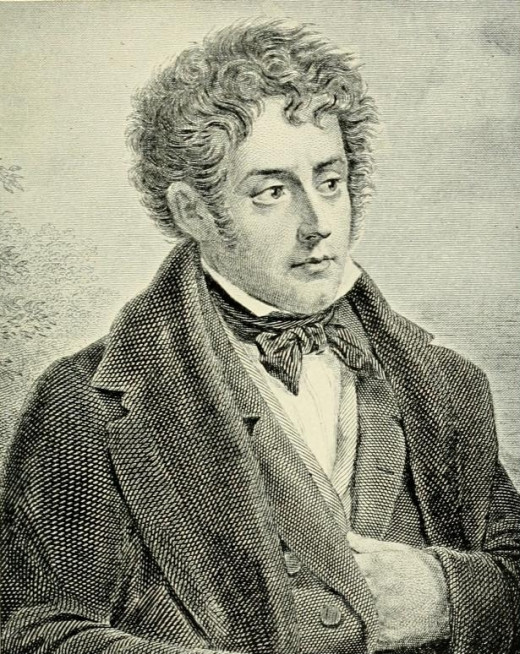
CHATEAUBRIAND
IV
"LE GÉNIE DU CHRISTIANISME"
Chateaubriand's book, Le Génie du Christianisme, which originally bore the significant title Beautés de la Religion Chrétienne, marks the transition from the first to the second stage of the reaction, because, cold and devoid of real feeling as it is, it is an attempt to vindicate and rehabilitate authority by means of an appeal to sentiment and imagination.
It was a defence of Christianity of a perfectly new species, from the fact that it appealed to imagination, not to faith; to sentiment, not to reason. It impresses one as being proffered under the conviction that reason was now inimical to Christianity, and that faith no longer existed.
The author, not many years before he wrote this work, had been a free-thinker, indeed a materialist. We have proof of this in some marginal notes in his own handwriting, discovered by Sainte-Beuve in a book which had belonged to him. Alongside of the words: "God, matter, and destiny are one," Chateaubriand has written: "This is my system; this is what I believe." Alongside of the following sentences: "You say that God has created you free. That is not the point in question. Did he foresee that I should fall, that I should be miserable to all eternity? Yes, undoubtedly. In that case your God is nothing but a horrible and unreasonable tyrant," we read in the margin: "This objection is irrefutable, and completely demolishes the whole edifice of Christian doctrine. But in any case it is doctrine which no one believes in now."
This is the standpoint of Chateaubriand's youth, but one to which he did not long adhere. He was too much the born doubter to be able to hold firmly to even a negative conviction. What there was of faith in the philosophy of the eighteenth century, namely, its belief in the steady progress of humanity, was probably what he first rejected, and on the loss of this conviction quickly followed the loss of all the rest. He himself attributes his conversion to the influence of his mother's dying prayer to him to keep to her faith. "I wept and believed," he says.
Himself converted, or half converted, by means of sentiment, he now endeavoured to influence others in the same manner. Although intellectual receptivity for the dogmas of Christianity was no longer to be looked for, it was surely still possible to arouse sympathy with its touching, noble poetry. It was an idea characteristic of both the period and the man, this of transforming the apology for Christianity into aesthetics. He devotes a whole chapter to the sweet, melodious music of the church bells. He describes the simple village church, with its feeling of innocence and peace. He presents us with pictures and symbols when we expect proofs. Bonald remarked that in books which were works of reason, such as his own, truth displayed itself like a king at the head of his army on the day of battle, while in books like Chateaubriand's Génie du Christianisme it had more resemblance to a queen on her coronation day, surrounded with everything magnificent and beautiful that could be got together. His meaning is that Chateaubriand aims rather at moving men than at convincing them. In private conversation he expressed himself more bluntly. He said: "I gave my pills as they were; he gave his with sugar."
Certainly no book affords a clearer indication of the want of serious reality in the religious regeneration of the day. Its point of view is that which men have agreed to call the romantic. It is to the past it turns, and as the Romanticist is a man of imagination, he sees the past in an imaginary light. The religion of the Romanticist is a parade religion, a tool for the politician, a lyre for the poet, a symbol for the philosopher, a fashion for the man of the world.
Like the German, the Danish, and, at a later period, the French Romanticists, Chateaubriand loves the mysterious. He begins his vindication of belief in authority by appealing to men's sense of mystery in life generally: "There is nothing beautiful or sweet or great in life that is not mysterious. The most wonderful feelings are those which at once move and perplex us. Bashfulness, chaste love, pure friendship, are full of mystery.... Is not innocence, which in its essence is nothing but holy ignorance, the most ineffable mystery? Women, the more admirable half of the human race, cannot live without mysteries." The transition from this to the dogmas of a so-called revealed religion strikes us as sudden.
De Maistre makes a somewhat similar use of mystery. When he has shown that such and such a social institution is inexplicable, he believes that he has proved it to be divine. There is, in his opinion, no reasonable explanation for hereditary royalty and hereditary nobility—which is proof sufficient that they exist by the grace of God. What is there to be said in defence of war? Hardly anything, thinks De Maistre; consequently war too is a mystery. A little reflection shows us the necessity of such argument. Authority demands mystery as its counterpart. Note what Michaud says in the dedication of his poem, "An Exile's Spring" (Le printemps d'un proscrit), 1803: "Society ought to have its mysterious side as well as religion; I have always thought that we should at times believe in the laws of our country as we believe in the commandments of God. In private as well as in public life there are things which a man does better if he does them without reflecting upon his reason for acting."
The style of Chateaubriand's work is dazzlingly brilliant. But for this it would not have created the sensation it did. It contains descriptions of nature, emotional outbursts, and some few sparsely scattered thoughts of real value. But all that is of genuine value from the literary and poetical point of view is to be found in the tales Atala and René, which, according to Chateaubriand's original plan, were to have formed chapters of the work—where they would have cut a curious figure among such chapters as those on missionaries and sisters of mercy. They were, preliminarily, sent out as feelers long before the main work, and they do not concern us now; we have studied them in their historical significance in their proper place.[1]
In Le Génie du Christianisme Chateaubriand did not, he has himself told us, endeavour to prove that Christianity is excellent because it comes from God, but that it comes from God because it is excellent.
He shows that men have been wrong in despising Christianity, that it has beautiful, noble, poetic qualities. He does not perceive that, even if he succeeds in proving in many instances the narrowness of view of those Encyclopedists whom he is continually attacking, this in itself is no manner of proof of the divine origin of religion.
The whole work is in reality an outcome of the dislike and contempt which he had gradually developed for the philosophy and literature of the eighteenth century. The spirit of this philosophy and literature now appeared to him to be fatal to all the higher desires and aspirations of the human soul. The eighteenth century had misunderstood feeling and poetry. Therefore what it had exalted must be condemned, and what it had dared to disdain must be exalted. And for what had it shown greater contempt than for Christianity!
Chateaubriand was not a man of a pious, but of an artistic nature; and he conceived a fruitful artistic idea. Perceiving that the classic period in France had reached the term of its natural life, he contended that the imitation of the works of heathen antiquity ought now to cease. It had gone on, at least in appearance, for not less than 250 years. Poets had neglected national and religious subjects for those of ancient mythology; by the end of the eighteenth century they were not even imitating antiquity, but the seventeenth-century authors of their own country. Now there had been enough of it; now it was time for France to dismiss mythology and have a literature inspired by its own history and its own religion.
In this roundabout way Chateaubriand arrived at his vindication of the beauty of Christianity, and of its superiority in artistic value to any of the heathen religions.
The nature of the vindication evidences the nature of the whole movement which the work inaugurates. Its æsthetic part is preceded by a dogmatic introduction which, in keeping with the rest of the book, aims at proving the beauty of the dogmas of Christianity. I adduce a few examples of the absurd results of this "how beautiful!" style of reasoning.
Of the sacrament of the Lord's Supper Chateaubriand writes: "We do not know what objections could be offered to a means of grace which evokes such a chain of poetical, moral, historical, and supernatural ideas, a means of grace which, beginning with flowers, youth, and charm, ends with bringing God down to earth to give Himself as spiritual sustenance to man." What objection indeed could be offered? None, if all this be true.
In spite of his æsthetic bias, Chateaubriand sets to work with a good deal of pedantry. Celibacy, as enjoined on the Catholic priesthood, is considered first from the moral point of view, and, thus considered, is denominated the most moral of institutions. A second chapter, with the somewhat comical title: "Virginity, considered from the poetical point of view," is devoted to the same subject. It ends with the following burst of eloquence: "Thus we see that virginity, beginning in the lowest link of the chain of beings (its significance among animals had been taken into consideration), makes its way upwards to man, from man to the angels, and from the angels to God, to lose itself in Him." In the original edition, as if this were not enough, there was added: "God is the great solitary, the eternal celibate of the universe." It is curious that no notice should be taken of His paternal relation to the second person of the Trinity. But this omission makes the appeal to the case of the Saviour the more effective. Chateaubriand says: "The law-giver of Christianity was born of a virgin and died virgin." And to this he adds: "Did he not intend thereby to teach us that the earth, as regarded human beings, was now, both for political and natural reasons, sufficiently populated, and that, far from multiplying the race, we ought rather to restrict its increase?"
We are struck dumb by finding Malthus's theory of population come out as the sum and end of this Christian Romanticism. Who would have believed that there was so much political economy in the Gospels!
On the subject of the Trinity we read: "In nature the number 3 seems to be the number superior to all others; it is not a product; hence Pythagoras calls it the number without a mother. Even in the doctrines of polytheistic religions we here and there come upon a dim intuition of the Trinity. The Graces chose its number as theirs."
Thus in Chateaubriand's imagination the Trinity is upborne by the three Graces as Caryatides. In keeping with this is his attempt to prove the divine origin of the cross from the existence of the constellation, the Southern Cross.
In keeping with his defence of Christian dogma is such a defence of the Christian form of worship as the following: "Speaking generally, we may answer that the rites of Christianity are in the highest degree moral, if for no other reason than that they have been practised by our fathers, that our mothers have watched over our cradles as Christian women, that the Christian religion has chanted its psalms over our parents' coffins and invoked peace upon them in their graves." If argument were required when it is perfectly self-evident that the same defence may be offered for any religion, we might urge that it is a very unsuitable one in this particular case, where the object in view was to induce sons to abjure the anti-Christian beliefs professed by their fathers.
No less droll are the arguments drawn from natural history to prove the love displayed in the order of the universe. Chateaubriand writes: "Is an alligator, is a serpent, is a tiger less loving to its young than a nightingale, a hen, or even a woman?... Is it not as wonderful as it is touching to see an alligator build a nest and lay eggs like a hen, and a little monster come out of the shell just like a chicken? How many touching truths are contained in this strange contrast! how it leads us to love the goodness of God!"
Chateaubriand is positively jocose in his attempts to prove the divine purpose evident in nature. He declares that the birds of passage come to us at a season when the earth yields no crops on purpose to be fed; and he maintains that the domestic animals are born with exactly the amount of instinct required to enable us to tame them.
When the Neo-Catholic authors embark on any subject connected with natural science, they at once become extremely comic. Any one interested should read (in his review of Bonald's La législation primitive) Chateaubriand's outburst of horror at having heard a little boy answer his teacher's question: What is man? with the words: A mammal. And in the same spirit De Maistre repeatedly asserts that the whole science of chemistry requires to be placed on a different, a religious basis, or declares his conviction that some honest scientist will certainly succeed in proving that it is not the moon, but God, who produces the ebb and flow of the tide, as also that water, which is an element, cannot be resolved into oxygen and hydrogen. He is of opinion that birds are a living proof of the incorrectness of the law of gravitation. In this connection one of the characters in his Soirées de St. Pétersbourg remarks that there is more of the supernatural in birds than in other animals, a fact witnessed to by the signal honour shown them in the choice of the dove to represent the Holy Spirit. That alligators should lay eggs, that birds should fly—such feats are miracles in the eyes of the Neo-Catholics.
On the dogmatic part of the work follows the æsthetic, which is the more important. In it Chateaubriand endeavours to prove that "of all the religions which have ever existed, the Christian religion is the most poetical, the most human, the most favourable to freedom, to art, and to literature—that to it the modern world owes everything, from agriculture to the abstract sciences, from asylums for the unfortunate to churches built by Michael Angelo and ornamented by Raphael—that there is nothing more divine than its morality, nothing more beautiful and noble than its dogmas and its rites—that it favours genius, purifies taste, approves and stimulates virtuous passion, invigorates thought, provides poets and artists with the noblest themes, &c., &c."
For two hundred years the great dispute had been going on as to the comparative superiority of the works of ancient and modern literature. It had occupied the minds of Corneille and Racine; it had produced the earliest translations of Greek and Roman poetry; and it had by slow degrees led the modern mind to recover its self-confidence, after the first overpowering impression of the grandeur of ancient literature had worn off. It was this two hundred years' long discussion which Chateaubriand revived in a new form, namely, as the question of the value of the Christian religion to poetry and the arts, compared with that of the old mythologies. In the most remarkable manner he ignores the fact that the great question in the case of a religion is not whether or in what degree it is poetical, but whether it has the truth on its side or not. Very remarkable, too, are the arguments to which he has recourse to support his assertions! He vaunts, for example, the æsthetic superiority of the Christian hell to the heathen Tartarus. Is it not infinitely grander—"poetry of torture, hymns of flesh and blood"?
He poetically jingles hell's instruments of torture, employs them as æsthetic rattles for the old, dull children of the new century, and brings into fashion a sort of drawing-room Christianity, specially adapted to the requirements of the blasés upper classes of France. In the seventeenth century men believed in Christianity, in the eighteenth they renounced and extirpated it, and now, in the nineteenth, the kind of piety was coming into vogue which consisted in looking at it pathetically, gazing at it from the outside, as one looks at an object in a museum, and saying: How poetic! how touching! how beautiful! Fragments from the ruins of monasteries were set up in gardens, with a figure dressed as a hermit guarding them; a gold cross was once more thought a most becoming ornament for a fashionable lady; the audiences at sacred concerts melted into tears. Men were touched by the thought of all the comfort religion affords to the poor and the suffering. They had lost the simple faith of olden days and now clung to externals, to the significance of the Catholic church in literature and art, its influence on society and the state. To make the antiquated principle of authority look young and attractive they painted it with the rouge of sentimental enthusiasm; but they only succeeded in making the principle that had once been so awe-inspiring, ridiculous.
Constant wrote his book on religion in the house of his friend, Madame de Charrière, Chateaubriand wrote his in the companionship of his devoted and intimate friend, Madame de Beaumont, who assisted him by searching for the quotations he required. His mind does not seem to have been taken up with his work to the exclusion of all mundane thoughts.
We know how grandiloquently Chateaubriand inveighed during Louis XVIII.'s reign against the married priests, in what a bitter spirit he stirred up the royalist and church party against them, how determined he was that they should be deprived of every sou of their pay, to punish them for having taken advantage of the laws of the Republic to marry like other citizens. Yet was not he himself, as the author of Le Génie du Christianisme (in the preface to which he writes of himself as "the humble Lévite"), a kind of priest, nay, more than a common priest? And was not he married, and that, too, without the aid of a priest? I draw attention to this because it is one of the thousand signs of something that is to be detected everywhere throughout this religious reaction, something to which I believe we are justified in applying, ugly as it is, the word "hypocrisy."
Such, then, is Chateaubriand's book, and such are the circumstances in which it came into being. To its unprecedented success and enormous influence it owes an importance greater than its proper due. It was the book of the moment; it smuggled in, well packed in sentimentality, that principle of authority which was soon to ascend the throne.
V
JOSEPH DE MAISTRE
The ascension was brought about by a man of a very different stamp.
Count Joseph de Maistre was born at Chambéry in Savoy in 1754. The De Maistre family, which belonged to the highest class of the bureaucracy, had immigrated from France at the beginning of the seventeenth century. In the boy's home his father's severe, imperious spirit, with its strong tone of old-fashioned piety, ruled supreme. Joseph, who was the eldest of ten children, was trained in such absolute obedience that even when he was at the University of Turin he never allowed himself to read a book without first writing to ask his father's permission. From a very early age he was devoted to serious study. He learned seven languages, which is an uncommon thing for a Frenchman to do even now, and was more uncommon then. He entered the civil service, became, like his father before him, a magistrate in his native town and a senator, and married at the age of thirty-two.
Two children had been born to him when the French Revolution broke out and made a complete change in his life. Savoy was incorporated with France, and to remain faithful to his king Joseph de Maistre gave up his home; he had to choose between becoming a citizen of the French Republic and having all his property confiscated, and he chose without hesitation. For a few years he lived in Switzerland. Here he wrote his first work, Considérations sur la France (published anonymously in London in 1797), and made the acquaintance of Madame de Staël. Though he considered that her head had been turned by modern philosophy (in his opinion an inevitable consequence in the case of any woman), he acknowledged her to be "astonishingly brilliant, especially when she was not trying to be so." They bickered and wrangled, but were none the less good friends.
In 1797, when the King of Sardinia was obliged to leave his continental territories and take refuge on his rocky island, Count de Maistre happened to be in Turin. He fled to Venice, arriving after many hairbreadth escapes, and there he and his family suffered great privations. From 1800 to 1802, as chief magistrate of Sardinia, he laboured hard to improve the slovenly administration of justice which he found prevailing there. In 1802 the deserted king sent him as envoy-extraordinary and minister plenipotentiary to St. Petersburg. His acceptance of this appointment obliged him to part from his wife and children, to whom he was tenderly attached. The pay was so miserable that it barely sufficed to cover his own necessary expenses—he could not afford to provide himself with a fur-lined coat. But in Russia, now passing through the most prosperous period of the reign of Alexander I, De Maistre's capacities found scope for development, and this poor ambassador of a petty power succeeded in winning the Emperor's entire confidence. The strength and purity of his character, his pronounced royalist and conservative views, his knowledge, his sagacity, and his wit ensured him a prominent place at a court whose sovereign knew how to appreciate both an uncommon character and remarkable talent.
Although by birth a Piedmontese, and as a diplomatist to a certain extent a cosmopolitan, Joseph de Maistre belongs by his language—and not by that alone—to French literature. All his literary theories were French, and there was much that was French in his intellectual idiosyncrasy. Not only was France always in his eyes the chief power in Europe, and the King of France, as "the most Christian king," the main bulwark of monarchy and Christianity, but he was at heart on the side of France even when it was for his ideas that her enemies were waging war upon her. In spite of everything he rejoiced when Republican France defeated the army of the allied monarchs. For what they desired was the division of France, the annihilation of its power. "But our descendants, who will think with indifference of our sufferings and dance upon our graves, will make very light of the excesses which we have witnessed and which have preserved undivided the most delectable kingdom after that of heaven." He desires the defeat of the Jacobins, but not the ruin of France, which would be equivalent to the inevitable intellectual relapse of the human race.
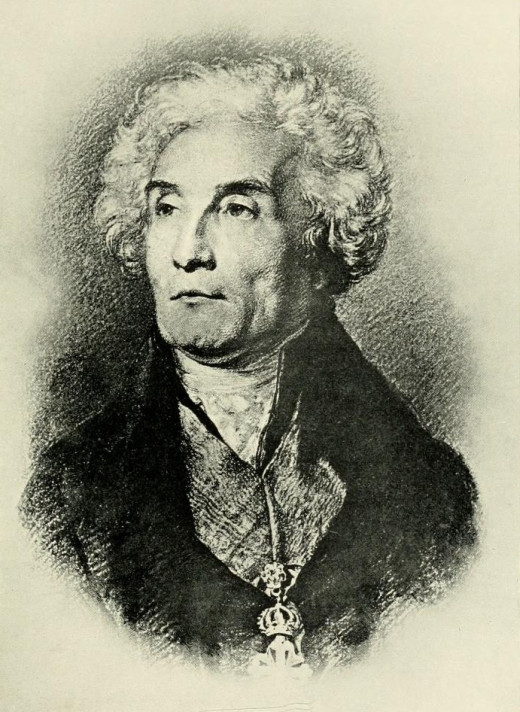
DE MAISTRE
In a manner he felt himself to be a Frenchman. All his life long he proclaims, and by his actions proves, himself to be the loyal subject and servant of the King of Sardinia; but, when he is more than usually ill rewarded for his services, the thought strikes him that it was really by a kind of mistake of nature that he was not born a Frenchman. We read in one of his letters (Correspondance diplomatique, i. 197): "I cannot get rid of the feeling that, let me do what I will, I am not the man to suit His Majesty. Sometimes in my poetic day-dreams I imagine that nature, carrying me in her apron from Nice to France, tripped on the Alps (a very excusable thing in an old lady) and let me fall into Chambéry. She ought by rights to have gone straight to Paris, or at any rate to have stopped at Turin, where I could have developed properly; but on the 1st of April 1754 the irreparable mistake was made. I discover in myself a certain Gallican element, for which, be it observed, I have all due respect." Thus it is not merely permissible but obligatory to set De Maistre's name first on the list of the men who brought about the powerful reaction in France against the fundamental ideas of the eighteenth century.
His first book, written in 1796, already shows the character of the reaction to which he gives expression, and which he endows with stubborn consistency. While the Revolution is still proceeding, but at the moment when the counter-revolution is beginning to make its influence felt, he eagerly vindicates the two powers which the century had repudiated—belief in the supernatural and fidelity to political tradition.
Maintaining that every nation, like every individual, has its mission to fulfil, he declares that France has guiltily abused the position of authority given to her in Europe. She stood at the head of the religious system, and not without reason were her kings called "the most Christian." As she has used her power to act in direct contradiction to her mission, it can surprise no one that she is being brought back to the right path by terrible chastisements. The French Revolution is marked by Satanic traits, which distinguish it from anything ever seen before and possibly from anything that will ever be seen again. Its so-called legislators have issued such a proclamation as this: "The nation supports no religion," words which would almost seem to indicate hatred of the Divine Being.
Even Rousseau, though he was "the most mistaken of men," perceived that it was only a narrow-minded and arrogant philosophy which could suppose the founders of such religions as the Jewish and the Mahometan to be nothing but lucky impostors. Philosophy is a disintegrating, religion alone an organising power. But no religion in the world can be compared with Christianity. It alone, although it is founded upon supernatural facts and is a revelation of incomprehensible dogmas, has been believed for eighteen centuries and been defended by the greatest men of all ages, from Origen to Pascal. Now it has been dethroned and its altars have been overturned. Philosophy reigns triumphant. But if Christianity issues from this ordeal purer and stronger than ever—then, Frenchmen, make way for the most Christian king, place him on his ancient throne, lift high his flaming banner (oriflamme), and proclaim that Christ commands, guides, and conquers!
There is no government but theocracy (priestly rule), and every constitution comes from God. A constitution is never the result of a contract, and the laws which rule the nations are never written laws, for those constitutions which are written are never anything but proclamations of older laws, of which all that can be said is that they exist because they exist. The constitution of 1795 is, like earlier revolutionary constitutions, made for man. But there is not such a thing as man: "In the course of my life I have seen Frenchmen, Italians, Russians, & I know, too, thanks to Montesquieu, that there are Persians; but man I have never met; if he exists, it is contrary to my knowledge." No; when the population, the customs, the religion, the geographical position, the existing political conditions, the good and bad qualities of a nation are known, then a constitution is the solution to the problem of finding the laws suitable for that particular nation.
De Maistre traces the probable course of the counter-revolution. He sagaciously demonstrates the unreasonableness of the supposition that it can only be the outcome of the will of the people. Very possibly a minority of four or five persons, he says, will give France a king. Letters from Paris will announce to the provinces that the country has a king, and the provinces will shout: Vive le roi! With his obstinate faith in providence he foretells the restoration (even in its details) at a time when all hopes of such an event seemed indeed to be built upon sand, and in process of so doing exhibits a fascinating combination of excessive enthusiasm for the pre-revolutionary conditions with a practical political sagacity which avoids any overstraining of principle that would make the restoration of these conditions impossible. On the delicate question, whether or not the restoration of the monarchy will entail the return of the national property to its original owners, he expresses himself with a caution which is strikingly at variance with the generally confident, defiant tone of the book. He explains that a revolutionary government is, by its very nature, an unsteady government. Under it nothing is certain. As the ownership of national property is not yet, in the opinion of the general public, free from the reproach originally attaching to it, a government which considered itself in no way debarred from undoing what it had done would in all probability lay hands on this property as soon as it could. "But under a steady, permanent government everything is permanent, so that even for the acquirers of national property it is important that the monarchy should be restored; they will then know what they have to rely upon." In other words, he has at least so much regard for actual circumstances as to acknowledge that it will not be possible to reign after the Revolution in exactly the same manner as before it.