GEORGE BRANDES (continued 3)
Mary Morison translation
His fundamental political doctrine is that the state is an organism, that as an organism it possesses real unity, and lives its life by virtue of a far-off past, from which it refreshes itself as from a perennial source, and by virtue of an inward, secret fountain of life. It is not the outcome of discussion and arrangement, but of an unfathomable mystery. Hence a written constitution signifies nothing. It is the soul of the nation which gives the nation unity and permanence, and this soul is the love of the nation for itself and its national memories. France is not thirty millions of human beings living between the Pyrenees and the Rhine, but a thousand millions who have lived there. Our country is nought else but the unity of those who live, those who have lived, and those who will live in the days to come on the same fragment of the earth's surface. The fact that one family is the symbol of the continued existence of this nation leads De Maistre to monarchy.
Sovereignty cannot be divided. Therefore the king does not share his power with the great of the land. These latter have no privileges, but they have duties. They form the king's council; they are guardians of the national unity, inasmuch as they unite the people to the throne, and guardians of the national continuity, inasmuch as they are the sustainers of tradition. It is their duty perpetually to proclaim to the people the benefit of authority, and to the king the benefits of liberty. The law is, as law, the same for all, therefore destitute of the pliability which is a necessity if freedom is to be granted and ensured. An enlightened autocracy secures liberty.
When Bonaparte appears and quickly develops into Napoleon, Joseph de Maistre is, naturally, his implacable enemy. Nevertheless, he recognises the autocrat in him. He feels that the unity of the French nation is embodied in him, and this though he regards him as the demonium meridianum (see Correspondance diplomatique, ii. 65). In July 1807 he writes: "In those newspapers which are his organs Bonaparte causes himself to be called the messenger of God. Nothing could be truer. Bonaparte comes straight from heaven ... as lightning does." In other words, De Maistre saw in the calamities which Napoleon brought upon Europe, as in all "heaven-sent" calamities, judgments, the justice of which did not diminish the guilt of those who executed them. In 1808, out of love for his country, he did violence to his own inclinations by endeavouring to obtain an audience of Napoleon for the purpose of pleading the cause of Sardinia. He took this step not in his capacity of minister, but privately and on his own responsibility. Napoleon, though he did not answer De Maistre's letter (written from St. Petersburg), was evidently impressed by the quality of the man; he ordered the French ambassador at the Russian court to show him favour, and did not take his audacity at all amiss. De Maistre's own court, however, did. It was intimated to him that the Cabinet, to which he had sent immediate notice of the measure taken, had been disagreeably surprised by it. He replies proudly and satirically: "The Cabinet has been surprised! The skies may fall—that is a matter of no consequence—but heaven preserve us from an unexpected idea! I am now more than ever persuaded that I am not the man you want. I can promise you to transact His Majesty's affairs as well as any man, but I cannot promise never to surprise you. That is a weakness in my character which I am incapable of curing." He proved the truth of what he himself somewhere says, that trusting to the constancy of court favour is "like lying down on the wing of a windmill to sleep soundly." When vindicating himself he writes: "I know everything that can be said against Bonaparte; he is a usurper, he is a murderer; but note well that he is less of a usurper than William of Orange and less of a murderer than Elizabeth of England. ... As yet we are not stronger than God, and we must come to terms with him to whom it has pleased God to entrust the power." (Lettres et opuscules, i. 114.)
Joseph de Maistre spent fourteen years of his life as envoy at St. Petersburg. The long separation from the female members of his family was very painful to him, and the cares of a father often weighed heavily on his mind. It is touching to read in one of his letters that when he was lying awake at night, over-tired with work, he often imagined that he heard his youngest little daughter, whom he did not know, crying in Turin.
As a proof of his favour and esteem for De Maistre, the Czar gave commissions in the Russian army to his brother and son. The brother was wounded during the campaign in the Caucasus. The son fought in the war against Napoleon. "No one," writes the father, "knows what war is unless he has a son fighting. I do what I can to banish the thoughts of hewn-off arms and smashed skulls that constantly torment me; then I sup like a youth, sleep like a child, and awake like a man, that is to say, early."
The great panegyrist of the executioner and the auto da fé had in private life a very tender heart. His private utterances often convey the impression of kindliness, as his public do of whimsical wit.
He perhaps shows most amiably in his letters to his daughter: "You ask me, dear child, why it is that women are condemned to mediocrity. They are not. They may become great, but it must be in a feminine way. Every creature ought to keep to its own place and not strive after advantages other than those which properly belong to it. I have a dog called Biribi, who is a great amusement to us all; if he were to take it into his head to have himself saddled and bridled to carry me out into the country, I should be as little pleased with him as with your brother's English mare if she were to take it into her head to jump on my knee or to sit down at the breakfast-table with me. The mistakes some women make come from their imagining that in order to rise above the common level they must act like men.... If twenty years ago a pretty woman had asked me: 'Do you not believe that a woman is just as capable of being a great general as a man?' I should have answered: 'Most undoubtedly I do, Madam. If you commanded an army, the enemy would fall on their knees to you as I do now, and you would enter their capital with drums beating and banners flying.' If she had said to me: 'What is there to prevent my knowing as much of astronomy as Newton?' I should have replied with equal sincerity: 'Nothing whatever, O peerless beauty! You have but to look through the telescope, and the stars will consider it an honour to be gazed at by your beautiful eyes, and will hasten to discover all their mysteries to you.' These are the things we say to women, both in prose and verse; but the woman who takes such speeches seriously is uncommonly stupid." After declaring that woman's mission is to bear and to bring up men, he adds: "But, dear child, I am for moderation in everything. I believe, speaking generally, that women ought not to aim at acquirements which are at variance with their duties, but I am far from thinking that they ought to be perfectly ignorant. I do not wish them to believe that Pekin is in France, or that Alexander the Great proposed marriage to a daughter of Louis XIV." And in a following letter he writes: "I see that you are angry with me for my impertinent attack on learned women. It is absolutely necessary that we should make friends again before Easter. The fact that you have misunderstood me ought to make the process easy. I never said that women were monkeys; I swear to you by all that is most holy that I have always thought them incomparably more beautiful, more amiable, and more useful; but I did say, and this I abide by, that the women who want to be men are monkeys; for wanting to be learned is wanting to be a man. I think that the Holy Spirit has shown His wisdom in arranging things as they are, sad as it may seem. I make my humble obeisance to the young lady you tell me of, who is writing an epic poem, but heaven preserve me from becoming her husband; I should live in terror of seeing her delivered in my house of a tragedy, or possibly even of a farce—for when talent has once set off, there is no knowing where it will stop."
"The best and most convincing observation in your letter is that upon the raw material employed in the creation of man. Strictly speaking, it is only man who is made of dust and ashes, or, not to mince matters, of dirt, whereas woman was made of a mire that had already been prepared and elevated to the dignity of a rib. Corpo di Bacco! questo vuol dir molto. You cannot say too much, my dear child, as far as I am concerned, about the nobility of women, even those of the bourgeois class; to a man there should be nothing more excellent than a woman, just as to a woman, &c., &c.... But it is precisely because of the exalted opinion I have of these noble ribs that I become seriously angry when I see any of them desiring to transform themselves into original mire. And now it seems to me that the question is completely disposed of." (Lettres et opuscules, i. 145, 156).
It surprises us to find the strictly orthodox Catholic jesting thus lightly with Bible legend; but even in his witty and sportive moods De Maistre is faithful to his reactionary principles. It is one of his characteristics that a certain piquant wit goes hand in hand with the violent, dæmonic energy of his attack, an energy which reveals itself even in the little fact that his favourite expression is à brûle-pourpoint (in its literal meaning—to fire with the muzzle of one's pistol upon one's antagonist's coat).
In the Soirées de St. Pétersbourg, in which he already writes of Bacon with some of that animosity to which he afterwards gave full vent in a large and erudite work, he makes a humorous observation which is quite in accord with the newest scientific view of the matter: "Bacon was a barometer that announced fine weather, and because he announced it, men believed that it was he who had produced it." And in a letter he writes: "I cannot tell how there came to be this war to the death between me and the late Lord Chancellor Bacon. We have boxed like two Fleet Street boxers, and if he has pulled out some of my hair, I imagine that his wig no longer sits very straight on his head."
When De Maistre is broaching his favourite theories, his humour is often very sarcastic, as, for instance, when he discourses, in the second part of the Soirées, on the ways of maintaining esprit de corps. There is much cynicism in such pleasantry as this: "To produce discipline and the feeling of honour in any corps or society, special rewards are of less avail than special punishments." He shows how the idea had occurred to the Romans of making military punishment a privilege—only soldiers had the right to be beaten with rods made of the wood of the vine. No man who was not a soldier might be beaten with such a rod, and no other kind of rod might be used to flog a soldier with. "I cannot understand how some such idea has not occurred to any of our modern rulers. If I were asked for advice on the subject, I should not go back to the vine rod, for slavish imitation is useless. I should suggest laurel rods." He further proposes that a great forcing-house should be erected in the capital, exclusively for the purpose of producing the necessary supply of laurel branches with which the non-commissioned officers are to belabour the backs of the Russian army. This forcing-house is to be under the supervision of a general, who must also be a Knight of St. George of the Second Class, at lowest, and whose title is to be "Chief Inspector of the Laurel Forcing-House"; the trees are to be attended to by old pensioners of unblemished character; models of the rods, which must all be exactly alike, are to be kept in a red case at the War Office; each non-commissioned officer is to carry one hanging by a ribbon of St. George from his button-hole; and on the façade of the forcing-house is to be inscribed: This is my tree, which brings forth my leaves.
De Maistre lived at St. Petersburg in great poverty, which he bore without being humiliated by it. He was distrusted and constantly left in the lurch by his ungrateful court, which did not even repay him the sums that from time to time he was obliged to advance out of his slender means to necessitous fellow-countrymen in Russia. During these years his theories matured and his intellectual idiosyncrasies became more marked. The letters, private as well as diplomatic, which he wrote at this time give us an excellent idea of the spirit and the general conditions prevailing at the court of Alexander I. Those written previous to and during Napoleon's campaign in Russia are especially interesting from the graphic impression they give of the fears, hopes, panics, and rejoicings produced at that time throughout the Russian empire by war news, whether true or false. At first De Maistre is in great anxiety about the issue of the war. He clearly sees the incompetence of the generals who are appointed to direct the operations against such a leader as the Emperor of the French. But from the moment when it is known how ill-equipped the French army is to face the Russian autumn, not to mention the Russian winter, he is no longer in doubt; he foresees that Napoleon's fall and the restitution of all his conquests—events which he had long regarded as certain to happen sooner or later—are close at hand.
Six of De Maistre's works were written at St. Petersburg. Of these Du Pape, De l'Église Gallicane, Examen de la Philosophie de Bacon, and Soirées de St. Pétersbourg are the most important and the most characteristic of their author.
The Soirées contain the ideas on the subject of God and the world upon which his theory of the state is based. Anticipating the objection that the authority of his absolute monarchs rests upon no foundation, that they are utterly irresponsible, that, in other words, autocracy is unjust, he meets it with the preliminary general answer that injustice is the law of every society, because it is the law of all life on earth. In nature itself might is right—with the right of the stronger, plants and animals are perpetually destroying one another. And this law: Might is right, is far from losing its validity in the world of man; here also it prevails, as the law of war. War is a perpetually recurring phenomenon in the life of the human race. Except for a few years in each century, it has raged from the most ancient times until now, and it will continue to do so. Human blood will always be flowing upon earth. For the chastisement of heaven is upon man. To this conception of war the military profession owes the high position it holds and always has held. No trade is considered so honourable as that of the soldier. The human race, taken as a whole, is guilty and deserves the scourge of war, unjustly though the punishment may fall in single cases.
It is, then, as the representative of God upon earth that the autocrat is, in the first place, the war-lord, in the second, the possessor of the divine and terrible prerogative of punishing the guilty. This prerogative necessarily entails the existence of a man whose profession it is to execute the punishments ordained by human justice. And such a man is always to be found—a strange and inexplicable fact, for our reason is at a loss to discover any motive which can lead a man to choose such a profession. Hence the character who is the mouthpiece of De Maistre's own opinions is inspired with a feeling of awe and reverence by the much misjudged executioner.
According to the general, and, in De Maistre's opinion, entirely justifiable verdict, every soldier, simply as such, is so noble that he ennobles even those actions which are generally regarded as the most degrading; he may exercise the calling of the executioner without suffering the slightest degradation, so long as he only carries out the sentence of death upon members of his own profession and uses no other instruments for the purpose but its weapons. It is not without its significance that on every page of the Old Testament shines the name, the Lord of Hosts. No action is more inseparably connected in men's minds with honour than the innocent shedding of innocent blood. It is in the very passion of carnage that De Maistre admires the soldier most. Such a thing has never been known as an army refusing to fight. It is an irresistible impulse that drives men onward into battle. And why is this so? In order that to the end of time there may be fulfilled that law of the violent destruction of living beings which extends throughout creation, from the lowest animal to man.
But although from time immemorial there has been no calling more honourable than that which involves the shedding of innocent blood, a remarkable prejudice has caused the calling of the executioner to be as much disdained as the soldier's is respected.
De Maistre inquires if this man who, in preference to all profitable and honourable callings, has chosen that of torturing and killing his fellow-men, is not really a being of some peculiar and higher kind. And in his dialogues the Count, who is his own mouthpiece, answers:—
"I myself have no doubt on the subject. Outwardly, he is formed like ourselves; but he is an abnormal being, and it is only a special act of creative power which can add such a member to the human family. He is like a world in himself. All shun him; his house stands in a desert place, every one withdrawing as far as possible from the spot where he lives with his mate and his young ones, whose voices are the only cheerful human sounds that fall upon his ear; but for them he would hear nothing but shrieks of agony.... A sinister signal is given. One of the lowest menials of justice knocks at his door and informs him that his services are required; he sets off; he arrives at a public place where human beings are crowding together in excited expectancy. A prisoner—a parricide, a committer of sacrilege—is flung at his feet; he seizes this man, binds him to a cross which is lying on the ground, then raises his arm—the terrible silence that follows is only broken by the sound of the crashing of bones under the blows of the iron mace and the screams of the victim. He unbinds the man; he carries him to the wheel; the broken limbs are twined round its spokes, the head hangs down, the hair stands on end, and from the mouth, open like the opening of a glowing furnace, there come at intervals a few broken syllables of entreaty for death.—He has finished his task; his heart is beating, but it is with pleasure; he is satisfied with his work; he says in his heart: No man breaks on the wheel better than I. He comes down from the scaffold and holds out his bloody hand, into which, from as great a distance as possible, the official whose duty it is to pay him flings a few gold pieces, with which he marches off between two rows of human beings who shrink from him with horror. He sits down to table and eats; he goes to bed and sleeps; and when he awakes next morning his thoughts run on everything but his occupation of the day before. Is he a man? Yes. God allows him to enter His temples and accepts his prayer. He is no criminal, and yet in no human language is he called honourable or estimable."
"Nevertheless all greatness, all power, all order depend upon the executioner. He is the terror of human society and the tie that holds it together. Take away this incomprehensible force, and that very moment order is superseded by chaos, thrones fall, and states disappear. God, who is the source of the power of the ruler, is also the source of punishment; He has suspended our world upon these two poles, for the Lord is the Lord of the poles, and round them He sets the world revolving."
And in order that this reverence for the office of the executioner which it is in keeping with his plan to inculcate, and which it entertains him to astound with, may make a proper impression on the reader, De Maistre takes up the subject again in one of the later conversations. He asks what a reasoning being coming from another world to investigate into the conditions prevailing in ours would think of the executioner, and himself gives the answer: "He is an august being, the corner-stone of society. Since crime has undoubtedly taken up its abode upon earth, and since it can only be kept in check by punishment, it is plain that, if the executioner disappeared, all order would disappear with him. And what greatness of soul, what noble disinterestedness must we presume that man to be possessed of who takes upon himself the execution of a task which, though certainly a very honourable one, is most painful and repugnant to human nature, &c."
In these utterances we have at one and the same time the delight in consistency which is to be observed in the earliest nineteenth-century devotees of the principle of authority, the delight in a disconcerting idea which is one of De Maistre's own chief mental characteristics, and the delight in describing suffering which he has in common with Görres and so many of the other champions of the gloomy doctrine of the necessary subjection of humanity to kings and priests.
De Maistre resents hearing men so often talk as if crime went unpunished. What do they mean by this? "For whom are the gallows, the knout, the wheel, and the stake and fagot provided? Surely for the criminal." Justice may sometimes miscarry, but such exceptions do not alter the rule. It is folly to believe in all the judicial murders one hears talked about. Take the frequently quoted case of Calas. Nothing is more doubtful than his innocence.
The very fact that Voltaire defended him speaks against it.
But given the worst—that an innocent man is deprived of his life—why, it is simply a misfortune like any other. When a guilty man escapes we have another exception and misfortune of the same kind. The events which lead to the discovery of a crime are, however, often so unexpected and improbable that we cannot but believe that human justice is supported by higher aid. And all the time that we are foolishly blaming human justice for having punished an innocent man, nothing is more probable than that he really is guilty, though of some other, unknown crime. Many such cases are on record, the truth coming to light through the confession of the criminals. De Maistre, we observe, understands how to extricate himself from a difficulty.
Something of the same nature holds good in the matter of sickness. Its injustice, too, is only apparent. If every kind of intemperance could be prevented, most, nay, in reality all diseases would be done away with. This inference may be arrived at by arguing as follows: If there were no moral evil in the world there would be no physical evil, and since an infinite number of diseases are direct consequences of certain offences, it is permissible to generalise and say that this holds good of them all.
Everything, then, is ordered upon moral principles. It is undeniable that life is a terrible thing, but this does not prove that God is unjust; he is offended, he is insulted, and to appease his anger blood is required. Man early comprehended his own fall, early understood that it is the innocent who must and alone can, by the transference of merit, atone for the sins of the guilty, that there is no salvation without the shedding of sacrificial blood.
Hence the idea of sacrifice is one of perpetual and keen interest to De Maistre. Sacrifice is ideal slaughter, slaughter the one and only aim of which is the accomplishment of what is right and meet. From the earliest ages men have offered both animal and human sacrifices; and in Christianity the practice is sanctified and acquires a deeper meaning. Here it is not any chance and possibly guilty individual who is the victim, but a being who is elected to die because of his innocence. This, therefore, is ideal sacrifice.
All this is undoubtedly an offence to reason. But contrariety to reason is the sign and seal of truth. The theory which is the most obviously reasonable is the theory which never stands the test of practice. Nothing could be more obviously reasonable than the whole philosophy of the eighteenth century, with its faith in man and its liberalism. But its very reasonableness bespeaks its superficiality. It satisfies reason; but experience opens men's eyes to its futility. Nothing seems more self-evident than that man is born free. Yet when Rousseau writes: "Man is born free, nevertheless he is everywhere in fetters," he does not notice that he is not only writing nonsense, but distinctly affirming that he is doing so. It would be quite as sensible to say; Sheep are born carnivorous, nevertheless they everywhere live on vegetable food. In the same way, nothing is theoretically more unreasonable than hereditary monarchy. If, without any previous experience, men were called on to choose a government, that man would be thought mad who hesitated to give an elective monarchy the preference over a hereditary one. And yet we know from experience that the latter is the best, the former the worst form of government. In other words, the world, far from being a reasonable world, is full of things that are profoundly at variance with reason.
Christianity, the Christian conception of life, is therefore no new, hitherto unknown conception. It is connected by many links with the whole succession of heathen religions, and is prepared for by them. All the truths of Christianity are foreshadowed in the creeds of heathendom. In heathen sacrificial practices, for instance, we already have the essential idea of sacrifice. And De Maistre waxes wroth over Voltaire's violent, irreligious tirades against the sacrificial festivals of the old pagans. He is yet more exasperated when, at the end of a description of a sacrifice of both adults and children, he comes upon the words; "However, the sacrifices of the Inquisition, of which we have so often spoken, are a hundred times more execrable."
It is apropos of this utterance that (in his essay Éclaircissement sur les sacrifices) De Maistre first takes up the cudgels for the Inquisition, to the defence of which institution he was ere long to devote a special work. He writes: "The passage relating to the Inquisition appears to have been written during an attack of delirium. What! The lawful execution of a small number of human beings, condemned to death by a fully qualified court of justice according to the strict letter of a penal law which had previously been solemnly proclaimed, and which each one of the victims was perfectly free to avoid transgressing—to call such an execution a hundred times more abominable than the horrible act of the parents who cast their children into the flaming arms of Moloch! What wild insanity! What forgetfulness of all reason, all justice, all shame!" De Maistre storms thus because he is here attacking the man who was his opposite, and who fought, like himself, with the weapons of wit and paradox, but wielded them with far greater power.
Founding his theory of the state upon the basis of religion, De Maistre derived the power of the ruler from God. It is from God that kings receive their rights, and to God that they owe duty. It is not the king's power but his duty that is absolute, for it is duty to the Absolute. The rights of the people may be called the duty of the king to God. In the proverb: "The voice of the people is the voice of God," there is this truth, that the rights of the people are the rights of God in His relation to the king. And "the voice of God" is not a mere figure of speech; the living voice of God speaks through the church. The king is responsible to God, and the church is the depositary of divine truth. But the church, as well as the state, is under the rule of an autocrat. As the state means the king, advised and guided by the great men of his country, so the church means the Pope, advised and guided by cardinals and bishops. The very idea of sovereignty implies that the king is absolute, the Pope infallible. People are not surprised that the captain of a ship should be, as such, an infallible sovereign, should permit no criticism of his orders, should issue unqualified commands and require them to be obeyed blindly; yet they are surprised that in all church matters the Pope should be infallible. They are accustomed to the idea that all the other courts of justice, low and high, are submitted to the jurisdiction of a highest court, the judgments of which are irreversible and may not be criticised; yet they are astonished that the Pope, as head of the church, is infallible. If they had any conception of what sovereignty means, they would not be astonished. A skilful attempt, this of De Maistre's, to prove to laymen the reasonableness of ecclesiastical dogma.
In his book Du Pape, which Catholics consider a work of the first importance, he carries his reasoning on ecclesiastical matters to its logical conclusion.
This book was the outcome of the remorse he felt for having, at a trying moment, forgotten the reverence due to the head of the church. When, three years after the conclusion of the Concordat, the Pope went to Paris, at Napoleon's request, to anoint and crown him Emperor, Joseph de Maistre, the ardent royalist, was so incensed that in various letters to his court he used such language in writing of the Holy Father that his Mémoires et correspondance diplomatique of these years were published by Cavour in 1858 with the view of depriving the papal power of a spiritual ally. In the course of a few years Napoleon and the Pope quarrelled, and when De Maistre saw the Pope insulted and ill-used by the Emperor, he repented his hasty words, and resolved to make ample reparation.
The fundamental idea of Du Pape is that there is no human society without government, no government without sovereignty, and no sovereignty without infallibility. This attribute of infallibility is so indispensable that men are obliged to assume its existence even in secular societies (where it does not exist) on pain of seeing these societies dissolved. The church lays claim to no more than do the other authorities, although it has this immeasurable advantage over them, that its infallibility is not only taken for granted by man, but also guaranteed by God.
De Maistre writes: "A great and powerful nation has lately, before our own eyes, made the most strenuous efforts in the direction of liberty which the world has ever beheld. What has it gained by these? It has covered itself with ridicule and shame, and has ended by setting a Corsican gendarme on the throne of the kings of France." He shows how the Catholic religion necessarily forbids every kind of revolt, whereas Protestantism, which is a result of the sovereignty of the people, leaves the decision of everything to private feeling—a supposed species of moral instinct. "There is such accordance, such a strong family likeness, such interdependence between the papal and the kingly power that the former has never been shaken without the latter suffering too." As a proof of this he quotes the following utterance of Luther: "Princes are as a rule the greatest fools and the most arrant rogues on the face of the earth; nothing good can be expected from them; they are God's executioners, whom He employs to chastise us." He avers that Protestantism, which has no reverence for royalty, has no respect for marriage: "Had not Luther the audacity to write in his exposition of the book of Genesis (1525) that the example of the patriarchs leaves it an open question whether or not a man may have more than one wife, that the thing is neither sanctioned nor forbidden, and that he, for his part, will not take it upon him to decide one way or other?—edifying doctrine, of which practical application was soon made in the family of the Landgrave of Hesse-Cassel." (Luther gave his consent to this prince having two wives at the same time.)
In opposition to Rousseau's doctrine De Maistre maintains that man is by nature a slave, but that Christianity has, in a supernatural manner, emancipated him. For this reason he calls the Christian woman a truly supernatural being. Voltaire he without more ado calls the man "into whose hands hell has given all its power." And he puts the crowning touch to his work by propounding the following theory: "Monarchy is a miracle, and instead of reverencing it as such, we rail against it as tyranny. The soldier who does not kill a man when commanded to do so by his lawful sovereign is not less guilty than he who kills without having received orders to do so." Those states which have introduced Protestantism have been punished by the loss of their monarchs. De Maistre has discovered that the average length of reigns is shorter in Protestant than in Catholic countries. The one inexplicable exception to this rule is provided by Denmark, which is the only Protestant country whose sovereigns live as long after the Reformation as before it. "Denmark appears, from some unknown reason, but doubtless one honourable to the nation, to have been exempted from this law of the shortening of reigns."[1]
The fifth book of the earliest edition of Du Pape was afterwards published as a separate work. It is the well-known De l'Église Gallicane, a treatise in which De Maistre draws from the doctrine of papal authority conclusions utterly subversive of the claim of the French church to relative independence. On this occasion he assumes an antagonistic and supercilious attitude towards Bossuet, a man for whom he generally has nothing but praise. The special object of his attack and invective is the Church Council held in France in 1682 for the purpose of strictly defining the limits of the Pope's power. He is almost as much incensed against that of 1700, which pronounced Jesuits and Jansenists to be equally blameworthy. It is to a life-long enthusiasm that De Maistre here gives expression. From his youth he had been the devoted friend, admirer, and supporter of the Jesuits. His diplomatic letters from Russia tell of his constant endeavours to be of assistance to them in their difficult position as Roman Catholics in a Greek Catholic country, of his anxiety to shield them when the court is exasperated by their efforts to convert members of the aristocracy, &c., &c. He now, as their champion, attacks Pascal. His attack is not made from the standpoint of philosophy, as it easily might have been, in so far as their sensible apprehension of the fact that there can be no other morality except morality of intention gives the Jesuits in certain ways the advantage over the man of genius who impeached them. Nor is his defence of the Jesuits conducted altogether from the standpoint of the man of the world, as it might well have been, in so far as the Jesuits, with their modification of principles and their practical indulgence, have followed the prudent rule that it is unwise to alarm and better to have some of the moral law fulfilled by demanding little than none by demanding all. He contents himself with maintaining that the Jesuit treatises on morality attacked by Pascal are obsolete, unread books, which Pascal dragged from their mouldy obscurity with the sole aim of insulting and injuring an order, the strict morality and stern self-discipline of which even its enemies had been forced to admit. Then, by way of variety taking up for a moment the standpoint of the worldling, he remarks humorously: "It is, when we come to think of it, very comical that we worldlings should take upon us to inveigh against the lax morality of the Jesuits. This much is certain, that the whole aspect of society would be changed if every member of it acted up even to Escobar's moral standard, and were guilty of no shortcomings other than those excused by him."
It was very natural that the energetic champion of the ideas of the past should, towards the close of his career, make a special effort to clear the reputation of the great, misunderstood, misjudged Inquisition. This he did in his Letters to a Russian Nobleman on the Subject of the Spanish Inquisition. In these letters De Maistre says everything that can be said in vindication and in honour of the Inquisition; yet in reading them we are irresistibly reminded of the remark of the old tiger in the Hitopadesa: "Nevertheless," says the tiger, "nevertheless, it is difficult to prove the falsehood of the report that tigers eat men." De Maistre shows that many of the assertions made of the Inquisition are incorrect; he proves, for instance, that it was a secular, not an ecclesiastical court of justice. But the only part of the book that has any attraction for us is that in which he defends its proceedings. He says: "In Spain and Portugal, as elsewhere, every man who lives quietly is unmolested; as to the rash person who attempts to teach others what to believe, or who disturbs public order, he has only himself to blame.... The modern propagator of heretical doctrine, haranguing at his ease in his own room, is quite untroubled by the knowledge that Luther's line of argument produced the Thirty Years' War; but the old legislators, who knew the price men might have to pay for these fatal doctrines, most justly punished with death a crime which was capable of shaking society to its foundations and bathing it in blood.... It is thanks to the Inquisition that for the last three hundred years there has been more happiness and peace in Spain than anywhere else in Europe."
To the Letters De Maistre has prefixed a quotation, which is to the effect that all great men have been intolerant, and that it is right to be so. "Let him who comes across a well-intentioned sovereign," says Grimm, the Encyclopedist, "preach tolerance in matters of faith to him, so that he may fall into the snare, and, by his toleration, give the persecuted party time to recover and prepare itself, when its turn of power comes, to crush its opponent. Voltaire's discourse, with its babble of tolerance, is a discourse only for simpletons and those who allow themselves to be fooled, or for people who have no interest in the matter."
A gross fallacy conceals itself in this argument. Every genuine, overpowering enthusiasm naturally makes tolerance impossible. Yet Voltaire's doctrine is none the less valid because of this. The difficulty is easy of solution. The principle of intolerance is the theoretical, that of tolerance the practical, principle. In theory no consideration, no toleration, no mercy! For error must be crushed and torn asunder, follies must be blown from the cannon's mouth, and lies flayed alive. But what about the liar, and the fool, and the erring one? Are they also to be hewn asunder, or flayed alive, or blown from the cannon's mouth? They are to go their way. The domain of real life is the domain of tolerance.
De Maistre's Examen de la philosophie de Bacon was not published until after its author's death. It is the most disputatious and tedious of his works, and one in which the combative champion of Christianity is plainly grappling with a subject that is beyond his powers. He desired to confute Bacon because he believed that the ungodliness of the French philosophy of the eighteenth century was entirely to be ascribed to his influence; and he falls upon him with positive theological fury, attacking all his theories—his theory of consciousness, of nature, of light, of the weather, of the soul, of religion; attacking him where he is right, and where, for once in a way, he is wrong; finding him out in immaterial and merely superficial inconsistencies; pointing out defects in his Latin and in his taste; fighting in a noisy, violent, dogmatic manner, with weapons drawn from the arsenals of supernaturalism and tradition. In single chapters, such as that on Causes Finales, he displays a certain futile acuteness; in others, such as that entitled Union de la Religion et de la Science, cold-blooded fanaticism. In this latter chapter we read: "Science undoubtedly has its value, but it is necessary that it should be kept within bounds.... It has been very aptly said that science resembles fire: confined to the hearths which are destined to receive it, it is man's most useful and powerful servant; left to the hazard of chance, it is a terrible scourge."
Faithful to his rule of allowing no stain to cling to the shield or sword of the church, he vehemently maintains (contradicting an assertion of Bacon's French translator) that the church has never opposed the progress of natural science. The translator had plainly affirmed that nothing had injured the church more than the clear demonstration of the truth of certain facts which it had long denied, and the proclaimers of which it had actually persecuted; and he had named Galileo as an example. After lauding the church as the patron of science in other cases, and trying as far as possible to explain away the case of Galileo, De Maistre is forced to make an admission. And this is how he does it: "Galileo was condemned by the Inquisition, that is to say, by a court liable to err like any other, and which in this case actually was mistaken regarding the main point at issue; but Galileo in numberless ways damaged his own cause, and by his own repeated indiscretions brought upon himself a humiliation which he might easily, and without dishonour, have avoided.... If he had kept his promise not to write, if he had not been determined to find proof in Holy Scripture of the truth of the Copernican theory, if he had even written in Latin instead of unsettling the public mind by employing the vulgar tongue, nothing would have happened to him."
To the end De Maistre was true to his character; he would not yield a foot of the ground that had been lost centuries before.[2]
He is a great and fascinating personality, this successful advocate of a lost cause, which unmistakably gained ground during his lifetime. As the upholder of authority, of monarchy, and of the gloomy view of life, as the disputant, as the knight of Christianity, and as the scorner of science, he has a faint resemblance to Kierkegaard. But his system is an edifice of ideas relating to the outer, Kierkegaard's one of ideas relating to the inner, world.
De Maistre is the thoroughly convinced and vehement, yet cold-hearted champion of the principle of authority. There is heart in his letters, but there is none in his books. In them there is nothing but heated argument, propounded with much subtlety of logic and pungency of wit. In his sarcasm he often reminds us of Voltaire, and his grim delight in horrors at times recalls Swift. It gives him pleasure to astonish and to irritate. He loves paradox, because it makes him feel his superiority, because it perplexes the reader, and because it makes attack difficult, paradox being a redoubt which one can without dishonour evacuate before the assault.
His Christianity is an entirely external thing. He is a Christian as a man is a Protectionist or a Free-trader, on grounds of general theoretical conviction. His Christianity is a Christianity without brotherly love—nay, it is a Christianity without Christ as saviour and reconciler. In it Christ is only the sanguinary sacrifice demanded by the offended Deity—like Iphigenia or Jephthah's daughter. Faguet has aptly said that De Maistre's Christianity is "fear, passive obedience, and state religion." It is a Christianity which does not originate in Jerusalem, but in Rome; and he himself "is something in the nature of an officer of the Pope's bodyguard."
The most ardent assailant of the spirit and philosophy of the eighteenth century, the century in which he was born, has this in common with it, that he is destitute of the proper apprehension of history. He would fain ignore the eighteenth century, just as it was fain to ignore the Middle Ages. He is the counterpart of the woman who represented the goddess of reason—he is the man who represents the principle of authority pure and simple, without any historical qualification. And at heart he is as devoid of religious feeling as the century which he attacks in the name of revealed religion.
Hard and cold, with a sarcastic and at times a cruel expression on his countenance, but noble in character and strong of will, he stands at the threshold of the new century like—if not the good, at least the best spirit of the great, universal reaction. There is no possibility of confusing him with the dwarfish figures who during the course of the century have diluted his ideas, taken the sap and strength out of his thoughts, and torn and twisted his doctrines in order to oppress and dissemble under cover of them. Joseph de Maistre was a mind, these others have only been bodies. He was a man without baseness and without hypocrisy, a colonel of the Papal Zouaves as litterateur, the most soldierlike and the most attractive figure which the reactionary camp of the century has to show.
VI
BONALD
Side by side with Joseph de Maistre stands Bonald, the famous medieval schoolmaster of the European reaction, a man with the same bent of mind and the same practical aims, but as monotonous as De Maistre is versatile, as conventional as De Maistre is wittily fantastic.
Louis Gabriel Ambroise, Vicomte de Bonald, was born in 1754 (the same year as De Maistre) at Monna, in the south of France. He began life as an officer in Louis XV.'s musketeers. During the first stage of the Revolution he favoured liberal ideas, but only for a short time. He married early, and was made chief magistrate of the Department of Aveyron, an appointment which he resigned when Louis XVI. found himself obliged to consent to the subjection of the clergy to the secular laws. In 1791 he emigrated, and joined the army of the Prince of Condé. He wrote his Théorie du Pouvoir at Heidelberg. The police of the Directory destroyed almost the whole first edition of this book, but a copy which had been sent to Bonaparte luckily reached its destination and made such a favourable impression on the great man that he removed its author's name from the list of exiles. Not unprofitably had Bonald taught that every revolution is begun by the subject but ended by the ruler, that it begins because the authorities have been weak and have yielded, and ends because they have recovered strength. He had shown that all disturbance only serves to strengthen authority, and prophesied that the Revolution, which had begun with the declaration of the rights of man, would end with the declaration of the rights of God. These latter being the very rights which Bonaparte, by means of his Concordat, was now proclaiming, Bonald's position was assured. He remained devotedly attached to the Bourbons, but was content to dream of them in an appointment conferred on him by the Emperor. He was made conseiller tutélaire of the University, with a salary of 12,000 francs a year for doing nothing. Chateaubriand reviewed his books with reverent admiration. De Maistre wrote to him after the publication of his Recherches Philosophiques; "Is it conceivable that nature has amused herself by tuning two strings until they are in as perfect harmony with each other as your mind and mine? If certain manuscripts of mine are ever printed, you will find in them almost the same expressions you yourself have used, and yet I certainly have altered nothing." In another letter he expresses himself even more strongly: "I have thought nothing which you have not written, and written nothing which you have not thought." Bonald felt himself flattered by these assertions, though he doubted their truth—and this with good reason, for, similar as are the results arrived at by these comrades-in-arms, there is little resemblance between their mental processes.
A proof of the high estimation in which Bonald was held is to be found in the touching letter in which Napoleon's brother, Louis, King of Holland, entreats him to undertake the education of his eldest son. Louis begins by telling what a complete invalid he himself is, how dearly he loves his son, how imperative it is that this son should be educated by a man, in the fullest acceptation of that word, in order that he too may become one. Then he says: "Although I do not know you personally, my investigations have led me to the conclusion that you are one of the men whom I esteem most highly. Therefore you will pardon me that now, when I have to choose the person to whom I must entrust what is more to me than life, I apply to you. If the happiness which you doubtless enjoy in a peaceful home has not made you indifferent to the service you are capable of rendering—I do not say to me, a single individual, but to a whole nation which is even more deserving than it is unfortunate (and that is saying much)—you will consent to become my son's tutor." And he concludes in the same strain, defending himself against slanders which he imagines may have reached Bonald's ears. With such humility did a king appeal to this man—and in vain; he refused the request.
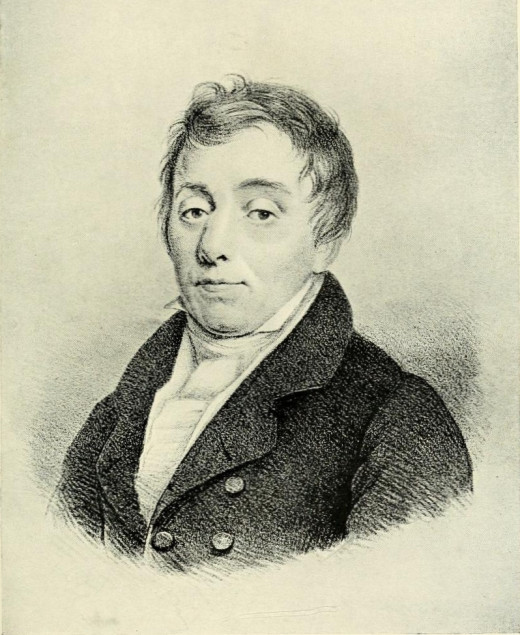
BONALD
A still more remarkable instance may be adduced of the importance at that time attributed to the influence of a determined upholder of authority of Bonald's calibre. One day Bonald received a note requesting him to call upon Cardinal Maury, an ecclesiastic whose position under the Empire was a very different one from that of the days when he argued in the National Assembly against the civic rights of the Jews. When they were alone, the Cardinal asked Bonald what his answer would be if the Emperor requested him to undertake the education of the King of Rome. For a moment Bonald was silent, astonished by the honour shown him. He then gave, it is said, the discouraging answer: "I confess that, if I ever taught him to rule, it would be in any place but Rome." After the restoration of the monarchy no one did more than Bonald to ensure that Rome and its spirit, the principle of authority, should rule in place of being ruled. All his life long he had opposed the liberty of the press. He attained to the position of its censor.
In 1815 he was elected to the Chamber of Deputies, where he sat on the extreme Right. Under Louis XVIII, he was made a member of the Academy and a peer of France, in which latter capacity he obstinately opposed liberty of religion and liberty of the press. In 1830 he retired from public life because it was against his conscience to swear allegiance to the monarchy of July.
Any one taking up Bonald's works directly after De Maistre's will have difficulty in wading through them. For nearly all of them are deadly dull. There are no human beings in his books, nothing but doctrines, and Bonald's doctrines consist of theologico-political propositions, which we are required to accept without proof. One cannot imagine a mind with a more implicit belief in dogmas, that is to say, a mind which more entirely ignores realities and scientific thought. He seems never to have doubted. Never once during his long career as an author does it appear to have entered his mind to question any one of the few simple fundamental principles on which he bases his theories. These principles are to be found in his works in a petrified form—speaking exactly, in the form of triads. Like the scholastics of the Middle Ages before him, like Hegel after him, Bonald thinks in triads, only he thinks without any perception of the two-sidedness of ideas, without flexibility, without inspiration. All relations are by him reduced to the great triad of cause, means, and effect. In the state we have power as the cause, ministers as the means, and subjects as the effect. In the religious world we have the triad—God, Jesus the Mediator, and man. In another acceptation Jesus is himself power, minister, and subject—power by his thought, minister by his word, subject as sacrifice. In the political sense, too, he is power, minister, and subject—power as King of the Jews, minister as priest, subject as the submissive martyr.
In the family, in society, in the state, in the universe, the same tri-unity is demonstrated; and all this is done with the aim of proving the necessity and the truth of monarchy. Monarchy is a true thing because it is founded on the principle by which the world is ordered. The universe is monarchic. Hence revolutionists and republicans, who have dared for the moment to abolish monarchy, have actually been making the bold attempt to overturn the order of the universe. It is not a constitution which they have abolished, but the constitution, for there is only one.
Bonald jeers at the witness of experience, scorns that of history—the lessons of experience are without significance to him who is in possession of the eternal, fundamental principles. Even natural history he will have nothing to do with, because in it he perceives the idea of evolution, which is of the evil one.
There is no such thing as historical evolution; there is historical tradition, and it is to this we must cling. For by means of tradition we reach God. In the chain of blind men which we call humanity only the first blind man requires a staff, and this staff is the commandment of God, which is transmitted by tradition.
The eighteenth century had placed more faith than any of its precursors in man's conscious capacity of invention and production. Rousseau maintained that it was man who invented and founded society. Bonald contests this theory. Man, he says, has invented nothing; he no more invented the family or society than he invented speech or writing. He was in the beginning the blank page, the tabula rasa, of which Condillac and the Sensationalists romanced—this blank page has not been filled with the impressions of the senses, but with the direct instructions of God.
For God was not merely the creator "in the beginning"; he continues to create to this very day. He founded society, and founded it that it might preserve his words and his thoughts. But this it can only do by preserving tradition unbroken.
The intention, the mission of tradition, then, is to keep God in the world. Hence every attempt to break with tradition is an attempt at spiritual suicide. And the endeavour to preserve tradition is simply aspiration after the full pulsation of life. A tenacious clinging to the purest spiritual inheritance produces the purest, fullest life. Therefore Bonald clings to the dogmas and to the supremacy of the Roman Catholic church.
In order to vindicate the doctrine of creation and continued creative acts in every domain of nature, he is obliged to prove the same immutability in the universe of which he is the advocate in politics; hence from the year 1800 onwards he is perpetually attacking what was a comparatively new thing in those days, the doctrine of evolution. Like Voltaire before him and Disraeli after him, he makes merry over the idea of man being descended from a fish.
With love and understanding, but with a persistently flattering pen, Bonald describes the government of France under kings like Henry IV. and regents like Richelieu. In his turn attacking the revolutionary assailants of the old monarchy and its nobles, he skilfully argues that the monarchy was not the despotism nor the aristocracy the exclusive caste which their detractors made them out to have been. He shrewdly points out the defects of the succeeding system, with its much boasted liberty for every one, which meant no more than that every one had a right to vote, and warmly defends the advantages of the old order of things, which permitted the rich man to become a nobleman, but set limits to plutocracy by prohibiting the nobleman's working to become rich. He wilfully overlooks the fact that the original advantages of the old monarchy existed at last only on paper, and that under its auspices the most shameful injustice and the basest cupidity grew up and prospered.
In his aversion to the independence of parliaments and courts of justice, to liberty of conscience and liberty of the press, Bonald is doubtless sincere enough, but in his eulogies of the old form of government there is a want of common honesty. As a historian he is ignorant, but not so ignorant as not to know what that government really was.
His writings are now not only antiquated but decayed. Open his long treatises where we will, a faint odour of dust and musty leaves and corruption meets us. The most important chapters in the once famous Recherches Philosophiques (such as those on the origin of speech and writing) read like fragments of some old theological text-book.
As a general rule the shorter treatises and occasional articles of philosophers of Bonald's type retain most freshness. But one can read through the two thick volumes which Bonald published under the title of Mélanges littéraires et politiques without coming upon a single page to which the word "fresh" can be applied. Even such essays as those on the writings of Voltaire, on the Jews, and on tolerance, topics which might have been expected to tempt him to say something strong or bitter—at any rate something which would imprint itself on the memory—are terribly monotonous and colourless. Whether he is disapproving of Voltaire's morality, or maintaining that the Jews ought to be deprived of civic rights, or proving that tolerance is a vice and an impossibility, we have always the same solemn and empty ceremonial, the same application of the formula of cause, means, and effect, the same grave, monotonous tempo—one, two, three; one, two, three. Bonald is unreadable because of the very passionlessness on which he prided himself.
The only one among his books which still attracts readers, and that simply because of its occasional flashes of passionate enthusiasm, is the famous Du Divorce, undoubtedly the most entertaining of them all.
It begins with a long jeremiad on the sad condition of the world since authority was overthrown. Modern philosophy, which originated in Greece, among that people who remained children to the end, and who ever sought wisdom by other paths than those of reason (sic!), began by atheistically or deistically (!) denying God. Now, Hume and Condillac, with their doctrine that all our knowledge is derived from the impressions of the senses, have turned man, who is "a reasonable being, served by his organs," into an animal pure and simple, an ordinary product of nature. The universal dissolving tendency has penetrated into family life, and instead of the old relation between parents and children—authority and submission—we have the spirit of revolt in the young hearts and ideas of equality in the young brains; the children regard themselves as the equals of their parents, actually permitting themselves to address them as "thou"; the parents, conscious of their own weakness, no longer dare to assert their authority, but try to become their children's "friends" or "confidants"—only too frequently their accomplices.
The enervated conception of life is imaged in an equally enervated conception of death. It has been proposed to preserve the ashes of the departed in glass or porcelain urns, and, horrible to relate! a mother has actually been permitted by the authorities to burn the corpse of her daughter in heathen fashion. There has been universal agitation for the abolition of capital punishment, that precious institution, ce premier moyen de conservation de la société, and in some countries it is already abolished. Governments have had attacks of "the sudden madness which goes by the name of philanthropy." The so-called natural sciences ("so-called" is amusing), which ought really to be styled the material sciences, because they treat of the material world alone, have ousted the higher, the intellectual sciences, beginning with that of metaphysics, so renowned in days of old. In poetry noble tragedy has had to make way for the light and humorous style. In fiction, which so clearly mirrors the spirit of an age, love used always to be sacrificed to duty. Now the reverse is the case; and it is Rousseau who has written the novel "which more than any other has misled the imagination and corrupted the hearts of women," namely, La nouvelle Héloïse. The principle of authority has been overthrown even in the art of gardening: "The rural uncultivatedness of the English garden has taken the place of the symmetrical splendour of the art of Le Nôtre."
In view of all this endeavour to dissolve society, Bonald makes his attempt to save it. It is a special institution which he aims at rescuing. Society is founded upon marriage, stands or falls with that. The Revolution has made divorce lawful. But where divorce is possible, marriage no longer exists. Therefore every possible effort must be made to procure the repeal of the law of divorce. The effort was made, and was only too successful.
Let us hear what Bonald's theory is.
He maintains (as usual) that a properly developed reasoning faculty reduces all relations to the triad of ideas—cause, means, and effect—the most universally applicable which reason can evolve. These ideas lie at the foundation of every judgment, and form the basis of all social order. Every society consists of three distinct personages, who may be termed the social personages. Reason perceives in God, who wills, the first cause; in the man who executes God's will, the means, or minister, or mediator; and in the order of things which goes by the name of society, the effect which is produced by the will of God and the action of man. But the reason which argues thus exists, in Bonald's opinion, only in conjunction with the Catholic religion. He says: "Religion, which places God at the head of society, gives man an exalted idea of his own dignity and a strong feeling of independence, whilst philosophy, which assigns the highest place to man himself, is always grovelling at the feet of some idol or other—in Asia at Mahomet's, in Europe at Luther's, Rousseau's, or Voltaire's." (Du Divorce, 42.)
We observe that Bonald calmly classes Luther with anti-Christians like Mahomet and Voltaire. All the Catholic authors of the period do this, and also insist on the affinity between Protestantism and immorality. When De Maistre is discoursing on the Reformation he asserts with the utmost gravity that one half of Europe changed its religion in order that a dissolute monk might be enabled to marry a nun. In his Théorie du Pouvoir (ii. 305) Bonald writes: "A choleric, sensual monk reformed religion in Germany; a voluptuous, cruel king reformed it in England.... It is significant that the Reformation was supported in Germany by the Landgrave of Hesse, who was desirous to marry Margarethe von Saale whilst his first wife still lived; in England by Henry VIII, who wished to divorce Katharine of Arragon in order to marry Anne Boleyn; and in France by Margaret of Navarre, a princess of more than doubtful morals. Divorce was the ruin of the West as polygamy had been of the East." In his Essay on English Literature (Œuvres, vi. 75) Chateaubriand, touching on Luther's marriage, writes: "He married for two reasons—to show a good example, and to deliver himself from temptation. The man who has transgressed laws always tries to draw his weak brethren after him, that he may shield himself behind numbers; he flatters himself that the acquiescence of many will lead men to believe in the propriety and rectitude of acts which were often only the result of accident or passion. Sacred vows were doubly violated—Luther married a nun."
These violent outbursts against Luther and Lutheranism are explained by the fact that the French reactionaries, like the German Romanticists, clearly perceived that the modern intellectual tendency of which they were so much afraid was the inevitable result of Protestantism. Lamennais, for example, writes (Essai sur l'indifférence): "It is now acknowledged that the church and its dogmas rest upon authority, as upon an impregnable rock. Hence it is that the adherents of all the different sects, who disagree upon every other point, unite in the attempt to undermine this main pillar of all truth. Lutheran, Socinian, Deist, Atheist, are the names which mark the gradual development of the one doctrine; one and all with unflagging perseverance pursue their particular plan of attack on authority."
Reason, then, Catholic reason, the alone genuine, sees everywhere (according to Bonald) the three social personages—power, minister, and subject. In the different domains of society they receive different names. In the religious world they are called God, priest, and flock; in the political, king, aristocracy or official class, subjects or people; in domestic life, father, mother, and child.
The reader who is not yet familiar with Bonald's mode of thought is likely to be taken aback by this last idea; but Bonald is so perfectly serious in his identification of the father with power, the mother with the minister, and the child with the subject, that he actually, as a rule, employs the designations father, mother, and child in place of the others; because, he says, they apply to animals as well as to man, whereas power, minister, and subject apply exclusively to thinking beings. Besides, he elsewhere says, we must do our utmost to spiritualise man and his relations in view of the attempts that are made to degrade them.
He introduces his theory with his customary formulæ. Man and woman, he says, both exist; but their manner of existence is not the same. They are like each other, but not equals. The union of the sexes is the object of the difference between them. The production of a human being is the object of their union. The father is strong, the child weak; the father active, the child inactive. The mother forms the connecting link. How so? The father, says Bonald, is a conscious being, and cannot become a father except with his own will; the mother, on the contrary, may, even with full consciousness, become a mother against her will (hence inactively). The child neither wills to be born nor is conscious of being born.
It is, thus, upon that revolting and tragic arrangement of nature which permits a woman to become a mother against her will that Bonald bases the difference in rank of the sexes. He says, moreover (Du Divorce, fifth edition, p. 71): "In this gradation of their relationship is to be found the solution of the question of divorce," namely, that it ought not to be allowed.
If Bonald's mad theory, like many another equally mad, had simply remained a theory, which no one dreamt of putting into practice, there would be nothing to resent. But it was upon the principles proclaimed in his work that the laws of marriage and divorce which held good in France for the next seventy years were based![1] Immediately after the restoration of the Bourbons (twelve years after the publication of Du Divorce) Bonald's influence was so irresistible that the lethargic, religiously disposed National Assembly abolished divorce by an overwhelming majority—236 to 11 votes.
It may be said, proceeds Bonald, writing of education, that the father is the power which, through the mother as minister or means, performs the reproductive and maintaining acts, which have the child as object or "subject."
The relation of man and woman in marriage is simply this: Man is power (le pouvoir), woman is duty (le devoir). Does not Holy Scripture itself call man woman's head (or reason), woman man's helpmeet (or minister), and signify that the child is the subject by perpetually inculcating obedience as its duty?
Woman resembles man as man resembles God. Man is created in the image of God, but is not because of this his equal. Woman is made of the flesh and blood of man, but is his inferior. Bonald's theory chimes in with Milton's: "He for God only, she for God in him." (Paradise Lost, Book IV.) He says: "The society of the family is a society to which the man contributes the protecting power of strength, the woman the necessities of weakness; he le pouvoir, she le devoir." Thus does the French philosopher caricature the doctrine of St. Paul, which, in its day, was a great and noble advance in the direction of the emancipation of woman.
What, then, is Bonald's definition of marriage? Marriage is the engagement entered into by two persons of opposite sexes to found a society—the society which is called a family. It is this engagement which distinguishes marriage from every other species of cohabitation of man and woman. Bonald refers with the utmost indignation to Condorcet's witty saying, that if men have any duty towards the beings who do not yet exist, it cannot be that of endowing them with existence. "Indeed it is!" he exclaims. "Marriage exists for the express purpose of continuing the race." But we are not therefore to conclude, maintains Bonald, that a childless marriage, that is to say, a marriage which appears to have failed in accomplishing its purpose, may be dissolved; for, by annulling the first marriage in order to legalise a second, the production of children in the first is made impossible, without their production in the second being positively ensured. Though a husband and wife have no children, there is always a possibility that children may come; and since marriage is only instituted for the sake of the possible children, the fact that they as yet have none is no reason for annulling it. To Bonald marriage is the possible society, to which the family, as the real society, corresponds. "The object of marriage" he teaches, "is not the happiness of the wedded pair." What, then, is its object? "Marriage" he answers, "exists for the sake of society." In marriage religion and the state see only the duties which it imposes.
But if marriage exists only for the sake of society, what, we eagerly ask, is the aim of society? True to his theological dogma, that society by preserving its tradition, i.e. itself, preserves nothing less than God, Bonald answers (as indeed he must) with the empty formula: The aim of society is its own preservation.[2]
Not a word does he waste upon the vain supposition that institutions exist for man's sake; not a thought does he bestow on human happiness, on the development of the race, or the evolution of human greatness.
The one and only vital consideration being the production and welfare of children, polygamy, the putting away of a wife, and divorce seem to Bonald all equally reprehensible. He remarks that the introduction of divorce and the introduction of polygamy seem to follow naturally one on the other, seeing that Luther (this story appears in every single book of our period), who permitted divorce, also, though in all secrecy, countenanced the bigamy of the Landgrave of Hesse. Bonald declares that he sees no difference between the polygamy which consists in having several wives at the same time and that which consists in having them one after the other; he forgets that he hereby pronounces a second marriage, after the death of husband or wife, to be as culpable as marriage after divorce. Everywhere, he declares, where divorce is legal, and where, consequently, a woman is entitled to see in every man a possible husband, the women are devoid of chastity, or at any rate of modesty. He instances England as an example—England. He compares the state of matters in that country, where in given cases divorce is permitted, with the conditions prevailing among certain savage races, where the husband obliges his wife's lover, when he catches him in flagranti delicto, to pay for a pig, which the three roast and eat in company. England, with its comparatively liberal institutions, is Bonald's and Lamennais' scapegoat. Lamennais says of England that nowhere else is there to be found a population as blunted, as destitute of the sense of morality, of higher ideas, of everything that elevates the mind and ennobles human life.[3]
All this is exaggeration, and of a most untruthful and illogical kind. But there is both logic and truth in what gives these details their significance, namely, Bonald's conception of the close connection between the question of divorce and the whole political question. He sees that a republic or democracy (the Republic is so obnoxious to him that he will not even use the word) inevitably leads to the loosening of the marriage tie.
He writes: "In 1792 divorce was legalised. No one was surprised, for this was one of the inevitable and long-foreseen consequences of the process of demolition carried on at that time with such ardour; but now, when our desire is to re-build, now, divorce entering as a principle into the edifice of society, shakes that edifice to its very foundations. Divorce was in harmony with the democracy which has too long ruled in France under different names and forms. In domestic as well as in public affairs power was delivered over to the passions of the subjects; there was disorder in the family and disorder in the state; there was similarity and harmony between the two disorders. But it is plain to every one that divorce is directly at variance with the spirit of the hereditary and indissoluble monarchy. If we retain divorce, we have order in the state and disorder in the family—indissolubility here, dissolubility there, hence no harmony. On that side to which man is inclined to bend, the law must prop him up; in our days it must forbid disorganised natures disorganisation, as in olden days it forbade half-savage barbarians cruel and bloody vengeance."
Thus Bonald succeeds in resting his theory of marriage upon his fundamental principle of sovereignty by the grace of God. The conclusion he arrives at is that divorce ought to be unconditionally prohibited, and that simple separation without permission to marry again is a sufficient remedy for the ills arising from unfortunate marriages. When his theories became laws, the marriage laws of France, they produced a state of matters in that country which excited the ridicule of the whole world—a state of matters which, for example, made it impossible for a young girl whose bridegroom ran off with her dowry on the wedding day ever to marry again or have lawful offspring. In the case of incendiaries and murderers the law permitted the plea of extenuating circumstances; they might be set at liberty after behaving well for a certain number of years; but, according to Bonald's doctrine and the laws of France, the deserted, victimised young girl had not the same hope of liberty that was extended to the girl who had burned a whole family in their beds or murdered her own father.
The scheme for a code of civil law prepared by the Convention contained the following clauses:—
In the matter of marriage men are free to act as they please, that is to say, marriage comes under the category of matters of conscience.
It is the formation of an alliance in which man and woman stand on an equal footing.
The contracting parties are free to determine the conditions of their union.
Husband and wife have or exercise equal rights as regards the disposal of their property.
Divorce is permissible if desired by both or by one of the spouses.
The law forbids any limitation of the right of divorce.
It appears that the great liberty in the matter of divorce thus suddenly bestowed was, like all suddenly acquired liberty, abused at first. Both men and women, without bestowing much thought on their children, recklessly gave way to ephemeral passions which had neither the justification nor the dignity of true love. Corresponding phenomena are to be found throughout all history, wherever fetters have been broken. But for those who, like Bonald, had no faith in liberty and believed in no disciplining power except that of restraint, what occurred sufficiently proved the necessity of returning to the old order of things.
The ideal marriage (an ideal which will never be lost sight of and which is sometimes realised) is, of course, that in which the two united human beings love each other till death, nay, with a love that lasts beyond death. But this ideal marriage is the result of a rare, fortunate choice, not of compulsory laws.
For such laws the children formed the natural pretext. Bonald propounds his doctrine of the rights of the child in the following effective, admirably expressed proposition: "As the contract of marriage concerns three persons, the father, the mother, and the child, it cannot be annulled because two agree in desiring that it should be. Since the child is under age, society defends its cause against its parents, and as the child's advocate protests against the dissolubility of marriage." This argument premises, in the first place, that the continuance of the marriage at all costs is what is undoubtedly best for the child, a premise which is distinctly open to doubt. In the second place, it presupposes the welfare of the child to be the one vital and all-important matter, a presupposition which only adherents of the principle of authority can be expected to accept without proof. And lastly, it takes account only of the children born in wedlock, regarding the others as non-existent, though it is well known that one of the saddest results of the traditional order of things is that not all children are born with equal claims upon their parents, nor, consequently, upon society. Bonald's social order, in which the welfare of the child is declared to be of supreme importance, has in our day led to more than 2,800,000 French men and women being born as illegitimate children, in an undeserved inferiority to their parents which is more strongly insisted on in France than in other countries.
But, absurd in many of its details as Bonald's theory is, it is valuable, nay, precious, as being in all its main features a consistent application of the principle of authority in the domain of the family. Bonald has, what semi-liberals never have, a keen perception of the connection between the political and the social principles of the Revolution. He is not able, like those whose very essence is foolish inconsistency, to separate the former from the latter, and to overlook the fact that the traditional theory of marriage, which is still in part the accepted one, is most intimately connected with the traditional theory of the state, which is now generally rejected.
The connection becomes obvious whenever the matter is discussed. The American slave-owners defended themselves against the accusations of the abolitionists by declaring that the relations existing between slaves and their masters were in no respect vitally different from those existing in the family and in marriage. We see, too, that quite as much has been said and written against the permissibility of divorce in any case whatever as would be said and written to-day against a proposal to increase the facility of divorce, or, indeed, against any change in the received conception of what makes the union of man and woman desirable.
In this province, as in every other, the principle of authority has as its opponent the principle of free thought—in various forms. If we leave the socialistic theories (which we shall consider later in connection with the Saint-Simonists) altogether out of the question, we find authority confronted in the matter under discussion by free thought in the shape of the principle of individualism, as developed by English, French, and American thinkers. The code of laws drafted by the Convention, from which extracts have been given above, is based on this principle, the fundamental idea of which is that it is not, as is generally maintained, the family, but the individual human being who is the main pillar of society, and that this individual is sovereign. The doctrine of the sovereignty of God, as proclaimed by the devotees of hereditary autocracy, and the ambiguous doctrine of the sovereignty of the people, as proclaimed by the revolutionary worshippers of the majority, are superseded by the doctrine of the sovereignty of the individual (an expression first employed by the American writer Samuel Warren, from whom it was borrowed by John Stuart Mill).[4] Sovereignty of the individual ensures, as the phrase implies, the absolute liberty of every human being—prohibits any man's usurping any authority or control whatever over other men. The adherents of this doctrine say: Either tutelage for every one, i.e. censorship of the press, a regular police-spy system, passports, tariffs, prohibition of divorce, laws regulating the intercourse of the sexes—the whole system of arbitrary restriction of the freedom of the individual, or the sovereignty of the individual, i.e. liberty of the press, liberty of speech, liberty to travel, free-trade, liberty of research, and liberty in the relations of the sexes. From their standpoint the only possible vindication of a law which restricts the liberty of the individual is that the provisional compulsory order of things is merely the speediest means of arriving at a more perfect order of things with more complete liberty—for liberty is the ideal of individualism. The thinkers of this school regard the interference of the state in matters of the affections as unwarranted; they maintain that the legal tie which keeps two beings of opposite sexes united is either superfluous—when it is their own wish to remain united, or revolting—when it is not their wish. They hold that society acts most criminally towards a married couple, one of whom detests the other, if it obliges them to remain together and bring children into being, the fruit of the desire of the one and the loathing of the other. They consider it revolting that society should compel a woman against her will to bear a child to a drunkard, a child which from its birth possesses its father's depraved instincts and lusts. And they consider it equally terrible that a man's whole life should be sacrificed to a connection which reduces him to despair. They take as much thought of the children yet unborn as Bonald does of those already in existence. They do not, like him, see in the fact that it is possible for a woman to become a mother against her will a proof of the imperfection of woman, but a proof of the uncivilised condition of society. Clearly perceiving the interdependence of all the different provinces of human life, they maintain it to be most improbable that one alone of these provinces should be, by means of tradition, absolutely rightly ordered, seeing that the ordering of all the others has been found to be altogether wrong and has consequently been completely changed in the course of the last hundred years. Such is the line of argument most frequently employed by writers of this school.[5] In this case, as in many others, it is doubtful if pure liberalism points out the right way of arriving at the desired end. The principle is stated here simply as being the direct opposite of that of authority. What is undoubtedly desirable, in this as in every other case, is absolute liberty of investigation. If a thinker in a Catholic country expresses his opinion freely on the subject of the mass, or any other of the prescribed rites and practices of the church, he is, as a rule, dubbed a scorner of religion in general, if not an atheist. For the orthodox Catholic believes that "religion" consists in, or at least can only exist in combination with, certain ecclesiastical traditions and customs with which in his consciousness it has always been associated. It never occurs to him that the assailant of these customs may have a far nobler and purer conception of religion than himself. He has observed that those whom he has hitherto found wanting in respect for the ordinances of religion have been disorderly, immoral men, capable of all kinds of foolish actions. From this he too quickly draws a general conclusion; his intellect is not sufficiently developed to enable him to distinguish between the different types of assailants; he confuses the earnest thinker and champion of a higher truth with the common rabble of graceless scoffers—confuses his superior with his inferiors.
The very same thing happens in the matter of the traditional conception of the proper relation of the sexes. The rules and regulations of this relation in a given country at a given time are no more marriage than Catholicism in Spain in the eighteenth century is religion. Some men are below the standard presupposed by the institution of marriage as it exists, some are above it, whilst the majority in civilised countries exactly come up to it, bring public opinion into harmony with their views, and, confounding the two groups of those who think otherwise, hold them up together to public scorn.
The same idea which leads to the assertion of the principle of authority in religion and in the state leads to its assertion in the matter of the relation of the sexes.
The mistake as regards religion consists in the supposition that the church, because its mission for centuries has been to ennoble, is of essential importance in the production of nobler feelings and thoughts—the supposition that love of truth is not natural to man, increasing with his general development, but must be communicated to him and kept up in him by the perpetual agency of bishops, priests, churches, church councils, &c.
The corresponding mistake in the matter of the mutual relations of man and woman lies in the belief that human beings do not by nature love order and refinement in this relation, and love it the more the more highly developed and consequently refined they are, that men do not instinctively love their children and protect their children's mother, but that all these qualities and virtues must be first manufactured, then preserved in the human soul by the aid of legislation—although the requisite laws are, strangely enough, only produced by the combined action of all those persons who, taken separately, are supposed to be devoid of the qualities and virtues in question. Entirely the opposite of this is the real truth; it is only their love of these same virtues and blessings which induces men patiently to submit to all the artificial arrangements and compulsory rules under which they groan. They submit because it has been impressed on them from their childhood that such institutions as the existing ones are the only guarantee for the maintenance of the virtues and benefits they so highly prize.
One result of this state of matters is the repression or complete prevention of all unprejudiced inquiry into the nature and working of the human soul; men are trained to accept unquestioningly as truth everything that bears the warrant of tradition or authority, and the opponents of the principle of authority are accused of desiring and favouring immorality.
If a man set himself seriously to ascertain what in our day is the most degrading and stultifying of all the principles that exist upon this earth, he could not avoid arriving at the conclusion that the principle of authority is the one most deserving of this unenviable distinction.
The principle of authority consistently applied produces such axioms as: Marriage exists for the sake of society, and the object of society is to preserve itself, or—the same thing differently put: Marriage in its traditional form is sacred, because it is indispensable to the preservation of pure morality. And in what does pure morality consist? In the preservation of marriage in its traditional form.
There is no progress possible on these lines. We go round in a ring without moving from the spot.
But if, on the contrary, the opponents of the principle of authority insist: The object of society is the greatest happiness of its members, and the object of marriage the welfare of the family, we are left free to find out what this welfare and this greatest happiness are. And if they further say: "Moral purity consists in that species of relation between beings of opposite sexes which conduces most to their development and mutual happiness, taking the farthest off as well as the immediate results of the union into consideration," this definition, supposing it to be accepted or put to the test of experiment, leaves such freedom for thorough and scientific investigation into all that concerns the health of the body, of the soul, and of society as has never before been known.
Order and refinement! These were the watchwords of the champions of the principle of authority. By all means let us have order and refinement—but what men have had to learn, and what they will learn even though it should take them centuries, is that order and refinement are the work of science or natural development, and never are or can be the work of arbitrary legislation, or of a criminal code and a public opinion founded upon tradition and authority. There is no real ordering, no real order of society but that which is the result of scientific insight into the nature of man. All societies—the society called the family as well as that called the state—exist, not for their own sake, but for the sake of men, for the purpose of enabling each individual composing them to attain certain great aims and great benefits. Such aims and benefits are personal development, moral purity, the education of the young, the protection of women.
If these objects can only be attained in the manner indicated by the principle of authority, then of course liberty, in so many other domains regarded as a blessing, is in these domains to be regarded as a curse, and is to be attacked and exterminated. But if they can possibly be attained in other ways, possibly be attained better in other ways (and such a possibility is difficult to disprove), if, finally, the measure of attainment arrived at in the traditional manner is hardly worth taking into account, then absolutely free inquiry, without regard to human or superhuman authority, is man's bounden duty. In a century such as that in which we live the principle of authority, as the principle which prevents all free inquiry, is the worst, the most stupid, and the most degrading that can be imagined, and stands self-condemned. The man who, by deriding or forbidding free investigation into any social question whatsoever, prevents, as he undoubtedly does, the suggestion of hypotheses and the trying of practical experiments which might prove to be of value to his fellow-men, is a criminal, for whom, if there were equity and justice upon earth, no punishment would be considered too severe. It unfortunately happens that the majority of educated men are criminals of this class, so that the prospect of having them punished is very slight.
Bonald was such a criminal; but in his outward circumstances we can find no trace of the pursuit of an avenging Nemesis. He lived to the age of eighty-six, and was all his life one of the most influential and respected men of his period. He died in 1840, full of days and of honour.
VII
CHATEAUBRIAND
There was no poetry in France under the Empire. Chateaubriand was doubtless an author with great poetic gifts, but Napoleon was the one poet in the grand style. Chateaubriand who hated him, felt this. He writes (in the fourth part of his Mémoires): "A marvellous power of imagination inspired this cold politician; but for his muse he would not have been what he was. His intellect carried out his poetic ideas." The long succession of his wars, victories, and defeats was a great Iliad, the Russian campaign a giant tragedy, with which none written at a desk could compare.
Even in the days of the Revolution, for kindred reasons, poetry had disappeared. A few poets still wrote tragedies in the old style; only they transformed Voltaire's philosophical tragedy into political tragedy, exploiting the republics of Rome and Greece for the benefit of the new French Republic, which discovered the prototypes of its heroes in the men whom it called the sansculottes of Rome and Athens. But the interest of these plays could not compare with the interest of the great dramas of the National Assembly and the Convention. Just as in ancient days the gladiatorial combats destroyed men's appreciation of plays in which no one was really killed, now the fifth acts of tragedies seemed flat and stale in comparison with the concluding scenes in the meetings of the Convention, during which the vanquished were led off to the scaffold. The dagger of Melpomene could not, in the long run, compete with the guillotine. Who by means of a poetical work could produce an emotion at all corresponding to what the audience felt on the occasion of the impeachment, sentence, and death of the King and Queen? Who could devise stage plots to compare with Robespierre's and Danton's plots against Vergniaud and the Girondists, or the snares that were afterwards laid for Robespierre? We have evidence that this was the feeling of contemporaries. Ducis, the famous translator of Shakespeare, replies to a friend who has been urging him to write for the theatre: "Do not talk to me of tragedies! We have tragedies in every street. I have but to put my foot out at the door to step into blood up to the ankles." That there is not much exaggeration in these words is proved by a letter written by Chaumette in 1793 to the municipal authorities of Paris, in which he complains that short-sighted persons were constantly exposed to the unpleasantness of stepping into human blood.