PART II SEA POWER IN HISTORY
Reading edition
137
15. A Nation Exhausted by Isolation[41]
France under Louis XIV
The peace signed at Ryswick in 1697 was most disadvantageous to France; she lost all that had been gained since the Peace of Nimeguen, nineteen years before, with the single important exception of Strasburg. All that Louis XIV had gained by trick or force during the years of peace was given up. Immense restitutions were made to Germany and to Spain. In so far as the latter were made in the Netherlands, they were to the immediate advantage of the United Provinces, and indeed of all Europe as well as of Spain. To the two sea nations the terms of the treaty gave commercial benefits, which tended to the increase of their own sea power and to the consequent injury of that of France.
France had made a gigantic struggle; to stand alone as she did then, and as she has since done more than once, against all Europe is a great feat. Yet it may be said that as the United Provinces taught the lesson that a nation, however active and enterprising, cannot rest upon external resources alone, if intrinsically weak in numbers and territory, so 138France in its measure shows that a nation cannot subsist indefinitely off itself, however powerful in numbers and strong in internal resources.
It is said that a friend once found Colbert looking dreamily from his windows, and on questioning him as to the subject of his meditations, received this reply: “In contemplating the fertile fields before my eyes, I recall those which I have seen elsewhere; what a rich country is France!” This conviction supported him amid the many discouragements of his official life, when struggling to meet the financial difficulties arising from the extravagance and wars of the king; and it has been justified by the whole course of the nation’s history since his days. France is rich in natural resources as well as in the industry and thrift of her people. But neither individual nations nor men can thrive when severed from natural intercourse with their kind; whatever the native vigor of constitution, it requires healthful surroundings, and freedom to draw to itself from near and from far all that is conducive to its growth and strength and general welfare. Not only must the internal organism work satisfactorily, the processes of decay and renewal, of movement and circulation, go on easily, but, from sources external to themselves, both mind and body must receive healthful and varied nourishment. With all her natural gifts France wasted away because of the want of that lively intercourse between the different parts of her own body and constant exchange with other people, which is known as commerce, internal or external. To say that war was the cause of these defects 139is to state at least a partial truth; but it does not exhaust the matter. War, with its many acknowledged sufferings, is above all harmful when it cuts a nation off from others and throws it back upon itself. There may indeed be periods when such rude shocks have a bracing effect, but they are exceptional, and of short duration, and they do not invalidate the general statement. Such isolation was the lot of France during the later wars of Louis XIV, and it well-nigh destroyed her; whereas to save her from the possibility of such stagnation was the great aim of Colbert’s life.
War alone could not entail it, if only war could be postponed until the processes of circulation within and without the kingdom were established and in vigorous operation. They did not exist when he took office; they had to be both created and firmly rooted in order to withstand the blast of war. Time was not given to accomplish this great work, nor did Louis XIV support the schemes of his minister by turning the budding energies of his docile and devoted subjects into paths favorable to it. So when the great strain came upon the powers of the nation, instead of drawing strength from every quarter and through many channels, and laying the whole outside world under contribution by the energy of its merchants and seamen, as England has done in like straits, it was thrown back upon itself, cut off from the world by the navies of England and Holland, and the girdle of enemies which surrounded it upon the continent. The only escape from this process of gradual starvation was by an effectual 140control of the sea; the creation of a strong sea power which should ensure free play for the wealth of the land and the industry of the people. For this, too, France had great natural advantages in her three seaboards, on the Channel, the Atlantic, and the Mediterranean; and politically she had had the fair opportunity of joining to her own maritime power that of the Dutch in friendly alliance, hostile or at least wary toward England. In the pride of his strength, conscious of absolute control in his kingdom, Louis cast away this strong reinforcement to his power, and proceeded to rouse Europe against him by repeated aggressions. In the period which we have just considered, France justified his confidence by a magnificent, and upon the whole successful, maintenance of his attitude against all Europe; she did not advance, but neither did she greatly recede. But this display of power was exhausting; it ate away the life of the nation, because it drew wholly upon itself and not upon the outside world, with which it could have been kept in contact by the sea. In the war that next followed, the same energy is seen, but not the same vitality; and France was everywhere beaten back and brought to the verge of ruin. The lesson of both is the same; nations, like men, however strong, decay when cut off from the external activities and resources which at once draw out and support their internal powers. A nation, as we have already shown, cannot live indefinitely off itself, and the easiest way by which it can communicate with other peoples and renew its own strength is the sea.
141
16. The Growth of British Sea Power[42]
England after the Peace of Utrecht, 1715
While England’s policy thus steadily aimed at widening and strengthening the bases of her sway upon the ocean, the other governments of Europe seemed blind to the dangers to be feared from her sea growth. The miseries resulting from the overweening power of Spain in days long gone by seemed to be forgotten; forgotten also the more recent lesson of the bloody and costly wars provoked by the ambition and exaggerated power of Louis XIV. Under the eyes of the statesmen of Europe there was steadily and visibly being built up a third overwhelming power, destined to be used as selfishly, as aggressively, though not as cruelly, and much more successfully than any that had preceded it. This was the power of the sea, whose workings, because more silent than the clash of arms, are less often noted, though lying clearly enough on the surface. It can scarcely be denied that England’s uncontrolled dominion of the seas, during almost the whole period chosen for our subject, was by long odds the chief among the military factors that determined the final issue.[43] So far, however, was 142this influence from being foreseen after Utrecht, that France for twelve years, moved by personal exigencies of her rulers, sided with England against Spain; and when Fleuri came into power in 1726, though this policy was reversed, the navy of France received no attention, and the only blow at England was the establishment of a Bourbon prince, a natural enemy to her, upon the throne of the two Sicilies in 1736. When war broke out with Spain in 1739, the navy of England was in numbers more than equal to the combined navies of Spain and France; and during the quarter of a century of nearly uninterrupted war that followed, this numerical disproportion increased. In these wars England, at first instinctively, afterward with conscious purpose under a government that recognized her opportunity and the possibilities of her great sea power, rapidly built up that mighty colonial empire whose foundations were already securely laid in the characteristics of her colonists and the strength of her fleets. In strictly European affairs her wealth, the outcome of her sea power, made her play a conspicuous part during the same period. The system of subsidies, which began half a century before in the wars of Marlborough and received its most extensive development half a century later in the Napoleonic wars, maintained the efforts of her allies, which would have been crippled, if not paralyzed, without them. Who can deny that the 143government which with one hand strengthened its fainting allies on the continent with the life-blood of money, and with the other drove its own enemies off the sea and out of their chief possessions, Canada, Martinique, Guadeloupe, Havana, Manila, gave to its country the foremost rôle in European politics; and who can fail to see that the power which dwelt in that government, with a land narrow in extent and poor in resources, sprang directly from the sea? The policy in which the English government carried on the war is shown by a speech of Pitt, the master-spirit during its course, though he lost office before bringing it to an end. Condemning the Peace of 1763, made by his political opponent, he said: “France is chiefly, if not exclusively, formidable to us as a maritime and commercial power. What we gain in this respect is valuable to us, above all, through the injury to her which results from it. You have left to France the possibility of reviving her navy.” Yet England’s gains were enormous; her rule in India was assured, and all North America east of the Mississippi in her hands. By this time the onward path of her government was clearly marked out, had assumed the force of a tradition, and was consistently followed. The war of the American Revolution was, it is true, a great mistake, looked at from the point of view of sea power; but the government was led into it insensibly by a series of natural blunders. Putting aside political and constitutional considerations, and looking at the question as purely military or naval, the case was this: The American colonies were large 144and growing communities at a great distance from England. So long as they remained attached to the mother-country, as they then were enthusiastically, they formed a solid base for her sea power in that part of the world; but their extent and population were too great, when coupled with the distance from England, to afford any hope of holding them by force, if any powerful nations were willing to help them. This “if,” however, involved a notorious probability; the humiliation of France and Spain was so bitter and so recent that they were sure to seek revenge, and it was well known that France in particular had been carefully and rapidly building up her navy. Had the colonies been thirteen islands, the sea power of England would quickly have settled the question; but instead of such a physical barrier they were separated only by local jealousies which a common danger sufficiently overcame. To enter deliberately on such a contest, to try to hold by force so extensive a territory, with a large hostile population, so far from home, was to renew the Seven Years’ War with France and Spain, and with the Americans, against, instead of for, England. The Seven Years’ War had been so heavy a burden that a wise government would have known that the added weight could not be borne, and have seen it was necessary to conciliate the colonists. The government of the day was not wise, and a large element of England’s sea power was sacrificed; but by mistake, not willfully; through arrogance, not through weakness.
This steady keeping to a general line of policy 145was doubtless made specially easy for successive English governments by the clear indications of the country’s conditions. Singleness of purpose was to some extent imposed. The firm maintenance of her sea power, the haughty determination to make it felt, the wise state of preparation in which its military element was kept, were yet more due to that feature of her political institutions which practically gave the government, during the period in question, into the hands of a class,—a landed aristocracy. Such a class, whatever its defects otherwise, readily takes up and carries on a sound political tradition, is naturally proud of its country’s glory, and comparatively insensible to the sufferings of the community by which that glory is maintained. It readily lays on the pecuniary burden necessary for preparation and for endurance of war. Being as a body rich, it feels those burdens less. Not being commercial, the sources of its own wealth are not so immediately endangered, and it does not share that political timidity which characterizes those whose property is exposed and business threatened,—the proverbial timidity of capital. Yet in England this class was not insensible to anything that touched her trade for good or ill. Both houses of Parliament vied in careful watchfulness, over its extension and protection, and to the frequency of their inquiries a naval historian attributes the increased efficiency of the executive power in its management of the navy. Such a class also naturally imbibes and keeps up a spirit of military honor, which is of the first importance in ages when military institutions have 146not yet provided the sufficient substitute in what is called esprit-de-corps. But although full of class feeling and class prejudice, which made themselves felt in the navy as well as elsewhere, their practical sense left open the way of promotion to its highest honors to the more humbly born; and every age saw admirals who had sprung from the lowest of the people. In this the temper of the English upper class differed markedly from that of the French. As late as 1789, at the outbreak of the Revolution, the French Navy List still bore the name of an official whose duty was to verify the proofs of noble birth on the part of those intending to enter the naval school.
Since 1815, and especially in our own day, the government of England has passed very much more into the hands of the people at large. Whether her sea power will suffer therefrom remains to be seen. Its broad basis still remains in a great trade, large mechanical industries, and an extensive colonial system. Whether a democratic government will have the foresight, the keen sensitiveness to national position and credit, the willingness to ensure its prosperity by adequate outpouring of money in times of peace, all of which are necessary for military preparation, is yet an open question. Popular governments are not generally favorable to military expenditure, however necessary, and there are signs that England tends to drop behind.
147
17. Results of the Seven Years’ War[44]
Nevertheless, the gains of England were very great, not only in territorial increase, nor yet in maritime preponderance, but in the prestige and position achieved in the eyes of the nations, now fully opened to her great resources and mighty power. To these results, won by the sea, the issue of the continental war offered a singular and suggestive contrast. France had already withdrawn, along with England, from all share in that strife, and peace between the other parties to it was signed five days after the Peace of Paris. The terms of the peace was simply the status quo ante bellum. By the estimate of the King of Prussia, one hundred and eighty thousand of his soldiers had fallen or died in this war, out of a kingdom of five million souls, while the losses of Russia, Austria, and France aggregated four hundred and sixty thousand men. The result was simply that things remained as they were.[45] To attribute this only to a difference between the possibilities of land and sea war is of course absurd. The genius of Frederick, backed by the money of England, had proved an equal 148match for the mismanaged and not always hearty efforts of a coalition numerically overwhelming.
What does seem a fair conclusion is, that States having a good seaboard, or even ready access to the ocean by one or two outlets, will find it to their advantage to seek prosperity and extension by the way of the sea and of commerce, rather than in attempts to unsettle and modify existing political arrangements in countries where a more or less long possession of power has conferred acknowledged rights, and created national allegiance or political ties. Since the Treaty of Paris in 1763, the waste places of the world have been rapidly filled; witness our own continent, Australia, and even South America. A nominal and more or less clearly defined political possession now generally exists in the most forsaken regions, though to this statement there are some marked exceptions; but in many places this political possession is little more than nominal, and in others of a character so feeble that it cannot rely upon itself alone for support or protection. The familiar and notorious example of the Turkish Empire, kept erect only by the forces pressing upon it from opposing sides, by the mutual jealousies of powers that have no sympathy with it, is an instance of such weak political tenure; and though the question is wholly European, all know enough of it to be aware that the interest and control of the sea powers is among the chief, if not the first, of the elements that now fix the situation; and that they, if intelligently used, will direct the future inevitable changes. Upon the western continents the political condition 149of the Central American and tropical South American States is so unstable as to cause constant anxiety about the maintenance of internal order, and seriously to interfere with commerce and with the peaceful development of their resources. So long as—to use a familiar expression—they hurt no one but themselves, this may go on; but for a long time the citizens of more stable governments have been seeking to exploit their resources, and have borne the losses arising from their distracted condition. North America and Australia still offer large openings to immigration and enterprise; but they are filling up rapidly, and as the opportunities there diminish, the demand must arise for a more settled government in those disordered States, for security to life and for reasonable stability of institutions enabling merchants and others to count upon the future. There is certainly no present hope that such a demand can be fulfilled from the existing native materials; if the same be true when the demand arises, no theoretical positions, like the Monroe Doctrine, will prevent interested nations from attempting to remedy the evil by some measure, which, whatever it may be called, will be a political interference. Such interferences must produce collisions, which may be at times settled by arbitration, but can scarcely fail at other times to cause war. Even for a peaceful solution, that nation will have the strongest arguments which has the strongest organized force.
It need scarcely be said that the successful piercing of the Central American Isthmus at any point may 150precipitate the moment that is sure to come sooner or later. The profound modification of commercial routes expected from this enterprise, the political importance to the United States of such a channel of communication between her Atlantic and Pacific seaboards, are not, however, the whole nor even the principal part of the question. As far as can be seen, the time will come when stable governments for the American tropical States must be assured by the now existing powerful and stable States of America or Europe. The geographical position of those States, the climatic conditions, make it plain at once that sea power will there, even more than in the case of Turkey, determine what foreign State shall predominate,—if not by actual possession, by its influence over the native governments. The geographical position of the United States and her intrinsic power give her an undeniable advantage; but that advantage will not avail if there is a great inferiority of organized brute-force, which still remains the last argument of republics as of kings.
Herein lies to us the great and still living interest of the Seven Years’ War. In it we have seen and followed England, with an army small as compared with other States, as is still her case to-day, first successfully defending her own shores, then carrying her arms in every direction, spreading her rule and influence over remote regions, and not only binding them to her obedience, but making them tributary to her wealth, her strength, and her reputation. As she loosens the grasp and neutralizes the influence of France and Spain in regions beyond the sea, there 151is perhaps seen the prophecy of some other great nation in days yet to come, that will incline the balance of power in some future sea war, whose scope will be recognized afterward, if not by contemporaries, to have been the political future and the economical development of regions before lost to civilization; but that nation will not be the United States if the moment find her indifferent, as now, to the empire of the seas.
The direction then given to England’s efforts, by the instinct of the nation and the fiery genius of Pitt, continued after the war, and has profoundly influenced her subsequent policy. Mistress now of North America, lording it in India, through the company whose territorial conquests had been ratified by native princes, over twenty millions of inhabitants,—a population larger than that of Great Britain and having a revenue respectable alongside of that of the home government,—England, with yet other rich possessions scattered far and wide over the globe, had ever before her eyes, as a salutary lesson, the severe chastisement which the weakness of Spain had allowed her to inflict upon that huge disjointed empire. The words of the English naval historian of that war, speaking about Spain, apply with slight modifications to England in our own day.
“Spain is precisely that power against which England can always contend with the fairest prospect of advantage and honor. That extensive monarchy is exhausted at heart, her resources lie at a great distance, and whatever power commands the sea, may command the wealth and commerce of 152Spain. The dominions from which she draws her resources, lying at an immense distance from the capital and from one another, make it more necessary for her than for any other State to temporize, until she can inspire with activity all parts of her enormous but disjointed empire.”[46]
It would be untrue to say that England is exhausted at heart; but her dependence upon the outside world is such as to give a certain suggestiveness to the phrase.
This analogy of positions was not overlooked by England. From that time forward up to our own day, the possessions won for her by her sea power have combined with that sea power itself to control her policy. The road to India—in the days of Clive a distant and perilous voyage on which she had not a stopping-place of her own—was reinforced as opportunity offered by the acquisition of St. Helena, of the Cape of Good Hope, of the Mauritius. When steam made the Red Sea and Mediterranean route practicable, she acquired Aden, and yet later has established herself at Socotra. Malta had already fallen into her hands during the wars of the French Revolution; and her commanding position, as the corner-stone upon which the coalitions against Napoleon rested, enabled her to claim it at the Peace of 1815. Being but a short thousand miles from Gibraltar, the circles of military command exercised by these two places intersect. The present day has seen the stretch from Malta to the Isthmus of Suez, formerly without a 153station, guarded by the cession to her of Cyprus. Egypt, despite the jealousy of France, has passed under English control. The importance of that position to India, understood by Napoleon and Nelson, led the latter at once to send an officer overland to Bombay with the news of the battle of the Nile and the downfall of Bonaparte’s hopes. Even now, the jealousy with which England views the advance of Russia in Central Asia is the result of those days in which her sea power and resources triumphed over the weakness of D’Aché and the genius of Suffren, and wrenched the peninsula of India from the ambition of the French.
“For the first time since the Middle Ages,” says M. Martin, speaking of the Seven Years’ War, “England had conquered France single-handed almost without allies, France having powerful auxiliaries. She had conquered solely by the superiority of her government.”
Yes! but by the superiority of her government using the tremendous weapon of her sea power. This made her rich and in turn protected the trade by which she had her wealth. With her money she upheld her few auxiliaries, mainly Prussia and Hanover, in their desperate strife. Her power was everywhere that her ships could reach, and there was none to dispute the sea to her. Where she would she went, and with her went her guns and her troops. By this mobility her forces were multiplied, those of her enemies distracted. Ruler of the seas, she everywhere obstructed its highways. The enemies’ fleets could not join; no great fleet could 154get out, or if it did, it was only to meet at once, with uninured officers and crews, those who were veterans in gales and warfare. Save in the case of Minorca, she carefully held her own sea bases and eagerly seized those of the enemy. What a lion in the path was Gibraltar to the French squadrons of Toulon and Brest! What hope for French succor to Canada, when the English fleet had Louisburg under its lee?
The one nation that gained in this war was that which used the sea in peace to earn its wealth, and ruled it in war by the extent of its navy, by the number of its subjects who lived on the sea or by the sea, and by its numerous bases of operations scattered over the globe. Yet it must be observed that these bases themselves would have lost their value if their communications remained obstructed. Therefore the French lost Louisburg, Martinique, Pondicherry; so England herself lost Minorca. The service between the bases and the mobile force, between the ports and the fleets, is mutual.[47] In this respect the navy is essentially a light corps; it keeps open the communications between its own ports, it obstructs those of the enemy; but it sweeps the sea for the service of the land, it controls the desert that man may live and thrive on the habitable globe.
155
18. Eighteenth Century Formalism in Naval Tactics[48]
Tourville,[49] though a brilliant seaman, thus not only typified an era of transition, with which he was contemporary, but fore-shadowed the period of merely formal naval warfare, precise, methodical, and unenterprising, emasculated of military virility, although not of mere animal courage. He left to his successors the legacy of a great name, but also unfortunately that of a defective professional tradition. The splendid days of the French Navy under Louis XIV passed away with him,—he died in 1701; but during the long period of naval lethargy on the part of the state, which followed, the French naval officers, as a class, never wholly lost sight of professional ideals. They proved themselves, on the rare occasions that offered, before 1715 and during the wars of Hawke and Rodney, not only gallant seamen after the pattern of Tourville, but also exceedingly capable tacticians, upon a system good as far as it went, but defective on Tourville’s express lines, in aiming rather at exact dispositions and defensive security than at the thorough-going initiative and persistence which confounds and destroys the enemy. “War,” to use Napoleon’s 156phrase, “was to be waged without running risks.” The sword was drawn, but the scabbard was kept ever open for its retreat.
The English, in the period of reaction which succeeded the Dutch wars, produced their own caricature of systematized tactics. Even under its influence, up to 1715, it is only just to say they did not construe naval skill to mean anxious care to keep one’s own ships intact. Rooke, off Malaga, in 1704, illustrated professional fearlessness of consequences as conspicuously as he had shown personal daring in the boat attack at La Hogue; but his plans of battle exemplified the particularly British form of inefficient naval action. There was no great difference in aggregate force between the French fleet and that of the combined Anglo-Dutch under his orders. The former, drawing up in the accustomed line of battle, ship following ship in a single column, awaited attack. Rooke, having the advantage of the wind, and therefore the power of engaging at will, formed his command in a similar and parallel line a few miles off, and thus all stood down together, the ships maintaining their line parallel to that of the enemy, and coming into action at practically the same moment, van to van, center to center, rear to rear. This ignored wholly the essential maxim of all intelligent warfare, which is so to engage as markedly to outnumber the enemy at a point of main collision. If he be broken there, before the remainder of his force come up, the chances all are that a decisive superiority will be established by this alone, not to mention the moral 157effect of partial defeat and disorder. Instead of this, the impact at Malaga was so distributed as to produce a substantial equality from one end to the other of the opposing fronts. The French, indeed, by strengthening their center relatively to the van and rear, to some extent modified this condition in the particular instance; but the fact does not seem to have induced any alteration in Rooke’s dispositions. Barring mere accident, nothing conclusive can issue from such arrangements. The result accordingly was a drawn battle, although Rooke says that the fight, which was maintained on both sides “with great fury for three hours, ... was the sharpest day’s service that I ever saw;” and he had seen much,—Beachy Head, La Hogue, Vigo Bay, not to mention his own great achievement in the capture of Gibraltar.
This method of attack remained the ideal—if such a word is not misnomer in such a case—of the British Navy, not merely as a matter of irreflective professional acceptance, but laid down in the official “Fighting Instructions.”[50] It cannot be said that these err on the side of lucidity; but their meaning to contemporaries in this particular respect is ascertained, not only by fair inference from their contents, but by the practical commentary of numerous actions under commonplace commanders-in-chief. It further received authoritative formulation in the specific finding of the Court-Martial 158upon Admiral Byng, which was signed by thirteen experienced-officers. “Admiral Byng should have caused his ships to tack together, and should immediately have borne down upon the enemy; his van steering for the enemy’s van, his rear for its rear, each ship making for the one opposite to her in the enemy’s line, under such sail as would have enabled the worst sailer to preserve her station in the line of battle.”[51] Each phrase of this opinion is a reflection of an article in the Instructions. The line of battle was the naval fetish of the day; and, be it remarked, it was the more dangerous because in itself an admirable and necessary instrument, constructed on principles essentially accurate. A standard wholly false may have its error demonstrated with comparative ease; but no servitude is more hopeless than that of unintelligent submission to an idea formally correct, yet incomplete. It has all the vicious misleading of a half-truth unqualified by appreciation of modifying conditions; and so seamen who disdained theories, and hugged the belief in themselves as “practical,” became doctrinaires in the worst sense.
159
19. The New Tactics[52]
Rodney and De Guichen, April 17, 1780
Despite his brilliant personal courage and professional skill, which in the matter of tactics was far in advance of his contemporaries in England, Rodney, as a commander-in-chief, belongs rather to the wary, cautious school of the French tacticians than to the impetuous, unbounded eagerness of Nelson. As in Tourville we have seen the desperate fighting of the seventeenth century, unwilling to leave its enemy, merging into the formal, artificial—we may almost say trifling—parade tactics of the eighteenth, so in Rodney we shall see the transition from those ceremonious duels to an action which, while skillful in conception, aimed at serious results. For it would be unjust to Rodney to press the comparison to the French admirals of his day. With a skill that De Guichen recognized as soon as they crossed swords, Rodney meant mischief, not idle flourishes. Whatever incidental favors fortune might bestow by the way, the objective from which his eye never wandered was the French fleet,—the organized military force of the enemy on the sea. And on the day when Fortune forsook the opponent who had neglected her offers, when the conqueror of Cornwallis failed to strike while he had Rodney at 160a disadvantage, the latter won a victory[53] which redeemed England from the depths of anxiety, and restored to her by one blow all those islands which the cautious tactics of the allies had for a moment gained, save only Tobago.
161
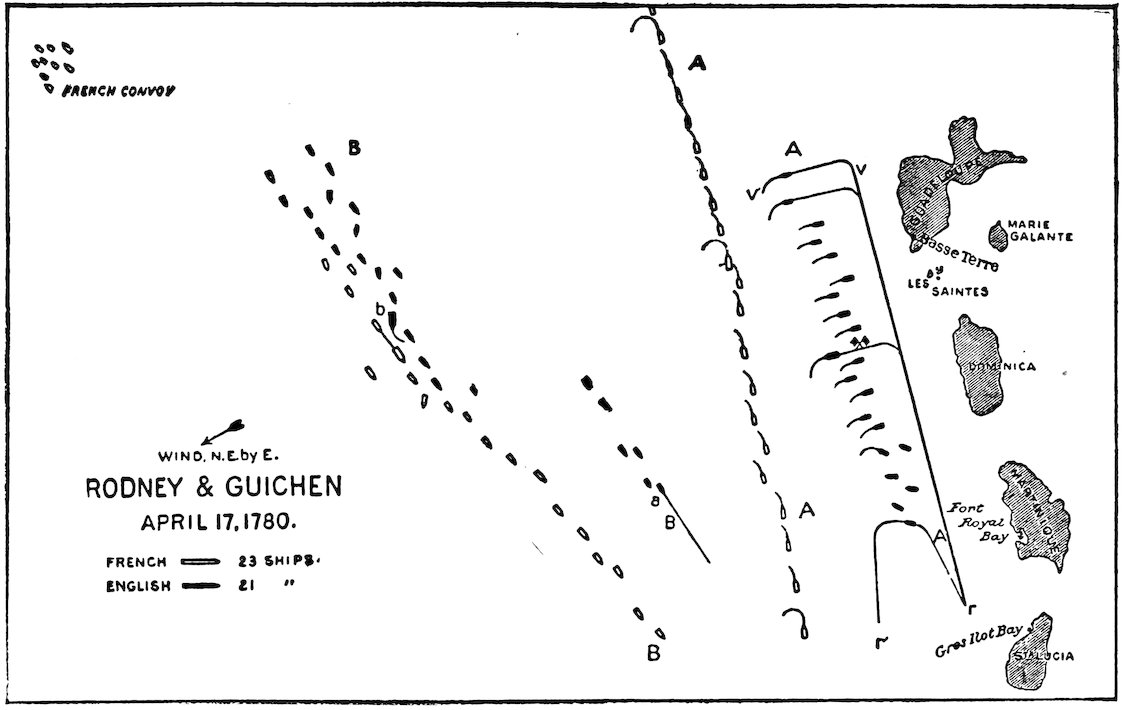
162De Guichen and Rodney met for the first time on the 17th of April, 1780, three weeks after the arrival of the latter. The French fleet was beating to windward in the channel between Martinique and Dominica, when the enemy was made in the south-east. A day was spent in maneuvering for the weather-gage, which Rodney got. The two fleets being now well to leeward of the islands (see Plate), both on the starboard tack heading to the northward and the French on the lee bow of the English, Rodney, who was carrying a press of sail, signalled to his fleet that he meant to attack the enemy’s rear and center with his whole force; and when he had reached the position he thought suitable, ordered them to keep away eight points (90°) together (A, A, A). De Guichen, seeing the danger of the rear, wore his fleet all together and stood down to succor it. Rodney, finding himself foiled, hauled up again on the same tack as the enemy, both fleets now heading to the southward and eastward.[54] Later, he again made signal for battle, followed an hour after, just at noon, by the order (quoting his own despatch), “for every ship to bear down and steer for her opposite in the enemy’s line.” This, which sounds like the old story of ship to ship, Rodney explains to have meant her opposite at the moment, not her opposite in numerical order. His own words are: “In a slanting position, that my leading ships might attack the van ships of the enemy’s center division, and the whole British fleet be opposed to only two thirds of the enemy” (B, B). The difficulty and misunderstanding which followed seem to have sprung mainly from the defective character of the signal book. Instead of doing as the admiral wished, the leading ships (a) carried sail so as to reach their supposed station abreast their numerical opposite in the order. Rodney stated afterward that when he bore down the second time, the French fleet was in a very extended line of battle; and that, had his orders been obeyed, the center and rear must have been disabled before the van could have joined.
There seems every reason to believe that Rodney’s intentions throughout were to double on the French, as asserted. The failure sprang from the signal book and tactical inefficiency of the fleet; for which he, having lately joined, was not answerable. But the ugliness of his fence was so apparent to De Guichen, that he exclaimed, when the English 163fleet kept away the first time, that six or seven of his ships were gone; and sent word to Rodney that if his signals had been obeyed he would have had him for his prisoner.[55] A more convincing proof that he recognized the dangerousness of his enemy is to be found in the fact that he took care not to have the lee-gage in their subsequent encounters. Rodney’s careful plans being upset, he showed that with them he carried all the stubborn courage of the most downright fighter; taking his own ship close to the enemy and ceasing only when the latter hauled off, her foremast and mainyard gone, and her hull so damaged that she could hardly be kept afloat.
164
20. Sea Power in the American Revolution[56]
Graves and De Grasse off the Chesapeake
[Preliminary to the events narrated, the general naval situation was as follows: The main British and French fleets, under Rodney and De Grasse, respectively, were in the West Indies, while a small British division was under Graves at New York, and a French squadron under De Barras was based on Newport, R. I. The squadrons on the American coast had met in a desultory action off the Virginia capes on March 16, 1781, after which the French commander had returned to Newport and left the British in control.—Editor.]
The way of the sea being thus open and held in force, two thousand more English troops sailing from New York reached Virginia on the 26th of March, and the subsequent arrival of Cornwallis in May raised the number to seven thousand. The operations of the contending forces during the spring and summer months, in which Lafayette commanded the Americans, do not concern our subject. Early in August, Cornwallis, acting under orders from Clinton, withdrew his troops into the peninsula between the York and James rivers, and occupied Yorktown.
Washington and Rochambeau had met on the 21st of May, and decided that the situation demanded 165that the effort of the French West Indian fleet, when it came, should be directed against either New York or the Chesapeake. This was the tenor of the despatch found by De Grasse at Cap Français,[57] and meantime the allied generals drew their troops toward New York, where they would be on hand for the furtherance of one object, and nearer the second if they had to make for it.
In either case the result, in the opinion both of Washington and of the French government, depended upon superior sea power; but Rochambeau had privately notified the admiral that his own preference was for the Chesapeake as the scene of the intended operations, and moreover the French government had declined to furnish the means for a formal siege of New York.[58] The enterprise therefore assumed the form of an extensive military combination, dependent upon ease and rapidity of movement, and upon blinding the eyes of the enemy to the real objective,—purposes to which the peculiar qualities of a navy admirably lent themselves. The shorter distance to be traversed, the greater depth of water and easier pilotage of the Chesapeake, were further reasons which would commend the scheme to the judgment of a seaman; and De Grasse readily accepted it, without making difficulties or demanding modifications which would have involved discussion and delay.
Having made his decision, the French admiral acted with great good judgment, promptitude, and 166vigor. The same frigate that brought despatches from Washington was sent back, so that by August 15 the allied generals knew of the intended coming of the fleet. Thirty-five hundred soldiers were spared by the governor of Cap Français, upon the condition of a Spanish squadron anchoring at the place, which De Grasse procured. He also raised from the governor of Havana the money urgently needed by the Americans; and finally, instead of weakening his force by sending convoys to France, as the court had wished, he took every available ship to the Chesapeake. To conceal his coming as long as possible, he passed through the Bahama Channel, as a less frequented route, and on the 30th of August anchored in Lynnhaven Bay, just within the capes of the Chesapeake, with twenty-eight ships-of-the-line. Three days before, August 27, the French squadron at Newport, eight ships-of-the-line with four frigates and eighteen transports under M. de Barras, sailed for the rendezvous; making, however, a wide circuit out to sea to avoid the English. This course was the more necessary as the French siege-artillery was with it. The troops under Washington and Rochambeau[59] had crossed the Hudson on the 24th of August, moving toward the head of Chesapeake Bay. Thus the different armed forces, both land and sea, were converging toward their objective, Cornwallis.
The English were unfortunate in all directions. 167Rodney, learning of De Grasse’s departure, sent fourteen ships-of-the-line under Admiral Hood to North America, and himself sailed for England in August, on account of ill health. Hood, going by the direct route, reached the Chesapeake three days before De Grasse, looked into the bay, and finding it empty went on to New York. There he met five ships-of-the-line under Admiral Graves, who, being senior officer, took command of the whole force and sailed on the 31st of August for the Chesapeake, hoping to intercept De Barras before he could join De Grasse. It was not till two days later that Sir Henry Clinton was persuaded that the allied armies had gone against Cornwallis, and had too far the start to be overtaken.
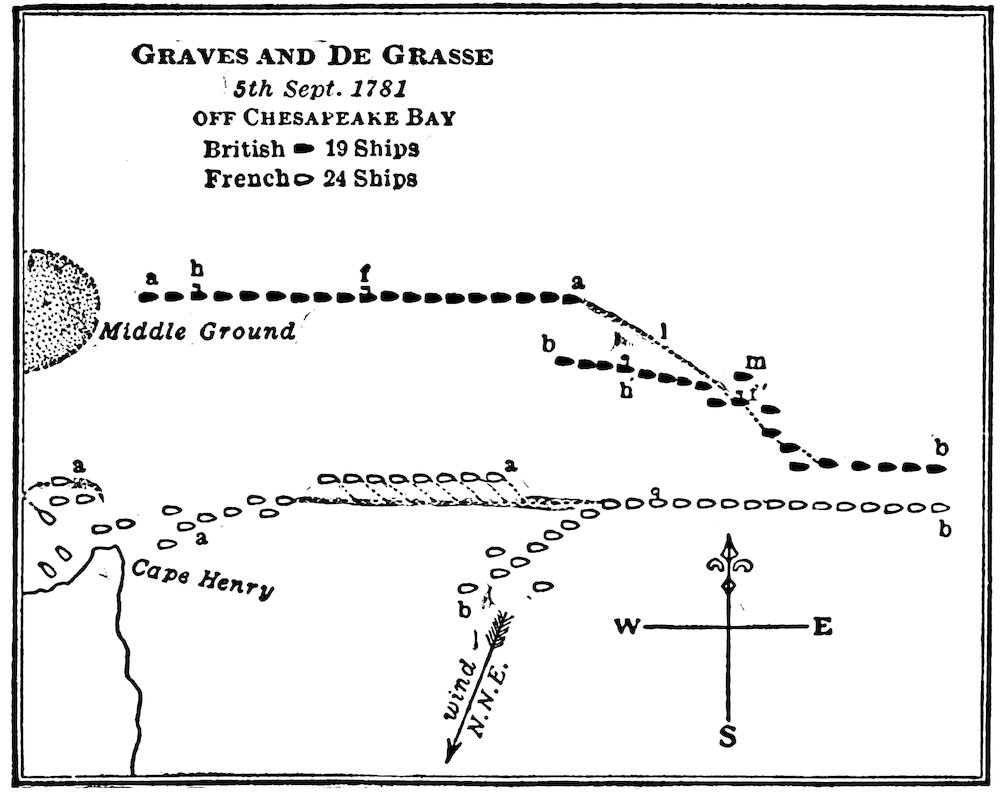
Admiral Graves was painfully surprised, on making 168the Chesapeake, to find anchored there a fleet which from its numbers could only be an enemy’s. Nevertheless, he stood in to meet it, and as De Grasse got under way, allowing his ships to be counted, the sense of numerical inferiority—nineteen to twenty-four—did not deter the English admiral from attacking. The clumsiness of his method, however, betrayed his gallantry; many of his ships were roughly handled, without any advantage being gained.[60] De Grasse, expecting De Barras, remained outside five days, keeping the English fleet in play without coming to action; then returning to port he found De Barras safely at anchor. Graves went back to New York, and with him disappeared the last hope of succor that was to gladden Cornwallis’s eyes. The siege was steadily endured, but the control of the sea made only one issue possible, and the English forces were surrendered October 19, 1781. With this disaster the hope of subduing the colonies died in England. The conflict 169flickered through a year longer, but no serious operations were undertaken.
... The defeat of Graves and subsequent surrender of Cornwallis did not end the naval operations in the western hemisphere. On the contrary, one of the most interesting tactical feats and the most brilliant victory of the whole war were yet to grace the English flag in the West Indies; but with the events at Yorktown the patriotic interest for Americans closes. Before quitting that struggle for independence, it must again be affirmed that its successful ending, at least at so early a date, was due to the control of the sea,—to sea power in the hands of the French, and its improper distribution by the English authorities. This assertion may be safely rested on the authority of the one man who, above all others, thoroughly knew the resources of the country, the temper of the people, the difficulties of the struggle, and whose name is still the highest warrant for sound, quiet, unfluttered good sense and patriotism.
The keynote to all Washington’s utterances is set in the “Memorandum for concerting a plan of operations with the French army,” dated July 15, 1780, and sent by the hands of Lafayette:
“The Marquis de Lafayette will be pleased to communicate the following general ideas to Count de Rochambeau and the Chevalier de Ternay, as the sentiments of the underwritten:
“I. In any operation, and under all circumstances, a decisive naval superiority is to be considered as a fundamental principle, and the basis 170upon which every hope of success must ultimately depend.”
This, however, though the most formal and decisive expression of Washington’s views, is but one among many others equally distinct.
171
21. The French Navy Demoralized by the Revolution[61]
... The seamen and the navy of France were swept away by the same current of thought and feeling which was carrying before it the whole nation; and the government, tossed to and fro by every wave of popular emotion, was at once too, weak and too ignorant of the needs of the service to repress principles and to amend defects which were fatal to its healthy life.
It is particularly instructive to dwell upon this phase of the revolutionary convulsions of France, because the result in this comparatively small, but still most important, part of the body politic was so different from that which was found elsewhere. Whatever the mistakes, the violence, the excesses of every kind, into which this popular rising was betrayed, they were symptomatic of strength, not of weakness,—deplorable accompaniments of a movement which, with all its drawbacks, was marked by overwhelming force.
It was the inability to realize the might in this outburst of popular feeling, long pent up, that caused the mistaken forecasts of many statesmen of the day; who judged of the power and reach of the movement by indications—such as the finances, the condition of the army, the quality of the known 172leaders—ordinarily fairly accurate tests of a country’s endurance, but which utterly misled those who looked to them only and did not take into account the mighty impulse of a whole nation stirred to its depths. Why, then, was the result so different in the navy? Why was it so weak, not merely nor chiefly in quantity, but in quality? and that, too, in days so nearly succeeding the prosperous naval era of Louis XVI. Why should the same throe which brought forth the magnificent armies of Napoleon have caused the utter weakness of the sister service, not only amid the disorders of the Republic, but also under the powerful organization of the Empire?
The immediate reason was that, to a service of a very special character, involving special exigencies, calling for special aptitudes, and consequently demanding special knowledge of its requirements in order to deal wisely with it, were applied the theories of men wholly ignorant of those requirements,—men who did not even believe that they existed. Entirely without experimental knowledge, or any other kind of knowledge, of the conditions of sea life, they were unable to realize the obstacles to those processes by which they would build up their navy, and according to which they proposed to handle it. This was true not only of the wild experiments of the early days of the Republic; the reproach may fairly be addressed to the great emperor himself, that he had scarcely any appreciation of the factors conditioning efficiency at sea; nor did he seemingly ever reach any such sense of them as 173would enable him to understand why the French navy failed. “Disdaining,” says Jean Bon Saint-André, the Revolutionary commissioner whose influence on naval organization was unbounded, “disdaining, through calculation and reflection, skillful evolutions, perhaps our seamen will think it more fitting and useful to try those boarding actions in which the Frenchman was always conqueror, and thus astonish Europe by new prodigies of valor.”[62] “Courage and audacity,” says Captain Chevalier, “had become in his eyes the only qualities necessary to our officers.” “The English,” said Napoleon, “will become very small when France shall have two or three admirals willing to die.”[63] So commented, with pathetic yet submissive irony, the ill-fated admiral, Villeneuve, upon whom fell the weight of the emperor’s discontent with his navy: “Since his Majesty thinks that nothing but audacity and resolve are needed to succeed in the naval officer’s calling, I shall leave nothing to be desired.”[64]
... In truth men’s understandings, as well as their morale and beliefs, were in a chaotic state. In the navy, as in society, the morale suffered first. Insubordination and mutiny, insult and murder, preceded the blundering measures which in the end destroyed the fine personnel that the monarchy bequeathed to the French republic. This insubordination broke out very soon after the affairs of the Bastille and the forcing of the palace at Versailles; that is, very soon after the powerlessness of the 174executive was felt. Singularly, yet appropriately, the first victim was the most distinguished flag-officer of the French navy.[65]
During the latter half of 1789 disturbances occurred in all the seaport towns; in Havre, in Cherbourg, in Brest, in Rochefort, in Toulon. Everywhere the town authorities meddled with the concerns of the navy yards and of the fleet, discontented seamen and soldiers, idle or punished, rushed to the town halls with complaints against their officers. The latter, receiving no support from Paris, yielded continually, and things naturally went from bad to worse.
175
22. Howe’s Victory of June 1, 1794[66]
[Prior to the engagement, the French fleet had met and was convoying to port 180 vessels from America with food-stuffs of which France was then in dire need. The British fleet encountered the French 400 miles west of Ushant on May 28, and in the four days of maneuvering and pursuit which followed, Howe displayed marked energy and tactical skill. Though the French fleet was defeated in the ensuing battle, it covered the escape of the convoy.—Editor.]
The French admiral on the evening of the 29th saw that he now must fight, and at a disadvantage; consequently, he could not hope to protect the convoy. As to save this was his prime object, the next best thing was to entice the British out of its path. With this view he stood away to the north-west; while a dense fog coming on both favored his design and prevented further encounter during the two ensuing days, throughout which Howe continued to pursue. In the evening of May 31 the weather cleared, and at daybreak the next morning the enemies were in position, ready for battle, two long 176columns of ships, heading west, the British twenty-five, the French again twenty-six through the junction of the four vessels mentioned. Howe now had cause to regret his absent six, and to ponder Nelson’s wise saying, “Only numbers can annihilate.”
This time for maneuvering was past. Able tactician as he personally was, and admirable as had been the direction of his efforts in the two days’ fighting, Howe had been forced in them to realize two things, namely, that his captains were, singly, superior in seamanship, and their crews in gunnery, to the French; and again, that in the ability to work together as a fleet the British were so deficient as to promise very imperfect results, if he attempted any but the simplest formation. To such, therefore, he resorted; falling back upon the old, unskillful, sledge-hammer fashion of the British navy. Arranging his ships in one long line, three miles from the enemy, he made them all go down together, each to attack a specified opponent, coming into action as nearly as might be at the same instant. Thus the French, from the individual inferiority of the units of their fleet, would be at all points over-powered. The issue justified the forecast; but the manner of performance was curiously and happily marked by Howe’s own peculiar phlegm. There was a long summer day ahead for fighting, and no need for hurry. The order was first accurately formed, and canvas reduced to proper proportions. Then the crews went to breakfast. After breakfast, the ships all headed for the hostile line, under short sail, the admiral keeping them in hand during the 177approach as an infantry officer dresses his company. Hence the shock from end to end was so nearly simultaneous as to induce success unequalled in any engagement conducted on the same primitive plan.
Picturesque as well as sublime, animating as well as solemn, on that bright Sunday morning, was this prelude to the stern game of war about to be played: the quiet summer sea stirred only by a breeze sufficient to cap with white the little waves that ruffled its surface; the dark hulls gently rippling the water aside in their slow advance, a ridge of foam curling on either side of the furrow ploughed by them in their onward way; their massive sides broken by two, or at times three, rows of ports, whence, the tompions drawn, yawned the sullen lines of guns, behind which, unseen, but easily realized by the instructed eye, clustered the groups of ready seamen who served each piece. Aloft swung leisurely to and fro the tall spars, which ordinarily, in so light a wind, would be clad in canvas from deck to truck, but whose naked trimness now proclaimed the deadly purpose of that still approach. Upon the high poops, where floated the standard of either nation, gathered round each chief the little knot of officers through whom commands were issued and reports received, the nerves along which thrilled the impulses of the great organism, from its head, the admiral, through every member to the dark lowest decks, nearly awash, where, as farthest from the captain’s own oversight, the senior lieutenants controlled the action of the ships’ heaviest batteries.
On board the Queen Charlotte, Lord Howe, 178whose burden of sixty-eight years had for four days found no rest save what he could snatch in an arm-chair, now, at the prospect of battle, “displayed an animation,” writes an eye-witness, “of which, at his age, and after such fatigue of body and mind, I had not thought him capable. He seemed to contemplate the result as one of unbounded satisfaction.” By his side stood his fleet-captain, Curtis, of whose service among the floating batteries, and during the siege of Gibraltar, the governor of the fortress had said, “He is the man to whom the king is chiefly indebted for its security;” and Codrington, then a lieutenant, who afterwards commanded the allied fleets at Navarino. Five ships to the left, Collingwood, in the Barfleur, was making to the admiral whose flag she bore the remark that stirred Thackeray: “Our wives are now about going to church, but we will ring about these Frenchmen’s ears a peal which will drown their bells.” The French officers, both admirals and captains, were mainly unknown men, alike then and thereafter. The fierce flames of the Revolution had swept away the men of the old school, mostly aristocrats, and time had not yet brought forward the very few who during the Napoleonic period showed marked capacity. The commander-in-chief, Villaret-Joyeuse, had three years before been a lieutenant. He had a high record for gallantry, but was without antecedents as a general officer. With him, on the poop of the Montagne, which took her name from Robespierre’s political supporters, stood that anomalous companion of the generals and admirals of the day, 179the Revolutionary commissioner, Jean Bon Saint-André, about to learn by experience the practical working of the system he had advocated, to disregard all tests of ability save patriotism and courage, depreciating practice and skill as unnecessary to the valor of the true Frenchman.
As the British line drew near the French, Howe said to Curtis, “Prepare the signal for close action.” “There is no such signal,” replied Curtis. “No,” said the admiral, “but there is one for closer action, and I only want that to be made in case of captains not doing their duty.” Then closing a little signal book he always carried, he continued to those around him, “Now, gentlemen, no more book, no more signals. I look to you to do the duty of the Queen Charlotte in engaging the flagship. I don’t want the ships to be bilge to bilge, but if you can lock the yardarms, so much the better; the battle will be the quicker decided.” His purpose was to go through the French line, and fight the Montagne on the far side. Some doubted their succeeding, but Howe overbore them. “That’s right, my lord!” cried Bowen, the sailing-master, who looked to the ship’s steering. “The Charlotte will make room for herself.” She pushed close under the French ship’s stern, grazing her ensign, and raking her from stern to stem with a withering fire, beneath which fell three hundred men. A length or two beyond lay the French Jacobin. Howe ordered the Charlotte to luff, and place herself between the two. “If we do,” said Bowen, “we shall be on board one of them.” “What is that to you, sir?” 180asked Howe quickly. “Oh!” muttered the master, not inaudibly. “D—n my eyes if I care, if you don’t. I’ll go near enough to singe some of our whiskers.” And then, seeing by the Jacobin’s rudder that she was going off, he brought the Charlotte sharp round, her jib boom grazing the second Frenchman as her side had grazed the flag of the first.
From this moment the battle raged furiously from end to end of the field for nearly an hour,—a wild scene of smoke and confusion, under cover of which many a fierce ship duel was fought, while here and there men wandered, lost, in a maze of bewilderment that neutralized their better judgment. An English naval captain tells a service tradition of one who was so busy watching the compass, to keep his position in the ranks, that he lost sight of his antagonist, and never again found him. Many a quaint incident passed, recorded or unrecorded, under that sulphurous canopy. A British ship, wholly dismasted, lay between two enemies, her captain desperately wounded. A murmur of surrender was somewhere heard; but as the first lieutenant checked it with firm authority, a cock flew upon the stump of a mast and crowed lustily. The exultant note found quick response in hearts not given to despair, and a burst of merriment, accompanied with three cheers, replied to the bird’s triumphant scream. On board the Brunswick, in her struggle with the Vengeur, one of the longest and fiercest fights the sea has ever seen, the cocked hat was shot off the effigy of the Duke of Brunswick, 181which she bore as a figure-head. A deputation from the crew gravely requested the captain to allow the use of his spare chapeau, which was securely nailed on, and protected his grace’s wig during the rest of the action. After this battle with the ships of the new republic, the partisans of monarchy noted with satisfaction that, among the many royal figures that surmounted the stems of the British fleet, not one lost his crown. Of a harum-scarum Irish captain are told two droll stories. After being hotly engaged for some time with a French ship, the fire of the latter slackened, and then ceased. He called to know if she had surrendered. The reply was, “No.” “Then,” shouted he, “d—n you, why don’t you fire?” Having disposed of his special antagonist without losing his own spars, the same man kept along in search of new adventures, until he came to a British ship totally dismasted and otherwise badly damaged. She was commanded by a captain of rigidly devout piety. “Well, Jemmy,” hailed the Irishman, “you are pretty well mauled; but never mind, Jemmy, whom the Lord loveth he chasteneth.”
The French have transmitted to us less of anecdote, nor is it easy to connect the thought of humor with those grimly earnest republicans and the days of the Terror. There is, indeed, something unintentionally funny in the remark of the commander of one of the captured ships to his captors. They had, it was true, dismasted half the French fleet, and had taken over a fourth; yet he assured them it could not be considered a victory, “but merely 182a butchery, in which the British had shown neither science nor tactics.” The one story, noble and enduring, that will ever be associated with the French on the 1st of June is in full keeping with the temper of the times and the enthusiasm of the nation. The seventy-four-gun ship Vengeur, after a three hours’ fight, yardarm to yardarm, with the British Brunswick, was left in a sinking state by her antagonist, who was herself in no condition to help. In the confusion, the Vengeur’s peril was for some time not observed; and when it was, the British ships that came to her aid had time only to remove part of her survivors. In their report of the event the latter said: “Scarcely had the boats pulled clear of the sides, when the most frightful spectacle was offered to our gaze. Those of our comrades who remained on board the Vengeur du Peuple, with hands raised to heaven, implored, with lamentable cries, the help for which they could no longer hope. Soon disappeared the ship and the unhappy victims it contained. In the midst of the horror with which this scene inspired us all, we could not avoid a feeling of admiration mingled with our grief. As we drew away, we heard some of our comrades still offering prayers for the welfare of their country. The last cries of these unfortunates were, ‘Vive la République!’ They died uttering them.” Over a hundred Frenchmen thus went down.
Seven French ships were captured, including the sunk Vengeur. Five more were wholly dismasted, but escaped,—a good fortune mainly to be attributed to Howe’s utter physical prostration, due to 183his advanced years and the continuous strain of the past five days. He now went to bed, completely worn out. “We all got round him,” wrote an officer, Lieutenant Codrington, who was present; “indeed, I saved him from a tumble, he was so weak that from a roll of the ship he was nearly falling into the waist. ‘Why, you hold me up as if I were a child,’ he said good-humoredly.” Had he been younger, there can be little doubt that the fruits of victory would have been gathered with an ardor which his assistant, Curtis, failed to show.
184
23. Nelson’s Strategy at Copenhagen[67]
[In 1800 Russia, Sweden, and Denmark, under the manipulation of Napoleon, formed a “League of Armed Neutrality” to resist British restrictions on their trade with France. To reinforce diplomatic pressure, Great Britain sent against the league a fleet of twenty ships, of which Nelson was second in command under Sir Hyde Parker. Throughout the campaign, writes Mahan, Nelson “lifted and carried on his shoulders the dead weight of his superior.”—Editor.]
The fleet sailed from Yarmouth on the 12th of March, 1801; and on the 19th, although there had been some scattering in a heavy gale, nearly all were collected off the Skaw, the northern point of Jutland at the entrance of the Kattegat. The wind being north-west was fair for going to Copenhagen, and Nelson, if in command, would have advanced at once with the ambassador on board. “While the negotiation is going on,” he said, “the Dane should see our flag waving every moment he lifted his head.” As it was, the envoy went forward with a frigate alone and the fleet waited. On the 12th it was off Elsineur, where the envoy rejoined, Denmark having rejected the British terms.
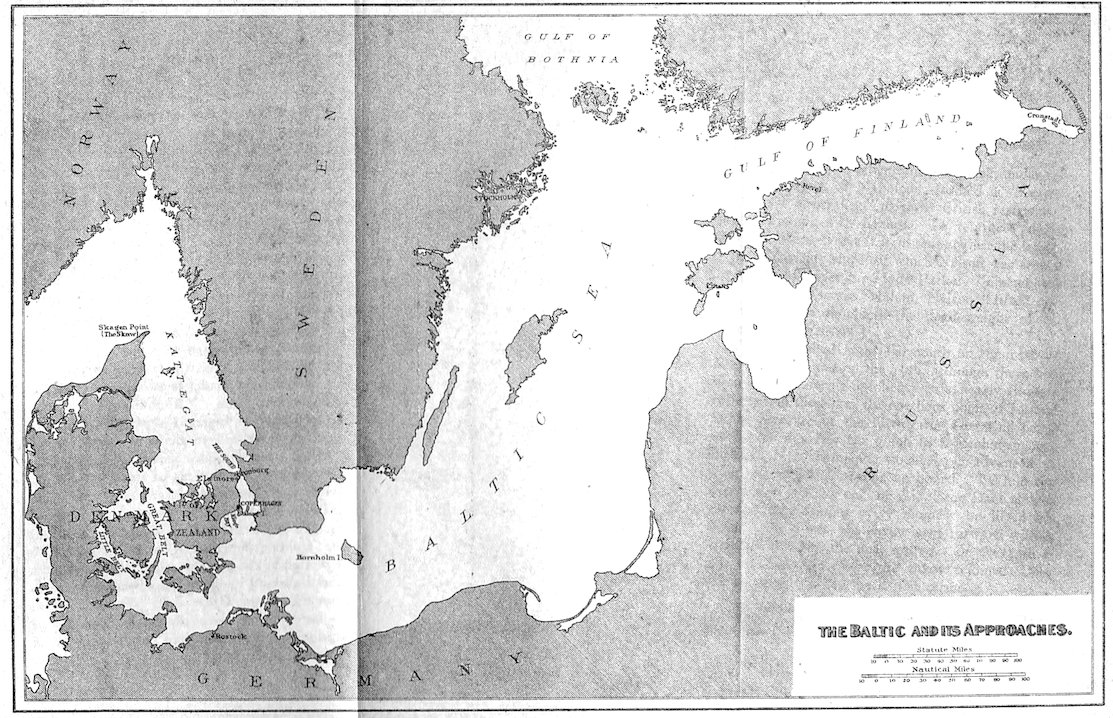
185This amounted to an acceptance of hostilities, and it only remained to the commander-in-chief to act at once; for the wind was favorable, an advantage which at any moment might be lost. On this day Nelson addressed Parker a letter, summing up in a luminous manner the features of the situation and the different methods of action. “Not a moment should be lost in attacking,” he said; “we shall never be so good a match for them as at this moment.” He next hinted, what he had probably already said, that the fleet ought to have been off Copenhagen, and not at Elsineur, when the negotiation failed. “Then you might instantly attack and there would be scarcely a doubt but the Danish fleet would be destroyed, and the capital made so hot that Denmark would listen to reason and its true interest.” Since, however, the mistake of losing so much time had been made, he seeks to stir his superior to lose no more. “Almost the safety, certainly the honor, of England is more entrusted to you than ever yet fell to the lot of any British officer; ... never did our country depend so much on the success of any fleet as of this.”
Having thus shown the necessity for celerity, Nelson next discussed the plan of operations. Copenhagen is on the east side of the island of Zealand, fronting the coast of Sweden, from which it is separated by the passage called the Sound. On the west the island is divided from the other parts of Denmark by the Great Belt. The navigation of the latter being much the more difficult, the preparations of the Danes had been made on the 186side of the Sound, and chiefly about Copenhagen itself. For half a mile from the shore in front of the city, flats extend, and in the Sound itself, at a distance of little over a mile, is a long shoal called the Middle Ground. Between these two bodies of shallow water is a channel, called the King’s, through which a fleet of heavy ships could sail, and from whose northern end a deep pocket stretches toward Copenhagen, forming the harbor proper. The natural point of attack therefore appears to be at the north; and there the Danes had erected powerful works, rising on piles out of the shoal water off the harbor’s mouth and known as the Three-Crown Batteries. Nelson, however, pointed out that not only was this head of the line exceedingly strong, but that the wind that was fair to attack would be foul to return; therefore a disabled ship would have no escape but by passing through the King’s Channel. Doing so she would have to run the gantlet of a line of armed hulks, which the Danes had established as floating batteries along the inner edge of the channel—covering the front of Copenhagen—and would also be separated from her fleet. Nor was this difficulty, which may be called tactical, the only objection to a plan that he disparaged as “taking the bull by the horns.” He remarked that so long as the British fleet remained in the Sound, without entering the Baltic, the way was left open for both the Swedes and the Russians, if released by the ice, to make a junction with the Danes. Consequently, he advised that a sufficiently strong force of the lighter ships-of-theline 187should pass outside the Middle Ground, despite the difficulties of navigation, which were not insuperable, and come up in rear of the city. There they would interpose between the Danes and their allies, and be in position to assail the weaker part of the hostile order. He offered himself to lead this detachment.
This whole letter of March 24, 1801,[68] possesses peculiar interest; for it shows with a rare particularity, elicited by the need he felt of arousing and convincing his superior, Nelson’s clear discernment of the decisive features of a military situation. The fame of this great admiral has depended less upon his conduct of campaigns than upon the renowned victories he won in the actual collision of fleet with fleet; and even then has been mutilated by the obstinacy with which, despite the perfectly evident facts, men have persisted in seeing in them nothing but dash,—heart, not head. Throughout his correspondence, it is true, there are frequent traces of the activity of his mental faculties and of the general accuracy of his military conclusions; but ordinarily it is from his actions that his reasonings and principles must be deduced. In the present case we have the views he held and the course he evidently would have pursued clearly formulated by himself; and it cannot but be a subject of regret that the naval world should have lost so fine an illustration as he would there have given of the principles and conduct of naval warfare. He concluded his letter with a suggestion worthy of Napoleon himself, and which, if 188adopted, would have brought down the Baltic Confederacy with a crash that would have resounded throughout Europe. “Supposing us through the Belt with the wind first westerly, would it not be possible to go with the fleet, or detach ten ships of three and two decks, with one bomb and two fireships, to Revel, to destroy the Russian squadron at that place? I do not see the great risk of such a detachment, and with the remainder to attempt the business at Copenhagen. The measure may be thought bold, but I am of opinion the boldest are the safest; and our country demands a most vigorous exertion of her force, directed with judgment.”
Committed as the Danes were to a stationary defense, this recommendation to strike at the soul of the confederacy evinced the clearest perception of the key to the situation, which Nelson himself summed up in the following words: “I look upon the Northern League to be like a tree, of which Paul was the trunk and Sweden and Denmark the branches. If I can get at the trunk and hew it down, the branches fall of course; but I may lop the branches and yet not be able to fell the tree, and my power must be weaker when its greatest strength is required”[69]—that is, the Russians should have been attacked before the fleet was weakened, as it inevitably must be, by the battle with the Danes. “If we could have cut up the Russian fleet,” he said again, “that was my object.” Whatever Denmark’s wishes about fighting, she was by her continental possessions tied to the policy of Russia and 189Prussia, either of whom could overwhelm her by land. She dared not disregard them. The course of both depended upon the czar; for the temporizing policy of Prussia would at once embrace his withdrawal from the league as an excuse for doing the same. At Revel were twelve Russian ships-of-the-line, fully half their Baltic fleet, whose destruction would have paralyzed the remainder and the naval power of the empire. To persuade Parker to such a step was, however, hopeless. “Our fleet would never have acted against Russia and Sweden,” wrote Nelson afterwards, “although Copenhagen would have been burned; for Sir Hyde Parker was determined not to leave Denmark hostile in his rear;”[70] a reason whose technical accuracy under all the circumstances was nothing short of pedantic, and illustrates the immense distance between a good and accomplished officer, which Parker was, and a genius whose comprehension of rules serves only to guide, not to fetter, his judgment.
Although unable to rise equal to the great opportunity indicated by Nelson, Sir Hyde Parker adopted his suggestion as to the method and direction of the principal attack upon the defenses of Copenhagen. For this, Nelson asked ten ships-of-the-line and a number of smaller vessels, with which he undertook to destroy the floating batteries covering the front of the city. These being reduced, the bomb vessels could be placed so as to play with effect upon the dockyard, arsenals, and the town, in case further resistance was made.
190[The fleet entered the Sound and anchored off Copenhagen on March 26. On April 2 Nelson attacked from the southward as he had suggested, and after a hard-fought battle forced a fourteen weeks’ armistice which practically secured the British aims, since it gave opportunity to proceed against Sweden and Russia. Nelson was given chief command on May 5, and two days later sailed for Revel, but the death of the Czar Paul had already brought a favorable change in Russia’s policy and made further action unnecessary.—Editor.]
191
24. England’s First Line of Defense[71]
[After the Copenhagen campaign, for a brief period in 1801, Nelson commanded the naval defense forces in the Channel. When, after two years of peace, hostilities were renewed in 1803, he sailed in the Victory to take command in the Mediterranean. During the following years of the war, “The British squadrons, hugging the French coasts and blocking the French arsenals, were the first line of defense, covering British interests from the Baltic to Egypt, the British colonies in the four quarters of the globe, and the British merchantmen which whitened every sea.”[72]—Editor.]
Meanwhile that period of waiting from May, 1803, to August, 1805, when the tangled net of naval and military movements began to unravel, was a striking and wonderful pause in the world’s history. On the heights above Boulogne, and along the narrow strip of beach from Étaples to Vimereux, were encamped one hundred and thirty thousand of the most brilliant soldiery of all time, the soldiers who had fought in Germany, Italy, and Egypt, soldiers who were yet to win, from Austria, Ulm and Austerlitz, and from Prussia, Auerstadt and Jena, to hold their own, though barely, at Eylau 192against the army of Russia, and to overthrow it also, a few months later, on the bloody field of Friedland. Growing daily more vigorous in the bracing sea air and the hardy life laid out for them, they could on fine days, as they practised the varied maneuvers which were to perfect the vast host in embarking and disembarking with order and rapidity, see the white cliffs fringing the only country that to the last defied their arms. Far away, Cornwallis off Brest, Collingwood off Rochefort, Pellew off Ferrol, were battling the wild gales of the Bay of Biscay, in that tremendous and sustained vigilance which reached its utmost tension in the years preceding Trafalgar, concerning which Collingwood wrote that admirals need to be made of iron, but which was forced upon them by the unquestionable and imminent danger of the country. Farther distant still, severed apparently from all connection with the busy scene at Boulogne, Nelson before Toulon was wearing away the last two years of his glorious but suffering life, fighting the fierce north-westers of the Gulf of Lyon and questioning, questioning continually with feverish anxiety, whether Napoleon’s object was Egypt again or Great Britain really. They were dull, weary, eventless months, those months of watching and waiting of the big ships before the French arsenals. Purposeless they surely seemed to many, but they saved England. The world has never seen a more impressive demonstration of the influence of sea power upon its history. Those far distant, storm-beaten ships, upon which the Grand Army never looked, 193stood between it and the dominion of the world. Holding the interior positions they did, before—and therefore between—the chief dockyards and detachments of the French navy, the latter could unite only by a concurrence of successful evasions, of which the failure of any one nullified the result. Linked together as the various British fleets were by chains of smaller vessels, chance alone could secure Bonaparte’s great combination, which depended upon the covert concentration of several detachments upon a point practically within the enemy’s lines. Thus, while bodily present before Brest, Rochefort, and Toulon, strategically the British squadrons lay in the Straits of Dover barring the way against the Army of Invasion.
The Straits themselves, of course, were not without their own special protection. Both they and their approaches, in the broadest sense of the term, from the Texel to the Channel Islands, were patrolled by numerous frigates and smaller vessels, from one hundred to a hundred and fifty in all. These not only watched diligently all that happened in the hostile harbors and sought to impede the movements of the flat-boats, but also kept touch with and maintained communication between the detachments of ships-of-the-line. Of the latter, five off the Texel watched the Dutch navy, while others were anchored off points of the English coast with reference to probable movements of the enemy. Lord St. Vincent, whose ideas on naval strategy were clear and sound, though he did not use the technical terms of the art, discerned and provided 194against the very purpose entertained by Bonaparte, of a concentration before Boulogne by ships drawn from the Atlantic and Mediterranean. The best security, the most advantageous strategic positions, were doubtless those before the enemy’s ports; and never in the history of blockades has there been excelled, if ever equalled, the close locking of Brest by Admiral Cornwallis, both winter and summer, between the outbreak of war and the battle of Trafalgar. It excited not only the admiration but the wonder of contemporaries.[73] In case, however, the French at Brest got out, so the prime minister of the day informed the speaker of the House, Cornwallis’s rendezvous was off the Lizard (due north of Brest), so as to go for Ireland, or follow the French up Channel, if they took either direction. Should the French run for the Downs, the five sail of the line at Spithead would also follow them; and Lord Keith (in the Downs) would in addition to his six, and six block ships, have also the North Sea fleet at his command.[74] Thus provision was made, in case of danger, for the outlying detachments to fall back on the strategic center, gradually accumulating strength, till they formed a body of from twenty-five to thirty heavy and disciplined ships-of-the-line, sufficient to meet all probable contingencies.
Hence, neither the Admiralty nor British naval officers in general shared the fears of the country 195concerning the peril from the flotilla. “Our first defense,” wrote Nelson in 1801, “is close to the enemy’s ports; and the Admiralty have taken such precautions, by having such a respectable force under my orders, that I venture to express a well-grounded hope that the enemy would be annihilated before they get ten miles from their own shores.”[75]
196
25. The Battle of Trafalgar[76]
[While Napoleon’s plans for control of the Channel underwent many changes, the movements actually carried out were as follows: On March 27, Villeneuve with eighteen ships left Toulon and sailed for the West Indies, arriving at Martinique May 12, where he was to be joined by the Brest fleet. Baffled at first by head winds and uncertainty as to the enemy’s destination, Nelson reached Barbados twenty-three days later.
Learning of his arrival, Villeneuve at once sailed for Europe, on June 9, again followed, four days later by Nelson. The brig Curieux, despatched by Nelson to England on the 12th, sighted the enemy fleet and reported its approach to the Admiralty, thus enabling Calder to meet Villeneuve in an indecisive action on July 22 off Ferrol, Spain. Nelson steered for Gibraltar, and thence, having learned that Villeneuve was to the northward, for the Channel, where on August 15 he left his ships with the Channel fleet under Cornwallis.
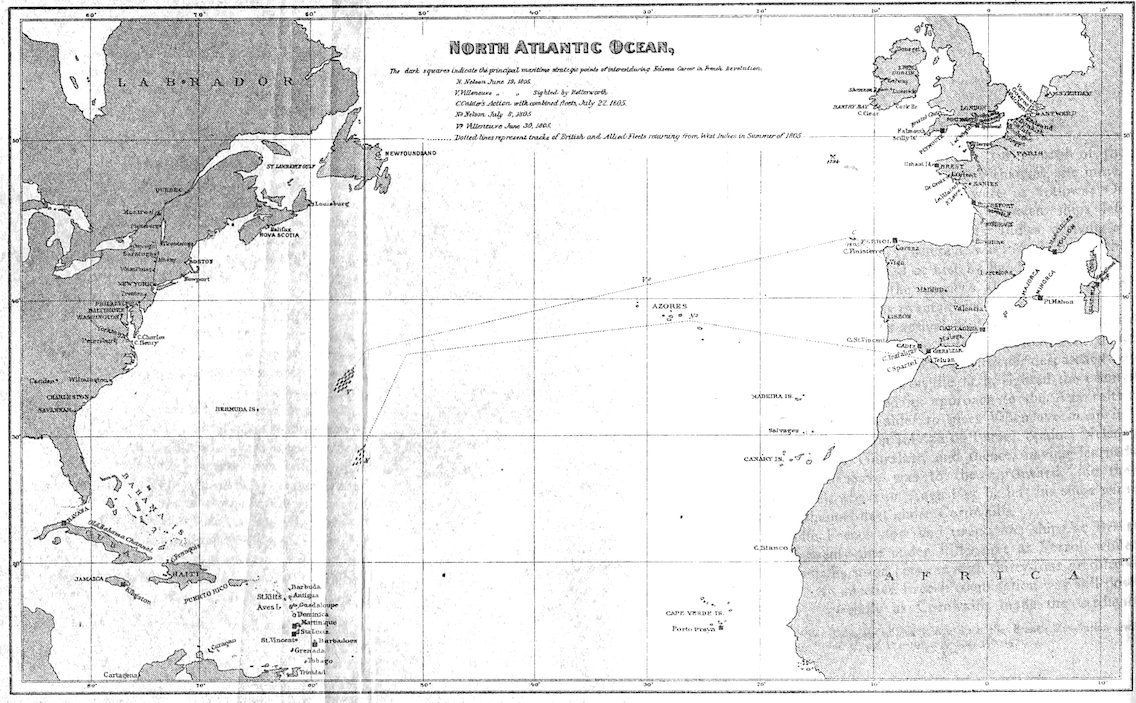
197The French now had twenty-one ships at Brest and twenty-nine under Villeneuve at Ferrol, while Cornwallis stood between with thirty-four or thirty-five. An effective French combination was still possible, especially as Cornwallis made the cardinal error of dividing his fleet. Accordingly, Villeneuve, under an imperative summons from Napoleon, left Ferrol on August 13; but, with his ships demoralized by their long cruise, with head winds, and disturbed by false reports from a Danish merchantman regarding the British strength, the French admiral two days later turned for Cadiz. Here he was watched by Collingwood; and on September 28 Nelson, after three weeks in England, took command of the blockading fleet. “Thus ended, and forever,” writes Mahan, “Napoleon’s profoundly conceived and laboriously planned scheme for the invasion of England. If it be sought to fix a definite moment which marked the final failure of so vast a plan, that one may well be chosen when Villeneuve made signal to bear up for Cadiz.”[77] On August 25 the Boulogne army broke camp and marched against the Austrian forces advancing toward the Rhine.—Editor.]
The importance attached by the emperor to his project was not exaggerated. He might, or he might not, succeed; but, if he failed against Great Britain, he failed everywhere. This he, with the intuition of genius, felt; and to this the record of his after history now bears witness. To the strife of arms with the great Sea Power succeeded the strife of endurance. Amid all the pomp and circumstance of the war which for ten years to come desolated the Continent, amid all the tramping to and fro over Europe of the French armies and their 198auxiliary legions, there went on unceasingly that noiseless pressure upon the vitals of France, that compulsion, whose silence, when once noted, becomes to the observer the most striking and awful mark of the working of Sea Power. Under it the resources of the Continent wasted more and more with each succeeding year; and Napoleon, amid all the splendor of his imperial position, was ever needy. To this, and to the immense expenditures required to enforce the Continental System, are to be attributed most of those arbitrary acts which made him the hated of the peoples, for whose enfranchisement he did so much. Lack of revenue and lack of credit, such was the price paid by Napoleon for the Continental System, through which alone, after Trafalgar, he hoped to crush the Power of the Sea. It may be doubted whether, amid all his glory, he ever felt secure after the failure of the invasion of England. To borrow his own vigorous words, in the address to the nation issued before he joined the army, “To live without commerce, without shipping, without colonies, subjected to the unjust will of our enemies, is to live as Frenchmen should not.” Yet so had France to live throughout his reign, by the will of the one enemy never conquered.
On the 14th of September, before quitting Paris, Napoleon sent Villeneuve orders to take the first favorable opportunity to leave Cadiz, to enter the Mediterranean, join the ships at Cartagena, and with this combined force move upon southern Italy. There, at any suitable point, he was to land the 199troops embarked in the fleet to reinforce General St. Cyr, who already had instructions to be ready to attack Naples at a moment’s notice.[78] The next day these orders were reiterated to Decrès, enforcing the importance to the general campaign of so powerful a diversion as the presence of this great fleet in the Mediterranean; but, as “Villeneuve’s excessive pusillanimity will prevent him from undertaking this, you will send to replace him Admiral Rosily, who will bear letters directing Villeneuve to return to France and give an account of his conduct.”[79] The emperor had already formulated his complaints against the admiral under seven distinct heads.[80] On the 15th of September, the same day the orders to relieve Villeneuve were issued, Nelson, having spent at home only twenty-five days, left England for the last time. On the 28th, when he joined the fleet off Cadiz, he found under his command twenty-nine ships-of-the-line, which successive arrivals raised to thirty-three by the day of the battle; but, water running short, it became necessary to send the ships, by divisions of six, to fill up at Gibraltar. To this cause was due that only twenty-seven British vessels were present in the action,—an unfortunate circumstance; for, as Nelson said, what the country wanted was not merely a splendid victory, but annihilation; “numbers only can annihilate.”[81] The force under his command was thus disposed: the main body about fifty miles west-south-west of Cadiz, seven lookout frigates close in with the port, 200and between these extremes, two small detachments of ships-of-the-line,—the one twenty miles from the harbor, the other about thirty-five. “By this chain,” he wrote, “I hope to have constant communication with the frigates.”
“The Nelson Touch”[82]
At 6 P.M. of Saturday, September 28, the Victory reached the fleet, then numbering twenty-nine of the line; the main body being fifteen to twenty miles west of Cadiz, with six ships close in with the port. The next day was Nelson’s birthday—forty-seven years old. The junior admirals and the captains visited the commander-in-chief, as customary, but with demonstrations of gladness and confidence that few leaders have elicited in equal measure from their followers. “The reception I met with on joining the fleet caused the sweetest sensation of my life. The officers who came on board to welcome my return, forgot my rank as commander-in-chief in the enthusiasm with which they greeted me. As soon as these emotions were past, I laid before them the plan I had previously arranged for attacking the enemy; and it was not only my pleasure to find it generally approved, but clearly perceived and understood.” To Lady Hamilton he gave an account of this scene which differs little from the above, except in its greater vividness. “I believe my arrival was most welcome, 201not only to the commander of the fleet, but also to every individual in it; and, when I came to explain to them the ‘Nelson touch,’ it was like an electric shock. Some shed tears, all approved—‘It was new—it was singular—it was simple!’ and, from admirals downwards, it was repeated—‘It must succeed, if ever they will allow us to get at them! You are, my Lord, surrounded by friends whom you inspire with confidence.’ Some may be Judas’s; but the majority are certainly much pleased with my commanding them.” No more joyful birthday levee was ever held than that of this little naval court. Besides the adoration for Nelson personally, which they shared with their countrymen in general, there mingled with the delight of the captains the sentiment of professional appreciation and confidence, and a certain relief, noticed by Codrington, from the dry, unsympathetic rule of Collingwood, a man just, conscientious, highly trained, and efficient, but self-centered, rigid, uncommunicative; one who fostered, if he did not impose, restrictions upon the intercourse between the ships, against which he had inveighed bitterly when himself one of St. Vincent’s captains. Nelson, on the contrary, at once invited cordial social relations with the commanding officers. Half of the thirty-odd were summoned to dine on board the flagship the first day, and half the second. Not till the third did he permit himself the luxury of a quiet dinner chat with his old chum, the second in command, whose sterling merits, under a crusty exterior, he knew and appreciated. Codrington mentions also an incident, trivial in itself, but illustrative 202of that outward graciousness of manner, which, in a man of Nelson’s temperament and position, is rarely the result of careful cultivation, but bespeaks rather the inner graciousness of the heart that he abundantly possessed. They had never met before, and the admiral, greeting him with his usual easy courtesy, handed him a letter from his wife, saying that being entrusted with it by a lady, he made a point of delivering it himself, instead of sending it by another.
The “Nelson Touch,” or Plan of Attack, expounded to his captains at the first meeting, was afterwards formulated in an Order, copies of which were issued to the fleet on the 9th of October. In this “Memorandum,” which was doubtless sufficient for those who had listened to the vivid oral explanation of its framer, the writer finds the simplicity, but not the absolute clearness, that they recognized. It embodies, however, the essential ideas, though not the precise method of execution, actually followed at Trafalgar, under conditions considerably different from those which Nelson probably anticipated; and it is not the least of its merits as a military conception that it could thus, with few signals and without confusion, adapt itself at a moment’s notice to diverse circumstances. This great order not only reflects the ripened experience of its author, but contains also the proof of constant mental activity and development in his thought; for it differs materially in detail from the one issued a few months before to the fleet, when in pursuit of Villeneuve to the West Indies.
203MEMORANDUM
(Secret)
Victory, off Cadiz, 9th October, 1805.
Thinking it almost impossible to bring a Fleet of forty Sail of the Line into a Line of Battle in variable winds, thick weather, and other circumstances which must occur, without such a loss of time that the opportunity would probably be lost of bringing the Enemy to Battle in such a manner as to make the business decisive, I have therefore made up my mind to keep the Fleet in that position of sailing (with the exception of the First and Second in Command) that the Order of Sailing is to be the Order of Battle, placing the Fleet in two Lines of sixteen Ships each, with an Advanced Squadron of eight of the fastest sailing Two-decked Ships, which will always make, if wanted, a Line of twenty-four Sail, on whichever Line the Commander-in-Chief may direct.
The Second in Command will, after my intentions are made known to him, have the entire direction of his Line to make the attack upon the Enemy, and to follow up the blow until they are captured or destroyed.
If the Enemy’s Fleet should be seen to windward in Line of Battle, and that the two Lines and the Advanced Squadron can fetch them, they will probably be so extended that their Van could not succor their Rear.
I should therefore probably make the Second in Command’s signal to lead through, about their twelfth Ship from their Rear, (or wherever he 204could fetch, if not able to get so far advanced); my Line would lead through about their Center, and the Advanced Squadron to cut two or three or four Ships ahead of their Center, so as to ensure getting at their Commander-in-Chief, on whom every effort must be made to capture.
The whole impression of the British Fleet must be to overpower from two or three Ships ahead of their Commander-in-Chief, supposed to be in the Center, to the Rear of their Fleet. I will suppose twenty Sail of the Enemy’s Line to be untouched, it must be some time before they could perform a maneuver to bring their force compact to attack any part of the British Fleet engaged, or to succor their own Ships, which indeed would be impossible without mixing with the Ships engaged.
Something must be left to chance; nothing is sure in a Sea Fight beyond all others. Shot will carry away the masts and yards of friends as well as foes; but I look with confidence to a Victory before the Van of the Enemy could succor their Rear, and then that the British Fleet would most of them be ready to receive their twenty Sail of the Line, or to pursue them, should they endeavor to make off.
If the Van of the Enemy tacks, the Captured Ships must run to leeward of the British Fleet; if the Enemy wears, the British must place themselves between the Enemy and the Captured, and disabled British Ships; and should the Enemy close, I have no fears as to the result.
The Second in Command will in all possible things direct the movements of his Line, by keeping 205them as compact as the nature of the circumstances will admit. Captains are to look to their particular Line as their rallying point. But, in case Signals can neither be seen or perfectly understood, no Captain can do very wrong if he places his Ship alongside that of an Enemy.
Of the intended attack from to windward, the Enemy in Line of Battle ready to receive an attack,
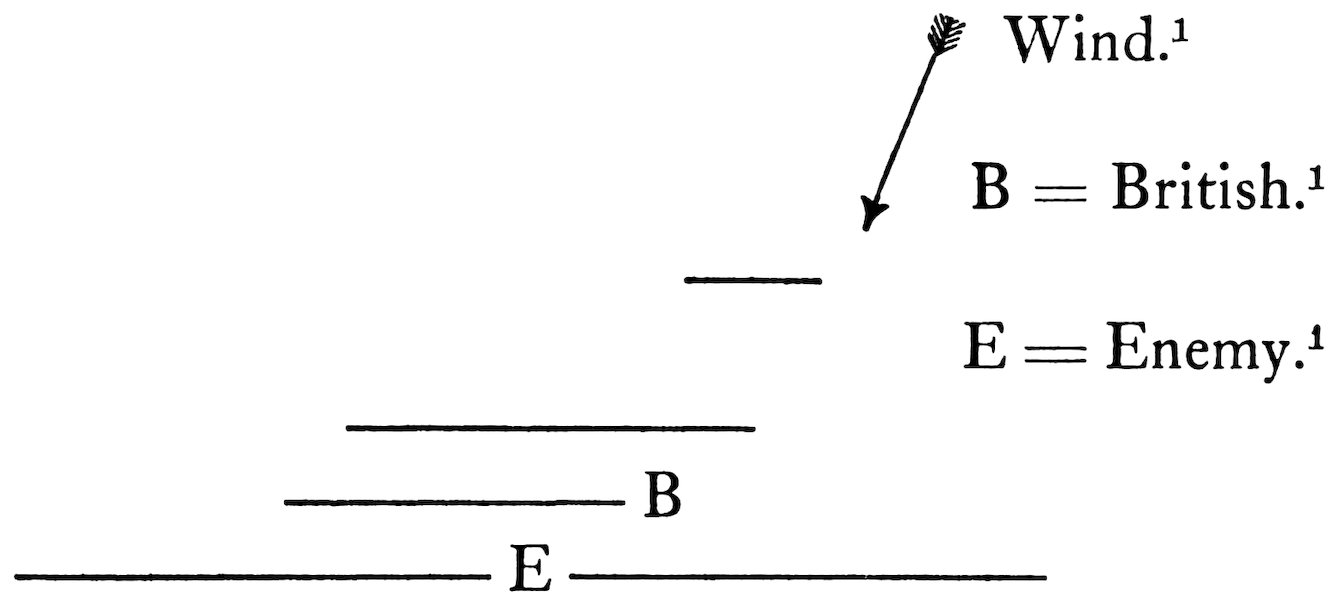
The divisions of the British Fleet will be brought nearly within gun shot of the Enemy’s Center. The signal will most probably then be made for the Lee Line to bear up together, to set all their sails, even steering sails, in order to get as quickly as possible to the Enemy’s Line, and to cut through, beginning from the 12 Ship from the Enemy’s Rear. Some Ships may not get through their exact place, but they will always be at hand to assist their friends; and if any are thrown round the Rear of the Enemy, they will effectually complete the business of twelve Sail of the Enemy.
Should the Enemy wear together, or bear up and 206sail large, still the twelve Ships composing, in the first position, the Enemy’s Rear, are to be the object of attack of the Lee Line, unless otherwise directed from the Commander-in-Chief, which is scarcely to be expected, as the entire management of the Lee Line, after the intentions of the Commander-in-Chief is signified, is intended to be left to the judgment of the Admiral commanding that Line.
The remainder of the Enemy’s Fleet, 34 Sail, are to be left to the management of the Commander-in-Chief who will endeavor to take care that the movements of the Second in Command are as little interrupted as is possible.
Nelson and Bronté.
After a statement of general considerations, and a frank attribution of full powers to the second in command for carrying out his part, Nelson lays down the manner of attack from to leeward. This condition not obtaining at Trafalgar, the plan cannot be contrasted with the performance of that day. Upon this follows a luminous enunciation of the general idea, namely, Collingwood’s engaging the twelve rear ships, which underlies the method prescribed for each attack—from to leeward and to windward. Of the latter Nelson fortunately gives an outline diagram, which illustrates the picture before his own mind, facilitating our comprehension of his probable expectations, and allowing a comparison between them and the event as it actually occurred. It is not to the discredit, but greatly to the credit, of his conception, that it was susceptible 207of large modification in practice while retaining its characteristic idea.
Looking at his diagram, and following his words, it will be seen that the British lines are not formed perpendicularly to that of the enemy (as they were at Trafalgar), but parallel to it. Starting from this disposition, near the enemy and abreast his center, the lee line of sixteen ships was to bear up together, and advance in line, not in column (as happened at Trafalgar); their object being the twelve rear ships of the enemy. This first move stands by itself; the action of the weather line, and of the reserve squadron still farther to windward, are held in suspense under the eye of the commander-in-chief, to take the direction which the latter shall prescribe as the struggle develops. The mere menace of such a force, just out of gunshot to windward, would be sufficient to prevent any extensive maneuver of the unengaged enemies. Nelson doubtless had in mind the dispositions, more than a century old, of Tourville and De Ruyter, by which a few ships, spaced to windward of an enemy’s van, could check its tacking, because of the raking fire to which they would subject it. Unquestionably, he would not have kept long in idle expectancy twenty-four ships, the number he had in mind; but clearly also he proposed to hold them until he saw how things went with Collingwood. Thus much time would allow, granting the position he assumed and a reasonable breeze. His twenty-four to windward held an absolute check over the supposed thirty-four unengaged, of the enemy.
208The attack as planned, therefore, differed from that executed (1) in that the lee line was not to advance in column, but in line, thereby dispersing the enemy’s fire, and avoiding the terrific concentration which crushed the leaders at Trafalgar; and (2) in that the weather squadrons were not to attack simultaneously with the lee, but after it had engaged, in order to permit the remedying of any mishap that might arise in delivering the crucial blow. In both these matters of detail the plan was better than the modification; but the latter was forced upon Nelson by conditions beyond his control.[84]