PART I NAVAL PRINCIPLES (continued 2)
Reading edition
67The United States, however, has an even more urgent situation as to frontier in its Atlantic and Pacific coasts. If my claim is correct, in the instance of France, that a water frontier is continuous when passage from end to end by water is practicable, this is also continuous; and the battle fleet has demonstrated the fact within the past few years. The United States, then, has a maritime frontier line from Eastport, Maine, to Puget Sound; and, like other military lines, it divides into three principal parts immediately obvious,—the Atlantic Coast, the Pacific Coast, and the line between. This summary will not be any more true, nor any more useful for reflection, when the line passes by Panama instead of the Straits of Magellan; but it certainly will be more obvious. It then will be seen easily, as now may be seen certainly, that the important part of the long line in the present case, as in the future, is the center, because that insures or prevents passage in force from side to side; the transfer of force; in short, the communications. This reproduces again the Danube position, and also the chain of Spanish positions from Genoa to Belgium. It is once more the central position, which we have met before in such varying localities and periods; but the central position of Panama has over that now open to us, by Magellan, the advantage of interior lines, of which class of lines indeed the contrast between the existing and the future of routes offers a notable illustration.
68
6. Strategic Positions[24]
The strategic value of any place depends upon three principal conditions:
1. Its position, or more exactly its situation. A place may have great strength, but be so situated with regard to the strategic lines as not to be worth occupying.
2. Its military strength, offensive and defensive. A place may be well situated and have large resources and yet possess little strategic value, because weak. It may, on the other hand, while not naturally strong, be given artificial strength for defense. The word “fortify” means simply to make strong.
3. The resources, of the place itself and of the surrounding country....
Where all three conditions, situation, intrinsic strength, and abundant resources, are found in the same place, it becomes of great consequence strategically and may be of the very first importance, though not always. For it must be remarked that there are other considerations, lesser in the purely military point of view, which enhance the consequence of a seaport even strategically; such as its being a great mart of trade, a blow to which would cripple the prosperity of the country; or the capital, 69the fall of which has a political effect additional to its importance otherwise.
I. Situation
Of the three principal conditions, the first, situation, is the most indispensable; because strength and resources can be artificially supplied or increased, but it passes the power of man to change the situation of a port which lies outside the limits of strategic effect.
Generally, value of situation depends upon nearness to a sea route; to those lines of trade which, when drawn upon the ocean common, are as imaginary as the parallels of the chart, yet as really and usefully exist. If the position be on two routes at the same time, that is, near the crossing, the value is enhanced. A cross-roads is essentially a central position, facilitating action in as many directions as there are roads. Those familiar with works on the art of land war will recognize the analogies. The value becomes yet more marked if, by the lay of the land, the road to be followed becomes very narrow; as at the Straits of Gibraltar, the English Channel, and in a less degree the Florida Strait. Perhaps narrowing should be applied to every inlet of the sea, by which trade enters into and is distributed over a great extent of country; such as the mouth of the Mississippi, of the Dutch and German rivers, New York harbor, etc. As regards the sea, however, harbors or the mouths of rivers are usually termini or entrepôts, at which goods are transshipped before going farther. If the road be narrowed 70to a mere canal, or to the mouth of a river, the point to which vessels must come is reduced almost to the geometrical definition of a point and near-by positions have great command. Suez presents this condition now, and Panama soon will.
Analogously, positions in narrow seas are more important than those in the great ocean, because it is less possible to avoid them by a circuit. If these seas are not merely the ends—“termini”—of travel but “highways,” parts of a continuous route; that is, if commerce not only comes to them but passes through to other fields beyond, the number of passing ships is increased and thereby the strategic value of the controlling points....
[Illustrations are here employed to show that, owing to the freedom of movements on the open sea, dangerous positions when not located in narrow channels are more easily avoided than on land. Hence “fausses routes et moments perdus,” in Napoleon’s phrase, play an important part in naval operations, as shown by Napoleon’s route to Egypt via Malta and Crete, and Rozhestvensky’s choice of routes before Tsushima. On the other hand, obstacles when they exist are impassable. Only submarines can avoid danger by transit over land.—Editor.]
II. Military Strength
A. Defensive Strength. [Military strength is considered in two aspects, (A) defensive, and (B) offensive. Under defensive strength, it is first pointed out that, as illustrated by Port Arthur and 71Santiago, coast bases are in chief danger of capture from the land side. While it is the business of the navy to prevent the landing of forces, its operations, though defensive in result, must be offensive in character, and not confined to the vicinity of the bases.—Editor.]
In the sphere of maritime war, the navy represents the army in the field; and the fortified strategic harbors, upon which it falls back as ports of refuge after battle or defeat, for repairs or for supplies, correspond precisely to strongholds, like Metz, Strasburg, Ulm, upon which, systematically occupied with reference to the strategic character of the theater of war, military writers agree the defense of a country must be founded. The foundation, however, must not be taken for the superstructure for which it exists. In war, the defensive exists mainly that the offensive may act more freely. In sea warfare, the offensive is assigned to the navy; and if the latter assumes to itself the defensive, it simply locks up a part of its trained men in garrisons, which could be filled as well by forces that have not their peculiar skill. To this main proposition I must add a corollary, that if the defense of ports, many in number, be attributed to the navy, experience shows that the navy will be subdivided among them to an extent that will paralyze its efficiency. I was amused, but at the same time instructed as to popular understanding of war, by the consternation aroused in Great Britain by one summer’s maneuvers, already alluded to, and the remedy proposed in some papers. It appeared that several seaports 72were open to bombardment and consequent exaction of subsidies by a small squadron, and it was gravely urged that the navy should be large enough to spare a small detachment to each port. Of what use is a navy, if it is to be thus whittled away? But a popular outcry will drown the voice of military experience.
... The strictly defensive strength of a seaport depends therefore upon permanent works, the provision of which is not the business of naval officers. The navy is interested in them because, when effective, they release it from any care about the port; from defensive action to the offensive, which is its proper sphere.
There is another sense in which a navy is regarded as defensive; namely, that the existence of an adequate navy protects from invasion by commanding the sea. That is measurably and in very large degree true, and is a strategic function of great importance; but this is a wholly different question from that of the defensive strength of seaports, of strategic points, with which we are now dealing. It therefore will be postponed, with a simple warning against the opinion that because the navy thus defends there is no need for local protection of the strategic ports; no need, that is, for fortifications. This view affirms that a military force can always, under all circumstances, dispense with secure bases of operations; in other words, that it can never be evaded, nor know momentary mishap.
I have now put before you reasons for rejecting the opinion that the navy is the proper instrument, 73generally speaking, for coast defense in the narrow sense of the expression, which limits it to the defense of ports. The reasons given may be summed up, and reduced to four principles, as follows:
1. That for the same amount of offensive power, floating batteries, or vessels of very little mobility, are less strong defensively against naval attack than land works are.
2. That by employing able-bodied seafaring men to defend harbors you lock up offensive strength in an inferior, that is, in a defensive, effort.
3. That it is injurious to the morale and skill of seamen to keep them thus on the defensive and off the sea. This has received abundant historical proof in the past.
4. That in giving up the offensive the navy gives up its proper sphere, which is also the most effective.
B. Offensive Strength.—The offensive strength of a seaport, considered independently of its strategic situation and of its natural and acquired resources, consists in its capacity:
1. To assemble and hold a large military force, of both ships of war and transports.
2. To launch such force safely and easily into the deep.
3. To follow it with a continued support until the campaign is ended. In such support are always to be reckoned facilities for docking, as the most important of all supports.
[These points are discussed in detail. It is noted that a port with two outlets, like New York and Vladivostok, has a decided advantage.—Editor.]
74
III. Resources
The wants of a navy are so many and so varied that it would be time lost to name them separately. The resources which meet them may be usefully divided under two heads, natural and artificial. The latter, again, may be conveniently and accurately subdivided into resources developed by man in his peaceful occupation and use of a country, and those which are immediately and solely created for the maintenance of war.
Other things being equal, the most favorable condition is that where great natural resources, joined to a good position for trade, have drawn men to settle and develop the neighboring country. Where the existing resources are purely artificial and for war, the value of the port, in so far, is inferior to that of one where the ordinary occupations of the people supply the necessary resources. To use the phraseology of our subject, a seaport that has good strategic situation and great military strength, but to which all resources must be brought from a distance, is much inferior to a similar port having a rich and developed friendly region behind it. Gibraltar and ports on small islands, like Santa Lucia and Martinique, labor under this disadvantage, as compared with ports of England, France, the United States; or even of a big island like Cuba, if the latter be developed by an industrial and commercial people.
75
7. Strategic Lines[25]
Communications
The most important of strategic lines are those which concern the communications. Communications dominate war. This has peculiar force on shore, because an army is immediately dependent upon supplies frequently renewed. It can endure a brief interruption much less readily than a fleet can, because ships carry the substance of communications largely in their own bottoms. So long as the fleet is able to face the enemy at sea, communications mean essentially, not geographical lines, like the roads an army has to follow, but those necessaries, supplies of which the ships cannot carry in their own hulls beyond a limited amount. These are, first, fuel; second, ammunition; last of all, food. These necessaries, owing to the facility of water transportation as compared with land, can accompany the movements of a fleet in a way impossible to the train of an army. An army train follows rather than accompanies, by roads which may be difficult and must be narrow; whereas maritime roads are easy, and inimitably wide.
Nevertheless, all military organizations, land or sea, are ultimately dependent upon open communications 76with the basis of the national power; and the line of communications is doubly of value, because it usually represents also the line of retreat. Retreat is the extreme expression of dependence upon the home base. In the matter of communications, free supplies and open retreat are two essentials to the safety of an army or of a fleet. Napoleon at Marengo in 1800, and again at Ulm in 1805, succeeded in placing himself upon the Austrian line of communication and of retreat, in force sufficient to prevent supplies coming forward from the base, or the army moving backward to the base. At Marengo there was a battle, at Ulm none; but at each the results depended upon the same condition,—the line of communication controlled by the enemy. In the War of Secession the forts of the Mississippi were conquered as soon as Farragut’s fleet, by passing above, held their line of communications. Mantua in 1796 was similarly conquered as soon as Napoleon had placed himself upon the line of retreat of its garrison. It held out for six months, very properly; but the rest of the campaign was simply an effort of the outside Austrians to drive the French off the line, and thus to reinforce the garrison or to enable it to retreat.
Importance of Sea Communications[26]
Except Russia and Japan, the nations actively concerned in this great problem [the problem of Asia] rest, for home bases, upon remote countries. 77We find therefore two classes of powers: those whose communication is by land, and those who depend upon the sea. The sea lines are the most numerous and easy, and they will probably be determinative of the courses of trade. Among them there are two the advantages of which excel all others—for Europe by Suez, from America by way of the Pacific Ocean. The latter will doubtless receive further modification by an isthmian canal, extending the use of the route to the Atlantic seaboard of America, North and South.
Communications dominate war; broadly considered, they are the most important single element in strategy, political or military. In its control over them has lain the pre-eminence of sea power—as an influence upon the history of the past; and in this it will continue, for the attribute is inseparable from its existence. This is evident because, for reasons previously explained, transit in large quantities and for great distances is decisively more easy and copious by water than by land. The sea, therefore, is the great medium of communications—of commerce. The very sound, “commerce,” brings with it a suggestion of the sea, for it is maritime commerce that has in all ages been most fruitful of wealth; and wealth is but the concrete expression of a nation’s energy of life, material and mental. The power, therefore, to insure these communications to one’s self, and to interrupt them for an adversary, affects the very root of a nation’s vigor, as in military operations it does the existence of an army, or as the free access to rain and sun—communication 78from without—does the life of a plant. This is the prerogative of the sea powers; and this chiefly—if not, indeed, this alone—they have to set off against the disadvantage of position and of numbers under which, with reference to land power, they labor in Asia. It is enough. Pressure afar off—diversion—is adequate to relieve that near at hand, as Napoleon expected to conquer Pondicherry on the banks of the Vistula. But if the sea powers embrace the proposition that has found favor in America, and, by the concession of immunity to an enemy’s commerce in time of war, surrender their control of maritime communications, they will have abdicated the scepter of the sea, for they will have abandoned one chief means by which pressure in one quarter—the sea—balances pressure in a remote and otherwise inaccessible quarter. Never was moment for such abandonment less propitious than the present, when the determination of influence in Asia is at stake.
79
8. Offensive Operations[27]
[The situation here considered is that of a fleet that has driven the enemy from a base in the theater of war, but has still to cope with the enemy fleet falling back on another base.—Editor.]
The case of further advance from your new base may not be complicated by the consideration of great distance. The next step requisite to be taken may be short, as from Cuba to Jamaica; or it may be that the enemy’s fleet is still at sea, in which case it is the great objective, now as always. Its being at sea may be because retreating, from the position you have occupied, towards his remoter base; either because conscious of inferiority, or, perhaps, after a defeat more or less decisive. It will then be necessary to act with rapidity, in order to cut off the enemy from his port of destination. If there is reason to believe that you can overtake and pass him with superior force, every effort to do so must be made. The direction of his retreat is known or must be ascertained, and it will be borne in mind that the base to which he is retreating and his fleet are separated parts of one force, the union of which must be prevented. In such a case, the excuses frequently made for a sluggish pursuit ashore, such as fatigue of troops, heavy roads, etc., do not apply. Crippled battleships must be dropped, or ordered 80to follow with the colliers. Such a pursuit presumes but one disadvantage to the chasing fleet, viz., that it is leaving its coal base while the chase is approaching his; and this, if the calculations are close, may give the pursuing admiral great anxiety. Such anxieties are the test and penalty of greatness. In such cases, excuses for failure attributed to shortness of coal will be closely scrutinized; and justly. In all other respects, superiority must be assumed, because on no other condition could such headlong pursuit be made. It aims at a great success, and successes will usually be in proportion to superiority, either original or acquired. “What the country needs,” said Nelson, “is the annihilation of the enemy. Only numbers can annihilate.”
If such a chase follow a battle, it can scarcely fail that the weaker party—the retreating party—is also distressed by crippled ships, which he may be forced to abandon—or fight. Strenuous, unrelaxing pursuit is therefore as imperative after a battle as is courage during it. Great political results often flow from correct military action; a fact which no military commander is at liberty to ignore. He may very well not know of those results; it is enough to know that they may happen, and nothing can excuse his losing a point which by exertion he might have scored. Napoleon, says Jomini, never forgave the general who in 1796, by resting his troops a couple of hours, failed to get between an Austrian division and Mantua, in which it was seeking refuge, and by his neglect found it. The failure of Admiral de Tourville to pursue vigorously the defeated Dutch 81and English fleet, after the battle of Beachy Head, in 1690, caused that victory to be indecisive, and helped to fasten the crown of England on the head of a Dutch King, who was the soul of the alliance against France. Slackness in following up victory had thus a decisive influence upon the results of the whole war, both on the continent and the sea. I may add, it has proved injurious to the art of naval strategy, by the seeming confirmation it has given to the theory of the “fleet in being.” It was not the beaten and crippled English and Dutch “fleet in being” that prevented an invasion of England. It was the weakness or inertness of Tourville, or the unreadiness of the French transports.
Similarly, the refusal of Admiral Hotham to pursue vigorously a beaten French fleet in 1795, unquestionably not only made that year’s campaign indecisive, but made possible Napoleon’s Italian campaign of 1796, from which flowed his whole career and its effects upon history. The same dazzling career received its sudden mortal stab when, in the height of his crushing advance in Spain, with its capital in his hands, at the very moment when his vast plans seemed on the eve of accomplishment, a more enterprising British leader, Sir John Moore, moved his petty army to Sahagun, on the flank of Napoleon’s communications between France and Madrid. The blow recoiled upon Moore, who was swept as by a whirlwind to Coruña, and into the sea; but Spain was saved. The Emperor could not retrieve the lost time and opportunity. He could not return to Madrid in person, 82but had to entrust to several subordinates the task which only his own supreme genius could successfully supervise. From the military standpoint, his downfall dates from that day. The whole career of Wellington, to Waterloo, lay in the womb of Moore’s daring conception. But for that, wrote Napier, the Peninsular War would not have required a chronicler.
An admiral may not be able to foresee such remote consequences of his action, but he can safely adopt the principle expressed by Nelson, in the instance just cited, after hearing his commander-in-chief say they had done well enough: “If ten ships out of eleven were taken, I would never call it well enough, if we were able to get at the eleventh.”
The relations between the fleets of Admirals Rozhestvensky and Togo prior to their meeting off Tsushima bore no slight resemblance to those between a pursued and a pursuing fleet. The Russian fleet, which had started before the Port Arthur division succumbed, was placed by that event in the position of a fleet which has suffered defeat so severe that its first effort must be to escape into its own ports. This was so obvious that many felt a retreat upon the Baltic was the only course left open; but, failing that, Rozhestvensky argued that he should rush on to Vladivostok at once, before the Japanese should get again into the best condition to intercept him, by repairing their ships, cleaning the bottoms, and refreshing the ships’ companies. Instead of so ordering, the Russian government decided to hold him at Nossi-Bé (the north end of Madagascar), 83pending a reinforcement to be sent under Admiral Nebogatoff. Something is to be said for both views, in the abstract; but considering that the reinforcement was heterogeneous and inferior in character, that the Russian first aim was not battle but escape to Vladivostok, and, especially, that the Japanese were particularly anxious to obtain the use of delay for the very purpose Rozhestvensky feared, it seems probable that he was right. In any event, he was delayed at Nossi-Bé from January 9 to March 16; and afterwards at Kamranh Bay in French Cochin-China, from April 14 to May 9, when Nebogatoff joined. Allowing time for coaling and refitting, this indicates a delay of sixty to seventy days; the actual time underway from Nossi-Bé to Tsushima being only forty-five days. Thus, but for the wait for Nebogatoff, the Russian division would have reached Tsushima two months before it did, or about March 20.
Togo did not have to get ahead of a flying fleet, for by the fortune of position he was already ahead of it; but he did have to select the best position for intercepting it, as well as to decide upon his general course of action: whether, for instance, he should advance to meet it; whether he should attempt embarrassment by his superior force of torpedo vessels, so as to cripple or destroy some of its units, thus reducing further a force already inferior; also the direction and activities of his available scouts. His action may be taken as expressing his opinions on these subjects. He did not advance; he did not attempt harassment prior to meeting; he concentrated 84his entire battle force on the line by which he expected the enemy must advance; and he was so far in ignorance of their movements that he received information only on the very morning of the battle. This was well enough; but it is scarcely unreasonable to say it might have been bettered. The Japanese, however, had behind them a large part of a successful naval campaign, the chief points of which it is relevant to our subject to note. They had first by a surprise attack inflicted a marked injury on the enemy’s fleet, which obtained for them a time of delay and opportunity during its enforced inactivity. They had then reduced one of the enemy’s two naval bases, and destroyed the division sheltered in it. By this they had begun to beat the enemy in detail, and had left the approaching reinforcement only one possible port of arrival.
If a flying fleet has been lost to sight and has but one port of refuge, pursuit, of course, will be directed upon that port; but if there are more, the chasing admiral will have to decide upon what point to direct his fleet, and will send out despatch vessels in different directions to find the enemy and transmit intelligence. Cruisers engaged in such duty should be notified of the intended or possible movements of the fleet, and when practicable should be sent in couples; for although wireless telegraphy has now superseded the necessity of sending one back with information, while the other remains in touch with the enemy, accidents may happen, and in so important a matter it seems expedient to double precautions. The case resembles duplicating important 85correspondence; for wireless cannot act before it has news, and to obtain news objects must be seen. It is to be remembered, too, that wireless messages may be intercepted, to the serious disadvantage of the sender. It seems possible that conjunctures may arise when it will be safer to send a vessel with tidings rather than commit them to air waves.
Thus, in theory, and to make execution perfect,—to capture, so to say, Nelson’s eleventh ship,—the aim must be to drive the enemy out of every foothold in the whole theater of war, and particularly to destroy or shut up his fleet. Having accomplished the great feature of the task by getting hold of the most decisive position, further effort must be directed towards, possibly not upon, those points which may serve him still for bases. In so doing, your fleet must not be divided, unless overwhelmingly strong, and must not extend its lines of communication beyond the power of protecting them, unless it be for a dash of limited duration.
If compelled to choose between fortified ports of the enemy and his fleet, the latter will be regarded as the true objective; but a blockade of the ports, or an attack upon them, may be the surest means of bringing the ships within reach. Thus, in the War of American Independence, the siege of Gibraltar compelled the British fleet on more than one occasion to come within fighting reach of the enemy’s blockading fleet, in order to throw in supplies. That the allies did not attack, except on one occasion, does not invalidate the lesson. Corbett in his “Seven Years’ War” points out very justly, in Byng’s celebrated 86failure, which cost him his life, that if he had moved against the French transports, in a neighboring bay, the French admiral would have had to attack, and the result might have been more favorable to the British. Such movements are essentially blows at the communications of the enemy, and if aimed without unduly risking your own will be in thorough accord with the most assured principles of strategy. A militarily effective blockade of a base essential to the enemy will force his fleet either to fight or to abandon the theater of war. Thus, as has been pointed out elsewhere, in Suffren’s campaign in Indian Seas, so long as Trincomalee was in possession of the British, a threat at it was sure to bring them out to fight, although it was not their principal base. The abandonment of the theater of war by the navy will cause the arsenal to fall in time, through failure of resources, as Gibraltar must have fallen if the British fleet had not returned and supplied it at intervals. Such a result, however, is less complete than a victory over the enemy’s navy, which would lead to the same end, and so be a double success, ships and port.
87
9. The Value of the Defensive[28]
It is true that in certain respects the defensive has advantages, the possession of which may even justify an expression, which has been stated as a maxim of war, that “Defense is a stronger form of war than Offense is.” I do not like the expression, for it seems to me misleading as to the determinative characteristics of a defensive attitude; but it may pass, if properly qualified. What is meant by it is that in a particular operation, or even in a general plan, the party on the defense, since he makes no forward movement for the time, can strengthen his preparations, make deliberate and permanent dispositions; while the party on the offensive, being in continual movement, is more liable to mistake, of which the defense may take advantage, and in any case has to accept as part of his problem the disadvantage, to him, of the accumulated preparations that the defense has been making while he has been marching. The extreme example of preparation is a fortified permanent post; but similar instances are found in a battle field carefully chosen for advantages of ground, where attack is awaited, and in a line of ships, which by the solidarity of its order, and deployment of broadside, awaits an enemy who has to approach in column with disadvantage as to train of guns. In so far, the form 88taken by the defense is stronger than the form assumed for the moment by the offense.
If you will think clearly, you will recognize that at Tsushima the Japanese were on the defensive, for their object was to stop, to thwart, the Russian attempt. Essentially, whatever the tactical method they adopted, they were to spread their broadsides across the road to Vladivostok, and await. The Russians were on the offensive, little as we are accustomed so to regard them; they had to get through to Vladivostok—if they could. They had to hold their course to the place, and to break through the Japanese,—if they could. In short, they were on the offensive, and the form of their approach had to be in column, bows on,—a weaker form,—which they had to abandon, tactically, as soon as they came under fire.
In our hostilities with Spain, also, Cervera’s movement before reaching Santiago was offensive in character, the attitude of the United States defensive; that is, he was trying to effect something which the American Navy was set to prevent. There being three principal Spanish ports, Havana, Cienfuegos, and Santiago, we could not be certain for which he would try, and should have been before two in such force that an attempt by him would have assured a battle. We were strong enough for such a disposition. The two ports thus to be barred were evidently Havana and Cienfuegos. The supposed necessity for defending our northern coast left Cienfuegos open. Had Cervera made for it, he would have reached it before the Flying Squadron 89did. The need for keeping the Flying Squadron in Hampton Roads was imaginary, but it none the less illustrates the effect of inadequate coast defenses upon the military plan of the nation.
The author whom I quote (Corbett, “Seven Years’ War,” Vol. I, p. 92), who himself quotes from one of the first of authorities, Clausewitz, has therefore immediately to qualify his maxim, thus:
“When we say that defense is a stronger form of war, that is, that it requires a smaller force, if soundly designed, we are speaking, of course, only of one certain line of operations. If we do not know the general line of operation on which the enemy intends to attack, and so cannot mass our force upon it, then defense is weak, because we are compelled to distribute our force so as to be strong enough to stop the enemy on any line of operations he may adopt.”
Manifestly, however, a force capable of being strong enough on several lines of operation to stop an enemy possesses a superiority that should take the offensive. In the instance just cited, of Cervera’s approach, the American true policy of concentration would have had to yield to distribution, between Cienfuegos and Havana. Instead of a decisive superiority on one position, there would have been a bare equality upon two. Granting an enemy of equal skill and training, the result might have been one way or the other; and the only compensation would have been that the enemy would have been so badly handled that, to use Nelson’s phrase, he would give no more trouble that season, and the 90other American division would have controlled the seas, as Togo did after August 10, 1904. From the purely professional point of view it is greatly to be regretted that the Spaniards and Russians showed such poor professional aptitude.
The radical disadvantage of the defensive is evident. It not only is the enforced attitude of a weaker party, but it labors under the further onerous uncertainty where the offensive may strike, when there is more than one line of operation open to him, as there usually is. This tends to entail dissemination of force. The advantages of the defensive have been sufficiently indicated; they are essentially those of deliberate preparation, shown in precautions of various kinds. In assuming the defensive you take for granted the impossibility of your own permanent advance and the ability of the enemy to present himself before your front in superior numbers; unless you can harass him on the way and cause loss enough to diminish the inequality. Unless such disparity exists, you should be on the offensive. On the other hand, in the defensive it has to be taken for granted that you have on your side a respectable though inferior battle fleet, and a sea frontier possessing a certain number of ports which cannot be reduced without regular operations, in which the armed shipping can be got ready for battle, and to which, as to a base, they can retire for refit. Without these two elements there can be no serious defense.
91
10. Commerce-Destroying and Blockade[29]
It is desirable to explain here what was, and is, the particular specific utility of operations directed toward the destruction of an enemy’s commerce; what its bearing upon the issues of war; and how, also, it affects the relative interests of antagonists, unequally paired in the matter of sea power. Without attempting to determine precisely the relative importance of internal and external commerce, which varies with each country, and admitting that the length of transportation entails a distinct element of increased cost upon the articles transported, it is nevertheless safe to say that, to nations having free access to the sea, the export and import trade is a very large factor in national prosperity and comfort. At the very least, it increases by so much the aggregate of commercial transactions, while the ease and copiousness of water carriage go far to compensate for the increase of distance. Furthermore, the public revenue of maritime states is largely derived from duties on imports. Hence arises, therefore, a large source of wealth, of money; and money—ready money or substantial credit—is proverbially the sinews of war, as the War of 1812 was amply to demonstrate. Inconvertible assets, as business men know, are a very inefficacious form of 92wealth in tight times; and war is always a tight time for a country, a time in which its positive wealth, in the shape of every kind of produce, is of little use, unless by freedom of exchange it can be converted into cash for governmental expenses. To this sea commerce greatly contributes, and the extreme embarrassment under which the United States as a nation labored in 1814 was mainly due to commercial exclusion from the sea. To attack the commerce of the enemy is therefore to cripple him, in the measure of success achieved, in the particular factor which is vital to the maintenance of war. Moreover, in the complicated conditions of mercantile activity no one branch can be seriously injured without involving others.
This may be called the financial and political effect of “commerce destroying,” as the modern phrase runs. In military effect, it is strictly analogous to the impairing of an enemy’s communications, of the line of supplies connecting an army with its base of operations, upon the maintenance of which the life of the army depends. Money, credit, is the life of war; lessen it, and vigor flags; destroy it, and resistance dies. No resource then remains except to “make war support war;” that is, to make the vanquished pay the bills for the maintenance of the army which has crushed him, or which is proceeding to crush whatever opposition is left alive. This, by the extraction of private money, and of supplies for the use of his troops, from the country in which he was fighting, was the method of Napoleon, than whom no man held more delicate views 93concerning the gross impropriety of capturing private property at sea, whither his power did not extend. Yet this, in effect, is simply another method of forcing the enemy to surrender a large part of his means, so weakening him, while transferring it to the victor for the better propagation of hostilities. The exaction of a pecuniary indemnity from the worsted party at the conclusion of a war, as is frequently done, differs from the seizure of property in transit afloat only in method, and as peace differs from war. In either case, money or money’s worth is exacted; but when peace supervenes, the method of collection is left to the Government of the country, in pursuance of its powers of taxation, to distribute the burden among the people; whereas in war, the primary object being immediate injury to the enemy’s fighting power, it is not only legitimate in principle, but particularly effective, to seek the disorganization of his financial system by a crushing attack upon one of its important factors, because effort thus is concentrated on a readily accessible, fundamental element of his general prosperity. That the loss falls directly on individuals, or a class, instead of upon the whole community, is but an incident of war, just as some men are killed and others not. Indirectly, but none the less surely, the whole community, and, what is more important, the organized government, are crippled; offensive powers impaired.
But while this is the absolute tendency of war against commerce, common to all cases, the relative value varies greatly with the countries having recourse 94to it. It is a species of hostilities easily extemporized by a great maritime nation; it therefore favors one whose policy is not to maintain a large naval establishment. It opens a field for a sea militia force, requiring little antecedent military training. Again, it is a logical military reply to commercial blockade, which is the most systematic, regularized, and extensive form of commerce-destruction known to war. Commercial blockade is not to be confounded with the military measure of confining a body of hostile ships of war to their harbor, by stationing before it a competent force. It is directed against merchant vessels, and is not a military operation in the narrowest sense, in that it does not necessarily involve fighting, nor propose the capture of the blockaded harbor. It is not usually directed against military ports, unless these happen to be also centers of commerce. Its object, which was the paramount function of the United States Navy during the Civil War, dealing probably the most decisive blow inflicted upon the Confederacy, is the destruction of commerce by closing the ports of egress and ingress. Incidental to that, all ships, neutrals included, attempting to enter or depart, after public notification through customary channels, are captured and confiscated as remorselessly as could be done by the most greedy privateer. Thus constituted, the operation receives far wider scope than commerce-destruction on the high seas; for this is confined to merchantmen of belligerents, while commercial blockade, by universal consent, subjects to capture neutrals who attempt to infringe 95it, because, by attempting to defeat the efforts of one belligerent, they make themselves parties to the war.
In fact, commercial blockade, though most effective as a military measure in broad results, is so distinctly commerce-destructive in essence, that those who censure the one form must logically proceed to denounce the other. This, as has been seen, Napoleon did; alleging in his Berlin Decree, in 1806, that war cannot be extended to any private property whatever, and that the right of blockade is restricted to fortified places, actually invested by competent forces. This he had the face to assert, at the very moment when he was compelling every vanquished state to extract, from the private means of its subjects, coin running up to hundreds of millions to replenish his military chest for further extension of hostilities. Had this dictum been accepted international law in 1861, the United States could not have closed the ports of the Confederacy, the commerce of which would have proceeded unmolested; and hostile measures being consequently directed against men’s persons instead of their trade, victory, if accomplished at all, would have cost three lives for every two actually lost.
It is apparent, immediately on statement, that against commerce-destruction by blockade, the recourse of the weaker maritime belligerent is commerce-destruction by cruisers on the high sea. Granting equal efficiency in the use of either measure, it is further plain that the latter is intrinsically far less efficacious. To cut off access to a city is much more certainly accomplished by holding the 96gates than by scouring the country in search of persons seeking to enter. Still, one can but do what one can. In 1861 to 1865, the Southern Confederacy, unable to shake off the death grip fastened on its throat, attempted counteraction by means of the “Alabama,” “Sumter,” and their less famous consorts, with what disastrous influence upon the navigation—the shipping—of the Union it is needless to insist. But while the shipping of the opposite belligerent was in this way not only crippled, but indirectly was swept from the seas, the Confederate cruisers, not being able to establish a blockade, could not prevent neutral vessels from carrying on the commerce of the Union. This consequently suffered no serious interruption; whereas the produce of the South, its inconvertible wealth—cotton chiefly—was practically useless to sustain the financial system and credit of the people. So, in 1812 and the two years following, the United States flooded the seas with privateers, producing an effect upon British commerce which, though inconclusive singly, doubtless co-operated powerfully with other motives to dispose the enemy to liberal terms of peace. It was the reply, and the only possible reply, to the commercial blockade, the grinding efficacy of which it will be a principal object of these pages to depict. The issue to us has been accurately characterized by Mr. Henry Adams, in the single word “Exhaustion.”[30]
Both parties to the War of 1812 being conspicuously maritime in disposition and occupation, 97while separated by three thousand miles of ocean, the sea and its navigable approaches became necessarily the most extensive scene of operations. There being between them great inequality of organized naval strength and of pecuniary resources, they inevitably resorted, according to their respective force, to one or the other form of maritime hostilities against commerce which have been indicated. To this procedure combats on the high seas were merely incidental. Tradition, professional pride, and the combative spirit inherent in both peoples, compelled fighting when armed vessels of nearly equal strength met; but such contests, though wholly laudable from the naval standpoint, which under ordinary circumstances cannot afford to encourage retreat from an equal foe, were indecisive of general results, however meritorious in particular execution. They had no effect upon the issue, except so far as they inspired moral enthusiasm and confidence. Still more, in the sequel they have had a distinctly injurious effect upon national opinion in the United States. In the brilliant exhibition of enterprise, professional skill, and usual success, by its naval officers and seamen, the country has forgotten the precedent neglect of several administrations to constitute the navy as strong in proportion to the means of the country as it was excellent through the spirit and acquirements of its officers. Sight also has been lost of the actual conditions of repression, confinement, and isolation, enforced upon the maritime frontier during the greater part of the war, with the misery and mortification thence ensuing. It has been 98widely inferred that the maritime conditions in general were highly flattering to national pride, and that a future emergency could be confronted with the same supposed facility, and as little preparation, as the odds of 1812 are believed to have been encountered and overcome. This mental impression, this picture, is false throughout, alike in its grouping of incidents, in its disregard of proportion, and in its ignoring of facts. The truth of this assertion will appear in due course of this narrative, and it will be seen that, although relieved by many brilliant incidents, indicative of the real spirit and capacity of the nation, the record upon the whole is one of gloom, disaster, and governmental incompetence, resulting from lack of national preparation, due to the obstinate and blind prepossessions of the Government, and, in part, of the people.
Command of the Sea Decisive[31]
It is not the taking of individual ships or convoys, be they few or many, that strikes down the money power of a nation; it is the possession of that overbearing power on the sea which drives the enemy’s flag from it, or allows it to appear only as a fugitive; and which, by controlling the great common, closes the highways by which commerce moves to and from the enemy’s shores. This overbearing power can only be exercised by great navies, and by them (on the broad sea) less efficiently now than in the days when the neutral flag had not its present immunity.[32] 99It is not unlikely that, in the event of a war between maritime nations, an attempt may be made by the one having a great sea power and wishing to break down its enemy’s commerce, to interpret the phrase “effective blockade” in the manner that best suits its interests at the time; to assert that the speed and disposal of its ships make the blockade effective at much greater distances and with fewer ships than formerly. The determination of such a question will depend, not upon the weaker belligerent, but upon neutral powers; it will raise the issue between belligerent and neutral rights; and if the belligerent have a vastly overpowering navy he may carry his point, just as England, when possessing the mastery of the seas, long refused to admit the doctrine of the neutral flag covering the goods.
100
11. Strategic Features of the Gulf of Mexico and the Caribbean[33]
In the special field proposed for our study, there are two principal points of such convergence—or divergence: the mouth of the Mississippi River, and the Central-American Isthmus. At the time when these lectures were first written the opinion of the world was hesitating between Panama and Nicaragua as the best site for a canal through the Isthmus. This question having now been settled definitively in favor of Panama, the particular point of convergence for trade routes passing through the Caribbean for the Pacific will continue at Colon, whither it for so long has been determined because there is the terminus of the Panama Railroad.
These two meeting points or cross-roads have long been, and still are, points of supreme interest to all mankind. At the one all the highways of the Mississippi valley, all the tributaries and sub-tributaries of the great river, meet, and thence they part. At the other all highways between the Atlantic and Pacific focus and intersect. The advancing population and development of the Mississippi valley, and the completion of the Panama Canal, will work together to cause this international interest to grow proportionately in the future. Among the great Powers of the world, no one is concerned so vitally in this progress as is the United States; because of her possession of one of these centers, the mouth of the Mississippi with its huge back country, and because of her geographical nearness to the other. This peculiar interest, which is natural and inevitable in virtue of proximity, is emphasized by the national policy known as the Monroe Doctrine; and still more by the particular result of the Doctrine which has involved the control, administration, and military protection of that belt of Isthmian territory called the Panama Canal Zone.
101
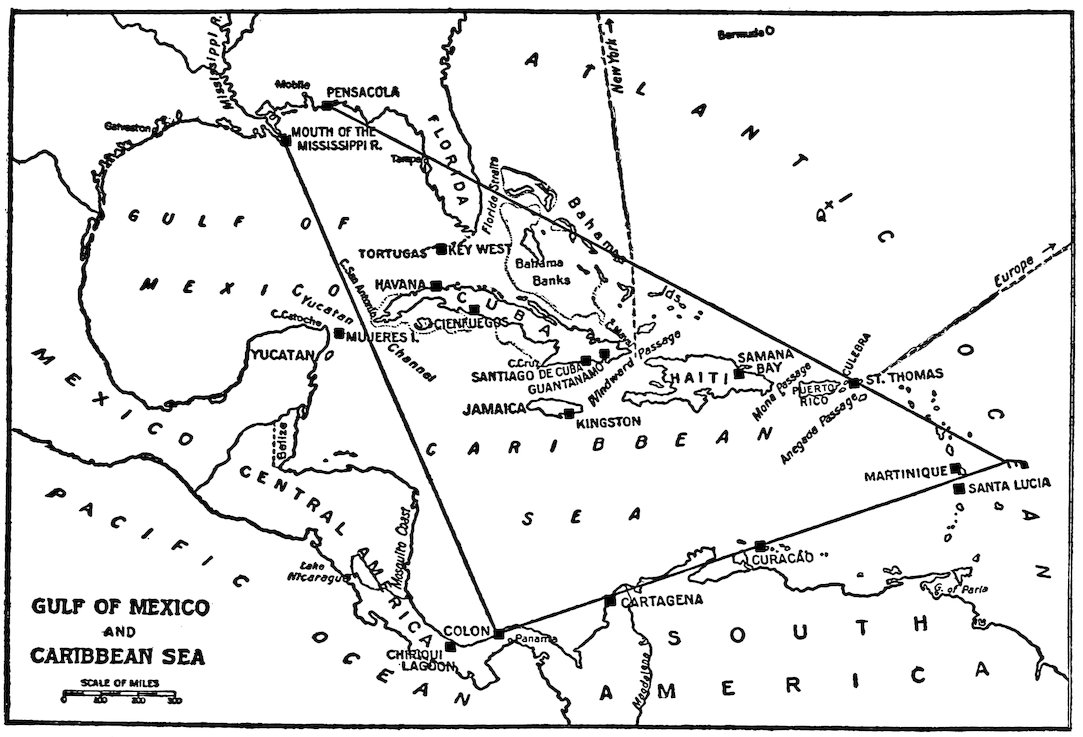
102[In the intervening pages, it is shown that the triangle drawn on the map (p. 101) includes all points of strategic importance, these being indicated by black squares. Cuba is the key to the Gulf of Mexico, and also controls three entrances to the Caribbean—the Yucatan, Windward, and Mona Passages. The entrances, the chief points of destination (Jamaica and the Isthmus), and the routes thither, constitute the main objects of military control in the Caribbean.—Editor.]
... Taking all together, control over transit depending upon situation only, other conditions being equal, is greatest with Jamaica, next with Cuba, least with the Lesser Antilles.
Accepting these conclusions as to control over transit, we now revert to that question to which all other inquiries are subsidiary, namely, Which of the three bases of operations in the Caribbean—one of the Lesser Antilles, Jamaica, or Cuba with its sphere of influence—is most powerful for military control of the principal objective points in the 103same sea? These principal objectives are Jamaica and the Isthmus; concerning the relative importance of which it may be remarked that, while the Isthmus intrinsically, and to the general interest of the world, is incomparably the more valuable, the situation of Jamaica gives such command over all the approaches to the Isthmus, as to make it in a military sense the predominant factor in the control of the Caribbean. Jamaica is a pre-eminent instance of central position, conferring the advantage of interior lines, for action in every direction within the field to which it belongs.
Military control depends chiefly upon two things, position and active military strength. As equal military strength has been assumed throughout, it is now necessary only to compare the positions held by other states in the field with that of the occupant of Cuba. This inquiry also is limited to the ability either to act offensively against these objective points, or, on the contrary, to defend them if already held by oneself or an ally; transit having been considered already.
Control by virtue of position, over a point external to your territory, depends upon nearness in point of time and upon the absence of obstacles capable of delaying or preventing your access to it.
Both Santiago (or Guantanamo) and Cienfuegos are nearer to the Isthmus than is any other one of the first-class strategic points that have been chosen on the borders of the Caribbean Sea, including Samana Bay and St. Thomas. They are little more than half the distance of the British Santa Lucia 104and the French Martinique. The formidable island and military stronghold of Jamaica, within the sea, is nearer the Isthmus than Guantanamo is, by one hundred and fifty miles, and than Cienfuegos by yet more.
Taking into consideration situation only, Jamaica is admirably placed for the control of the Caribbean. It is equidistant from Colon, from the Yucatan Passage, and from the Mona Passage. It shares with Guantanamo and Santiago control of the Windward Passage, and of that along the south coast of Cuba; while, with but a slight stretching out of its arm, it reaches the routes from the Gulf of Mexico to the Isthmus. Above all, as towards Cuba, it so blocks the road to the Isthmus that any attempt directed upon the Isthmus from Cuba must first have to account with the military and naval forces of Jamaica.
There are, however, certain deductions to be made from the strength of Jamaica that do not apply as forcibly to Cuba. Leaving to one side the great and widely scattered colonial system of Great Britain, which always throws that empire on the defensive and invites division of the fleet, owing to the large number of points open to attack, and confining our attention strictly to the field before us, it will be observed that in a scheme of British operations Jamaica is essentially, as has been said before, an advanced post; singularly well situated, it is true, but still with long and difficult communications. Its distance from Antigua, a possible intermediate base of supplies, is over nine hundred miles; from Santa 105Lucia, the chief British naval station in the Lesser Antilles, over one thousand miles, not less than three days’ economical steaming. Great Britain, if at war with a state possessing Cuba, is shut out from the Windward Passage by Guantanamo, and from the Gulf of Mexico by Havana. The Mona Passage, also, though not necessarily closed, will be too dangerous to be relied upon. For these reasons, in order to maintain communications with Jamaica, an intermediate position and depot, like Santa Lucia, will be urgently needed. Supplies coming from Bermuda, Halifax, or England would probably have to be collected first there, or at Antigua, and thence make a more secure, but still exposed, voyage to Kingston. The north coasts of Cuba and Haiti must be looked upon as practically under the control of the Cuban fleet, in consequence of the command which it exercises over the Windward Passage, by virtue of position.
The possessor of Cuba, on the contrary, by his situation has open communication with the Gulf of Mexico, which amounts to saying that he has all the resources of the United States at his disposal, through the Mississippi Valley. Cruisers from Jamaica attempting to intercept that trade would be at a great disadvantage, especially as to coal, compared with their enemy resting upon Havana. Cruisers from Havana, reaching their cruising ground with little or no consumption, can therefore remain longer, and consequently are equivalent to a greater number of ships. On the other hand, cruisers from Santiago could move almost with impunity 106by the north side of Haiti as far as the Mona Passage, and beyond that without any other risk than that of meeting and fighting vessels of equal size. If they stretch their efforts toward the Anegada Passage, they would feel the same disadvantage, relatively to cruisers from Santa Lucia, that Jamaica cruisers in the Gulf would undergo as compared with those from Havana; but by inclining their course more to the northward, to or about the point Q (see map, page 101), they would there be equidistant from Guantanamo and Santa Lucia, and so on an equality with the latter, while at the same time in a position gravely to endanger supplies from any point in North America. If it be replied that Bermuda can take care of these cruisers at Q, the answer is plain: on the supposition of equal forces, it can do so only by diminishing the force at Santa Lucia. In short, when compared with Jamaica, in respect of strategic relations to Bermuda, Halifax, and Santa Lucia, Cuba enjoys the immense advantage of a central position, and of interior lines of communication, with consequent concentration of force and effort.
It is not easy to see how, in the face of these difficulties, Great Britain, in the supposed case of equal force in this theater of war, could avoid dividing her fleet sufficiently to put Jamaica at a disadvantage as to Cuba. In truth, Cuba here enjoys not only the other advantages of situation already pointed out, but also that of being central as regards the enemy’s positions; and what is, perhaps, even more important, she possesses secure interior 107land lines of supply and coal between the points of her base, while covering the sea lines in her rear, in the Gulf of Mexico. For Guantanamo and Santiago have communication by rail with Havana, while the island itself covers the lines from Havana to the Gulf coast of the United States; whereas Jamaica depends wholly upon the sea, by lines of communication not nearly as well sheltered.
Contrasted with Cuba, Jamaica is seen to be, as has been more than once said, a strong advanced post, thrust well forward into the face of an enemy to which it is much inferior in size and resources, and therefore dependent for existence upon its power of holding out, despite uncertain and possibly suspended communication. Its case resembles that of Minorca, Malta, Gibraltar, the endurance of which, when cut off from the sea, has always been measurable. The question here before us, however, is not that of mere holding out on the defensive, which would be paralysis. If Cuba can reduce Jamaica to a passive defensive, Jamaica disappears as a factor in the control of the Caribbean and Isthmus—no obstacle then stands in the way of Cuba using her nearness to Panama. If Cuba can bring about a scarcity of coal at Kingston she achieves a strategic advantage; if a coal famine, the enemy’s battle fleet must retire, probably to the Lesser Antilles.
The case of Jamaica, contrasted with Cuba, covers that of all strategic points on the borders of the Caribbean Sea, east, west, north, or south. Almost on the border itself, although within it, Jamaica 108has in nearness, in situation, in size, and in resources, a decisive advantage over any of the ports of Haiti or of the smaller islands. If Jamaica is inferior to Cuba, then is each of the other points on the circumference, and, it may be added, all of them together....
[It is shown that, while Santa Lucia is essential to Jamaica, the two are too far apart to work together in concert. As for the Lesser Antilles, they may be said to control the approaches from Europe, while Cuba controls those from North America; but the Antilles are twice as far from the Isthmus as Cuba is, and much weaker in resources.—Editor.]
As to resources, those of all the West India islands for war will depend mainly upon the policy and preparation of the governments. Except Cuba, they are deficient in natural resources adequately developed. Outside of direct governmental action it can only be said that the much greater population of Cuba will draw more supplies and furnish more material for troops and garrisons. At present, as already noted, the resources of the United States are in effect also the resources of Cuba.
As between the three possible bases for attempted control of the Caribbean, no doubts can remain that Cuba is the most powerful, Jamaica next, and the Antilles least. Jamaica being where it is, Cuba cannot put forth her power against the Isthmus or against the lines of transit in the Caribbean, until she has materially reduced, if not neutralized, the offensive power of her smaller opponent. Upon the supposition of equal fleets, if the Cuban fleet move 109against the Isthmus, or into the Caribbean, it uncovers its communications; if it seeks to cover these, it divides its force. Jamaica exactly meets the case supposed in a previous chapter: “If, in moving upon the coveted objective you pass by a strategic point held by the enemy, capable of sheltering his ships—a point from which he may probably intercept your supplies of coal or ammunition, the circle of influence of that point will require your attention and reduce your force.”
In that case it was laid down that, if you cannot observe the port without reducing your fleet below that of the enemy, you must not divide it; either the intermediate point must be taken, or, if you think you can accomplish your special aim with the supplies on board, you may cut loose from your base, giving up your communications. Undoubtedly, the same difficulty would be felt by the Jamaica fleet, if it moved away from home leaving the Cuban fleet in port in Santiago or Guantanamo; but, of the two, Jamaica has the inside track. It is not so with operations based upon the Lesser Antilles only, and directed against the Isthmus, or against any position in the western basin of the Caribbean, Cuba being hostile; the line of communication in that case is so long as to be a very serious comparative disadvantage.
Upon the whole, then, Jamaica, though less powerful than Cuba, seems to deserve the title of the “key to the Caribbean.” Only when Cuba has mastered it can she predominantly control the positions of that sea. But if Jamaica in this sense be the 110key, Cuba has the grip that can wrest it away. Secure as to her own communications, in the rear, towards the Gulf of Mexico, Cuba has it in her power to impose upon her enemy a line so long and insecure as to be finally untenable. First a scarcity of coal, then a famine, lastly the retreat of the Jamaica fleet to the most available coal station. Such is the solution I believe possible to the military problem of the Caribbean as dependent upon geographical conditions,—that is, upon positions; concerning which Napoleon has said that “War is a business of positions.” The instant the Cuban fleet has gained a decided superiority over that of Jamaica, it can take a position covering at once the approaches to that island and the Windward Channel, keeping all its own ships in hand while cutting off the enemy’s supplies and reinforcements. The converse is not true of the Jamaica fleet, in case it gains a momentary superiority, because the southern ports of Cuba should be able to receive supplies by land, from the Gulf of Mexico through Havana.
The general discussion of the strategic features of the Gulf of Mexico and Caribbean ends here; but the treatment of the subject will not be complete, unless there be some further specific consideration of the bearing which the conclusions reached have upon the facilities of the United States for naval action in the region studied.
[The political developments between 1887 and 1911 are here considered, including the growth of the American Navy; the construction of the Panama Canal; the acquisition by the United States of 111strategic points along the line from Key West to Culebra Island, centering at Guantanamo and “most effectual for military and naval action in the Caribbean;” and, finally, our increased responsibilities arising from the growth of the German Navy and the consequent limitation of England’s co-operation in support of the Monroe Doctrine.—Editor.]
... The Caribbean Sea and the Isthmus of Panama furnish the student of naval strategy with a very marked illustration of the necessity of such cohesion and mutual support between military positions assumed; as well as between those positions and the army in the field,—that is, the navy. It affords therefore a subject of the first importance for such a student to master, and that in fuller detail than is expedient for a series of lectures, the object of which should be to suggest lines of thought, rather than to attempt exhaustive treatment. For an American naval officer, the intimate relation of the Isthmus and its coming canal to the mutual support of the Atlantic and Pacific coasts renders the subject doubly interesting. This interest is yet farther increased by the consideration that the general international importance to commerce of such a point as the Canal can scarcely fail to make the conditions of its tenure and use a source of international difference and negotiation, which often are war under another form; that is, the solution depends upon military power, even though held in the background. There are questions other than commercial dependent upon the tenure of the Isthmus, of which I will not here speak explicitly. To appreciate them 112fully there must be constant reading and reflection upon the general topics of the day.
One thing is sure: in the Caribbean Sea is the strategic key to the two great oceans, the Atlantic and Pacific, our own chief maritime frontiers.
113
12. Principles of Naval Administration
Opposing Elements[34]
Administration being a term of very general application, it will be expected that that of the navy should present close analogies, and even points of identity, with other forms of administration; for instance, that in it, as elsewhere, efficiency of result will be better secured by individual responsibility than by collective responsibility. But, along with general resemblance, naval administration is very clearly and sharply differentiated by the presence of an element which is foreign to almost all other activities of life in countries like Great Britain and the United States. The military factor is to it not merely incidental, but fundamental; whatever other result may be achieved, naval administration has failed unless it provides to the nation an efficient fighting body, directed by well-trained men, animated by a strong military spirit. On the other hand, many of the operations connected with it differ from those common to civil life only in a certain particularity of method. This is true in principal measure of the financial management, of the medical establishment, and to a considerable though much smaller degree of the manufacturing processes connected with the production of naval material. The business routine of even the most military department 114of a naval administration is in itself more akin to civil than to military life: but it by no means follows that those departments would be better administered under men of civil habits of thought than by those of military training. The method exists for the result, and an efficient fighting body is not to be attained by weakening the appreciation of military necessities at the very fountain head of their supply in the administration. This necessary appreciation can be the result only of personal experience of good and bad through the formative period of life.
We find, therefore, at the very outset of our inquiry two fundamental yet opposing elements, neither of which can be eliminated. Nor can they be reconciled, in the sense of becoming sympathetic. In its proper manifestation the jealousy between the civil and military spirits is a healthy symptom. They can be made to work together harmoniously and efficiently; to complement, not to antagonize each other; provided means are taken to ensure to each its due relative precedence and weight in the determination of practical questions.
Historically, the institution and development of naval administration has been essentially a civil process, the object of which has been to provide and keep in readiness a national weapon for war. The end is war—fighting; the instrument is the navy; the means are the various activities which we group under the head of administration. Of these three, the end necessarily conditions the others. The proverb is familiar, “He who wills the end wills 115the means.” Whatever is essential to the spirit and organization of the navy afloat, to its efficiency for war, must find itself adequately represented in the administration, in order that the exigencies of fighting may be kept well to the front in governmental and national consideration. Since armies and navies have existed as permanent national institutions, there has been a constant struggle on the part of the military element to keep the end—fighting, or readiness to fight—superior to mere administrative considerations. This is but natural, for all men tend to magnify their office. The military man having to do the fighting, considers that the chief necessity; the administrator equally naturally tends to think the smooth running of the machine the most admirable quality. Both are necessary; but the latter cannot obtain under the high pressure of war unless in peace the contingency of war has dictated its system. There is a quaint, well-worn story, which yet may be new to some readers, of an administrator who complained that his office was working admirably until war came and threw everything out of gear.
The opposition between civil and military, necessitating their due adjustment, may be said to be original, of the nature of things. It is born with naval administration. Corresponding roughly to these primary factors are the two principal activities in which administration is exerted—organization and execution. These also bear to each other the relation of means to end. Organization is not for itself, but is a means to an ultimate executive action; in the case of a navy, to war or to the prevention of 116war. It is, therefore, in its end—war—that organization must find the conditions dictating its character. Whatever the system adopted, it must aim above all at perfect efficiency in military action; and the nearer it approaches to this ideal the better it is. It would seem that this is too obvious for mention. It may be for mention; but not for reiteration. The long record of naval history on the side of administration shows a constant predominance of other considerations, and the abiding necessity for insisting, in season and out of season, that the one test of naval administration is not the satisfactory or economical working of the office, as such, but the readiness of the navy in all points for war. The one does not exclude the other; but there is between them the relation of greater and less.
Both organization and execution are properties alike of the active navy, the instrument for war, and of the naval administration, the means which has been constituted to create and maintain the instrument; but from their respective spheres, and in proportion to their relative nearness to the great final end of war, the one or the other characteristic is found predominant. The naval officer on board his ship, face to face with the difficulties of the profession, and in daily contact with the grim implements which remind him of the eventualities of his calling, naturally sees in organization mainly a means to an end. Some indeed fall short. The martinet is a man to whom the organization is more than a means; but he is the exception. Naval administration, on the other hand, in the common 117acceptation of the term, is mostly office work. It comes into contact with the navy proper chiefly through official correspondence, less by personal intercourse with the officers concerned; still less by immediate contact with the daily life of the profession, which it learns at second hand. It consequently tends to overvalue the orderly routine and observance of the system by which it receives information, transmits orders, checks expenditure, files returns, and, in general, keeps with the service the touch of paper; in short, the organization which has been created for facilitating its own labors. In due measure these are imperatively necessary; but it is undeniable that the practical tendency is to exaggerate their importance relatively to the executive end proposed. The writer was once visiting a French captain, who in the course of the interview took up wearily a mass of papers from a desk beside him. “I wonder,” said he, “whether all this is as bad with you as with us. Look at our Navy Register;” and dividing the pages into two parts, severally about one-sixth and five-sixths of the whole, he continued, “This, the smaller, is the Navy; and that is the Administration.” No wonder he had papers galore; administration needs papers, as a mill needs grist.
Even in the case of naval officers entering administrative offices, the influence of prolonged tenure is in the same direction. The habits of a previous lifetime doubtless act as a check, in proportion to the strength they have acquired in the individual. They serve as an invaluable leaven, not only to his 118own thought but to that of his associates. Nevertheless, the experience is general that permanence in an office essentially civil tends to deaden the intimate appreciation of naval exigencies; yet upon this alone can thrive that sympathy between the administrative and executive functions of the navy which is requisite to efficiency. The habit of the arm-chair easily prevails over that of the quarterdeck; it is more comfortable. For this reason, in the best-considered systems, a frequent exchange between the civil and military parts of their profession, between the administrative offices and the army or fleet, is thought expedient for officers who show aptitude for the former. It is better for them personally, better for the administration, and consequently better for the service at large. It prevails extensively in the United States Navy, where it is frequently the subject of ill-instructed outside criticism on the score of sea-officers being on “shore duty.” Without asserting that the exact proportions of service are always accurately observed, it may be confidently affirmed that the interchange between the civil and military occupations tends to facilitate the smooth working of both, by promoting mutual understanding of conditions and difficulties.
The British System[35]
[From 1660 to 1832, British naval administration was divided between a civilian “Navy Board” and a military “Board of Admiralty.”—Editor.]
119Divided control means divided responsibility; and that in turn means no responsibility, or at least one very hard to fix. The abuses that grew up, especially in the dockyards, the effect of which of course was transmitted to the navy that depended upon them, led to a loud outcry throughout the service towards the end of the eighteenth century; but horses are not swapped when crossing streams, and the exigencies of the great wars which ended in 1815 made it long impossible to attempt the revolutionary change needed. This was carried out in 1832 by the Government which came in with the Reform Bill of 1830. The spirit of the innovation was summarized in the expression, “Individual (undivided) Responsibility.” The Navy Board disappeared altogether. The civil functions which in the process of centuries had accumulated in its hands, and had culminated by successive additions into a very numerous and loose aggregation of officials, were concentrated into five heads, having separate and independent responsibilities; in this resembling the chiefs of bureau in the United States Naval Administration. Each of the five was specifically under one of the members of the Admiralty Board, who thus represented that particular interest of the Navy in the Board regarded as a consultative body. Admiral Sir Vesey Hamilton writes: “This was a consolidation of functions and a subordination of the civil branches to the Admiralty as a whole ... under the Board of Admiralty collectively and under the Lords individually.” While the First Lord is a civilian, the majority of the other members of the 120Admiralty are naval officers. Authority, therefore, is in civil hands, while military influence enters strongly.
While I highly appreciate the value of this latter factor, particularly as the sea lords do not consequently give up their profession, but remain actively connected with it, it appears to my observation of human nature that the system has some of the disadvantages of a council of war, tending to make responsibility elusive. I question, in short, the entire soundness of a scheme which by its nature, if not by specific provision, inclines to place executive action in the hands of a consultative body. It seems to sap individual responsibility; not perhaps in subordinates, but, what is much worse, in the head, in the commander-in-chief of the administration, upon whom depend the great determinative lines of provision and of policy. In conception, the Admiralty is primarily a Board, secondarily individual members. For individual responsibility at the head, too much depends upon the personality of the First Lord, too little upon his position. Since these lines were first written, five years ago, it may fairly be inferred, from the language of the English Press, that very decisive changes of policy have been adopted which are attributed popularly, and even professionally, to the dominating influence of one of the “Sea” Lords. During a brief period in 1827, as two centuries before, an arrangement more formally ideal obtained. The Duke of Clarence, afterwards William IV, being appointed Lord High Admiral, the Admiralty Board lapsed as a board 121and became his council. The modification here made in deference to royal blood might well serve as a model for naval administration; a head with advisers feels responsibility more than a head with associates. It should go without saying that in any case the head must be good.
In the United States Naval Administration the head is one man, with no division of responsibility. His own superior, the President, may control his action, as may Congress by law; but this, as far as it goes, is simply a transfer of responsibility in its entirety. It is not a division. The Secretary of the Navy has no associates, but he has subordinates. In them he has capable advisers, so far as he chooses to use them; but he can transfer to them no responsibility, except that of doing as he tells them. The responsibility of decision is his alone. The law constitutes them subordinate executive officers, just as it constitutes a lieutenant in the navy; but it does not constitute them advisers, and there is in their position nothing which compels the Secretary to hear their advice, still less to accept it. Each is independent of the others, and there is nothing in law to compel conference between them. The Secretary may assemble them, or any number of them, as a board for consultation, in his presence or otherwise; but there is nothing in the system which obliges him to do so. Unity of action between several naval technical experts, each of whom is represented in the planning and maintenance of every naval vessel, and some in every element of naval military efficiency, depends entirely upon the co-ordinating force 122of the Secretary, who is a civilian, possibly with only more or less outside knowledge of the subject. The system provides no strictly professional unifying force, such as the Board of Admiralty, which has a numerical preponderance of combatant sea-officers, each of whom has in individual control one or more of the technical administrative departments, and may be supposed therefore to be fully informed of its arguments in any technical matter under discussion. The constitution of the Admiralty Board also ensures that all technical details and their effect upon naval efficiency shall be scrutinized from the point of view of the men who shall do the work of war. The American plan fixes the very strictest individual responsibility in the Secretary, and in his principal subordinates, the chiefs of bureau. His duties are universal and supreme, theirs sharply defined and mutually independent. This result appears to me superior to the British, but it has the defects of its qualities; not too much independence in responsibility, but, so far as the system goes, too little co-ordination. As I said of the responsibility of the First Lord, unity of action depends too much on the personality of the Secretary.
The United States System[36]
The United States system of naval administration has progressed successively, and without breach of legislative continuity, from the simple rudimentary organ, the one man, in whom all functions as well 123as all responsibility were centered, through the phase of a complex organ with aggregate functions and responsibilities, defined, but still undifferentiated, into an organization elaborate in form, if not final in development. The process has been from first to last consistent in principle. The sole control and single responsibility of the Secretary—the representative of the President—have been preserved throughout, and all other responsibility is, and has been, not only subordinate to him but derivative from him, as a branch derives its being from the root. Moreover, consistency has also been maintained in restricting the administration thus evolved to the civil function which it essentially is. From the first departure, in the institution of the Board of Commissioners, to the present time, it has not had military authority properly so-called. It has had necessary authority in matters pertaining to a military establishment, but it has had no direction of activities in themselves essentially military; that has remained with the Secretary, and is by him transferred only to officers properly military in function. Finally, the principle of particular responsibility has been strictly followed. Within the limits of the duty assigned, the corporate responsibility of the Board in its day was, and the individual responsibility of each bureau chief now is, as certain and defined as that of the Secretary.
The defect of the system is that no means is provided for co-ordinating the action of the bureaus,[37] 124except the single authority of the Secretary. This, in his beginning days of inexperience, together with his preoccupations with the numerous collateral engagements attendant upon all positions of public responsibility, will most usually be inadequate to the task. To indicate a defect is not to prescribe a remedy; and the purpose of this article is to show things as they are, not to advocate particular changes. One of the ablest administrative sea-officers, both afloat and ashore, that I have known in my professional career, stated before a Congressional committee that he had “always believed it would be wise to have a board of five officers for the purpose of harmonizing difficulties between bureaus, settling upon a ship-building policy, and other matters that embarrass the head of the Department on account of a lack of professional knowledge.” I do not undertake to pass an opinion upon this particular suggestion, but confine myself to remarking that the fault in the system certainly exists, and that any remedy requires the careful observance of two points: 1, that the adviser, one or a board, be wholly clear of administrative activity; and, 2, that he or they be advisers only, pure and simple, with no power to affect the individual responsibility of decision. This must be preserved under whatever method, as the Secretary’s privilege as well as his obligation.
125
13. The Military Rule of Obedience[38]
It may be asserted, as perhaps the most tenable general definition of the principle upon which the rule of obedience rests, that the spirit of obedience, as distinguished from its letter, consists in faithfully forwarding the general object to which the officer’s particular command is contributing. This finds expression in the well-known directive maxim, “March to the sound of the guns.” In doubtful cases, however,—and by doubtful I mean cases where action other than that prescribed in the orders seems expedient,—liberty of judgment is conditioned by the officer’s acquaintance with the plans of his superior. If his knowledge is imperfect, or altogether lacking, the doing that which at the moment seems wise to himself may be to defeat a much more important object, or to dissolve the bonds of a combined movement to which his co-operation is essential. If, under such circumstances of ignorance, resting only upon his own sagacity or surmises, he errs either in his reading of his commander’s general purpose, or in his decision as to his own action, and through such error disobeys, he cannot complain if he receive censure or punishment. He has violated a recognized rule without adequate reason. The rectitude of his intentions may clear him of moral blame, though not necessarily even so; for the duty of obedience is not merely military, but moral. It is not an arbitrary rule, but one essential and fundamental; 126the expression of a principle without which military organization would go to pieces, and military success be impossible. Consequently, even where the individual purpose may be demonstrably honest, not willful, blame adheres and punishment may follow, according to the measure of the delinquency, though that be due to nothing worse than personal incompetency....
No man wrestled with the question more vigorously than Nelson; none found greater exasperation than he did in the too often successful opposition of the letter to the demands of his impetuous spirit for co-operation, addressed to men over whom he had not immediate control; none was more generous in his attitude to subordinates who overrode or overpassed his own orders, provided he saw in their acts the intelligent and honest will to forward his purposes. Obedience he certainly required; but he recognized that, given a capable and zealous man, better work would usually be had by permitting a certain elasticity of initiative, provided it was accompanied by accurate knowledge of his general wishes. These he was always most careful to impart; in nothing was he more precise or particular. If he allowed large liberty in the letter, he expected close observance of, nay, rather, participation in, the spirit of his ideas. He was not tolerant of incapacity, nor would he for a moment bear willful disregard of his plans. When considerations of high policy entertained by himself were crossed by Sidney Smith, his language became peremptory. “As this is in strict opposition to my opinion, which is never 127to suffer any one individual Frenchman to quit Egypt, I strictly charge and command you never to give any French ship or man leave to quit Egypt.” The italics are his own; and he adds again, as though distrustful still: “You are to put my orders in force, not on any pretense to permit a single Frenchman to leave Egypt.” The severity of the tone sufficiently proves his disposition to enforce the strictest rule, where necessary to control individuals; but a more liberal reliance upon principle, in preference to rule, was his habit. None, it may be added, illustrated more copiously than he, when a junior, the obedience of the spirit and the disobedience of the letter. His practice was in this consistent in all stages of his career. Unfortunately, the example may tempt smaller men to follow where their heads are not steady enough to keep their feet.
Of course, thinking and feeling thus, he gave frequent expression to his views, and these, coming from a man of his military genius, are often very illuminative. There is one such that is singularly applicable to our present purpose, of searching for the underlying principle which governs the duty and observance of obedience, and determines its absolute necessity to all military action. “I find few think as I do, but to obey orders is all perfection. What would my superiors direct, did they know what is passing under my nose? To serve my King and to destroy the French I consider as the great order of all, from which little ones spring, and if one of these little ones militate against it, I go back to obey the great order.”
128
14. Preparedness for Naval War[39]
Preparation for war, rightly understood, A falls under two heads,—preparation and preparedness. The one is a question mainly of material, and is constant in its action. The second involves an idea of completeness. When, at a particular moment, preparations are completed, one is prepared—not otherwise. There may have been made a great deal of very necessary preparation for war without being prepared. Every constituent of preparation may be behindhand, or some elements may be perfectly ready, while others are not. In neither case can a state be said to be prepared.
In the matter of preparation for war, one clear idea should be absorbed first by every one who, recognizing that war is still a possibility, desires to see his country ready. This idea is that, however defensive in origin or in political character a war may be, the assumption of a simple defensive in war is ruin. War, once declared, must be waged offensively, aggressively. The enemy must not be fended off, but smitten down. You may then spare him every exaction, relinquish every gain; but till down he must be struck incessantly and remorselessly.
Preparation, like most other things, is a question both of kind and of degree, of quality and of quantity. As regards degree, the general lines upon 129which it is determined have been indicated broadly in the preceding part of this article. The measure of degree is the estimated force which the strongest probable enemy can bring against you, allowance being made for clear drawbacks upon his total force, imposed by his own embarrassments and responsibilities in other parts of the world. The calculation is partly military, partly political, the latter, however, being the dominant factor in the premises.
In kind, preparation is twofold,—defensive and offensive. The former exists chiefly for the sake of the latter, in order that offense, the determining factor in war, may put forth its full power, unhampered by concern for the protection of the national interests or for its own resources. In naval war, coast defense is the defensive factor, the navy the offensive. Coast defense, when adequate, assures the naval commander-in-chief that his base of operations—the dockyards and coal depots—is secure. It also relieves him and his government, by the protection afforded to the chief commercial centers, from the necessity of considering them, and so leaves the offensive arm perfectly free.
Coast defense implies coast attack. To what attacks are coast liable? Two, principally,—blockade and bombardment. The latter, being the more difficult, includes the former, as the greater does the lesser. A fleet that can bombard can still more easily blockade. Against bombardment the necessary precaution is gun-fire, of such power and range that a fleet cannot lie within bombarding distance. This condition is obtained, where surroundings permit, 130by advancing the line of guns so far from the city involved that bombarding distance can be reached only by coming under their fire. But it has been demonstrated, and is accepted, that, owing to their rapidity of movement,—like a flock of birds on the wing,—a fleet of ships can, without disabling loss, pass by guns before which they could not lie. Hence arises the necessity of arresting or delaying their progress by blocking channels, which in modern practice is done by lines of torpedoes. The mere moral effect of the latter is a deterrent to a dash past,—by which, if successful, a fleet reaches the rear of the defenses, and appears immediately before the city, which then lies at its mercy.
Coast defense, then, implies gun power and torpedo lines placed as described. Be it said in passing that only places of decisive importance, commercially or militarily, need such defenses. Modern fleets cannot afford to waste ammunition in bombarding unimportant towns,—at least when so far from their own base as they would be on our coast. It is not so much a question of money as of frittering their fighting strength. It would not pay.
Even coast defense, however, although essentially passive, should have an element of offensive force, local in character, distinct from the offensive navy, of which nevertheless it forms a part. To take the offensive against a floating force it must itself be afloat—naval. This offensive element of coast defense is to be found in the torpedo-boat, in its various developments. It must be kept distinct in idea from the sea-going fleet, although it is, of 131course, possible that the two may act in concert. The war very well may take such a turn that the sea-going navy will find, its best preparation for initiating an offensive movement to be by concentrating in a principal seaport. Failing such a contingency, however, and in and for coast defense in its narrower sense, there should be a local flotilla of small torpedo-vessels, which by their activity should make life a burden to an outside enemy. A distinguished British admiral, now dead, has said that he believed half the captains of a blockading fleet would break down—“go crazy” were the words repeated to me—under the strain of modern conditions. The expression, of course, was intended simply to convey a sense of the immensity of suspense to be endured. In such a flotilla, owing to the smallness of its components, and to the simplicity of their organization and functions, is to be found the best sphere for naval volunteers; the duties could be learned with comparative ease, and the whole system is susceptible of rapid development. Be it remembered, however, that it is essentially defensive, only incidentally offensive, in character.
Such are the main elements of coast defense—guns, lines of torpedoes, torpedo-boats. Of these none can be extemporized, with the possible exception of the last, and that would be only a makeshift. To go into details would exceed the limits of an article,—require a brief treatise. Suffice it to say, without the first two, coast cities are open to bombardment; without the last, they can be blockaded freely, unless relieved by the sea-going navy. Bombardment 132and blockade are recognized modes of warfare, subject only to reasonable notification,—a concession rather to humanity and equity than to strict law.[40] Bombardment and blockade directed against great national centers, in the close and complicated network of national and commercial interests as they exist in modern times, strike not only the point affected, but every corner of the land.
The offensive in naval war, as has been said, is the function of the sea-going navy—of the battleships, and of the cruisers of various sizes and purposes, including sea-going torpedo-vessels capable of accompanying a fleet, without impeding its movements by their loss of speed or unseaworthiness. Seaworthiness, and reasonable speed under all weather conditions, are qualities necessary to every constituent of a fleet; but, over and above these, the backbone and real power of any navy are the vessels which, by due proportion of defensive and offensive powers, are capable of taking and giving hard knocks. All others are but subservient to these, and exist only for them.
What is that strength to be? Ships answering to this description are the kind which make naval strength; what is to be its degree? What their number? The answer—a broad formula—is that it must be great enough to take the sea, and to fight, with reasonable chances of success, the largest force likely to be brought against it, as shown by calculations 133which have been indicated previously. Being, as we claim, and as our past history justifies us in claiming, a nation indisposed to aggression, unwilling to extend our possessions or our interests by war, the measure of strength we set ourselves depends, necessarily, not upon our projects of aggrandizement, but upon the disposition of others to thwart what we consider our reasonable policy, which they may not so consider. When they resist, what force can they bring against us? That force must be naval; we have no exposed point upon which land operations, decisive in character, can be directed. This is the kind of the hostile force to be apprehended. What may its size be? There is the measure of our needed strength. The calculation may be intricate, the conclusion only approximate and probable, but it is the nearest reply we can reach. So many ships of such and such sizes, so many guns, so much ammunition—in short, so much naval material.