PART II SEA POWER IN HISTORY (continued 3)
Reading edition
From the military point of view the absurdity of 273the procedure is clear; but for national safety it has to be equally clear to statesmen and to people. An outside observer, with some little acquired knowledge of the workings of men’s minds, needs small imagination to hear the arguments at the Russian council board. “Things are looking squally in the East,” says one; “the fleet ought to be increased.” “Increased,” says another, “you may say so. All the ships we have ought to be sent, and together, the instant they can be got ready.” “Oh but,” rejoins a third, “consider how exposed our Baltic shores would be, in case war against us should be declared by Great Britain, which already has an understanding with Japan.” The obvious reply, that, in case Great Britain did declare war, the only thing to be done with the Baltic fleet would be to snuggle it close inside of the guns of Cronstadt, would probably be made; if it was, it was not heeded. In a representative government would doubtless have been heard the further remark, “The feeling in our coast towns, at seeing no ship left for their protection, would be so strong, that I doubt if the party could carry the next election.” Against this there is no provision, except popular understanding; operative perhaps in the interior, where there is no occasion for fright.
The most instructive feature of this Russian mistake, inexcusable in a government not browbeaten by political turmoil, is that it was made in time of peace, in the face of conditions threatening war. In fact, as is often the case, when war came it was already too late to remedy adequately the blunders 274or neglects of peace. More than twenty years ago the present writer had occasion to quote emphatically the words of a French author, “Naval Strategy”—naval strategic considerations—“is as necessary in peace as in war.” In 1904, nearly a decade had elapsed since Japan had been despoiled of much of her gains in her war with China. Since then Russia had been pursuing a course of steady aggression, in furtherance of her own aims, and contrary to what Japan considered her “vital interests and national honor.” It is not necessary to pronounce between the views of the two parties to see that the action of Russia was militarily preposterous, unless her fleet grew in proportion to that of Japan, and of her own purposes, and was kept in hand; that is, kept concentrated. It would have mattered little whether, being united, the outbreak of war found it in the Baltic, or in Vladivostok. That it could come, as did Rozhestvensky, but in double his force, would have been a fact no less emphatic when in the Baltic than in the farther East.
It is precisely the same, in application as well as in principle, with the Atlantic and Pacific coasts of the United States. Both are exposed. Neither need be more exposed than the other; for, in virtue of our geographical position relatively to the other great Powers of the world, it is not the momentary location of the fleet, but its simple existence, adequate in numbers and efficiency, and concentrated in force, which protects both coasts. Any invader from the one side or the other must depend upon sea communications to support his army throughout the war; 275not merely for the three months needed to bring the United States fleet from one side to the other. But, if the war begin with the fleet divided between the two oceans, one half may be overmatched and destroyed, as was that of Port Arthur; and the second on coming prove unequal to restore the situation, as befell Rozhestvensky. That is to say, Concentration protects both coasts, Division exposes both. It is of vital consequence to the nation of the United States, that its people, contemplating the Russo-Japanese naval war, substitute therein, in their apprehension, Atlantic for Baltic, and Pacific for Port Arthur. So they will comprehend as well as apprehend.
276
30. Rozhestvensky at Tsushima[104]
[The Russian fleet under Rozhestvensky left Libau October 15, 1904; reached Madagascar January 1, 1905, the day of the surrender of Port Arthur; and entered the Korea or Tsushima Straits on the morning of May 26. A part of the auxiliaries had been left in the mouth of the Yang-tse River, but the hospital and repair ships and those laden with naval stores were with the fleet. According to testimony at the court martial of Admiral Rozhestvensky, the battleships entered the straits with coal for three thousand miles, though the distance from the Saddle Islands to Vladivostok was but nine hundred.—Editor.]
Criticism here is another case of inferring intentions from actions; but, when the various parts of Rozhestvensky’s conduct are taken together, the inference is nearly irresistible that the exaggerated estimate of the influence of an inferior fleet in being possessed his imagination. Besides the excessive coal stowage, he took with him a train of transports, a notorious source of tactical embarrassment in battle, though doubtless equally a source of refitment, if he got them to Vladivostok; and there is no evidence of any attempt at advanced scouting on his own part, or of driving off, as he might have done, 277the Japanese scouts which showed up; the result being that Togo knew all about his dispositions, and he knew nothing about Togo’s until he saw the enemy’s main body.
Now I say, that, while all this was bad management in the face of the enemy, and in so far bad tactics, the bad tactics issued from an error of strategy; and the error in strategy was due to the lack of unity of conception, of that exclusiveness of purpose, which is the essence of strategy, and which subordinates, adjusts, all other factors and considerations to the one exclusive aim. While writing these pages, I came across a few lines by one of the first of German philosophical historians, Ranke, in one of his greatest works, “England in the Seventeenth Century.” They apply to policy, but policy is twin brother to strategy. Permit me to quote them:
“Why did William III get the better of James II in Ireland? Because he always kept his one great idea before his eyes, amid the many perplexing circumstances, which surrounded him. The decision which he displayed at every moment rested upon the fact that he had only one end, and that the one imposed by the course of things.”
278
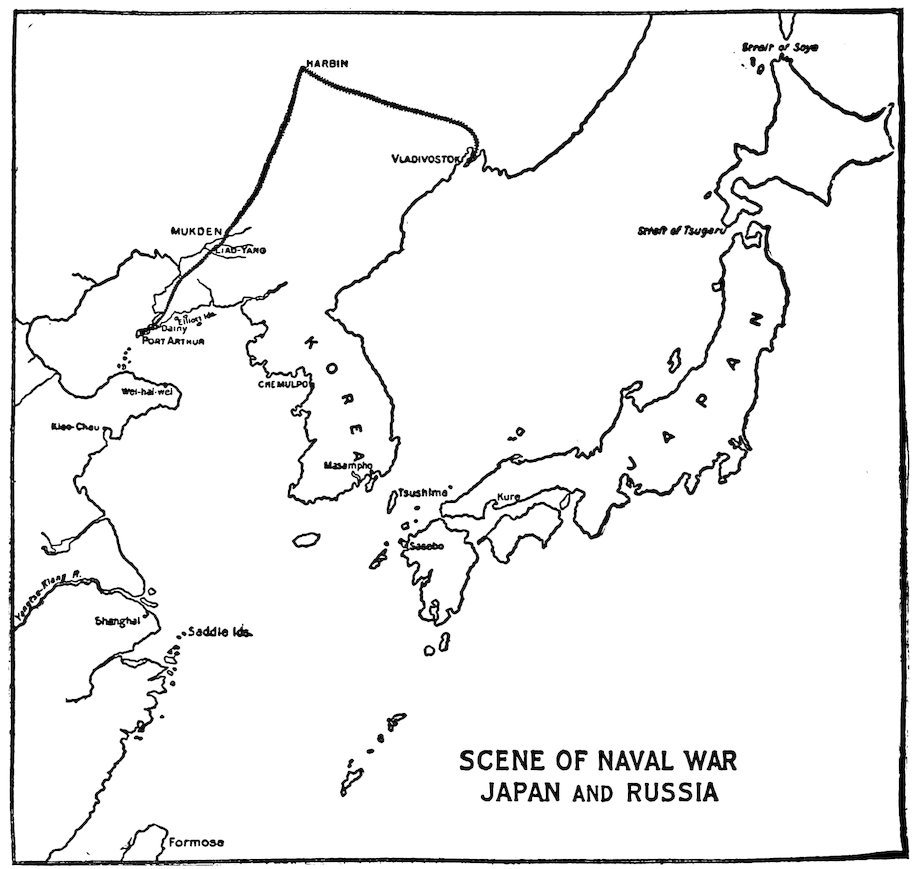
Apply this to Rozhestvensky. The one end imposed on him by the course of things was the destruction of the Japanese fleet, which comprised every armored vessel Japan could possibly muster for that war. Togo’s signal[105] before the battle recognized this one end, and there was no reason why his opponent should not have recognized it equally. To reach Vladivostok was only a means to that end; an object most important, because, if attained, it would put the Russians in the best possible condition for battle. But this by no means superseded the one necessary aim,—battle. More, it did not even postpone that aim, as a matter of immediate consideration and preparation; for, though escape through to Vladivostok might be possible, it was not certain. It was not even 279probable, under all the conditions. Therefore, while every forethought and care should have been to effect escape, if possible, they should have been accompanied with the clear decision that, should battle be forced, the fighting should have been qualified by no thought of escape, and the fleet, like a ship cleared for action, should have been stripped of all fleet encumbrances from the moment of leaving the Saddles. A fleet is half beaten already when it goes into battle with one eye upon something else than fighting.
If Rozhestvensky had recognized these facts, in their due importance and proportion, and had been convinced that battle was his one aim, and that there was at least a very real possibility that he could not postpone it till after Vladivostok, it seems to me he must have reasoned thus: I must have coal enough to reach Vladivostok, on a reasonable calculation of the distance, and of the expenditures of the ships; both which were known. To this amount add a fair margin of safety. This total should be carried for the purpose of escape, if feasible; with perhaps an addition sufficient to last during battle, with funnels pierced, which was a likely accident. Again, there is for each ship a draft of water which best meets her maneuvering needs. The chances are that the enemy will await us either in the narrower part of the sea, or near his navy yards. As there is one position, that in the Straits of Korea, which favors both these objects, it is there I will probably have to fight, if at all. Therefore, as far as possible, the coal carried by the fleet on starting should be such 280that consumption up to the moment of reaching the straits will put them in their best tactical trim. The coal supply needed to reach Vladivostok is thus adjusted to the exigencies of battle.
Then as regards the transports. For the moment, on this last fateful stretch, they are absolutely of no consequence as affecting results. The adjustment of them, to the end of the battle, is to dismiss them out of mind and presence. If beaten, the loss of them will not be of the slightest consequence to Russia; if successful, they can be summoned from an appointed rendezvous, and escorted to a destination under such protection as may then seem expedient. An Austrian officer has suggested that if the whole body had weighed together, and at night had separated, the supply vessels proceeding under convoy by the east of Japan might have escaped notice; or, if seen, this report might have perplexed Togo, rather than enlightened him. Upon the suggestion I make no comment, other than that it would have been one way of counting out the supply ships.
The imminency of the occasion should have drawn, and did draw, all Japan’s fighting force to the Straits of Korea, an element for Rozhestvensky’s consideration. According to Semenoff the auxiliary steamers Terek and Kuban were sent off the east coast expressly to draw attention, but met no one, and their presence was unknown to the Japanese.
I am not disposed to question, or to doubt, that if the Russian squadron had escaped Togo, and if the separated supply train had been intercepted, it 281would have been very embarrassing to the ships of war refitting at Vladivostok. Nor do I question that, in case of such escape, the coal remaining in consequence of the deck loads taken would have been of much value for future operations. The more real and the greater those distracting considerations, like those of William III in Ireland, the more do they throw into relief the greatness, as well as the necessity, of subordinating them to the one thing needful, namely, to be ready to the utmost on the day of battle. They illustrate, too, how misleading is the disposition to compromise, to concede something all around; to straddle the two horses, escape and battle.
Rozhestvensky’s course was a compromise, a mix-up of escape and fighting; a strategic blunder to begin with, in not concentrating attention on the one needful thing clearly indicated by the course of events, and hence resulting necessarily in a series of blunders, which comprehensively may be called tactical. They all hang together, as the results of a frame of mind; the overloading with coal, the increased danger of fire therefrom, the submersion of the armor belts, the loss of speed and tactical capacity, the neglect of scouting, the company of the transports,—each of which is a tactical error,—all proceed from the failure to observe that the one governing consideration of strategy, in this war, was a naval battle under the most favorable conditions. It is the repetition of the mistakes of the Port Arthur division. When it becomes clearly imminent that one may have to fight under conditions 282less favorable than one would desire, conditions are changed; but there is no change of the principles involved. Vladivostok reached, the principle would have required the utmost preparation the yard offered, in the least possible time, so as to be the most fit possible to fight. At the Saddles, the same fitness required the dismissal from influence upon conduct of all thought of Vladivostok, and of supplies there, so far as such thought might modify the preparation for probable battle. It seems very probable that the defective conceptions deducible from Rozhestvensky’s conduct were emphasized and reinforced by the heavy preoccupations about supplies, necessarily incidental to his anxious outward voyage. His mind and morale had got a twist, a permanent set, from which they could not recover.
283