PART II SEA POWER IN HISTORY (continued 2)
Reading edition
The Battle
Napoleon’s commands to enter the Mediterranean reached Villeneuve on September 27. The following day, when Nelson was joining his fleet, the admiral acknowledged their receipt, and submissively reported his intention to obey as soon as the wind served. Before he could do so, accurate intelligence was received of the strength of Nelson’s force, which the emperor had not known. Villeneuve assembled a council of war to consider the situation, and the general opinion was adverse to sailing; but the commander-in-chief, alleging the orders of Napoleon, announced his determination to follow them. To this all submitted. An event, then unforeseen by Villeneuve, precipitated his action.
Admiral Rosily’s approach was known in Cadiz 209some time before he could arrive. It at first made little impression upon Villeneuve, who was not expecting to be superseded. On the 11th of October, however, along with the news that his successor had reached Madrid, there came to him a rumor of the truth. His honor took alarm. If not allowed to remain afloat, how remove the undeserved imputation of cowardice which he knew had by some been attached to his name. He at once wrote to Decrès that he would have been well content if permitted to continue with the fleet in a subordinate capacity; and closed with the words, “I will sail to-morrow, if circumstances favor.”
The wind next day was fair, and the combined fleets began to weigh. On the 19th eight ships got clear of the harbor, and by ten A.M. Nelson, far at sea, knew by signal that the long-expected movement had begun. He at once made sail toward the Straits of Gibraltar to bar the entrance of the Mediterranean to the allies. On the 20th, all the latter, thirty-three ships-of-the-line accompanied by five frigates and two brigs, were at sea, steering with a south-west wind to the northward and westward to gain the offing needed before heading direct for the Straits. That morning Nelson, for whom the wind had been fair, was lying to off Cape Spartel to intercept the enemy; and learning from his frigates that they were north of him, he stood in that direction to meet them.
During the day the wind shifted to west, still fair for the British and allowing the allies, by going about, to head south. It was still very weak, so that 210the progress of the fleets was slow. During the night both maneuvered; the allies to gain, the British to retain, the position they wished. At daybreak of the 21st they were in presence, the French and Spaniards steering south in five columns; of which the two to windward, containing together twelve ships, constituted a detached squadron of observation under Admiral Gravina. The remaining twenty-one formed the main body, commanded by Villeneuve. Cape Trafalgar, from which the battle took its name, was on the south-eastern horizon, ten or twelve miles from the allies; and the British fleet was at the same distance from them to the westward.
Soon after daylight Villeneuve signalled to form line of battle on the starboard tack, on which they were then sailing, heading south. In performing this evolution Gravina with his twelve ships took post in the van of the allied fleet, his own flagship heading the column. It is disputed between the French and Spaniards whether this step was taken by Villeneuve’s order, or of Gravina’s own motion. In either case, these twelve, by abandoning their central and windward position, sacrificed to a great extent their power to reinforce any threatened part of the order, and also unduly extended a line already too long. In the end, instead of being a reserve well in hand, they became the helpless victims of the British concentration.
At eight A.M. Villeneuve saw that battle could not be shunned. Wishing to have Cadiz under his lee in case of disaster, he ordered the combined fleet 211to wear together. The signal was clumsily executed; but by ten all had gone round and were heading north in inverse order, Gravina’s squadron in the rear. At eleven Villeneuve directed this squadron to keep well to windward, so as to be in position to succor the center, upon which the enemy seemed about to make his chief attack; a judicious order, but rendered fruitless by the purpose of the British to concentrate on the rear itself. When this signal was made, Cadiz was twenty miles distant in the north-north-east, and the course of the allies was carrying them toward it.
Owing to the lightness of the wind Nelson would lose no time in maneuvering. He formed his fleet rapidly in two divisions, each in single column, the simplest and most flexible order of attack, and the one whose regularity is most easily preserved. The simple column, however, unflanked, sacrifices during the critical period of closing the support given by the rear ships to the leader, and draws upon the latter the concentrated fire of the enemy’s line. Its use by Nelson on this occasion has been much criticized. It is therefore to be remarked that, although his orders, issued several days previous to the battle, are somewhat ambiguous on this point, their natural meaning seems to indicate the intention, if attacking from to windward, to draw up with his fleet in two columns parallel to the enemy and abreast his rear. Then the column nearest the enemy, the lee, keeping away together, would advance in line against the twelve rear ships; while the weather column, moving forward, would hold in check the remainder 212of the hostile fleet. In either event, whether attacking in column or in line, the essential feature of his plan was to overpower twelve of the enemy by sixteen British, while the remainder of his force covered this operation. The destruction of the rear was entrusted to the second in command; he himself with a smaller body took charge of the more uncertain duties of the containing force. “The second in command,” wrote he in his memorable order, “will, after my instructions are made known to him, have the entire direction of his line.”
The justification of Nelson’s dispositions for battle at Trafalgar rests therefore primarily upon the sluggish breeze, which would so have delayed formations as to risk the loss of the opportunity. It must also be observed that, although a column of ships does not possess the sustained momentum of a column of men, whose depth and mass combine to drive it through the relatively thin resistance of a line, and so cut the latter in twain, the results nevertheless are closely analogous. The leaders in either case are sacrificed,—success is won over their prostrate forms; but the continued impact upon one part of the enemy’s order is essentially a concentration, the issue of which, if long enough maintained, cannot be doubtful. Penetration, severance, and the enveloping of one of the parted fragments, must be the result. So, exactly, it was at Trafalgar. It must also be noted that the rear ships of either column, until they reached the hostile line, swept with their broadsides the sea over which enemy’s ships from either flank might try to come 213to the support of the attacked center. No such attempt was in fact made from either extremity of the combined fleet.
The two British columns were nearly a mile apart and advanced on parallel courses,—heading nearly east, but a little to the northward to allow for the gradual advance in that direction of the hostile fleet. The northern or left-hand column, commonly called the “weather line” because the wind came rather from that side, contained twelve ships, and was led by Nelson himself in the Victory, a ship of one hundred guns. The Royal Sovereign, of the same size and carrying Collingwood’s flag, headed the right column, of fifteen ships.
To the British advance the allies opposed the traditional order of battle, a long single line, close-hauled,—in this case heading north, with the wind from west-north-west. The distance from one flank to the other was nearly five miles. Owing partly to the lightness of the breeze, partly to the great number of ships, and partly to the inefficiency of many of the units of the fleet, the line was very imperfectly formed. Ships were not in their places, intervals were of irregular width, here vessels were not closed up, there two overlapped, one masking the other’s fire. The general result was that, instead of a line, the allied order showed a curve of gradual sweep, convex toward the east. To the British approach from the west, therefore, it presented a disposition resembling a re-entrant angle; and Collingwood, noting with observant eye the advantage of this arrangement for a cross-fire, commented favorably upon it in his report of the battle. It was, however, the result of chance, not of intention,—due, not to the talent of the chief, but to the want of skill in his subordinates.
214
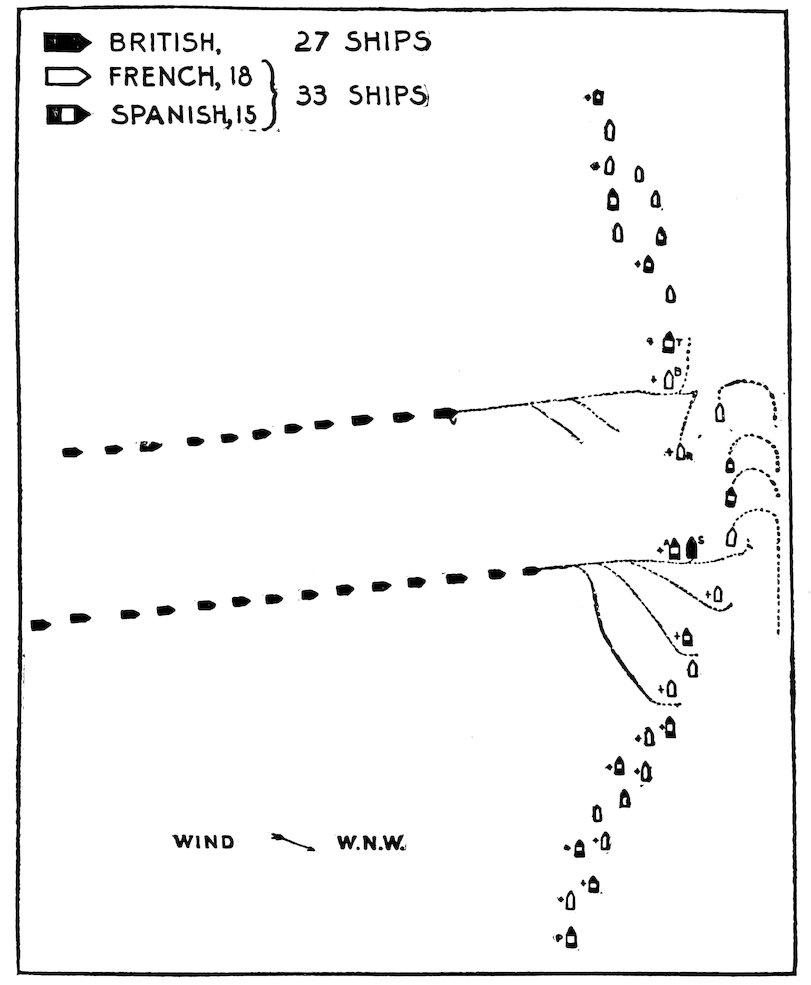
THE ATTACK AT TRAFALGAR OCTOBER 21, 1805 5 minutes past noon The French and Spanish ships marked + were taken or destroyed in the action. References A. Santa Ana, Alava’s Flagship B. Bucentaure, Villeneuve’s Flagship P. Principe De Asturias, Gravina’s Flagship R. Redoutable S. Royal Sovereign, Collingwood’s Flagship T. Santisima Trinidad V. Victory, Nelson’s Flagship Recent investigation has shown that Collingwood’s division was much more nearly parallel to the enemy than is indicated in this diagram, and thus in a formation more closely resembling Nelson’s original plan.—Editor.
215The commander-in-chief of the allies, Villeneuve, was in the Bucentaure, an eighty-gun ship, the twelfth in order from the van of the line. Immediately ahead of him was the huge Spanish four-decker, the Santisima Trinidad, a Goliath among ships, which had now come forth to her last battle. Sixth behind the Bucentaure, and therefore eighteenth in the order, came a Spanish three-decker, the Santa Ana, flying the flag of Vice-Admiral Alava. These two admirals marked the right and left of the allied center, and upon them, therefore, the British leaders respectively directed their course,—Nelson upon the Bucentaure, Collingwood upon the Santa Ana.
The Royal Sovereign had recently been refitted, and with clean new copper easily outsailed her more worn followers. Thus it happened that, as Collingwood came within range, his ship, outstripping the others by three quarters of a mile, entered alone, and for twenty minutes endured, unsupported, the fire of all the hostile ships that could reach her. A proud deed, surely, but surely also not a deed to be commended as a pattern. The first shot of the battle was fired at her by the Fougueux, the next astern of the Santa Ana. This was just at noon, and with the opening guns the ships of both fleets hoisted their ensigns; the Spaniards also hanging large wooden crosses from their spanker booms.
216The Royal Sovereign advanced in silence until, ten minutes later, she passed close under the stern of the Santa Ana. Then she fired a double-shotted broadside which struck down four hundred of the enemy’s crew, and, luffing rapidly, took her position close alongside, the muzzles of the hostile guns nearly touching. Here the Royal Sovereign underwent the fire not only of her chief antagonist, but of four other ships; three of which belonged to the division of five that ought closely to have knit the Santa Ana to the Bucentaure, and so fixed an impassable barrier to the enemy seeking to pierce the center. The fact shows strikingly the looseness of the allied order, these three being all in rear and to leeward of their proper stations.
For fifteen minutes the Royal Sovereign was the only British ship in close action. Then her next astern entered the battle, followed successively by the rest of the column. In rear of the Santa Ana were fifteen ships. Among these, Collingwood’s vessels penetrated in various directions; chiefly, however, at first near the spot where his flag had led the way, enveloping and destroying in detail the enemy’s center and leading rear ships, and then passing on to subdue the rest. Much doubtless was determined by chance in such confusion and obscurity; but the original tactical plan ensured an ever-whelming concentration upon a limited portion of the enemy’s order. This being subdued with the less loss, because so outnumbered, the intelligence and skill of the various British captains readily compassed the destruction of the dwindling remnant. 217Of the sixteen ships, including the Santa Ana, which composed the allied rear, twelve were taken or destroyed.
Not till one o’clock, or nearly half an hour after the vessels next following Collingwood came into action, did the Victory reach the Bucentaure. The latter was raked with the same dire results that befell the Santa Ana; but a ship close to leeward blocked the way, and Nelson was not able to grapple with the enemy’s commander-in-chief. The Victory, prevented from going through the line, fell on board the Redoutable, a French seventy-four, between which and herself a furious action followed,—the two lying in close contact. At half-past one Nelson fell mortally wounded, the battle still raging fiercely.
The ship immediately following Nelson’s came also into collision with the Redoutable, which thus found herself in combat with two antagonists. The next three of the British weather column each in succession raked the Bucentaure, complying thus with Nelson’s order that every effort must be made to capture the enemy’s commander-in-chief. Passing on, these three concentrated their efforts, first upon the Bucentaure, and next upon the Santisima Trinidad. Thus it happened that upon the allied commander-in-chief, upon his next ahead, and upon the ship which, though not his natural supporter astern, had sought and filled that honorable post,—upon the key, in short, of the allied order,—were combined under the most advantageous conditions the fires of five hostile vessels, three of them first-rates. Consequently, not only were the three added 218to the prizes, but also a great breach was made between the van and rear of the combined fleets. This breach became yet wider by the singular conduct of Villeneuve’s proper next astern. Soon after the Victory came into action, that ship bore up out of the line, wore round, and stood toward the rear, followed by three others. This movement is attributed to a wish to succor the rear. If so, it was at best an indiscreet and ill-timed act, which finds little palliation in the fact that not one of these ships was taken.
Thus, two hours after the battle began, the allied fleet was cut in two, the rear enveloped and in process of being destroyed in detail, the Bucentaure, Santisima Trinidad, and Redoutable practically reduced, though not yet surrendered. Ahead of the Santisima Trinidad were ten ships, which as yet had not been engaged. The inaction of the van, though partly accounted for by the slackness of the wind, has given just cause for censure. To it, at ten minutes before two, Villeneuve made signal to get into action and to wear together. This was accomplished with difficulty, owing to the heavy swell and want of wind. At three, however, all the ships were about, but by an extraordinary fatality they did not keep together. Five with Admiral Dumanoir stood along to windward of the battle, three passed to leeward of it, and two, keeping away, left the field entirely. Of the whole number, three were intercepted, raising the loss of the allies to eighteen ships-of-the-line taken, one of which caught fire and was burned. The approach of Admiral Dumanoir, if 219made an hour earlier, might have conduced to save Villeneuve; it was now too late. Exchanging a few distant broadsides with enemy’s ships, he stood off to the south-west with four vessels; one of those at first with him having been cut off.
At quarter before five Admiral Gravina, whose ship had been the rear of the order during the battle and had lost heavily, retreated toward Cadiz, making signal to the vessels which had not struck to form around his flag. Five other Spanish ships and five French followed him. As he was withdrawing, the last two to resist of the allied fleet struck their colors.
During the night of the 21st these eleven ships anchored at the mouth of Cadiz harbor, which they could not then enter, on account of a land wind from south-east. At the same time the British and their prizes were being carried shoreward by the heavy swell which had prevailed during the battle; the light air blowing from the sea not enabling them to haul off. The situation was one of imminent peril. At midnight the wind freshened much, but fortunately hauled to the southward, whence it blew a gale all the 22d. The ships got their heads to the westward and drew off shore, with thirteen of the prizes; the other four having had to anchor off Cape Trafalgar. That morning the Bucentaure, Villeneuve’s late flagship, was wrecked on some rocks off the entrance to Cadiz; and toward evening the Redoutable, that had so nobly supported her, was found to be sinking astern of the British ship that had her in tow. During the night of the 22d she went down 220with a hundred and fifty of her people still on board. On the 24th the same fate befell the great Santisima Trinidad, which had been the French admiral’s next ahead. Thus his own ship and his two supports vanished from the seas.
For several days the wind continued violent from north-west and south-west. On the 23d five of the ships that had escaped with Gravina put out, to cut off some of the prizes that were near the coast. They succeeded in taking two; but as these were battered to pieces, while three of the five rescuers were carried on the beach and wrecked with great loss of life, little advantage resulted from this well-meant and gallant sortie. Two other prizes were given up to their own crews by the British prize-masters, because the latter were not able with their scanty force to save them. These got into Cadiz. Of the remaining British prizes, all but four either went ashore or were destroyed by the orders of Collingwood, who despaired of saving them. No British ship was lost.
Of thirty-three combined French and Spanish ships which sailed out of Cadiz on the 20th of October, eleven, five French and six Spanish, mostly now disabled hulks, lay there at anchor on the last day of the month. The four that escaped to sea under Dumanoir fell in with a British squadron of the same size near Cape Ortegal, on the 4th of November, and were all taken. This raised the allied loss to twenty-two,—two more than the twenty for which Nelson, in his dying hour, declared that he had bargained.
221No attempt to move from Cadiz was again made by the shattered relics of the fight. On the 25th of October Rosily arrived and took up his now blasted command. Nearly three years later, when the Spanish monarchy, so long the submissive tool of the Directory and of Napoleon, had been overthrown by the latter, and the Spanish people had risen against the usurper, the five French ships were still in the port. Surprised between the British blockade and the now hostile batteries of the coast, Rosily, after an engagement of two days with the latter, surrendered his squadron, with the four thousand seamen then on board. This event occurred on the 14th of June, 1808. It was the last echo of Trafalgar.
Such, in its leading outlines and direct consequences, was the famous battle of Trafalgar. Its lasting significance and far-reaching results have been well stated by a recent historian, more keenly alive than most of his fellows to the paramount, though silent, influence of Sea Power upon the course of events: “Trafalgar was not only the greatest naval victory, it was the greatest and most momentous victory won either by land or by sea during the whole of the Revolutionary War. No victory, and no series of victories, of Napoleon produced the same effect upon Europe.... A generation passed after Trafalgar before France again seriously threatened England at sea. The prospect of crushing the British navy, so long as England had the means to equip a navy, vanished. Napoleon henceforth set his hopes on exhausting 222England’s resources, by compelling every state on the Continent to exclude her commerce. Trafalgar forced him to impose his yoke upon all Europe, or to abandon the hope of conquering Great Britain.... Nelson’s last triumph left England in such a position that no means remained to injure her but those which must result in the ultimate deliverance of the Continent.”[85]
These words may be accepted with very slight modification. Napoleon’s scheme for the invasion of Great Britain, thwarted once and again by the strategic difficulties attendant upon its execution, was finally frustrated when Villeneuve gave up the attempt to reach Brest and headed for Cadiz. On the part of the allies Trafalgar was, in itself, a useless holocaust, precipitated in the end by the despair of the unfortunate admiral, upon whose irresolution Napoleon not unjustly visited the anger caused by the wreck of his plans. Villeneuve was perfectly clear-sighted and right in his appreciation of the deficiencies of his command,—of the many chances against success. Where he wretchedly failed was in not recognizing the simple duty of obedience,—the obligation to persist at all hazards in the part of a great scheme assigned to him, even though it led to the destruction of his whole force. Had he, upon leaving Ferrol, been visited by a little of the desperation which brought him to Trafalgar, the invasion of England might possibly—not probably—have been effected.
An event so striking as the battle of Trafalgar 223becomes, however, to mankind the symbol of all the circumstances—more important, perhaps, but less obvious—which culminate in it. In this sense it may be said that Trafalgar was the cause—as it certainly marked the period—of Napoleon’s resolution to crush Great Britain by excluding her commerce from the Continent. Here, therefore, the story of the influence of Sea Power upon this great conflict ceases to follow the strictly naval events, and becomes concerned simply with commerce-destroying, ordinarily a secondary operation of maritime war, but exalted in the later years of Napoleon’s reign to be the principal, if not the sole, means of action.
Commerce Warfare after Trafalgar
The warfare against commerce during the French Revolution, alike under the Republic and under Napoleon, was marked by the same passionate vehemence, the same extreme and far-reaching conceptions, the same obstinate resolve utterly to overthrow and extirpate every opposing force, that characterized the political and military enterprises of the period. In the effort to bring under the yoke of their own policy the commerce of the whole world, the two chief contestants, France and Great Britain, swayed back and forth in deadly grapple over the vast arena, trampling under foot the rights and interests of the weaker parties; who, whether as neutrals, or as subjects of friendly or allied powers, looked helplessly on, and found that in this great struggle for self-preservation, neither 224outcries, nor threats, nor despairing submission, availed to lessen the pressure that was gradually crushing out both hope and life. The question between Napoleon and the British people became simply one of endurance, as was tersely and powerfully shown by the emperor himself. Both were expending their capital, and drawing freely drafts upon the future, the one in money, the other in men, to sustain their present strength. Like two infuriated dogs, they had locked jaws over commerce, as the decisive element in the contest. Neither would let go his grip until failing vitality should loose it, or until some bystander should deal one a wound through which the powers of life should drain away. All now know that in the latter way the end came. The commercial policy of the great monarch, who, from the confines of Europe, had watched the tussle with all the eagerness of self-interest, angered Napoleon. To enforce his will, he made new and offensive annexations of territory. The czar replied by a commercial edict, sharp and decisive, and war was determined. “It is all a scene in the Opera,” wrote Napoleon,[86] “and the English are the scene shifters.” Words failed the men of that day to represent the grandeur and apparent solidity of the Empire in 1811, when Napoleon’s heir was born. In December, 1812, it was shattered from turret to foundation stone; wrecked in the attempt “to conquer the sea by the land.” The scene was shifted indeed.
225Great Britain remained victorious on the field, but she had touched the verge of ruin. Confronted with the fixed resolution of her enemy to break down her commerce by an absolute exclusion from the continent of Europe, and as far as possible from the rest of the world, she met the challenge by a measure equally extreme, forbidding all neutral vessels to enter ports hostile to her, unless they had first touched at one of her own. Shut out herself from the Continent, she announced that while this exclusion lasted she would shut the Continent off from all external intercourse. “No trade except through England,” was the formula under which her leaders expressed their purpose. The entrance of Russia into this strife, under the provocations of Napoleon, prevented the problem, which of these two policies would overthrow the other, from reaching a natural solution; and the final result of the measures which it is one object of this and the following chapter to narrate must remain for ever uncertain. It is, however, evident that a commercial and manufacturing country like Great Britain must, in a strife the essence of which was the restriction of trade, suffer more than one depending, as France did, mainly upon her internal resources. The question, as before stated, was whether she could endure the greater drain by her greater wealth. Upon the whole, the indications were, and to the end continued to be, that she could do so; that Napoleon, in entering upon this particular struggle, miscalculated his enemy’s strength.
But besides this, here, as in every contest where 226the opponents are closely matched, where power and discipline and leadership are nearly equal, there was a further question: which of the two would make the first and greatest mistakes, and how ready the other party was to profit by his errors. In so even a balance, the wisest prophet cannot foresee how the scale will turn. The result will depend not merely upon the skill of the swordsman in handling his weapons, but also upon the wariness of his fence and the quickness of his returns; much, too, upon his temper. Here also Napoleon was worsted. Scarcely was the battle over commerce joined, when the uprising of Spain was precipitated by overconfidence; Great Britain hastened at once to place herself by the side of the insurgents. Four years later, when the British people were groaning in a protracted financial crisis,—when, if ever, there was a hope that the expected convulsion and ruin were at hand,—Napoleon, instead of waiting for his already rigorous blockade to finish the work he attributed to it, strove to draw it yet closer, by demands which were unnecessary and to which the czar could not yield. Again Great Britain seized her opportunity, received her late enemy’s fleet, and filled his treasury. Admit the difficulties of Napoleon; allow as we may for the intricacy of the problem before him; the fact remains that he wholly misunderstood the temper of the Spanish people, the dangers of the Spanish enterprise, the resolution of Alexander. On the other hand, looking upon the principal charge against the policy of the British government, that it alienated the United States, it is still true that there 227was no miscalculation as to the long-suffering of the latter under the guidance of Jefferson, with his passion for peace. The submission of the United States lasted until Napoleon was committed to his final blunder, thus justifying the risk taken by Great Britain and awarding to her the strategic triumph.
... As regards the rightfulness of the action of the two parties, viewed separately from their policy, opinions will probably always differ, according to the authority attributed by individuals to the dicta of International Law. It may be admitted at once that neither Napoleon’s decrees nor the British orders can be justified at that bar, except by the simple plea of self-preservation,—the first law of states even more than of men; for no government is empowered to assent to that last sacrifice, which the individual may make for the noblest motives. The beneficent influence of the mass of conventions known as International Law is indisputable, nor should its authority be lightly undermined; but it cannot prevent the interests of belligerents and neutrals from clashing, nor speak with perfect clearness in all cases where they do. Of this the Rule of 1756 offered, in its day, a conspicuous instance. The belligerent claimed that the neutral, by covering with his flag a trade previously the monopoly of the enemy, not only inflicted a grave injury by snatching from him a lawful prey, but was guilty likewise of a breach of neutrality; the neutral contended that the enemy had a right to change his commercial regulations, in war as well as in peace. To the author, though an American, the belligerent argument seems the stronger; nor 228was the laudable desire of the neutral for gain a nobler motive than the solicitude, about their national resources, of men who rightly believed themselves engaged in a struggle for national existence. The measure meted to Austria and Prussia was an ominous indication of the fate Great Britain might expect, if her strength failed her. But, whatever the decision of our older and milder civilization on the merits of the particular question, there can be no doubt of the passionate earnestness of the two disputants in their day, nor of the conviction of right held by either. In such a dilemma, the last answer of International Law has to be that every state is the final judge as to whether it should or should not make war; to its own self alone is it responsible for the rightfulness of this action. If, however, the condition of injury entailed by the neutral’s course is such as to justify war, it justifies all lesser means of control. The question of the rightfulness of these disappears, and that of policy alone remains.
It is the business of the neutral, by his prepared condition, to make impolitic that which he claims is also wrong. The neutral which fails to do so, which leaves its ports defenseless and its navy stunted until the emergency comes, will then find, as the United States found in the early years of this century, an admirable opportunity to write State Papers.
229
26. General Strategy of the War of 1812[87]
The general considerations that have been advanced are sufficient to indicate what should have been the general plan of the war on the part of the United States. Every war must be aggressive, or, to use the technical term, offensive, in military character; for unless you injure the enemy, if you confine yourself, as some of the grumblers of that day would have it, to simple defense against his efforts, obviously he has no inducement to yield your contention. Incidentally, however, vital interests must be defended, otherwise the power of offense falls with them. Every war, therefore, has both a defensive and an offensive side, and in an effective plan of campaign each must receive due attention. Now, in 1812, so far as general natural conditions went, the United States was relatively weak on the sea frontier, and strong on the side of Canada. The seaboard might, indeed, in the preceding ten years, have been given a development of force, by the creation of an adequate navy, which would have prevented war, by the obvious danger to British interests involved in hostilities. But this had not been done; and Jefferson, by his gunboat policy, building some two hundred of those vessels, worthless 230unless under cover of the land, proclaimed by act as by voice his adherence to a bare defensive. The sea frontier, therefore, became mainly a line of defense, the utility of which primarily was, or should have been, to maintain communication with the outside world; to support commerce, which in turn should sustain the financial potency that determines the issues of war.
... Such in general was the condition of the sea frontier, thrown inevitably upon the defensive. With the passing comment that, had it been defended as suggested [by a squadron of respectable battleships in concentrated strength.—Editor], Great Britain would never have forced the war, let us now consider conditions on the Canadian line, where circumstances eminently favored the offensive by the United States; for this war should not be regarded simply as a land war or a naval war, nor yet as a war of offense and again one of defense, but as being continuously and at all times both offensive and defensive, both land and sea, in reciprocal influence.
Disregarding as militarily unimportant the artificial boundary dividing Canada from New York, Vermont, and the eastern parts of the Union, the frontier separating the land positions of the two belligerents was the Great Lakes and the river St. Lawrence. This presented certain characteristic and unusual features. That it was a water line was a condition not uncommon; but it was exceptionally marked by those broad expanses which constitute inland seas of great size and depth, navigable by 231vessels of the largest sea-going dimensions. This water system, being continuous and in continual progress, is best conceived by applying to the whole, from Lake Superior to the ocean, the name of the great river, the St. Lawrence, which on the one hand unites it to the sea, and on the other divides the inner waters from the outer by a barrier of rapids, impassable to ships that otherwise could navigate freely both lakes and ocean.
The importance of the lakes to military operations must always be great, but it was much enhanced in 1812 by the undeveloped condition of land communications. With the roads in the state they then were, the movement of men, and still more of supplies, was vastly more rapid by water than by land. Except in winter, when iron-bound snow covered the ground, the routes of Upper Canada were well-nigh impassable; in spring and in autumn rains, wholly so to heavy vehicles. The mail from Montreal to York,—now Toronto,—three hundred miles, took a month in transit.[88] In October, 1814, when the war was virtually over, the British general at Niagara lamented to the commander-in-chief that, owing to the refusal of the navy to carry troops, an important detachment was left “to struggle through the dreadful roads from Kingston to York.”[89] “Should reinforcements and provisions not arrive, the naval commander would,” in his opinion, “have much to answer for.”[90] The commander-in-chief 232himself wrote: “The command of the lakes enables the enemy to perform in two days what it takes the troops from Kingston sixteen to twenty days of severe marching. Their men arrive fresh; ours fatigued, and with exhausted equipment. The distance from Kingston to the Niagara frontier exceeds two hundred and fifty miles, and part of the way is impracticable for supplies.”[91] On the United States side, road conditions were similar but much less disadvantageous. The water route by Ontario was greatly preferred as a means of transportation, and in parts and at certain seasons was indispensable. Stores for Sackett’s Harbor, for instance, had in early summer to be brought to Oswego, and thence coasted along to their destination, in security or in peril, according to the momentary predominance of one party or the other on the lake. In like manner, it was more convenient to move between the Niagara frontier and the east end of the lake by water; but in case of necessity, men could march. An English traveler in 1818 says: “I accomplished the journey from Albany to Buffalo in October in six days with ease and comfort, whereas in May it took ten of great difficulty and distress.”[92] In the farther West the American armies, though much impeded, advanced securely through Ohio and Indiana to the shores of Lake Erie, and there maintained themselves in supplies sent over-country; whereas the British at the 233western end of the lake, opposite Detroit, depended wholly upon the water, although no hostile force threatened the land line between them and Ontario. The battle of Lake Erie, so disastrous to their cause, was forced upon them purely by failure of food, owing to the appearance of Perry’s squadron.
... The opinion of competent soldiers on the spot, such as Craig and Brock, in full possession of all the contemporary facts, may be accepted explicitly as confirming the inferences which in any event might have been drawn from the natural features of the situation. Upon Mackinac and Detroit depended the control and quiet of the Northwestern country, because they commanded vital points on its line of communication. Upon Kingston and Montreal, by their position and intrinsic advantages, rested the communication of all Canada, along and above the St. Lawrence, with the sea power of Great Britain, whence alone could be drawn the constant support without which ultimate defeat should have been inevitable. Naval power, sustained upon the Great Lakes, controlled the great line of communication between the East and West, and also conferred upon the party possessing it the strategic advantage of interior lines; that is, of shorter distances, both in length and time, to move from point to point of the lake shores, close to which lay the scenes of operations. It followed that Detroit and Michilimackinac, being at the beginning in the possession of the United States, should have been fortified, garrisoned, provisioned, in readiness for siege, and placed in close communication 234with home, as soon as war was seen to be imminent, which it was in December, 1811, at latest. Having in that quarter everything to lose, and comparatively little to gain, the country was thrown on the defensive. On the east the possession of Montreal or Kingston would cut off all Canada above from support by the sea, which would be equivalent to ensuring its fall. “I shall continue to exert myself to the utmost to overcome every difficulty,” wrote Brock, who gave such emphatic proof of energetic and sagacious exertion in his subsequent course. “Should, however, the communication between Montreal and Kingston be cut off, the fate of the troops in this part of the province will be decided.”[93] “The Montreal frontier,” said the officer selected by the Duke of Wellington to report on the defenses of Canada, “is the most important, and at present [1826] confessedly most vulnerable and accessible part of Canada.”[94] There, then, was the direction for offensive operations by the United States; preferably against Montreal, for, if successful, a much larger region would be isolated and reduced. Montreal gone, Kingston could receive no help from without; and, even if capable of temporary resistance, its surrender would be but a question of time. Coincidently with this military advance, naval development for the control of the lakes should have proceeded, as a discreet precaution; although, after the fall of Kingston and Montreal, there could have been little use of an 235inland navy, for the British local resources would then have been inadequate to maintain an opposing force.
Results of the Northern Campaign
[While control was more vital and the forces stronger on Lake Ontario than on either Erie or Champlain, no naval action of consequence occurred there in 1813 or in fact throughout the war. Yeo, the British commander, was enjoined by Admiralty orders to take no risks; and the American Commodore Chauncey, with no such justification, adopted a similar policy. Hence the important fleet actions of the war were in other waters—Perry’s victory of September 10, 1813, on Lake Erie, and Macdonough’s victory on Lake Champlain a year later. The first sentence in the paragraph following refers to a raid on Buffalo, December 30, 1813.—Editor.]
With this may be said to have terminated the northern campaign of 1813. The British had regained full control of the Niagara peninsula, and they continued to hold Fort Niagara, in the State of New York, till peace was concluded. The only substantial gain on the whole frontier, from the extreme east to the extreme west, was the destruction of the British fleet on Lake Erie, and the consequent transfer of power in the west to the United States. This was the left flank of the American position. Had the same result been accomplished on the right flank,—as it might have been,—at Montreal, or even at Kingston, the center and left must have fallen also. For the misdirection of effort to 236Niagara, the local commanders, Dearborn and Chauncey, are primarily responsible; for Armstrong[95] yielded his own correct perceptions to the representations of the first as to the enemy’s force, supported by the arguments of the naval officer favoring the diversion of effort from Kingston to Toronto. Whether Chauncey ever formally admitted to himself this fundamental mistake, which wrecked the summer’s work upon Lake Ontario, does not appear; but that he had learned from experience is shown by a letter to the Secretary of the Navy,[96] when the squadrons had been laid up. In this he recognized the uselessness of the heavy sailing schooners when once a cruising force of ships for war had been created, thereby condemning much of his individual management of the campaign; and he added: “If it is determined to prosecute the war offensively, and secure our conquests in Upper Canada, Kingston ought unquestionably to be the first object of attack, and that so early in the spring as to prevent the enemy from using the whole of the naval force that he is preparing.”
In the three chapters which here end, the Ontario operations have been narrated consecutively and at length, without interruption by other issues,—except the immediately related Lake Erie campaign,—because upon them turned, and upon them by the dispositions of the government this year were wrecked the fortunes of the war. The year 1813, from the opening of the spring to the closing in of 237winter, was for several reasons the period when conditions were most propitious to the American cause. In 1812 war was not begun until June, and then with little antecedent preparation; and it was waged half-heartedly, both governments desiring to nip hostilities. In 1814, on the other hand, when the season opened, Napoleon had fallen, and the United States no longer had an informal ally to divert the efforts of Great Britain. But in the intervening year, 1813, although the pressure upon the seaboard, the defensive frontier, was undoubtedly greater than before, and much vexation and harassment was inflicted, no serious injury was done beyond the suppression of commerce, inevitable in any event. In the north, on the lakes frontier, the offensive and the initiative continued in the hands of the United States. No substantial reinforcements reached Canada until long after the ice broke up, and then in insufficient numbers. British naval preparations had been on an inadequate scale, receiving no proper professional supervision. The American Government, on the contrary, had had the whole winter to prepare, and the services of a very competent naval organizer. It had also the same period to get ready its land forces; while incompetent Secretaries of War and of the Navy gave place in January to capable men in both situations.
With all this in its favor, and despite certain gratifying successes, the general outcome was a complete failure, the full measure of which could be realized only when the downfall of Napoleon revealed 238what disaster may result from neglect to seize opportunity while it exists. The tide then ebbed, and never again flowed. For this many causes may be alleged. The imbecile ideas concerning military and naval preparation which had prevailed since the opening of the century doubtless counted for much. The entrusting of chief command to broken-down men like Dearborn and Wilkinson was enough to ruin the best conceived schemes. But, despite these very serious drawbacks, the strategic misdirection of effort was the most fatal cause of failure.
There is a simple but very fruitful remark of a Swiss military writer, that every military line may be conceived as having three parts, the middle and the two ends, or flanks. As sound principle requires that military effort should not be distributed along the whole of an enemy’s position,—unless in the unusual case of overwhelming superiority,—but that distinctly superior numbers should be concentrated upon a limited portion of it, this idea of a threefold division aids materially in considering any given situation. One third, or two thirds, of an enemy’s line may be assailed, but very seldom the whole; and everything may depend upon the choice made for attack. Now the British frontier, which the United States was to assail, extended from Montreal on the east to Detroit on the west. Its three parts were: Montreal and the St. Lawrence on the east, or left flank; Ontario in the middle, centering at Kingston; and Erie on the right; the strength of the British position in the last-named section being 239at Detroit and Malden, because they commanded the straits upon which the Indian tribes depended for access to the east. Over against the British positions named lay those of the United States. Given in the same order, these were: Lake Champlain, and the shores of Ontario and of Erie, centering respectively in the naval stations at Sackett’s Harbor and Presque Isle.
Accepting these definitions, which are too obvious to admit of dispute, what considerations should have dictated to the United States the direction of attack; the one, or two, parts out of the three, on which effort should be concentrated? The reply, as a matter of abstract, accepted, military principle, is certain. Unless very urgent reasons to the contrary exist, strike at one end rather than at the middle, because both ends can come up to help the middle against you quicker than one end can get to help the other; and, as between the two ends, strike at the one upon which the enemy most depends for reinforcements and supplies to maintain his strength. Sometimes this decision presents difficulties. Before Waterloo, Wellington had his own army as a center of interest; on his right flank the sea, whence came supplies and reinforcements from England; on his left the Prussian army, support by which was imminently necessary. On which flank would Napoleon throw the weight of his attack? Wellington reasoned, perhaps through national bias, intensified by years of official dependence upon sea support, that the blow would fall upon his right, and he strengthened it with a body 240of men sorely needed when the enemy came upon his left, in overwhelming numbers, seeking to separate him from the Prussians.
No such doubt was possible as to Canada in 1813. It depended wholly upon the sea, and it touched the sea at Montreal. The United States, with its combined naval and military strength, crude as the latter was, was at the beginning of 1813 quite able in material power to grapple two out of the three parts,—Montreal and Kingston. Had they been gained, Lake Erie would have fallen; as is demonstrated by the fact that the whole Erie region went down like a house of cards the moment Perry triumphed on the lake. His victory was decisive, simply because it destroyed the communications of Malden with the sea. The same result would have been achieved, with effect over a far wider region, by a similar success in the east.
241
27. Lessons of the War with Spain[97]
The Possibilities of a “Fleet in Being”
[Admiral Cervera left the Cape Verde Islands on April 29, 1898. After touching at Martinique on May 11, he coaled at Curaçao on the 15th, and entered Santiago on the 19th.
On news of Cervera’s arrival at Martinique, Sampson’s squadron from Porto Rico and Schley’s Flying Squadron from Hampton Roads converged on Key West. Sampson had his full strength in the approaches to Havana by the 21st and Schley was off Cienfuegos, the chief southern port of Cuba, on the 22d.
“We cannot,” writes Admiral Mahan, “expect ever again to have an enemy so entirely inapt as Spain showed herself to be; yet, even so, Cervera’s division reached Santiago on the 19th of May, two days before our divisions appeared in the full force they could muster before Havana and Cienfuegos.”[98]—Editor.]
As was before said, the disparity between the armored fleets of the two nations was nominally inconsiderable; and the Spaniards possessed one extremely valuable—and by us unrivalled—advantage 242in a nearly homogeneous group of five[99] armored cruisers, very fast, and very similar both in nautical qualities and in armament. It is difficult to estimate too highly the possibilities open to such a body of ships, regarded as a “fleet in being,” to use an expression that many of our readers may have seen, but perhaps scarcely fully understood.
The phrase “fleet in being,” having within recent years gained much currency in naval writing, demands—like the word “jingo”—preciseness of definition; and this, in general acceptance, it has not yet attained. It remains, therefore, somewhat vague, and so occasions misunderstandings between men whose opinions perhaps do not materially differ. The writer will not attempt to define, but a brief explanation of the term and its origin may not be amiss. It was first used, in 1690, by the British admiral Lord Torrington, when defending his course in declining to engage decisively, with an inferior force, a French fleet, then dominating in the Channel, and under cover of which it was expected that a descent upon the English coast would be made by a great French army. “Had I fought otherwise,” he said, “our fleet had been totally lost, and the kingdom had lain open to invasion. As it was, most men were in fear that the French would invade; but I was always of another opinion, for I always said that whilst we had a fleet in being, they would not dare to make an attempt.”
A “fleet in being,” therefore, is one the existence 243and maintenance of which, although inferior, on or near the scene of operations, is a perpetual menace to the various more or less exposed interests of the enemy, who cannot tell when a blow may fall, and who is therefore compelled to restrict his operations, otherwise possible, until that fleet can be destroyed or neutralized. It corresponds very closely to “a position on the flank and rear” of an enemy, where the presence of a smaller force, as every military student knows, harasses, and may even paralyze, offensive movements. When such a force is extremely mobile, as a fleet of armored cruisers may be, its power of mischief is very great; potentially, it is forever on the flank and rear, threatening the lines of communications. It is indeed as a threat to communications that the “fleet in being” is chiefly formidable.
The theory received concrete and convincing illustration during the recent hostilities, from the effect exerted—and justly exerted—upon our plans and movements by Cervera’s squadron, until there had been assembled before Santiago a force at once so strong and so numerous as to make his escape very improbable. Even so, when a telegram was received from a capable officer that he had identified by night, off the north coast of Cuba, an armored cruiser,—which, if of that class, was most probably an enemy,—the sailing of Shafter’s expedition was stopped until the report could be verified. So much for the positive, material influence—in the judgment of the writer, the reasonable influence—of a “fleet in being.” As regards 244the moral effect, the effect upon the imagination, it is scarcely necessary more than to allude to the extraordinary play of the fancy, the kaleidoscopic effects elicited from our own people, and from some foreign critics, in propounding dangers for ourselves and ubiquity for Cervera. Against the infection of such tremors it is one of the tasks of those in responsibility to guard themselves and, if possible, their people. “Don’t make pictures for yourself,” was Napoleon’s warning to his generals. “Every naval operation since I became head of the government has failed, because my admirals see double and have learned—where I don’t know—that war can be made without running risks.”
The probable value of a “fleet in being” has, in the opinion of the writer, been much overstated; for, even at the best, the game of evasion, which this is, if persisted in, can have but one issue. The superior force will in the end run the inferior to earth. In the meanwhile, however, vital time may have been lost. It is conceivable, for instance, that Cervera’s squadron, if thoroughly effective, might, by swift and well-concealed movements, have detained our fleet in the West Indies until the hurricane of September, 1898, swept over the Caribbean. We had then no reserve to replace armored ships lost or damaged. But, for such persistence of action, there is needed in each unit of the “fleet in being” an efficiency rarely attainable, and liable to be lost by unforeseen accident at a critical moment. Where effect, nay, safety, depends upon mere celerity of movement, as in retreat, a crippled ship 245means a lost ship; or a lost fleet, if the body sticks to its disabled member. Such efficiency it is probable Cervera’s division never possessed. The length of its passage across the Atlantic, however increased by the embarrassment of frequently recoaling the torpedo destroyers, so far overpassed the extreme calculations of our naval authorities, that ready credence was given to an apparently authentic report that it had returned to Spain; the more so that such concentration was strategically correct, and it was incorrect to adventure an important detachment so far from home, without the reinforcement it might have received in Cadiz. This delay, in ships whose individual speed had originally been very high, has been commonly attributed in our service to the inefficiency of the engine-room force; and this opinion is confirmed by a Spanish officer writing in their “Revista de la Marina.” “The Americans,” he says, “keep their ships cruising constantly, in every sea, and therefore have a large and qualified engine-room force. We have but few machinists, and are almost destitute of firemen.” This inequality, however, is fundamentally due to the essential differences of mechanical capacity and development in the two nations. An amusing story was told the writer some years ago by one of our consuls in Cuba. Making a rather rough passage between two ports, he saw an elderly Cuban or Spanish gentleman peering frequently into the engine-room, with evident uneasiness. When asked the cause of his concern, the reply was, “I don’t feel comfortable unless the man in charge of the engines talks English to them.”
246When to the need of constant and sustained ability to move at high speed is added the necessity of frequent recoaling, allowing the hostile navy time to come up, it is evident that the active use of a “fleet in being,” however perplexing to the enemy, must be both anxious and precarious to its own commander. The contest is one of strategic wits, and it is quite possible that the stronger, though slower, force, centrally placed, may, in these days of cables, be able to receive word and to corner its antagonist before the latter can fill his bunkers. Of this fact we should probably have received a very convincing illustration, had a satisfactory condition of our coast defenses permitted the Flying Squadron to be off Cienfuegos, or even off Havana, instead of in Hampton Roads. Cervera’s entrance to Santiago was known to us within twenty-four hours. In twenty-four more it could have been communicated off Cienfeugos by a fast despatch boat, after which less than forty-eight would have placed our division before Santiago. The uncertainty felt by Commodore Schley, when he arrived off Cienfuegos, as to whether the Spanish division was inside or no, would not have existed had his squadron been previously blockading; and his consequent delay of over forty-eight hours—with the rare chance thus offered to Cervera—would not have occurred. To coal four great ships within that time was probably beyond the resources of Santiago; whereas the speed predicted for our own movements is rather below than above the dispositions contemplated to ensure it.
247The great end of a war fleet, however, is not to chase, nor to fly, but to control the seas. Had Cervera escaped our pursuit at Santiago, it would have been only to be again paralyzed at Cienfuegos or at Havana. When speed, not force, is the reliance, destruction may be postponed, but can be escaped only by remaining in port. Let it not, therefore, be inferred, from the possible, though temporary, effect of a “fleet in being,” that speed is the chief of all factors in the battleship. This plausible, superficial notion, too easily accepted in these days of hurry and of unreflecting dependence upon machinery as the all in all, threatens much harm to the future efficiency of the navy. Not speed, but power of offensive action, is the dominant factor in war. The decisive preponderant element of great land forces has ever been the infantry, which, it is needless to say, is also the slowest. The homely summary of the art of war, “To get there first with the most men,” has with strange perverseness been so distorted in naval—and still more in popular—conception, that the second and more important consideration has been subordinated to the former and less essential. Force does not exist for mobility, but mobility for force. It is of no use to get there first unless, when the enemy in turn arrives, you have also the most men,—the greater force. This is especially true of the sea, because there inferiority of force—of gun power—cannot be compensated, as on land it at times may be, by judiciously using accidents of the ground. I do not propose to fall into an absurdity of my own by 248questioning the usefulness of higher speed, provided the increase is not purchased at the expense of strictly offensive power; but the time has come to say plainly that its value is being exaggerated; that it is in the battleship secondary to gun power; that a battle fleet can never attain, nor maintain, the highest rate of any ship in it, except of that one which at the moment is the slowest, for it is a commonplace of naval action that fleet speed is that of the slowest ship; that not exaggerated speed, but uniform speed—sustained speed—is the requisite of the battle fleet; that it is not machinery, as is often affirmed, but brains and guns, that win battles and control of the sea. The true speed of war is not headlong precipitancy, but the unremitting energy which wastes no time.
For the reasons that have been given, the safest, though not the most effective, disposition of an inferior “fleet in being” is to lock it up in an impregnable port or ports, imposing upon the enemy the intense and continuous strain of watchfulness against escape. This it was that Torrington, the author of the phrase, proposed for the time to do. Thus it was that Napoleon, to some extent before Trafalgar, but afterward with set and exclusive purpose, used the French Navy, which he was continually augmenting, and yet never, to the end of his reign, permitted again to undertake any serious expedition. The mere maintenance of several formidable detachments, in apparent readiness, from the Scheldt round to Toulon, presented to the British so many possibilities of mischief that they were 249compelled to keep constantly before each of the French ports a force superior to that within, entailing an expense and an anxiety by which the emperor hoped to exhaust their endurance. To some extent this was Cervera’s position and function in Santiago, whence followed logically the advisability of a land attack upon the port, to force to a decisive issue a situation which was endurable only if incurable. “The destruction of Cervera’s squadron,” justly commented an Italian writer, before the result was known, “is the only really decisive fact that can result from the expedition to Santiago, because it will reduce to impotence the naval power of Spain. The determination of the conflict will depend throughout upon the destruction of the Spanish sea power, and not upon territorial descents, although the latter may aggravate the situation.” The American admiral from before Santiago, when urging the expedition of a land force to make the bay untenable, telegraphed, “The destruction of this squadron will end the war;” and it did.
250
28. The Santiago Blockade[100]
Our battle fleet before Santiago was more than powerful enough to crush the hostile squadron in a very short time if the latter attempted a stand-up fight. The fact was so evident that it was perfectly clear nothing of the kind would be hazarded; but, nevertheless, we could not afford to diminish the number of armored vessels on this spot, now become the determining center of the conflict. The possibility of the situation was twofold. Either the enemy might succeed in an effort at evasion, a chance which required us to maintain a distinctly superior force of battleships in order to allow the occasional absence of one or two for coaling or repairs, besides as many lighter cruisers as could be mustered for purposes of lookout, or, by merely remaining quietly at anchor, protected from attack by the lines of torpedoes, he might protract a situation which tended not only to wear out our ships, but also to keep them there into the hurricane season,—a risk which was not, perhaps, adequately realized by the people of the United States.
It is desirable at this point to present certain other elements of the naval situation which weightily affected naval action at the moment, and which, also, were probably overlooked by the nation at 251large, for they give a concrete illustration of conditions, which ought to influence our national policy, as regards the navy, in the present and immediate future. We had to economize our ships because they were too few. There was no reserve. The Navy Department had throughout, and especially at this period, to keep in mind, not merely the exigencies at Santiago, but the fact that we had not a battleship in the home ports that could in six months be made ready to replace one lost or seriously disabled, as the Massachusetts, for instance, not long afterwards was, by running on an obstruction in New York Bay. Surprise approaching disdain was expressed, both before and after the destruction of Cervera’s squadron, that the battle fleet was not sent into Santiago either to grapple the enemy’s ships there, or to support the operations of the army, in the same way, for instance, that Farragut crossed the torpedo lines at Mobile. The reply—and, in the writer’s judgment, the more than adequate reason—was that the country could not at that time, under the political conditions which then obtained, afford to risk the loss or disablement of a single battleship, unless the enterprise in which it was hazarded carried a reasonable probability of equal or greater loss to the enemy, leaving us, therefore, as strong as before relatively to the naval power which in the course of events might yet be arrayed against us. If we lost ten thousand men, the country could replace them; if we lost a battleship, it could not be replaced. The issue of the war, as a whole and in every locality 252to which it extended, depended upon naval force, and it was imperative to achieve, not success only, but success delayed no longer than necessary. A million of the best soldiers would have been powerless in face of hostile control of the sea. Dewey had not a battleship, but there can be no doubt that that capable admiral thought he ought to have one or more; and so he ought, if we had had them to spare. The two monitors would be something, doubtless, when they arrived; but, like all their class, they lacked mobility.
When Cámara started by way of Suez for the East, it was no more evident than it was before that we ought to have battleships there. That was perfectly plain from the beginning; but battleships no more than men can be in two places at once, and until Cámara’s movement had passed beyond the chance of turning west, the Spanish fleet in the Peninsula had, as regarded the two fields of war, the West Indies and the Philippines, the recognized military advantage of an interior position. In accepting inferiority in the East, and concentrating our available force in the West Indies, thereby ensuring a superiority over any possible combination of Spanish vessels in the latter quarter, the Department acted rightly and in accordance with sound military precedent; but it must be remembered that the Spanish Navy was not the only possibility of the day. The writer was not in a position to know then, and does not know now, what weight the United States Government attached to the current rumors of possible political friction 253with other states whose people were notoriously sympathizers with our enemy. The public knows as much about that as he does; but it was clear that if a disposition to interfere did exist anywhere, it would not be lessened by a serious naval disaster to us, such as the loss of one of our few battleships would be. Just as in the maintenance of a technically “effective” blockade of the Cuban ports, so, also, in sustaining the entireness and vigor of the battle fleet, the attitude of foreign Powers as well as the strength of the immediate enemy had to be considered. For such reasons it was recommended that the orders on this point to Admiral Sampson should be peremptory; not that any doubt existed as to the discretion of that officer, who justly characterized the proposition to throw the ships upon the mine fields of Santiago as suicidal folly, but because it was felt that the burden of such a decision should be assumed by a superior authority, less liable to suffer in personal reputation from the idle imputations of over-caution, which at times were ignorantly made by some who ought to have known better, but did not. “The matter is left to your discretion,” the telegram read, “except that the United States armored vessels must not be risked.”
When Cervera’s squadron was once cornered, an intelligent opponent would, under any state of naval preparedness, have seen the advisability of forcing him out of the port by an attack in the rear, which could be made only by an army. As Nelson said on one occasion, “What is wanted now is not more 254ships, but troops.” Under few conditions should such a situation be prolonged. But the reasons adduced in the last paragraph made it doubly incumbent upon us to bring the matter speedily to an issue, and the combined expedition from Tampa was at once ordered. Having in view the number of hostile troops in the country surrounding Santiago, as shown by the subsequent returns of prisoners, and shrewdly suspected by ourselves beforehand, it was undoubtedly desirable to employ a larger force than was sent. The criticism made upon the inadequate number of troops engaged in this really daring movement is intrinsically sound, and would be wholly accurate if directed, not against the enterprise itself, but against the national shortsightedness which gave us so trivial an army at the outbreak of the war. The really hazardous nature of the movement is shown by the fact that the column of Escario, three thousand strong, from Manzanillo, reached Santiago on July 3d; too late, it is true, abundantly too late, to take part in the defense of San Juan and El Caney, upon holding which the city depended for food and water; yet not so late but that it gives a shivering suggestion how much more arduous would have been the task of our troops had Escario come up in time. The incident but adds another to history’s long list of instances where desperate energy and economy of time have wrested safety out of the jaws of imminent disaster. The occasion was one that called upon us to take big risks; and success merely justifies doubly an attempt which, from the 255obvious balance of advantages and disadvantages, was antecedently justified by its necessity, and would not have been fair subject for blame, even had it failed.
The Navy Department did not, however, think that even a small chance of injury should be taken which could be avoided; and it may be remarked that, while the man is unfit for command who, on emergency, is unable to run a very great risk for the sake of decisive advantage, he, on the other hand, is only less culpable who takes even a small risk of serious harm against which reasonable precaution can provide. It has been well said that Nelson took more care of his topgallant masts, in ordinary cruising, than he did of his whole fleet when the enemy was to be checked or beaten; and this combination of qualities apparently opposed is found in all strong military characters to the perfection of which both are necessary.
256
29. “Fleet in Being” and “Fortress Fleet”[101]
The Port Arthur Squadron in the Russo-Japanese War
[At the outbreak of the Russo-Japanese War in February, 1904, Russia had three armored cruisers at Vladivostok, another at Chemulpo, Korea, and seven battleships, six cruisers, and a torpedo flotilla at Port Arthur. Three of the Port Arthur ships were badly damaged by torpedo attack on February 8, and the cruiser at Chemulpo was destroyed on the next day. Togo lost two of his six first-class battleships by running into a mine field off Port Arthur on May 15. In an attempt to escape to Vladivostok on August 10, the Port Arthur squadron lost a battleship and several cruisers; the remainder were sunk in the course of the Port Arthur siege. This lasted from May 27 to January 1, 1905. Even before February 8, 1904, the Japanese had begun transporting their troops to Korea; and after the fall of Port Arthur they were able to throw their full strength against General Kuropatkin in the decisive battle of Mukden, February 24, 1905.—Editor.]
I have been led, on an occasion not immediately connected with Naval Strategy, to observe that 257errors and defeats are more obviously illustrative of principles than successes are. It is from the records of the beaten side that we are most surely able to draw instruction. This is partly due to the fact that the general or admiral who is worsted has to justify himself to his people, perhaps also to his Government. The naval practice of court-martialing a defeated captain or admiral has been most productive of the material which history, and the art of war, both require for their treatment. Even failing a court-martial, defeat cries aloud for explanation; whereas success, like charity, covers a multitude of sins. To this day Marengo is the victory of Napoleon, not of Desaix; and the hazardous stretching of the French line which caused the first defeat is by most forgotten in the ultimate triumph. The man who has failed will of his own motion bring out all that extenuates failure, or relieves him from the imputation of it. The victor is asked few questions; and if conscious of mistakes he need not reveal them. More can be found to criticize Kuropatkin and Rozhestvensky than to recognize either their difficulties or their merits. Probably few, even in this naval audience, knew, or have noted, that on the day preceding that on which two Japanese battleships, the Hatsuse and Yashima, were sunk by Russian mines, not a Japanese scout was in sight, to notice the Russian vessel engaged in the work which resulted so disastrously to its foes. On that day, during that operation, no Japanese vessel was visible to the lookouts at Port Arthur.
258For the reasons advanced, I turn at first, and more particularly, to the Russian naval action for illustration of principles, whether shown in right or wrong conduct; and here I first name two such principles, or formulation of maxims, as having been fundamental, and in my judgment fundamentally erroneous, in the Russian practice. These are mental conceptions, the first of which has been explicitly stated as controlling Russian plans, and influencing Russian military ideas; while the second may be deduced, inferentially, as exercising much effect. The first, under the title of “Fortress Fleet,” is distinctly Russian; realized, that is, in Russian theory and practice, though not without representation in the military thought of other countries. The second is the well known “Fleet in Being;” a conception distinctly English in statement and in origin, although, like the first, it finds reflection in naval circles elsewhere. I shall not at this point define this conception “Fleet in Being.” I shall attempt to do so later, by marking its extreme expression; but to do more will require more space than is expedient to give here, because full definition would demand the putting forward of various shades of significance, quite wide in their divergence, which are attributed to the expression—“Fleet in Being”—by those who range themselves as advocates of the theory embraced in the phrase.
It is, however, apt here to remark that, in extreme formulation, the two theories, or principles, summed up in the phrases, “Fortress Fleet” and 259“Fleet in Being,” are the antipodes of each other. They represent naval, or military, thought polarized, so to say. The one lays all stress on the fortress, making the fleet so far subsidiary as to have no reason for existence save to help the fortress. The other discards the fortress altogether, unless possibly as a momentary refuge for the vessels of the fleet while coaling, repairing, or refreshing. The one throws national defense for the coast lines upon fortifications only; the other relies upon the fleet alone for actual defense. In each case, co-operation between the two arms, fleet and coast-works, is characterized by a supremacy of one or the other, so marked as to be exclusive. Co-ordination of the two, which I conceive to be the proper solution, can scarcely be said to exist. The relation is that of subjection, rather than of co-ordination. [Here a distinction is drawn between compromise, which implies concessions and a middle course between divergent purposes, and the proper method best expressed by the word adjustment, which signifies concentration on a single purpose and co-ordination of all means to that end.]
It is worthy of your consideration whether the word “compromise” does not really convey to your minds an impression that, when you come to design a ship of war, you must be prepared to concede something on every quality, in order that each of the others may have its share. Granting, and I am not prepared to deny, that in effect each several quality must yield something, if only in order that its own effectiveness be ensured, as in the case of 260the central defense force just cited, is it of no consequence that you approach the problem in the spirit of him who divided his force among several passes, rather than of him who recognizes a central conception to which all else is to minister? Take the armored cruiser; a fad, I admit, with myself. She is armored, and she is a cruiser; and what have you got? A ship to “lie in the line?” as our ancestors used to say. No, and Yes; that is to say, she may on a pinch, and at a risk which exceeds her powers. A cruiser? Yes, and No; for, in order to give her armor and armament which do not fit her for the line, you have given tonnage beyond what is needed for the speed and coal endurance proper to a cruiser. By giving this tonnage to armor and armament you have taken it from other uses; either from increasing her own speed and endurance, or from providing an additional cruiser. You have in her more cruiser than you ought to have, and less armored vessel; or else less cruiser and more armored ship. I do not call this a combination, though it is undoubtedly a compromise. You have put two things together, but they remain two, have not become one; and, considering the tonnage, you have neither as much armored ship, nor as much cruiser, as you ought to have. I do not say you have a useless ship. I do say you have not as useful a ship as, for the tonnage, you ought to have. Whether this opinion of one man is right or wrong, however, is a very small matter compared with the desirability of officers generally considering these subjects on proper lines of thought, and with 261proper instruments of expression; that is, with correct principles and correct phraseology.
As an illustration of what I am here saying, the two expressions, “Fortress Fleet” and “Fleet in Being,” themselves give proof in their ultimate effect upon Russian practice and principle. Fortress Fleet was a dominant conception in Russian military and naval thought. I quote with some reserve, because from a daily newspaper,[102] but as probably accurate, and certainly characteristic of Russian theory, the following: “Before his departure from Bizerta for the Suez Canal, Admiral Wirenius, in command of the Russian squadron, remarked that the Russian plan was to make Port Arthur and Vladivostok the two most important arsenals in the empire, each having a fleet of corresponding strength,”—corresponding, that is, to the fortress,—“depending upon it as upon a base.” The distribution would be a division in the face of the probable enemy, Japan, centrally situated, because the design has reference primarily to the fortress, not to naval efficiency. The conception is not wholly erroneous; if it were, the error would have been detected. It has an element of truth, and therein lies its greatest danger; the danger of half or quarter truths. A fleet can contribute to the welfare of coast fortresses; especially when the fortress is in a foreign possession of the nation. On the other hand, the Fleet in Being theory has also an element of truth, a very considerable element; and it 262has been before the naval public, explicitly, for so long a time that it is impossible it was not known in Russia. It was known and was appreciated. It had a strong following. The Russian Naval General Staff clamored for command of the sea; but in influence upon the government, the responsible director and formulator of national policy, it did not possess due weight. Not having been adequately grasped,—whether from neglect, or because the opposite factor of Fortress Fleet was already in possession of men’s minds,—it was never able to secure expression in the national plans. There was compromise, possibly; both things, Fleet in Being and Fortress Fleet, were attempted; but there was not adjustment. The fortress throughout reduced the fleet, as fleet, to insignificance in the national conceptions. What resulted was that at Port Arthur the country got neither a fortress fleet, for, except the guns mounted from it, the fleet contributed nothing to the defense of the place; nor yet a Fleet in Being, for it was never used as such.
It is interesting to observe that this predominant conception of a fortress fleet reflects national temperament; that is, national characteristics, national bias. For, for what does Fortress Fleet stand? For the defensive idea. For what does Fleet in Being stand? For the offensive. In what kind of warfare has Russia most conspicuously distinguished herself? In defensive. She has had her Suvarof, doubtless; but in 1812, and in the Crimea, and now again, in 1904–1905, it is to the defensive that she has inclined. In virtue of her territorial bulk and 263vast population, she has, so to say, let the enemy hammer at her, sure of survival in virtue of mass. Militarily, Russia as a nation is not enterprising. She has an apathetic bias towards the defensive. She has not, as a matter of national, or governmental, decision, so grasped the idea of offense, nor, as a people, been so gripped by that idea, as to correct the natural propensity to defense, and to give to defense and offense their proper adjustment in national and military policy.
In these two well-known expressions, “Fortress Fleet” and “Fleet in Being,” both current, and comparatively recent, we find ourselves therefore confronting the two old divisions of warfare,—defensive and offensive. We may expect these old friends to exhibit their well-known qualities and limitations in action; but, having recognized them under their new garb, we will also consider them under it, speaking not directly of offensive and defensive, but of Fortress Fleet and Fleet in Being, and endeavoring, first, to trace their influence in the Russian conduct....
Why then was the fleet stationed in Port Arthur? Because, expecting the Japanese attack to fall upon Port Arthur, the purpose of the Russian authorities was not to use the fleet offensively against the enemy’s navy, but defensively as a fortress fleet; defending the fortress by defensive action, awaiting attack, not making it. That is, the function of the fortress was conceived as defensive chiefly, and not as offensive. Later, I hope to show that the purpose, the raison d’être, of a coast fortress is in itself 264offensive; because it exists chiefly for the purpose of sheltering a fleet, and keeping it fit to act offensively. For the present, waiving the point, it will be sufficient to note that the conception of the fleet by the Russians, that it should act only in defense, led necessarily to imperfect action even in that respect. The Port Arthur division virtually never acted offensively, even locally. An observer on the spot says: “In the disposition of their destroyers, the authorities did not seem disposed to give them a free hand, or to allow them to take any chances.” And again, “The torpedo boats were never sent out with the aim of attacking Japanese ships, or transports. If out, and attacked, they fought, but they did not go out for the purpose of attacking, although they would to cover an army flank.” These two actions define the rôle indicated by the expression, “Fortress Fleet.” The Japanese expressed surprise that no attempt by scouting was made to ascertain their naval base, which was also the landing place of their army; and, although the sinking of the two battleships on May 15 was seen from Port Arthur, no effort was made to improve such a moment of success, and of demoralization to the enemy, although there were twenty-one destroyers at Port Arthur; sixteen of which were under steam and outside. So, at the very last moment, the fleet held on to its defensive rôle; going out only when already damaged by enemy’s shells, and then not to fight but to fly.
It is a curious commentary upon this course of action, that, as far as any accounts that have come 265under my eye show, the fleet contributed nothing to the defense of the fortress beyond landing guns, and, as the final death struggle approached, using their batteries in support of those of the fortress; but the most extreme theorist would scarcely advocate such an end as the object of maintaining a fleet. The same guns would be better emplaced on shore. As far as defense went, the Russian Port Arthur fleet might as well have been at Cronstadt throughout. Indeed, better; for then it would have accompanied Rozhestvensky in concentrated numbers, and the whole Russian navy there assembled, in force far superior, would have been a threat to the Japanese command of the sea much more effective, as a defense to Port Arthur, than was the presence of part of that fleet in the port itself.
The Russian fleet in the Far East, assembled as to the main body in Port Arthur, by its mere presence under the conditions announced that it was there to serve the fortress, to which it was subsidiary. Concentrated at Vladivostok, to one side of the theater of war, and flanking the enemy’s line of communications to that which must be the chief scene of operations, it would have been a clear evident declaration that the fortress was subsidiary to the ships; that its chief value in the national military scheme was to shelter, and to afford repairs, in short, to maintain in efficiency, a body which meant to go out to fight, and with a definite object. The hapless Rozhestvensky gave voice to this fact in an expression which I have found attributed to him before the fatal battle at Tsushima: that; if twenty 266only of the numbers under his command reached Vladivostok, the Japanese communications would be seriously endangered. This is clear “Fleet in Being” theory, and quite undiluted; for it expresses the extreme view that the presence of a strong force, even though inferior, near the scene of operations, will produce a momentous effect upon the enemy’s action. The extreme school has gone so far as to argue that it will stop an expedition; or should do so, if the enemy be wise. I have for years contended against this view as unsound; as shown to be so historically. Such a “fleet in being,” inferior, should not be accepted by an enemy as a sufficient deterrent under ordinary circumstances. It has not been in the past, and the Japanese did not so accept it. The Russian “fleet in being,” in Port Arthur, did not stop their transportation; although they recognized danger from it, and consistently took every step in their power to neutralize it. Their operations throughout were directed consistently to this end. The first partially successful torpedo attack; the attempts to block the harbor by sinking vessels; the distant bombardments; the mines laid outside; and the early institution and persistence in the siege operations,—all had but one end, the destruction of the fleet, in being, within; but, for all that, that fleet did not arrest the transport of the Japanese army.
These two simultaneous operations, the transport of troops despite the fleet in being, and the persevering effort at the same time to destroy it—or neutralize it—illustrate what I have called adjustment 267between opposite considerations. The danger from the fleet in being is recognized, but so also is the danger in delaying the initiation of the land campaign. The Fleet in Being School would condemn the transportation, so long as the Port Arthur fleet existed. It actually did so condemn it. The London Times, which is, or then was, under the influence of this school, published six weeks before the war began a summary of the situation, by naval and military correspondents, in which appears this statement: “With a hostile fleet behind the guns at Port Arthur, the Japanese could hardly venture to send troops into the Yellow Sea.” And again, four weeks later: “It is obvious that, until the Russian ships are sunk, captured, or shut up in their ports with their wings effectually clipped, there can be no security for the sea communications of an expeditionary force.” These are just as clear illustrations of the exaggeration inherent in the Fleet in Being theory, which assumes the deterrent influence of an offensive threatened by inferior force, as the conduct of the Russian naval operations was of the inefficiency latent in their theory of Fortress Fleet.
If security meant the security of peace, these Fleet in Being statements could be accepted; but military security is an entirely different thing; and we know that, coincidently with the first torpedo attack, before its result could be known, an expeditionary Japanese force was sent into the Yellow Sea to Chemulpo, and that it rapidly received reinforcements to the estimated number of fifty or sixty thousand. The enterprise in Manchuria, the landing 268of troops west of the mouth of the Yalu, was delayed for some time—two months, more or less. What the reason of that delay, and what determined the moment of beginning, I do not know; but we do know, not only that it was made in face of four Russian battleships within Port Arthur, but that it continued in face of the increase of their number to six by the repair of those damaged in the first torpedo attack. As early as May 31, it was known in Tokyo that the damaged ships were nearly ready for the sortie, which they actually made on June 23.
It is doubtless open to say that, though the Japanese did thus venture, they ought not to have done so. Note therefore that the Japanese were perfectly alive to the risks run. From the first they were exceedingly careful of their battleships, knowing that on them depended the communications of their army. The fact was noted early in the war by observers on the spot. This shows that they recognized the full menace of all the conditions of the Russian fleet in Port Arthur, also of the one in the Baltic, and of the danger to their communications. Nevertheless, though realizing these various dangers from the hostile “fleets in being,” they ventured.
About the middle of March, that is, six weeks after the war began, a report, partly believed by the Japanese authorities, came in that the Port Arthur ships had escaped in a snow storm, on March 11. It is reported that all transportation of troops stopped for some ten days. It may be remembered that in our war with Spain, a very similar report, from two different and competent 269witnesses, arrested the movement of Shafter’s army from Key West until it could be verified. In the case of the Japanese, as in our own, the incident illustrates the possible dangers from a “fleet in being.” In neither report was there an evident impossibility. Had either proved true the momentary danger to communications is evident; but the danger is one the chance of which has to be taken. As Napoleon said, “War cannot be made without running risks.” The condition that an enemy’s fleet watched in port may get out, and may do damage, is entirely different from the fact that it has gotten out. The possibility is not a sufficient reason for stopping transportation; the actual fact is sufficient for taking particular precautions, adjusting dispositions to the new conditions, as was done by ourselves and by the Japanese in the circumstances. The case is wholly different if the enemy has a fleet equal or superior; for then he is entirely master of his movement, does not depend upon evasion for keeping the sea, and communications in such case are in danger, not merely of temporary disarrangement but of permanent destruction. No special warning is needed to know this; the note of the “Fleet in Being” School is insistence on the paralyzing effect of an inferior fleet.
Divided Forces[103]
But among the most important lessons of this war—perhaps the most important, as also one 270easily understood and which exemplifies a principle of warfare of ageless application—is the inexpediency, the terrible danger, of dividing the battle fleet, even in times of peace, into fractions individually smaller than those of a possible enemy. The Russian divisions at Port Arthur, at Vladivostok, and in the European ports of Russia, if united, would in 1904 have outweighed decisively the navy of Japan, which moreover could receive no increase during hostilities. It would have been comparatively immaterial, as regards effect upon the local field of operations, whether the ships were assembled in the Baltic, in Vladivostok, or in Port Arthur. Present together, the fleet thus constituted could not have been disregarded by Japan without a risk transcending beyond comparison that caused by the Port Arthur division alone, which the Japanese deliberately put out of court. For, while they undertook, and successfully carried out, measures which during a period of four months disabled it as a body menacing their sea communications, they none the less before the torpedo attack of February 8 had begun the movement of their army to the continent. It is most improbable that they would have dared the same had the available Russian navy been united. It would have mattered nothing that it was frozen in in Vladivostok. The case of Japan would not have been better, but worse, for having utilized the winter to cross her troops to the mainland, if, when summer came, the enemy appeared in overwhelming naval force. If Togo, in face of Rozhestvensky’s division alone, could signal his fleet, 271“The salvation or the fall of the Empire depends upon the result of this engagement,” how much more serious the situation had there been with it the Port Arthur ships, which had handled his vessels somewhat roughly the preceding August.
To an instructed, thoughtful, naval mind in the United States, there is no contingency affecting the country, as interested in the navy, so menacing as the fear of popular clamor influencing an irresolute, or militarily ignorant, administration to divide the battleship force into two divisions, the Atlantic and the Pacific. A determined President, instructed in military matters, doubtless will not yield, but will endeavor by explanation to appease apprehension and quiet outcry. Nevertheless, the danger exists; and always will exist in proportion as the people do not understand the simple principle that an efficient military body depends for its effect in war—and in peace—less upon its position than upon its concentrated force. This does not ignore position, and its value. On the contrary, it is written with a clear immediate recollection of Napoleon’s pregnant saying, “War is a business of positions.” But the great captain, in the letter in which the phrase occurs, goes on directly to instruct the marshal to whom he is writing so to station the divisions of his corps, for purposes of supply, around a common center, that they can unite rapidly; and can meet the enemy in mass before he can attack any one of them, or move far from his present position against another important French interest.
Concentration indeed, in last analysis, may be 272correctly defined as being itself a choice of position; viz.: that the various corps, or ships, shall not be some in one place, and some in others, but all in one place. We Americans have luckily had an object lesson, not at our own expense, but at that of an old friend. There is commonly believed to have been little effective public opinion in Russia at the time the war with Japan was at hand; such as did manifest itself, in the use of dynamite against officials, seems not to have taken into consideration international relations, military or other. But in the councils of the Empire, however constituted, and whatever the weight of the military element, there was shown in act an absolute disregard of principles so simple, so obvious, and so continually enforced by precept and experience, that the fact would be incomprehensible, had not we all seen, in civil as in military life, that the soundest principles, perfectly well known, fail, more frequently than not, to sustain conduct against prepossession or inclination. That communications dominate strategy, and that the communications of Japan in a continental war would be by sea, were clear as daylight. That the whole navy of Russia, united on the scene, would be sufficient, and half of it probably insufficient, certainly hazardous, was equally plain. Yet, ship by ship, half was assembled in the Far East, until Japan saw that this process of division had been carried as far as suited her interests and declared war; after which of course no Russian battleship could go forward alone.