"WHISTLING FOR IT."
Reading edition
T he "it" was his supper. Dinner had been a movable feast that day, tea indefinitely postponed, and Patch was beginning to fear that supper also was fading away beyond his grasp.
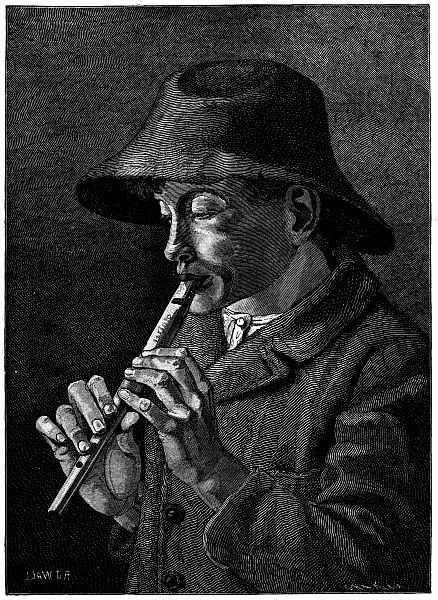
"And I may go on whistling till that flute bursts itself before I get a halfpenny," he remarked to himself in a tone of intense injury, eyeing the "flute" (which was really a penny whistle) anxiously as he rubbed it on his wet sleeve with a view to improving the notes. "All this day and not a——"
"I say, Patch," broke in a mournful voice from behind, "couldn't you lend me twopence just till to-morrow? It's to get some supper; I haven't sold a single box since morning."
"Supper!" echoed Patch, turning sharply on his supplicant. "Do you think I'd be blowing away here if I didn't want a supper myself? You'd better go on to the bank and ask them."
"I've asked everybody, and it's no use," was the weary answer.
"Well it's no use here either, Mike; if I get any I'll want it myself."
Mike listlessly wandered on a few steps farther up the dingy road, and then collapsed, a mere bundle of rags, under the shadow of a doorway.
"You'll not get much of a supper sitting there," commented Patch, setting off himself in quest of a more appreciative audience.
At the corner of the next street was a big hospital, and Patch betook himself thither. He had received stray coppers occasionally from the visitors who came and went through the ponderous iron gates, and what had been once might be again. Fortune was going to favour him at last, he thought, for coming down the steps was a gentle-faced old lady in a curiously-shaped bonnet and grey gown. Patch realised that it was a case of "whistling for it" now, and no mistake; so he put on his most dejected expression and piped out "The Last Rose of Summer" with truly startling emphasis.
Unhappily there chanced to be a shaggy-haired dog waiting outside the gate whose taste for music had evidently not been cultivated. At the very first notes he raised his head with a long howl of disgust that spoilt the effect entirely. It was trying, for Patch saw his prospects vanishing into thin air unless his rival could be promptly silenced; so slipping cautiously behind, he dealt the animal as vigorous a kick as the dilapidated state of his shoe would permit.
"Oh, thee should not have done that! the poor creature meant no harm," cried the lady reproachfully, hastening down the steps to console the sufferer; and Patch discovered, with confusion, that the dog belonged to her. Truly it had been an unfortunate day.
"He looked like a poor dog; I didn't know it was yours," he stammered out. "It's the first chance I've had to-day, and he was spoiling the music."
The old lady looked gravely down at his pinched face and ragged figure.
"Thee looks ill."
"It's enough to make a fellow ill—hungry like this all day long."
He looked as if he were speaking sorrowful truth. The old lady opened her bag—"There is sixpence for thee to get some food with," she said kindly, "and try and remember another time, friend, that if thee art poor thyself there is the greater reason why thee should'st feel for others who are poor likewise."
Patch looked from the coin to her face, almost too much astonished to be grateful. Donations to him usually consisted of pence or halfpence flung into the gutter, or carelessly dropped on the roadway. That a lady—and a very beautiful old lady she seemed to him, in spite of the old-fashioned dress and speech—should stand to talk to him in a civil, pleasant voice was something new indeed, especially after that unfortunate blunder about her dog.
"We are none of us so poor that we cannot help each other in some little way," she went on gently, perhaps mistaking the cause of his silence.
"There ain't anybody poorer than me," Patch answered; and his appearance certainly justified the statement. "Much I could help other folk!"
"Try and find out; it only needs a word sometimes. Good-night, friend, do not stay here longer than thee can help in thy wet clothes."
Patch received all the injunctions respectfully for the sake of the sixpence, and proceeded to carry out the first of them straightway. As quickly as his battered shoes would allow he was out of sight on his way to a certain well-known cook-shop. There, in all the assurance of conscious wealth, he planted his elbows on the window-ledge and critically surveyed the contents. Great joints of meat, slabs of suet pudding, dotted here and there with currants, one—but that was a very superior compound—with raisins, cakes and pies in abundance.
A mingled odour of coffee and tea floated through the open door; and Patch, sniffing up the delightful fragrance, went through a rapid mental calculation of the glorious possibilities within his reach.
whistling for it. (See p. 271).
"Coffee twopence, a fine big cup too, bread and sausage twopence, and a lump of the currant pudding to wind up; something like a supper that."
Poor hungry Patch! as he lifted his arms from the ledge a sudden recollection of Mike under the dark archway came back to his mind. He wished it had not obtruded itself just then; he had quite enough trouble to get food for himself without looking after other people, and yet something made him hesitate on the threshold and presently go back to his old position, elbows on the window-ledge, while he solemnly debated the matter in his own mind.
It was a subject he had never considered before in all his solitary selfish life; kindly words or deeds had not been his portion, and the gentle-faced woman who had given him a sixpence instead of a scolding was a new feature in his experience.
The debate ended in his walking soberly away from the bright visions in the window to the humbler shop he usually favoured with his custom, and there laying out the precious sixpence in bread and cold meat. He took his purchase, the bread under his arm, the meat in a piece of newspaper, and carried the feast to the doorway where Mike still sat crouching in the chilly darkness.
"Wake up, Mike; see here what I've got. There's some for you as well; sit up and begin."
Mike lifted his head from his arm in utter amazement. "You ain't joking about it?" and then—he was but a little fellow, and hunger is hard to bear—at the sight of the provisions Patch was laying out on the newspaper wrapper, he began to cry for very gladness.
"Stop that!" ordered his host, peremptorily. "It's damp enough without you beginning. Eat away, there's plenty of it."
"Did they trust you at the shop?" queried Mike when the banquet was well in progress. "You said you'd no money."
"Did they ever trust you at the shop when you'd no money?" demanded Patch, scornfully. "I paid for it, that's all you need bother yourself about."
"It isn't that," explained his guest, hastily; "you never had anything to spare before, and I was wondering how you afforded to give me such a lot now."
Patch wondered too; then he crumpled up the paper table-cloth, and flung it into the gutter. "I never wanted to give anything away before," he remarked; "but perhaps—if you couldn't get it anywhere else—I might give you a bit another time."
And presently in the dark a dirty hand stretched out and timidly stroked his sleeve.
Patch went home down the wet streets with his flute. He looked poor and ragged as ever, but he had at least taken the first step upward that night in finding out the possibility even for him of helping another.
Sarah Pitt.