Chapter XIX · —MRS. FERGUSON IS BAFFLED.
Reading edition
W hen Robbie awoke next morning at his usual early hour, and saw no sign of his mother in the room, he thought he must have overslept himself, so he jumped up quickly, and dressed.
He ran downstairs into the kitchen, and found Mrs. McDougall seated before the empty grate.
She turned her head quickly as Robbie entered. In a moment the child saw that something dreadful was the matter. Never in all his life had he seen his mother look like that.
The child glanced at her wonderingly, then came close to her, with the quick sympathy which is so sweet.
"Mother," he said, "is it Elsie and Duncan? Haven't you found them yet?"
"No, Robbie," Mrs. McDougall replied. "They're just lost, and that's all about it."
Robbie could not understand how it could be, but he saw that his mother was in great trouble, and he did not like to ask any questions.
"This will not do," Mrs. McDougall said, with a heavy sigh, as she rose resolutely from her chair, and began bustling about. "You shouldn't ha' got up yet, Robbie. It's over early for you."
"I thought it was late," Robbie said. "Mother," he added eagerly, "might I—oh! might I run and fetch the milk for you? Oh, do just let me go!"
"the child glanced at her wonderingly" (p. 264).
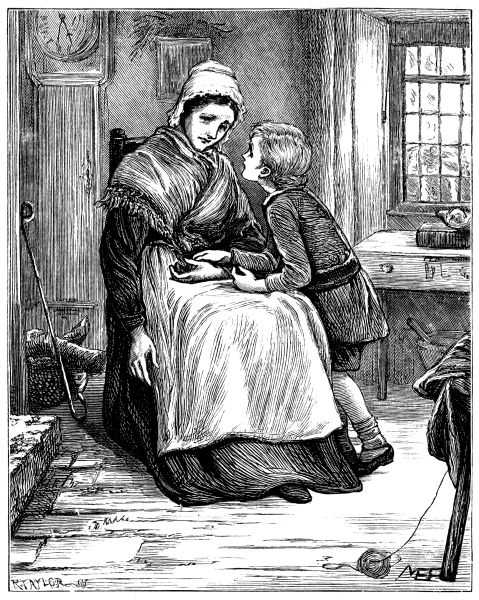
"Dear me! no, child," Mrs. McDougall replied. "You'd be lost too."
"Should I?" Robbie said, very crestfallen. "Can't I do nothing, mother?"
"Yes; you shall feed the hens. You know how to do that, don't you, Robbie? I'll just get the food ready for them."
Robbie was delighted. He longed to be useful.
Mrs. McDougall bustled about, and got the breakfast—porridge without milk—set everything in order, then went up to see to her mother, just as if nothing had happened. She was not the woman to sit idly nursing her troubles.
As soon as she had partaken of a little food, she prepared to depart once more on her anxious errand, with many an injunction to Robbie not to go outside the gate, and to keep a watch, in case Elsie and Duncan might return, but be afraid to enter.
At the police-station there was no news. Bills were being printed, she was informed, and would be widely distributed before the day was out. Any information they received should be sent to her.
She waited for more than an hour in order to see the bill. It was some sort of consolation to her to see the great black letters, and read the description of the children in black and white.
"This cannot fail to find them," the officer told her. "Every police office in the country will be furnished with this description. The children can't have got very far away. Some of our men must come across them."
"Far enough away to have got beyond our reach," Mrs. McDougall said, dubiously. "And who knows but they may have fallen into bad hands, or got stuck in some bog in the blackness of the night?" she added, with a shudder.
"They'd keep fast enough to the road," the man said, re-assuringly.
"I'd rather ten times over that they should be lying dead in the woods or on a mountain side than that they should fall into the hands of wicked men and women!" Mrs. McDougall said fervently. "The mercies of God are a deal more tender than those of men. I could thank God with all my heart to know that He had them safe."
"There are bad enough folk about," the policeman assented, "but your children are over young to get led astray."
"I pray the Almighty that He'll grant them a merciful death rather than they should fall into bad hands," Mrs. McDougall said, wearily, as she rose to go. "Better for them to die of cold than to be murdered by violence, or made to lie and steal."
"You're taking an over gloomy view of the matter, good wife," the man said, cheerfully; "and perhaps you'll be getting them back safe and sound before nightfall."
But that was not to be. The description of the children was, truly enough, sent to every town or village that could boast a police-station, and was eagerly discussed that very nightfall in many a remote cottage. Had the children wandered farther, to even the first village on their road, they must have been found, but they were safely hidden from the outer world in the least suspected place of any—the miserable hovel of one of those wretched tillers of the land, too poor to deserve the name of farmer, with which some parts of Scotland abound. The man was listless, and apathetic with hunger and poverty, a miserable, degraded creature, who would have sacrificed anything or anybody for the sake of the few pounds that would pay his rent or sow his tiny bit of unproductive land.
He was the very last sort of person to hear rumours of the lost children. On that day when he and his wretched beast had toiled the distance of twenty miles to fetch a load of fish refuse from the nearest fishing village in order to enrich his bit of barren land, the bills about the children were not yet distributed. Even had they been, he was little likely to have heard about them, for he was too dull and dejected to talk with his neighbours. When he met them on the road, the idea of giving them a lift would not have penetrated his mind had not Elsie herself requested it. Yet the man was no worse than his fellows, and had an element of unselfish kindness in him, which was shown by his giving them the old sack to sit upon. Under happier auspices he would probably have been a very decent sort of person, but the hopeless hardship of his existence had gradually wiped out every ambition and hope, till at last he had sunk into something scarcely better than an animal.
And, children, let me tell you that there are plenty of us, now bright and gentle and happy, who in Sandy Ferguson's place would have been no better than he; and I wonder whether we always remember that God judges every one, even His little ones, according to the opportunities they have had?
Sandy had no thought of injuring the children any more than of assisting them; but his wife, who was cleverer, and had therefore become cunning and shrewish under the sordid cares of her life, saw directly that she might gain something by keeping them.
She had taken away their clothes, partly because it angered her to see these ungrateful runaway children warmly clothed while her own were shivering in their rags, but far more with the idea of preventing their escape. Their friends would come after them, and it would be her own fault if she didn't see some of their money, she told herself. Five of her children had died from illness, caused by want and cold and misery; it was little wonder that she had grown grasping and cruel.
Yet she, too, meant them no harm. She was anxious enough to get rid of them, for the miserable food that she gave them had to be stolen from their own portions. She looked out eagerly for passers-by, in the hope that the children's friends would overtake them, yet jealously kept her secret, for fear that others might outwit her and reap the reward.
On that day when she had been occupied in listening to a long account of a neighbour's affairs, and had, as she supposed, got the children doubly safe, by virtue of the watch she had set over them as well as the safe custody of their clothes, she had been startled by hearing from this very neighbour an account of how two children had been lost off the moor, and a reward offered for them. She kept her countenance admirably, and pretended to be most astonished and interested, but she sat on thorns, fearing Sandy would betray her. The neighbours stayed long, having much to talk of, and when at last they departed, Mrs. Ferguson went on cleaning, satisfied that the children were safe, since they were all together, and Sandy with them.
the song of a little bird (p. 267).
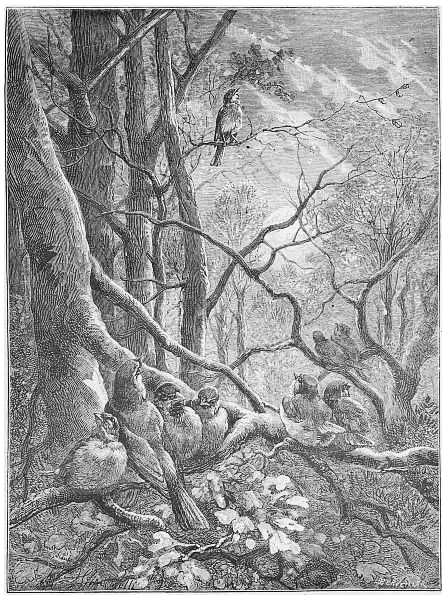
By-and-by Sandy came in, and stood staring hopelessly. Then he began to scratch his head, and looked altogether so stupid that Mrs. Ferguson administered him a good shaking, and demanded of him what he meant by it.
"Where be the bairns?" Sandy asked, in his rough Gaelic.
Then Mrs. Ferguson flew out, and when she could see none of them her wrath knew no bounds. Young Sandy and Jamie, her two boys, were discovered under the cart, and when dragged out and cuffed, declared that Elsie and Duncan had beaten them, and then run as fast as they could down the road; that they had called as loudly as they could, but were unable to make any one hear; and plenty more tales, that their mother knew were made up to shield themselves.
Having called them every bad name she could think of, and dealt them some stinging blows, she flew along the road to seek them. The road wound about pretty much, and as they were nowhere in sight, she concluded they must have gone by it. She came back furiously angry and disappointed, and continued her search till nightfall in the immediate neighbourhood of the croft, but without success. Sandy and Jamie were not to be envied that night.
Thus it happened that the police were quite baffled in their endeavours to find the children, and after they had fallen into Mrs. Donaldson's hands the description given was not accurate.
(To be continued.)