The Editors Pocket-Book.
Reading edition
A Product of the Soudan.
It is said that the Mahdi, of whom so much has been printed in the papers for months past, has been the means of increasing the price of gum arabic. This material, which is obtained from the Soudan, is largely used in the making of sweet-meats, while the Government envelope factory in the United States uses one ton every week. Owing to the war in the Soudan, the supply, amounting to ten millions of pounds yearly, has been stopped for more than a twelvemonth. The price has been gradually rising, and it will be not a little odd if we have to blame the Mahdi, among other things, for dear jujubes.
The Vallary Crown.
The old Romans were before all things a military people. Consequently, they took care to confer rewards upon soldiers for bravery and other forms of service, so as to preserve proper spirit among the men. One of these rewards of valour was called the Vallary Crown, and was bestowed upon the soldier who was the first to mount the enemy's rampart (vallum). It consisted of a circle of gold, with palisades attached to it. One can imagine with what zeal an attack would be made, and how hotly the foremost place would be struggled for, so that the crown might be won.
Supposed Relic of Trafalgar.
While a diver was engaged off the coast near Gibraltar in the search for the whereabouts of a recent wreck, he discovered at the bottom from eighty to one hundred large guns, mostly 24- and 32-pounders, and two big anchors. As no appliance for raising them was at hand, they were not brought up, and their nationality has not been ascertained. It is supposed that they belonged to a line-of-battle —-—File: 159.png—-\micmac999\Clog\Joe Cooper\raindrop\Oopsadoodle\—-—- ship, which sank in the Peninsular war, possibly after the battle of Trafalgar.
The Founder of Ragged Schools.
John Pounds, a poor shoemaker of Portsmouth, was the originator of this well-known method of educating city arabs and other very poor children. For twenty years before his death in 1839, he used to collect around him the ragged children of the district in which he lived, and teach them while he worked at his cobbling. He taught them for nothing, and his class was well attended. His success at length attracted general notice, and systematic effort was in due course made for the establishment of such schools in other towns and cities throughout the kingdom.
Tallow Trees.
In different parts of the globe are found various sorts of trees that yield a thick oil or resin, that, like tallow, is used for making candles, and hence the trees are popularly styled tallow trees. The substance is commonly extracted by making a cut in the bark, from which the oily matter exudes. In other cases the seeds are boiled, from which a fine white tallow is obtained. The candles and soap so made are beautifully white.
A Saucy Sparrow.
One day a boy picked up a young sparrow, which he brought home. His father put it in a big cage, and in course of time it became thoroughly domesticated. It used to fly about the garden and perch upon the heads and hands of the family. After a while it would venture upon an oak and carry on a very voluble conversation with its fellows who also patronised the tree. It soon grew as impudent and pugnacious and ravenous as most sparrows. It was always hungry and talkative. Though it had the freedom of the neighbourhood, it came down daily before sunset and roosted on a perch in its cage, the door of which was left open for its convenience. It was let out the first thing in the morning, but returned about six times a day for food, usually taking care to attend all the family meals, and often breakfasting with the master of the house, with whom it struck up a firm friendship. Sometimes it brought home a friend or two, but as they lacked its faith they invariably remained outside while it feasted indoors. It generally watched the boy's father as he left home every morning, chirping "good-bye" from a gutter-pipe. Its appetite continued healthy and its taste accommodating. Latterly it started a home of its own, but did not give up its old friends, looking in upon the household almost as often as ever.
"Sansculottes."
This term—in allusion to their poor and mean attire—was applied, during the earlier stages of the great French Revolution, by the Court party to those democrats of Paris who were foremost in urging the demand for reform. The epithet given in scorn was accepted with pleasure by the people, and it soon came in their eyes to indicate a patriot, and some even affected a ruder mode of dress as if to show they gloried in the title. However, after the lapse of a very few years, the name fell into disuse, as it had been connected with so many scenes of bloodshed and revolting cruelty.
Fresh-water Springs in the Sea.
There is a hot region on the Persian Gulf where little or no rain falls. At Babrin, though the dry shore has no fresh water, the people obtain a supply from springs which burst forth copiously from the bottom of the sea. The fresh water is got by diving. The diver winds a large goatskin bag round his left arm, his hand grasping the bag's mouth. He next takes a heavy stone to which a stout line is fastened, and then plunges in. As soon as he reaches the bottom, he opens the bag over the strong jet of fresh water, ascends with the upward current, shutting the bag the while, and is helped on board. The stone having been pulled up and the driver refreshed, he plunges in again. These submarine springs are believed to take their source in the hills of Osman, some 500 or 600 miles distant.
Feathered Thieves.
It is very well known that jackdaws are accomplished thieves, and their evil fame in this respect has been humorously pictured in the story of "The Jackdaw of Rheims," in the "Ingoldsby Legends." It seems, however, that other birds besides jackdaws may be occasional robbers, and may cause much mischief. Not long ago, a gentleman on going to his letter-box discovered that a letter containing a cheque for £10 had been tampered with, and that the cheque was missing. He immediately came to the conclusion that human thieves had been at work, and gave information to the police at the nearest station. On his return home, however, he examined his letter-box more closely, and then found several tomtits in it; and on further search, he discovered the missing cheque lying twenty-six yards away on the turnpike road, whither it was evident it had been carried by a tomtit, since it bore abundant marks of the bird's beak.
Carlyle's Birthplace.
The house in Ecclefechan, in Dumfriesshire, where Carlyle was born, and which was purchased by a niece, has been restored and has had some interesting relics placed in it. It will no doubt be the scene of many pilgrimages. In carrying out the alterations, the old doors and the like have been scrupulously preserved. The room where the young Carlyle lived contains the philosopher's easy-chair, a mahogany table well stained with ink, an old-fashioned bookcase consisting of a series of shelves supported by pillars at the side and hung upon the wall, besides appropriate photographs and other articles.
Memory in Dogs.
Several years ago a gentleman was presented with a black-and-tan terrier. One evening he went to St. John's Wood, London, to fetch it to his own home, some five miles on the south of the Thames. For the greater part of the way the dog and his new owner travelled (in the dark of course) outside an omnibus. The terrier was confined for a week and then set at liberty. Next day it disappeared, and it was afterwards learnt that it arrived at its old home—ragged and starved—six or seven days after effecting its escape. As the dog had been taken on a vehicle right across London, over the river, and in the dark, to a strange district nine miles from its home, its finding its way back to St. John's Wood must be regarded as a remarkable instance of canine intelligence.
Anecdotes of Apelles.
Some interesting anecdotes have been preserved about Apelles, who flourished during the latter half of the fourth century before Christ, and who was considered to be the most famous painter of the ancient world. Alexander the Great once visited his studio, and exhibited so much ignorance of art that Apelles desired him to be silent, as the boys who were grinding his colours were laughing at him. He painted an ideal portrait of this celebrated king, of which Alexander said, "There are only two Alexanders—the invincible son of Philip, and the inimitable Alexander of Apelles." The painter's disposition was so generous that he purchased a picture of an artist whose talents were not recognised as they deserved, and spread a report that he would sell it again as one of his own. His industry was such that he never allowed a day to pass without painting one line—a habit which has become proverbial in the Latin phrase, nulla dies sine linea ("No day without a line"). Apelles was not above criticism. When his paintings were exposed to the public view, it is said that he used to conceal himself near them so that he might hear the comments of onlookers. A cobbler finding fault with the shoe of one of his figures, Apelles at once corrected it. But next day when the cobbler ventured to criticise the legs, the painter came forth from his hiding-place and recommended the cobbler to stick to the shoes—advice which in the words of the Latin version of the story also has been adopted as a proverb, Ne sutor ultra crepidam ("Let not the shoemaker overstep his last").
Drawing the Badger.
Badger-baiting was a brutal sport at one time in vogue in this country as a kind of "attraction" in public-houses of the lowest class. The animal was kept in a tub or barrel and was attacked by dogs. Yielding at last to superior numbers, it was dragged or drawn out. The badger was then set free and permitted to return to its tub until it recovered from the effects of the struggle, after which it was again baited. It had to submit to this barbarous treatment several times a day. The verb "to badger," now often applied to persons, was originally used in direct reference to this cruel practice.
A Gallant Rescue.
Not many months since some boys were sitting on the banks of the River Devon, near Tillicoultry (Scotland), when one of them, aged ten, waded into the stream in search of an article. He had hardly entered the water when he walked into a deep pool, in which he was whirled about quite helplessly, like a cork. Fortunately, a lad named James Henderson happened to be passing at the time, and observing the imminent peril of the poor boy, plunged into the river at the risk of his life, and brought him to the bank, where, after treatment, he recovered. The painful screams of the boy created great excitement in the neighbourhood, and there seems no doubt that but for the gallant rescue here recorded he would have been drowned. It would be a great advantage if the teaching of boys and girls how to swim were made a necessary part of their education.
a modern war elephant.
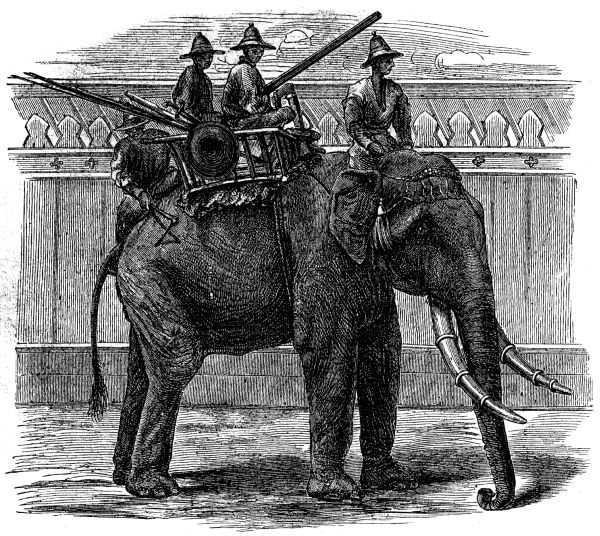
War Elephants.
From time immemorial elephants have been employed in war in the East and in Africa, though the Indian kind is more familiar to us in this respect. At first they were equipped with a huge tower, in which fighting-men were carried—a practice of which we are reminded in the sign of the "Elephant and Castle" still in vogue in some inns—and were even trained to use swords with their trunks. In the present day, however, the creatures are found more useful in assisting the transport of artillery in hilly or marshy districts. The "castle" has been replaced by a howdah, from which the soldiers use the modern weapons of war. Military service may, therefore, be regarded as being a good deal easier than it once was—so far, at least, as elephants are concerned.
in safe hands. (See p. 313).