THE MAGIC MUSIC AND ITS MESSAGE.
Reading edition
A FAIRY STORY.
"It was the nightingale singing to the rose," said the girl, bending over the flowers. "I heard it all through the night, when the moon was shining into my room."
"No, it was not."
And the brook danced by—such a tiny little silver streak, winding through the ferns and mosses, that the girl could scarcely see it. But she certainly heard it, for no other voice could be so sweet.
"Did you see the lilies in the moonlight?" continued the voice; "they looked like pearl and ivory."
"Then, does the nightingale like the lilies best?" asked the girl.
"I do not know. But what has the nightingale to do with it?"
The girl looked down at the lilies, and one of them seemed to nod to her, and its perfumed breath rose up, until a delicate cloud, like incense, spread around her.
And suddenly the same sweet strain of music that she had heard in the night sounded from afar off. Yes, it was the same tune: she was sure it was; she knew it quite well; she had been humming it over and over as she stood beside the flowers.
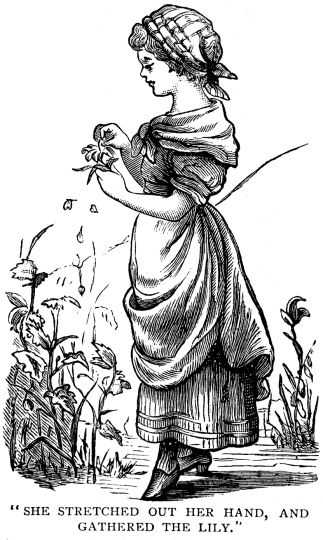
As if moved by a sudden thought, she stretched out her hand, and gathered the lily that had nodded to her. And as she did so the music grew louder and louder, and instead of the tiny brook dancing through the ferns and mosses, she saw a great sea, that shone like glittering gold in the sunlight. And in the distance was a shadowy purple island, all indistinct in the golden haze around it. She could not clearly make out its outlines, but she fancied she could trace the towers and turrets of a stately castle. And as the music grew clearer and clearer the island appeared to move towards her, and the waves of the golden sea came dashing up towards her feet. The waters already covered part of the garden in which she was wandering, and some of the roses were beginning to disappear, and the girl felt afraid lest she should be drowned.
She threw down the lily, and as she did so she heard a sudden cry, and the music died away in a low wail, the purple island and the glittering sea vanished, and the little brook again danced along.
She wondered whatever it could mean.
The girl fancied it was saying—
"Alas! alas!"
Then she fled home, without stopping to pick up the lily.
II.
The girl lay sleeping in her little bedroom; she had left the window open, because the night was warm. The moon was shining in, but it did not wake her; neither did the little wood-elves, who had climbed up the great vine, and had swarmed in at the window. Such numbers of them! Some were sitting on the pillow stroking her hair, and whispering into her ears, "Sleep, sleep, sleep," and others were holding her eyelids fast closed, so that she could not open them to see what was going on.
Some of them were dancing round in rings upon the soft white coverlet, and others playing all sorts of pranks about the room.
The girl neither saw them nor heard them: she was too fast asleep for that.
She did not even dream of them, but was dreaming of something very different from wood-elves, or mountain-elves, or any other sort of fay or fairy.
No; she dreamed that she heard some one singing—
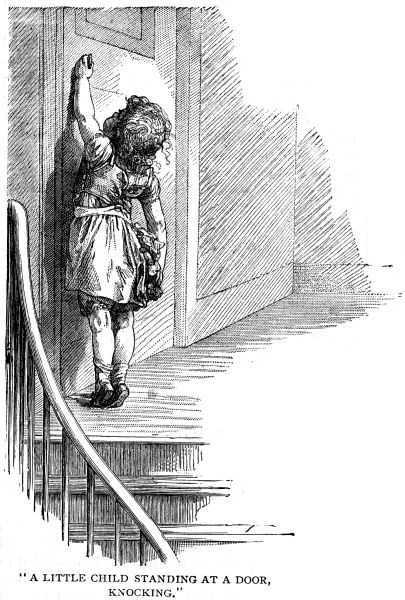
"Up the stairs, if you will go, You'll hear a tapping, tapping At a door, for there you know A little child is rapping, Rapping, tapping, all the time, Tapping, rapping, tapping."
"No, I don't know anything of the kind," said the girl, moving so suddenly in her sleep that a score of wood-elves fell, heels over head, from the bed to the floor.
"If you don't, if you'll go up The staircase, you will find her; She won't look round: she never does, So you can get behind her,"
went on the song.
"And what will be the use of that?" murmured the girl in her dream.
"Why, you will help her, I suppose, To reach up to the knocker. You must not startle her, for that Most certainly would shock her."
"It was the sea and the castle in the sunlight," said the girl, "and now it is something quite as ridiculous: a little child standing at a door knocking. That comes in the moonlight. And the music is going on all the time."
She was speaking quite loudly now, and she suddenly opened her eyes, in spite of the wood-elves, who crept down from the bed and hid themselves in the folds of the curtains, for they did not want the girl to know that they were there.
"It's the music that has waked me," said the girl, getting up in bed and listening; "it's the same song over and over again, only I can't make out the words, excepting, 'Come, come, come,' and then something about the sea. But that is very absurd, for there is no sea near here. The moon knows that as well as I do, for the moon looks down, and sees that there are only fields and woods and orchards, and beautiful gardens full of flowers. I wish I were not dreaming all the time. The music is a dream too; I thought it was the nightingale: and I dare say it is, and that if I looked out of the window I should see about a dozen nightingales sitting in a row, for it would take a dozen quite to make such loud music as I hear in the moonlight."
And the girl shook back her long hair, and jumped out of bed and went to the window; but she could see nothing, for pressed tightly against the window was a great white lily, just like the one she had thrown down, only instead of being of the ordinary size, it was so large that it covered all the panes of glass and also the open part of the window, so that it was quite impossible to look out. The stalk was towards her.
"I'm like an umbrella white, Keeping off the sun or rain; Keeping out the bright moonlight, Keeping in the wood-elves' train,
said the lily. Then it continued—
"Yes, you threw me down in fright, But I've come to you to-night. Take me in your hand, and see What will then my purpose be."
The girl was silent for a moment; everything was so strange: the beautiful music, the talking brook, and now the talking flower.
"I will not have anything to do with any of you," she said, giving the flower a push to send it away from the window.
But no sooner had she touched it than the flower shrank to its natural size, and remained in her hand, which was so tightly closed that she could not open it again.
"Away, away, Each elf and fay!"
murmured the lily; and there was a soft rush as of many tiny wings, and the girl felt herself carried through the air.
This was the work of the wood-elves, who were there to help the lily. But the girl scarcely knew what was happening; she was listening to the music, which was so grand and beautiful that she forgot everything else.
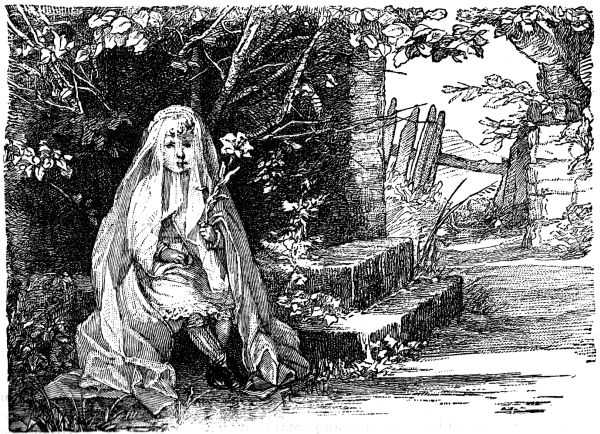
"she held the lily in her hand"
III.
Was the girl the fairy queen? She began to think that she must be, as she sat on some marble steps in the wood. She was dressed in white, and had long silk stockings; and a veil of shining gossamer was fastened on her head with a gold band, and it fell down to her feet, and wrapped her round like a glittering cloud, and she held the lily in her hand. And the music pealed on like a grand triumphal march, and made the girl feel very proud and joyful.
Not very far off there was a carved chair, with some velvet cushions upon it.
"Perhaps for me to be crowned in," said the girl, tossing her head. "I wonder where my crown is?"
And as she said this she heard a burst of laughter, as if a thousand grasshoppers were chirping. And an owl seated not far off said—
"Only queens are crowned, little girl."
"How do you know I am not a queen?" asked the girl, angrily. "Look at my dress and my veil."
But the owl only said—
"Tu-whit, tu-whoo! tu-whit, tu-whoo!" and laughed so loudly that all the wood-elves began to laugh also; so did the birds and the frogs, and even the flowers. And the echoes answered back again.
There was so much noise that a troop of little sailors came running up from the shore to see what was the matter.
"Are you ready?" said they to the girl; "the boat is waiting
With its silken sails, The moon shines clear and bright; There is no fear of stormy gales Upon the sea to-night."
"I don't know what you are talking about," answered the girl. "There is no sea near here, and if there is I am not going upon it."
But the sailors had wheeled the carved chair close to the marble steps, and they went on speaking—
"To-night upon the sea we go, And you with us must sail. Step in; the tide is up, and we Must start off without fail."
And the girl found herself in the chair, which the sailors pushed down to the beach.
On the sea was a fine boat, with silken sails and a crimson flag.
The boat had a gilt figure-head, and its sides were painted blue and gold. A red velvet carpet was spread upon the deck, and the sailors, having hoisted the girl in the chair up the side of the vessel, placed her upon the velvet carpet, and she found herself sailing fast away from the land before she had time to think of how she had got there.
The sailors were all standing at one end of the deck playing upon various musical instruments, and the tune they played seemed to answer back the beautiful music that she had heard for so many days floating in the air. Also the sailors sang—
"Away it sails, the music-ship, Over the moonlit sea, And the trumpet that the captain blows Is the only rudder the vessel knows, As we sail so merrily, The fiddles, and fifes, and drums, and horns All carry the ship along, It shapes its course by the cymbal clash To the land of music and song."
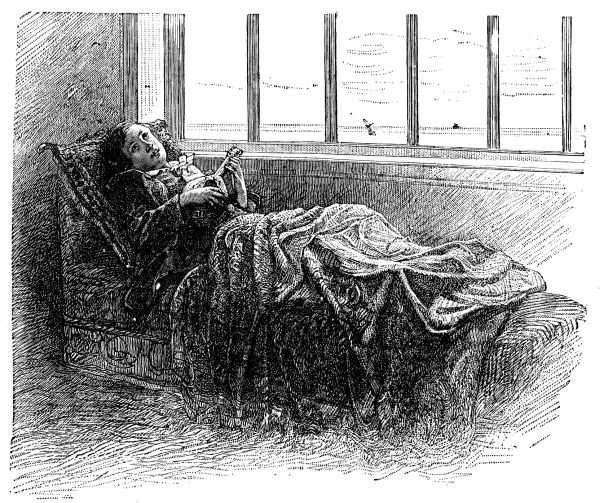
"on a couch lay the master of the castle" (p. 297).
The girl did not quite understand what the sailors meant by their strange song. It did not seem to be altogether sense to her, but she supposed that they knew where they were going. Still she asked—
"Whither are we sailing?"
"Don't you hear the music calling to us from the castle?" said the captain: "the castle on the purple island in the golden sea. We are sailing there; the music has spoken to us many times, but we did not attend to it until now."
"Has it called me?" asked the girl.
And she thought of the beautiful tune that had seemed to say "Come, come." And now, as they sailed beneath the castle walls, the tune issued forth very clear, sweet, and strong from an open window.
"It is the master of the castle: he plays night and day, and is always inviting those who love music to come and dwell with him."
The girl looked up at the stately castle.
"If I had known that I should have come here before."
"No, you would not."
"Why?"
"Because no one would have brought you. You can only come at the right time. Hush!"
IV.
"Hush!" said the captain; "we must not make any noise. Do not speak again.
Go like a mouse Into the house. Up the stairs creep Though they are steep. There you will find, If you're not blind, A little child who's softly tapping, Tapping, rapping, rapping, tapping, Rapping, tapping at the door. Though the knocker is so high, Yet she still doth try and try; You must knock, and it will fly Open—little girl, good bye."
"Why, that was in the dream; and if you please, captain, tell me where I am, and who is the child, and——"
But the captain had gone, so had the sailors, so had the ship.
The girl went slowly up the steps to the castle door, which being open, she entered in, and found herself in a great hall, from which a staircase wound up and up through a great many storeys.
"I must go," she said; for the music that sounded through the castle seemed to speak to her, and bid her come.
And on and on she went, and on the seventh storey she paused; for at a door she saw a child tapping and rapping, and trying to reach the knocker.
Softly the girl went behind the little one, who never turned round, but clutched in her hand a lily similar to the one the girl herself held. She reached above the child's head, and knocked loudly. And lo! a bugle-blast answered, and the door flew open, and the girl and the child entered in together. They wandered through beautiful rooms, listening ever to the music, and at last they came to one where on a couch lay the master of the castle playing upon a lute.
If the music had sounded sweet in the distance, it sounded far sweeter now, and the two paused on the threshold.
But the master said—
"Welcome to the Castle of Song, for none but true musicians find their way here."
And then the child knelt down beside him, and said to him—
"I tried to come, but I could not knock loudly enough."
And the girl said—
"I do not think I tried to come, though the music was so beautiful. Did you send for me?"
The master of the castle smiled, and answered—
"The music brought you."
Then the girl remembered that the boat sailed by music, and as she looked through the open window and saw it sailing away in the distance, she asked—
"Will it bring others, too?"
And the master of the castle replied—
"In time, in time."
Julia Goddard.