THE RIVAL KINGS.
Reading edition
(A FABLE IN FOUR SITUATIONS.)
SITUATION FIRST
"I have only one ambition in this world," said King Albus, addressing the feathered members of his household, "only one ambition."
"And what is that?" said the oldest and the fattest hen, sidling up to him.
"My ambition is," replied the king, strutting about the yard, and looking as haughty and as full of fight as only a Spanish cock can, "to see my detested rival over the fence yonder humbled in the dust."
"You've often said that," remarked the old hen.
"Yes," continued the king, "I mean to do it, too; and his lifeless body shall float down the mill-stream as helpless as a ball of worsted. I have said, and I will do."
"Well, dear," the hen said; "don't forget that King Crèvecœur is a powerful big bird."
"King Crèvecœur! Crève cur I call him. Deprive him of his diphthong, when speaking of him to me, madam, please."
"Well, diphthong, or not diphthong," sang the old hen, picking up a small pebble, and swallowing it, "he is big, and he wears a pair of frightfully long spurs."
"And what a charming plume he has on his head!" cried a young hen; "he looks quite soldierly. Belongs to the dragoons, I suppose."
"Hold your tongue," exclaimed the king; "and go about your business. Plume, indeed! spurs forsooth! The plume, madam, is an airy nothing; the spurs have neither strength nor substance. Now, look at me," this proud king went on, as he flew up on top of an old hurdle, "behold me well. Am I not as white as the driven snow? Is not my comb as red and rosy as crimson daisies, or the sunset's glow at dewy eve?" "Cock-a-doodle—doodle—do—o! Did ever you hear such a crow as that before?"
"Never," said the old hen.
"Except——" said the young one.
The king looked at her, and she was silent. But just at that moment came a voice from the other side of the old fence, that fairly startled every hen in King Albus's household. Shrill, defiant, terrible!
"Cock-a-doodle—roaro—ro—o!" went the voice.
"That is he!" cried the king. "That is more of his audacity! It is unbearable. I will stand it no longer. I will instantly give him battle. Farewell, and if for ever—still for ever, fare-ye-well."
"Stay with us, stay with us, stay—stay—stay," cried all the hens in cackling chorus.
"Never," cried the king; "while Crève cur lives! Cock-a-doodle—do! Death or victory!"
He sprang over the fence as he spoke.
"the king had crossed the rubicon.
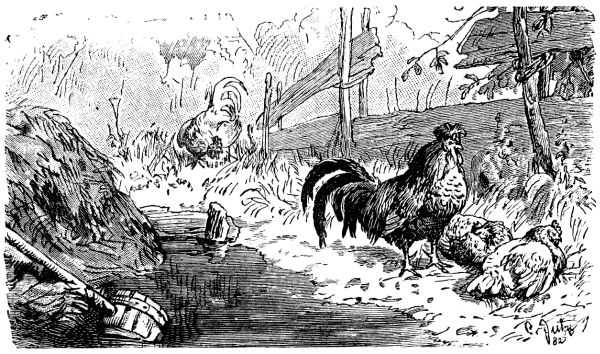
SITUATION SECOND.
The king had crossed the Rubicon. There was no going back with honour now. He was fairly over the fence, and in the domains of the rival king.
King Albus bent his wattles to the ground, and gazed at his rival with one eye. His rival's back was turned towards him, and he took not the slightest notice of the king.
"I wonder if he'll fight!" said the king to himself. "For my part I hope he won't, for I don't feel half so full of courage on this side of the fence as I did on the other. I daren't go back, though. How the young hens would giggle if I did, and how the old ones would cackle! No!"
All this time King Albus never moved; he still held his wattles close to the ground, and still looked at his rival with one eye, only sometimes he turned his head and looked with the other.
"He is pretending not to see me," he continued.
"He is afraid. I'll wager my wattles he's afraid. But—what?—do my eyes deceive me? No, he really has two lovely pure—white hens lying beside him. That seals his fate. If any one in the world ought to have white hens as companions, it is myself, because I am pure white. So he must die."
Now, although King Crèvecœur's back was turned to his rival, he could see him with the side of his eye, and besides, his two hens told him what the silly old Spaniard was doing.
"He's afraid to come on, I think," said one.
"Don't be too hard on him," said the other.
"A deal depends," replied Crèvecœur, shaking his head. "I have never insulted him; I can't help being bigger and handsomer and richer than he is; he has no right to go on envying me as he does. He deserves to be punished. He is mean, that is what he is. Stop, I'll give him a little encouragement—Cock-a-doodle-do-o!"
"It needed but that," cried King Albus.
He advanced speedily as he spoke, along by the side of the mill lead.
"Run away, my dears," said the Crève to his two hens, "the battle is about to commence."
One hen went; the other declared she would stand by him as long as she lived.
Now, it was a very remarkable thing, but no sooner had King Albus got close up behind King Crève, and was just about to strike the blow, that might or might not have both begun and ended the fight, than all his courage at once oozed out at his toes, and he really didn't feel he had pluck enough to raise his foot to strike, or even to keep his tail erect.
"I feel very faint," he said to himself, "I think I'll just take a run home and have a few crumbs of food, and then come back again."
He turned as he spoke and began to move off.
"Cock-a-doodle-do-o-o!" roared the cock with the plumes.
he began to move off. (p. 277).
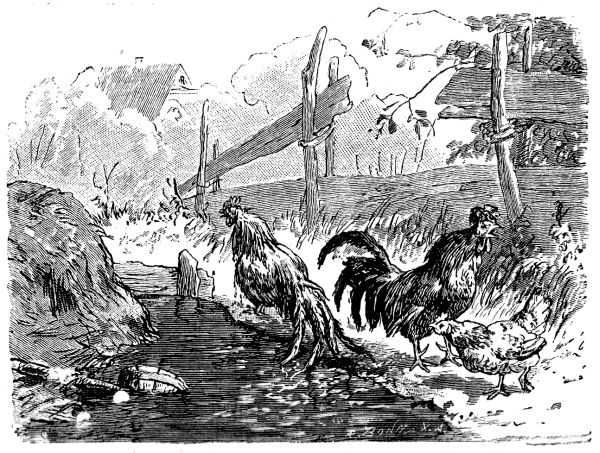
SITUATION THIRD.
Now, this was more than the meanest-spirited cock that ever crowed could stand.
He raised his tail again, wheeled suddenly round and faced his foe. The other cock or king also wheeled round, and so with ruffles raised and wings half spread, and with fire flashing from their eyes, the two confronted each other.
But courage now deserted the heart of the white hen, and she fled.
"Cray—cray—cray," she screamed; "there'll be bloodshed, cray—cray—cray!"
"Have you made your will?" cried the white king, fiercely. "Are you prepared for a watery grave?"
"As to my will," replied the dark king, "there'll be plenty of time to think about that when you're dead. As to the watery grave, I'm quite ready for it, as soon as I meet any one who has the strength and courage to send me there. It won't be you."
"You may imagine yourself dead already," roared the white king. "Your body will go floating down the mill-stream, and there won't be a feather of you left together an hour after this—the frogs and fish will eat you."
"come on and fight if you dare."
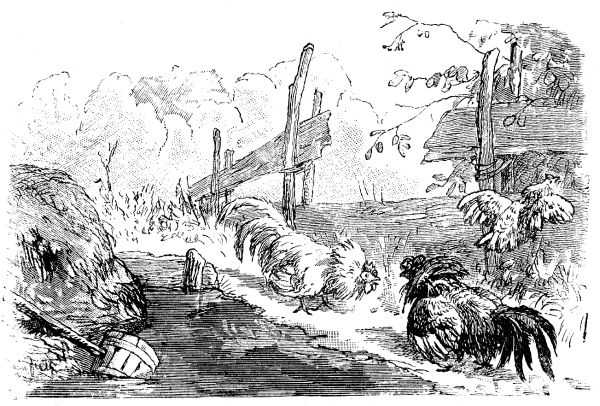
"Fish and frogs!" cried King Crève, "fiddlesticks! Come on and fight if you dare. I'll give you leave to strike the first blow."
Then the white cock grew very sentimental.
"I don't really want to kill you," he said; "it seems a pity."
"Can nought but blood our feud atone, Are there no means?" "No, stranger, none!"
"Now just look here," said the dark king. "What are you talking about? If you mean to fight—fight. If you don't mean to fight—go over the fence again."
"But I want to have something to say to you," cried King Albus.
"Well then, out with it. I'm not going to stand here palavering all day, with my feathers up like a ruffed grouse. I'm catching cold, I am. I'll go to work to warm myself presently, and it will be a bad thing for you when I do."
"What d'ye mean by being bigger than me, then?" said the white cock.
"Oh! that's your grievance, is it?"
"Yes, and what d'ye mean by crowing louder every morning, and wearing that silly old plume on top o' your poll, and those stupid long spurs on your heels, eh?"
"Anything else?"
"Ye-s—What d'ye mean by having more oats to eat than me? And more hens to walk about and sing to ye, eh?"
"Oh! You envious silly old thing, you," cried King Crève. "Go home at once, and learn to live a better life, do."
"Not till I've killed King Cur."
SITUATION FOURTH AND LAST.
Whack! Whack! Whack!
They were at it now spur and bill. The sound of the blows went echoing all over the farmyards where they lived. Whack! Whack! Whack! Dear me, how the feathers flew!
"My brave!" cried the fat old hen, "I never thought there was so much courage in him before!"
"Wait a bit," cried the saucy young one. "Plumes will give him a lesson presently."
"Plumes won't," shrieked the other.
"Plumes will" roared the young one. And lo! and behold those two hens got fighting behind the fence—so foolish of them—and thus there were two battles raging at one and the same time.
Now sometimes, right is might, but in this case right and might were both on the same side. For King Albus had no business to be so envious and jealous of his neighbour, simply because he was better than he; and he was certainly very wrong to invade his territory. If he had only stayed at home, and been content with his own surroundings, he might have lived and been happy for many a long day.
To do the white king justice, however, he fought well. Though a coward at heart, now that he found himself really engaged, he knew that to give in would mean being trodden to death under the feet of his foe. So he fought on and on.
Both shortly paused for breath, and the white king began turning over the gravel with his bill, as if looking for a grub or two. This was merely a pretence, in order to gain time, and the dark king knew that well enough.
"Don't be silly," he said, tantalisingly, "grubs don't grow in the gravel. I don't believe you could swallow a grub if you had one. Go home now, and come back again when your poor old head is healed."
"I'll heal you!" roared King Albus, "I'll grub you!"
Then the battle re-commenced with re-doubled fury.
But it did not last much longer. The dark king watched his chance, and bringing all his strength to bear on one blow, sent his adversary sprawling and roaring for mercy right into the mill-stream.
"roaring for mercy."
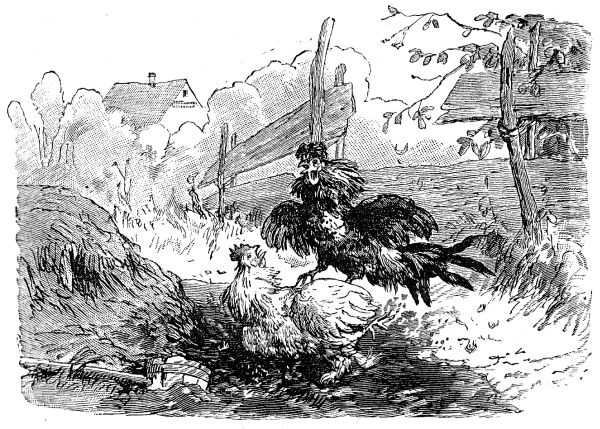
Then he jumped nimbly on top of him and crowed.
His weight sank his foe, he gave a gasp or two, then away he floated still and quiet enough, while the dark king jumped on shore, and coolly began to re-arrange his ruffled plumage, his two hens soon returning to admire him.
"I told you," cried the young hen, "that Plumes would kill him."
"Ah! well," said the fat old hen, "such things will happen, you know. It can't be helped. It's a pity, of course. But he was always rather haughty and overbearing, and envious too; and if there is one feeling more distasteful to me than another it is Envy."
Arion