THE MOON RABBIT
Reading edition
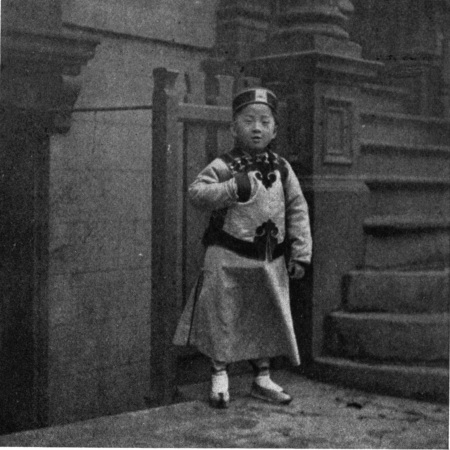
Little Priest
IT was the eve of the Moon Festival. The homes and the people of Chinatown were gay within and gay without, and the incense-laden air was full of the holiday spirit. The Moon Festival with the Chinese is something like the American Christmas, only it lasts longer, extending into their New Year.
Kon Ying had not been very happy in her little life, for she had always been made to feel that she was one too many in the home. She had three sisters older than herself, and the Chinese do not like so many daughters,—they would rather have sons; so when she arrived in the small home, it was decided to call her Kon Ying, which means “enough hawks.” After her had come a baby brother, who was petted and spoiled in every way possible, because he was a boy. As he was the only son, the parents soon resorted to a queer Chinese method. They shaved his head and called him “little priest,” allowing him to be adopted by another family. This was done to deceive the bad spirits, and make them think they cared no more for their child than for a despised priest, and had thought so little of him that they had even allowed another family to adopt him.
Little Kon Ying had been left to herself a great deal, and so had thought of many things. Perhaps
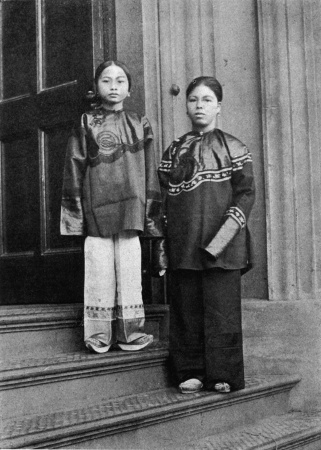
She and one of her sisters were on the step in front of their home
she had thought more of the Moon Rabbit than anything else, and wondered in her childish way why it had never remembered her. She and one of her sisters were on the step in front of their home talking about it, when she saw her brother across the street, in front of the joss house. He was richly dressed, and pretended he did not know her.
The streets were beautiful to-night, so, after much persuasion, mo chun had promised to take the children to see the shop windows. Soon the mother appeared at the door, where in a little bowl punks were always kept burning for the god, and in her high-pitched Chinese voice told the children she was ready. Kon Ying was happy for once. She was happy to-night, because she was strong and young, and the Chinese world was beautiful. And, someway, she felt that the rabbit would really remember her to-night.
On they went, one after another, in true Chinese fashion, but never losing sight of the polished hair of mo chun in front of them.
How gay it all was, and how bright! The great irregular rows of big round lanterns looked like a lot of moons, and surely the rabbit’s own moon could not be more beautiful. They could scarcely tear themselves away from the bakeshop windows, which were full of cakes of all kinds. Some were shaped like the moon, and some were made into tall Chinese pagodas, a fish, a horse, or something of the kind. Some had on them the picture of the white rabbit, who is always pounding out rice in the moon. On others were painted beautiful gods and goddesses. Mo chun was telling them that when good little Chinese children were all asleep the mysterious rabbit would come to the shops and purchase the pretty things, to leave in the homes of the children.
Kon Ying was thinking as she pressed her cunning little nose up against the cold glass: “I likee know if I been good enough this time. I help mo chun—I play (pray) to joss heap plenty time; maybe the moon labbit come—maybe, I no sabe” (understand). She only knew that she had done her best, always; but perhaps the wonderful rabbit would not think so. Never mind! she would pray once more to the ugly little old god at home, before she went to sleep.
Soon they came to the toy shops. She felt as if she could stay forever, for there were toys of all kinds, and no one would ever know how good they seemed to a poor little Chinese girl who had never had any toys. The only one she had ever possessed was an old broken doll she had once found upon a trash heap, but she had treasured it as no doll was ever before treasured, and had given it all the pent-up love in her little starved heart. She had even named it “Kin Leen” (golden lily), and pretended that it was a fine aristocratic lady, with “little feet.” She had bound its feet with strips of cloth, and it was to this doll that she had gone with all her troubles; but no one knew this. If her proud brother had known he would have teased her unmercifully.
There were so many lovely pagodas in the window, and some of them were several feet high. She would like one of these, but knew she might as well long for the moon. There was something in the window which she would rather have than a pagoda or anything else, and she longed for it so intensely that a real prayer must have gone out from her little innocent heart. It was a doll!—a Chinese doll, with big slanting eyes, like Kon Ying’s own, and the most gorgeous dress of flowered silk.
Suddenly it dawned upon her what she would do when she got home. Instead of praying to the god on the shelf she would pray to the moon rabbit, and beg and beg of it to bring her a doll. If she could only have one of those gorgeous creatures, with the tuft of black hair on its head, and the wobbly feet and arms, and painted cheeks and lips, she would surely never ask for anything else. There were other dolls in plenty, but none so beautiful. They were only bits of wood, with eyes, nose, and mouth painted on them. If she had not seen the big one she might have cared for those, but now—she would never care for them; she had seen the queen.
She gasped out, in her shrill childish voice: “Oh, mo chun! Why—why—won’t the moon labbit bling me doll?”
Before the mother could reply, a kind hand was laid upon the polished head of the little girl, and a man’s kind voice said: “The moon labbit will bling you doll, and all the little sistehs too.”
Looking up, she saw that the voice came from the lips of a notorious highbinder—a friend of her father’s.
The man had been to their home many times. She had liked him, for he always had a kind word for children, and last New Year he had even brought them some cunning little mandarin oranges, and a package of Chinese candy. He was said to be a very bad man, but he loved children. Speaking a few words of holiday greeting, he passed on into the shop, while Kon Ying and her sisters still gazed at the contents of the windows.
The big doll seemed to be saying: “I am yours, Kon Ying!—take me!” while it held out its wobbly arms in entreaty. Its painted lips seemed as if they might be forming pretty Chinese words of good wishes for the Moon Festival.
Kon Ying’s little celestial heart longed for it with a terrible longing, but the glass was between them, and so—her heart could only ache in silence. It could not happen, anyway. When did anything nice ever happen to her? She had always been in the way, and there were no toys to spare for her—little “Enough Hawks.”
She was so absorbed in gazing at the doll that she did not see the highbinder, away back in the shop. Her nose was pressed against the glass, and her dirty little fingers had left ten marks, but she did not know; she would not have cared if she had known. Suddenly, as she gazed, something wonderful happened. A big blue arm reached into the window from the shop, and slim fingers with long Chinese nails closed upon the doll, lifting it out of the window, to disappear from the gaze of the enraptured children. It seemed to blink its slanting eyes in farewell as it departed.
The pale yellow ivory face of little Kon Ying appeared to grow even more pale as she screamed out, in that little nasal voice of hers: “She gone—the moon labbit no can get her now to bling to me. Heap bad spirit catch ’em doll: I so solly—I so solly.”
It seemed to her that when the doll had gone from her sight it had taken with it the very heart out of her body, and she did not care to linger now, so they passed on, to other sights and sounds.
On a flower-laden balcony some one was twanging on a sam yun (banjo), but even music had no charm for her now, because—the DOLL was gone. She would never see it again; the bad spirits had taken it. Perhaps it was because she had neglected to pray to the god lately. She had even dared, when no one was looking, to make a horrible face at him, and tell him she hated him. She did this because her little heart was so heavy; no one seemed to care for her, and the god never made anything nice happen to her, nor paid any attention to her little prayers. Never mind! she would pray to the moon rabbit after this; perhaps it would hear her prayer. After she had decided upon this course she was anxious to get back to her home. The children were all getting tired now, and their wooden sandals dragged heavily upon the narrow pavements.
“We go home now,” said mo chun; “Maybe moon labbit come to-night.”
At last they reached their home, and the tired children ascended the stairway. Kon Ying set to work to offer her sacrifices, as she was tired and wanted to go to bed. She had nothing to offer the moon rabbit except her old broken doll; so she placed it on a table and burned her incense sticks, and everybody thought she was praying to the god. But she was not; she knew,—and the god knew. At last she laid her tired head on the hard couch.
It seemed to her she had only been there a minute, when there came a great glare of light and the sound of Chinese flutes. The lattice window opened, and in marched a troop of tiny Chinamen, dressed in purple and gold. Each one carried a stick of lighted incense for a torch, making the room as bright as day.
They marched right up to where Kon Ying lay, and the most richly dressed one said: “Kon Ying, our queen has prepared a banquet for you; will your highness please to accept the invitation?”
Kon Ying was frightened at first, but something within her seemed to speak the words: “I shall be pleased to obey the commands of your queen;” and she made a curtsey to the royal messenger.
“Be prepared to go when the time comes!” he said, and vanished with his company.
By and by there was another glare of lights, and the sound of music. The lattice opened again, and there flitted in a crowd of the dearest little Chinese ladies, all clad in pink silk blouses, with lavender trousers, and pretty little golden sandals. They had so many diamonds in their hair and ears that it almost put out little Kon Ying’s eyes. They each carried a tiny Chinese lantern, which shed a soft light.
The most beautiful one now approached Kon Ying and said: “The queen has sent you a royal robe; please put it on, and we will hasten to the moon.”
Again the little girl gasped out: “Your highness’ commands shall be obeyed;” and slipping from her couch she stood shivering upon the floor, while the moon-maidens arrayed her in a robe of palest lavender.
“Our queen heard your prayer, and has sent us to carry you to her kingdom,” they said; and spreading out the wide Chinese sleeves of her gown until they looked just like wings, they told her to come, and away through the window she flew with them.
She felt as light as a feather, and could not resist the pleasure of making one real ugly face at the god as she passed. There stood on the street in front of the house a row of the dearest little sedan chairs, all glittering with gold, and carried by huge white rabbits. Before she could say a word they had opened the door for her, and placing her inside, flew away,—away from the squatty little god and the smell of incense, away from the great shining lanterns of the dragon, and the narrow, crooked streets, and into air that was so pure it seemed like a delicious nectar.
Kon Ying leaned from the window of her sedan chair and gazed at all the wondrous beauty of the sky. As they passed through the milky way some tiny star-fairies handed her a jewelled glass of the richest milk. She was very glad, for it seemed a long time since her supper of rice and tea. She was far away from the lights of the city now, and surrounded by the dazzling radiance of the stars. One very large star seemed to be the queen, and all the little stars bowed down before it, chanting the sweetest melody.
They were getting nearer and nearer the moon now, and, oh, how very large it was! To Kon Ying it had always seemed no larger than a small Chinese lantern, but now, as she came nearer, it seemed greater than the whole world. Soon she could see it no more, and the white rabbits told her that they were already in the moon. It was the most beautiful country. The velvet grass was covered with the sacred almond blossom petals, and their perfume was sweeter far than any incense. They passed through a long avenue of pure white chrysanthemums, which showered their petals upon them like snow. At the end of this avenue the chairs were stopped, and cunning little white-rabbit pages assisted them gently to the ground. A tender light flooded the place, and when Kon Ying raised her eyes she saw before her a throne, draped with the flags of the Imperial Court of China,—yellow silk, with blue dragons embroidered upon them,—and on the throne sat the queen,—the good moon rabbit who had heard her prayer.
This queen was busily engaged in pounding rice, pounding it into a powder, and then sending it down to earth, to be eaten during the Moon Festival and the China New Year. She wore a pink gauze dress all covered with glittering spangles, and as Kon Ying approached the queen was singing:
“The small-footed girl with the sweet little smile, She loves to eat sugar and sweets all the while; Her money’s all gone, and because she can’t buy, She holds her small feet while she sits down to cry.”
It sounded very pretty, as the queen had quite a sweet voice, and Kon Ying soon found herself singing it with all the others. The queen extended one soft white paw in greeting, but kept on pounding rice with the other.
All the dear little Chinese ladies and men now seated themselves around the throne. The white-rabbit pages handed each one a different musical instrument, and there burst forth the loveliest music that Kon Ying had ever heard. She found that she could play quite as well as any of them, which was a great surprise to her, as she had never before even touched a musical instrument.
After the music the queen ordered refreshments served, and they entered a bower of almond blossoms and China lilies, seating themselves at a long table, where they were served by a lot of tiny white-rabbit pages. They ate with ivory chopsticks set with diamonds. The queen sat at the head of the table, and could hold the chopsticks in her paws quite as well as any one. What a feast that was! Yet plenty of funny things happened, even if it was a royal company. The queen forgot herself, and stuck her nose right into a bowl of hot rice, at which there was a general giggle. A page quickly brought a finger-bowl and sponged the burnt nose, so it was all right.
There were all sorts of good Chinese things to eat,—delicious chah (tea) in little handleless bowls, all kinds of pretty moon-cakes, little biscuit made of almond meal; watermelon seed, and many other things. When the feast was ended the queen said that each of them could make one wish, and it would be gratified. Kon Ying did not have to hesitate long over her wish.
She knew what she wanted more than anything in the world, and she remembered that she had prayed to the rabbit, so perhaps—perhaps—“Oh, dear queen!” she said at last in her piping little voice, “I be so good if only—if only—I could have—a doll, like the one in the shop window; oh, if I could—if I could.”
Her eyes were full of tears as she finished, for it meant so much to her. The good moon rabbit replied: “You shall have your wish, little one, for you are a good child.”
Kon Ying now bade farewell to the queen and all the dear little Chinese people, and jumping into the sedan chair was soon whirling away once more, and in a short while found herself entering the window of her own home, and placing her tired body on the bed. When she awoke the next morning she remembered the queen’s promise, and—what was that on her bed, close beside her? A queer looking package, and on it, written in Chinese letters, “For good little Kon Ying, from the moon labbit.” Hastily tearing open the packet she saw disclosed—the DOLL! She fancied the god frowned when he saw it.
That night, when the narrow Chinese streets were gay with the many lanterns, and sweet with the fragrant almond blossom and lily, and the happy crowds were thronging the streets, the old highbinder passed the door. He smiled as he saw little Kon Ying seated in the doorway, holding the DOLL in her arms, and with rapture unspeakable in her childish eyes.
“Where you catch ’em?” he inquired in a jovial tone.
“Oh, I so happy,” she said. “I went to the moon last night, and the moon labbit did bling me the DOLL.”
And the highbinder smiled.