PING PONG AND PING YET
Reading edition
PING PONG was not a game, but a dear little Chinese boy, who was eagerly looking forward to something which was almost like an American Christmas. The Chinese do not have any Christmas, but they have something else which serves the purpose, as far as their eager little hearts are concerned, and that is, the Festival of the Moon. Ping Pong’s round, fat, and very dirty face looked something like a moon as he leaned over the counter in his father’s drug store, and watched him weigh and mix portions of dried lizards and snakes for his customers; for the Chinese use dried lizards and snakes, and all sorts of funny things, for medicine.
It would seem so very queer to an American child, but it did not strike little Ping Pong as being at all out of the way, and he would probably have thought it just as strange to know that people took powders and pills. He thought when he grew up to be a “velly big man” like his father, he would either be a druggist or a highbinder, or better still he might be both; yet, a highbinder was one who always sought a way of killing people he did not like, and a druggist sometimes killed people he really did like,—but that was always through mistake, of course.
Ping Pong and his dear little sister Ping Yet were teasing the good-natured father to take them to the joss house. That was indeed a queer idea. Why should two children wish to go to the temple to pray to the joss? Surely the father could pray enough for himself and his family, too. But he never liked to refuse any reasonable request of his children, so he asked advice of the little mother, who was engaged in some very mysterious occupation which compelled her to keep the kitchen door locked. Mo chun opened the door cautiously, and, peeping out, whispered to ho chun, who smiled in a peculiar way. “What foh you likee go joss house, you hai tongs?” (babies), she now asked, and Ping Pong replied: “We likee play to good joss to bling us pletty moon-cakes.”
The mother had to giggle at that, in her dear little Chinese way, for she knew a good deal about moon-cakes, and knew about the white rabbit. But she was not going to tell all she knew, just now, so she only smiled in her sweet mother way, and gave her consent to their going.
It was just getting dark when they left, and the proud father started out to the joss house with a happy child on each side of him, and two small brown hands clasped tightly in his big brown ones. They had never been to the temple before, but they had heard it was a very good thing to do when one wanted anything very badly.
“How pletty the big dlagon lantehns look!” they exclaimed.
Yes, the big lanterns did indeed look pretty, as they gleamed and swayed in front of every door in the big Chinatown of San Francisco, and looked like big golden moons, almost as big as the moon in which the white rabbit lived. The streets were very gay at this season, and the shops were full of people buying gifts.
Little Ping Yet made a very pretty picture as she shyly patted down the narrow streets with her embroidered sandals, wide silken trousers, and blue silk blouse richly embroidered by the loving fingers of her dear mo chun. Her polished hair was done in a queue.
The moon rabbit must surely have passed this way, for the windows were all full of little cakes shaped like the moon. They thought that all the year, while they were flying kites, popping fire-crackers, and playing in the street in front of their home, the white rabbit must be always pounding rice.
It took them a very long time to get to the joss house, because there were so many interesting things on the way. Ping Pong, in boyish eagerness, pressed his little nose and dirty fingers right up against the glass in one place, or at least he thought it was the glass, until he fell right in, with his nose on a candy pagoda thirteen stories high, and then he found out his mistake. That glass happened to be broken out, and he was very much embarrassed. The gingerbread peacock seemed to glare scornfully at him as his ho chun pulled him out, and the painted gods and goddesses seemed to smile on him in a pitying way.
Little Ping Yet was as much ashamed as if she herself had fallen with her nose on a Chinese pagoda, and she hid her face with her wide silken sleeves. But the shopkeeper was good natured and said, with a kindly pat of the button on top of Ping Pong’s round Chinese cap, “Neveh mind! that’s all light; you heap good samen jai and ne jai (boy and girl). I hope you get heap plenty moon-cake flom the white labbit.”
They wandered on in happy abandon, until they reached the long steps, which, ho chun informed them, led up to the temple of the good Joss. They had so often wondered what the joss looked like; was he a big rabbit, or a peacock, or perhaps a dragon with scaly sides and spitting fire? They secretly hoped, in their innocent little hearts, that if it was a “dlagon” he would refrain from spitting fire while they were there. When they thought of what might await them, they were almost sorry they had come, and their timid little hearts beat fearfully against their blouses; but the touch of ho chun’s strong hand was reassuring, and they reflected that surely there could be nothing so very dreadful up there, or he would not have taken them.
First they passed through a room where some Chinamen were selling long narrow red-paper packages of incense sticks. Ho chun bought one, and the men spoke kindly to the boy and girl, and they passed on. Up another flight of steps they went, until it seemed as if they must be almost as high up as the moon. A strong odor of incense greeted their nostrils, and it seemed good, for they were accustomed to it, as it was always burning at home before the different gods and ancestral tablets.
The odor grew stronger, and they heard some one beating the big gong. Soon they had placed their sandalled feet upon the last step, and their oblique eyes were fairly dazzled with the sparkle and beauty of it all.
“Where joss? I likee see him,” they both exclaimed in awed whispers, while ho chun pointed to the gaudy altar, gay with its brass carvings and rosettes of red paper. Bright peacock feathers were plentiful, and seemed to stare at them with a thousand eyes. Back of it all, in a sheltered recess, was the joss. They heaved a sigh of relief that he was not a dragon. An American child would have thought him perfectly hideous, but the Chinese children have such different ideas, and they exclaimed rapturously, “Oh, velly pletty joss! heap fine god; me likee.”
Perhaps they thought it best to say very nice things of him in his presence, however, because it would never do to offend him, or he might not allow the white “labbit” to visit them. So they ventured quite near, and spoke in tones he could not fail to hear.
After a whispered consultation with ho chun they opened the pretty red-paper package, and each took from it two incense sticks, and their father having lighted them, the children waved them several times right under the nose of the great and high one, and bowed their little heads to the floor a great many times, meanwhile asking in their innocent little way that the good joss would please make the white rabbit bring them something nice. When they had finished, they placed the rest of the incense sticks in the great brass urn in front of the joss, and the sacred ashes fell down and helped to fill it up. Every time they had bowed their heads the big gong had been beaten, and at first the noise had frightened them, but finally they grew to like it.
Ho chun thought that while they were there, they had better try throwing the fortune sticks, as he knew it would please them, so he picked up a tall round box, full of bamboo sticks, and explained it to them. They first asked the joss “Will we get any moon-cakes?” Then each in turn took the box and shook it until one stick fell out, when they picked it up, and ho chun read the Chinese number on it, then looked in a book and found out what that number said. Fortunately the answer was favorable, and they felt happy now. That meant that they might really expect some gift from the moon rabbit.
Before going home they all stepped out on the beautiful balcony on which were swinging the biggest lanterns they had ever seen, and they leaned over the edge, where there were great pots of the pretty China lily in blossom, with red papers tied around the stems, and looked at the hundreds of people passing below them. The grown-up people all had their arms full of bundles, and little three-cornered brown paper parcels. All was noisy and happy and bright, because it was the eve of the Moon Festival, and the shopping must all be done before the rabbit should come.
Down the long steps they went again, and into the crowded street, where all was joy and delight, and mysterious whispering.
“Oh, that pletty pagoda!” said Ping Pong, “I so ’flaid the labbit no bling me pagoda, I think ho chun betteh get.”
Ho chun laughed and said, “No! I wait and see if the labbit come, I think bimeby he come and bling pagoda; I no can tell—we wait and see.”
But what if he should forget to bring one? and they were such beautiful pagodas, and all made of candy. The little round faces were sober for a while, thinking how very dreadful it would be if, after all, the rabbit did not come, or, if he did come, and should forget to bring the much-desired pagoda.
They were very tired when at last they reached their home, over which gleamed the big golden Chinese letters of welcome, and in a little bowl beside the door burned the punk sticks, day and night, to keep the evil spirits from entering their home. Their tired little legs could hardly climb the stairs, but at last they were there, and had tumbled into the mother’s loving arms, and had been kissed and questioned thoroughly.
Mo chun was really astonished to hear of the glorious time they had enjoyed, and of the many wonders they had seen. When they mentioned the pagoda she was suddenly seized with the giggles, and her laughter was so merry and contagious that they all laughed till their sides ached, though the children could not have told why they laughed. The mother and father knew why, but they would not tell. The hour had come, and indeed it was long past the hour when they should have gone to bed, but then the beautiful Moon Festival came only once a year, and so they might be allowed a few privileges. They were finally asleep on their beds of matting, and the mother looked tenderly at the rosy little faces as she went into the kitchen—the kitchen which for some reason had been locked all day.
Well, morning came at last, as it always does, and before the sun was up Ping Pong and his sister jumped out of bed, exclaiming: “Oh, mo chun, has the white labbit been?”
Oh, what were all those beautiful things on the table? Why, the whole room was changed. When they had gone to bed the night before, there was nothing there but just the things that belonged in the room, and now—and now— The white rabbit had
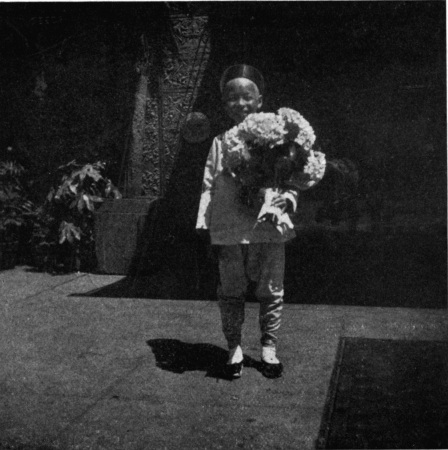
There was a big bouquet for Ping Pong
surely been here, for the table was covered with the most beautiful gifts they had ever seen,—lots of cunning little moon-cakes, sprinkled with poppy and caraway seed; and some like a horse and a cow, and all sorts of funny animals. And there was a big bouquet for Ping Pong, because it was his birthday too.
There were also some big candy dragons, with great staring eyes, but now, instead of the dragons eating them, they were going to eat the dragons. My! what fun that would be! and they could not wait, but planted their strong white teeth in the white heads, and bit them off. My! how sweet they were! so sweet that their bodies went next, and soon there were no dragons at all.
There were all kinds of gaudily painted toys of clay, and little Ping Yet’s dancing eyes danced more than ever, and she fairly rippled over with smiles when she saw, sticking out of a bright red pair of embroidered sandals, a real Chinese doll. It looked very much like Ping Yet herself, with its bright black eyes, rosy cheeks, and coal-black hair. She thought it surely must be the most beautiful thing in the whole big world, but mo chun said she knew something more beautiful. The little one wondered vaguely what it could be, and how anything could be more beautiful, but she was too busy to wonder long, for Ping Pong had uttered such a shriek of delight that she almost jumped out of her little sandals. What could be the matter?
“What foh you cly? you buhn youh fingeh?” she cried; and he in reply pointed to the cause of all his excitement; it was—oh, joy!—a pagoda, and mo chun said:
“The dragon pagoda it touches the sky; The dragon pagoda, thirteen stories high.”
It was just exactly like the one they had asked ho chun to buy, and the dear white rabbit in the moon must have seen right down into their minds and brought what they wished. And oh, they were so glad now that they had gone to the joss house, and burned the incense and thrown the fortune sticks, for if they had not—who knows?—the white rabbit might have forgotten them.